

- Market Size (2026)
- USD 50.0 Mn
- Forecast (2036)
- USD 100.0 Mn
- CAGR (2026 to 2036)
- 7.2%
How big is the Precision Fermentation Casein Protein Ingredients Market in 2026?
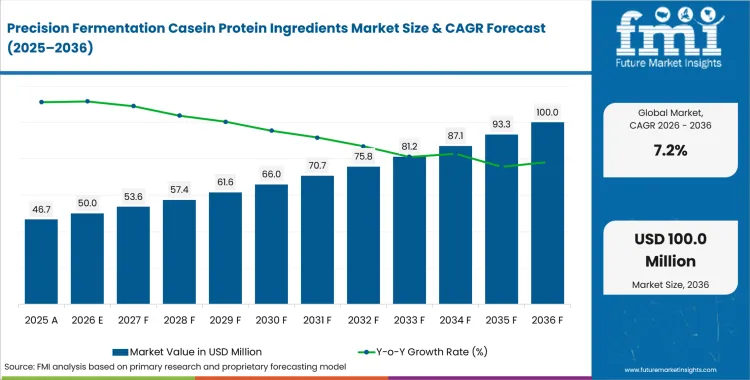
USD 50.0 million in 2026 and USD 100.0 million by 2036 at a 7.2% CAGR.
Sales of precision fermentation casein protein ingredients are forecast to rise at 7.2% CAGR through 2036, driving valuation from USD 50.0 million in 2026 to USD 100.0 million by 2036. Early commercial adoption is strengthening confidence in precision-fermented casein by demonstrating its functionality in real-world foodservice applications. New Culture reported USD 5 million in early mozzarella demand in March 2025 from pizzerias and professional chefs. The company also documented consistent performance across commercial ovens operating from 550°F to 900°F. Those orders show why precision fermentation ingredients need application data that reflects normal processing conditions. Purification losses and modest production volumes make casein pricing difficult across early commercial manufacturing batches. Manufacturers therefore need stable recovery yields and formulation efficiency before recurring orders support wider capacity investment.
Regulatory preparation has become a separate commercial workstream beside strain development and food application testing. The Food Standards Agency launched a precision fermentation Innovation Research Programme in September 2025 with a guidance hub and business support service. The programme aims to improve regulatory capability and help applicants understand evidence needed for market authorization in Great Britain. Fermentation supplier economics therefore include dossier preparation and specialist review beside production yield and purification costs. Established dairy ingredient portfolios do not remove novel-food obligations for proteins made through engineered microorganisms. Developers must plan national filings around the production strain, impurity controls and intended consumption levels.
Key Takeaways of Precision Fermentation Casein Protein Ingredients Market
- Food manufacturers are increasing qualification work for casein ingredients that deliver dairy-like structure without complete dependence on conventional milk supply.
- Proteins are expected to represent 29.0% of product type demand in 2026, supported by direct roles in texture and nutritional formulation.
- Microbial sources are projected to account for 82.0% of source demand in 2026, reflecting precise control over casein expression and recovery.
- Bakery applications are anticipated to capture 23.0% in 2026, owing to repeated needs for binding and heated structure.
- Technical performance alone does not establish lawful commercial sale, leaving purification costs and national authorization requirements as material barriers.
- Competition spans New Culture and Formo; Those Vegan Cowboys and Standing Ovation; Fooditive and Nutropy; plus DairyX and All G across distinct development routes.
Analyst Perspective
"Precision-fermented casein earns recurring orders through performance that survives commercial cheese and bakery processing at scale. Developers must control purification costs and document host removal plus milk-allergen labeling for each launch country. Strong programs combine casein-specific functionality with industrial partners that validate melt, binding and texture under normal production conditions."
- Nandini Roy Choudhury, Principal Analyst, Future Market Insights
How is the Precision Fermentation Casein Protein Ingredients Market segmented?
The precision fermentation casein protein ingredients industry is segmented by product type, source, application, end user, and region.
The segmentation framework separates the purchased ingredient from its production route and the organization responsible for recurring commercial approval. Product type covers proteins and other functional outputs that manufacturers create through controlled fermentation for defined formulation needs. Source distinguishes microbial systems from plant, dairy-analog, upcycled and mineral routes with different process controls and qualification requirements. Application maps fermented protein systems across bakery, beverages, snacks, infant nutrition and ready meals that expose different performance demands. End user identifies manufacturers, foodservice operators, contract producers and retail brands with separate technical responsibilities. Regional analysis compares authorization pathways and labeling rules across national markets and gives bakery ingredients special analytical attention through direct tests of binding and structure under heated commercial production conditions.
Why do Proteins remain central to product type demand?
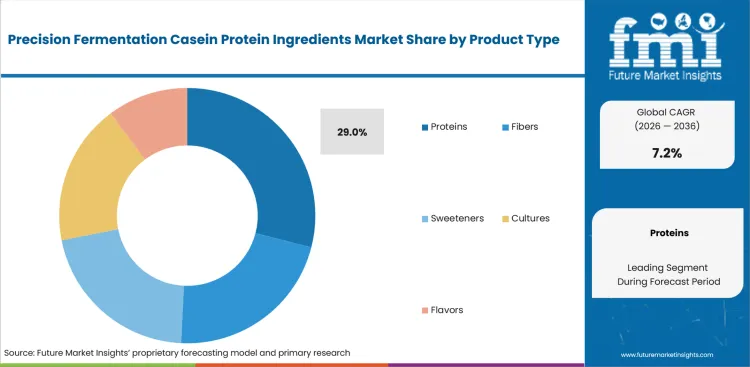
Casein gives the protein category its clearest commercial role through melt, binding and network structure that broad protein claims cannot replace. The European Investment Bank approved EUR 35 million for Formo in January 2025 to advance fermentation processes and industrial production. The financing covers work on bioidentical caseins with melting properties and supports approval activity in the United States and Europe. Protein ingredient specifications therefore need to connect molecular identity with scalable recovery and finished-food performance.
- Proteins are projected to hold 29.0% share in 2026 owing to their direct influence on texture and nutritional positioning. Food manufacturers can compare melting, binding and finished-product structure against conventional casein through normal production trials. Defined performance measures create a clearer qualification path than fermentation outputs with less direct application value.
- Food manufacturers increasingly purchase casein proteins for formulations that cannot reach target texture with starches or plant isolates. Adoption depends on stable performance across repeated batches and acceptable inclusion costs within each finished product. Application teams also require technical support that links protein characteristics with mixing, heating and storage behavior under commercial conditions.
Why does microbial lead by source in 2026?
Microbial production gives developers direct control over the casein sequence without relying on milk separation or animal output. FDA listed GRN 1312 in July 2026 for recombinant αS1-casein produced by Escherichia coli DSM 35603. The notice covers cheese analogues at defined inclusion levels and remains pending within FDA’s public inventory. Its status confirms that commercial authorization requires complete safety review for the defined protein and proposed use level.
- Microbial is expected to lead source demand with 82.0% share in 2026, reflecting precise control over protein expression. The production route separates casein design from seasonal milk composition and livestock output across repeated manufacturing cycles. Commercial performance depends on maintaining expression yield, purification recovery and consistent food-grade specifications at larger batch sizes.
- Ingredient developers favor microbial systems that use established bioreactor controls and documented purification stages for consistent food-grade production. Food manufacturers require evidence that residual host material and process impurities remain within accepted limits. Adoption expands through repeatable strain performance and recovery yields that support the same specification across each intended food application.
How does bakery create a distinct application demand base?
Bakery and pizza applications expose casein to high heat and mechanical stress that quickly reveal weak binding or unstable texture. New Culture reported in January 2025 that it submitted an animal-free casein mozzarella label and product registration to California regulators. The company linked casein with melting and browning performance in restaurant-quality pizza cheese, connecting application evidence with labeling and commercial launch preparation.
- By application, bakery is forecast to represent 23.0% share in 2026 driven by repeated needs for binding and heat-stable structure. Casein can improve topping behavior and finished-product texture across repeated industrial oven cycles and normal storage conditions. Application teams therefore test performance at normal process temperatures rather than relying on laboratory solubility measurements.
- Commercial bakery teams introduce precision-fermented casein through products with visible texture gaps and clear dairy replacement targets. Trials compare mixing tolerance and thermal response across existing lines and confirm stable output under routine equipment settings. Wider adoption also requires dependable ingredient volumes, accurate milk-allergen communication and storage data for finished products.
Why do food manufacturers shape end user demand?
Food manufacturers control formulation approval and carry responsibility for scale-up across production assets and quality systems. Standing Ovation announced a January 2025 partnership with Ajinomoto Foods Europe to produce casein at its Nesle facility. The plant combines industrial fermentation and downstream processing with established food-manufacturing expertise for commercial qualification programs. The partnership lets application teams test a defined protein against commercial equipment and quality requirements without building a dedicated fermentation site.
- By end user, food manufacturers are estimated to hold 22.0% share in 2026 owing to their control over recipes and production validation. They can compare ingredient cost with yield and finished-product performance across complete manufacturing runs and routine quality controls. Their approval turns successful trials into recurring volume more directly than exploratory orders from intermediaries.
- Large food companies require technical-transfer support and defined quality specifications to expand a formulation trial into recurring production. Smaller processors may use contract manufacturers to avoid dedicated fermentation-handling equipment and specialized analytical work. Line support and documented corrective actions make adoption more durable by assigning clear responsibility for testing and process correction.
What are the drivers, restraints, and opportunities in the Precision Fermentation Casein Protein Ingredients Market?
Demand expands as food manufacturers validate casein performance in commercial foods, while purification economics and national authorization requirements limit broader purchasing.
- Driver: Demonstrated performance in commercial cheese and bakery processing gives food manufacturers stronger reasons to fund scale-up and application support.
- Restraint: Regulatory dossiers must address production organisms, process impurities and milk-allergen risks across separate national authorization systems.
- Opportunity: Licensing and industrial partnerships can connect proven casein strains with purification equipment, manufacturing capacity and established application teams.
Commercial processing evidence strengthens casein investment decisions by connecting protein performance with measurable finished-food value. Bioökonomie.de reported in October 2025 that Formo’s KassettE project was developing casein and fat production within one microorganism. The project combines strain selection and fermentation optimization with analytical work on casein-fat mixtures, and initial cheese prototypes had already been evaluated. Integrating fermentation capacity with application testing can reduce costly redesign between protein recovery and finished-food formulation.
Regulatory review is one of the notable challenges for casein produced with genetically engineered microorganisms across commercial development programs. FDA closed GRN 1228 in June 2025 at the notifier’s request rather than issuing a no-questions letter. The notice covered β-casein for cheese analogues and several other foods at defined use levels. A submission therefore cannot serve as evidence of commercial authorization until the regulator completes its review. Developers may need additional studies and revised timelines that raise costs across each national filing.
Industrial partnerships create a practical opening for developers that possess casein strains but lack downstream separation and plant-design expertise. Tetra Pak announced an April 2025 partnership with Standing Ovation to optimize separation and purification for alternative caseins. The work covers pilot and industrial manufacturing units, reducing scale-up uncertainty and avoiding equipment choices that lower protein recovery. Commercial agreements must assign quality release, technical support and continuing process improvement across every production stage.
Which country CAGRs are profiled in the Precision Fermentation Casein Protein Ingredients Market?
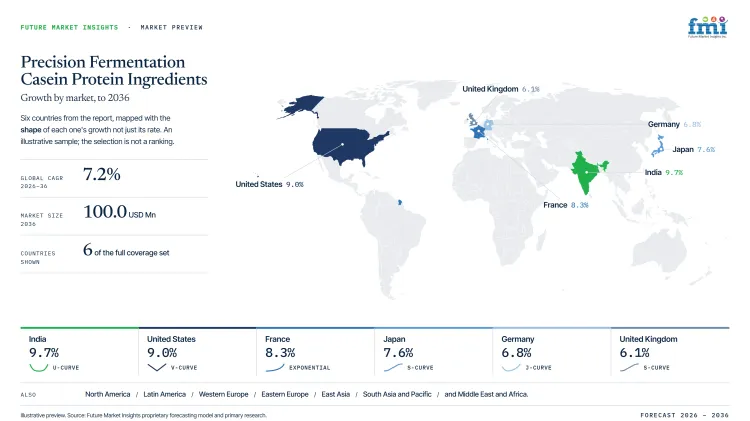
| Country | CAGR |
|---|---|
| India | 9.7% |
| United States | 9.0% |
| France | 8.3% |
| Japan | 7.6% |
| Germany | 6.8% |
| United Kingdom | 6.1% |
How do country-level CAGRs compare in the Precision Fermentation Casein Protein Ingredients Market?
The six forecasts form a gradual progression across a narrow 3.6-percentage-point range with no clear break between national groups. Five adjacent gaps measure 0.7 percentage point, and the Japan-Germany gap measures 0.8 point across the comparison. India and the United States combine development support with different authorization routes, whereas France and Japan rely more on industrial partnerships or demonstrations. Germany and the United Kingdom pair established food manufacturing with detailed novel-food requirements, so similar growth rates hide meaningful differences in commercialization.
- India combines public smart-protein funding with an expanding biotechnology base that supports strain development and pilot translation. The main challenge is converting funded research into food-grade production and a clear authorization strategy for commercial casein ingredients.
- United States developers combine active foodservice testing with established federal ingredient pathways across several commercial application channels. Commercial timelines also depend on consistent milk-allergen communication across restaurants, packaged foods and customer qualification programs.
- France connects biotechnology developers with dairy processors that possess downstream equipment and established cheese formulation experience. Commercial launch depends on resolving separate planning duties for European novel-food review and protected dairy terminology.
- Japan supports food-technology demonstrations through public programs and experienced domestic processors with detailed quality systems. International developers also need local formulation knowledge and regulatory documentation that matches Japanese manufacturing and authorization requirements.
- Germany combines fermentation engineering with experienced cheese manufacturers and detailed classifications for alternative dairy foods. Strong technical resources cannot replace novel-food authorization or lawful product naming across retail and foodservice channels.
- The United Kingdom provides centralized review and increasingly detailed hazard guidance for precision-fermented food ingredients. Smaller developers face material costs for specialist testing and a complete safety dossier that covers each proposed use.
Comparable growth rates create different market-entry conditions across countries with distinct manufacturing resources and separate authorization requirements. Application partnerships and local technical capacity also change commercialization costs and timing across national markets with similar forecasts. The full report provides country-level CAGR analysis across North America, Latin America, Europe, East Asia, South Asia, Oceania and the Middle East and Africa.
Country-wise Analysis
- India’s smart-protein programs provide grant routes for strain development and pilot translation within domestic biomanufacturing networks. Precision fermentation casein protein ingredient sales in India are forecast to expand at 9.7% CAGR by 2036, supported by public funding for fermentation-derived proteins. BIRAC opened a Smart Proteins proposal call in February 2025 and included precision fermentation within the eligible scope. The program supports research and later-stage translation across technology readiness levels five through seven, reducing development costs and linking laboratory work with pilot processing. Commercial progress remains constrained by food-grade purification capacity and the need for clear authorization plans for each casein application. Developers also need manufacturing partners that can document release controls from fermentation through final ingredient testing.
- United States commercialization combines an established foodservice testing base with separate federal ingredient and finished-food requirements. The United States precision fermentation casein protein ingredients market outlook is anticipated to advance at 9.0% CAGR over the assessment period, linked to active product development and application partnerships. Patent protection and cross-category testing can strengthen manufacturer confidence during application review across several national food categories. New Culture announced another casein-based mozzarella patent in July 2026 and described work with global food companies across yogurt, creamers and beverages. The patent broadens application evidence beyond pizza cheese and supports discussions with national manufacturers across beverage and cultured-dairy categories. Milk ingredient labeling and federal ingredient status remain essential for every formulation that reaches retail or foodservice channels. Smaller developers may face long schedules as regulatory work and production transfer compete for limited technical staff.
- France offers established dairy processors and industrial fermentation assets within reach of major cheese application teams. Adoption of precision-fermented casein ingredients in France is estimated to expand at 8.3% CAGR through 2036, enabled by local biotechnology and dairy collaboration. Bel and Standing Ovation announced in April 2025 that they had validated a process converting dairy whey streams into functional caseins. The partners plan industrial implementation and food applications that combine Bel’s cheese expertise with an existing dairy side stream as fermentation feedstock. Commercial sale remains subject to European novel-food authorization and protected dairy terminology, so development plans must separate technical scale-up from lawful market entry.
- Japanese food manufacturers favor controlled demonstrations and domestic partners that can meet detailed quality expectations. Japan’s precision fermentation casein protein ingredient sector is estimated to post 7.6% CAGR over the forecast period, aided by public support for food-technology demonstrations. The Ministry of Agriculture opened its fiscal 2025 Food Tech Business Demonstration program in February 2025. The program supports commercialization testing and broader use of verified food technologies across domestic manufacturing networks. Domestic quality systems can improve trial discipline, but they also increase documentation work for overseas development teams. International developers need local partners that translate fermentation specifications into accepted manufacturing records and regulatory documentation for each application.
- Germany's precision fermentation casein sector benefits from deep processing infrastructure and strict national entry requirements for novel food ingredients. The Germany precision fermentation casein protein ingredients market sector is projected to record 6.8% CAGR during the assessment period, shaped by strong processing capabilities and strict entry requirements. The federal food ministry stated in April 2025 that bioreactor fermentation can reproduce milk proteins. Its guidance also explains that novel-food authorization may apply and protected dairy names remain restricted. Local engineering and application expertise support demanding industrial trials, yet technical success does not authorize commercial sale or conventional dairy terminology. Developers need approval plans that progress beside scale-up work and cover every intended food application.
- United Kingdom developers use a centralized safety route with increasingly specific evidence requirements for precision-fermented foods. Precision fermentation casein protein ingredient demand in the United Kingdom is forecast to rise at a 6.1% CAGR over the forecast period, underpinned by regulatory clarification and specialist review. The Food Standards Agency published technical hazard guidance in March 2026 using findings from expert elicitation events. The guidance addresses production methods and hazard characterization that affect precision-fermented novel-food applications and safety dossier design. Clearer expectations can reduce avoidable dossier revisions, although specialist testing and documentation raise entry costs for smaller developers. Successful applicants need regulatory teams that connect strain records, process controls and exposure estimates with each proposed casein use.
Who are the notable companies in the Precision Fermentation Casein Protein Ingredients Market?
New Culture, Formo, Those Vegan Cowboys, Standing Ovation, Fooditive, Nutropy, DairyX and All G are the notable companies shaping this market.
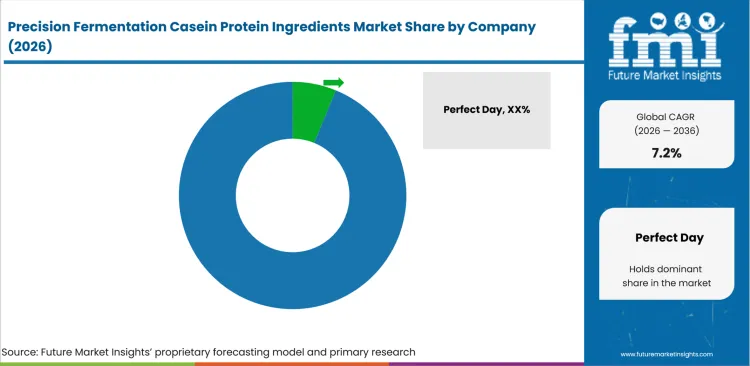
Competition spans formulation-led developers, licensing platforms and industrial dairy partnerships that address different stages of casein commercialization. New Culture and Formo emphasize casein-specific intellectual property and application evidence for commercial cheese ingredient programs. Those Vegan Cowboys and Standing Ovation use established dairy partners to test microbial casein under commercial processing conditions. Fooditive offers a licensable production platform and Nutropy provides a cheeseable milk base for existing dairy equipment. DairyX and All G focus on micellar casein structures for specialized dairy and nutrition applications. Selection depends on protein format, regulatory status and manufacturing support across cheese ingredients and related formulations.
- New Culture and Formo combine casein-specific development with documented food applications and regulatory preparation across commercial cheese programs. Their strongest competitive position comes from connecting the protein with measurable processing performance, production economics and a defined route toward market authorization.
- Those Vegan Cowboys and Standing Ovation use established dairy or fermentation partners to expand application knowledge and production access. These alliances reduce the operational gap between laboratory casein and industrial cheese processing by adding equipment experience and commercial channel knowledge.
- Fooditive and Nutropy offer platform-led routes for manufacturers seeking broader formulation and technology-transfer packages across commercial programs. DairyX and All G remain more specialized around casein structures and nutrition applications, with commercial strength depending on scale evidence and named customer programs.
Competitive Benchmarking: Precision Fermentation Casein Protein Ingredients Market
| Company | Technical Depth and Evidence | Delivery and Integration Support | Account and Channel Reach | Geographic Reach |
|---|---|---|---|---|
| New Culture | High | Medium | High | North America |
| Formo | High | High | Medium | Europe and North America |
| Those Vegan Cowboys | Medium | High | High | Europe |
| Standing Ovation | High | High | High | Europe and North America |
| Fooditive | High | High | Medium | Europe and North America |
| Nutropy | Medium | Low | Low | Europe |
| DairyX | Medium | Low | Low | Israel |
| All G | High | Medium | Low | Australia |
Key Developments in the Precision Fermentation Casein Protein Ingredients Market
- In February 2025, Those Vegan Cowboys announced a development partnership with Hochland Group for hard and semi-hard cheeses made with microbial casein. Hochland contributes cheese-making expertise and established commercial channels, giving the developer an industrial setting for comparing texture and processing behavior against conventional benchmarks. The partnership can shorten application development and preserve a clear separation between regulatory authorization and technical performance validation.
- In June 2025, Fooditive launched the Fooditive Engine as a licensable precision-fermentation platform that includes non-animal casein technology. The company also reported a long-term commercial agreement with a major global dairy brand across future dairy applications. The model gives food manufacturers access to process protocols and scale-up support without building a complete internal platform. Commercial value depends on transferring the process into qualified facilities with consistent purity and yield.
- In October 2025, Standing Ovation and Bel reported the first industrial-scale production cycles for caseins made from dairy whey through precision fermentation. The partners stated that the cycles validated the process at full industrial scale, connecting whey valorization with measurable manufacturing output rather than laboratory feasibility. Wider use now depends on repeatable quality, approved food applications and commercial agreements with additional dairy processors.
Key Players in the Precision Fermentation Casein Protein Ingredients Market
Casein Technology Leaders
- New Culture
- Formo
- Those Vegan Cowboys
Industrial Development Partners
- Standing Ovation
- Fooditive
- Nutropy
Specialist Protein Developers
- DairyX
- All G
Precision Fermentation Casein Protein Ingredients Market - Report Scope
| Coverage field | Report scope |
|---|---|
| Market breakdown | Product type, source, application, end user, and region. |
| Quantitative Units | USD Million, CAGR in %. |
| Market Definition | Commercial demand for casein protein ingredients produced through precision fermentation and sold for food and beverage formulation. |
| Regions Covered | North America, Latin America, Western Europe, Eastern Europe, East Asia, South Asia and Pacific, and Middle East and Africa. |
| Countries Covered | United States, Germany, United Kingdom, France, Japan, India, and 30+ countries. |
| Key Companies Profiled | New Culture, Formo, Those Vegan Cowboys, Standing Ovation, Fooditive, Nutropy, DairyX and All G. |
| Forecast Period | 2026 to 2036. |
| Approach | Hybrid bottom-up and top-down market sizing supported by primary interviews and official desk research. |
Precision Fermentation Casein Protein Ingredients Market - Research Methodology
| Method | Approach |
|---|---|
| Primary Research | FMI analysts gathered input from manufacturers, service providers, technology developers, distributors, end users, procurement teams, and subject-matter experts. Interviews examined purchasing decisions, product or service evaluation, adoption barriers, approval requirements, pricing considerations, and expectations for technical or commercial support. Respondents were also asked what evidence is required before a trial, pilot, or initial order develops into regular purchasing. |
| Desk Research | Desk research covered government statistics, regulatory publications, trade data, industry associations, technical literature, standards, company filings, product information, and official corporate announcements. Sources were reviewed for relevance, publication date, geographic coverage, and consistency with the defined market scope. Claims relating to performance, applications, approvals, capacity, investment, and commercial activity were retained only when supported by credible public evidence. |
| Market Sizing and Forecasting | The market model combined the baseline value with historical performance, segment structure, pricing and volume indicators, adoption levels, company participation, and country-level demand conditions. Forecast assumptions considered economic activity, investment trends, regulatory developments, technology adoption, purchasing cycles, supply availability, and barriers to wider market use. Segment and regional estimates were reconciled before the final market total was calculated. |
| Data Validation | Estimates were checked against multiple independent indicators, including public data, company activity, trade patterns, industry developments, and findings from primary interviews. Validation also tested whether products, services, applications, and company revenues fell within the defined market boundaries. Adjacent categories, unsupported claims, overlapping revenues, and activities without direct market relevance were excluded to reduce double counting and maintain consistency across segments and countries. |
Precision Fermentation Casein Protein Ingredients Market by Segments
Precision Fermentation Casein Protein Ingredients Market segmented by Product Type:
- Proteins
- Fibers
- Sweeteners
- Cultures
- Flavors
Precision Fermentation Casein Protein Ingredients Market segmented by Source:
- Plant
- Microbial
- Dairy Analog
- Upcycled
- Mineral
Precision Fermentation Casein Protein Ingredients Market segmented by Application:
- Bakery
- Beverages
- Snacks
- Infant Nutrition
- Ready Meals
Precision Fermentation Casein Protein Ingredients Market segmented by End User:
- Food Manufacturers
- Beverage Manufacturers
- Foodservice Operators
- Contract Manufacturers
- Retail Brands
Precision Fermentation Casein Protein Ingredients Market by Region:
- North America
- United States
- Canada
- Mexico
- Latin America
- Brazil
- Chile
- Rest of Latin America
- Western Europe
- Germany
- United Kingdom
- Italy
- Spain
- France
- Nordic
- BENELUX
- Rest of Western Europe
- Eastern Europe
- Russia
- Poland
- Hungary
- Balkan and Baltic
- Rest of Eastern Europe
- East Asia
- China
- Japan
- South Korea
- South Asia and Pacific
- India
- ASEAN
- Australia and New Zealand
- Rest of South Asia and Pacific
- Middle East and Africa
- Kingdom of Saudi Arabia
- Other GCC Countries
- Türkiye
- South Africa
- Other African Union
- Rest of Middle East and Africa
Research Sources and Bibliography
- All G. (2025, August 9). Inside All G’s new process for precision-fermented casein micelles for dairy.
- Bel Group. (2025, April 16). BEL AND STANDING OVATION REVOLUTIONIZE THE VALORIZATION OF DAIRY CO-PRODUCTS.
- Bel Group. (2025, October 20). Standing Ovation and Bel scale up industrial production of milk proteins from dairy co-products - a circular revolution for the food industry.
- Biotechnology Industry Research Assistance Council. (2025, February 22). DBT-BIRAC joint call for proposals on smart proteins for fostering high performance biomanufacturing under BioE3 Policy.
- European Investment Bank. (2025, January 14). Germany: EIB provides €35 million to Formo to expand production of cheese alternatives free from animal products.
- Federal Ministry of Food and Agriculture. (2025, April 30). Alternative Lebensmittel zu Fleischwaren und Milcherzeugnissen.
- Food Standards Agency. (2025, September 23). FSA champions food innovation in the UK with the launch of a new Innovation Research Programme.
- Food Standards Agency. (2026, March 12). Technical production methods of precision fermented foods.
- Fooditive Group. (2025, June 9). Fooditive Engine: Revolutionizing Sustainable Food Innovation Through Precision Fermentation.
- Holzamer, L. (2025, October 15). New protein sources for tomorrow’s diet. Bioökonomie.de.
- New Culture. (2025, January 22). New Culture Cheese: Label, Ingredients, Nutritionals.
- New Culture. (2025, March 11). $5M in Early Demand for New Culture Mozzarella.
- New Culture. (2026, July 7). Another granted patent for New Culture.
- Standing Ovation. (2025, January 9). STANDING OVATION AND AJINOMOTO FOODS EUROPE ANNOUNCE STRATEGIC PARTNERSHIP.
- Tetra Pak. (2025, April 29). Standing Ovation and Tetra Pak® join forces to accelerate the industrialization of alternative proteins.
- Those Vegan Cowboys. (2025, February 3). pt. 30: The Alpine Giant.
- USA Food and Drug Administration. (2025, January). Guidance for industry: Questions and answers regarding food allergen labeling, edition 5.
- USA Food and Drug Administration. (2025, June 13). GRN No. 1228: β-Casein produced by E. coli DSM 35048.
- USA Food and Drug Administration. (2026, July 15). GRN No. 1312: Recombinant αS1-casein from Bos taurus produced by Escherichia coli DSM 35603.
This bibliography is provided for reader reference and is not exhaustive. The full report contains the complete reference list and detailed citations
This Report Answers
- How large is the precision fermentation casein protein ingredients market in 2026 and 2036?
- Which commercial factors support demand for animal-free casein ingredients across food manufacturing?
- Why do proteins account for a notable product type share in 2026?
- How does microbial production influence source demand and regulatory preparation?
- Why does bakery represent a distinct application opportunity for functional casein?
- How do country growth rates differ across India, the United States, France, Japan, Germany and the United Kingdom?
- Which companies develop casein proteins, licensing platforms or industrial application partnerships?
- What limits commercialization across purification, authorization and allergen-labeling requirements?
- How can licensing and joint development reduce the investment required for scale-up?
Frequently Asked Questions
How big is the Precision Fermentation Casein Protein Ingredients Market in 2026?
The precision fermentation casein protein ingredients market is valued at USD 50.0 million in 2026 and is forecast to reach USD 100.0 million by 2036, driven by food manufacturers increasing qualification work for casein ingredients that deliver dairy-like melt, binding, and texture without complete dependence on conventional milk supply.
What is the CAGR of the Precision Fermentation Casein Protein Ingredients Market from 2026 to 2036?
The precision fermentation casein protein ingredients market is projected to grow at a CAGR of 7.2% between 2026 and 2036, supported by demonstrated commercial performance in cheese and bakery applications, expanding industrial partnerships, and growing regulatory clarity across key national authorization pathways.
Which source leads the Precision Fermentation Casein Protein Ingredients Market?
Microbial sources account for 82.0% of the precision fermentation casein protein ingredients market by source in 2026, driven by precise control over casein protein expression, separation from seasonal milk composition variability, and the ability to maintain consistent food-grade specifications across repeated manufacturing cycles.
Which country is growing fastest in the Precision Fermentation Casein Protein Ingredients Market?
The precision fermentation casein protein ingredients market in India is projected to grow at a CAGR of 9.7% through 2036, supported by public smart-protein funding programs including a BIRAC proposal call opened in February 2025 that covers precision fermentation within its eligible technology readiness scope.
Who are the leading companies in the Precision Fermentation Casein Protein Ingredients Market?
Leading companies in the precision fermentation casein protein ingredients market include New Culture, Formo, Those Vegan Cowboys, Standing Ovation, Fooditive, Nutropy, DairyX, and All G, spanning casein-specific intellectual property, licensable fermentation platforms, industrial dairy partnerships, and specialist micellar casein development.
Preview the report firsthand - request a free sample
Get SampleGet the brochure for pricing and purchase details.
Get PDFTable of Content
- Key Takeaways
- Market Size and CAGR
- Top Growth Driver
- Fastest Growing Segment
- Leading Region
- Key Companies
- Emerging Opportunities
- Executive Summary
- Global Market Outlook
- Demand-side Trends
- Supply-side Trends
- Technology Roadmap Analysis
- Analysis and Recommendations
- Analyst Perspective (What is happening? Why now? What should investors know?)
- Key Questions Answered
- How large is the market?
- What is the CAGR?
- What are key trends?
- Which region dominates?
- Who are the leaders?
- Market Overview
- Market Coverage / Taxonomy
- Market Definition / Scope / Limitations
- Research Methodology
- Chapter Orientation
- Analytical Lens and Working Hypotheses
- Market Structure, Signals, and Trend Drivers
- Benchmarking and Cross-market Comparability
- Market Sizing, Forecasting, and Opportunity Mapping
- Research Design and Evidence Framework
- Desk Research Programme (Secondary Evidence)
- Expert Input and Fieldwork (Primary Evidence)
- Tooling, Models, and Reference Databases
- Data Engineering and Model Build
- Quality Assurance and Audit Trail
- Market Background
- Market Dynamics (Drivers, Restraints, Opportunity, Trends)
- Scenario Forecast (Optimistic, Likely, Conservative)
- Impact Analysis
- AI Impact
- Sustainability Impact
- Regulatory Impact
- Technology Impact
- Consumer / Buyer Analysis
- Purchase Drivers
- Adoption Barriers
- Buyer Journey
- Opportunity Map Analysis
- Product Life Cycle Analysis
- Supply Chain Analysis
- Investment Feasibility Matrix
- Value Chain Analysis
- PESTLE and Porter's Analysis
- Regulatory Landscape
- Regional Parent Market Outlook
- Production and Consumption Statistics
- Import and Export Statistics
- Global Market Analysis and Forecast, 2021 to 2036
- Historical Market Size Value (USD Million) Analysis, 2021 to 2025
- Current and Future Market Size Value (USD Million) Projections, 2026 to 2036
- Y-o-Y Growth Trend Analysis
- Absolute $ Opportunity Analysis
- Global Market Pricing Analysis, 2021 to 2036
- Global Market Analysis and Forecast, By Product Type, 2021 to 2036
- Introduction / Key Findings
- Historical Market Size Value (USD Million) Analysis By Product Type, 2021 to 2025
- Current and Future Market Size Value (USD Million) Analysis and Forecast By Product Type, 2026 to 2036
- Proteins
- Fibers
- Sweeteners
- Cultures
- Flavors
- Proteins
- Y-o-Y Growth Trend Analysis By Product Type, 2021 to 2025
- Absolute $ Opportunity Analysis By Product Type, 2026 to 2036
- Global Market Analysis and Forecast, By Source, 2021 to 2036
- Introduction / Key Findings
- Historical Market Size Value (USD Million) Analysis By Source, 2021 to 2025
- Current and Future Market Size Value (USD Million) Analysis and Forecast By Source, 2026 to 2036
- Microbial
- Plant
- Dairy Analog
- Upcycled
- Mineral
- Microbial
- Y-o-Y Growth Trend Analysis By Source, 2021 to 2025
- Absolute $ Opportunity Analysis By Source, 2026 to 2036
- Global Market Analysis and Forecast, By Application, 2021 to 2036
- Introduction / Key Findings
- Historical Market Size Value (USD Million) Analysis By Application, 2021 to 2025
- Current and Future Market Size Value (USD Million) Analysis and Forecast By Application, 2026 to 2036
- Bakery
- Beverages
- Snacks
- Infant Nutrition
- Ready Meals
- Bakery
- Y-o-Y Growth Trend Analysis By Application, 2021 to 2025
- Absolute $ Opportunity Analysis By Application, 2026 to 2036
- Global Market Analysis and Forecast, By End User, 2021 to 2036
- Introduction / Key Findings
- Historical Market Size Value (USD Million) Analysis By End User, 2021 to 2025
- Current and Future Market Size Value (USD Million) Analysis and Forecast By End User, 2026 to 2036
- Food Manufacturers
- Ingredient Blenders
- Private Label
- Foodservice
- Nutraceutical Brands
- Food Manufacturers
- Y-o-Y Growth Trend Analysis By End User, 2021 to 2025
- Absolute $ Opportunity Analysis By End User, 2026 to 2036
- Global Market Analysis and Forecast, By Region, 2021 to 2036
- Introduction
- Historical Market Size Value (USD Million) Analysis By Region, 2021 to 2025
- Current Market Size Value (USD Million) Analysis and Forecast By Region, 2026 to 2036
- North America
- Latin America
- Western Europe
- Eastern Europe
- East Asia
- South Asia and Pacific
- Middle East & Africa
- Market Attractiveness Analysis By Region
- North America Market Analysis and Forecast, By Country, 2021 to 2036
- Historical Market Size Value (USD Million) Trend Analysis By Market Taxonomy, 2021 to 2025
- Market Size Value (USD Million) Forecast By Market Taxonomy, 2026 to 2036
- By Country
- USA
- Canada
- By Product Type
- By Source
- By Application
- By End User
- By Country
- Market Attractiveness Analysis
- By Country
- By Product Type
- By Source
- By Application
- By End User
- Key Takeaways
- Latin America Market Analysis and Forecast, By Country
- Historical Market Size Value (USD Million) Trend Analysis By Market Taxonomy, 2021 to 2025
- Market Size Value (USD Million) Forecast By Market Taxonomy, 2026 to 2036
- By Country
- Brazil
- Mexico
- Chile
- Rest of Latin America
- By Product Type
- By Source
- By Application
- By End User
- By Country
- Market Attractiveness Analysis
- By Country
- By Product Type
- By Source
- By Application
- By End User
- Key Takeaways
- Western Europe Market Analysis and Forecast, By Country
- Historical Market Size Value (USD Million) Trend Analysis By Market Taxonomy, 2021 to 2025
- Market Size Value (USD Million) Forecast By Market Taxonomy, 2026 to 2036
- By Country
- Germany
- UK
- Italy
- Spain
- France
- Nordic
- BENELUX
- Rest of Western Europe
- By Product Type
- By Source
- By Application
- By End User
- By Country
- Market Attractiveness Analysis
- By Country
- By Product Type
- By Source
- By Application
- By End User
- Key Takeaways
- Eastern Europe Market Analysis and Forecast, By Country
- Historical Market Size Value (USD Million) Trend Analysis By Market Taxonomy, 2021 to 2025
- Market Size Value (USD Million) Forecast By Market Taxonomy, 2026 to 2036
- By Country
- Russia
- Poland
- Hungary
- Balkan & Baltic
- Rest of Eastern Europe
- By Product Type
- By Source
- By Application
- By End User
- By Country
- Market Attractiveness Analysis
- By Country
- By Product Type
- By Source
- By Application
- By End User
- Key Takeaways
- East Asia Market Analysis and Forecast, By Country
- Historical Market Size Value (USD Million) Trend Analysis By Market Taxonomy, 2021 to 2025
- Market Size Value (USD Million) Forecast By Market Taxonomy, 2026 to 2036
- By Country
- China
- Japan
- South Korea
- By Product Type
- By Source
- By Application
- By End User
- By Country
- Market Attractiveness Analysis
- By Country
- By Product Type
- By Source
- By Application
- By End User
- Key Takeaways
- South Asia and Pacific Market Analysis and Forecast, By Country
- Historical Market Size Value (USD Million) Trend Analysis By Market Taxonomy, 2021 to 2025
- Market Size Value (USD Million) Forecast By Market Taxonomy, 2026 to 2036
- By Country
- India
- ASEAN
- Australia & New Zealand
- Rest of South Asia and Pacific
- By Product Type
- By Source
- By Application
- By End User
- By Country
- Market Attractiveness Analysis
- By Country
- By Product Type
- By Source
- By Application
- By End User
- Key Takeaways
- Middle East & Africa Market Analysis and Forecast, By Country
- Historical Market Size Value (USD Million) Trend Analysis By Market Taxonomy, 2021 to 2025
- Market Size Value (USD Million) Forecast By Market Taxonomy, 2026 to 2036
- By Country
- Kingdom of Saudi Arabia
- Other GCC Countries
- Türkiye
- South Africa
- Other African Union
- Rest of Middle East & Africa
- By Product Type
- By Source
- By Application
- By End User
- By Country
- Market Attractiveness Analysis
- By Country
- By Product Type
- By Source
- By Application
- By End User
- Key Takeaways
- Key Countries Market Analysis
- USA
- Pricing Analysis
- Market Share Analysis, 2025
- By Product Type
- By Source
- By Application
- By End User
- Canada
- Pricing Analysis
- Market Share Analysis, 2025
- By Product Type
- By Source
- By Application
- By End User
- Mexico
- Pricing Analysis
- Market Share Analysis, 2025
- By Product Type
- By Source
- By Application
- By End User
- Brazil
- Pricing Analysis
- Market Share Analysis, 2025
- By Product Type
- By Source
- By Application
- By End User
- Chile
- Pricing Analysis
- Market Share Analysis, 2025
- By Product Type
- By Source
- By Application
- By End User
- Germany
- Pricing Analysis
- Market Share Analysis, 2025
- By Product Type
- By Source
- By Application
- By End User
- UK
- Pricing Analysis
- Market Share Analysis, 2025
- By Product Type
- By Source
- By Application
- By End User
- Italy
- Pricing Analysis
- Market Share Analysis, 2025
- By Product Type
- By Source
- By Application
- By End User
- Spain
- Pricing Analysis
- Market Share Analysis, 2025
- By Product Type
- By Source
- By Application
- By End User
- France
- Pricing Analysis
- Market Share Analysis, 2025
- By Product Type
- By Source
- By Application
- By End User
- India
- Pricing Analysis
- Market Share Analysis, 2025
- By Product Type
- By Source
- By Application
- By End User
- ASEAN
- Pricing Analysis
- Market Share Analysis, 2025
- By Product Type
- By Source
- By Application
- By End User
- Australia & New Zealand
- Pricing Analysis
- Market Share Analysis, 2025
- By Product Type
- By Source
- By Application
- By End User
- China
- Pricing Analysis
- Market Share Analysis, 2025
- By Product Type
- By Source
- By Application
- By End User
- Japan
- Pricing Analysis
- Market Share Analysis, 2025
- By Product Type
- By Source
- By Application
- By End User
- South Korea
- Pricing Analysis
- Market Share Analysis, 2025
- By Product Type
- By Source
- By Application
- By End User
- Russia
- Pricing Analysis
- Market Share Analysis, 2025
- By Product Type
- By Source
- By Application
- By End User
- Poland
- Pricing Analysis
- Market Share Analysis, 2025
- By Product Type
- By Source
- By Application
- By End User
- Hungary
- Pricing Analysis
- Market Share Analysis, 2025
- By Product Type
- By Source
- By Application
- By End User
- Kingdom of Saudi Arabia
- Pricing Analysis
- Market Share Analysis, 2025
- By Product Type
- By Source
- By Application
- By End User
- Türkiye
- Pricing Analysis
- Market Share Analysis, 2025
- By Product Type
- By Source
- By Application
- By End User
- South Africa
- Pricing Analysis
- Market Share Analysis, 2025
- By Product Type
- By Source
- By Application
- By End User
- USA
- Market Structure Analysis
- Competition Dashboard
- Competition Benchmarking
- Market Share Analysis of Top Players
- By Regional
- By Product Type
- By Source
- By Application
- By End User
- Emerging Startups
- Innovation Benchmarking
- Competition Analysis
- Competition Deep Dive
- Perfect Day
- Overview
- Product Portfolio
- Profitability by Market Segments
- Sales Footprint
- Strategy Overview
- Marketing Strategy
- Product Strategy
- Channel Strategy
- New Culture
- Formo
- Those Vegan Cowboys
- Imagindairy
- Remilk
- Standing Ovation
- Change Foods
- Perfect Day
- Case Studies
- Success Stories
- Recent Developments
- Competition Deep Dive
- Assumptions & Acronyms Used


