

- Market Size (2026)
- USD 360.7 Mn
- Forecast (2036)
- USD 582.0 Mn
- CAGR (2026 to 2036)
- 4.9%
How big is Prism Poles Market in 2026?
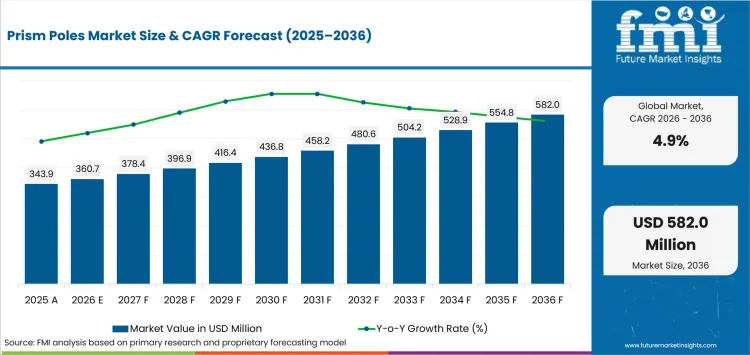
USD 360.7 million in 2026 and USD 582.0 million by 2036 at a 4.9% CAGR.
Demand for prism poles is projected to expand at 4.9% CAGR between 2026 and 2036, increasing valuation from USD 360.7 million in 2026 to USD 582.0 million by 2036. Physical targets remain part of high-precision control and construction workflows that transfer checked reflector positions between active work fronts. Hexagon reported in August 2025 that Skanska teams on Norway’s Rogfast project use the Leica AP20 AutoPole beside total stations and other measurement systems. The documented deployment keeps pole-based targeting inside a complex construction survey kit even as laser scanning and GNSS expand.
Country growth differs as survey-control maintenance and replacement cycles change the frequency of portable target use. Australia is projected at 4.7% CAGR compared with 3.6% in Japan during the assessment period. Land Use Victoria reported in June 2025 that 6,227 additional permanent survey marks had been identified and registered statewide. That physical control base sustains recurring field verification in one major Australian market while Japan’s mature instrument base keeps accessory purchases more closely tied to planned replacement.
Key Takeaways of Prism Poles Market
- Boundary surveys and construction layout sustain prism-pole replacement as crews transfer checked reflector positions between control points across active field assignments.
- Telescopic prism poles are projected to account for 36.0% in 2026 owing to adjustable working height and shorter transport length.
- The 2-3 m length segment is estimated to capture 41.0% in 2026 due to practical reach without excessive extension leverage.
- Twist-lock models are anticipated to represent 34.0% in 2026 as continuous adjustment avoids separate retaining pins during repeated setups.
- Reflectorless total stations, mobile mapping and tilt-compensated GNSS reduce prism setups for selected tasks and temper replacement demand in target-free workflows.
- SECO Manufacturing, Leica Geosystems, Trimble, Topcon Positioning, Nedo, Dave White’s SitePro, Sokkia and AdirPro represent specialist and integrated survey-equipment positions.
Analyst Perspective
"Prism poles earn repeat orders when crews trust height markings, lock repeatability and thread compatibility across mixed instruments. The replacement case weakens on target-free tasks, so manufacturers need lower weight and field durability without sacrificing straightness at full extension."
- Nikhil Kaitwade, Principal Consultant, Future Market Insights
How is the Prism Poles Market segmented?
The prism poles market is segmented by pole type, length, locking mechanism, application, sales channel and region.
Market taxonomy covers pole type, length, locking mechanism, application, sales channel and region. Pole types include telescopic prism poles, carbon fiber prism poles, aluminum prism poles, fixed-height prism poles and GPS or GNSS rover poles. Length classes include below 2 m, 2-3 m, 3-5 m and above 5 m. Locking mechanisms include twist lock, clamp lock, compression lock and quick release. Applications cover land surveying, construction layout, GIS or mapping, monitoring and mining survey. Sales channels include survey equipment dealers, online or catalog, direct manufacturer and rental or replacement.
What role does land surveying play within the application category?
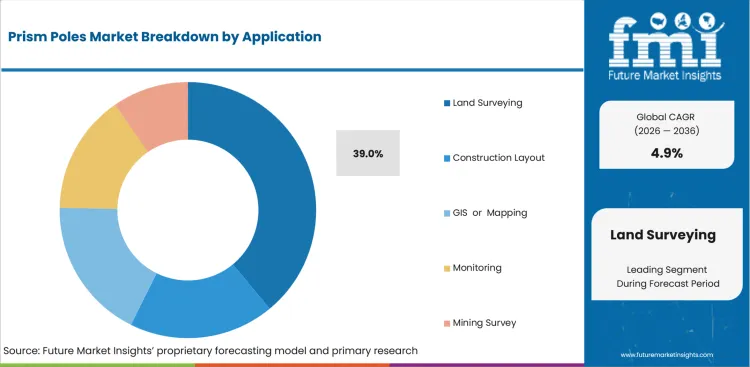
Land surveying requires repeatable reflector positions for boundary control and reference transfer across changing terrain. Navigation satellite systems support wider positioning tasks but optical targets remain useful where total-station sight lines require checked control.
- Based on application, land surveying is projected to account for 39.0% in 2026 due to recurring boundary and control work requiring repeatable target positions.
- GNSS IC-based rover platforms reduce reflector setups on selected observations across modern field workflows. The USA Bureau of Labor Statistics reported in August 2025 that about 3,900 surveyor openings are projected each year over the decade, sustaining recurring boundary and construction measurement work.
What supports demand for telescopic prism poles within the pole type category?
Survey crews favor adjustable poles as one reflector must serve boundary control and construction layout across changing sight lines. Telescopic designs also reduce transport length between land survey equipment jobs without requiring crews to carry several fixed-height poles.
- Telescopic prism poles are set to lead the pole type category with 36.0% share in 2026 due to adjustable working height and compact transport.
- The bundled specification places the pole inside a complete robotic workflow instead of treating it as an isolated field accessory.
How does the 2-3 m segment shape demand within the length category?
Pole length affects reach and straightness as taller extensions increase leverage during handheld measurements. In May 2026 the City of Philadelphia specified a carbon-fiber robotic prism pole and bipod inside its GT-1500 survey-equipment solicitation for routine field work.
- By length, the 2-3 m segment is estimated to hold 41.0% in 2026 owing to practical reach across routine land-surveying and construction-layout assignments.
- Mid-range poles are expected to retain broad use within geospatial solutions across common reflector heights without the transport burden or deflection risk of longer extensions. Crews also move them efficiently between control points during daily assignments.
What drives twist lock within the locking mechanism category?
Trimble released Access 2025.10 in April 2025 with Auto Resection for conventional surveys on sites containing multiple permanent control targets. Twist locks complement that workflow by letting crews reset target height continuously beside smart construction equipment during repeated control observations.
- The locking mechanism category is forecast to be led by twist lock at 34.0% share in 2026 due to continuous adjustment without separate retaining pins.
- Continuous adjustment lets one pole serve several sight lines across a control network during robotic observations. The lock must still resist slip as crews extend the pole repeatedly during active survey assignments.
What makes survey equipment dealers central to the sales channel category?
Specialist dealers bundle poles with prisms and bipods while checking compatibility with laser measuring instruments in each crew’s field kit. Local service matters as calibration or thread mismatches delay work.
- The survey equipment dealers segment is likely to capture 44.0% share in 2026 attributable to bundled accessory replacement and local compatibility support. Topcon named Instruments by Lepont an authorized geomatics distributor in France in February 2026 with technical training and after-sales workshops.
- Matched accessories reduce downtime and keep dealer service relevant beyond the original instrument purchase. Laser distance meters remain practical for direct or online replacement once thread and height requirements are known.
What are the drivers, restraints and opportunities in the Prism Poles Market?
Construction staking preserves physical target work while target-free capture reduces some pole setups and integrated field kits support higher-value accessory replacement.
- Driver: Boundary control and construction staking continue to require checked reflector height during conventional and robotic total-station measurements.
- Restraint: Mobile mapping, reflectorless measurement and tilt-compensated GNSS reduce pole use on survey tasks that no longer require physical targets.
- Opportunity: Lightweight poles paired with prisms, bipods and controller mounts raise the value captured during complete field-kit replacement.
Construction Layout Preserves Repeat Target Work
Construction staking keeps physical targets relevant on sites that still use robotic or manual total stations for checked layout points. The USA Census Bureau reported in July 2026 that June housing starts reached a seasonally adjusted annual rate of 1.427 million. Active residential construction sustains replacement demand for prism poles and construction equipment attachments used during repeated setup changes.
Target-Free Capture Reduces Some Pole Setups
Mobile mapping shifts selected corridor and asset surveys away from point-by-point reflector observations toward continuous spatial capture. Trimble introduced two mobile-mapping positioning portfolios in October 2025 with centimeter-level positioning for LiDAR sensors or cameras. Wider LiDAR mapping use lowers prism-pole intensity on suitable capture tasks while boundary control and certified reference transfer retain physical targets.
Integrated Field Kits Support Higher Accessory Value
Integrated field kits raise the commercial value of a pole purchase as crews need one mount system across prisms and controllers. Trimble launched the TSC710, TSC510 and T110 data collectors in October 2025 for geospatial and construction work. Compatible mounts and distance measurement sensors give accessory manufacturers a practical route to higher-value replacement bundles.
Which country CAGRs are profiled in the Prism Poles Market?
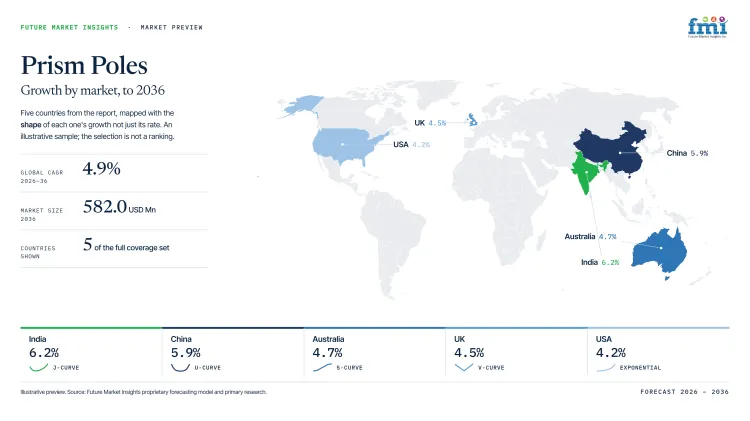
| Country | CAGR |
|---|---|
| Australia | 4.7% |
| United Kingdom | 4.5% |
| United States | 4.2% |
| Germany | 3.9% |
| Japan | 3.6% |
How do country-level CAGRs compare in the Prism Poles Market?
The five profiled forecasts span 1.1 percentage points from Australia at 4.7% to Japan at 3.6%. These rates describe expected expansion speed and do not measure current country market size or installed equipment depth.
- Australia combines engineering work with long field travel that rewards lightweight accessories plus dependable regional support.
- United Kingdom demand reflects construction and infrastructure surveying with replacement purchases distributed across specialist geospatial dealers.
- United States growth is shaped by recurring boundary work and a broad base of engineering plus mapping service firms.
- Germany benefits from civil-engineering order backlogs although mature instrument fleets moderate the pace of accessory replacement.
- Japan retains survey demand around housing and infrastructure projects but shorter order visibility restrains faster equipment replacement.
Comparable CAGRs can produce different market entry conditions. The full report provides country-level CAGR analysis across North America, Latin America, Europe, East Asia, South Asia and Pacific, and the Middle East and Africa.
Country-wise Analysis
- Australian engineering crews work across long transport and resource corridors, and the Australian Bureau of Statistics reported in June 2026 that engineering construction work rose 7.1% during the March quarter across major projects. In Australia prism pole demand is predicted to advance at 4.7% CAGR through 2036, supported by repeated control-point moves across infrastructure and resource projects that keep reflector-height checks part of nationwide field work. Remote sites increase the cost of replacement delays and technical support, so distributors serving dispersed crews need poles that remain straight at extension and locks that hold reliably during repeated field setups under exposed conditions.
- British survey firms work across dense redevelopment sites and established transport assets, making compact poles practical around restricted access points and short optical sight lines during repeated layout and control assignments across active urban projects. The Office for National Statistics reported in July 2026 that construction output grew 1.6% during the three months to May, sustaining field measurement activity across urban building and civil works that require repeatable site control. The United Kingdom’s prism poles outlook is anticipated to advance at 4.5% CAGR over the assessment period, although dealer stock and installed-instrument compatibility continue to shape replacement timing across project schedules and regional service networks.
- American survey firms combine boundary work with construction staking across varied total-station fleets, and the Bureau of Labor Statistics reported in August 2025 that surveying and mapping technician employment is projected to grow 5% from 2024 to 2034. That labor base keeps recurring optical control work available for prism poles across local engineering and mapping assignments, although GNSS measurements reduce target setups on observations that crews can establish without a physical reflector. Prism pole sales in the United States are forecast to expand at 4.2% CAGR by 2036, influenced by control transfer and robotic layout work that rewards thread compatibility plus regional service support across mixed instrument fleets.
- German engineering firms serve transport and utility projects with mature instrument fleets, making thread compatibility and dependable replacement support central to prism-pole purchasing across established regional surveying and construction networks with long equipment cycles. The German Federal Statistical Office reported in June 2026 that main-construction order stocks were 6.7% higher year on year during the first quarter, supporting a 3.9% prism-pole CAGR outlook over the forecast period. Long equipment lives keep accessory replacement measured despite active civil workloads, so distributors gain more from compatible poles and reliable locks than from frequent changes in installed total-station fleets across established service territories.
- Japanese survey crews work on dense construction sites with established total-station fleets, making compact field kits and dependable local support important during replacement purchasing for repeated layout and control assignments across constrained urban worksites. Long equipment lives keep accessory orders tied to planned replacement across housing and infrastructure survey work, so compatible poles matter more than frequent format changes during periods of limited near-term project visibility across domestic projects. The Japan prism poles sector is projected to record 3.6% CAGR during the assessment period, while Japan’s MLIT reported in June 2026 that major-contractor orders fell 6.7% year on year in May.
Who are the notable companies in the Prism Poles Market?
SECO Manufacturing, Leica Geosystems, Trimble, Topcon Positioning, Nedo, Dave White’s SitePro, Sokkia and AdirPro are notable companies serving this market.
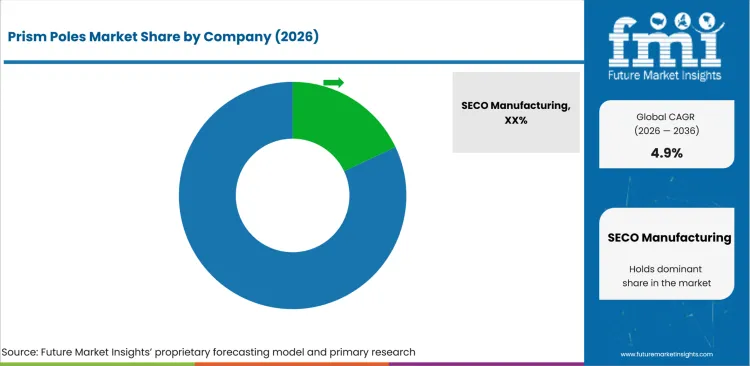
Specialist accessory manufacturers compete with integrated geospatial platforms and broad survey-tool brands across established surveying and construction channels. Entry barriers center on verified pole straightness, repeatable locks, thread compatibility and dependable dealer service.
- SECO Manufacturing, Nedo, Dave White’s SitePro and AdirPro compete with pole plus accessory ranges aimed at routine survey replacement needs.
- Leica Geosystems, Trimble, Topcon Positioning and Sokkia connect field accessories with total stations plus GNSS platforms across wider positioning workflows.
Competitive Benchmarking: Prism Poles Market
| Company | Survey Accessory Focus | Instrument Workflow Integration | Dealer and Service Network | Geographic Reach |
|---|---|---|---|---|
| SECO Manufacturing | High | Low | High | Global dealer network |
| Leica Geosystems | Medium | High | High | Global |
| Trimble | Medium | High | High | Global distribution partners |
| Topcon Positioning | Medium | High | High | Global |
| Nedo | High | Low | High | 100+ countries and North American logistics center |
| Dave White’s SitePro | High | Low | Medium | North America with worldwide sales |
| Sokkia | Medium | High | High | Americas and Oceania with worldwide use |
| AdirPro | Medium | Low | Medium | Worldwide contractor and surveyor market |
Key Developments in the Prism Poles Market
- In November 2025, Trimble provided S7 robotic total stations plus C5 mechanical total stations and GNSS equipment to Fresno State’s Geomatics Engineering Program. Trimble and California Surveying & Drafting Supply also provided configuration, calibration and onsite training for recurring practical survey work.
- In October 2025, Leica Geosystems launched the TS20 robotic total station and scheduled AI-Follow as a post-launch software update. The TS20 works with existing accessories plus the AP20 AutoPole, keeping physical target hardware relevant during robotic instrument upgrades.
- In February 2025, Topcon Positioning launched the HiPer XR GNSS receiver for surveying and construction applications with tilt compensation up to 60 degrees. The receiver expands target-free rover options that compete with prism-based measurements on selected field points.
Key Players in the Prism Poles Market
Specialist Prism Pole and Survey Accessory Suppliers
- SECO Manufacturing
- Nedo
- Dave White’s SitePro
- AdirPro
Integrated Geospatial Equipment Platforms
- Leica Geosystems
- Trimble
- Topcon Positioning
- Sokkia
Prism Poles Market - Report Scope
| Coverage field | Report scope |
|---|---|
| Market breakdown | By pole type, length, locking mechanism, application, sales channel and region. |
| Quantitative Units | Revenue in USD million and CAGR in %. |
| Market Definition | Commercial prism poles and compatible rover poles used to position optical reflectors or GNSS equipment at controlled field heights. |
| Regions Covered | North America, Latin America, Europe, East Asia, South Asia and Pacific and Middle East and Africa. |
| Countries Covered | Australia, United Kingdom, United States, Germany, Japan, and 20+ countries included in the full report. |
| Key Companies Profiled | SECO Manufacturing, Leica Geosystems, Trimble, Topcon Positioning, Nedo, Dave White’s SitePro, Sokkia and AdirPro. |
| Forecast Period | 2026 to 2036. |
| Approach | Primary and secondary research with market triangulation. |
Prism Poles Market - Research Methodology
| Method | Approach |
|---|---|
| Primary Research | FMI analysts gathered input from manufacturers, service providers, technology developers, distributors, end users, procurement teams, and subject-matter experts. Interviews examined purchasing decisions, product or service evaluation, adoption barriers, approval requirements, pricing considerations, and expectations for technical or commercial support. Respondents were also asked what evidence is required before a trial, pilot, or initial order develops into regular purchasing. |
| Desk Research | Desk research covered government statistics, regulatory publications, trade data, industry associations, technical literature, standards, company filings, product information, and official corporate announcements. Sources were reviewed for relevance, publication date, geographic coverage, and consistency with the defined market scope. Claims relating to performance, applications, approvals, capacity, investment, and commercial activity were retained only when supported by credible public evidence. |
| Market Sizing and Forecasting | The market model combined the baseline value with historical performance, segment structure, pricing and volume indicators, adoption levels, company participation, and country-level demand conditions. Forecast assumptions considered economic activity, investment trends, regulatory developments, technology adoption, purchasing cycles, supply availability, and barriers to wider market use. Segment and regional estimates were reconciled before the final market total was calculated. |
| Data Validation | Estimates were checked against multiple independent indicators, including public data, company activity, trade patterns, industry developments, and findings from primary interviews. Validation also tested whether products, services, applications, and company revenues fell within the defined market boundaries. Adjacent categories, unsupported claims, overlapping revenues, and activities without direct market relevance were excluded to reduce double counting and maintain consistency across segments and countries. |
Prism Poles Market by Segments
Prism Poles Market segmented by Pole Type:
- Telescopic Prism Poles
- Carbon Fiber Prism Poles
- Aluminum Prism Poles
- Fixed-height Prism Poles
- GPS or GNSS Rover Poles
Prism Poles Market segmented by Length:
- 2-3 m
- 3-5 m
- Below 2 m
- Above 5 m
Prism Poles Market segmented by Locking Mechanism:
- Twist Lock
- Clamp Lock
- Compression Lock
- Quick Release
Prism Poles Market segmented by Application:
- Land Surveying
- Construction Layout
- GIS or Mapping
- Monitoring
- Mining Survey
Prism Poles Market segmented by Sales Channel:
- Survey Equipment Dealers
- Online or Catalog
- Direct Manufacturer
- Rental or Replacement
Prism Poles Market by Region:
- North America
- United States
- Canada
- Latin America
- Brazil
- Mexico
- Chile
- Rest of Latin America
- Western Europe
- Germany
- United Kingdom
- Italy
- Spain
- France
- Nordics
- Benelux
- Rest of Western Europe
- Eastern Europe
- Russia
- Poland
- Hungary
- Balkan and Baltic States
- Rest of Eastern Europe
- East Asia
- China
- Japan
- South Korea
- South Asia and Pacific
- India
- ASEAN
- Australia and New Zealand
- Rest of South Asia and Pacific
- Middle East and Africa
- Kingdom of Saudi Arabia
- Other GCC Countries
- Türkiye
- South Africa
- Other African Union Countries
- Rest of Middle East and Africa
Research Sources and Bibliography
- Hexagon AB. (2025, August 6). Hexagon's technology guides Skanska in building the world’s most ambitious road tunnel.
- Land Use Victoria. (2025, June 30). Digital cadastre uncovers more than 6000 additional survey marks across Victoria.
- City of Philadelphia Procurement Department. (2025, May 27). Bid Solicitation: B2524529.
- City of Philadelphia Procurement Department. (2026, May 12). Bid Solicitation: B2626956.
- Trimble. (2025, April). 2025.10.
- USA Bureau of Labor Statistics. (2025, August 28). Surveyors.
- Topcon Positioning Systems. (2026, February 2). Instruments by Lepont named authorised distributor of Topcon geomatics solutions in France.
- USA Census Bureau. (2026, July 17). Monthly New Residential Construction, June 2026.
- Trimble. (2025, October 8). New Trimble Portfolios Introduce All-in-One Mobile Mapping Solutions for Land and Air.
- Trimble. (2025, October 7). Trimble Ushers in New Era of Productivity and Connectivity with Comprehensive Data Collector Portfolio.
- Australian Bureau of Statistics. (2026, June 24). Engineering Construction Activity, Australia, March 2026.
- Office for National Statistics. (2026, July 16). Construction output in Great Britain: May 2026.
- USA Bureau of Labor Statistics. (2025, August 28). Surveying and Mapping Technicians.
- German Federal Statistical Office. (2026, June 1). Index of stock of orders for main construction industry, building construction, civil engineering.
- Ministry of Land, Infrastructure, Transport and Tourism. (2026, June 30).
- Precisional LLC. (n.d.). Seco | Precisional LLC. Retrieved August 8, 2026.
- Hexagon AB. (2025, October 2). Introducing the Leica TS20 robotic total station with edge AI: Elevating everyday productivity even in the toughest conditions.
- Trimble. (n.d.). About | Trimble Geospatial. Retrieved August 8, 2026.
- Topcon Positioning Systems. (n.d.). About Topcon Positioning Systems | We help the people who build and feed the world work smarter and faster. Retrieved August 8, 2026.
- Nedo GmbH & Co. KG. (n.d.). Nedo - Company. Retrieved August 8, 2026.;
- Trimble. (2025, November 6). Trimble, California Surveying & Drafting Supply and Fresno State Collaborate to Address Surveyor Labor Shortage.
- Topcon Positioning Systems. (2025, February 6). Topcon introduces the new HiPer XR GNSS receiver for increased accuracy and reliability.
- Hexagon AB. (2026, June 9). Leica RTC series sets new benchmark in scanning accuracy and productivity.
- Topcon Positioning Systems. (2025, September 30). Topcon launches new organization dedicated to Geomatics.
- Topcon Positioning Systems. (2025, February 18). Topcon and FARO Technologies announce strategic agreement in laser scanning technology.
This bibliography is provided for reader reference and is not exhaustive. The full report contains the complete reference list and detailed citations
This Report Answers
- How large is the prism poles market in 2026 and what value is projected by 2036?
- Which field conditions keep physical reflector poles relevant as surveying workflows add reflectorless measurement and GNSS?
- Why are telescopic prism poles projected to account for 34.0% of pole-type demand in 2026?
- Why does the 2-3 m length class account for the largest reported share of prism-pole demand?
- How does twist-lock adjustment affect repeated robotic total-station setups across active survey assignments?
- How do forecast CAGRs differ across Australia, the United Kingdom, the United States, Germany and Japan?
- Which suppliers combine specialist prism-pole ranges with broader total-station or GNSS positioning systems?
- How are mobile mapping and integrated field controllers changing prism-pole replacement patterns across survey crews?
Frequently Asked Questions
How big is the Prism Poles Market in 2026?
The Prism Poles Market is estimated at USD 360.7 million in 2026 across the defined global commercial scope. Recurring land surveying and construction layout work supports poles that provide checked reflector height across conventional and robotic total-station workflows during routine field assignments.
What is the CAGR of the Prism Poles Market from 2026 to 2036?
The Prism Poles Market is projected to expand at a 4.9% CAGR from 2026 to 2036. Replacement demand persists around field accessories across mixed survey fleets even as reflectorless instruments and GNSS workflows reduce physical prism setups for selected measurements.
Which pole type segment leads the Prism Poles Market?
Telescopic prism poles are projected to account for 34.0% of the Prism Poles Market by pole type in 2026. Adjustable working height and shorter transport length make telescopic designs practical for crews moving between control points and changing sight lines.
How much incremental opportunity is projected in the Prism Poles Market from 2026 to 2036?
The Prism Poles Market is projected to add USD 221.3 million between 2026 and 2036 over the assessment period. Replacement cycles, active surveying workloads and integrated accessory purchases support that increase despite target-free measurement reducing pole use on selected tasks.
Which companies are active in the Prism Poles Market?
Some profiled companies in the Prism Poles Market are SECO Manufacturing, Leica Geosystems, Trimble, Topcon Positioning, Nedo, Dave White’s SitePro, Sokkia and AdirPro. Their roles span specialist pole manufacturing, survey accessories and integrated total-station plus GNSS platforms serving recurring field measurement work.
Preview the report firsthand - request a free sample
Get SampleGet the brochure for pricing and purchase details.
Get PDFTable of Content
- Key Takeaways
- Market Size and CAGR
- Top Growth Driver
- Fastest Growing Segment
- Leading Region
- Key Companies
- Emerging Opportunities
- Executive Summary
- Global Market Outlook
- Demand-side Trends
- Supply-side Trends
- Technology Roadmap Analysis
- Analysis and Recommendations
- Analyst Perspective (What is happening? Why now? What should investors know?)
- Key Questions Answered
- How large is the market?
- What is the CAGR?
- What are key trends?
- Which region dominates?
- Who are the leaders?
- Market Overview
- Market Coverage / Taxonomy
- Market Definition / Scope / Limitations
- Research Methodology
- Chapter Orientation
- Analytical Lens and Working Hypotheses
- Market Structure, Signals, and Trend Drivers
- Benchmarking and Cross-market Comparability
- Market Sizing, Forecasting, and Opportunity Mapping
- Research Design and Evidence Framework
- Desk Research Programme (Secondary Evidence)
- Expert Input and Fieldwork (Primary Evidence)
- Tooling, Models, and Reference Databases
- Data Engineering and Model Build
- Quality Assurance and Audit Trail
- Market Background
- Market Dynamics (Drivers, Restraints, Opportunity, Trends)
- Scenario Forecast (Optimistic, Likely, Conservative)
- Impact Analysis
- AI Impact
- Sustainability Impact
- Regulatory Impact
- Technology Impact
- Consumer / Buyer Analysis
- Purchase Drivers
- Adoption Barriers
- Buyer Journey
- Opportunity Map Analysis
- Product Life Cycle Analysis
- Supply Chain Analysis
- Investment Feasibility Matrix
- Value Chain Analysis
- PESTLE and Porter's Analysis
- Regulatory Landscape
- Regional Parent Market Outlook
- Production and Consumption Statistics
- Import and Export Statistics
- Global Market Analysis and Forecast, 2021 to 2036
- Historical Market Size Value (USD Million) Analysis, 2021 to 2025
- Current and Future Market Size Value (USD Million) Projections, 2026 to 2036
- Y-o-Y Growth Trend Analysis
- Absolute $ Opportunity Analysis
- Global Market Pricing Analysis, 2021 to 2036
- Global Market Analysis and Forecast, By Pole Type, 2021 to 2036
- Introduction / Key Findings
- Historical Market Size Value (USD Million) Analysis By Pole Type, 2021 to 2025
- Current and Future Market Size Value (USD Million) Analysis and Forecast By Pole Type, 2026 to 2036
- Telescopic Prism Poles
- Carbon Fiber Prism Poles
- Aluminum Prism Poles
- Fixed-height Prism Poles
- GPS or GNSS Rover Poles
- Telescopic Prism Poles
- Y-o-Y Growth Trend Analysis By Pole Type, 2021 to 2025
- Absolute $ Opportunity Analysis By Pole Type, 2026 to 2036
- Global Market Analysis and Forecast, By Length, 2021 to 2036
- Introduction / Key Findings
- Historical Market Size Value (USD Million) Analysis By Length, 2021 to 2025
- Current and Future Market Size Value (USD Million) Analysis and Forecast By Length, 2026 to 2036
- 2–3 m
- 3–5 m
- Below 2 m
- Above 5 m
- 2–3 m
- Y-o-Y Growth Trend Analysis By Length, 2021 to 2025
- Absolute $ Opportunity Analysis By Length, 2026 to 2036
- Global Market Analysis and Forecast, By Locking Mechanism, 2021 to 2036
- Introduction / Key Findings
- Historical Market Size Value (USD Million) Analysis By Locking Mechanism, 2021 to 2025
- Current and Future Market Size Value (USD Million) Analysis and Forecast By Locking Mechanism, 2026 to 2036
- Twist Lock
- Clamp Lock
- Compression Lock
- Quick Release
- Twist Lock
- Y-o-Y Growth Trend Analysis By Locking Mechanism, 2021 to 2025
- Absolute $ Opportunity Analysis By Locking Mechanism, 2026 to 2036
- Global Market Analysis and Forecast, By Application, 2021 to 2036
- Introduction / Key Findings
- Historical Market Size Value (USD Million) Analysis By Application, 2021 to 2025
- Current and Future Market Size Value (USD Million) Analysis and Forecast By Application, 2026 to 2036
- Land Surveying
- Construction Layout
- GIS or Mapping
- Monitoring
- Mining Survey
- Land Surveying
- Y-o-Y Growth Trend Analysis By Application, 2021 to 2025
- Absolute $ Opportunity Analysis By Application, 2026 to 2036
- Global Market Analysis and Forecast, By Sales Channel, 2021 to 2036
- Introduction / Key Findings
- Historical Market Size Value (USD Million) Analysis By Sales Channel, 2021 to 2025
- Current and Future Market Size Value (USD Million) Analysis and Forecast By Sales Channel, 2026 to 2036
- Survey Equipment Dealers
- Online or Catalog
- Direct Manufacturer
- Rental or Replacement
- Survey Equipment Dealers
- Y-o-Y Growth Trend Analysis By Sales Channel, 2021 to 2025
- Absolute $ Opportunity Analysis By Sales Channel, 2026 to 2036
- Global Market Analysis and Forecast, By Region, 2021 to 2036
- Introduction
- Historical Market Size Value (USD Million) Analysis By Region, 2021 to 2025
- Current Market Size Value (USD Million) Analysis and Forecast By Region, 2026 to 2036
- North America
- Latin America
- Western Europe
- Eastern Europe
- East Asia
- South Asia and Pacific
- Middle East & Africa
- Market Attractiveness Analysis By Region
- North America Market Analysis and Forecast, By Country, 2021 to 2036
- Historical Market Size Value (USD Million) Trend Analysis By Market Taxonomy, 2021 to 2025
- Market Size Value (USD Million) Forecast By Market Taxonomy, 2026 to 2036
- By Country
- USA
- Canada
- By Pole Type
- By Length
- By Locking Mechanism
- By Application
- By Sales Channel
- By Country
- Market Attractiveness Analysis
- By Country
- By Pole Type
- By Length
- By Locking Mechanism
- By Application
- By Sales Channel
- Key Takeaways
- Latin America Market Analysis and Forecast, By Country
- Historical Market Size Value (USD Million) Trend Analysis By Market Taxonomy, 2021 to 2025
- Market Size Value (USD Million) Forecast By Market Taxonomy, 2026 to 2036
- By Country
- Brazil
- Mexico
- Chile
- Rest of Latin America
- By Pole Type
- By Length
- By Locking Mechanism
- By Application
- By Sales Channel
- By Country
- Market Attractiveness Analysis
- By Country
- By Pole Type
- By Length
- By Locking Mechanism
- By Application
- By Sales Channel
- Key Takeaways
- Western Europe Market Analysis and Forecast, By Country
- Historical Market Size Value (USD Million) Trend Analysis By Market Taxonomy, 2021 to 2025
- Market Size Value (USD Million) Forecast By Market Taxonomy, 2026 to 2036
- By Country
- Germany
- UK
- Italy
- Spain
- France
- Nordic
- BENELUX
- Rest of Western Europe
- By Pole Type
- By Length
- By Locking Mechanism
- By Application
- By Sales Channel
- By Country
- Market Attractiveness Analysis
- By Country
- By Pole Type
- By Length
- By Locking Mechanism
- By Application
- By Sales Channel
- Key Takeaways
- Eastern Europe Market Analysis and Forecast, By Country
- Historical Market Size Value (USD Million) Trend Analysis By Market Taxonomy, 2021 to 2025
- Market Size Value (USD Million) Forecast By Market Taxonomy, 2026 to 2036
- By Country
- Russia
- Poland
- Hungary
- Balkan & Baltic
- Rest of Eastern Europe
- By Pole Type
- By Length
- By Locking Mechanism
- By Application
- By Sales Channel
- By Country
- Market Attractiveness Analysis
- By Country
- By Pole Type
- By Length
- By Locking Mechanism
- By Application
- By Sales Channel
- Key Takeaways
- East Asia Market Analysis and Forecast, By Country
- Historical Market Size Value (USD Million) Trend Analysis By Market Taxonomy, 2021 to 2025
- Market Size Value (USD Million) Forecast By Market Taxonomy, 2026 to 2036
- By Country
- China
- Japan
- South Korea
- By Pole Type
- By Length
- By Locking Mechanism
- By Application
- By Sales Channel
- By Country
- Market Attractiveness Analysis
- By Country
- By Pole Type
- By Length
- By Locking Mechanism
- By Application
- By Sales Channel
- Key Takeaways
- South Asia and Pacific Market Analysis and Forecast, By Country
- Historical Market Size Value (USD Million) Trend Analysis By Market Taxonomy, 2021 to 2025
- Market Size Value (USD Million) Forecast By Market Taxonomy, 2026 to 2036
- By Country
- India
- ASEAN
- Australia & New Zealand
- Rest of South Asia and Pacific
- By Pole Type
- By Length
- By Locking Mechanism
- By Application
- By Sales Channel
- By Country
- Market Attractiveness Analysis
- By Country
- By Pole Type
- By Length
- By Locking Mechanism
- By Application
- By Sales Channel
- Key Takeaways
- Middle East & Africa Market Analysis and Forecast, By Country
- Historical Market Size Value (USD Million) Trend Analysis By Market Taxonomy, 2021 to 2025
- Market Size Value (USD Million) Forecast By Market Taxonomy, 2026 to 2036
- By Country
- Kingdom of Saudi Arabia
- Other GCC Countries
- Türkiye
- South Africa
- Other African Union
- Rest of Middle East & Africa
- By Pole Type
- By Length
- By Locking Mechanism
- By Application
- By Sales Channel
- By Country
- Market Attractiveness Analysis
- By Country
- By Pole Type
- By Length
- By Locking Mechanism
- By Application
- By Sales Channel
- Key Takeaways
- Key Countries Market Analysis
- USA
- Pricing Analysis
- Market Share Analysis, 2025
- By Pole Type
- By Length
- By Locking Mechanism
- By Application
- By Sales Channel
- Canada
- Pricing Analysis
- Market Share Analysis, 2025
- By Pole Type
- By Length
- By Locking Mechanism
- By Application
- By Sales Channel
- Mexico
- Pricing Analysis
- Market Share Analysis, 2025
- By Pole Type
- By Length
- By Locking Mechanism
- By Application
- By Sales Channel
- Brazil
- Pricing Analysis
- Market Share Analysis, 2025
- By Pole Type
- By Length
- By Locking Mechanism
- By Application
- By Sales Channel
- Chile
- Pricing Analysis
- Market Share Analysis, 2025
- By Pole Type
- By Length
- By Locking Mechanism
- By Application
- By Sales Channel
- Germany
- Pricing Analysis
- Market Share Analysis, 2025
- By Pole Type
- By Length
- By Locking Mechanism
- By Application
- By Sales Channel
- UK
- Pricing Analysis
- Market Share Analysis, 2025
- By Pole Type
- By Length
- By Locking Mechanism
- By Application
- By Sales Channel
- Italy
- Pricing Analysis
- Market Share Analysis, 2025
- By Pole Type
- By Length
- By Locking Mechanism
- By Application
- By Sales Channel
- Spain
- Pricing Analysis
- Market Share Analysis, 2025
- By Pole Type
- By Length
- By Locking Mechanism
- By Application
- By Sales Channel
- France
- Pricing Analysis
- Market Share Analysis, 2025
- By Pole Type
- By Length
- By Locking Mechanism
- By Application
- By Sales Channel
- India
- Pricing Analysis
- Market Share Analysis, 2025
- By Pole Type
- By Length
- By Locking Mechanism
- By Application
- By Sales Channel
- ASEAN
- Pricing Analysis
- Market Share Analysis, 2025
- By Pole Type
- By Length
- By Locking Mechanism
- By Application
- By Sales Channel
- Australia & New Zealand
- Pricing Analysis
- Market Share Analysis, 2025
- By Pole Type
- By Length
- By Locking Mechanism
- By Application
- By Sales Channel
- China
- Pricing Analysis
- Market Share Analysis, 2025
- By Pole Type
- By Length
- By Locking Mechanism
- By Application
- By Sales Channel
- Japan
- Pricing Analysis
- Market Share Analysis, 2025
- By Pole Type
- By Length
- By Locking Mechanism
- By Application
- By Sales Channel
- South Korea
- Pricing Analysis
- Market Share Analysis, 2025
- By Pole Type
- By Length
- By Locking Mechanism
- By Application
- By Sales Channel
- Russia
- Pricing Analysis
- Market Share Analysis, 2025
- By Pole Type
- By Length
- By Locking Mechanism
- By Application
- By Sales Channel
- Poland
- Pricing Analysis
- Market Share Analysis, 2025
- By Pole Type
- By Length
- By Locking Mechanism
- By Application
- By Sales Channel
- Hungary
- Pricing Analysis
- Market Share Analysis, 2025
- By Pole Type
- By Length
- By Locking Mechanism
- By Application
- By Sales Channel
- Kingdom of Saudi Arabia
- Pricing Analysis
- Market Share Analysis, 2025
- By Pole Type
- By Length
- By Locking Mechanism
- By Application
- By Sales Channel
- Türkiye
- Pricing Analysis
- Market Share Analysis, 2025
- By Pole Type
- By Length
- By Locking Mechanism
- By Application
- By Sales Channel
- South Africa
- Pricing Analysis
- Market Share Analysis, 2025
- By Pole Type
- By Length
- By Locking Mechanism
- By Application
- By Sales Channel
- USA
- Market Structure Analysis
- Competition Dashboard
- Competition Benchmarking
- Market Share Analysis of Top Players
- By Regional
- By Pole Type
- By Length
- By Locking Mechanism
- By Application
- By Sales Channel
- Emerging Startups
- Innovation Benchmarking
- Competition Analysis
- Competition Deep Dive
- SECO Manufacturing
- Overview
- Product Portfolio
- Profitability by Market Segments
- Sales Footprint
- Strategy Overview
- Marketing Strategy
- Product Strategy
- Channel Strategy
- Leica Geosystems
- Trimble
- Topcon Positioning
- Nedo
- Crain Enterprises
- SitePro
- CST or Berger
- Sokkia
- AdirPro
- SECO Manufacturing
- Case Studies
- Success Stories
- Recent Developments
- Competition Deep Dive
- Assumptions & Acronyms Used


