

- Market Size (2026)
- USD 1240.7 Mn
- Forecast (2036)
- USD 2350.9 Mn
- CAGR (2026 to 2036)
- 6.6%
How big is PU Injection Grouts Market in 2026?
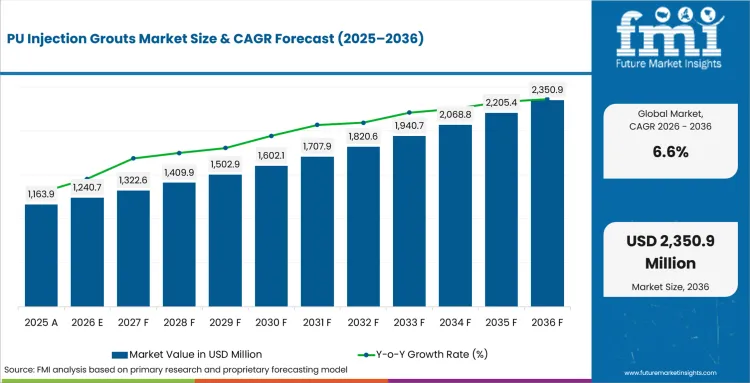
USD 1,240.7 million in 2026 and USD 2,350.9 million by 2036 at a 6.6% CAGR.
Sales of PU injection grouts are estimated to rise at 6.6% CAGR through 2036, increasing valuation from USD 1240.7 million in 2026 to USD 2350.9 million by 2036. Project engineers compare reactive resins through documented laboratory performance and practical application instructions across occupied concrete structures. Product records support that comparison by linking declared performance with approved conditions for use across formal project submittals. In January 2025, the European Commission introduced digital product passports for construction products across member countries. Digital product passports connect declarations with site instructions across the construction chemicals market and project approval.
National maintenance systems produce different purchasing routes despite comparable water-control needs across aging concrete assets. Public owners identify defects through inspections and route repair methods through funding and technical approval processes. Infrastructure grades provide operating context for assets requiring localized intervention rather than immediate product purchasing decisions. In March 2025, the American Society of Civil Engineers assigned stormwater a D grade and wastewater a D+ grade. The ratings connect deterioration with repair planning across distributed asset networks without proving immediate grout purchasing. German budgets and Japanese inspection schedules shape conversion differently from waterproofing admixtures used during new concrete placement projects.
Key Takeaways of PU Injection Grouts Market
- Localized injection preserves usable concrete and reduces disruption across occupied infrastructure during planned maintenance work.
- Single-component products are projected to hold 62.0% share in 2026 owing to simpler preparation.
- Specialty distributors are estimated to capture 37.0% share in 2026 due to local stock.
- Hydrophobic grouts are anticipated to represent 31.0% share in 2026, reflecting recurring wet-condition suitability.
- Hidden leak paths and uncontrolled pumping limit repeatability; equipment upkeep also requires trained field crews.
- Sika, Master Builders Solutions, Mapei, Normet, and Avanti International are focusing on portfolios or injection expertise.
Analyst Perspective
"PU injection grout selection begins with hidden water paths rather than product labels on technical sheets. Contractors match moisture conditions with reaction speed and pumping pressure across cracks that remain concealed during work. Repeat specifications depend on stable water control plus compatible pumps and field guidance during later maintenance cycles."
- Nikhil Kaitwade, Principal Analyst, Future Market Insights
How is the PU Injection Grouts Market segmented?
The PU injection grouts industry is segmented by chemistry, component, application, end use, sales channel, and region.
Chemistry separates hydrophobic and hydrophilic systems from flexible resins or rigid foams used under different moisture conditions. Component analysis distinguishes single-component products from two-component systems requiring controlled proportioning during active field injection work. Applications cover leak waterproofing plus crack sealing and underground repair across several concrete asset types. End users include infrastructure owners and commercial facilities alongside residential or water-system repair programs regionally. Sales channels separate specialty distributors from direct contractor supply and local waterproofing applicator routes regionally. Regional analysis compares specification practices and technical service access as project teams evaluate pump compatibility and formal acceptance documentation across national markets.
What makes hydrophobic PU grouts central to the chemistry category?
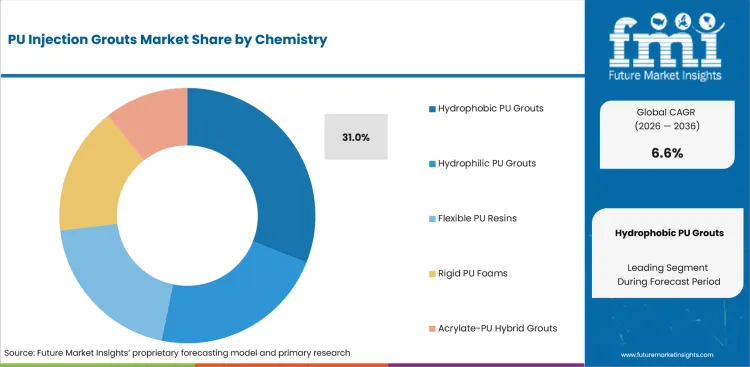
Hydrophobic formulations react with limited moisture and form closed-cell barriers along active leakage paths in concrete. Reaction speed controls grout travel through concealed cracks during pressure injection in underground structures. Crews consider concrete epoxy repair following injection confirmation of a stable and dry restoration zone.
- Hydrophobic PU grouts are set to lead the chemistry category with 31.0% share in 2026 due to wet-condition requirements. Adjustable reaction control supports active leakage work across tunnels with varied pressure and moisture conditions.
- Underground crews select hydrophobic grouts for recurring water entry across concealed structural joints and substrate interfaces. Accurate packer placement protects performance during pressure injection into concrete cracks with uncertain internal geometry.
Why does the single-component segment lead the component category?
Single-component grouts reduce mixing steps and permit compact pumping across basements and underground access points. Restricted preparation space makes proportioning errors a direct operating concern during urgent field repair work. For example, Mapei identifies RESFOAM 1KM as a one-component polyurethane resin for structures and water-bearing rock repairs. Repair mortar additives enter later restoration stages following successful leak control and complete substrate stabilization.
- By component, single-component grouts are estimated to hold 62.0% share in 2026 owing to setup speed and mixing risk. Portable pumps directly reduce setup demands across restricted sites and underground workspaces during urgent repairs. Catalyst selection remains decisive during active leakage work requiring reaction timing and dependable grout travel.
- Compact equipment and limited preparation requirements make single-component systems practical for smaller contractors at confined infrastructure repair sites. Two-component resins remain necessary for controlled reactions or higher strength under demanding underground site conditions. Regional stock supports emergency work without lengthy delivery schedules or complex proportioning equipment at each repair location.
How do waterproofing leaks shape demand within the application category?
Active water entry disrupts basements and utility structures even without a complete mapped leakage pathway. Concealed pathways require application guidance that links leak mapping with controlled injection pressure during repairs. GCP Applied Technologies documents DE NEEF polyurethane injection systems for active water control across infrastructure. Construction sealants remain suitable for accessible joints but cannot reach concealed leakage networks beneath surfaces.
- In 2026, waterproofing leaks are expected to lead the application category with 39.0% share because leakage favors targeted injection. Injection limits demolition across occupied structures with accessible pumping routes during controlled field repair work. Repeat purchasing depends on documented leakage reduction across agreed inspection periods and surrounding concrete areas.
- Facility owners use waterproofing injection to define repair boundaries without removing broad areas of finished concrete surfaces. Leak mapping must confirm a reachable crack or substrate interface during preparation for controlled field pumping. Post-repair observation verifies stability across nearby cracks and surrounding concrete during later inspections and seasonal rainfall cycles.
What supports the infrastructure segment in the end-use category?
Public infrastructure develops recurring leakage across tunnels and water-retaining structures exposed to pressure or movement. Asset owners need repair methods that fit restricted access windows and formal public acceptance procedures. In April 2026, the Department for Transport opened England’s Structures Fund for bridges and tunnels. Tunnel monitoring systems help verify movement outside treated zones during wider rehabilitation and acceptance planning.
- Based on end use, infrastructure is projected to account for 29.0% share in 2026 due to aging assets. Localized injection limits closures across tunnels and water facilities requiring continuous operations and restricted access. Formal acceptance depends on documented leakage reduction and stable surrounding conditions following repairs through owner review.
- Transport authorities use injection across assets with restricted access and costly operational closures during maintenance. Local stock reduces delivery delays across narrow work windows affecting remote tunnels and water facilities. Service teams maintain pumps and adjust chemistry during active repairs across water facilities or underground transport assets with limited access.
What drives specialty construction chemical distributors within the sales channel category?
Specialty distributors combine resin selection with pumps and troubleshooting across projects requiring different reaction profiles. Urgent leakage makes local stock and technical support decisive during contractor mobilization and site approval. SealBoss documents international distribution routes for concrete repair products and application assistance across regional markets. Construction adhesives use comparable channels but rarely require emergency chemistry screening during active water-control repairs.
- The specialty construction chemical distributors segment is likely to capture 37.0% share in 2026 attributable to package demand. Local inventory reduces downtime during active leakage work across scattered repair projects and limited shutdown windows. Technical screening prevents unsuitable chemistry or pump combinations during uncertain site conditions and water pressure.
- Contractors turn to specialty distributors for replacement parts and field guidance across repairs with uncertain grout travel. Direct supply remains practical for large contracts with predictable schedules and dedicated onsite engineering teams. Regional dealers retain an advantage across scattered repairs requiring immediate inventory and application support over broad service territories.
What are the drivers, restraints, and opportunities in the PU Injection Grouts Market?
Aging concrete assets support localized leak repair, while installation variability limits repeatability and integrated service models strengthen recurring maintenance programs.
- Driver: Aging concrete assets require localized water stopping that preserves structures and limits operational disruption.
- Restraint: Hidden pathways require accurate diagnosis and controlled pumping across repairs with uncertain resin travel.
- Opportunity: Integrated service packages combine chemistry selection with equipment support and post-injection verification for maintenance.
Municipal asset owners favor targeted leak repair that preserves usable concrete within constrained maintenance budgets. Public road and water programs prioritize confirmed defects without closing entire structures for costly reconstruction. In June 2026, KfW reported 30% of German municipalities had limited resources for road maintenance. Budget pressure favors scopes that control water first and reserve reconstruction for damage; concrete corrosion inhibitors support later reinforcement treatment across drier substrates during restoration.
Hidden voids make polyurethane placement difficult to predict across cracks that remain concealed from surface inspection. Technicians identify likely pathways and establish controlled injection points through pressure testing during field preparation. Poor pressure control can redirect water into untreated areas and force another mobilization across operating structures with connected leakage paths and limited shutdown time.
Integrated service packages align leak diagnosis with chemistry selection and installed performance across restricted infrastructure repairs. One accountable service team connects onsite pump setup with post-injection observation throughout the complete repair process. In July 2025, Alchatek documented polyurethane leak sealing during the Tom Miller Dam gate replacement. The documented route limits handoff risk and prepares the structure for sprayed concrete systems during later tunnel stabilization with closely coordinated contractor sequencing.
Which country CAGRs are profiled in the PU Injection Grouts Market?
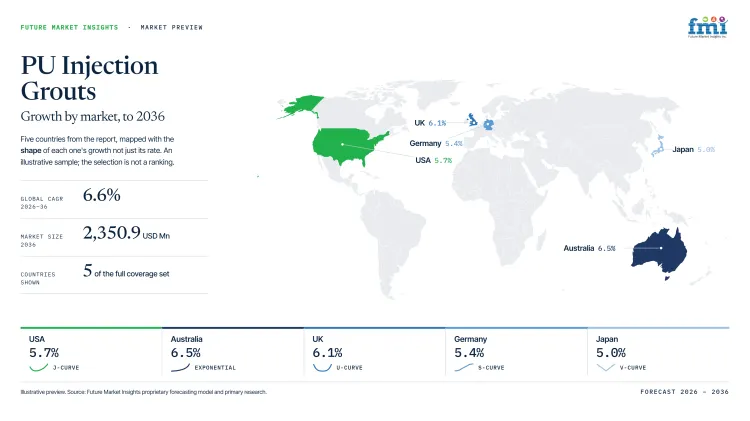
| Country | CAGR |
|---|---|
| United States | 5.7% |
| Germany | 5.4% |
| Japan | 5.0% |
| UK | 6.1% |
| Australia | 6.5% |
How do country-level CAGRs compare in the PU Injection Grouts Market?
Forecasts form a narrow band shaped by maintenance routes rather than uniform conditions across countries. Australia and the United Kingdom pair project pipelines with defined national infrastructure repair funding programs. The United States combines a distributed asset base with varied owner specifications and approval procedures. Germany and Japan rely on qualification systems that extend conversion between defect identification and mobilization. The 1.5-percentage-point spread reflects different purchasing speeds rather than different needs for leakage control. Commercial entry depends on service coverage and qualification timing across each national infrastructure network examined.
- Australia combines infrastructure programs with service distances that constrain specialist response across remote repair locations.
- United Kingdom funding supports repairs but council procedures and restricted access delay approved injection schedules.
- United States demand reflects distributed assets with varied specifications requiring adaptable documentation and local support.
- Germany relies on tender approval and constrained budgets that delay repair contracts for identified leakage.
- Japan applies scheduled inspections yet conservative qualification delays injection across assets with confirmed water ingress.
The full report provides country-level CAGR analysis across North America, Latin America, Europe, East Asia, South Asia, Oceania and the Middle East and Africa.
Country-wise Analysis
- United States infrastructure owners manage bridge repairs through decentralized specifications across federal and local networks. PU injection grout demand in the United States is forecast to rise at 5.7% CAGR over the forecast period, supported by decentralized maintenance. Public agencies use condition records to direct bridge funding across federal and local maintenance networks. In June 2025 the Federal Highway Administration recorded 624,193 bridges; 41,685 carried poor ratings. The distributed bridge base favors regional resin inventory and pump support across active repair schedules. Different agency submittal rules remain the main friction during contractor qualification and final owner approval.
- German municipalities use formal tenders and engineering approval for roads or public buildings requiring documented repair methods. Germany is estimated to post 5.4% CAGR over the forecast period, due to formal qualification routes. KfW reported during July 2025 that 19% of municipalities could invest little or nothing in infrastructure upkeep. Budget limits postpone conversion from confirmed leakage into funded municipal maintenance contracts across local infrastructure. Established distributors provide technical documentation and trained application support across major regions and local municipal repair programs. Lengthy grant procedures remain the main friction despite qualified installers and available repair systems across municipal programs.
- Japanese road authorities classify bridge and tunnel defects through scheduled visual inspections under national maintenance rules. Domestic repair planning follows national condition categories and five-year inspection cycles across covered publicly managed assets. Adoption of PU injection grouts in Japan is estimated to expand at 5.0% CAGR through 2036, supported by scheduled inspections. Japan’s transport ministry confirmed in August 2025 that covered bridges and tunnels receive inspections every five years. Domestic technical channels provide method approval and equipment support across major cities and infrastructure projects. Limited specialist availability remains the main friction across restricted public assets with confirmed water ingress.
- United Kingdom councils manage aging bridges and tunnels through funded programs covering local road infrastructure. Formal maintenance ratings connect public asset conditions with contractor selection and scheduled repair access planning. The Department for Transport reported 13 red-rated local highway authorities during January 2026 across England. By 2036, the United Kingdom is projected to grow at 6.1% CAGR, due to dedicated maintenance programs. Specialist applicators pair local stock with technical support across major regions and scheduled regional public repairs. Council procedures remain the material friction during restricted repair windows and traffic management planning across local highway authorities and aging bridges.
- Australian infrastructure programs cover transport and water assets across large service distances and varied environments. PU injection grout sales in Australia are forecast to expand at 6.5% CAGR by 2036, aided by public project pipelines. Remote project routes place unusual pressure on local stock plus technician travel and equipment support planning. Infrastructure Australia reported during November 2025 that workforce shortages could reach 300,000 by 2027. National distributors help offset that shortage through regional resin inventory and technical assistance across population centers. Long travel distances remain a material friction for remote water and transport assets requiring specialist field service.
Who are the notable companies in the PU Injection Grouts Market?
Sika, Master Builders Solutions, Mapei, GCP Applied Technologies, Normet, Euclid Chemical, SealBoss, Avanti International, Alchatek, and Fosroc are notable companies profiled in this market.
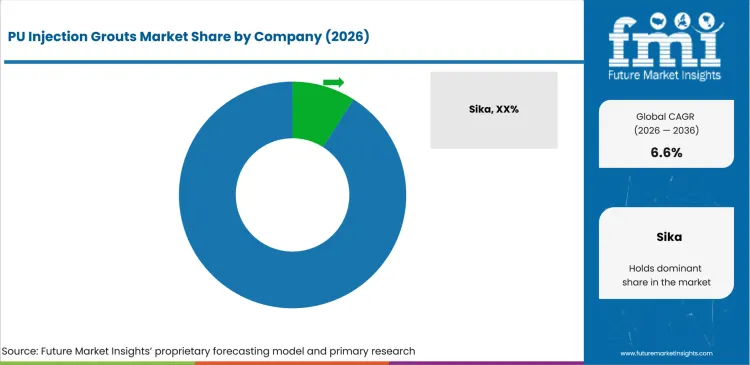
The competitive field is moderately fragmented as broad construction-chemical groups compete beside injection specialists and established regional channels. Large groups use wider restoration portfolios and multi-region distribution across established contractor networks and infrastructure programs. Specialists concentrate on polyurethane chemistry plus pumps and onsite technical troubleshooting for difficult leakage conditions. Entry remains possible for focused formulators establishing credible technical support and reliable local inventory channels. Structural waterproofing services strengthen repeat specifications by linking diagnosis with installation responsibility across complex infrastructure repairs.
- Sika and Master Builders Solutions provide injection chemistries across water control and underground construction through broad international distribution channel networks. Normet and GCP Applied Technologies add documented polyurethane guidance plus equipment support across confined infrastructure worksites and underground projects worldwide.
- Mapei and Euclid Chemical combine polyurethane injection products with wider concrete repair portfolios across established commercial distribution channels worldwide. Fosroc extends coordinated waterproofing and restoration systems across regions that purchase complementary repair materials following successful leak sealing and stabilization work.
- SealBoss and Avanti International combine specialist grout choices with pumps or packers for difficult leakage conditions across infrastructure assets. Alchatek adds hydrophobic and hydrophilic systems with technical training that supports contractors across complex leak-sealing and foundation-repair projects in field conditions.
Competitive Benchmarking: PU Injection Grouts Market
| Company | PU Portfolio Breadth | Application Support | Channel Support | Geographic Reach |
|---|---|---|---|---|
| Sika | High | High | High | Global or multi-region |
| Master Builders Solutions | High | High | High | Global or multi-region |
| Mapei | Medium | High | Medium | Global or multi-region |
| GCP Applied Technologies | High | High | Medium | Global or multi-region |
| Normet | High | High | High | Global or multi-region |
| Euclid Chemical | Medium | High | High | Global or multi-region |
| SealBoss | High | High | Medium | North America and export |
| Avanti International | High | High | High | North America and dealer-led export |
| Alchatek | High | High | Medium | North America and distributor-led international markets |
| Fosroc | Medium | High | High | Global or multi-region |
Scoring basis: Portfolio breadth rates high for multiple systems; medium for selective ranges; low for narrow specialization. Application support rates high for detailed guidance; medium for standard documents; low for basic instructions. Channel support rates high for broad distribution; medium for regional coverage; low for narrow access.
Key Developments in the PU Injection Grouts Market
- In May 2025, Alchatek documented Shell Lake Dam repair using Spetec PUR H100 following failed bentonite treatment. Engineers injected hydrophobic polyurethane along the concrete and sandstone interface to form a grout curtain. The case connected leak-path diagnosis with water stopping across a foundation repair under field conditions; the documented route supports dam repairs requiring injection access and subsurface flow control.
- In July 2025, Avanti International documented nuclear facility repair using AV-278 grout around cooling pipe. The contractor combined void filling with stitch grouting during a tightly controlled operational shutdown window.
- In February 2025, Saint-Gobain completed the Fosroc acquisition, adding it to the group's construction-chemicals platform. Fosroc contributes polyurethane injection resins within a portfolio of concrete repair systems across multiple regions.
PU Injection Grouts Market - Report Scope
| Coverage field | Report scope |
|---|---|
| Market breakdown | chemistry, component, application, end use, sales channel, and region |
| Quantitative Units | Revenue in USD million and CAGR in %. |
| Market Definition | Polyurethane resin systems injected into cracks, joints, voids, soils, or interfaces for water control, sealing, stabilization, and repair |
| Regions Covered | North America, Latin America, Western Europe, Eastern Europe, East Asia, South Asia and Pacific, and Middle East and Africa |
| Countries Covered | United States, Canada, Brazil, Mexico, Argentina, Chile, Germany, France, United Kingdom, Italy, Spain, Benelux, Nordics, Poland, Czech Republic, Romania, Hungary, China, Japan, South Korea, India, ASEAN, Australia and New Zealand, GCC Countries, South Africa, Türkiye, and Israel |
| Key Companies Profiled | Sika, Master Builders Solutions, Mapei, GCP Applied Technologies, Normet, Euclid Chemical, SealBoss, Avanti International, Alchatek, and Fosroc |
| Forecast Period | 2026 to 2036 |
| Approach | Hybrid bottom-up and top-down market sizing supported by segment assessment, country-level analysis, company benchmarking, and evidence-based forecasting. |
PU Injection Grouts Market - Research Methodology
| Method | Approach |
|---|---|
| Primary Research | FMI analysts gathered input from manufacturers, service providers, technology developers, distributors, end users, procurement teams, and subject-matter experts. Interviews examined purchasing decisions, product or service evaluation, adoption barriers, approval requirements, pricing considerations, and expectations for technical or commercial support. Respondents were also asked what evidence is required before a trial, pilot, or initial order develops into regular purchasing. |
| Desk Research | Desk research covered government statistics, regulatory publications, trade data, industry associations, technical literature, standards, company filings, product information, and official corporate announcements. Sources were reviewed for relevance, publication date, geographic coverage, and consistency with the defined market scope. Claims relating to performance, applications, approvals, capacity, investment, and commercial activity were retained only when supported by credible public evidence. |
| Market Sizing and Forecasting | The market model combined the baseline value with historical performance, segment structure, pricing and volume indicators, adoption levels, company participation, and country-level demand conditions. Forecast assumptions considered economic activity, investment trends, regulatory developments, technology adoption, purchasing cycles, supply availability, and barriers to wider market use. Segment and regional estimates were reconciled before the final market total was calculated. |
| Data Validation | Estimates were checked against multiple independent indicators, including public data, company activity, trade patterns, industry developments, and findings from primary interviews. Validation also tested whether products, services, applications, and company revenues fell within the defined market boundaries. Adjacent categories, unsupported claims, overlapping revenues, and activities without direct market relevance were excluded to reduce double counting and maintain consistency across segments and countries. |
PU Injection Grouts Market by Segments
PU Injection Grouts Market segmented by Chemistry:
- Hydrophobic PU Grouts
- Hydrophilic PU Grouts
- Flexible PU Resins
- Rigid PU Foams
- Acrylate-PU Hybrid Grouts
PU Injection Grouts Market segmented by Component:
- Single-component
- Two-component
PU Injection Grouts Market segmented by Application:
- Waterproofing Leaks
- Crack Sealing
- Tunnel Injection
- Basement / Foundation Repair
- Sewer / Manhole Repair
PU Injection Grouts Market segmented by End Use:
- Infrastructure
- Commercial Buildings
- Residential Repair
- Water / Wastewater
- Mining / Tunnels
PU Injection Grouts Market segmented by Sales Channel:
- Specialty Construction Chemical Distributors
- Direct Contractor Supply
- Waterproofing Applicators
- Retail / Repair Kits
PU Injection Grouts Market by Region:
- North America
- United States
- Canada
- Latin America
- Brazil
- Mexico
- Argentina
- Chile
- Western Europe
- Germany
- France
- United Kingdom
- Italy
- Spain
- Benelux
- Nordics
- Eastern Europe
- Poland
- Czech Republic
- Romania
- Hungary
- East Asia
- China
- Japan
- South Korea
- South Asia and Pacific
- India
- ASEAN
- Australia and New Zealand
- Middle East and Africa
- GCC Countries
- South Africa
- Türkiye
- Israel
Research Sources and Bibliography
- Directorate-General for Internal Market, Industry, Entrepreneurship and SMEs. (2025, January 7). New EU rules on the safety and sustainability of construction products mark a new step for the sector’s competitiveness.
- American Society of Civil Engineers. (2025, March 25). 2025 Infrastructure Report Card.
- Federal Highway Administration. (2025, June 15). Bridge Condition by Highway System 2025.
- KfW Research. (2026, June 17). KfW Municipal Panel: Municipalities want to significantly ramp up their investment this year.
- KfW Research. (2025, July 1). KfW Research: Municipalities complain about worsening investment backlog.
- Ministry of Land, Infrastructure, Transport and Tourism. (2025, August 25).
- Department for Transport. (2026, April 15). Fixing the foundations: Government fund to fix England’s bridges, flyovers and tunnels now open.
- Department for Transport. (2026, January 11). Local road maintenance ratings 2025 to 2026.
- Infrastructure Australia. (2025, November 13). 2025 Infrastructure Market Capacity Report.
- Alchatek. (2025, May 21). Case Study - Shell Lake Dam Foundation Leak Repair.
- Avanti International. (2025, June 13). Case Study: Geotechnical Soil Stabilization and Water Control Remediation of the Ogle Lake Spillway.
- Avanti International. (2025, July 22). Case Study: Water Cooling Pipe Leak Creates Massive Voids, Infiltration Issues at Nuclear Power Generating Station Site.
- Saint-Gobain. (2025, February 10). Saint-Gobain completes the acquisition of FOSROC, a leading player in construction chemicals in Asia and emerging markets, further strengthening its worldwide presence in the sector.
- Master Builders Solutions. (n.d.). Injection & Ground Improvement.
- GCP Applied Technologies. (n.d.). DE NEEF® Waterproofing Injection Solutions.
- Avanti International. (n.d.). Avanti’s Hydrophobic Polyurethane Grouts: Superior Soil Stabilization & Water Control.
This bibliography is provided for reader reference and is not exhaustive. The full report contains the complete reference list and detailed citations
This Report Answers
- What factors are driving demand for PU Injection Grouts across construction, tunneling, and waterproofing applications?
- Which repair and remediation applications account for the highest usage of PU injection grouts?
- Why do single-component PU injection grouts hold the dominant share of the market?
- How do hydrophobic PU injection grouts perform in water-sealing and leak-control applications?
- Why do distributors play a critical role in market reach, product availability, and customer support?
- How do market trends, demand patterns, and growth prospects differ across key countries?
- Which leading companies are competing in the global PU Injection Grouts market?
- Which application, installation, and environmental risks can reduce grout performance and project effectiveness?
Frequently Asked Questions
How big is the PU Injection Grouts Market in 2026?
The PU injection grouts market is valued at USD 1240.7 million in 2026 and is forecast to reach USD 2350.9 million by 2036. Growth is supported by aging concrete infrastructure sustaining recurring demand for localized leak repair and water-control injection across occupied structures.
What is the CAGR of the PU Injection Grouts Market from 2026 to 2036?
The PU injection grouts market grows at a CAGR of 6.6% between 2026 and 2036, supported by infrastructure owners adopting localized injection repair once leak diagnosis confirms accessible cracks within concrete assets requiring water control across tunnels, water-retaining structures, and occupied maintenance sites.
Which component leads the PU Injection Grouts Market?
Single-component systems account for 62.0% of the PU injection grouts market by component in 2026, driven by simpler preparation and compact pumping that let contractors reduce mixing steps and proportioning errors during urgent field repairs at restricted underground and basement access points.
How much will the PU Injection Grouts Market add between 2026 and 2036?
The PU injection grouts market is set to add USD 1110.2 million between 2026 and 2036, growing from USD 1240.7 million to USD 2350.9 million as localized injection repair expands across aging tunnels, water-retaining structures, and occupied infrastructure requiring documented leak control worldwide.
Who are the leading companies in the PU Injection Grouts Market?
Ten companies lead the PU injection grouts market, including Sika, Master Builders Solutions, Mapei, GCP Applied Technologies, and Normet, competing through hydrophobic and hydrophilic polyurethane chemistries, pump and packer systems, and technical field support across infrastructure, tunnel, and underground waterproofing repair projects worldwide.
Preview the report firsthand - request a free sample
Get SampleGet the brochure for pricing and purchase details.
Get PDFTable of Content
- Key Takeaways
- Market Size and CAGR
- Top Growth Driver
- Fastest Growing Segment
- Leading Region
- Key Companies
- Emerging Opportunities
- Executive Summary
- Global Market Outlook
- Demand-side Trends
- Supply-side Trends
- Technology Roadmap Analysis
- Analysis and Recommendations
- Analyst Perspective (What is happening? Why now? What should investors know?)
- Key Questions Answered
- How large is the market?
- What is the CAGR?
- What are key trends?
- Which region dominates?
- Who are the leaders?
- Market Overview
- Market Coverage / Taxonomy
- Market Definition / Scope / Limitations
- Research Methodology
- Chapter Orientation
- Analytical Lens and Working Hypotheses
- Market Structure, Signals, and Trend Drivers
- Benchmarking and Cross-market Comparability
- Market Sizing, Forecasting, and Opportunity Mapping
- Research Design and Evidence Framework
- Desk Research Programme (Secondary Evidence)
- Expert Input and Fieldwork (Primary Evidence)
- Tooling, Models, and Reference Databases
- Data Engineering and Model Build
- Quality Assurance and Audit Trail
- Market Background
- Market Dynamics (Drivers, Restraints, Opportunity, Trends)
- Scenario Forecast (Optimistic, Likely, Conservative)
- Impact Analysis
- AI Impact
- Sustainability Impact
- Regulatory Impact
- Technology Impact
- Consumer / Buyer Analysis
- Purchase Drivers
- Adoption Barriers
- Buyer Journey
- Opportunity Map Analysis
- Product Life Cycle Analysis
- Supply Chain Analysis
- Investment Feasibility Matrix
- Value Chain Analysis
- PESTLE and Porter's Analysis
- Regulatory Landscape
- Regional Parent Market Outlook
- Production and Consumption Statistics
- Import and Export Statistics
- Global Market Analysis and Forecast, 2021 to 2036
- Historical Market Size Value (USD Million) Analysis, 2021 to 2025
- Current and Future Market Size Value (USD Million) Projections, 2026 to 2036
- Y-o-Y Growth Trend Analysis
- Absolute $ Opportunity Analysis
- Global Market Pricing Analysis, 2021 to 2036
- Global Market Analysis and Forecast, By Chemistry, 2021 to 2036
- Introduction / Key Findings
- Historical Market Size Value (USD Million) Analysis By Chemistry, 2021 to 2025
- Current and Future Market Size Value (USD Million) Analysis and Forecast By Chemistry, 2026 to 2036
- Hydrophobic PU Grouts
- Hydrophilic PU Grouts
- Flexible PU Resins
- Rigid PU Foams
- Acrylate-PU Hybrid Grouts
- Hydrophobic PU Grouts
- Y-o-Y Growth Trend Analysis By Chemistry, 2021 to 2025
- Absolute $ Opportunity Analysis By Chemistry, 2026 to 2036
- Global Market Analysis and Forecast, By Component, 2021 to 2036
- Introduction / Key Findings
- Historical Market Size Value (USD Million) Analysis By Component, 2021 to 2025
- Current and Future Market Size Value (USD Million) Analysis and Forecast By Component, 2026 to 2036
- Single-component
- Two-component
- Single-component
- Y-o-Y Growth Trend Analysis By Component, 2021 to 2025
- Absolute $ Opportunity Analysis By Component, 2026 to 2036
- Global Market Analysis and Forecast, By Application, 2021 to 2036
- Introduction / Key Findings
- Historical Market Size Value (USD Million) Analysis By Application, 2021 to 2025
- Current and Future Market Size Value (USD Million) Analysis and Forecast By Application, 2026 to 2036
- Waterproofing Leaks
- Crack Sealing
- Tunnel Injection
- Basement / Foundation Repair
- Sewer / Manhole Repair
- Waterproofing Leaks
- Y-o-Y Growth Trend Analysis By Application, 2021 to 2025
- Absolute $ Opportunity Analysis By Application, 2026 to 2036
- Global Market Analysis and Forecast, By End Use, 2021 to 2036
- Introduction / Key Findings
- Historical Market Size Value (USD Million) Analysis By End Use, 2021 to 2025
- Current and Future Market Size Value (USD Million) Analysis and Forecast By End Use, 2026 to 2036
- Infrastructure
- Commercial Buildings
- Residential Repair
- Water / Wastewater
- Mining / Tunnels
- Infrastructure
- Y-o-Y Growth Trend Analysis By End Use, 2021 to 2025
- Absolute $ Opportunity Analysis By End Use, 2026 to 2036
- Global Market Analysis and Forecast, By Sales Channel, 2021 to 2036
- Introduction / Key Findings
- Historical Market Size Value (USD Million) Analysis By Sales Channel, 2021 to 2025
- Current and Future Market Size Value (USD Million) Analysis and Forecast By Sales Channel, 2026 to 2036
- Specialty Construction Chemical Distributors
- Direct Contractor Supply
- Waterproofing Applicators
- Retail / Repair Kits
- Specialty Construction Chemical Distributors
- Y-o-Y Growth Trend Analysis By Sales Channel, 2021 to 2025
- Absolute $ Opportunity Analysis By Sales Channel, 2026 to 2036
- Global Market Analysis and Forecast, By Region, 2021 to 2036
- Introduction
- Historical Market Size Value (USD Million) Analysis By Region, 2021 to 2025
- Current Market Size Value (USD Million) Analysis and Forecast By Region, 2026 to 2036
- North America
- Latin America
- Western Europe
- Eastern Europe
- East Asia
- South Asia and Pacific
- Middle East & Africa
- Market Attractiveness Analysis By Region
- North America Market Analysis and Forecast, By Country, 2021 to 2036
- Historical Market Size Value (USD Million) Trend Analysis By Market Taxonomy, 2021 to 2025
- Market Size Value (USD Million) Forecast By Market Taxonomy, 2026 to 2036
- By Country
- USA
- Canada
- By Chemistry
- By Component
- By Application
- By End Use
- By Sales Channel
- By Country
- Market Attractiveness Analysis
- By Country
- By Chemistry
- By Component
- By Application
- By End Use
- By Sales Channel
- Key Takeaways
- Latin America Market Analysis and Forecast, By Country
- Historical Market Size Value (USD Million) Trend Analysis By Market Taxonomy, 2021 to 2025
- Market Size Value (USD Million) Forecast By Market Taxonomy, 2026 to 2036
- By Country
- Brazil
- Mexico
- Chile
- Rest of Latin America
- By Chemistry
- By Component
- By Application
- By End Use
- By Sales Channel
- By Country
- Market Attractiveness Analysis
- By Country
- By Chemistry
- By Component
- By Application
- By End Use
- By Sales Channel
- Key Takeaways
- Western Europe Market Analysis and Forecast, By Country
- Historical Market Size Value (USD Million) Trend Analysis By Market Taxonomy, 2021 to 2025
- Market Size Value (USD Million) Forecast By Market Taxonomy, 2026 to 2036
- By Country
- Germany
- UK
- Italy
- Spain
- France
- Nordic
- BENELUX
- Rest of Western Europe
- By Chemistry
- By Component
- By Application
- By End Use
- By Sales Channel
- By Country
- Market Attractiveness Analysis
- By Country
- By Chemistry
- By Component
- By Application
- By End Use
- By Sales Channel
- Key Takeaways
- Eastern Europe Market Analysis and Forecast, By Country
- Historical Market Size Value (USD Million) Trend Analysis By Market Taxonomy, 2021 to 2025
- Market Size Value (USD Million) Forecast By Market Taxonomy, 2026 to 2036
- By Country
- Russia
- Poland
- Hungary
- Balkan & Baltic
- Rest of Eastern Europe
- By Chemistry
- By Component
- By Application
- By End Use
- By Sales Channel
- By Country
- Market Attractiveness Analysis
- By Country
- By Chemistry
- By Component
- By Application
- By End Use
- By Sales Channel
- Key Takeaways
- East Asia Market Analysis and Forecast, By Country
- Historical Market Size Value (USD Million) Trend Analysis By Market Taxonomy, 2021 to 2025
- Market Size Value (USD Million) Forecast By Market Taxonomy, 2026 to 2036
- By Country
- China
- Japan
- South Korea
- By Chemistry
- By Component
- By Application
- By End Use
- By Sales Channel
- By Country
- Market Attractiveness Analysis
- By Country
- By Chemistry
- By Component
- By Application
- By End Use
- By Sales Channel
- Key Takeaways
- South Asia and Pacific Market Analysis and Forecast, By Country
- Historical Market Size Value (USD Million) Trend Analysis By Market Taxonomy, 2021 to 2025
- Market Size Value (USD Million) Forecast By Market Taxonomy, 2026 to 2036
- By Country
- India
- ASEAN
- Australia & New Zealand
- Rest of South Asia and Pacific
- By Chemistry
- By Component
- By Application
- By End Use
- By Sales Channel
- By Country
- Market Attractiveness Analysis
- By Country
- By Chemistry
- By Component
- By Application
- By End Use
- By Sales Channel
- Key Takeaways
- Middle East & Africa Market Analysis and Forecast, By Country
- Historical Market Size Value (USD Million) Trend Analysis By Market Taxonomy, 2021 to 2025
- Market Size Value (USD Million) Forecast By Market Taxonomy, 2026 to 2036
- By Country
- Kingdom of Saudi Arabia
- Other GCC Countries
- Türkiye
- South Africa
- Other African Union
- Rest of Middle East & Africa
- By Chemistry
- By Component
- By Application
- By End Use
- By Sales Channel
- By Country
- Market Attractiveness Analysis
- By Country
- By Chemistry
- By Component
- By Application
- By End Use
- By Sales Channel
- Key Takeaways
- Key Countries Market Analysis
- USA
- Pricing Analysis
- Market Share Analysis, 2025
- By Chemistry
- By Component
- By Application
- By End Use
- By Sales Channel
- Canada
- Pricing Analysis
- Market Share Analysis, 2025
- By Chemistry
- By Component
- By Application
- By End Use
- By Sales Channel
- Mexico
- Pricing Analysis
- Market Share Analysis, 2025
- By Chemistry
- By Component
- By Application
- By End Use
- By Sales Channel
- Brazil
- Pricing Analysis
- Market Share Analysis, 2025
- By Chemistry
- By Component
- By Application
- By End Use
- By Sales Channel
- Chile
- Pricing Analysis
- Market Share Analysis, 2025
- By Chemistry
- By Component
- By Application
- By End Use
- By Sales Channel
- Germany
- Pricing Analysis
- Market Share Analysis, 2025
- By Chemistry
- By Component
- By Application
- By End Use
- By Sales Channel
- UK
- Pricing Analysis
- Market Share Analysis, 2025
- By Chemistry
- By Component
- By Application
- By End Use
- By Sales Channel
- Italy
- Pricing Analysis
- Market Share Analysis, 2025
- By Chemistry
- By Component
- By Application
- By End Use
- By Sales Channel
- Spain
- Pricing Analysis
- Market Share Analysis, 2025
- By Chemistry
- By Component
- By Application
- By End Use
- By Sales Channel
- France
- Pricing Analysis
- Market Share Analysis, 2025
- By Chemistry
- By Component
- By Application
- By End Use
- By Sales Channel
- India
- Pricing Analysis
- Market Share Analysis, 2025
- By Chemistry
- By Component
- By Application
- By End Use
- By Sales Channel
- ASEAN
- Pricing Analysis
- Market Share Analysis, 2025
- By Chemistry
- By Component
- By Application
- By End Use
- By Sales Channel
- Australia & New Zealand
- Pricing Analysis
- Market Share Analysis, 2025
- By Chemistry
- By Component
- By Application
- By End Use
- By Sales Channel
- China
- Pricing Analysis
- Market Share Analysis, 2025
- By Chemistry
- By Component
- By Application
- By End Use
- By Sales Channel
- Japan
- Pricing Analysis
- Market Share Analysis, 2025
- By Chemistry
- By Component
- By Application
- By End Use
- By Sales Channel
- South Korea
- Pricing Analysis
- Market Share Analysis, 2025
- By Chemistry
- By Component
- By Application
- By End Use
- By Sales Channel
- Russia
- Pricing Analysis
- Market Share Analysis, 2025
- By Chemistry
- By Component
- By Application
- By End Use
- By Sales Channel
- Poland
- Pricing Analysis
- Market Share Analysis, 2025
- By Chemistry
- By Component
- By Application
- By End Use
- By Sales Channel
- Hungary
- Pricing Analysis
- Market Share Analysis, 2025
- By Chemistry
- By Component
- By Application
- By End Use
- By Sales Channel
- Kingdom of Saudi Arabia
- Pricing Analysis
- Market Share Analysis, 2025
- By Chemistry
- By Component
- By Application
- By End Use
- By Sales Channel
- Türkiye
- Pricing Analysis
- Market Share Analysis, 2025
- By Chemistry
- By Component
- By Application
- By End Use
- By Sales Channel
- South Africa
- Pricing Analysis
- Market Share Analysis, 2025
- By Chemistry
- By Component
- By Application
- By End Use
- By Sales Channel
- USA
- Market Structure Analysis
- Competition Dashboard
- Competition Benchmarking
- Market Share Analysis of Top Players
- By Regional
- By Chemistry
- By Component
- By Application
- By End Use
- By Sales Channel
- Emerging Startups
- Innovation Benchmarking
- Competition Analysis
- Competition Deep Dive
- Sika
- Overview
- Product Portfolio
- Profitability by Market Segments
- Sales Footprint
- Strategy Overview
- Marketing Strategy
- Product Strategy
- Channel Strategy
- Master Builders Solutions
- Mapei
- GCP Applied Technologies
- Normet
- Tremco CPG
- SealBoss
- Avanti International
- Spetec
- Fosroc
- Sika
- Case Studies
- Success Stories
- Recent Developments
- Competition Deep Dive
- Assumptions & Acronyms Used


