

- Market Size (2026)
- USD 537.3 Mn
- Forecast (2036)
- USD 858.7 Mn
- CAGR (2026 to 2036)
- 4.8%
How big is PU Sole Catalysts Market in 2026?
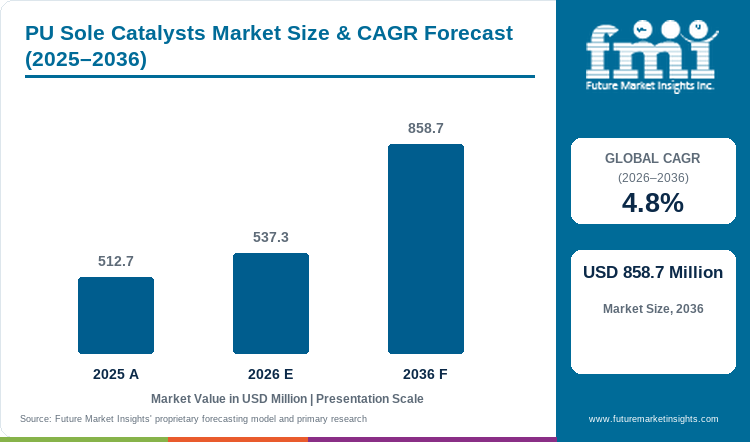
USD 537.3 Million in 2026 and USD 858.7 Million by 2036 at a 4.8% CAGR.
The PU Sole Catalysts market stood at USD 512.7 Million in 2025, is estimated at USD 537.3 Million in 2026, and is forecast to reach USD 858.7 Million by 2036 at a 4.8% CAGR from 2026 to 2036. The market advances as footwear formulators demand tighter control over the short reaction window between mold filling and demold. Catalysts represent a small formulation component but have an outsized effect on cream time and gel development in microcellular PU. They also influence flow and back-end cure. The wider polyurethane foam market is sensitive to the same cure window.
BASF product documentation identifies Lupragen N203 as a TEDA catalyst in monoethylene glycol and a classical catalyst for shoe soles. In April 2024, Evonik also presented negligible-emission catalyst technologies as part of its current polyurethane-additives direction. Momentive likewise positions Niax catalysts around selective reaction kinetics and delayed-action processing for microcellular applications. The commercial bridge from USD 537.3 Million in 2026 to USD 858.7 Million in 2036 therefore depends less on catalyst volume alone than on formulation turnover.
System houses and footwear processors reformulate for shorter cycles or new sole architectures. They also respond to lower-emission and alternative-metal requirements. Purchasing shifts when a catalyst can improve the processing window without creating a new mechanical-performance qualification problem. Country conditions change the route to that purchase. Portugal and Mexico combine active footwear-manufacturing clusters with export-oriented production, making local formulation support and reliable supply important for catalyst conversion.
Germany and France place greater emphasis on documented protective-footwear selection and conformity, which increases the cost of changing a qualified formulation. Japan adds a standards-led requirement: national safety-footwear guidance recognizes foamed polyurethane as an outsole material and maintains defined performance tests. Brazil combines a large footwear-production base with PPE certification requirements for safety products, while the USA remains influenced by workplace foot-protection rules and globalized footwear sourcing. Across these models, supplier access is strongest when catalyst vendors work through PU system houses or application laboratories that can translate reactivity changes into finished-sole test results. Interest converts into an order only after the proposed catalyst preserves density and cell structure. It must also maintain mechanical properties and repeatable molding behavior.
Key Takeaways
- The market is estimated at USD 537.3 Million in 2026 and is forecast to reach USD 858.7 Million by 2036 at a 4.8% CAGR.
- Amine catalysts lead the market in 2026. Polyester PU soles lead in 2026.
- Safety shoes lead the market in 2026. Cream time control leads in 2026. PU system houses lead the market in 2026.
- Driver: Higher-value safety and technical footwear requires repeatable cream time, cure, and cell structure in PU sole molding.
- Restraint: Changing catalyst chemistry can force formulation trials and finished-sole requalification before a processor accepts the switch.
- Opportunity: Delayed-action, low-emission and alternative-metal catalysts can replace higher-concern chemistry when they preserve incumbent processing behavior. Portugal has the highest profiled country CAGR at 5.6%, compared with Japan at 3.6%.
Analyst Perspective
Revenue capture depends on proving processing equivalence, not simply offering a different catalyst chemistry. Suppliers need application data that connects cream time and cure behavior to mold fill, demold cycle and finished-sole properties.
- Nikhil Kaitwade, Principal Consultant, Future Market Insights
How is the PU Sole Catalysts Market segmented?
The market is segmented by Catalyst Type, PU System, Footwear Type, Function, and Sales Channel.
Catalyst Type separates amine, tin, bismuth, delayed-action, and low-emission chemistries according to the reaction profile a formulator needs.
PU System distinguishes polyester, polyether, dual-density, TPU hybrid, and safety-footwear constructions because each creates a different balance of flow, cure, and durability. Footwear Type separates safety, casual, sports, sandal or slipper, and industrial-boot demand according to performance and cycle requirements.
Function identifies whether the catalyst is bought primarily for cream-time control, cure acceleration, cell-structure control, or low-VOC processing. Sales Channel separates the formulation role of PU system houses from direct OEM purchases, chemical distribution, and direct catalyst supply.
What makes Amine catalysts central to the Catalyst Type category?
Amine catalysts are central because footwear processors need a reaction package that can be tuned across front-end delay and back-end cure without relying on one metal-catalyst pathway. Tertiary amines such as TEDA have a long record in microcellular PU and can be supplied in carrier systems that simplify dosing.
The category also supports selective gelling or blowing activity. Balanced amine systems help system houses adjust formulations for mold geometry and throughput.
Tin and bismuth catalysts remain useful where strong gelling or alternative-metal performance is needed, while low-emission and delayed-action variants serve narrower processing or compliance objectives.
That breadth keeps amines embedded in footwear formulation work even as suppliers refine emissions and odor profiles.
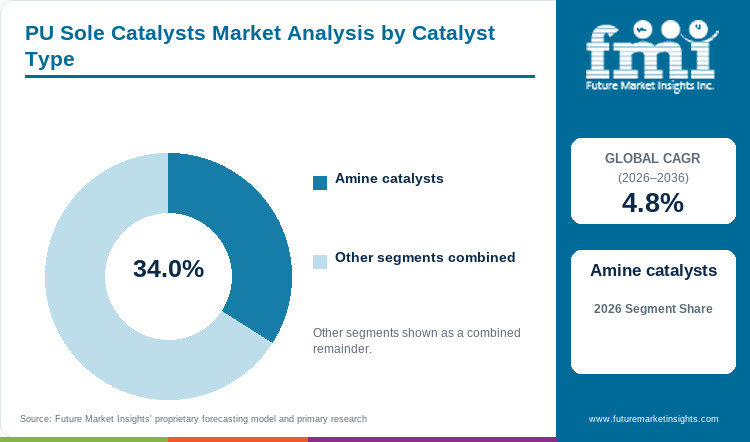
- Amine catalysts account for 34.0% of the market in 2026, reflecting their ability to tune gelling and blowing behavior across established microcellular PU formulations.
- In April 2024, Evonik presented its latest polyurethane additive solutions at UTECH Europe and highlighted a global amine platform alongside negligible-emission catalyst options, showing how incumbent amine chemistry is being extended toward lower-emission processing.
Why do Polyester PU soles lead the PU System category?
Polyester PU soles lead because footwear producers continue to use polyester-based systems where abrasion resistance, toughness, and sole integrity are prioritized.
Catalyst selection in these systems is not interchangeable with every polyether formulation because front-end delay, viscosity development, and end cure must be balanced against the polyester chemistry and moisture sensitivity of the complete system.
Momentive technical literature for shoe-sole catalysts specifically evaluates delayed cream time and end cure in polyester-based sole formulations, illustrating the formulation work required around this substrate family.
Polyether systems remain important where hydrolysis resistance or specific comfort properties dominate, while dual-density and hybrid constructions add interface and cycle-control requirements.
- Polyester PU soles hold a 32.0% share in 2026 because their established footwear use rewards catalyst packages that preserve abrasion-oriented performance while maintaining mold-filling and demold control.
- Momentive’s current Niax polyurethane-additives guidance includes microcellular and shoe-sole catalyst selections with delayed-action options, providing a direct formulation reference for footwear processors managing polyester and related PU systems.
What supports Safety shoes in the Footwear Type category?
Safety shoes lead because their soles are bought against explicit performance requirements rather than appearance alone. Protective-footwear programs assess attributes such as slip resistance, mechanical protection, and suitability for the workplace hazard.
That makes sole density and cell structure more consequential to the formulator. Bond integrity and repeatable cure also matter. PU is well suited to light, direct-molded protective footwear, but catalyst changes can affect both processing and the final test result.
Casual and sports footwear provide substantial volume, yet they often allow broader material and construction choices. Safety-shoe formulations therefore create a persistent need for catalyst packages that combine cycle productivity with qualification stability.
- Safety shoes lead the market in 2026, supported by specification-led use cases in which catalyst selection must preserve both manufacturing consistency and finished-sole performance.
- In September 2024, BASF used Simac to present new Elastopan footwear processing concepts and lighter PU sole solutions that included safety-shoe applications, reinforcing the continued role of tailored PU chemistry in protective footwear.
How does Cream time control shape the Function category?
Cream time control leads because shoe-sole molding requires enough early-stage delay for mixing and mold fill, followed by a cure profile that supports practical demold times. A catalyst that reacts too quickly can reduce flow and increase fill defects.
A catalyst that is too slow can lengthen the cycle or leave the part under-cured. Delayed-action catalysts therefore create value by separating the handling window from the main reaction rise. The same principle matters in complex or larger molds where the formulation must move before viscosity builds.
Cure acceleration and cell-structure control remain important, but both are usually constrained by the front-end window available to the processor.
- Cream time control leads in 2026 because it governs the usable processing window before rapid urethane formation makes mold filling difficult.
- Momentive’s Niax catalyst portfolio documents delayed-action gelling and blowing options for microcellular applications, directly linking catalyst choice to front-end processing delay and controlled back-end cure.
Why do PU system houses lead the Sales Channel category?
PU system houses lead because the catalyst is normally qualified as part of a complete footwear recipe rather than as an isolated raw material. The system-house formulator balances the polyol package with chain extenders and surfactants before the recipe reaches the footwear line.
Pigments, blowing inputs, and catalysts are then tuned around that system. This position lets system houses solve reaction timing and finished-property problems together.
Footwear OEMs may buy catalysts directly when they maintain internal formulation capability, while distributors serve smaller or geographically dispersed processors. Direct catalyst suppliers remain important for technical support and specialty chemistry.
The system-house channel captures the largest share because it concentrates formulation accountability at the point where catalyst performance is approved.
- PU system houses lead the market in 2026, reflecting their role in integrating catalysts into complete sole formulations before production-scale approval.
- Huntsman’s DALTOPED footwear portfolio includes activator blends containing catalysts and other formulation components for microcellular PU injection systems, illustrating why catalyst demand is frequently embedded within system-house chemistry rather than purchased as a stand-alone line item.
What are the drivers, restraints, and opportunities in the PU Sole Catalysts Market?
Specification-led PU footwear production supports catalyst demand, while formulation requalification slows switching and low-emission or non-tin chemistry creates the clearest product-development opening.
- Driver: Higher-value safety and technical footwear requires repeatable cream time, cure, and cell structure in PU sole molding.
- Restraint: Changing catalyst chemistry can force formulation trials and finished-sole requalification before a processor accepts the switch.
- Opportunity: Delayed-action, low-emission, and alternative-metal catalysts can replace higher-concern chemistry when they preserve incumbent processing behavior.
The driver is the processor’s need to hold a narrow production window while meeting a finished-footwear specification. Safety and technical footwear magnify that need because a sole formulation can be rejected for mechanical or slip-performance reasons even when the molding cycle itself looks acceptable.
PortugalGlobal reported in March 2026 that Portuguese safety-footwear exports increased in 2025, a country example of specification-heavy footwear gaining commercial weight.
The catalyst consequence is specific: system houses must support faster or more repeatable production without shifting density, flow, or cure outside the qualified range. Demand therefore follows formulation activity and production complexity rather than a simple one-for-one increase in footwear pairs.
The restraint appears at qualification. A catalyst change alters reaction kinetics at very low addition levels. Processors therefore verify cream time and rise behavior before release. They also check mold fill, demold condition, and final sole properties.
European REACH restrictions also place conditions on certain organotin compounds in articles including footwear intended for skin contact. The restriction is not a blanket ban on all tin catalysts, but it raises the value of residual-control knowledge and alternative chemistry.
For an established sole recipe, the direct cost of a new catalyst can be less important than the downtime and validation risk associated with changing the formulation. This slows switching even when a technical alternative is available.
The opportunity is to offer lower-emission or non-tin chemistry with a familiar processing signature. Reaxis has documented a delayed-action iron carboxylate catalyst as a non-tin option for urethane chemistries, while Evonik has emphasized negligible-emission amine technologies in its current PU-additives direction.
Bismuth and iron catalysts can address part of the substitution problem. Titanium and reactive or low-odor amine approaches provide other pathways. The winning product is not the one with the newest metal or amine structure.
It is the product that reproduces required cream time and end cure at commercially practical dosage, then survives the footwear maker’s finished-part tests. Suppliers with application laboratories and system-house relationships are best placed to shorten that qualification cycle.
Which country CAGRs are profiled in the PU Sole Catalysts Market?
| Country | CAGR |
|---|---|
| USA | 4.6% |
| Germany | 4.3% |
| Japan | 3.6% |
| Brazil | 5.0% |
| France | 3.9% |
| Mexico | 5.3% |
| Portugal | 5.6% |
How do country-level CAGRs compare in the PU Sole Catalysts Market?
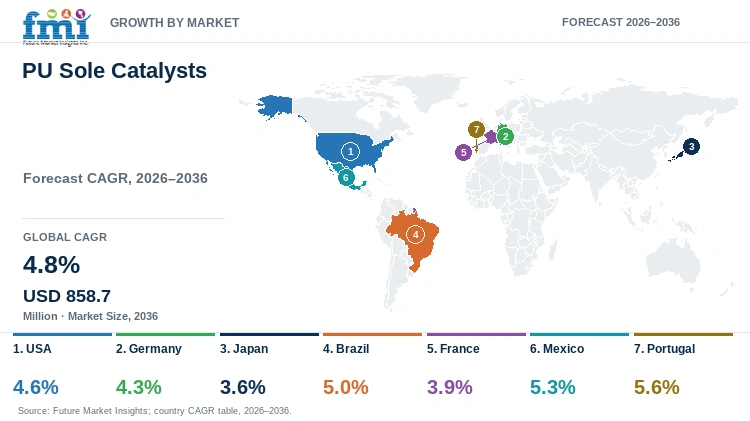
The seven profiled markets span a 2.0 percentage-point CAGR range from Portugal at 5.6% to Japan at 3.6% from 2026 to 2036. Portugal, Mexico, and Brazil form the faster-growth band. Their footwear manufacturing bases include export production and technical-footwear activity that can support formulation turnover.
USA and Germany form a middle band at 4.6% and 4.3%. Growth is more closely tied to replacement and process improvement, with formulation upgrades providing another source of demand. France and Japan sit lower at 3.9% and 3.6%.
Their more mature purchasing environments make growth selective and place greater weight on qualification evidence. These rates describe pace, not absolute market size.
- Portugal at 5.6% and Mexico at 5.3% are separated by 0.3 percentage points. Suppliers should prioritize local technical coverage because both markets combine manufacturing concentration with export-facing quality requirements.
- Mexico at 5.3% and Brazil at 5.0% are also separated by 0.3 percentage points. The commercial difference is less about rate than route to market, with system houses and regional distributors important for serving fragmented footwear processors.
- Brazil at 5.0% is 0.4 percentage points above the USA at 4.6%. Brazil offers faster forecast expansion, while U.S. demand is more influenced by established workplace-protection requirements and internationally distributed footwear production.
- The USA and Germany grow at 4.6% and 4.3%, respectively. France and Japan follow at 3.9% and 3.6%. These standards-led markets need stronger process data because growth depends on qualified reformulation more than rapid capacity addition.
Country-wise Analysis
- USA: Footwear processors serving U.S. safety and work applications operate under established workplace foot-protection requirements while much finished-footwear sourcing remains international. Demand for PU Sole Catalysts in the USA is forecast to expand at 4.6% CAGR from 2026 to 2036. During February 2026 the U.S. Census Bureau released its latest Annual Integrated Economic Survey footwear-manufacturing series, providing a current benchmark for domestic production activity. The friction is that catalyst demand may sit upstream with overseas factories or domestic system houses rather than with the brand that sells the shoe. Suppliers need channel visibility and application support that follows the formulation to the actual molding location.
- Germany: German protective-footwear buyers emphasize hazard-based selection and conformity. Documented use conditions also shape how formulation changes are evaluated against a mature safety framework. Demand for PU Sole Catalysts in Germany is forecast to expand at 4.3% CAGR from 2026 to 2036. In December 2025, DGUV published a fully revised Rule 112-191 covering the selection and use of foot and knee protection with updated standards references. The local friction is qualification conservatism once a sole system is accepted for a defined application. Catalyst suppliers should lead with traceable technical data, repeatable cure behavior and system-house trials rather than price-only substitution.
- Japan: Japanese safety-footwear procurement is closely tied to JIS performance requirements and local manufacturing discipline, which favors stable formulations with well-documented process windows. Demand for PU Sole Catalysts in Japan is forecast to expand at 3.6% CAGR from 2026 to 2036. JIS T 8101 was amended on 25 June 2024 and Japanese industry guidance continues to recognize foamed polyurethane as a sole material for safety footwear. The friction is a high proof threshold for changes that could affect slip performance, sole integrity or production consistency. Suppliers need localized technical service and catalyst packages that demonstrate equivalence inside existing PU systems.
- Brazil: Brazilian footwear production combines large regional manufacturing clusters with a PPE regime that requires approved protective equipment for regulated workplace use. Demand for PU Sole Catalysts in Brazil is forecast to expand at 5.0% CAGR from 2026 to 2036. Brazil’s Ministry of Labor and Employment updated NR-6 through Portaria MTE No. 57 on January 16, 2025, maintaining the framework for personal protective equipment. The friction is balancing cost sensitivity with the documentation and consistency required for safety-footwear formulations. Suppliers should support regional system houses with robust dosing guidance and alternatives that do not force expensive rework at the footwear line.
- France: French buyers of occupational footwear follow risk-specific selection practices and expect suppliers to document why a particular protection class or sole construction fits the workplace. Demand for PU Sole Catalysts in France is forecast to expand at 3.9% CAGR from 2026 to 2036. In June 2025, INRS published updated guidance on choosing and using personal protective equipment for the foot and lower leg. The local friction is that mature users often keep established qualified products until a performance, compliance or cost trigger justifies change. Catalyst suppliers should connect low-emission or process improvements to a measurable production benefit and provide evidence that finished-sole performance remains stable.
- Mexico: Mexican footwear manufacturing is concentrated in major industrial clusters but includes a long tail of smaller producers. This makes channel reach and technical service uneven. Demand for PU Sole Catalysts in Mexico is forecast to expand at 5.3% CAGR from 2026 to 2036. Data México’s May 2026 business-demography update identified 9,483 economic units in Footwear Manufacturing with a strong concentration in Guanajuato. The friction is that smaller processors may lack dedicated formulation laboratories and therefore avoid catalyst changes that require extended trials. Suppliers can win by working through system houses and distributors that provide ready-to-process recipes with dependable local replenishment.
- Portugal: Portuguese footwear companies operate in an export-intensive environment where technical footwear, short development cycles and European buyer requirements raise the value of controlled PU processing. Demand for PU Sole Catalysts in Portugal is forecast to expand at 5.6% CAGR from 2026 to 2036. PortugalGlobal reported on 11 March 2026 that technical footwear exports increased in 2025 and that safety footwear also recorded strong growth. The friction is that exporters cannot trade processing speed for inconsistent finished quality. Catalyst suppliers should emphasize delayed-action control, low-emission options and application support that helps manufacturers qualify changes quickly for multiple customer programs.
Who are the notable companies in the PU Sole Catalysts Market?
Evonik and Momentive are profiled. BASF and Huntsman are also covered. Tosoh and Kao Corporation are also covered. Dorf Ketal and Air Products legacy/Evonik are also covered. Reaxis and LANXESS complete the notable-company set.
Competition separates into three practical positions. Evonik and Momentive compete alongside BASF and the Air Products legacy portfolio now within Evonik. Their shoe-sole and microcellular use cases rely on reaction-profile tuning backed by application data and broad polyurethane-additive portfolios.
Huntsman, Tosoh, and Kao Corporation participate through PU systems or amine-catalyst platforms that can place catalyst selection upstream in a wider formulation package.
Dorf Ketal, Reaxis and LANXESS are more relevant where formulators want specialty organometallic chemistry, alternative-metal options or targeted gelling behavior. No single criterion determines supplier choice. Footwear processors and system houses compare cream-time control with end cure.
They also compare emissions or metal profile and carrier compatibility. Technical support matters because the catalyst must clear requalification before it can enter a production recipe.
- Footwear-integrated catalyst and additive platforms: Evonik and Momentive compete alongside BASF and the Air Products legacy portfolio now within Evonik. They offer documented microcellular use and formulation support across amine or metal catalyst families.
- PU system and amine-catalyst specialists: Huntsman, Tosoh and Kao Corporation compete through upstream formulation access, established polyurethane chemistry and the ability to bundle catalyst choice with a wider system or additive package.
- Alternative-metal and specialty catalyst suppliers: Dorf Ketal, Reaxis and LANXESS compete where buyers need non-tin pathways, delayed or selective cure behavior or specialty organometallic performance within a qualified PU formulation.
Competitive Benchmarking: PU Sole Catalysts Market
| Company | Shoe-Sole Catalyst Specificity | Reaction-Profile Control | Low-Tin / Low-Emission Options | Geographic Reach |
|---|---|---|---|---|
| Evonik | High | High | High | Europe and North America are covered. Coverage extends to Asia-Pacific and other global markets. |
| Momentive | High | High | High | North America and Europe are covered. Coverage extends to Asia-Pacific and other global markets. |
| BASF | High | High | Medium | Europe and North America are covered. Coverage extends to Asia-Pacific and other global markets. |
| Huntsman | Medium | High | Low | Europe and North America are covered. Coverage extends to Asia-Pacific and other global markets. |
| Tosoh | Medium | High | High | Japan and wider Asia are covered. Coverage extends to North America and Europe. |
| Kao Corporation | Unscored | Medium | Low | Japan and wider Asia are covered. Coverage extends to Europe and the Americas. |
| Dorf Ketal | Unscored | High | High | North America and Europe are covered. Coverage extends to Middle East and Asia. |
| Air Products legacy/Evonik | High | High | Medium | Legacy global PU-additives footprint now integrated into Evonik |
| Reaxis | Unscored | High | High | North America and selected international markets |
| LANXESS | Unscored | Medium | Medium | Europe, Asia, and global specialty-chemicals channels |
Scoring basis: Shoe-Sole Catalyst Specificity measures whether public product or technical literature directly references shoe-sole or microcellular footwear use. Reaction-Profile Control measures documented capability across gelling and blowing behavior.
It also covers delayed-action or selective cure behavior relevant to PU processing. Low-Tin / Low-Emission Options measures documented alternatives to conventional tin chemistry or catalyst designs intended to reduce emissions or odor.
High indicates broad or deep documented capability, Medium indicates credible but narrower evidence, and Low would indicate a documented limitation. Unavailable public information is left Unscored rather than treated as a weakness.
Air Products legacy/Evonik is assessed as a legacy portfolio lineage now integrated into Evonik and is not treated as a separate current operating franchise.
Key Developments in the PU Sole Catalysts Market
- In April 2024, Evonik presented its latest polyurethane additive solutions at UTECH Europe and highlighted its global amine platform together with negligible-emission catalyst technologies. The company framed the portfolio around both processing performance and sustainability attributes. For PU sole formulators, the development expands the amine options available when odor or emissions requirements are added to cream-time and cure targets. Supplier-footprint requirements can be assessed in the same sourcing decision.
- During May 2024 Momentive came under full ownership of KCC Corporation after KCC completed its acquisition of the remaining equity in Momentive Performance Materials Group. The transaction placed Momentive’s Niax polyurethane-additives portfolio inside one strategic ownership structure. For footwear catalyst buyers, the consequence is organizational rather than chemical. Long-term product support and investment priorities are managed within the combined ownership platform, together with regional application resources.
- In September 2024, BASF used Simac to present new processing technology and lighter sole concepts based on its Elastopan polyurethane footwear systems. The program included safety-shoe and running-shoe use cases as well as a meltable PU concept intended to simplify material separation. The catalyst implication is that suppliers must support evolving sole-system processing windows while maintaining cure consistency as footwear producers test lower-density and more circular PU constructions.
Key Players in the PU Sole Catalysts Market
Footwear-Integrated Catalyst and Additive Platforms
- Evonik
- Momentive
- BASF
- Air Products legacy/Evonik
PU System and Amine-Catalyst Specialists
- Huntsman
- Tosoh
- Kao Corporation
Alternative-Metal and Specialty Catalyst Suppliers
- Dorf Ketal
- Reaxis
- LANXESS
PU Sole Catalysts Market - Report Scope
| Coverage field | Report scope |
|---|---|
| Market breakdown | Catalyst Type; PU System; Footwear Type; Function; Sales Channel |
| Quantitative Units | USD Million |
| Market Definition | Revenue from catalysts sold for polyurethane footwear-sole formulations within the stated segmentation categories. The scope excludes downstream PU systems as finished packages when catalyst value cannot be isolated, finished footwear revenue, and adjacent or substitute additive categories. |
| Regions Covered | North America; Latin America; Western Europe; Eastern Europe; East Asia; South Asia and Pacific; Middle East and Africa |
| Countries Covered | USA; Germany; Japan; Brazil; France; Mexico; Portugal; more than twenty-five additional countries in the full report |
| Key Companies Profiled | Evonik; Momentive; BASF; Huntsman; Tosoh; Kao Corporation; Dorf Ketal; Air Products legacy/Evonik; Reaxis; LANXESS |
| Forecast Period | 2026 to 2036 |
| Approach | FMI applies a hybrid bottom-up and top-down sizing approach that reconciles catalyst demand by formulation route, footwear output, supplier participation, channel structure, and country-level adoption conditions. |
PU Sole Catalysts Market - Research Methodology
| Method | Approach |
|---|---|
| Primary Research | FMI consults catalyst makers and polyurethane system formulators. Footwear processors and distributors clarify buying and switching behavior. The research tests purchase criteria and adoption barriers. |
| Desk Research | FMI reviews company product literature and official footwear or PPE sources. Standards and industrial statistics are checked against PU sole processing. Sources are retained when they support the defined market boundary. |
| Market Sizing and Forecasting | FMI reconciles catalyst use in PU sole formulations and footwear production. Forecasts reflect qualification cycles and low-emission substitution. Country conditions and channel structure are checked against the revenue boundary. |
| Data Validation | Findings are checked against independent evidence. The estimate excludes finished-footwear revenue and adjacent additives. Duplicate system-house value and unsupported supplier claims are removed. |
PU Sole Catalysts Market by Segments
PU Sole Catalysts Market segmented by Catalyst Type:
- Amine catalysts
- Tin catalysts
- Bismuth catalysts
- Delayed-action catalysts
- Low-emission catalysts
PU Sole Catalysts Market segmented by PU System:
- Polyester PU soles
- Polyether PU soles
- Dual-density PU soles
- TPU hybrid soles
- Safety footwear PU
PU Sole Catalysts Market segmented by Footwear Type:
- Safety shoes
- Casual shoes
- Sports shoes
- Sandals/slippers
- Industrial boots
PU Sole Catalysts Market segmented by Function:
- Cream time control
- Cure acceleration
- Cell structure control
- Low-VOC processing
PU Sole Catalysts Market segmented by Sales Channel:
- PU system houses
- Footwear OEMs
- Chemical distributors
- Direct catalyst suppliers
PU Sole Catalysts Market by Region:
- North America
- United States
- Canada
- Latin America
- Brazil
- Mexico
- Argentina
- Chile
- Western Europe
- Germany
- France
- United Kingdom
- Italy
- Spain
- Benelux
- Nordics
- Eastern Europe
- Poland
- Czech Republic
- Romania
- Hungary
- East Asia
- China
- Japan
- South Korea
- South Asia and Pacific
- India
- ASEAN
- Australia and New Zealand
- Middle East and Africa
- GCC Countries
- South Africa
- Türkiye
- Israel
Research Sources and Bibliography
- BASF (n.d.; accessed September 4, 2026). Lupragen® N203.
- BASF (2024, September 10). BASF at Simac 2024: “Make the Move” to new processing technology, lighter soles and circular solutions for footwear.
- Evonik (2024, April 17). Evonik presents its latest solutions for the polyurethane markets at UTECH Europe 2024.
- Momentive (2024, May 14). KCC Corporation Completes Acquisition of Momentive Performance Materials Group.
- Momentive (n.d.; accessed September 4, 2026). Niax Polyurethane Additives Guide.
- Huntsman (n.d.; accessed September 4, 2026). DALTOPED polyurethane footwear systems.
- Reaxis (2023, July). REAXIS C3002EXP: Non-Tin Catalyst for Urethane Chemistries.
- European Chemicals Agency (2026, July 14). Substances restricted under REACH.
- U.S. Census Bureau (2026, February 26). Annual Integrated Economic Survey: Footwear Manufacturing.
- Deutsche Gesetzliche Unfallversicherung (2025, December). DGUV Regel 112-191: Benutzung von Fuß- und Knieschutz.
- Japanese Standards Association (2024, June 25). JIS T 8101:2020/Amendment 1:2024, Protective footwear.
- Brazil Ministry of Labor and Employment (2025, January 16). Norma Regulamentadora No. 6 (NR-6) - Equipamento de Proteção Individual.
- INRS (2025, June). Les équipements de protection individuelle du pied et du bas de la jambe - Choix et utilisation.
- Mexico Secretaría de Economía, Data México (2026, May; accessed September 4, 2026). Footwear Manufacturing.
- AICEP Portugal Global (2026, March 11). Technical footwear drives Portuguese industry in foreign markets.
This bibliography is provided for reader reference and is not exhaustive. The full report contains the complete reference list and detailed citations.
This Report Answers
- What is the PU Sole Catalysts Market size in 2026 and what value is forecast for 2036?
- What footwear-production and formulation pressures support demand for PU sole catalysts?
- Why do Amine catalysts hold the leading position in the Catalyst Type category?
- How do Polyester PU soles influence catalyst selection and downstream formulation demand?
- Why do Safety shoes hold the leading position in the Footwear Type category?
- How do the profiled country growth rates compare for the PU Sole Catalysts market?
- Which companies participate through footwear-specific catalysts, PU systems, amine platforms or alternative-metal chemistry?
- What qualification and reformulation barriers limit catalyst switching in PU sole production?
Frequently Asked Questions
What is driving growth in the PU Sole Catalysts Market?
Growth is driven by footwear processors seeking tighter cream-time, cure and cell-structure control as PU sole designs become more demanding. Safety and technical footwear add qualification pressure, which favors catalyst packages that improve cycle performance without destabilizing finished-sole properties.
Who are the key players in the PU Sole Catalysts Market?
Evonik, Momentive and BASF are among the profiled suppliers. The wider field covers integrated PU systems, amine catalysts and alternative-metal chemistry. All companies appear under Key Players.
What is a notable restraint in the PU Sole Catalysts Market?
The main restraint is the qualification burden created when a new catalyst changes reaction kinetics inside an established sole recipe. Processors may need new molding trials and finished-part testing before accepting the switch, which can outweigh a small raw-material cost advantage.
Why should executives track the PU Sole Catalysts Market?
Executives should track the market because catalyst choices influence throughput and formulation stability while also affecting emissions strategy and the ease of changing PU sole architectures. Supplier shifts can therefore affect both production economics and the time required to qualify new footwear programs.
What business problem does the PU Sole Catalysts Market address?
The market addresses the need to control when polyurethane reactions begin and how quickly they reach sufficient cure inside a footwear mold. Effective catalysts help formulators preserve mold fill and cell structure while achieving practical demold cycles and repeatable final properties.
What should footwear formulation teams evaluate in the PU Sole Catalysts Market?
Formulation teams should test cream time and gel build alongside end cure. Dose sensitivity and carrier compatibility affect cell structure. They also need odor and emissions data plus finished-sole tests and technical support.
What limits return on investment in the PU Sole Catalysts Market?
Return on investment is limited when a catalyst saves material or cycle time but creates longer qualification work, scrap risk or unstable production. The relevant cost includes application trials and line disruption, while failed parts and supplier-switching effort also matter alongside the catalyst purchase price.
What supports long-term commercial confidence in the PU Sole Catalysts Market?
Long-term confidence comes from the continuing need to control polyurethane reaction kinetics in molded footwear and from ongoing reformulation toward lower-emission or alternative-metal chemistry. The 2026 market value of USD 537.3 Million is forecast to reach USD 858.7 Million by 2036 at 4.8% CAGR.
Preview the report firsthand - request a free sample
Get SampleGet the brochure for pricing and purchase details.
Get PDFTable of Content
- Key Takeaways
- Market Size and CAGR
- Top Growth Driver
- Fastest Growing Segment
- Leading Region
- Key Companies
- Emerging Opportunities
- Executive Summary
- Global Market Outlook
- Demand-side Trends
- Supply-side Trends
- Technology Roadmap Analysis
- Analysis and Recommendations
- Analyst Perspective (What is happening? Why now? What should investors know?)
- Key Questions Answered
- How large is the market?
- What is the CAGR?
- What are key trends?
- Which region dominates?
- Who are the leaders?
- Market Overview
- Market Coverage / Taxonomy
- Market Definition / Scope / Limitations
- Research Methodology
- Chapter Orientation
- Analytical Lens and Working Hypotheses
- Market Structure, Signals, and Trend Drivers
- Benchmarking and Cross-market Comparability
- Market Sizing, Forecasting, and Opportunity Mapping
- Research Design and Evidence Framework
- Desk Research Programme (Secondary Evidence)
- Expert Input and Fieldwork (Primary Evidence)
- Tooling, Models, and Reference Databases
- Data Engineering and Model Build
- Quality Assurance and Audit Trail
- Market Background
- Market Dynamics (Drivers, Restraints, Opportunity, Trends)
- Scenario Forecast (Optimistic, Likely, Conservative)
- Impact Analysis
- AI Impact
- Sustainability Impact
- Regulatory Impact
- Technology Impact
- Consumer / Buyer Analysis
- Purchase Drivers
- Adoption Barriers
- Buyer Journey
- Opportunity Map Analysis
- Product Life Cycle Analysis
- Supply Chain Analysis
- Investment Feasibility Matrix
- Value Chain Analysis
- PESTLE and Porter's Analysis
- Regulatory Landscape
- Regional Parent Market Outlook
- Production and Consumption Statistics
- Import and Export Statistics
- Global Market Analysis and Forecast, 2021 to 2036
- Historical Market Size Value (USD Million) Analysis, 2021 to 2025
- Current and Future Market Size Value (USD Million) Projections, 2026 to 2036
- Y-o-Y Growth Trend Analysis
- Absolute $ Opportunity Analysis
- Global Market Pricing Analysis, 2021 to 2036
- Global Market Analysis and Forecast, By Catalyst Type, 2021 to 2036
- Introduction / Key Findings
- Historical Market Size Value (USD Million) Analysis By Catalyst Type, 2021 to 2025
- Current and Future Market Size Value (USD Million) Analysis and Forecast By Catalyst Type, 2026 to 2036
- Amine catalysts
- Tin catalysts
- Bismuth catalysts
- Delayed-action catalysts
- Low-emission catalysts
- Y-o-Y Growth Trend Analysis By Catalyst Type, 2021 to 2025
- Absolute $ Opportunity Analysis By Catalyst Type, 2026 to 2036
- Global Market Analysis and Forecast, By PU System, 2021 to 2036
- Introduction / Key Findings
- Historical Market Size Value (USD Million) Analysis By PU System, 2021 to 2025
- Current and Future Market Size Value (USD Million) Analysis and Forecast By PU System, 2026 to 2036
- Polyester PU soles
- Polyether PU soles
- Dual-density PU soles
- TPU hybrid soles
- Safety footwear PU
- Y-o-Y Growth Trend Analysis By PU System, 2021 to 2025
- Absolute $ Opportunity Analysis By PU System, 2026 to 2036
- Global Market Analysis and Forecast, By Footwear Type, 2021 to 2036
- Introduction / Key Findings
- Historical Market Size Value (USD Million) Analysis By Footwear Type, 2021 to 2025
- Current and Future Market Size Value (USD Million) Analysis and Forecast By Footwear Type, 2026 to 2036
- Safety shoes
- Casual shoes
- Sports shoes
- Sandals/slippers
- Industrial boots
- Y-o-Y Growth Trend Analysis By Footwear Type, 2021 to 2025
- Absolute $ Opportunity Analysis By Footwear Type, 2026 to 2036
- Global Market Analysis and Forecast, By Function, 2021 to 2036
- Introduction / Key Findings
- Historical Market Size Value (USD Million) Analysis By Function, 2021 to 2025
- Current and Future Market Size Value (USD Million) Analysis and Forecast By Function, 2026 to 2036
- Cream time control
- Cure acceleration
- Cell structure control
- Low-VOC processing
- Y-o-Y Growth Trend Analysis By Function, 2021 to 2025
- Absolute $ Opportunity Analysis By Function, 2026 to 2036
- Global Market Analysis and Forecast, By Sales Channel, 2021 to 2036
- Introduction / Key Findings
- Historical Market Size Value (USD Million) Analysis By Sales Channel, 2021 to 2025
- Current and Future Market Size Value (USD Million) Analysis and Forecast By Sales Channel, 2026 to 2036
- PU system houses
- Footwear OEMs
- Chemical distributors
- Direct catalyst suppliers
- Y-o-Y Growth Trend Analysis By Sales Channel, 2021 to 2025
- Absolute $ Opportunity Analysis By Sales Channel, 2026 to 2036
- Global Market Analysis and Forecast, By Region, 2021 to 2036
- Introduction
- Historical Market Size Value (USD Million) Analysis By Region, 2021 to 2025
- Current Market Size Value (USD Million) Analysis and Forecast By Region, 2026 to 2036
- North America
- Latin America
- Western Europe
- Eastern Europe
- East Asia
- South Asia and Pacific
- Middle East and Africa
- Market Attractiveness Analysis By Region
- North America Market Analysis and Forecast, By Country, 2021 to 2036
- Historical Market Size Value (USD Million) Trend Analysis By Market Taxonomy, 2021 to 2025
- Market Size Value (USD Million) Forecast By Market Taxonomy, 2026 to 2036
- By Country
- United States
- Canada
- By Catalyst Type
- By PU System
- By Footwear Type
- By Function
- By Sales Channel
- By Country
- Market Attractiveness Analysis
- By Country
- By Catalyst Type
- By PU System
- By Footwear Type
- By Function
- By Sales Channel
- Key Takeaways
- Latin America Market Analysis and Forecast, By Country
- Historical Market Size Value (USD Million) Trend Analysis By Market Taxonomy, 2021 to 2025
- Market Size Value (USD Million) Forecast By Market Taxonomy, 2026 to 2036
- By Country
- Brazil
- Mexico
- Argentina
- Chile
- By Catalyst Type
- By PU System
- By Footwear Type
- By Function
- By Sales Channel
- By Country
- Market Attractiveness Analysis
- By Country
- By Catalyst Type
- By PU System
- By Footwear Type
- By Function
- By Sales Channel
- Key Takeaways
- Western Europe Market Analysis and Forecast, By Country
- Historical Market Size Value (USD Million) Trend Analysis By Market Taxonomy, 2021 to 2025
- Market Size Value (USD Million) Forecast By Market Taxonomy, 2026 to 2036
- By Country
- Germany
- France
- United Kingdom
- Italy
- Spain
- Benelux
- Nordics
- By Catalyst Type
- By PU System
- By Footwear Type
- By Function
- By Sales Channel
- By Country
- Market Attractiveness Analysis
- By Country
- By Catalyst Type
- By PU System
- By Footwear Type
- By Function
- By Sales Channel
- Key Takeaways
- Eastern Europe Market Analysis and Forecast, By Country
- Historical Market Size Value (USD Million) Trend Analysis By Market Taxonomy, 2021 to 2025
- Market Size Value (USD Million) Forecast By Market Taxonomy, 2026 to 2036
- By Country
- Poland
- Czech Republic
- Romania
- Hungary
- By Catalyst Type
- By PU System
- By Footwear Type
- By Function
- By Sales Channel
- By Country
- Market Attractiveness Analysis
- By Country
- By Catalyst Type
- By PU System
- By Footwear Type
- By Function
- By Sales Channel
- Key Takeaways
- East Asia Market Analysis and Forecast, By Country
- Historical Market Size Value (USD Million) Trend Analysis By Market Taxonomy, 2021 to 2025
- Market Size Value (USD Million) Forecast By Market Taxonomy, 2026 to 2036
- By Country
- China
- Japan
- South Korea
- By Catalyst Type
- By PU System
- By Footwear Type
- By Function
- By Sales Channel
- By Country
- Market Attractiveness Analysis
- By Country
- By Catalyst Type
- By PU System
- By Footwear Type
- By Function
- By Sales Channel
- Key Takeaways
- South Asia and Pacific Market Analysis and Forecast, By Country
- Historical Market Size Value (USD Million) Trend Analysis By Market Taxonomy, 2021 to 2025
- Market Size Value (USD Million) Forecast By Market Taxonomy, 2026 to 2036
- By Country
- India
- ASEAN
- Australia and New Zealand
- By Catalyst Type
- By PU System
- By Footwear Type
- By Function
- By Sales Channel
- By Country
- Market Attractiveness Analysis
- By Country
- By Catalyst Type
- By PU System
- By Footwear Type
- By Function
- By Sales Channel
- Key Takeaways
- Middle East and Africa Market Analysis and Forecast, By Country
- Historical Market Size Value (USD Million) Trend Analysis By Market Taxonomy, 2021 to 2025
- Market Size Value (USD Million) Forecast By Market Taxonomy, 2026 to 2036
- By Country
- GCC Countries
- South Africa
- Türkiye
- Israel
- By Catalyst Type
- By PU System
- By Footwear Type
- By Function
- By Sales Channel
- By Country
- Market Attractiveness Analysis
- By Country
- By Catalyst Type
- By PU System
- By Footwear Type
- By Function
- By Sales Channel
- Key Takeaways
- Key Countries Market Analysis
- United States
- Pricing Analysis
- Market Share Analysis, 2025
- By Catalyst Type
- By PU System
- By Footwear Type
- By Function
- By Sales Channel
- Canada
- Pricing Analysis
- Market Share Analysis, 2025
- By Catalyst Type
- By PU System
- By Footwear Type
- By Function
- By Sales Channel
- Mexico
- Pricing Analysis
- Market Share Analysis, 2025
- By Catalyst Type
- By PU System
- By Footwear Type
- By Function
- By Sales Channel
- Brazil
- Pricing Analysis
- Market Share Analysis, 2025
- By Catalyst Type
- By PU System
- By Footwear Type
- By Function
- By Sales Channel
- Chile
- Pricing Analysis
- Market Share Analysis, 2025
- By Catalyst Type
- By PU System
- By Footwear Type
- By Function
- By Sales Channel
- Germany
- Pricing Analysis
- Market Share Analysis, 2025
- By Catalyst Type
- By PU System
- By Footwear Type
- By Function
- By Sales Channel
- United Kingdom
- Pricing Analysis
- Market Share Analysis, 2025
- By Catalyst Type
- By PU System
- By Footwear Type
- By Function
- By Sales Channel
- Italy
- Pricing Analysis
- Market Share Analysis, 2025
- By Catalyst Type
- By PU System
- By Footwear Type
- By Function
- By Sales Channel
- Spain
- Pricing Analysis
- Market Share Analysis, 2025
- By Catalyst Type
- By PU System
- By Footwear Type
- By Function
- By Sales Channel
- France
- Pricing Analysis
- Market Share Analysis, 2025
- By Catalyst Type
- By PU System
- By Footwear Type
- By Function
- By Sales Channel
- India
- Pricing Analysis
- Market Share Analysis, 2025
- By Catalyst Type
- By PU System
- By Footwear Type
- By Function
- By Sales Channel
- ASEAN
- Pricing Analysis
- Market Share Analysis, 2025
- By Catalyst Type
- By PU System
- By Footwear Type
- By Function
- By Sales Channel
- Australia and New Zealand
- Pricing Analysis
- Market Share Analysis, 2025
- By Catalyst Type
- By PU System
- By Footwear Type
- By Function
- By Sales Channel
- China
- Pricing Analysis
- Market Share Analysis, 2025
- By Catalyst Type
- By PU System
- By Footwear Type
- By Function
- By Sales Channel
- Japan
- Pricing Analysis
- Market Share Analysis, 2025
- By Catalyst Type
- By PU System
- By Footwear Type
- By Function
- By Sales Channel
- South Korea
- Pricing Analysis
- Market Share Analysis, 2025
- By Catalyst Type
- By PU System
- By Footwear Type
- By Function
- By Sales Channel
- Poland
- Pricing Analysis
- Market Share Analysis, 2025
- By Catalyst Type
- By PU System
- By Footwear Type
- By Function
- By Sales Channel
- Hungary
- Pricing Analysis
- Market Share Analysis, 2025
- By Catalyst Type
- By PU System
- By Footwear Type
- By Function
- By Sales Channel
- Türkiye
- Pricing Analysis
- Market Share Analysis, 2025
- By Catalyst Type
- By PU System
- By Footwear Type
- By Function
- By Sales Channel
- South Africa
- Pricing Analysis
- Market Share Analysis, 2025
- By Catalyst Type
- By PU System
- By Footwear Type
- By Function
- By Sales Channel
- Portugal
- Pricing Analysis
- Market Share Analysis, 2025
- By Catalyst Type
- By PU System
- By Footwear Type
- By Function
- By Sales Channel
- United States
- Market Structure Analysis
- Competition Dashboard
- Competition Benchmarking
- Market Share Analysis of Top Players
- By Regional
- By Catalyst Type
- By PU System
- By Footwear Type
- By Function
- By Sales Channel
- Emerging Startups
- Innovation Benchmarking
- Competition Analysis
- Competition Deep Dive
- Evonik
- Overview
- Product Portfolio
- Profitability by Market Segments
- Sales Footprint
- Strategy Overview
- Marketing Strategy
- Product Strategy
- Channel Strategy
- Momentive
- BASF
- Huntsman
- Tosoh
- Kao Corporation
- Dorf Ketal
- Air Products legacy/Evonik
- Reaxis
- LANXESS
- Evonik
- Case Studies
- Success Stories
- Recent Developments
- Competition Deep Dive
- Assumptions & Acronyms Used


