

- Market Size (2026)
- USD 480.2 Mn
- Forecast (2036)
- USD 1027.2 Mn
- CAGR (2026 to 2036)
- 7.9%
How big is Recyclable Produce Films Market in 2026?
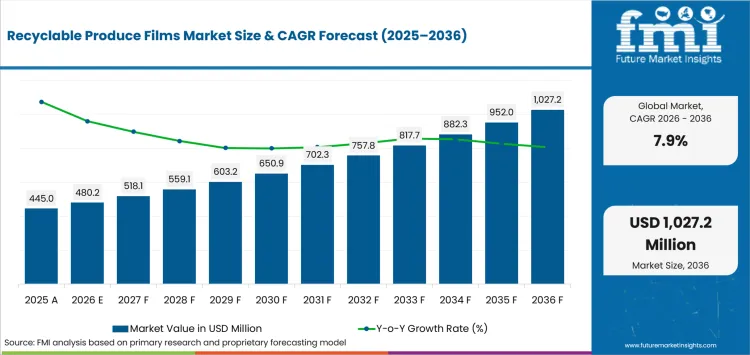
USD 480.2 million in 2026 and USD 1027.2 million by 2036 at a 7.9% CAGR.
Recyclable produce film demand is projected to expand at 7.9% CAGR between 2026 and 2036, surpassing valuation of USD 1027.2 million by 2036 from USD 480.2 million in 2026. Produce packers are replacing mixed-material films with PE or PP structures that enter established flexible plastic packaging recovery routes. Oregon’s Department of Environmental Quality reported in July 2025 that packaging producer responsibility began statewide on July 1. The program uses producer fees for recycling improvements, so commercial conversion requires compliant films that preserve shelf life and line speed.
Major markets apply different design tests as recycling systems and packaging rules remain nationally specific. The German Environment Agency and ZSVR reported in January 2026 that 70% of plastic packaging entered material recycling during 2024. The figure does not establish flexible-film recovery, but it gives German firms a more measurable end-of-life baseline than fragmented United States programs. Japan emphasizes controlled trials and consistent presentation across smaller fresh food packaging formats and national grocery programs. Commercial orders follow once the film protects the crop and passes each destination market’s documented recovery rules.
Key Takeaways of Recyclable Produce Films Market
- Recyclable produce film demand is supported by packaging accountability and food-loss controls that place freshness performance inside each conversion decision.
- In 2026, Mono-PE Films are projected to account for 32.0% of Product Type demand owing to simpler recovery claims from one-polymer structures.
- Polyethylene is estimated to hold 38.0% of Material demand in 2026 owing to its sealing range and puncture resistance.
- Bags & Pouches are forecast to represent 36.0% of Format demand in 2026 due to efficient changes in venting and package dimensions.
- Adoption remains constrained by crop-specific respiration requirements and printing components that can disqualify structures during commercial packing-line trials.
- Amcor, Coveris, ProAmpac, StePac PPC, PerfoTec, Klöckner Pentaplast, Winpak and Emerald Packaging form the verified company set.
Analyst Perspective
“Produce films earn approval through crop-specific testing on the intended packing line and within the destination market’s recovery system. Commercial value concentrates in structures that simplify material recovery without weakening respiration control, sealing stability or seasonal production speed.”
- Nandini Roy Choudhury, Principal Consultant, Future Market Insights
How is the Recyclable Produce Films Market segmented?
The Recyclable Produce Films Market is segmented by Product Type, Material, Format, Produce Type, End Use, Sales Channel and Region.
Product type covers mono-PE, mono-PP, perforated and PCR structures, and material includes polyethylene, polypropylene, PET and PCR blends. Format covers bags, pouches, flow-wrap rollstock, lidding films and sheets, and produce type includes vegetables, fruits, fresh-cut salads and herbs. End use covers packers, retailers and foodservice, and sales channel separates direct supply, distribution and e-commerce by FMI region.
What makes Mono-PE Films central to the product type category?
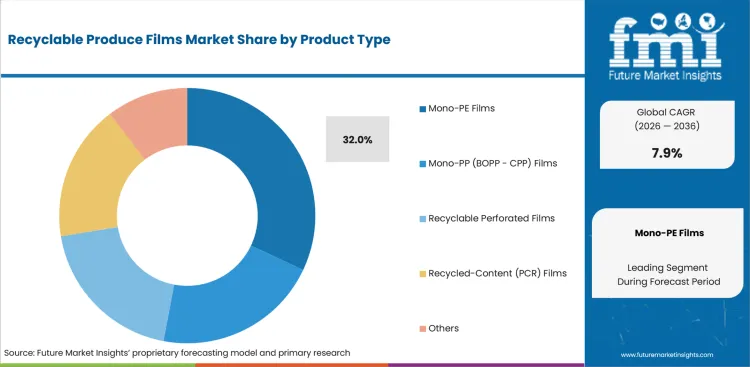
Mono-PE Films reduce the number of polymer families in a pack and retain the toughness required for produce bags. These flexible packaging formats can be tuned for crop respiration without adding a dissimilar laminate layer or changing established bag-making equipment.
- Based on product type, mono-PE films are projected to account for 32.0% in 2026 due to simpler recovery claims and familiar converting methods.
- Produce packers qualify Mono-PE structures against shelf life and seal consistency on the commercial packing line. Commercial value weakens if venting or printing components prevent local recycling acceptance across the destination market.
Why does Polyethylene lead the material category?
Polyethylene gives produce film manufacturers a broad processing window across blown film and rollstock used on commercial equipment. Food packaging materials based on PE can balance clarity and gas transmission for crops with different moisture requirements during seasonal production.
- By material, polyethylene is estimated to hold 38.0% in 2026 owing to dependable sealing and puncture resistance at comparatively low gauges.
- Polypropylene remains useful for stiffness and selected heat requirements across specialized lidding and multilayer film structures. Polyethylene retains broader use for applications requiring line speed and controlled permeability within one recognized recycling family.
How do bags & pouches set the pace in the format category?
Bags & Pouches cover retail and institutional produce volumes without requiring a rigid container during seasonal merchandising programs. Dimensions and perforation patterns can change across crop seasons using established equipment at regional converting plants.
- In 2026, bags and pouches are expected to lead format with 36.0% share due to low material use and broad packing-line compatibility.
- The commercial test centers on venting accuracy following printing and bag making on finished produce packages. Flow-wrap rollstock offers faster automation but bags and pouches address more crop sizes with fewer equipment changes.
What drives packers & processors in the end use category?
Packers & Processors control the operating point that turns film performance into a production decision at commercial scale. They set seal conditions and shelf-life targets and carry the cost of rejects and product loss during production.
- The packers and processors segment is likely to capture 44.0% share in 2026 attributable to direct control over film specifications and line trials.
- Retailers influence material policy but packers must prove performance during seasonal throughput across national produce programs with repeatable seasonal line performance. Application support and trial rolls therefore remain central to account conversion during peak harvesting periods.
What are the drivers, restraints and opportunities in the Recyclable Produce Films Market?
Packaging accountability supports conversion, yet shelf-life qualification restricts switching and crop-specific mono-material design offers the clearest recurring revenue route.
- Driver: Producer-responsibility rules and retailer specifications shift film selection toward structures with documented sorting and recycling routes.
- Restraint: Simplified structures must preserve gas transmission and sealing performance during produce-specific commercial trials on existing equipment.
- Opportunity: Crop-specific mono-PE and mono-PP films can secure repeat orders from validated packing programs across regional grocery networks.
Packaging Rules Shift Film Selection into Accountable Design
European recyclable packaging rules now link film design with documented sorting and recycling conditions for regional food brands. The Packaging and Packaging Waste Regulation entered into force in February 2025 and placed recyclability inside regional packaging decisions. Produce brands therefore request material declarations and component evidence during artwork approval, which moves mono-material film selection into commercial account reviews.
Respiration and Component Compatibility Extend Qualification
Fresh produce continues to respire inside sealed packaging and requires controlled gas transmission throughout the planned distribution period. RecyClass revised PE and PP flexible-film guidance in March 2026 and added findings for inks and treatment methods. Film conversion proceeds once permeability, printing and seal behavior satisfy the same recycling structure and commercial line trial.
Produce-Specific Platforms Convert Technical Proof into Repeat Orders
Application laboratories can turn mono-material designs into recurring produce programs by matching film permeability with crop respiration and route temperature. Trial rolls test venting and seal stability at commercial speed without changing a live specification prematurely. Repeat revenue depends on one documented film specification performing across the intended crop route and destination recovery system.
Which country CAGRs are profiled in the Recyclable Produce Films Market?
| Country | CAGR |
|---|---|
| United States | 7.3% |
| Germany | 7.7% |
| Japan | 6.5% |
| United Kingdom | 7.8% |
| Brazil | 8.3% |
How do country-level CAGRs compare in the Recyclable Produce Films Market?
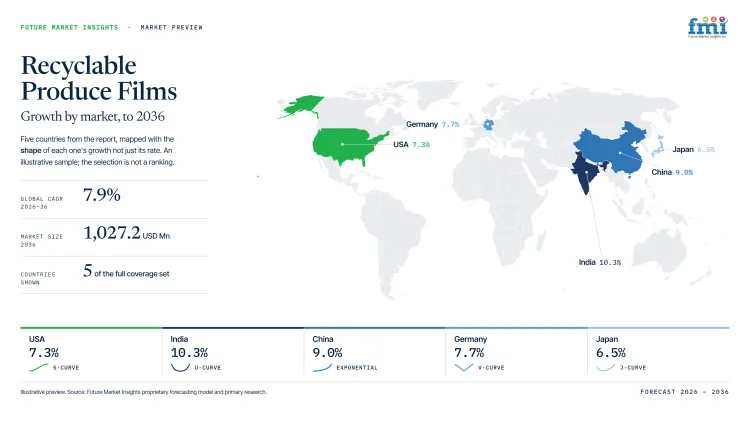
The profiled country range spans 1.8 percentage points between Brazil at 8.3% and Japan at 6.5%. The United Kingdom and Germany form a policy-led band at 7.8% and 7.7% compared with 7.3% in the United States. These forecast differences reflect separate conversion conditions and do not rank present revenue or installed production capacity.
- Brazil exceeds the United Kingdom by 0.5 percentage points as reverse-logistics duties combine with long produce routes.
- The United Kingdom exceeds Germany by 0.1 percentage point as producer fees add a direct cost signal to recyclability assessment.
- Germany exceeds the United States by 0.4 percentage points as national rules provide a more consistent design reference.
- The United States exceeds Japan by 0.8 percentage points as large packing programs offset fragmented state requirements.
- Japan’s 6.5% profile reflects detailed qualification requirements that lengthen switching across smaller retail produce formats.
CAGR does not establish current market size or immediate account value across countries with different installed packing bases. The full report assesses additional markets using collection access and produce mix alongside qualification timing and regional service coverage.
Country-wise Analysis
- Large United States produce packers run high-volume lines that require repeatable seals and retailer-specific labeling across seasonal crop programs and major private-label contracts across several producing states. Recyclable produce film demand in the United States is forecast to rise at 7.3% CAGR over the forecast period, supported by established conversion capacity and national grocery distribution. CalRecycle confirmed in May 2026 that permanent SB 54 regulations became effective on May 1 and gave California accounts a producer-responsibility framework amid fragmented collection elsewhere, requiring film manufacturers to provide defensible recovery instructions and crop trials that protect shelf life and peak line speed.
- German grocery programs require detailed packaging files that connect film construction with formal recyclability assessment and retailer approval across national accounts and repeatable seasonal line operation throughout the calendar year. Adoption of recyclable produce films in Germany is estimated to expand at 7.7% CAGR through 2036, reinforced by stable technical criteria and established conversion capacity for national fresh-produce accounts at scale. ZSVR published the 2025 minimum standard in August and reorganized assessment around the predominant packaging material, requiring manufacturers to document inks and incompatible barriers and preserve produce-specific seal performance during seasonal line trials and repeat commercial approval each year.
- Japanese grocery programs emphasize consistent pack appearance and controlled specification changes across smaller formats and detailed national qualification schedules with limited tolerance for visual or seal variation. Japan is estimated to post 6.5% CAGR over the forecast period, shaped by formal resource-circulation work and established technical evaluation across domestic food packaging and national commercial retail accounts nationwide. The Ministry of Agriculture reported in June 2026 that plastic food packaging exceeds one quarter of domestic plastic product consumption, yet recycled resin use faces food-quality and safety constraints that require local technical support and stable crop-specific sealing performance through repeated seasonal programs.
- United Kingdom grocery chains connect packaging specifications with mandatory recyclability reporting and fee modulation across national private-label programs and retailer scorecards for national produce programs. The United Kingdom’s recyclable produce films outlook is anticipated to advance at 7.8% CAGR over the assessment period, influenced by mature grocery networks and direct producer accountability across commercial packaging portfolios and seasonal programs. PackUK published RAM 2027 in July 2026 and retained red, amber and green ratings that affect disposal fees, requiring film manufacturers to document flexible-film composition and collection access as crop packers verify shelf life and seal stability during commercial approval.
- Brazilian exporters and grocery distributors rely on film performance across long routes and uneven regional collection systems serving distant wholesale and retail centers during hot and humid distribution periods under variable temperature exposure nationally. Recyclable produce film sales in Brazil are forecast to expand at 8.3% CAGR by 2036, aided by formal recovery duties and recurring transport-protection needs for regional wholesalers. Decree 12.688 established a national reverse-logistics system in October 2025 and requires annual mass-based recovery records, yet local collection and transport conditions vary enough that film manufacturers need lightweight structures with verified venting and seal strength across export seasons.
Who are the notable companies in the Recyclable Produce Films Market?
Amcor, Coveris, ProAmpac, StePac PPC, PerfoTec, Klöckner Pentaplast, Winpak and Emerald Packaging are profiled in this market.
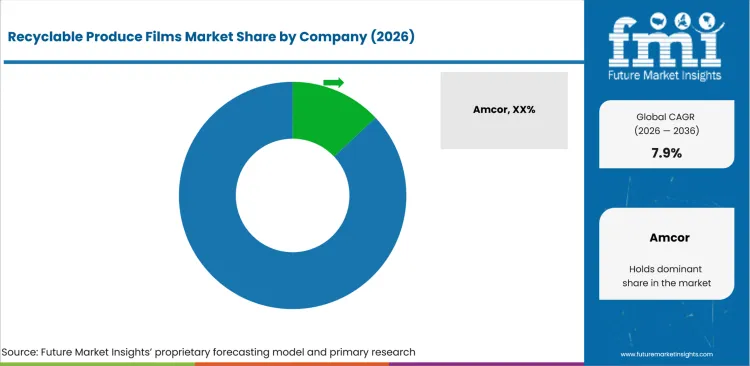
The competition is fragmented across global film groups, regional converters and specialists competing on format breadth or crop validation. Recycled plastic requirements cannot replace shelf-life proof, so entry also depends on application support and commercial line trials.
- Amcor, Coveris, ProAmpac and Winpak compete with broad film portfolios that support multi-region food-packaging accounts.
- StePac PPC and PerfoTec focus on atmosphere control alongside Klöckner Pentaplast and Emerald Packaging in fresh-produce applications.
Competitive Benchmarking: Recyclable Produce Films Market
| Company | Recyclable Film Breadth | Produce Atmosphere Control | Packing-Line Support | Geographic Reach |
|---|---|---|---|---|
| Amcor | High | High | High | Global |
| Coveris | High | Medium | High | Europe and international supply |
| ProAmpac | High | Medium | High | North America and Europe |
| StePac PPC | Medium | High | High | Global |
| PerfoTec | Medium | High | High | Global |
| Klöckner Pentaplast | High | Medium | High | Europe, North America and Asia |
| Winpak | Medium | Medium | Medium | North and Latin America |
| Emerald Packaging | Medium | Medium | Medium | United States |
Key Developments in the Recyclable Produce Films Market
- In April 2026, Coveris added a wicketted-bag line producing up to 550 bags per minute in southern Poland. The new commercial line processes CPP, LDPE and HDPE films for produce and other fresh-food applications. The capacity gives regional packers standardized bag formats during regional harvest peaks and reduces dependence on slower changeovers across existing assets.
- In December 2025, PerfoTec formalized a partnership with Green Factory for fresh-cut fruit and vegetable production. The program combines factory-level respiration measurement and micro-perforation with direct collaboration on commercial packaging lines. The agreement gives European fresh-cut programs a defined route for matching film permeability with product respiration and production consistency across repeat commercial output programs.
- In May 2025, Amcor documented BelOrta’s use of P-Plus liners for commercial pear storage programs. The liners regulate oxygen and carbon dioxide around stored fruit and are tailored at Amcor’s Ledbury fresh-produce center. The case establishes a route for produce-specific atmosphere control and leaves packers responsible for line-validation and destination-market recycling review requirements.
Key Players in the Recyclable Produce Films Market
Broad Flexible-Film Platforms
- Amcor
- Coveris
- ProAmpac
- Winpak
Atmosphere Specialists
- StePac PPC
- PerfoTec
Fresh-Produce Suppliers
- Klöckner Pentaplast
- Emerald Packaging
Recyclable Produce Films Market - Report Scope
| Coverage field | Report scope |
|---|---|
| Market breakdown | By product type, material, format, produce type, end use, sales channel and region. |
| Quantitative Units | Revenue in USD million and CAGR in %. |
| Market Definition | Revenue includes recyclable flexible films sold for fresh fruits, vegetables, fresh-cut produce, salads and herbs. Revenue excludes downstream produce sales, rigid trays and punnets, paper or corrugated packs, packaging machinery and conventional non-recyclable films. |
| Regions Covered | North America, Latin America, Western Europe, Eastern Europe, East Asia, South Asia and Pacific, and Middle East and Africa. |
| Countries Covered | United States, Germany, Japan, United Kingdom, Brazil, and more than twenty-five additional countries in the full report. |
| Key Companies Profiled | Amcor, Coveris, ProAmpac, StePac PPC, PerfoTec, Klöckner Pentaplast, Winpak and Emerald Packaging. |
| Forecast Period | 2026 to 2036. |
| Approach | Primary and secondary research with market triangulation. |
Recyclable Produce Films Market - Research Methodology
| Method | Approach |
|---|---|
| Primary Research | FMI analysts gathered input from manufacturers, service providers, technology developers, distributors, end users, procurement teams, and subject-matter experts. Interviews examined purchasing decisions, product or service evaluation, adoption barriers, approval requirements, pricing considerations, and expectations for technical or commercial support. Respondents were also asked what evidence is required before a trial, pilot, or initial order develops into regular purchasing. |
| Desk Research | Desk research covered government statistics, regulatory publications, trade data, industry associations, technical literature, standards, company filings, product information, and official corporate announcements. Sources were reviewed for relevance, publication date, geographic coverage, and consistency with the defined market scope. Claims relating to performance, applications, approvals, capacity, investment, and commercial activity were retained only when supported by credible public evidence. |
| Market Sizing and Forecasting | The market model combined the baseline value with historical performance, segment structure, pricing and volume indicators, adoption levels, company participation, and country-level demand conditions. Forecast assumptions considered economic activity, investment trends, regulatory developments, technology adoption, purchasing cycles, supply availability, and barriers to wider market use. Segment and regional estimates were reconciled before the final market total was calculated. |
| Data Validation | Estimates were checked against multiple independent indicators, including public data, company activity, trade patterns, industry developments, and findings from primary interviews. Validation also tested whether products, services, applications, and company revenues fell within the defined market boundaries. Adjacent categories, unsupported claims, overlapping revenues, and activities without direct market relevance were excluded to reduce double counting and maintain consistency across segments and countries. |
Recyclable Produce Films Market by Segments
Recyclable Produce Films Market segmented by Product Type:
- Mono-PE Films
- Mono-PP (BOPP - CPP) Films
- Recyclable Perforated Films
- Recycled-Content (PCR) Films
- Others
Recyclable Produce Films Market segmented by Material:
- Polyethylene
- Polypropylene
- PET
- PCR Blends
- Others
Recyclable Produce Films Market segmented by Format:
- Bags & Pouches
- Flow Wrap - Roll Stock
- Lidding Films
- Sheets
- Others
Recyclable Produce Films Market segmented by Produce Type:
- Whole Vegetables
- Fruits
- Fresh-Cut & Salads
- Herbs
- Others
Recyclable Produce Films Market segmented by End Use:
- Packers & Processors
- Grocery Retail
- Foodservice
- Others
Recyclable Produce Films Market segmented by Sales Channel:
- Direct - OEM Supply
- Packaging Distributors
- Online - E-commerce
- Others
Recyclable Produce Films Market by Region:
- North America
- United States
- Canada
- Latin America
- Brazil
- Mexico
- Chile
- Rest of Latin America
- Western Europe
- Germany
- United Kingdom
- Italy
- Spain
- France
- Nordics
- Benelux
- Rest of Western Europe
- Eastern Europe
- Russia
- Poland
- Hungary
- Balkan and Baltic States
- Rest of Eastern Europe
- East Asia
- China
- Japan
- South Korea
- South Asia and Pacific
- India
- ASEAN
- Australia and New Zealand
- Rest of South Asia and Pacific
- Middle East and Africa
- Kingdom of Saudi Arabia
- Other GCC Countries
- Türkiye
- South Africa
- Other African Union Countries
- Rest of Middle East and Africa
Research Sources and Bibliography
- Oregon Department of Environmental Quality. (2025, July 1). Oregon leads the nation in implementing the Plastic Pollution and Recycling Modernization Act.
- German Environment Agency and Central Agency Packaging Register. (2026, January 27). Facts against myths: Packaging waste recycling in Germany is working.
- European Commission, Directorate-General for Environment. (2025, February 11). New rules enter into force for a more sustainable and competitive packaging economy.
- RecyClass. (2026, March 11). Guidelines.
- California Department of Resources Recycling and Recovery. (2026, May 12). Notice of SB 54 Plastic Pollution Prevention and Packaging Producer Responsibility Act Permanent Regulations Final OAL Approval.
- Zentrale Stelle Verpackungsregister. (2025, August 29). 2025 minimum standard published - initial touchstone for companies preparing for the EU Packaging and Packaging Waste Regulation (PPWR).
- Ministry of Agriculture, Forestry and Fisheries, Japan. (2026, June 25). 食品容器包装の減量・リサイクルに関する情報.
- PackUK. (2026, July 1). PackUK Publishes Recyclability Assessment Methodology (RAM) 2027.
- Presidency of the Federative Republic of Brazil. (2025, October 21). DECRETO Nº 12.688, DE 21 DE OUTUBRO DE 2025.
- Amcor. (2025, May 23). How BelOrta and Amcor combine expertise to extend the shelf life of pears.
- Coveris. (2026, April 13). Coveris strengthens CEE operations with new investments.
- ProAmpac. (2026, March 31). Packaging That Seals the Difference.
- StePac PPC. (2026). Post-Harvest Handling Protocols.
- PerfoTec. (2025, December 10). Green Factory & PerfoTec: The Start of a Fresh Partnership.
- Klöckner Pentaplast. (2026, April 14). Solutions that perform, packs that comply.
- Winpak Ltd. (2026). Financial Information.
- Emerald Packaging. (2026). News.
- Amcor. (2025, April 30). Amcor completes combination with Berry Global; Positioned to significantly enhance value for customers and shareholders.
- Coveris. (2026, April 16). Nextek and Coveris launch fully operational demonstration plant for food-grade recycling.
- Coveris. (2026, June 16). Coveris expands CPP film capabilities with acquisition of GEFO in Germany.
- Coveris. (2026, July 7). Coveris Strengthens Recycled Plastics Transparency with RecyClass Certifications.
This bibliography is provided for reader reference and is not exhaustive. The full report contains the complete reference list and detailed citations
This Report Answers
- How large is the Recyclable Produce Films Market in 2026 and 2036?
- Which packaging rules and food-loss controls support market demand?
- Why do Mono-PE Films account for 32.0% of Product Type demand?
- How does polyethylene influence produce film conversion and performance?
- Why do bags and pouches represent 36.0% of Format demand?
- How do growth conditions differ across the five profiled countries?
- Which companies combine broad film platforms with produce-atmosphere expertise?
- What technical conditions slow replacement of established film structures?
- How should packers compare recyclable produce films before commercial adoption?
Frequently Asked Questions
How big is the Recyclable Produce Films Market in 2026?
The recyclable produce films market is valued at USD 480.2 million in 2026 and is forecast to reach USD 1027.2 million by 2036. Growth is supported by packaging accountability, food-loss controls, recyclable film conversion, and demand for structures that maintain shelf life, sealing performance, and packing-line efficiency.
What is the CAGR of the Recyclable Produce Films Market from 2026 to 2036?
The recyclable produce films market grows at a CAGR of 7.9% between 2026 and 2036, supported by producer-responsibility requirements, retailer packaging specifications, and conversion toward recyclable film structures. Demand also benefits from crop-specific solutions that balance material recovery requirements with respiration control, sealing stability, and seasonal packing-line performance.
Which product type leads the Recyclable Produce Films Market?
Mono-PE Films account for 32.0% of the recyclable produce films market by product type in 2026, supported by simpler recovery claims and familiar converting methods. Produce packers can qualify mono-PE structures against shelf life, venting, sealing consistency, and commercial packing-line requirements while maintaining a single-polymer structure.
How much will the Recyclable Produce Films Market add between 2026 and 2036?
The recyclable produce films market is set to add USD 547.0 million between 2026 and 2036, increasing from USD 480.2 million to USD 1027.2 million. Expansion is supported by recyclable packaging requirements, retailer specifications, and demand for crop-specific film structures that preserve produce quality while meeting documented recovery conditions.
Who are the leading companies in the Recyclable Produce Films Market?
8 companies are profiled in the recyclable produce films market, including Amcor, Coveris, ProAmpac, StePac PPC, PerfoTec, Klöckner Pentaplast, Winpak, and Emerald Packaging, competing across recyclable film platforms, produce-atmosphere control, crop-specific applications, packing-line support, and commercial qualification for fresh fruits, vegetables, salads, and herbs.
Preview the report firsthand - request a free sample
Get SampleGet the brochure for pricing and purchase details.
Get PDFTable of Content
- Key Takeaways
- Market Size and CAGR
- Top Growth Driver
- Fastest Growing Segment
- Leading Region
- Key Companies
- Emerging Opportunities
- Executive Summary
- Global Market Outlook
- Demand-side Trends
- Supply-side Trends
- Technology Roadmap Analysis
- Analysis and Recommendations
- Analyst Perspective (What is happening? Why now? What should investors know?)
- Key Questions Answered
- How large is the market?
- What is the CAGR?
- What are key trends?
- Which region dominates?
- Who are the leaders?
- Market Overview
- Market Coverage / Taxonomy
- Market Definition / Scope / Limitations
- Research Methodology
- Chapter Orientation
- Analytical Lens and Working Hypotheses
- Market Structure, Signals, and Trend Drivers
- Benchmarking and Cross-market Comparability
- Market Sizing, Forecasting, and Opportunity Mapping
- Research Design and Evidence Framework
- Desk Research Programme (Secondary Evidence)
- Expert Input and Fieldwork (Primary Evidence)
- Tooling, Models, and Reference Databases
- Data Engineering and Model Build
- Quality Assurance and Audit Trail
- Market Background
- Market Dynamics (Drivers, Restraints, Opportunity, Trends)
- Scenario Forecast (Optimistic, Likely, Conservative)
- Impact Analysis
- AI Impact
- Sustainability Impact
- Regulatory Impact
- Technology Impact
- Consumer / Buyer Analysis
- Purchase Drivers
- Adoption Barriers
- Buyer Journey
- Opportunity Map Analysis
- Product Life Cycle Analysis
- Supply Chain Analysis
- Investment Feasibility Matrix
- Value Chain Analysis
- PESTLE and Porter's Analysis
- Regulatory Landscape
- Regional Parent Market Outlook
- Production and Consumption Statistics
- Import and Export Statistics
- Global Market Analysis and Forecast, 2021 to 2036
- Historical Market Size Value (USD Million) Analysis, 2021 to 2025
- Current and Future Market Size Value (USD Million) Projections, 2026 to 2036
- Y-o-Y Growth Trend Analysis
- Absolute $ Opportunity Analysis
- Global Market Pricing Analysis, 2021 to 2036
- Global Market Analysis and Forecast, By Product Type, 2021 to 2036
- Introduction / Key Findings
- Historical Market Size Value (USD Million) Analysis By Product Type, 2021 to 2025
- Current and Future Market Size Value (USD Million) Analysis and Forecast By Product Type, 2026 to 2036
- Mono-PE Films
- Mono-PP (BOPP - CPP) Films
- Recyclable Perforated Films
- Recycled-Content (PCR) Films
- Others
- Mono-PE Films
- Y-o-Y Growth Trend Analysis By Product Type, 2021 to 2025
- Absolute $ Opportunity Analysis By Product Type, 2026 to 2036
- Global Market Analysis and Forecast, By Material, 2021 to 2036
- Introduction / Key Findings
- Historical Market Size Value (USD Million) Analysis By Material, 2021 to 2025
- Current and Future Market Size Value (USD Million) Analysis and Forecast By Material, 2026 to 2036
- Polyethylene
- Polypropylene
- PET
- PCR Blends
- Others
- Polyethylene
- Y-o-Y Growth Trend Analysis By Material, 2021 to 2025
- Absolute $ Opportunity Analysis By Material, 2026 to 2036
- Global Market Analysis and Forecast, By Format, 2021 to 2036
- Introduction / Key Findings
- Historical Market Size Value (USD Million) Analysis By Format, 2021 to 2025
- Current and Future Market Size Value (USD Million) Analysis and Forecast By Format, 2026 to 2036
- Bags & Pouches
- Flow Wrap - Roll Stock
- Lidding Films
- Sheets
- Others
- Bags & Pouches
- Y-o-Y Growth Trend Analysis By Format, 2021 to 2025
- Absolute $ Opportunity Analysis By Format, 2026 to 2036
- Global Market Analysis and Forecast, By Produce Type, 2021 to 2036
- Introduction / Key Findings
- Historical Market Size Value (USD Million) Analysis By Produce Type, 2021 to 2025
- Current and Future Market Size Value (USD Million) Analysis and Forecast By Produce Type, 2026 to 2036
- Whole Vegetables
- Fruits
- Fresh-Cut & Salads
- Others
- Herbs
- Whole Vegetables
- Y-o-Y Growth Trend Analysis By Produce Type, 2021 to 2025
- Absolute $ Opportunity Analysis By Produce Type, 2026 to 2036
- Global Market Analysis and Forecast, By End Use, 2021 to 2036
- Introduction / Key Findings
- Historical Market Size Value (USD Million) Analysis By End Use, 2021 to 2025
- Current and Future Market Size Value (USD Million) Analysis and Forecast By End Use, 2026 to 2036
- Packers & Processors
- Grocery Retail
- Foodservice
- Others
- Packers & Processors
- Y-o-Y Growth Trend Analysis By End Use, 2021 to 2025
- Absolute $ Opportunity Analysis By End Use, 2026 to 2036
- Global Market Analysis and Forecast, By Sales Channel
- Introduction / Key Findings
- Historical Market Size Value (USD Million) Analysis By Sales Channel, 2021 to 2025
- Current and Future Market Size Value (USD Million) Analysis and Forecast By Sales Channel, 2026 to 2036
- Direct - OEM Supply
- Packaging Distributors
- Online - E-commerce
- Others
- Direct - OEM Supply
- Y-o-Y Growth Trend Analysis By Sales Channel, 2021 to 2025
- Absolute $ Opportunity Analysis By Sales Channel, 2026 to 2036
- Global Market Analysis and Forecast, By Region, 2021 to 2036
- Introduction
- Historical Market Size Value (USD Million) Analysis By Region, 2021 to 2025
- Current Market Size Value (USD Million) Analysis and Forecast By Region, 2026 to 2036
- North America
- Latin America
- Western Europe
- Eastern Europe
- East Asia
- South Asia and Pacific
- Middle East & Africa
- Market Attractiveness Analysis By Region
- North America Market Analysis and Forecast, By Country, 2021 to 2036
- Historical Market Size Value (USD Million) Trend Analysis By Market Taxonomy, 2021 to 2025
- Market Size Value (USD Million) Forecast By Market Taxonomy, 2026 to 2036
- By Country
- USA
- Canada
- By Product Type
- By Material
- By Format
- By Produce Type
- By End Use
- By Sales Channel
- By Country
- Market Attractiveness Analysis
- By Country
- By Product Type
- By Material
- By Format
- By Produce Type
- By End Use
- By Sales Channel
- Key Takeaways
- Latin America Market Analysis and Forecast, By Country
- Historical Market Size Value (USD Million) Trend Analysis By Market Taxonomy, 2021 to 2025
- Market Size Value (USD Million) Forecast By Market Taxonomy, 2026 to 2036
- By Country
- Brazil
- Mexico
- Chile
- Rest of Latin America
- By Product Type
- By Material
- By Format
- By Produce Type
- By End Use
- By Sales Channel
- By Country
- Market Attractiveness Analysis
- By Country
- By Product Type
- By Material
- By Format
- By Produce Type
- By End Use
- By Sales Channel
- Key Takeaways
- Western Europe Market Analysis and Forecast, By Country
- Historical Market Size Value (USD Million) Trend Analysis By Market Taxonomy, 2021 to 2025
- Market Size Value (USD Million) Forecast By Market Taxonomy, 2026 to 2036
- By Country
- Germany
- UK
- Italy
- Spain
- France
- Nordic
- BENELUX
- Rest of Western Europe
- By Product Type
- By Material
- By Format
- By Produce Type
- By End Use
- By Sales Channel
- By Country
- Market Attractiveness Analysis
- By Country
- By Product Type
- By Material
- By Format
- By Produce Type
- By End Use
- By Sales Channel
- Key Takeaways
- Eastern Europe Market Analysis and Forecast, By Country
- Historical Market Size Value (USD Million) Trend Analysis By Market Taxonomy, 2021 to 2025
- Market Size Value (USD Million) Forecast By Market Taxonomy, 2026 to 2036
- By Country
- Russia
- Poland
- Hungary
- Balkan & Baltic
- Rest of Eastern Europe
- By Product Type
- By Material
- By Format
- By Produce Type
- By End Use
- By Sales Channel
- By Country
- Market Attractiveness Analysis
- By Country
- By Product Type
- By Material
- By Format
- By Produce Type
- By End Use
- By Sales Channel
- Key Takeaways
- East Asia Market Analysis and Forecast, By Country
- Historical Market Size Value (USD Million) Trend Analysis By Market Taxonomy, 2021 to 2025
- Market Size Value (USD Million) Forecast By Market Taxonomy, 2026 to 2036
- By Country
- China
- Japan
- South Korea
- By Product Type
- By Material
- By Format
- By Produce Type
- By End Use
- By Sales Channel
- By Country
- Market Attractiveness Analysis
- By Country
- By Product Type
- By Material
- By Format
- By Produce Type
- By End Use
- By Sales Channel
- Key Takeaways
- South Asia and Pacific Market Analysis and Forecast, By Country
- Historical Market Size Value (USD Million) Trend Analysis By Market Taxonomy, 2021 to 2025
- Market Size Value (USD Million) Forecast By Market Taxonomy, 2026 to 2036
- By Country
- India
- ASEAN
- Australia & New Zealand
- Rest of South Asia and Pacific
- By Product Type
- By Material
- By Format
- By Produce Type
- By End Use
- By Sales Channel
- By Country
- Market Attractiveness Analysis
- By Country
- By Product Type
- By Material
- By Format
- By Produce Type
- By End Use
- By Sales Channel
- Key Takeaways
- Middle East & Africa Market Analysis and Forecast, By Country
- Historical Market Size Value (USD Million) Trend Analysis By Market Taxonomy, 2021 to 2025
- Market Size Value (USD Million) Forecast By Market Taxonomy, 2026 to 2036
- By Country
- Kingdom of Saudi Arabia
- Other GCC Countries
- Türkiye
- South Africa
- Other African Union
- Rest of Middle East & Africa
- By Product Type
- By Material
- By Format
- By Produce Type
- By End Use
- By Sales Channel
- By Country
- Market Attractiveness Analysis
- By Country
- By Product Type
- By Material
- By Format
- By Produce Type
- By End Use
- By Sales Channel
- Key Takeaways
- Key Countries Market Analysis
- USA
- Pricing Analysis
- Market Share Analysis, 2025
- By Product Type
- By Material
- By Format
- By Produce Type
- By End Use
- By Sales Channel
- Canada
- Pricing Analysis
- Market Share Analysis, 2025
- By Product Type
- By Material
- By Format
- By Produce Type
- By End Use
- By Sales Channel
- Mexico
- Pricing Analysis
- Market Share Analysis, 2025
- By Product Type
- By Material
- By Format
- By Produce Type
- By End Use
- By Sales Channel
- Brazil
- Pricing Analysis
- Market Share Analysis, 2025
- By Product Type
- By Material
- By Format
- By Produce Type
- By End Use
- By Sales Channel
- Chile
- Pricing Analysis
- Market Share Analysis, 2025
- By Product Type
- By Material
- By Format
- By Produce Type
- By End Use
- By Sales Channel
- Germany
- Pricing Analysis
- Market Share Analysis, 2025
- By Product Type
- By Material
- By Format
- By Produce Type
- By End Use
- By Sales Channel
- UK
- Pricing Analysis
- Market Share Analysis, 2025
- By Product Type
- By Material
- By Format
- By Produce Type
- By End Use
- By Sales Channel
- Italy
- Pricing Analysis
- Market Share Analysis, 2025
- By Product Type
- By Material
- By Format
- By Produce Type
- By End Use
- By Sales Channel
- Spain
- Pricing Analysis
- Market Share Analysis, 2025
- By Product Type
- By Material
- By Format
- By Produce Type
- By End Use
- By Sales Channel
- France
- Pricing Analysis
- Market Share Analysis, 2025
- By Product Type
- By Material
- By Format
- By Produce Type
- By End Use
- By Sales Channel
- India
- Pricing Analysis
- Market Share Analysis, 2025
- By Product Type
- By Material
- By Format
- By Produce Type
- By End Use
- By Sales Channel
- ASEAN
- Pricing Analysis
- Market Share Analysis, 2025
- By Product Type
- By Material
- By Format
- By Produce Type
- By End Use
- By Sales Channel
- Australia & New Zealand
- Pricing Analysis
- Market Share Analysis, 2025
- By Product Type
- By Material
- By Format
- By Produce Type
- By End Use
- By Sales Channel
- China
- Pricing Analysis
- Market Share Analysis, 2025
- By Product Type
- By Material
- By Format
- By Produce Type
- By End Use
- By Sales Channel
- Japan
- Pricing Analysis
- Market Share Analysis, 2025
- By Product Type
- By Material
- By Format
- By Produce Type
- By End Use
- By Sales Channel
- South Korea
- Pricing Analysis
- Market Share Analysis, 2025
- By Product Type
- By Material
- By Format
- By Produce Type
- By End Use
- By Sales Channel
- Russia
- Pricing Analysis
- Market Share Analysis, 2025
- By Product Type
- By Material
- By Format
- By Produce Type
- By End Use
- By Sales Channel
- Poland
- Pricing Analysis
- Market Share Analysis, 2025
- By Product Type
- By Material
- By Format
- By Produce Type
- By End Use
- By Sales Channel
- Hungary
- Pricing Analysis
- Market Share Analysis, 2025
- By Product Type
- By Material
- By Format
- By Produce Type
- By End Use
- By Sales Channel
- Kingdom of Saudi Arabia
- Pricing Analysis
- Market Share Analysis, 2025
- By Product Type
- By Material
- By Format
- By Produce Type
- By End Use
- By Sales Channel
- Türkiye
- Pricing Analysis
- Market Share Analysis, 2025
- By Product Type
- By Material
- By Format
- By Produce Type
- By End Use
- By Sales Channel
- South Africa
- Pricing Analysis
- Market Share Analysis, 2025
- By Product Type
- By Material
- By Format
- By Produce Type
- By End Use
- By Sales Channel
- USA
- Market Structure Analysis
- Competition Dashboard
- Competition Benchmarking
- Market Share Analysis of Top Players
- By Regional
- By Product Type
- By Material
- By Format
- By Produce Type
- By End Use
- By Sales Channel
- Emerging Startups
- Innovation Benchmarking
- Competition Analysis
- Competition Deep Dive
- Amcor
- Overview
- Product Portfolio
- Profitability by Market Segments
- Sales Footprint
- Strategy Overview
- Marketing Strategy
- Product Strategy
- Channel Strategy
- Berry Global
- Coveris
- Sealed Air
- Mondi
- StePac
- Klockner Pentaplast
- ProAmpac
- Winpak
- Perfotec
- Amcor
- Case Studies
- Success Stories
- Recent Developments
- Competition Deep Dive
- Assumptions & Acronyms Used


