

- Market Size (2026)
- USD 1.7 Bn
- Forecast (2036)
- USD 2.9 Bn
- CAGR (2026 to 2036)
- 5.6%
How big is Reflective Glass Beads Market in 2026?
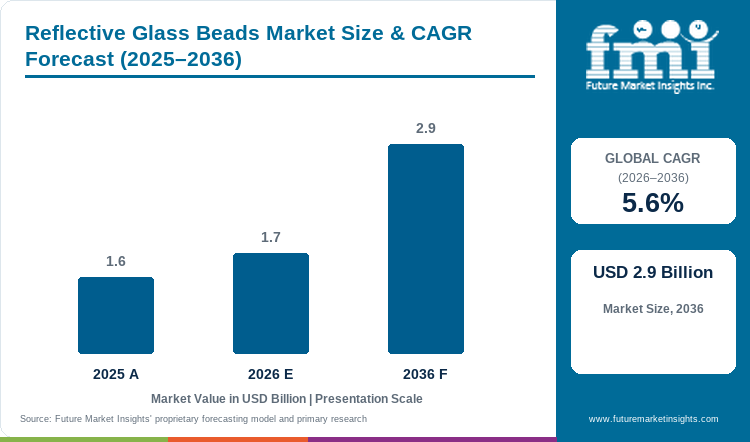
The reflective glass beads market is valued at USD 1.7 billion in 2026 and is projected to reach USD 2.9 billion by 2036, growing at a 5.6% CAGR.
Demand for reflective glass beads is estimated to rise at 5.6% CAGR from USD 1.7 Billion in 2026 to USD 2.9 Billion by 2036. The market was valued at USD 1.6 Billion in 2025. Pavement markings lose optical performance under traffic, weather and maintenance cycles, so road agencies repeatedly restore the reflective layer instead of treating it as a one-time installation. The U.S. Federal Highway Administration added maintained pavement-marking retroreflectivity provisions in August 2022 and retained them in the 11th Edition MUTCD published in December 2023. The result is a performance-based buying cycle in which glass beads are specified together with paint, thermoplastic or other binders. That recurring interface also links demand to the road marking paints and coatings market, where material choice and installed visibility are evaluated as a system.
Reflective beads must work with the binder and application method used on the road. Particle size, coating and embedment affect how much light returns to a driver's headlamps. US procurement emphasizes maintained retroreflectivity and state qualifications; other markets specify grades for local road and weather conditions. Contractors need a consistent product they can apply during scheduled marking works.
Key Takeaways of Reflective Glass Beads Market
- The market is projected to increase from USD 1.7 Billion in 2026 to USD 2.9 Billion by 2036 at a 5.6% CAGR. The 2025 market value is USD 1.6 Billion.
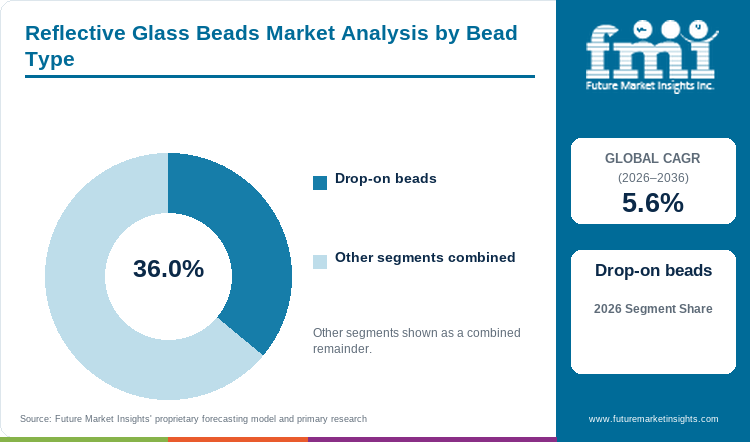
- Drop-on beads hold 36.0% of Bead Type demand in 2026 because surface application gives striping crews an established route to immediate retroreflection on fresh markings.
- The 1.5 RI standard represents 54.0% of Refractive Index demand in 2026. Its optical characteristics fit established road-marking specifications and common binder systems.
- Road marking paints account for 31.0% of Application demand, while Highways represent 34.0% of End Use and Road marking material producers hold 42.0% of Sales Channel demand in 2026.
- Country CAGRs range from 4.6% in Germany to 6.1% in Australia from 2026 to 2036. Qualification rules, road maintenance cycles and wet-weather performance needs determine how forecast growth converts into supplier orders.
- Competition spans integrated road-marking platforms, specialist glass-bead manufacturers and premium optical suppliers. Consistent gradation, binder compatibility, local availability and field application support shape repeat purchasing.
Analyst Perspective
Road users experience the completed marking, so bead selection and application have to be assessed together. A suitable grade can perform poorly if it is embedded too deeply or applied unevenly. Suppliers earn repeat orders by helping contractors reproduce the required visibility with the approved binder and by maintaining supply through the restriping season.
- Nikhil Kaitwade, Principal Consultant, Future Market Insights
How is the Reflective Glass Beads Market segmented?
The market is segmented by Bead Type, Refractive Index, Application, End Use, Sales Channel, and Region.
The reflective glass beads market uses five segment axes with region as the geographic split.
Bead type covers drop-on beads, intermix beads, high-index beads, moisture-proof coated beads, and airport-grade beads.
Refractive index covers 1.5 RI standard, 1.7 RI high index, 1.9 RI premium, and specialty coated grades.
Application covers road marking paints, thermoplastic markings, cold plastic markings, airport runway markings, and safety apparel/signage.
End use covers highways, urban roads, airports, industrial sites, and work zone safety.
Sales channel covers road marking material producers, direct project supply, distributors, and government-approved suppliers.
What makes Drop-on beads central to the Bead Type category?
Drop-on beads sit at the point where a fresh marking becomes immediately retroreflective. They are dispensed onto wet paint, thermoplastic or another compatible binder so that the bead is partly embedded and partly exposed. FHWA technical work shows why the application stage matters: bead rate, vehicle speed, binder viscosity and embedment depth all affect the installed result. That makes manufacturing consistency important even for a familiar product. Within the microspheres market, reflective glass beads serve road, runway and related safety markings.
- Drop-on beads account for 36.0% of Bead Type demand in 2026 because surface application fits established striping workflows and produces immediate night visibility.
- Potters Industries states that its Wilson, North Carolina plant went live in April 2025, adding another production location to its highway glass-bead supply network.
Why does 1.5 RI standard anchor the Refractive Index category?
A refractive index around 1.5 sits inside the conventional design envelope for road-marking glass beads. FHWA technical work identifies 1.50 as a typical pavement-marking bead grade and explains that the binder beneath the bead acts as the reflecting surface. Standard-index beads therefore fit mature paint and thermoplastic systems without requiring a premium optical architecture. Buyers still have to control roundness, clarity, size distribution and embedment. Higher-index grades remain relevant where wet-night brightness or specialty applications justify a different optical system. The 1.5 RI category remains widely specified because it matches a large installed base of road-marking practice.
- 1.5 RI standard accounts for 54.0% of Refractive Index demand in 2026 because it aligns with familiar optical specifications used in routine road markings.
- Unitika documents glass beads for road center lines, pedestrian crossings and other traffic markings, while its group also uses high-refractive-index glass beads in retroreflective materials.
How do Road marking paints shape the Application category?
Road marking paints create repeat bead consumption because reflective media can be dropped onto a liquid line during application. Bead dispensing fits the existing paint application process. A road authority can keep a familiar paint system while adjusting bead gradation, coating or drop rate to reach the required retroreflectivity. Thermoplastic and cold-plastic systems can offer longer service life in demanding locations, but paint remains common for routine network maintenance. Contractor productivity also matters because the bead delivery system has to stay synchronized with the striping machine. That operating requirement connects bead demand to the road marking equipment market as well as to the traffic road marking coatings market.
- Road marking paints account for 31.0% of Application demand in 2026 because they support direct bead application within routine maintenance and restriping workflows.
- 3M updated its Connected Roads All Weather Elements application guidance in June 2025 across high-build waterborne paint, thermoplastic, polyurea, epoxy and MMA systems, illustrating the range of binder environments that reflective optics must accommodate.
What supports Highways in the End Use category?
Highways combine long marking mileage with night driving exposure, traffic wear and recurring resurfacing. Those conditions make retroreflective performance a maintenance issue rather than an installation-only feature. The U.S. MUTCD framework requires a method designed to maintain minimum dry retroreflectivity on covered longitudinal markings, while Australian road authorities specify reflectorized markings and defined bead application practice. Airports impose a different operating environment, but similar visibility logic appears around runway and taxiway infrastructure that also depends on the airport lighting market for complementary visual guidance. Highway programs create repeat bead demand because long-line networks are renewed through recurring marking and resurfacing cycles.
- Highways account for 34.0% of End Use demand in 2026 because long-line networks combine night visibility requirements with recurring maintenance and resurfacing.
- Agency specifications increasingly connect material acceptance to installed retroreflectivity, making contractor application control part of the supplier value proposition.
What drives Road marking material producers in the Sales Channel category?
Road-marking material producers convert bead specifications into complete marking offers across paint, thermoplastic, cold plastic and two-component systems. They buy on repeat schedules and can standardize bead grades across multiple contractor customers. This channel also reduces the need for a road agency to manage bead properties in isolation because the producer can qualify binder and reflective media together. Direct project supply becomes more important for airports or unusual performance requirements. Distributors remain useful where contractors need local inventory, while government-approved suppliers matter when procurement rules restrict eligible products. Producers hold the leading channel position because they sit upstream of recurring marking installations.
- Road marking material producers account for 42.0% of Sales Channel demand in 2026 because they integrate reflective beads into repeatable marking formulations and contractor supply programs.
- SWARCO combines glass beads with wider road-marking materials and services, giving the company a route to buyers that evaluate the optical component as part of a complete marking system.
What are the drivers, restraints and opportunities in the Reflective Glass Beads Market?
In the reflective glass beads market, the key driver is the shift from installation-only purchasing to maintained retroreflectivity, where performance-based road marking standards oblige covered agencies to restore measurable nighttime visibility through recurring restriping and bead application cycles rather than treating the initial marking as a permanent installation, the key restraint is that installed retroreflectivity depends on bead quality, binder compatibility, embedment depth and application rate together, so a contractor switching to a new bead grade may need field trials, equipment adjustment and qualification documentation before the product becomes part of a routine marking program, and the key opportunity is that larger beads, higher-index optics and specialty moisture-resistant coatings can gain specification value in wet-night, airport and premium highway applications where standard dry-night performance does not meet the required visibility threshold, justifying added material and qualification cost through measurable service-life or brightness benefits.
- Driver: Road agencies renew reflective markings to maintain measurable nighttime visibility across public road networks and airport surfaces.
- Restraint: Field performance depends on bead specification, binder compatibility, embedment and application control, which can increase the cost of changing grades or suppliers.
- Opportunity: Larger beads, higher-index optics and specialty coatings can gain specification value where standard dry-night performance does not meet wet-weather or premium visibility requirements.
A central demand mechanism is the shift from initial appearance to maintained performance. FHWA added minimum pavement-marking retroreflectivity provisions in 2022 and retained them in the 11th Edition MUTCD. That obliges covered agencies to use a maintenance method rather than waiting for markings to become visibly poor. Brazil follows a similar performance logic. DNIT Instruction No. 03/2026 requires reflective glass microspheres Type I-B and II-A to meet ABNT requirements and ties service performance to minimum retroreflectivity. Bead purchases therefore recur as agencies restore markings during scheduled maintenance and resurfacing.
Changing bead grades can require new application settings and field trials. A compliant bead can still underperform when the drop rate, dispersion, embedment or binder condition is wrong. Brazil adds lot quality reporting, while Australian specifications require defined bead types and controlled application. A contractor may need trials, equipment adjustments and additional documentation before using a new grade routinely. Stable manufacturing and field support reduce that risk.
A notable opportunity sits above the standard dry-night baseline. Larger beads can project through a thin water film more effectively than small beads, while higher-index optics can increase returned light when the system is designed around them. Premium drop-on blends, moisture-resistant coatings and airport-oriented grades address more demanding specifications. The business case depends on measured visibility or service-life benefits that justify added material and qualification cost.
Which country CAGRs are profiled in the Reflective Glass Beads Market?
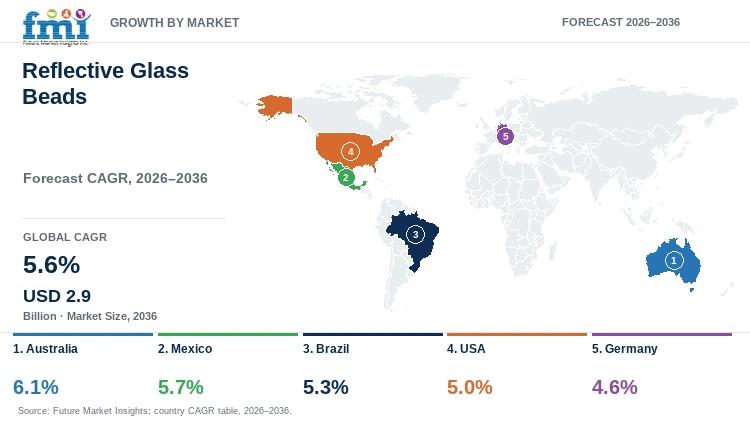
| Country | CAGR |
|---|---|
| Australia | 6.1% |
| Mexico | 5.7% |
| Brazil | 5.3% |
| USA | 5.0% |
| Germany | 4.6% |
How do country-level CAGRs compare in the Reflective Glass Beads Market?
The five profiled markets span a 1.5 percentage-point range from Germany at 4.6% CAGR to Australia at 6.1% from 2026 to 2036. Australia and Mexico sit above the other three rates, while Brazil is projected at 5.3%, USA at 5.0% and Germany at 4.6%. The spread is compact, so commercial planning depends more on the reason behind each rate than on the ranking itself. Specification changes, maintenance intensity, climate and supplier qualification shape the conversion of forecast growth into orders.
- Australia is projected at 6.1%. State-level specifications and wet-weather performance requirements support demand for controlled bead application and locally available qualified grades.
- Mexico is projected at 5.7%. Updated technical guidance links paint and microsphere selection to road type, maintenance interval, traffic intensity and weather conditions.
- Brazil is projected at 5.3%. DNIT ties reflective glass microspheres to ABNT requirements, lot-level quality control and residual retroreflectivity during the service guarantee.
- USA is projected at 5.0%. Federal maintained-retroreflectivity requirements operate alongside state qualification practices and recurring restriping programs.
- Germany is projected at 4.6%. Demand is linked to standards-led procurement and rehabilitation schedules that renew pavement markings with wider road works.
A market with a moderate rate can still offer recurring annual volume when procurement is stable and qualification is predictable. A market with a higher rate can remain difficult when specifications vary by authority or local inventory is weak. The broader assessment therefore considers buyer behavior, standards, application practice and channel structure alongside country growth.
Country-wise Analysis
- USA: Demand for reflective glass beads is forecast to expand at 5.0% CAGR from 2026 to 2036. FHWA finalized maintained-retroreflectivity provisions in August 2022 and carried them into the 11th Edition MUTCD. Installed visibility depends on embedment and binder control as well as bead quality. Suppliers need qualification support and dependable regional availability across seasonal restriping windows.
- Germany: Demand is forecast to expand at 4.6% CAGR from 2026 to 2036. Motorway rehabilitation renews the pavement surface and the marking system together, so bead suppliers compete through conformity documentation, consistent product quality and service that fits restricted work windows on heavily used corridors.
- Brazil: Demand is forecast to expand at 5.3% CAGR from 2026 to 2036. DNIT Instruction No. 03/2026 requires Type I-B and II-A reflective glass microspheres to meet ABNT requirements and sets residual retroreflectivity expectations during the guarantee period. Traceable lots and contractor support are therefore directly connected to the service obligation.
- Mexico: Demand is forecast to expand at 5.7% CAGR from 2026 to 2036. The Mexican Institute of Transportation described standards work in January 2025 that links paints and glass microspheres to road type, maintenance periods, traffic intensity and meteorological conditions. Suppliers need grades and application guidance that reflect local operating conditions.
- Australia: Demand is forecast to expand at 6.1% CAGR from 2026 to 2036. Queensland road specifications require surface-applied glass beads across pavement-marking work and define application provisions. State-level qualification and wet-weather conditions make local technical support and inventory important during narrow maintenance windows.
Who are the notable companies in the Reflective Glass Beads Market?
Potters Industries; SWARCO; 3M; Weissker; Sovitec; Blastrite; Unitika; and Langfang Olan Glass Beads are notable companies serving the reflective glass beads market.
Competition is organized around three operating positions. Potters Industries and SWARCO combine road-marking bead supply with wider specification knowledge and access to marking-system buyers. 3M competes through engineered reflective optics used where wet-night or premium performance matters. Weissker and Sovitec bring European bead specialization, while Unitika and Langfang Olan Glass Beads cover road-marking and higher-index glass-bead capabilities. Blastrite adds regional supply across conventional road-marking bead applications. Buyers compare this company set on product consistency, optical capability, qualification support and the ability to supply the grade during active marking programs.
- Integrated road-marking platforms: Potters Industries and SWARCO connect reflective beads with wider road-marking materials, application knowledge and downstream buyer access.
- Premium optical and specialist suppliers: 3M, Weissker, Sovitec and Unitika compete through differentiated optical performance, specialist glass-bead know-how or higher-index capability.
- Regional bead manufacturing: Blastrite and Langfang Olan Glass Beads compete through road-marking bead portfolios, export supply and regional contractor or distributor relationships.
Competitive Benchmarking: Reflective Glass Beads Market
| Company | Road-Marking Bead Portfolio | High-Index / Wet-Night Optics | Binder & Application Compatibility | Geographic Reach |
|---|---|---|---|---|
| Potters Industries | High | High | High | North America, Europe and international markets |
| SWARCO | High | High | High | Europe, USA, Middle East and international markets |
| 3M | Medium | High | High | Global |
| Weissker | High | Medium | High | Europe with international project supply |
| Sovitec | High | Medium | Medium | European and international distribution |
| Blastrite | Medium | Low | Medium | Southern Africa and export markets |
| Unitika | Medium | High | Medium | Japan and international markets |
| Langfang Olan Glass Beads | High | High | Medium | China and export markets |
Scoring basis: Road-Marking Bead Portfolio considers documented coverage across conventional, specialty and airport-oriented road-marking grades. High-Index / Wet-Night Optics considers products designed for stronger retroreflective performance or difficult viewing conditions. Binder & Application Compatibility considers guidance or product evidence tied to real marking-system use. Geographic Reach reflects documented production, distribution or project-market access. High, Medium and Low indicate comparative capability within this profiled set.
Key Developments in the Reflective Glass Beads Market
- In June 2026, SWARCO acquired Hi-Way Services Ltd., a UK provider of highway and off-highway road marking services operating from three depots across the south east and south of England, strengthening SWARCO's downstream application presence in the UK road marking market. The move adds downstream application access and strengthens SWARCO's connection between reflective materials, road-marking systems and field execution.
- In April 2025, Potters Industries received $19.5 million in New Markets Tax Credit financing to accelerate operations at its Wilson, North Carolina facility, supporting the acquisition of capital equipment and inventory to expand highway glass-bead supply in the Southeast United States.
- In March 2025, SWARCO published an Environmental Product Declaration for SWARCOFLEX reflective glass beads. The EPD provides life-cycle information that procurement teams can use alongside optical performance, compliance and price in tender evaluation.
Key Players in the Reflective Glass Beads Market
Integrated Road-Marking Platforms
- Potters Industries
- SWARCO
Premium Reflective Optics and European Specialists
- 3M
- Weissker
- Sovitec
Regional and Specialist Glass-Bead Manufacturers
- Blastrite
- Unitika
- Langfang Olan Glass Beads
Reflective Glass Beads Market - Report Scope
| Coverage field | Report scope |
|---|---|
| Market breakdown | Bead Type; Refractive Index; Application; End Use; Sales Channel; Region |
| Quantitative Units | USD Billion |
| Market Definition | Revenue includes reflective glass beads sold within the stated bead type, refractive index, application, end-use and sales-channel universe. Downstream finished marking-system revenue and adjacent substitute optical-material revenue are excluded. |
| Regions Covered | North America; Latin America; Western Europe; Eastern Europe; East Asia; South Asia & Pacific; Middle East & Africa |
| Countries Covered | Australia; Mexico; Brazil; USA; Germany; and additional countries in the full report |
| Key Companies Profiled | Potters Industries; SWARCO; 3M; Weissker; Sovitec; Blastrite; Unitika; Langfang Olan Glass Beads |
| Forecast Period | 2026 to 2036 |
| Approach | Hybrid bottom-up and top-down market sizing that reconciles supplier activity, channel flow, road-marking demand, application cycles and country operating conditions within the defined revenue boundary. |
Reflective Glass Beads Market - Research Methodology
| Method | Approach |
|---|---|
| Primary Research | FMI uses structured consultations with manufacturers, road-marking material producers, distributors, contractors, transportation authorities, airport stakeholders, procurement specialists and subject-matter experts to test product specification, qualification, pricing, application performance, channel behavior and purchase frictions. |
| Desk Research | Government road-marking requirements, infrastructure programs, technical standards, engineering publications, company disclosures, product documentation and official corporate announcements are reviewed for evidence tied to the defined market. |
| Market Sizing and Forecasting | Supplier and channel activity is reconciled with pavement-marking use, maintenance frequency, material consumption, specification change and country operating conditions. Downstream finished marking-system revenue is separated from reflective glass-bead revenue. |
| Data Validation | Findings are cross-checked across buyer specifications, public infrastructure signals, technical sources and company disclosures. Validation removes double counting, adjacent substitute revenue and unsupported company-share assumptions. |
Reflective Glass Beads Market by Segments
Reflective Glass Beads Market segmented by Bead Type:
- Drop-on beads
- Intermix beads
- High-index beads
- Moisture-proof coated beads
- Airport-grade beads
Reflective Glass Beads Market segmented by Refractive Index:
- 1.5 RI standard
- 1.7 RI high index
- 1.9 RI premium
- Specialty coated grades
Reflective Glass Beads Market segmented by Application:
- Road marking paints
- Thermoplastic markings
- Cold plastic markings
- Airport runway markings
- Safety apparel / signage
Reflective Glass Beads Market segmented by End Use:
- Highways
- Urban roads
- Airports
- Industrial sites
- Work zone safety
Reflective Glass Beads Market segmented by Sales Channel:
- Road marking material producers
- Direct project supply
- Distributors
- Government-approved suppliers
Reflective Glass Beads Market by Region:
- North America
- United States
- Canada
- Latin America
- Brazil
- Mexico
- Argentina
- Chile
- Western Europe
- Germany
- France
- United Kingdom
- Italy
- Spain
- Benelux
- Nordics
- Eastern Europe
- Poland
- Czech Republic
- Romania
- Hungary
- East Asia
- China
- Japan
- South Korea
- South Asia & Pacific
- India
- ASEAN
- Australia and New Zealand
- Middle East & Africa
- GCC Countries
- South Africa
- Türkiye
- Israel
Research Sources and Bibliography
- Federal Highway Administration. Pavement Markings Regulations / Standards. Updated for the 11th Edition MUTCD.
- Federal Highway Administration. Pavement Marking Demonstration Projects: State of Alaska and State of Tennessee.
- Departamento Nacional de Infraestrutura de Transportes. (2026). Instrução Normativa No. 03/2026.
- Instituto Mexicano del Transporte. (2025, January 8). Pinturas y microesferas de vidrio para señalamiento horizontal en carreteras.
- Queensland Department of Transport and Main Roads. (2025). MRTS45 Road Surface Delineation.
- Die Autobahn GmbH des Bundes. (2025). A60 rehabilitation and pavement-marking renewal notice.
- Potters Industries. (2025, April). Wilson, North Carolina plant goes live.
- SWARCO. (2026, June). Acquisition of Hi-Way Services Ltd.
- SWARCO. (2025, March). Environmental Product Declaration for SWARCOFLEX reflective glass beads.
- 3M. (2025, June). Connected Roads All Weather Elements Application Guidelines, Revision A.
- Unitika Ltd. (2025). Unitika Report 2025, Glass Beads Business.
- Langfang Olan Glass Beads. (2026). Road-marking and high-index glass bead product information.
This Report Answers
- What is the Reflective Glass Beads Market size in 2026 and what value is forecast for 2036?
- How does road-marking maintenance convert into recurring reflective glass bead demand?
- Why do Drop-on beads hold 36.0% of Bead Type demand in 2026?
- How does the 1.5 RI standard influence specification and purchasing?
- Why do Road marking paints hold 31.0% of Application demand?
- How do profiled country CAGRs compare across Australia, Mexico, Brazil, USA and Germany?
- How do suppliers differ across bead portfolio, optical capability, application compatibility and geographic reach?
- What should road-marking material producers and procurement teams evaluate before changing reflective glass bead grades?
Frequently Asked Questions
How big is the Reflective Glass Beads Market in 2026?
The market is estimated at USD 1.7 Billion in 2026 and is forecast to reach USD 2.9 Billion by 2036 at a 5.6% CAGR. The 2025 market value is USD 1.6 Billion.
What is driving growth in the Reflective Glass Beads Market?
Growth is tied to recurring restriping and maintenance programs that restore nighttime visibility as pavement markings wear. Performance-based specifications keep reflective beads connected to repeat maintenance spending rather than only new road construction.
Which Bead Type holds 36.0% of the Reflective Glass Beads Market in 2026?
Drop-on beads are projected to account for 36.0% of Bead Type demand in 2026 because they can be applied directly to fresh marking binders and fit established striping workflows.
Which End Use accounts for 34.0% of demand in 2026?
Highways are projected to account for 34.0% of End Use demand in 2026. Long marking runs, night driving exposure and recurring resurfacing create repeat demand for reflective media.
Who are the key players in the Reflective Glass Beads Market?
Key companies include Potters Industries, SWARCO, 3M, Weissker, Sovitec, Blastrite, Unitika and Langfang Olan Glass Beads. Their positions range from integrated road-marking platforms to premium optics and specialist bead manufacturing.
What notable restraint affects the Reflective Glass Beads Market?
Installed retroreflectivity depends on bead quality, binder compatibility, embedment and application rate. A new supplier can therefore require trials, equipment adjustment and qualification work before the grade becomes a repeat purchase.
Preview the report firsthand - request a free sample
Get SampleGet the brochure for pricing and purchase details.
Get PDFTable of Content
- Key Takeaways
- Market Size and CAGR
- Top Growth Driver
- Fastest Growing Segment
- Leading Region
- Key Companies
- Emerging Opportunities
- Executive Summary
- Global Market Outlook
- Demand-side Trends
- Supply-side Trends
- Technology Roadmap Analysis
- Analysis and Recommendations
- Analyst Perspective (What is happening? Why now? What should investors know?)
- Key Questions Answered
- How large is the market?
- What is the CAGR?
- What are key trends?
- Which region dominates?
- Who are the leaders?
- Market Overview
- Market Coverage / Taxonomy
- Market Definition / Scope / Limitations
- Research Methodology
- Chapter Orientation
- Analytical Lens and Working Hypotheses
- Market Structure, Signals, and Trend Drivers
- Benchmarking and Cross-market Comparability
- Market Sizing, Forecasting, and Opportunity Mapping
- Research Design and Evidence Framework
- Desk Research Programme (Secondary Evidence)
- Expert Input and Fieldwork (Primary Evidence)
- Tooling, Models, and Reference Databases
- Data Engineering and Model Build
- Quality Assurance and Audit Trail
- Market Background
- Market Dynamics (Drivers, Restraints, Opportunity, Trends)
- Scenario Forecast (Optimistic, Likely, Conservative)
- Impact Analysis
- AI Impact
- Sustainability Impact
- Regulatory Impact
- Technology Impact
- Consumer / Buyer Analysis
- Purchase Drivers
- Adoption Barriers
- Buyer Journey
- Opportunity Map Analysis
- Product Life Cycle Analysis
- Supply Chain Analysis
- Investment Feasibility Matrix
- Value Chain Analysis
- PESTLE and Porter's Analysis
- Regulatory Landscape
- Regional Parent Market Outlook
- Production and Consumption Statistics
- Import and Export Statistics
- Global Market Analysis and Forecast, 2021 to 2036
- Historical Market Size Value (USD Billion) Analysis, 2021 to 2025
- Current and Future Market Size Value (USD Billion) Projections, 2026 to 2036
- Y-o-Y Growth Trend Analysis
- Absolute $ Opportunity Analysis
- Global Market Pricing Analysis, 2021 to 2036
- Global Market Analysis and Forecast, By Bead Type, 2021 to 2036
- Introduction / Key Findings
- Historical Market Size Value (USD Billion) Analysis By Bead Type, 2021 to 2025
- Current and Future Market Size Value (USD Billion) Analysis and Forecast By Bead Type, 2026 to 2036
- Drop-on beads
- Intermix beads
- High-index beads
- Moisture-proof coated beads
- Airport-grade beads
- Y-o-Y Growth Trend Analysis By Bead Type, 2021 to 2025
- Absolute $ Opportunity Analysis By Bead Type, 2026 to 2036
- Global Market Analysis and Forecast, By Refractive Index, 2021 to 2036
- Introduction / Key Findings
- Historical Market Size Value (USD Billion) Analysis By Refractive Index, 2021 to 2025
- Current and Future Market Size Value (USD Billion) Analysis and Forecast By Refractive Index, 2026 to 2036
- 1.5 RI standard
- 1.7 RI high index
- 1.9 RI premium
- Specialty coated grades
- Y-o-Y Growth Trend Analysis By Refractive Index, 2021 to 2025
- Absolute $ Opportunity Analysis By Refractive Index, 2026 to 2036
- Global Market Analysis and Forecast, By Application, 2021 to 2036
- Introduction / Key Findings
- Historical Market Size Value (USD Billion) Analysis By Application, 2021 to 2025
- Current and Future Market Size Value (USD Billion) Analysis and Forecast By Application, 2026 to 2036
- Road marking paints
- Thermoplastic markings
- Cold plastic markings
- Airport runway markings
- Safety apparel / signage
- Y-o-Y Growth Trend Analysis By Application, 2021 to 2025
- Absolute $ Opportunity Analysis By Application, 2026 to 2036
- Global Market Analysis and Forecast, By End Use, 2021 to 2036
- Introduction / Key Findings
- Historical Market Size Value (USD Billion) Analysis By End Use, 2021 to 2025
- Current and Future Market Size Value (USD Billion) Analysis and Forecast By End Use, 2026 to 2036
- Highways
- Urban roads
- Airports
- Industrial sites
- Work zone safety
- Y-o-Y Growth Trend Analysis By End Use, 2021 to 2025
- Absolute $ Opportunity Analysis By End Use, 2026 to 2036
- Global Market Analysis and Forecast, By Sales Channel, 2021 to 2036
- Introduction / Key Findings
- Historical Market Size Value (USD Billion) Analysis By Sales Channel, 2021 to 2025
- Current and Future Market Size Value (USD Billion) Analysis and Forecast By Sales Channel, 2026 to 2036
- Road marking material producers
- Direct project supply
- Distributors
- Government-approved suppliers
- Y-o-Y Growth Trend Analysis By Sales Channel, 2021 to 2025
- Absolute $ Opportunity Analysis By Sales Channel, 2026 to 2036
- Global Market Analysis and Forecast, By Region, 2021 to 2036
- Introduction
- Historical Market Size Value (USD Billion) Analysis By Region, 2021 to 2025
- Current Market Size Value (USD Billion) Analysis and Forecast By Region, 2026 to 2036
- North America
- Latin America
- Western Europe
- Eastern Europe
- East Asia
- South Asia & Pacific
- Middle East & Africa
- Market Attractiveness Analysis By Region
- North America Market Analysis and Forecast, By Country, 2021 to 2036
- Historical Market Size Value (USD Billion) Trend Analysis By Market Taxonomy, 2021 to 2025
- Market Size Value (USD Billion) Forecast By Market Taxonomy, 2026 to 2036
- By Country
- United States
- Canada
- By Bead Type
- By Refractive Index
- By Application
- By End Use
- By Sales Channel
- By Country
- Market Attractiveness Analysis
- By Country
- By Bead Type
- By Refractive Index
- By Application
- By End Use
- By Sales Channel
- Key Takeaways
- Latin America Market Analysis and Forecast, By Country
- Historical Market Size Value (USD Billion) Trend Analysis By Market Taxonomy, 2021 to 2025
- Market Size Value (USD Billion) Forecast By Market Taxonomy, 2026 to 2036
- By Country
- Brazil
- Mexico
- Argentina
- Chile
- By Bead Type
- By Refractive Index
- By Application
- By End Use
- By Sales Channel
- By Country
- Market Attractiveness Analysis
- By Country
- By Bead Type
- By Refractive Index
- By Application
- By End Use
- By Sales Channel
- Key Takeaways
- Western Europe Market Analysis and Forecast, By Country
- Historical Market Size Value (USD Billion) Trend Analysis By Market Taxonomy, 2021 to 2025
- Market Size Value (USD Billion) Forecast By Market Taxonomy, 2026 to 2036
- By Country
- Germany
- France
- United Kingdom
- Italy
- Spain
- Benelux
- Nordics
- By Bead Type
- By Refractive Index
- By Application
- By End Use
- By Sales Channel
- By Country
- Market Attractiveness Analysis
- By Country
- By Bead Type
- By Refractive Index
- By Application
- By End Use
- By Sales Channel
- Key Takeaways
- Eastern Europe Market Analysis and Forecast, By Country
- Historical Market Size Value (USD Billion) Trend Analysis By Market Taxonomy, 2021 to 2025
- Market Size Value (USD Billion) Forecast By Market Taxonomy, 2026 to 2036
- By Country
- Poland
- Czech Republic
- Romania
- Hungary
- By Bead Type
- By Refractive Index
- By Application
- By End Use
- By Sales Channel
- By Country
- Market Attractiveness Analysis
- By Country
- By Bead Type
- By Refractive Index
- By Application
- By End Use
- By Sales Channel
- Key Takeaways
- East Asia Market Analysis and Forecast, By Country
- Historical Market Size Value (USD Billion) Trend Analysis By Market Taxonomy, 2021 to 2025
- Market Size Value (USD Billion) Forecast By Market Taxonomy, 2026 to 2036
- By Country
- China
- Japan
- South Korea
- By Bead Type
- By Refractive Index
- By Application
- By End Use
- By Sales Channel
- By Country
- Market Attractiveness Analysis
- By Country
- By Bead Type
- By Refractive Index
- By Application
- By End Use
- By Sales Channel
- Key Takeaways
- South Asia & Pacific Market Analysis and Forecast, By Country
- Historical Market Size Value (USD Billion) Trend Analysis By Market Taxonomy, 2021 to 2025
- Market Size Value (USD Billion) Forecast By Market Taxonomy, 2026 to 2036
- By Country
- India
- ASEAN
- Australia and New Zealand
- By Bead Type
- By Refractive Index
- By Application
- By End Use
- By Sales Channel
- By Country
- Market Attractiveness Analysis
- By Country
- By Bead Type
- By Refractive Index
- By Application
- By End Use
- By Sales Channel
- Key Takeaways
- Middle East & Africa Market Analysis and Forecast, By Country
- Historical Market Size Value (USD Billion) Trend Analysis By Market Taxonomy, 2021 to 2025
- Market Size Value (USD Billion) Forecast By Market Taxonomy, 2026 to 2036
- By Country
- GCC Countries
- South Africa
- Türkiye
- Israel
- By Bead Type
- By Refractive Index
- By Application
- By End Use
- By Sales Channel
- By Country
- Market Attractiveness Analysis
- By Country
- By Bead Type
- By Refractive Index
- By Application
- By End Use
- By Sales Channel
- Key Takeaways
- Key Countries Market Analysis
- United States
- Pricing Analysis
- Market Share Analysis, 2025
- By Bead Type
- By Refractive Index
- By Application
- By End Use
- By Sales Channel
- Canada
- Pricing Analysis
- Market Share Analysis, 2025
- By Bead Type
- By Refractive Index
- By Application
- By End Use
- By Sales Channel
- Mexico
- Pricing Analysis
- Market Share Analysis, 2025
- By Bead Type
- By Refractive Index
- By Application
- By End Use
- By Sales Channel
- Brazil
- Pricing Analysis
- Market Share Analysis, 2025
- By Bead Type
- By Refractive Index
- By Application
- By End Use
- By Sales Channel
- Chile
- Pricing Analysis
- Market Share Analysis, 2025
- By Bead Type
- By Refractive Index
- By Application
- By End Use
- By Sales Channel
- Germany
- Pricing Analysis
- Market Share Analysis, 2025
- By Bead Type
- By Refractive Index
- By Application
- By End Use
- By Sales Channel
- United Kingdom
- Pricing Analysis
- Market Share Analysis, 2025
- By Bead Type
- By Refractive Index
- By Application
- By End Use
- By Sales Channel
- Italy
- Pricing Analysis
- Market Share Analysis, 2025
- By Bead Type
- By Refractive Index
- By Application
- By End Use
- By Sales Channel
- Spain
- Pricing Analysis
- Market Share Analysis, 2025
- By Bead Type
- By Refractive Index
- By Application
- By End Use
- By Sales Channel
- France
- Pricing Analysis
- Market Share Analysis, 2025
- By Bead Type
- By Refractive Index
- By Application
- By End Use
- By Sales Channel
- India
- Pricing Analysis
- Market Share Analysis, 2025
- By Bead Type
- By Refractive Index
- By Application
- By End Use
- By Sales Channel
- ASEAN
- Pricing Analysis
- Market Share Analysis, 2025
- By Bead Type
- By Refractive Index
- By Application
- By End Use
- By Sales Channel
- Australia and New Zealand
- Pricing Analysis
- Market Share Analysis, 2025
- By Bead Type
- By Refractive Index
- By Application
- By End Use
- By Sales Channel
- China
- Pricing Analysis
- Market Share Analysis, 2025
- By Bead Type
- By Refractive Index
- By Application
- By End Use
- By Sales Channel
- Japan
- Pricing Analysis
- Market Share Analysis, 2025
- By Bead Type
- By Refractive Index
- By Application
- By End Use
- By Sales Channel
- South Korea
- Pricing Analysis
- Market Share Analysis, 2025
- By Bead Type
- By Refractive Index
- By Application
- By End Use
- By Sales Channel
- Poland
- Pricing Analysis
- Market Share Analysis, 2025
- By Bead Type
- By Refractive Index
- By Application
- By End Use
- By Sales Channel
- Hungary
- Pricing Analysis
- Market Share Analysis, 2025
- By Bead Type
- By Refractive Index
- By Application
- By End Use
- By Sales Channel
- Türkiye
- Pricing Analysis
- Market Share Analysis, 2025
- By Bead Type
- By Refractive Index
- By Application
- By End Use
- By Sales Channel
- South Africa
- Pricing Analysis
- Market Share Analysis, 2025
- By Bead Type
- By Refractive Index
- By Application
- By End Use
- By Sales Channel
- Australia
- Pricing Analysis
- Market Share Analysis, 2025
- By Bead Type
- By Refractive Index
- By Application
- By End Use
- By Sales Channel
- United States
- Market Structure Analysis
- Competition Dashboard
- Competition Benchmarking
- Market Share Analysis of Top Players
- By Regional
- By Bead Type
- By Refractive Index
- By Application
- By End Use
- By Sales Channel
- Emerging Startups
- Innovation Benchmarking
- Competition Analysis
- Competition Deep Dive
- Potters Industries
- Overview
- Product Portfolio
- Profitability by Market Segments
- Sales Footprint
- Strategy Overview
- Marketing Strategy
- Product Strategy
- Channel Strategy
- SWARCO
- 3M
- Weissker
- Sovitec
- Blastrite
- Unitika
- Langfang Olan Glass Beads
- Potters Industries
- Case Studies
- Success Stories
- Recent Developments
- Competition Deep Dive
- Assumptions & Acronyms Used


