

- Market Size (2026)
- USD 118.6 Mn
- Forecast (2036)
- USD 275.7 Mn
- CAGR (2026 to 2036)
- 8.8%
How big is Rice Paper Snacks Market in 2026?
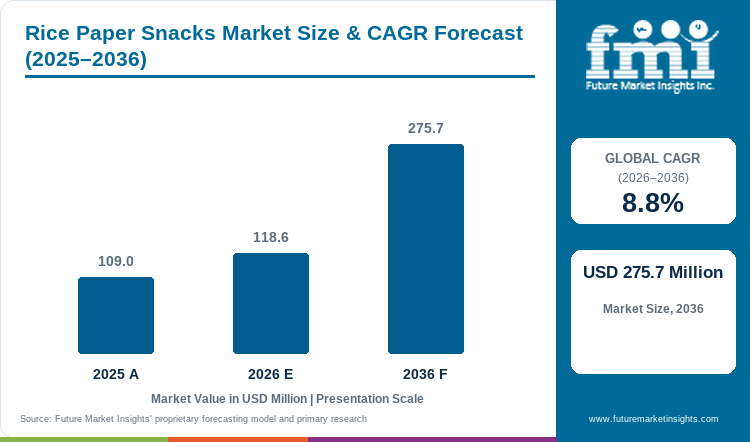
USD 118.6 Million in 2026 and USD 275.7 Million by 2036 at an 8.8% CAGR.
Sales of rice paper snacks are estimated to rise from USD 118.6 Million in 2026 to USD 275.7 Million by 2036 at an 8.8% CAGR. The market was valued at USD 109.0 Million in 2025. Packaged bánh tráng needs to retain its intended chewy or crisp texture during transport and shelf storage. Vietnam already exports rice-based foods through established routes. World Bank WITS records USD 302.3 Million of Vietnamese exports under HS 190590 in 2023, a category covering rice paper alongside other bakery and wafer products. USA, Japan, Australia and South Korea were among the main destinations.
Rice paper snacks bring Vietnamese street-food flavors into the ethnic food market. Moving from freshly mixed bánh tráng to a sealed pack changes the production task. Sheet thickness, seasoning distribution and moisture must be consistent, while packaging must prevent breakage or softening. VN Flex describes work on crispness, shape, flavor and shelf life as part of this transition to mass production.
Key Takeaways
- The market is estimated at USD 118.6 Million in 2026 and USD 275.7 Million by 2036 at an 8.8% CAGR. The 2025 base is USD 109.0 Million, creating USD 157.1 Million of incremental opportunity through 2036.
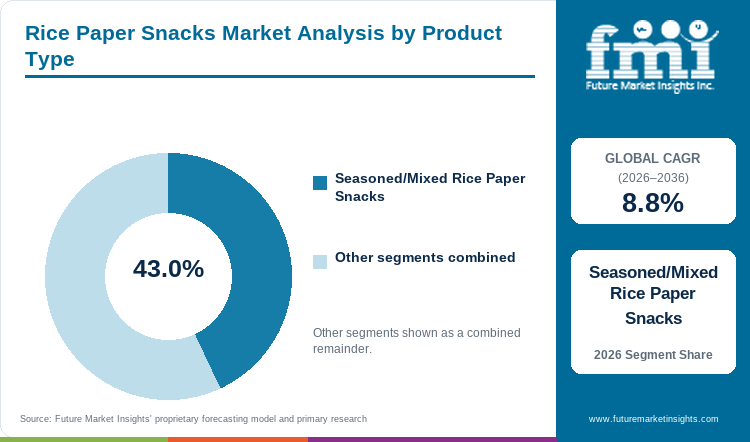
- Seasoned/Mixed Rice Paper Snacks hold 43.0% of Product Type demand in 2026 because the format keeps the core bánh tráng experience while making seasoning, portioning and packaging repeatable.
- Spicy & Savory flavors account for 58.0% of Flavor Profile demand. Chili, satay, shrimp-seasoning, garlic and seaweed combinations dominate current Vietnamese branded assortments.
- Ready-to-Eat products represent 72.0% of Preparation Format demand because the value proposition depends on removing the mixing or grilling step from the eating occasion.
- Below 50 g packs hold 46.0% of Pack Size demand, while Supermarkets & Hypermarkets account for 34.0% of Sales Channel demand because small packs fit impulse trial and retail shelf economics.
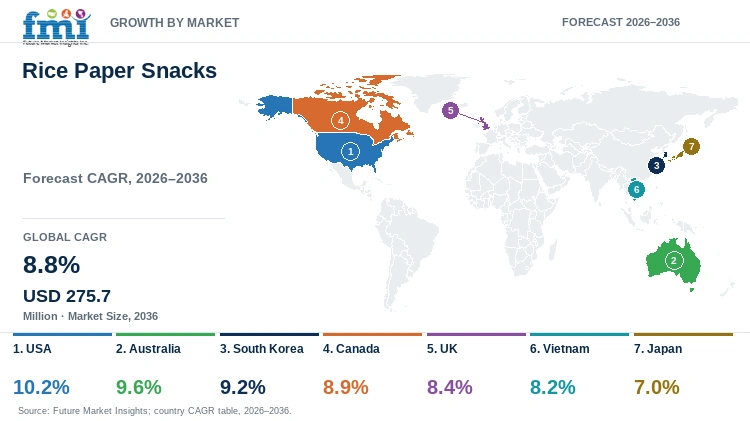
- Country CAGRs range from 10.2% in the USA to 7.0% in Japan from 2026 to 2036. Growth depends on how quickly Vietnamese-origin snacks move from diaspora and Asian-specialty channels into mainstream convenience and grocery retail.
Analyst Perspective
Chewy and crisp rice paper snacks need different moisture control. A chewy product can stiffen during storage; a fried or toasted sheet can lose its crunch. Seasoning adds further requirements when it contains shrimp, peanuts, sesame, soy or dairy. Export packs must preserve the intended texture and clearly identify preparation, ingredients and allergens. Small packs can help buyers try the format without leaving several servings exposed after opening.
- Nandini Roy Choudhury, Principal Consultant, Future Market Insights
How is the Rice Paper Snacks Market segmented?
The Rice Paper Snacks Market is segmented by Product Type, Flavor Profile, Preparation Format, Pack Size, Sales Channel, and Region.
Product Type covers Seasoned/Mixed Rice Paper Snacks, Grilled/Toasted Rice Paper Snacks, Crispy/Fried Rice Paper Chips, Rolled/Filled Rice Paper Snacks and Others. Flavor Profile includes Spicy & Savory, Seaweed/Umami, Cheese/Creamy, Sweet-Tangy/Fruit and Others. Preparation Format is divided into Ready-to-Eat, Mix-at-Home Kits and Heat-and-Eat/Grill-Ready. Pack Size includes Below 50 g, 50-100 g and Above 100 g. Sales Channel covers Supermarkets & Hypermarkets, Convenience Stores, Online Retail/DTC, Asian Specialty Stores and Other Channels. Regional coverage spans North America, Latin America, Western Europe, Eastern Europe, East Asia, South Asia & Pacific and Middle East & Africa.
Why do Seasoned/Mixed Rice Paper Snacks lead the Product Type category?
Seasoned or mixed rice paper is closest to the established Vietnamese bánh tráng trộn occasion. It combines thin rice paper with chili seasoning, satay, fried aromatics and other inclusions, then shifts preparation from the street stall into a controlled pack. Tanisa sells an 80 g mixed rice paper snack in which rice paper is combined with chili shrimp salt, fried onion, fried garlic, tiny shrimp, satay oil and peanut. Vina Snack also sells beef satay, shrimp satay, roast chicken and seaweed variants. The format gives brands multiple flavor routes without abandoning the core product identity.
- Seasoned/Mixed Rice Paper Snacks hold 43.0% of Product Type demand in 2026 because they translate an established eating occasion into a branded pack with repeatable portioning.
- Current company assortments show the segment can support shrimp, beef, chicken, garlic and seaweed profiles, giving retailers enough SKU depth to build a visible rice paper snack set.
Why do Spicy & Savory flavors lead the Flavor Profile category?
The dominant flavor logic comes from how rice paper snacks are eaten in Vietnam. Chili, satay and savory seasoning give a relatively neutral rice-paper base a strong sensory identity. WEFCO lists spicy shrimp satay, spicy satay sauce, garlic butter, seaweed with fried garlic and chilli rice paper among its export snack products. The same architecture appears across Vina Snack and Tanisa. Seaweed and cheese can extend the category into other taste systems, but spicy and savory profiles remain closest to the original street-snack experience and therefore require less consumer education.
- Spicy & Savory flavors represent 58.0% of Flavor Profile demand in 2026 because chili, satay and savory inclusions are already embedded in the category’s product language.
- Flavor development is commercially useful when it changes a repeat-purchase reason without forcing the buyer to learn a new format. That makes seasoning rotation easier than changing the underlying rice-paper platform.
Why does Ready-to-Eat lead the Preparation Format category?
Ready-to-Eat packs remove the need to mix seasonings or grill rice paper at home. A consumer can buy the pack for school, work, travel or casual snacking without extra preparation. This links the category to the wider convenience food market, but rice paper snacks carry a specific texture challenge because thin sheets can harden, soften or break. VN Flex moved from traditional rice paper toward ready-to-eat snacks only after reworking thickness, crispness and shelf-life behavior. That makes format engineering part of the value proposition rather than a packaging afterthought.
- Ready-to-Eat products account for 72.0% of Preparation Format demand in 2026 because immediate consumption is central to the packaged-snack proposition.
- Mix-at-Home kits retain authenticity and give consumers control over sauce or seasoning, but they add steps that are less suited to impulse channels and travel occasions.
Why do Below 50 g packs lead the Pack Size category?
Small packs reduce trial risk for a snack that remains unfamiliar to many consumers outside Vietnam. They also help protect texture because fewer servings are exposed after opening. WEFCO lists several rice paper snack variants at 50 g, while VN Flex described reducing the number of rice paper pieces per pack and using protective packaging to limit breakage during transport. Those mechanics favor small single-serve formats in convenience retail, e-commerce sample bundles and Asian specialty stores.
- Below 50 g packs account for 46.0% of Pack Size demand in 2026 because they combine lower trial cost with less post-opening exposure to humidity.
- The pack does more than carry branding. It protects thin sheets from breakage and helps manufacturers control the texture window between production and consumption.
Why do Supermarkets & Hypermarkets lead the Sales Channel category?
Supermarkets give rice paper snacks a route from Vietnamese specialty stores into routine grocery baskets. The channel also allows shoppers to compare ingredients, allergen declarations and pack sizes before trying an unfamiliar snack. Vina Snack entered T&T Supermarket in Canada in November 2025 and has also moved into convenience and airport retail. Tanisa reports supply relationships with H-Mart in the USA, Don Quijote in Japan, Homeplus in South Korea and Foodland in Australia. Modern retail therefore acts as the bridge between cultural familiarity and broader trial.
- Supermarkets & Hypermarkets hold 34.0% of Sales Channel demand in 2026 because they provide shelf visibility and repeat replenishment across both diaspora and mainstream shoppers.
- Convenience stores can accelerate impulse trial once pack size and shelf life are proven, while online channels are useful for bundles, discovery and cross-border access.
What are the drivers, restraints and opportunities in the Rice Paper Snacks Market?
Packaged conversion of Vietnamese street snacks supports demand, texture and allergen control constrain scale, and small-format export retail creates a route to new buyers.
- Driver: Producers are converting a familiar Vietnamese street-food format into sealed products that can move through supermarkets, convenience stores and international e-commerce.
- Restraint: Thin rice paper is sensitive to moisture and breakage, while seasonings can introduce allergens that require market-specific labeling and production controls.
- Opportunity: Export-ready single-serve packs, vegetarian recipes and OEM/private-label programs can widen access without requiring a consumer to prepare rice paper at home.
The growth mechanism begins with formalization. In 2024, Vietnam’s total retail sales of goods and consumer services reached VND 6,391.0 trillion, up 9.0% year on year according to the National Statistics Office. VN Flex’s experience shows what that formalization requires at product level. The company moved drying into controlled rooms, introduced automated grilling and redesigned protective packaging because traditional production and simple plastic bags were not reliable enough for modern channels. Once a product can meet consistent shelf specifications, the same recipe can move from local agents into supermarkets and export assortments. This path creates new revenue without requiring rice paper itself to become a new food concept.
Scale is constrained by the product’s physical behavior. Chewy rice paper can dry and stiffen. Crisp formats can lose crunch when humidity enters the pack. Grilled sheets can break during transport. Flavor systems create another layer of control because shrimp, peanut, sesame, soy and dairy ingredients appear in common variants. FDA’s January 2025 allergen guidance covers nine major allergens in the United States, including crustacean shellfish, peanuts, soybeans and sesame. Canada also requires priority allergens such as crustaceans, sesame and soy to be declared on prepackaged foods. Export brands therefore need recipes and labels that can travel legally as well as physically.
Additional seasonings can introduce rice paper snacks to shoppers with different tastes. Vegetarian satay, seaweed and vegetable-based variants can connect rice paper snacks with the plant-based snacks market. Non-fried or simply seasoned formats can also sit near the better-for-you snacks market when the nutrition and ingredient proposition genuinely supports that placement. NHC already offers OEM and ODM manufacturing for seasoned rice paper, while Sachi provides private-label support across rice paper and rice-based snack products. Those capabilities give retailers and emerging brands a route to test differentiated flavors without building a production line first.
Which country CAGRs are profiled in the Rice Paper Snacks Market?
| Country | CAGR |
|---|---|
| USA | 10.2% |
| Australia | 9.6% |
| South Korea | 9.2% |
| Canada | 8.9% |
| UK | 8.4% |
| Vietnam | 8.2% |
| Japan | 7.0% |
How do country-level CAGRs compare in the Rice Paper Snacks Market?
The profiled country CAGRs range from 10.2% in the USA to 7.0% in Japan from 2026 to 2036. The difference reflects channel maturity more than basic access to rice paper. The USA and Canada have room to convert Asian-specialty trial into mainstream snack purchasing. Established food trade with Vietnam provides import routes into Australia and South Korea. Vietnam grows from a much deeper cultural base, but value creation depends on moving informal or freshly prepared consumption into branded packs. Japan has strong rice-paper import infrastructure and modern retail access, yet a more mature snack system produces a steadier expansion path.
- USA at 10.2% has a strong import base plus new branded entry. Vina Snack announced official exports to the United States in December 2025.
- Australia at 9.6% benefits from an established Vietnam food-import route. Vietnam’s HS 190590 exports to Australia rose from USD 10.3 Million in 2022 to USD 29.4 Million in 2023.
- South Korea at 9.2% combines established rice-paper familiarity with new packaged-snack entry, including Vina Snack’s official export announcement in November 2025.
- Japan at 7.0% remains commercially important, but suppliers face a mature packaged-snack environment where portioning and consistent sensory performance carry more weight than novelty alone.
Country-wise Analysis
- USA: Demand for Rice Paper Snacks is forecast to expand at 10.2% CAGR from 2026 to 2036. Vietnam exported USD 40.4 Million of the broader HS 190590 category to the United States in 2023, and Vina Snack announced an official US export entry in December 2025. The growth route is from Asian grocery and Vietnamese diaspora demand into mainstream snack shelves. Allergen control is a practical gate because shrimp, peanuts, soy and sesame can appear in seasoned variants.
- Australia: Demand is forecast to rise at 9.6% CAGR through 2036. Vietnam’s HS 190590 exports to Australia reached USD 29.4 Million in 2023, up from USD 10.3 Million in 2022. Tanisa reports distribution through Foodland Australia. This creates a stronger import and retail foundation for rice paper snacks, but products still need pack structures that protect thin sheets during long-distance transport.
- South Korea: Demand is projected to increase at 9.2% CAGR from 2026 to 2036. Vietnam shipped USD 25.2 Million of HS 190590 products to South Korea in 2023. Vina Snack announced official export in November 2025, while Tanisa reports supply into Homeplus and compliance with Korean food-safety requirements. Rice paper is already familiar as an ingredient, so suppliers can focus more on flavor translation and convenience than basic product education.
- Canada: Demand is forecast to expand at 8.9% CAGR from 2026 to 2036. Vina Snack entered T&T Supermarket Canada in November 2025 after completing transport and customs procedures. That type of Asian supermarket placement is useful because it puts Vietnamese snacks in front of both diaspora shoppers and consumers already buying imported Asian foods. Canadian allergen declarations add a formulation and label-control requirement for shrimp, sesame and other priority allergens.
- UK: Demand is forecast to increase at 8.4% CAGR through 2036. Vietnam exported USD 20.3 Million of the broader HS 190590 category to the UK in 2023. The market has established Asian food retail, but shelf competition is intense. Rice paper snack suppliers need clear pack communication so a consumer can immediately understand whether the product is chewy, crisp, ready to eat or intended for mixing.
- Vietnam: Demand is forecast to rise at 8.2% CAGR from 2026 to 2036. The market already has strong cultural familiarity, so growth comes from formal retail conversion and branded value addition. VN Flex has moved rice-paper products into retail outlets and e-commerce while working toward supermarket access. Vina Snack has added convenience-store and airport channels. These moves raise the share of consumption captured in measurable packaged retail.
- Japan: Demand is projected to expand at 7.0% CAGR through 2036. Vietnam exported USD 33.3 Million of HS 190590 products to Japan in 2023. Tanisa reports placement through Don Quijote. Japan therefore offers an established route for Vietnamese rice products, but rice paper snacks must compete against a dense local snack assortment. Small portions and precise texture control are important for repeat purchase.
Who are the notable companies in the Rice Paper Snacks Market?
Vina Snack Food JSC / Miss Bánh Tráng; Tanisa Foods JSC; Sachi Foods / IPP SACHI; Western Foods Company Limited; Nature Health NHC Vietnam Co., Ltd.; ABI Snack; VN Flex Import-Export Trading and Manufacturing Co., Ltd.
Competition is fragmented across branded snack specialists, rice-paper manufacturers and export/OEM suppliers. Vina Snack is building a consumer brand across Vietnamese retail and selected overseas channels. Tanisa combines rice-paper manufacturing with mixed, chili, seasoned and seaweed snack formats plus private-label support. Sachi uses a broader rice and tapioca platform that includes crispy rice paper and flavored rice crackers. WEFCO carries several rice paper snack SKUs in its export catalog. NHC approaches the category through OEM and ODM. ABI Snack competes with a wide flavor assortment. VN Flex is developing technology and packaging around a modern rice-snack proposition.
- Consumer-brand and export route: Vina Snack and Tanisa are pushing packaged rice paper snacks into named retail systems and international markets.
- Manufacturing and portfolio route: Sachi, WEFCO and ABI Snack compete through product breadth, texture options and flavor rotation.
- OEM and emerging-brand route: NHC and VN Flex create access for private-label buyers or newer branded concepts that need production flexibility before scale is proven.
Competitive Benchmarking: Rice Paper Snacks Market
| Company | Packaged Rice Paper Snack Breadth | Export / Modern Retail Access | OEM / Private-Label Capability | Geographic Reach |
|---|---|---|---|---|
| Vina Snack / Miss Bánh Tráng | High | High | Unscored | Vietnam; USA; Canada; South Korea; Cambodia |
| Tanisa Foods JSC | High | High | High | Vietnam and 30+ international markets |
| Sachi Foods / IPP SACHI | Medium | High | High | Vietnam; USA; EU; Taiwan; South Korea |
| Western Foods Company Limited | High | Medium | Unscored | Vietnam with export catalog |
| Nature Health NHC Vietnam | Medium | Medium | High | Vietnam; USA; Norway; Hungary; Russia; Estonia |
| ABI Snack | High | Medium | Unscored | Vietnam |
| VN Flex | Medium | Medium | Unscored | Vietnam |
Scoring basis: Packaged Rice Paper Snack Breadth measures the documented range of seasoned, mixed, crisp or other snack-ready rice paper formats. Export / Modern Retail Access measures named international or organized-retail routes. OEM / Private-Label Capability measures documented formulation, packaging or brand-manufacturing support. High indicates broad documented capability against the criterion. Medium indicates narrower but relevant coverage. Low indicates a documented limitation relative to the criterion.
Key Developments in the Rice Paper Snacks Market
- In January 2026, Vina Snack announced that Miss Bánh Tráng had entered 7-Eleven Cambodia. The move puts packaged Vietnamese rice paper snacks into a convenience-store environment where single-serve formats and repeat replenishment are central to the commercial model.
- In November 2025, Tanisa showcased export-ready mixed rice paper snacks, chili rice paper, seasoned rice paper and seaweed rice paper at Vietnam Foodexpo 2025. The company said the event drew more than 2,000 registered international buyers, giving its snack portfolio direct exposure to importers and retail buyers.
- In September 2025, Sachi reported that a US customer had received an order containing Sachi rice paper and toasted rice/tapioca crackers through the Saywee platform. The shipment illustrates how Vietnamese rice-based products can be bundled for overseas discovery and repeat ordering.
Key Players in the Rice Paper Snacks Market
Branded Packaged Rice Paper Snack Platforms
- Vina Snack Food JSC / Miss Bánh Tráng
- Tanisa Foods JSC
- ABI Snack
Rice Paper and Rice-Based Snack Manufacturers
- Sachi Foods / IPP SACHI
- Western Foods Company Limited
OEM and Emerging Specialty Platforms
- Nature Health NHC Vietnam Co., Ltd.
- VN Flex Import-Export Trading and Manufacturing Co., Ltd.
Rice Paper Snacks Market - Report Scope
| Coverage field | Report scope |
|---|---|
| Market breakdown | Product Type; Flavor Profile; Preparation Format; Pack Size; Sales Channel; Region |
| Quantitative Units | USD Million |
| Market Definition | Revenue from commercially packaged rice paper snacks made from thin edible rice paper sheets and sold as seasoned, mixed, grilled, toasted, crisped, fried, rolled or filled snack formats. |
| Regions Covered | North America; Latin America; Western Europe; Eastern Europe; East Asia; South Asia & Pacific; Middle East & Africa |
| Countries Covered | USA; Australia; South Korea; Canada; UK; Vietnam; Japan; and more than twenty-five additional countries in the full report |
| Key Companies Profiled | Vina Snack / Miss Bánh Tráng; Tanisa Foods; Sachi Foods; Western Foods Company; Nature Health NHC Vietnam; ABI Snack; VN Flex |
| Forecast Period | 2026 to 2036 |
| Approach | Hybrid bottom-up and trade-based triangulation using packaged-product pricing, manufacturer assortment, trade flows, retail access and country adoption indicators. |
| Exclusions | Plain unseasoned spring-roll wrappers; rice cakes; puffed or molded rice snacks that do not use a rice-paper base; restaurant-prepared fresh rolls; loose street snacks; sauces sold separately. |
Rice Paper Snacks Market - Research Methodology
| Method | Approach |
|---|---|
| Primary Research | Market-participant evidence covers manufacturer, exporter, distributor, retailer and snack-brand perspectives on pack size, texture performance, shelf life, flavor rotation and channel economics. This layer is used to test whether modeled assumptions reflect commercial practice. |
| Desk Research | The assessment reviews World Bank WITS trade data, Vietnam retail statistics, US and Canadian allergen guidance, official company product catalogs, dated company news and public retail-channel evidence. |
| Market Sizing and Forecasting | The sizing model narrows relevant trade and manufacturer activity to finished rice paper snacks, then reconciles domestic packaged demand, export routes, channel markups, product pricing and country adoption. Forecast assumptions reflect formal retail conversion, export distribution and packaged-product penetration. |
| Data Validation | Findings are cross-checked against company assortment, named retail placements, country trade flows, packaging constraints and the defined revenue boundary. Adjacent rice crackers, plain wrappers, fresh prepared foods and duplicated channel revenue are excluded. |
Rice Paper Snacks Market by Segments
Rice Paper Snacks Market segmented by Product Type:
- Seasoned/Mixed Rice Paper Snacks
- Grilled/Toasted Rice Paper Snacks
- Crispy/Fried Rice Paper Chips
- Rolled/Filled Rice Paper Snacks
- Others
Rice Paper Snacks Market segmented by Flavor Profile:
- Spicy & Savory
- Seaweed/Umami
- Cheese/Creamy
- Sweet-Tangy/Fruit
- Others
Rice Paper Snacks Market segmented by Preparation Format:
- Ready-to-Eat
- Mix-at-Home Kits
- Heat-and-Eat / Grill-Ready
Rice Paper Snacks Market segmented by Pack Size:
- Below 50 g
- 50-100 g
- Above 100 g
Rice Paper Snacks Market segmented by Sales Channel:
- Supermarkets & Hypermarkets
- Convenience Stores
- Online Retail / DTC
- Asian Specialty Stores
- Other Channels
Rice Paper Snacks Market by Region:
- North America
- United States
- Canada
- Latin America
- Brazil
- Mexico
- Argentina
- Chile
- Western Europe
- Germany
- France
- United Kingdom
- Italy
- Spain
- Benelux
- Nordics
- Eastern Europe
- Poland
- Czech Republic
- Romania
- Hungary
- East Asia
- China
- Japan
- South Korea
- South Asia & Pacific
- India
- ASEAN
- Australia and New Zealand
- Middle East & Africa
- GCC Countries
- South Africa
- Türkiye
- Israel
Research Sources and Bibliography
- World Bank World Integrated Trade Solution (WITS), based on UN Comtrade. Vietnam HS 190590 export data for 2020, 2021, 2022 and 2023.
- National Statistics Office of Vietnam. Socio-economic situation in the fourth quarter and 2024. Published February 2025.
- U.S. Food and Drug Administration. Guidance for Industry: Questions and Answers Regarding Food Allergen Labeling, Edition 5. January 2025.
- Canadian Food Inspection Agency. Industry resource: food allergen labelling. Updated February 2026.
- Tanisa Foods JSC. Vietnamese Rice Paper Snacks product pages and Vietnam Foodexpo 2025 company release.
- Vina Snack Food JSC / Miss Bánh Tráng. Company news on exports and retail placements, September 2025 to June 2026.
- Sachi Foods / IPP SACHI. Current rice paper and snack catalog; company news on US order, September 2025.
- Hue Ngay Nay. The story of Vietnamese rice snacks. September 6, 2026.
- Western Foods Company Limited. Current export products and drinks-and-snacks catalog.
- Nature Health NHC Vietnam Co., Ltd. Company introduction and current OEM snack portfolio.
- ABI Snack. Current branded rice paper snack product catalog.
This Report Answers
- What is the Rice Paper Snacks Market size in 2026 and what value is forecast for 2036?
- Why do Seasoned/Mixed Rice Paper Snacks hold 43.0% of Product Type demand in 2026?
- Why do Spicy & Savory flavors account for 58.0% of Flavor Profile demand?
- How do packaging and moisture control affect texture retention and transport performance?
- How do growth rates differ across the USA, Australia, South Korea, Canada, UK, Vietnam and Japan?
- Which companies are moving rice paper snacks into modern retail and export channels?
- How do allergen rules affect shrimp, peanut, sesame, soy and dairy-seasoned variants?
- What should retailers, importers and private-label buyers evaluate before listing a rice paper snack?
Frequently Asked Questions
How big is the Rice Paper Snacks Market in 2026?
The Rice Paper Snacks Market is estimated at USD 118.6 Million in 2026 and is forecast to reach USD 275.7 Million by 2036. The market was valued at USD 109.0 Million in 2025.
What is the CAGR of the Rice Paper Snacks Market from 2026 to 2036?
Demand is forecast to expand at an 8.8% CAGR from 2026 to 2036 as packaged formats move further into supermarkets, convenience stores and export retail. Growth still depends on texture stability and consistent production rather than novelty alone.
Which Product Type leads the Rice Paper Snacks Market?
Seasoned/Mixed Rice Paper Snacks lead Product Type with a 43.0% share in 2026. The format is close to established bánh tráng trộn consumption and gives brands room to rotate sauces, seasonings and inclusions without changing the base product.
Which Sales Channel leads the Rice Paper Snacks Market?
Supermarkets & Hypermarkets account for 34.0% of Sales Channel demand in 2026. The channel gives imported snacks visibility and gives shoppers the information needed to compare preparation format, ingredients and pack size.
What notable restraint affects the Rice Paper Snacks Market?
Texture stability is a central restraint. Crisp products can absorb moisture, chewy products can dry out and grilled sheets can break in transit. Seasoned variants can also carry allergens that require controlled labeling and production practices in export markets.
Why should executives track the Rice Paper Snacks Market?
The category shows how a local street food can move into mainstream packaged snacking without losing its cultural identity. It also sits close to the healthy snacks market when products use simple rice-based formulations, yet the commercial outcome still depends on taste, packaging and channel economics. That makes rice paper snacks useful for tracking the wider exportability of Vietnamese specialty foods.
What should retail and private-label buyers evaluate before listing a Rice Paper Snack?
Buyers should test texture after the expected shelf period, seal integrity, breakage through transport, seasoning distribution, allergen declarations and pack weight consistency. They should also compare minimum order quantities, private-label flexibility, case configuration and the supplier’s ability to reproduce flavor at scale.
Preview the report firsthand - request a free sample
Get SampleGet the brochure for pricing and purchase details.
Get PDFTable of Content
- Key Takeaways
- Market Size and CAGR
- Top Growth Driver
- Fastest Growing Segment
- Leading Region
- Key Companies
- Emerging Opportunities
- Executive Summary
- Global Market Outlook
- Demand-side Trends
- Supply-side Trends
- Technology Roadmap Analysis
- Analysis and Recommendations
- Analyst Perspective (What is happening? Why now? What should investors know?)
- Key Questions Answered
- How large is the market?
- What is the CAGR?
- What are key trends?
- Which region dominates?
- Who are the leaders?
- Market Overview
- Market Coverage / Taxonomy
- Market Definition / Scope / Limitations
- Research Methodology
- Chapter Orientation
- Analytical Lens and Working Hypotheses
- Market Structure, Signals, and Trend Drivers
- Benchmarking and Cross-market Comparability
- Market Sizing, Forecasting, and Opportunity Mapping
- Research Design and Evidence Framework
- Desk Research Programme (Secondary Evidence)
- Expert Input and Fieldwork (Primary Evidence)
- Tooling, Models, and Reference Databases
- Data Engineering and Model Build
- Quality Assurance and Audit Trail
- Market Background
- Market Dynamics (Drivers, Restraints, Opportunity, Trends)
- Scenario Forecast (Optimistic, Likely, Conservative)
- Impact Analysis
- AI Impact
- Sustainability Impact
- Regulatory Impact
- Technology Impact
- Consumer / Buyer Analysis
- Purchase Drivers
- Adoption Barriers
- Buyer Journey
- Opportunity Map Analysis
- Product Life Cycle Analysis
- Supply Chain Analysis
- Investment Feasibility Matrix
- Value Chain Analysis
- PESTLE and Porter's Analysis
- Regulatory Landscape
- Regional Parent Market Outlook
- Production and Consumption Statistics
- Import and Export Statistics
- Global Market Analysis and Forecast, 2021 to 2036
- Historical Market Size Value (USD Million) Analysis, 2021 to 2025
- Current and Future Market Size Value (USD Million) Projections, 2026 to 2036
- Y-o-Y Growth Trend Analysis
- Absolute $ Opportunity Analysis
- Global Market Pricing Analysis, 2021 to 2036
- Global Market Analysis and Forecast, By Product Type, 2021 to 2036
- Introduction / Key Findings
- Historical Market Size Value (USD Million) Analysis By Product Type, 2021 to 2025
- Current and Future Market Size Value (USD Million) Analysis and Forecast By Product Type, 2026 to 2036
- Seasoned/Mixed Rice Paper Snacks
- Grilled/Toasted Rice Paper Snacks
- Crispy/Fried Rice Paper Chips
- Rolled/Filled Rice Paper Snacks
- Others
- Y-o-Y Growth Trend Analysis By Product Type, 2021 to 2025
- Absolute $ Opportunity Analysis By Product Type, 2026 to 2036
- Global Market Analysis and Forecast, By Flavor Profile, 2021 to 2036
- Introduction / Key Findings
- Historical Market Size Value (USD Million) Analysis By Flavor Profile, 2021 to 2025
- Current and Future Market Size Value (USD Million) Analysis and Forecast By Flavor Profile, 2026 to 2036
- Spicy & Savory
- Seaweed/Umami
- Cheese/Creamy
- Sweet-Tangy/Fruit
- Others
- Y-o-Y Growth Trend Analysis By Flavor Profile, 2021 to 2025
- Absolute $ Opportunity Analysis By Flavor Profile, 2026 to 2036
- Global Market Analysis and Forecast, By Preparation Format, 2021 to 2036
- Introduction / Key Findings
- Historical Market Size Value (USD Million) Analysis By Preparation Format, 2021 to 2025
- Current and Future Market Size Value (USD Million) Analysis and Forecast By Preparation Format, 2026 to 2036
- Ready-to-Eat
- Mix-at-Home Kits
- Heat-and-Eat / Grill-Ready
- Y-o-Y Growth Trend Analysis By Preparation Format, 2021 to 2025
- Absolute $ Opportunity Analysis By Preparation Format, 2026 to 2036
- Global Market Analysis and Forecast, By Pack Size, 2021 to 2036
- Introduction / Key Findings
- Historical Market Size Value (USD Million) Analysis By Pack Size, 2021 to 2025
- Current and Future Market Size Value (USD Million) Analysis and Forecast By Pack Size, 2026 to 2036
- Below 50 g
- 50-100 g
- Above 100 g
- Y-o-Y Growth Trend Analysis By Pack Size, 2021 to 2025
- Absolute $ Opportunity Analysis By Pack Size, 2026 to 2036
- Global Market Analysis and Forecast, By Sales Channel, 2021 to 2036
- Introduction / Key Findings
- Historical Market Size Value (USD Million) Analysis By Sales Channel, 2021 to 2025
- Current and Future Market Size Value (USD Million) Analysis and Forecast By Sales Channel, 2026 to 2036
- Supermarkets & Hypermarkets
- Convenience Stores
- Online Retail / DTC
- Asian Specialty Stores
- Other Channels
- Y-o-Y Growth Trend Analysis By Sales Channel, 2021 to 2025
- Absolute $ Opportunity Analysis By Sales Channel, 2026 to 2036
- Global Market Analysis and Forecast, By Region, 2021 to 2036
- Introduction
- Historical Market Size Value (USD Million) Analysis By Region, 2021 to 2025
- Current Market Size Value (USD Million) Analysis and Forecast By Region, 2026 to 2036
- North America
- Latin America
- Western Europe
- Eastern Europe
- East Asia
- South Asia & Pacific
- Middle East & Africa
- Market Attractiveness Analysis By Region
- North America Market Analysis and Forecast, By Country, 2021 to 2036
- Historical Market Size Value (USD Million) Trend Analysis By Market Taxonomy, 2021 to 2025
- Market Size Value (USD Million) Forecast By Market Taxonomy, 2026 to 2036
- By Country
- United States
- Canada
- By Product Type
- By Flavor Profile
- By Preparation Format
- By Pack Size
- By Sales Channel
- By Country
- Market Attractiveness Analysis
- By Country
- By Product Type
- By Flavor Profile
- By Preparation Format
- By Pack Size
- By Sales Channel
- Key Takeaways
- Latin America Market Analysis and Forecast, By Country
- Historical Market Size Value (USD Million) Trend Analysis By Market Taxonomy, 2021 to 2025
- Market Size Value (USD Million) Forecast By Market Taxonomy, 2026 to 2036
- By Country
- Brazil
- Mexico
- Argentina
- Chile
- By Product Type
- By Flavor Profile
- By Preparation Format
- By Pack Size
- By Sales Channel
- By Country
- Market Attractiveness Analysis
- By Country
- By Product Type
- By Flavor Profile
- By Preparation Format
- By Pack Size
- By Sales Channel
- Key Takeaways
- Western Europe Market Analysis and Forecast, By Country
- Historical Market Size Value (USD Million) Trend Analysis By Market Taxonomy, 2021 to 2025
- Market Size Value (USD Million) Forecast By Market Taxonomy, 2026 to 2036
- By Country
- Germany
- France
- United Kingdom
- Italy
- Spain
- Benelux
- Nordics
- By Product Type
- By Flavor Profile
- By Preparation Format
- By Pack Size
- By Sales Channel
- By Country
- Market Attractiveness Analysis
- By Country
- By Product Type
- By Flavor Profile
- By Preparation Format
- By Pack Size
- By Sales Channel
- Key Takeaways
- Eastern Europe Market Analysis and Forecast, By Country
- Historical Market Size Value (USD Million) Trend Analysis By Market Taxonomy, 2021 to 2025
- Market Size Value (USD Million) Forecast By Market Taxonomy, 2026 to 2036
- By Country
- Poland
- Czech Republic
- Romania
- Hungary
- By Product Type
- By Flavor Profile
- By Preparation Format
- By Pack Size
- By Sales Channel
- By Country
- Market Attractiveness Analysis
- By Country
- By Product Type
- By Flavor Profile
- By Preparation Format
- By Pack Size
- By Sales Channel
- Key Takeaways
- East Asia Market Analysis and Forecast, By Country
- Historical Market Size Value (USD Million) Trend Analysis By Market Taxonomy, 2021 to 2025
- Market Size Value (USD Million) Forecast By Market Taxonomy, 2026 to 2036
- By Country
- China
- Japan
- South Korea
- By Product Type
- By Flavor Profile
- By Preparation Format
- By Pack Size
- By Sales Channel
- By Country
- Market Attractiveness Analysis
- By Country
- By Product Type
- By Flavor Profile
- By Preparation Format
- By Pack Size
- By Sales Channel
- Key Takeaways
- South Asia & Pacific Market Analysis and Forecast, By Country
- Historical Market Size Value (USD Million) Trend Analysis By Market Taxonomy, 2021 to 2025
- Market Size Value (USD Million) Forecast By Market Taxonomy, 2026 to 2036
- By Country
- India
- ASEAN
- Australia and New Zealand
- By Product Type
- By Flavor Profile
- By Preparation Format
- By Pack Size
- By Sales Channel
- By Country
- Market Attractiveness Analysis
- By Country
- By Product Type
- By Flavor Profile
- By Preparation Format
- By Pack Size
- By Sales Channel
- Key Takeaways
- Middle East & Africa Market Analysis and Forecast, By Country
- Historical Market Size Value (USD Million) Trend Analysis By Market Taxonomy, 2021 to 2025
- Market Size Value (USD Million) Forecast By Market Taxonomy, 2026 to 2036
- By Country
- GCC Countries
- South Africa
- Türkiye
- Israel
- By Product Type
- By Flavor Profile
- By Preparation Format
- By Pack Size
- By Sales Channel
- By Country
- Market Attractiveness Analysis
- By Country
- By Product Type
- By Flavor Profile
- By Preparation Format
- By Pack Size
- By Sales Channel
- Key Takeaways
- Key Countries Market Analysis
- United States
- Pricing Analysis
- Market Share Analysis, 2025
- By Product Type
- By Flavor Profile
- By Preparation Format
- By Pack Size
- By Sales Channel
- Canada
- Pricing Analysis
- Market Share Analysis, 2025
- By Product Type
- By Flavor Profile
- By Preparation Format
- By Pack Size
- By Sales Channel
- Mexico
- Pricing Analysis
- Market Share Analysis, 2025
- By Product Type
- By Flavor Profile
- By Preparation Format
- By Pack Size
- By Sales Channel
- Brazil
- Pricing Analysis
- Market Share Analysis, 2025
- By Product Type
- By Flavor Profile
- By Preparation Format
- By Pack Size
- By Sales Channel
- Chile
- Pricing Analysis
- Market Share Analysis, 2025
- By Product Type
- By Flavor Profile
- By Preparation Format
- By Pack Size
- By Sales Channel
- Germany
- Pricing Analysis
- Market Share Analysis, 2025
- By Product Type
- By Flavor Profile
- By Preparation Format
- By Pack Size
- By Sales Channel
- United Kingdom
- Pricing Analysis
- Market Share Analysis, 2025
- By Product Type
- By Flavor Profile
- By Preparation Format
- By Pack Size
- By Sales Channel
- Italy
- Pricing Analysis
- Market Share Analysis, 2025
- By Product Type
- By Flavor Profile
- By Preparation Format
- By Pack Size
- By Sales Channel
- Spain
- Pricing Analysis
- Market Share Analysis, 2025
- By Product Type
- By Flavor Profile
- By Preparation Format
- By Pack Size
- By Sales Channel
- France
- Pricing Analysis
- Market Share Analysis, 2025
- By Product Type
- By Flavor Profile
- By Preparation Format
- By Pack Size
- By Sales Channel
- India
- Pricing Analysis
- Market Share Analysis, 2025
- By Product Type
- By Flavor Profile
- By Preparation Format
- By Pack Size
- By Sales Channel
- ASEAN
- Pricing Analysis
- Market Share Analysis, 2025
- By Product Type
- By Flavor Profile
- By Preparation Format
- By Pack Size
- By Sales Channel
- Australia and New Zealand
- Pricing Analysis
- Market Share Analysis, 2025
- By Product Type
- By Flavor Profile
- By Preparation Format
- By Pack Size
- By Sales Channel
- China
- Pricing Analysis
- Market Share Analysis, 2025
- By Product Type
- By Flavor Profile
- By Preparation Format
- By Pack Size
- By Sales Channel
- Japan
- Pricing Analysis
- Market Share Analysis, 2025
- By Product Type
- By Flavor Profile
- By Preparation Format
- By Pack Size
- By Sales Channel
- South Korea
- Pricing Analysis
- Market Share Analysis, 2025
- By Product Type
- By Flavor Profile
- By Preparation Format
- By Pack Size
- By Sales Channel
- Poland
- Pricing Analysis
- Market Share Analysis, 2025
- By Product Type
- By Flavor Profile
- By Preparation Format
- By Pack Size
- By Sales Channel
- Hungary
- Pricing Analysis
- Market Share Analysis, 2025
- By Product Type
- By Flavor Profile
- By Preparation Format
- By Pack Size
- By Sales Channel
- Türkiye
- Pricing Analysis
- Market Share Analysis, 2025
- By Product Type
- By Flavor Profile
- By Preparation Format
- By Pack Size
- By Sales Channel
- South Africa
- Pricing Analysis
- Market Share Analysis, 2025
- By Product Type
- By Flavor Profile
- By Preparation Format
- By Pack Size
- By Sales Channel
- Australia
- Pricing Analysis
- Market Share Analysis, 2025
- By Product Type
- By Flavor Profile
- By Preparation Format
- By Pack Size
- By Sales Channel
- Vietnam
- Pricing Analysis
- Market Share Analysis, 2025
- By Product Type
- By Flavor Profile
- By Preparation Format
- By Pack Size
- By Sales Channel
- United States
- Market Structure Analysis
- Competition Dashboard
- Competition Benchmarking
- Market Share Analysis of Top Players
- By Regional
- By Product Type
- By Flavor Profile
- By Preparation Format
- By Pack Size
- By Sales Channel
- Emerging Startups
- Innovation Benchmarking
- Competition Analysis
- Competition Deep Dive
- Vina Snack / Miss Bánh Tráng
- Overview
- Product Portfolio
- Profitability by Market Segments
- Sales Footprint
- Strategy Overview
- Marketing Strategy
- Product Strategy
- Channel Strategy
- Tanisa Foods JSC
- Sachi Foods / IPP SACHI
- Western Foods Company Limited
- Nature Health NHC Vietnam
- ABI Snack
- VN Flex
- Vina Snack Food JSC / Miss Bánh Tráng
- Nature Health NHC Vietnam Co., Ltd.
- VN Flex Import-Export Trading and Manufacturing Co., Ltd.
- Vina Snack / Miss Bánh Tráng
- Case Studies
- Success Stories
- Recent Developments
- Competition Deep Dive
- Assumptions & Acronyms Used


