

- Market Size (2026)
- USD 7.9 Bn
- Forecast (2036)
- USD 11.5 Bn
- CAGR (2026 to 2036)
- 3.8%
How Big is the Road Deicing Salts Market in 2026?
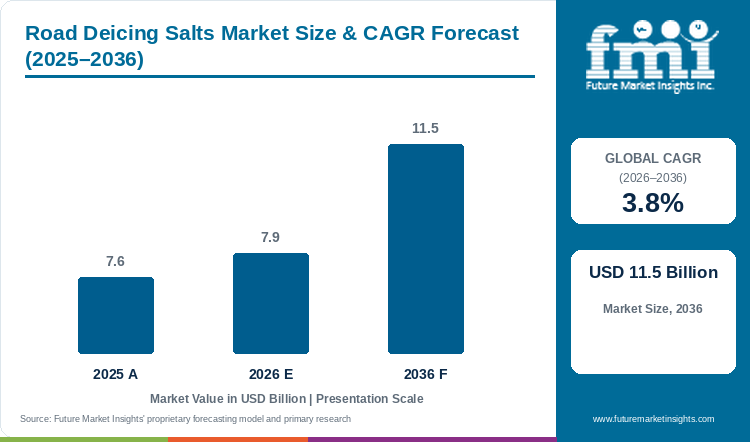
The road deicing salts market size is USD 7.9 Billion in 2026, up from USD 7.6 Billion in 2025, and is projected to reach USD 11.5 Billion by 2036 at 3.8% CAGR.
The road deicing salts market size is estimated at USD 7.9 Billion in 2026, according to FMI, and is projected to reach USD 11.5 Billion by 2036 at 3.8% CAGR. The market size chart plots this path from USD 7.6 Billion in 2025, adding USD 3.6 Billion over the decade. Highways take 41% of demand by application in 2026, the largest single end use. Compass Minerals sold 2,851 thousand tons of highway deicing salt in the first quarter of fiscal 2026, up from 1,987 thousand tons a year earlier [1].
Adoption changes sharply once salt leaves the highway network. Parking lots and commercial properties rely on packaged formats, and the ice melt pellets market is projected to grow from USD 2.1 Billion in 2026 to USD 3.2 Billion by 2036. Airport access roads and industrial sites near sensitive areas are moving toward chloride-free deicers, with sales in the potassium acetate market projected to reach USD 559.6 Million by 2035. Public roads are changing too, as 63% of reporting Canadian road organizations used pre-wetting or pre-treated salts in 2024, against a target of 95% [2]. The fastest shift in product mix through 2036 is expected in parking, airport and industrial end uses.
Key Takeaways
- Key players operating in the road deicing salts market include Compass Minerals, Cargill, K+S, Morton Salt, American Rock Salt, Detroit Salt Company and Kissner Milling.
- With 61% of market share in 2026, sodium chloride will remain the base deicer for public roads on the strength of low delivered cost.
- Bulk supply contracts are estimated to carry 54% of demand by sales channel in 2026, as state and municipal buyers fix tonnage and delivery terms before winter.
- Poland will post the fastest growth at 4.5% CAGR through 2036, followed by the USA at 4.2%. Larger agency salt stocks after recent shortages support demand in both markets.
Analyst Perspective
“The next decade will test whether road agencies can cut chloride per lane mile without giving up safety, and treated salt and brine programs are the route most agencies will take. Highways, at 41% of demand in 2026, will lead that change, and Canada, growing at 3.9% CAGR through 2036 under a national pre-wetting push, will show other countries the trade-off between tonnage and product value.”
- Nikhil Kaitwade, Principal Consultant, Future Market Insights
How is the Road Deicing Salts Market Segmented?
The road deicing salts market is divided into salt type, form, application, buyer type, sales channel and region.
FMI tracks salt type across sodium chloride, calcium chloride, magnesium chloride, potassium chloride blends, and treated and pre-wet salts. Forms covered are rock salt, solar salt, liquid brine, pellets and flakes, and blended formulations. The application split includes highways, urban roads, parking lots, airport access roads and industrial facilities. Buyer types studied are state and provincial DOTs, municipalities, private snow contractors and commercial property managers. By sales channel, the market is divided into bulk supply contracts, distributor and depot sales, retail bags and contractor programs. The regional analysis covers seven regions and more than 25 countries.
Why Does Sodium Chloride Lead the Road Deicing Salts Market by Salt Type?
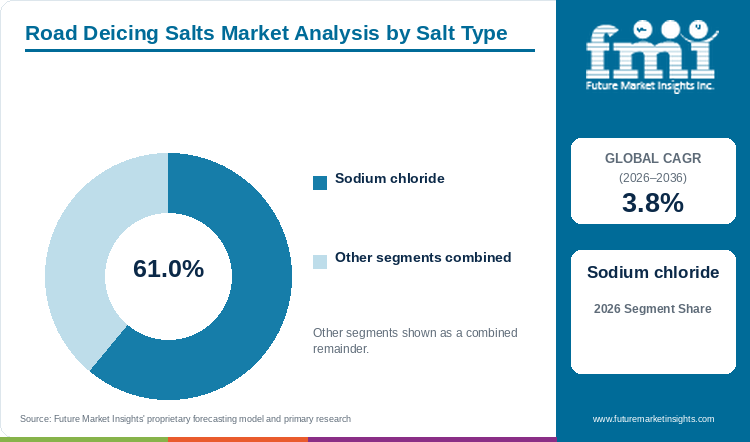
Sodium chloride is set to lead salt type with 61% of market share in 2026.
Sodium chloride is the default deicer for public roads, holding 61% of demand by salt type in 2026. Calcium chloride is the closest alternative, and agencies keep calcium chloride for the coldest days and spot treatment, as a higher unit price limits wider use. Magnesium chloride, potassium chloride blends and treated or pre-wet salts are bought in smaller lots for sensitive areas and premium contracts.
- Delivered price per ton keeps sodium chloride the first choice in most bulk road tenders through 2036.
- In May 2026, K+S reported de-icing salt sales volumes of 1.49 million tonnes for the first quarter, against 0.69 million tonnes a year earlier [3].
Why Does Rock Salt Lead the Road Deicing Salts Market by Form?
Rock salt is projected to hold 44% of market share by form in 2026.
Rock salt leads the form category with 44% of demand in 2026, and the New York State road salt award shows the buying pattern behind that share. The September 2025 award split bulk rock road salt and two grades of treated salt into separate lots [4]. Solar salt, liquid brine, pellets, flakes and blends serve narrower needs, from warm-region supply to depot-made brine and walkway use.
- Many agencies make liquid brine at the depot from rock salt, so growth in brine use still adds rock salt tonnage.
- Reporting organizations in Canada had 80% of vehicles equipped for pre-wetting in 2024, above the 75% target [2].
Why Do Highways Lead the Road Deicing Salts Market by Application?
Highways will represent 41% of market share by application in 2026.
Highways are expected to account for 41% of demand by application in 2026, and German districts showed the reason in January 2026 by cutting winter service on secondary roads during a salt shortage, with highways keeping stocks through larger storage and long-term contracts [5]. Urban roads, parking lots, airport access roads and industrial facilities buy smaller lots, as cities plough side streets and private sites order bagged salt as needed.
- Treated and pre-wetted salt use on highways is expected to increase as agencies cut scatter at higher spreading speeds.
- Compass Minerals reported highway deicing prices about 6% above the prior-year level in the first quarter of fiscal 2026 [1].
Why Do State and Provincial DOTs Lead the Road Deicing Salts Market by Buyer Type?
In 2026, state and provincial DOTs will account for 45% of market share by buyer type.
State and provincial DOTs hold 45% of demand by buyer type in 2026, as procurement rules let eligible local agencies use many state contracts. Each state award therefore sets the price and supplier list for a large part of municipal buying. Private snow contractors and commercial property managers buy smaller volumes, mostly bagged salt from distributors.
- Smaller cities often join state contracts or joint purchasing programs, keeping municipal demand tied to state awards.
- Spending on winter maintenance of Polish national roads exceeded PLN 750 million in 2025/2026, about 13% above the previous season [6].
Why Do Bulk Supply Contracts Lead the Road Deicing Salts Market by Sales Channel?
Bulk supply contracts are estimated to capture 54% of market share by sales channel in 2026.
Bulk supply contracts make up 54% of demand by sales channel in 2026. Contracts fix price, call-off ranges and delivery points before winter, and agencies use them to lock in tonnage for the full season. Distributor and depot sales fill storm-time refills for smaller buyers, and retail bags reach homeowners and property managers.
- Emergency standby clauses in bulk contracts give agencies extra tonnage on call during multi-storm weeks.
- K+S raised the full-year 2026 EBITDA forecast in May 2026 after first-quarter de-icing salt volumes more than doubled [3].
What are the Drivers, Restraints, and Opportunities in the Road Deicing Salts Market?
Winter-service duties keep demand for road deicing salts recurring every year, according to FMI. Chloride rules hold down dosage per lane mile, and treated salt and brine programs are set to open the largest new revenue pool through 2036.
- Driver: Road agencies carry a safety duty to keep networks open in snow and ice, so salt stocks are bought every year and refilled after heavy storms.
- Restraint: Chloride damage to water, soil, vegetation, vehicles and bridges is pushing agencies to cut application rates per lane mile.
- Opportunity: Pre-wetted salt, brine and treated salt programs open higher-value supply contracts with highway agencies.
Winter-service duties make road salt a recurring public purchase, as agencies have to keep priority routes open in every storm. Heavy seasons force mid-season depot refills, and agencies then write larger backup quantities into the next contract. Chloride alternatives are growing alongside rock salt, with sales in the magnesium chloride market projected to reach USD 1.3 Billion by 2036 and calcium chloride bought for the coldest days, as covered in the calcium chloride market.
Chloride rules set the main limit on tonnage growth. Canadian road organizations reporting under the federal code spread 3,939,881 tonnes on 418,331 km of salted road in the 2023-2024 winter, and the code asks each agency to bring that dosage down through pre-wetting and brine [2]. Mature networks in Canada, Norway and Japan are expected to post the slowest tonnage growth through 2036.
Which Country CAGRs are Profiled in the Road Deicing Salts Market?
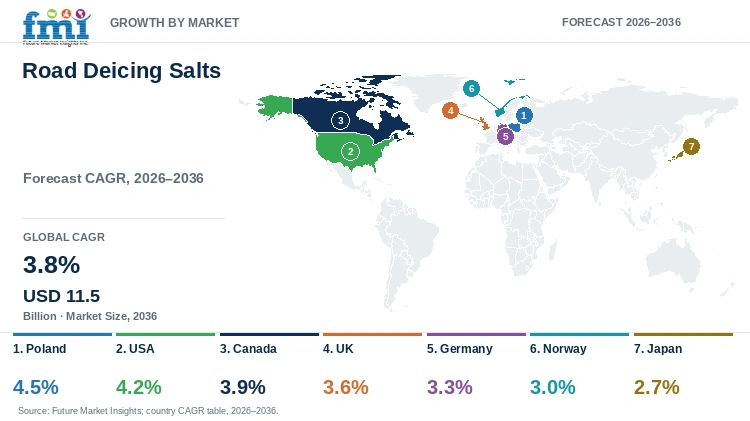
| Country | CAGR, 2026 to 2036 |
|---|---|
| Poland | 4.5% |
| USA | 4.2% |
| Canada | 3.9% |
| UK | 3.6% |
| Germany | 3.3% |
| Norway | 3% |
| Japan | 2.7% |
How do Country-level CAGRs Compare in the Road Deicing Salts Market?
Agency stock policy and salt-use rules split the seven profiled countries into two groups in FMI's analysis. Poland tops the country CAGR chart at 4.5%, and Japan holds the lowest bar at 2.7% through 2036. Poland and the USA are projected to grow above 4%, as national and state agencies hold larger stocks after recent shortages. Canada, at 3.9%, and the UK, at 3.6%, are expected to grow on code-led pre-wetting and depot stocking. Demand in Germany, Norway and Japan will rise at 3.3% or below, as low-salt policies and mechanical snow removal keep tonnage targeted. The USA will keep the largest tonnage in the group, with state and municipal networks across the snow belt.
- Poland is projected to grow fastest at 4.5% CAGR through 2036. National road salt use has run close to record levels in recent seasons.
- Statewide contracts that set bulk volumes for local agencies will keep the USA second at 4.2% during the forecast period.
- Pre-wetting targets under the national code will carry Canada to 3.9% CAGR by 2036, ahead of the UK.
- Demand for road deicing salts in the UK is expected to rise at 3.6% CAGR over the decade to 2036, as depots stock rock salt before every winter.
- Recent shortages are pushing German towns to review salt storage, supporting 3.3% CAGR by 2036.
- Norway will expand at 3% CAGR during the forecast period, faster than Japan, under a policy of low salt use per road section.
- Japan is projected to grow slowest at 2.7% CAGR through 2036. Mechanical snow removal handles deep snow first, leaving salt for curves and steep grades.
Beyond these seven profiles, the full report carries CAGR estimates for seven regions and more than 25 national and grouped markets.
Country Outlook
- GDDKiA used nearly 469,000 tonnes of salt in winter 2025/2026, close to the 497,000-tonne record set in 2020/2021 [6]. National road maintenance runs on contracted winter service, so heavy seasons quickly raise call-offs. Demand for road deicing salts in Poland is projected to grow at 4.5% CAGR through 2036, the fastest in the group.
- The USA is expected to grow at 4.2% CAGR during the forecast period, second in the group. New York State estimates about USD 200 million a year in purchases under the statewide road salt award issued in September 2025 [4]. State and municipal buyers pool orders through cooperative contracts like this one, and producers named on statewide awards reach local agency volume.
- Key drivers of demand for road deicing salts in Canada include the national code of practice for road salt management. Winter maintenance under the code favors pre-wet and treated products, and agencies report progress against equipment and practice targets each year. Canada is projected at 3.9% CAGR by 2036, with brine and pre-wet programs taking a larger part of each contract.
- National Highways and local councils stock rock salt at depots before every winter in the UK, and deliveries during cold spells refill those depots. Growth in the UK is projected at 3.6% CAGR through 2036.
- Recent salt shortages are reshaping municipal stock planning in Germany. The Emsland district used about 2,100 tons of road salt by January 26, 2026, against about 1,700 tons across the whole 2024/25 winter [5]. Towns are expected to raise pre-season stock commitments, and Germany is projected at 3.3% CAGR during the forecast period.
- Sales of road deicing salts in Norway are projected to rise at 3% CAGR by 2036. Road authorities use salt selectively according to traffic and climate, with sodium chloride as the standard winter salt, so tonnage growth stays moderate. Suppliers offering consistent particle size for precise spreading are expected to hold Norwegian contracts.
- Snow-region authorities in Japan clear deep snow mechanically and spread freezing-prevention agents only at curves, intersections and steep grades. Chemical use therefore stays targeted, and Japan is expected to record the slowest growth among the profiled countries at 2.7% CAGR through 2036.
Who are the Notable Companies in the Road Deicing Salts Market?
Compass Minerals, Cargill, K+S, Morton Salt, American Rock Salt and Detroit Salt Company are among the leading companies profiled by FMI across bulk and specialty deicing supply.
Road deicing salt supply is concentrated in each region around a small group of mine owners, ports and depots. Agencies compare delivered price per ton, contract eligibility, particle size, purity and delivery capacity during multi-storm weeks. New York State spread Award 23409 across six contractors, including American Rock Salt, Cargill, Compass Minerals and Morton Salt [4]. Compass Minerals raised highway deicing volumes by 43% in fiscal first-quarter 2026, and K+S more than doubled de-icing salt volumes in the first quarter of 2026 [1] [3]. Formal tenders and delivery records slow switching within a contract term. Evaporated supply from the solar salt market and packaged salt drawn from the wider sodium chloride market give buyers outside the snow belt other sources. FMI identifies delivered cost from nearby mines as the main differentiator through 2036.
- Integrated Bulk Salt Producers: Compass Minerals, Cargill, K+S, Morton Salt, American Rock Salt and Detroit Salt Company supply mined or evaporated bulk road salt, treated salt and brine programs to public agencies.
- Packaged and Specialty Deicing Suppliers: Tata Chemicals Europe / British Salt and Kissner Milling offer packaged deicing salt, ice melt and specialty granules for lighter-duty users, and INEOS Salt holds a UK salt production asset.
- China-Centered Salt Production: China National Salt Industry operates a large integrated salt business centered on China, with limited public detail on road deicing supply.
Competitive Benchmarking
| Company | Bulk Road-Salt Supply | Enhanced Deicer / Brine Breadth | Public-Agency Contract Evidence | Geographic Reach |
|---|---|---|---|---|
| Compass Minerals | High | Medium | High | Canada, United States and UK |
| Cargill | High | High | High | United States |
| K+S | High | High | Low | Germany |
| Tata Chemicals Europe / British Salt | Low | Low | Low | UK |
| Morton Salt | High | High | High | United States |
| Kissner Milling | Medium | High | Low | North America |
| American Rock Salt | High | Medium | High | Northeastern United States; over 12 states |
| Detroit Salt Company | High | Medium | High | United States and Canada |
| INEOS Salt | Low | Low | Low | UK |
| China National Salt Industry | Low | Low | Low | China |
Scoring basis: Bulk Road-Salt Supply is High for official or company records showing broad bulk highway supply and Medium for a narrower proven role. Enhanced Deicer / Brine Breadth is High for several documented treated, blended or liquid formats and Medium for a narrower range. Public-Agency Contract Evidence is High for recent statewide or repeated road salt awards. A Low rating marks limited public documentation or a small-pack role for the criterion.
Key Developments
- In September 2025, New York State OGS issued Award 23409 for bulk rock salt, treated salt and emergency standby salt, naming six contractors with about USD 200 million in expected annual purchases [4].
- In February 2026, Compass Minerals reported first-quarter highway deicing volumes of 2,851 thousand tons, up 43%, after strong winter weather in the company's markets [1].
- In May 2026, K+S reported first-quarter de-icing salt sales of 1.49 million tonnes, up from 0.69 million tonnes, and raised the full-year 2026 EBITDA forecast [3].
Key Players
Integrated Bulk Salt Producers
- Compass Minerals
- Cargill
- K+S
- Morton Salt
- American Rock Salt
- Detroit Salt Company
Packaged and Specialty Deicing Suppliers
- Tata Chemicals Europe / British Salt
- Kissner Milling
- INEOS Salt
China-Centered Salt Production
- China National Salt Industry
Report Scope and Methodology
| Coverage field | Report scope |
|---|---|
| Market breakdown | 5 categories plus region: Salt Type (Sodium chloride, Calcium chloride, Magnesium chloride, Potassium chloride blends, Treated salt / pre-wet salts), Form (Rock salt, Solar salt, Liquid brine, Pellets / flakes, Blended formulations), Application (Highways, Urban roads, Parking lots, Airport access roads, Industrial facilities), Buyer Type (State / provincial DOTs, Municipalities, Private snow contractors, Commercial property managers), Sales Channel (Bulk supply contracts, Distributor / depot sales, Retail bags, Contractor programs), and Region |
| Quantitative units | USD Billion |
| Market definition | Revenue from road deicing salt sold within the stated salt types, forms, applications, buyer types and sales channels. Snow-removal services, spreading equipment, weather systems, abrasive-only materials and salt sold only for non-deicing uses are excluded. Product value within a bundled winter-maintenance contract is included only when the salt component is identifiable. |
| Regions covered | North America, Latin America, Western Europe, Eastern Europe, East Asia, South Asia and Pacific, Middle East and Africa |
| Countries covered | More than 25 countries and country groups, including the USA, Canada, the UK, Germany, Poland, Norway and Japan |
| Key companies profiled | A few of the notable companies out of many players covered in the study: Compass Minerals, Cargill, K+S, Tata Chemicals Europe / British Salt, Morton Salt, Kissner Milling, American Rock Salt, Detroit Salt Company, INEOS Salt and China National Salt Industry |
| Forecast period | 2026 to 2036 |
| Approach | A hybrid bottom-up and top-down model built by FMI reconciles producer shipments, agency procurement, salt type mix and buyer demand within the defined revenue boundary. |
Research Methodology
| Method | Approach |
|---|---|
| Primary research | Interviews with salt producers, deicer formulators, distributors, state and municipal road agencies, snow contractors and procurement teams test purchase criteria, contract terms, switching costs and pricing. |
| Desk research | The analysis reviews procurement awards, agency winter-service reports, environmental codes, company filings, product documentation and technical standards, retaining sources that are recent and relevant to road deicing salts. |
| Market sizing and forecasting | The sizing framework combines salt tonnage, delivered price, salt type and form mix, contract structure and country winter conditions. Forecasts consider weather volatility, chloride rules, application technology and supply logistics. |
| Data validation | Estimates are cross-checked across source types and buyer-side operating logic. Snow-removal services, spreading equipment, non-deicing salt and unsupported company rankings are excluded to avoid double counting. |
Road Deicing Salts Market by Segments
Road Deicing Salts Market Segmented by Salt Type
- Sodium chloride
- Calcium chloride
- Magnesium chloride
- Potassium chloride blends
- Treated salt / pre-wet salts
Road Deicing Salts Market Segmented by Form
- Rock salt
- Solar salt
- Liquid brine
- Pellets / flakes
- Blended formulations
Road Deicing Salts Market Segmented by Application
- Highways
- Urban roads
- Parking lots
- Airport access roads
- Industrial facilities
Road Deicing Salts Market Segmented by Buyer Type
- State / provincial DOTs
- Municipalities
- Private snow contractors
- Commercial property managers
Road Deicing Salts Market Segmented by Sales Channel
- Bulk supply contracts
- Distributor / depot sales
- Retail bags
- Contractor programs
Road Deicing Salts Market Segmented by Region
- North America
- Latin America
- Western Europe
- Eastern Europe
- East Asia
- South Asia and Pacific
- Middle East and Africa
Research Sources and Bibliography
- [1] Compass Minerals (2026, February 4). Compass Minerals Reports Fiscal 2026 First-Quarter Results.
- [2] Environment and Climate Change Canada (2025, October 15). Code of practice for the environmental management of road salts: Annual overview of data reported (2019 to 2024).
- [3] K+S Aktiengesellschaft (2026, May 11). K+S raises EBITDA forecast for the full year 2026.
- [4] New York State Office of General Services (2025, September 15). Contract Award Notification: Road Salt, Treated Salt, & Emergency Standby Road Salt (Statewide), Award 23409.
- [5] web.de (2026, January 29). Streu-Salz wird knapp: Erste Notfall-Pläne in Kraft.
- [6] Spider's Web Autoblog (2026, June 3). GDDKiA tęskni za zimą. Soli starczyłoby na bardzo duże frytki.
This bibliography is provided for reader reference and is not exhaustive. The full report contains the complete reference list and detailed citations.
This Report Answers
- What will the Road Deicing Salts Market size be in 2026, and what value will the market reach by 2036?
- Which winter-service duties and weather swings will shape demand for road deicing salts?
- Why will sodium chloride hold the leading position within the Salt Type category in 2026?
- In what ways will chloride rules and pre-wetting targets change dosage per lane mile?
- Why will rock salt, highways, state DOTs and bulk contracts anchor demand across the other categories?
- Which growth rates will Poland, the USA, Canada, the UK, Germany, Norway and Japan post till 2036?
- Which delivery, storage and specification checks will slow supplier switching for road agencies?
- What will road authorities and commercial buyers need to verify before qualifying a new salt supplier?
Frequently Asked Questions
How Big Is the Road Deicing Salts Market Expected to Be in 2026?
Road deicing salt sales will reach USD 7.9 Billion in 2026, up from USD 7.6 Billion in 2025, as FMI estimates show. Revenue will rise to USD 11.5 Billion by 2036 as road agencies keep contracted stocks for severe winters.
What Is the CAGR of the Road Deicing Salts Market from 2026 to 2036?
The market will grow at a 3.8% CAGR from 2026 to 2036. Weather swings will move yearly tonnage, and chloride rules will hold dosage per lane mile at lower levels in mature networks.
Which Salt Type Holds the Largest Share of the Road Deicing Salts Market?
Sodium chloride will lead with 61% of market share by salt type in 2026. Low delivered cost, bulk availability and use in dry, pre-wet and brine programs will support the position.
Which Form Leads the Road Deicing Salts Market?
Rock salt will account for 44% of market share by form in 2026. Bulk handling, long storage life and flexible spreading on highways will support the lead.
Which Country Is Expected to Grow Fastest in the Road Deicing Salts Market?
Poland will grow fastest at a 4.5% CAGR till 2036, followed by the USA at 4.2% and Canada at 3.9%. Japan will post the slowest rate of the seven profiled countries at 2.7%.
What Notable Restraint Affects the Road Deicing Salts Market?
Key challenges will come from chloride rules, since road salt can harm water, soil and plants near treated roads. Agencies will cut dosage through pre-wetting and brine, and this will slow tonnage growth.
Which Are the Key Companies in the Road Deicing Salts Market?
Compass Minerals, Cargill, K+S, Morton Salt, American Rock Salt, Detroit Salt Company, Kissner Milling, Tata Chemicals Europe / British Salt, INEOS Salt and China National Salt Industry rank among the leading companies covered by FMI. The report assigns each company to one of three supplier groups.
Preview the report firsthand - request a free sample
Get SampleGet the brochure for pricing and purchase details.
Get PDFTable of Content
- Key Takeaways
- Market Size and CAGR
- Top Growth Driver
- Fastest Growing Segment
- Leading Region
- Key Companies
- Emerging Opportunities
- Executive Summary
- Global Market Outlook
- Demand-side Trends
- Supply-side Trends
- Technology Roadmap Analysis
- Analysis and Recommendations
- Analyst Perspective (What is happening? Why now? What should investors know?)
- Key Questions Answered
- How large is the market?
- What is the CAGR?
- What are key trends?
- Which region dominates?
- Who are the leaders?
- Market Overview
- Market Coverage / Taxonomy
- Market Definition / Scope / Limitations
- Research Methodology
- Chapter Orientation
- Analytical Lens and Working Hypotheses
- Market Structure, Signals, and Trend Drivers
- Benchmarking and Cross-market Comparability
- Market Sizing, Forecasting, and Opportunity Mapping
- Research Design and Evidence Framework
- Desk Research Programme (Secondary Evidence)
- Expert Input and Fieldwork (Primary Evidence)
- Tooling, Models, and Reference Databases
- Data Engineering and Model Build
- Quality Assurance and Audit Trail
- Market Background
- Market Dynamics (Drivers, Restraints, Opportunity, Trends)
- Scenario Forecast (Optimistic, Likely, Conservative)
- Impact Analysis
- AI Impact
- Sustainability Impact
- Regulatory Impact
- Technology Impact
- Consumer / Buyer Analysis
- Purchase Drivers
- Adoption Barriers
- Buyer Journey
- Opportunity Map Analysis
- Product Life Cycle Analysis
- Supply Chain Analysis
- Investment Feasibility Matrix
- Value Chain Analysis
- PESTLE and Porter's Analysis
- Regulatory Landscape
- Regional Parent Market Outlook
- Production and Consumption Statistics
- Import and Export Statistics
- Global Market Analysis and Forecast, 2021 to 2036
- Historical Market Size Value (USD Billion) Analysis, 2021 to 2025
- Current and Future Market Size Value (USD Billion) Projections, 2026 to 2036
- Y-o-Y Growth Trend Analysis
- Absolute $ Opportunity Analysis
- Global Market Pricing Analysis, 2021 to 2036
- Global Market Analysis and Forecast, By Salt Type, 2021 to 2036
- Introduction / Key Findings
- Historical Market Size Value (USD Billion) Analysis By Salt Type, 2021 to 2025
- Current and Future Market Size Value (USD Billion) Analysis and Forecast By Salt Type, 2026 to 2036
- Sodium chloride
- Calcium chloride
- Magnesium chloride
- Potassium chloride blends
- Treated salt / pre-wet salts
- Y-o-Y Growth Trend Analysis By Salt Type, 2021 to 2025
- Absolute $ Opportunity Analysis By Salt Type, 2026 to 2036
- Global Market Analysis and Forecast, By Form, 2021 to 2036
- Introduction / Key Findings
- Historical Market Size Value (USD Billion) Analysis By Form, 2021 to 2025
- Current and Future Market Size Value (USD Billion) Analysis and Forecast By Form, 2026 to 2036
- Rock salt
- Solar salt
- Liquid brine
- Pellets / flakes
- Blended formulations
- Y-o-Y Growth Trend Analysis By Form, 2021 to 2025
- Absolute $ Opportunity Analysis By Form, 2026 to 2036
- Global Market Analysis and Forecast, By Application, 2021 to 2036
- Introduction / Key Findings
- Historical Market Size Value (USD Billion) Analysis By Application, 2021 to 2025
- Current and Future Market Size Value (USD Billion) Analysis and Forecast By Application, 2026 to 2036
- Highways
- Urban roads
- Parking lots
- Airport access roads
- Industrial facilities
- Y-o-Y Growth Trend Analysis By Application, 2021 to 2025
- Absolute $ Opportunity Analysis By Application, 2026 to 2036
- Global Market Analysis and Forecast, By Buyer Type, 2021 to 2036
- Introduction / Key Findings
- Historical Market Size Value (USD Billion) Analysis By Buyer Type, 2021 to 2025
- Current and Future Market Size Value (USD Billion) Analysis and Forecast By Buyer Type, 2026 to 2036
- State / provincial DOTs
- Municipalities
- Private snow contractors
- Commercial property managers
- Y-o-Y Growth Trend Analysis By Buyer Type, 2021 to 2025
- Absolute $ Opportunity Analysis By Buyer Type, 2026 to 2036
- Global Market Analysis and Forecast, By Sales Channel, 2021 to 2036
- Introduction / Key Findings
- Historical Market Size Value (USD Billion) Analysis By Sales Channel, 2021 to 2025
- Current and Future Market Size Value (USD Billion) Analysis and Forecast By Sales Channel, 2026 to 2036
- Bulk supply contracts
- Distributor / depot sales
- Retail bags
- Contractor programs
- Y-o-Y Growth Trend Analysis By Sales Channel, 2021 to 2025
- Absolute $ Opportunity Analysis By Sales Channel, 2026 to 2036
- Global Market Analysis and Forecast, By Region, 2021 to 2036
- Introduction
- Historical Market Size Value (USD Billion) Analysis By Region, 2021 to 2025
- Current Market Size Value (USD Billion) Analysis and Forecast By Region, 2026 to 2036
- North America
- Latin America
- Western Europe
- Eastern Europe
- East Asia
- South Asia and Pacific
- Middle East and Africa
- Market Attractiveness Analysis By Region
- North America Market Analysis and Forecast, By Country, 2021 to 2036
- Historical Market Size Value (USD Billion) Trend Analysis By Market Taxonomy, 2021 to 2025
- Market Size Value (USD Billion) Forecast By Market Taxonomy, 2026 to 2036
- By Country
- By Salt Type
- By Form
- By Application
- By Buyer Type
- By Sales Channel
- Market Attractiveness Analysis
- By Country
- By Salt Type
- By Form
- By Application
- By Buyer Type
- By Sales Channel
- Key Takeaways
- Latin America Market Analysis and Forecast, By Country
- Historical Market Size Value (USD Billion) Trend Analysis By Market Taxonomy, 2021 to 2025
- Market Size Value (USD Billion) Forecast By Market Taxonomy, 2026 to 2036
- By Country
- By Salt Type
- By Form
- By Application
- By Buyer Type
- By Sales Channel
- Market Attractiveness Analysis
- By Country
- By Salt Type
- By Form
- By Application
- By Buyer Type
- By Sales Channel
- Key Takeaways
- Western Europe Market Analysis and Forecast, By Country
- Historical Market Size Value (USD Billion) Trend Analysis By Market Taxonomy, 2021 to 2025
- Market Size Value (USD Billion) Forecast By Market Taxonomy, 2026 to 2036
- By Country
- By Salt Type
- By Form
- By Application
- By Buyer Type
- By Sales Channel
- Market Attractiveness Analysis
- By Country
- By Salt Type
- By Form
- By Application
- By Buyer Type
- By Sales Channel
- Key Takeaways
- Eastern Europe Market Analysis and Forecast, By Country
- Historical Market Size Value (USD Billion) Trend Analysis By Market Taxonomy, 2021 to 2025
- Market Size Value (USD Billion) Forecast By Market Taxonomy, 2026 to 2036
- By Country
- By Salt Type
- By Form
- By Application
- By Buyer Type
- By Sales Channel
- Market Attractiveness Analysis
- By Country
- By Salt Type
- By Form
- By Application
- By Buyer Type
- By Sales Channel
- Key Takeaways
- East Asia Market Analysis and Forecast, By Country
- Historical Market Size Value (USD Billion) Trend Analysis By Market Taxonomy, 2021 to 2025
- Market Size Value (USD Billion) Forecast By Market Taxonomy, 2026 to 2036
- By Country
- By Salt Type
- By Form
- By Application
- By Buyer Type
- By Sales Channel
- Market Attractiveness Analysis
- By Country
- By Salt Type
- By Form
- By Application
- By Buyer Type
- By Sales Channel
- Key Takeaways
- South Asia and Pacific Market Analysis and Forecast, By Country
- Historical Market Size Value (USD Billion) Trend Analysis By Market Taxonomy, 2021 to 2025
- Market Size Value (USD Billion) Forecast By Market Taxonomy, 2026 to 2036
- By Country
- By Salt Type
- By Form
- By Application
- By Buyer Type
- By Sales Channel
- Market Attractiveness Analysis
- By Country
- By Salt Type
- By Form
- By Application
- By Buyer Type
- By Sales Channel
- Key Takeaways
- Middle East and Africa Market Analysis and Forecast, By Country
- Historical Market Size Value (USD Billion) Trend Analysis By Market Taxonomy, 2021 to 2025
- Market Size Value (USD Billion) Forecast By Market Taxonomy, 2026 to 2036
- By Country
- By Salt Type
- By Form
- By Application
- By Buyer Type
- By Sales Channel
- Market Attractiveness Analysis
- By Country
- By Salt Type
- By Form
- By Application
- By Buyer Type
- By Sales Channel
- Key Takeaways
- Key Countries Market Analysis
- Poland
- Pricing Analysis
- Market Share Analysis, 2025
- By Salt Type
- By Form
- By Application
- By Buyer Type
- By Sales Channel
- USA
- Pricing Analysis
- Market Share Analysis, 2025
- By Salt Type
- By Form
- By Application
- By Buyer Type
- By Sales Channel
- Canada
- Pricing Analysis
- Market Share Analysis, 2025
- By Salt Type
- By Form
- By Application
- By Buyer Type
- By Sales Channel
- UK
- Pricing Analysis
- Market Share Analysis, 2025
- By Salt Type
- By Form
- By Application
- By Buyer Type
- By Sales Channel
- Germany
- Pricing Analysis
- Market Share Analysis, 2025
- By Salt Type
- By Form
- By Application
- By Buyer Type
- By Sales Channel
- Norway
- Pricing Analysis
- Market Share Analysis, 2025
- By Salt Type
- By Form
- By Application
- By Buyer Type
- By Sales Channel
- Japan
- Pricing Analysis
- Market Share Analysis, 2025
- By Salt Type
- By Form
- By Application
- By Buyer Type
- By Sales Channel
- Poland
- Market Structure Analysis
- Competition Dashboard
- Competition Benchmarking
- Market Share Analysis of Top Players
- By Regional
- By Salt Type
- By Form
- By Application
- By Buyer Type
- By Sales Channel
- Emerging Startups
- Innovation Benchmarking
- Competition Analysis
- Competition Deep Dive
- Compass Minerals
- Overview
- Product Portfolio
- Profitability by Market Segments
- Sales Footprint
- Strategy Overview
- Marketing Strategy
- Product Strategy
- Channel Strategy
- Cargill
- K+S
- Tata Chemicals Europe / British Salt
- Morton Salt
- Kissner Milling
- American Rock Salt
- Detroit Salt Company
- INEOS Salt
- China National Salt Industry
- Compass Minerals
- Case Studies
- Success Stories
- Recent Developments
- Competition Deep Dive
- Assumptions & Acronyms Used


