

- Market Size (2026)
- USD 360.0 Mn
- Forecast (2036)
- USD 2229.0 Mn
- CAGR (2026 to 2036)
- 20.0%
How big is Robot Pets & Emotional Companions Market in 2026?
Demand for Robot Pets & Emotional Companions is projected to expand at 20.0% CAGR between 2026 and 2036, increasing valuation from USD 360.0 million in 2026 to USD 2,229.0 million by 2036.
Growing acceptance of artificial intelligence is encouraging adoption of robotic companion devices across households and healthcare facilities. Emotional support technologies continue attracting attention as users seek interactive companionship without the responsibilities associated with live pets. Manufacturers are strengthening conversational capability, emotional response algorithms, and sensor technology to improve long-term user engagement. Yukai Engineering officially launched the Kickstarter campaign for Mirumi, confirming commercial preorders and planned deliveries beginning in 2026. The launch marked the company's transition from concept demonstration to commercial production.
Commercial priorities continue differing across countries. United States developers focus on artificial intelligence capability and consumer wellness applications. Japanese manufacturers continue emphasizing long-term companionship and emotionally responsive interaction. European organizations increasingly assess robotic companion devices for elderly care and therapeutic support across healthcare environments.
Investment also continues shifting toward intelligent companion platforms capable of personalized interaction. Buyers increasingly evaluate emotional engagement and hardware reliability before selecting robotic companion devices. Product differentiation therefore extends beyond appearance and increasingly reflects long-term interaction quality together with dependable operational performance.
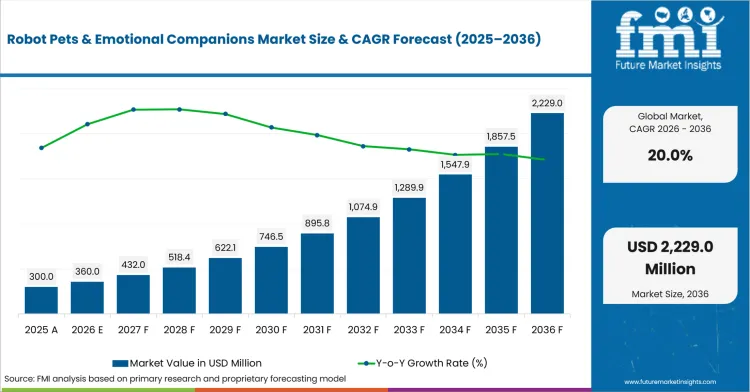
Key Takeaways of Robot Pets & Emotional Companions Market
- Demand for robot pets and emotional companions is driven by rising interest in emotional wellness combined with artificial intelligence, with product acceptance increasingly reflecting user engagement and long-term interaction quality.
- By component, hardware is expected to lead, representing the largest share of commercial expenditure across deployed devices.
- Companionship is the dominant application segment, remaining the primary use case across consumer and healthcare deployments.
- Robotic dogs and cats are estimated to lead the product category, favored for their familiar design and interactive behavior.
- Artificial intelligence capability remains a critical purchasing consideration, with software gains strengthening long-term product differentiation beyond the physical device.
- The United States, Japan, and Europe are expected to remain key markets, shaped by differences in AI investment, consumer acceptance, and healthcare technology development, with Japan emphasizing emotional interaction and robotics engineering expertise.
- Competition centers on artificial intelligence capability, emotional interaction quality, cloud connectivity, and lifecycle software support, with vendors differentiating through dependable user experience and long-term customer retention.
Analyst Perspective
"The AI companion robots market is expanding as consumers look for technologies that deliver meaningful interaction, dependable performance, and lasting value beyond the initial purchase. Buying decisions are influenced by natural communication, personalized user experiences, and reliable operation across everyday use. Companies that combine advanced artificial intelligence with robust robotic platforms, continuous software improvements, and responsive customer support are likely to strengthen long-term customer loyalty as companion robotics become more widely adopted."
- Rahul Pandita, Principal Consultant at Future Market Insights
Source: Future Market Insights (FMI) analysis, based on proprietary forecasting model and primary research
How is the Robot Pets & Emotional Companions Market segmented?
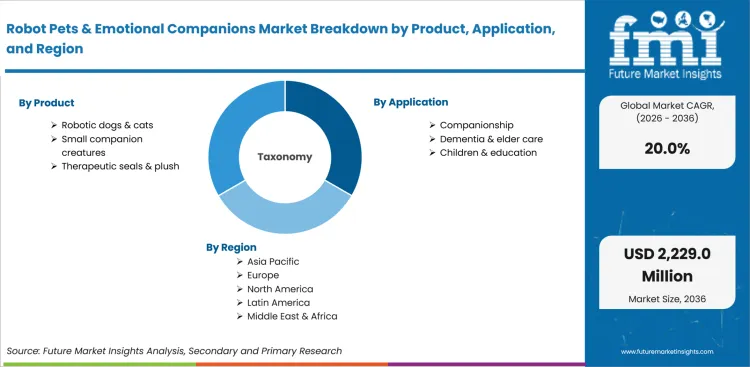
The robot pets & emotional companions market is segmented by product, application, component, end user, sales channel, and region.
Product segmentation includes robotic dogs & cats, small companion creatures, and therapeutic seals & plush. Application coverage comprises companionship, dementia & elder care, and children & education. Component analysis includes hardware, AI software & cloud services, and services. End users include consumers, care homes & hospitals, and retail & hospitality facilities. Sales channels consist of online platforms, specialty retail, and healthcare channels. Regional assessment covers North America, Latin America, Europe, East Asia, South Asia & Pacific, Oceania, and the Middle East & Africa.
Why are robotic dogs & cats leading product adoption?
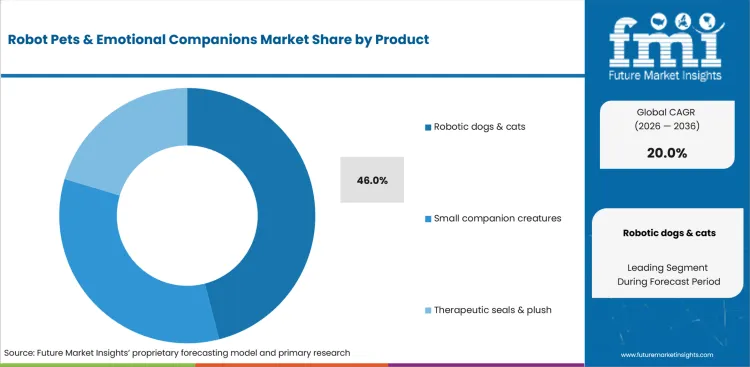
People naturally connect with familiar companion animals, making robotic dogs and cats the preferred entry point into emotional robotics. Their recognizable appearance reduces hesitation among first-time users and encourages regular interaction across different age groups. Artificial intelligence adds behavioral adaptation that helps every interaction feel less repetitive over time.
- Robotic dogs & cats are estimated to represent 46.0% of product demand in 2026. Consumer preference remains concentrated around familiar pet forms that provide emotional comfort without feeding, grooming, or veterinary care. Growing interest from older adults and single-person households continues strengthening commercial demand.
- Product development is shifting beyond mechanical movement toward adaptive emotional behaviour. Casio states that Moflin develops unique behavioural patterns through reinforcement learning, allowing each device to evolve differently according to user interaction.
Why does companionship account for the largest application share?
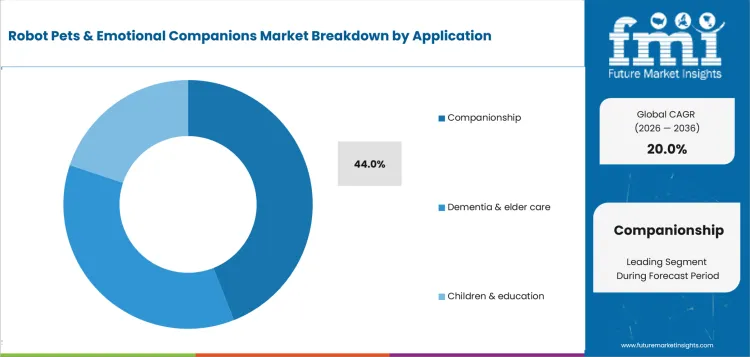
Most purchases originate from consumers seeking everyday emotional interaction rather than clinical treatment. Companion robots increasingly occupy a space between consumer electronics and wellness products by providing conversation, engagement, and routine interaction throughout daily life.
- Companionship is projected to contribute 44.0% of application demand in 2026. Consumer purchasing remains driven by emotional wellbeing, social interaction, and personal comfort across homes, assisted living communities, and independent living environments.
- Healthcare providers are also exploring companion robots as complementary wellness tools that encourage communication and reduce feelings of isolation among selected patient groups. Software personalization continues improving user engagement throughout repeated interactions.
Why does hardware account for most component spending?
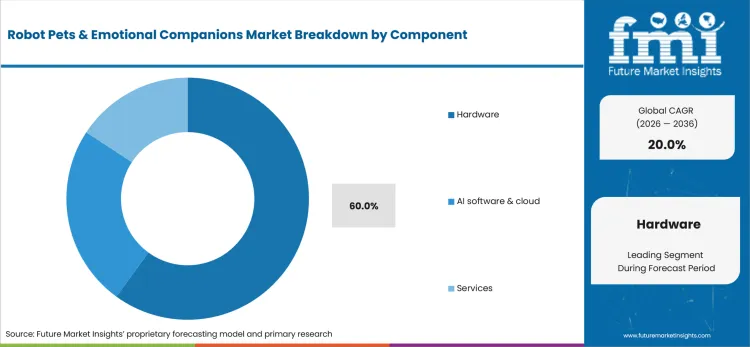
Every companion robot relies on physical components that determine movement quality, sensory perception, operating life, and interaction capability. Mechanical design therefore represents the largest share of manufacturing cost before software services become part of the ownership experience.
- Hardware is expected to account for 60.0% of component revenue in 2026. Precision motors, cameras, microphones, pressure sensors, batteries, and structural assemblies together represent the majority of product value during manufacturing.
- Software upgrades continue extending product functionality after purchase. Hardware reliability nevertheless remains the first factor consumers evaluate before investing in robotic companion devices.
What are the drivers, restraints, and opportunities in the Robot Pets & Emotional Companions Market?
Growing awareness of emotional wellbeing is encouraging interest in intelligent companion devices across households and care environments. High ownership costs remain a barrier for many first-time buyers, whereas ageing populations are opening new avenues for therapeutic companion technologies.
- Driver: Greater attention to emotional health and social companionship is encouraging adoption of AI-powered robotic pets across homes and assisted living environments.
- Restraint: Premium pricing together with limited public familiarity reduces purchase confidence among mainstream consumers.
- Opportunity: Rising demand for non-pharmaceutical wellbeing solutions is creating fresh opportunities across elder care and mental wellness services.
More consumers are seeking companionship that blends naturally into everyday life without the responsibility of caring for live animals. Robot pets answer that need through adaptive behavior and emotional responsiveness that evolves with continued use. Sony published the aibo Medical Institution Support Project Report, highlighting the use of aibo in hospitals and healthcare environments to encourage communication and emotional engagement among patients.
Affordability continues shaping purchasing behaviour across many regions. Emotional companion robots combine sophisticated sensors, artificial intelligence processors, expressive movement systems, and continuous software development within a single product. Many families remain cautious about investing until product reliability, privacy protection, and long-term software support become easier to evaluate before purchase.
Healthcare providers are beginning to view robotic companions as tools that complement emotional care instead of replacing human interaction. Senior living communities, children's therapy programmes, memory care centres, and rehabilitation facilities are exploring companion robots to encourage communication, reduce feelings of isolation, and improve everyday engagement. Developers capable of delivering natural interaction together with dependable product support are expected to gain wider acceptance as emotional robotics enters more care settings.
Which country CAGRs are profiled in the Robot Pets & Emotional Companions Market?
| Country | CAGR |
|---|---|
| Japan | 22.4% |
| United States | 21.0% |
Source: FMI's proprietary forecasting model and primary research.
How do country-level CAGRs compare in the Robot Pets & Emotional Companions Market?
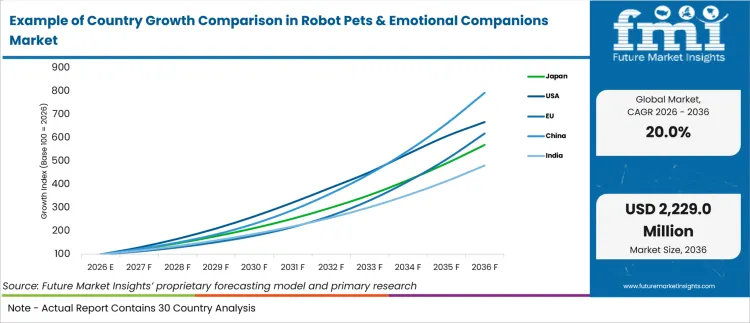
The country comparison spans 1.4 percentage points and indicates a highly concentrated growth outlook across the robot pets & emotional companions market. Japan leads at 22.4% CAGR, while the United States follows at 21.0%. The narrow gap suggests that both markets are expanding rapidly, although adoption is shaped by different demographic trends, consumer preferences and applications for companion robotics.
-
Japan records the highest CAGR at 22.4%. An aging population, longstanding acceptance of social robotics and growing interest in companionship technologies continue to encourage adoption of robotic pets across households, senior care settings and assisted living environments.
-
The United States follows 1.4 percentage points behind Japan with a CAGR of 21.0%. Consumer interest in AI-enabled companion devices, increasing attention to emotional well-being and wider availability of connected home technologies are creating opportunities for robot pets that provide interaction, engagement and companionship across different age groups.
Comparable CAGRs can still produce different market entry conditions. Differences in consumer acceptance of social robots, demographic trends, healthcare integration and product innovation influence commercialization strategies and long-term market opportunities. The full report provides country-level CAGR analysis across North America, Latin America, Europe, East Asia, South Asia, Oceania and the Middle East and Africa.
Country-wise Analysis
Emotional acceptance of companion robots differs across countries according to cultural preferences, ageing demographics, and familiarity with consumer robotics. Japan has developed an early foundation for social robot adoption, whereas the United States is witnessing rising interest in AI-enabled wellbeing products designed for everyday interaction.
-
Japan is anticipated to expand at 22.4% CAGR from 2026 to 2036 owing to widespread acceptance of companion robotics and growing demand for emotional support technologies among older adults. According to Japan's Ministry of Health, Labour and Welfare, people aged 65 years and above accounted for 29.3% of the national population in 2024, encouraging healthcare providers to examine technologies that promote social engagement and daily companionship. Developers continue refining behavioural learning and emotional response to strengthen long-term user interaction.
-
Growth across the United States is estimated at 21.0% CAGR through 2036 as households show greater interest in intelligent products designed for companionship, wellbeing, and everyday assistance. The Consumer Technology Association highlighted artificial intelligence among the defining themes of CES 2025, reflecting growing consumer attention toward interactive personal technologies. Manufacturers continue expanding conversational ability and personalization features to improve emotional engagement across different user groups.
Who are the notable companies in the Robot Pets & Emotional Companions Market?
Casio, Yukai Engineering, Ageless Innovation, Tombot, PARO, Elephant Robotics, Sony Group Corporation, and LuxAI are among the companies operating in the robot pets & emotional companions market.
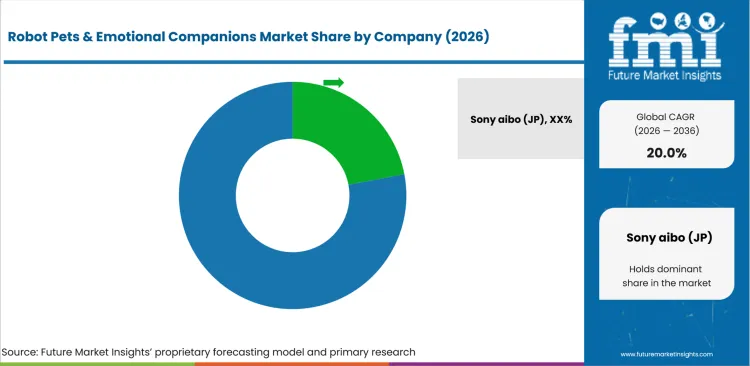
Competition reflects advances in emotional intelligence rather than mechanical performance alone. Product developers are placing greater emphasis on behavioural learning, conversational interaction, expressive movement, and long-term engagement to create experiences that feel familiar and reassuring.
Privacy protection, software updates, and emotional personalization are also becoming important considerations as companion robots spend more time in everyday living environments.
- Casio and Yukai Engineering focus on emotionally responsive companion robots designed to build familiarity through adaptive behaviour and repeated interaction. Product development emphasizes behavioural learning, gentle physical expression, and user recognition to encourage stronger emotional attachment over time.
- Ageless Innovation, Tombot, and PARO develop companion robots for older adults, memory care, and therapeutic wellbeing. Product strategies center on reducing loneliness, encouraging communication, and supporting emotional comfort across home care and assisted living environments.
- Sony Group Corporation, Elephant Robotics, and LuxAI contribute expertise in artificial intelligence, robotics, sensing technology, and human-robot interaction. Continued investment in conversational capability, cloud intelligence, and expressive robotics is expanding the role of companion devices across consumer and professional care settings.
Competitive Benchmarking: Robot Pets & Emotional Companions Market
| Company | Emotional AI | Interaction Capability | Product Innovation | Geographic Presence |
|---|---|---|---|---|
| Casio | High | High | High | Asia |
| Yukai Engineering | High | High | High | Asia |
| Ageless Innovation | Medium | High | Medium | North America |
| Tombot | High | High | Medium | North America |
| PARO | High | High | High | Global |
| Sony Group Corporation | High | Medium | High | Global |
| Elephant Robotics | High | High | Medium | Global |
| LuxAI | High | High | High | Europe |
Scoring basis: High reflects established capability in emotional interaction, artificial intelligence, and commercial product availability. Medium represents demonstrated capability across selected companion robotics applications and regional markets.
Source: FMI proprietary competitive assessment based on company product portfolios, commercial activity, and primary research
Key Developments in the Robot Pets & Emotional Companions Market
- In December 3, 2025, Yukai Engineering launched Mirumi on Kickstarter after its debut at CES 2025. The crowdfunding campaign marked the company's transition from concept demonstration to commercial pre-orders, with deliveries planned for Spring 2026.
- In January 2025, Casio expanded commercial availability of Moflin, an AI-powered emotional companion robot designed to strengthen human interaction through adaptive behavioral learning.
Key Players in the Robot Pets & Emotional Companions Market
- Casio Computer Co., Ltd.
- Yukai Engineering Inc.
- Ageless Innovation
- Tombot
- PARO (AIST)
- Elephant Robotics
- Sony Group Corporation
- LuxAI
Robot Pets & Emotional Companions Market Report Scope
| Coverage field | Report scope |
|---|---|
| Market breakdown | Product, application, component, end user, sales channel, country, and regional analysis. |
| Quantitative Units | Revenue in USD Million/Billion, Volume in Units, CAGR in %. |
| Market Definition | Robot pets and emotional companions are artificial intelligence-enabled robotic devices designed to provide companionship, emotional engagement, therapeutic interaction, and social support through adaptive behaviour, voice recognition, and autonomous response systems. |
| Regions Covered | North America, Latin America, Europe, East Asia, South Asia and Pacific, Oceania, and the Middle East and Africa. |
| Countries Covered | United States, Japan, China, Germany, United Kingdom, France, South Korea, Australia, and more than 30 additional countries. |
| Key Companies Profiled | Casio Computer Co., Ltd., Yukai Engineering Inc., Ageless Innovation, Tombot, PARO (AIST), Elephant Robotics, Sony Group Corporation, and LuxAI. |
| Forecast Period | 2026 to 2036, with 2025 used as the historical market-size reference. |
| Approach | Hybrid bottom-up and top-down market sizing supported by vendor activity, consumer adoption trends, healthcare applications, and country-level robotics acceptance patterns. |
Source: FMI proprietary research and market analysis.
Robot Pets & Emotional Companions Market Research Methodology
| Method | Approach |
|---|---|
| Primary Research | FMI analysts gathered input from manufacturers, service providers, technology developers, distributors, end users, procurement teams, and subject-matter experts. Interviews examined purchasing decisions, product or service evaluation, adoption barriers, approval requirements, pricing considerations, and expectations for technical or commercial support. Respondents were also asked what evidence is required before a trial, pilot, or initial order develops into regular purchasing. |
| Secondary Research | Desk research covered government statistics, regulatory publications, trade data, industry associations, technical literature, standards, company filings, product information, and official corporate announcements. Sources were reviewed for relevance, publication date, geographic coverage, and consistency with the defined market scope. Claims relating to performance, applications, approvals, capacity, investment, and commercial activity were retained only when supported by credible public evidence. |
| Market Estimation | The market model combined the baseline value with historical performance, segment structure, pricing and volume indicators, adoption levels, company participation, and country-level demand conditions. Forecast assumptions considered economic activity, investment trends, regulatory developments, technology adoption, purchasing cycles, supply availability, and barriers to wider market use. Segment and regional estimates were reconciled before the final market total was calculated. |
| Forecast Validation | Estimates were checked against multiple independent indicators, including public data, company activity, trade patterns, industry developments, and findings from primary interviews. Validation also tested whether products, services, applications, and company revenues fell within the defined market boundaries. Adjacent categories, unsupported claims, overlapping revenues, and activities without direct market relevance were excluded to reduce double counting and maintain consistency across segments and countries. |
Source: Future Market Insights (FMI) analysis, based on proprietary forecasting model and primary research.
Robot Pets & Emotional Companions Market by Segments
By Product
- Robotic Dogs & Cats
- Small Companion Creatures
- Therapeutic Seals & Plush
By Application
- Companionship
- Dementia & Elder Care
- Children & Education
By Component
- Hardware
- AI Software & Cloud Services
- Services
By End User
- Consumers
- Care Homes & Hospitals
- Retail & Hospitality
By Sales Channel
- Online Platforms
- Specialty Retail
- Healthcare Channels
By Region
- North America
- United States
- Canada
- Latin America
- Brazil
- Mexico
- Argentina
- Europe
- Germany
- United Kingdom
- France
- Italy
- Spain
- Rest of Europe
- East Asia
- Japan
- China
- South Korea
- South Asia and Pacific
- India
- ASEAN
- Australia & New Zealand
- Rest of South Asia and Pacific
- Oceania
- Australia
- New Zealand
- Middle East and Africa
- GCC Countries
- South Africa
- Rest of Middle East and Africa
Bibliography
- Casio Computer Co., Ltd. (2025). Moflin vs. other AI pets: What makes them unique? Casio.
- Consumer Technology Association. (2025). CES 2025 highlights and technology trends. Consumer Technology Association.
- Sony Group Corporation. (2024, August 6). 25 years since the birth of the first generation: The past, present and future of Sony's beloved autonomous robot, aibo. Sony Corporate Blog
- Japan Ministry of Health, Labour and Welfare. (2024). Annual report on the ageing society. Ministry of Health, Labour and Welfare.
- Yukai Engineering Inc. (2025, December 3). Yukai Engineering launches Mirumi. the charming robot that turns to steal a look on Kickstarter. Yukai Engineering Inc.
This Report Answers
- What is the estimated value of the robot pets & emotional companions market in 2026 and 2036?
- What CAGR is projected for the robot pets & emotional companions market between 2026 and 2036?
- Which product, application, and component account for the leading market shares?
- What factors are encouraging adoption of robot pets and emotional companions?
- How do country growth rates compare across major markets?
- Which companies are shaping competition in robot pets and emotional companions?
- How does Future Market Insights estimate market size and validate forecast assumptions?
- What purchasing factors influence adoption across households and healthcare organizations?
- How are artificial intelligence and emotional interaction reshaping companion robotics?
Frequently Asked Questions
What is supporting demand for robot pets & emotional companions?
Growing attention toward emotional wellbeing, social interaction, and intelligent companionship is encouraging adoption across households, senior care facilities, and healthcare organizations.
Who are the leading companies in the robot pets & emotional companions market?
Major participants include Casio Computer Co., Ltd., Yukai Engineering, Ageless Innovation, Tombot, PARO, Sony Group Corporation, Elephant Robotics, and LuxAI.
What is limiting wider adoption?
Higher purchase costs together with limited public familiarity continue slowing buying decisions among mainstream consumers.
Why is the market attracting industry attention?
Advances in emotional artificial intelligence are expanding the role of companion robots beyond entertainment into wellbeing, therapy, and assisted care.
What challenge do robot pets address?
Robot pets help reduce loneliness, encourage social interaction, and provide emotional engagement for users seeking companionship without caring for live animals.
What should buyers evaluate before selecting a companion robot?
Product reliability, emotional interaction quality, privacy protection, software support, battery performance, and long-term usability remain important evaluation factors.
Which end users are creating new opportunities?
Senior living communities, healthcare providers, rehabilitation centres, and households are steadily expanding demand for emotionally responsive companion robots.
Preview the report firsthand - request a free sample
Get SampleGet the brochure for pricing and purchase details.
Get PDFTable of Content
- Key Takeaways
- Market Size and CAGR
- Top Growth Driver
- Fastest Growing Segment
- Leading Region
- Key Companies
- Emerging Opportunities
- Executive Summary
- Global Market Outlook
- Demand-side Trends
- Supply-side Trends
- Technology Roadmap Analysis
- Analysis and Recommendations
- Analyst Perspective (What is happening? Why now? What should investors know?)
- Key Questions Answered
- How large is the market?
- What is the CAGR?
- What are key trends?
- Which region dominates?
- Who are the leaders?
- Market Overview
- Market Coverage / Taxonomy
- Market Definition / Scope / Limitations
- Research Methodology
- Chapter Orientation
- Analytical Lens and Working Hypotheses
- Market Structure, Signals, and Trend Drivers
- Benchmarking and Cross-market Comparability
- Market Sizing, Forecasting, and Opportunity Mapping
- Research Design and Evidence Framework
- Desk Research Programme (Secondary Evidence)
- Expert Input and Fieldwork (Primary Evidence)
- Tooling, Models, and Reference Databases
- Data Engineering and Model Build
- Quality Assurance and Audit Trail
- Market Background
- Market Dynamics (Drivers, Restraints, Opportunity, Trends)
- Scenario Forecast (Optimistic, Likely, Conservative)
- Impact Analysis
- AI Impact
- Sustainability Impact
- Regulatory Impact
- Technology Impact
- Consumer / Buyer Analysis
- Purchase Drivers
- Adoption Barriers
- Buyer Journey
- Opportunity Map Analysis
- Product Life Cycle Analysis
- Supply Chain Analysis
- Investment Feasibility Matrix
- Value Chain Analysis
- PESTLE and Porter's Analysis
- Regulatory Landscape
- Regional Parent Market Outlook
- Production and Consumption Statistics
- Import and Export Statistics
- Global Market Analysis and Forecast, 2021 to 2036
- Historical Market Size Value (USD Million) Analysis, 2021 to 2025
- Current and Future Market Size Value (USD Million) Projections, 2026 to 2036
- Y-o-Y Growth Trend Analysis
- Absolute $ Opportunity Analysis
- Global Market Pricing Analysis, 2021 to 2036
- Global Market Analysis and Forecast, By Product, 2021 to 2036
- Introduction / Key Findings
- Historical Market Size Value (USD Million) Analysis By Product, 2021 to 2025
- Current and Future Market Size Value (USD Million) Analysis and Forecast By Product, 2026 to 2036
- Robotic dogs & cats
- Small companion creatures
- Therapeutic seals & plush
- Robotic dogs & cats
- Y-o-Y Growth Trend Analysis By Product, 2021 to 2025
- Absolute $ Opportunity Analysis By Product, 2026 to 2036
- Global Market Analysis and Forecast, By Application, 2021 to 2036
- Introduction / Key Findings
- Historical Market Size Value (USD Million) Analysis By Application, 2021 to 2025
- Current and Future Market Size Value (USD Million) Analysis and Forecast By Application, 2026 to 2036
- Companionship
- Dementia & elder care
- Children & education
- Companionship
- Y-o-Y Growth Trend Analysis By Application, 2021 to 2025
- Absolute $ Opportunity Analysis By Application, 2026 to 2036
- Global Market Analysis and Forecast, By Component, 2021 to 2036
- Introduction / Key Findings
- Historical Market Size Value (USD Million) Analysis By Component, 2021 to 2025
- Current and Future Market Size Value (USD Million) Analysis and Forecast By Component, 2026 to 2036
- Hardware
- AI software & cloud
- Services
- Hardware
- Y-o-Y Growth Trend Analysis By Component, 2021 to 2025
- Absolute $ Opportunity Analysis By Component, 2026 to 2036
- Global Market Analysis and Forecast, By End User, 2021 to 2036
- Introduction / Key Findings
- Historical Market Size Value (USD Million) Analysis By End User, 2021 to 2025
- Current and Future Market Size Value (USD Million) Analysis and Forecast By End User, 2026 to 2036
- Consumers
- Care homes & hospitals
- Retail & hospitality
- Consumers
- Y-o-Y Growth Trend Analysis By End User, 2021 to 2025
- Absolute $ Opportunity Analysis By End User, 2026 to 2036
- Global Market Analysis and Forecast, By Sales Channel, 2021 to 2036
- Introduction / Key Findings
- Historical Market Size Value (USD Million) Analysis By Sales Channel, 2021 to 2025
- Current and Future Market Size Value (USD Million) Analysis and Forecast By Sales Channel, 2026 to 2036
- Online
- Specialty retail
- Healthcare channels
- Online
- Y-o-Y Growth Trend Analysis By Sales Channel, 2021 to 2025
- Absolute $ Opportunity Analysis By Sales Channel, 2026 to 2036
- Global Market Analysis and Forecast, By Region, 2021 to 2036
- Introduction
- Historical Market Size Value (USD Million) Analysis By Region, 2021 to 2025
- Current Market Size Value (USD Million) Analysis and Forecast By Region, 2026 to 2036
- North America
- Latin America
- Western Europe
- Eastern Europe
- East Asia
- South Asia and Pacific
- Middle East & Africa
- Market Attractiveness Analysis By Region
- North America Market Analysis and Forecast, By Country, 2021 to 2036
- Historical Market Size Value (USD Million) Trend Analysis By Market Taxonomy, 2021 to 2025
- Market Size Value (USD Million) Forecast By Market Taxonomy, 2026 to 2036
- By Country
- USA
- Canada
- By Product
- By Application
- By Component
- By End User
- By Sales Channel
- By Country
- Market Attractiveness Analysis
- By Country
- By Product
- By Application
- By Component
- By End User
- By Sales Channel
- Key Takeaways
- Latin America Market Analysis and Forecast, By Country
- Historical Market Size Value (USD Million) Trend Analysis By Market Taxonomy, 2021 to 2025
- Market Size Value (USD Million) Forecast By Market Taxonomy, 2026 to 2036
- By Country
- Brazil
- Mexico
- Chile
- Rest of Latin America
- By Product
- By Application
- By Component
- By End User
- By Sales Channel
- By Country
- Market Attractiveness Analysis
- By Country
- By Product
- By Application
- By Component
- By End User
- By Sales Channel
- Key Takeaways
- Western Europe Market Analysis and Forecast, By Country
- Historical Market Size Value (USD Million) Trend Analysis By Market Taxonomy, 2021 to 2025
- Market Size Value (USD Million) Forecast By Market Taxonomy, 2026 to 2036
- By Country
- Germany
- UK
- Italy
- Spain
- France
- Nordic
- BENELUX
- Rest of Western Europe
- By Product
- By Application
- By Component
- By End User
- By Sales Channel
- By Country
- Market Attractiveness Analysis
- By Country
- By Product
- By Application
- By Component
- By End User
- By Sales Channel
- Key Takeaways
- Eastern Europe Market Analysis and Forecast, By Country
- Historical Market Size Value (USD Million) Trend Analysis By Market Taxonomy, 2021 to 2025
- Market Size Value (USD Million) Forecast By Market Taxonomy, 2026 to 2036
- By Country
- Russia
- Poland
- Hungary
- Balkan & Baltic
- Rest of Eastern Europe
- By Product
- By Application
- By Component
- By End User
- By Sales Channel
- By Country
- Market Attractiveness Analysis
- By Country
- By Product
- By Application
- By Component
- By End User
- By Sales Channel
- Key Takeaways
- East Asia Market Analysis and Forecast, By Country
- Historical Market Size Value (USD Million) Trend Analysis By Market Taxonomy, 2021 to 2025
- Market Size Value (USD Million) Forecast By Market Taxonomy, 2026 to 2036
- By Country
- China
- Japan
- South Korea
- By Product
- By Application
- By Component
- By End User
- By Sales Channel
- By Country
- Market Attractiveness Analysis
- By Country
- By Product
- By Application
- By Component
- By End User
- By Sales Channel
- Key Takeaways
- South Asia and Pacific Market Analysis and Forecast, By Country
- Historical Market Size Value (USD Million) Trend Analysis By Market Taxonomy, 2021 to 2025
- Market Size Value (USD Million) Forecast By Market Taxonomy, 2026 to 2036
- By Country
- India
- ASEAN
- Australia & New Zealand
- Rest of South Asia and Pacific
- By Product
- By Application
- By Component
- By End User
- By Sales Channel
- By Country
- Market Attractiveness Analysis
- By Country
- By Product
- By Application
- By Component
- By End User
- By Sales Channel
- Key Takeaways
- Middle East & Africa Market Analysis and Forecast, By Country
- Historical Market Size Value (USD Million) Trend Analysis By Market Taxonomy, 2021 to 2025
- Market Size Value (USD Million) Forecast By Market Taxonomy, 2026 to 2036
- By Country
- Kingdom of Saudi Arabia
- Other GCC Countries
- Türkiye
- South Africa
- Other African Union
- Rest of Middle East & Africa
- By Product
- By Application
- By Component
- By End User
- By Sales Channel
- By Country
- Market Attractiveness Analysis
- By Country
- By Product
- By Application
- By Component
- By End User
- By Sales Channel
- Key Takeaways
- Key Countries Market Analysis
- USA
- Pricing Analysis
- Market Share Analysis, 2025
- By Product
- By Application
- By Component
- By End User
- By Sales Channel
- Canada
- Pricing Analysis
- Market Share Analysis, 2025
- By Product
- By Application
- By Component
- By End User
- By Sales Channel
- Mexico
- Pricing Analysis
- Market Share Analysis, 2025
- By Product
- By Application
- By Component
- By End User
- By Sales Channel
- Brazil
- Pricing Analysis
- Market Share Analysis, 2025
- By Product
- By Application
- By Component
- By End User
- By Sales Channel
- Chile
- Pricing Analysis
- Market Share Analysis, 2025
- By Product
- By Application
- By Component
- By End User
- By Sales Channel
- Germany
- Pricing Analysis
- Market Share Analysis, 2025
- By Product
- By Application
- By Component
- By End User
- By Sales Channel
- UK
- Pricing Analysis
- Market Share Analysis, 2025
- By Product
- By Application
- By Component
- By End User
- By Sales Channel
- Italy
- Pricing Analysis
- Market Share Analysis, 2025
- By Product
- By Application
- By Component
- By End User
- By Sales Channel
- Spain
- Pricing Analysis
- Market Share Analysis, 2025
- By Product
- By Application
- By Component
- By End User
- By Sales Channel
- France
- Pricing Analysis
- Market Share Analysis, 2025
- By Product
- By Application
- By Component
- By End User
- By Sales Channel
- India
- Pricing Analysis
- Market Share Analysis, 2025
- By Product
- By Application
- By Component
- By End User
- By Sales Channel
- ASEAN
- Pricing Analysis
- Market Share Analysis, 2025
- By Product
- By Application
- By Component
- By End User
- By Sales Channel
- Australia & New Zealand
- Pricing Analysis
- Market Share Analysis, 2025
- By Product
- By Application
- By Component
- By End User
- By Sales Channel
- China
- Pricing Analysis
- Market Share Analysis, 2025
- By Product
- By Application
- By Component
- By End User
- By Sales Channel
- Japan
- Pricing Analysis
- Market Share Analysis, 2025
- By Product
- By Application
- By Component
- By End User
- By Sales Channel
- South Korea
- Pricing Analysis
- Market Share Analysis, 2025
- By Product
- By Application
- By Component
- By End User
- By Sales Channel
- Russia
- Pricing Analysis
- Market Share Analysis, 2025
- By Product
- By Application
- By Component
- By End User
- By Sales Channel
- Poland
- Pricing Analysis
- Market Share Analysis, 2025
- By Product
- By Application
- By Component
- By End User
- By Sales Channel
- Hungary
- Pricing Analysis
- Market Share Analysis, 2025
- By Product
- By Application
- By Component
- By End User
- By Sales Channel
- Kingdom of Saudi Arabia
- Pricing Analysis
- Market Share Analysis, 2025
- By Product
- By Application
- By Component
- By End User
- By Sales Channel
- Türkiye
- Pricing Analysis
- Market Share Analysis, 2025
- By Product
- By Application
- By Component
- By End User
- By Sales Channel
- South Africa
- Pricing Analysis
- Market Share Analysis, 2025
- By Product
- By Application
- By Component
- By End User
- By Sales Channel
- USA
- Market Structure Analysis
- Competition Dashboard
- Competition Benchmarking
- Market Share Analysis of Top Players
- By Regional
- By Product
- By Application
- By Component
- By End User
- By Sales Channel
- Emerging Startups
- Innovation Benchmarking
- Competition Analysis
- Competition Deep Dive
- Sony aibo (JP)
- Overview
- Product Portfolio
- Profitability by Market Segments
- Sales Footprint
- Strategy Overview
- Marketing Strategy
- Product Strategy
- Channel Strategy
- PARO (JP)
- Tombot (US)
- Casio Moflin (JP)
- Sony aibo (JP)
- Case Studies
- Success Stories
- Recent Developments
- Competition Deep Dive
- Assumptions & Acronyms Used


