

- Market Size (2026)
- USD 210.0 Mn
- Forecast (2036)
- USD 6074.0 Mn
- CAGR (2026 to 2036)
- 40.0%
How big is the Robotic EV Charging (Auto-Connect) Market in 2026?
USD 210.0 million in 2026 and USD 6,074.0 million by 2036 at a 40.0% CAGR.
Demand for robotic EV charging (auto-connect) is projected to expand at 40.0% CAGR between 2026 and 2036. Valuation is expected to rise from USD 210.0 million in 2026 to USD 6,074.0 million by 2036. Growth is anticipated to be driven by the expansion of driverless vehicle operations that generate charging events without a human present. According to the California Department of Motor Vehicles, permitted autonomous vehicles logged more than 9 million public‑road test miles between December 2024 and November 2025, as reported in February 2026. Longer driverless operating hours are expected to create more charging events with no driver available to handle a cable. Automatic connection is a practical extension of EV charging stations at robotaxi and freight depots.
European ports provide fixed lanes and repeat parking positions that support long tests under normal traffic. South Korean airports combine controlled vehicle movement with nearby robotics teams that can support extended automatic charging trials. USA freight depots need higher charging power and wider parking tolerance across trucks that return on tightly planned routes. The USA Department of Transportation announced USD 635 million in January 2025 for 49 projects across 27 states. Those awards cover more than 11,500 charging ports and related fuel infrastructure across the country. The investment expands charging access without removing the manual cable task that each returning vehicle creates. One missed session can leave a vehicle unprepared for its next paid route and disrupt the depot schedule. For robotaxi operations, the system must prove safe connection and quick recovery across normal parking variation.
-market-value-analysis.webp "Robotic Ev Charging (auto Connect) Market Value Analysis")
Key Takeaways of Robotic EV Charging (Auto-Connect) Market
- Demand for robotic EV charging is driven by closing the manual gap between vehicle parking and the start of a planned charging session, with commercial value tied to completed sessions and vehicle readiness rather than robot count.
- By technology, robotic arm auto-connect is expected to lead with 46.0% share in 2026, driven by its fit with standard side inlets.
- AV fleet depots are the dominant application segment, projected to hold 36.0% share in 2026, reflecting repeated driverless charging during fixed route cycles.
- Hardware is estimated to lead the component category with 58.0% share in 2026, through motion equipment and protective controls placed near the vehicle.
- Software adds value through fault reporting and dispatch links that protect later charging sessions from one failed attempt, with service coverage critical at high-utilization sites.
- South Korea, the United States, and the European Union are expected to lead growth at 41.0%, 40.0%, and 39.0% CAGR respectively, driven by airport trials, freight depot use cases, and port-based cross-brand compatibility testing.
- Competition centers on Rocsys, Hyundai Motor Group Robotics LAB, Easelink, Volterio, Beam Global, HEVO, Electreon, and Mob-Energy, with vendors differentiating through robotic arm connectors, underbody contact systems, stationary wireless transfer, and mobile charging delivery.
Analyst Perspective
"The automated EV charging robots market is progressing as fleet operators shift their attention from prototype demonstrations to dependable day-to-day charging operations. Commercial deployment is influenced by how consistently robotic charging systems recover from routine positioning errors, integrate with diverse vehicle fleets, and maintain high charger utilization with minimal operational disruption. Long-term market opportunities will favor providers that deliver reliable autonomous connection, transparent fault management, and scalable deployment models that support evolving fleet electrification strategies."
- Nikhil Kaitwade, Principal Analyst at Future Market Insights
How is the Robotic EV Charging (Auto-Connect) Market segmented?
Segmented by technology, application, component, end-use, business model, and region
The report segments the market by technology including side‑mounted robotic connectors, underbody contact systems, mobile charging units, and battery swap‑assist systems. By application covering autonomous depots, heavy‑vehicle yards, public charging hubs, and managed port locations. By component spanning hardware, software, and services; by end use identifying fleet operators, infrastructure owners, and terminal operator. Based on business model comparing direct purchase, service contracts, and managed solutions. Regional analysis covers North America, Europe, Asia Pacific, the Middle East & Africa, and Latin America.
How does robotic arm auto-connect shape demand within the technology category?
-market-analysis-by-technology.webp "Robotic Ev Charging (auto Connect) Market Analysis By Technology")
Robotic arms use the vehicle's standard side inlet and avoid fitting a special receiver beneath every vehicle. Rocsys and ICT Group announced a software integration for ports in June 2025 that linked charging with the terminal schedule. The integration lets terminal software schedule charging alongside movement and loading tasks during the same operating cycle. This makes EV charging cables part of daily terminal operations instead of leaving cable handling as a separate manual job.
- Robotic arm auto-connect is projected to hold 46.0% share in 2026 due to its fit with fixed bays and standard side inlets. Rocsys and Einride demonstrated hands-free charging at AstaZero in May 2025 through an autonomous freight routine. The trial used a standard connector and avoided vehicle-inlet changes during the early testing of an autonomous freight fleet.
- Port operators and distribution centers are expected to choose robotic arm systems that work with standard charging inlets. Commercial approval requires safe reach across several inlet heights and reliable cable release during normal parking errors. Extended trials should measure recovery across many cycles and show how quickly local service returns a failed bay to use.
What makes AV fleet depots central to the application category?
-market-analysis-by-application.webp "Robotic Ev Charging (auto Connect) Market Analysis By Application")
An autonomous vehicle can finish a route but cannot connect its own charging cable without another system. Hyundai Motor Group demonstrated an Automatic Charging Robot with an IONIQ 5 robotaxi at CES in January 2026. The demonstration joined parking and charging with dispatch inside one driverless routine that ended without staff action. Autonomous mobile robots follow a similar pattern by completing assigned factory tasks without direct supervision. At a fleet depot, the commercial gain comes from completing the full route cycle without adding a manual charging step.
- AV fleet depots are set to lead the application category with 36.0% share in 2026 through repeated unattended charging. Electreon announced a project with ATLoS in September 2025 for a closed logistics route in Portugal. Wireless charging at fixed loading points makes energy transfer part of the route plan and removes the need for a separate charging queue.
- Autonomous shuttle operators are expected to favor automatic connection over manual cable handling due to repeated vehicle returns throughout the day. Trials should track planned sessions completed without staff support and verify that fault messages can redirect one vehicle without closing a charging lane. Faster recovery protects the next departure and prevents one failure from affecting the full fleet schedule.
How do site engineers evaluate hardware within the component category?
-market-analysis-by-component.webp "Robotic Ev Charging (auto Connect) Market Analysis By Component")
Hardware must create a safe connection near an energized vehicle and survive repeated outdoor use across many charging cycles. Easelink announced European Innovation Council support in February 2025 for Matrix Charging and cross-brand standardization. The funding supports hardware design and shared interface rules that can serve several vehicle brands. Charging cable management then becomes part of site safety and maintenance planning with a direct effect on daily operations.
- By component, hardware is estimated to hold 58.0% share in 2026 through motion equipment and protective controls placed near the vehicle. Rocsys launched the S2 for heavy-duty electric fleets in May 2026 and designed it for mixed vehicles with normal parking variation. Replaceable parts can shorten bay downtime during repeated outdoor charging at busy heavy-duty fleet depots.
- Fleet depots are expected to give more weight to serviceable hardware that restores failed charging positions during busy shifts. A damaged arm or ground contact can remove one charging position and affect later routes during high-use shifts. Replaceable parts and safe stopping controls carry more commercial value than a single successful demonstration under ideal conditions.
What are the drivers, restraints, and opportunities in the Robotic EV Charging (Auto-Connect) Market?
Unattended fleets are expected to require dependable charging session starts, while interface differences are anticipated to increase vehicle and site integration work
- Driver: Electric and autonomous fleets need planned charging sessions to start without routine cable handling. The financial case rests on vehicle readiness and charger use across each shift, not the presence of a robotic unit.
- Restraint: Mixed fleets place charging inlets at different heights and use different vehicle hardware across models. A method suited to one vehicle family can require new equipment or calibration for another model, which raises trial cost and slows site approval.
- Opportunity: Ports and high-use depots offer fixed routes and repeat parking positions across each shift. The same schedule can link connection control with dispatch and local power limits, giving the installation clear measures for session completion and bay recovery.
Unattended charging creates value at transport sites that run several shifts and cannot absorb a missed session. Rocsys announced in February 2025 that APM Terminals Maasvlakte II would add hands-free charging for 30 automated electric terminal trucks. The installation places charging inside a nonstop container schedule with almost no room for delay. One failed connection can delay a truck and disrupt the task assigned to it next during the same operating cycle. Completed sessions and vehicle readiness provide the commercial test; robot count alone cannot show whether terminal output improves.
Interface differences remain the main barrier for mixed fleets that share one charging area across vehicle models. Robotic arms must reach different inlet positions without unsafe movement or frequent recalibration during routine parking. Underbody systems need matching equipment on every compatible vehicle and within each approved parking position at the site. SAE International published SAE J3400/2 in May 2025 to define connector dimensions and design requirements across North American charging systems. The standard gives developers a reference design; mixed sites face calibration and testing across J3400 and CCS vehicles.
Controlled industrial sites offer a clearer route to paid use than public locations that serve changing vehicles. Charging controls can use the same schedule to reduce blocked bays and local power peaks. Mobile charging robots suit flexible parking areas that cannot justify fixed equipment at every space. Bidirectional EV charging can add grid value at sites with compatible vehicles and coordinated energy controls. Commercial use is most likely at sites with repeat routes and clear measures for session completion and power use.
Which country CAGRs are profiled in the Robotic EV Charging (Auto-Connect) Market?
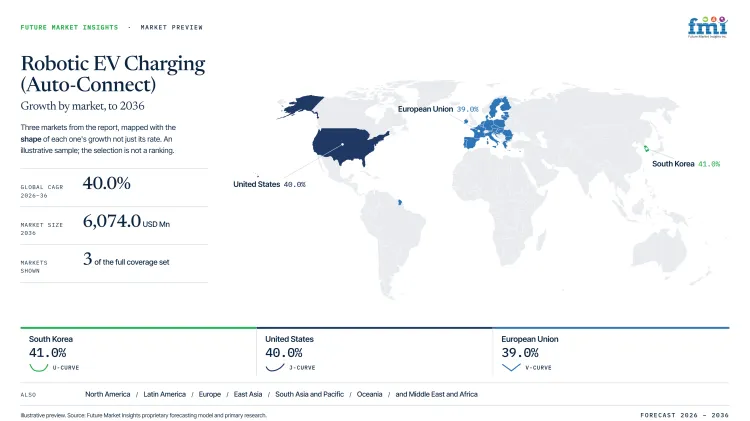
| Country | CAGR |
|---|---|
| European Union | 39.0% |
| South Korea | 41.0% |
| United States | 40.0% |
Source: FMI's proprietary forecasting model and primary research
How do country-level CAGRs compare in the Robotic EV Charging (Auto-Connect) Market?
The comparison spans 2.0 percentage points and places all three markets within a narrow growth range. South Korea records the highest CAGR at 41.0%, followed by the United States at 40.0% and the European Union at 39.0%. The close alignment indicates broad investment in automated EV charging infrastructure, while deployment priorities differ across regional charging networks and vehicle ecosystems.
-
South Korea leads with a CAGR of 41.0%. The market reflects continued investment in automated charging technologies that connect vehicles without manual intervention, supporting smart mobility infrastructure and reducing charging time in commercial and public locations.
-
The United States follows at 40.0%, only 1.0 percentage point below South Korea. Charging network operators and technology providers are evaluating robotic connection systems for high-utilization charging sites where automation can improve charger availability, streamline vehicle servicing and support fleet operations.
-
The European Union records a CAGR of 39.0%, 1.0 percentage point behind the United States. Deployment is linked to expanding EV charging infrastructure and the integration of automated charging solutions across public and commercial installations. Adoption differs among member states because charging network expansion, infrastructure investment and transport policies are not uniform.
Comparable CAGRs do not indicate identical market conditions. Differences in EV charging infrastructure, fleet electrification, automation strategies and capital investment priorities influence deployment patterns and long-term commercial opportunities. The full report provides country-level CAGR analysis across North America, Latin America, Europe, East Asia, South Asia, Oceania and the Middle East and Africa.
Country-wise Analysis
Three profiled rates remain close to the 40.0% global forecast but the route to commercial use differs by region. South Korea can test safe recovery at airports and vehicle-maker locations that operate with controlled traffic and repeat routes. USA freight depots need high power and proof that automatic connection improves vehicle readiness during each shift. European programs face more cross-brand work across national markets and need reliable local service coverage. These conditions lead each region to test a different part of the commercial case in daily operations. A similar risk appears in warehouse robotics; one missed charging task can interrupt work scheduled later in the same shift.
- European projects start from a large public charging base but automatic connector handling remains a separate investment. Adoption in the European Union is estimated to expand at 39.0% CAGR through 2036 as ports and freight sites test unattended charging. The International Energy Agency reported in May 2026 that five EU countries increased their charging networks by more than 50% during 2025. Rapid charger growth gives fleets more possible sites but does not solve cross-brand connection by itself. Systems must prove parking tolerance and safe release across several vehicle models under normal operating traffic. Local service coverage carries equal weight; a failed bay can disrupt a port schedule and delay linked vehicle tasks. Broad vehicle fit and fast repair support are required for commercial use beyond pilot work.
- South Korea combines dense charging coverage with airports and vehicle-maker sites that support controlled transport trials. Robotic EV charging demand in South Korea is forecast to expand at 41.0% CAGR through 2036, supported by controlled airport sites and local robotics expertise. South Korea's environment ministry reported in November 2025 that 52,000 fast chargers were operating by October 2025. The charging base is large enough for trials to focus on automatic connection performance instead. Approval requires safe detection and recovery from normal parking errors over extended operating cycles at the site. Hyundai Motor Group's airport project provides active traffic and direct user feedback under controlled conditions. A design that performs under airport traffic can support later use at other managed transport locations.
- USA projects are likely to begin at freight depots with high power needs and planned vehicle routes. Robotic EV charging demand is forecast to rise at 40.0% CAGR from 2026 to 2036 supported by heavy-duty fleet investment. The USA Department of Energy announced USD 68 million in January 2025 for charging sites near ports and distribution hubs. The selected projects cover fleets ranging from tens to hundreds of medium-duty and heavy-duty electric vehicles. A missed connection can disturb a large dispatch plan and leave expensive charging equipment idle. A depot trial should measure connector reach and fault recovery during normal yard traffic to prove that vehicle readiness improves across larger programs.
Who are the notable companies in the robotic EV charging (auto-connect) market?
Rocsys, Hyundai Motor Group Robotics LAB, Easelink, Beam Global, HEVO Inc., Electreon, Volterio, and Mob-Energy are notable developers across robotic side connectors, underbody contacts, wireless charging, and mobile charging robots.
-market-analysis-by-company.webp "Robotic Ev Charging (auto Connect) Market Analysis By Company")
Competition depends on how each system reaches the vehicle and what new equipment each installation requires. Rocsys and Hyundai Motor Group Robotics LAB place robotic arms beside fixed bays and use standard side inlets. Easelink and Volterio use conductive contacts beneath compatible vehicles at sites with planned parking positions. Beam Global with HEVO Inc. and Electreon use wireless transfer through receivers at fixed stops or planned industrial routes. Mob-Energy sends a charging robot to parked vehicles across flexible yards with longer dwell times. These methods solve the same cable-handling problem but create different costs for vehicle changes and installation work. ISO 15118-20 charging can coordinate the vehicle and charger but cannot remove mechanical fit or repair needs.
- Rocsys and Hyundai Motor Group Robotics LAB lead conventional side-inlet automation through projects at ports and airports. Their systems use standard vehicle inlets and reduce the need for hardware changes across the fleet. Performance depends on accurate arm reach and reliable cable release across normal parking variation during repeated daily use.
- Underbody conductive systems from Easelink and Volterio remove exposed cable movement but require matching hardware on each compatible vehicle. Accurate alignment over the ground unit forms part of the daily operating case at every compatible parking position. These systems fit controlled fleets that can add matching hardware to each vehicle under one planned upgrade program.
- Beam Global with HEVO Inc. and Electreon use wireless transfer as a separate route to automatic charging. Their systems avoid a mechanical connector beside the vehicle during each charging session at a managed fleet location. Commercial value rises if transfer efficiency stays high and receiver cost remains manageable across repeated stops.
- Flexible parking layouts create a distinct role for Mob-Energy through a mobile charging robot that reaches parked vehicles instead of rebuilding every space. Yards with longer dwell times can use this model, but robot energy capacity and dispatch timing limit coverage during busy shifts.
Competitive Benchmarking: Robotic EV Charging (Auto-Connect) Market
| Company | Standard-Inlet Compatibility | Hands-Free Connection | Deployment Evidence | Service Reach |
|---|---|---|---|---|
| Rocsys | High | High | High | Europe and North America |
| Hyundai Motor Group Robotics LAB | High | High | Medium | South Korea and selected United States demonstrations |
| Easelink | Low | High | High | Europe with selected China development programs |
| Volterio | Low | High | Low | Europe |
| Beam Global | Low | High | Medium | United States and UAE with selected international programs |
| HEVO Inc. | Low | High | Medium | United States and UAE with selected international programs |
| Electreon | Low | High | High | North America, Europe and Israel |
| Mob-Energy | Medium | Medium | High | France |
Scoring basis: A High rating for standard-inlet compatibility indicates that supported vehicles retain their normal charging inlet without dedicated underbody charging hardware. A Medium rating indicates that the standard inlet remains usable but an adapter or manual preparation step is required. A Low rating indicates that each vehicle needs a dedicated conductive connector or wireless receiver.
Key Developments in the Robotic EV Charging (Auto-Connect) Market
- In April 2026, Rocsys introduced the M1 multi-bay system for robotaxi depots and announced a USD 13 million Series A extension. The overhead rail lets one system serve several bays and leaves floor space clear for vehicles. The design targets sites that need more charging positions without placing a separate arm beside every bay.
- In July 2026, Easelink announced Project SUITE with Nissan Technical Centre Europe for the first automated AC vehicle-to-grid operation in the United Kingdom. The field project combines bidirectional charging with an automatic underbody contact during routine commercial parking. It tests unattended grid connection and could widen the value of automatic connection beyond charging alone.
- In February 2026, Beam Global launched an autonomous wireless charging platform with HEVO Inc. for commercial fleets using Beam Global's off-grid EV ARC equipment. The system combines solar charging with a wireless receiver and avoids trenching for a new grid connection at each site.
- In May 2025, Hyundai Motor Group signed an agreement with Incheon International Airport Corporation to deploy its Automatic Charging Robot in an airport demonstration project. The program tests parking tolerance and safety controls in active transport traffic and gathers feedback on service needs.
Key Players in the Robotic EV Charging (Auto-Connect) Market
Robotic side-connector developer
- Rocsys
- Hyundai Motor Group Robotics LAB
Underbody conductive charging developer
- Easelink
- Volterio
Wireless charging developer
- Beam Global
- HEVO Inc.
- Electreon
Mobile charging robot developer
- Mob-Energy
Robotic EV Charging (Auto-Connect) Market - Report Scope
-market-breakdown-by-technology,-application,-and-region.webp "Robotic Ev Charging (auto Connect) Market Breakdown By Technology, Application, And Region")
| Report Attribute | Coverage |
|---|---|
| Market Breakdown | Technology, Application, Component, End-use, Business Model, and Region |
| Quantitative Units | Revenue in USD Million, CAGR in %. |
| Market Definition | Automated systems that connect an electric vehicle to charging equipment without routine manual cable handling. |
| Regions Covered | North America, Latin America, Europe, East Asia, South Asia and Pacific, Oceania, and Middle East and Africa |
| Countries Covered | United States, Canada, Brazil, Germany, United Kingdom, France, China, Japan, South Korea, India, Australia, and other countries within the regional model |
| Key Companies Profiled | Rocsys, Hyundai Motor Group Robotics LAB, Easelink, Beam Global, HEVO Inc., Electreon, Volterio, and Mob-Energy |
| Approach | Review of fleet charging routines and connection methods with company activity and country forecasts compared across regions |
Source: Future Market Insights - analysis based on proprietary forecasting models and primary research
Robotic EV Charging (Auto-Connect) Market - Research Methodology
| Method | Application |
|---|---|
| Primary Research |
FMI analysts gathered input from manufacturers, service providers, technology developers, distributors, end users, sourcing teams, and subject-matter experts. Interviews examined purchasing decisions, product or service evaluation, adoption barriers, approval requirements, pricing considerations, and expectations for technical or commercial support. Respondents were also asked what evidence is required before a trial, pilot, or initial order develops into regular purchasing. |
| Desk Research | Desk research covered government statistics, regulatory publications, trade data, industry associations, technical literature, standards, company filings, product information, and official corporate announcements. Sources were reviewed for relevance, publication date, geographic coverage, and consistency with the defined market scope. Claims relating to performance, applications, approvals, capacity, investment, and commercial activity were retained only when supported by credible public evidence. |
| Market Sizing and Forecasting | The market model combined the baseline value with historical performance, segment structure, pricing and volume indicators, adoption levels, company participation, and country-level demand conditions. Forecast assumptions considered economic activity, investment trends, regulatory developments, technology adoption, purchasing cycles, supply availability, and barriers to wider market use. Segment and regional estimates were reconciled before the final market total was calculated. |
| Data Validation | Estimates were checked against multiple independent indicators, including public data, company activity, trade patterns, industry developments, and findings from primary interviews. Validation also tested whether products, services, applications, and company revenues fell within the defined market boundaries. Adjacent categories, unsupported claims, overlapping revenues, and activities without direct market relevance were excluded to reduce double counting and maintain consistency across segments and countries. |
Robotic EV Charging (Auto-Connect) Market by Segments
Robotic EV Charging (Auto-Connect) Market segmented by Technology:
- Robotic arm auto-connect
- Underbody conductive systems
- Mobile charging robots
- Swap-assist robotics
Robotic EV Charging (Auto-Connect) Market segmented by Application:
- AV fleet depots
- Truck and bus depots
- Public charging hubs
- Ports and logistics
Robotic EV Charging (Auto-Connect) Market segmented by Component:
- Hardware
- Software
- Services
Robotic EV Charging (Auto-Connect) Market segmented by End-use:
- Fleet operators
- Charge point operators
- Vehicle manufacturer depots
- Ports
Robotic EV Charging (Auto-Connect) Market segmented by Business Model:
- Direct sales
- Charge point operator partnerships
- Subscriptions
- Pilot programs
Robotic EV Charging (Auto-Connect) Market by Region:
- North America
- United States
- Canada
- Latin America
- Brazil
- Mexico
- Other Latin American Countries
- Europe
- Germany
- United Kingdom
- France
- Italy
- Spain
- Other European Countries
- East Asia
- China
- Japan
- South Korea
- South Asia and Pacific
- India
- ASEAN Countries
- Other South Asian and Pacific Countries
- Oceania
- Australia
- New Zealand
- Middle East and Africa
- Gulf Cooperation Council Countries
- South Africa
- Other Middle Eastern and African Countries
Research Sources and Bibliography
- California Department of Motor Vehicles. (2026, February 20). Autonomous vehicle permit holders in California logged more than 9 million test miles between December 1, 2024, and November 30, 2025.
- USA Department of Transportation. (2025, January 10). Investing in America: Biden-Harris Administration announces USD 635 million in awards to continue expanding zero-emission EV charging and refueling infrastructure.
- International Energy Agency. (2026, May 20). Electric vehicle charging. Global EV Outlook 2026.
- Ministry of Climate, Energy and Environment. (2025, November 16). Annual EV supply hits 200,000: Driving mainstream adoption through stronger industry competitiveness.
- USA Department of Energy. (2025, January 15). DOE invests USD 68 million in innovative heavy-duty electric vehicle charging solutions.
- Rocsys. (2025, June 16). Rocsys and ICT Group join forces to enable hands-free charging in ports and logistics.
- Rocsys. (2025, May 19). Rocsys and Einride collaborate to enable hands-free charging for autonomous freight operations.
- Hyundai Motor Group. (2026, January 7). Hyundai Motor Group showcases AI robotics products and solutions at CES 2026.
- Electreon. (2025, September 16). Electreon collaborates with ATLoS autonomous vehicle supplier to accelerate fully autonomous wirelessly charged industrial transport.
- Easelink. (2025, February 21). Easelink secures €11.5 million funding to advance automated EV charging standardization.
- Rocsys. (2026, May 5). Rocsys launches S2, its next-generation hands-free charging system for heavy-duty electric fleets.
- Rocsys. (2025, February 4). Rocsys to deploy at APM Terminals Maasvlakte II.
- SAE International. (2025, May 28). SAE International publishes SAE J3400/2 standard to accelerate safer, faster EV charging across North America.
- Rocsys. (2026, April 29). Rocsys unveils the first multi-bay hands-free charging system and raises a USD 13 million Series A extension.
- Easelink. (2026, July 1). Project SUITE: Nissan and Easelink build the first automated AC vehicle-to-grid operation in the United Kingdom.
- Beam Global. (2026, February 24). Beam Global and HEVO Inc. launch a market-ready autonomous charging platform for autonomous vehicles.
- Hyundai Motor Group. (2025, May 23). Hyundai Motor Group and Incheon International Airport to deliver next-level convenience with AI-powered EV charging robots.
- Volterio. (n.d.). Cable-free automatic charging.
- Mob-Energy. (n.d.). Robot-led charging for operational fleets.
This bibliography is provided for reader reference and uses primary government, standards-body, official trade body, and company sources.
This Report Answers
- How large is the robotic EV charging (auto-connect) market in 2026 and by 2036?
- Which operating problem creates demand for unattended vehicle connection?
- Why do robotic arms lead the technology category during 2026?
- How do AV fleet depots differ from public charging applications?
- Which interface and parking issues can delay commercial use?
- How do growth paths differ across the European Union and South Korea?
- Why does the United States present an opening for freight-depot systems?
- Which companies compete through robotic and underbody connection methods?
- How are wireless and mobile charging systems changing the competitive set?
- What should depot operators test during a commercial installation?
Frequently Asked Questions
What is driving growth in the Robotic EV Charging (Auto-Connect) Market?
Growth comes from electric fleets that need charging sessions to start without routine cable handling across repeated daily routes. The 40.0% forecast reflects demand for dependable automatic connection at depots and other controlled transport locations.
Who are the key players in the Robotic EV Charging (Auto-Connect) Market?
Rocsys and Hyundai Motor Group Robotics LAB develop robotic systems that connect through standard side charging inlets. Easelink and Volterio cover underbody contacts; Beam Global with HEVO Inc. and Electreon cover wireless systems, and Mob-Energy supplies mobile charging robots.
What is a notable restraint in the Robotic EV Charging (Auto-Connect) Market?
Mixed fleets use different inlet positions and vehicle hardware across models that share the same charging location. Project value falls if the selected method needs extensive vehicle changes or frequent staff support during failed connections.
Why should executives track the Robotic EV Charging (Auto-Connect) Market?
Automatic connection can determine whether an electric fleet completes charging in time for its planned daily routes. The category links charging equipment with dispatch timing and local power limits across depots that run several shifts.
What business problem does the Robotic EV Charging (Auto-Connect) Market address?
The market addresses the unfinished step between vehicle parking and the safe start of a charging session. Automatic connection removes routine cable handling from depots that receive the same vehicles several times each day.
What should procurement leaders evaluate before selecting suppliers?
Evaluation should test parking tolerance and failed-connection recovery with representative vehicles under normal depot traffic. The review should cover vehicle changes and service access together with charger controls and dispatch links.
What limits return on investment for purchasers?
Returns fall if connection failures remove charging bays from service or require regular staff support during busy shifts. Major installation work and extra vehicle hardware can extend the payback period beyond the planned fleet cycle.
How do suppliers build long-term account confidence?
Developers earn confidence through repeatable connections with real vehicles across normal parking errors and daily traffic. Clear maintenance plans and complete fault records reduce disruption and shorten recovery during a charging failure.
Preview the report firsthand - request a free sample
Get SampleGet the brochure for pricing and purchase details.
Get PDFTable of Content
- Key Takeaways
- Market Size and CAGR
- Top Growth Driver
- Fastest Growing Segment
- Leading Region
- Key Companies
- Emerging Opportunities
- Executive Summary
- Global Market Outlook
- Demand-side Trends
- Supply-side Trends
- Technology Roadmap Analysis
- Analysis and Recommendations
- Analyst Perspective (What is happening? Why now? What should investors know?)
- Key Questions Answered
- How large is the market?
- What is the CAGR?
- What are key trends?
- Which region dominates?
- Who are the leaders?
- Market Overview
- Market Coverage / Taxonomy
- Market Definition / Scope / Limitations
- Research Methodology
- Chapter Orientation
- Analytical Lens and Working Hypotheses
- Market Structure, Signals, and Trend Drivers
- Benchmarking and Cross-market Comparability
- Market Sizing, Forecasting, and Opportunity Mapping
- Research Design and Evidence Framework
- Desk Research Programme (Secondary Evidence)
- Expert Input and Fieldwork (Primary Evidence)
- Tooling, Models, and Reference Databases
- Data Engineering and Model Build
- Quality Assurance and Audit Trail
- Market Background
- Market Dynamics (Drivers, Restraints, Opportunity, Trends)
- Scenario Forecast (Optimistic, Likely, Conservative)
- Impact Analysis
- AI Impact
- Sustainability Impact
- Regulatory Impact
- Technology Impact
- Consumer / Buyer Analysis
- Purchase Drivers
- Adoption Barriers
- Buyer Journey
- Opportunity Map Analysis
- Product Life Cycle Analysis
- Supply Chain Analysis
- Investment Feasibility Matrix
- Value Chain Analysis
- PESTLE and Porter's Analysis
- Regulatory Landscape
- Regional Parent Market Outlook
- Production and Consumption Statistics
- Import and Export Statistics
- Global Market Analysis and Forecast, 2021 to 2036
- Historical Market Size Value (USD Mn) Analysis, 2021 to 2025
- Current and Future Market Size Value (USD Mn) Projections, 2026 to 2036
- Y-o-Y Growth Trend Analysis
- Absolute $ Opportunity Analysis
- Global Market Pricing Analysis, 2021 to 2036
- Global Market Analysis and Forecast, By Technology, 2021 to 2036
- Introduction / Key Findings
- Historical Market Size Value (USD Mn) Analysis By Technology, 2021 to 2025
- Current and Future Market Size Value (USD Mn) Analysis and Forecast By Technology, 2026 to 2036
- Robotic arm auto-connect
- Underbody - conductive systems
- Mobile charging robots
- Swap-assist robotics
- Robotic arm auto-connect
- Y-o-Y Growth Trend Analysis By Technology, 2021 to 2025
- Absolute $ Opportunity Analysis By Technology, 2026 to 2036
- Global Market Analysis and Forecast, By Application, 2021 to 2036
- Introduction / Key Findings
- Historical Market Size Value (USD Mn) Analysis By Application, 2021 to 2025
- Current and Future Market Size Value (USD Mn) Analysis and Forecast By Application, 2026 to 2036
- AV fleet depots
- Truck & bus depots
- Public charging hubs
- Ports & logistics
- AV fleet depots
- Y-o-Y Growth Trend Analysis By Application, 2021 to 2025
- Absolute $ Opportunity Analysis By Application, 2026 to 2036
- Global Market Analysis and Forecast, By Component, 2021 to 2036
- Introduction / Key Findings
- Historical Market Size Value (USD Mn) Analysis By Component, 2021 to 2025
- Current and Future Market Size Value (USD Mn) Analysis and Forecast By Component, 2026 to 2036
- Hardware
- Software
- Services
- Hardware
- Y-o-Y Growth Trend Analysis By Component, 2021 to 2025
- Absolute $ Opportunity Analysis By Component, 2026 to 2036
- Global Market Analysis and Forecast, By End-use, 2021 to 2036
- Introduction / Key Findings
- Historical Market Size Value (USD Mn) Analysis By End-use, 2021 to 2025
- Current and Future Market Size Value (USD Mn) Analysis and Forecast By End-use, 2026 to 2036
- Fleet operators
- Charge point operators
- OEM depots
- Ports
- Fleet operators
- Y-o-Y Growth Trend Analysis By End-use, 2021 to 2025
- Absolute $ Opportunity Analysis By End-use, 2026 to 2036
- Global Market Analysis and Forecast, By Business Model, 2021 to 2036
- Introduction / Key Findings
- Historical Market Size Value (USD Mn) Analysis By Business Model, 2021 to 2025
- Current and Future Market Size Value (USD Mn) Analysis and Forecast By Business Model, 2026 to 2036
- Direct
- CPO partnership
- Subscription
- Pilot programs
- Direct
- Y-o-Y Growth Trend Analysis By Business Model, 2021 to 2025
- Absolute $ Opportunity Analysis By Business Model, 2026 to 2036
- Global Market Analysis and Forecast, By Region, 2021 to 2036
- Introduction
- Historical Market Size Value (USD Mn) Analysis By Region, 2021 to 2025
- Current Market Size Value (USD Mn) Analysis and Forecast By Region, 2026 to 2036
- North America
- Latin America
- Western Europe
- Eastern Europe
- East Asia
- South Asia and Pacific
- Middle East & Africa
- Market Attractiveness Analysis By Region
- North America Market Analysis and Forecast, By Country, 2021 to 2036
- Historical Market Size Value (USD Mn) Trend Analysis By Market Taxonomy, 2021 to 2025
- Market Size Value (USD Mn) Forecast By Market Taxonomy, 2026 to 2036
- By Country
- USA
- Canada
- By Technology
- By Application
- By Component
- By End-use
- By Business Model
- By Country
- Market Attractiveness Analysis
- By Country
- By Technology
- By Application
- By Component
- By End-use
- By Business Model
- Key Takeaways
- Latin America Market Analysis and Forecast, By Country
- Historical Market Size Value (USD Mn) Trend Analysis By Market Taxonomy, 2021 to 2025
- Market Size Value (USD Mn) Forecast By Market Taxonomy, 2026 to 2036
- By Country
- Brazil
- Mexico
- Chile
- Rest of Latin America
- By Technology
- By Application
- By Component
- By End-use
- By Business Model
- By Country
- Market Attractiveness Analysis
- By Country
- By Technology
- By Application
- By Component
- By End-use
- By Business Model
- Key Takeaways
- Western Europe Market Analysis and Forecast, By Country
- Historical Market Size Value (USD Mn) Trend Analysis By Market Taxonomy, 2021 to 2025
- Market Size Value (USD Mn) Forecast By Market Taxonomy, 2026 to 2036
- By Country
- Germany
- UK
- Italy
- Spain
- France
- Nordic
- BENELUX
- Rest of Western Europe
- By Technology
- By Application
- By Component
- By End-use
- By Business Model
- By Country
- Market Attractiveness Analysis
- By Country
- By Technology
- By Application
- By Component
- By End-use
- By Business Model
- Key Takeaways
- Eastern Europe Market Analysis and Forecast, By Country
- Historical Market Size Value (USD Mn) Trend Analysis By Market Taxonomy, 2021 to 2025
- Market Size Value (USD Mn) Forecast By Market Taxonomy, 2026 to 2036
- By Country
- Russia
- Poland
- Hungary
- Balkan & Baltic
- Rest of Eastern Europe
- By Technology
- By Application
- By Component
- By End-use
- By Business Model
- By Country
- Market Attractiveness Analysis
- By Country
- By Technology
- By Application
- By Component
- By End-use
- By Business Model
- Key Takeaways
- East Asia Market Analysis and Forecast, By Country
- Historical Market Size Value (USD Mn) Trend Analysis By Market Taxonomy, 2021 to 2025
- Market Size Value (USD Mn) Forecast By Market Taxonomy, 2026 to 2036
- By Country
- China
- Japan
- South Korea
- By Technology
- By Application
- By Component
- By End-use
- By Business Model
- By Country
- Market Attractiveness Analysis
- By Country
- By Technology
- By Application
- By Component
- By End-use
- By Business Model
- Key Takeaways
- South Asia and Pacific Market Analysis and Forecast, By Country
- Historical Market Size Value (USD Mn) Trend Analysis By Market Taxonomy, 2021 to 2025
- Market Size Value (USD Mn) Forecast By Market Taxonomy, 2026 to 2036
- By Country
- India
- ASEAN
- Australia & New Zealand
- Rest of South Asia and Pacific
- By Technology
- By Application
- By Component
- By End-use
- By Business Model
- By Country
- Market Attractiveness Analysis
- By Country
- By Technology
- By Application
- By Component
- By End-use
- By Business Model
- Key Takeaways
- Middle East & Africa Market Analysis and Forecast, By Country
- Historical Market Size Value (USD Mn) Trend Analysis By Market Taxonomy, 2021 to 2025
- Market Size Value (USD Mn) Forecast By Market Taxonomy, 2026 to 2036
- By Country
- Kingdom of Saudi Arabia
- Other GCC Countries
- Türkiye
- South Africa
- Other African Union
- Rest of Middle East & Africa
- By Technology
- By Application
- By Component
- By End-use
- By Business Model
- By Country
- Market Attractiveness Analysis
- By Country
- By Technology
- By Application
- By Component
- By End-use
- By Business Model
- Key Takeaways
- Key Countries Market Analysis
- USA
- Pricing Analysis
- Market Share Analysis, 2025
- By Technology
- By Application
- By Component
- By End-use
- By Business Model
- Canada
- Pricing Analysis
- Market Share Analysis, 2025
- By Technology
- By Application
- By Component
- By End-use
- By Business Model
- Mexico
- Pricing Analysis
- Market Share Analysis, 2025
- By Technology
- By Application
- By Component
- By End-use
- By Business Model
- Brazil
- Pricing Analysis
- Market Share Analysis, 2025
- By Technology
- By Application
- By Component
- By End-use
- By Business Model
- Chile
- Pricing Analysis
- Market Share Analysis, 2025
- By Technology
- By Application
- By Component
- By End-use
- By Business Model
- Germany
- Pricing Analysis
- Market Share Analysis, 2025
- By Technology
- By Application
- By Component
- By End-use
- By Business Model
- UK
- Pricing Analysis
- Market Share Analysis, 2025
- By Technology
- By Application
- By Component
- By End-use
- By Business Model
- Italy
- Pricing Analysis
- Market Share Analysis, 2025
- By Technology
- By Application
- By Component
- By End-use
- By Business Model
- Spain
- Pricing Analysis
- Market Share Analysis, 2025
- By Technology
- By Application
- By Component
- By End-use
- By Business Model
- France
- Pricing Analysis
- Market Share Analysis, 2025
- By Technology
- By Application
- By Component
- By End-use
- By Business Model
- India
- Pricing Analysis
- Market Share Analysis, 2025
- By Technology
- By Application
- By Component
- By End-use
- By Business Model
- ASEAN
- Pricing Analysis
- Market Share Analysis, 2025
- By Technology
- By Application
- By Component
- By End-use
- By Business Model
- Australia & New Zealand
- Pricing Analysis
- Market Share Analysis, 2025
- By Technology
- By Application
- By Component
- By End-use
- By Business Model
- China
- Pricing Analysis
- Market Share Analysis, 2025
- By Technology
- By Application
- By Component
- By End-use
- By Business Model
- Japan
- Pricing Analysis
- Market Share Analysis, 2025
- By Technology
- By Application
- By Component
- By End-use
- By Business Model
- South Korea
- Pricing Analysis
- Market Share Analysis, 2025
- By Technology
- By Application
- By Component
- By End-use
- By Business Model
- Russia
- Pricing Analysis
- Market Share Analysis, 2025
- By Technology
- By Application
- By Component
- By End-use
- By Business Model
- Poland
- Pricing Analysis
- Market Share Analysis, 2025
- By Technology
- By Application
- By Component
- By End-use
- By Business Model
- Hungary
- Pricing Analysis
- Market Share Analysis, 2025
- By Technology
- By Application
- By Component
- By End-use
- By Business Model
- Kingdom of Saudi Arabia
- Pricing Analysis
- Market Share Analysis, 2025
- By Technology
- By Application
- By Component
- By End-use
- By Business Model
- Türkiye
- Pricing Analysis
- Market Share Analysis, 2025
- By Technology
- By Application
- By Component
- By End-use
- By Business Model
- South Africa
- Pricing Analysis
- Market Share Analysis, 2025
- By Technology
- By Application
- By Component
- By End-use
- By Business Model
- USA
- Market Structure Analysis
- Competition Dashboard
- Competition Benchmarking
- Market Share Analysis of Top Players
- By Regional
- By Technology
- By Application
- By Component
- By End-use
- By Business Model
- Emerging Startups
- Innovation Benchmarking
- Competition Analysis
- Competition Deep Dive
- Rocsys (NL)
- Overview
- Product Portfolio
- Profitability by Market Segments
- Sales Footprint
- Strategy Overview
- Marketing Strategy
- Product Strategy
- Channel Strategy
- Hyundai ACR (KR)
- Kempower robotics (FI)
- Rocsys (NL)
- Case Studies
- Success Stories
- Recent Developments
- Competition Deep Dive
- Assumptions & Acronyms Used


