

- Industry Size (2026)
- USD 569.4 Mn
- Forecast (2036)
- USD 1411.1 Mn
- CAGR (2026 to 2036)
- 9.5%
Salivary Biomarkers Market Forecast and Outlook 2026 to 2036
The salivary biomarkers market is expected to experience steady growth from 2026 to 2036. In 2026, the market value is projected to be USD 569.4 million, with consistent growth anticipated, reaching USD 1,411.1 million by 2036. The compound annual growth rate (CAGR) for the market is forecasted at 9.5%, driven by the increasing demand for non-invasive diagnostic tools in healthcare. Salivary biomarkers are becoming more popular due to their ability to detect a wide range of diseases, including cancer, diabetes, and neurological disorders, without the need for blood samples.
The growth of the market is supported by technological advancements in biomarker discovery, increased awareness of the benefits of saliva-based diagnostics, and the rising demand for personalized medicine. Over the forecast period, the market is expected to expand steadily as research into salivary biomarkers advances and more applications for these biomarkers are discovered. The ongoing development of reliable, accurate, and cost-effective salivary diagnostic tests will play a key role in driving the market forward.
Quick Stats of the Salivary Biomarkers Market
- Salivary Biomarkers Market Value (2026): USD 569.4 million
- Salivary Biomarkers Market Forecast Value (2036): USD 1,411.1 million
- Salivary Biomarkers Market Global Forecast CAGR (2026-2036): 9.5%
- Salivary Biomarkers Market Leading Segment: Application (Disease diagnostics) 60%
- Key Growth Regions in Salivary Biomarkers Market: India
- Top Players in Salivary Biomarkers Market: Salimetrics, Qiagen, Thermo Fisher, Abbott, Bio-Rad, Others
What is the Growth Forecast for the Salivary Biomarkers Market through 2036?
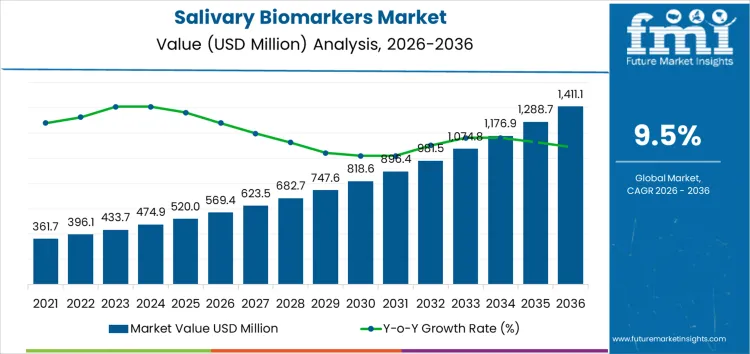
The growth forecast for the salivary biomarkers market reflects steady and consistent expansion, with a projected CAGR of 9.5%. Starting at USD 569.4 million in 2026, the market is expected to grow year-on-year, reaching USD 623.5 million in 2027, USD 682.7 million in 2028, and USD 747.6 million in 2029. By 2030, the market value is projected to rise to USD 818.6 million, continuing its upward trajectory.
From 2031 to 2036, the market will continue to experience steady growth, reaching USD 896.4 million in 2031, USD 981.5 million in 2032, and USD 1,074.8 million in 2033. The market will expand further, reaching USD 1,176.9 million in 2034, USD 1,288.7 million in 2035, and finally USD 1,411.1 million by 2036. This consistent growth is indicative of the increasing adoption of salivary biomarkers for disease detection and the growing shift toward non-invasive, personalized diagnostic methods in healthcare.
Salivary Biomarkers Market Key Takeaways
| Metric | Value |
|---|---|
| Industry Sales Value (2026) | USD 569.4 million |
| Industry Forecast Value (2036) | USD 1,411.1 million |
| Industry Forecast CAGR (2026-2036) | 9.5% |
What Is Driving the Demand for the Salivary Biomarkers Market Globally?
The global demand for salivary biomarkers is driven by growing interest in non invasive diagnostics, preventive health screening, and personalized medicine. Saliva contains a range of biological molecules-including proteins, nucleic acids, metabolites, and hormones-that reflect physiological and pathological states. Unlike blood draws, saliva collection is painless, low risk, and can be performed without specialized clinical personnel, which supports broader use in point of care testing, home testing, and large scale screening. This has made salivary biomarkers attractive for monitoring infectious diseases, metabolic conditions, stress related hormones, oncology signatures, and oral health indicators. Increasing prevalence of chronic diseases worldwide, coupled with pressure on healthcare systems to shift toward early detection and outpatient care, has encouraged researchers, diagnostic developers, and healthcare providers to explore saliva‐based tests as scalable alternatives to traditional approaches. Advances in high sensitivity analytical platforms, microfluidics, and molecular assays have improved the reliability and accuracy of salivary biomarker detection, expanding potential clinical applications beyond research settings.
Future demand for the salivary biomarkers market is expected to grow as technological innovation and clinical validation progress. Improvements in assay sensitivity, automation, and integration with digital health platforms will support real time monitoring and telehealth applications, enabling clinicians to track disease progression or treatment response with greater frequency and convenience. Expansion of personalized health programs, workplace wellness testing, and school based screening initiatives will further broaden use cases, particularly when invasive procedures are impractical. Regulatory advancements that recognize the clinical utility of saliva diagnostics will influence adoption as more assays secure clearance or approval across jurisdictions. Growth in research linking specific salivary signatures to systemic conditions will also bolster confidence among clinicians and payers in the utility of saliva based tests. As global healthcare infrastructure evolves toward preventive and decentralized care, salivary biomarkers are expected to play an increasing role in diagnostics, monitoring, and health management.
What are the Leading Segments in the Global Salivary Biomarkers Market?
The global salivary biomarkers market is segmented by product and application. Among products, diagnostic assay kits lead the market, capturing 50% of the share, followed by collection devices and analytical services. Diagnostic assay kits are essential for detecting specific biomarkers in saliva, facilitating disease diagnostics and drug monitoring. On the application side, disease diagnostics dominates the market, holding 60% of the share, followed by drug monitoring and wellness & research. The growing demand for non-invasive, rapid, and cost-effective diagnostic solutions drives the adoption of salivary biomarkers in disease diagnostics.
What Drives the Growth of Diagnostic Assay Kits in the Salivary Biomarkers Market?
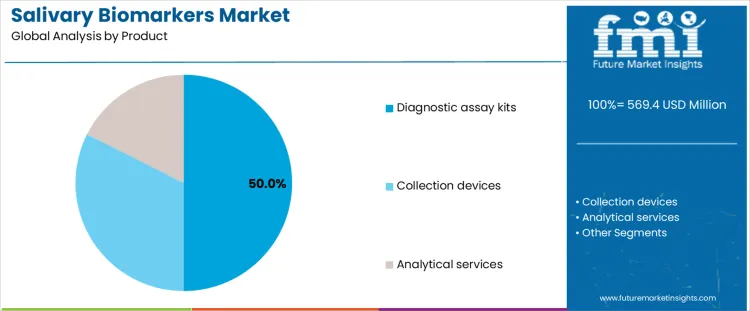
Diagnostic assay kits are the leading product type in the salivary biomarkers market, holding 50% of the share. These kits are designed to detect specific biomarkers in saliva, offering a non-invasive alternative to blood-based testing. The demand for diagnostic assay kits is driven by the growing preference for non-invasive, easy-to-use diagnostic methods in both clinical and at-home settings. Salivary biomarkers are particularly valuable in early disease detection, especially for conditions like cancer, diabetes, and oral diseases. The increased focus on personalized medicine, combined with advancements in biomarker discovery, has further fueled the growth of diagnostic assay kits. As healthcare systems worldwide emphasize more efficient, patient-friendly diagnostic tools, the market for salivary diagnostic assay kits is expected to continue expanding, making them a dominant product in the market.
What is Driving the Demand for Disease Diagnostics in the Salivary Biomarkers Market?
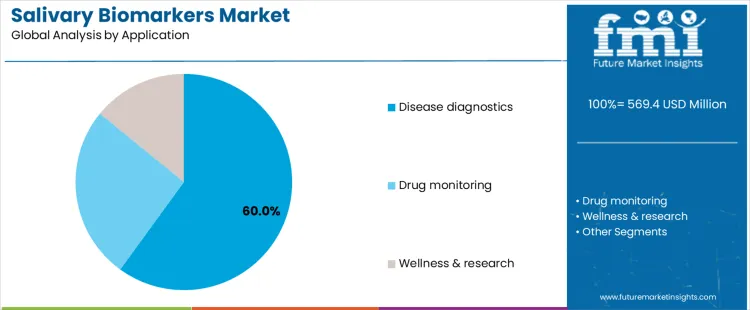
Disease diagnostics is the leading application segment in the salivary biomarkers market, capturing 60% of the share. The growth of this segment is driven by the increasing need for non-invasive, rapid, and cost-effective diagnostic tools for disease detection. Salivary biomarkers offer several advantages, including ease of sample collection, low cost, and the potential for point-of-care testing, making them ideal for diagnosing a wide range of diseases such as cancer, cardiovascular diseases, and diabetes. Furthermore, the rising prevalence of chronic diseases and the growing awareness of the importance of early disease detection are contributing to the demand for salivary biomarkers in disease diagnostics. As healthcare providers and patients seek more accessible and efficient diagnostic solutions, the role of salivary biomarkers in disease diagnosis is expected to expand, solidifying disease diagnostics as the dominant application in the market.
What are the Key Dynamics in the Global Salivary Biomarkers Market?
The global salivary biomarkers market is expanding as research and clinical interest in non invasive diagnostic solutions increases. Saliva contains molecular indicators such as proteins, hormones, metabolites and nucleic acids that reflect systemic health and disease states, enabling applications in disease screening, monitoring and personalized medicine. Growth is driven by demand for early disease detection, patient comfort and cost effective sample collection without need for trained phlebotomists. Adoption spans oncology, infectious diseases, metabolic disorders and oral health assessment, with expanding use in clinical research, point of care platforms and wellness monitoring worldwide.
What are the Key Drivers for the Global Salivary Biomarkers Market?
Rising focus on non invasive, patient friendly diagnostics is a major driver for the salivary biomarkers market. Saliva collection is simple, painless and reduces risk of infection, making it suitable for repeated testing and remote sample gathering. Advances in molecular biology, high sensitivity assays and biosensor technologies enable detection of relevant biomarkers at low concentrations, supporting broader clinical utility. Increased prevalence of chronic diseases and need for early intervention fuels interest in screening tools that improve outcomes and reduce healthcare costs. Growth in personalized medicine, preventive care and home testing solutions further encourages development and adoption of saliva based diagnostics across healthcare settings.
What are the Restraints for the Global Salivary Biomarkers Market?
One restraint is the technical challenge of achieving reliable, reproducible biomarker measurement given the variability in saliva composition related to flow rate, diet, hydration and circadian rhythms. Standardizing sample collection and processing protocols is essential to reduce pre analytical variation, but this can slow clinical adoption and regulatory approval. Some clinicians remain cautious about substituting saliva for blood or tissue samples until extensive validation and correlation studies are completed. Regulatory pathways for diagnostic assays vary by region and require clinical evidence to demonstrate safety and effectiveness, which can lengthen product development timelines. Limited reimbursement frameworks for saliva based tests in some markets may also affect uptake.
What are the Key Trends in the Global Salivary Biomarkers Market?
A key trend is integration of salivary biomarker detection with digital health and point of care technologies that enable real time or near real time results outside traditional laboratory settings. Portable biosensors, microfluidic devices and smartphone linked platforms are expanding access, particularly in remote or resource limited areas. Research is advancing multi analyte panels that combine several biomarkers to improve diagnostic accuracy and disease specificity. Collaborative efforts between academic researchers, clinical institutions and industry players are accelerating validation studies and biomarker discovery. Increased investment in artificial intelligence and machine learning supports pattern recognition and predictive modeling that enhance interpretation of complex salivary data for personalized health insights.
What is the Country-Wise Analysis of the Salivary Biomarkers Market?
The salivary biomarkers market is expected to experience steady growth, driven by advancements in diagnostic technologies and an increasing focus on non-invasive testing methods. Salivary biomarkers are becoming increasingly important in the detection and monitoring of various diseases, including cancers, diabetes, and cardiovascular conditions. The demand for non-invasive diagnostics that are both cost-effective and easy to use is rising across healthcare sectors. High-growth markets like India and China are seeing strong demand due to their large populations, expanding healthcare sectors, and the increasing adoption of advanced diagnostic technologies. Developed markets such as the USA, UK, and Germany are also witnessing steady growth, supported by significant investments in research and healthcare infrastructure, alongside increasing public awareness of the benefits of salivary diagnostics.
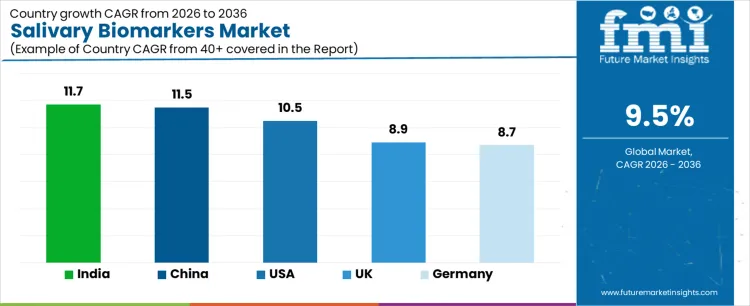
| Country | CAGR (2026-2036) |
|---|---|
| India | 11.7% |
| China | 11.5% |
| United States | 10.5% |
| United Kingdom | 8.9% |
| Germany | 8.7% |
What is the Growth Outlook for the Salivary Biomarkers Market in India?
The salivary biomarkers market in India is expected to grow at the highest rate, with a projected CAGR of 11.7%. India’s rapidly expanding healthcare sector, coupled with increasing awareness of non-invasive diagnostic methods, is driving strong demand for salivary biomarker testing. The country’s large population, growing prevalence of chronic diseases, and expanding access to healthcare services are further contributing to the market’s growth. As India’s healthcare infrastructure continues to improve and as diagnostic costs become more affordable, salivary biomarkers are likely to become a preferred method for disease detection and monitoring. The country’s significant investment in medical research and its commitment to advancing healthcare technologies make it a key player in the global salivary biomarkers market.
What is the Market Outlook for the Salivary Biomarkers Market in China?
The salivary biomarkers market in China is projected to grow at a strong pace, with a projected CAGR of 11.5%. China’s growing healthcare industry, combined with increasing technological advancements and innovations in diagnostic tools, is driving demand for salivary biomarkers. The country’s large population, rising prevalence of chronic conditions, and government initiatives to improve healthcare access are all contributing factors. As China continues to focus on expanding healthcare research and development, salivary biomarkers will likely play a significant role in the country’s healthcare future. Additionally, with growing consumer preference for non-invasive diagnostic methods, the market for salivary biomarkers is expected to experience continued growth.
What is the Growth Forecast for the Salivary Biomarkers Market in the United States?
The salivary biomarkers market in the United States is expected to grow steadily, with a projected CAGR of 10.5%. The U.S. is a leader in healthcare research, and the adoption of non-invasive diagnostic technologies, including salivary biomarkers, is increasing rapidly. The demand for early disease detection methods and the shift towards personalized healthcare solutions are driving market growth. Salivary biomarkers are becoming increasingly important in the detection of various conditions such as cancer, diabetes, and cardiovascular diseases, due to their ease of use, accuracy, and non-invasive nature. The U.S. healthcare system’s focus on precision medicine and advancements in research make the country a key player in the growth of the salivary biomarkers market.
What is the Market Outlook for the Salivary Biomarkers Market in the United Kingdom?
The salivary biomarkers market in the United Kingdom is projected to grow steadily, with a projected CAGR of 8.9%. The UK’s healthcare system, known for its high standard of medical care and research, is increasingly adopting non-invasive diagnostic methods, including salivary biomarker testing. The demand for these diagnostic solutions is being driven by rising healthcare costs, growing awareness about early disease detection, and the country’s commitment to improving patient care. With a focus on advancing personalized medicine and promoting efficient healthcare delivery, the UK is expected to see steady growth in the salivary biomarkers market. Furthermore, increasing public awareness about the benefits of non-invasive diagnostics is expected to further contribute to this growth.
What are the Growth Prospects for the Salivary Biomarkers Market in Germany?
The salivary biomarkers market in Germany is expected to grow at a moderate pace, with a projected CAGR of 8.7%. Germany’s well-established healthcare system, strong emphasis on medical research, and focus on advanced diagnostic technologies are key drivers of this market’s growth. As demand for non-invasive diagnostic methods rises across various medical fields, including oncology, diabetes, and cardiovascular health, salivary biomarkers are becoming an increasingly popular choice. Germany’s focus on precision medicine and its robust healthcare infrastructure are expected to support the growth of the salivary biomarkers market. Additionally, Germany’s position as a leader in healthcare innovation and research makes it a key player in the global market.
What is the Competitive Landscape for the Salivary Biomarkers Market?
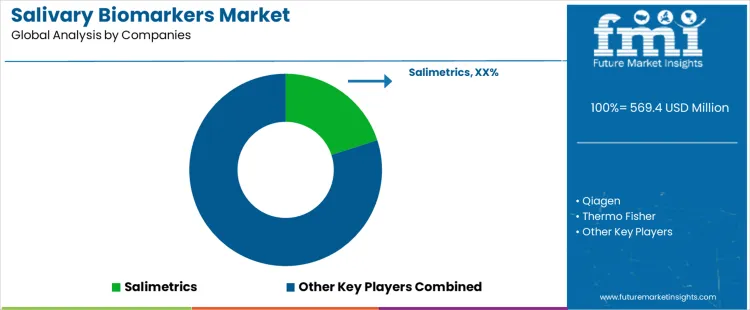
The salivary biomarkers market is growing as industries focus on non-invasive diagnostic solutions, particularly in areas such as healthcare, disease monitoring, and personalized medicine. Salimetrics leads the market with its advanced salivary biomarker detection systems, offering reliable, high-precision products designed to measure biomarkers from saliva samples. Their focus on innovation, quality, and non-invasive diagnostics positions them as a dominant player in this space. Qiagen, Thermo Fisher, and Abbott are significant competitors, each offering specialized solutions for salivary biomarker analysis. Qiagen provides comprehensive testing platforms for molecular diagnostics, while Thermo Fisher and Abbott offer a range of tools and technologies for analyzing biomarkers in saliva, focusing on improving diagnostic accuracy and accessibility.
Bio-Rad and Others further contribute to the competitive landscape by offering salivary biomarker detection solutions for various research and diagnostic applications. Bio-Rad specializes in high-quality immunoassay technologies for biomarker analysis, while Others refers to regional players and emerging companies that focus on innovative, cost-effective solutions in salivary biomarker testing. These companies compete by focusing on technological advancements, non-invasive testing methods, and the ability to provide precise, actionable biomarker data for improved healthcare outcomes. Their strategies aim to meet the growing demand for accurate, easy-to-use, and accessible diagnostic solutions in the salivary biomarkers market.
Key Players of the Salivary Biomarkers Market
- Salimetrics
- Qiagen
- Thermo Fisher
- Abbott
- Bio-Rad
- Others
Scope of the Report
| Items | Values |
|---|---|
| Quantitative Units (2026) | USD Million |
| Product | Diagnostic Assay Kits, Collection Devices, Analytical Services, DTC Kits |
| Application | Disease Diagnostics, Drug Monitoring, Wellness & Research |
| End User | Clinical Labs, Hospitals, Research Institutes |
| Companies | Salimetrics, Qiagen, Thermo Fisher, Abbott, Bio-Rad, Others |
| Regions Covered | North America, Latin America, Western Europe, Eastern Europe, South Asia and Pacific, East Asia, Middle East & Africa |
| Countries Covered | United States, Canada, Mexico, Brazil, Argentina, Germany, France, United Kingdom, Italy, Spain, Netherlands, China, India, Japan, South Korea, ANZ, GCC Countries, South Africa |
| Additional Attributes | Dollar by sales by product, application, end user, and region. Includes market trends in salivary biomarkers, focusing on diagnostic kits, collection devices, and analytical services. Highlights the role of clinical labs, hospitals, and research institutes in disease diagnostics and wellness research. Focus on performance, regulatory compliance, market share, and competitive positioning of key companies in the biomarker market. |
Salivary Biomarkers Market Segmentation
Product
- Diagnostic assay kits
- Collection devices
- Analytical services
- DTC kits
Application
- Disease diagnostics
- Drug monitoring
- Wellness & research
End User
- Clinical labs
- Hospitals
- Research institutes
Region
- Asia Pacific
- China
- Japan
- South Korea
- India
- Australia & New Zealand
- ASEAN
- Rest of Asia Pacific
- Europe
- Germany
- United Kingdom
- France
- Italy
- Spain
- Nordic
- BENELUX
- Rest of Europe
- North America
- United States
- Canada
- Mexico
- Latin America
- Brazil
- Chile
- Rest of Latin America
- Middle East & Africa
- Kingdom of Saudi Arabia
- Other GCC Countries
- Turkey
- South Africa
- Other African Union
- Rest of Middle East & Africa
Frequently Asked Questions
How big is the salivary biomarkers market in 2026?
The global salivary biomarkers market is estimated to be valued at USD 569.4 million in 2026.
What will be the size of salivary biomarkers market in 2036?
The market size for the salivary biomarkers market is projected to reach USD 1,411.1 million by 2036.
How much will be the salivary biomarkers market growth between 2026 and 2036?
The salivary biomarkers market is expected to grow at a 9.5% CAGR between 2026 and 2036.
What are the key product types in the salivary biomarkers market?
The key product types in salivary biomarkers market are diagnostic assay kits, collection devices and analytical services.
Which application segment to contribute significant share in the salivary biomarkers market in 2026?
In terms of application, disease diagnostics segment to command 60.0% share in the salivary biomarkers market in 2026.
Preview the report firsthand - request a free sample
Get SampleGet the brochure for pricing and purchase details.
Get PDFTable of Content
- Executive Summary
- Global Market Outlook
- Demand-side Trends
- Supply-side Trends
- Technology Roadmap Analysis
- Analysis and Recommendations
- Market Overview
- Market Coverage / Taxonomy
- Market Definition / Scope / Limitations
- Market Background
- Market Dynamics
- Drivers
- Restraints
- Opportunity
- Trends
- Scenario Forecast
- Demand in Optimistic Scenario
- Demand in Likely Scenario
- Demand in Conservative Scenario
- Opportunity Map Analysis
- Product Life Cycle Analysis
- Supply Chain Analysis
- Investment Feasibility Matrix
- Value Chain Analysis
- PESTLE and Porter’s Analysis
- Regulatory Landscape
- Regional Parent Market Outlook
- Production and Consumption Statistics
- Import and Export Statistics
- Market Dynamics
- Global Market Analysis 2021 to 2025 and Forecast, 2026 to 2036
- Historical Market Size Value (USD Million) Analysis, 2021 to 2025
- Current and Future Market Size Value (USD Million) Projections, 2026 to 2036
- Y-o-Y Growth Trend Analysis
- Absolute $ Opportunity Analysis
- Global Market Pricing Analysis 2021 to 2025 and Forecast 2026 to 2036
- Global Market Analysis 2021 to 2025 and Forecast 2026 to 2036, By Product
- Introduction / Key Findings
- Historical Market Size Value (USD Million) Analysis By Product , 2021 to 2025
- Current and Future Market Size Value (USD Million) Analysis and Forecast By Product , 2026 to 2036
- Diagnostic assay kits
- Collection devices
- Analytical services
- Diagnostic assay kits
- Y-o-Y Growth Trend Analysis By Product , 2021 to 2025
- Absolute $ Opportunity Analysis By Product , 2026 to 2036
- Global Market Analysis 2021 to 2025 and Forecast 2026 to 2036, By Application
- Introduction / Key Findings
- Historical Market Size Value (USD Million) Analysis By Application, 2021 to 2025
- Current and Future Market Size Value (USD Million) Analysis and Forecast By Application, 2026 to 2036
- Disease diagnostics
- Drug monitoring
- Wellness & research
- Disease diagnostics
- Y-o-Y Growth Trend Analysis By Application, 2021 to 2025
- Absolute $ Opportunity Analysis By Application, 2026 to 2036
- Global Market Analysis 2021 to 2025 and Forecast 2026 to 2036, By End User
- Introduction / Key Findings
- Historical Market Size Value (USD Million) Analysis By End User, 2021 to 2025
- Current and Future Market Size Value (USD Million) Analysis and Forecast By End User, 2026 to 2036
- Clinical labs
- Hospitals
- Research institutes
- DTC kits
- Clinical labs
- Y-o-Y Growth Trend Analysis By End User, 2021 to 2025
- Absolute $ Opportunity Analysis By End User, 2026 to 2036
- Global Market Analysis 2021 to 2025 and Forecast 2026 to 2036, By Region
- Introduction
- Historical Market Size Value (USD Million) Analysis By Region, 2021 to 2025
- Current Market Size Value (USD Million) Analysis and Forecast By Region, 2026 to 2036
- North America
- Latin America
- Western Europe
- Eastern Europe
- East Asia
- South Asia and Pacific
- Middle East & Africa
- Market Attractiveness Analysis By Region
- North America Market Analysis 2021 to 2025 and Forecast 2026 to 2036, By Country
- Historical Market Size Value (USD Million) Trend Analysis By Market Taxonomy, 2021 to 2025
- Market Size Value (USD Million) Forecast By Market Taxonomy, 2026 to 2036
- By Country
- USA
- Canada
- Mexico
- By Product
- By Application
- By End User
- By Country
- Market Attractiveness Analysis
- By Country
- By Product
- By Application
- By End User
- Key Takeaways
- Latin America Market Analysis 2021 to 2025 and Forecast 2026 to 2036, By Country
- Historical Market Size Value (USD Million) Trend Analysis By Market Taxonomy, 2021 to 2025
- Market Size Value (USD Million) Forecast By Market Taxonomy, 2026 to 2036
- By Country
- Brazil
- Chile
- Rest of Latin America
- By Product
- By Application
- By End User
- By Country
- Market Attractiveness Analysis
- By Country
- By Product
- By Application
- By End User
- Key Takeaways
- Western Europe Market Analysis 2021 to 2025 and Forecast 2026 to 2036, By Country
- Historical Market Size Value (USD Million) Trend Analysis By Market Taxonomy, 2021 to 2025
- Market Size Value (USD Million) Forecast By Market Taxonomy, 2026 to 2036
- By Country
- Germany
- UK
- Italy
- Spain
- France
- Nordic
- BENELUX
- Rest of Western Europe
- By Product
- By Application
- By End User
- By Country
- Market Attractiveness Analysis
- By Country
- By Product
- By Application
- By End User
- Key Takeaways
- Eastern Europe Market Analysis 2021 to 2025 and Forecast 2026 to 2036, By Country
- Historical Market Size Value (USD Million) Trend Analysis By Market Taxonomy, 2021 to 2025
- Market Size Value (USD Million) Forecast By Market Taxonomy, 2026 to 2036
- By Country
- Russia
- Poland
- Hungary
- Balkan & Baltic
- Rest of Eastern Europe
- By Product
- By Application
- By End User
- By Country
- Market Attractiveness Analysis
- By Country
- By Product
- By Application
- By End User
- Key Takeaways
- East Asia Market Analysis 2021 to 2025 and Forecast 2026 to 2036, By Country
- Historical Market Size Value (USD Million) Trend Analysis By Market Taxonomy, 2021 to 2025
- Market Size Value (USD Million) Forecast By Market Taxonomy, 2026 to 2036
- By Country
- China
- Japan
- South Korea
- By Product
- By Application
- By End User
- By Country
- Market Attractiveness Analysis
- By Country
- By Product
- By Application
- By End User
- Key Takeaways
- South Asia and Pacific Market Analysis 2021 to 2025 and Forecast 2026 to 2036, By Country
- Historical Market Size Value (USD Million) Trend Analysis By Market Taxonomy, 2021 to 2025
- Market Size Value (USD Million) Forecast By Market Taxonomy, 2026 to 2036
- By Country
- India
- ASEAN
- Australia & New Zealand
- Rest of South Asia and Pacific
- By Product
- By Application
- By End User
- By Country
- Market Attractiveness Analysis
- By Country
- By Product
- By Application
- By End User
- Key Takeaways
- Middle East & Africa Market Analysis 2021 to 2025 and Forecast 2026 to 2036, By Country
- Historical Market Size Value (USD Million) Trend Analysis By Market Taxonomy, 2021 to 2025
- Market Size Value (USD Million) Forecast By Market Taxonomy, 2026 to 2036
- By Country
- Kingdom of Saudi Arabia
- Other GCC Countries
- Turkiye
- South Africa
- Other African Union
- Rest of Middle East & Africa
- By Product
- By Application
- By End User
- By Country
- Market Attractiveness Analysis
- By Country
- By Product
- By Application
- By End User
- Key Takeaways
- Key Countries Market Analysis
- USA
- Pricing Analysis
- Market Share Analysis, 2025
- By Product
- By Application
- By End User
- Canada
- Pricing Analysis
- Market Share Analysis, 2025
- By Product
- By Application
- By End User
- Mexico
- Pricing Analysis
- Market Share Analysis, 2025
- By Product
- By Application
- By End User
- Brazil
- Pricing Analysis
- Market Share Analysis, 2025
- By Product
- By Application
- By End User
- Chile
- Pricing Analysis
- Market Share Analysis, 2025
- By Product
- By Application
- By End User
- Germany
- Pricing Analysis
- Market Share Analysis, 2025
- By Product
- By Application
- By End User
- UK
- Pricing Analysis
- Market Share Analysis, 2025
- By Product
- By Application
- By End User
- Italy
- Pricing Analysis
- Market Share Analysis, 2025
- By Product
- By Application
- By End User
- Spain
- Pricing Analysis
- Market Share Analysis, 2025
- By Product
- By Application
- By End User
- France
- Pricing Analysis
- Market Share Analysis, 2025
- By Product
- By Application
- By End User
- India
- Pricing Analysis
- Market Share Analysis, 2025
- By Product
- By Application
- By End User
- ASEAN
- Pricing Analysis
- Market Share Analysis, 2025
- By Product
- By Application
- By End User
- Australia & New Zealand
- Pricing Analysis
- Market Share Analysis, 2025
- By Product
- By Application
- By End User
- China
- Pricing Analysis
- Market Share Analysis, 2025
- By Product
- By Application
- By End User
- Japan
- Pricing Analysis
- Market Share Analysis, 2025
- By Product
- By Application
- By End User
- South Korea
- Pricing Analysis
- Market Share Analysis, 2025
- By Product
- By Application
- By End User
- Russia
- Pricing Analysis
- Market Share Analysis, 2025
- By Product
- By Application
- By End User
- Poland
- Pricing Analysis
- Market Share Analysis, 2025
- By Product
- By Application
- By End User
- Hungary
- Pricing Analysis
- Market Share Analysis, 2025
- By Product
- By Application
- By End User
- Kingdom of Saudi Arabia
- Pricing Analysis
- Market Share Analysis, 2025
- By Product
- By Application
- By End User
- Turkiye
- Pricing Analysis
- Market Share Analysis, 2025
- By Product
- By Application
- By End User
- South Africa
- Pricing Analysis
- Market Share Analysis, 2025
- By Product
- By Application
- By End User
- USA
- Market Structure Analysis
- Competition Dashboard
- Competition Benchmarking
- Market Share Analysis of Top Players
- By Regional
- By Product
- By Application
- By End User
- Competition Analysis
- Competition Deep Dive
- Salimetrics
- Overview
- Product Portfolio
- Profitability by Market Segments (Product/Age /Sales Channel/Region)
- Sales Footprint
- Strategy Overview
- Marketing Strategy
- Product Strategy
- Channel Strategy
- Qiagen
- Thermo Fisher
- Abbott
- Bio-Rad
- Others
- Salimetrics
- Competition Deep Dive
- Assumptions & Acronyms Used
- Research Methodology


