

- Market Size (2026)
- USD 1305.7 Mn
- Forecast (2036)
- USD 2338.3 Mn
- CAGR (2026 to 2036)
- 6.0%
How big is Sawmill Scanning and Optimization Systems Market in 2026?
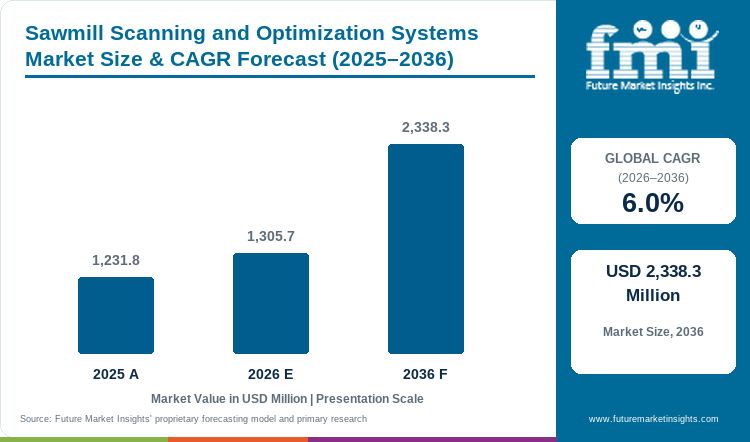
The sawmill scanning and optimization systems market was valued at USD 1,231.8 million in 2025, reaches USD 1,305.7 million in 2026, and is projected to reach USD 2,338.3 million by 2036 at 6.0% CAGR between 2026 and 2036.
Sales of sawmill scanning and optimization systems are estimated to rise at 6.0% CAGR through 2036. Mills are using scanners and optimization software to compare cut plans before logs enter primary breakdown systems. In April 2026, MiCROTEC reported that Norra Timber tested up to 35 sawing patterns for each log. Those comparisons are helping operators choose higher-value feasible patterns without stopping normal production. Buyers are asking suppliers to prove recovery gains at line speed and connect new scanners with existing controls and species settings. According to FMI analysis, this purchase pattern is expected to continue through the 2036 forecast period.
Germany is projected to expand at 6.1% CAGR through 2036, while USA demand is estimated to rise at 4.4%. German mills are adding scanners and controls to working sawlines while useful equipment remains in service during upgrades. US mills are more often modernizing one machine center during planned maintenance while surrounding equipment keeps operating. In June 2026, the Bureau of Labor Statistics reported sawmill and wood-preservation productivity rose 6.2% during 2025. Those conditions are making shutdown length, control fit, and local service important in staged industrial automation projects. German buyers are focusing on recovery from timber and compatibility with older controls. US buyers are placing more weight on labor productivity, maintenance windows, and service support through the 2036 forecast period.
Key Takeaways
- Mills are using scan-guided cut decisions to recover more lumber they can sell without slowing normal production.
- Log scanners are estimated at 24.0% of system type in 2026 as mills are using them before primary breakdown.
- Laser scanning is projected at 31.0% of technology revenue in 2026 as mills are measuring moving wood without contact.
- Modular upgrades are expected to let mills add scanning and optimization while useful sawline equipment remains in service.
- Older controls, species settings, and short shutdowns are making existing-line scanner setup slower and harder.
- A few notable suppliers include MiCROTEC, USNR, Comact, Carbotech, SPRINGER Maschinenfabrik, HewSaw (Veisto Oy), RemaSawco, and EWD.
Analyst Perspective
“Mill teams are expanding scanner use where trials are showing better recovery without longer shutdowns. Suppliers are preparing species-specific trials and local service because startup problems can erase gains from accurate scans.”
- Nikhil Kaitwade, Principal Consultant, Future Market Insights
How is the sawmill scanning and optimization systems market segmented?
The sawmill scanning and optimization systems market is segmented six ways: by system type, technology, application, end use, sales channel, and region. In 2026, log scanners are estimated at 24.0% of system type, laser scanning at 31.0% of technology, and softwood sawmills at 38.0% of end use.
The market uses six segment axes with region as the geographic split.
System type covers log scanners, board scanners, edger optimizers, trim optimizers, and full-mill optimization suites.
Technology covers laser scanning, X-ray scanning, 3D vision, AI defect detection, and moisture/density sensing.
Application covers primary breakdown, edging, trimming, grading, and yield optimization across the sawmill process.
End use covers softwood sawmills, hardwood sawmills, planer mills, plywood - LVL plants, and integrated forest products.
Sales channel covers direct technology suppliers, sawmill OEM integration, turnkey modernization, and service - software subscription.
What makes log scanners central to the system type category?
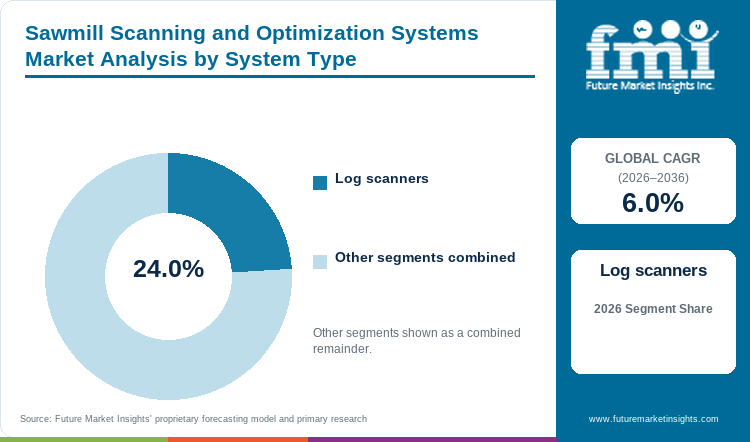
Log scanners are expected to hold 24.0% of system type revenue in 2026, supported by pre-cut rotation optimization.
Mills are using log scanners before the first cut to set the best rotation for each log. 3D laser scanners are mapping log shape without contact while material is moving through the line. In May 2026, MiCROTEC said Logeye Stereo scanned and optimized logs during positioning. That early information is helping operators protect later board options. Through 2036, log scanners are expected to remain central where mills are prioritizing recovery before primary breakdown.
- Based on system type, log scanners are projected to account for 24.0% in 2026, supported by rotation decisions before primary breakdown.
- Log scanners are expected to keep giving operators rotation data before the first saw cut removes other options.
How does laser scanning shape technology selection?
Laser scanning is estimated to represent 31.0% of technology revenue in 2026, reflecting non-contact measurement on moving wood.
Mills are using laser scanning to measure moving logs and boards without touching the material. Industrial machine vision is identifying visible defects through calibrated cameras and software. In April 2026, D&G Forest Products selected Logeye Stereo for 360-degree log reconstruction during transfer. Existing conveyors are allowing mills to add scanners without changing material flow. Through 2036, laser scanning is expected to remain favored where mills are prioritizing non-contact measurement during retrofits.
- By technology, laser scanning is estimated to hold 31.0% of technology revenue in 2026, reflecting non-contact measurement on moving wood.
- Laser systems are expected to keep capturing log and board shape on moving conveyors without adding another handling step.
Why does primary breakdown hold a significant application role?
Primary breakdown is projected to capture 24.0% of application demand in 2026, driven by irreversible first-cut decisions across sawlines.
Mills are concentrating scanning at primary breakdown because the first major cut can remove valuable board options. Machine vision cameras are helping teams compare log shape and position before that cut. In September 2025, Comact announced Smart Vision tools for Hood Industries' phased brownfield upgrade. The phased upgrade was designed to improve early cut decisions while useful equipment remained in service. Through 2036, primary breakdown is expected to remain a key optimization point where first-cut errors are costly.
- In 2026, primary breakdown is expected to account for 24.0% of application demand, reflecting the value of protecting later board options.
- Primary breakdown is expected to remain a higher-risk stage because first-cut errors can remove more later options.
What supports softwood sawmills within the end-use category?
Softwood sawmills are expected to hold 38.0% of end-use revenue in 2026, underpinned by high-speed standardized lumber runs.
Softwood mills are running standard lumber sizes at high speed, so small recovery gains are accumulating across long shifts. Optical sensors are helping maintain shape readings despite dust and vibration around moving wood. In March 2026, MiCROTEC announced BrasPine chose a full scanner package for its Oceano mill in Uruguay. Four Logeye units are linking decisions from the logyard with later mill stages. Through 2036, softwood sawmills are expected to keep favoring scanning systems that protect recovery at sustained line speed.
- Softwood sawmills are projected to capture 38.0% of end-use revenue in 2026, supported by recovery gains across high-speed lines.
- High-speed softwood lines are expected to keep magnifying small recovery gains across long production runs.
Why do direct technology suppliers hold the sales-channel position?
Direct technology suppliers are anticipated to command 39.0% of sales-channel revenue in 2026, reinforced by integrated startup support.
Direct technology suppliers are managing scanning, software, startup, and later tuning through one support path. Mills are training computer vision on local species and grades before relying on automated defect decisions. In July 2026, Comact signed an agreement to buy Checkmate and expand cutting services in New Zealand and Australia. Broader service coverage is helping mills resolve setup and tuning issues faster. Through 2036, direct technology suppliers are expected to retain an advantage where buyers are seeking one accountable integration and support route.
- Direct technology suppliers are expected to hold 39.0% of sales-channel revenue in 2026, reinforced by one integrated setup and tuning route.
- Direct suppliers are expected to keep giving mills one support path for sensing, software, startup, and later tuning.
What are the drivers, restraints and opportunities in the Sawmill Scanning and Optimization Systems Market?
The sawmill scanning and optimization systems market is supported by lumber-recovery investment, constrained by existing-line control integration, and opened by modular upgrades that avoid full sawline replacement.
- Driver: Mills will continue using scanners to recover more sellable lumber while maintaining line speed and grade consistency through 2036.
- Restraint: Unstable control links are expected to keep delaying orders because accurate scan data can trigger poor machine actions.
- Opportunity: Mills are expected to add modular scanners and software at one machine center without replacing the complete sawline.
Driver: Lumber recovery
Poor cut choices are reducing sellable lumber because each log offers limited chances for high-value boards. Mill teams are comparing recovered value with line speed before approving a new scanning system. In May 2026, Statistics Canada reported sawmills produced 3,430.4 thousand cubic meters of lumber during February. That production scale is making small recovery gains worth measuring across long runs. Vision sensors and control software are turning log measurements into saw actions by tracking each piece and confirming saw positions. Mills are approving systems that improve sellable output without slowing the line. Local trials are giving managers direct proof before they commit capital. As per FMI analysis, lumber recovery will continue to be a key investment test through 2036.
Restraint: Existing-line control integration
Older controls are creating problems during existing-line upgrades because accurate scan data can reach the wrong machine action. Engineers are matching scanner signals with log tracking and machine-control commands at each saw position. In February 2025, RemaSawco documented ATA Timber Rörvik upgrading log measurement with RS-LogScanner3D and RS-715 controls. The project connected new scanning hardware with the mill's existing systems and nearby service. Short shutdowns are limiting time for species tests and tracking checks. Clear interface maps are helping engineers find control conflicts before production restarts. Fast support is protecting lumber recovery while operators learn the upgraded control setup. Through 2036, this integration risk is expected to keep slowing approvals for upgrades with short shutdown windows.
Opportunity: Modular modernization
Mills are using modular upgrades to add automation without replacing the full sawline at once. Smaller mills are starting with one scanner or optimizer and adding software after results become clear. In January 2026, RemaSawco released RS-Opt 4.0.0 with adaptive rotation and expanded production monitoring. Mill teams are comparing yield and value before applying the same logic to another machine center. Staged projects are keeping useful machines in service and spreading capital across several shutdown windows. Condition monitoring is supporting later tuning after the core cut logic becomes stable. Suppliers that support staged commissioning can serve sites that cannot justify a full-line replacement. Growth projections through 2036 will favor modular projects that prove value before wider sawline replacement.
Which country CAGRs are included in the Sawmill Scanning and Optimization Systems Market?
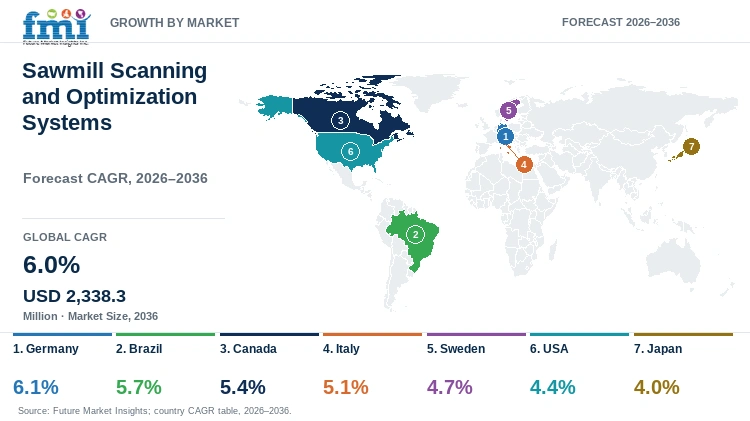
| Country | CAGR |
|---|---|
| Germany | 6.1% |
| Brazil | 5.7% |
| Canada | 5.4% |
| Italy | 5.1% |
| Sweden | 4.7% |
| USA | 4.4% |
| Japan | 4.0% |
How do country-level CAGRs compare in the Sawmill Scanning and Optimization Systems Market?
Country conditions are diverging because mills are starting with different equipment ages, plant sizes, and service access. Those differences are shaping how scanners fit current controls and planned shutdowns. In the FMI country outlook, these operating gaps are expected to keep influencing upgrade decisions through 2036.
- German mills are choosing upgrades that add scanners and controls without replacing useful equipment across current sawlines.
- Brazilian mills are spread across a wide forestry base, which is increasing the need for regional installation and service support.
- Canadian export mills are relying on stable grades and remote service because many sites sit far from service teams.
- Italian plants are choosing phased scanner upgrades that fit smaller layouts and shorten mill shutdowns during installation.
- Swedish mills are using mature automation and are demanding clear yield gains before replacing systems that remain useful.
- Across the USA, mills are adding scanners during machine-center upgrades, making control fit and service access central to approval.
- Japanese mills are choosing compact systems and local service for smaller sites with varied layouts and machine ages.
Mill size, control age, and service access are shaping buying conditions across countries. The full report covers more than 20 countries across North America, Latin America, Western Europe, and Eastern Europe. It also covers East Asia, South Asia and Pacific, the Middle East, and Africa.
Country-wise Analysis
- Germany is projected to grow at 6.1% CAGR through 2036. National wood-use goals are keeping attention on recovery from each log and upgrades to existing sawlines. In April 2026, Destatis reported Germany logged 57.3 million cubic meters of timber during 2025. The agency said timber volume was 6.4% lower than in 2024. Less available timber is making recovery gains more important on lines that mills already own. Older controls are making scanner connections harder during an upgrade. German engineers are using interface maps to plan each connection around scheduled mill stops. Species trials are showing whether new scan settings work with current machines. Local service is helping mills restart production faster once upgraded scanners enter regular use.
- Brazil is estimated to post 5.7% CAGR through 2036 in the current forecast. A wide forestry base is creating service needs across mills that rely on imported equipment. In August 2025, Brazil's federal planning report estimated planted forests at about 10 million hectares. Mills across this resource base are operating far from major technical service hubs in many areas. Currency changes are adding purchase risk for imported equipment even when yield gains look attractive. Regional training is giving mill teams more control over startup and later tuning. Remote diagnostics are helping engineers solve smaller faults without waiting for a site visit. Stocked spare parts are reducing longer stops at mills far from major service centers.
- Canada's sawmill scanning outlook is anticipated to advance at 5.4% CAGR through 2036. Export-focused softwood mills are relying on stable grade recovery across plants that can be far from service teams. In February 2026, Natural Resources Canada reported that 76% of forest-product exports went to the United States. Export dependence is keeping grade consistency important across changing production schedules. Machine vision is helping mills check shape and grade through current saw controls. Remote sites are facing longer response times and higher spare-parts risk during equipment faults. Regional field teams are providing the first support layer between planned site visits. Buyers are valuing systems that remain stable without constant specialist attention.
- Italy is projected to record 5.1% CAGR through 2036 in the current forecast. Smaller plant layouts are making phased scanner upgrades more practical because they fit limited space and shorter shutdowns. In January 2026, Italy's agriculture ministry opened timber-operator registration and required reporting of 2025 wood-product quantities. The registry is adding record work while yield control remains important for mill operations. Smaller plants are operating with fewer engineers available for scanner setup and control tuning. A staged startup is helping operators learn one control change before engineers modify the next machine center. Phased projects are adding automation without stopping the complete line for long periods. Nearby technical support is reducing later tuning work for small engineering teams.
- Sweden's sawmill scanning demand is predicted to advance at 4.7% CAGR through 2036. Mature automation is making mills compare new scanners with controls that already work reliably. In June 2026, the Swedish Forest Agency reported gross felling reached 87.0 million cubic meters during 2025. The agency said the annual volume fell for a fourth straight year. Lower log supply is increasing the value of recovering more lumber from each log. Swedish mills are asking for clear grade and line-speed gains before retiring useful equipment. Trials are testing whether new scanners work with current controls and species settings. Service plans are protecting output during changeover and helping mills recover faster from early faults.
- The USA is estimated to post 4.4% CAGR through 2036. Many mills are upgrading one machine center at a time because full-line shutdowns are expensive. In June 2026, the U.S. Bureau of Labor Statistics reported 94,000 jobs in sawmills and wood preservation during 2025. That operating base is creating varied control layouts and service needs. Engineers are using local trials to connect scan accuracy with lumber recovery on each species mix. Older controls are complicating scanner links during short shutdowns. Regional service teams are fixing early faults without waiting for distant specialists. Buyers are favoring projects that improve yield while the rest of the line keeps running. Clear startup plans are reducing production risk as staged upgrades continue through 2036.
- Japan's sawmill scanning outlook is anticipated to advance at 4.0% CAGR through 2036. Smaller mill layouts are making compact systems practical because they avoid major building work. In June 2026, MAFF published 2025 wood statistics covering sawmill counts and national log intake. The data is giving suppliers a current view of mill size and log flow. Local species settings remain important because cut software must match the wood entering each line. Stable production data is supporting AI-based maintenance after control links are working reliably. Short shutdown windows are favoring compact upgrades over much larger rebuilds. Local training is helping operators learn new scanner settings without extending startup. Nearby parts support is reducing downtime during early commercial use.
Who are the notable companies in the Sawmill Scanning and Optimization Systems Market?
A few notable companies among many active players include MiCROTEC, USNR, Comact, Carbotech, SPRINGER Maschinenfabrik, HewSaw (Veisto Oy), RemaSawco, and EWD.
The FMI report covers a wider supplier base than the companies named above. Full-line suppliers are connecting machines, scanners, controls, and startup support across several production stages. Specialists are concentrating on measurement, grading, or cut planning at fewer machine centers. Broad platforms can reduce the number of interfaces engineers must validate. Specialist tools can improve one decision point without forcing a wider replacement. Both routes are requiring tuning for local species, tracking signals, and existing controls before regular production starts. Service coverage is becoming important because early setup faults can erase recovery gains during initial production. That support will remain important as staged upgrades continue through 2036.
- USNR, Comact, Carbotech, SPRINGER Maschinenfabrik, HewSaw (Veisto Oy), EWD, MiCROTEC, and RemaSawco serve primary breakdown. Public records across the group show machines, scanners, and cut software used for first-cut control.
- MiCROTEC and RemaSawco are connecting scanning and grading data with cut planning across several mill stages.
- HewSaw (Veisto Oy) is combining primary-breakdown machines with optimized sawing methods and ongoing service for mill teams.
Competitive Benchmarking: Sawmill Scanning and Optimization Systems Market
| Company | Integration Breadth | Defect Intelligence | Retrofit and Lifecycle Support | Geographic Reach |
|---|---|---|---|---|
| MiCROTEC | High | High | High | Global |
| USNR | High | High | High | North America, Europe, global mills |
| Comact | High | High | High | North America, Oceania, global projects |
| Carbotech | High | Medium | High | North America and South America |
| SPRINGER Maschinenfabrik | Medium | Medium | High | Europe and global projects |
| HewSaw (Veisto Oy) | High | Low | High | Europe, North America, global installations |
| RemaSawco | High | High | High | Nordics, Europe, selected global projects |
| EWD | High | Medium | High | Europe and global sawmill projects |
High marks show broad public evidence for the capability measured in each company row. Medium marks show credible evidence across a narrower set of functions. Low marks show a documented limit in that capability rather than poor overall company quality. Integration breadth measures how many scanning and sawline stages one supplier connects. Defect intelligence covers public proof of X-ray, AI, or multi-sensor inspection. Retrofit and lifecycle support covers installation, startup tuning, upgrades, and later technical service. Geographic reach lists documented operating regions and is not a performance score.
Key Developments in the Sawmill Scanning and Optimization Systems Market
- In September 2026, Comact launched Comact Cutting Solutions to bring several cutting brands under one group. The launch gave sawmill customers one service route for cutting products across several regions.
- In August 2026, MiCROTEC announced a Logeye order from Hyne Timber's Tuan Mill in Australia. The ordered system uses X-ray data to measure wood density and support log quality decisions before cutting.
- In January 2025, RemaSawco released RS-BoardScannerQ version 11.0.0 with new grading and cut-planning tools. The update added rough-lumber checks, US sorting rules, dashboards, and mill decision tools.
Key Players in the Sawmill Scanning and Optimization Systems Market
Integrated sawmill and automation platforms
- USNR
- Comact
- Carbotech
- SPRINGER Maschinenfabrik
- EWD
Scanning and optimization intelligence
- MiCROTEC
- RemaSawco
Sawline optimization specialist
- HewSaw (Veisto Oy)
Sawmill Scanning and Optimization Systems Market - Report Scope
| Coverage field | Report scope |
|---|---|
| Market breakdown | By system type, technology, application, end use, sales channel, and region. |
| Quantitative Units | USD million. |
| Market Definition | Revenue from sawmill scanning hardware, optimization and control software, installation, integration, commissioning, and directly associated support is included. Downstream lumber revenue and unrelated machinery are excluded. |
| Regions Covered | North America, Latin America, Western Europe, Eastern Europe, East Asia, South Asia and Pacific, and Middle East and Africa. |
| Countries Covered | Germany, Brazil, Canada, Italy, Sweden, USA, Japan, and 20+ countries included in the full report. |
| Key Companies Profiled | MiCROTEC, USNR, Comact, Carbotech, SPRINGER Maschinenfabrik, HewSaw (Veisto Oy), RemaSawco, and EWD. |
| Forecast Period | 2026 to 2036. |
| Approach | Primary and secondary research with market triangulation. |
Sawmill Scanning and Optimization Systems Market - Research Methodology
| Method | Approach |
|---|---|
| Primary Research | FMI analysts gathered input from manufacturers, service providers, technology developers, distributors, end users, procurement teams, and subject-matter experts. Interviews examined purchasing decisions, product or service evaluation, adoption barriers, approval requirements, pricing considerations, and expectations for technical or commercial support. Respondents were also asked what evidence is required before a trial, pilot, or initial order develops into regular purchasing. |
| Desk Research | Desk research covered government statistics, regulatory publications, trade data, industry associations, technical literature, standards, company filings, product information, and official corporate announcements. Sources were reviewed for relevance, publication date, geographic coverage, and consistency with the defined market scope. Claims relating to performance, applications, approvals, capacity, investment, and commercial activity were retained only when supported by credible public evidence. |
| Market Sizing and Forecasting | The market model combined the baseline value with historical performance, segment structure, pricing and volume indicators, adoption levels, company participation, and country-level demand conditions. Forecast assumptions considered economic activity, investment trends, regulatory developments, technology adoption, purchasing cycles, supply availability, and barriers to wider market use. Segment and regional estimates were reconciled before the final market total was calculated. |
| Data Validation | Estimates were checked against multiple independent indicators, including public data, company activity, trade patterns, industry developments, and findings from primary interviews. Validation also tested whether products, services, applications, and company revenues fell within the defined market boundaries. Adjacent categories, unsupported claims, overlapping revenues, and activities without direct market relevance were excluded to reduce double counting and maintain consistency across segments and countries. |
Sawmill Scanning and Optimization Systems Market by Segments
Sawmill Scanning and Optimization Systems Market segmented by System Type:
- Log scanners
- Board scanners
- Edger optimizers
- Trim optimizers
- Full-mill optimization suites
Sawmill Scanning and Optimization Systems Market segmented by Technology:
- Laser scanning
- X-ray scanning
- 3D vision
- AI defect detection
- Moisture/density sensing
Sawmill Scanning and Optimization Systems Market segmented by Application:
- Primary breakdown
- Edging
- Trimming
- Grading
- Yield optimization
Sawmill Scanning and Optimization Systems Market segmented by End Use:
- Softwood sawmills
- Hardwood sawmills
- Planer mills
- Plywood - LVL plants
- Integrated forest products
Sawmill Scanning and Optimization Systems Market segmented by Sales Channel:
- Direct technology suppliers
- Sawmill OEM integration
- Turnkey modernization
- Service - software subscription
Sawmill Scanning and Optimization Systems Market by Region:
- North America
- United States
- Canada
- Latin America
- Brazil
- Mexico
- Chile
- Rest of Latin America
- Western Europe
- Germany
- United Kingdom
- Italy
- Spain
- France
- Nordics
- Benelux
- Rest of Western Europe
- Eastern Europe
- Russia
- Poland
- Hungary
- Balkan and Baltic States
- Rest of Eastern Europe
- East Asia
- China
- Japan
- South Korea
- South Asia and Pacific
- India
- ASEAN
- Australia and New Zealand
- Rest of South Asia and Pacific
- Middle East and Africa
- Kingdom of Saudi Arabia
- Other GCC Countries
- Türkiye
- South Africa
- Other African Union Countries
- Rest of Middle East and Africa
Research Sources and Bibliography
- MiCROTEC. (2026, April 9). With CT, X-ray and AI, sawmills can see inside the wood - and control how it is sawn.
- Federal Ministry of Food and Agriculture, Germany. (2025, May 12). Klimaschutz durch nachhaltige Holzverwendung: Charta für Holz 2.0.
- MiCROTEC. (2026, May 13). Seeing the Whole Log, Before the First Cut.
- MiCROTEC. (2026, April 15). D&G Forest Products to Install First MiCROTEC Logeye Stereo in Quebec.
- USNR. (2026, September 1). McDowell Lumber purchases new end dogging carriage.
- MiCROTEC. (2026, March 25). BrasPine chooses MiCROTEC as complete scanner supplier for greenfield project.
- Carbotech. (2026, April 28). Carbotech Strengthens Its Presence in South America Through Partnership with Manufacturer’s Agent Innovación Nórdica.
- Natural Resources Canada. (2026, February 5). The State of Canada’s Forests: Annual Report 2025. https://natural-resources.canada.ca/forests-forestry/state-canada-forests/state-canada-s-forests-annual-report-2025
- Comact. (2026). Optimization courses - 2026.
- RemaSawco. (2026, January 27). Nu releasar vi RS-Opt 4.0.0, ännu smartare optimering för maximalt värde!.
- U.S. Census Bureau. (2026, February 26). All Sectors: Summary Statistics for Industry Groups and Industries for Employer Firms in the U.S. and Selected Geographies.
- Federal Statistical Office of Germany (Destatis). (2026, April 15). 57.3 million cubic metres of timber logged in 2025.
- Brazilian Institute of Geography and Statistics (IBGE). (2025, September 25). Production value of silviculture and wild-crop harvesting grows 16.7% and production occurs in 4,921 municipalities.
- Ministry of Agriculture, Food and Forestry, Italy. (2026, January 16). Regolamento EUTR: 2026 Registro Imprese Legno registration notice.
- Swedish Forest Agency. (2026, June 9). Felling continued to decrease in 2025. https://www.skogsstyrelsen.se/en/news/felling-continued-to-decrease-in-2025/
- Ministry of Agriculture, Forestry and Fisheries, Japan. (2026, June 12). Wood Statistics Survey: 2025 annual results.
- SPRINGER Maschinenfabrik. (2026, September 3). From the trade fair straight into practice: live SAWBOX tour at Cimenti.
- MiCROTEC. (2026, August 20). MiCROTEC’s First Australian Logeye for Quality Scanning.
- USNR. (2026). Millwide Insider 2026.
- Comact. (2026, September 16). Comact unites cutting expertise through a portfolio of established brands.
- HewSaw - Veisto Oy. (2025, February 26). HewSaw’s Patented dx Sawing™ Technology Provides Benefits to Sawmillers Worldwide.
- EWD - Esterer WD GmbH. (2026, September). EWD Open Days 2026 and current sawmill technology demonstrations.
- MiCROTEC. (2026, July 7). A Redesigned Generation of Transverse Lumber Scanning for North America.
- Comact. (2025, September 4). Hood Industries Partners with Comact to Upgrade Waynesboro, MS Facility.
- Comact. (2026, July 29). COMACT TO ACQUIRE CHECKMATE PRECISION CUTTING TOOLS.
- Statistics Canada. (2026, May 6). Sawmills, February 2026.
- RemaSawco. (2025, February 26). Kundcase: ATA Timber Rörvik.
- RemaSawco. (2025, January 7). RS-BoardScannerQ - Ny release - 11.0.0.
- Comact. (2025, December 9). Niagara Sawmilling Company Selects Comact for Major Modernization Project in Invercargill, New Zealand.
- Comact. (2026, May 4). Comact Launches New Generation Miller Planer.
- RemaSawco. (2025, May 21). Westas.
- Comact. (2026, April 7). COMACT COMPLETES ACQUISITION OF OLESON SAW TECHNOLOGY.
- RemaSawco. (2025, December 12). Wallnäs Timber väljer RemaSawco för att framtidssäkra sitt sågverk.
- U.S. Bureau of Labor Statistics. (2026, June 24). Productivity and Costs by Industry: Manufacturing and Mining Industries - 2025. https://www.bls.gov/news.release/prin.nr0.htm
- Ministry of Planning and Budget, Brazil. (2025, August 11). Relatório de Monitoramento Anual do Plano Plurianual 2025: Ano-base 2024 - Volume 7.
- USNR. (2025, April). BioLuma 6000 series sensors.
- MiCROTEC. (2026, May 28). Logeye receives Type Approval for Top-Break detection.
This bibliography gives readers the main public sources used in the article. The full report contains additional public references and more detailed source citations.
This Report Answers
- How large is the market?
- Why do mills invest?
- Why do log scanners lead?
- How does laser scanning affect retrofits?
- Why is primary breakdown critical?
- What slows upgrades on existing sawmill lines?
- How do country growth rates differ?
- Which companies offer full-line or specialist systems?
Frequently Asked Questions
How big is the Sawmill Scanning and Optimization Systems Market in 2026?
The Sawmill Scanning and Optimization Systems Market is valued at USD 1,305.7 million in 2026. It is projected to reach USD 2,338.3 million by 2036.
What is the CAGR of the Sawmill Scanning and Optimization Systems Market from 2026 to 2036?
The Sawmill Scanning and Optimization Systems Market is expected to grow at 6.0% CAGR from 2026 through 2036. Mills use automation to recover more sellable lumber from current lines.
Which system type leads the Sawmill Scanning and Optimization Systems Market in 2026?
Log scanners are estimated to hold 24.0% of system type in 2026. Mills are using them before primary breakdown to set log rotation.
Which technology leads the Sawmill Scanning and Optimization Systems Market in 2026?
Laser scanning is estimated to hold 31.0% of technology revenue in 2026. Mills are using it to measure moving wood without adding material contact.
Which companies are active in the Sawmill Scanning and Optimization Systems Market?
The Sawmill Scanning and Optimization Systems Market includes notable companies such as MiCROTEC, USNR, Comact, Carbotech, SPRINGER Maschinenfabrik, HewSaw (Veisto Oy), RemaSawco, and EWD. Their roles differ across scanning, machine integration, cut software, and lifecycle service.
Preview the report firsthand - request a free sample
Get SampleGet the brochure for pricing and purchase details.
Get PDFTable of Content
- Key Takeaways
- Market Size and CAGR
- Top Growth Driver
- Fastest Growing Segment
- Leading Region
- Key Companies
- Emerging Opportunities
- Executive Summary
- Global Market Outlook
- Demand-side Trends
- Supply-side Trends
- Technology Roadmap Analysis
- Analysis and Recommendations
- Analyst Perspective (What is happening? Why now? What should investors know?)
- Key Questions Answered
- How large is the market?
- What is the CAGR?
- What are key trends?
- Which region dominates?
- Who are the leaders?
- Market Overview
- Market Coverage / Taxonomy
- Market Definition / Scope / Limitations
- Research Methodology
- Chapter Orientation
- Analytical Lens and Working Hypotheses
- Market Structure, Signals, and Trend Drivers
- Benchmarking and Cross-market Comparability
- Market Sizing, Forecasting, and Opportunity Mapping
- Research Design and Evidence Framework
- Desk Research Programme (Secondary Evidence)
- Expert Input and Fieldwork (Primary Evidence)
- Tooling, Models, and Reference Databases
- Data Engineering and Model Build
- Quality Assurance and Audit Trail
- Market Background
- Market Dynamics (Drivers, Restraints, Opportunity, Trends)
- Scenario Forecast (Optimistic, Likely, Conservative)
- Impact Analysis
- AI Impact
- Sustainability Impact
- Regulatory Impact
- Technology Impact
- Consumer / Buyer Analysis
- Purchase Drivers
- Adoption Barriers
- Buyer Journey
- Opportunity Map Analysis
- Product Life Cycle Analysis
- Supply Chain Analysis
- Investment Feasibility Matrix
- Value Chain Analysis
- PESTLE and Porter's Analysis
- Regulatory Landscape
- Regional Parent Market Outlook
- Production and Consumption Statistics
- Import and Export Statistics
- Global Market Analysis and Forecast, 2021 to 2036
- Historical Market Size Value (USD Million) Analysis, 2021 to 2025
- Current and Future Market Size Value (USD Million) Projections, 2026 to 2036
- Y-o-Y Growth Trend Analysis
- Absolute $ Opportunity Analysis
- Global Market Pricing Analysis, 2021 to 2036
- Global Market Analysis and Forecast, By System Type, 2021 to 2036
- Introduction / Key Findings
- Historical Market Size Value (USD Million) Analysis By System Type, 2021 to 2025
- Current and Future Market Size Value (USD Million) Analysis and Forecast By System Type, 2026 to 2036
- Log scanners
- Board scanners
- Edger optimizers
- Trim optimizers
- Full-mill optimization suites
- Y-o-Y Growth Trend Analysis By System Type, 2021 to 2025
- Absolute $ Opportunity Analysis By System Type, 2026 to 2036
- Global Market Analysis and Forecast, By Technology, 2021 to 2036
- Introduction / Key Findings
- Historical Market Size Value (USD Million) Analysis By Technology, 2021 to 2025
- Current and Future Market Size Value (USD Million) Analysis and Forecast By Technology, 2026 to 2036
- Laser scanning
- X-ray scanning
- 3D vision
- AI defect detection
- Moisture/density sensing
- Y-o-Y Growth Trend Analysis By Technology, 2021 to 2025
- Absolute $ Opportunity Analysis By Technology, 2026 to 2036
- Global Market Analysis and Forecast, By Application, 2021 to 2036
- Introduction / Key Findings
- Historical Market Size Value (USD Million) Analysis By Application, 2021 to 2025
- Current and Future Market Size Value (USD Million) Analysis and Forecast By Application, 2026 to 2036
- Primary breakdown
- Edging
- Trimming
- Grading
- Yield optimization
- Y-o-Y Growth Trend Analysis By Application, 2021 to 2025
- Absolute $ Opportunity Analysis By Application, 2026 to 2036
- Global Market Analysis and Forecast, By End Use, 2021 to 2036
- Introduction / Key Findings
- Historical Market Size Value (USD Million) Analysis By End Use, 2021 to 2025
- Current and Future Market Size Value (USD Million) Analysis and Forecast By End Use, 2026 to 2036
- Softwood sawmills
- Hardwood sawmills
- Planer mills
- Plywood - LVL plants
- Integrated forest products
- Y-o-Y Growth Trend Analysis By End Use, 2021 to 2025
- Absolute $ Opportunity Analysis By End Use, 2026 to 2036
- Global Market Analysis and Forecast, By Sales Channel, 2021 to 2036
- Introduction / Key Findings
- Historical Market Size Value (USD Million) Analysis By Sales Channel, 2021 to 2025
- Current and Future Market Size Value (USD Million) Analysis and Forecast By Sales Channel, 2026 to 2036
- Direct technology suppliers
- Sawmill OEM integration
- Turnkey modernization
- Service - software subscription
- Y-o-Y Growth Trend Analysis By Sales Channel, 2021 to 2025
- Absolute $ Opportunity Analysis By Sales Channel, 2026 to 2036
- Global Market Analysis and Forecast, By Region, 2021 to 2036
- Introduction
- Historical Market Size Value (USD Million) Analysis By Region, 2021 to 2025
- Current Market Size Value (USD Million) Analysis and Forecast By Region, 2026 to 2036
- North America
- Latin America
- Western Europe
- Eastern Europe
- East Asia
- South Asia and Pacific
- Middle East and Africa
- Market Attractiveness Analysis By Region
- North America Market Analysis and Forecast, By Country, 2021 to 2036
- Historical Market Size Value (USD Million) Trend Analysis By Market Taxonomy, 2021 to 2025
- Market Size Value (USD Million) Forecast By Market Taxonomy, 2026 to 2036
- By Country
- United States
- Canada
- By System Type
- By Technology
- By Application
- By End Use
- By Sales Channel
- By Country
- Market Attractiveness Analysis
- By Country
- By System Type
- By Technology
- By Application
- By End Use
- By Sales Channel
- Key Takeaways
- Latin America Market Analysis and Forecast, By Country
- Historical Market Size Value (USD Million) Trend Analysis By Market Taxonomy, 2021 to 2025
- Market Size Value (USD Million) Forecast By Market Taxonomy, 2026 to 2036
- By Country
- Brazil
- Mexico
- Chile
- Rest of Latin America
- By System Type
- By Technology
- By Application
- By End Use
- By Sales Channel
- By Country
- Market Attractiveness Analysis
- By Country
- By System Type
- By Technology
- By Application
- By End Use
- By Sales Channel
- Key Takeaways
- Western Europe Market Analysis and Forecast, By Country
- Historical Market Size Value (USD Million) Trend Analysis By Market Taxonomy, 2021 to 2025
- Market Size Value (USD Million) Forecast By Market Taxonomy, 2026 to 2036
- By Country
- Germany
- United Kingdom
- Italy
- Spain
- France
- Nordics
- Benelux
- Rest of Western Europe
- By System Type
- By Technology
- By Application
- By End Use
- By Sales Channel
- By Country
- Market Attractiveness Analysis
- By Country
- By System Type
- By Technology
- By Application
- By End Use
- By Sales Channel
- Key Takeaways
- Eastern Europe Market Analysis and Forecast, By Country
- Historical Market Size Value (USD Million) Trend Analysis By Market Taxonomy, 2021 to 2025
- Market Size Value (USD Million) Forecast By Market Taxonomy, 2026 to 2036
- By Country
- Russia
- Poland
- Hungary
- Balkan and Baltic States
- Rest of Eastern Europe
- By System Type
- By Technology
- By Application
- By End Use
- By Sales Channel
- By Country
- Market Attractiveness Analysis
- By Country
- By System Type
- By Technology
- By Application
- By End Use
- By Sales Channel
- Key Takeaways
- East Asia Market Analysis and Forecast, By Country
- Historical Market Size Value (USD Million) Trend Analysis By Market Taxonomy, 2021 to 2025
- Market Size Value (USD Million) Forecast By Market Taxonomy, 2026 to 2036
- By Country
- China
- Japan
- South Korea
- By System Type
- By Technology
- By Application
- By End Use
- By Sales Channel
- By Country
- Market Attractiveness Analysis
- By Country
- By System Type
- By Technology
- By Application
- By End Use
- By Sales Channel
- Key Takeaways
- South Asia and Pacific Market Analysis and Forecast, By Country
- Historical Market Size Value (USD Million) Trend Analysis By Market Taxonomy, 2021 to 2025
- Market Size Value (USD Million) Forecast By Market Taxonomy, 2026 to 2036
- By Country
- India
- ASEAN
- Australia and New Zealand
- Rest of South Asia and Pacific
- By System Type
- By Technology
- By Application
- By End Use
- By Sales Channel
- By Country
- Market Attractiveness Analysis
- By Country
- By System Type
- By Technology
- By Application
- By End Use
- By Sales Channel
- Key Takeaways
- Middle East and Africa Market Analysis and Forecast, By Country
- Historical Market Size Value (USD Million) Trend Analysis By Market Taxonomy, 2021 to 2025
- Market Size Value (USD Million) Forecast By Market Taxonomy, 2026 to 2036
- By Country
- Kingdom of Saudi Arabia
- Other GCC Countries
- Türkiye
- South Africa
- Other African Union Countries
- Rest of Middle East and Africa
- By System Type
- By Technology
- By Application
- By End Use
- By Sales Channel
- By Country
- Market Attractiveness Analysis
- By Country
- By System Type
- By Technology
- By Application
- By End Use
- By Sales Channel
- Key Takeaways
- Key Countries Market Analysis
- United States
- Pricing Analysis
- Market Share Analysis, 2025
- By System Type
- By Technology
- By Application
- By End Use
- By Sales Channel
- Canada
- Pricing Analysis
- Market Share Analysis, 2025
- By System Type
- By Technology
- By Application
- By End Use
- By Sales Channel
- Mexico
- Pricing Analysis
- Market Share Analysis, 2025
- By System Type
- By Technology
- By Application
- By End Use
- By Sales Channel
- Brazil
- Pricing Analysis
- Market Share Analysis, 2025
- By System Type
- By Technology
- By Application
- By End Use
- By Sales Channel
- Chile
- Pricing Analysis
- Market Share Analysis, 2025
- By System Type
- By Technology
- By Application
- By End Use
- By Sales Channel
- Germany
- Pricing Analysis
- Market Share Analysis, 2025
- By System Type
- By Technology
- By Application
- By End Use
- By Sales Channel
- United Kingdom
- Pricing Analysis
- Market Share Analysis, 2025
- By System Type
- By Technology
- By Application
- By End Use
- By Sales Channel
- Italy
- Pricing Analysis
- Market Share Analysis, 2025
- By System Type
- By Technology
- By Application
- By End Use
- By Sales Channel
- Spain
- Pricing Analysis
- Market Share Analysis, 2025
- By System Type
- By Technology
- By Application
- By End Use
- By Sales Channel
- France
- Pricing Analysis
- Market Share Analysis, 2025
- By System Type
- By Technology
- By Application
- By End Use
- By Sales Channel
- India
- Pricing Analysis
- Market Share Analysis, 2025
- By System Type
- By Technology
- By Application
- By End Use
- By Sales Channel
- ASEAN
- Pricing Analysis
- Market Share Analysis, 2025
- By System Type
- By Technology
- By Application
- By End Use
- By Sales Channel
- Australia and New Zealand
- Pricing Analysis
- Market Share Analysis, 2025
- By System Type
- By Technology
- By Application
- By End Use
- By Sales Channel
- China
- Pricing Analysis
- Market Share Analysis, 2025
- By System Type
- By Technology
- By Application
- By End Use
- By Sales Channel
- Japan
- Pricing Analysis
- Market Share Analysis, 2025
- By System Type
- By Technology
- By Application
- By End Use
- By Sales Channel
- South Korea
- Pricing Analysis
- Market Share Analysis, 2025
- By System Type
- By Technology
- By Application
- By End Use
- By Sales Channel
- Russia
- Pricing Analysis
- Market Share Analysis, 2025
- By System Type
- By Technology
- By Application
- By End Use
- By Sales Channel
- Poland
- Pricing Analysis
- Market Share Analysis, 2025
- By System Type
- By Technology
- By Application
- By End Use
- By Sales Channel
- Hungary
- Pricing Analysis
- Market Share Analysis, 2025
- By System Type
- By Technology
- By Application
- By End Use
- By Sales Channel
- Kingdom of Saudi Arabia
- Pricing Analysis
- Market Share Analysis, 2025
- By System Type
- By Technology
- By Application
- By End Use
- By Sales Channel
- Türkiye
- Pricing Analysis
- Market Share Analysis, 2025
- By System Type
- By Technology
- By Application
- By End Use
- By Sales Channel
- South Africa
- Pricing Analysis
- Market Share Analysis, 2025
- By System Type
- By Technology
- By Application
- By End Use
- By Sales Channel
- Sweden
- Pricing Analysis
- Market Share Analysis, 2025
- By System Type
- By Technology
- By Application
- By End Use
- By Sales Channel
- United States
- Market Structure Analysis
- Competition Dashboard
- Competition Benchmarking
- Market Share Analysis of Top Players
- By Regional
- By System Type
- By Technology
- By Application
- By End Use
- By Sales Channel
- Emerging Startups
- Innovation Benchmarking
- Competition Analysis
- Competition Deep Dive
- MiCROTEC
- Overview
- Product Portfolio
- Profitability by Market Segments
- Sales Footprint
- Strategy Overview
- Marketing Strategy
- Product Strategy
- Channel Strategy
- USNR
- Comact
- Carbotech
- SPRINGER Maschinenfabrik
- HewSaw (Veisto Oy)
- RemaSawco
- EWD
- MiCROTEC
- Case Studies
- Success Stories
- Recent Developments
- Competition Deep Dive
- Assumptions & Acronyms Used


