

- Market Size (2026)
- USD 1.9 Bn
- Forecast (2036)
- USD 3.0 Bn
- CAGR (2026 to 2036)
- 4.7%
How big is Sawmill Headrig Systems Market in 2026?
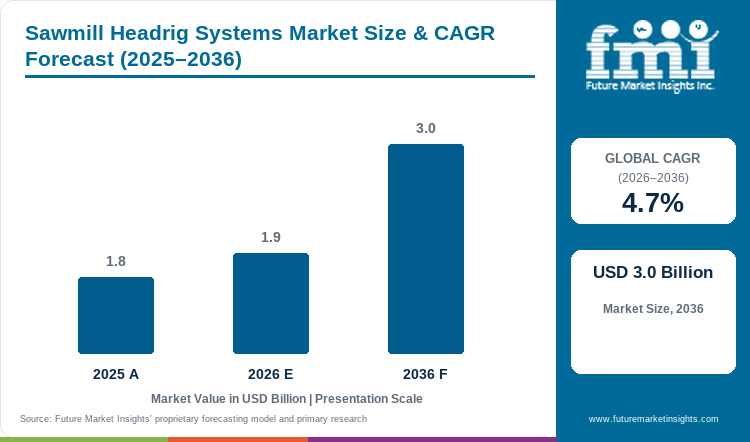
USD 1.9 billion in 2026 and USD 3.0 billion by 2036, expanding at 4.7% CAGR.
Sales of sawmill headrig systems are estimated to rise at 4.7% CAGR through 2036, increasing valuation from USD 1.8 billion in 2025 to USD 1.9 billion in 2026, and reaching USD 3.0 billion by 2036. Mill managers usually judge a headrig by the lumber they can recover from each log. Primary breakdown makes the first cut that sets saleable output. USNR documented a 2026 end-dogging carriage installation at McDowell Lumber with built-in optimization. The project links better log position with usable output.
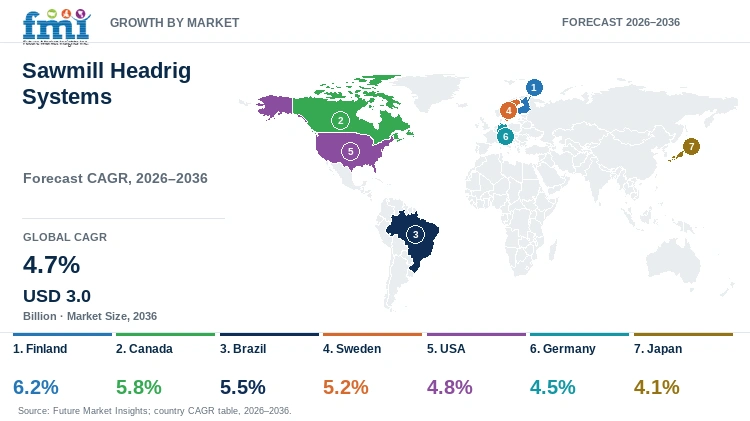
Mills in each country approve spending against local log flow and service support. Finland is projected at 6.2% CAGR, while Japan is projected at 4.1%. The Natural Resources Institute Finland reported in April 2026 that sawmills used 27.2 million m³ of roundwood in 2025. High log flow lets mills spread small recovery gains over more output. Many Japanese mills operate on smaller sites, so compact retrofits can reduce shutdown time.
Key Takeaways
- Mill operators replace first-cut machines when better log position raises lumber yield without slowing the line.
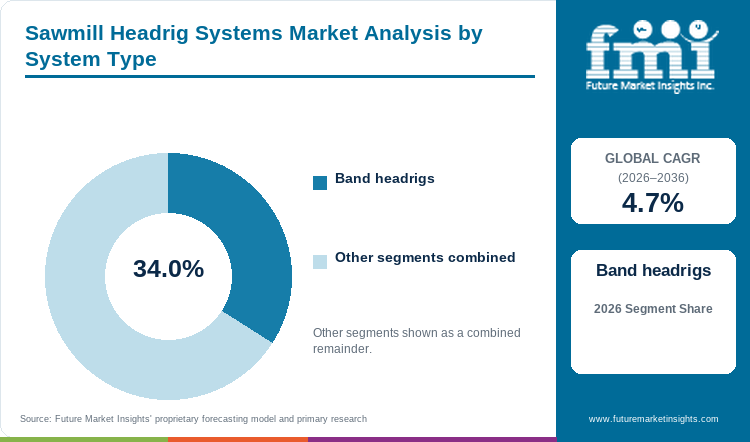
- By system type, band headrigs are estimated to hold 34.0% in 2026, supported by flexible log turning and thin-kerf cutting.
- In 2026, medium logs are expected to lead log size with 39.0% share, supported by their use across common industrial headrig sizes.
- Optimized scanning is projected to hold 36.0% of automation revenue in 2026, driven by measured log shape and repeatable cut plans.
- Civil work and control changes can extend a shutdown and delay an otherwise sound replacement project.
- Some of the key players in this market include USNR, Comact, LINCK Holzverarbeitungstechnik GmbH, Esterer WD GmbH (EWD), McDonough Manufacturing, Salem Equipment, Inc., Valon Kone Oy, Nicholson Manufacturing Ltd., Pendu Manufacturing, and MiCROTEC.
Analyst Perspective
"Headrig economics depend on the lumber value recovered from the mill’s own logs. A brochure feed rate cannot show that value by itself. Strong bids also define who handles each interface and how commissioning will work before the shutdown is approved."
- Nikhil Kaitwade, Principal Consultant, Future Market Insights
How is the sawmill headrig systems market segmented?
The sawmill headrig systems market is segmented by System Type, Log Size, Automation, End Use, and Sales Channel.
The sawmill headrig systems market is segmented by system type, log size, automation, end use and sales channel. System type covers band, circular, chip-n-saw, twin-band and optimized carriage headrigs. Log size covers medium, small, large and mixed diameters. Automation ranges from manual carriage systems to fully automated lines. End use separates four sawmill types. Sales channel covers OEM, turnkey, modernization and dealer-service routes.
How do band headrigs shape selection within the system type category?
Band headrigs let mills turn uneven logs before the first cut. The design helps operators line up sweep with the cut plan. Modern bandsaw machines also keep kerf easy to count in the yield model. Salem Equipment lists current headrig bandmills in its primary sawmill systems. The offering confirms that this design remains part of modern mill layouts.
- Based on system type, band headrigs are projected to account for 34.0% in 2026, supported by flexible opening-face choices and thin-kerf cutting.
- Mills test blade control and carriage speed because poor alignment or filing can reduce lumber yield during a shift.
Why do medium logs lead the log size category?
Medium logs work with several band and circular layouts without the heavy handling needed for very large timber. LINCK lists a 2026 Holzindustrie Schwaiger project for smaller-diameter logs inside an existing building. The project shows why woodworking machines must match both the log size and the space inside the mill.
- By log size, medium logs are estimated to hold 39.0% in 2026, influenced by their use across common industrial feed and handling ranges.
- Mills still check taper and species density because both factors change carriage loads and the cut plan used for each log.
How does optimized scanning shape the automation category?
Optimized scanning measures log shape and sweep before the first cut. industrial sensors must keep those measurements accurate enough for log rotation and cut choices. In April 2026 MiCROTEC announced a Logeye Stereo installation at D&G Forest Products. The system scans logs as they move into the sawing position.
- In 2026, optimized scanning is expected to lead automation with 36.0% share, driven by repeatable log measurement and cut plans.
- Plant teams compare scan results with real lumber output before they trust forecast yield for daily mill use.
What supports softwood sawmills within the end use category?
Softwood sawmills handle large log volumes, so small yield gains can add up over long runs. Statistics Canada reported 3,894.4 thousand m³ of lumber production and 4,133.3 thousand m³ of shipments in June 2026. High output makes uptime and lumber yield important when mills choose forestry equipment.
- By end use, softwood sawmills are forecast to represent 42.0% in 2026, reinforced by large log flows and repeat production programs.
- Mill managers size the headrig for local species and product needs because the same speed target can require different cutting routes.
Why do sawmill OEMs lead the sales channel category?
A headrig project links infeed, scanning, controls and downstream transfer. One OEM can cut setup work by taking charge of these connections during design and start-up. Salem Equipment says it designs full sawmill systems and provides field service. The full-system model explains why material handling equipment and sawline machines are often planned together.
- Sawmill OEMs are set to lead the sales channel category with 40.0% share in 2026, attributable to one team handling design and start-up.
- Turnkey contractors and upgrade specialists remain important when a mill owner splits civil work or retrofit tasks among several firms.
What are the drivers, restraints and opportunities in the Sawmill Headrig Systems Market?
Recovery and staffing pressure support replacement while integration risk slows approval and modular modernization expands the addressable installed base.
- Driver: Mills need more recoverable lumber value and stable throughput from variable logs.
- Restraint: Shutdown exposure and multi-system integration can delay otherwise economical replacement projects.
- Opportunity: Scanning, controls and service upgrades can improve existing headrigs without replacing the complete line.
Recovery pressure turns primary breakdown into a capital decision
A headrig makes the first cut that sets how much lumber a mill can sell. Better log position can raise saleable output from the same wood supply. Steady flow also keeps the next machines fed. In March 2026 USDA Rural Development announced USD 115.2 million for sawmills and other wood-processing sites in eight states. The funds cover new, reopened, larger or improved operations. The funding covers active spending on wood-processing capacity. Modern machine control systems add value by turning log measurements into repeatable cut choices. Mill owners still test the savings against their own lumber prices and species mix. A project moves ahead when the added yield can cover cost and shutdown risk.
Integration risk can move an attractive project outside the shutdown window
Replacing a headrig affects more than the saw itself. The work can change foundations, wiring, guards, scanners and controls. Old buildings may also limit the new layout. EWD states that its 2026 service offer includes inspections, maintenance contracts and machine or control upgrades. Service planning starts with the condition of equipment already in the mill. Good predictive maintenance can reduce risk when sensors and service records show what needs attention. Mill teams also plan training and start-up time before a shutdown is approved. A strong production period can delay the order if the changeover looks too risky. Suppliers can shorten approval by defining each interface and the work needed before start-up.
Modular upgrades give suppliers a lower-disruption revenue route
A mill does not always need to replace the whole breakdown line at once. Mill teams can add scanning or new controls while the headrig still has useful life. Mechanical work can follow in a later shutdown. Comact completed its Oleson Saw Technology acquisition in April 2026. The deal added wide bandsaw and filing-room support to its aftermarket offer. Better cutting support can keep an older line stable between major rebuilds. More industrial automation can widen the retrofit path when older controls can accept a staged interface. Suppliers need to prove that new parts will work with the installed line. They also need nearby parts and service after start-up. A smaller upgrade can then move ahead with less downtime.
Which country CAGRs are profiled in the Sawmill Headrig Systems Market?
| Country | CAGR |
|---|---|
| Finland | 6.2% |
| Canada | 5.8% |
| Brazil | 5.5% |
| Sweden | 5.2% |
| USA | 4.8% |
| Germany | 4.5% |
| Japan | 4.1% |
How do country-level CAGRs compare in the Sawmill Headrig Systems Market?
The profiled range runs from Finland at 6.2% to Japan at 4.1%. Canada and Brazil form the next group above Sweden. The USA and Germany are closer to the lower end. The rates describe forecast speed, not current market size. Mill scale, log supply and service access can change the purchase case in each country.
- Finland processes large sawlog volumes, so mills can spread the cost of automation over long production runs.
- Canada's export sales and changing wood supply make flexible cutting more useful than one fixed high-speed setup.
- Brazil's plantation logs support repeatable high-volume lines, while long service distances raise the need for local support.
- Swedish mills run large softwood lines, and changes in domestic log supply raise the value of flexible cut rules.
- US mill needs vary by region because hardwood and Southern softwood plants process different logs and product mixes.
- German upgrade projects need careful line design because older buildings and changing logs can limit the equipment layout.
- Japanese mills often choose compact upgrades because mill size and floor space differ widely from site to site.
Similar CAGRs can still lead to different buying conditions because mill size and shutdown limits differ by country. The full report provides country-level CAGR analysis across North America, Latin America, Western Europe, Eastern Europe, East Asia, South Asia and Pacific, and the Middle East and Africa.
Country-wise Analysis
- Finnish sawmills run large softwood programs and expect stable controls on long shifts. Finland is projected to record 6.2% CAGR through 2036, supported by its large sawlog base. The Natural Resources Institute Finland reported 78.9 million m³ of roundwood use in 2025. Forest industry production used 84% of that volume. Large mills cannot accept long or unstable start-ups. Good saw blades and control settings must stay steady through long production runs. Mill teams also test scanner accuracy before the planned shutdown. Suppliers need to prove yield before the new line goes live. Strong local service can reduce the risk of lost output during early operation.
- Canadian softwood mills sell into export markets and change equipment plans as fiber supply and lumber trade conditions move. Canada's demand for sawmill headrig systems is set to expand at 5.8% CAGR through 2036, shaped by the need for flexible yield. Natural Resources Canada states that nearly 70% of softwood lumber production was exported in 2020. Export exposure raises the value of flexible product output when customer needs change. Large projects can pause during mill curtailments or weak log supply. Local sawing and cutting tools also need strong regional support. Modular retrofit options can shorten shutdown time and make a project easier to approve.
- Brazilian mills often process planted pine or eucalyptus in steady mill programs. Sawmill headrig systems sales in Brazil are forecast to expand at 5.5% CAGR by 2036, linked to the country's broad planted-forest base. IBGE reported forestry work in 4,921 municipalities for 2024. The broad reach supports many wood-processing areas instead of one mill corridor. Steady plantation flows work well with standard infeed and cut plans. Long service distances can raise risk for imported machines. Suppliers need rugged systems and parts close to the mill. Remote checks can shorten downtime, but local mechanics are still needed for physical repairs.
- Swedish sawmills depend on steady softwood flow and close control of lumber yield. The outlook for sawmill headrig systems in Sweden is anticipated to rise at 5.2% CAGR through 2036. Changes in national log supply influence that outlook. The Swedish Forest Agency reported 87.0 million m³ of gross felling in 2025. Coniferous sawlog harvesting fell by just over 1% from 2024. Mills need cut rules that can adjust as feedstock changes. Service speed also matters because large lines cannot absorb unstable start-up. Suppliers with flexible controls and proven start-up work can protect output while the log mix changes.
- US sawmills include Southern softwood lines and regional hardwood plants with different needs at primary breakdown. Demand in the USA is predicted to advance at 4.8% CAGR through 2036, influenced by a large and varied mill base. The U.S. Forest Service maintains Timber Products Output data for state production and primary wood-using mills. The data show that sawlog processing is spread across many regions and mill types. Equipment choice therefore depends on local species and target products. Older sites also differ in foundations and floor space. Suppliers need practical engineering that turns each mill's log mix into a clear recovery case.
- German sawmills often use engineered sawlines inside older buildings and must handle changes in log quality. Sawmill headrig systems demand in Germany is forecast to rise at 4.5% CAGR over the forecast period, shaped by feedstock changes. Destatis reported 57.3 million m³ of timber logged during 2025. Damaged timber fell to 12.7 million m³ after a large year-on-year drop. Mills that handled more storm or beetle wood may now receive a different log mix. predictive maintenance helps only when teams first measure the real machine condition. Flexible layouts and staged installation can reduce risk during capital approval.
- Japanese sawmills range from small regional plants to large industrial sites with different levels of automation. Japan is estimated to post 4.1% CAGR over the forecast period, linked to plant-specific upgrade needs. MAFF's 99th Statistical Yearbook provides national data on sawmill counts and log receipts. The yearbook also covers lumber shipments by use and the split between domestic and imported logs. National data help mills plan around their real scale and feedstock. Limited floor space can slow review of a larger headrig. Compact modules and local-language controls can make installation easier. Phased start-up lets operators change work routines without replacing every connected machine at once.
Who are the notable companies in the Sawmill Headrig Systems Market?
USNR, Comact, LINCK Holzverarbeitungstechnik GmbH, Esterer WD GmbH (EWD), McDonough Manufacturing, Salem Equipment, Inc., Valon Kone Oy, Nicholson Manufacturing Ltd., Pendu Manufacturing, and MiCROTEC are active within the defined sawmill headrig systems supply boundary.
Competition includes full-line OEMs, primary cutting specialists, log-preparation companies and scanning providers. Entry is hard because a headrig must work with infeed, controls and downstream transfer. USNR, Comact, LINCK and EWD cover broad sawline work. McDonough and Salem focus more on primary cutting. Valon Kone and Nicholson support log preparation. MiCROTEC supplies scanning and optimization. Buyers compare who owns each interface and how fast service can respond before they compare the width of a product range.
- Integrated sawline and primary breakdown platforms: USNR, Comact, LINCK Holzverarbeitungstechnik GmbH, Esterer WD GmbH (EWD), McDonough Manufacturing, and Salem Equipment, Inc.
- Log preparation and custom mill equipment: Valon Kone Oy, Nicholson Manufacturing Ltd., and Pendu Manufacturing.
- Scanning and cut-planning specialist: MiCROTEC supports log measurement and cut choices at the first-cut stage.
Competitive Benchmarking: Sawmill Headrig Systems Market
| Company | Primary Breakdown Systems | Optimization and Controls | Lifecycle Support | Geographic Reach |
|---|---|---|---|---|
| USNR | High | High | High | North America, Europe and selected global markets |
| Comact | High | High | High | North America with international project reach |
| LINCK Holzverarbeitungstechnik GmbH | High | High | High | Europe with projects on multiple continents |
| Esterer WD GmbH (EWD) | High | High | High | Europe with international sawmill project reach |
| McDonough Manufacturing | High | Medium | High | USA, Canada and selected export projects |
| Salem Equipment, Inc. | High | Medium | High | North America with international sales capability |
| Valon Kone Oy | Low | Low | High | Europe, North America and other sawmill regions |
| Nicholson Manufacturing Ltd. | Low | Low | High | North America, Europe and other forest-product regions |
| Pendu Manufacturing | Low | Medium | High | North America with custom industrial projects |
| MiCROTEC | Low | High | High | Global scanner and optimization project reach |
Scoring basis: High primary-cut evidence means a company supplies a full headrig or sawline center. Medium means a narrower cutting role. Low means a support role. High control evidence includes built-in scanning or cut-value control. Medium means machine controls. Low means a mainly mechanical role. High service support requires parts, service or start-up support. Geographic reach is not scored.
Key Developments in the Sawmill Headrig Systems Market
- In September 2026, Comact launched Comact Cutting Solutions and brought its saw, bandsaw, knife and filing-room businesses under one operating name.
- In March 2026, MiCROTEC was selected to supply scanners for BrasPine's greenfield sawmill project in Uruguay.
- In February 2026, McDonough Manufacturing reported a six-foot Quad Band Mill build for Two Rivers Lumber as the Alabama mill expanded.
Key Players in the Sawmill Headrig Systems Market
Integrated sawline and primary breakdown OEMs
- USNR
- Comact
- LINCK Holzverarbeitungstechnik GmbH
- Esterer WD GmbH (EWD)
- McDonough Manufacturing
- Salem Equipment, Inc.
Log preparation and custom mill equipment
- Valon Kone Oy
- Nicholson Manufacturing Ltd.
- Pendu Manufacturing
Scanning and optimization
- MiCROTEC
Sawmill Headrig Systems Market - Report Scope
| Coverage field | Report scope |
|---|---|
| Market breakdown | By system type, log size, automation, end use, sales channel and region. |
| Quantitative Units | USD billion. |
| Market Definition | Industrial headrig machines and integrated headrig lines used for primary log breakdown are included with directly bundled scanning, controls, engineering and commissioning. Standalone portable sawmills, dryers, planers and downstream lumber revenue are excluded. |
| Regions Covered | North America, Latin America, Western Europe, Eastern Europe, East Asia, South Asia and Pacific, and Middle East and Africa. |
| Countries Covered | Finland, Canada, Brazil, Sweden, USA, Germany, Japan, and 20+ countries included in the full report. |
| Key Companies Profiled | USNR, Comact, LINCK Holzverarbeitungstechnik GmbH, Esterer WD GmbH (EWD), McDonough Manufacturing, Salem Equipment, Inc., Valon Kone Oy, Nicholson Manufacturing Ltd., Pendu Manufacturing, and MiCROTEC. |
| Forecast Period | 2026 to 2036. |
| Approach | Primary and secondary research with market triangulation. |
Sawmill Headrig Systems Market - Research Methodology
| Method | Approach |
|---|---|
| Primary Research | FMI analysts gathered input from manufacturers, service providers, technology developers, distributors, end users, procurement teams, and subject-matter experts. Interviews examined purchasing decisions, product or service evaluation, adoption barriers, approval requirements, pricing considerations, and expectations for technical or commercial support. Respondents were also asked what evidence is required before a trial, pilot, or initial order develops into regular purchasing. |
| Desk Research | Desk research covered government statistics, regulatory publications, trade data, industry associations, technical literature, standards, company filings, product information, and official corporate announcements. Sources were reviewed for relevance, publication date, geographic coverage, and consistency with the defined market scope. Claims relating to performance, applications, approvals, capacity, investment, and commercial activity were retained only when supported by credible public evidence. |
| Market Sizing and Forecasting | The market model combined the baseline value with historical performance, segment structure, pricing and volume indicators, adoption levels, company participation, and country-level demand conditions. Forecast assumptions considered economic activity, investment trends, regulatory developments, technology adoption, purchasing cycles, supply availability, and barriers to wider market use. Segment and regional estimates were reconciled before the final market total was calculated. |
| Data Validation | Estimates were checked against multiple independent indicators, including public data, company activity, trade patterns, industry developments, and findings from primary interviews. Validation also tested whether products, services, applications, and company revenues fell within the defined market boundaries. Adjacent categories, unsupported claims, overlapping revenues, and activities without direct market relevance were excluded to reduce double counting and maintain consistency across segments and countries. |
Sawmill Headrig Systems Market by Segments
Sawmill Headrig Systems Market segmented by System Type:
- Band headrigs
- Circular headrigs
- Chip-n-saw headrigs
- Twin band systems
- Optimized carriage headrigs
Sawmill Headrig Systems Market segmented by Log Size:
- Medium logs
- Small logs
- Large logs
- Mixed diameter logs
Sawmill Headrig Systems Market segmented by Automation:
- Optimized scanning
- Semi-automatic
- Manual carriage
- Fully automated line
Sawmill Headrig Systems Market segmented by End Use:
- Softwood sawmills
- Hardwood sawmills
- Industrial sawmills
- Specialty lumber mills
Sawmill Headrig Systems Market segmented by Sales Channel:
- Sawmill OEMs
- Turnkey mill projects
- Aftermarket modernization
- Dealer - service network
Sawmill Headrig Systems Market by Region:
- North America
- United States
- Canada
- Latin America
- Brazil
- Mexico
- Chile
- Rest of Latin America
- Western Europe
- Germany
- United Kingdom
- Italy
- Spain
- France
- Nordics
- Benelux
- Rest of Western Europe
- Eastern Europe
- Russia
- Poland
- Hungary
- Balkan and Baltic States
- Rest of Eastern Europe
- East Asia
- China
- Japan
- South Korea
- South Asia and Pacific
- India
- ASEAN
- Australia and New Zealand
- Rest of South Asia and Pacific
- Middle East and Africa
- Kingdom of Saudi Arabia
- Other GCC Countries
- Türkiye
- South Africa
- Other African Union Countries
- Rest of Middle East and Africa
Research Sources and Bibliography
- USNR. (2026). Millwide Insider 2026.
- Natural Resources Institute Finland. (2026, April 28). Forest industries' wood consumption 2025.
- Comact. (2026, April 7). Comact completes acquisition of Oleson Saw Technology.
- LINCK Holzverarbeitungstechnik GmbH. (2026). Our commitment to excellence: Major projects - Holzindustrie Schwaiger.
- MiCROTEC. (2026, April 15). D&G Forest Products to install first MiCROTEC Logeye Stereo in Quebec.
- Statistics Canada. (2026, September 4). Sawmills, June 2026.
- McDonough Manufacturing. (2026, February 6). Building for growth: A 6 Foot Quad Band Mill for Two Rivers Lumber.
- Esterer WD GmbH. (n.d.). Service.
- U.S. Department of Agriculture Rural Development. (2026, March 23). USDA announces USD 115.2 million in eight states to capitalize on timber production and protect our communities from devastating wildfires.
- Natural Resources Institute Finland. (2026, April 28). Wood consumption 2025 (provisional).
- Natural Resources Canada. (n.d.). Canada's softwood lumber industry.
- Brazilian Institute of Geography and Statistics. (2025, September 25). Forestry Activities: 2024 tables and national release.
- Swedish Forest Agency. (2026, June 9). Felling continued to decrease in 2025.
- U.S. Forest Service Research and Development. (n.d.). Timber Products Output (TPO) One-Click Factsheets.
- German Federal Statistical Office. (2026). Amount of damaged timber logged dropped to 12.7 million cubic metres in 2025.
- Ministry of Agriculture, Forestry and Fisheries of Japan. (n.d.). The 99th Statistical Yearbook of Ministry of Agriculture, Forestry and Fisheries.
- Salem Equipment, Inc.. (n.d.). About Salem Equipment, Inc..
- Valon Kone Oy. (n.d.). News.
- Nicholson Manufacturing Ltd.. (n.d.). Nicholson Manufacturing.
- Pendu Manufacturing. (n.d.). About Pendu Manufacturing.
- Comact. (n.d.). Comact: Cutting solutions and wood processing equipment.
- LINCK Holzverarbeitungstechnik GmbH. (n.d.). The World of LINCK.
- McDonough Manufacturing. (n.d.). McDonough Blog.
- Comact. (2026, September 16). Comact unites cutting expertise through a portfolio of established brands.
- MiCROTEC. (2026, March 25). BrasPine chooses MiCROTEC as complete scanner supplier for greenfield project.
- McDonough Manufacturing. (2026, February 11). Project spotlight: Devereaux Sawmill expands with new McDonough equipment.
- Nordautomation. (2026, August 18). Nordautomation to supply conveyor solutions for Keitele Wood's sawmill investment.
- Esterer WD GmbH. (2026, September). International Wood Fair 2026 and technical plant inspection.
- Comact. (2026, July 29). Comact to acquire Checkmate Precision Cutting Tools.
- MiCROTEC. (2026, August 20). MiCROTEC's first Australian Logeye for quality scanning.
- McDonough Manufacturing. (2026, July 21). Rebuilding for the future: Gates Milling invests in a new McDonough band mill.
- Comact. (2026, May 4). Comact Launches New Generation Miller Planer.
- MiCROTEC. (2026, July 7). A Redesigned Generation of Transverse Lumber Scanning for North America.
This bibliography is provided for reader reference and is not exhaustive. The full report contains the complete reference list and detailed citations
This Report Answers
- How large is the sawmill headrig systems market in 2026 and what value is projected for 2036?
- What makes a primary breakdown replacement worth the cost for a mill?
- Why do band headrigs hold the highest supplied share within system type?
- Why do medium logs account for the highest supplied share within log size?
- How does optimized scanning change lumber yield during the first-cut stage?
- Which shutdown and setup issues can delay headrig replacement?
- How do Finland, Canada, Brazil, Sweden, the USA, Germany and Japan differ in forecast growth?
- Which companies supply full sawlines, primary machines, log prep and cut planning?
- What should mill managers check before they approve a headrig upgrade?
Frequently Asked Questions
How big is the sawmill headrig systems market in 2026?
The sawmill headrig systems market is valued at USD 1.9 billion in 2026 and projected at USD 3.0 billion by 2036. Mill replacement plans depend on lumber yield and steady uptime at the first-cut stage.
What is the CAGR of the sawmill headrig systems market from 2026 to 2036?
The sawmill headrig systems market is projected to grow at 4.7% CAGR between 2026 and 2036. Growth comes from yield-focused upgrades and wider use of scanning with built-in controls.
Which system type leads the sawmill headrig systems market?
The band headrig segment is expected to hold 34.0% of system type revenue in 2026. Flexible log rotation and thinner kerf help mills recover more value from uneven logs.
Which log size holds the highest supplied share in the sawmill headrig systems market?
The medium logs segment is estimated to hold 39.0% of log size revenue in 2026. Medium logs work with several carriage and saw designs without the heavy handling needed for very large logs.
Which countries are projected to record the highest growth in the sawmill headrig systems market?
Finland is projected at 6.2% CAGR followed by Canada at 5.8% and Brazil at 5.5% through 2036. Their paths differ because wood flow, export sales and mill spending patterns are not the same.
Which companies are active in the sawmill headrig systems market?
Key companies operating in the market include USNR, Comact, LINCK Holzverarbeitungstechnik GmbH, Esterer WD GmbH (EWD), McDonough Manufacturing, Salem Equipment, Inc., Valon Kone Oy, Nicholson Manufacturing Ltd., Pendu Manufacturing, and MiCROTEC. Their roles cover primary machines, full-line work, log preparation, scanning, controls and service.
Preview the report firsthand - request a free sample
Get SampleGet the brochure for pricing and purchase details.
Get PDFTable of Content
- Key Takeaways
- Market Size and CAGR
- Top Growth Driver
- Fastest Growing Segment
- Leading Region
- Key Companies
- Emerging Opportunities
- Executive Summary
- Global Market Outlook
- Demand-side Trends
- Supply-side Trends
- Technology Roadmap Analysis
- Analysis and Recommendations
- Analyst Perspective (What is happening? Why now? What should investors know?)
- Key Questions Answered
- How large is the market?
- What is the CAGR?
- What are key trends?
- Which region dominates?
- Who are the leaders?
- Market Overview
- Market Coverage / Taxonomy
- Market Definition / Scope / Limitations
- Research Methodology
- Chapter Orientation
- Analytical Lens and Working Hypotheses
- Market Structure, Signals, and Trend Drivers
- Benchmarking and Cross-market Comparability
- Market Sizing, Forecasting, and Opportunity Mapping
- Research Design and Evidence Framework
- Desk Research Programme (Secondary Evidence)
- Expert Input and Fieldwork (Primary Evidence)
- Tooling, Models, and Reference Databases
- Data Engineering and Model Build
- Quality Assurance and Audit Trail
- Market Background
- Market Dynamics (Drivers, Restraints, Opportunity, Trends)
- Scenario Forecast (Optimistic, Likely, Conservative)
- Impact Analysis
- AI Impact
- Sustainability Impact
- Regulatory Impact
- Technology Impact
- Consumer / Buyer Analysis
- Purchase Drivers
- Adoption Barriers
- Buyer Journey
- Opportunity Map Analysis
- Product Life Cycle Analysis
- Supply Chain Analysis
- Investment Feasibility Matrix
- Value Chain Analysis
- PESTLE and Porter's Analysis
- Regulatory Landscape
- Regional Parent Market Outlook
- Production and Consumption Statistics
- Import and Export Statistics
- Global Market Analysis and Forecast, 2021 to 2036
- Historical Market Size Value (USD Billion) Analysis, 2021 to 2025
- Current and Future Market Size Value (USD Billion) Projections, 2026 to 2036
- Y-o-Y Growth Trend Analysis
- Absolute $ Opportunity Analysis
- Global Market Pricing Analysis, 2021 to 2036
- Global Market Analysis and Forecast, By System Type, 2021 to 2036
- Introduction / Key Findings
- Historical Market Size Value (USD Billion) Analysis By System Type, 2021 to 2025
- Current and Future Market Size Value (USD Billion) Analysis and Forecast By System Type, 2026 to 2036
- Band headrigs
- Circular headrigs
- Chip-n-saw headrigs
- Twin band systems
- Optimized carriage headrigs
- Y-o-Y Growth Trend Analysis By System Type, 2021 to 2025
- Absolute $ Opportunity Analysis By System Type, 2026 to 2036
- Global Market Analysis and Forecast, By Log Size, 2021 to 2036
- Introduction / Key Findings
- Historical Market Size Value (USD Billion) Analysis By Log Size, 2021 to 2025
- Current and Future Market Size Value (USD Billion) Analysis and Forecast By Log Size, 2026 to 2036
- Medium logs
- Small logs
- Large logs
- Mixed diameter logs
- Y-o-Y Growth Trend Analysis By Log Size, 2021 to 2025
- Absolute $ Opportunity Analysis By Log Size, 2026 to 2036
- Global Market Analysis and Forecast, By Automation, 2021 to 2036
- Introduction / Key Findings
- Historical Market Size Value (USD Billion) Analysis By Automation, 2021 to 2025
- Current and Future Market Size Value (USD Billion) Analysis and Forecast By Automation, 2026 to 2036
- Optimized scanning
- Semi-automatic
- Manual carriage
- Fully automated line
- Y-o-Y Growth Trend Analysis By Automation, 2021 to 2025
- Absolute $ Opportunity Analysis By Automation, 2026 to 2036
- Global Market Analysis and Forecast, By End Use, 2021 to 2036
- Introduction / Key Findings
- Historical Market Size Value (USD Billion) Analysis By End Use, 2021 to 2025
- Current and Future Market Size Value (USD Billion) Analysis and Forecast By End Use, 2026 to 2036
- Softwood sawmills
- Hardwood sawmills
- Industrial sawmills
- Specialty lumber mills
- Y-o-Y Growth Trend Analysis By End Use, 2021 to 2025
- Absolute $ Opportunity Analysis By End Use, 2026 to 2036
- Global Market Analysis and Forecast, By Sales Channel, 2021 to 2036
- Introduction / Key Findings
- Historical Market Size Value (USD Billion) Analysis By Sales Channel, 2021 to 2025
- Current and Future Market Size Value (USD Billion) Analysis and Forecast By Sales Channel, 2026 to 2036
- Sawmill OEMs
- Turnkey mill projects
- Aftermarket modernization
- Dealer - service network
- Y-o-Y Growth Trend Analysis By Sales Channel, 2021 to 2025
- Absolute $ Opportunity Analysis By Sales Channel, 2026 to 2036
- Global Market Analysis and Forecast, By Region, 2021 to 2036
- Introduction
- Historical Market Size Value (USD Billion) Analysis By Region, 2021 to 2025
- Current Market Size Value (USD Billion) Analysis and Forecast By Region, 2026 to 2036
- North America
- Latin America
- Western Europe
- Eastern Europe
- East Asia
- South Asia and Pacific
- Middle East and Africa
- Market Attractiveness Analysis By Region
- North America Market Analysis and Forecast, By Country, 2021 to 2036
- Historical Market Size Value (USD Billion) Trend Analysis By Market Taxonomy, 2021 to 2025
- Market Size Value (USD Billion) Forecast By Market Taxonomy, 2026 to 2036
- By Country
- United States
- Canada
- By System Type
- By Log Size
- By Automation
- By End Use
- By Sales Channel
- By Country
- Market Attractiveness Analysis
- By Country
- By System Type
- By Log Size
- By Automation
- By End Use
- By Sales Channel
- Key Takeaways
- Latin America Market Analysis and Forecast, By Country
- Historical Market Size Value (USD Billion) Trend Analysis By Market Taxonomy, 2021 to 2025
- Market Size Value (USD Billion) Forecast By Market Taxonomy, 2026 to 2036
- By Country
- Brazil
- Mexico
- Chile
- Rest of Latin America
- By System Type
- By Log Size
- By Automation
- By End Use
- By Sales Channel
- By Country
- Market Attractiveness Analysis
- By Country
- By System Type
- By Log Size
- By Automation
- By End Use
- By Sales Channel
- Key Takeaways
- Western Europe Market Analysis and Forecast, By Country
- Historical Market Size Value (USD Billion) Trend Analysis By Market Taxonomy, 2021 to 2025
- Market Size Value (USD Billion) Forecast By Market Taxonomy, 2026 to 2036
- By Country
- Germany
- United Kingdom
- Italy
- Spain
- France
- Nordics
- Benelux
- Rest of Western Europe
- By System Type
- By Log Size
- By Automation
- By End Use
- By Sales Channel
- By Country
- Market Attractiveness Analysis
- By Country
- By System Type
- By Log Size
- By Automation
- By End Use
- By Sales Channel
- Key Takeaways
- Eastern Europe Market Analysis and Forecast, By Country
- Historical Market Size Value (USD Billion) Trend Analysis By Market Taxonomy, 2021 to 2025
- Market Size Value (USD Billion) Forecast By Market Taxonomy, 2026 to 2036
- By Country
- Russia
- Poland
- Hungary
- Balkan and Baltic States
- Rest of Eastern Europe
- By System Type
- By Log Size
- By Automation
- By End Use
- By Sales Channel
- By Country
- Market Attractiveness Analysis
- By Country
- By System Type
- By Log Size
- By Automation
- By End Use
- By Sales Channel
- Key Takeaways
- East Asia Market Analysis and Forecast, By Country
- Historical Market Size Value (USD Billion) Trend Analysis By Market Taxonomy, 2021 to 2025
- Market Size Value (USD Billion) Forecast By Market Taxonomy, 2026 to 2036
- By Country
- China
- Japan
- South Korea
- By System Type
- By Log Size
- By Automation
- By End Use
- By Sales Channel
- By Country
- Market Attractiveness Analysis
- By Country
- By System Type
- By Log Size
- By Automation
- By End Use
- By Sales Channel
- Key Takeaways
- South Asia and Pacific Market Analysis and Forecast, By Country
- Historical Market Size Value (USD Billion) Trend Analysis By Market Taxonomy, 2021 to 2025
- Market Size Value (USD Billion) Forecast By Market Taxonomy, 2026 to 2036
- By Country
- India
- ASEAN
- Australia and New Zealand
- Rest of South Asia and Pacific
- By System Type
- By Log Size
- By Automation
- By End Use
- By Sales Channel
- By Country
- Market Attractiveness Analysis
- By Country
- By System Type
- By Log Size
- By Automation
- By End Use
- By Sales Channel
- Key Takeaways
- Middle East and Africa Market Analysis and Forecast, By Country
- Historical Market Size Value (USD Billion) Trend Analysis By Market Taxonomy, 2021 to 2025
- Market Size Value (USD Billion) Forecast By Market Taxonomy, 2026 to 2036
- By Country
- Kingdom of Saudi Arabia
- Other GCC Countries
- Türkiye
- South Africa
- Other African Union Countries
- Rest of Middle East and Africa
- By System Type
- By Log Size
- By Automation
- By End Use
- By Sales Channel
- By Country
- Market Attractiveness Analysis
- By Country
- By System Type
- By Log Size
- By Automation
- By End Use
- By Sales Channel
- Key Takeaways
- Key Countries Market Analysis
- United States
- Pricing Analysis
- Market Share Analysis, 2025
- By System Type
- By Log Size
- By Automation
- By End Use
- By Sales Channel
- Canada
- Pricing Analysis
- Market Share Analysis, 2025
- By System Type
- By Log Size
- By Automation
- By End Use
- By Sales Channel
- Mexico
- Pricing Analysis
- Market Share Analysis, 2025
- By System Type
- By Log Size
- By Automation
- By End Use
- By Sales Channel
- Brazil
- Pricing Analysis
- Market Share Analysis, 2025
- By System Type
- By Log Size
- By Automation
- By End Use
- By Sales Channel
- Chile
- Pricing Analysis
- Market Share Analysis, 2025
- By System Type
- By Log Size
- By Automation
- By End Use
- By Sales Channel
- Germany
- Pricing Analysis
- Market Share Analysis, 2025
- By System Type
- By Log Size
- By Automation
- By End Use
- By Sales Channel
- United Kingdom
- Pricing Analysis
- Market Share Analysis, 2025
- By System Type
- By Log Size
- By Automation
- By End Use
- By Sales Channel
- Italy
- Pricing Analysis
- Market Share Analysis, 2025
- By System Type
- By Log Size
- By Automation
- By End Use
- By Sales Channel
- Spain
- Pricing Analysis
- Market Share Analysis, 2025
- By System Type
- By Log Size
- By Automation
- By End Use
- By Sales Channel
- France
- Pricing Analysis
- Market Share Analysis, 2025
- By System Type
- By Log Size
- By Automation
- By End Use
- By Sales Channel
- India
- Pricing Analysis
- Market Share Analysis, 2025
- By System Type
- By Log Size
- By Automation
- By End Use
- By Sales Channel
- ASEAN
- Pricing Analysis
- Market Share Analysis, 2025
- By System Type
- By Log Size
- By Automation
- By End Use
- By Sales Channel
- Australia and New Zealand
- Pricing Analysis
- Market Share Analysis, 2025
- By System Type
- By Log Size
- By Automation
- By End Use
- By Sales Channel
- China
- Pricing Analysis
- Market Share Analysis, 2025
- By System Type
- By Log Size
- By Automation
- By End Use
- By Sales Channel
- Japan
- Pricing Analysis
- Market Share Analysis, 2025
- By System Type
- By Log Size
- By Automation
- By End Use
- By Sales Channel
- South Korea
- Pricing Analysis
- Market Share Analysis, 2025
- By System Type
- By Log Size
- By Automation
- By End Use
- By Sales Channel
- Russia
- Pricing Analysis
- Market Share Analysis, 2025
- By System Type
- By Log Size
- By Automation
- By End Use
- By Sales Channel
- Poland
- Pricing Analysis
- Market Share Analysis, 2025
- By System Type
- By Log Size
- By Automation
- By End Use
- By Sales Channel
- Hungary
- Pricing Analysis
- Market Share Analysis, 2025
- By System Type
- By Log Size
- By Automation
- By End Use
- By Sales Channel
- Kingdom of Saudi Arabia
- Pricing Analysis
- Market Share Analysis, 2025
- By System Type
- By Log Size
- By Automation
- By End Use
- By Sales Channel
- Türkiye
- Pricing Analysis
- Market Share Analysis, 2025
- By System Type
- By Log Size
- By Automation
- By End Use
- By Sales Channel
- South Africa
- Pricing Analysis
- Market Share Analysis, 2025
- By System Type
- By Log Size
- By Automation
- By End Use
- By Sales Channel
- Finland
- Pricing Analysis
- Market Share Analysis, 2025
- By System Type
- By Log Size
- By Automation
- By End Use
- By Sales Channel
- Sweden
- Pricing Analysis
- Market Share Analysis, 2025
- By System Type
- By Log Size
- By Automation
- By End Use
- By Sales Channel
- United States
- Market Structure Analysis
- Competition Dashboard
- Competition Benchmarking
- Market Share Analysis of Top Players
- By Regional
- By System Type
- By Log Size
- By Automation
- By End Use
- By Sales Channel
- Emerging Startups
- Innovation Benchmarking
- Competition Analysis
- Competition Deep Dive
- USNR
- Overview
- Product Portfolio
- Profitability by Market Segments
- Sales Footprint
- Strategy Overview
- Marketing Strategy
- Product Strategy
- Channel Strategy
- Comact
- LINCK Holzverarbeitungstechnik GmbH
- Esterer WD GmbH (EWD)
- McDonough Manufacturing
- Salem Equipment, Inc.
- Valon Kone Oy
- Nicholson Manufacturing Ltd.
- Pendu Manufacturing
- MiCROTEC
- USNR
- Case Studies
- Success Stories
- Recent Developments
- Competition Deep Dive
- Assumptions & Acronyms Used


