

- Market Size (2026)
- USD 263.1 Mn
- Forecast (2036)
- USD 404.7 Mn
- CAGR (2026 to 2036)
- 4.4%
How big is Scalp Care Kits Market in 2026?
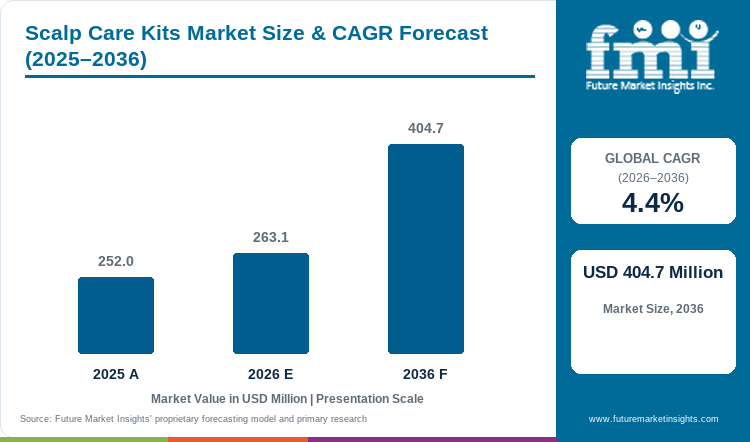
USD 263.1 Million in 2026 and USD 404.7 Million by 2036 at a 4.4% CAGR.
The market is valued at USD 252.0 Million in 2025. From 2026 to 2036, the market is set to grow at a CAGR of 4.4% reaching USD 404.7 million. Demand for scalp care kits builds when recurring scalp concerns are addressed through a repeatable routine rather than a single product. A July 2024 JAMA Dermatology meta-analysis estimated global seborrheic dermatitis prevalence at 4.4%, showing a persistent base of people dealing with scalp inflammation and flaking. P&G followed this routine approach with Pantene Abundant & Strong in February 2026, combining shampoo and conditioner with a daily scalp serum. Within the wider Hair Care Market, this creates a distinct commercial layer because the scalp step can be replenished alongside familiar wash products.
Conversion also depends on local rules and how clearly the kit is explained. In the USA, a dandruff-control product may be treated as an OTC drug even if the rest of the kit is cosmetic. Great Britain uses SCPN notification, while Northern Ireland uses CPNP. In South Korea, products that claim to reduce hair-loss symptoms are treated as functional cosmetics. This means each product in the kit needs clear instructions when the same routine is sold in different countries.
Key Takeaways
- The market is valued at USD 252.0 Million in 2025. It is expected to grow from USD 263.1 Million in 2026 to USD 404.7 Million by 2036 at a 4.4% CAGR.
- Core / classic lines hold 42.0% of Product Type demand in 2026 because they fit easily into a familiar hair-wash routine.
- Conventional holds 56.0% of Nature demand in 2026 because it gives brands more flexibility across everyday and targeted scalp-care products.
- Cream & balm accounts for 27.0% of Format demand in 2026 because these formats are easy to apply directly to the scalp.
- Mass holds 34.0% of Price Positioning, while Specialty beauty retail accounts for 27.0% of Sales Channel demand in 2026. This keeps kits affordable while still giving buyers some guidance.
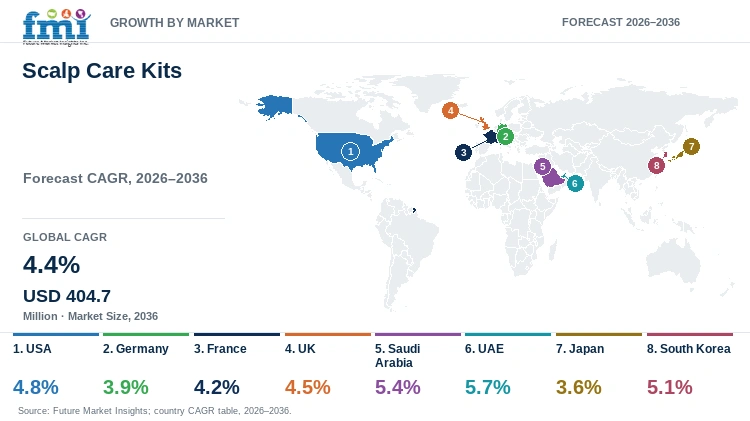
- Country growth ranges from 5.7% CAGR in UAE to 3.6% in Japan from 2026 to 2036. Local rules and product education affect how quickly buyers move from trial to repeat purchase.
Analyst Perspective
“Scalp care kits create value when every step has a clear job and the user knows what belongs in daily maintenance versus targeted treatment. Adding more products without that sequence raises drop-off risk. Brands can protect repeat purchase by keeping the base routine simple and attaching one treatment step that retailers or salons can explain consistently.”
- Rahul Pandita, Principal Consultant, Future Market Insights
How is the Scalp Care Kits Market segmented?
The Scalp Care Kits Market is segmented by Product Type, Nature, Format, Price Positioning, Sales Channel, and Region. Product Type includes Core / classic lines, Targeted treatment lines, Sensitive & gentle lines, Premium & clinical lines, and Kits & sets. Nature includes Conventional, Vegan & cruelty-free, Natural & organic, Dermocosmetic / clinical, and Fragrance-free & sensitive. Format includes Cream & balm, Liquid & serum, Stick & solid, Spray & mist, Sheet & patch, and Powder. Price Positioning includes Mass, Masstige, Premium, and Professional. Sales Channel includes Specialty beauty retail, E-commerce & DTC, Pharmacies & drugstores, Supermarkets & hypermarkets, and Salons & spas.
What makes Core / classic lines central to the Product Type category?
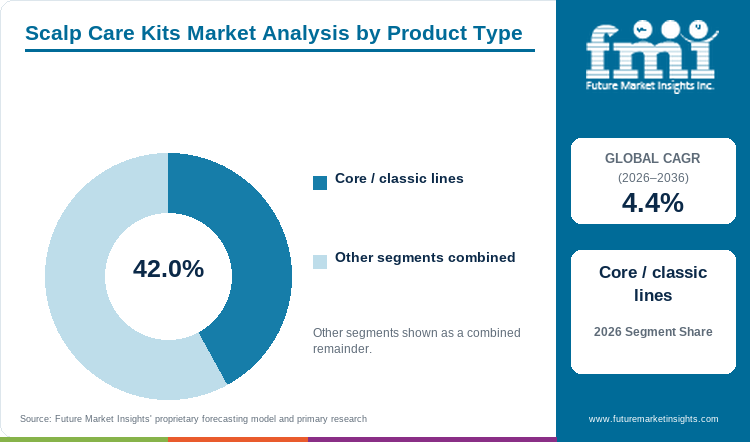
Core / classic lines are easy for consumers to understand because they build on a normal hair-wash routine. Shampoo and conditioner remain the main steps, while a tonic or serum can be added for scalp care. This makes the routine easier to start and easier to repeat.
Targeted treatment lines are used when consumers have a more specific scalp concern. Premium clinical lines can support higher spending. Core / classic lines remain important because they make scalp care feel like part of regular hair care instead of a separate routine.
- Core/classic lines hold a 42.0% share in 2026 because familiar wash routines make it easier for consumers to move from first use to repeat purchase.
- In April 2024, Wella Company placed Nioxin System Kits at the center of its refreshed 30-day regimen campaign and supported the range with dermatologist-led scalp education.
Why does Conventional lead the Nature category?
Conventional products can cover many scalp-care needs within one kit. One product can help with oil or flakes, while another can focus on hydration or soothing. This gives brands more freedom to combine different products in the same routine.
Vegan and natural ranges can appeal to shoppers who care about ingredients. Dermocosmetic products may appeal to buyers looking for more clinical positioning. Conventional products still lead because they give brands more flexibility across different formulas and price points.
- Conventional holds a 56.0% share in 2026 because it supports a wide range of scalp-care products and is already well established in mass-market channels.
- P&G introduced Head & Shoulders BARE in June 2023 with nine ingredients and versions for dry or oily scalp needs. This shows how a simpler product approach can still be offered through a large conventional brand.
How does Cream & balm lead the Format category?
Cream and balm formats make the treatment step visible because the user applies them deliberately and can control scalp contact. They suit pre-wash use, masks and soothing applications where dwell time matters. Richer textures can also signal care for consumers who associate dryness or irritation with a weakened scalp barrier. Liquid leave-on products remain important for precise application, as reflected in the adjacent Hair Serum Market, but cream and balm retain an advantage when the kit needs to communicate treatment intensity and reduce runoff.
• Cream & balm holds a 27.0% share in 2026 because richer contact formats fit targeted treatment and soothing steps within multi-product routines.
• FDA OTC dandruff rules distinguish leave-on forms such as creams and lotions from brief-contact wash-off forms, showing how format changes directions for use and claim execution.
What supports Mass leadership in Price Positioning?
Mass pricing helps keep the total cost of a scalp-care routine lower when two or three products need to be bought again together. This matters when problems such as flakes or oiliness return after use stops, or when dryness needs regular care.
Masstige and premium products can offer more specialized ingredients or a richer product experience. Professional kits can add salon guidance. Mass products still lead because the full routine stays closer to normal shampoo and conditioner spending, making repeat purchase easier.
- Mass holds a 34.0% share in 2026 because lower pricing makes it easier to keep buying several products as part of the same routine.
- In February 2026, P&G positioned Pantene Abundant & Strong as an accessible three-step system with shampoo, conditioner, and a daily scalp serum.
What drives Specialty beauty retail leadership in Sales Channel?
Specialty beauty retail can explain what each item in a kit is meant to do. Staff guidance and curated shelf adjacency help a shopper separate a maintenance cleanser from a targeted serum. Sampling can reinforce that difference. E-commerce is effective for replenishment after the routine is understood, while pharmacies gain relevance when dandruff or sensitive-scalp positioning is prominent. The channel logic is similar to parts of the Professional Hair Care Products Market, where recommendation and demonstration influence product choice.
- Specialty beauty retail holds a 27.0% share in 2026 because regimen education and curated comparison support higher-confidence kit selection.
- Wella launched Nioxin Hair Fall Defense Shampoo through Ulta in August 2024 before broader Amazon availability, showing how specialty-led discovery can support a scalp-focused launch.
What are the drivers, restraints and opportunities in the Scalp Care Kits Market?
Skinification and condition-specific routines are increasing demand for scalp-care kits. Growth can slow when product claims are difficult to support or when the routine does not suit the consumer. Modular kits can help by adding targeted treatment steps without making the routine too complex to follow or repeat.
- Driver: Skinification is shifting scalp care from one-product problem solving toward coordinated cleansing and treatment routines.
- Restraint: Dandruff and hair-loss language can trigger different evidence or regulatory requirements across markets, while one poorly matched component can undermine the full kit experience.
- Opportunity: Modular kits can pair a stable daily base with one replaceable treatment step selected for the user’s scalp concern or channel guidance.
The demand mechanism starts with recurring scalp problems. The 2024 JAMA Dermatology meta-analysis estimated global seborrheic dermatitis prevalence at 4.4%. Consumers already recognize Anti-Dandruff Shampoos Market products as a familiar response to flakes, and kits extend that behavior by attaching a second step with a different job. When a cleanser and a leave-on treatment are both replenished, one recurring concern supports more than one purchase line.
The restraint appears when the routine crosses claim categories or becomes too complex for the user. FDA rules specify permitted actives and directions for qualifying OTC dandruff products. South Korea places hair-loss symptom claims within its functional-cosmetics framework. In a mixed kit, one component can therefore carry a different evidence burden from the others. The commercial risk is compounded if a consumer reacts poorly to one step or stops using the sequence because the instructions are unclear.
A practical opportunity is a modular system with a stable daily base and one targeted booster. Kao reported in January 2026 that facial and scalp skin-surface lipid RNA show similar expression patterns, and it is exploring further scalp applications of that work. Brands can use better condition classification to guide format choice without claiming diagnosis. A gentle cleanser can remain constant while the treatment step changes by need, making the routine easier to explain and easier to replenish.
Which country CAGRs are profiled in the Scalp Care Kits Market?
| Country | CAGR |
|---|---|
| USA | 4.8% |
| Germany | 3.9% |
| France | 4.2% |
| UK | 4.5% |
| Saudi Arabia | 5.4% |
| UAE | 5.7% |
| Japan | 3.6% |
| South Korea | 5.1% |
How do country-level CAGRs compare in the Scalp Care Kits Market?
The range spans 2.1 percentage points, from UAE at 5.7% to Japan at 3.6%. The gap is useful as a pacing signal, but it does not indicate absolute market value. Faster growth can still require more registration work or channel development, while mature markets can generate repeat demand through established retail systems. The practical comparison is therefore the growth rate together with claim rules and the channel’s ability to explain a multi-step routine.
- UAE at 5.7% and Saudi Arabia at 5.4% sit within 0.3 percentage points of each other, making registration readiness and premium beauty distribution relevant to both launch plans.
- South Korea at 5.1% is 0.3 percentage points above USA at 4.8%, but the commercial mechanics differ because Korea applies a functional-cosmetics pathway to hair-loss symptom claims while the USA uses OTC rules for qualifying dandruff products.
- UK at 4.5%, France at 4.2% and Germany at 3.9% show a narrower growth band where notification discipline and digital product information can influence conversion.
- Japan at 3.6% sits at the low end of the profiled range, with established beauty routines and claim-category discipline shaping the pace of new kit adoption.
Country-wise Analysis
- USA: Demand for Scalp Care Kits is forecast to expand at 4.8% CAGR from 2026 to 2036. FDA rules for OTC dandruff products set which active ingredients can be used and how these products must be labeled. This means a kit may combine a cosmetic scalp-care product with an OTC dandruff product that has different instructions. Brands need clear directions for each item so treatment claims do not get mixed with normal cosmetic claims across mass, pharmacy and specialty channels.
- Germany: Demand for Scalp Care Kits is forecast to expand at 3.9% CAGR from 2026 to 2036. Destatis reported in November 2024 that more than 83% of people aged 16 to 74 had bought goods or services online. This makes online product pages important for explaining how a scalp-care routine works. Clear German-language instructions and consistent product information can make multi-product kits easier to understand.
- France: Demand for Scalp Care Kits is forecast to expand at 4.2% CAGR from 2026 to 2036. From 2024, DGCCRF became the main authority controlling cosmetic products and establishments, while Anses took over cosmetovigilance and risk evaluation. Scalp-care kits therefore need clear cosmetic claims and complete safety documentation. This is important before brands can build trust through pharmacy and specialty beauty channels.
- UK: Demand for Scalp Care Kits is forecast to expand at 4.5% CAGR from 2026 to 2036. OPSS reported in July 2026 on the SCPN system used for products sold in Great Britain, while Northern Ireland continues to use CPNP. Suppliers selling the same routine across the UK need to manage both systems while keeping product instructions and claims clear for consumers.
- Saudi Arabia: Demand for Scalp Care Kits is forecast to expand at 5.4% CAGR from 2026 to 2036. The Ministry of Commerce evaluated major e-commerce stores in August 2025 on consumer rights and store compliance. This included returns, privacy and required business information. For scalp-care kits sold online, buyers need a clear seller route and Arabic product information that explains how each item should be used before they buy the full routine.
- UAE: Demand for Scalp Care Kits is forecast to expand at 5.7% CAGR from 2026 to 2036. Dubai Municipality used Beautyworld Middle East in October 2025 to unveil Montaji+ and the Smart Salon Project, highlighting product registration and salon compliance. Salon-linked education therefore has a direct role in helping consumers choose between oil-control, soothing or buildup routines. This fits a wider move within the Salon Service Market toward adding scalp care to professional beauty services.
- Japan: Demand for Scalp Care Kits is forecast to expand at 3.6% CAGR from 2026 to 2036. Japan’s NIPH Clinical Trials Search registered a Kao-sponsored 16-week study in June 2026 evaluating a topical hair-growth product. The activity shows continued validation work around scalp and hair outcomes. Kits aimed at Japanese buyers benefit from compact steps and claim language that stays aligned with the relevant cosmetic or quasi-drug pathway.
- South Korea: Demand for Scalp Care Kits is forecast to expand at 5.1% CAGR from 2026 to 2036. MFDS identifies products that aid in alleviating hair-loss symptoms as functional cosmetics subject to evaluation or reporting. Amorepacific introduced the RYO ROOT:GEN scalp core reinforcement line in June 2025 with shampoo and tonic formats. Suppliers can use compact systems, but the claim pathway needs to be set before launch.
Who are the notable companies in the Scalp Care Kits Market?
Procter & Gamble; Wella Company; Henkel; Church & Dwight; Shiseido; Olaplex; Unilever; Kao Corporation; L'Oreal; Amorepacific
Competition turns on routine architecture and treatment depth, then on the channel used to explain the regimen. Consumer-scale platforms attach scalp steps to familiar hair-care purchasing. Professional systems use stylist or dermatologist education to make the sequence easier to adopt. Premium targeted players concentrate value in treatment steps that address a narrower concern. Companies with multi-region reach also need claim language that can be adapted when dandruff or hair-loss wording triggers a different pathway by country.
- Consumer-scale scalp platforms: Procter & Gamble, Unilever, Kao Corporation and Church & Dwight compete through broad access and repeat-use hair-care routines.
- Professional and salon-led scalp systems: Wella Company, Henkel, Shiseido and L'Oreal use professional education or salon-linked discovery to support treatment selection.
- Premium targeted routines: Olaplex and Amorepacific use concentrated treatment steps and system architecture aimed at specific scalp or thinning concerns.
Competitive Benchmarking: Scalp Care Kits Market
| Company | Multi-Step Kit Architecture | Scalp-Specific Treatment Depth | Professional Guidance Integration | Geographic Reach |
|---|---|---|---|---|
| Procter & Gamble | High | High | Medium | Multi-region consumer retail across North America, Europe, Asia-Pacific and Middle East |
| Wella Company | High | High | High | North America, Europe and Asia-Pacific through professional and specialty channels |
| Henkel | Medium | High | High | Europe, North America and Asia with professional hair-care infrastructure |
| Church & Dwight | High | Medium | Medium | North America with international retail and digital reach through Viviscal |
| Shiseido | Medium | High | High | Japan, East Asia and international professional salon markets |
| Olaplex | High | High | Medium | North America, Europe and Asia-Pacific through prestige and professional channels |
| Unilever | Medium | High | Medium | Multi-region consumer retail and e-commerce presence |
| Kao Corporation | Medium | High | Medium | Japan, East Asia, Europe and North America |
| L'Oreal | High | High | High | Salon, specialty beauty, pharmacy and e-commerce reach across multiple regions |
| Amorepacific | Medium | High | Medium | South Korea, wider Asia and selected specialty markets |
Scoring basis: Multi-Step Kit Architecture measures documented packaged systems or clearly sequenced routines. Scalp-Specific Treatment Depth reflects the range of scalp concerns, formats or dedicated research. Professional Guidance Integration captures salon, dermatologist or trichology touchpoints. High indicates broad documented capability. Medium indicates credible but narrower capability. Low indicates a documented limitation.
Key Developments in the Scalp Care Kits Market
- In February 2026, Procter & Gamble introduced Pantene Abundant & Strong as a three-step system that combines shampoo and conditioner with a daily scalp serum. The system places a targeted scalp treatment inside a familiar mass hair-care sequence, which can increase routine attachment without asking the user to replace established wash behavior.
- In December 2025, Unilever detailed an expanded scalp-care strategy spanning Dove DermaCare and Clear ScalpCeuticals Pro. The portfolio direction moves consumer scalp care toward condition-specific routines that use distinct cleansing and treatment steps instead of relying on one generic anti-dandruff proposition.
- In June 2025, Amorepacific introduced the RYO ROOT:GEN scalp core reinforcement line with shampoo and tonic formats focused on sebum balance and scalp conditioning. The compact two-step structure gives the brand a way to support premium scalp positioning while keeping the regimen manageable for repeat purchase.
Key Players in the Scalp Care Kits Market
Consumer-Scale Scalp Health Platforms
- Procter & Gamble
- Unilever
- Kao Corporation
- Church & Dwight
Professional and Salon-Led Scalp Systems
- Wella Company
- Henkel
- Shiseido
- L'Oreal
Premium Science-Led Targeted Routines
- Olaplex
- Amorepacific
Scalp Care Kits Market - Report Scope
| Coverage field | Report scope |
|---|---|
| Market breakdown | Product Type, Nature, Format, Price Positioning, Sales Channel, and Region |
| Quantitative Units | USD Million |
| Market Definition | Revenue includes packaged scalp-care kits, sets and coordinated multi-product routines sold within the defined segmentation universe. It excludes standalone adjacent hair-care products, oral supplements, prescription therapies, diagnostic devices, salon service fees and substitute product revenue. |
| Regions Covered | North America; Latin America; Western Europe; Eastern Europe; East Asia; South Asia & Pacific; Middle East & Africa |
| Countries Covered | USA, Germany, France, UK, Saudi Arabia, UAE, Japan, South Korea, and more than twenty-five additional countries in the full report |
| Key Companies Profiled | Procter & Gamble; Wella Company; Henkel; Church & Dwight; Shiseido; Olaplex; Unilever; Kao Corporation; L'Oreal; Amorepacific |
| Forecast Period | 2026 to 2036 |
| Approach | Market sizing uses a hybrid bottom-up and top-down approach that reconciles category revenue, channel structure, company activity, regulatory boundaries and country-level demand conditions within the defined market scope. |
Scalp Care Kits Market - Research Methodology
| Method | Approach |
|---|---|
| Primary Research | FMI uses structured discussions with manufacturers, distributors, specialty retailers, salons and subject-matter experts to test product boundaries, purchase triggers, channel behavior, pricing logic and adoption friction. |
| Desk Research | Public regulatory guidance, national statistics, peer-reviewed literature, company filings, official company product material, trade information and government notices are reviewed for facts directly relevant to scalp-care kits. |
| Market Sizing and Forecasting | The sizing framework reconciles product and channel revenue views with company activity, replenishment behavior, regulatory constraints and country-specific demand conditions. Forecast assumptions consider routine adoption, premiumization, channel migration and claim requirements. |
| Data Validation | Findings are cross-checked across independent evidence types and reviewed against the defined revenue boundary so that packaged kits and coordinated routines remain separate from excluded adjacent categories. |
Scalp Care Kits Market by Segments
Scalp Care Kits Market segmented by Product Type:
- Core / classic lines
- Targeted treatment lines
- Sensitive & gentle lines
- Premium & clinical lines
- Kits & sets
Scalp Care Kits Market segmented by Nature:
- Conventional
- Vegan & cruelty-free
- Natural & organic
- Dermocosmetic / clinical
- Fragrance-free & sensitive
Scalp Care Kits Market segmented by Format:
- Cream & balm
- Liquid & serum
- Stick & solid
- Spray & mist
- Sheet & patch
- Powder
Scalp Care Kits Market segmented by Price Positioning:
- Mass
- Masstige
- Premium
- Professional
Scalp Care Kits Market segmented by Sales Channel:
- Specialty beauty retail
- E-commerce & DTC
- Pharmacies & drugstores
- Supermarkets & hypermarkets
- Salons & spas
Scalp Care Kits Market by Region
- North America
- United States
- Canada
- Latin America
- Brazil
- Mexico
- Argentina
- Chile
- Western Europe
- Germany
- France
- United Kingdom
- Italy
- Spain
- Benelux
- Nordics
- Eastern Europe
- Poland
- Czech
- Republic
- Romania
- Hungary
- East Asia
- China
- Japan
- South Korea
- South Asia & Pacific
- India
- ASEAN
- Australia and New Zealand
- Middle East & Africa
- GCC Countries
- South Africa
- Türkiye
- Israel
Research Sources and Bibliography
- Polaskey, M. T., Chang, C. H., Daftary, K., Fakhraie, S., Miller, C. H., and Chovatiya, R. (2024, July 3). The Global Prevalence of Seborrheic Dermatitis: A Systematic Review and Meta-Analysis. JAMA Dermatology.
- U.S. Food and Drug Administration (2021, December 16). Over-the-Counter Monograph M032: Drug Products for the Control of Dandruff, Seborrheic Dermatitis, and Psoriasis for Over-the-Counter Human Use.
- German Federal Statistical Office, Destatis (2024, November 28). 83% der 16- bis 74-Jährigen kaufen online ein.
- Direction générale de la concurrence, de la consommation et de la répression des fraudes, France (2023, December 29). Produits cosmétiques : la DGCCRF assure désormais seule le contrôle des produits et établissements.
- UK Office for Product Safety and Standards (2026, July 17). New data on UK cosmetic product safety notifications.
- Saudi Ministry of Commerce (2025, August 18). Ministry of Commerce Announces the Results of E-Commerce Store Evaluation.
- Dubai Municipality (2025, October 27). Product safety at Beautyworld Middle East 2025.
- National Institute of Public Health, Japan, Clinical Trials Search (2026, June 19). A Study to Evaluate the Effects of W-006 on Hair Growth and Hair Condition.
- Ministry of Food and Drug Safety, Republic of Korea (2020, June 4). Cosmetic Regulatory Framework in Korea.
- Procter & Gamble (2026, February 25). Unraveling the Hair Loss Challenge: Introducing Pantene Abundant & Strong.
- Unilever (2025, December 1). The skinification of scalp care: Unilever delivers on demand.
- Amorepacific (2025, June 1). RYO ROOT:GEN scalp core reinforcement line.
- Wella Company (2024, April 19). Nioxin unveils new look and Global Dermatologist Partnership with a focus on science-backed solutions that grow results.
- Kao Corporation (2026, January 28). Similarity of Expression Patterns Between Facial and Scalp Skin Surface Lipids RNA Is Confirmed.
This bibliography is provided for reader reference and is not exhaustive. The full report contains the complete reference list and detailed citations.
This Report Answers
- What is the Scalp Care Kits Market size in 2026 and what value is forecast for 2036?
- Which scalp-health needs are converting consumer concerns into multi-product kit demand?
- Why do Core / classic lines hold the leading position in Product Type?
- How do Nature, Format and Price Positioning shape the design of a repeatable scalp routine?
- Why does Specialty beauty retail lead the Sales Channel category?
- How do growth rates differ across USA, Germany, France, UK, Saudi Arabia, UAE, Japan and South Korea?
- Which competitive roles are occupied by consumer-scale, professional and premium targeted companies?
- How do claim rules, irritation risk and regimen complexity affect return on scalp-care kit launches?
Frequently Asked Questions
What is driving growth in the Scalp Care Kits Market?
Growth is driven by the skinification of scalp care and by consumers moving from single-product fixes toward coordinated cleansing and treatment routines. Recurring concerns create repeat purchase when each step has a clear role.
Who are the key players in the Scalp Care Kits Market?
Key players include Procter & Gamble, Wella Company, Henkel, Church & Dwight, Shiseido, Olaplex, Unilever, Kao Corporation, L'Oreal and Amorepacific. Their positions differ by routine architecture and treatment depth, as well as by the channel used to guide product choice.
What notable restraint affects the Scalp Care Kits Market?
Claim substantiation is a material restraint because dandruff and hair-loss wording can follow different regulatory pathways across countries. A multi-item kit also raises adherence risk because one poorly matched step can weaken satisfaction with the full routine.
Why should executives track the Scalp Care Kits Market?
A kit can attach more than one product to a recurring hair-care purchase and can support premium or professional price points. Commercial results still depend on whether the sequence is simple enough to repeat and whether the claims travel cleanly across markets.
What should beauty retailers evaluate in the Scalp Care Kits Market?
Retailers should evaluate regimen clarity and component compatibility, then compare the price of the full routine with expected replenishment. They should also check whether staff or digital content can explain which step is maintenance and which step is targeted treatment.
What supports long-term commercial confidence in the Scalp Care Kits Market?
Persistent scalp-health needs support repeat demand, while major beauty companies continue to invest in multi-step systems and scalp research. Durability depends on tolerable formulations and disciplined claims, with replenishment built around a routine the consumer can sustain.
Preview the report firsthand - request a free sample
Get SampleGet the brochure for pricing and purchase details.
Get PDFTable of Content
- Key Takeaways
- Market Size and CAGR
- Top Growth Driver
- Fastest Growing Segment
- Leading Region
- Key Companies
- Emerging Opportunities
- Executive Summary
- Global Market Outlook
- Demand-side Trends
- Supply-side Trends
- Technology Roadmap Analysis
- Analysis and Recommendations
- Analyst Perspective (What is happening? Why now? What should investors know?)
- Key Questions Answered
- How large is the market?
- What is the CAGR?
- What are key trends?
- Which region dominates?
- Who are the leaders?
- Market Overview
- Market Coverage / Taxonomy
- Market Definition / Scope / Limitations
- Research Methodology
- Chapter Orientation
- Analytical Lens and Working Hypotheses
- Market Structure, Signals, and Trend Drivers
- Benchmarking and Cross-market Comparability
- Market Sizing, Forecasting, and Opportunity Mapping
- Research Design and Evidence Framework
- Desk Research Programme (Secondary Evidence)
- Expert Input and Fieldwork (Primary Evidence)
- Tooling, Models, and Reference Databases
- Data Engineering and Model Build
- Quality Assurance and Audit Trail
- Market Background
- Market Dynamics (Drivers, Restraints, Opportunity, Trends)
- Scenario Forecast (Optimistic, Likely, Conservative)
- Impact Analysis
- AI Impact
- Sustainability Impact
- Regulatory Impact
- Technology Impact
- Consumer / Buyer Analysis
- Purchase Drivers
- Adoption Barriers
- Buyer Journey
- Opportunity Map Analysis
- Product Life Cycle Analysis
- Supply Chain Analysis
- Investment Feasibility Matrix
- Value Chain Analysis
- PESTLE and Porter's Analysis
- Regulatory Landscape
- Regional Parent Market Outlook
- Production and Consumption Statistics
- Import and Export Statistics
- Global Market Analysis and Forecast, 2021 to 2036
- Historical Market Size Value (USD Million) Analysis, 2021 to 2025
- Current and Future Market Size Value (USD Million) Projections, 2026 to 2036
- Y-o-Y Growth Trend Analysis
- Absolute $ Opportunity Analysis
- Global Market Pricing Analysis, 2021 to 2036
- Global Market Analysis and Forecast, By Product Type, 2021 to 2036
- Introduction / Key Findings
- Historical Market Size Value (USD Million) Analysis By Product Type, 2021 to 2025
- Current and Future Market Size Value (USD Million) Analysis and Forecast By Product Type, 2026 to 2036
- Core / classic lines
- Targeted treatment lines
- Sensitive & gentle lines
- Premium & clinical lines
- Kits & sets
- Y-o-Y Growth Trend Analysis By Product Type, 2021 to 2025
- Absolute $ Opportunity Analysis By Product Type, 2026 to 2036
- Global Market Analysis and Forecast, By Nature, 2021 to 2036
- Introduction / Key Findings
- Historical Market Size Value (USD Million) Analysis By Nature, 2021 to 2025
- Current and Future Market Size Value (USD Million) Analysis and Forecast By Nature, 2026 to 2036
- Conventional
- Vegan & cruelty-free
- Natural & organic
- Dermocosmetic / clinical
- Fragrance-free & sensitive
- Y-o-Y Growth Trend Analysis By Nature, 2021 to 2025
- Absolute $ Opportunity Analysis By Nature, 2026 to 2036
- Global Market Analysis and Forecast, By Format, 2021 to 2036
- Introduction / Key Findings
- Historical Market Size Value (USD Million) Analysis By Format, 2021 to 2025
- Current and Future Market Size Value (USD Million) Analysis and Forecast By Format, 2026 to 2036
- Cream & balm
- Liquid & serum
- Stick & solid
- Spray & mist
- Sheet & patch
- Powder
- Y-o-Y Growth Trend Analysis By Format, 2021 to 2025
- Absolute $ Opportunity Analysis By Format, 2026 to 2036
- Global Market Analysis and Forecast, By Price Positioning, 2021 to 2036
- Introduction / Key Findings
- Historical Market Size Value (USD Million) Analysis By Price Positioning, 2021 to 2025
- Current and Future Market Size Value (USD Million) Analysis and Forecast By Price Positioning, 2026 to 2036
- Mass
- Masstige
- Premium
- Professional
- Y-o-Y Growth Trend Analysis By Price Positioning, 2021 to 2025
- Absolute $ Opportunity Analysis By Price Positioning, 2026 to 2036
- Global Market Analysis and Forecast, By Sales Channel, 2021 to 2036
- Introduction / Key Findings
- Historical Market Size Value (USD Million) Analysis By Sales Channel, 2021 to 2025
- Current and Future Market Size Value (USD Million) Analysis and Forecast By Sales Channel, 2026 to 2036
- Specialty beauty retail
- E-commerce & DTC
- Pharmacies & drugstores
- Supermarkets & hypermarkets
- Salons & spas
- Y-o-Y Growth Trend Analysis By Sales Channel, 2021 to 2025
- Absolute $ Opportunity Analysis By Sales Channel, 2026 to 2036
- Global Market Analysis and Forecast, By Region, 2021 to 2036
- Introduction
- Historical Market Size Value (USD Million) Analysis By Region, 2021 to 2025
- Current Market Size Value (USD Million) Analysis and Forecast By Region, 2026 to 2036
- North America
- Latin America
- Western Europe
- Eastern Europe
- East Asia
- South Asia & Pacific
- Middle East & Africa
- Market Attractiveness Analysis By Region
- North America Market Analysis and Forecast, By Country, 2021 to 2036
- Historical Market Size Value (USD Million) Trend Analysis By Market Taxonomy, 2021 to 2025
- Market Size Value (USD Million) Forecast By Market Taxonomy, 2026 to 2036
- By Country
- United States
- Canada
- By Product Type
- By Nature
- By Format
- By Price Positioning
- By Sales Channel
- By Country
- Market Attractiveness Analysis
- By Country
- By Product Type
- By Nature
- By Format
- By Price Positioning
- By Sales Channel
- Key Takeaways
- Latin America Market Analysis and Forecast, By Country
- Historical Market Size Value (USD Million) Trend Analysis By Market Taxonomy, 2021 to 2025
- Market Size Value (USD Million) Forecast By Market Taxonomy, 2026 to 2036
- By Country
- Brazil
- Mexico
- Argentina
- Chile
- By Product Type
- By Nature
- By Format
- By Price Positioning
- By Sales Channel
- By Country
- Market Attractiveness Analysis
- By Country
- By Product Type
- By Nature
- By Format
- By Price Positioning
- By Sales Channel
- Key Takeaways
- Western Europe Market Analysis and Forecast, By Country
- Historical Market Size Value (USD Million) Trend Analysis By Market Taxonomy, 2021 to 2025
- Market Size Value (USD Million) Forecast By Market Taxonomy, 2026 to 2036
- By Country
- Germany
- France
- United Kingdom
- Italy
- Spain
- Benelux
- Nordics
- By Product Type
- By Nature
- By Format
- By Price Positioning
- By Sales Channel
- By Country
- Market Attractiveness Analysis
- By Country
- By Product Type
- By Nature
- By Format
- By Price Positioning
- By Sales Channel
- Key Takeaways
- Eastern Europe Market Analysis and Forecast, By Country
- Historical Market Size Value (USD Million) Trend Analysis By Market Taxonomy, 2021 to 2025
- Market Size Value (USD Million) Forecast By Market Taxonomy, 2026 to 2036
- By Country
- Poland
- Czech Republic
- Romania
- Hungary
- By Product Type
- By Nature
- By Format
- By Price Positioning
- By Sales Channel
- By Country
- Market Attractiveness Analysis
- By Country
- By Product Type
- By Nature
- By Format
- By Price Positioning
- By Sales Channel
- Key Takeaways
- East Asia Market Analysis and Forecast, By Country
- Historical Market Size Value (USD Million) Trend Analysis By Market Taxonomy, 2021 to 2025
- Market Size Value (USD Million) Forecast By Market Taxonomy, 2026 to 2036
- By Country
- China
- Japan
- South Korea
- By Product Type
- By Nature
- By Format
- By Price Positioning
- By Sales Channel
- By Country
- Market Attractiveness Analysis
- By Country
- By Product Type
- By Nature
- By Format
- By Price Positioning
- By Sales Channel
- Key Takeaways
- South Asia & Pacific Market Analysis and Forecast, By Country
- Historical Market Size Value (USD Million) Trend Analysis By Market Taxonomy, 2021 to 2025
- Market Size Value (USD Million) Forecast By Market Taxonomy, 2026 to 2036
- By Country
- India
- ASEAN
- Australia and New Zealand
- By Product Type
- By Nature
- By Format
- By Price Positioning
- By Sales Channel
- By Country
- Market Attractiveness Analysis
- By Country
- By Product Type
- By Nature
- By Format
- By Price Positioning
- By Sales Channel
- Key Takeaways
- Middle East & Africa Market Analysis and Forecast, By Country
- Historical Market Size Value (USD Million) Trend Analysis By Market Taxonomy, 2021 to 2025
- Market Size Value (USD Million) Forecast By Market Taxonomy, 2026 to 2036
- By Country
- GCC Countries
- South Africa
- Türkiye
- Israel
- By Product Type
- By Nature
- By Format
- By Price Positioning
- By Sales Channel
- By Country
- Market Attractiveness Analysis
- By Country
- By Product Type
- By Nature
- By Format
- By Price Positioning
- By Sales Channel
- Key Takeaways
- Key Countries Market Analysis
- United States
- Pricing Analysis
- Market Share Analysis, 2025
- By Product Type
- By Nature
- By Format
- By Price Positioning
- By Sales Channel
- Canada
- Pricing Analysis
- Market Share Analysis, 2025
- By Product Type
- By Nature
- By Format
- By Price Positioning
- By Sales Channel
- Mexico
- Pricing Analysis
- Market Share Analysis, 2025
- By Product Type
- By Nature
- By Format
- By Price Positioning
- By Sales Channel
- Brazil
- Pricing Analysis
- Market Share Analysis, 2025
- By Product Type
- By Nature
- By Format
- By Price Positioning
- By Sales Channel
- Chile
- Pricing Analysis
- Market Share Analysis, 2025
- By Product Type
- By Nature
- By Format
- By Price Positioning
- By Sales Channel
- Germany
- Pricing Analysis
- Market Share Analysis, 2025
- By Product Type
- By Nature
- By Format
- By Price Positioning
- By Sales Channel
- United Kingdom
- Pricing Analysis
- Market Share Analysis, 2025
- By Product Type
- By Nature
- By Format
- By Price Positioning
- By Sales Channel
- Italy
- Pricing Analysis
- Market Share Analysis, 2025
- By Product Type
- By Nature
- By Format
- By Price Positioning
- By Sales Channel
- Spain
- Pricing Analysis
- Market Share Analysis, 2025
- By Product Type
- By Nature
- By Format
- By Price Positioning
- By Sales Channel
- France
- Pricing Analysis
- Market Share Analysis, 2025
- By Product Type
- By Nature
- By Format
- By Price Positioning
- By Sales Channel
- India
- Pricing Analysis
- Market Share Analysis, 2025
- By Product Type
- By Nature
- By Format
- By Price Positioning
- By Sales Channel
- ASEAN
- Pricing Analysis
- Market Share Analysis, 2025
- By Product Type
- By Nature
- By Format
- By Price Positioning
- By Sales Channel
- Australia and New Zealand
- Pricing Analysis
- Market Share Analysis, 2025
- By Product Type
- By Nature
- By Format
- By Price Positioning
- By Sales Channel
- China
- Pricing Analysis
- Market Share Analysis, 2025
- By Product Type
- By Nature
- By Format
- By Price Positioning
- By Sales Channel
- Japan
- Pricing Analysis
- Market Share Analysis, 2025
- By Product Type
- By Nature
- By Format
- By Price Positioning
- By Sales Channel
- South Korea
- Pricing Analysis
- Market Share Analysis, 2025
- By Product Type
- By Nature
- By Format
- By Price Positioning
- By Sales Channel
- Poland
- Pricing Analysis
- Market Share Analysis, 2025
- By Product Type
- By Nature
- By Format
- By Price Positioning
- By Sales Channel
- Hungary
- Pricing Analysis
- Market Share Analysis, 2025
- By Product Type
- By Nature
- By Format
- By Price Positioning
- By Sales Channel
- Türkiye
- Pricing Analysis
- Market Share Analysis, 2025
- By Product Type
- By Nature
- By Format
- By Price Positioning
- By Sales Channel
- South Africa
- Pricing Analysis
- Market Share Analysis, 2025
- By Product Type
- By Nature
- By Format
- By Price Positioning
- By Sales Channel
- Saudi Arabia
- Pricing Analysis
- Market Share Analysis, 2025
- By Product Type
- By Nature
- By Format
- By Price Positioning
- By Sales Channel
- UAE
- Pricing Analysis
- Market Share Analysis, 2025
- By Product Type
- By Nature
- By Format
- By Price Positioning
- By Sales Channel
- United States
- Market Structure Analysis
- Competition Dashboard
- Competition Benchmarking
- Market Share Analysis of Top Players
- By Regional
- By Product Type
- By Nature
- By Format
- By Price Positioning
- By Sales Channel
- Emerging Startups
- Innovation Benchmarking
- Competition Analysis
- Competition Deep Dive
- Procter & Gamble
- Overview
- Product Portfolio
- Profitability by Market Segments
- Sales Footprint
- Strategy Overview
- Marketing Strategy
- Product Strategy
- Channel Strategy
- Wella Company
- Henkel
- Church & Dwight
- Shiseido
- Olaplex
- Unilever
- Kao Corporation
- L'Oreal
- Amorepacific
- Procter & Gamble
- Case Studies
- Success Stories
- Recent Developments
- Competition Deep Dive
- Assumptions & Acronyms Used


