

- Market Size (2026)
- USD 1.3 Bn
- Forecast (2036)
- USD 3.3 Bn
- CAGR (2026 to 2036)
- 9.6%
How big is Seaweed-Based Medical Disposables Market in 2026?
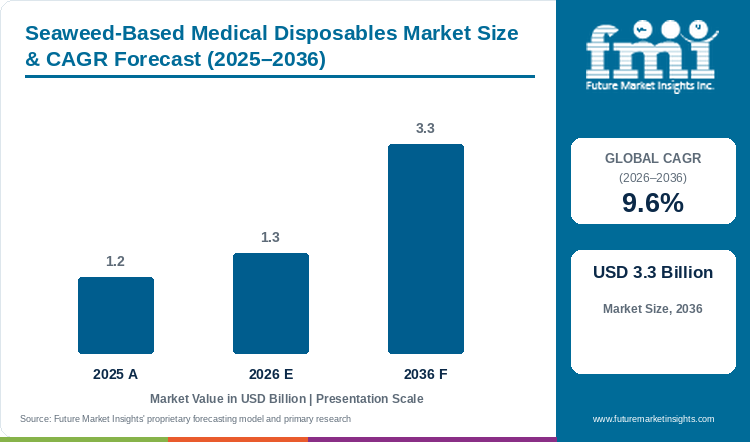
Sales of seaweed-based medical disposables are estimated to rise at 9.6% CAGR through 2036. Market valuation increases from USD 1.2 billion in 2025 to USD 1.3 billion in 2026 and is estimated to reach USD 3.3 billion by 2036.
As per FMI, the global seaweed-based medical disposables market was valued at USD 1.2 billion in 2025 and is projected to rise from USD 1.3 billion in 2026 to USD 3.3 billion by 2036, at 9.6% CAGR. Alginate wound dressings holds 48.2% of product type revenue in 2026, as its absorbent fibers forms a gel after taking wound fluid. AHRQ recorded 93,807 pressure-injury reports through December 2024, while 77.1% documented preventive intervention and 79.5% included skin inspection on admission.[1] Smith+Nephew also launched a five-layer dressing in March 2026 for wound management and pressure-injury prevention, complementing broader antimicrobial wound care dressings.[13] Repeated wound checks and dressing changes are expected to upkeep demand for medical-grade alginate formats.
Key Market Trends & Insights
- By Product Type, alginate wound dressings led with 48.2% revenue share in 2026. Sheet, rope and cavity forms allows selection according to wound depth and exudate level.
- By Seaweed Derivative, alginate accounted for 64.3% of revenue in 2026, owing to viscosity and gel formation offered by sodium and calcium forms.
- By Application, wound care represented 44.6% of revenue in 2026. Regular assessment and dressing changes are expected to support repeat product demand.
- By End User, hospitals held 50.8% of demand in 2026. Presence of wound-care teams and centralized replenishment keeps hospitals as the largest purchasing setting.
Regional Highlights
- Fastest-growing profiled country: Norway (12.1% CAGR, 2026 to 2036). Its 70% to 75% emission-reduction target for 2035 is increasing requirement for lifecycle and disposal information in public purchasing.[9]
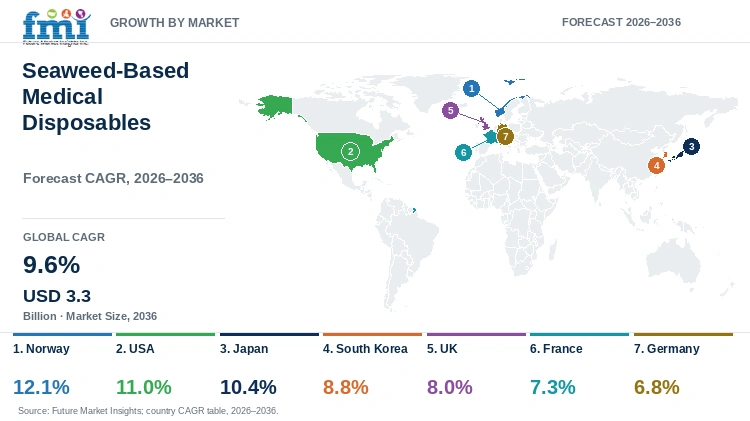
- By country: The USA and Japan are projected at 11.0% and 10.4% CAGR, respectively, while Germany records 6.8% through 2036.
Market Size & Forecast
Table 1: Market Size and Forecast for the Seaweed-Based Medical Disposables Market (USD billion and percentage), 2025 to 2036
| Metric | Value |
|---|---|
| 2025 Market Size | USD 1.2 billion |
| Estimated Market Size in 2026 | USD 1.3 billion |
| Projected Market Size by 2036 | USD 3.3 billion |
| CAGR, 2026 to 2036 | 9.6% |
| Added Revenue, 2026 to 2036 | USD 2.0 billion |
| Market Expansion Multiple | 2.54 times |
Clinical need alone does not create regular purchase of a wound dressing, as records and approved supply routes also decide the final order. CMS reported a 57.6% improper-payment rate and USD 177 million in projected improper payments for surgical dressings, wherein missing and insufficient records formed most errors.[2] NHS Supply Chain, on the other side, started a 24-month framework in September 2025 with 56 suppliers across 18 lots.[6] These conditions shows that the USA demand depends on wound size, drainage and changing frequency, while framework buyers compare eligible packs. Products combining absorbency, clear coding and continuous supply are likely to gain more repeat orders.
Wound-Care Demand and Qualification Indicators
Wound-care products are repeatedly used throughout treatment, as each inspection can result in another sheet, rope or cavity dressing, frequently following initial preparation with wound debridement products. However, medical use remains limited to products meeting contact, sterilization, documentation and purchasing requirements. The following indicators covers the points where clinical requirement is converted into regular product demand.
Table 2: Wound-Care Demand and Qualification Indicators for the Seaweed-Based Medical Disposables Market (reports, percentages, suppliers, lots, product layers, and clearances), mixed reporting years from 2024 to 2026
| Indicator | Data Point | Why It Matters | Source |
|---|---|---|---|
| Pressure-injury reporting | 93,807 reports through December 2024 | Shows a large body of reported events requiring wound assessment and prevention activity. | [1] |
| Preventive intervention | 77.1% of recorded events | Supports recurring demand where dressings form part of prevention protocols. | [1] |
| Skin inspection on admission | 79.5% of recorded events | Creates an early decision point for dressing selection and replacement. | [1] |
| US payment documentation | 57.6% improper-payment rate; USD 177 million projected | Shows that clinical need alone does not convert into covered purchasing without complete records. | [2] |
| Advanced wound-care framework | 56 suppliers and 18 lots from September 2025 | Provides institutional buyers with qualified product and pack choices. | [6] |
| New dressing construction | Five layers; launched March 2026 | Indicates movement towards formats combining exudate control and pressure-injury prevention. | [13] |
| Regulatory market access | US, UK, EU and Australia clearance in July 2025; availability from 2026 | Shows that new gelling-fibre products require multi-market clearance before commercial supply. | [14] |
Basis: Added revenue is USD 3.3 billion less USD 1.3 billion, while the expansion multiple is USD 3.3 billion divided by USD 1.3 billion. External indicators use mixed reporting years and does not change the market forecast.
Analyst Perspective
“Alginate dressings will gain repeat demand where exudate control reduces leakage without adding steps for nursing teams. Packaging opportunity will grow slower, as sterile-barrier evidence and hospital disposal routes will decide wider adoption.”
- Anurag Sharma, Principal Consultant, Future Market Insights.
How is the seaweed-based medical disposables market segmented?
Seaweed-based medical disposables market is segmented by four primary commercial axes and region: product type, seaweed derivative, application, end user, and region. In 2026, alginate wound dressings are projected at 48.2%, alginate at 64.3%, wound care at 44.6%, and hospitals at 50.8%.
By product type: alginate wound dressings; dental impression and hemostatic materials; compostable packaging and consumables; seaweed-based gloves and drapes.
By seaweed derivative: alginate; carrageenan; agar and agarose; fucoidan and other extracts.
By application: wound care; dental and oral care; surgical and hospital consumables; drug delivery and diagnostics.
By end user: hospitals; clinics and dental practices; home care and long-term care.
By region: North America; Latin America; Western Europe; Eastern Europe; East Asia; South Asia and Pacific; Middle East and Africa.
Why do alginate wound dressings lead product type purchases?
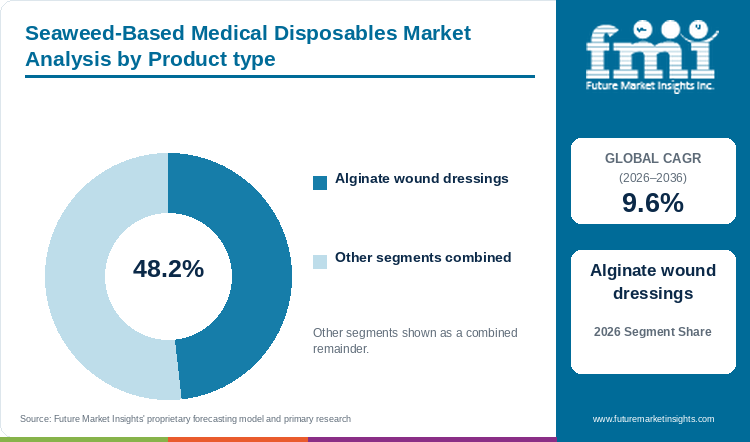
Based on product type, alginate wound dressings are projected to account for 48.2% in 2026, driven by established exudate-management use.
Table 3: Product Type Share for the Seaweed-Based Medical Disposables Market (percentage share), 2026
| Product Type | Share (2026) |
|---|---|
| Alginate Wound Dressings | 48.2% |
| Other Segments Combined | 51.8%* |
| Total | 100.0% |
*Calculated as the balance remaining after deducting the leading segment's reported share from 100.0%.
Table 4: Product Type Leadership and Market Growth for the Seaweed-Based Medical Disposables Market (segment and CAGR percentage), 2026 to 2036
| Metric | Value |
|---|---|
| Global CAGR (2026 to 2036) | 9.6% |
| Leading Segment | Alginate Wound Dressings |
Alginate wound dressings are made from seaweed-derived alginate and forms gel after coming in contact with wound fluid. Sheet formats covers wider wounds, while rope and cavity formats are used where wound depth requires filling. A 2026 review noted that commercial alginate dressings mainly absorbs exudate and protects the wound, whereas advanced products are being developed for controlled release, hydrogel formulations, and tissue integration.[3] Availability of different formats helps hospitals select the dressing according to drainage and wound shape. Owing to these applications, alginate wound dressings are projected to hold 48.2% of product type revenue in 2026.
- Alginate wound dressings are projected to hold 48.2% of product type revenue in 2026, owing to established sheet, rope and cavity forms for exudate management.
- Qualified absorbent formats can enter existing wound protocols, while multifunctional designs require separate evidence for each added claim.
What supports alginate as the preferred seaweed derivative?
By seaweed derivative, alginate is estimated to hold 64.3% in 2026, owing to controllable gel formation and purity.
Alginate is available in sodium and calcium forms, and each form provides different dissolution and gel properties. Sodium alginate is used where viscosity and formulation control is required, whereas calcium alginate is widely applied in absorbent wound dressings. KIMICA documents low-endotoxin alginate for medical development, which supports manufacturers requiring controlled purity before final product testing.[4] Medical-grade specification, adaptable salt forms and established conversion methods are boosting the use of alginate. In the FMI report, alginate is estimated to hold 64.3% of seaweed derivative revenue in 2026.
- Alginate is estimated to hold 64.3% of seaweed derivative revenue in 2026 through adaptable salt forms and specification control.
- Controlled viscosity and impurity limits help converters reproduce gel behaviour before the finished device enters biological evaluation.
How does wound care create recurring application demand?
In 2026, wound care is expected to lead application with 44.6% share, supported by repeated dressing assessment and replacement.
Wound care is one of the primary application for seaweed-based medical disposables, as alginate dressings absorbs fluid and is replaced during treatment. In April 2026, Haute Autorite de Sante published its ALGOSTERIL opinion for defined wound and bleeding uses.[5] The opinion is linked with named indications and does not provide similar reimbursement position to every alginate product. Thus, finished dressing, comparator and pack size remains important for purchasing. Availability of qualified sheet and rope formats is expected to support wound care in holding 44.6% of application revenue in 2026.
- Wound care is expected to represent 44.6% of application revenue in 2026 as treatment episodes require repeated product use.
- Product-specific reimbursement keeps purchase decisions tied to the named wound indication, comparator, and pack configuration.
Why do hospitals concentrate end-user purchasing?
Hospitals are set to lead end user with 50.8% share in 2026, underpinned by centralized qualification and replenishment.
Hospitals are major users of alginate wound dressings, as wound inspection, infection control, product selection and replenishment takes place through the same care setting. NHS Supply Chain started the advanced wound care framework in September 2025 with 56 suppliers and 18 lots.[6] The framework brings different dressing forms and stockholding measures under one purchasing route. Hospitals also requires varied sizes for pressure injuries, surgical wounds and cavity wounds. FMI research indicates that centralized purchasing and repeated dressing use will support hospitals in holding 50.8% of end-user demand in 2026.
- Hospitals are projected to hold 50.8% of end-user demand in 2026 because formularies coordinate selection and replenishment.
- Framework listing gives hospitals a route to compare eligible packs while preserving local clinical choice and stock planning.
What are the drivers, restraints, and opportunities in the seaweed-based medical disposables market?
In the seaweed-based medical disposables market, the key driver is repeat wound treatment, the key restraint is final-device qualification, and the key opportunity is segregated medical packaging.
- Driver: Established wound-care protocols support recurring orders for clinically suitable alginate dressings.
- Restraint: Biological evaluation and application-specific testing limit direct substitution of food-grade or experimental materials.
- Opportunity: Qualified non-contact packaging can address waste goals where a verified disposal route exists.
Protocol-Based Treatment Supports Replenishment
Pressure injuries and chronic wounds require repeated assessment, which in turn creates recurring requirement for wound dressings. A July 2025 acute-care hospital study reported an overall hospital-acquired pressure injury prevalence rate of 3.8% across 355,031 high-risk patients, while moisture management protocols reached 91.9% to 95.4% implementation across clinical cohorts.[16] These clinical protocols show how structured skin assessment and moisture control establish ongoing decision points for dressing selection. Alginate dressings are preferred where fluid absorption and cavity filling are required. Expansion of protocol-based treatment is expected to drive the seaweed-based medical disposables market growth.
Qualification Limits Material Substitution
Final-device testing is one of the major factor restricting direct replacement of conventional medical disposables with seaweed materials. In June 2026, Japan revised criteria covering biological raw materials and medical adhesives under its medical-device standards system.[7] Manufacturers requires evidence for sterilization, storage, extractables and finished-product performance according to intended contact, mirroring validation hurdles seen in high barrier packaging films for pharmaceuticals. Food-grade alginate or an experimental seaweed film cannot be directly supplied for medical use. Long evaluation period and separate testing for each application may hamper the growth of market.
Segregated Packaging Opens Conditional Demand
Seaweed-based pouches, trays and secondary packs are creating opportunities where material does not directly touch the wound or patient. Within secondary medical packaging, NHS England updated carbon-reduction plan requirements for new procurements in December 2025,[8] increasing attention towards supplier commitments and product information. Apart from that, biodegradable origin does not replace sterile-barrier and disposal-route evidence. Packaging manufacturers matching seaweed materials with hospital waste practices can possibly gain early orders in non-contact formats. Wider application for seaweed packaging will develop as barrier testing and disposal routes improve.
Which country CAGRs are profiled in the seaweed-based medical disposables market?
Table 5: Country CAGR Comparison for the Seaweed-Based Medical Disposables Market (CAGR percentage), 2026 to 2036
| Country | CAGR |
|---|---|
| Norway | 12.1% |
| USA | 11.0% |
| Japan | 10.4% |
| South Korea | 8.8% |
| UK | 8.0% |
| France | 7.3% |
| Germany | 6.8% |
How do country-level CAGRs compare in the seaweed-based medical disposables market?
Growth conditions vary between the profiled countries as Norway and the USA are projected to lead expansion, while Japan develops through domestic medical-grade alginate and a structured device system. South Korea is developing community and home-care routes, whereas the UK, France and Germany will grow through procurement and reimbursement requirements. Country-level purchasing differs depending on clinical use, regulatory documentation and dependable supply rather than material origin alone.
- Norway links healthcare purchasing with documented environmental and product evidence.
- USA demand follows wound eligibility, product documentation, and replenishment through established channels.
- Japan combines a formal approval system with domestic medical-grade alginate production.
- South Korea is extending integrated care and post-discharge service routes.
- UK procurement joins clinical eligibility with supplier carbon-plan requirements.
- France uses product-specific reimbursement opinions for defined wound indications.
- Germany separates conventional dressings from products claiming additional therapeutic action.
Full report country CAGRs cover: North America; Latin America; Western Europe; Eastern Europe; East Asia; South Asia and Pacific; Middle East and Africa.
Country-wise Analysis
- By 2036, Norway is projected to grow at 12.1% CAGR, supported by public purchasing and rising requirement for environmental documentation. In April 2025, the government proposed reducing national greenhouse-gas emissions by 70% to 75% by 2035 from 1990 levels.[9] The target does not provide automatic preference to seaweed products, however, it increases the importance of lifecycle and waste information in public tenders. Alginate dressings already offers a familiar medical format for absorbency and exudate management. Suppliers combining clinical performance with documented material information are expected to gain more opportunities in Norway.
- Seaweed-based medical disposable sales in the USA are forecast to expand at 11.0% CAGR through 2036, owing to established wound-treatment and Medicare purchasing channels. In February 2026, CMS reported a 57.6% improper-payment rate for surgical dressings and USD 177 million in projected improper payments for the 2024 reporting period.[2] No documentation accounted for 48.6% of errors and insufficient documentation accounted for 43.8%. As a result, wound size, drainage, dressing type and changing frequency remains important for covered use. Availability of alginate sheets and ropes with clear coding and pack information is anticipated to support repeat demand in the USA.
- Japan’s seaweed-based medical disposables outlook is anticipated to advance at 10.4% CAGR over the assessment period, supported by domestic alginate capability and a structured device route. In September 2026, PMDA published its list of approved medical devices through December 2025.[10] The list separates review categories and identifies priority or orphan-device status where applicable. KIMICA also documents low-endotoxin alginate for medical development. These conditions support controlled viscosity, purity limits, and technical work before conversion. A material specification does not authorize a finished dressing or diagnostic article. Growth therefore depends on products that pair domestic formulation support with application testing and an approved purchasing route, particularly as standards for plastic healthcare packaging continue to develop.
- Adoption of seaweed-based medical disposables in South Korea is estimated to expand at 8.8% CAGR through 2036, supported by expansion of integrated community care. The Ministry of Health and Welfare maintained an integrated-care portal and municipal service information during 2026.[11] These arrangements connects hospitals, community providers and home-care services after discharge. Smaller dressing packs and clear changing instructions are increasingly required when wound treatment continues outside hospitals. Expansion of post-discharge care is expected to support seaweed-based wound dressing demand, subject to national device eligibility and purchasing responsibility.
- The seaweed-based medical disposables market in the UK is anticipated to grow at 8.0% CAGR between 2026 and 2036, influenced by structured national procurement. NHS Supply Chain started its advanced wound care framework in September 2025 with 56 suppliers and 18 product lots.[6] The framework includes UK stockholding and contingency planning for supply disruption. These requirements places product availability with clinical suitability and price during purchasing. Alginate formats matching local formularies and pack sizes are expected to witness increasing demand, while broader biodegradable paper and plastic packaging still requires sterile-barrier and waste-route evidence.
- In France, demand for seaweed-based medical disposables is predicted to advance at 7.3% CAGR through 2036, supported by product-specific reimbursement assessment. On April 27, 2026, Haute Autorite de Sante published its ALGOSTERIL opinion for defined wound and bleeding uses.[5] The assessment covers named indications and does not provide a similar reimbursement position to every alginate dressing. Finished product, comparator and pack configuration therefore remains important for market access. Increasing availability of alginate formats connected with approved use is expected to support market growth in France.
- Germany is estimated to post 6.8% CAGR over the forecast period, influenced by the reimbursement difference between conventional dressings and products claiming an additional therapeutic action. In December 2025, the G-BA updated its wound-treatment guidance.[12] Conventional dressings can cover, absorb, stabilize, immobilize or compress a wound, whereas products claiming pharmacological, immunological or metabolic action follows another assessment route. This distinction affects plain alginate and active-containing formats. Clear classification and benefit evidence is expected to support product entry, while uncertain therapeutic positioning may hamper reimbursement.
Who are the notable companies in the seaweed-based medical disposables market?
Smith & Nephew plc, Coloplast, Mölnlycke Health Care AB, ConvaTec Group plc, Solventum Corporation, Dentsply Sirona Inc., KIMICA Corporation, Notpla Ltd., Cargill, Incorporated, and Marine Biopolymers Ltd. are notable companies profiled in this market.
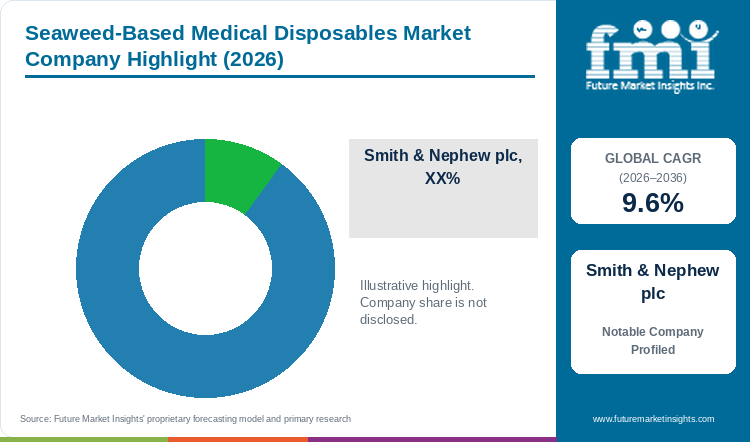
Seaweed-based medical disposables market is moderately fragmented with wound-dressing manufacturers, dental-material suppliers, hydrocolloid producers and seaweed processors. Smith & Nephew, Coloplast, Molnlycke, ConvaTec and Solventum offers qualified wound-care formats through hospital channels. KIMICA, Cargill and Dentsply Sirona participate through alginate, carrageenan and dental materials, whereas Notpla and Marine Biopolymers are focusing on seaweed conversion and algae-based bioplastics. FMI data suggests that companies adding medical specifications and continuous supply will gain more opportunity than suppliers offering material origin alone.
- Clinical alginate portfolios: Smith & Nephew plc, Coloplast, Mölnlycke Health Care AB, ConvaTec Group plc, and Solventum Corporation.
- Dental and medical hydrocolloids: Dentsply Sirona Inc., KIMICA Corporation, and Cargill, Incorporated.
- Seaweed processing and packaging platforms: Notpla Ltd. and Marine Biopolymers Ltd.
Competitive Benchmarking: Seaweed-Based Medical Disposables Market
Table 6: Competitive Benchmarking for the Seaweed-Based Medical Disposables Market (qualitative capability ratings), 2026
| Company | Clinical formats | Material depth | Current activity | Reach |
|---|---|---|---|---|
| Smith & Nephew plc | Medium | Low | Medium | High |
| Coloplast | High | Low | High | High |
| Mölnlycke Health Care AB | High | Low | Medium | High |
| ConvaTec Group plc | Medium | Low | Medium | High |
| Solventum Corporation | Medium | Low | High | High |
| Dentsply Sirona Inc. | Low | Medium | Medium | High |
| KIMICA Corporation | Low | High | High | Medium |
| Notpla Ltd. | Low | Low | High | Medium |
| Cargill, Incorporated | Low | Medium | Medium | High |
| Marine Biopolymers Ltd. | Low | Medium | Medium | Low |
High represents wider documented capability, Medium represents selected documented activity and Low represents limited public evidence for the stated area. The ratings describes company activity and not product quality, revenue share or company rank.
Key Developments in the Seaweed-Based Medical Disposables Market
- In March 2026, Smith+Nephew launched ALLEVYN COMPLETE CARE, a five-layer foam dressing developed for wound management and pressure-injury prevention.[13] The launch expands the company wound-care portfolio.
- In July 2025, Convatec secured US and European clearance for Aquacel ConvaFiber, with commercial availability planned from 2026.[14] The clearance increases product choice in gelling-fibre dressings.
- In March 2025, Mölnlycke launched its Future Summit programme for more than 130 healthcare professionals from surgical specialties.
- In February 2026, Coloplast reported 5% organic growth in wound and tissue repair for the first quarter of 2025/26.[15] The result indicates continued demand across its wound-care activities.
Key Players in the Seaweed-Based Medical Disposables Market
Clinical alginate dressing portfolios
- Smith & Nephew plc
- Coloplast
- Mölnlycke Health Care AB
- ConvaTec Group plc
- Solventum Corporation
Dental impressions and medical hydrocolloids
- Dentsply Sirona Inc.
- KIMICA Corporation
- Cargill, Incorporated
Seaweed processing and packaging platforms
- Notpla Ltd.
- Marine Biopolymers Ltd.
Seaweed-Based Medical Disposables Market - Report Scope
Table 7: Report Scope for the Seaweed-Based Medical Disposables Market (coverage fields and definitions), 2026 to 2036
| Coverage field | Report scope |
|---|---|
| Market breakdown | Product type; seaweed derivative; application; end user; region. |
| Quantitative units | USD billion. |
| Market definition | Supplier revenue from listed seaweed-derived single-use medical articles and medically specified consumable materials at their own sale boundary. Clinical services, equipment, unrelated bulk ingredients, and nonmedical packaging are excluded. |
| Regions covered | North America; Latin America; Western Europe; Eastern Europe; East Asia; South Asia and Pacific; Middle East and Africa. |
| Countries covered | Norway; USA; Japan; South Korea; UK; France; Germany. |
| Forecast period | 2026 to 2036. |
| Approach | The report covers supplier activity, segment structure, application routes, and country adoption within the stated boundary. |
Seaweed-Based Medical Disposables Market - Research Methodology
Table 8: Research Methodology for the Seaweed-Based Medical Disposables Market (research methods and approach), 2026 edition
| Method | Approach |
|---|---|
| Primary Research | The research study includes primary interviews with manufacturers, material suppliers, distributors, hospitals, clinics, procurement teams, end users and industry experts. Interviews covers purchasing decision, product evaluation, pricing, adoption barriers, approval requirement and technical support. Respondents were also asked about the evidence required before trial use develops into regular purchasing. |
| Desk Research | Desk research includes government statistics, regulatory publications, industry associations, technical literature, company filings, product information and official company announcements. Sources were checked for publication date, geography and direct relevance to the stated market. Performance, approval, investment and commercial developments were retained when supported by public evidence. |
| Market Sizing and Forecasting | Market sizing combines the 2025 and 2026 values with historical performance, segment structure, pricing, volume indicators, application use, company participation and country demand. Forecast assumptions considers economic activity, regulation, technology adoption, purchasing cycle, supply availability and barriers to wider use. Segment and regional estimates are reconciled with the total market value. |
| Data Validation | Market estimates were checked with public data, company activity, procurement information, trade indicators and primary interviews. Validation confirms whether each product, application and company activity falls within the stated market boundary. Unrelated packaging, clinical services, overlapping revenue and unsupported claims are excluded in order to reduce double counting. |
Seaweed-Based Medical Disposables Market by Segments
Seaweed-Based Medical Disposables Market segmented by Product type:
- Alginate wound dressings
- Calcium alginate dressings
- Silver-impregnated alginate dressings
- Alginate rope and ribbon dressings
- Dental impression and hemostatic materials
- Compostable packaging and consumables
- Seaweed-based gloves and drapes
Seaweed-Based Medical Disposables Market segmented by Seaweed derivative:
- Alginate
- Sodium alginate
- Calcium alginate
- Carrageenan
- Agar and agarose
- Fucoidan and other extracts
Seaweed-Based Medical Disposables Market segmented by Application:
- Wound care
- Chronic wound management
- Surgical and trauma wounds
- Dental and oral care
- Surgical and hospital consumables
- Drug delivery and diagnostics
Seaweed-Based Medical Disposables Market segmented by End user:
- Hospitals
- Public hospitals
- Private hospitals
- Clinics and dental practices
- Home care and long-term care
Seaweed-Based Medical Disposables Market by Region
- North America
- United States
- Canada
- Latin America
- Brazil
- Mexico
- Argentina
- Chile
- Western Europe
- Germany
- France
- United Kingdom
- Italy
- Spain
- Benelux
- Nordics
- Eastern Europe
- Poland
- Czech Republic
- Romania
- Hungary
- East Asia
- China
- Japan
- South Korea
- South Asia and Pacific
- India
- ASEAN
- Australia and New Zealand
- Middle East and Africa
- GCC Countries
- South Africa
- Türkiye
- Israel
Research Sources and Bibliography
- [1] Agency for Healthcare Research and Quality. (2025, September). 2025 Network of Patient Safety Databases chartbook: Analysis of reported pressure injury events.
- [2] Centers for Medicare & Medicaid Services. (2026, February 12). Surgical dressings: Medicare provider compliance tips.
- [3] Pinto, E., Barrias, C. C., & Barbosa, J. N. (2026, May 21). The next generation of alginate dressings: Recent innovations for chronic wound healing. Regenerative Biomaterials, 13, rbag099.
- [4] KIMICA Corporation. (2026). Ultra-pure alginate for medical use.
- [5] Haute Autorite de Sante. (2026, April 27). ALGOSTERIL.
- [6] NHS Supply Chain. (2025, September 1). Advanced wound care framework.
- [7] Pharmaceuticals and Medical Devices Agency. (2026, June 23). Standards information for medical devices.
- [8] NHS England. (2025, December 11). Carbon reduction plan requirements for procurement.
- [9] Government of Norway. (2025, April). Norway submits new climate target under the Paris Agreement.
- [10] Pharmaceuticals and Medical Devices Agency. (2026, September 10). List of approved medical devices: April 2004 to December 2025.
- [11] Ministry of Health and Welfare, Republic of Korea. (2026). Integrated care information.
- [12] Gemeinsamer Bundesausschuss. (2025, December). Verbandmittel oder sonstiges Produkt der Wundbehandlung?
- [13] Smith+Nephew. (2026, March 10). Smith+Nephew launches next-generation ALLEVYN COMPLETE CARE foam dressing.
- [14] Convatec Group plc. (2025, July 24). Convatec secures US and European regulatory clearance for Aquacel ConvaFiber.
- [15] Coloplast A/S. (2026). Interim financial results, Q1 2025/26.
- [16] Bergquist-Beringer, S., et al. (2025, July 1). Utilization of pressure injury prevention interventions in acute care hospitals. American Journal of Nursing, 125(7), 38-43.
This bibliography is provided for reader reference. The full report contains the complete reference list and detailed citations.
This Report Answers
- How large is Seaweed-Based Medical Disposables Market during 2026?
- What value is Seaweed-Based Medical Disposables Market projected by 2036?
- Which product type holds notable market share during 2026?
- Which seaweed derivative holds notable market share during 2026?
- Which countries have notable expansion outlooks through the forecast period?
- Which companies are notable in Seaweed-Based Medical Disposables Market?
Frequently Asked Questions
How big is the Seaweed-Based Medical Disposables Market in 2026?
As per FMI, the seaweed-based medical disposables market is valued at USD 1.3 billion in 2026 and is projected to reach USD 3.3 billion by 2036.
What CAGR is forecast for the market through 2036?
The market is projected to expand at 9.6% CAGR from 2026 to 2036, supported by recurring wound-care use and medical-grade alginate availability.
Which product type holds a notable market share in 2026?
Alginate wound dressings are projected to hold 48.2% of product type revenue in 2026, owing to established sheet, rope and cavity forms for exudate management.
Which seaweed derivative accounts for notable demand in 2026?
Alginate is estimated to represent 64.3% of seaweed derivative revenue in 2026, supported by controllable gel formation and medical-grade sodium and calcium forms.
Which country has a notable expansion outlook through 2036?
As noted by FMI, Norway is projected to expand at 12.1% CAGR from 2026 to 2036, supported by evidence-led public purchasing and environmental documentation.
Which companies are active in the market during 2026?
Key participants include Smith & Nephew plc, Coloplast, Molnlycke Health Care AB, ConvaTec Group plc, Solventum Corporation, Dentsply Sirona Inc., KIMICA Corporation, Notpla Ltd., Cargill, Incorporated, and Marine Biopolymers Ltd.
Preview the report firsthand - request a free sample
Get SampleGet the brochure for pricing and purchase details.
Get PDFTable of Content
- Key Takeaways
- Market Size and CAGR
- Top Growth Driver
- Fastest Growing Segment
- Leading Region
- Key Companies
- Emerging Opportunities
- Executive Summary
- Global Market Outlook
- Demand-side Trends
- Supply-side Trends
- Technology Roadmap Analysis
- Analysis and Recommendations
- Analyst Perspective (What is happening? Why now? What should investors know?)
- Key Questions Answered
- How large is the market?
- What is the CAGR?
- What are key trends?
- Which region dominates?
- Who are the leaders?
- Market Overview
- Market Coverage / Taxonomy
- Market Definition / Scope / Limitations
- Research Methodology
- Chapter Orientation
- Analytical Lens and Working Hypotheses
- Market Structure, Signals, and Trend Drivers
- Benchmarking and Cross-market Comparability
- Market Sizing, Forecasting, and Opportunity Mapping
- Research Design and Evidence Framework
- Desk Research Programme (Secondary Evidence)
- Expert Input and Fieldwork (Primary Evidence)
- Tooling, Models, and Reference Databases
- Data Engineering and Model Build
- Quality Assurance and Audit Trail
- Market Background
- Market Dynamics (Drivers, Restraints, Opportunity, Trends)
- Scenario Forecast (Optimistic, Likely, Conservative)
- Impact Analysis
- AI Impact
- Sustainability Impact
- Regulatory Impact
- Technology Impact
- Consumer / Buyer Analysis
- Purchase Drivers
- Adoption Barriers
- Buyer Journey
- Opportunity Map Analysis
- Product Life Cycle Analysis
- Supply Chain Analysis
- Investment Feasibility Matrix
- Value Chain Analysis
- PESTLE and Porter's Analysis
- Regulatory Landscape
- Regional Parent Market Outlook
- Production and Consumption Statistics
- Import and Export Statistics
- Global Market Analysis and Forecast, 2021 to 2036
- Historical Market Size Value (USD Billion) Analysis, 2021 to 2025
- Current and Future Market Size Value (USD Billion) Projections, 2026 to 2036
- Y-o-Y Growth Trend Analysis
- Absolute $ Opportunity Analysis
- Global Market Pricing Analysis, 2021 to 2036
- Global Market Analysis and Forecast, By Product type, 2021 to 2036
- Introduction / Key Findings
- Historical Market Size Value (USD Billion) Analysis By Product type, 2021 to 2025
- Current and Future Market Size Value (USD Billion) Analysis and Forecast By Product type, 2026 to 2036
- Alginate wound dressings
- Calcium alginate dressings
- Silver-impregnated alginate dressings
- Alginate rope and ribbon dressings
- Dental impression and hemostatic materials
- Compostable packaging and consumables
- Seaweed-based gloves and drapes
- Y-o-Y Growth Trend Analysis By Product type, 2021 to 2025
- Absolute $ Opportunity Analysis By Product type, 2026 to 2036
- Global Market Analysis and Forecast, By Seaweed derivative, 2021 to 2036
- Introduction / Key Findings
- Historical Market Size Value (USD Billion) Analysis By Seaweed derivative, 2021 to 2025
- Current and Future Market Size Value (USD Billion) Analysis and Forecast By Seaweed derivative, 2026 to 2036
- Alginate
- Sodium alginate
- Calcium alginate
- Carrageenan
- Agar and agarose
- Fucoidan and other extracts
- Y-o-Y Growth Trend Analysis By Seaweed derivative, 2021 to 2025
- Absolute $ Opportunity Analysis By Seaweed derivative, 2026 to 2036
- Global Market Analysis and Forecast, By Application, 2021 to 2036
- Introduction / Key Findings
- Historical Market Size Value (USD Billion) Analysis By Application, 2021 to 2025
- Current and Future Market Size Value (USD Billion) Analysis and Forecast By Application, 2026 to 2036
- Wound care
- Chronic wound management
- Surgical and trauma wounds
- Dental and oral care
- Surgical and hospital consumables
- Drug delivery and diagnostics
- Y-o-Y Growth Trend Analysis By Application, 2021 to 2025
- Absolute $ Opportunity Analysis By Application, 2026 to 2036
- Global Market Analysis and Forecast, By End user, 2021 to 2036
- Introduction / Key Findings
- Historical Market Size Value (USD Billion) Analysis By End user, 2021 to 2025
- Current and Future Market Size Value (USD Billion) Analysis and Forecast By End user, 2026 to 2036
- Hospitals
- Public hospitals
- Private hospitals
- Clinics and dental practices
- Home care and long-term care
- Y-o-Y Growth Trend Analysis By End user, 2021 to 2025
- Absolute $ Opportunity Analysis By End user, 2026 to 2036
- Global Market Analysis and Forecast, By Region, 2021 to 2036
- Introduction
- Historical Market Size Value (USD Billion) Analysis By Region, 2021 to 2025
- Current Market Size Value (USD Billion) Analysis and Forecast By Region, 2026 to 2036
- North America
- Latin America
- Western Europe
- Eastern Europe
- East Asia
- South Asia and Pacific
- Middle East and Africa
- Market Attractiveness Analysis By Region
- North America Market Analysis and Forecast, By Country, 2021 to 2036
- Historical Market Size Value (USD Billion) Trend Analysis By Market Taxonomy, 2021 to 2025
- Market Size Value (USD Billion) Forecast By Market Taxonomy, 2026 to 2036
- By Country
- United States
- Canada
- By Product type
- By Seaweed derivative
- By Application
- By End user
- By Country
- Market Attractiveness Analysis
- By Country
- By Product type
- By Seaweed derivative
- By Application
- By End user
- Key Takeaways
- Latin America Market Analysis and Forecast, By Country
- Historical Market Size Value (USD Billion) Trend Analysis By Market Taxonomy, 2021 to 2025
- Market Size Value (USD Billion) Forecast By Market Taxonomy, 2026 to 2036
- By Country
- Brazil
- Mexico
- Argentina
- Chile
- By Product type
- By Seaweed derivative
- By Application
- By End user
- By Country
- Market Attractiveness Analysis
- By Country
- By Product type
- By Seaweed derivative
- By Application
- By End user
- Key Takeaways
- Western Europe Market Analysis and Forecast, By Country
- Historical Market Size Value (USD Billion) Trend Analysis By Market Taxonomy, 2021 to 2025
- Market Size Value (USD Billion) Forecast By Market Taxonomy, 2026 to 2036
- By Country
- Germany
- France
- United Kingdom
- Italy
- Spain
- Benelux
- Nordics
- By Product type
- By Seaweed derivative
- By Application
- By End user
- By Country
- Market Attractiveness Analysis
- By Country
- By Product type
- By Seaweed derivative
- By Application
- By End user
- Key Takeaways
- Eastern Europe Market Analysis and Forecast, By Country
- Historical Market Size Value (USD Billion) Trend Analysis By Market Taxonomy, 2021 to 2025
- Market Size Value (USD Billion) Forecast By Market Taxonomy, 2026 to 2036
- By Country
- Poland
- Czech Republic
- Romania
- Hungary
- By Product type
- By Seaweed derivative
- By Application
- By End user
- By Country
- Market Attractiveness Analysis
- By Country
- By Product type
- By Seaweed derivative
- By Application
- By End user
- Key Takeaways
- East Asia Market Analysis and Forecast, By Country
- Historical Market Size Value (USD Billion) Trend Analysis By Market Taxonomy, 2021 to 2025
- Market Size Value (USD Billion) Forecast By Market Taxonomy, 2026 to 2036
- By Country
- Japan
- South Korea
- By Product type
- By Seaweed derivative
- By Application
- By End user
- By Country
- Market Attractiveness Analysis
- By Country
- By Product type
- By Seaweed derivative
- By Application
- By End user
- Key Takeaways
- South Asia and Pacific Market Analysis and Forecast, By Country
- Historical Market Size Value (USD Billion) Trend Analysis By Market Taxonomy, 2021 to 2025
- Market Size Value (USD Billion) Forecast By Market Taxonomy, 2026 to 2036
- By Country
- ASEAN
- Australia and New Zealand
- By Product type
- By Seaweed derivative
- By Application
- By End user
- By Country
- Market Attractiveness Analysis
- By Country
- By Product type
- By Seaweed derivative
- By Application
- By End user
- Key Takeaways
- Middle East and Africa Market Analysis and Forecast, By Country
- Historical Market Size Value (USD Billion) Trend Analysis By Market Taxonomy, 2021 to 2025
- Market Size Value (USD Billion) Forecast By Market Taxonomy, 2026 to 2036
- By Country
- GCC Countries
- South Africa
- Türkiye
- Israel
- By Product type
- By Seaweed derivative
- By Application
- By End user
- By Country
- Market Attractiveness Analysis
- By Country
- By Product type
- By Seaweed derivative
- By Application
- By End user
- Key Takeaways
- Key Countries Market Analysis
- United States
- Pricing Analysis
- Market Share Analysis, 2025
- By Product type
- By Seaweed derivative
- By Application
- By End user
- Canada
- Pricing Analysis
- Market Share Analysis, 2025
- By Product type
- By Seaweed derivative
- By Application
- By End user
- Mexico
- Pricing Analysis
- Market Share Analysis, 2025
- By Product type
- By Seaweed derivative
- By Application
- By End user
- Brazil
- Pricing Analysis
- Market Share Analysis, 2025
- By Product type
- By Seaweed derivative
- By Application
- By End user
- Chile
- Pricing Analysis
- Market Share Analysis, 2025
- By Product type
- By Seaweed derivative
- By Application
- By End user
- Germany
- Pricing Analysis
- Market Share Analysis, 2025
- By Product type
- By Seaweed derivative
- By Application
- By End user
- United Kingdom
- Pricing Analysis
- Market Share Analysis, 2025
- By Product type
- By Seaweed derivative
- By Application
- By End user
- Italy
- Pricing Analysis
- Market Share Analysis, 2025
- By Product type
- By Seaweed derivative
- By Application
- By End user
- Spain
- Pricing Analysis
- Market Share Analysis, 2025
- By Product type
- By Seaweed derivative
- By Application
- By End user
- France
- Pricing Analysis
- Market Share Analysis, 2025
- By Product type
- By Seaweed derivative
- By Application
- By End user
- ASEAN
- Pricing Analysis
- Market Share Analysis, 2025
- By Product type
- By Seaweed derivative
- By Application
- By End user
- Australia and New Zealand
- Pricing Analysis
- Market Share Analysis, 2025
- By Product type
- By Seaweed derivative
- By Application
- By End user
- Japan
- Pricing Analysis
- Market Share Analysis, 2025
- By Product type
- By Seaweed derivative
- By Application
- By End user
- South Korea
- Pricing Analysis
- Market Share Analysis, 2025
- By Product type
- By Seaweed derivative
- By Application
- By End user
- Poland
- Pricing Analysis
- Market Share Analysis, 2025
- By Product type
- By Seaweed derivative
- By Application
- By End user
- Hungary
- Pricing Analysis
- Market Share Analysis, 2025
- By Product type
- By Seaweed derivative
- By Application
- By End user
- Türkiye
- Pricing Analysis
- Market Share Analysis, 2025
- By Product type
- By Seaweed derivative
- By Application
- By End user
- South Africa
- Pricing Analysis
- Market Share Analysis, 2025
- By Product type
- By Seaweed derivative
- By Application
- By End user
- Norway
- Pricing Analysis
- Market Share Analysis, 2025
- By Product type
- By Seaweed derivative
- By Application
- By End user
- United States
- Market Structure Analysis
- Competition Dashboard
- Competition Benchmarking
- Market Share Analysis of Top Players
- By Regional
- By Product type
- By Seaweed derivative
- By Application
- By End user
- Emerging Startups
- Innovation Benchmarking
- Competition Analysis
- Competition Deep Dive
- Smith & Nephew plc
- Overview
- Product Portfolio
- Profitability by Market Segments
- Sales Footprint
- Strategy Overview
- Marketing Strategy
- Product Strategy
- Channel Strategy
- Coloplast
- Mölnlycke Health Care AB
- ConvaTec Group plc
- Solventum Corporation
- Dentsply Sirona Inc.
- KIMICA Corporation
- Notpla Ltd.
- Cargill, Incorporated
- Marine Biopolymers Ltd.
- Smith & Nephew plc
- Case Studies
- Success Stories
- Recent Developments
- Competition Deep Dive
- Assumptions & Acronyms Used


