

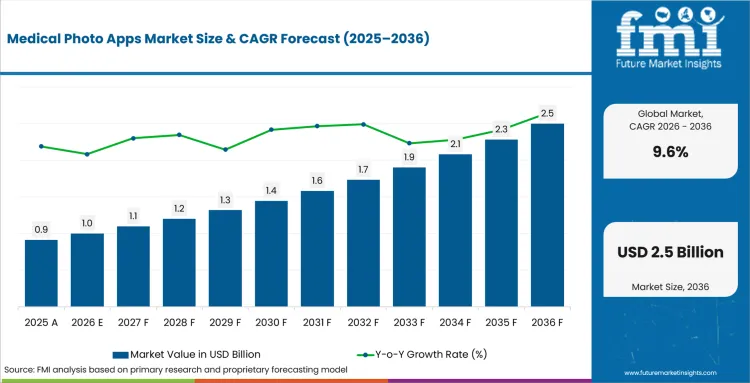
- Market Size (2026)
- USD 1.0 Bn
- Forecast (2036)
- USD 2.5 Bn
- CAGR (2026 to 2036)
- 9.6%
How big is Medical Photo Apps Market in 2026?
USD 1.0 billion in 2026 and USD 2.5 billion by 2036 at a 9.6% CAGR.
Medical photo app demand is projected to expand at a 9.6% CAGR between 2026 and 2036, increasing valuation from USD 1.0 billion in 2026 to USD 2.5 billion by 2036. Clinical teams need controlled capture to preserve body-site context and secure routing that personal-camera workflows often lose. NHS Dumfries and Galloway reviewed its clinical photography guidance in July 2025 and directed staff to submit images through an approved dermatology application. The guidance requires orientation and close-up photographs with dependable focus so medical imaging software can preserve image context for authorized care teams. Applications gain commercial value through consistent identity controls and clinical context rather than better phone cameras or larger storage libraries.
Remote assessment expands the addressable workflow by giving clinicians comparable photographs between physical appointments and specialist reviews across several care specialties. An image remains useful if the receiving service can verify patient identity and preserve the clinical purpose of capture. The Australian Digital Health Agency specified in September 2025 that clinical communication systems should use healthcare identifiers and support FHIR and DICOM standards for image exchange. The stated identifier and exchange requirements give telehealth and telemedicine programs a defined route for transferring photographs between approved systems without losing record context. Smaller practices may delay deployment if interface work and staff training outweigh remote-review benefits during early use.
Key Takeaways of Medical Photo Apps Market
- Hospitals and specialty practices replace personal-device photography with governed capture that preserves patient identity and supports reliable clinical comparison across repeated visits.
- By product type, clinical photography apps are estimated to hold 31.0% share in 2026 owing to their role in standardized capture and record-linked documentation.
- The dermatology segment is likely to capture 34.0% share in 2026 attributable to frequent lesion monitoring and repeated visual comparison across specialist appointments.
- Hospitals are set to lead the end user category with 36.0% share in 2026 due to shared governance across several clinical departments.
- Privacy exposure and inconsistent positioning remain material barriers that weaken identification and comparison across separate care episodes.
- VisualDx and SkinVision compete through image-based dermatology decisions, while FotoFinder Systems and Canfield Scientific emphasize standardized specialist imaging. MetaOptima Technology and RxPhoto by PatientNow provide connected image-management workflows, whereas Miiskin and SkinIO extend remote monitoring through guided patient submission and defined review routes.
Analyst Perspective
"Medical photo apps earn institutional trust through photographs that preserve patient identity, body-site context and recorded consent. Hospitals value faster remote review but reject workflows that leave images inside personal galleries or disconnected archives. Applications can expand across departments by reducing capture errors and entering existing records without weakening clinical accountability. The winning model balances simpler capture with strict record ownership across every participating clinical service line."
- Anurag Sharma, Principal Analyst, Future Market Insights
How is the Medical Photo Apps Market segmented?
The Medical Photo Apps market is segmented by Product Type, Application, End User, Distribution Channel, Platform, and Region.
The segmentation framework separates medical photo apps according to capture purpose and the clinical route that receives each image. Product type distinguishes general photography tools from specialty applications that guide positioning and retain body-site context across repeated visits. Application follows the care task that creates the photograph and determines whether longitudinal comparison or immediate review carries greater value. Oral documentation shares several workflow requirements with dental imaging equipment used inside structured patient records. Eye-care teams provide a separate comparison through ophthalmic diagnostic equipment that supports controlled specialist review and image-linked follow-up. End user and distribution channel identify purchasing authority, while platform distinguishes mobile and cloud environments used for governed access across approved clinical teams.
What supports demand for clinical photography apps within the product type category?
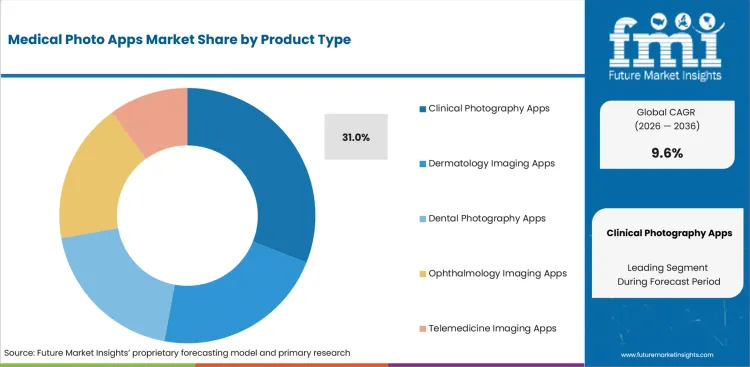
Clinical photography apps control the first step between image capture and a usable patient record across several specialties. Guided entry reduces the risk that body-site details or visit context disappear during transfer into clinical documentation. VisualDx introduced a redesigned home screen in January 2025 that placed its Analyze a Photo route beside diagnosis and differential workflows. The change embeds photographic review inside an established decision path instead of isolating images inside a separate gallery. Comparable controls support surgical wound care teams that require secure image transfer and dependable patient matching.
- Clinical photography apps are likely to capture 31.0% share in 2026 attributable to repeatable capture across several clinical specialties. Guided framing and linked patient records reduce duplicate photography that consumes staff time and weakens comparison quality. One platform receives budget preference if it supports routine documentation without creating separate image repositories for every department.
- Hospital teams usually begin with one department and a defined image protocol that permits controlled workflow testing. Clinical managers measure record matching and staff adherence during the initial deployment period across participating teams. Expansion weakens if uploads require manual reclassification or photographs enter the record without reliable body-site and consent information.
Why does dermatology lead the application category?
Longitudinal dermatology workflows depend on visible change across lesions and chronic skin conditions over several appointments. Canfield Scientific reported in December 2025 that the Australian Skin Cancer Foundation launched a mobile clinic using VECTRA WB360 imaging and connected body-mapping software. The deployment places dermatology devices near underserved communities and retains specialist review for lesions requiring further examination. Standardized mobile capture therefore extends access without separating photographs from the specialist referral pathway used in regional screening.
- Dermatology is set to lead the application category with 34.0% share in 2026 due to frequent photographic documentation across screening and treatment follow-up. Repeated visual decisions create stronger workflow demand than a single image captured without meaningful longitudinal context. Clinics gain value by comparing consistent views without searching through personal phones or disconnected folders.
- Specialty clinics favor applications that reproduce lesion position and preserve visit chronology across repeated clinical examinations. Dermatologists also need a clear escalation route for uncertain photographs that require dermoscopy or direct examination. Adoption slows if an application presents automated output without explaining image-quality limits or the circumstances requiring specialist review.
How do hospitals shape the end user category?
Hospital information teams review personal-device controls to prevent unmanaged photographs from bypassing consent and record policies. Approval work focuses on secure transfer into the official record rather than camera quality alone. NHS England updated its bring-your-own-device guidance in January 2026 and directed staff to use approved clinical photography applications during secure record transfer. The guidance makes application approval and transfer testing part of hospital deployment across participating clinical services. Shared governance keeps clinical workflow solutions aligned with departmental access and incident responsibilities across participating hospital services.
- By end user, hospitals are forecast to represent 36.0% share in 2026 due to governance needs across several departments. Central contracts can cover identity controls and retention policies that smaller practices often manage independently. The segment retains its position if one implementation serves several clinical teams without weakening access control or local workflow ownership.
- Hospital adoption often advances through one controlled service line that establishes capture rules and escalation ownership. Information teams then test integration load and user access during a defined pilot period across participating sites. Expansion becomes difficult if bedside staff need several logins or technical teams cannot resolve routing failures during active care.
What makes direct enterprise licensing central to the distribution channel category?
Enterprise licensing places implementation responsibility inside one contract covering user access and support alongside permitted clinical use. Distributed health systems prefer one account structure for clinicians working across several locations and service lines. A common review route strengthens centralized clinical accountability across the same network during implementation and expansion. VisualDx announced in July 2026 that Sun River Health deployed its full visual clinical decision-support platform for nearly 500 providers across 50 New York locations. Enterprise contracts gain value through electronic medical records onboarding and consistent technical support across participating sites.
- Direct enterprise licensing is projected to hold 38.0% share in 2026 owing to contract control over deployment and technical support. Health systems can negotiate role access and data handling across several locations through one agreement. Integrated service obligations and interface performance make the channel preferable to separately priced application downloads.
- Health system administrators use enterprise agreements to define implementation milestones and support response times ahead of clinical expansion. Central administration reduces individual account setup across large health systems and participating departments at multiple sites. Contract value weakens if agreements leave data export and interface remediation unclear or require custom work for every connection.
Why do cloud-based applications lead the platform category?
Cloud deployment allows approved users to review clinical photographs across locations without copying files between personal devices. Central hosting provides one administrative point for access rights and software updates across participating practices. Miiskin announced a partnership with Photon Health in July 2025 that embedded prescription management inside its digital dermatology provider portal. The integration keeps patient submissions and treatment actions inside one managed workflow for dermatology practices. Connected clinical tasks increase the value of healthcare cloud infrastructure, but hosting location and restoration procedures remain material purchasing conditions.
- Based on platform, cloud-based applications are projected to account for 35.0% share in 2026 due to centralized access and managed updates. Health systems can apply one retention policy across distributed users without maintaining local repositories at each site. The position depends on dependable connectivity and clear separation between clinical records and promotional image libraries.
- Multisite practices use cloud applications to review progress photographs without maintaining separate servers at every clinic. Administrators can update access rights as clinicians change locations or responsibilities during routine staffing changes across the organization. Adoption remains constrained if connectivity is unreliable or contracts leave regional data hosting and restoration procedures unclear.
What are the drivers, restraints, and opportunities in the Medical Photo Apps Market?
Longitudinal visual care supports demand, privacy exposure limits adoption, and interoperable image records provide a practical route into routine clinical workflows.
- Driver: Remote and longitudinal care requires comparable clinical photographs that remain connected to the correct patient record across repeated appointments.
- Restraint: Privacy exposure and inconsistent capture reduce clinical trust whenever applications lack dependable identity controls and clear escalation responsibilities.
- Opportunity: Interoperable image records can connect guided capture with clinical communication systems and approved electronic health information exchange.
Remote follow-up depends on photographs that clinicians can compare across separate visits without losing body-site or patient context. Community screening becomes more useful through a defined specialist review route that receives each captured image. Canfield Scientific reported in December 2025 that Sinclair Dermatology began free screening with VECTRA WB360 whole-body imaging. The service links baseline photography with later lesion assessment instead of leaving images as isolated records. Medical photo apps gain sustained demand by preserving this sequence across routine care and repeated specialist review.
Clinical photographs combine identity clues and health information in one file, which raises privacy risk beyond ordinary mobile documentation. The Office of the Australian Information Commissioner reported in July 2026 that health service providers accounted for 225 breach notifications during 2025. The notification volume increases remediation exposure for hospitals that use photography across several clinical departments. Security teams therefore review encryption and access logs alongside retention ownership during institutional application approval. Applications gain an advantage by removing images from personal galleries and assigning clear incident responsibilities.
Interoperable image records connect guided capture with specialist care by transferring patient-linked photographs into existing records without manual reclassification. Hospitals require patient identifiers and standard exchange formats for every transfer across participating clinical systems. The product test extends beyond secure storage to dependable exchange with established records across separate care settings. The Australian Digital Health Agency specified in September 2025 that specialty systems should support healthcare identifiers, FHIR interfaces and DICOM medical imaging. The stated interoperability requirements define a direct test for medical photo apps and related healthcare interoperability solutions.
Which country CAGRs are profiled in the Medical Photo Apps Market?
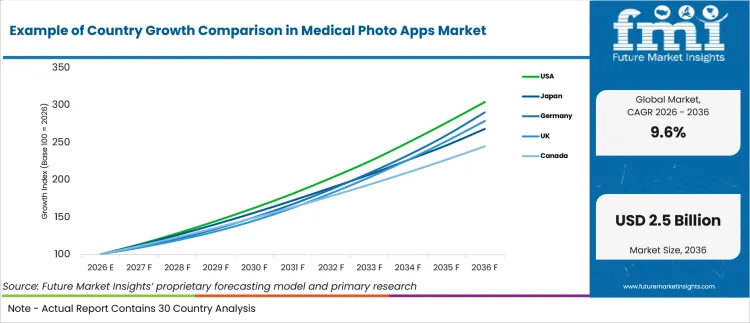
| Country | CAGR |
|---|---|
| USA | 11.8% |
| Germany | 11.2% |
| UK | 10.8% |
| Japan | 10.4% |
| Brazil | 9.9% |
| Canada | 9.4% |
| Australia | 9.0% |
How do country-level CAGRs compare in the Medical Photo Apps Market?
The forecasts form a gradual progression rather than separate growth tiers across the seven profiled countries. Limited separation between the USA and Germany reflects established digital record investment but does not imply identical purchasing routes. The UK and Japan combine formal identity controls with demanding institutional evaluation across different care systems. Brazil and Canada rely more heavily on distributed telehealth structures, while Australia combines national standards with close privacy scrutiny. The 2.8 percentage-point range therefore reflects differences in integration readiness and service coverage rather than a simple measure of current adoption.
- The USA benefits from large integrated health systems that can connect governed photography with national record-exchange infrastructure across several specialties.
- Germany combines national electronic patient records with demanding institutional data protection and local support requirements for clinical image applications.
- United Kingdom adoption follows national information standards, but centralized evaluation can extend implementation timelines for unfamiliar clinical photography workflows.
- Japan links digital access with verified identity and dependable local service, creating a controlled route for patient-linked image exchange.
- Brazil uses public telehealth pathways to extend specialist access, yet fragmented purchasing and uneven connectivity complicate wider clinical photography deployment.
- Canada combines connected-care policy with provincial decision authority, so applications need adaptable interfaces and regional implementation support.
- Australia offers defined national communication standards, but privacy exposure and long service distances increase operational scrutiny outside major cities.
Different privacy ownership and integration responsibilities produce distinct entry conditions even among countries with similar growth rates. The full report provides country-level CAGR analysis across North America, Latin America, Europe, East Asia, South Asia, Oceania and the Middle East and Africa.
Country-wise Analysis
- Large United States health systems require clinical photography applications to preserve patient identity and professional review routes across several care settings. In the USA, medical photo app demand is predicted to advance at 11.8% CAGR through 2036, supported by specialist access needs and mobile dermatology services. SkinVision announced a pivotal trial with Mayo Clinic in March 2026 to support its United States regulatory pathway. The trial gives smartphone-based skin assessment a defined commercialization route under professional evaluation and regulatory review. State privacy rules and complex hospital interfaces remain material deployment frictions that require accountable implementation partners and clear incident ownership across departments.
- Germany requires clinical image applications to align with institutional data protection and the national electronic patient record environment. National record testing determines whether photography applications can enter shared care workflows without separate local archives. Germany's medical photo apps outlook is anticipated to advance at 11.2% CAGR over the assessment period, influenced by structured digital health adoption. The Federal Ministry of Health started electronic patient record testing in January 2025 across roughly 300 practices and healthcare organizations. The pilot gives governed photography applications a defined route into participating care settings and shared clinical records. Certification review and demanding local service expectations create practical implementation frictions for international application developers. German-language support and dependable export functions are required for wider hospital deployment across participating departments.
- National information standards establish the operating baseline for clinical image exchange across health services in England and influence wider United Kingdom deployments. Central purchasing can support broad use but places substantial weight on clinical safety evidence and service continuity. The Department of Health and Social Care published mandatory information standards guidance in March 2025 for public and private providers in England. The UK medical photo apps market is estimated to post 10.8% CAGR over the forecast period, supported by common digital requirements and specialist teleconsultation. Lengthy purchasing cycles remain a material friction for applications seeking contracts across regional health systems. Regional contracts depend on proven record integration and dependable support across participating healthcare organizations during implementation.
- Japan links digital care access with verified identity and consent at participating medical institutions and connected clinical records. The Ministry of Health enabled smartphone My Number insurance-card use from September 2025 with authentication and consent entry requirements at equipped providers. The Japan medical photo apps sector is projected to record 10.4% CAGR during the assessment period, aided by dense specialist networks and digital identity tools. The identity route gives clinical photography applications a clearer method for matching submitted images with the correct patient. Local integration and extended service approval remain material frictions that require Japanese-language workflows and dependable technical support for wider hospital deployment.
- Brazil has formal telehealth pathways that connect remote specialist services with public digital health infrastructure. Medical photo app sales in Brazil are forecast to expand at 9.9% CAGR by 2036, supported by regional specialist access needs and formal telehealth routes. The Ministry of Health opened a public call in August 2025 to accredit private telehealth providers for services delivered through the national health system. The accreditation route can support image-based review across participating services without requiring every patient to reach a specialist site. Fragmented purchasing and uneven connectivity remain material frictions across regional health networks and provider organizations. Wider deployment beyond major urban networks depends on Portuguese workflows and resilient upload options for regional providers.
- Provincial health systems make interoperability and data governance central entry conditions for clinical photography applications across Canada. Federal investment is expanding shared data infrastructure but provincial authorities retain control over purchasing and implementation. Medical photo app demand in Canada is forecast to rise at 9.4% CAGR over the forecast period, influenced by remote access needs and common data standards. Innovation, Science and Economic Development Canada reported in June 2026 that the government would invest USD 100 million in VITAL to integrate medical imaging data and expand participation to rural hospitals. The initiative strengthens the exchange environment, yet provincial purchasing differences and dispersed service coverage remain material frictions. Platforms need adaptable interfaces and regional support arrangements across provincial health authorities and remote care networks.
- Australian clinical image systems must protect patient identity and support secure communication across metropolitan and regional care settings. The Office of the Australian Information Commissioner reported in November 2025 that health organizations produced 18% of notified breaches during the first half of that year. The finding reinforces privacy review for applications that store patient photographs across distributed clinical teams. Adoption of medical photo apps in Australia is estimated to expand at 9.0% CAGR through 2036, supported by remote-care needs and national communication standards. Long service distances remain a material support friction for regional hospitals and specialist practices outside major cities. Regional hospitals require explicit hosting controls and dependable remote technical assistance for wider clinical use.
Who are the notable companies in the Medical Photo Apps Market?
VisualDx, SkinVision, Miiskin, FotoFinder Systems, Canfield Scientific, MetaOptima Technology, RxPhoto by PatientNow, and SkinIO are notable companies shaping the Medical Photo Apps market.
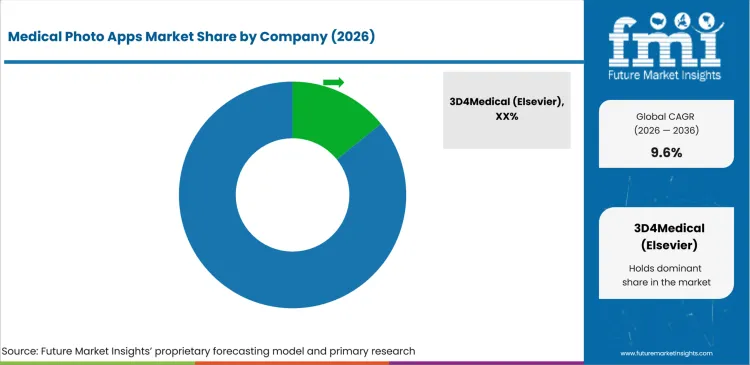
Competition remains fragmented across clinical decision-support applications and specialist imaging platforms that address different photography tasks. Hardware-linked platforms build switching costs through standardized positioning and accumulated image histories across specialist practices. Mobile applications compete through consent controls and simpler deployment across distributed care teams and patient workflows. Narrow specialty entry remains possible but institutional expansion requires reliable integration and clear clinical accountability. Companies extend their positions through connected imaging modules, referral pathways and practice-management links rather than broad consumer-camera features.
- RxPhoto by PatientNow and Canfield Scientific support guided photography and organized patient records across specialty practices. Their commercial test is repeatable capture and dependable record linkage rather than broad consumer engagement. Hospitals evaluate implementation support to prevent poor configuration from weakening image consistency across participating clinical teams.
- VisualDx and SkinVision connect patient photographs with dermatology assessment through different professional and consumer-facing routes. Miiskin and SkinIO extend remote review through patient-submitted images and specialist escalation across defined care pathways. Institutional selection depends on whether each route preserves clinical responsibility and supports dependable follow-up across repeated patient reviews.
- FotoFinder Systems and MetaOptima Technology combine software with standardized imaging environments for total-body mapping and repeated comparison. Their systems compete through reproducible capture and longitudinal review across specialist dermatology workflows and repeated patient assessments. Imaging hardware and accumulated histories raise entry barriers by increasing switching costs for established specialist clinics.
Competitive Benchmarking: Medical Photo Apps Market
| Company | Capture Standardization | Longitudinal Image Management | Clinical Record Integration | Geographic Reach |
|---|---|---|---|---|
| VisualDx | Medium | Low | High | Global |
| SkinVision | Medium | Medium | Low | Europe and selected international markets |
| Miiskin | Medium | Medium | Medium | United States and Mexico |
| FotoFinder Systems | High | High | Low | Global |
| Canfield Scientific | High | High | Medium | Global |
| MetaOptima Technology | High | High | Medium | Canada and international |
| RxPhoto by PatientNow | High | High | High | North America |
| SkinIO | High | High | High | United States |
Key Developments in the Medical Photo Apps Market
- In March 2026, Canfield Scientific launched a VISIA facial skin analysis system that combines two-dimensional and three-dimensional imaging inside one consultation platform. The release added volumetric measurements to established skin-analysis workflows and gave medical and cosmetic practices a new route for standardized facial documentation. Practices can justify the combined platform if volumetric analysis improves repeat assessment without adding capture complexity during routine consultations.
- In June 2025, VisualDx completed a SOC 2 examination covering security trust criteria for its clinical decision-support platform. The certification gives hospital security teams a documented review point for a system that combines medical imagery with clinical information. Hospital expansion requires those controls to remain effective across authentication, data exchange and remote review during routine use at distributed care sites.
- In September 2025, Miiskin received a grant worth USD 0.2 million from the Danish Innovation Fund for generative artificial intelligence work in dermatology. The project targets non-clinical workflow tasks such as organizing patient-submitted information and routine communication inside the provider platform. The project must reduce administrative work at participating practices without weakening clinician oversight or privacy controls during asynchronous care.
- In September 2025, MetaOptima secured INOVAIT Pilot Fund support for OptimaScan through Canada’s Strategic Innovation Fund. OptimaScan combines controlled three-dimensional body photography with DermEngine software for annotation and longitudinal comparison across specialist reviews. The project expands MetaOptima’s route into standardized clinical documentation and preserves a cloud-based environment for connected review and image-guided follow-up. The funding lowers commercialization risk for a platform that requires coordinated imaging hardware and cloud software.
Medical Photo Apps Market - Report Scope
| Coverage field | Report scope |
|---|---|
| Market breakdown | Product Type, Application, End User, Distribution Channel, Platform, and Region. |
| Quantitative Units | Revenue in USD Billion and CAGR in %. |
| Market Definition | Applications that capture and label clinical photographs before storing and comparing them for medical documentation and review. |
| Regions Covered | North America, Latin America, Western Europe, East Asia, South Asia and Pacific, and the Middle East and Africa. |
| Countries Covered | USA, Germany, UK, Japan, Brazil, Canada, and Australia. |
| Key Companies Profiled | VisualDx, SkinVision, Miiskin, FotoFinder Systems, Canfield Scientific, MetaOptima Technology, RxPhoto by PatientNow, and SkinIO. |
| Forecast Period | 2026 to 2036. |
| Approach | Hybrid bottom-up and top-down market sizing supported by primary interviews and official desk research. |
Medical Photo Apps Market - Research Methodology
| Method | Approach |
|---|---|
| Primary Research | FMI analysts gathered input from manufacturers, service providers, technology developers, distributors, end users, procurement teams, and subject-matter experts. Interviews examined purchasing decisions, product or service evaluation, adoption barriers, approval requirements, pricing considerations, and expectations for technical or commercial support. Respondents were also asked what evidence is required before a trial, pilot, or initial order develops into regular purchasing. |
| Desk Research | Desk research covered government statistics, regulatory publications, trade data, industry associations, technical literature, standards, company filings, product information, and official corporate announcements. Sources were reviewed for relevance, publication date, geographic coverage, and consistency with the defined market scope. Claims relating to performance, applications, approvals, capacity, investment, and commercial activity were retained only when supported by credible public evidence. |
| Market Sizing and Forecasting | The market model combined the baseline value with historical performance, segment structure, pricing and volume indicators, adoption levels, company participation, and country-level demand conditions. Forecast assumptions considered economic activity, investment trends, regulatory developments, technology adoption, purchasing cycles, supply availability, and barriers to wider market use. Segment and regional estimates were reconciled before the final market total was calculated. |
| Data Validation | Estimates were checked against multiple independent indicators, including public data, company activity, trade patterns, industry developments, and findings from primary interviews. Validation also tested whether products, services, applications, and company revenues fell within the defined market boundaries. Adjacent categories, unsupported claims, overlapping revenues, and activities without direct market relevance were excluded to reduce double counting and maintain consistency across segments and countries. |
Medical Photo Apps Market by Segments
Medical Photo Apps Market segmented by Product Type:
- Clinical Photography Apps
- Wound Imaging Apps
- General Medical Photography Apps
- Dermatology Imaging Apps
- Skin Lesion Imaging Apps
- Mole Tracking Apps
- Dental Photography Apps
- Orthodontic Imaging Apps
- Cosmetic Dentistry Imaging Apps
- Ophthalmology Imaging Apps
- Retinal Imaging Apps
- Anterior Eye Imaging Apps
- Telemedicine Imaging Apps
- Remote Patient Imaging Apps
- Virtual Consultation Imaging Apps
Medical Photo Apps Market segmented by Application:
- Dermatology
- Skin Cancer Assessment
- Chronic Skin Disease Monitoring
- Wound Care
- Post-Surgical Wound Monitoring
- Diabetic Ulcer Assessment
- Plastic & Cosmetic Surgery
- Preoperative Documentation
- Postoperative Progress Tracking
- Dentistry
- Orthodontic Documentation
- Oral Disease Assessment
- Ophthalmology
- Retinal Disease Documentation
- Corneal Imaging
Medical Photo Apps Market segmented by End User:
- Hospitals
- Public Hospitals
- Private Hospitals
- Dermatology Clinics
- Specialty Dermatology Clinics
- Aesthetic Clinics
- Physician Practices
- Primary Care Clinics
- Specialist Clinics
- Telehealth Providers
- Virtual Care Providers
- Remote Monitoring Providers
- Academic & Research Institutes
- Medical Universities
- Clinical Research Centers
Medical Photo Apps Market segmented by Distribution Channel:
- Direct Enterprise Licensing
- Hospital Contracts
- Healthcare Network Agreements
- Mobile App Stores
- iOS App Store
- Google Play Store
- Software as a Service (SaaS)
- Cloud Subscription
- Annual Enterprise Subscription
- Value-Added Resellers
- Healthcare IT Partners
- Medical Device Integrators
- Online Healthcare Marketplaces
- Digital Health Platforms
- B2B Software Marketplaces
Medical Photo Apps Market segmented by Platform:
- Cloud-Based Applications
- Public Cloud Deployment
- Private Cloud Deployment
- Mobile Applications
- iOS Applications
- Android Applications
- Web-Based Platforms
- Browser-Based Solutions
- Progressive Web Applications
- Desktop Applications
- Windows Applications
- macOS Applications
- Hybrid Platforms
- Cross-Platform Applications
- Integrated Healthcare Platforms
Medical Photo Apps Market by Region:
- North America
- USA
- Canada
- Latin America
- Brazil
- Western Europe
- Germany
- United Kingdom
- East Asia
- Japan
- South Asia and Pacific
- Australia
- Middle East and Africa
- Additional countries covered in the full regional model
Research Sources and Bibliography
- NHS Dumfries and Galloway. (2025, July 7). Taking a clinical photo.
- Australian Digital Health Agency. (2025, September 22). Clinical Communication System.
- VisualDx. (2025, January 16). A New VisualDx Experience: Check Out The New Home Screen.
- Canfield Scientific. (2025, December 1). Canfield’s VECTRA® WB360 is on Wheels! Australian Skin Cancer Foundation Launches New 3D Skin Check Mobile Clinic.
- NHS England. (2026, January 29). Bring your own device (BYOD).
- VisualDx. (2026, July 8). VisualDx Partners with Sun River Health to Expand Access to Clinical Decision Support for Underserved Patients.
- Canfield Scientific. (2025, December 10). Prof. Rod Sinclair, MD Offers Free Skin Screenings with Canfield’s VECTRA® WB360.
- Office of the Australian Information Commissioner. (2026, July 6). Data breach notifications increase to all-time high in 2025, new NDB stats show.
- Australian Digital Health Agency. (2025, September 22). Specialty Systems.
- VisualDx. (2025, June 13). VisualDx Successfully Completes SOC 2 Audit.
- Bundesministerium für Gesundheit. (2025, January 14). ePA für alle in Modellregionen gestartet.
- Department of Health and Social Care. (2025, March 25). Health and Care Act 2022: information standards.
- Ministry of Health, Labour and Welfare of Japan. (2025, September 19).
- Ministry of Health of Brazil. (2025, August 22). Chamamento Público nº 02/2025 - Secretaria de Informação e Saúde Digital (SEIDIGI).
- Innovation, Science and Economic Development Canada. (2026, June 23). Government of Canada invests $100 million in VITAL health data platform.
- Office of the Australian Information Commissioner. (2025, November 4). OAIC launches new dashboard for data breaches.
- Canfield Scientific. (2026, March 25). Canfield Scientific Premieres Next Generation VISIA® Skin Analysis. Now in 3D.
- SkinVision. (2026, March 16). SkinVision Collaborates on Pivotal Trial to Improve Access to Dermatology Care in the United States.
- Miiskin. (2025, September 9). Miiskin Awarded Innovation Fund Grant to Advance Dermatology with Generative AI.
- The DermEngine Team. (2025, September 25). Healing with Technology: OptimaScan + DermEngine.
- VisualDx. (2026, July 8). Designed for the Way Clinicians Think: New VisualDx Enhancements.
- SkinVision. (2025, August 5). SkinVision Earns Europe’s Top Medical Certification for AI-Powered Skin Cancer Detection.
- Miiskin. (2025, July 15). Miiskin Announces Strategic Partnership With Photon to Simplify ePrescriptions for Dermatology Providers and Patients.
- FotoFinder Systems. (2025, July 8). A new chapter together with GHO Capital Partners.
- The RxPhoto Team. (2025, October 22). RxPhoto Wins At The Aesthetic Awards 2025.
This bibliography is provided for reader reference and is not exhaustive. The full report contains the complete reference list and detailed citations
This Report Answers
- How large is the Medical Photo Apps market in 2026 and 2036?
- Which clinical workflows create demand for governed medical photography applications?
- Why do clinical photography apps account for the selected product type share in 2026?
- How does dermatology influence application-level adoption and product requirements?
- Why do hospitals represent the selected end user share in 2026?
- How do country growth rates differ across the USA and six other profiled markets?
- Which companies provide clinical photography or dermatology imaging applications?
- What privacy and integration barriers can delay enterprise deployment?
- How can interoperable image records support wider clinical use?
Frequently Asked Questions
How big is the Medical Photo Apps Market in 2026?
The medical photo apps market is valued at USD 1.0 billion in 2026 and is forecast to reach USD 2.5 billion by 2036. Growth is supported by hospitals and specialty practices replacing personal-device photography with governed capture that preserves patient identity across repeated clinical visits.
What is the CAGR of the Medical Photo Apps Market from 2026 to 2036?
The medical photo apps market grows at a CAGR of 9.6% between 2026 and 2036, supported by remote and longitudinal care needs that require comparable clinical photographs connected to the correct patient record across repeated appointments and specialist reviews within governed clinical workflows.
Which product type leads the Medical Photo Apps Market?
Clinical photography apps lead the medical photo apps market by product type with 31.0% share in 2026, driven by guided framing and record-linked documentation that reduce duplicate photography and preserve body-site context across repeated clinical visits and specialties for participating hospital staff.
How much will the Medical Photo Apps Market add between 2026 and 2036?
The medical photo apps market is set to add USD 1.5 billion between 2026 and 2036, growing from USD 1.0 billion to USD 2.5 billion as governed photography applications enter routine clinical documentation across a widening base of hospitals and specialty practices.
Who are the leading companies in the Medical Photo Apps Market?
Eight companies lead the medical photo apps market, including VisualDx, SkinVision, Miiskin, FotoFinder Systems, Canfield Scientific, MetaOptima Technology, RxPhoto by PatientNow, and SkinIO, competing through standardized capture, longitudinal image management and clinical record integration across specialist dermatology and hospital workflows.
Preview the report firsthand - request a free sample
Get SampleGet the brochure for pricing and purchase details.
Get PDFTable of Content
- Key Takeaways
- Market Size and CAGR
- Top Growth Driver
- Fastest Growing Segment
- Leading Region
- Key Companies
- Emerging Opportunities
- Executive Summary
- Global Market Outlook
- Demand-side Trends
- Supply-side Trends
- Technology Roadmap Analysis
- Analysis and Recommendations
- Analyst Perspective (What is happening? Why now? What should investors know?)
- Key Questions Answered
- How large is the market?
- What is the CAGR?
- What are key trends?
- Which region dominates?
- Who are the leaders?
- Market Overview
- Market Coverage / Taxonomy
- Market Definition / Scope / Limitations
- Research Methodology
- Chapter Orientation
- Analytical Lens and Working Hypotheses
- Market Structure, Signals, and Trend Drivers
- Benchmarking and Cross-market Comparability
- Market Sizing, Forecasting, and Opportunity Mapping
- Research Design and Evidence Framework
- Desk Research Programme (Secondary Evidence)
- Expert Input and Fieldwork (Primary Evidence)
- Tooling, Models, and Reference Databases
- Data Engineering and Model Build
- Quality Assurance and Audit Trail
- Market Background
- Market Dynamics (Drivers, Restraints, Opportunity, Trends)
- Scenario Forecast (Optimistic, Likely, Conservative)
- Impact Analysis
- AI Impact
- Sustainability Impact
- Regulatory Impact
- Technology Impact
- Consumer / Buyer Analysis
- Purchase Drivers
- Adoption Barriers
- Buyer Journey
- Opportunity Map Analysis
- Product Life Cycle Analysis
- Supply Chain Analysis
- Investment Feasibility Matrix
- Value Chain Analysis
- PESTLE and Porter's Analysis
- Regulatory Landscape
- Regional Parent Market Outlook
- Production and Consumption Statistics
- Import and Export Statistics
- Global Market Analysis and Forecast, 2021 to 2036
- Historical Market Size Value (USD Billion) Analysis, 2021 to 2025
- Current and Future Market Size Value (USD Billion) Projections, 2026 to 2036
- Y-o-Y Growth Trend Analysis
- Absolute $ Opportunity Analysis
- Global Market Pricing Analysis, 2021 to 2036
- Global Market Analysis and Forecast, By Product Type, 2021 to 2036
- Introduction / Key Findings
- Historical Market Size Value (USD Billion) Analysis By Product Type, 2021 to 2025
- Current and Future Market Size Value (USD Billion) Analysis and Forecast By Product Type, 2026 to 2036
- Clinical Photography Apps
- Wound Imaging Apps
- General Medical Photography Apps
- Dermatology Imaging Apps
- Skin Lesion Imaging Apps
- Mole Tracking Apps
- Dental Photography Apps
- Orthodontic Imaging Apps
- Cosmetic Dentistry Imaging Apps
- Ophthalmology Imaging Apps
- Retinal Imaging Apps
- Anterior Eye Imaging Apps
- Telemedicine Imaging Apps
- Remote Patient Imaging Apps
- Virtual Consultation Imaging Apps
- Clinical Photography Apps
- Y-o-Y Growth Trend Analysis By Product Type, 2021 to 2025
- Absolute $ Opportunity Analysis By Product Type, 2026 to 2036
- Global Market Analysis and Forecast, By Application, 2021 to 2036
- Introduction / Key Findings
- Historical Market Size Value (USD Billion) Analysis By Application, 2021 to 2025
- Current and Future Market Size Value (USD Billion) Analysis and Forecast By Application, 2026 to 2036
- Dermatology
- Skin Cancer Assessment
- Chronic Skin Disease Monitoring
- Wound Care
- Post-Surgical Wound Monitoring
- Diabetic Ulcer Assessment
- Plastic & Cosmetic Surgery
- Preoperative Documentation
- Postoperative Progress Tracking
- Dentistry
- Orthodontic Documentation
- Oral Disease Assessment
- Ophthalmology
- Retinal Disease Documentation
- Corneal Imaging
- Dermatology
- Y-o-Y Growth Trend Analysis By Application, 2021 to 2025
- Absolute $ Opportunity Analysis By Application, 2026 to 2036
- Global Market Analysis and Forecast, By End User, 2021 to 2036
- Introduction / Key Findings
- Historical Market Size Value (USD Billion) Analysis By End User, 2021 to 2025
- Current and Future Market Size Value (USD Billion) Analysis and Forecast By End User, 2026 to 2036
- Hospitals
- Public Hospitals
- Private Hospitals
- Dermatology Clinics
- Specialty Dermatology Clinics
- Aesthetic Clinics
- Physician Practices
- Primary Care Clinics
- Specialist Clinics
- Telehealth Providers
- Virtual Care Providers
- Remote Monitoring Providers
- Academic & Research Institutes
- Medical Universities
- Clinical Research Centers
- Hospitals
- Y-o-Y Growth Trend Analysis By End User, 2021 to 2025
- Absolute $ Opportunity Analysis By End User, 2026 to 2036
- Global Market Analysis and Forecast, By Distribution Channel, 2021 to 2036
- Introduction / Key Findings
- Historical Market Size Value (USD Billion) Analysis By Distribution Channel, 2021 to 2025
- Current and Future Market Size Value (USD Billion) Analysis and Forecast By Distribution Channel, 2026 to 2036
- Direct Enterprise Licensing
- Hospital Contracts
- Healthcare Network Agreements
- Mobile App Stores
- iOS App Store
- Google Play Store
- Software as a Service (SaaS)
- Cloud Subscription
- Annual Enterprise Subscription
- Value-Added Resellers
- Healthcare IT Partners
- Medical Device Integrators
- Online Healthcare Marketplaces
- Digital Health Platforms
- B2B Software Marketplaces
- Direct Enterprise Licensing
- Y-o-Y Growth Trend Analysis By Distribution Channel, 2021 to 2025
- Absolute $ Opportunity Analysis By Distribution Channel, 2026 to 2036
- Global Market Analysis and Forecast, By Platform, 2021 to 2036
- Introduction / Key Findings
- Historical Market Size Value (USD Billion) Analysis By Platform, 2021 to 2025
- Current and Future Market Size Value (USD Billion) Analysis and Forecast By Platform, 2026 to 2036
- Cloud-Based Applications
- Public Cloud Deployment
- Private Cloud Deployment
- Mobile Applications
- iOS Applications
- Android Applications
- Web-Based Platforms
- Browser-Based Solutions
- Progressive Web Applications
- Desktop Applications
- Windows Applications
- macOS Applications
- Hybrid Platforms
- Cross-Platform Applications
- Integrated Healthcare Platforms
- Cloud-Based Applications
- Y-o-Y Growth Trend Analysis By Platform, 2021 to 2025
- Absolute $ Opportunity Analysis By Platform, 2026 to 2036
- Global Market Analysis and Forecast, By Region, 2021 to 2036
- Introduction
- Historical Market Size Value (USD Billion) Analysis By Region, 2021 to 2025
- Current Market Size Value (USD Billion) Analysis and Forecast By Region, 2026 to 2036
- North America
- Latin America
- Western Europe
- Eastern Europe
- East Asia
- South Asia and Pacific
- Middle East & Africa
- Market Attractiveness Analysis By Region
- North America Market Analysis and Forecast, By Country, 2021 to 2036
- Historical Market Size Value (USD Billion) Trend Analysis By Market Taxonomy, 2021 to 2025
- Market Size Value (USD Billion) Forecast By Market Taxonomy, 2026 to 2036
- By Country
- USA
- Canada
- By Product Type
- By Application
- By End User
- By Distribution Channel
- By Platform
- By Country
- Market Attractiveness Analysis
- By Country
- By Product Type
- By Application
- By End User
- By Distribution Channel
- By Platform
- Key Takeaways
- Latin America Market Analysis and Forecast, By Country
- Historical Market Size Value (USD Billion) Trend Analysis By Market Taxonomy, 2021 to 2025
- Market Size Value (USD Billion) Forecast By Market Taxonomy, 2026 to 2036
- By Country
- Brazil
- Mexico
- Chile
- Rest of Latin America
- By Product Type
- By Application
- By End User
- By Distribution Channel
- By Platform
- By Country
- Market Attractiveness Analysis
- By Country
- By Product Type
- By Application
- By End User
- By Distribution Channel
- By Platform
- Key Takeaways
- Western Europe Market Analysis and Forecast, By Country
- Historical Market Size Value (USD Billion) Trend Analysis By Market Taxonomy, 2021 to 2025
- Market Size Value (USD Billion) Forecast By Market Taxonomy, 2026 to 2036
- By Country
- Germany
- UK
- Italy
- Spain
- France
- Nordic
- BENELUX
- Rest of Western Europe
- By Product Type
- By Application
- By End User
- By Distribution Channel
- By Platform
- By Country
- Market Attractiveness Analysis
- By Country
- By Product Type
- By Application
- By End User
- By Distribution Channel
- By Platform
- Key Takeaways
- Eastern Europe Market Analysis and Forecast, By Country
- Historical Market Size Value (USD Billion) Trend Analysis By Market Taxonomy, 2021 to 2025
- Market Size Value (USD Billion) Forecast By Market Taxonomy, 2026 to 2036
- By Country
- Russia
- Poland
- Hungary
- Balkan & Baltic
- Rest of Eastern Europe
- By Product Type
- By Application
- By End User
- By Distribution Channel
- By Platform
- By Country
- Market Attractiveness Analysis
- By Country
- By Product Type
- By Application
- By End User
- By Distribution Channel
- By Platform
- Key Takeaways
- East Asia Market Analysis and Forecast, By Country
- Historical Market Size Value (USD Billion) Trend Analysis By Market Taxonomy, 2021 to 2025
- Market Size Value (USD Billion) Forecast By Market Taxonomy, 2026 to 2036
- By Country
- China
- Japan
- South Korea
- By Product Type
- By Application
- By End User
- By Distribution Channel
- By Platform
- By Country
- Market Attractiveness Analysis
- By Country
- By Product Type
- By Application
- By End User
- By Distribution Channel
- By Platform
- Key Takeaways
- South Asia and Pacific Market Analysis and Forecast, By Country
- Historical Market Size Value (USD Billion) Trend Analysis By Market Taxonomy, 2021 to 2025
- Market Size Value (USD Billion) Forecast By Market Taxonomy, 2026 to 2036
- By Country
- India
- ASEAN
- Australia & New Zealand
- Rest of South Asia and Pacific
- By Product Type
- By Application
- By End User
- By Distribution Channel
- By Platform
- By Country
- Market Attractiveness Analysis
- By Country
- By Product Type
- By Application
- By End User
- By Distribution Channel
- By Platform
- Key Takeaways
- Middle East & Africa Market Analysis and Forecast, By Country
- Historical Market Size Value (USD Billion) Trend Analysis By Market Taxonomy, 2021 to 2025
- Market Size Value (USD Billion) Forecast By Market Taxonomy, 2026 to 2036
- By Country
- Kingdom of Saudi Arabia
- Other GCC Countries
- Türkiye
- South Africa
- Other African Union
- Rest of Middle East & Africa
- By Product Type
- By Application
- By End User
- By Distribution Channel
- By Platform
- By Country
- Market Attractiveness Analysis
- By Country
- By Product Type
- By Application
- By End User
- By Distribution Channel
- By Platform
- Key Takeaways
- Key Countries Market Analysis
- USA
- Pricing Analysis
- Market Share Analysis, 2025
- By Product Type
- By Application
- By End User
- By Distribution Channel
- By Platform
- Canada
- Pricing Analysis
- Market Share Analysis, 2025
- By Product Type
- By Application
- By End User
- By Distribution Channel
- By Platform
- Mexico
- Pricing Analysis
- Market Share Analysis, 2025
- By Product Type
- By Application
- By End User
- By Distribution Channel
- By Platform
- Brazil
- Pricing Analysis
- Market Share Analysis, 2025
- By Product Type
- By Application
- By End User
- By Distribution Channel
- By Platform
- Chile
- Pricing Analysis
- Market Share Analysis, 2025
- By Product Type
- By Application
- By End User
- By Distribution Channel
- By Platform
- Germany
- Pricing Analysis
- Market Share Analysis, 2025
- By Product Type
- By Application
- By End User
- By Distribution Channel
- By Platform
- UK
- Pricing Analysis
- Market Share Analysis, 2025
- By Product Type
- By Application
- By End User
- By Distribution Channel
- By Platform
- Italy
- Pricing Analysis
- Market Share Analysis, 2025
- By Product Type
- By Application
- By End User
- By Distribution Channel
- By Platform
- Spain
- Pricing Analysis
- Market Share Analysis, 2025
- By Product Type
- By Application
- By End User
- By Distribution Channel
- By Platform
- France
- Pricing Analysis
- Market Share Analysis, 2025
- By Product Type
- By Application
- By End User
- By Distribution Channel
- By Platform
- India
- Pricing Analysis
- Market Share Analysis, 2025
- By Product Type
- By Application
- By End User
- By Distribution Channel
- By Platform
- ASEAN
- Pricing Analysis
- Market Share Analysis, 2025
- By Product Type
- By Application
- By End User
- By Distribution Channel
- By Platform
- Australia & New Zealand
- Pricing Analysis
- Market Share Analysis, 2025
- By Product Type
- By Application
- By End User
- By Distribution Channel
- By Platform
- China
- Pricing Analysis
- Market Share Analysis, 2025
- By Product Type
- By Application
- By End User
- By Distribution Channel
- By Platform
- Japan
- Pricing Analysis
- Market Share Analysis, 2025
- By Product Type
- By Application
- By End User
- By Distribution Channel
- By Platform
- South Korea
- Pricing Analysis
- Market Share Analysis, 2025
- By Product Type
- By Application
- By End User
- By Distribution Channel
- By Platform
- Russia
- Pricing Analysis
- Market Share Analysis, 2025
- By Product Type
- By Application
- By End User
- By Distribution Channel
- By Platform
- Poland
- Pricing Analysis
- Market Share Analysis, 2025
- By Product Type
- By Application
- By End User
- By Distribution Channel
- By Platform
- Hungary
- Pricing Analysis
- Market Share Analysis, 2025
- By Product Type
- By Application
- By End User
- By Distribution Channel
- By Platform
- Kingdom of Saudi Arabia
- Pricing Analysis
- Market Share Analysis, 2025
- By Product Type
- By Application
- By End User
- By Distribution Channel
- By Platform
- Türkiye
- Pricing Analysis
- Market Share Analysis, 2025
- By Product Type
- By Application
- By End User
- By Distribution Channel
- By Platform
- South Africa
- Pricing Analysis
- Market Share Analysis, 2025
- By Product Type
- By Application
- By End User
- By Distribution Channel
- By Platform
- USA
- Market Structure Analysis
- Competition Dashboard
- Competition Benchmarking
- Market Share Analysis of Top Players
- By Regional
- By Product Type
- By Application
- By End User
- By Distribution Channel
- By Platform
- Emerging Startups
- Innovation Benchmarking
- Competition Analysis
- Competition Deep Dive
- 3D4Medical (Elsevier)
- Overview
- Product Portfolio
- Profitability by Market Segments
- Sales Footprint
- Strategy Overview
- Marketing Strategy
- Product Strategy
- Channel Strategy
- CureSkin
- SkinVision
- VisualDx
- CaptureProof
- TouchMD
- CureCast
- Miiskin
- FotoFinder Systems
- Canfield Scientific
- 3D4Medical (Elsevier)
- Case Studies
- Success Stories
- Recent Developments
- Competition Deep Dive
- Assumptions & Acronyms Used


