

- Market Size (2026)
- USD 41.2 Bn
- Forecast (2036)
- USD 88.1 Bn
- CAGR (2026 to 2036)
- 7.9%
How big is the Second-Hand Furniture Market in 2026?
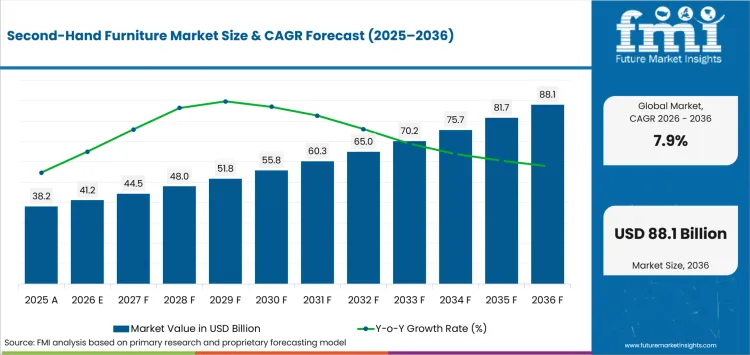
USD 41.2 billion in 2026 and USD 88.1 billion by 2036 at a 7.9% CAGR.
Demand for Second-Hand Furniture Market is projected to expand at 7.9% CAGR between 2026 and 2036. FMI estimates that the Second-Hand Furniture Market will rise from USD 41.2 billion in 2026 to USD 88.1 billion by 2036, representing a 7.9% CAGR. The forecast reflects organized resale transactions across online marketplaces, managed furniture platforms, specialist stores and charity and thrift networks and auction channels and liquidation sales.
Demand expands when the resale discount remains meaningful after transport, cleaning, repair and platform charges. Digital listing tools can increase supply quickly, but the market scales only where buyers receive enough information to evaluate fit and condition and where sellers can complete pickup or delivery without losing the price advantage.
Key Takeaways
- The market is estimated at USD 41.2 billion in 2026 and is forecast to reach USD 88.1 billion by 2036 at a 7.9% CAGR.
- Online Marketplaces lead Distribution Channel with a 42.0% share in 2026 as local search, messaging and listing tools widen supply and shorten seller onboarding.
- Residential leads Application at 58.0%, Wood leads Material at 54.0% and Beds & Headboards lead Product Type at 25.0%.
- Conversion depends on verified dimensions, credible condition grading, safe and clean inventory and a workable pickup or delivery plan.
- Bulky last-mile cost, fire-label requirements, recall screening and pest risk and product variability can erase the apparent saving versus new furniture.
- South Korea posts the highest profiled country CAGR at 8.72%, followed by Australia at 8.04% through 2036.
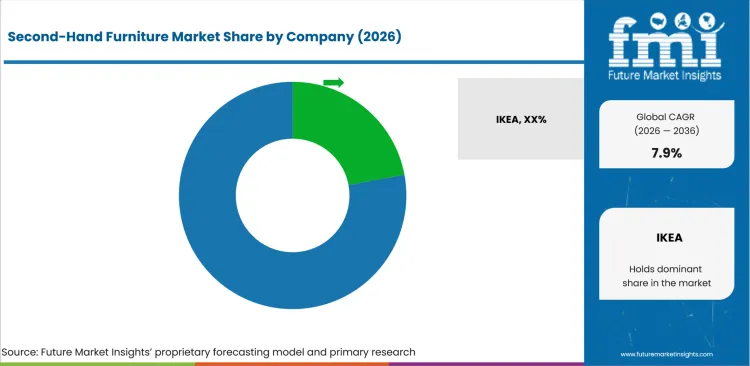
- IKEA, eBay Inc., Facebook Marketplace (Meta Platforms) and AptDeco and Chairish and 1stDibs and Etsy Inc. and Vinterior and The Salvation Army represent different operating models across organized resale.
Analyst Perspective
"Second-hand furniture is a logistics and trust market presented through listings. A seller can create supply with a phone camera, but revenue is realized only when the buyer can verify dimensions, condition and safety and delivery economics. Platforms that standardize grading, screen restricted items and control pickup or handoff will convert inventory faster than marketplaces that rely on price alone."
- Rahul Pandita, Principal Consultant, Future Market Insights
How is the Second-Hand Furniture Market segmented?
The Second-Hand Furniture Market is segmented by product type, material, application, distribution channel and region. Product Type covers Beds & Headboards, Sofas & Couches, Tables & Desks, Chairs & Stools and Cabinets & Shelves. Material covers Wood, Metal, Plastic & Composite and Glass. Application covers Residential, Commercial, Institutional and Others. Distribution Channel covers Online Marketplaces, Specialty Re-Sale Stores, Thrift & Charity Stores and Other Channels.
Why do Beds & Headboards lead the Product Type category?
Beds and headboards combine high household necessity with clear dimensions and recognizable formats.
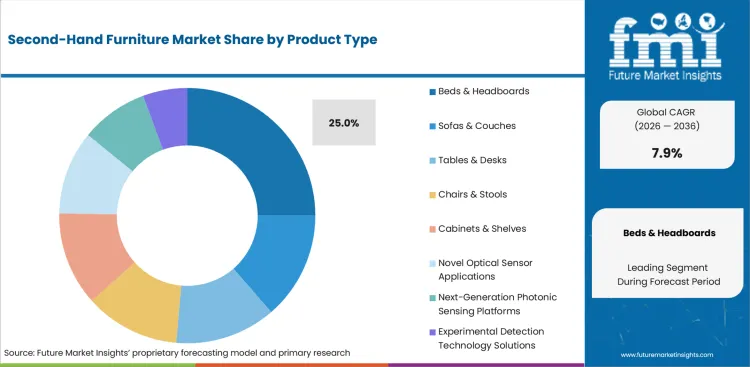
Beds & Headboards hold a 25.0% share in 2026. Buyers can compare single, twin, double and king sizes quickly. In contrast sellers often release inventory during moves and renovations or landlord turnover. Frames and headboards can retain functional value after mattresses or soft components are replaced.
Why does Wood lead the Material category?
Wood is familiar to buyers, repairable in many forms and present across beds, tables and cabinets and chairs and shelves.
Wood holds a 54.0% share in 2026. Solid wood can preserve resale value when joints remain sound and cosmetic damage can be refinished. Engineered wood broadens affordable supply, although swollen edges, damaged fasteners and repeated assembly can reduce its remaining life.
Why does Residential lead the Application category?
Households create both the largest supply pool and the broadest buyer base.
Residential accounts for a 58.0% share in 2026. Moves, estate clearances, room changes and rental turnover generate recurring listings. Households purchase item by item and can accept varied styles when the price and condition are clear. Rental Properties create repeat demand for standardized beds, tables, seating and storage but landlords need fast replacement and predictable delivery.
Why do Online Marketplaces lead the Distribution Channel category?
Online Marketplaces lower the cost of creating listings and make local inventory searchable.
Online Marketplaces hold a 42.0% share in 2026. Peer-to-Peer Marketplaces maximize breadth and price discovery, yet they transfer more responsibility for condition, payment and handoff to users. Specialized Resale Platforms can narrow this risk through curation, inspection, delivery or dispute processes.
What are the drivers, restraints and opportunities in the Second-Hand Furniture Market?
- Driver: Price-sensitive buyers and waste-prevention policy support longer product use through resale.
- Restraint: Product variability and bulky fulfillment raise condition, safety and delivery risk.
- Opportunity: Managed logistics and standardized item data can convert fragmented local supply into dependable inventory.
Which country CAGRs are profiled in the Second-Hand Furniture Market?
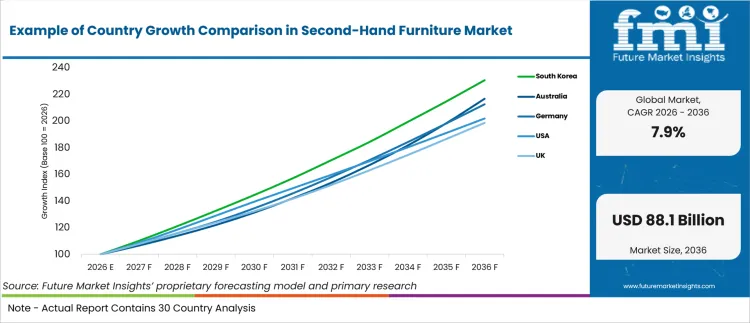
| Country | CAGR |
|---|---|
| USA | 7.28% |
| Japan | 6.54% |
| Germany | 7.83% |
| UK | 7.11% |
| Canada | 6.87% |
| Australia | 8.04% |
| South Korea | 8.72% |
Country-wise Analysis
- USA: The market is forecast to expand at a 7.28% CAGR through 2036. Horizontal marketplaces and local pickup create broad supply, but resellers must screen inventory for recalls and other safety issues. The US EPA also advises buyers to inspect second-hand furniture, beds and couches for bed bug infestation. Furniture and furnishings accounted for 12.1 million tons of US municipal solid-waste generation in 2018, indicating a large stock of products that can move into reuse before disposal.
- Japan: The market is forecast to expand at a 6.54% CAGR through 2036. The Secondhand Goods Business Act requires dealers and secondhand market owners to keep prescribed registers. That favors sellers able to document transactions and maintain orderly inventory. Compact urban homes increase the value of exact dimensions, while stair, lift and local delivery access shape the practical resale radius.
- Germany: The market is forecast to expand at a 7.83% CAGR through 2036. Product reuse is a central waste-prevention measure, and German reporting covers furniture among the product groups monitored for reuse. The country reported about 3 million tonnes of reused household products for the first reporting year, creating policy visibility around second-life channels. Buyers still distinguish sharply between durable pieces and low-cost furniture with limited repair potential.
- UK: The market is forecast to expand at a 7.11% CAGR through 2036. Second-hand upholstered furniture continues to require a permanent fire-safety label under the amended framework. Missing or unreadable labels can remove otherwise saleable stock from organized channels. Marketplaces and stores that check labels before acceptance reduce buyer and seller friction.
- Canada: The market is forecast to expand at a 6.87% CAGR through 2036. Federal policy targets a 30% reduction in waste sent to disposal by 2030 from the 2014 baseline. Municipal collection remains important for bulky items, so resale and donation compete directly with curbside disposal. Long travel distances outside dense cities make local inventory density and pickup coordination central to unit economics.
- Australia: The market is forecast to expand at a 8.04% CAGR through 2036. Government procurement guidance notes that Australia generates 30,000 tonnes of commercial furniture waste each year. Office fit-outs and public procurement can therefore create batch supply for reuse, refurbishment or resale. Freight distance remains a constraint, which favors city-level sorting and buyer matching before transport.
- South Korea: The market is forecast to expand at a 8.72% CAGR through 2036. Its circular-economy framework includes work on product durability and repairability, while dense urban digital markets support rapid local listing and handoff. Platforms can gain an advantage by standardizing condition information and reducing seller response time.
Who are the notable companies in the Second-Hand Furniture Market?
IKEA, eBay Inc., Facebook Marketplace (Meta Platforms) and AptDeco.
- eBay Inc., Facebook Marketplace (Meta Platforms) and Etsy Inc. provide broad horizontal discovery.
- AptDeco manages furniture-specific fulfillment through a dedicated resale platform.
- Chairish, 1stDibs and Vinterior emphasize curated or professional supply.
- IKEA connects resale to a known product catalog, while The Salvation Army converts donated goods into store inventory.
- Kaiyo is included as an additional named digital resale platform in the market scope.
How do notable companies compare in the Second-Hand Furniture Market?
| Company | Operating model | Evidence-backed market mechanism |
|---|---|---|
| IKEA | Brand-linked local resale marketplace | Recommended pricing, product images, exact dimensions and product instructions; active in Spain and Norway and Portugal and Poland and Sweden. |
| eBay Inc. | Horizontal consumer-to-consumer marketplace | Streamlined listing and delivery tools, revamped local pickup and fee-free UK private selling across categories except motors. |
| Facebook Marketplace (Meta Platforms) | Local and shipped peer-to-peer marketplace | AI-assisted listing, price suggestions, seller profile summaries and a dedicated US Seller app for inventory and messages. |
| AptDeco | Managed furniture resale platform | Verified users, professional pickup and delivery, item inspection at collection and a description-dispute process in the contiguous USA. |
| Chairish | Curated fixed-price design marketplace | Expert curation and access to a broader auction and fixed-price ecosystem after the ATG acquisition. |
| 1stDibs | Professional dealer marketplace | More than 6,000 vetted sellers, no consumer-to-consumer listings and buyer support for design-led inventory. |
| Etsy Inc. | Marketplace for handmade and vintage goods | Vintage eligibility requires items to be at least 20 years old and seller-curated, supporting age-based listing discipline. |
| Vinterior | Curated pre-loved furniture marketplace | Curated inventory and sellers in more than 30 countries, with emphasis on vintage and design-led pieces. |
| The Salvation Army | Donation-led thrift retail network | Furniture donation pickup where available, local acceptance checks and resale through thrift stores. |
What are the key developments in the Second-Hand Furniture Market?
- On August 27, 2024, IKEA began testing IKEA Preowned in Madrid and Oslo and enabling consumers to buy and sell pre-owned IKEA items locally with product information and recommended pricing support.
- On October 1, 2024, eBay removed UK consumer-to-consumer selling fees across all categories except motors and introduced improvements to listing and delivery and local pickup and wallet functionality.
- On August 4, 2025, Auction Technology Group acquired Chairish, Inc. for USD 85 million, combining Chairish's fixed-price design marketplace with ATG's auction marketplace portfolio.
- On January 26, 2026, Ingka Group announced the expansion of the IKEA second-hand marketplace to Sweden and bringing the platform to five countries when the Swedish service launched on January 28.
- On March 12, 2026, Meta introduced AI-powered Facebook Marketplace features for draft listing creation and price suggestions and shipping management and auto replies and seller profile summaries.
- On July 24, 2026, Meta launched the Seller app for Facebook Marketplace sellers in the USA and combining AI listing creation and a unified inbox and inventory management and performance insights.
What is covered in the Second-Hand Furniture Market report?
| Coverage field | Report scope |
|---|---|
| Market breakdown | Product Type, Material, Application and Distribution Channel and Region |
| Quantitative Units | USD Billion |
| Market Definition | FMI-estimated transaction value generated by the organized sale of pre-owned furniture through online marketplaces, managed resale platforms, specialty resale stores and thrift and charity stores and auction houses and furniture liquidation channels. New furniture, rental revenue, repair-only services and waste-disposal fees and informal transfers without a recorded transaction are excluded. |
| Regions Covered | North America; Latin America; Western Europe; Eastern Europe; East Asia; South Asia and Pacific; Middle East and Africa |
| Countries Covered | USA, Japan, Germany and UK and Canada and Australia and South Korea and more than thirty additional countries in the full report |
| Key Companies Profiled | IKEA; eBay Inc.; Facebook Marketplace (Meta Platforms); AptDeco; Chairish; Kaiyo; 1stDibs; Etsy Inc.; Vinterior; The Salvation Army |
| Forecast Period | 2026 to 2036 |
| Approach | Hybrid bottom-up and top-down sizing using platform and reseller transaction indicators, listing and store throughput, average transaction values and product and channel mix and country factors and buyer-side validation. |
How was the Second-Hand Furniture Market assessed?
| Method | Approach |
|---|---|
| Primary Research | FMI engages resale marketplaces, specialist dealers, thrift and charity operators and auction houses and liquidation providers and furniture movers and refurbishment and cleaning providers and landlords and facilities teams and procurement professionals and household buyers. |
| Desk Research | The review covers official waste and reuse policy, product-safety and fire-label rules, government statistics and trade and public-procurement guidance and company filings and first-party service documentation and official company announcements. |
| Market Sizing and Forecasting | The model reconciles organized transaction value, platform and store throughput, average resale prices and product mix and material mix and application demand and channel structure and regional density and logistics cost and country adoption indicators. |
| Data Validation | Supplier-side findings are cross-checked with buyer behavior, channel economics, product-condition requirements and logistics practice and country regulation. Forecast values are reconciled to the 2026 base and 2036 outlook. |
Second-Hand Furniture Market segmentation
Second-Hand Furniture Market segmented by Product Type:
- Beds & Headboards
- Single & Twin Beds
- Double & King Beds
- Sofas & Couches
- Sectional Sofas
- Standard Sofas & Loveseats
- Tables & Desks
- Dining Tables
- Office & Study Desks
- Chairs & Stools
- Dining Chairs
- Office & Accent Chairs
- Cabinets & Shelves
- Wardrobes & Storage Cabinets
- Bookcases & Shelving Units
Second-Hand Furniture Market segmented by Material:
- Wood
- Solid Wood
- Engineered Wood
- Metal
- Steel Furniture
- Aluminum Furniture
- Plastic & Composite
- Plastic Furniture
- Composite Furniture
- Glass
- Glass Tables
- Glass Shelving
Second-Hand Furniture Market segmented by Application:
- Residential
- Households
- Rental Properties
- Commercial
- Offices
- Hospitality & Restaurants
- Institutional
- Schools & Universities
- Healthcare Facilities
- Others
- Event & Exhibition Spaces
- Community Facilities
Second-Hand Furniture Market segmented by Distribution Channel:
- Online Marketplaces
- Peer-to-Peer Marketplaces
- Specialized Resale Platforms
- Specialty Re-Sale Stores
- Independent Resale Stores
- Vintage & Antique Stores
- Thrift & Charity Stores
- Charity Shops
- Thrift Stores
- Other Channels
- Auction Houses
- Furniture Liquidation Sales
How is the Second-Hand Furniture Market segmented by region?
- North America
- United States
- Canada
- Mexico
- Latin America
- Brazil
- Chile
- Rest of Latin America
- Western Europe
- Germany
- United Kingdom
- Italy
- Spain
- France
- Nordics
- Benelux
- Rest of Western Europe
- Eastern Europe
- Russia
- Poland
- Hungary
- Balkan and Baltic States
- Rest of Eastern Europe
- East Asia
- China
- Japan
- South Korea
- South Asia and Pacific
- India
- ASEAN
- Australia and New Zealand
- Rest of South Asia and Pacific
- Middle East and Africa
- Kingdom of Saudi Arabia
- Other GCC Countries
- Türkiye
- South Africa
- Other African Union Countries
- Rest of Middle East and Africa
Which sources support the Second-Hand Furniture Market analysis?
- US Environmental Protection Agency (updated October 23, 2025). Durable Goods: Product-Specific Data.
- US Environmental Protection Agency (updated July 6, 2026). Protecting Your Home from Bed Bugs.
- US Consumer Product Safety Commission (accessed July 31, 2026). Resale/Thrift Stores Information Center.
- US Consumer Product Safety Commission (accessed July 31, 2026). Resellers Guide to Selling Safer Products.
- UK Department for Business and Trade (April 30, 2025). Furniture and Furnishings Fire Safety Amendment Regulations 2025.
- UK Legislation (accessed July 31, 2026). Furniture and Furnishings (Fire) (Safety) Regulations 1988.
- German Environment Agency (updated February 6, 2026). Wiederverwendung von Produkten.
- Japanese Law Translation, Ministry of Justice (accessed July 31, 2026). Secondhand Goods Business Act.
- Environment and Climate Change Canada (November 28, 2024). Solid Waste Diversion and Disposal.
- Australian Department of Climate Change, Energy, the Environment and Water (2025). Sustainability Ideas for Furniture.
- Republic of Korea Ministry of Environment (February 7, 2023). Circular Economy Work Plan and Product Durability Measures.
- Ingka Group (August 27, 2024). IKEA Starts Testing Second-Hand Marketplace in Madrid and Oslo.
- eBay Inc. (October 1, 2024). eBay Announces Free Selling in the UK.
- Chairish (August 4, 2025). ATG Acquires Chairish, Inc.
- Ingka Group (January 26, 2026). IKEA Expands Second-Hand Marketplace to Sweden.
- Meta (March 12, 2026). Facebook Marketplace's New Meta AI Tools Make Selling Faster and Easier.
- Meta (July 24, 2026). Introducing Seller, an App for Facebook Marketplace Sellers.
- AptDeco (accessed July 31, 2026). How It Works: Used Furniture Pickup and Delivery.
- 1stDibs (accessed July 31, 2026). Vetted Sellers.
- 1stDibs (accessed July 31, 2026). About 1stDibs.
- Etsy Inc. (June 10, 2025). Etsy Creativity Standards.
- Vinterior (accessed July 31, 2026). About Us.
- The Salvation Army (accessed July 31, 2026). Thrift Store and Donation Center FAQs.
What questions does this report answer?
- What is the Second-Hand Furniture Market size in 2026 and what value is forecast for 2036?
- Which buyer economics convert a used furniture listing into a completed transaction?
- Why do Beds & Headboards hold the leading position within Product Type?
- Why does Wood account for the leading Material share?
- How do Residential buyers and rental-property operators shape demand?
- Why do Online Marketplaces lead Distribution Channel?
- How do country growth rates compare across the USA, Japan, Germany and UK and Canada and Australia and South Korea?
- Which safety, fire-label, pest and condition and logistics risks limit resale?
- How do horizontal marketplaces differ from managed, curated, brand-linked and donation-led models?
- Which companies are adding product data, seller tools or marketplace reach to strengthen second-hand furniture transactions?
Frequently Asked Questions
How big is the Second-Hand Furniture Market in 2026?
FMI estimates the market at USD 41.2 billion in 2026.
What is the forecast value for the Second-Hand Furniture Market in 2036?
The market is forecast to reach USD 88.1 billion by 2036.
What CAGR is expected from 2026 to 2036?
The market is expected to expand at a 7.9% CAGR during the forecast period.
Which Product Type leads the market?
Beds & Headboards lead Product Type with a 25.0% share in 2026.
Which Material leads the market?
Wood leads Material with a 54.0% share in 2026.
Which Application leads the market?
Residential leads Application with a 58.0% share in 2026.
Which Distribution Channel leads the market?
Online Marketplaces lead Distribution Channel with a 42.0% share in 2026.
Which profiled country grows fastest?
South Korea has the highest profiled CAGR at 8.72% through 2036.
What is the main purchase constraint?
The main constraint is the loss of price advantage when condition uncertainty, safety checks, pickup and cleaning and repair or delivery costs are added.
What should buyers verify before purchasing?
Buyers should verify dimensions, structural condition, upholstery cleanliness and missing parts and applicable safety labels and product recalls and access for removal and the full delivered cost.
What creates supplier advantage?
Supplier advantage comes from credible item data, local inventory density, fast seller response and inspection and protected payment and reliable pickup or delivery.
Who are the notable companies?
The company set includes IKEA, eBay Inc., Facebook Marketplace (Meta Platforms) and AptDeco and Chairish and Kaiyo and 1stDibs and Etsy Inc. and Vinterior and The Salvation Army.
Preview the report firsthand - request a free sample
Get SampleGet the brochure for pricing and purchase details.
Get PDFTable of Content
- Key Takeaways
- Market Size and CAGR
- Top Growth Driver
- Fastest Growing Segment
- Leading Region
- Key Companies
- Emerging Opportunities
- Executive Summary
- Global Market Outlook
- Demand-side Trends
- Supply-side Trends
- Technology Roadmap Analysis
- Analysis and Recommendations
- Analyst Perspective (What is happening? Why now? What should investors know?)
- Key Questions Answered
- How large is the market?
- What is the CAGR?
- What are key trends?
- Which region dominates?
- Who are the leaders?
- Market Overview
- Market Coverage / Taxonomy
- Market Definition / Scope / Limitations
- Research Methodology
- Chapter Orientation
- Analytical Lens and Working Hypotheses
- Market Structure, Signals, and Trend Drivers
- Benchmarking and Cross-market Comparability
- Market Sizing, Forecasting, and Opportunity Mapping
- Research Design and Evidence Framework
- Desk Research Programme (Secondary Evidence)
- Expert Input and Fieldwork (Primary Evidence)
- Tooling, Models, and Reference Databases
- Data Engineering and Model Build
- Quality Assurance and Audit Trail
- Market Background
- Market Dynamics (Drivers, Restraints, Opportunity, Trends)
- Scenario Forecast (Optimistic, Likely, Conservative)
- Impact Analysis
- AI Impact
- Sustainability Impact
- Regulatory Impact
- Technology Impact
- Consumer / Buyer Analysis
- Purchase Drivers
- Adoption Barriers
- Buyer Journey
- Opportunity Map Analysis
- Product Life Cycle Analysis
- Supply Chain Analysis
- Investment Feasibility Matrix
- Value Chain Analysis
- PESTLE and Porter's Analysis
- Regulatory Landscape
- Regional Parent Market Outlook
- Production and Consumption Statistics
- Import and Export Statistics
- Global Market Analysis and Forecast, 2021 to 2036
- Historical Market Size Value (USD Billion) Analysis, 2021 to 2025
- Current and Future Market Size Value (USD Billion) Projections, 2026 to 2036
- Y-o-Y Growth Trend Analysis
- Absolute $ Opportunity Analysis
- Global Market Pricing Analysis, 2021 to 2036
- Global Market Analysis and Forecast, By Product Type, 2021 to 2036
- Introduction / Key Findings
- Historical Market Size Value (USD Billion) Analysis By Product Type, 2021 to 2025
- Current and Future Market Size Value (USD Billion) Analysis and Forecast By Product Type, 2026 to 2036
- Beds & Headboards
- Sofas & Couches
- Tables & Desks
- Chairs & Stools
- Cabinets & Shelves
- Novel Optical Sensor Applications
- Next-Generation Photonic Sensing Platforms
- Experimental Detection Technology Solutions
- Beds & Headboards
- Y-o-Y Growth Trend Analysis By Product Type, 2021 to 2025
- Absolute $ Opportunity Analysis By Product Type, 2026 to 2036
- Global Market Analysis and Forecast, By Material, 2021 to 2036
- Introduction / Key Findings
- Historical Market Size Value (USD Billion) Analysis By Material, 2021 to 2025
- Current and Future Market Size Value (USD Billion) Analysis and Forecast By Material, 2026 to 2036
- Wood
- Metal
- Plastic & Composite
- Glass
- Wood
- Y-o-Y Growth Trend Analysis By Material, 2021 to 2025
- Absolute $ Opportunity Analysis By Material, 2026 to 2036
- Global Market Analysis and Forecast, By Application, 2021 to 2036
- Introduction / Key Findings
- Historical Market Size Value (USD Billion) Analysis By Application, 2021 to 2025
- Current and Future Market Size Value (USD Billion) Analysis and Forecast By Application, 2026 to 2036
- Residential
- Commercial
- Institutional
- Threat Detection Solutions
- Security Applications
- Infrastructure Protection Systems
- Public Safety Monitoring Platforms
- Others
- Residential
- Y-o-Y Growth Trend Analysis By Application, 2021 to 2025
- Absolute $ Opportunity Analysis By Application, 2026 to 2036
- Global Market Analysis and Forecast, By Distribution Channel, 2021 to 2036
- Introduction / Key Findings
- Historical Market Size Value (USD Billion) Analysis By Distribution Channel, 2021 to 2025
- Current and Future Market Size Value (USD Billion) Analysis and Forecast By Distribution Channel, 2026 to 2036
- Online Marketplaces
- Specialty Re-Sale Stores
- Thrift & Charity Stores
- Other Channels
- Online Marketplaces
- Y-o-Y Growth Trend Analysis By Distribution Channel, 2021 to 2025
- Absolute $ Opportunity Analysis By Distribution Channel, 2026 to 2036
- Global Market Analysis and Forecast, By Region, 2021 to 2036
- Introduction
- Historical Market Size Value (USD Billion) Analysis By Region, 2021 to 2025
- Current Market Size Value (USD Billion) Analysis and Forecast By Region, 2026 to 2036
- North America
- Latin America
- Western Europe
- Eastern Europe
- East Asia
- South Asia and Pacific
- Middle East & Africa
- Market Attractiveness Analysis By Region
- North America Market Analysis and Forecast, By Country, 2021 to 2036
- Historical Market Size Value (USD Billion) Trend Analysis By Market Taxonomy, 2021 to 2025
- Market Size Value (USD Billion) Forecast By Market Taxonomy, 2026 to 2036
- By Country
- USA
- Canada
- By Product Type
- By Material
- By Application
- By Distribution Channel
- By Country
- Market Attractiveness Analysis
- By Country
- By Product Type
- By Material
- By Application
- By Distribution Channel
- Key Takeaways
- Latin America Market Analysis and Forecast, By Country
- Historical Market Size Value (USD Billion) Trend Analysis By Market Taxonomy, 2021 to 2025
- Market Size Value (USD Billion) Forecast By Market Taxonomy, 2026 to 2036
- By Country
- Brazil
- Mexico
- Chile
- Rest of Latin America
- By Product Type
- By Material
- By Application
- By Distribution Channel
- By Country
- Market Attractiveness Analysis
- By Country
- By Product Type
- By Material
- By Application
- By Distribution Channel
- Key Takeaways
- Western Europe Market Analysis and Forecast, By Country
- Historical Market Size Value (USD Billion) Trend Analysis By Market Taxonomy, 2021 to 2025
- Market Size Value (USD Billion) Forecast By Market Taxonomy, 2026 to 2036
- By Country
- Germany
- UK
- Italy
- Spain
- France
- Nordic
- BENELUX
- Rest of Western Europe
- By Product Type
- By Material
- By Application
- By Distribution Channel
- By Country
- Market Attractiveness Analysis
- By Country
- By Product Type
- By Material
- By Application
- By Distribution Channel
- Key Takeaways
- Eastern Europe Market Analysis and Forecast, By Country
- Historical Market Size Value (USD Billion) Trend Analysis By Market Taxonomy, 2021 to 2025
- Market Size Value (USD Billion) Forecast By Market Taxonomy, 2026 to 2036
- By Country
- Russia
- Poland
- Hungary
- Balkan & Baltic
- Rest of Eastern Europe
- By Product Type
- By Material
- By Application
- By Distribution Channel
- By Country
- Market Attractiveness Analysis
- By Country
- By Product Type
- By Material
- By Application
- By Distribution Channel
- Key Takeaways
- East Asia Market Analysis and Forecast, By Country
- Historical Market Size Value (USD Billion) Trend Analysis By Market Taxonomy, 2021 to 2025
- Market Size Value (USD Billion) Forecast By Market Taxonomy, 2026 to 2036
- By Country
- China
- Japan
- South Korea
- By Product Type
- By Material
- By Application
- By Distribution Channel
- By Country
- Market Attractiveness Analysis
- By Country
- By Product Type
- By Material
- By Application
- By Distribution Channel
- Key Takeaways
- South Asia and Pacific Market Analysis and Forecast, By Country
- Historical Market Size Value (USD Billion) Trend Analysis By Market Taxonomy, 2021 to 2025
- Market Size Value (USD Billion) Forecast By Market Taxonomy, 2026 to 2036
- By Country
- India
- ASEAN
- Australia & New Zealand
- Rest of South Asia and Pacific
- By Product Type
- By Material
- By Application
- By Distribution Channel
- By Country
- Market Attractiveness Analysis
- By Country
- By Product Type
- By Material
- By Application
- By Distribution Channel
- Key Takeaways
- Middle East & Africa Market Analysis and Forecast, By Country
- Historical Market Size Value (USD Billion) Trend Analysis By Market Taxonomy, 2021 to 2025
- Market Size Value (USD Billion) Forecast By Market Taxonomy, 2026 to 2036
- By Country
- Kingdom of Saudi Arabia
- Other GCC Countries
- Türkiye
- South Africa
- Other African Union
- Rest of Middle East & Africa
- By Product Type
- By Material
- By Application
- By Distribution Channel
- By Country
- Market Attractiveness Analysis
- By Country
- By Product Type
- By Material
- By Application
- By Distribution Channel
- Key Takeaways
- Key Countries Market Analysis
- USA
- Pricing Analysis
- Market Share Analysis, 2025
- By Product Type
- By Material
- By Application
- By Distribution Channel
- Canada
- Pricing Analysis
- Market Share Analysis, 2025
- By Product Type
- By Material
- By Application
- By Distribution Channel
- Mexico
- Pricing Analysis
- Market Share Analysis, 2025
- By Product Type
- By Material
- By Application
- By Distribution Channel
- Brazil
- Pricing Analysis
- Market Share Analysis, 2025
- By Product Type
- By Material
- By Application
- By Distribution Channel
- Chile
- Pricing Analysis
- Market Share Analysis, 2025
- By Product Type
- By Material
- By Application
- By Distribution Channel
- Germany
- Pricing Analysis
- Market Share Analysis, 2025
- By Product Type
- By Material
- By Application
- By Distribution Channel
- UK
- Pricing Analysis
- Market Share Analysis, 2025
- By Product Type
- By Material
- By Application
- By Distribution Channel
- Italy
- Pricing Analysis
- Market Share Analysis, 2025
- By Product Type
- By Material
- By Application
- By Distribution Channel
- Spain
- Pricing Analysis
- Market Share Analysis, 2025
- By Product Type
- By Material
- By Application
- By Distribution Channel
- France
- Pricing Analysis
- Market Share Analysis, 2025
- By Product Type
- By Material
- By Application
- By Distribution Channel
- India
- Pricing Analysis
- Market Share Analysis, 2025
- By Product Type
- By Material
- By Application
- By Distribution Channel
- ASEAN
- Pricing Analysis
- Market Share Analysis, 2025
- By Product Type
- By Material
- By Application
- By Distribution Channel
- Australia & New Zealand
- Pricing Analysis
- Market Share Analysis, 2025
- By Product Type
- By Material
- By Application
- By Distribution Channel
- China
- Pricing Analysis
- Market Share Analysis, 2025
- By Product Type
- By Material
- By Application
- By Distribution Channel
- Japan
- Pricing Analysis
- Market Share Analysis, 2025
- By Product Type
- By Material
- By Application
- By Distribution Channel
- South Korea
- Pricing Analysis
- Market Share Analysis, 2025
- By Product Type
- By Material
- By Application
- By Distribution Channel
- Russia
- Pricing Analysis
- Market Share Analysis, 2025
- By Product Type
- By Material
- By Application
- By Distribution Channel
- Poland
- Pricing Analysis
- Market Share Analysis, 2025
- By Product Type
- By Material
- By Application
- By Distribution Channel
- Hungary
- Pricing Analysis
- Market Share Analysis, 2025
- By Product Type
- By Material
- By Application
- By Distribution Channel
- Kingdom of Saudi Arabia
- Pricing Analysis
- Market Share Analysis, 2025
- By Product Type
- By Material
- By Application
- By Distribution Channel
- Türkiye
- Pricing Analysis
- Market Share Analysis, 2025
- By Product Type
- By Material
- By Application
- By Distribution Channel
- South Africa
- Pricing Analysis
- Market Share Analysis, 2025
- By Product Type
- By Material
- By Application
- By Distribution Channel
- USA
- Market Structure Analysis
- Competition Dashboard
- Competition Benchmarking
- Market Share Analysis of Top Players
- By Regional
- By Product Type
- By Material
- By Application
- By Distribution Channel
- Emerging Startups
- Innovation Benchmarking
- Competition Analysis
- Competition Deep Dive
- IKEA
- Overview
- Product Portfolio
- Profitability by Market Segments
- Sales Footprint
- Strategy Overview
- Marketing Strategy
- Product Strategy
- Channel Strategy
- eBay Inc.
- Facebook Marketplace (Meta Platforms)
- AptDeco
- Chairish
- 1stDibs
- Etsy Inc.
- Vinterior
- The Salvation Army
- IKEA
- Case Studies
- Success Stories
- Recent Developments
- Competition Deep Dive
- Assumptions & Acronyms Used


