
- Market Size (2026)
- USD 1171.5 Mn
- Forecast (2036)
- USD 2304.5 Mn
- CAGR (2026 to 2036)
- 7.0%
How big is the Self-Expanding Covered Stents Market in 2026?
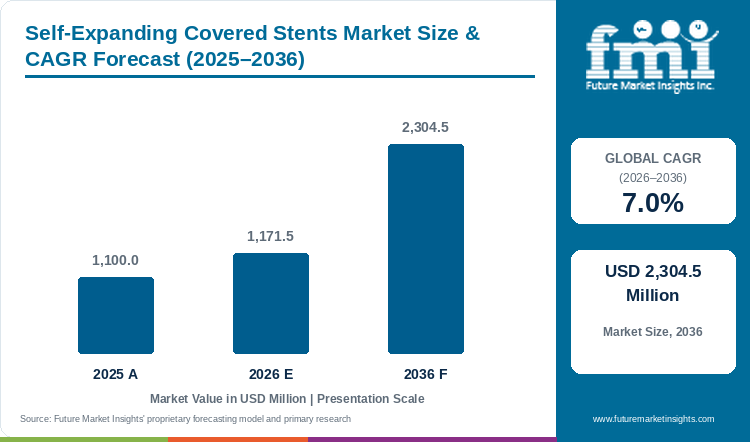
FMI projects the global self-expanding covered stents market at USD 2,304.5 million in 2036, a 7.0% CAGR over 2026 to 2036. The market was valued at USD 1,100.0 million in 2025 and is estimated at USD 1,171.5 million in 2026.
Self-Expanding Covered Stents Market Size and Forecast
Table 1: Self-Expanding Covered Stents Market Size and Forecast
| Market size and forecast | Value |
|---|---|
| Market size in 2025 | USD 1,100.0 million |
| Estimated market size in 2026 | USD 1,171.5 million |
| Projected market size by 2036 | USD 2,304.5 million |
| CAGR from 2026 to 2036 | 7.0% |
Source: Future Market Insights analysis of the Self-Expanding covered stents market, 2026.
Indication-specific evidence is dividing this market into separate purchasing programmes. France's March 2026 assessment of GORE VIABAHN PROPATEN found sufficient expected benefit for defined femoropopliteal lesions and selected popliteal aneurysms. It found insufficient benefit for a separate longer-lesion indication. The commercial addressable population therefore follows the actual decision and not a general peripheral disease count.
Product introductions also remain application-specific. The FDA cleared Merit Medical's Resilience Fully Covered Esophageal Stent System on 23 July 2025. Its route into hospital endoscopy purchasing differs from a vascular implant's route. FMI expects suppliers to gain repeat business when their evidence and available configurations match an institution's treated cases. The broader peripheral vascular stents market includes alternatives outside this assessment, so covered self-expanding device sales form a narrower base than its procedure mix.
Key Market Trends & Insights
- Product lifecycle changes require purchasing departments to track individual references. France's September 2025 order removed specified VIABAHN PROPATEN references after their commercialization ceased. The action concerned named references only.
- Endoscopic coverings have their own design requirements. Boston Scientific's Agile instructions describe a braided nitinol implant with silicone covering. This is a distinct material offer from the ePTFE-led vascular category, with different evidence and product comparisons.
- Manufacturing expansion can begin before additional output is established. M.I. Tech's March 2026 annual filing records the incorporation of a wholly owned Vietnamese subsidiary on 8 October 2025 for production-cost efficiency and capacity expansion.
Regional Highlights
- Global share rises for China and India. FMI projects China rising from 9.0% to 12.0% and India rising from 2.0% to 2.9% by 2036.
- Global share declines for Japan, the United States and Germany even as revenue grows. FMI projects Japan from 8.0% to 7.0%, the United States from 38.0% to 36.5% and Germany from 8.0% to 7.3% by 2036.
Analyst Perspective
“A vascular covered-stent account and an endoscopy account require separate evidence and purchasing work. Suppliers should protect reference-level availability while pursuing additional indications through their own clinical and funding routes. Portfolio breadth has value when each offer reaches the appropriate department.”
- Anurag Sharma, Principal Consultant, FMI
How is the Self-Expanding Covered Stents Market segmented?
- By application: Peripheral Vascular, Gastrointestinal and Biliary, Airway and Esophageal, and Venous and Dialysis Access.
- By material: Nitinol with ePTFE, Nitinol with Other Polymer, and Stainless Steel and Other Alloys.
- By end user: Hospitals, Ambulatory Surgical Centers, and Specialty Clinics.
- By region: North America, Latin America, Western Europe, East Asia, South Asia, and Rest of world.
Why does the Peripheral Vascular segment lead by Application in the Self-Expanding Covered Stents Market in 2026?
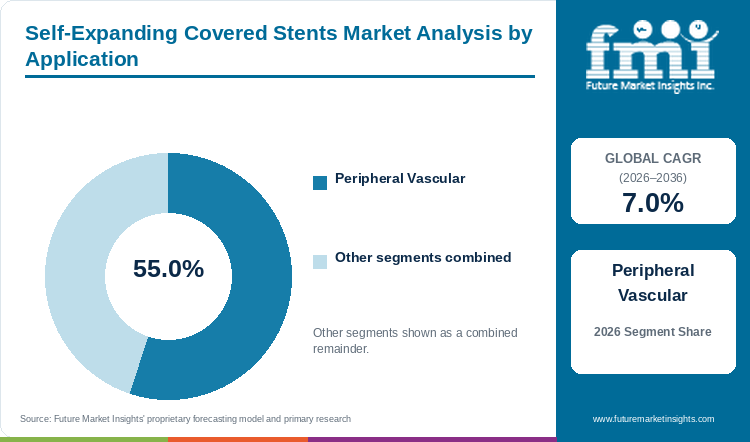
The Peripheral Vascular segment holds 55.0% of the Self-Expanding Covered Stents Market by application in 2026.
The application lead rests on established vascular product programmes with evidence organized around defined lesions and follow-up outcomes. Gore's clinical library separates superficial femoral artery disease, in-stent restenosis, iliac disease and arteriovenous access. The evidence is presented by indication. That structure gives suppliers an existing clinical base from which to support institution-specific purchasing.
FMI forecasts Peripheral Vascular revenue of USD 1,308.1 million in 2036. Its share rises to 56.8%, with a 7.3% CAGR over the decade. Yet the buying decision remains narrower than the overall application label, because each lesion type forms its own unit opportunity.
Competition also comes from products beyond covered self-expanding implants. The wider peripheral vascular devices market spans other treatment technologies. A manufacturer's commercial case must therefore explain where its particular covered device fits within the available alternatives. The most useful sales evidence combines the relevant patient group with observed durability and the institution's actual case mix.
Gastrointestinal and Biliary, Airway and Esophageal and Venous and Dialysis Access together hold the remaining 45.0% by application.
Table 2: Application, 2026 Share
| Leading Share | 2026 market share |
|---|---|
| Peripheral Vascular | 55.0% |
| All Other Segments Combined Share | 45.0% |
Source: Future Market Insights analysis of the Self-Expanding covered stents market, 2026.
Why does the Nitinol with ePTFE segment lead by Material in the Self-Expanding Covered Stents Market in 2026?
The Nitinol with ePTFE segment holds 62.0% of the Self-Expanding Covered Stents Market by material in 2026.
Material selection is embedded in a complete regulated product. A covering is evaluated together with the supporting frame and delivery system. The ePTFE-led category benefits from the vascular application mix, which is the market's leading revenue allocation. FMI projects its material share to rise to 65.8% by 2036, with revenue of USD 1,516.0 million and a 7.6% CAGR.
Other polymer constructions retain distinct commercial positions. The FDA's March 2026 SPAXUS documentation describes nitinol with silicone covering for specified gastrointestinal drainage indications. Boston Scientific's Agile instructions also identify a silicone-covered nitinol design.
This creates a qualification barrier for new material suppliers. The wider high performance fluoropolymer market provides upstream context, but the covered-stent value pool is determined by finished-device sales. Polymer producers participate through qualified device supply relationships.
Nitinol with Other Polymer and Stainless Steel and Other Alloys together hold the remaining 38.0% by material.
Table 3: Material, 2026 Share
| Leading Share | 2026 market share |
|---|---|
| Nitinol with ePTFE | 62.0% |
| All Other Segments Combined Share | 38.0% |
Source: Future Market Insights analysis of the Self-Expanding covered stents market, 2026.
Why does the Hospitals segment lead by End User in the Self-Expanding Covered Stents Market in 2026?
The Hospitals segment holds 72.0% of the Self-Expanding Covered Stents Market by end user in 2026.
Hospital demand combines several specialist departments with separate purchasing requirements. The November 2025 Naples award was made for the vascular surgery unit at Ospedale del Mare. Merit Medical's annual report describes covered esophageal and tracheobronchial product families serving different clinical areas. An institutional supplier can therefore serve more than one department, each buying a different implant.
FMI expects hospital revenue to reach USD 1,612.9 million by 2036. Its share eases to 70.0% as Ambulatory Surgical Centers grow at 8.2% and Specialty Clinics at 7.2%. The change should be read as a sales-channel outlook.
Funding arrangements influence how this channel develops. NHS England's national supply system identifies peripheral vascular stents and endovascular stent grafts among high-cost device categories. Such arrangements create commercial requirements beyond a physician's product preference. A supplier must satisfy the purchasing route while maintaining product availability at the clinical site. Hospital leadership is consequently reinforced by the intersection of specialist activity and established supply contracts, even as selected services develop through other treatment settings.
Ambulatory Surgical Centers and Specialty Clinics together hold the remaining 28.0% by end user.
Table 4: End User, 2026 Share
| Leading Share | 2026 market share |
|---|---|
| Hospitals | 72.0% |
| All Other Segments Combined Share | 28.0% |
Source: Future Market Insights analysis of the Self-Expanding covered stents market, 2026.
What are the key drivers restraints and opportunities?
Growth depends on indication-specific product adoption and access to specialist intervention. Evidence requirements, competing treatments and fragmented purchasing restrain conversion. Additional approved uses and dependable local supply create opportunities within defined patient groups.
Driver
Existing vascular and endoscopic product programmes provide established purchasing routes for additional device sales.
Restraint
Approval, reimbursement and clinical evidence differ across applications, preventing a broad product claim from converting directly into eligible cases.
Opportunity
Manufacturers can expand carefully into separately supported indications while improving the availability of configurations used by existing accounts.
How do purchasing rules and qualification affect Self-Expanding covered stents market demand?
The clearest route to recurring sales is continued use within an established service. BD's Covera evidence programme distinguishes graft and fistula access, with outcomes evaluated against relevant comparators. This gives purchasers more specific information than a statement about the overall burden of kidney disease. It also separates devices intended to preserve an existing access circuit from products used to establish a new access route.
Service development can broaden the potential pool of treated cases, but device conversion remains conditional. India's August 2026 update records 1,856 haemodialysis centres under its national programme as of June 2026. That infrastructure is commercially relevant to referral networks and access maintenance. Related vascular access systems address a wider set of products than the covered implants assessed here.
What limits reliable Self-Expanding covered stents market supply and quality?
A broad indication claim can overstate the accessible sales base. The French assessment's different conclusions for defined lesion lengths illustrate a real boundary in market access. Manufacturers also manage continuing product-reference changes. France's 2025 removal of specific discontinued references shows why catalogue continuity and payer listings need to remain aligned.
Technical differentiation leaves follow-up requirements in place. The Japanese one-year access study summarized by Gore reports both primary and secondary patency measures. Those outcomes answer different questions. A commercial argument based only on the most favourable measure could understate the continuing intervention burden. Buyers need the result relevant to their service, with the study population and endpoint kept intact.
Where can suppliers win additional business in the Self-Expanding covered stents market?
Product development offers a route into additional purchasing categories when it establishes a clear regulatory position. Merit's July 2025 Resilience clearance supports a defined esophageal product, while Taewoong's March 2026 SPAXUS clearance concerns particular gastrointestinal drainage uses. These developments broaden the available product offers.
Manufacturing and distribution choices then determine how effectively an approved offer reaches customers. M.I. Tech's Vietnamese subsidiary formation states a cost and capacity objective. In established markets, the opportunity is often more immediate: keeping contracted configurations available and maintaining continuity when individual references change. FMI expects this combination of additional evidence and reliable supply to influence repeat purchasing through 2036.
Self-Expanding Covered Stents Market by Country (2026 to 2036)
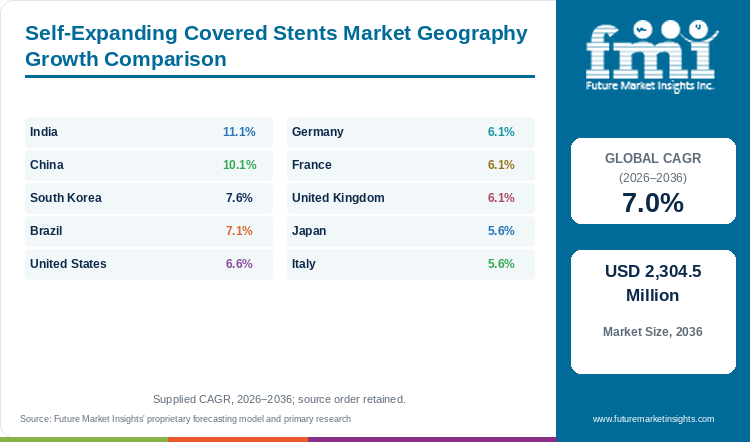
Table 5: Self-Expanding Covered Stents Market Country Growth Forecast
| Country | CAGR, 2026 to 2036 |
|---|---|
| India | 11.1% |
| China | 10.1% |
| South Korea | 7.6% |
| Brazil | 7.1% |
| United States | 6.6% |
| Germany | 6.1% |
| France | 6.1% |
| United Kingdom | 6.1% |
| Japan | 5.6% |
| Italy | 5.6% |
Source: Future Market Insights analysis of the Self-Expanding covered stents market, 2026.
India
India has the fastest forecast expansion among the ten named countries, with an 11.1% CAGR from 2026 to 2036. Revenue rises from USD 23.4 million to USD 67.0 million. The starting base is modest, so the growth rate sits beside an absolute increase of USD 43.6 million.
The national dialysis programme provides a concrete service backdrop. In its August 2026 update, the Ministry of Health reported 1,856 haemodialysis centres and 13,535 machines as of June 2026. The programme covered all 36 states and union territories, including linked districts. Their commercial relevance lies in the continuing need to connect renal care with access assessment and specialist intervention.
BD's India-facing Covera information presents a device offer for arteriovenous access with separate graft and fistula evidence. That establishes a relevant local product-information channel. Manufacturers still need to establish the appropriate purchasing route and the clinical service responsible for intervention.
FMI expects market development to depend on those connections. More dialysis treatment can widen the population under continuing access surveillance, but covered implants remain a selected intervention within that pathway. Hospitals and specialist centres need relevant configurations available, and use differs across renal facilities. The opportunity is strongest where patient referral and product supply develop together, supported by evidence for the actual access problem being treated.
China
China's regulatory development creates a route for domestic innovation alongside imported products. The NMPA's report on 2025 registrations, published in February 2026, records measures encouraging multinational production in China and continued work on device review capacity. The report covers the whole medical-device sector.
FMI forecasts a 10.1% CAGR for China between 2026 and 2036. Revenue rises from USD 105.4 million to USD 275.5 million, with the country's share increasing from 9.0% to 12.0%. Revenue in China climbs by USD 170.1 million, second among the ten. In 2026 revenue terms, China is second of the ten countries. Its 10.1% CAGR runs 3.1 percentage points above the 7.0% global rate, and revenue rises 2.6 times over the decade against 2.0 times for the global market.
Lifetech's annual report published in 2025 described a programme including SilverFlow peripheral vascular stent grafts alongside aortic systems and identified pending Chinese registrations at that reporting date. Much of the company's disclosed activity concerns aortic repair, which sits outside this market.
For suppliers, the commercial question is which included applications can be served through an established domestic registration and hospital purchasing route. The NMPA report also documents a broad clinical-trial institution network, and those institutions are not all active covered-stent accounts. FMI expects manufacturers to benefit when regulatory development is accompanied by relevant local evidence and a dependable product supply.
South Korea
South Korea combines domestic nonvascular stent manufacturing with access to overseas regulatory markets. M.I. Tech's annual filing in March 2026 describes a business centred on nonvascular stents and records the formation of MITECH PLANT VINA in October 2025. The expansion objective concerns manufacturing cost and capacity.
South Korean demand is projected at USD 35.1 million in 2026 and USD 73.0 million in 2036, expanding at a 7.6% CAGR from 2026 to 2036. The national revenue series measures demand in the country. A 7.6% CAGR leaves South Korea 0.6 points above the 7.0% global pace. Global revenue share for South Korea increases to 3.2% from 3.0%. The market adds USD 37.9 million over the decade, which is more than Brazil's USD 23.0 million.
Taewoong provides a separate example of product-specific international progress. The FDA cleared its Niti-S SPAXUS system in March 2026 for stated gastrointestinal drainage uses. This supports its position in a defined covered-product field.
Ownership reporting also requires care. Olympus announced the acquisition of one stent maker in January 2024, then disclosed the agreement's rescission in March 2024. FMI expects competition involving Korean specialists to be understood through their present product offers and actual distribution relationships. Manufacturing location and regulatory reach are commercially relevant, but they answer different questions from the size of the domestic treatment market.
Brazil
Brazil's renal-care expansion is creating a wider service context for vascular-access maintenance. In September 2026, the Ministry of Health reported 62 service habilitations between January 2025 and August 2026. These included 25 for haemodialysis, four for peritoneal dialysis and 33 for care before dialysis becomes necessary. The figures identify service development.
FMI forecasts Brazil's market at a 7.1% CAGR from 2026 to 2036. Revenue grows from USD 23.4 million to USD 46.4 million. The commercial question is how access to specialist intervention develops alongside continuing renal treatment. A dialysis service generates referrals for access problems, and a specialist service implants the covered devices. A 7.1% CAGR leaves Brazil 0.1 points above the 7.0% global pace. The market adds USD 23.0 million across the decade and keeps its global share at 2.0%.
The Ministry's service figures also distinguish haemodialysis from peritoneal dialysis and earlier-stage renal care. Only part of the service network relates to the access-circuit applications included in this assessment, and those applications still require an appropriate specialist referral.
For suppliers, the implication is to connect institutional stocking and distribution with the specialist service that treats the referred patient. A service habilitation establishes a place within the care network. FMI expects the link between continuing care and intervention access to determine the pace of device adoption. The relevant account opportunity is the service undertaking the included intervention.
United States
New product access in the United States remains closely tied to the specific device and its intended use. The FDA's July 2025 clearance of Merit's Resilience system identifies a fully covered esophageal product under a particular regulatory classification.
The United States contributes USD 445.2 million in 2026 and is forecast to grow at a 6.6% CAGR from 2026 to 2036. Revenue reaches USD 841.7 million in the outlook. Its share declines from 38.0% to 36.5% as several smaller national markets grow faster. This remains a substantial absolute opportunity, even though the country's relative contribution eases. The United States records a USD 396.5 million increase, first of the ten. The United States compounds at 6.6%, which is 0.4 points below the global 7.0%.
The product mix is important to that opportunity. Gore's clinical material separates arterial disease from access-circuit applications. Merit describes esophageal and airway families in its annual reporting. Each of those programmes has its own route into the hospital. Department relationships, available configurations and evidence must travel together.
FMI expects account retention to depend on how effectively suppliers maintain an established offer while introducing new products with a clear clinical position. Broad company revenue is a weak proxy for this category because major manufacturers sell many unrelated devices. The relevant competitive measure is the covered self-expanding portfolio that actually serves the institution's cases.
Germany
Germany makes device identification visible in its procedure coding. The BfArM's 2026 OPS category 8-842 covers non-drug-eluting covered stents and distinguishes quantities. It separately directs aortic stent-graft placement to another category and requires additional coding for characteristics including covering type and specified length.
This creates a practical commercial distinction between device revenue and reimbursed clinical activity. Manufacturers selling into hospitals need an offer that can be described accurately within the institution's recorded procedure. A catalogue that separates balloon-expandable from self-expanding covered products describes the included sales base more accurately.
Germany's market is projected at a 6.1% CAGR from 2026 to 2036, rising from USD 93.7 million to USD 169.1 million. The opportunity combines established vascular work with specialist endoscopy. Cook's European catalogue identifies a fully covered Evolution esophageal product, illustrating a separate nonvascular offer within the wider market. Its share of global revenue eases from 8.0% to 7.3%. Growth of USD 75.4 million leaves Germany third among the ten named countries. At 6.1%, the CAGR for Germany is 0.9 points below the global 7.0%.
FMI expects German purchasing discussions to remain focused on specific configurations and their clinical position. Suppliers can support that process through clear reference-level documentation and continuity between the product ordered and the product delivered. The stronger opportunity lies in addressing a defined departmental requirement.
France
France offers the clearest example of a market-access decision that differentiates between patient groups within one product family. The HAS assessment published in 2026 found sufficient expected benefit for specified femoropopliteal lesions and selected popliteal aneurysm cases. It found insufficient benefit for a separate indication involving longer lesions.
The distinction shapes the commercial interpretation of FMI's 6.1% CAGR forecast for France from 2026 to 2036. Revenue increases from USD 46.9 million to USD 84.5 million. Suppliers need to connect that opportunity to eligible cases and the applicable product offer. Revenue in France multiplies 1.8 times by 2036, compared with 2.0 times worldwide. France adds USD 37.6 million over the decade. Global revenue share for France decreases from 4.0% to 3.7%.
Reference-level continuity adds another requirement. A September 2025 ministerial order removed certain VIABAHN PROPATEN references from the reimbursement list following their discontinued commercialization. Its commercial implication is that suppliers and hospitals must align available references with current purchasing and reimbursement information.
FMI expects successful suppliers in France to distinguish evidence expansion from product maintenance. A favourable decision for a new use can widen the eligible opportunity, while reference transitions protect existing supply. The company's local account work needs to connect the exact indication and configuration with what the institution can purchase and use under the applicable funding framework.
United Kingdom
The United Kingdom's vascular services face a conversion challenge between clinical need and timely intervention. The November 2025 National Vascular Registry report recorded 16,618 lower-limb revascularisations during 2024, including 9,636 endovascular procedures. It also reported that 49.0% of emergency chronic limb-threatening ischaemia cases were revascularised within five days.
FMI expects UK self-expanding covered stent revenue to grow at a 6.1% CAGR between 2026 and 2036, from USD 46.9 million to USD 84.5 million. The commercial opportunity depends partly on service capacity and referral coordination. Device sales follow treatment scheduling, and a larger eligible population converts only as capacity allows.
Purchasing arrangements also matter. NHS England identifies peripheral vascular stents and endovascular stent grafts among categories in its national high-cost device supply system.A supplier needs to satisfy that route while maintaining an offer relevant to the treatment site. Clinical interest and a supply agreement are related steps in demand.
FMI's view is that dependable availability should be assessed against the institution's booked activity. A manufacturer with evidence for a specific indication still needs the required configurations accessible when cases reach intervention. At the same time, endovascular activity includes competing devices and techniques outside this assessment. Suppliers should use registry information to understand the service environment, while basing category sales expectations on the covered self-expanding products actually selected.
Japan
Japanese post-market follow-up provides a particularly useful view of continuing access-circuit care. Gore's July 2025 summary of a multicentre Japanese study distinguishes target-lesion and access-circuit patency, including secondary patency at one year.
FMI's Japan outlook rises from USD 93.7 million in 2026 to USD 161.3 million in 2036. The forecast CAGR reaches 5.6% across 2026 to 2036. Japan and Germany begin at the same revenue value, but their growth rates differ. The national forecast should therefore be interpreted through the local mix of treated cases and product programmes. Revenue in Japan climbs by USD 67.6 million, fourth among the ten. Global revenue share for Japan decreases from 8.0% to 7.0%. Japan's revenue grows 1.7 times over the decade, against 2.0 times globally.
The Japanese access study concerns a defined population with stenosis or occlusion at the venous anastomosis of a synthetic access graft. Commercial teams need to preserve that boundary when using the evidence with customers.
Japan also illustrates why manufacturer nationality is insufficient to define the competitive set. Terumo's published library contains aortic systems and clinical updates, which represent adjacent expertise but largely sit outside the included applications. FMI expects the relevant comparison to remain the device supported for the local clinical requirement. Durable evidence within that use is more persuasive than a supplier's overall vascular portfolio breadth.
Italy
An Italian hospital contract provides concrete evidence of how covered-stent demand reaches a supplier. On 19 November 2025, ASL Napoli 1 Centro recorded an award to W.L. Gore & Associati for three lots of covered stents for the vascular surgery unit at Ospedale del Mare. The decision followed a request for offers through the MePA purchasing platform. It demonstrates an institutional award.
Italy's revenue is forecast to rise from USD 35.1 million in 2026 to USD 60.5 million in 2036. The 2026 to 2036 CAGR is 5.6%. The outlook is smaller than that of France or the United Kingdom, but its institutional purchasing mechanism creates identifiable account-level opportunities. Global revenue share for Italy decreases from 3.0% to 2.6%. Italy contributes USD 25.4 million of new revenue, ninth of ten. The gain of USD 25.4 million equals 2.2% of the global increase of USD 1,133.0 million.
The Naples example suggests a useful focus for suppliers: the actual lot specification and the service being supplied. Commercial execution therefore involves matching the offered portfolio to the relevant lot and maintaining the agreed supply.
Nonvascular products follow their own departmental requirements. FMI expects market development to remain divided across those clinical purchasing programmes. A manufacturer can broaden its account reach when it has evidence and supply capabilities for more than one programme, while keeping each contract's scope clear.
Who are the notable companies in the Self-Expanding Covered Stents Market?
Notable companies in the Self-Expanding Covered Stents Market include W. L. Gore & Associates, Becton Dickinson, Boston Scientific, Cook Medical and Merit Medical Systems.
W. L. Gore & Associates and Becton Dickinson have identifiable covered vascular product programmes. Boston Scientific, Cook Medical and Merit Medical Systems offer covered nonvascular products serving endoscopy or airway applications. These groups compete through specific product offers in separate applications.
Taewoong Medical and M.I. Tech add specialist nonvascular capabilities. Their international presence needs to be evaluated through individual authorizations and distribution arrangements. Taewoong's historical Olympus transaction was rescinded, so the original acquisition announcement does not establish its current ownership.
The wider company comparison also includes adjacent technologies. Getinge's Advanta V12 and Medtronic's Radiant relationship concerns balloon-expandable products. Terumo's aortic systems and much of Lifetech's disclosed stent-graft development concern aortic repair, which is outside this assessment's included applications. Their presence in the company review does not assign their entire vascular revenue to this market. FMI's competitive interpretation separates those adjacent offers from direct sales of covered self-expanding devices within the defined scope.
Direct vascular programmes: W. L. Gore & Associates and Becton Dickinson.
Covered endoscopy and airway portfolios: Boston Scientific, Cook Medical, Merit Medical Systems, Taewoong Medical, and M.I. Tech.
Adjacent vascular comparison and development activity: Getinge, Medtronic, Terumo, and Lifetech Scientific.
Key Developments in the Self-Expanding Covered Stents Market
- On 13 March 2026, the FDA cleared Taewoong Medical's Niti-S SPAXUS Stent. The documentation identifies nitinol with silicone covering and stated pancreatic and gallbladder drainage indications. The clearance is product- and use-specific.
Key Players in the Self-Expanding Covered Stents Market
- W. L. Gore & Associates
- Becton Dickinson
- Boston Scientific
- Cook Medical
- Merit Medical Systems
- Taewoong Medical
- M.I. Tech
- Getinge
- Medtronic
- Terumo
- Lifetech Scientific
Self-Expanding Covered Stents Market Report Scope
Table 6: Self-Expanding Covered Stents Market Report Scope
| Coverage field | Report scope |
|---|---|
| Market definition | Self-expanding stents with polymer covering for included peripheral arterial, venous, dialysis-access and nonvascular uses. |
| Application allocation | Peripheral Vascular. Gastrointestinal and Biliary. Airway and Esophageal. Venous and Dialysis Access. Esophageal sales are counted in their dedicated category. |
| Material coverage | Nitinol with ePTFE. Nitinol with Other Polymer. Stainless Steel and Other Alloys, within the self-expanding definition. |
| End users | Hospitals, Ambulatory Surgical Centers, and Specialty Clinics. |
| Quantitative Units | USD million |
| Volume basis | Device units sold, distinct from patients, procedures or hospital reimbursement. |
| Geographic coverage | Ten named countries plus a separately identified Rest of world aggregate. |
| Company coverage | Eleven companies reviewed, with direct included products separated from adjacent offers and development programmes. |
| Exclusions | Bare-metal devices, balloon-expandable covered products, aortic repair systems, coronary products, and unrelated device or service revenue. |
Source: Future Market Insights analysis of the Self-Expanding covered stents market, 2026.
Self-Expanding Covered Stents Market Research Methodology
FMI's numerical outlook is assessed alongside regulatory, product, company and service evidence, separating included device sales from adjacent portfolios and respecting clinical study populations.
Self-Expanding Covered Stents Market by Segments
Self-Expanding Covered Stents Market segmented by Application:
- Peripheral Vascular
- Gastrointestinal and Biliary
- Airway and Esophageal
- Venous and Dialysis Access
Self-Expanding Covered Stents Market segmented by Material:
- Nitinol with ePTFE
- Nitinol with Other Polymer
- Stainless Steel and Other Alloys
Self-Expanding Covered Stents Market segmented by End User:
- Hospitals
- Ambulatory Surgical Centers
- Specialty Clinics
Self-Expanding Covered Stents Market by Region
- North America
- United States
- Latin America
- Brazil
- Western Europe
- Germany
- France
- United Kingdom
- Italy
- East Asia
- China
- Japan
- South Korea
- South Asia
- India
- Rest of world
Research Sources and Bibliography
- ASL Napoli 1 Centro. (2025, November 19). Determination 4881: Award of covered-stent supply to W.L. Gore & Associati for Ospedale del Mare, lots 1, 2 and 3. https://aslnapoli1centro.portaleamministrazionetrasparente.it/archivio28_provvedimenti-amministrativi_0_350411_726_1.html
- Becton, Dickinson and Company. (n.d.). Covera Vascular Covered Stent: India product information and clinical experience. Accessed 9 November 2026. https://www.bd.com/en-in/products-and-solutions/products/product-families/covera-vascular-covered-stent
- Boston Scientific. (n.d.). Agile Esophageal Fully Covered Stent System: Instructions for Use, document 51627816-01A. Accessed 9 November 2026. https://www.bostonscientific.com/content/dam/elabeling/endo/agile-esophageal/51627816-01A_AGILEESOPH_FC_IFU_ML_s.pdf
- Bundesinstitut für Arzneimittel und Medizinprodukte. (2026). OPS Version 2026: Category 8-842 and associated coding notes. https://klassifikationen.bfarm.de/ops/kode-suche/htmlops2026/block-8-80...8-85.htm
- Cook Medical. (n.d.). Evolution Esophageal Controlled-Release Stent: Fully Covered, European product catalogue. Accessed 9 November 2026. https://www.cookmedical.eu/products/c81da256-7408-4b7d-8b7c-c6b27a8a232b/
- Getinge. (2022, September 20). Getinge partners with Medtronic for the manufacturing of the Radiant balloon-expandable covered stent. https://www.getinge.com/int/company/news/press-releases/2022/4355398-Getinge-partners-with-Medtronic-for-the-manufacturing-of/
- Haute Autorité de Santé. (2026). GORE VIABAHN à revêtement bioactif PROPATEN: CNEDiMTS assessment of 3 March 2026, published July 2026. https://www.has-sante.fr/jcms/p_4121518/fr/gore-viabahn-a-revetement-bioactif-propaten
- Lifetech Scientific Corporation. (2025, April 25). Annual Report 2024, management discussion and analysis. https://www1.hkexnews.hk/listedco/listconews/sehk/2025/0425/2025042503445.pdf
- Merit Medical Systems. (2026). 2025 Annual Report and Form 10-K. https://www.merit.com/wp-content/uploads/2026/04/MMSI-2025-AnnualReport-Final.pdf
- Ministério da Saúde, Brazil. (2026, September). Ministério da Saúde qualifica assistência para prevenir progressão da doença renal. https://www.gov.br/saude/pt-br/assuntos/noticias/2026/setembro/ministerio-da-saude-qualifica-assistencia-para-prevenir-progressao-da-doenca-renal/
- Ministry of Health and Family Welfare, India. (2026, August 11). Update on Pradhan Mantri National Dialysis Programme, release 2297506. https://www.pib.gov.in/PressReleasePage.aspx?PRID=2297506&lang=2®=48
- M.I. Tech. (n.d.). NTS HANAROSTENT Trachea/Bronchium (CCC): Covered-product information. Accessed 9 November 2026. https://www.mitech.co.kr/pages/sub2/product_detail.php?seq=84&viewmore=
- M.I. Tech. (2026, March 18). Business report for the year ended 31 December 2025. Korea Exchange filing. https://kind.krx.co.kr/external/2026/03/18/002268/20260318010599/11011.htm
- National Vascular Registry. (2025, November). 2025 State of the Nation Report: Results for vascular procedures during 2024. https://www.vsqip.org.uk/reports-publications/2025-nvr-state-of-the-nation-report-html/
- National Medical Products Administration. (2026, February 24). Report on medical-device registration work in 2025. https://www.nmpa.gov.cn/xxgk/fgwj/gzwj/gzwjylqx/20260224172356196.html
- NHS England. (n.d.). National supply system for high-cost tariff-excluded devices. Accessed 9 November 2026. https://www.england.nhs.uk/commissioning/spec-services/key-docs/medical-devices/
- Olympus Corporation. (2024, March 8). Notice regarding rescission of definitive agreement to acquire shares of Taewoong Medical Co., Ltd. https://www.olympus-global.com/ir/data/announcement/2024/contents/ir00010.pdf
- République française. (2025, September 30). Order removing specified products from the reimbursable products and services list, NOR TSSS2526822A. Journal officiel, 2 October 2025. https://www.legifrance.gouv.fr/jorf/id/JORFTEXT000052340275
- Terumo Aortic. (n.d.). Product and clinical media library. Accessed 9 November 2026. https://terumoaortic.com/library/
- U.S. Food and Drug Administration. (2025, July 23). Resilience Fully Covered Esophageal Stent System, K251265. U.S. Food and Drug Administration. (2025, July 23). Resilience Fully Covered Esophageal Stent System, K251265.
- U.S. Food and Drug Administration. (2026, March 13). Niti-S SPAXUS Stent, K252648: Clearance letter, indications and 510(k) summary. https://www.accessdata.fda.gov/cdrh_docs/pdf25/K252648.pdf
- W. L. Gore & Associates. (2025, July). VIABAHN Endoprosthesis: One-year findings from a prospective multicentre Japanese arteriovenous-access study, document 25PL2226-EN01. https://www.goremedical.com/sites/default/files/resources/pdf/2025-09/25PL2226-EN01_AV%20Access%201Y%20Japan%20study%20Flyer-EMEA-FNL.pdf
- W. L. Gore & Associates. (n.d.). GORE VIABAHN Endoprosthesis with Heparin Bioactive Surface: Clinical Data. Accessed 9 November 2026. https://www.goremedical.com/products/viabahn/clinical-data
This bibliography is provided for reader reference and is not exhaustive. The full report contains the complete reference list and detailed citations.
Table of Content
- Key Takeaways
- Market Size and CAGR
- Top Growth Driver
- Fastest Growing Segment
- Leading Region
- Key Companies
- Emerging Opportunities
- Executive Summary
- Global Market Outlook
- Demand-side Trends
- Supply-side Trends
- Technology Roadmap Analysis
- Analysis and Recommendations
- Analyst Perspective (What is happening? Why now? What should investors know?)
- Key Questions Answered
- How large is the market?
- What is the CAGR?
- What are key trends?
- Which region dominates?
- Who are the leaders?
Read More...
- Market Overview
- Market Coverage / Taxonomy
- Market Definition / Scope / Limitations
- Research Methodology
- Chapter Orientation
- Analytical Lens and Working Hypotheses
- Market Structure, Signals, and Trend Drivers
- Benchmarking and Cross-market Comparability
- Market Sizing, Forecasting, and Opportunity Mapping
- Research Design and Evidence Framework
- Desk Research Programme (Secondary Evidence)
- Expert Input and Fieldwork (Primary Evidence)
- Tooling, Models, and Reference Databases
- Data Engineering and Model Build
- Quality Assurance and Audit Trail
- Market Background
- Market Dynamics (Drivers, Restraints, Opportunity, Trends)
- Scenario Forecast (Optimistic, Likely, Conservative)
- Impact Analysis
- AI Impact
- Sustainability Impact
- Regulatory Impact
- Technology Impact
- Consumer / Buyer Analysis
- Purchase Drivers
- Adoption Barriers
- Buyer Journey
- Opportunity Map Analysis
- Product Life Cycle Analysis
- Supply Chain Analysis
- Investment Feasibility Matrix
- Value Chain Analysis
- PESTLE and Porter's Analysis
- Regulatory Landscape
- Regional Parent Market Outlook
- Production and Consumption Statistics
- Import and Export Statistics
- Global Market Analysis and Forecast, 2021 to 2036
- Historical Market Size Value (USD Million) Analysis, 2021 to 2025
- Current and Future Market Size Value (USD Million) Projections, 2026 to 2036
- Y-o-Y Growth Trend Analysis
- Absolute $ Opportunity Analysis
- Global Market Pricing Analysis, 2021 to 2036
- Global Market Analysis and Forecast, By Application, 2021 to 2036
- Introduction / Key Findings
- Historical Market Size Value (USD Million) Analysis By Application, 2021 to 2025
- Current and Future Market Size Value (USD Million) Analysis and Forecast By Application, 2026 to 2036
- Peripheral Vascular
- Gastrointestinal and Biliary
- Airway and Esophageal
- Venous and Dialysis Access
- Y-o-Y Growth Trend Analysis By Application, 2021 to 2025
- Absolute $ Opportunity Analysis By Application, 2026 to 2036
- Global Market Analysis and Forecast, By Material, 2021 to 2036
- Introduction / Key Findings
- Historical Market Size Value (USD Million) Analysis By Material, 2021 to 2025
- Current and Future Market Size Value (USD Million) Analysis and Forecast By Material, 2026 to 2036
- Nitinol with ePTFE
- Nitinol with Other Polymer
- Stainless Steel and Other Alloys
- Y-o-Y Growth Trend Analysis By Material, 2021 to 2025
- Absolute $ Opportunity Analysis By Material, 2026 to 2036
- Global Market Analysis and Forecast, By End User, 2021 to 2036
- Introduction / Key Findings
- Historical Market Size Value (USD Million) Analysis By End User, 2021 to 2025
- Current and Future Market Size Value (USD Million) Analysis and Forecast By End User, 2026 to 2036
- Hospitals
- Ambulatory Surgical Centers
- Specialty Clinics
- Y-o-Y Growth Trend Analysis By End User, 2021 to 2025
- Absolute $ Opportunity Analysis By End User, 2026 to 2036
- Global Market Analysis and Forecast, By Region, 2021 to 2036
- Introduction
- Historical Market Size Value (USD Million) Analysis By Region, 2021 to 2025
- Current Market Size Value (USD Million) Analysis and Forecast By Region, 2026 to 2036
- North America
- Latin America
- Western Europe
- East Asia
- South Asia
- Market Attractiveness Analysis By Region
- North America Market Analysis and Forecast, By Country, 2021 to 2036
- Historical Market Size Value (USD Million) Trend Analysis By Market Taxonomy, 2021 to 2025
- Market Size Value (USD Million) Forecast By Market Taxonomy, 2026 to 2036
- By Country
- United States
- By Application
- By Material
- By End User
- By Country
- Market Attractiveness Analysis
- By Country
- By Application
- By Material
- By End User
- Key Takeaways
- Latin America Market Analysis and Forecast, By Country
- Historical Market Size Value (USD Million) Trend Analysis By Market Taxonomy, 2021 to 2025
- Market Size Value (USD Million) Forecast By Market Taxonomy, 2026 to 2036
- By Country
- Brazil
- By Application
- By Material
- By End User
- By Country
- Market Attractiveness Analysis
- By Country
- By Application
- By Material
- By End User
- Key Takeaways
- Western Europe Market Analysis and Forecast, By Country
- Historical Market Size Value (USD Million) Trend Analysis By Market Taxonomy, 2021 to 2025
- Market Size Value (USD Million) Forecast By Market Taxonomy, 2026 to 2036
- By Country
- Germany
- France
- United Kingdom
- Italy
- By Application
- By Material
- By End User
- By Country
- Market Attractiveness Analysis
- By Country
- By Application
- By Material
- By End User
- Key Takeaways
- East Asia Market Analysis and Forecast, By Country
- Historical Market Size Value (USD Million) Trend Analysis By Market Taxonomy, 2021 to 2025
- Market Size Value (USD Million) Forecast By Market Taxonomy, 2026 to 2036
- By Country
- China
- Japan
- South Korea
- By Application
- By Material
- By End User
- By Country
- Market Attractiveness Analysis
- By Country
- By Application
- By Material
- By End User
- Key Takeaways
- South Asia Market Analysis and Forecast, By Country
- Historical Market Size Value (USD Million) Trend Analysis By Market Taxonomy, 2021 to 2025
- Market Size Value (USD Million) Forecast By Market Taxonomy, 2026 to 2036
- By Country
- India
- Rest of world
- By Application
- By Material
- By End User
- By Country
- Market Attractiveness Analysis
- By Country
- By Application
- By Material
- By End User
- Key Takeaways
- Key Countries Market Analysis
- United States
- Pricing Analysis
- Market Share Analysis, 2025
- By Application
- By Material
- By End User
- Brazil
- Pricing Analysis
- Market Share Analysis, 2025
- By Application
- By Material
- By End User
- Germany
- Pricing Analysis
- Market Share Analysis, 2025
- By Application
- By Material
- By End User
- United Kingdom
- Pricing Analysis
- Market Share Analysis, 2025
- By Application
- By Material
- By End User
- Italy
- Pricing Analysis
- Market Share Analysis, 2025
- By Application
- By Material
- By End User
- France
- Pricing Analysis
- Market Share Analysis, 2025
- By Application
- By Material
- By End User
- India
- Pricing Analysis
- Market Share Analysis, 2025
- By Application
- By Material
- By End User
- China
- Pricing Analysis
- Market Share Analysis, 2025
- By Application
- By Material
- By End User
- Japan
- Pricing Analysis
- Market Share Analysis, 2025
- By Application
- By Material
- By End User
- South Korea
- Pricing Analysis
- Market Share Analysis, 2025
- By Application
- By Material
- By End User
- United States
- Market Structure Analysis
- Competition Dashboard
- Competition Benchmarking
- Market Share Analysis of Top Players
- By Regional
- By Application
- By Material
- By End User
- Emerging Startups
- Innovation Benchmarking
- Competition Analysis
- Competition Deep Dive
- W. L. Gore & Associates
- Overview
- Product Portfolio
- Profitability by Market Segments
- Sales Footprint
- Strategy Overview
- Marketing Strategy
- Product Strategy
- Channel Strategy
- Boston Scientific
- Becton Dickinson
- Cook Medical
- Merit Medical Systems
- Taewoong Medical
- M.I. Tech
- Getinge
- Medtronic
- Terumo
- Lifetech Scientific
- W. L. Gore & Associates
- Case Studies
- Success Stories
- Recent Developments
- Competition Deep Dive
- Assumptions & Acronyms Used
List of Tables
- Table 1: Global Market Value (USD Million) Forecast by Region, 2021 to 2036
- Table 2: Global Market Value (USD Million) Forecast by Application, 2021 to 2036
- Table 3: Global Market Value (USD Million) Forecast by Material, 2021 to 2036
- Table 4: Global Market Value (USD Million) Forecast by End User, 2021 to 2036
- Table 5: North America Market Value (USD Million) Forecast by Country, 2021 to 2036
- Table 6: North America Market Value (USD Million) Forecast by Application, 2021 to 2036
- Table 7: North America Market Value (USD Million) Forecast by Material, 2021 to 2036
- Table 8: North America Market Value (USD Million) Forecast by End User, 2021 to 2036
- Table 9: Latin America Market Value (USD Million) Forecast by Country, 2021 to 2036
- Table 10: Latin America Market Value (USD Million) Forecast by Application, 2021 to 2036
- Table 11: Latin America Market Value (USD Million) Forecast by Material, 2021 to 2036
- Table 12: Latin America Market Value (USD Million) Forecast by End User, 2021 to 2036
- Table 13: Western Europe Market Value (USD Million) Forecast by Country, 2021 to 2036
- Table 14: Western Europe Market Value (USD Million) Forecast by Application, 2021 to 2036
- Table 15: Western Europe Market Value (USD Million) Forecast by Material, 2021 to 2036
- Table 16: Western Europe Market Value (USD Million) Forecast by End User, 2021 to 2036
- Table 17: East Asia Market Value (USD Million) Forecast by Country, 2021 to 2036
- Table 18: East Asia Market Value (USD Million) Forecast by Application, 2021 to 2036
- Table 19: East Asia Market Value (USD Million) Forecast by Material, 2021 to 2036
- Table 20: East Asia Market Value (USD Million) Forecast by End User, 2021 to 2036
- Table 21: South Asia Market Value (USD Million) Forecast by Country, 2021 to 2036
- Table 22: South Asia Market Value (USD Million) Forecast by Application, 2021 to 2036
- Table 23: South Asia Market Value (USD Million) Forecast by Material, 2021 to 2036
- Table 24: South Asia Market Value (USD Million) Forecast by End User, 2021 to 2036
List of Figures
- Figure 1: Global Market Pricing Analysis
- Figure 2: Global Market Value (USD Million) Forecast 2021-2036
- Figure 3: Global Market Value Share and BPS Analysis by Application, 2026 and 2036
- Figure 4: Global Market Y-o-Y Growth Comparison by Application, 2026-2036
- Figure 5: Global Market Attractiveness Analysis by Application
- Figure 6: Global Market Value Share and BPS Analysis by Material, 2026 and 2036
- Figure 7: Global Market Y-o-Y Growth Comparison by Material, 2026-2036
- Figure 8: Global Market Attractiveness Analysis by Material
- Figure 9: Global Market Value Share and BPS Analysis by End User, 2026 and 2036
- Figure 10: Global Market Y-o-Y Growth Comparison by End User, 2026-2036
- Figure 11: Global Market Attractiveness Analysis by End User
- Figure 12: Global Market Value (USD Million) Share and BPS Analysis by Region, 2026 and 2036
- Figure 13: Global Market Y-o-Y Growth Comparison by Region, 2026-2036
- Figure 14: Global Market Attractiveness Analysis by Region
- Figure 15: North America Market Incremental Dollar Opportunity, 2026-2036
- Figure 16: Latin America Market Incremental Dollar Opportunity, 2026-2036
- Figure 17: Western Europe Market Incremental Dollar Opportunity, 2026-2036
- Figure 18: East Asia Market Incremental Dollar Opportunity, 2026-2036
- Figure 19: South Asia Market Incremental Dollar Opportunity, 2026-2036
- Figure 20: North America Market Value Share and BPS Analysis by Country, 2026 and 2036
- Figure 21: North America Market Value Share and BPS Analysis by Application, 2026 and 2036
- Figure 22: North America Market Y-o-Y Growth Comparison by Application, 2026-2036
- Figure 23: North America Market Attractiveness Analysis by Application
- Figure 24: North America Market Value Share and BPS Analysis by Material, 2026 and 2036
- Figure 25: North America Market Y-o-Y Growth Comparison by Material, 2026-2036
- Figure 26: North America Market Attractiveness Analysis by Material
- Figure 27: North America Market Value Share and BPS Analysis by End User, 2026 and 2036
- Figure 28: North America Market Y-o-Y Growth Comparison by End User, 2026-2036
- Figure 29: North America Market Attractiveness Analysis by End User
- Figure 30: Latin America Market Value Share and BPS Analysis by Country, 2026 and 2036
- Figure 31: Latin America Market Value Share and BPS Analysis by Application, 2026 and 2036
- Figure 32: Latin America Market Y-o-Y Growth Comparison by Application, 2026-2036
- Figure 33: Latin America Market Attractiveness Analysis by Application
- Figure 34: Latin America Market Value Share and BPS Analysis by Material, 2026 and 2036
- Figure 35: Latin America Market Y-o-Y Growth Comparison by Material, 2026-2036
- Figure 36: Latin America Market Attractiveness Analysis by Material
- Figure 37: Latin America Market Value Share and BPS Analysis by End User, 2026 and 2036
- Figure 38: Latin America Market Y-o-Y Growth Comparison by End User, 2026-2036
- Figure 39: Latin America Market Attractiveness Analysis by End User
- Figure 40: Western Europe Market Value Share and BPS Analysis by Country, 2026 and 2036
- Figure 41: Western Europe Market Value Share and BPS Analysis by Application, 2026 and 2036
- Figure 42: Western Europe Market Y-o-Y Growth Comparison by Application, 2026-2036
- Figure 43: Western Europe Market Attractiveness Analysis by Application
- Figure 44: Western Europe Market Value Share and BPS Analysis by Material, 2026 and 2036
- Figure 45: Western Europe Market Y-o-Y Growth Comparison by Material, 2026-2036
- Figure 46: Western Europe Market Attractiveness Analysis by Material
- Figure 47: Western Europe Market Value Share and BPS Analysis by End User, 2026 and 2036
- Figure 48: Western Europe Market Y-o-Y Growth Comparison by End User, 2026-2036
- Figure 49: Western Europe Market Attractiveness Analysis by End User
- Figure 50: East Asia Market Value Share and BPS Analysis by Country, 2026 and 2036
- Figure 51: East Asia Market Value Share and BPS Analysis by Application, 2026 and 2036
- Figure 52: East Asia Market Y-o-Y Growth Comparison by Application, 2026-2036
- Figure 53: East Asia Market Attractiveness Analysis by Application
- Figure 54: East Asia Market Value Share and BPS Analysis by Material, 2026 and 2036
- Figure 55: East Asia Market Y-o-Y Growth Comparison by Material, 2026-2036
- Figure 56: East Asia Market Attractiveness Analysis by Material
- Figure 57: East Asia Market Value Share and BPS Analysis by End User, 2026 and 2036
- Figure 58: East Asia Market Y-o-Y Growth Comparison by End User, 2026-2036
- Figure 59: East Asia Market Attractiveness Analysis by End User
- Figure 60: South Asia Market Value Share and BPS Analysis by Country, 2026 and 2036
- Figure 61: South Asia Market Value Share and BPS Analysis by Application, 2026 and 2036
- Figure 62: South Asia Market Y-o-Y Growth Comparison by Application, 2026-2036
- Figure 63: South Asia Market Attractiveness Analysis by Application
- Figure 64: South Asia Market Value Share and BPS Analysis by Material, 2026 and 2036
- Figure 65: South Asia Market Y-o-Y Growth Comparison by Material, 2026-2036
- Figure 66: South Asia Market Attractiveness Analysis by Material
- Figure 67: South Asia Market Value Share and BPS Analysis by End User, 2026 and 2036
- Figure 68: South Asia Market Y-o-Y Growth Comparison by End User, 2026-2036
- Figure 69: South Asia Market Attractiveness Analysis by End User
- Figure 70: Global Market - Tier Structure Analysis
- Figure 71: Global Market - Company Share Analysis
Frequently Asked Questions
How big is the Self-Expanding covered stents market in 2026?
FMI estimates the market at USD 1,171.5 million in 2026, up from USD 1,100.0 million in 2025. It is forecast to reach USD 2,304.5 million by 2036 at a 7.0% CAGR.
Which application leads the Self-Expanding covered stents market in 2026?
Peripheral Vascular leads by application with 55.0% in 2026. All other segments together hold 45.0%.
Which material and end user lead in 2026?
Nitinol with ePTFE holds 62.0% by material and Hospitals holds 72.0% by end user in FMI's 2026 assessment.
Which market is forecast to grow fastest through 2036?
India has the highest forecast CAGR at 11.1% during 2026 to 2036, followed by China at 10.1%.
Are balloon-expandable covered stents included?
No. This assessment covers self-expanding covered devices within its stated applications. Getinge's identified Advanta V12 and Medtronic's Radiant relationship concern adjacent balloon-expandable products.[17]
Preview the report firsthand - request a free sample
Get SampleGet the brochure for pricing and purchase details.
Get PDF
