

- Market Size (2026)
- USD 1.9 Bn
- Forecast (2036)
- USD 3.4 Bn
- CAGR (2026 to 2036)
- 6.1%
How big is Silica Fume Additives Market in 2026?
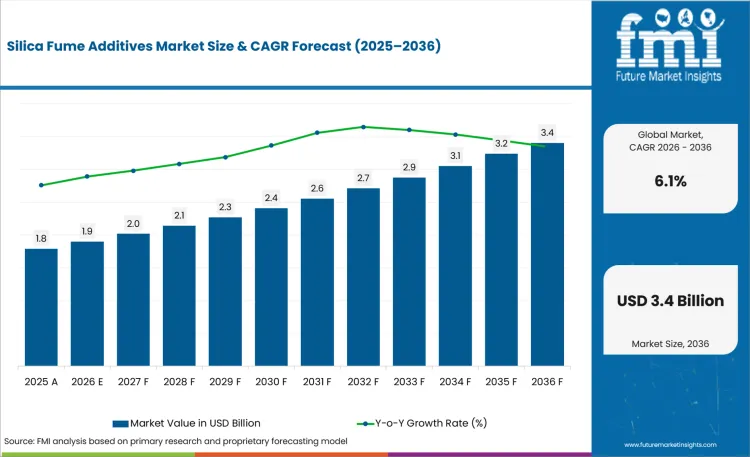
USD 1.9 billion in 2026 and USD 3.4 billion by 2036 at a 6.1% CAGR.
Sales of silica fume additives are estimated to rise at 6.1% CAGR through 2036, increasing valuation from USD 1.9 billion in 2026 to USD 3.4 billion by 2036. The market reached USD 1.8 billion during 2025 amid infrastructure specifications requiring greater durability from exposed concrete. Commercial acceptance depends on mixture qualification for ultra-high-performance concrete within ready-mix plants and precast facilities. FHWA revised cementitious-material requirements in January 2026 following structural-concrete revisions for federal road projects during December 2025. Project teams need compatible dosing guidance and production records that reduce requalification risk across repeated national public works programs with changing regional sources.
National purchasing routes differ through material authorization and project execution rules across major public infrastructure programs worldwide. California's official May 2026 register lists silica fume products from Ferroglobe and CC Metals & Alloys under AASHTO M 307. The same register includes formulated systems from Sika and Master Builders Solutions for approved regional concrete work. German civil contracts emphasize standards records and lifecycle costs across formal engineering tenders and approvals. Japan requires durability records, Norway needs sprayed concrete support, Brazilian highways depend on long-distance logistics. Regional distributors must protect dry storage and delivery timing through changing schedules and local weather conditions year-round.
Key Takeaways of Silica Fume Additives Market
- Durability specifications support silica fume demand across structures exposed to chloride penetration and mechanical loading.
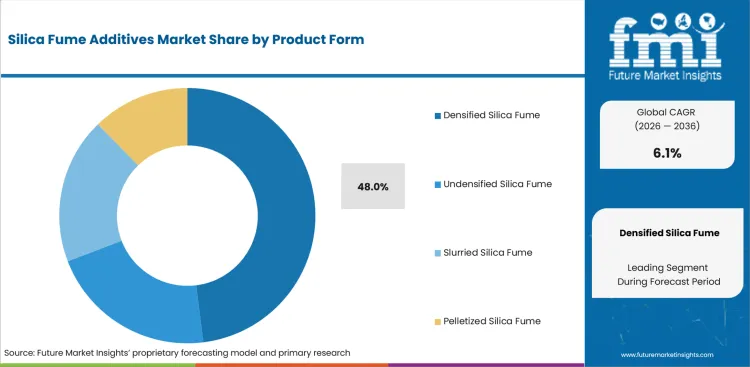
- Densified silica fume is expected to hold 48.0% share in 2026 driven by compact bulk handling.
- Concrete grade is projected to represent 72.0% share in 2026 due to repeat structural qualification requirements.
- High-performance concrete is anticipated to capture 37.0% share in 2026 supported by documented project durability requirements.
- Fine powder handling and mixture sensitivity restrain adoption across plants lacking transfer equipment or specialists.
- Elkem and Ferroglobe supply silica fume, Sika, Mapei, and Master Builders Solutions offer formulated concrete systems.
Analyst Perspective
"Silica fume earns its price through measured permeability control and repeatable batching across exposed concrete. Densified forms improve logistics, yet poor dispersion can undermine every durability claim during routine commercial production. The strongest position combines standards documentation with regional inventory and mixture support from trial production through final placement onsite."
- Nikhil Kaitwade, Principal Analyst, Future Market Insights
How is the Silica Fume Additives Market segmented?
The silica fume additives market is segmented by Product Form, Grade, Application, End Use, Sales Channel, and Region.
Product form separates densified and undensified powders from slurries or pellets through distinct handling requirements across plants. Grade distinguishes concrete products from refractory and oilwell formulations that follow separate performance tests and specifications. Application categories cover high-performance concrete and UHPC beside shotcrete, refractory castables, and oilwell cementing. End use identifies infrastructure and commercial construction beside marine assets, tunnels, industrial flooring, and distinct exposure conditions. Sales channel distinguishes ready-mix concrete suppliers from admixture companies, direct bulk supply, and distributors through purchasing routes. Regional analysis compares qualification routes and technical support across operating markets with different logistics and standards frameworks.
What supports densified silica fume within the product form category?
Plant logistics determine whether silica fume enters routine batching without excessive storage or manual handling across busy production schedules. Norchem documents densified products for bulk tankers and pneumatic transfer beside packaged formats serving smaller concrete plants. Densification reduces freight volume and supports enclosed silo feeding, yet controlled trials must confirm complete dispersion for commercial supply agreements across changing regional schedules.
- Densified silica fume is projected to hold 48.0% share in 2026 owing to compact storage and familiar bulk handling. Higher bulk density reduces warehouse pressure across plants managing cementitious powders through pneumatic transfer, although complete dispersion remains essential for consistent mixture performance and reliable project acceptance during repeated qualification cycles.
- Ready-mix plants favor densified grades for production schedules requiring predictable deliveries and controlled dust exposure. Poor dispersion forms agglomerates that weaken mixture consistency across repeated regional commercial batches and changing cement sources.
Why does concrete grade shape the grade category?
Concrete-grade material follows requirements placed directly inside specifications for structural projects and recurring public approvals. Qualification records let laboratories compare certificates as contractors evaluate established concrete designs across current projects. Ferroglobe documents silica fume use across bridges and parking decks under EN and ASTM standards. Refractory and oilwell grades require separate service-specific evidence across markets and specialized operating routes worldwide.
- Based on grade, concrete grade is projected to account for 72.0% in 2026 due to repeat qualification across structural concrete. Established test methods let laboratories compare certificates and mixture results across public infrastructure projects, reducing material-selection uncertainty and preserving application-specific dosage reviews and local cement compatibility checks in current practice.
- Engineers adopt concrete-grade products through controlled tests of workability and permeability beside strength and air content. Orders slow whenever certificates or application guidance cannot address changing cement and aggregate sources across projects.
How does high-performance concrete influence the application category?
High-performance concrete uses silica fume to tighten cement paste and improve resistance across structures facing severe environmental or mechanical exposure. Elkem documents microsilica use for bridges and tunnels, then extends current construction guidance to roadways and marine concrete applications. Producers compete through proportioning support and verified durability performance rather than isolated strength claims across precast concrete production or field placement.
- The high-performance concrete segment is likely to capture 37.0% share in 2026 attributable to durability specifications. The segment converts permeability and strength performance into engineering targets across exposed structures and long service periods.
- Infrastructure owners select high-performance mixtures for structures that justify added testing and disciplined batching procedures. Adoption remains selective in ordinary construction without compatible concrete admixtures or experienced finishing crews available locally.
What sustains infrastructure demand within the end use category?
Bridge decks and rigid pavements expose concrete to moisture, chemical exposure, and abrasion under loading. Large placements require material continuity so contractors can maintain stable batching across pours and inspections. DNIT reported in May 2025 that Xingu mast required 1,800 cubic meters of concrete. Project scale rewards qualified mixtures and compatible construction chemicals under authority-controlled production procedures throughout construction.
- By end use, infrastructure is forecast to represent 34.0% share in 2026 driven by concentrated volumes and formal durability requirements. Public projects support repeat call-off orders as approved mixtures enter regular production, although remote work sites require coordinated inventory and technical assistance throughout scheduled concrete placements across extended regional corridors.
- Civil contractors use silica fume across exposure conditions that justify lower permeability or greater early strength. Dependable delivery remains essential throughout continuous pours and staged inspections across remote infrastructure construction projects.
Why are ready-mix suppliers important within the sales channel category?
Ready-mix suppliers control silica fume dosing and delivery operations until concrete reaches the construction site. Master Builders Solutions documents MasterLife SF 100 for concrete with reduced permeability and improved cohesiveness. The product fits plant-controlled batching beside water reducers and compatible repair mortar additives across systems. Engineers gain an accountable quality route through producer records and delivery tickets for each load.
- By sales channel, ready-mix suppliers are estimated to hold 32.0% share in 2026 owing to centralized dosing and quality records. Plant addition reduces manual jobsite handling across scheduled deliveries, established routine production controls help contractors receive consistent concrete without managing separate silica fume packaging and storage across multiple operating regions.
- Plants expand silica fume offerings as repeat project demand justifies dedicated storage and operator training. Smaller markets often rely on packaged additions distributed through established regional warehouses and admixture channels.
What are the drivers, restraints, and opportunities in the Silica Fume Additives Market?
Durability specifications support demand, while handling complexity restrains routine use and regional technical service improves project conversion.
- Driver: Infrastructure owners specify permeability and strength for concrete exposed to moisture, chemicals, and abrasion.
- Restraint: Fine powder demands enclosed transfer systems and trained operators for accurate dosing during batching.
- Opportunity: Regional laboratories can adapt silica fume dosage to local cement, admixtures, and placement conditions.
Durability specifications strengthen demand by converting permeability and strength targets into approval criteria for exposed infrastructure. Long paving programs concentrate repeat placements along one corridor under an agency schedule, rewarding mixtures that remain stable through inspections.DNIT reported in April 2026 that the BR-135 whitetopping project had completed 49 kilometers of its planned segment. Approved mixture designs can support recurring silica fume orders across coordinated regional paving and long-term maintenance programs.
Fine powder handling limits routine adoption in plants lacking enclosed storage and controlled transfer equipment. Dosing errors can disturb workability and air content across production batches, raising qualification and corrective-testing costs. Sika requires laboratory trials ahead of site concreting and dry storage for its silica fume additive. Concrete plants without trained operators therefore face setup costs that can outweigh durability benefits on ordinary projects with limited exposure across scheduled production.
Regional technical service offers a practical route for adapting silica fume to local cement sources and water reducers. Underground rehabilitation adds pumping constraints and narrow delivery windows that make trial support commercially valuable. Statens vegvesen specified more than forty permanent sprayed-concrete arches for Strindheim tunnel work in February 2025. Local laboratories can shorten qualification by aligning batching procedures with tunneling equipment and restricted site access during tightly scheduled rehabilitation work.
Which country CAGRs are profiled in the Silica Fume Additives Market?
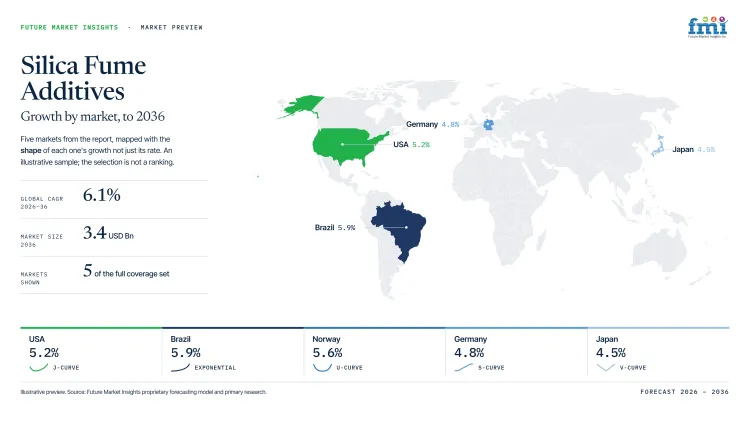
| Country | CAGR |
|---|---|
| United States | 5.2% |
| Germany | 4.8% |
| Japan | 4.5% |
| Norway | 5.6% |
| Brazil | 5.9% |
How do country-level CAGRs compare in the Silica Fume Additives Market?
The five profiled markets span 1.4 percentage points between Brazil at 5.9% and Japan at 4.5%. The narrow spread reflects different conversion speeds rather than equal revenue potential across national construction markets. Recurring silica fume orders depend on recognized concrete specifications and dependable regional technical service and distribution networks. FHWA listed current road-and-bridge specifications from multiple United States jurisdictions for public construction use in June 2026. Comparable infrastructure needs convert differently through batching access and contractor qualification alongside delivery coverage and technical support during formal local public project approvals nationwide.
- Brazilian highway programs support corridor demand, although logistics and plant capability constrain repeat concrete conversion.
- Norwegian tunnel rehabilitation requires durable sprayed concrete, remote service routes raise delivery and technical-response costs.
- United States authorization routes reward qualified materials but increase recurring testing and documentation costs locally.
- German contractors balance standards records against costs that discourage unfamiliar mixtures without proven lifecycle value.
- Japanese bridge programs reward durability evidence, conservative qualification extends entry for overseas silica fume producers.
The full report provides country-level CAGR analysis across North America, Latin America, Europe, East Asia, South Asia, Oceania and the Middle East and Africa.
Country-wise Analysis
- United States transportation projects require formal cementitious-material authorization for concrete entering major publicly funded construction schedules. Adoption of silica fume additives in the United States is estimated to expand at 5.2% CAGR through 2036, supported by established qualification routes. Caltrans revised its current authorization criteria in May 2026 and retained independent sampling rights for materials supplied to departmental projects. Authorized products gain a direct purchasing route, although trial batching and recurring certificates raise regional costs for smaller project teams. Commercial plans require dry regional storage and distributors that protect delivery timing across approved major national bridge and pavement programs nationwide.
- German civil construction contracts require formal standards records and documented concrete performance for accepting silica fume in approved mixtures. Germany is estimated to post 4.8% CAGR over the forecast period, influenced by formal acceptance procedures and local supply access. Destatis officially reported in April 2026 that road-bridge construction prices increased 2.4% year over year during the first quarter. Rising project costs increase scrutiny of mixture changes, and qualification expenses discourage unfamiliar formulations without German-language certificates and local technical guidance.
- Japanese national bridge programs emphasize validated long-term durability as engineers review unfamiliar cementitious materials for established concrete behavior in service. Silica fume additive demand in Japan is forecast to rise at 4.5% CAGR over the forecast period, shaped by conservative formal review. Japan's transport ministry revised national road-bridge standards in August 2025 and expanded performance-based evaluation routes for construction technologies. Market entry requires local partners that coordinate trial production with established contractors and engineering consultants across major public bridge programs nationwide.
- Norwegian infrastructure combines marine exposure with remote bridge and tunnel sites requiring durable concrete across short seasonal construction windows. Norway's silica fume additives outlook is anticipated to advance at 5.6% CAGR over the assessment period, reinforced by specialized concrete requirements. Statens vegvesen awarded fourteen independent bridge-design control contracts in March 2025 and reported roughly 300 to 350 annual technical reviews. Manufacturers need regional inventory and local field specialists who support batching and placement near remote projects during restricted seasonal construction periods.
- Brazilian highway programs use substantial concrete volumes across pavement and bridge projects located far from major industrial supply centers. Silica fume additive sales in Brazil are forecast to expand at 5.9% CAGR by 2036, supported by infrastructure renewal programs. DNIT reported in December 2025 that planned whitetopping work covered a 74-kilometer section of the BR-135 federal highway corridor. Scheduled pavement volumes support repeat orders, although long transport distances and uneven regional ready-mix capability raise delivery risks outside cities.
Who are the notable companies in the Silica Fume Additives Market?
Elkem, Ferroglobe, RW silicium GmbH, Finnfjord AS, CC Metals & Alloys, LLC, Sika, Mapei, and Master Builders Solutions are the notable companies shaping this market.
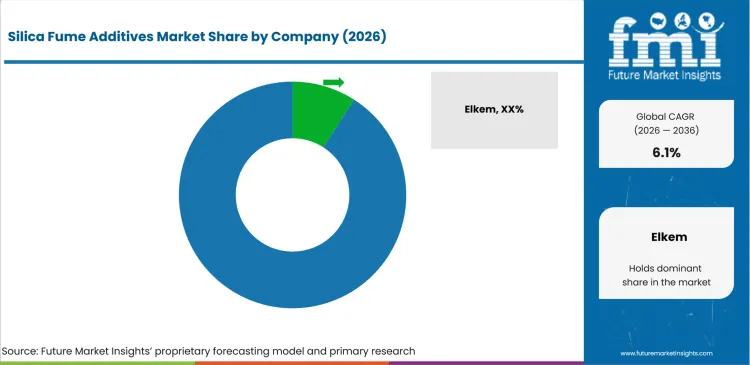
Silica fume supply remains moderately fragmented, primary output depends on silicon furnaces with effective collection systems. Regional processors widen availability through several product forms, admixture groups compete through formulated concrete systems and field support. Entry requires dependable furnace-derived supply or verified sourcing beside standards documentation and reliable regional inventory. Refractory materials applications reward heat-resistant formulations and documented chemistry across demanding global industrial production environments. Fiber cement producers assess fine-particle consistency and dependable deliveries across continuous board manufacturing schedules and plants.
- Elkem and Ferroglobe combine primary silica fume supply with international standards documentation across concrete and industrial applications. Their commercial advantage depends on consistent furnace-derived material plus delivery options that serve large projects and regional distributors without repeated requalification across markets.
- Regional producers include RW silicium GmbH and Finnfjord AS beside CC Metals & Alloys, LLC across regional construction markets. Their narrower portfolios support nearby concrete customers, although export coverage and application support vary within target construction and refractory markets across regions.
- Sika and Mapei join Master Builders Solutions through broader concrete-admixture portfolios supported by technical teams across regional markets. Their position strengthens during projects requiring mixture trials and compatible water reducers alongside coordinated field guidance rather than standalone raw material supply.
Competitive Benchmarking: Silica Fume Additives Market
| Company | Product Form Coverage | Concrete Documentation | Application Support | Geographic Reach |
|---|---|---|---|---|
| Elkem | High | High | High | Global |
| Ferroglobe | Low | High | Medium | Global |
| RW silicium GmbH | High | Medium | Medium | Europe |
| Finnfjord AS | Low | High | Medium | Europe and export markets |
| CC Metals & Alloys, LLC | Low | Medium | Low | North America |
| Sika | Medium | High | High | Global |
| Mapei | Low | High | High | Global |
| Master Builders Solutions | Low | High | High | North America |
Product-form coverage rates three formats high and two medium with one low, concrete documentation rates broad records high and selective records medium with narrow records low, application support rates High, Medium, or Low based on the depth of verified field guidance a company provides.
Key Developments in the Silica Fume Additives Market
- In February 2026, Sika opened an automated concrete-admixture facility in Haines City, Florida as part of a five-site expansion. The site increases regional production and service capacity for concrete technologies, Sika's current portfolio includes qualified silica fume systems.
- In February 2026, Ferroglobe reported a ten-year French energy contract that reduces cost volatility across silicon production operations. Silica fume forms during silicon and ferrosilicon manufacturing, collection systems then process the captured material for concrete and industrial applications.
- In November 2025, Mapei opened a concrete-technology research center at its Sagstua production site in Norway for advanced mixture development. The laboratory expands testing for low-clinker systems and circular materials through equipment designed for concrete formulation and performance validation. Mapei's current portfolio includes densified silica fume for pumped and sprayed concrete, connecting the investment with relevant mixture development and qualification.
- In May 2026, Master Builders Solutions opened two concrete-admixture manufacturing facilities near Orlando and Greensboro metropolitan areas to improve service coverage. Its expanded North American network reached seventeen plants, shortening transportation distances and regional order times.
Silica Fume Additives Market - Report Scope
| Coverage field | Report scope |
|---|---|
| Market breakdown | Product Form, Grade, Application, End Use, Sales Channel, and Region. |
| Market Definition | Silica fume additives sold as powders, slurries, pellets, or formulated concrete systems for defined construction and industrial applications. |
| Regions Covered | North America, Latin America, Western Europe, Eastern Europe, East Asia, South Asia and Pacific, and Middle East and Africa. |
| Countries Covered | United States, Germany, Japan, Norway, and Brazil, with more than twenty-five additional countries in the full report. |
| Key Companies Profiled | Elkem, Ferroglobe, RW silicium GmbH, Finnfjord AS, CC Metals & Alloys, LLC, Sika, Mapei, and Master Builders Solutions |
| Forecast Period | 2026 to 2036. |
| Approach | Hybrid bottom-up and top-down market sizing supported by primary interviews and official desk research. |
Silica Fume Additives Market - Research Methodology
| Method | Approach |
|---|---|
| Primary Research | FMI analysts gathered input from manufacturers, service providers, technology developers, distributors, end users, procurement teams, and subject-matter experts. Interviews examined purchasing decisions, product or service evaluation, adoption barriers, approval requirements, pricing considerations, and expectations for technical or commercial support. Respondents were also asked what evidence is required before a trial, pilot, or initial order develops into regular purchasing. |
| Desk Research | Desk research covered government statistics, regulatory publications, trade data, industry associations, technical literature, standards, company filings, product information, and official corporate announcements. Sources were reviewed for relevance, publication date, geographic coverage, and consistency with the defined market scope. Claims relating to performance, applications, approvals, capacity, investment, and commercial activity were retained only when supported by credible public evidence. |
| Market Sizing and Forecasting | The market model combined the baseline value with historical performance, segment structure, pricing and volume indicators, adoption levels, company participation, and country-level demand conditions. Forecast assumptions considered economic activity, investment trends, regulatory developments, technology adoption, purchasing cycles, supply availability, and barriers to wider market use. Segment and regional estimates were reconciled before the final market total was calculated. |
| Data Validation | Estimates were checked against multiple independent indicators, including public data, company activity, trade patterns, industry developments, and findings from primary interviews. Validation also tested whether products, services, applications, and company revenues fell within the defined market boundaries. Adjacent categories, unsupported claims, overlapping revenues, and activities without direct market relevance were excluded to reduce double counting and maintain consistency across segments and countries. |
Silica Fume Additives Market by Segments
Silica Fume Additives Market segmented by Product Form:
- Densified Silica Fume
- Undensified Silica Fume
- Slurried Silica Fume
- Pelletized Silica Fume
Silica Fume Additives Market segmented by Grade:
- Concrete Grade
- Refractory Grade
- Oilwell / Specialty Grade
Silica Fume Additives Market segmented by Application:
- High-performance Concrete
- UHPC
- Shotcrete
- Refractory Castables
- Oilwell Cementing
Silica Fume Additives Market segmented by End Use:
- Infrastructure
- Commercial Construction
- Marine / Ports
- Mining / Tunnels
- Industrial Flooring
Silica Fume Additives Market segmented by Sales Channel:
- Ready-mix Suppliers
- Admixture Companies
- Direct Bulk Supply
- Distributors
Silica Fume Additives Market by Region:
- North America
- United States
- Canada
- Latin America
- Brazil
- Mexico
- Argentina
- Chile
- Western Europe
- Germany
- France
- United Kingdom
- Italy
- Spain
- Benelux
- Nordics
- Eastern Europe
- Poland
- Czech Republic
- Romania
- Hungary
- East Asia
- China
- Japan
- South Korea
- South Asia and Pacific
- India
- ASEAN
- Australia and New Zealand
- Middle East and Africa
- GCC Countries
- South Africa
- Türkiye
- Israel
Research Sources and Bibliography
- Federal Highway Administration. (2026, June 25). FP-24 EFL Library of Supplemental Specifications.
- California Department of Transportation. (2026, May 20). Cementitious Materials for use in Concrete.
- Elkem ASA. (n.d.). Silica fume for concrete and mortar applications.
- Departamento Nacional de Infraestrutura de Transportes. (2025, May 29). Iniciada concretagem do primeiro mastro da Ponte do Xingu, na BR-230/PA.
- Departamento Nacional de Infraestrutura de Transportes. (2026, April 29). No Maranhão, restauração de 49 km em whitetopping da BR-135 é liberada ao tráfego.
- Statens vegvesen. (2025, February 28). Utbedringen av Strindheimtunnelen starter i april.
- California Department of Transportation. (2026, May 7). Authorization Criteria for Cementitious Materials for use in Concrete List.
- German Federal Statistical Office. (2026, April 10). Short-term indicators Prices.
- Ministry of Land, Infrastructure, Transport and Tourism. (2025, August 22).
- Statens vegvesen. (2025, March 4). Vegvesenet inngår 14 kontrakter om uavhengig prosjekteringskontroll av bruer.
- Departamento Nacional de Infraestrutura de Transportes. (2025, December 5). DNIT avança na recuperação da BR-135 no Maranhão com tecnologia whitetopping.
- Sika AG. (2026, February 3). Sika expands its global manufacturing footprint across growth markets with five new plants.
- Ferroglobe PLC. (2026, February 17). Ferroglobe reports fourth quarter and full year 2025 financial results.
- Mapei S.p.A. (2025, November 13). Mapei opens a Research and Development centre for sustainable concrete technology in Norway.
- Master Builders Solutions. (2026, May 22). Master Builders Solutions expands USA manufacturing footprint with two new admixture sites.
This bibliography is provided for reader reference and is not exhaustive. The full report contains the complete reference list and detailed citations
This Report Answers
- How large is the global Silica Fume Additives market, and what is its growth outlook through 2036?
- What factors are driving demand for silica fume additives across infrastructure and industrial applications?
- Why does densified silica fume lead the product form category?
- How does grade selection affect purchasing decisions across concrete, refractory, and oilwell applications?
- Why is high-performance concrete central to the application category?
- How do market growth rates and qualification routes compare across major countries?
- Which leading companies compete in the silica fume additives market?
- What technical and handling factors limit broader adoption?`
Frequently Asked Questions
How big is the Silica Fume Additives Market in 2026?
The silica fume additives market is valued at USD 1.9 billion in 2026 and is forecast to reach USD 3.4 billion by 2036. Growth is supported by infrastructure specifications requiring greater durability from exposed concrete facing chloride penetration and mechanical loading across public works programs.
What is the CAGR of the Silica Fume Additives Market from 2026 to 2036?
The silica fume additives market grows at a CAGR of 6.1% between 2026 and 2036, driven by infrastructure owners specifying permeability and strength targets for concrete exposed to moisture and chemicals, while fine powder handling and dosing complexity restrain routine adoption.
Which product form leads the Silica Fume Additives Market?
Densified silica fume leads the silica fume additives market by product form, holding 48.0% share in 2026 due to compact bulk handling and enclosed silo feeding that reduce freight volume and warehouse pressure across ready-mix production schedules.
How much will the Silica Fume Additives Market add between 2026 and 2036?
The silica fume additives market is set to add USD 1.5 billion between 2026 and 2036, growing from USD 1.9 billion to USD 3.4 billion as durability specifications expand silica fume qualification across bridges, tunnels, and high-performance concrete infrastructure programs.
Who are the leading companies in the Silica Fume Additives Market?
Eight companies lead the silica fume additives market, including Elkem, Ferroglobe, RW silicium GmbH, Finnfjord AS, CC Metals & Alloys, Sika, Mapei, and Master Builders Solutions, competing through primary supply, standards documentation, and formulated concrete-admixture systems.
Preview the report firsthand - request a free sample
Get SampleGet the brochure for pricing and purchase details.
Get PDFTable of Content
- Key Takeaways
- Market Size and CAGR
- Top Growth Driver
- Fastest Growing Segment
- Leading Region
- Key Companies
- Emerging Opportunities
- Executive Summary
- Global Market Outlook
- Demand-side Trends
- Supply-side Trends
- Technology Roadmap Analysis
- Analysis and Recommendations
- Analyst Perspective (What is happening? Why now? What should investors know?)
- Key Questions Answered
- How large is the market?
- What is the CAGR?
- What are key trends?
- Which region dominates?
- Who are the leaders?
- Market Overview
- Market Coverage / Taxonomy
- Market Definition / Scope / Limitations
- Research Methodology
- Chapter Orientation
- Analytical Lens and Working Hypotheses
- Market Structure, Signals, and Trend Drivers
- Benchmarking and Cross-market Comparability
- Market Sizing, Forecasting, and Opportunity Mapping
- Research Design and Evidence Framework
- Desk Research Programme (Secondary Evidence)
- Expert Input and Fieldwork (Primary Evidence)
- Tooling, Models, and Reference Databases
- Data Engineering and Model Build
- Quality Assurance and Audit Trail
- Market Background
- Market Dynamics (Drivers, Restraints, Opportunity, Trends)
- Scenario Forecast (Optimistic, Likely, Conservative)
- Impact Analysis
- AI Impact
- Sustainability Impact
- Regulatory Impact
- Technology Impact
- Consumer / Buyer Analysis
- Purchase Drivers
- Adoption Barriers
- Buyer Journey
- Opportunity Map Analysis
- Product Life Cycle Analysis
- Supply Chain Analysis
- Investment Feasibility Matrix
- Value Chain Analysis
- PESTLE and Porter's Analysis
- Regulatory Landscape
- Regional Parent Market Outlook
- Production and Consumption Statistics
- Import and Export Statistics
- Global Market Analysis and Forecast, 2021 to 2036
- Historical Market Size Value (USD Billion) Analysis, 2021 to 2025
- Current and Future Market Size Value (USD Billion) Projections, 2026 to 2036
- Y-o-Y Growth Trend Analysis
- Absolute $ Opportunity Analysis
- Global Market Pricing Analysis, 2021 to 2036
- Global Market Analysis and Forecast, By Product Form, 2021 to 2036
- Introduction / Key Findings
- Historical Market Size Value (USD Billion) Analysis By Product Form, 2021 to 2025
- Current and Future Market Size Value (USD Billion) Analysis and Forecast By Product Form, 2026 to 2036
- Densified Silica Fume
- Undensified Silica Fume
- Slurried Silica Fume
- Pelletized Silica Fume
- Densified Silica Fume
- Y-o-Y Growth Trend Analysis By Product Form, 2021 to 2025
- Absolute $ Opportunity Analysis By Product Form, 2026 to 2036
- Global Market Analysis and Forecast, By Grade, 2021 to 2036
- Introduction / Key Findings
- Historical Market Size Value (USD Billion) Analysis By Grade, 2021 to 2025
- Current and Future Market Size Value (USD Billion) Analysis and Forecast By Grade, 2026 to 2036
- Concrete Grade
- Refractory Grade
- Oilwell / Specialty Grade
- Concrete Grade
- Y-o-Y Growth Trend Analysis By Grade, 2021 to 2025
- Absolute $ Opportunity Analysis By Grade, 2026 to 2036
- Global Market Analysis and Forecast, By Application, 2021 to 2036
- Introduction / Key Findings
- Historical Market Size Value (USD Billion) Analysis By Application, 2021 to 2025
- Current and Future Market Size Value (USD Billion) Analysis and Forecast By Application, 2026 to 2036
- High-performance Concrete
- UHPC
- Shotcrete
- Refractory Castables
- Oilwell Cementing
- High-performance Concrete
- Y-o-Y Growth Trend Analysis By Application, 2021 to 2025
- Absolute $ Opportunity Analysis By Application, 2026 to 2036
- Global Market Analysis and Forecast, By End Use, 2021 to 2036
- Introduction / Key Findings
- Historical Market Size Value (USD Billion) Analysis By End Use, 2021 to 2025
- Current and Future Market Size Value (USD Billion) Analysis and Forecast By End Use, 2026 to 2036
- Infrastructure
- Commercial Construction
- Marine / Ports
- Mining / Tunnels
- Industrial Flooring
- Infrastructure
- Y-o-Y Growth Trend Analysis By End Use, 2021 to 2025
- Absolute $ Opportunity Analysis By End Use, 2026 to 2036
- Global Market Analysis and Forecast, By Sales Channel, 2021 to 2036
- Introduction / Key Findings
- Historical Market Size Value (USD Billion) Analysis By Sales Channel, 2021 to 2025
- Current and Future Market Size Value (USD Billion) Analysis and Forecast By Sales Channel, 2026 to 2036
- Ready-mix Suppliers
- Admixture Companies
- Direct Bulk Supply
- Distributors
- Ready-mix Suppliers
- Y-o-Y Growth Trend Analysis By Sales Channel, 2021 to 2025
- Absolute $ Opportunity Analysis By Sales Channel, 2026 to 2036
- Global Market Analysis and Forecast, By Region, 2021 to 2036
- Introduction
- Historical Market Size Value (USD Billion) Analysis By Region, 2021 to 2025
- Current Market Size Value (USD Billion) Analysis and Forecast By Region, 2026 to 2036
- North America
- Latin America
- Western Europe
- Eastern Europe
- East Asia
- South Asia and Pacific
- Middle East & Africa
- Market Attractiveness Analysis By Region
- North America Market Analysis and Forecast, By Country, 2021 to 2036
- Historical Market Size Value (USD Billion) Trend Analysis By Market Taxonomy, 2021 to 2025
- Market Size Value (USD Billion) Forecast By Market Taxonomy, 2026 to 2036
- By Country
- USA
- Canada
- By Product Form
- By Grade
- By Application
- By End Use
- By Sales Channel
- By Country
- Market Attractiveness Analysis
- By Country
- By Product Form
- By Grade
- By Application
- By End Use
- By Sales Channel
- Key Takeaways
- Latin America Market Analysis and Forecast, By Country
- Historical Market Size Value (USD Billion) Trend Analysis By Market Taxonomy, 2021 to 2025
- Market Size Value (USD Billion) Forecast By Market Taxonomy, 2026 to 2036
- By Country
- Brazil
- Mexico
- Chile
- Rest of Latin America
- By Product Form
- By Grade
- By Application
- By End Use
- By Sales Channel
- By Country
- Market Attractiveness Analysis
- By Country
- By Product Form
- By Grade
- By Application
- By End Use
- By Sales Channel
- Key Takeaways
- Western Europe Market Analysis and Forecast, By Country
- Historical Market Size Value (USD Billion) Trend Analysis By Market Taxonomy, 2021 to 2025
- Market Size Value (USD Billion) Forecast By Market Taxonomy, 2026 to 2036
- By Country
- Germany
- UK
- Italy
- Spain
- France
- Nordic
- BENELUX
- Rest of Western Europe
- By Product Form
- By Grade
- By Application
- By End Use
- By Sales Channel
- By Country
- Market Attractiveness Analysis
- By Country
- By Product Form
- By Grade
- By Application
- By End Use
- By Sales Channel
- Key Takeaways
- Eastern Europe Market Analysis and Forecast, By Country
- Historical Market Size Value (USD Billion) Trend Analysis By Market Taxonomy, 2021 to 2025
- Market Size Value (USD Billion) Forecast By Market Taxonomy, 2026 to 2036
- By Country
- Russia
- Poland
- Hungary
- Balkan & Baltic
- Rest of Eastern Europe
- By Product Form
- By Grade
- By Application
- By End Use
- By Sales Channel
- By Country
- Market Attractiveness Analysis
- By Country
- By Product Form
- By Grade
- By Application
- By End Use
- By Sales Channel
- Key Takeaways
- East Asia Market Analysis and Forecast, By Country
- Historical Market Size Value (USD Billion) Trend Analysis By Market Taxonomy, 2021 to 2025
- Market Size Value (USD Billion) Forecast By Market Taxonomy, 2026 to 2036
- By Country
- China
- Japan
- South Korea
- By Product Form
- By Grade
- By Application
- By End Use
- By Sales Channel
- By Country
- Market Attractiveness Analysis
- By Country
- By Product Form
- By Grade
- By Application
- By End Use
- By Sales Channel
- Key Takeaways
- South Asia and Pacific Market Analysis and Forecast, By Country
- Historical Market Size Value (USD Billion) Trend Analysis By Market Taxonomy, 2021 to 2025
- Market Size Value (USD Billion) Forecast By Market Taxonomy, 2026 to 2036
- By Country
- India
- ASEAN
- Australia & New Zealand
- Rest of South Asia and Pacific
- By Product Form
- By Grade
- By Application
- By End Use
- By Sales Channel
- By Country
- Market Attractiveness Analysis
- By Country
- By Product Form
- By Grade
- By Application
- By End Use
- By Sales Channel
- Key Takeaways
- Middle East & Africa Market Analysis and Forecast, By Country
- Historical Market Size Value (USD Billion) Trend Analysis By Market Taxonomy, 2021 to 2025
- Market Size Value (USD Billion) Forecast By Market Taxonomy, 2026 to 2036
- By Country
- Kingdom of Saudi Arabia
- Other GCC Countries
- Türkiye
- South Africa
- Other African Union
- Rest of Middle East & Africa
- By Product Form
- By Grade
- By Application
- By End Use
- By Sales Channel
- By Country
- Market Attractiveness Analysis
- By Country
- By Product Form
- By Grade
- By Application
- By End Use
- By Sales Channel
- Key Takeaways
- Key Countries Market Analysis
- USA
- Pricing Analysis
- Market Share Analysis, 2025
- By Product Form
- By Grade
- By Application
- By End Use
- By Sales Channel
- Canada
- Pricing Analysis
- Market Share Analysis, 2025
- By Product Form
- By Grade
- By Application
- By End Use
- By Sales Channel
- Mexico
- Pricing Analysis
- Market Share Analysis, 2025
- By Product Form
- By Grade
- By Application
- By End Use
- By Sales Channel
- Brazil
- Pricing Analysis
- Market Share Analysis, 2025
- By Product Form
- By Grade
- By Application
- By End Use
- By Sales Channel
- Chile
- Pricing Analysis
- Market Share Analysis, 2025
- By Product Form
- By Grade
- By Application
- By End Use
- By Sales Channel
- Germany
- Pricing Analysis
- Market Share Analysis, 2025
- By Product Form
- By Grade
- By Application
- By End Use
- By Sales Channel
- UK
- Pricing Analysis
- Market Share Analysis, 2025
- By Product Form
- By Grade
- By Application
- By End Use
- By Sales Channel
- Italy
- Pricing Analysis
- Market Share Analysis, 2025
- By Product Form
- By Grade
- By Application
- By End Use
- By Sales Channel
- Spain
- Pricing Analysis
- Market Share Analysis, 2025
- By Product Form
- By Grade
- By Application
- By End Use
- By Sales Channel
- France
- Pricing Analysis
- Market Share Analysis, 2025
- By Product Form
- By Grade
- By Application
- By End Use
- By Sales Channel
- India
- Pricing Analysis
- Market Share Analysis, 2025
- By Product Form
- By Grade
- By Application
- By End Use
- By Sales Channel
- ASEAN
- Pricing Analysis
- Market Share Analysis, 2025
- By Product Form
- By Grade
- By Application
- By End Use
- By Sales Channel
- Australia & New Zealand
- Pricing Analysis
- Market Share Analysis, 2025
- By Product Form
- By Grade
- By Application
- By End Use
- By Sales Channel
- China
- Pricing Analysis
- Market Share Analysis, 2025
- By Product Form
- By Grade
- By Application
- By End Use
- By Sales Channel
- Japan
- Pricing Analysis
- Market Share Analysis, 2025
- By Product Form
- By Grade
- By Application
- By End Use
- By Sales Channel
- South Korea
- Pricing Analysis
- Market Share Analysis, 2025
- By Product Form
- By Grade
- By Application
- By End Use
- By Sales Channel
- Russia
- Pricing Analysis
- Market Share Analysis, 2025
- By Product Form
- By Grade
- By Application
- By End Use
- By Sales Channel
- Poland
- Pricing Analysis
- Market Share Analysis, 2025
- By Product Form
- By Grade
- By Application
- By End Use
- By Sales Channel
- Hungary
- Pricing Analysis
- Market Share Analysis, 2025
- By Product Form
- By Grade
- By Application
- By End Use
- By Sales Channel
- Kingdom of Saudi Arabia
- Pricing Analysis
- Market Share Analysis, 2025
- By Product Form
- By Grade
- By Application
- By End Use
- By Sales Channel
- Türkiye
- Pricing Analysis
- Market Share Analysis, 2025
- By Product Form
- By Grade
- By Application
- By End Use
- By Sales Channel
- South Africa
- Pricing Analysis
- Market Share Analysis, 2025
- By Product Form
- By Grade
- By Application
- By End Use
- By Sales Channel
- USA
- Market Structure Analysis
- Competition Dashboard
- Competition Benchmarking
- Market Share Analysis of Top Players
- By Regional
- By Product Form
- By Grade
- By Application
- By End Use
- By Sales Channel
- Emerging Startups
- Innovation Benchmarking
- Competition Analysis
- Competition Deep Dive
- Elkem
- Overview
- Product Portfolio
- Profitability by Market Segments
- Sales Footprint
- Strategy Overview
- Marketing Strategy
- Product Strategy
- Channel Strategy
- Ferroglobe
- Wacker Chemie
- RW Silicium
- Finnfjord
- CC Metals & Alloys
- Guru Corporation
- Sika
- BASF
- Mapei
- Elkem
- Case Studies
- Success Stories
- Recent Developments
- Competition Deep Dive
- Assumptions & Acronyms Used


