

- Market Size (2026)
- USD 1.7 Bn
- Forecast (2036)
- USD 3.2 Bn
- CAGR (2026 to 2036)
- 6.5%
How big is Sintered Metal Filters Market in 2026?
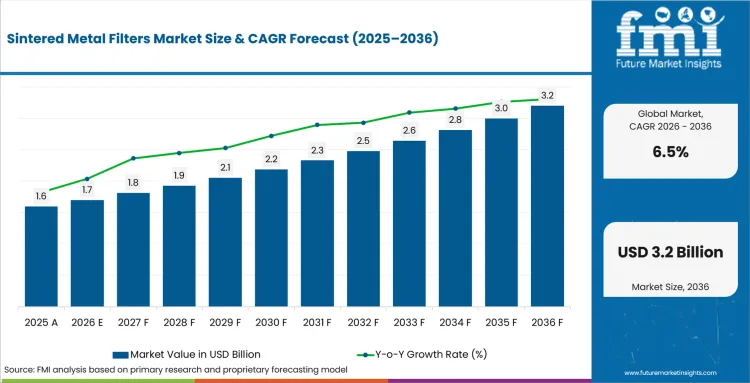
USD 1.7 billion in 2026 and USD 3.2 billion by 2036 at a 6.5% CAGR.
Sales of sintered metal filters are estimated to rise at 6.5% CAGR through 2036, increasing valuation from USD 1.7 billion in 2026 to USD 3.2 billion by 2036. Harsh liquid and gas duties support industrial filtration demand through fixed pore geometry with heat and corrosion resistance. Mott introduced its GasShield HiFlow sandwich filter in May 2025 for semiconductor deposition systems that demand stable ultra-clean gas delivery. The company documented an all-metal Alloy C-22 design with 25% to 35% lower pressure loss than traditional disc filters. The documented performance shows how controlled porosity creates commercial value through process cleanliness and usable flow. Porous metal sheets extend the same design logic into discs and tubes for compact assemblies.
Japanese semiconductor fabs favor compact filters beside process tools and expect rapid local engineering response during qualification. United States projects often require wider replacement coverage across several utility buildings and construction phases. TSMC reported in April 2026 that its first Kumamoto fab began volume production at the end of 2024. The company was constructing a second Kumamoto fab planned for 3-nanometer technology to serve advanced production needs. TSMC also reported that its first Arizona fab entered high-volume production during the fourth quarter of 2024. The two operating models create different service requirements for high-purity chemical filters across large fabrication sites. Japanese installations reward close technical access, whereas American campuses place greater weight on scalable inventory and documented interchangeability.
Key Takeaways of Sintered Metal Filters Market
- Chemical plants and semiconductor fabs require rigid media that protect continuous processes from particles under heat or corrosive chemistry.
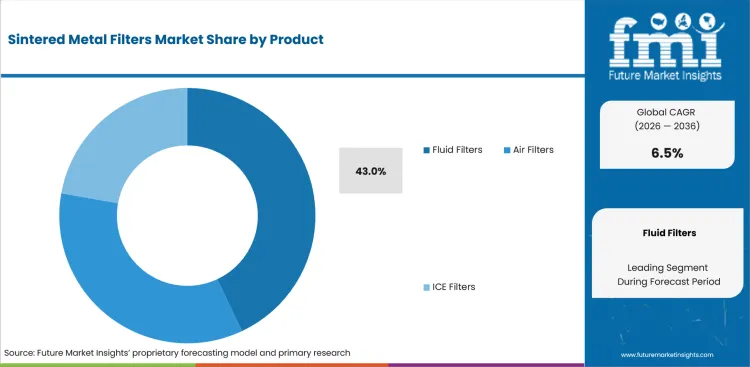
- The product category is forecast to be led by fluid filters at 43.0% share in 2026, supported by broad use across demanding liquid and gas duties.
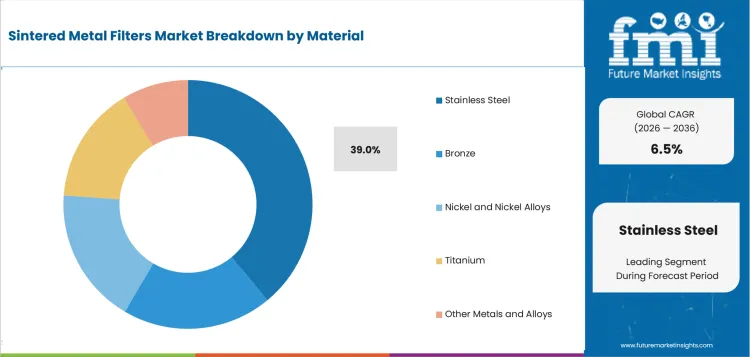
- Based on material, stainless steel is projected to account for 39.0% in 2026 due to familiar fabrication routes and broad corrosion resistance.
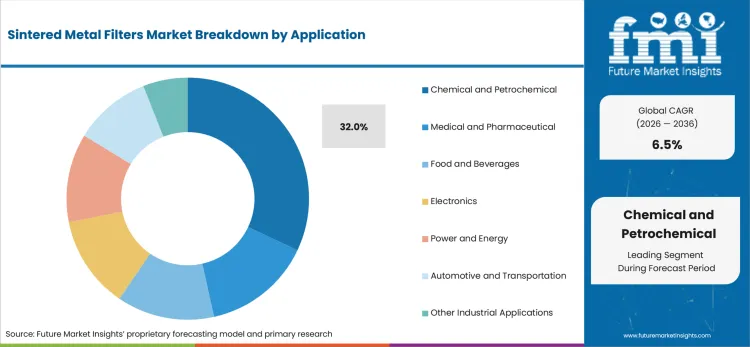
- In 2026, chemical and petrochemical applications are expected to lead the application category with 32.0% share due to catalyst recovery and corrosion-resistant liquid separation.
- Higher initial cost and uncertain cleaning recovery can delay approval if avoided shutdown value remains difficult to prove across representative operating cycles.
- Parker Hannifin and Mott emphasize engineered assemblies, while Porvair Filtration Group and GKN Powder Metallurgy develop porous media for specified process duties. Pall and Entegris address ultra-high-purity duties, whereas AMES-PORE Filtration and Bekaert serve specialized requirements through controlled-pore components and metal-fiber media.
Analyst Perspective
"Sintered metal filters deserve a premium in process duties that reward heat resistance and rigid pore geometry during repeated cleaning. Plant engineers should test restored flow and particle retention under the actual contaminant load instead of approving an element from a nominal micron rating. The strongest offers pair the correct alloy with maintainable housings and local service that prevents a reusable element from becoming a long replacement delay."
- Nikhil Kaitwade, Principal Analyst, Future Market Insights
How is the Sintered Metal Filters Market segmented?
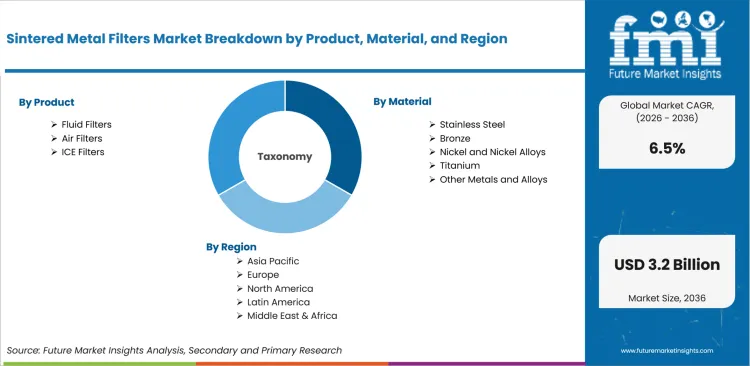
The sintered metal filters industry is segmented by product, material, application, end user, distribution channel, technology, and region.
The segmentation framework separates physical filter format from material choice, process use, purchasing route, and manufacturing technology. Product distinguishes fluid, air, and internal-combustion-engine filter forms used across separate gas or liquid duties. Material compares stainless steel, bronze, nickel alloys, titanium, and other metals with different corrosion and temperature limits. Application identifies the process duty that creates a filtration need, while end user identifies the organization operating that duty. Distribution channel separates direct engineering sales from distributors, integrators, online platforms, and specialty engineering companies. Technology distinguishes sintered powder, wire mesh, metal fiber, porous membrane, and composite routes with different permeability and fabrication features. Regional analysis compares availability, qualification practices, service conditions, and replacement access across the defined country set.
What supports the position of fluid filters within the product category?
Fluid filters address both liquid and gas streams that require rigid media with stable pore geometry during repeated operation. Mott announced a partnership with Avio in March 2025 for porous metal filtration and flow-control components exposed to extreme temperature and pressure. Aerospace propulsion provides a demanding proof case for mechanical strength and cleanliness, while liquid filtration systems create broader commercial use across chemical and pharmaceutical processes. Engineers must compare differential pressure and retention throughout the expected cleaning sequence before replacing disposable media.
- The product category is forecast to be led by fluid filters at 43.0% share in 2026, supported by broad coverage across liquid and gas duties. Cartridges and tubes fit continuous process lines that handle difficult solids or contamination-sensitive gases across demanding production conditions. Discs and integrated assemblies extend the segment into compact equipment that requires rigid media with controlled pore dimensions.
- Plant reliability teams favor fluid filters that restore usable flow without changing validated retention or pressure-drop behavior. Reusable elements reduce disposal and replacement frequency across lines with demanding temperature or corrosion conditions. Embedded fouling or housing-seal failures can weaken the commercial case, so approval depends on recovered performance across several representative cleaning cycles.
Why does stainless steel remain central to the material category?
Stainless steel gives equipment designers a familiar combination of corrosion resistance and weldable construction across many process housings. Established fabrication methods improve replacement access and simplify repairs across standard industrial systems with local welding capability. Engineers must compare 304L with 316L because each grade responds differently to chloride exposure and cleaning chemistry. Nickel alloys remain necessary in duties that exceed verified stainless temperature or corrosion limits, so material selection requires stream-specific compatibility evidence rather than a general stainless designation.
- Based on material, stainless steel is projected to account for 39.0% in 2026 due to familiar fabrication routes and broad corrosion resistance. Porvair described precision-sintered HPLC frits in March 2026 using stainless steel and titanium alongside specialized alloys. The development shows how controlled porosity and chemical durability support stainless selection under high pressure and aggressive solvents.
- Process engineers adopt stainless steel elements for duties whose temperature and cleaning chemistry remain within verified material limits. Familiar welding methods help maintenance teams repair housings without changing the validated system design or connection layout. Nickel alloys gain preference under severe chloride exposure or oxidizing conditions that shorten expected stainless service life. The adoption decision therefore turns on total service life and compatibility evidence rather than initial element price.
How does the chemical and petrochemical segment shape application demand?
Chemical and petrochemical plants use rigid filters for catalyst recovery and aggressive liquid service across continuous processing units. Brazil’s EPE reported in November 2025 that national refining capacity is expected to expand 10% between 2025 and 2035. Capacity growth enlarges the operating base but does not prove individual purchases of sintered metal filter systems. New distillation and hydrotreating units create defined filtration points for catalyst fines and hard particles. Refinery filtration projects become addressable when metal media reduce shutdown exposure or protect downstream equipment.
- In 2026, chemical and petrochemical applications are expected to lead the application category with 32.0% share due to catalyst recovery and corrosion-resistant separation. Continuous units face costly contamination events that justify rigid media with repeatable retention during long production runs. Verified cleaning recovery determines the segment’s position more directly than broad refinery capacity or general chemical investment.
- Refinery operators adopt sintered elements through pilot testing that confirms restored flow under representative solids loading and cleaning chemistry. Process teams value reusable media that protect downstream catalysts or equipment from hard particles during continuous production. Adoption slows if the filtration system transfers fouling into valves or polishing stages and creates another maintenance burden.
What supports the chemical and petrochemical industry within the end user category?
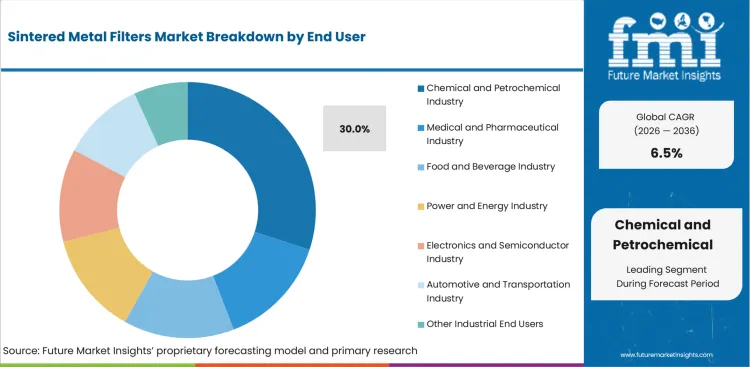
Chemical producers evaluate filtration economics through process continuity and contamination risk instead of element price alone. EPE reported in December 2025 that planned Brazilian refining and logistics investment totaled USD 25.8 billion for 2026 through 2035. The figure identifies an operating base with new process units and logistics assets, but it does not prove filter orders. Filtration equipment earns consideration at process points that protect catalysts or finished materials from damaging particles. Each project requires evidence on retention stability and cleaning intervals under its actual process chemistry.
- The chemical and petrochemical industry is likely to capture 30.0% of the end user category in 2026, attributable to continuous operation and costly contamination risks. Chemical plants and refineries apply different maintenance rules despite sharing harsh filtration duties across long production cycles. Their combined position reflects the value of stable production across streams that penalize frequent shutdowns and particle release.
- Process engineers favor cleanable media where avoided shutdowns offset higher initial cost across several maintenance cycles. Chemical facilities can justify reusable elements for catalyst recovery or hot corrosive liquids with measurable production losses. Adoption remains limited in low-value streams that tolerate disposable cartridges without material downtime or downstream equipment risk.
Which buying mechanism supports direct sales in the distribution channel category?
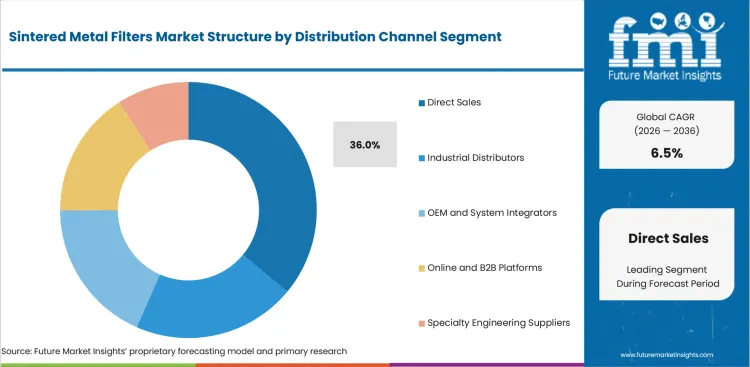
Direct sales fit custom housings and qualification programs that require immediate access to application engineers. Mott and deltaVision announced an April 2026 partnership that combines filters with valves and restrictors inside contamination-controlled spacecraft propulsion assemblies. The collaboration shows why complex fluid systems need coordinated design ownership, while candle filter cartridges can pass through distributors for standard replacements. Custom sintered assemblies usually require operating data and approved drawings before a manufacturer can prepare a reliable quotation.
- By distribution channel direct sales are forecast to represent 36.0% in 2026, driven by custom design and qualification needs. Direct engagement gives manufacturers access to operating data and documented failure history across complex accounts. Engineering ownership improves material selection and clarifies service responsibilities from validation and installation through regular commercial use.
- Large process operators use direct contracts to define testing and response responsibilities across several production sites. Direct engagement helps engineering teams coordinate drawings with housing and cleaning requirements across custom installations. Regional distributors remain useful for replacement stock across standardized element families with predictable specifications, so channel selection depends on customization depth and service urgency.
What supports sintered powder technology within the technology category?
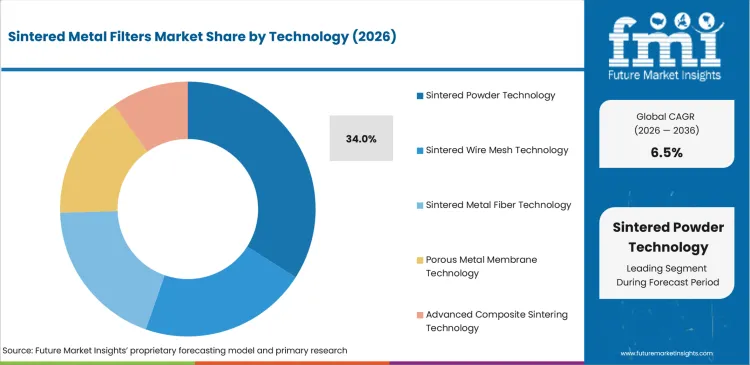
Sintered powder technology creates controlled porosity through compaction and thermal bonding of metal particles inside rigid geometries. Powder routes produce seamless tubes and compact shapes that avoid mesh joints across demanding filter installations. Isostatic pressing can improve density consistency along extended parts that carry demanding pressure and mechanical loads. Metal fiber felt offers higher void volume and pleating potential for duties that prioritize permeability. Technology selection depends on pore uniformity and mechanical loading across each defined process duty rather than manufacturing familiarity.
- Sintered powder technology is set to lead the technology category with 34.0% share in 2026 due to seamless shapes and broad alloy choice. Powder compaction supports discs and cylindrical elements across several filtration duties with different pressure and flow requirements. Isostatic pressing can improve pore consistency along long tubes that require stable strength and predictable pressure-drop behavior.
- Component manufacturers adopt powder technology for rigid shapes with repeatable pore dimensions and controlled pressure loss. Mott introduced a 3D-printed porous metal impeller in April 2025 that combines filtration with fluid movement inside perfusion equipment. The design shows how additive manufacturing can integrate flow paths and porous sections within one reusable component, although each geometry requires application-specific validation.
What are the drivers, restraints, and opportunities in the Sintered Metal Filters Market?
New high-purity and harsh-process capacity supports demand for cleanable metal filtration across contamination-sensitive production duties. Higher initial cost and uncertain cleaning recovery restrain conversion across applications without measurable shutdown savings. Engineered porosity and integrated assemblies create an opening through lower pressure loss and simpler equipment architecture.
- Driver: New high-purity and harsh-process capacity creates gas and liquid duties that require stable filtration across repeated operating cycles.
- Restraint: Higher initial cost and demanding qualification can delay orders if service-life evidence remains incomplete under the intended process conditions.
- Opportunity: Additive manufacturing and graded porosity can combine filtration with flow control while reducing joints inside compact equipment assemblies.
High-purity manufacturing creates a direct demand driver through new gas and liquid utilities that require dependable contamination control. The UK government reported in April 2026 that three supported life-science manufacturing investments would expand medicine production and support more than 500 jobs. New facilities create filtration duties across sterile utilities and production equipment exposed to repeated cleaning and demanding temperatures. Pharmaceutical filtration becomes relevant to sintered metal in steam service or harsh cycles that exclude softer media. Equipment manufacturers must identify the exact process duty instead of treating every new facility as addressable revenue.
Qualification is one of the notable challenges because nominal retention does not establish stable performance under real process conditions. Entegris reported in February 2025 that a joint study with Inpria and imec compared point-of-use filters through a normalized defect test. One design reduced defectivity by 20% against the traditional 3-nanometer UPE control used in the study. The research examined polymeric media instead of sintered metal and linked filter design with measurable wafer defects. The testing approach shows why semiconductor fabs require application-level proof beyond nominal pore ratings for contamination-sensitive filtration. Metal gas filters face comparable demands for verified cleanliness and stable pressure loss across representative operating conditions.
Engineered porosity offers an opportunity to improve permeability and cleaning recovery without weakening mechanical strength. Bekaert explained in June 2026 that stable sintered bonds and connected pore networks influence pressure loss and back-pulse cleaning across metal fiber media. The documented relationship gives manufacturers a practical development route for higher-flow elements with repeatable cleaning performance. Commercial value depends on restored performance under representative deposits and cleaning methods across several operating cycles. Application-specific alloys can extend the design into corrosive or high-temperature duties that exceed standard stainless limits.
Which country CAGRs are profiled in the Sintered Metal Filters Market?
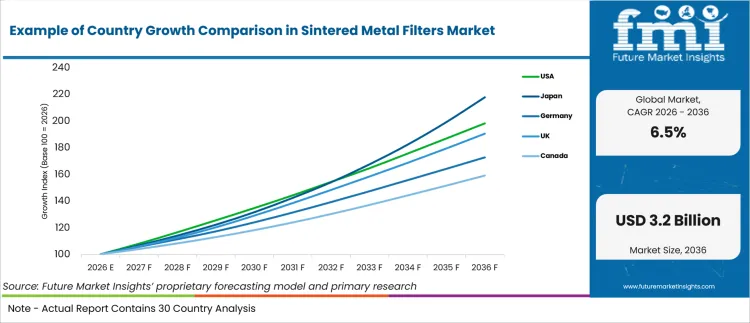
| Country | CAGR |
|---|---|
| Japan | 8.1% |
| Brazil | 7.4% |
| USA | 7.1% |
| UK | 6.7% |
| South Korea | 6.3% |
| Germany | 5.6% |
| Canada | 4.8% |
How do country-level CAGRs compare in the Sintered Metal Filters Market?
The country forecasts show a gradual progression across the sintered metal filters market, with growth distributed across all seven countries rather than concentrated in a small number of markets. Japan forms the upper end of the comparison, while Brazil and the USA create a closely aligned second group with only a limited difference between their forecasts. The UK and South Korea follow within a narrow range, indicating similar momentum in industrial filtration adoption. Germany and Canada record more moderate growth rates, although the transition from one market to the next remains relatively smooth rather than segmented by major gaps. This pattern reflects differences in advanced manufacturing activity, process filtration requirements and investment in industrial equipment modernization.
- Japan benefits from a strong industrial manufacturing base and continued demand for high-performance filtration systems used in precision engineering, electronics production and advanced process industries.
- Brazil reflects growing adoption of industrial filtration technologies as manufacturers invest in process efficiency and equipment upgrades across mining, chemicals and food processing operations.
- The USA supports market expansion through broad demand from industrial, pharmaceutical and environmental applications that require durable and reusable filtration solutions.
- The UK continues to generate demand through modernization of manufacturing facilities and increasing focus on filtration performance in regulated processing environments.
- South Korea's outlook is supported by advanced electronics, semiconductor and industrial production sectors where filtration quality and process reliability remain important operational priorities.
- Germany maintains steady market development through its established engineering sector, with demand driven by industrial automation, precision manufacturing and process optimization requirements.
- Canada reflects a more measured growth profile as adoption is supported by energy, water treatment and industrial processing applications, while overall market expansion remains linked to capital investment cycles.
Similar CAGRs do not necessarily create identical market opportunities for sintered metal filter manufacturers. Differences in industrial end-use sectors, filtration standards, regulatory requirements and equipment replacement cycles can significantly influence purchasing behavior and adoption timelines. The full report provides country-level CAGR analysis across North America, Latin America, Europe, East Asia, South Asia, Oceania and the Middle East and Africa.
Country-wise Analysis
- Japanese semiconductor facilities require ultra-clean gas systems and compact filtration equipment near contamination-sensitive process tools. Sintered metal filter sales in Japan are forecast to expand at 8.1% CAGR by 2036, supported by advanced fab investment and local precision engineering. METI stated in February 2026 that TSMC’s revised second Kumamoto fab plan would target 3-nanometer production. The project creates defined need for low-shedding filters across critical gas delivery and deposition equipment. Local engineering access helps manufacturers resolve qualification issues near clustered fabrication sites and process-tool teams. Lengthy customer validation remains the main friction because one contamination event can damage costly wafer output. Foreign manufacturers need Japanese technical support and documented cleanliness performance for wider site approval and reliable maintenance.
- Brazilian refineries require filters that tolerate variable feed conditions and long maintenance intervals across large industrial sites. By 2036 Brazil’s sintered metal filters market is projected to grow at 7.4% CAGR, supported by refinery upgrades and petrochemical investment. The Ministry of Mines and Energy announced in July 2025 that projects included additional diesel capacity and a renewable aviation fuel plant. New units create defined filtration points for catalyst retention and hot liquid service across continuous refinery processes. Regional engineering contractors provide an entry route through installation and maintenance support for specialized metal elements. Import exposure and limited local cleaning support can weaken service-life economics through higher custom-alloy costs and delayed replacements outside major industrial centers.
- United States semiconductor projects combine large utility networks with formal validation across several process buildings. In the USA sintered metal filter demand is predicted to advance at 7.1% CAGR through 2036, supported by domestic fabrication investment and broad technical distribution. TSMC records April 2025 as the start of site work for its third advanced Arizona fabrication facility. New capacity creates defined demand for high-purity gas filtration with strict leak and particle specifications. Regional distribution improves replacement coverage across major industrial clusters and multiple customer sites with demanding production schedules. Fragmented owner requirements remain a friction because each site can impose different documentation and testing procedures. Manufacturers need traceable records and clear service responsibility for wider deployment across several facilities and utility systems.
- United Kingdom pharmaceutical sites require validated materials and documented cleaning procedures across sterile production utilities. Sintered metal filter demand in the UK is forecast to rise at 6.7% CAGR over the forecast period, supported by medicine manufacturing investment and local validation services. The government reported in July 2026 that life-science investment announcements covered several production facilities and research sites. Steam and process-gas duties create focused openings for reusable metal elements under repeated sterilization cycles. Established engineering companies provide local qualification and maintenance support across regulated medicine manufacturing facilities and utilities. Narrow duty fit remains a friction because polymer membranes serve many sterile liquid filtration and product-contact steps. Metal media must show a clear temperature or durability advantage to justify higher initial cost.
- South Korean semiconductor clusters provide dense customer access for specialized filtration engineering across concentrated fabrication sites. South Korea’s sintered metal filters outlook is anticipated to advance at 6.3% CAGR over the assessment period, influenced by high production intensity and rapid engineering response. Entegris opened its Korea Technology Center in July 2025 with liquid filtration support and customer-fab simulation capabilities. The 12,000-square-meter site gives local chipmakers a practical route for application testing under representative production conditions. Close technical access helps manufacturers coordinate material reviews and qualification with demanding fabrication teams across concentrated industrial clusters. Delivery performance remains a friction because fabrication schedules allow little tolerance for late custom parts or incomplete test records. Foreign companies need dependable Korean service routes and documented compatibility across equipment platforms and production tools.
- German chemical plants require detailed material documentation and lifecycle economics for filtration changes across critical process lines. The German sintered metal filters sector is projected to record 5.6% CAGR during the assessment period, shaped by chemical production and advanced equipment engineering. Destatis reported in May 2026 that industrial production stood 2.8% below March 2025 despite a monthly increase. Current conditions favor selective replacement programs instead of broad capacity expansion across every chemical facility. Strong application engineering provides an enabler for complex housings and alloy selection under demanding process chemistry. Weak production cycles create a material friction through deferred filtration upgrades with long investment payback periods. Manufacturers should target contamination-critical duties that justify reusable media through measurable shutdown protection and maintenance savings.
- Canadian demand is distributed across refineries and chemical facilities separated by long regional service distances. Adoption of sintered metal filters in Canada is estimated to expand at 4.8% CAGR through 2036, linked to diverse process industries and regional aerospace demand. Statistics Canada reported in June 2026 that Alberta chemical manufacturing sales rose 8.6% during April and Quebec petroleum sales rose 24.8%. Regional activity creates defined filtration workloads without supporting uniform deployment across every provincial industrial cluster. Aerospace and process clusters provide an enabler for high-performance porous components under demanding operating conditions. Long travel distances create a material friction for urgent replacements and custom maintenance across remote industrial facilities. Manufacturers need regional inventory and qualified service partners to preserve reusable-filter economics across dispersed accounts.
Who are the notable companies in the Sintered Metal Filters Market?
Parker Hannifin and Mott are notable participants alongside Porvair Filtration Group and GKN Powder Metallurgy. Pall Corporation and Entegris join AMES-PORE Filtration and Bekaert within the exact-market group of competing filtration manufacturers.
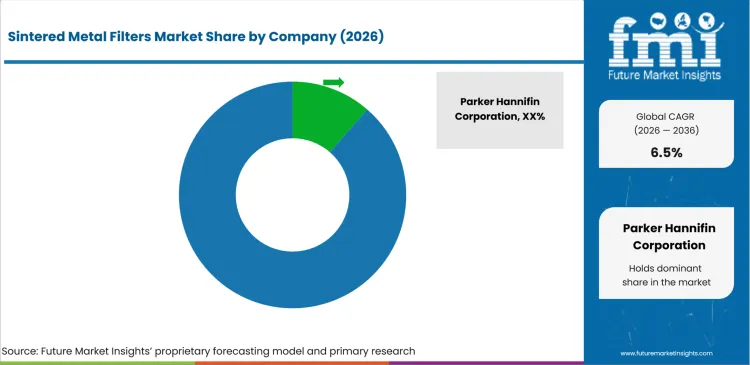
The competitive outlook combines process-filter specialists with diversified filtration groups and porous-media manufacturers serving demanding applications. Mott and Porvair offer several metal media forms with engineered assemblies for chemical and aerospace systems. Entegris focuses on ultra-high-purity semiconductor filtration, while GKN and AMES-PORE connect powder processing with serial production. Dauch Corporation confirmed in February 2026 that its completed Dowlais acquisition included GKN Powder Metallurgy. Parker and Pall provide metal elements through broad industrial channels, while Bekaert adds sintered metal fiber media designed for repeated cleaning. Exact-market differentiation depends on alloy range and custom engineering alongside harsh-duty qualification and accessible technical service.
- Mott and Porvair Filtration Group compete with GKN Powder Metallurgy through porous media and application-specific assemblies for demanding process systems. Commercial differentiation depends on documented retention stability and cleaning recovery under the operator’s actual temperature and chemical exposure.
- Parker Hannifin and Pall Corporation supply assembled metal filtration products through broad industrial service networks. Bekaert contributes sintered metal fiber media for high-temperature or corrosive service across systems that require repeated cleaning. Their commercial positions depend on matching material performance with regional engineering support and practical replacement planning.
- Entegris and AMES-PORE Filtration address specialized requirements through ultra-high-purity gas filters or serial sintered components with controlled pore structures. Each company must prove exact application fit through documented performance and accessible engineering support rather than general manufacturing scale.
Competitive Benchmarking: Sintered Metal Filters Market
| Company | Porous Media Breadth | Custom Assembly Engineering | Harsh-Duty Qualification | Geographic Reach |
|---|---|---|---|---|
| Parker Hannifin Corporation | Medium | Medium | Medium | Global |
| Mott Corporation | High | High | High | Global |
| Porvair Filtration Group | High | High | High | Global |
| GKN Powder Metallurgy | Medium | High | Medium | Global |
| Pall Corporation | High | High | High | Global |
| Entegris, Inc. | Medium | High | High | Global |
| AMES-PORE Filtration, S.L. | Medium | Medium | Medium | Multi-country |
| Bekaert NV | Medium | Low | High | Global |
Key Developments in the Sintered Metal Filters Market
- In March 2025, Mott Corporation received a USD 1.9 million United States Department of Defense agreement for additively manufactured components using advanced porous materials in hypersonic systems. The project funds prototypes that must withstand extreme service conditions and carry traceable engineering records through development. Mott identifies sintered porous metal design and customization as core capabilities for mission-critical fluid systems. The agreement adds commercial proof for controlled-porosity manufacturing beyond standard filter cartridges across demanding qualification programs.
- In November 2025, Entegris opened its Colorado Springs Manufacturing Center of Excellence for advanced filtration and purification products serving semiconductor production. The 135,000-square-foot facility began initial commercial operations during 2025 and expanded domestic manufacturing capacity. Entegris linked the site to chip purity and yield requirements across critical process solutions serving demanding fabrication operations. The development improves United States availability and gives semiconductor customers a closer manufacturing base for qualification support and continuity planning.
- In May 2026, Pall Corporation announced an engineering-scale flue-gas filtration pilot in Alberta with provincial funding. The project combines jet-pulse cleaning with 3D-printed metal filter media inside a regenerable modular system. Pall plans to validate performance at a Canadian cement plant under high particulate loading and variable operating conditions. The program creates field data for carbon-capture pretreatment, but wider use depends on stable pressure drop and cleaning recovery.
- In June 2025, GKN Powder Metallurgy introduced metallic membrane cartridge filters for chemical and pharmaceutical separation alongside food-processing duties. The design positions the membrane inside or outside the element to improve cake release and cleaning access. GKN reported productivity gains of up to 30% under the stated operating configuration and filter arrangement. The launch expands exact-market availability through regenerable cartridges, although each plant must confirm performance under its actual solids loading and cleaning chemistry.
Key Players in the Sintered Metal Filters Market
Integrated Filtration and Flow-Control Providers
- Parker Hannifin Corporation
- Mott Corporation
- Porvair Filtration Group
Powder Metallurgy and Porous Media Manufacturers
- GKN Powder Metallurgy
- AMES-PORE Filtration, S.L.
High-Purity and Process Filtration Participants
- Pall Corporation
- Entegris, Inc.
- Bekaert NV
Sintered Metal Filters Market - Report Scope
| Coverage field | Report scope |
|---|---|
| Market breakdown | Product, material, application, end user, distribution channel, technology, and region. |
| Quantitative Units | Revenue in USD Million, CAGR in %. |
| Market Definition | Porous sintered metal media and assemblies used for cleanable gas or liquid filtration under demanding pressure, temperature, corrosion, or cleanliness conditions. |
| Regions Covered | North America, Latin America, Europe, East Asia, South Asia, Oceania, and the Middle East and Africa. |
| Countries Covered | Japan, Brazil, USA, UK, South Korea, Germany, and Canada. |
| Key Companies Profiled | Parker Hannifin Corporation, Mott Corporation, Porvair Filtration Group, GKN Powder Metallurgy, Pall Corporation, Entegris, Inc., AMES-PORE Filtration, S.L., and Bekaert NV. |
| Forecast Period | 2026 to 2036. |
| Approach | Market estimates reflect product revenue, replacement cycles, application demand, company participation, and country-level operating conditions. |
Sintered Metal Filters Market - Research Methodology
| Method | Approach |
|---|---|
| Primary Research | FMI analysts gathered input from manufacturers, service providers, technology developers, distributors, end users, sourcing teams, and subject-matter experts. Interviews examined purchasing decisions, product or service evaluation, adoption barriers, approval requirements, pricing considerations, and expectations for technical or commercial support. Respondents were also asked what evidence is required before a trial, pilot, or initial order develops into regular purchasing. |
| Desk Research | Desk research covered government statistics, regulatory publications, trade data, industry associations, technical literature, standards, company filings, product information, and official corporate announcements. Sources were reviewed for relevance, publication date, geographic coverage, and consistency with the defined market scope. Claims relating to performance, applications, approvals, capacity, investment, and commercial activity were retained only when supported by credible public evidence. |
| Market Sizing and Forecasting | The market model combined the baseline value with historical performance, segment structure, pricing and volume indicators, adoption levels, company participation, and country-level demand conditions. Forecast assumptions considered economic activity, investment trends, regulatory developments, technology adoption, purchasing cycles, supply availability, and barriers to wider market use. Segment and regional estimates were reconciled before the final market total was calculated. |
| Data Validation | Estimates were checked against multiple independent indicators, including public data, company activity, trade patterns, industry developments, and findings from primary interviews. Validation also tested whether products, services, applications, and company revenues fell within the defined market boundaries. Adjacent categories, unsupported claims, overlapping revenues, and activities without direct market relevance were excluded to reduce double counting and maintain consistency across segments and countries. |
Sintered Metal Filters Market by Segments
Sintered Metal Filters Market segmented by Product:
- Fluid Filters
- Liquid Filters
- Gas Filters
- Air Filters
- Compressed Air Filters
- Process Air Filters
- ICE Filters
- Fuel Filters
- Lubricant Filters
Sintered Metal Filters Market segmented by Material:
- Stainless Steel
- Stainless Steel 316L
- Stainless Steel 304L
- Bronze
- Bronze Powder
- Sintered Bronze Alloys
- Nickel and Nickel Alloys
- Nickel 200
- Inconel Alloys
- Titanium
- Pure Titanium
- Titanium Alloys
- Other Metals and Alloys
- Hastelloy Alloys
- Monel Alloys
Sintered Metal Filters Market segmented by Application:
- Chemical and Petrochemical
- Chemical Processing
- Petrochemical Processing
- Medical and Pharmaceutical
- Pharmaceutical Manufacturing
- Medical Gas and Sterile Processing
- Food and Beverages
- Food Processing
- Beverage Processing
- Electronics
- Semiconductor Manufacturing
- Electronics Manufacturing
- Power and Energy
- Power Generation
- Nuclear Energy
- Automotive and Transportation
- Fuel Systems
- Emission Control Systems
- Other Industrial Applications
- Water Treatment
- Aerospace and Defense
Sintered Metal Filters Market segmented by End User:
- Chemical and Petrochemical Industry
- Chemical Manufacturers
- Petrochemical Refineries
- Medical and Pharmaceutical Industry
- Pharmaceutical Companies
- Medical Device Manufacturers
- Food and Beverage Industry
- Food Processing Companies
- Beverage Manufacturers
- Power and Energy Industry
- Thermal Power Plants
- Nuclear Power Plants
- Electronics and Semiconductor Industry
- Semiconductor Manufacturers
- Electronics Producers
- Automotive and Transportation Industry
- Automotive OEMs
- Transportation Equipment Manufacturers
- Other Industrial End Users
- Water Treatment Operators
- Aerospace and Defense Contractors
Sintered Metal Filters Market segmented by Distribution Channel:
- Direct Sales
- Direct Manufacturer Sales
- Key Account Contracts
- Industrial Distributors
- Regional Industrial Distributors
- Specialized Filtration Distributors
- OEM and System Integrators
- Filtration System OEMs
- Process Equipment Integrators
- Online and B2B Platforms
- Industrial E-Commerce Platforms
- B2B Procurement Portals
- Specialty Engineering Suppliers
- Custom Filtration Suppliers
- Engineering and Technical Suppliers
Sintered Metal Filters Market segmented by Technology:
- Sintered Powder Technology
- Powder Metallurgy Sintering
- Advanced Powder Compaction
- Sintered Wire Mesh Technology
- Multilayer Sintered Mesh
- Single-Layer Sintered Mesh
- Sintered Metal Fiber Technology
- Metal Fiber Media
- Fiber-Based High-Flow Filters
- Porous Metal Membrane Technology
- Porous Metal Membranes
- Membrane-Supported Filters
- Advanced Composite Sintering Technology
- Metal-Ceramic Composites
- Multi-Material Sintered Filters
Sintered Metal Filters Market by Region:
- North America
- United States
- Canada
- Latin America
- Brazil
- Mexico
- Argentina
- Chile
- Western Europe
- Germany
- France
- United Kingdom
- Italy
- Spain
- Benelux
- Nordics
- Eastern Europe
- Poland
- Czech Republic
- Romania
- Hungary
- East Asia
- China
- Japan
- South Korea
- South Asia and Pacific
- India
- ASEAN
- Australia and New Zealand
- Middle East and Africa
- GCC Countries
- South Africa
- Türkiye
- Israel
Research Sources and Bibliography
- Mott Corporation. (2025, May). Mott Corporation Unveils GasShield HiFlow Sandwich Filter.
- Taiwan Semiconductor Manufacturing Company Limited. (2026, April 16). TSMC 2025 Annual Report Website.
- Mott Corporation. (2025, March 3). Mott Launches Partnership with International Aerospace Leader Avio.
- Porvair Filtration Group. (2026, March 30). HPLC (High performance liquid chromatography).
- Empresa de Pesquisa Energética. (2025, November 27). Caderno de Abastecimento de Derivados de Petróleo do PDE 2035 estima redução da dependência externa ao GLP, à nafta, e ao QAV e à gasolina nos próximos dez anos.
- Empresa de Pesquisa Energética. (2025, December 11). EPE publica informe técnico sobre investimentos em refino e logística para o PDE 2035.
- Mott Corporation. (2026, April). Mott and deltaVision Partner to Advance Spacecraft Propulsion Flow Control Systems.
- Mott Corporation. (2025, April). Breaking the Bottleneck: How Mott’s 3D-Printed Impeller is Revolutionizing Perfusion Filtration.
- Department for Science, Innovation and Technology. (2026, April 14). Vital medicines and new jobs in over £80 million for UK life sciences.
- Entegris. (2025, February 14). Empowering Semiconductor and Device Performance with Improved Point-of-Use Filtration.
- Bekaert. (2026, June 5). From structure to behavior: how metal fiber filter media works.
- Ministry of Economy, Trade and Industry. (2026, February 10). Press Conference by Minister Akazawa (Excerpt).
- Ministério de Minas e Energia. (2025, July 4). Ao lado de Lula, Silveira anuncia retomada do setor de refino com investimentos de R$ 33 bilhões.
- Taiwan Semiconductor Manufacturing Company Limited. (2025, April). TSMC Arizona.
- Department for Science, Innovation and Technology. (2026, July 9). UK life sciences attracts £3bn investment, creating jobs and faster patient treatments.
- Entegris, Inc. (2025, July 18). Entegris Opens New Korea Technology Center.
- Federal Statistical Office of Germany. (2026, May 8). Production in March 2026: -0.7% on the previous month.
- Statistics Canada. (2026, June 15). Monthly Survey of Manufacturing, April 2026.
- Dauch Corporation. (2026, February 3). Dauch Corporation Completes Acquisition of Dowlais Group plc.
- Mott Corporation. (2025, March 5). United States Department of Defense Awards Mott Corporation $1.9 Million Agreement for the Joint Hypersonics Transition Office.
- Entegris, Inc. (2025, November 5). Entegris Celebrates Grand Opening of Colorado Springs Manufacturing Center of Excellence.
- Pall Corporation. (2026, May 20). Pall to Address a Key Decarbonization Challenge with Additively Manufactured Filtration.
- GKN Powder Metallurgy. (2025, June 19). GKN Powder Metallurgy introduces new Metallic Membrane cartridge filters for enhanced fine filtration and efficiency.
This bibliography is provided for reader reference and is not exhaustive. The full report contains the complete reference list and detailed citations.
This Report Answers
- How large is the sintered metal filters market in 2026 and 2036?
- Which operating conditions support investment in cleanable porous metal filtration?
- Why do fluid filters hold the largest product share in 2026?
- How does stainless steel support material selection across demanding process duties?
- Which chemical and petrochemical applications support commercial adoption?
- How do country growth rates differ across Japan, Brazil, the USA, Europe, and Canada?
- Which companies provide porous media, engineered assemblies, and high-purity gas filters?
- What limits cleaning recovery and service-life economics across reusable filter elements?
- How can additive manufacturing and graded porosity expand application design options?
Frequently Asked Questions
How big is the Sintered Metal Filters Market in 2026?
The sintered metal filters market is valued at USD 1.7 billion in 2026 and is forecast to reach USD 3.2 billion by 2036. Growth reflects harsh liquid and gas duties supporting industrial filtration demand through fixed pore geometry with heat and corrosion resistance worldwide.
What is the CAGR of the Sintered Metal Filters Market from 2026 to 2036?
The sintered metal filters market grows at a CAGR of 6.5% between 2026 and 2036, supported by new high-purity and harsh-process capacity that creates gas and liquid duties requiring stable filtration across repeated operating cycles.
Which product leads the Sintered Metal Filters Market?
Fluid filters account for 43.0% of the sintered metal filters market by product in 2026, supported by broad coverage across liquid and gas duties that let cartridges and tubes fit continuous process lines handling difficult solids or contamination-sensitive gases.
How much will the Sintered Metal Filters Market add between 2026 and 2036?
The sintered metal filters market is set to add USD 1.5 billion between 2026 and 2036, growing from USD 1.7 billion to USD 3.2 billion as cleanable metal filtration extends across a widening base of chemical, semiconductor, and process industries.
Who are the leading companies in the Sintered Metal Filters Market?
Five companies lead the sintered metal filters market, including Parker Hannifin, Mott, Porvair Filtration Group, GKN Powder Metallurgy, and Pall Corporation, competing through engineered assemblies, porous media, and harsh-duty qualification across specialized process applications.
Preview the report firsthand - request a free sample
Get SampleGet the brochure for pricing and purchase details.
Get PDFTable of Content
- Key Takeaways
- Market Size and CAGR
- Top Growth Driver
- Fastest Growing Segment
- Leading Region
- Key Companies
- Emerging Opportunities
- Executive Summary
- Global Market Outlook
- Demand-side Trends
- Supply-side Trends
- Technology Roadmap Analysis
- Analysis and Recommendations
- Analyst Perspective (What is happening? Why now? What should investors know?)
- Key Questions Answered
- How large is the market?
- What is the CAGR?
- What are key trends?
- Which region dominates?
- Who are the leaders?
- Market Overview
- Market Coverage / Taxonomy
- Market Definition / Scope / Limitations
- Research Methodology
- Chapter Orientation
- Analytical Lens and Working Hypotheses
- Market Structure, Signals, and Trend Drivers
- Benchmarking and Cross-market Comparability
- Market Sizing, Forecasting, and Opportunity Mapping
- Research Design and Evidence Framework
- Desk Research Programme (Secondary Evidence)
- Expert Input and Fieldwork (Primary Evidence)
- Tooling, Models, and Reference Databases
- Data Engineering and Model Build
- Quality Assurance and Audit Trail
- Market Background
- Market Dynamics (Drivers, Restraints, Opportunity, Trends)
- Scenario Forecast (Optimistic, Likely, Conservative)
- Impact Analysis
- AI Impact
- Sustainability Impact
- Regulatory Impact
- Technology Impact
- Consumer / Buyer Analysis
- Purchase Drivers
- Adoption Barriers
- Buyer Journey
- Opportunity Map Analysis
- Product Life Cycle Analysis
- Supply Chain Analysis
- Investment Feasibility Matrix
- Value Chain Analysis
- PESTLE and Porter's Analysis
- Regulatory Landscape
- Regional Parent Market Outlook
- Production and Consumption Statistics
- Import and Export Statistics
- Global Market Analysis and Forecast, 2021 to 2036
- Historical Market Size Value (USD Billion) Analysis, 2021 to 2025
- Current and Future Market Size Value (USD Billion) Projections, 2026 to 2036
- Y-o-Y Growth Trend Analysis
- Absolute $ Opportunity Analysis
- Global Market Pricing Analysis, 2021 to 2036
- Global Market Analysis and Forecast, By Product, 2021 to 2036
- Introduction / Key Findings
- Historical Market Size Value (USD Billion) Analysis By Product, 2021 to 2025
- Current and Future Market Size Value (USD Billion) Analysis and Forecast By Product, 2026 to 2036
- Fluid Filters
- Liquid Filters
- Gas Filters
- Air Filters
- Compressed Air Filters
- Process Air Filters
- ICE Filters
- Fuel Filters
- Lubricant Filters
- Fluid Filters
- Y-o-Y Growth Trend Analysis By Product, 2021 to 2025
- Absolute $ Opportunity Analysis By Product, 2026 to 2036
- Global Market Analysis and Forecast, By Material, 2021 to 2036
- Introduction / Key Findings
- Historical Market Size Value (USD Billion) Analysis By Material, 2021 to 2025
- Current and Future Market Size Value (USD Billion) Analysis and Forecast By Material, 2026 to 2036
- Stainless Steel
- Stainless Steel 316L
- Stainless Steel 304L
- Bronze
- Bronze Powder
- Sintered Bronze Alloys
- Nickel and Nickel Alloys
- Nickel 200
- Inconel Alloys
- Titanium
- Pure Titanium
- Titanium Alloys
- Other Metals and Alloys
- Hastelloy Alloys
- Monel Alloys
- Stainless Steel
- Y-o-Y Growth Trend Analysis By Material, 2021 to 2025
- Absolute $ Opportunity Analysis By Material, 2026 to 2036
- Global Market Analysis and Forecast, By Application, 2021 to 2036
- Introduction / Key Findings
- Historical Market Size Value (USD Billion) Analysis By Application, 2021 to 2025
- Current and Future Market Size Value (USD Billion) Analysis and Forecast By Application, 2026 to 2036
- Chemical and Petrochemical
- Chemical Processing
- Petrochemical Processing
- Medical and Pharmaceutical
- Pharmaceutical Manufacturing
- Medical Gas and Sterile Processing
- Food and Beverages
- Food Processing
- Beverage Processing
- Electronics
- Semiconductor Manufacturing
- Electronics Manufacturing
- Power and Energy
- Power Generation
- Nuclear Energy
- Automotive and Transportation
- Fuel Systems
- Emission Control Systems
- Other Industrial Applications
- Water Treatment
- Aerospace and Defense
- Chemical and Petrochemical
- Y-o-Y Growth Trend Analysis By Application, 2021 to 2025
- Absolute $ Opportunity Analysis By Application, 2026 to 2036
- Global Market Analysis and Forecast, By End User, 2021 to 2036
- Introduction / Key Findings
- Historical Market Size Value (USD Billion) Analysis By End User, 2021 to 2025
- Current and Future Market Size Value (USD Billion) Analysis and Forecast By End User, 2026 to 2036
- Chemical and Petrochemical Industry
- Chemical Manufacturers
- Petrochemical Refineries
- Medical and Pharmaceutical Industry
- Pharmaceutical Companies
- Medical Device Manufacturers
- Food and Beverage Industry
- Food Processing Companies
- Beverage Manufacturers
- Power and Energy Industry
- Thermal Power Plants
- Nuclear Power Plants
- Electronics and Semiconductor Industry
- Semiconductor Manufacturers
- Electronics Producers
- Automotive and Transportation Industry
- Automotive OEMs
- Transportation Equipment Manufacturers
- Other Industrial End Users
- Water Treatment Operators
- Aerospace and Defense Contractors
- Chemical and Petrochemical Industry
- Y-o-Y Growth Trend Analysis By End User, 2021 to 2025
- Absolute $ Opportunity Analysis By End User, 2026 to 2036
- Global Market Analysis and Forecast, By Distribution Channel, 2021 to 2036
- Introduction / Key Findings
- Historical Market Size Value (USD Billion) Analysis By Distribution Channel, 2021 to 2025
- Current and Future Market Size Value (USD Billion) Analysis and Forecast By Distribution Channel, 2026 to 2036
- Direct Sales
- Direct Manufacturer Sales
- Key Account Contracts
- Industrial Distributors
- Regional Industrial Distributors
- Specialized Filtration Distributors
- OEM and System Integrators
- Filtration System OEMs
- Process Equipment Integrators
- Online and B2B Platforms
- Industrial E-Commerce Platforms
- B2B Procurement Portals
- Specialty Engineering Suppliers
- Custom Filtration Suppliers
- Engineering and Technical Suppliers
- Direct Sales
- Y-o-Y Growth Trend Analysis By Distribution Channel, 2021 to 2025
- Absolute $ Opportunity Analysis By Distribution Channel, 2026 to 2036
- Global Market Analysis and Forecast, By Technology
- Introduction / Key Findings
- Historical Market Size Value (USD Billion) Analysis By Technology, 2021 to 2025
- Current and Future Market Size Value (USD Billion) Analysis and Forecast By Technology, 2026 to 2036
- Sintered Powder Technology
- Powder Metallurgy Sintering
- Advanced Powder Compaction
- Sintered Wire Mesh Technology
- Multilayer Sintered Mesh
- Single-Layer Sintered Mesh
- Sintered Metal Fiber Technology
- Metal Fiber Media
- Fiber-Based High-Flow Filters
- Porous Metal Membrane Technology
- Porous Metal Membranes
- Membrane-Supported Filters
- Advanced Composite Sintering Technology
- Metal-Ceramic Composites
- Multi-Material Sintered Filters
- Sintered Powder Technology
- Y-o-Y Growth Trend Analysis By Technology, 2021 to 2025
- Absolute $ Opportunity Analysis By Technology, 2026 to 2036
- Global Market Analysis and Forecast, By Region, 2021 to 2036
- Introduction
- Historical Market Size Value (USD Billion) Analysis By Region, 2021 to 2025
- Current Market Size Value (USD Billion) Analysis and Forecast By Region, 2026 to 2036
- North America
- Latin America
- Western Europe
- Eastern Europe
- East Asia
- South Asia and Pacific
- Middle East & Africa
- Market Attractiveness Analysis By Region
- North America Market Analysis and Forecast, By Country, 2021 to 2036
- Historical Market Size Value (USD Billion) Trend Analysis By Market Taxonomy, 2021 to 2025
- Market Size Value (USD Billion) Forecast By Market Taxonomy, 2026 to 2036
- By Country
- USA
- Canada
- By Product
- By Material
- By Application
- By End User
- By Distribution Channel
- By Technology
- By Country
- Market Attractiveness Analysis
- By Country
- By Product
- By Material
- By Application
- By End User
- By Distribution Channel
- By Technology
- Key Takeaways
- Latin America Market Analysis and Forecast, By Country
- Historical Market Size Value (USD Billion) Trend Analysis By Market Taxonomy, 2021 to 2025
- Market Size Value (USD Billion) Forecast By Market Taxonomy, 2026 to 2036
- By Country
- Brazil
- Mexico
- Chile
- Rest of Latin America
- By Product
- By Material
- By Application
- By End User
- By Distribution Channel
- By Technology
- By Country
- Market Attractiveness Analysis
- By Country
- By Product
- By Material
- By Application
- By End User
- By Distribution Channel
- By Technology
- Key Takeaways
- Western Europe Market Analysis and Forecast, By Country
- Historical Market Size Value (USD Billion) Trend Analysis By Market Taxonomy, 2021 to 2025
- Market Size Value (USD Billion) Forecast By Market Taxonomy, 2026 to 2036
- By Country
- Germany
- UK
- Italy
- Spain
- France
- Nordic
- BENELUX
- Rest of Western Europe
- By Product
- By Material
- By Application
- By End User
- By Distribution Channel
- By Technology
- By Country
- Market Attractiveness Analysis
- By Country
- By Product
- By Material
- By Application
- By End User
- By Distribution Channel
- By Technology
- Key Takeaways
- Eastern Europe Market Analysis and Forecast, By Country
- Historical Market Size Value (USD Billion) Trend Analysis By Market Taxonomy, 2021 to 2025
- Market Size Value (USD Billion) Forecast By Market Taxonomy, 2026 to 2036
- By Country
- Russia
- Poland
- Hungary
- Balkan & Baltic
- Rest of Eastern Europe
- By Product
- By Material
- By Application
- By End User
- By Distribution Channel
- By Technology
- By Country
- Market Attractiveness Analysis
- By Country
- By Product
- By Material
- By Application
- By End User
- By Distribution Channel
- By Technology
- Key Takeaways
- East Asia Market Analysis and Forecast, By Country
- Historical Market Size Value (USD Billion) Trend Analysis By Market Taxonomy, 2021 to 2025
- Market Size Value (USD Billion) Forecast By Market Taxonomy, 2026 to 2036
- By Country
- China
- Japan
- South Korea
- By Product
- By Material
- By Application
- By End User
- By Distribution Channel
- By Technology
- By Country
- Market Attractiveness Analysis
- By Country
- By Product
- By Material
- By Application
- By End User
- By Distribution Channel
- By Technology
- Key Takeaways
- South Asia and Pacific Market Analysis and Forecast, By Country
- Historical Market Size Value (USD Billion) Trend Analysis By Market Taxonomy, 2021 to 2025
- Market Size Value (USD Billion) Forecast By Market Taxonomy, 2026 to 2036
- By Country
- India
- ASEAN
- Australia & New Zealand
- Rest of South Asia and Pacific
- By Product
- By Material
- By Application
- By End User
- By Distribution Channel
- By Technology
- By Country
- Market Attractiveness Analysis
- By Country
- By Product
- By Material
- By Application
- By End User
- By Distribution Channel
- By Technology
- Key Takeaways
- Middle East & Africa Market Analysis and Forecast, By Country
- Historical Market Size Value (USD Billion) Trend Analysis By Market Taxonomy, 2021 to 2025
- Market Size Value (USD Billion) Forecast By Market Taxonomy, 2026 to 2036
- By Country
- Kingdom of Saudi Arabia
- Other GCC Countries
- Türkiye
- South Africa
- Other African Union
- Rest of Middle East & Africa
- By Product
- By Material
- By Application
- By End User
- By Distribution Channel
- By Technology
- By Country
- Market Attractiveness Analysis
- By Country
- By Product
- By Material
- By Application
- By End User
- By Distribution Channel
- By Technology
- Key Takeaways
- Key Countries Market Analysis
- USA
- Pricing Analysis
- Market Share Analysis, 2025
- By Product
- By Material
- By Application
- By End User
- By Distribution Channel
- By Technology
- Canada
- Pricing Analysis
- Market Share Analysis, 2025
- By Product
- By Material
- By Application
- By End User
- By Distribution Channel
- By Technology
- Mexico
- Pricing Analysis
- Market Share Analysis, 2025
- By Product
- By Material
- By Application
- By End User
- By Distribution Channel
- By Technology
- Brazil
- Pricing Analysis
- Market Share Analysis, 2025
- By Product
- By Material
- By Application
- By End User
- By Distribution Channel
- By Technology
- Chile
- Pricing Analysis
- Market Share Analysis, 2025
- By Product
- By Material
- By Application
- By End User
- By Distribution Channel
- By Technology
- Germany
- Pricing Analysis
- Market Share Analysis, 2025
- By Product
- By Material
- By Application
- By End User
- By Distribution Channel
- By Technology
- UK
- Pricing Analysis
- Market Share Analysis, 2025
- By Product
- By Material
- By Application
- By End User
- By Distribution Channel
- By Technology
- Italy
- Pricing Analysis
- Market Share Analysis, 2025
- By Product
- By Material
- By Application
- By End User
- By Distribution Channel
- By Technology
- Spain
- Pricing Analysis
- Market Share Analysis, 2025
- By Product
- By Material
- By Application
- By End User
- By Distribution Channel
- By Technology
- France
- Pricing Analysis
- Market Share Analysis, 2025
- By Product
- By Material
- By Application
- By End User
- By Distribution Channel
- By Technology
- India
- Pricing Analysis
- Market Share Analysis, 2025
- By Product
- By Material
- By Application
- By End User
- By Distribution Channel
- By Technology
- ASEAN
- Pricing Analysis
- Market Share Analysis, 2025
- By Product
- By Material
- By Application
- By End User
- By Distribution Channel
- By Technology
- Australia & New Zealand
- Pricing Analysis
- Market Share Analysis, 2025
- By Product
- By Material
- By Application
- By End User
- By Distribution Channel
- By Technology
- China
- Pricing Analysis
- Market Share Analysis, 2025
- By Product
- By Material
- By Application
- By End User
- By Distribution Channel
- By Technology
- Japan
- Pricing Analysis
- Market Share Analysis, 2025
- By Product
- By Material
- By Application
- By End User
- By Distribution Channel
- By Technology
- South Korea
- Pricing Analysis
- Market Share Analysis, 2025
- By Product
- By Material
- By Application
- By End User
- By Distribution Channel
- By Technology
- Russia
- Pricing Analysis
- Market Share Analysis, 2025
- By Product
- By Material
- By Application
- By End User
- By Distribution Channel
- By Technology
- Poland
- Pricing Analysis
- Market Share Analysis, 2025
- By Product
- By Material
- By Application
- By End User
- By Distribution Channel
- By Technology
- Hungary
- Pricing Analysis
- Market Share Analysis, 2025
- By Product
- By Material
- By Application
- By End User
- By Distribution Channel
- By Technology
- Kingdom of Saudi Arabia
- Pricing Analysis
- Market Share Analysis, 2025
- By Product
- By Material
- By Application
- By End User
- By Distribution Channel
- By Technology
- Türkiye
- Pricing Analysis
- Market Share Analysis, 2025
- By Product
- By Material
- By Application
- By End User
- By Distribution Channel
- By Technology
- South Africa
- Pricing Analysis
- Market Share Analysis, 2025
- By Product
- By Material
- By Application
- By End User
- By Distribution Channel
- By Technology
- USA
- Market Structure Analysis
- Competition Dashboard
- Competition Benchmarking
- Market Share Analysis of Top Players
- By Regional
- By Product
- By Material
- By Application
- By End User
- By Distribution Channel
- By Technology
- Emerging Startups
- Innovation Benchmarking
- Competition Analysis
- Competition Deep Dive
- Parker Hannifin Corporation
- Overview
- Product Portfolio
- Profitability by Market Segments
- Sales Footprint
- Strategy Overview
- Marketing Strategy
- Product Strategy
- Channel Strategy
- Mott Corporation
- Porvair Filtration Group
- Donaldson Company, Inc.
- GKN Powder Metallurgy
- Pall Corporation
- Entegris, Inc.
- Sinterflo
- PECO Pal
- Filtration Group Corporation
- Parker Hannifin Corporation
- Case Studies
- Success Stories
- Recent Developments
- Competition Deep Dive
- Assumptions & Acronyms Used


