

- Market Size (2026)
- USD 342.3 Mn
- Forecast (2036)
- USD 840.6 Mn
- CAGR (2026 to 2036)
- 9.4%
How big is Slider Buns Market in 2026?
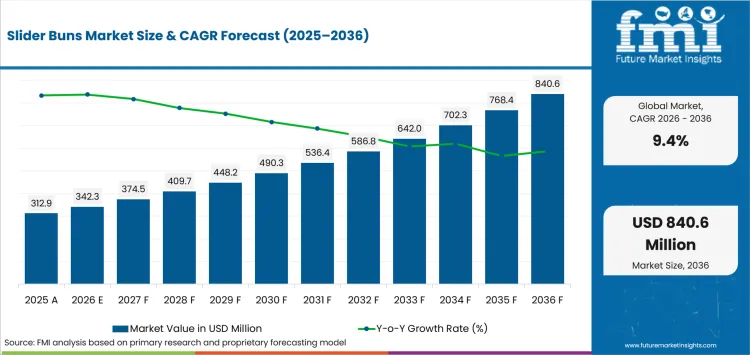
USD 342.3 million in 2026 and USD 840.6 million by 2036 at a 9.4% CAGR.
Demand for slider buns is projected to expand at 9.4% CAGR from 2026 to 2036 and rise from USD 342.3 million to USD 840.6 million. Foodservice accounts need predictable diameter and softness because consistent portions reduce preparation variation during busy service. Flowers Foods reported in February 2026 that sandwich buns and rolls gained 50 basis points of unit share in its fourth quarter. Units rose 3% and outpaced the category by about 600 basis points. The result gives the forecast a direct bun-category signal.
Pack choice creates a retail test because smaller households can waste unused bread before the next meal. WRAP reported in March 2026 that 62% of UK survey respondents choose smaller packs to match household size. That behavior favors multipacks with clear portion counts and a usable selling window. Retail growth depends on matching pack size to consumption frequency while foodservice growth depends more on case yield and assembly consistency.
Key Takeaways
- Foodservice assembly and household sharing increase slider-bun use because smaller carriers standardize portions without changing familiar fillings.
- Classic - original holds 39.0% of product type in 2026 because familiar taste fits varied fillings.
- Conventional holds 53.0% of claim - nature in 2026 because mainstream recipes avoid specialty-claim controls.
- Fresh holds 32.0% of format in 2026 because nearby routes replenish products before softness declines.
- Short selling windows turn unused inventory into waste before premium pricing recovers additional handling costs.
- Some of the key players in this market include Grupo Bimbo, Flowers Foods, Inc., ARYZTA AG, Lantmännen Unibake, Vandemoortele, Yamazaki Baking Co., Ltd., Warburtons, King's Hawaiian, Europastry, and St Pierre Groupe.
Analyst Perspective
"Retailers should compare softness and usable selling life before paying a premium. Foodservice accounts should prioritize diameter consistency because predictable sizing reduces preparation rework."
- Nandini Roy Choudhury, Principal Consultant, Future Market Insights
How is the slider buns market segmented?
The slider buns market is segmented by product type, claim - nature, format, packaging format, sales channel and region.
The market framework examines product type across classic, whole-grain, flavored, mini and premium variants; claim - nature across conventional, clean-label, organic, gluten-free and fortified offerings; and format across fresh, frozen, ambient, chilled and par-baked products. It also assesses packaging choices ranging from single-serve and multipack options to family and bulk-foodservice packs, sales channels spanning modern retail, specialty bakeries, convenience outlets, online platforms and foodservice distributors, and regional demand across the major global markets.
What supports classic - original within the product type category?
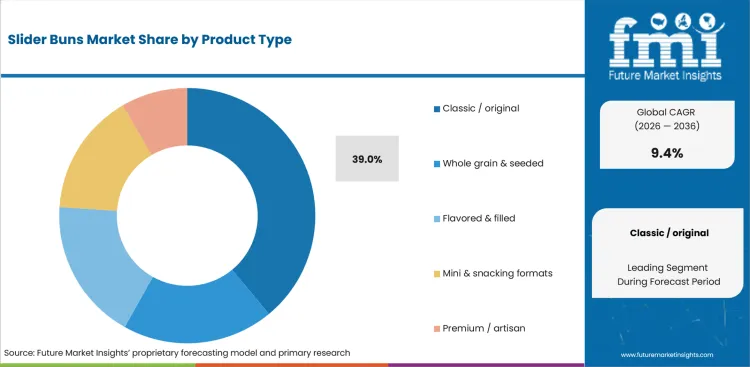
Classic slider buns hold their position because restaurants can change fillings without changing the carrier specification. In January 2026 ARYZTA announced a new bun bakery in Portugal for foodservice customers. The action gives industrial bun production a current capacity signal tied directly to buns.
- By product type, classic - original is estimated to hold 39.0% in 2026 owing to familiar taste and broad filling compatibility.
- Operators can keep the same portion controls for burgers and shared plates while frozen bakery systems give distant accounts more holding flexibility. Repeat orders still depend on diameter consistency and softness after storage or delivery.
Why does conventional hold the claim - nature position?
Conventional buns stay near mainstream bread specifications because retailers already understand their handling. Grupo Bimbo stated in June 2026 that its daily-consumption portfolio including breads and buns was already free from artificial colors. The update shows established formulations can absorb ingredient changes without becoming specialty-only products.
- In 2026, conventional is expected to lead claim - nature with 53.0% share because familiar eating quality supports broad retail and foodservice use.
- Specialty variants still need comparable softness before retailers widen listings. Clean-label ingredients can change formulation choices but the finished bun must keep the handling behavior expected from a mainstream sandwich carrier.
How does fresh shape selection within the format category?
Fresh buns compete on softness that shoppers and restaurant operators can judge immediately. The UK Ministry of Defence published its Defence Requirement for Food in February 2026 with controls covering receipt and storage. Remaining selling life and delivery condition therefore become practical qualification points for fresh bakery supply.
- Fresh is set to lead the format category with 32.0% share in 2026 because frequent replenishment protects expected bakery-aisle texture.
- Longer routes shift part of the account base toward frozen baked goods because storage flexibility can reduce unsold stock before service. Fresh formats keep an advantage only where replenishment frequency protects softness without raising waste.
What makes multipack important within packaging format?
Multipacks work when households can finish the pack before texture declines and retailers can explain serving counts quickly. Warburtons announced a portfolio-wide packaging redesign for rollout from March 2026 to improve shelf recognition and navigation. The action makes pack architecture a current retail lever rather than a passive container.
- The multipack segment is likely to capture 31.0% share in 2026 attributable to household sharing occasions and predictable portion counts.
- Pack sizes also let premium brioche products serve family meals without requiring a larger individual bun. The commercial limit is leftover quality because a pack loses value quickly if the remaining portions stale before reuse.
Why do supermarkets & hypermarkets anchor the sales channel category?
Supermarkets remain the main retail route because slider buns can sit beside established rolls during routine shopping. Flowers Foods announced its 2025 innovation lineup in April 2025 with new buns and sandwich rolls. The launch gives grocery buyers direct evidence that bun shelves are still being refreshed.
- By sales channel, supermarkets & hypermarkets are forecast to represent 40.0% in 2026 driven by routine grocery traffic and repeat packaged-bakery replenishment.
- Retail listings perform better when pack counts and use occasions remain clear beside familiar bakery products. Shelf competition stays intense because stores can replace a slow slider format with ordinary rolls that turn faster.
What are the drivers, restraints and opportunities in the Slider Buns Market?
Foodservice portioning supports repeat use, short selling windows constrain economics and channel-specific formats widen the addressable account base.
- Driver: Fixed dimensions reduce preparation work and portion variance for retail meal builders and foodservice kitchens.
- Restraint: Short selling windows weaken delivered economics when freight and waste consume the price premium.
- Opportunity: Nutrition claims can raise value when handling remains familiar to retail and foodservice buyers.
Foodservice Portioning Sustains Repeat Bun Usage
Foodservice accounts reorder buns when fixed sizing keeps portions consistent during busy service. In March 2026 Lantmännen added McDonald's Finland as the first wheat partner in its Climate & Nature program while Lantmännen Unibake continued supplying hamburger buns. The partnership ties industrial bakery inputs to a named restaurant program where repeat orders depend on predictable carrier performance.
Selling Life and Pack Fit Limit Fresh Economics
Fresh bakery economics weaken when stores cannot sell inventory before softness declines. Flowers Foods reported in August 2026 that the fresh packaged bread category remained difficult and its second-quarter net sales fell 4.0% as lower volume offset price and mix. Bakery flour improvers can protect texture but cannot recover margin from excess inventory or weak rotation.
Nutrition-Led Bun Formats Broaden Account Choice
Nutrition claims can widen the account base when the bun still performs like a familiar sandwich carrier. Vandemoortele launched its first high-protein bun in August 2026 under Banquet d'Or with 18 grams of protein per 100 grams. The launch gives bakery ingredients a direct route into differentiated buns while texture and handling still decide whether trial converts into repeat purchase.
Which country CAGRs are profiled in the Slider Buns Market?
| Country | CAGR |
|---|---|
| UAE | 10.7% |
| Saudi Arabia | 10.4% |
| South Korea | 10.0% |
| USA | 9.7% |
| UK | 9.4% |
| Germany | 9.1% |
| France | 8.8% |
| Japan | 8.5% |
How do country-level CAGRs compare in the Slider Buns Market?
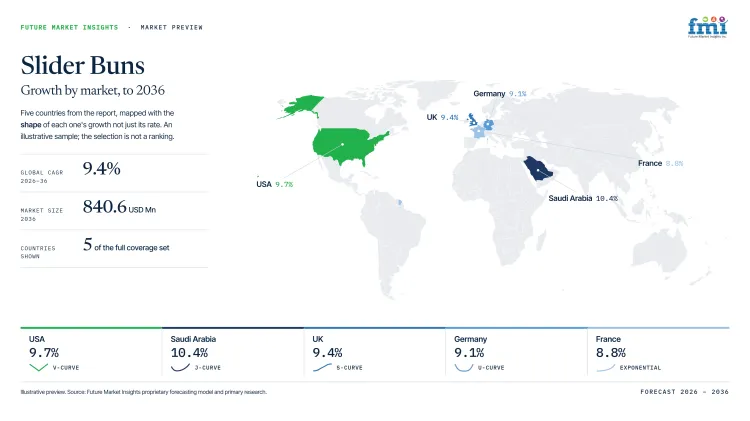
The country forecasts form three groups. UAE, Saudi Arabia and South Korea reach at least 10.0% CAGR as hospitality and restaurant traffic create menu trials. USA, UK and Germany form the middle group. France and Japan grow more slowly as established bread formats raise switching standards.
- The UAE’s high concentration of hotels and hospitality venues creates a dense foodservice market for bakery and prepared-food suppliers.
- Saudi Arabia’s expanding tourism infrastructure is increasing purchasing activity across hotels, restaurants, and catering operations.
- Heavy restaurant traffic in South Korea favors products that simplify preparation and support quick service execution.
- The USA’s extensive restaurant network and packaged-bakery distribution system provide broad market access across channels.
- In the UK, demand is supported by both grocery multipacks and a well-established eating-out culture.
- Germany’s restaurant operators face growing pressure to control waste, making yield and portion management more important.
- France’s strong bakery tradition creates competition from established bread and roll categories, raising differentiation requirements.
- Frequent assortment refreshes in Japan keep consumer expectations high for texture, consistency and product quality.
The 2.2-point spread measures growth pace rather than absolute revenue. The full report provides country-level CAGR analysis across North America, Latin America, Western Europe, Eastern Europe, East Asia, South Asia and Pacific, and Middle East and Africa.
Country-wise Analysis
- Restaurant chains and grocery retailers in the United States rely on bun formats that maintain diameter consistency and softness throughout large distribution networks. Commercial demand for slider buns in the United States is anticipated to advance at a 9.7% CAGR over the assessment period as standardized formats continue supporting high-volume menu execution. Packaged bakery innovation expands menu possibilities, but foodservice accounts remain focused on shelf life, case yield, and freight efficiency.
- Foodservice operators in Germany faced weaker restaurant economics during 2025, increasing attention on product waste and inventory performance. Bakery formats must demonstrate consistent yield because unused stock becomes more visible when operating margins tighten. Destatis reported in February 2026 that real gastronomy turnover declined by 2.2% during 2025. Lower turnover increases interest in ingredients and production methods that help maintain texture throughout distribution. Documentation-led purchasing decisions are expected to help Germany register a 9.1% CAGR through 2036 as restaurant operators continue prioritizing bakery products that deliver dependable serving consistency. Premium recipes still require practical pack formats that minimize unsold inventory.
- Quick-service restaurants and bakery counters in France frequently compete for the same sandwich and snack occasions. Compact bakery formats gain acceptance when they combine convenience with eating qualities that align with local consumer expectations. INSEE published a fast-food restaurant turnover index of 171.73 for December 2025 in its May 2026 release. The level of foodservice activity creates recurring opportunities for handheld menu items. Sales of slider buns in France are forecast to rise at an 8.8% CAGR during the assessment period, driven by gradual expansion of standardized handheld meal formats. Texture consistency and crust quality remain important considerations before distributors broaden product listings.
- Bakery demand in the United Kingdom is supported by both a dense grocery channel and a mature eating-out market. Retail multipacks and foodservice cases often serve different consumption occasions even when they use similar bakery formats. The Office for National Statistics reported food and beverage service activity growth of 1.5% during the three months to December 2025. Supported by demand across both retail and foodservice channels, slider-bun consumption in the United Kingdom is forecast to expand at a 9.4% CAGR through 2036. Grocery products require clear pack counts and usable shelf life, while restaurant operators remain sensitive to waste generated by oversized case quantities.
- Hospitality activity in Saudi Arabia creates recurring demand for standardized bakery products used across hotels, restaurants, and catering operations. Distributor-led supply networks become increasingly important when operators need consistent products for high-frequency foodservice occasions. GASTAT reported 5,622 licensed tourism facilities during the third quarter of 2025. The growing facility base expands the number of locations capable of incorporating compact sandwich formats into foodservice menus. The Saudi Arabian slider-bun market is expected to post a 10.4% CAGR through 2036 as hospitality expansion increases recurring consumption opportunities. Product softness remains important because long transport routes and elevated temperatures can affect finished-bun performance.
- The UAE hospitality industry serves an international customer base that frequently introduces new menu concepts and foodservice formats. Hotels, restaurants, and catering operators often test products repeatedly before adding them to broader purchasing programs. The Ministry of Economy and Tourism reported 1,260 hotels and roughly 216,900 rooms through November 2025. Supported by intensive hospitality activity, the UAE is expected to help the slider-bun market register a 10.7% CAGR through 2036. High service standards leave limited tolerance for inconsistent texture, while inventory flexibility remains important because menu requirements can change rapidly.
- Convenience stores and bakery chains in Japan refresh product assortments frequently, creating recurring opportunities for compact bakery formats. New products must establish repeat demand quickly because listing windows are often shorter than those found in many Western markets. METI reported foodservice activity growth of 3.2% during 2025. Higher foodservice activity supports additional handheld meal occasions across convenience and bakery channels. Adoption of slider buns in Japan is forecast to post an 8.5% CAGR between 2026 and 2036 because compact formats continue benefiting from frequent assortment renewal. Local preferences for texture and sweetness still require formulation adjustments before widespread market acceptance.
- Foodservice outlets in South Korea often experience concentrated meal periods where preparation speed directly affects operational efficiency. Compact sandwich formats can reduce assembly complexity when operators are serving large numbers of customers within limited time windows. MAFRA reported in March 2026 that surveyed foodservice outlets averaged 53.0 daily visitors during 2025 compared with 41.8 in 2021. The survey covered 3,138 outlets nationwide. Commercial uptake of slider buns in South Korea is anticipated to advance at a 10.0% CAGR over the assessment period as operators continue seeking bakery formats that simplify meal preparation. Local flavor expectations and strong distributor support remain important for sustained menu adoption.
Who are the notable companies in the Slider Buns Market?
Grupo Bimbo, Flowers Foods, Inc., ARYZTA AG, Lantmännen Unibake, Vandemoortele, Yamazaki Baking Co., Ltd., Warburtons, King's Hawaiian, Europastry, and St Pierre Groupe are notable companies active in the defined slider buns market.
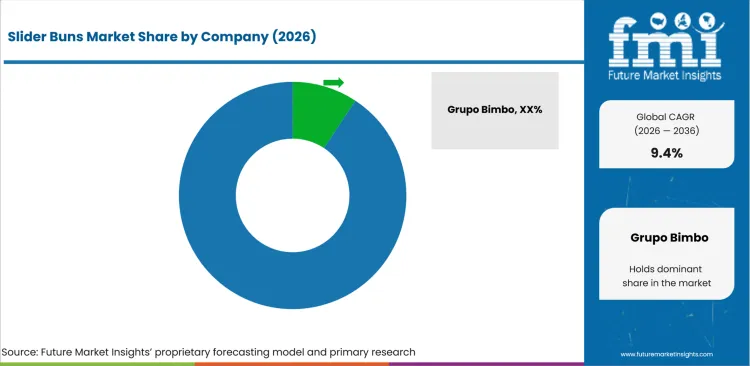
Competition divides by route to customer. Packaged bakery groups compete on shelf rotation while frozen-bakery operators sell storage flexibility. Slider-focused brands sell recognizable meal occasions. St Pierre Groupe operates within Grupo Bimbo's portfolio.
- Branded retail bakery suppliers include Grupo Bimbo, Flowers Foods, Inc., Yamazaki Baking Co., Ltd., and Warburtons.
- Slider specialists include King's Hawaiian and St Pierre Groupe for sweet or brioche meal occasions.
- Frozen foodservice suppliers include ARYZTA AG, Lantmännen Unibake, Vandemoortele, and Europastry for flexible service formats.
Competitive Benchmarking: Slider Buns Market
| Company | Small-Format Bun Relevance | Format Flexibility | Foodservice Channel Evidence | Geographic Reach |
|---|---|---|---|---|
| Grupo Bimbo | High | High | High | Global |
| Flowers Foods, Inc. | Medium | Medium | Medium | United States |
| ARYZTA AG | Medium | High | High | Europe and Asia-Pacific |
| Lantmännen Unibake | High | High | High | Europe and international markets |
| Vandemoortele | Medium | High | High | Europe and North America |
| Yamazaki Baking Co., Ltd. | Medium | Medium | Medium | Japan and selected markets |
| Warburtons | Medium | Medium | Medium | United Kingdom |
| King's Hawaiian | High | Medium | High | United States and Canada |
| Europastry | Medium | High | High | Europe and North America |
| St Pierre Groupe | High | Medium | Medium | United States and United Kingdom |
Small-Format Bun Relevance and Format Flexibility measure documented product breadth within this market boundary. Foodservice Channel Evidence measures verified operator routes while ratings distinguish broader from narrower documentation.
Key Developments in the Slider Buns Market
- In May 2026, St Pierre launched limited-edition Spicy Brioche Buns in major US retailers for seasonal burger and barbecue occasions. The action tests flavor-led premium demand on an established brioche-bun platform.
- In May 2026, Grupo Bimbo announced approximately USD 1 billion of US investment through 2028 for innovation and bakery-network capacity. The program can support buns and rolls without implying that every dollar targets slider buns.
- In July 2026, King's Hawaiian entered Yakiniku King's nationwide Hawaii Fair in Japan with a build-your-own slider menu. The restaurant collaboration gives the brand a direct foodservice trial route for portioned sweet rolls.
Key Players in the Slider Buns Market
Packaged Bakery Platforms
- Grupo Bimbo
- Flowers Foods, Inc.
- Yamazaki Baking Co., Ltd.
- Warburtons
Frozen and Foodservice Bakery Platforms
- ARYZTA AG
- Lantmännen Unibake
- Vandemoortele
- Europastry
Slider and Brioche Specialists
- King's Hawaiian
- St Pierre Groupe
Slider Buns Market - Report Scope
| Coverage field | Report scope |
|---|---|
| Market breakdown | By product type, claim - nature, format, packaging format, sales channel and region. |
| Quantitative Units | USD million. |
| Market Definition | Slider buns and mini buns supplied for slider or mini-sandwich assembly within the defined categories. |
| Regions Covered | North America; Latin America; Western Europe; Eastern Europe; East Asia; South Asia and Pacific; Middle East and Africa |
| Countries Covered | USA; Germany; France; UK; Saudi Arabia; UAE; Japan; South Korea; additional countries in the full report |
| Key Companies Profiled | Grupo Bimbo; Flowers Foods, Inc.; ARYZTA AG; Lantmännen Unibake; Vandemoortele; Yamazaki Baking Co., Ltd.; Warburtons; King's Hawaiian; Europastry; St Pierre Groupe |
| Forecast Period | 2026 to 2036 |
| Approach | Hybrid bottom-up and top-down sizing reconciles product demand, channel activity, company participation and country assumptions. |
Slider Buns Market - Research Methodology
| Method | Approach |
|---|---|
| Primary Research | FMI analysts gathered input from manufacturers, service providers, technology developers, distributors, end users, procurement teams, and subject-matter experts. Interviews examined purchasing decisions, product or service evaluation, adoption barriers, approval requirements, pricing considerations, and expectations for technical or commercial support. Respondents were also asked what evidence is required before a trial, pilot, or initial order develops into regular purchasing. |
| Desk Research | Desk research covered government statistics, regulatory publications, trade data, industry associations, technical literature, standards, company filings, product information, and official corporate announcements. Sources were reviewed for relevance, publication date, geographic coverage, and consistency with the defined market scope. Claims relating to performance, applications, approvals, capacity, investment, and commercial activity were retained only when supported by credible public evidence. |
| Market Sizing and Forecasting | The market model combined the baseline value with historical performance, segment structure, pricing and volume indicators, adoption levels, company participation, and country-level demand conditions. Forecast assumptions considered economic activity, investment trends, regulatory developments, technology adoption, purchasing cycles, supply availability, and barriers to wider market use. Segment and regional estimates were reconciled before the final market total was calculated. |
| Data Validation | Estimates were checked against multiple independent indicators, including public data, company activity, trade patterns, industry developments, and findings from primary interviews. Validation also tested whether products, services, applications, and company revenues fell within the defined market boundaries. Adjacent categories, unsupported claims, overlapping revenues, and activities without direct market relevance were excluded to reduce double counting and maintain consistency across segments and countries. |
Slider Buns Market by Segments
Slider Buns Market segmented by Product Type:
- Classic - original
- Whole grain & seeded
- Flavored & filled
- Mini & snacking formats
- Premium - artisan
Slider Buns Market segmented by Claim - Nature:
- Conventional
- Clean label
- Organic
- Gluten-free
- High-protein - fortified
Slider Buns Market segmented by Format:
- Fresh
- Frozen
- Ambient packaged
- Chilled
- Par-baked - thaw-and-serve
Slider Buns Market segmented by Packaging Format:
- Multipack
- Single-serve
- Family - loaf pack
- Bulk foodservice
Slider Buns Market segmented by Sales Channel:
- Supermarkets & hypermarkets
- Artisan & specialty bakeries
- Convenience & forecourt
- Online & DTC
- Foodservice distributors
Slider Buns Market by Region:
- North America
- United States
- Canada
- Latin America
- Brazil
- Mexico
- Argentina
- Chile
- Western Europe
- Germany
- France
- United Kingdom
- Italy
- Spain
- Benelux
- Nordics
- Eastern Europe
- Poland
- Czech Republic
- Romania
- Hungary
- East Asia
- China
- Japan
- South Korea
- South Asia and Pacific
- India
- ASEAN
- Australia and New Zealand
- Middle East and Africa
- GCC Countries
- South Africa
- Türkiye
- Israel
Research Sources and Bibliography
- Flowers Foods, Inc. (2026, February 12). Flowers Foods - Fourth Quarter and Full Year 2025 Earnings (Prepared Remarks).
- Waste and Resources Action Programme. (2026, March 9). Understanding household food waste in the UK: the Household Food Management Survey 2025.
- ARYZTA AG. (2026, January 22). Full year 2025 targets achieved; Revenue growth & improved performance expected in 2026; New €40m bun bakery in Portugal.
- Grupo Bimbo. (2026, June 10). Portfolio Free from Artificial Colors.
- UK Ministry of Defence. (2026, February 12). Defence Requirement for Food.
- Warburtons. (2026, March 30). Packaging Redesign Unveiled.
- Flowers Foods, Inc. (2025, April 16). Flowers Foods Launches New Products and Line Expansions to Meet Consumer Needs.
- Lantmännen. (2026, March 24). McDonald’s joins Lantmännen’s Climate & Nature cultivation program as the first partner in Finland.
- Flowers Foods, Inc. (2026, August 20). Flowers Foods, Inc. Reports Second Quarter 2026 Results.
- Vandemoortele. (2026, August 20). Meet our newest healthy hero: the High Protein Bun.
- Flowers Foods, Inc. (2026, May 21). Flowers Foods - First Quarter 2026 Earnings (Prepared Remarks).
- Statistisches Bundesamt. (2026, February 19). Gastgewerbeumsatz 2025 real 2,2 % niedriger als im Vorjahr.
- INSEE. (2026, May 20). Turnover Index - Fast Food Restaurants.
- Office for National Statistics. (2026, February 12). GDP monthly estimate, UK: December 2025.
- General Authority for Statistics. (2026, January 8). GASTAT Publishes Tourism Establishments Statistics for Q3 of 2025.
- Ministry of Economy and Tourism - UAE. (2026, February 8). Hospitality Advisory Council reviews its new initiatives for 2026 and underscores its role in driving growth and sustainability of the hotel sector.
- Ministry of Economy, Trade and Industry, Japan. (2026, May 27). 飲食関連産業の動向(FBI 2025年).
- Ministry of Agriculture, Food and Rural Affairs, Republic of Korea. (2026, March 29). 외식업 ‘매출 2억 5천만원’ 시대 열렸다 … 5년전 대비 41% 성장.
- St Pierre Groupe. (2026, May 15). Limited-Edition Spicy Brioche Buns to Boost Category Sales.
- Grupo Bimbo. (2026, May 5). Grupo Bimbo Announces Approximately US $1 Billion Investment in the United States Between 2026 and 2028.
- King's Hawaiian. (2026, July 9). 焼肉きんぐ「ハワイフェア」にKING’S HAWAIIANが登場!
- ARYZTA AG. (2026, June 23). ARYZTA acquires French distribution business.
- Vandemoortele. (2026, August 3). Vandemoortele USA completes final phase of acquisition of New Jersey-based Banneton Bakery.
- Lantmännen. (2025, December 23). Lantmännen Unibake signs agreement to expand in Italy.
- Grupo Bimbo. (2026, March 26). Inauguramos NOVABES y reforzamos nuestra apuesta por la inversión y desarrollo en El Salvador.
- ARYZTA AG. (2026, August 26). New Perth bakery officially opened.
- Lantmännen. (2026, February 17). Lantmännen steps up health effort with lower salt and clearer energy labeling.
- King's Hawaiian. (2026, July 17). 「さあ、シェアロハ!」キャンペーンを開催!
This bibliography is provided for reader reference and is not exhaustive. The full report contains the complete reference list and detailed citations
This Report Answers
- How large is the slider buns market in 2026 and 2036?
- Which meal conditions support repeat slider-bun demand?
- Why does classic - original hold 39.0% of product type?
- Which recent bun-category statistic directly supports current slider-bun demand?
- Why do supermarkets & hypermarkets hold 40.0% of sales channel?
- Why do growth conditions differ among the eight profiled countries?
- Which companies serve branded, frozen-foodservice and slider-focused positions?
- What should buyers compare before selecting a slider-bun specification?
Frequently Asked Questions
How big is the slider buns market in 2026?
The slider buns market is valued at USD 342.3 million in 2026 and is projected to reach USD 840.6 million by 2036. Foodservice portioning and household sharing sustain repeat use because smaller carriers simplify meal assembly.
What is the CAGR of the slider buns market from 2026 to 2036?
The slider buns market is projected to grow at 9.4% CAGR between 2026 and 2036. Expansion depends on foodservice assembly convenience and retail formats that protect softness while keeping unsold inventory within acceptable waste levels.
Which product type leads the slider buns market?
The classic - original segment is expected to hold 39.0% of the slider buns market in 2026 because familiar taste fits varied fillings. Standard dimensions also let kitchens change proteins without rebuilding portion systems.
Which format holds a major current share in the slider buns market?
The fresh segment is expected to hold 32.0% of the slider buns market in 2026 because nearby routes can replenish softness quickly. Longer routes increase frozen or par-baked appeal because those formats give operators more inventory flexibility.
Which packaging format has a major current share in the slider buns market?
The multipack segment is expected to hold 31.0% of the slider buns market in 2026 because household sharing rewards predictable serving counts. Commercial performance still depends on remaining buns retaining acceptable softness for the next meal.
Which countries record the upper country growth comparison in the slider buns market?
The UAE is projected to grow at 10.7% CAGR followed by Saudi Arabia at 10.4% and South Korea at 10.0% through 2036. Hospitality density and restaurant traffic create more frequent menu trials for standardized buns.
Which companies are active in the slider buns market?
Key companies active in the slider buns market include Grupo Bimbo, Flowers Foods, Inc., ARYZTA AG, Lantmännen Unibake, Vandemoortele, Yamazaki Baking Co., Ltd., Warburtons, King's Hawaiian, Europastry, and St Pierre Groupe. Their positions differ by packaged retail reach, frozen-foodservice access and slider-focused branding.
Preview the report firsthand - request a free sample
Get SampleGet the brochure for pricing and purchase details.
Get PDFTable of Content
- Key Takeaways
- Market Size and CAGR
- Top Growth Driver
- Fastest Growing Segment
- Leading Region
- Key Companies
- Emerging Opportunities
- Executive Summary
- Global Market Outlook
- Demand-side Trends
- Supply-side Trends
- Technology Roadmap Analysis
- Analysis and Recommendations
- Analyst Perspective (What is happening? Why now? What should investors know?)
- Key Questions Answered
- How large is the market?
- What is the CAGR?
- What are key trends?
- Which region dominates?
- Who are the leaders?
- Market Overview
- Market Coverage / Taxonomy
- Market Definition / Scope / Limitations
- Research Methodology
- Chapter Orientation
- Analytical Lens and Working Hypotheses
- Market Structure, Signals, and Trend Drivers
- Benchmarking and Cross-market Comparability
- Market Sizing, Forecasting, and Opportunity Mapping
- Research Design and Evidence Framework
- Desk Research Programme (Secondary Evidence)
- Expert Input and Fieldwork (Primary Evidence)
- Tooling, Models, and Reference Databases
- Data Engineering and Model Build
- Quality Assurance and Audit Trail
- Market Background
- Market Dynamics (Drivers, Restraints, Opportunity, Trends)
- Scenario Forecast (Optimistic, Likely, Conservative)
- Impact Analysis
- AI Impact
- Sustainability Impact
- Regulatory Impact
- Technology Impact
- Consumer / Buyer Analysis
- Purchase Drivers
- Adoption Barriers
- Buyer Journey
- Opportunity Map Analysis
- Product Life Cycle Analysis
- Supply Chain Analysis
- Investment Feasibility Matrix
- Value Chain Analysis
- PESTLE and Porter's Analysis
- Regulatory Landscape
- Regional Parent Market Outlook
- Production and Consumption Statistics
- Import and Export Statistics
- Global Market Analysis and Forecast, 2021 to 2036
- Historical Market Size Value (USD Million) Analysis, 2021 to 2025
- Current and Future Market Size Value (USD Million) Projections, 2026 to 2036
- Y-o-Y Growth Trend Analysis
- Absolute $ Opportunity Analysis
- Global Market Pricing Analysis, 2021 to 2036
- Global Market Analysis and Forecast, By Product Type, 2021 to 2036
- Introduction / Key Findings
- Historical Market Size Value (USD Million) Analysis By Product Type, 2021 to 2025
- Current and Future Market Size Value (USD Million) Analysis and Forecast By Product Type, 2026 to 2036
- Classic / original
- Whole grain & seeded
- Flavored & filled
- Mini & snacking formats
- Premium / artisan
- Classic / original
- Y-o-Y Growth Trend Analysis By Product Type, 2021 to 2025
- Absolute $ Opportunity Analysis By Product Type, 2026 to 2036
- Global Market Analysis and Forecast, By Claim / Nature, 2021 to 2036
- Introduction / Key Findings
- Historical Market Size Value (USD Million) Analysis By Claim / Nature, 2021 to 2025
- Current and Future Market Size Value (USD Million) Analysis and Forecast By Claim / Nature, 2026 to 2036
- Conventional
- Clean label
- Organic
- Gluten-free
- High-protein / fortified
- Conventional
- Y-o-Y Growth Trend Analysis By Claim / Nature, 2021 to 2025
- Absolute $ Opportunity Analysis By Claim / Nature, 2026 to 2036
- Global Market Analysis and Forecast, By Format, 2021 to 2036
- Introduction / Key Findings
- Historical Market Size Value (USD Million) Analysis By Format, 2021 to 2025
- Current and Future Market Size Value (USD Million) Analysis and Forecast By Format, 2026 to 2036
- Fresh
- Frozen
- Ambient packaged
- Chilled
- Par-baked / thaw-and-serve
- Fresh
- Y-o-Y Growth Trend Analysis By Format, 2021 to 2025
- Absolute $ Opportunity Analysis By Format, 2026 to 2036
- Global Market Analysis and Forecast, By Packaging Format, 2021 to 2036
- Introduction / Key Findings
- Historical Market Size Value (USD Million) Analysis By Packaging Format, 2021 to 2025
- Current and Future Market Size Value (USD Million) Analysis and Forecast By Packaging Format, 2026 to 2036
- Multipack
- Single-serve
- Family / loaf pack
- Bulk foodservice
- Multipack
- Y-o-Y Growth Trend Analysis By Packaging Format, 2021 to 2025
- Absolute $ Opportunity Analysis By Packaging Format, 2026 to 2036
- Global Market Analysis and Forecast, By Sales Channel, 2021 to 2036
- Introduction / Key Findings
- Historical Market Size Value (USD Million) Analysis By Sales Channel, 2021 to 2025
- Current and Future Market Size Value (USD Million) Analysis and Forecast By Sales Channel, 2026 to 2036
- Supermarkets & hypermarkets
- Artisan & specialty bakeries
- Convenience & forecourt
- Online & DTC
- Foodservice distributors
- Supermarkets & hypermarkets
- Y-o-Y Growth Trend Analysis By Sales Channel, 2021 to 2025
- Absolute $ Opportunity Analysis By Sales Channel, 2026 to 2036
- Global Market Analysis and Forecast, By Region, 2021 to 2036
- Introduction
- Historical Market Size Value (USD Million) Analysis By Region, 2021 to 2025
- Current Market Size Value (USD Million) Analysis and Forecast By Region, 2026 to 2036
- North America
- Latin America
- Western Europe
- Eastern Europe
- East Asia
- South Asia and Pacific
- Middle East & Africa
- Market Attractiveness Analysis By Region
- North America Market Analysis and Forecast, By Country, 2021 to 2036
- Historical Market Size Value (USD Million) Trend Analysis By Market Taxonomy, 2021 to 2025
- Market Size Value (USD Million) Forecast By Market Taxonomy, 2026 to 2036
- By Country
- USA
- Canada
- By Product Type
- By Claim / Nature
- By Format
- By Packaging Format
- By Sales Channel
- By Country
- Market Attractiveness Analysis
- By Country
- By Product Type
- By Claim / Nature
- By Format
- By Packaging Format
- By Sales Channel
- Key Takeaways
- Latin America Market Analysis and Forecast, By Country
- Historical Market Size Value (USD Million) Trend Analysis By Market Taxonomy, 2021 to 2025
- Market Size Value (USD Million) Forecast By Market Taxonomy, 2026 to 2036
- By Country
- Brazil
- Mexico
- Chile
- Rest of Latin America
- By Product Type
- By Claim / Nature
- By Format
- By Packaging Format
- By Sales Channel
- By Country
- Market Attractiveness Analysis
- By Country
- By Product Type
- By Claim / Nature
- By Format
- By Packaging Format
- By Sales Channel
- Key Takeaways
- Western Europe Market Analysis and Forecast, By Country
- Historical Market Size Value (USD Million) Trend Analysis By Market Taxonomy, 2021 to 2025
- Market Size Value (USD Million) Forecast By Market Taxonomy, 2026 to 2036
- By Country
- Germany
- UK
- Italy
- Spain
- France
- Nordic
- BENELUX
- Rest of Western Europe
- By Product Type
- By Claim / Nature
- By Format
- By Packaging Format
- By Sales Channel
- By Country
- Market Attractiveness Analysis
- By Country
- By Product Type
- By Claim / Nature
- By Format
- By Packaging Format
- By Sales Channel
- Key Takeaways
- Eastern Europe Market Analysis and Forecast, By Country
- Historical Market Size Value (USD Million) Trend Analysis By Market Taxonomy, 2021 to 2025
- Market Size Value (USD Million) Forecast By Market Taxonomy, 2026 to 2036
- By Country
- Russia
- Poland
- Hungary
- Balkan & Baltic
- Rest of Eastern Europe
- By Product Type
- By Claim / Nature
- By Format
- By Packaging Format
- By Sales Channel
- By Country
- Market Attractiveness Analysis
- By Country
- By Product Type
- By Claim / Nature
- By Format
- By Packaging Format
- By Sales Channel
- Key Takeaways
- East Asia Market Analysis and Forecast, By Country
- Historical Market Size Value (USD Million) Trend Analysis By Market Taxonomy, 2021 to 2025
- Market Size Value (USD Million) Forecast By Market Taxonomy, 2026 to 2036
- By Country
- China
- Japan
- South Korea
- By Product Type
- By Claim / Nature
- By Format
- By Packaging Format
- By Sales Channel
- By Country
- Market Attractiveness Analysis
- By Country
- By Product Type
- By Claim / Nature
- By Format
- By Packaging Format
- By Sales Channel
- Key Takeaways
- South Asia and Pacific Market Analysis and Forecast, By Country
- Historical Market Size Value (USD Million) Trend Analysis By Market Taxonomy, 2021 to 2025
- Market Size Value (USD Million) Forecast By Market Taxonomy, 2026 to 2036
- By Country
- India
- ASEAN
- Australia & New Zealand
- Rest of South Asia and Pacific
- By Product Type
- By Claim / Nature
- By Format
- By Packaging Format
- By Sales Channel
- By Country
- Market Attractiveness Analysis
- By Country
- By Product Type
- By Claim / Nature
- By Format
- By Packaging Format
- By Sales Channel
- Key Takeaways
- Middle East & Africa Market Analysis and Forecast, By Country
- Historical Market Size Value (USD Million) Trend Analysis By Market Taxonomy, 2021 to 2025
- Market Size Value (USD Million) Forecast By Market Taxonomy, 2026 to 2036
- By Country
- Kingdom of Saudi Arabia
- Other GCC Countries
- Türkiye
- South Africa
- Other African Union
- Rest of Middle East & Africa
- By Product Type
- By Claim / Nature
- By Format
- By Packaging Format
- By Sales Channel
- By Country
- Market Attractiveness Analysis
- By Country
- By Product Type
- By Claim / Nature
- By Format
- By Packaging Format
- By Sales Channel
- Key Takeaways
- Key Countries Market Analysis
- USA
- Pricing Analysis
- Market Share Analysis, 2025
- By Product Type
- By Claim / Nature
- By Format
- By Packaging Format
- By Sales Channel
- Canada
- Pricing Analysis
- Market Share Analysis, 2025
- By Product Type
- By Claim / Nature
- By Format
- By Packaging Format
- By Sales Channel
- Mexico
- Pricing Analysis
- Market Share Analysis, 2025
- By Product Type
- By Claim / Nature
- By Format
- By Packaging Format
- By Sales Channel
- Brazil
- Pricing Analysis
- Market Share Analysis, 2025
- By Product Type
- By Claim / Nature
- By Format
- By Packaging Format
- By Sales Channel
- Chile
- Pricing Analysis
- Market Share Analysis, 2025
- By Product Type
- By Claim / Nature
- By Format
- By Packaging Format
- By Sales Channel
- Germany
- Pricing Analysis
- Market Share Analysis, 2025
- By Product Type
- By Claim / Nature
- By Format
- By Packaging Format
- By Sales Channel
- UK
- Pricing Analysis
- Market Share Analysis, 2025
- By Product Type
- By Claim / Nature
- By Format
- By Packaging Format
- By Sales Channel
- Italy
- Pricing Analysis
- Market Share Analysis, 2025
- By Product Type
- By Claim / Nature
- By Format
- By Packaging Format
- By Sales Channel
- Spain
- Pricing Analysis
- Market Share Analysis, 2025
- By Product Type
- By Claim / Nature
- By Format
- By Packaging Format
- By Sales Channel
- France
- Pricing Analysis
- Market Share Analysis, 2025
- By Product Type
- By Claim / Nature
- By Format
- By Packaging Format
- By Sales Channel
- India
- Pricing Analysis
- Market Share Analysis, 2025
- By Product Type
- By Claim / Nature
- By Format
- By Packaging Format
- By Sales Channel
- ASEAN
- Pricing Analysis
- Market Share Analysis, 2025
- By Product Type
- By Claim / Nature
- By Format
- By Packaging Format
- By Sales Channel
- Australia & New Zealand
- Pricing Analysis
- Market Share Analysis, 2025
- By Product Type
- By Claim / Nature
- By Format
- By Packaging Format
- By Sales Channel
- China
- Pricing Analysis
- Market Share Analysis, 2025
- By Product Type
- By Claim / Nature
- By Format
- By Packaging Format
- By Sales Channel
- Japan
- Pricing Analysis
- Market Share Analysis, 2025
- By Product Type
- By Claim / Nature
- By Format
- By Packaging Format
- By Sales Channel
- South Korea
- Pricing Analysis
- Market Share Analysis, 2025
- By Product Type
- By Claim / Nature
- By Format
- By Packaging Format
- By Sales Channel
- Russia
- Pricing Analysis
- Market Share Analysis, 2025
- By Product Type
- By Claim / Nature
- By Format
- By Packaging Format
- By Sales Channel
- Poland
- Pricing Analysis
- Market Share Analysis, 2025
- By Product Type
- By Claim / Nature
- By Format
- By Packaging Format
- By Sales Channel
- Hungary
- Pricing Analysis
- Market Share Analysis, 2025
- By Product Type
- By Claim / Nature
- By Format
- By Packaging Format
- By Sales Channel
- Kingdom of Saudi Arabia
- Pricing Analysis
- Market Share Analysis, 2025
- By Product Type
- By Claim / Nature
- By Format
- By Packaging Format
- By Sales Channel
- Türkiye
- Pricing Analysis
- Market Share Analysis, 2025
- By Product Type
- By Claim / Nature
- By Format
- By Packaging Format
- By Sales Channel
- South Africa
- Pricing Analysis
- Market Share Analysis, 2025
- By Product Type
- By Claim / Nature
- By Format
- By Packaging Format
- By Sales Channel
- USA
- Market Structure Analysis
- Competition Dashboard
- Competition Benchmarking
- Market Share Analysis of Top Players
- By Regional
- By Product Type
- By Claim / Nature
- By Format
- By Packaging Format
- By Sales Channel
- Emerging Startups
- Innovation Benchmarking
- Competition Analysis
- Competition Deep Dive
- Grupo Bimbo
- Overview
- Product Portfolio
- Profitability by Market Segments
- Sales Footprint
- Strategy Overview
- Marketing Strategy
- Product Strategy
- Channel Strategy
- Flowers Foods
- Aryzta
- Lantmannen Unibake
- Vandemoortele
- Yamazaki Baking
- Warburtons
- King's Hawaiian
- Europastry
- St Pierre Groupe
- Grupo Bimbo
- Case Studies
- Success Stories
- Recent Developments
- Competition Deep Dive
- Assumptions & Acronyms Used


