

- Market Size (2026)
- USD 217.6 Mn
- Forecast (2036)
- USD 501.2 Mn
- CAGR (2026 to 2036)
- 8.7%
How big is Soft-Diet Clinical Meal Market in 2026?
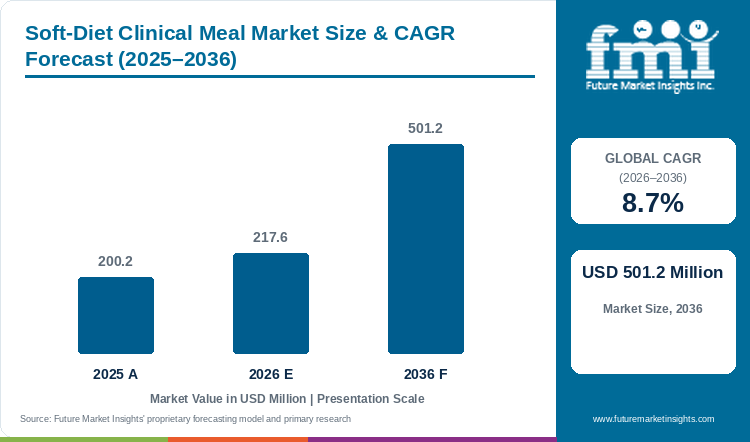
Global soft-diet clinical meal revenues are projected to climb from USD 200.2 million in 2025 to USD 217.6 million in 2026, advancing at an anticipated 8.7% CAGR to reach USD 501.2 million by 2036.
Managing swallowing safety across geriatric wards without sacrificing daily protein density has become an urgent operational priority for residential care kitchens, corroborated by an October 2025 observational cohort study in Nutrients that screened 656 nursing home seniors across six Italian facilities to identify a 28.6% dysphagia prevalence (188 residents), among whom 23 died over six months with aspiration pneumonia accounting for 21.7% of those deaths [1]. To eliminate manual blender viscosity drift, Soft & Bite-Sized Ready Meals (IDDSI 6) are projected to capture 42.4% of product type demand in 2026 as institutional dietitians transition toward pre-portioned medical foods that meet 15-millimeter particle thresholds. According to FMI, global soft-diet clinical meal sales are estimated to rise from USD 200.2 million in 2025 to USD 217.6 million in 2026 and are forecast to reach USD 501.2 million by 2036, expanding at an anticipated 8.7% CAGR to generate USD 283.6 million in added annual revenue. Even so, starch retrogradation and liquid syneresis during prolonged steam-table holding continue to restrict rapid kitchen conversion across budget-constrained care facilities.
Key Market Trends & Insights
- By product type: Soft & Bite-Sized Ready Meals (IDDSI 6) are projected to capture 42.4% in 2026 because recognizable plate formats reduce kitchen preparation errors.
- By fortification: Protein-fortified recipes are estimated to command 48.9% in 2026 as institutional dietitians specify soft meals that preserve resident lean muscle mass.
- By meal occasion: Lunch / dinner entrees are expected to concentrate 51.6% in 2026 because primary savory meals carry the largest daily protein allocation.
- By end user: Long-term care facilities are forecast to generate 47.1% in 2026 owing to chronic swallowing limitations that create predictable three-meal daily volume.
- By sales channel: Hospital pharmacy is anticipated to account for 42.0% in 2026 through clinically supervised dispensing of therapeutic dysphagia formulations.
Regional Highlights
- Top national expansion: Japan is projected to lead major healthcare markets at a 9.3% CAGR through 2036 under universal long-term care insurance meal subsidies.
- Broader country progression: South Korea is expected to expand at 9.0% CAGR ahead of Australia at 8.5% and the USA at 8.3%, while France is forecast to advance at a 7.1% yearly pace.
Market Size & Forecast
Table 1: Market Size and Forecast for the Soft-Diet Clinical Meal Market (USD million and CAGR percentage), 2025 to 2036
| Metric | Value |
|---|---|
| 2025 Market Size | USD 200.2 million |
| Estimated Market Size in 2026 | USD 217.6 million |
| Projected Market Size by 2036 | USD 501.2 million |
| CAGR, 2026 to 2036 | 8.7% |
| Added Revenue, 2026 to 2036 | USD 283.6 million |
Acute-care hospitals and residential nursing homes confront persistent dietary staffing shortages alongside strict patient swallow-safety liability. Manual kitchen pureeing frequently introduces viscosity drift across dining shifts, which directly elevates inpatient choking and malnutrition risks. In June 2025, the international TEAMS survey of 877 healthcare professionals across 54 countries published in Nutrition revealed that 46% of clinicians observed fewer than 60% of malnourished dysphagia patients receiving targeted nutritional interventions [2]. Consequently, healthcare catering directors are replacing scratch blending with batch-tested clinical nutrition trays so nursing staff maintain regulatory compliance without expanding culinary payroll.
Patient-Pool and Meal-Requirement Sizing
Table 2: Patient-Pool and Meal-Requirement Sizing for the Soft-Diet Clinical Meal Market (USD million and operational ranges), 2025 to 2036
| Metric | 2025 | 2026 | 2036 |
|---|---|---|---|
| Market size (USD million) | 200.2 | 217.6 | 501.2 |
| Dysphagia population in care (million) | 2.1 to 2.4 | 2.2 to 2.5 | 3.1 to 3.5 |
| Texture-modified meals per day (million) | 6.3 to 7.2 | 6.6 to 7.5 | 9.3 to 10.5 |
| Daily spend per resident (USD) | 0.3 to 0.3 | 0.3 to 0.3 | 0.4 to 0.5 |
Operational note: Patient-pool ranges apply residential care populations against the 28.6% to 51.0% clinical dysphagia prevalence benchmarks documented in multi-center geriatric care cohorts across three daily modified dining occasions.
Institutional care networks require predictable rheology across daily dining tray lines to prevent aspiration pneumonia during post-stroke rehabilitation. Centralized commissary kitchens increasingly partner with medical nutrition distributors to standardize portion weights and verify fork-pressure compliance prior to ward delivery.
Per Capita & Healthcare Facility Sizing
Table 3: Per Capita and Facility Spending Indicators for the Soft-Diet Clinical Meal Market (USD), 2025 to 2036
| Metric | 2025 | 2026 | 2036 |
|---|---|---|---|
| World population (billion) | 8.2 | 8.3 | 9.0 |
| Spend per 1,000 people (USD) | 24.3 | 26.2 | 56.0 |
| Annual spend per care resident (USD) | 90.0 to 105.0 | 95.0 to 110.0 | 155.0 to 190.0 |
| Institutional tray contract share (%) | 64.0% to 68.0% | 66.0% to 70.0% | 74.0% to 78.0% |
Table 4: Facility & Institutional Meal Spending Indicators for the Soft-Diet Clinical Meal Market (USD and percentages), 2026
| Metric | Value | Institutional Reference Basis |
|---|---|---|
| Market size, 2026 | USD 217.6 million | 2026 global revenue baseline |
| Healthcare facilities worldwide | 1.2 million | Global inpatient & eldercare facility registry |
| Market spend per facility | USD 181.3 | Annualized institutional meal expenditure |
| Long-term care revenue, 2026 | USD 102.5 million | 47.1% end-user segment allocation |
Managing dysphagic feeding requires balancing concentrated caloric density with cohesive bolus formation across geriatric wards. Healthcare purchasing groups pair texture-graded entrees with older adults health supplements to sustain serum albumin levels and reduce inpatient malnutrition.
Analyst Perspective
"Clinical foodservice operators require certified meal textures that remain stable through institutional steam-table heating and ward serving cycles. Food manufacturers delivering standardized viscosity alongside high protein density will capture multi-year procurement contracts across eldercare facilities."
- Anurag Sharma, Principal Consultant, Future Market Insights.
How is the soft-diet clinical meal market segmented?
The soft-diet clinical meal market is segmented by product type, fortification, meal occasion, end user, and sales channel. In 2026, Soft & Bite-Sized Ready Meals (IDDSI 6) is projected at 42.4%, protein-fortified at 48.9%, lunch / dinner entrees at 51.6%, long-term care at 47.1%, and hospital pharmacy at 42.0%.
By product type: Soft & Bite-Sized Ready Meals (IDDSI 6), soft main-dish components, soft fortified desserts, and others.
By fortification: Protein-fortified, energy-dense, and standard.
By meal occasion: Lunch / dinner entrees, breakfast, and snacks & desserts.
By end user: Long-term care, homecare, hospitals, and others.
By sales channel: Hospital pharmacy, retail pharmacy, online, institutional tender, and others.
Why do Soft & Bite-Sized Ready Meals (IDDSI 6) lead the product type category?
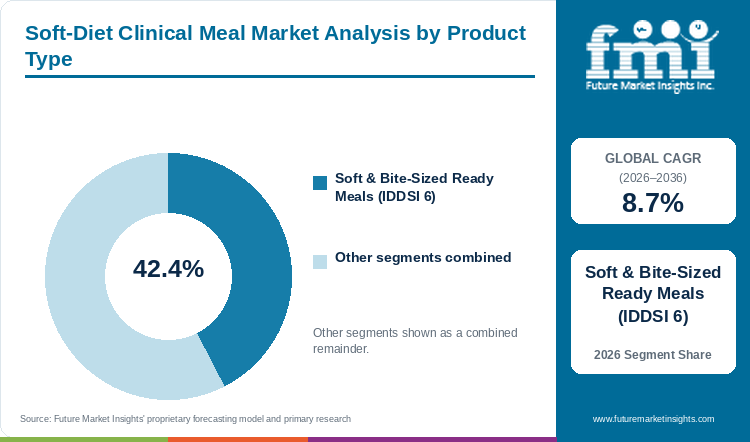
Soft & Bite-Sized Ready Meals (IDDSI 6) are projected to capture 42.4% of product type demand in 2026, supported by particle sizing.
Table 5: Product Type Share for the Soft-Diet Clinical Meal Market (percentage share), 2026
| Product Type | Share (2026) |
|---|---|
| Soft & Bite-Sized Ready Meals (IDDSI 6) | 42.4% |
| Other Segments Combined | 57.6%* |
| Total | 100.0% |
*Note: Remaining product type categories sum to 100.0% of 2026 clinical nutrition volume.
Table 6: Product Type Leadership and Market Growth for the Soft-Diet Clinical Meal Market (segment and CAGR percentage), 2026 to 2036
| Metric | Value |
|---|---|
| Global CAGR (2026 to 2036) | 8.7% |
| Leading Segment | Soft & Bite-Sized Ready Meals (IDDSI 6) |
Healthcare foodservice buyers favor IDDSI Level 6 ready meals because pre-diced components preserve recognizable plate appeal while honoring the 15-millimeter adult particle safety ceiling. Factory-portioned trays eliminate labor-intensive manual dicing in nursing kitchens, preventing choking citations while complementing complete nutrition products across rehabilitation wards.
- Soft & Bite-Sized Ready Meals (IDDSI 6) are projected to secure 42.4% of product type revenue in 2026 by combining dignified visual presentation with verified fork-pressure softness.
- A May 2025 scoping review of 1,183 clinical records published in Dysphagia confirmed the absence of universal provider competency standards for bedside texture modification, reinforcing institutional conversion toward factory-verified IDDSI Level 6 trays [3].
Why does Protein-Fortified define the largest fortification segment?
Protein-fortified formulations are estimated to secure 48.9% of the fortification category in 2026, driven by protocols against geriatric muscle loss.
Counteracting catabolic sarcopenia in frail dysphagic seniors requires enriching small meal volumes with whey isolates and hydrolyzed collagen peptides. Integrating concentrated amino acids into specialized nutrition entrees allows clinical dietitians to deliver 20 grams of protein per serving without overwhelming low-appetite patients.
- Protein-fortified options are estimated to command 48.9% of the fortification segment in 2026 as eldercare clinicians prioritize lean tissue preservation alongside safe bolus transit.
- Clinical study findings published in the Journal of the American Geriatrics Society in April 2025 demonstrated that nutrition-fortified texture-modified diets increased daily energy intake by roughly 200 kcal and improved activities of daily living in older dysphagia patients [4].
What keeps Lunch / Dinner Entrees ahead by meal occasion?
Lunch / dinner entrees are expected to command 51.6% of meal occasion volume in 2026, reflecting recurring demand for savory main meals.
Center-of-plate savory entrees represent the highest culinary preparation complexity and greatest aspiration risk across institutional dining rooms. Pre-cooked enzyme-softened meats and molded vegetables streamline midday and evening tray assembly while integrating into therapeutic food delivery programs for post-discharge patients.
- Lunch / dinner entrees are expected to hold 51.6% of meal occasion sales in 2026 because main meals anchor daily caloric and micronutrient targets.
- Clinical meal guidance updated by Mom's Meals in June 2026 notes that swallowing difficulties affect up to 51% of nursing home residents, prompting expanded fulfillment of fully prepared IDDSI Level 4 pureed savory entrees [5].
Why does Long-Term Care lead the end user category?
Long-term care facilities are forecast to generate 47.1% of end user revenue in 2026, owing to continuous daily dysphagia meal requirements.
Permanent nursing home residents living with neurodegenerative disorders or post-stroke bulbar palsy require three texture-controlled meals daily over multi-year stays. Unlike short-stay surgical wards, residential eldercare chains execute multi-year catering contracts that stabilize recurring volume for regional foodservice distributors.
- Long-term care is forecast to account for 47.1% of end user demand in 2026 as chronic swallowing impairment creates predictable year-round tray procurement.
- A June 2026 Duke University study of U.S. Medicare beneficiaries aged 65 and older published in Dysphagia documented an 11.0% dysphagia rate among primary brain tumor patients alongside elevated inpatient hospitalization demand [6].
What gives Hospital Pharmacy the leading position in sales channel?
Hospital pharmacy channels are anticipated to account for 42.0% of sales channel turnover in 2026, reinforced by dietitian-supervised inpatient dispensing.
Inpatient hospital pharmacies govern formulary approval and ward replenishment for high-density dysphagia jellies and therapeutic pureed meals. Coordinating pharmacy-dispensed soft foods with clinical speech-language pathology evaluations ensures strict patient adherence during acute recovery and discharge planning.
- Hospital pharmacy is anticipated to capture 42.0% of sales channel revenue in 2026 because therapeutic soft meals require registered dietitian oversight and controlled formulary coding.
- Nestle Health Science published a clinical compendium in May 2025 summarizing 18 clinical studies confirming that xanthan-gum-based ThickenUp Clear resists salivary amylase thinning across hospital pharmacy and homecare feeding pathways [7].
What are the drivers, restraints, and opportunities in the soft-diet clinical meal market?
In the soft-diet clinical meal market, aging residential care cohorts are projected to expand daily tray volumes whereas steam-table syneresis restrains adoption and high-calorie micro-portions create premium formulary opportunities.
- Driver: Rising geriatric care admissions and mandatory dysphagia safety audits convert pre-packaged texture-modified meals into routine institutional procurement.
- Restraint: Starch retrogradation and liquid separation during prolonged steam-table holding elevate aspiration liability and trigger strict dietitian qualification hurdles.
- Opportunity: Enriching compact soft meal portions with hydrolyzed peptides and medium-chain triglycerides solves early mealtime fatigue across rehabilitation wards.
Growth Analysis and Future Potential: Qualitative Demand Catalysts
Residential aged-care operators are phasing out manual kitchen pureeing because batch-to-batch viscosity drift triggers regulatory citations during unannounced dining inspections. Delivering consistent swallowing safety across three daily meals requires validated shear-thinning behavior and uniform particle softening. Future Market Insights notes that rising nursing home admissions are converting dysphagia management into a contracted catering category alongside parenteral nutrition support in acute wards. In January 2026, a systematic review of 31 clinical studies from Seoul National University Hospital published in Dysphagia confirmed that generalized sarcopenia directly accelerates swallowing muscle loss across older inpatients [8]. Institutional administrators increasingly establish multi-year supply agreements for factory-tested soft meals to protect resident weight stability.
Risk Assessment of the Soft-Diet Clinical Meal Market: Operational and Formulation Friction
Thermal degradation during institutional steam-table holding and underlying inflammatory catabolism represent the primary barriers restricting commercial meal efficacy. When texture-modified purees remain on hospital hot-holding lines above 65 degrees Celsius, starch retrogradation induces liquid pooling that turns cohesive boluses into aspiration hazards. In September 2025, a clinical study published in the Journal of the American Nutrition Association documented a 29.4% malnutrition prevalence under GLIM criteria among adults and older people with videofluoroscopy-confirmed oropharyngeal dysphagia [9]. Hospital dietitians consequently enforce rigorous thermal-hold qualification trials before approving commercial vendors. When facilities compare oral soft trays against tube feeding formula regimens, tight daily per-bed catering budgets generate price resistance against premium molded entrees.
Commercial Opportunity Analysis: Formulation Differentiation and Value-Add Formats
Healthcare procurement economics reward food processors that overcome early mealtime fatigue in frail seniors through high-density micro-portion engineering. Dysphagic patients frequently tire after five minutes of chewing and swallowing, leaving broth-diluted purees unfinished and accelerating inpatient malnutrition. Manufacturers capturing higher gross margins replace water dilution by fortifying 100-gram portions with whey peptides and emulsified lipids that complement enteral nutrition protocols. In July 2025, an observational real-world cohort study across 58 tertiary hospitals published in BMC Geriatrics analyzed a 136-patient subgroup of moderately dysphagic older inpatients achieving sufficient caloric intake and found that 53% of the 91 patients receiving oral nutrition (including dietary modifications and oral nutritional supplements) showed an improved Mini Nutritional Assessment Short-Form (MNA-SF) category versus 26% of the 45 patients on tube feeding [10]. Pairing 3D-molded visual appeal with concentrated macronutrients enables suppliers to secure preferred formulary tiers.
Soft-Diet Clinical Meal Market by Country (2026 to 2036)
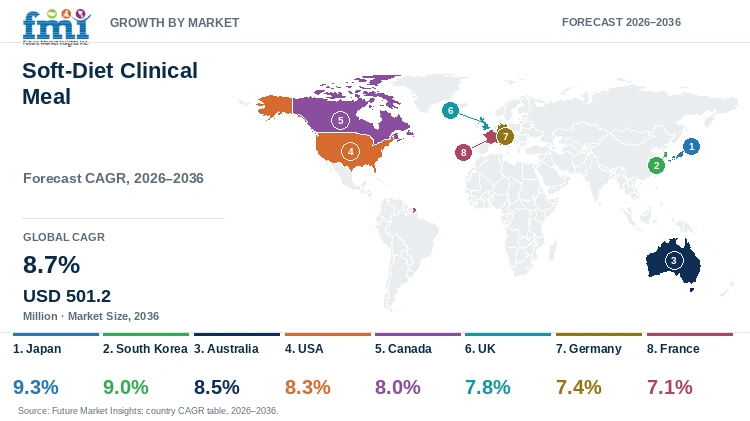
As per FMI, Japan is projected to lead soft-diet clinical meal expansion across major healthcare systems at a 9.3% CAGR through 2036, whereas France is forecast to progress at a 7.1% annual pace. Commercial performance across East Asian and European geriatric networks alongside North American hospital chains depends on statutory long-term care reimbursement ceilings and verified rheological stability during institutional re-thermalization.
Table 7: Country CAGR and Primary Growth Levers for the Soft-Diet Clinical Meal Market (CAGR percentage and operational drivers), 2026 to 2036
| Country | CAGR (2026 to 2036) | Primary Growth Lever |
|---|---|---|
| Japan | 9.3% | Universal LTCI care-food subsidies and Smile Care Diet standardization |
| South Korea | 9.0% | Senior-Friendly Food industrial certifications and hospital-to-home meal programs |
| Australia | 8.5% | Aged Care Quality Standards audits and clinical IDDSI speech pathology compliance |
| USA | 8.3% | Medicare Advantage Medically Tailored Meals (MTM) benefits and acute-care supply contracts |
| Canada | 8.0% | Long-term care kitchen staffing shortages driving factory-standardized meal tray procurement |
| UK | 7.8% | NHS patient safety alerts mandating IDDSI-compliant texture consistency in trust catering |
| Germany | 7.4% | Pflegeversicherung long-term care insurance cash allowances funding delivered meal trays |
| France | 7.1% | Hospital malnutrition prevention initiatives and high-protein texture-modified gastronomy |
Source: Future Market Insights analysis
Japan Soft-Diet Clinical Meal Market Outlook (2026 to 2036)
Unlike Western healthcare markets that rely on frozen bulk hospital trays, Japan operates a retail-and-institutional care-food ecosystem built around ambient enzyme-softened retort pouches and pharmacy jellies. A May 2025 longitudinal study of 177 Japanese adults aged 65 and older from Nippon Dental University published in The Journal of Nutrition Health and Aging confirmed that reduced tongue pressure precedes clinical malnutrition over 12 months [11]. Domestic soft-diet clinical meal sales are projected to expand at a leading 9.3% annual trajectory through 2036 as nursing homes outsource dysphagia tray preparation. Although Smile Care Diet labels and Long-Term Care Insurance subsidies standardize purchasing, tight municipal reimbursement caps favor Kewpie Corporation enzyme-infused domestic pouches.
Key takeaway: In Japan, universal long-term care insurance subsidies and statutory Smile Care Diet standards are projected to anchor institutional procurement of enzyme-softened clinical meals.
South Korea Soft-Diet Clinical Meal Market Outlook (2026 to 2036)
Institutional soft-diet clinical meal sales in South Korea are expected to climb at a 9.0% annual rate over the 2026 to 2036 window as geriatric wards standardize dysphagia catering. Whereas European care systems emphasize home-delivered trays, South Korea concentrates demand inside high-occupancy convalescent hospitals that house elderly stroke and dementia patients. An October 2025 clinical review from Eulji University published in the Korean Journal of Community Nutrition validated standardized Korean EAT-10 screening paired with IDDSI liquidized and minced meal strategies for older adults [12]. National Senior-Friendly Food rules mandate strict viscosity grades, yet fixed National Health Insurance meal allowances cap per-bed spending and favor domestic processors supplying bulk retort bags.
Key takeaway: In South Korea, national senior-friendly food certifications and convalescent hospital expansion are expected to shift institutional catering toward certified bulk soft-meal formats.
Australia Soft-Diet Clinical Meal Market Outlook (2026 to 2036)
In contrast to densely populated Asian markets, Australia's vast geographic dispersion between metropolitan commissaries and regional care homes makes freeze-thaw and shelf stability the decisive purchasing criterion. In November 2025, Danone Nutricia Australia updated clinical distribution specifications for its 125-milliliter Fortisip Compact Protein Food for Special Medical Purposes delivering 306 kcal and 18 grams of protein across pharmacy and eldercare pathways [13]. Because manual blender inconsistency risks regulatory sanctions under Aged Care Quality Standards, facility directors are forecast to shift spending toward commercial soft-diet clinical meals at an 8.5% annual pace through 2036. Prohibitive rural cold-chain freight rates still pressure operating budgets, so processors formulate blast-chilled IDDSI Level 6 entrees.
Key takeaway: In Australia, unannounced aged-care clinical dining audits are forecast to compel facility operators to procure certified freeze-thaw-stable texture-modified entrees.
USA Soft-Diet Clinical Meal Market Outlook (2026 to 2036)
Unlike single-payer European hospital tenders, United States demand is uniquely bifurcated between acute-care group purchasing organizations and private Medicare Advantage post-discharge home meal benefits. A July 2025 population study of 1,497 Medicare beneficiaries from the National Health and Aging Trends Study published in Dysphagia found up to 10.2% self-reported swallowing difficulty strongly associated with needing meal-preparation assistance [14]. Commercial soft-diet clinical meal turnover in the USA is anticipated to rise at an 8.3% yearly clip over the ten-year horizon to 2036 across inpatient and homecare channels. Because payer rules typically cap coverage at 60-day post-discharge episodes, vendors like Mom's Meals contract directly with accountable care organizations to curb stroke readmissions.
Key takeaway: In the USA, Medicare Advantage medically tailored meal benefits and hospital readmission-reduction contracts are anticipated to sustain commercial volume expansion.
Canada Soft-Diet Clinical Meal Market Outlook (2026 to 2036)
Multi-year provincial health authority tenders with rigid per-tray price caps govern institutional catering across Canada, setting the market apart from decentralized private U.S. payer contracting. A March 2025 clinical practice survey of 126 Canadian healthcare providers published in the Canadian Journal of Dietetic Practice and Research documented that 92% of dietitians rely on texture modification while noting dysphagia affects up to 35% of older adults [15]. Canadian soft-diet clinical meal spending is predicted to grow at an 8.0% yearly pace through 2036 as regional health authorities centralize commissary production. Because provincial price ceilings squeeze supplier margins during ingredient inflation, foodservice processors supply pre-portioned IDDSI Level 6 trays that eliminate manual prep hours.
Key takeaway: In Canada, provincial nursing home dietary labor deficits are predicted to drive centralized group purchasing of ready-to-heat IDDSI-compliant meal trays.
UK Soft-Diet Clinical Meal Market Outlook (2026 to 2036)
What distinguishes the UK from continental European markets is the strict clinical governance of National Health Service dysphagia pathways across acute hospital trusts and residential care homes. A January 2025 national survey of UK speech and language therapists led by Newcastle upon Tyne NHS Foundation Trust documented 98% videofluoroscopy utilization alongside standardized texture modification across head-and-neck oncology pathways [16]. United Kingdom soft-diet clinical meal expenditure is estimated to climb at a 7.8% annual rate through 2036 across NHS trusts and private eldercare operators. Persistent trust budget deficits and capped local council social-care funding create pushback against premium single-serve trays, compelling vendors to prove that fortified purees shorten inpatient stays.
Key takeaway: In the UK, strict NHS swallowing safety mandates are estimated to make verified IDDSI texture stability the primary qualification gate for hospital catering contracts.
Germany Soft-Diet Clinical Meal Market Outlook (2026 to 2036)
Germany diverges sharply from institutional-heavy global markets because statutory Pflegeversicherung care allowances fund outpatient home dining alongside neurologic rehabilitation clinics. In April 2026, a multidisciplinary Delphi study led by University Hospital Duesseldorf and University Hospital Muenster published in Clinical Nutrition proposed a nine-statement FOOD-DM consensus framework recommending available high-calorie options (such as 1.5 to 2.0 kcal per milliliter) and texture descriptions using IDDSI and/or SI rheology, with 61% of experts favoring combined labeling [17]. German demand for soft-diet clinical meals is slated to expand at a 7.4% CAGR through 2036 across nursing homes and mobile meal fleets. Vendors address household copayment sensitivity by formulating nutrient-dense soft entrees aligned with Pflegeversicherung reimbursement tiers.
Key takeaway: In Germany, statutory Pflegeversicherung care allowances and the flexible FOOD-DM clinical nutrition consensus framework are slated to guide recurring demand for energy-dense soft entrees.
France Soft-Diet Clinical Meal Market Outlook (2026 to 2036)
Whereas Anglo-Saxon healthcare kitchens prioritize labor-saving frozen tray standardization, French hospitals and EHPAD nursing homes evaluate dysphagia meals through deeply rooted gastronomic and culinary standards. In June 2025, European clinical recommendations co-authored by digestive physiology specialists at Hospices Civils de Lyon and CHU de Bordeaux achieved 100% consensus across 41 clinical statements governing oropharyngeal dysphagia dietary management [18]. French institutional soft-diet spending is likely to increase at a 7.1% yearly rate through 2036 as geriatric wards upgrade protein density across modified menus. Because residents reject unappealing liquidized purees and in-house chefs resist industrial trays, specialized processors formulate 3D-molded, butter-enriched high-protein purees that replicate classic French bistro dishes across hospital consortia.
Key takeaway: In France, clinical anti-denutrition directives combined with institutional culinary standards are likely to compel eldercare homes to adopt high-protein molded purees.
Full report country CAGRs cover: North America; Latin America; Western Europe; Eastern Europe; East Asia; South Asia and Pacific; Middle East and Africa.
Who are the notable companies in the soft-diet clinical meal market?
Kewpie Corporation, Meiji Holdings, Hormel Health Labs, Clinico (Morinaga), Mom's Meals (PurFoods), Danone Nutricia, Kent Precision Foods, and Nestle Health Science are the notable companies in the soft-diet clinical meal market.
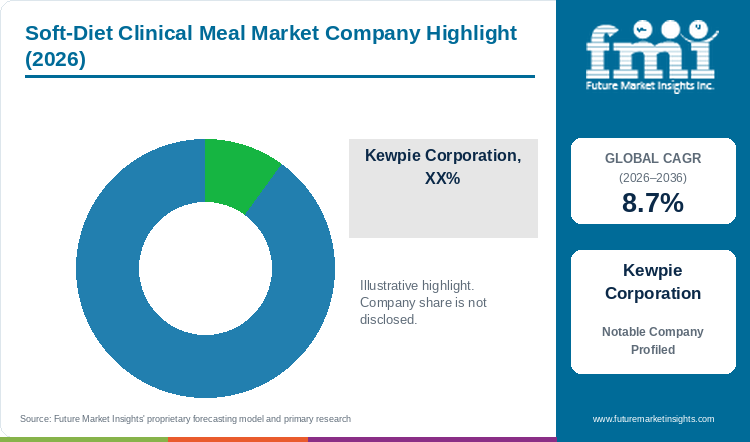
FMI analysis indicates that the competitive arena divides between specialized healthcare foodservice processors and diversified clinical nutrition corporations. Dedicated meal manufacturers formulate pre-cooked texture-modified entrees for nursing home tray lines and home-delivered post-discharge programs. Japanese care-food producers lead in enzyme-softened pouches and compact energy-dense jellies, whereas global nutrition groups supply broad hospital formulary portfolios.
- Texture-Modified Meal Specialists: Hormel Health Labs and Kent Precision Foods alongside Mom's Meals formulate prepared dysphagia entrees that eliminate manual kitchen pureeing.
- Japanese Care-Food Platforms: Kewpie Corporation and Meiji Holdings together with Clinico supply certified soft meals across domestic hospitals and community pharmacies.
- Global Clinical-Nutrition Platforms: Danone Nutricia and Nestle Health Science deliver concentrated dysphagia nutrition and broad inpatient formulary reach.
Competitive Benchmarking: Soft-Diet Clinical Meal Market
Table 8: Competitive Benchmarking for the Soft-Diet Clinical Meal Market (qualitative capability ratings), 2026
| Company | Texture-Modified Meal Breadth | Clinical Fortification Depth | Institutional / Homecare Access | Geographic Reach |
|---|---|---|---|---|
| Kewpie Corporation | High | Medium | Medium | Medium |
| Meiji Holdings | Medium | High | Medium | Medium |
| Hormel Health Labs | High | Medium | High | Medium |
| Clinico (Morinaga) | Medium | High | High | Medium |
| Mom's Meals (PurFoods) | High | Medium | High | Medium |
| Danone Nutricia | High | High | High | High |
| Kent Precision Foods | High | Medium | Medium | Medium |
| Nestle Health Science | Medium | High | High | High |
Scoring basis: Capability tiers evaluate documented product breadth across IDDSI levels 4 through 6 and protein fortification density per 100-gram serving. Institutional access and geographic ratings reflect verified hospital pharmacy distribution contracts and multi-region cold-chain fulfillment networks.
Key Developments in the Soft-Diet Clinical Meal Market
- Kewpie Corporation co-founded the Japan Frailty Prevention Industry Association in May 2025 to expand frailty-prevention soft meal programs and senior nutrition education across Japanese care channels [19].
- Mom's Meals expanded its home-delivered USDA- and FDA-inspected Pureed Meals program in January 2026, offering over 60 medically tailored meal options starting at USD 7.99 for healthcare plan beneficiaries [20].
- Hormel Foods Corporation reported USD 12.1 billion in fiscal 2025 net sales in December 2025, supported by 6% fourth-quarter organic net sales growth in Foodservice healthcare and prepared protein solutions [21].
Key Players in the Soft-Diet Clinical Meal Market
Texture-Modified Meal Specialists
- Hormel Health Labs
- Kent Precision Foods
- Mom's Meals (PurFoods)
Japanese Senior-Nutrition and Care-Food Platforms
- Kewpie Corporation
- Meiji Holdings
- Clinico (Morinaga)
Global Clinical Nutrition Platforms
- Danone Nutricia
- Nestle Health Science
Soft-Diet Clinical Meal Market - Report Scope
Table 9: Report Scope for the Soft-Diet Clinical Meal Market (coverage fields and definitions), 2026 to 2036
| Coverage field | Report scope |
|---|---|
| Market breakdown | Product Type; Fortification; Meal Occasion; End User; Sales Channel |
| Quantitative Units | USD Million |
| Market Definition | Includes commercial supplier revenue from prepared soft-diet clinical meals and fortified texture-modified meal components (IDDSI Levels 4 to 6). Category Scope Note: Excludes unfortified retail baby purees, raw thickening powders sold separately, and standard enteral tube-feeding liquids. |
| Regions Covered | North America; Latin America; Western Europe; Eastern Europe; East Asia; South Asia and Pacific; Middle East and Africa |
| Countries Covered | Japan, South Korea, Australia, USA, Canada, UK, Germany, France, and additional countries in the full report |
| Key Companies Covered | Kewpie Corporation, Meiji Holdings, Hormel Health Labs, Clinico (Morinaga), Mom's Meals (PurFoods), Danone Nutricia, Kent Precision Foods, Nestle Health Science |
| Forecast Period | 2026 to 2036 |
| Approach | Primary and secondary research with top-down and bottom-up market triangulation. |
Soft-Diet Clinical Meal Market - Research Methodology
Table 10: Research Methodology for the Soft-Diet Clinical Meal Market (research methods and approach), 2026 edition
| Method | Approach |
|---|---|
| Primary Research | Structured interviews with hospital foodservice directors, geriatric dietitians, speech-language pathologists, and institutional catering distributors to validate IDDSI compliance workflows and per-tray pricing. |
| Secondary Research | Analysis of corporate annual filings, PubMed and PMC clinical dysphagia studies, national geriatric nutrition consensus guidelines, and peer-reviewed dietetic journals. |
| Market Sizing and Forecasting | Top-down institutional dietary budget models reconciled against bottom-up inpatient dysphagia prevalence and daily modified meal volumes from 2026 to 2036. |
| Country Forecasting Model | Econometric country projections weight 65+ demographic expansion, nursing home bed capacity, and statutory care-insurance meal reimbursement ceilings across eight national healthcare systems. |
| Operational Benchmark Traceability | Patient-pool and facility spending indicators in Tables 2, 3, and 4 trace to Nutrients and Dysphagia observational cohorts, NHATS Medicare beneficiary studies, and BMC Geriatrics inpatient evaluations. |
| Data Triangulation and Validation | Demand estimates are cross-checked against commercial foodservice contract volumes and hospital pharmacy formulary procurement without double counting standalone powder thickeners. |
Soft-Diet Clinical Meal Market by Segments
Soft-Diet Clinical Meal Market segmented by Product Type:
- Soft & Bite-Sized Ready Meals (IDDSI 6)
- Soft Main-Dish Components
- Soft Fortified Desserts
- Others
Soft-Diet Clinical Meal Market segmented by Fortification:
- Protein-Fortified
- Energy-Dense
- Standard
Soft-Diet Clinical Meal Market segmented by Meal Occasion:
- Lunch / Dinner Entrees
- Breakfast
- Snacks & Desserts
Soft-Diet Clinical Meal Market segmented by End User:
- Long-Term Care
- Homecare
- Hospitals
- Others
Soft-Diet Clinical Meal Market segmented by Sales Channel:
- Hospital Pharmacy
- Retail Pharmacy
- Online
- Institutional Tender
- Others
Soft-Diet Clinical Meal Market by Region
- North America
- United States
- Canada
- Latin America
- Brazil
- Mexico
- Argentina
- Chile
- Western Europe
- Germany
- France
- United Kingdom
- Italy
- Spain
- Benelux
- Nordics
- Eastern Europe
- Poland
- Czech Republic
- Romania
- Hungary
- East Asia
- China
- Japan
- South Korea
- South Asia and Pacific
- India
- ASEAN
- Australia and New Zealand
- Middle East and Africa
- GCC Countries
- South Africa
- Türkiye
- Israel
Research Sources and Bibliography
- [1] Formisano, E., Di Cino, E., Nicosia, E., Pasta, A., Paccione, G., Sukkar, A. A., Pisciotta, L., & Sukkar, S. G. (2025, October 17). Prevalence of Dysphagia and Its Health Implications Among Elderly Residents in Long-Term Care Facilities in the Liguria Region (Italy): An Observational Cohort Study. Nutrients, 17(20), 3268 (PubMed PMID 41156521).
- [2] Cheng, I., Rommel, N., Duchac, S., Regan, J., Speyer, R., & Dziewas, R. (2025, June 2). Understanding health care professionals' knowledge and practice regarding malnutrition and dysphagia: Insights from Targeted Education to Address Malnutrition and Swallowing disorders (TEAMS) international survey. Nutrition, 139, 112858 (PubMed PMID 40582268).
- [3] Hazelwood, R. J., Robinson, G. F., Wolford, G. W., & Smith, R. F. (2025, May 28). Assessment of Dysphagia Management Competence among Healthcare Providers: A Scoping Review. Dysphagia, 40(6), 1381-1398 (PubMed PMID 40434492).
- [4] Ueshima, J., Maeda, K., Miyoshi, F., Takeuchi, N., Morita, Y., Kaneda, H., & Fukuda, A. (2025, April 11). Nutrition-Fortified Texture-Modified Diet Enhances Recovery in Older Adult Patients With Dysphagia. Journal of the American Geriatrics Society (PubMed PMID 40211928).
- [5] Mom's Meals. (2026, June 11). Dysphagia Diets | Mom's Meals. Mom's Meals (PurFoods, LLC).
- [6] Johnson, M. O., Parish, A., Cohen, S. M., Niedzwiecki, D., Dalton, J., & Leiman, D. A. (2026, June 12). Dysphagia in Older Adults with Malignant Brain Tumors: Results of a National Study of Medicare Beneficiaries. Dysphagia (PubMed PMID 42277296).
- [7] Nestle Health Science. (2025, May 7). Compendium of Scientific Studies: ThickenUp Clear and ThickenUp. Nestle Health Science Professional.
- [8] Yun, S. J., Seo, H. G., Lee, S. Y., Cho, B., & Oh, B.-M. (2026, January 23). Sarcopenic Dysphagia Reconsidered: A Systematic Review of Complex Interactions and Diagnostic Challenges. Dysphagia, 41(3), 511-528 (PubMed PMID 41571804).
- [9] Lyra, E., Moreira, E. A. M., Machado, M., Oliveira, D. L., Freitas, M. B., Rosa, J. S., Furkim, A. M., Moreno, Y. M. F., Frode, T. S., & Hauschild, D. B. (2025, September 17). Inflammatory Response and Malnutrition Based on the Global Leadership Initiative on Malnutrition: Adults and Older People With Oropharyngeal Dysphagia. Journal of the American Nutrition Association, 45(2), 179-188 (PubMed PMID 40961417).
- [10] Li, M., Jiang, S., Li, J., Chen, X., Ma, L., Guo, Q., et al. (2025, July 31). Effectiveness and safety of oral nutrition in older patients with moderate dysphagia: a real-world cohort study in geriatric inpatients. BMC Geriatrics, 25(1), 571 (PubMed PMID 40745263).
- [11] Furuya, H., Kikutani, T., Yokota, Y., Ozeki, M., & Tamura, F. (2025, May 6). Temporal relationship between malnutrition and oral function impairment in older adults with dysphagia: A cross-lagged panel model. The Journal of Nutrition, Health and Aging, 29(7), 100577 (PubMed PMID 40334363).
- [12] Paik, J. K. (2025, October 31). Evaluation and standardized dietary strategies for dysphagia in older adults: a narrative review. Korean Journal of Community Nutrition, 30(5), 323-330 (PubMed PMID 41245615).
- [13] Nutricia Australia. (2025, November 6). Fortisip Compact Protein Supplements - 125ml | Nutricia Fortisip. Danone Nutricia Australia.
- [14] Namasivayam-MacDonald, A., Werbeloff, M., & Shune, S. (2025, July 17). Prevalence and Predictors of Self-Reported Swallowing Difficulties in Community-Dwelling Older Adults: A Population-Based Study from the National Health and Aging Trends Study (NHATS). Dysphagia, 41(1), 127-137 (PubMed PMID 40676172).
- [15] Lam, P., Bailey, E., & Steel, C. (2025, March 17). Exploring Dysphagia Assessment and Management in Canadian Primary Care: A Clinical Practice Survey. Canadian Journal of Dietetic Practice and Research, 86(2), 84-89 (PubMed PMID 40094845).
- [16] Sellstrom, D., Haighton, C., Finch, T., O'Hara, J., & Patterson, J. M. (2025, January 15). Assessment and management of late radiation-associated dysphagia after treatment for head and neck cancer: A scoping review and survey of UK speech and language therapists. International Journal of Language & Communication Disorders, 60(1), e13154 (PubMed PMID 39745790).
- [17] Brux, L., Lapa, S., Hofacker, J., Huber, C., Lueg, G., Jung, A., Muhle, P., Suntrup-Krueger, S., Wirth, R., Meuth, S. G., Warnecke, T., Dziewas, R., & Labeit, B. (2026, April 16). A multidisciplinary Delphi consensus on the formulation of an optimized oral diet for dysphagia and malnutrition (FOOD-DM). Clinical Nutrition, 61, 106667 (PubMed PMID 42054965).
- [18] Mari, A., Calabrese, F., Pasta, A., Lorenzon, G., Weusten, B., Keller, J., Visaggi, P., Roman, S., et al. (2025, June 21). Esophageal and Oropharyngeal Dysphagia: Clinical Recommendations From the United European Gastroenterology and European Society for Neurogastroenterology and Motility. United European Gastroenterology Journal, 13(6), 855-901 (PubMed PMID 40543044).
- [19] Kewpie Corporation. (2025, May 20). contribution to extending healthy life expectancy | Sustainability | Kewpie. Kewpie Corporation.
- [20] Mom's Meals. (2026, January 15). Pureed Meals Delivered To Your Home | Mom's Meals. Mom's Meals (PurFoods, LLC).
- [21] Hormel Foods Corporation. (2025, December 4). Hormel Foods Reports Fourth Quarter and Full-Year Fiscal 2025 Results. Hormel Foods Newsroom.
- [22] Kewpie Corporation. (2026, March 15). Initiatives toward Universal Design | Sustainability | Kewpie. Kewpie Corporation.
- [23] Danone Group. (2025, October 15). Supporting health at all life stages with Specialized Nutrition | Danone Group. Danone S.A.
This bibliography is provided for reader reference and is not exhaustive. The full report contains the complete reference list and detailed citations.
This Report Answers
- How large is the soft-diet clinical meal market in 2026 and what is forecast for 2036?
- Which care and nutrition pressures support demand for soft-diet clinical meals?
- Why do Soft & Bite-Sized Ready Meals (IDDSI 6) lead the product type category?
- Why does protein-fortified lead the fortification category globally?
- How do growth rates differ across Japan, South Korea, Australia, and the USA?
- Which leading companies supply relevant meal and clinical-nutrition categories today?
- What limits adoption or supplier switching in the soft-diet clinical meal market?
- What should buyers evaluate before purchasing a soft-diet clinical meal?
Frequently Asked Questions
How big is the soft-diet clinical meal market in 2026, and what is forecast for 2036?
According to FMI, global soft-diet clinical meal turnover is estimated to reach USD 217.6 million in 2026 from USD 200.2 million in 2025. Revenue is forecast to hit USD 501.2 million by 2036 as nursing homes outsource dysphagia tray preparation.
What is the CAGR for the soft-diet clinical meal market from 2026 to 2036?
Future Market Insights projects an 8.7% compound annual growth rate between 2026 and 2036, representing an anticipated USD 283.6 million increase in annual market revenue across institutional and homecare channels.
Which product type segment leads the soft-diet clinical meal market?
Soft & Bite-Sized Ready Meals (IDDSI 6) are projected to capture 42.4% of product type demand in 2026 because 15-millimeter pre-diced portions preserve visual meal dignity while preventing choking.
Which fortification segment leads the soft-diet clinical meal market?
Protein-fortified formulations are estimated to secure 48.9% of the fortification category in 2026 as geriatric clinicians combat inpatient sarcopenia using peptide-enriched soft portions.
Which country has a notable growth outlook during the assessment period?
Japan is projected to lead national growth at a 9.3% CAGR through 2036, backed by universal Long-Term Care Insurance meal subsidies and Smile Care Diet texture classifications.
Who are the key players in the market?
Kewpie Corporation, Meiji Holdings, Hormel Health Labs, Clinico (Morinaga), Mom's Meals (PurFoods), Danone Nutricia, Kent Precision Foods, and Nestle Health Science lead commercial supply across healthcare foodservice and pharmacy networks.
Preview the report firsthand - request a free sample
Get SampleGet the brochure for pricing and purchase details.
Get PDFTable of Content
- Key Takeaways
- Market Size and CAGR
- Top Growth Driver
- Fastest Growing Segment
- Leading Region
- Key Companies
- Emerging Opportunities
- Executive Summary
- Global Market Outlook
- Demand-side Trends
- Supply-side Trends
- Technology Roadmap Analysis
- Analysis and Recommendations
- Analyst Perspective (What is happening? Why now? What should investors know?)
- Key Questions Answered
- How large is the market?
- What is the CAGR?
- What are key trends?
- Which region dominates?
- Who are the leaders?
- Market Overview
- Market Coverage / Taxonomy
- Market Definition / Scope / Limitations
- Research Methodology
- Chapter Orientation
- Analytical Lens and Working Hypotheses
- Market Structure, Signals, and Trend Drivers
- Benchmarking and Cross-market Comparability
- Market Sizing, Forecasting, and Opportunity Mapping
- Research Design and Evidence Framework
- Desk Research Programme (Secondary Evidence)
- Expert Input and Fieldwork (Primary Evidence)
- Tooling, Models, and Reference Databases
- Data Engineering and Model Build
- Quality Assurance and Audit Trail
- Market Background
- Market Dynamics (Drivers, Restraints, Opportunity, Trends)
- Scenario Forecast (Optimistic, Likely, Conservative)
- Impact Analysis
- AI Impact
- Sustainability Impact
- Regulatory Impact
- Technology Impact
- Consumer / Buyer Analysis
- Purchase Drivers
- Adoption Barriers
- Buyer Journey
- Opportunity Map Analysis
- Product Life Cycle Analysis
- Supply Chain Analysis
- Investment Feasibility Matrix
- Value Chain Analysis
- PESTLE and Porter's Analysis
- Regulatory Landscape
- Regional Parent Market Outlook
- Production and Consumption Statistics
- Import and Export Statistics
- Global Market Analysis and Forecast, 2021 to 2036
- Historical Market Size Value (USD Million) Analysis, 2021 to 2025
- Current and Future Market Size Value (USD Million) Projections, 2026 to 2036
- Y-o-Y Growth Trend Analysis
- Absolute $ Opportunity Analysis
- Global Market Pricing Analysis, 2021 to 2036
- Global Market Analysis and Forecast, By Product Type, 2021 to 2036
- Introduction / Key Findings
- Historical Market Size Value (USD Million) Analysis By Product Type, 2021 to 2025
- Current and Future Market Size Value (USD Million) Analysis and Forecast By Product Type, 2026 to 2036
- Soft & Bite-Sized Ready Meals (IDDSI 6)
- Soft Main-Dish Components
- Soft Fortified Desserts
- Others
- Y-o-Y Growth Trend Analysis By Product Type, 2021 to 2025
- Absolute $ Opportunity Analysis By Product Type, 2026 to 2036
- Global Market Analysis and Forecast, By Fortification, 2021 to 2036
- Introduction / Key Findings
- Historical Market Size Value (USD Million) Analysis By Fortification, 2021 to 2025
- Current and Future Market Size Value (USD Million) Analysis and Forecast By Fortification, 2026 to 2036
- Protein-Fortified
- Energy-Dense
- Standard
- Y-o-Y Growth Trend Analysis By Fortification, 2021 to 2025
- Absolute $ Opportunity Analysis By Fortification, 2026 to 2036
- Global Market Analysis and Forecast, By Meal Occasion, 2021 to 2036
- Introduction / Key Findings
- Historical Market Size Value (USD Million) Analysis By Meal Occasion, 2021 to 2025
- Current and Future Market Size Value (USD Million) Analysis and Forecast By Meal Occasion, 2026 to 2036
- Lunch / Dinner Entrees
- Breakfast
- Snacks & Desserts
- Y-o-Y Growth Trend Analysis By Meal Occasion, 2021 to 2025
- Absolute $ Opportunity Analysis By Meal Occasion, 2026 to 2036
- Global Market Analysis and Forecast, By End User, 2021 to 2036
- Introduction / Key Findings
- Historical Market Size Value (USD Million) Analysis By End User, 2021 to 2025
- Current and Future Market Size Value (USD Million) Analysis and Forecast By End User, 2026 to 2036
- Long-Term Care
- Homecare
- Hospitals
- Others
- Y-o-Y Growth Trend Analysis By End User, 2021 to 2025
- Absolute $ Opportunity Analysis By End User, 2026 to 2036
- Global Market Analysis and Forecast, By Sales Channel, 2021 to 2036
- Introduction / Key Findings
- Historical Market Size Value (USD Million) Analysis By Sales Channel, 2021 to 2025
- Current and Future Market Size Value (USD Million) Analysis and Forecast By Sales Channel, 2026 to 2036
- Hospital Pharmacy
- Retail Pharmacy
- Online
- Institutional Tender
- Others
- Y-o-Y Growth Trend Analysis By Sales Channel, 2021 to 2025
- Absolute $ Opportunity Analysis By Sales Channel, 2026 to 2036
- Global Market Analysis and Forecast, By Region, 2021 to 2036
- Introduction
- Historical Market Size Value (USD Million) Analysis By Region, 2021 to 2025
- Current Market Size Value (USD Million) Analysis and Forecast By Region, 2026 to 2036
- North America
- Latin America
- Western Europe
- Eastern Europe
- East Asia
- South Asia and Pacific
- Middle East and Africa
- Market Attractiveness Analysis By Region
- North America Market Analysis and Forecast, By Country, 2021 to 2036
- Historical Market Size Value (USD Million) Trend Analysis By Market Taxonomy, 2021 to 2025
- Market Size Value (USD Million) Forecast By Market Taxonomy, 2026 to 2036
- By Country
- United States
- Canada
- By Product Type
- By Fortification
- By Meal Occasion
- By End User
- By Sales Channel
- By Country
- Market Attractiveness Analysis
- By Country
- By Product Type
- By Fortification
- By Meal Occasion
- By End User
- By Sales Channel
- Key Takeaways
- Latin America Market Analysis and Forecast, By Country
- Historical Market Size Value (USD Million) Trend Analysis By Market Taxonomy, 2021 to 2025
- Market Size Value (USD Million) Forecast By Market Taxonomy, 2026 to 2036
- By Country
- Brazil
- Mexico
- Argentina
- Chile
- By Product Type
- By Fortification
- By Meal Occasion
- By End User
- By Sales Channel
- By Country
- Market Attractiveness Analysis
- By Country
- By Product Type
- By Fortification
- By Meal Occasion
- By End User
- By Sales Channel
- Key Takeaways
- Western Europe Market Analysis and Forecast, By Country
- Historical Market Size Value (USD Million) Trend Analysis By Market Taxonomy, 2021 to 2025
- Market Size Value (USD Million) Forecast By Market Taxonomy, 2026 to 2036
- By Country
- Germany
- France
- United Kingdom
- Italy
- Spain
- Benelux
- Nordics
- By Product Type
- By Fortification
- By Meal Occasion
- By End User
- By Sales Channel
- By Country
- Market Attractiveness Analysis
- By Country
- By Product Type
- By Fortification
- By Meal Occasion
- By End User
- By Sales Channel
- Key Takeaways
- Eastern Europe Market Analysis and Forecast, By Country
- Historical Market Size Value (USD Million) Trend Analysis By Market Taxonomy, 2021 to 2025
- Market Size Value (USD Million) Forecast By Market Taxonomy, 2026 to 2036
- By Country
- Poland
- Czech Republic
- Romania
- Hungary
- By Product Type
- By Fortification
- By Meal Occasion
- By End User
- By Sales Channel
- By Country
- Market Attractiveness Analysis
- By Country
- By Product Type
- By Fortification
- By Meal Occasion
- By End User
- By Sales Channel
- Key Takeaways
- East Asia Market Analysis and Forecast, By Country
- Historical Market Size Value (USD Million) Trend Analysis By Market Taxonomy, 2021 to 2025
- Market Size Value (USD Million) Forecast By Market Taxonomy, 2026 to 2036
- By Country
- China
- Japan
- South Korea
- By Product Type
- By Fortification
- By Meal Occasion
- By End User
- By Sales Channel
- By Country
- Market Attractiveness Analysis
- By Country
- By Product Type
- By Fortification
- By Meal Occasion
- By End User
- By Sales Channel
- Key Takeaways
- South Asia and Pacific Market Analysis and Forecast, By Country
- Historical Market Size Value (USD Million) Trend Analysis By Market Taxonomy, 2021 to 2025
- Market Size Value (USD Million) Forecast By Market Taxonomy, 2026 to 2036
- By Country
- India
- ASEAN
- Australia and New Zealand
- By Product Type
- By Fortification
- By Meal Occasion
- By End User
- By Sales Channel
- By Country
- Market Attractiveness Analysis
- By Country
- By Product Type
- By Fortification
- By Meal Occasion
- By End User
- By Sales Channel
- Key Takeaways
- Middle East and Africa Market Analysis and Forecast, By Country
- Historical Market Size Value (USD Million) Trend Analysis By Market Taxonomy, 2021 to 2025
- Market Size Value (USD Million) Forecast By Market Taxonomy, 2026 to 2036
- By Country
- GCC Countries
- South Africa
- Türkiye
- Israel
- By Product Type
- By Fortification
- By Meal Occasion
- By End User
- By Sales Channel
- By Country
- Market Attractiveness Analysis
- By Country
- By Product Type
- By Fortification
- By Meal Occasion
- By End User
- By Sales Channel
- Key Takeaways
- Key Countries Market Analysis
- United States
- Pricing Analysis
- Market Share Analysis, 2025
- By Product Type
- By Fortification
- By Meal Occasion
- By End User
- By Sales Channel
- Canada
- Pricing Analysis
- Market Share Analysis, 2025
- By Product Type
- By Fortification
- By Meal Occasion
- By End User
- By Sales Channel
- Mexico
- Pricing Analysis
- Market Share Analysis, 2025
- By Product Type
- By Fortification
- By Meal Occasion
- By End User
- By Sales Channel
- Brazil
- Pricing Analysis
- Market Share Analysis, 2025
- By Product Type
- By Fortification
- By Meal Occasion
- By End User
- By Sales Channel
- Chile
- Pricing Analysis
- Market Share Analysis, 2025
- By Product Type
- By Fortification
- By Meal Occasion
- By End User
- By Sales Channel
- Germany
- Pricing Analysis
- Market Share Analysis, 2025
- By Product Type
- By Fortification
- By Meal Occasion
- By End User
- By Sales Channel
- United Kingdom
- Pricing Analysis
- Market Share Analysis, 2025
- By Product Type
- By Fortification
- By Meal Occasion
- By End User
- By Sales Channel
- Italy
- Pricing Analysis
- Market Share Analysis, 2025
- By Product Type
- By Fortification
- By Meal Occasion
- By End User
- By Sales Channel
- Spain
- Pricing Analysis
- Market Share Analysis, 2025
- By Product Type
- By Fortification
- By Meal Occasion
- By End User
- By Sales Channel
- France
- Pricing Analysis
- Market Share Analysis, 2025
- By Product Type
- By Fortification
- By Meal Occasion
- By End User
- By Sales Channel
- India
- Pricing Analysis
- Market Share Analysis, 2025
- By Product Type
- By Fortification
- By Meal Occasion
- By End User
- By Sales Channel
- ASEAN
- Pricing Analysis
- Market Share Analysis, 2025
- By Product Type
- By Fortification
- By Meal Occasion
- By End User
- By Sales Channel
- Australia and New Zealand
- Pricing Analysis
- Market Share Analysis, 2025
- By Product Type
- By Fortification
- By Meal Occasion
- By End User
- By Sales Channel
- China
- Pricing Analysis
- Market Share Analysis, 2025
- By Product Type
- By Fortification
- By Meal Occasion
- By End User
- By Sales Channel
- Japan
- Pricing Analysis
- Market Share Analysis, 2025
- By Product Type
- By Fortification
- By Meal Occasion
- By End User
- By Sales Channel
- South Korea
- Pricing Analysis
- Market Share Analysis, 2025
- By Product Type
- By Fortification
- By Meal Occasion
- By End User
- By Sales Channel
- Poland
- Pricing Analysis
- Market Share Analysis, 2025
- By Product Type
- By Fortification
- By Meal Occasion
- By End User
- By Sales Channel
- Hungary
- Pricing Analysis
- Market Share Analysis, 2025
- By Product Type
- By Fortification
- By Meal Occasion
- By End User
- By Sales Channel
- Türkiye
- Pricing Analysis
- Market Share Analysis, 2025
- By Product Type
- By Fortification
- By Meal Occasion
- By End User
- By Sales Channel
- South Africa
- Pricing Analysis
- Market Share Analysis, 2025
- By Product Type
- By Fortification
- By Meal Occasion
- By End User
- By Sales Channel
- Australia
- Pricing Analysis
- Market Share Analysis, 2025
- By Product Type
- By Fortification
- By Meal Occasion
- By End User
- By Sales Channel
- United States
- Market Structure Analysis
- Competition Dashboard
- Competition Benchmarking
- Market Share Analysis of Top Players
- By Regional
- By Product Type
- By Fortification
- By Meal Occasion
- By End User
- By Sales Channel
- Emerging Startups
- Innovation Benchmarking
- Competition Analysis
- Competition Deep Dive
- Kewpie Corporation
- Overview
- Product Portfolio
- Profitability by Market Segments
- Sales Footprint
- Strategy Overview
- Marketing Strategy
- Product Strategy
- Channel Strategy
- Meiji Holdings
- Hormel Health Labs
- Clinico (Morinaga)
- Mom's Meals (PurFoods)
- Danone Nutricia
- Kent Precision Foods
- Nestle Health Science
- Kewpie Corporation
- Case Studies
- Success Stories
- Recent Developments
- Competition Deep Dive
- Assumptions & Acronyms Used


