

- Market Size (2026)
- USD 344.2 Mn
- Forecast (2036)
- USD 566.0 Mn
- CAGR (2026 to 2036)
- 5.1%
How big is Solid Perfumes Market in 2026?
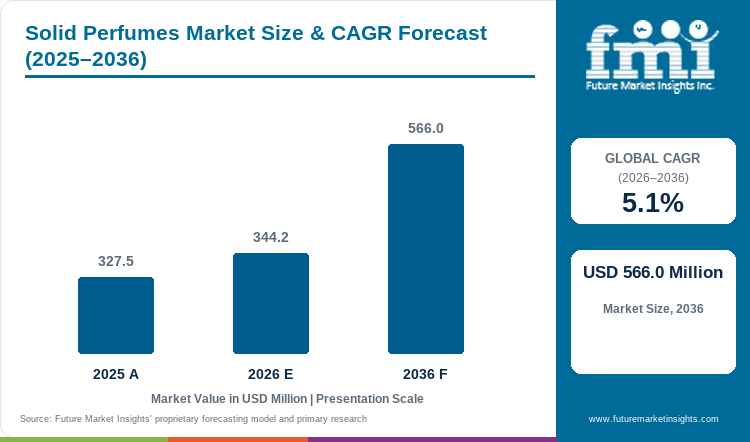
USD 344.2 million in 2026 and USD 566.0 million by 2036, expanding at 5.1% CAGR.
Demand for solid perfumes is projected to expand at 5.1% CAGR between 2026 and 2036, growing from USD 327.5 million in 2025 to USD 344.2 million in 2026, and escalating to USD 566.0 million by 2036. Portable pulse-point use is giving fragrance buyers a compact repeat-use format beside established full-size sprays. Puig's August 2026 environmental record identifies Byredo Mojave Ghost Parfum Solide as a 3 g solid perfume. The record confirms that a global fragrance owner is merchandising a compact solid under an established scent identity. Buyers can therefore assess portability without abandoning a fragrance identity they already recognize from regular use.
Country growth differs because national formula controls change launch work for fragrance companies between markets. UAE is forecast at 6.7% CAGR compared with Germany at 4.4% through 2036. Germany's BfR stated in September 2026 that leave-on cosmetics should keep each of four named aromatic substances below a 1% maximum. The recommendation covers eucalyptus oil and camphor plus menthol and methyl salicylate in leave-on cosmetic products. That national safety boundary can lengthen formula qualification for botanical-heavy solid perfumes before launch. The two forecasts therefore describe different launch conditions even though both markets serve the same compact fragrance occasion.
Key Takeaways
- Portable pulse-point reapplication supports demand because solid perfumes add convenience beside established fragrance sprays.
- Based on product type, eau de parfum is projected to account for 40.0% in 2026, supported by familiar scent identities that guide compact extensions.
- By nature, conventional formulas are estimated to hold 58.0% in 2026, owing to broader formulation choices for waxes, emollients, and fragrance systems.
- In 2026, liquid & serum formats are expected to lead the format category with 28.0% share, driven by familiar pulse-point application behavior.
- Leave-on formula controls and destination-market compliance can extend launch work before retailers accept a new compact fragrance.
- Some of the key players in this market include Coty, Rasasi, Puig, dsm-firmenich, L’Oréal, The Estée Lauder Companies, Givaudan, Ajmal Perfumes, Swiss Arabian, and Symrise.
Analyst Perspective
“Solid perfumes earn repeat purchase when the compact format preserves the scent character buyers already recognize from a spray. Brands should qualify texture and reapplication behavior before treating portability as a sufficient reason for a line extension.”
- Rahul Pandita, Principal Consultant, Future Market Insights.
How is the solid perfumes market segmented?
The solid perfumes market is segmented by product type, nature, format, price positioning, sales channel and region.
The solid perfumes market is segmented by product type, nature, format, price positioning, sales channel, and region. Product type distinguishes concentration while nature separates conventional and claim-led formula choices within the supplied taxonomy. Format covers fluid, balm, stick, spray, sheet, patch, and powder presentations while price positioning and sales channel organize commercial access.
How does eau de parfum shape demand within the product type category?
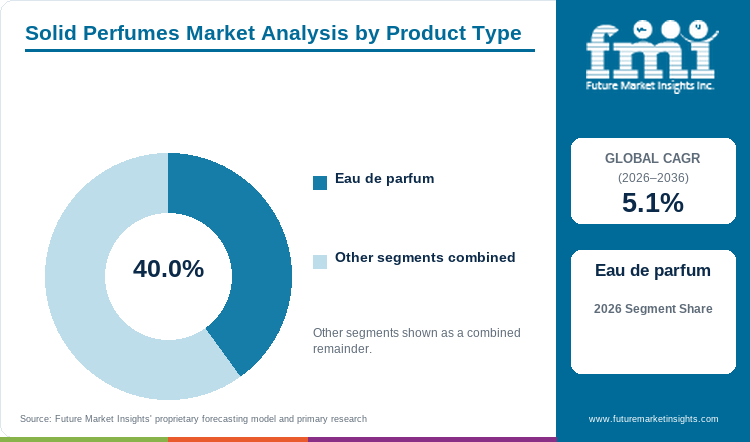
Fragrance buyers use eau de parfum as a familiar concentration reference when judging whether a companion format preserves the expected scent profile. Puig’s 2025 report identified Carolina Herrera’s La Bomba as a new fragrance pillar and listed several additional prestige launches. That activity keeps eau de parfum central to brand architecture even as houses test compact delivery. Solid formats can borrow recognition from an established scent identity while changing only the application ritual. The adjacent fragrance products category gives buyers a known spray reference before they add a touch-up format.
- By product type, eau de parfum is forecast to represent 40.0% in 2026, supported by its familiar role as the reference scent concentration.
- Brands can transfer a known eau de parfum identity into compact formats without asking buyers to learn an unrelated scent.
What supports conventional formulas within the nature category?
Nature positioning changes the formulation choices available to developers working on a leave-on fragrance product. The European Commission states that 56 additional fragrance allergens now require individual labeling above the applicable concentration thresholds. Since 31 July 2026 noncompliant new cosmetic products cannot be placed on the EU market. Conventional formulas still give developers a wider ingredient palette for balancing scent release against carrier texture and shelf stability. Natural cosmetics narrow that palette when botanical or essential-oil systems add sensitization or oxidation considerations. Conventional formulations give developers wider room to adjust waxes and emollients without making claim-led ingredient restrictions the primary design constraint.
- Conventional formulas are likely to capture 58.0% share in 2026, owing to broader ingredient and carrier choices within the nature category.
- Formula developers still need skin-safety controls because leave-on fragrance systems remain exposed to ingredient-specific concentration limits.
Why do liquid & serum formats lead the format category?
Liquid and serum presentations remain familiar because fragrance users already understand pulse-point oils and other fluid delivery systems. Coty reported in August 2025 that recent Consumer Beauty launches included hair and body mists under adidas Vibes and Nautica. That activity shows how fragrance companies keep extending fluid formats around established scenting behavior. Solid products must earn a place by reducing spill risk and package bulk without sacrificing immediate scent release. Buyers compare texture and application against fluids before deciding whether the compact product belongs in travel or daily touch-up use. beauty packaging formats can reinforce that decision when portability forms part of the purchase case.
- Liquid & serum formats are set to lead the format category with 28.0% share in 2026, driven by familiar pulse-point dosing and easy application.
- Solid formats gain consideration when reduced spill risk and compact handling offset the buyer’s familiarity with fluid application.
What supports mass positioning within the price positioning category?
Mass positioning lowers the financial cost of trying an unfamiliar portable fragrance format for buyers. Coty said in September 2025 that it was integrating prestige and mass fragrance operations across price points ranging from accessible products to ultra-premium offerings. That operating structure gives the group several routes for matching fragrance concepts with different buyer budgets. Mass products can lower the first-purchase barrier when a shopper is testing a compact application format for the first time. Luxury perfume demand follows a different purchase logic because higher prices need recognizable brand equity and a clear sensorial reason for the smaller format.
- Mass is projected to hold 34.0% share in 2026, supported by accessible entry prices that reduce first-purchase risk in the price positioning category.
- Premium solid perfumes must justify higher pricing with recognizable scent identity and a compact presentation that feels intentional.
How does specialty beauty retail influence sales channel selection?
Specialty beauty retail reduces uncertainty for fragrance formats that require consumers to understand texture before purchase. Store staff can demonstrate application quantity and let shoppers compare scent projection against a familiar spray. The Estée Lauder Companies introduced an AI-powered Jo Malone London Scent Advisor in December 2025 for the United States and United Kingdom. That digital tool addresses fragrance discovery but does not reproduce tactile assessment of a balm or stick. The perfume category therefore benefits from specialty retail during first-format trial while digital tools can support later discovery and replenishment once shoppers understand the compact application routine.
- The sales channel category is forecast to be led by specialty beauty retail at 27.0% share in 2026, attributable to assisted trial that reduces fragrance uncertainty.
- Digital discovery tools can support replenishment after buyers understand the scent profile and application behavior of a compact format.
What are the drivers, restraints and opportunities in the Solid Perfumes Market?
Portable reapplication supports demand while leave-on formula controls slow some launches and fragrance extensions create a practical route into compact formats.
- Driver: Portable pulse-point use gives solid perfumes a repeatable occasion beside traditional fragrance sprays and oils.
- Restraint: Leave-on ingredient limits and destination-market labeling can extend formula qualification before a solid perfume reaches sale.
- Opportunity: Established scent franchises can add balm or stick companions when formula performance preserves the expected fragrance identity.
Portable Reapplication Adds a Distinct Use Occasion
Solid perfumes add a distinct use occasion when consumers want controlled reapplication without carrying a full-size bottle. A compact balm or stick fits a desk drawer or travel kit and applies directly to pulse points. Lush listed its Perfume Behind Your Ears Kitchen Exclusive Solid Perfume in April 2025 and described it as a scent consumers can take everywhere during daily routines. That dated direct example confirms portable solid fragrance as a current consumer format rather than a theoretical extension. Perfume packs need enough durability for repeated handling because repeat purchase depends on convenience surviving normal daily use and routine travel.
Leave-On Formula Controls Can Extend Launch Timelines
Leave-on fragrance safety can delay commercialization when formula limits require reformulation or label changes close to launch. Commission Regulation (EU) 2026/909 set category-specific limits for several fragrance substances and retained disclosure thresholds for ingredients including citral. Solid perfumes remain on skin after application so developers must check concentration limits against intended use before finalizing the formula. Wax and emollient systems can also alter diffusion from the original spray and require stability work before release. Perfume ingredients therefore affect scent design and the regulatory review required before commercial release. Smaller brands face longer schedules when one formula must satisfy several destination rules at the same time.
Fragrance Extensions Give Brands a Familiar Entry Route
Franchise extension gives established fragrance owners a practical route into solid formats without building awareness for an unrelated scent. Sol de Janeiro explained in March 2026 that perfume balms use a solid base for targeted application and pair with fragrance mists for layering. That direct format guidance connects compact touch-up use with an existing fragrance routine already familiar to buyers. A brand can position a balm beside a known spray and use the same scent story for discovery and replenishment. Fragrance compounds must preserve the expected profile inside wax or balm carriers before retailers can treat the solid as a credible companion product.
Which country CAGRs are profiled in the Solid Perfumes Market?
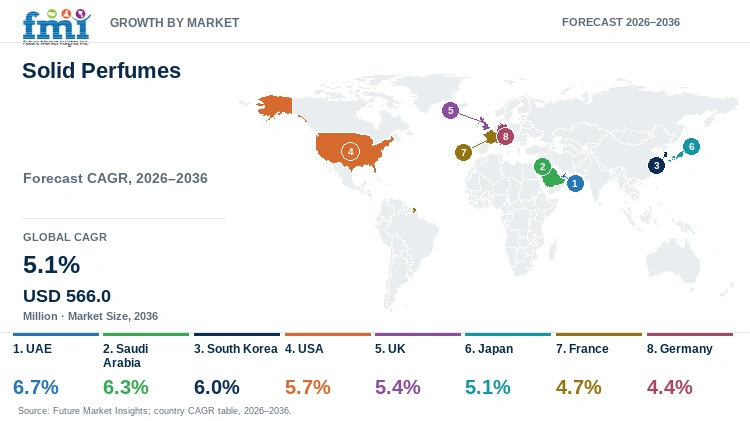
| Country | CAGR |
|---|---|
| UAE | 6.7% |
| Saudi Arabia | 6.3% |
| South Korea | 6.0% |
| USA | 5.7% |
| UK | 5.4% |
| Japan | 5.1% |
| France | 4.7% |
| Germany | 4.4% |
How do country-level CAGRs compare in the Solid Perfumes Market?
The country forecasts span 2.3 percentage points with Gulf markets forming the upper growth group and Western Europe lower. The spread measures expansion speed rather than absolute market size so fragrance habits and national compliance routes still determine commercial entry conditions.
- UAE supports faster assortment testing because specialist perfumeries and concentrated-fragrance habits give compact formats a familiar consumer context.
- Saudi Arabia combines strong concentrated-scent traditions with licensed cosmetics infrastructure that supports formal national distribution for fragrance products.
- South Korea gives fragrance exporters a defined HS classification route that can simplify documentation for perfume and toilet-water shipments.
- USA provides broad retail and digital discovery routes while federal cosmetics listing obligations make product records part of launch planning.
- UK online fragrance discovery expands channel reach but notification and Responsible Person duties keep first-market entry documentation intensive.
- Japan combines compact-product merchandising with a national perfume tariff classification that affects landed cost and distributor assortment planning.
- France rewards distinctive brand authorship because prestige competition leaves limited room for fragrance extensions without a clear commercial identity.
- Germany places heavier weight on leave-on ingredient scrutiny which can extend formula qualification for aromatic-oil and botanical-heavy concepts.
The full report provides country-level CAGR analysis across North America, Latin America, Western Europe, Eastern Europe, East Asia, South Asia and Pacific, and the Middle East and Africa.
Country-wise Analysis
- Federal conformity requirements shape how fragrance suppliers prepare UAE market entry even when retail demand moves quickly. By 2036, UAE is projected to grow at 6.7% CAGR, supported by specialist perfumery channels that keep concentrated fragrance formats familiar to shoppers. The Ministry of Industry and Advanced Technology's national conformity database lists perfumes under ECAS and EQM product categories. That federal route gives importers and local distributors a defined certification path before products reach normal retail circulation. Competitive density still requires a clear scent identity and disciplined merchandising that retailers can explain quickly. Personal care packaging must also protect compact products during repeated handling and routine travel.
- Saudi fragrance buying combines concentrated scent traditions with a regulated cosmetics manufacturing and warehousing base. Saudi Arabia's solid perfumes outlook is anticipated to advance at 6.3% CAGR over the assessment period, driven by compact formats that fit established pulse-point and gifting routines. The Saudi Food and Drug Authority reported in January 2026 that the country had 43 licensed cosmetics factories and 831 licensed cosmetics warehouses during 2025. That national infrastructure supports formal distribution but keeps product files and safety controls close to commercial expansion. Brands still need scent profiles suited to local preferences and reliable registration records before retail scale can follow across major channels.
- South Korea combines fast beauty commercialization with a formal trade classification for perfume products moving through national import and export channels. Solid perfume demand in South Korea is forecast to rise at 6.0% CAGR over the forecast period, supported by brands testing compact formats inside digitally active beauty retail. Korea Customs published the K-Beauty Cosmetics HS Guidebook in December 2025 and identifies perfume under HSK 3303.00-1000. That direct product classification gives exporters and distributors a defined customs route for fragrance shipments. Compact fragrance still needs clear differentiation because rapid assortment turnover can shorten the window for consumer education and sustained repeat purchase.
- The United States combines fragrance retail access with a federal cosmetics listing system under MoCRA. Adoption of solid perfumes in the United States is estimated to expand at 5.7% CAGR through 2036, supported by specialty retail and direct commerce that widen discovery and replenishment. FDA data listed 16,398 active facility registrations as of June 30 2026. The same database listed 1,298,361 active cosmetic product records nationwide on that date. Those national records show the scale of compliance administration that fragrance brands must handle before routine distribution. Retailers can still require clear ingredient records and reliable fulfillment before accepting channel expansion. Portable formats convert trial into repeat purchase only when product information travels cleanly between channels.
- Great Britain requires cosmetic notification and Responsible Person oversight before fragrance products enter normal retail circulation. The UK solid perfumes sector is projected to record 5.4% CAGR during the assessment period, driven by e-commerce discovery for compact fragrance formats. The Office for Product Safety and Standards reported 325,496 cosmetic notifications during 2025-2026 which was 11% above the previous year. That national notification volume makes compliance administration a normal part of beauty launch planning. Online fragrance selling still carries a sensory disadvantage because buyers cannot test texture or scent projection before ordering. Brands need clear usage guidance and dependable returns handling to support repeat purchase after the first digital order.
- Japan places imported fragrance products inside a national tariff structure that affects landed cost and distributor planning. In Japan, solid perfume demand is predicted to advance at 5.1% CAGR through 2036, supported by compact presentation that fits selective fragrance merchandising and controlled application routines. Japan Customs classified perfumes and toilet waters under heading 3303 in the tariff schedule effective January 1 2026 with a 5.3% general rate before preferential treatment. That direct classification gives importers a clear cost reference before assortment and pricing decisions. Several preferential routes reduce duties for qualifying origins and can change landed-cost comparisons between suppliers. Distributors still need labeling discipline and product education before unfamiliar solid textures receive sustained shelf space.
- France combines prestige fragrance heritage with detailed cosmetic product-information obligations that raise requirements for new brand entry. France is estimated to post 4.7% CAGR over the forecast period, supported by brands adding alternative formats beside established scent franchises. DGCCRF reported in February 2026 that inspectors examined more than 200 product information files at 147 cosmetics establishments. The national review found weak regulatory mastery among some newer small cosmetics operators entering the sector. That enforcement context makes documentation and claim discipline part of commercial credibility at national scale. Fragrance extensions therefore need distinctive authorship plus complete product files before retailers can support wider distribution.
- Germany gives leave-on fragrance products a mature cosmetics manufacturing base with established national production capability. Solid perfume sales in Germany are forecast to expand at 4.4% CAGR by 2036, driven by buyers adding compact formats within familiar fragrance routines. Destatis reported 19,921 employees in the body-care and fragrance manufacturing category in its 2026 monthly table. That national category includes perfume manufacturing alongside broader personal-care production and therefore measures the surrounding production base rather than solid perfume alone. A new compact format enters a market with experienced producers and dense category competition for retailer attention. Brands need clear ingredient communication and a recognizable scent identity before an unfamiliar solid texture can secure sustained distribution.
Who are the notable companies in the Solid Perfumes Market?
Coty, Rasasi, Puig, dsm-firmenich, L’Oréal, The Estée Lauder Companies, Givaudan, Ajmal Perfumes, Swiss Arabian, and Symrise are notable companies active in this market.
Competition divides among finished-fragrance owners and Middle Eastern perfumeries alongside fragrance-creation houses with different control points. Global fragrance groups use established scent franchises and retail access to place compact extensions beside familiar sprays. Regional perfumeries bring concentrated-format credibility and local scent knowledge to consumer-facing fragrance selection and repeat-purchase support. B2B fragrance houses influence formula development and customer briefs without owning the retail transaction. Entry therefore depends on brand access or regional scent authority or formulation depth that a buyer can verify. Beauty and personal care packaging choices also affect whether compact products tolerate repeated travel handling.
- Coty and Puig join L’Oréal plus The Estée Lauder Companies as consumer fragrance owners with broad retail access.
- Rasasi joins Ajmal Perfumes and Swiss Arabian as Middle Eastern specialists with concentrated-fragrance heritage.
- dsm-firmenich joins Givaudan and Symrise as fragrance-creation houses supplying formulation expertise to finished brands.
Competitive Benchmarking: Solid Perfumes Market
| Company | Solid / Concentrated Format Relevance | Fragrance Creation & Formulation Depth | Retail or Customer Reach | Geographic Reach |
|---|---|---|---|---|
| Coty | Medium | High | High | Global |
| Rasasi | High | Medium | Medium | Middle East and international |
| Puig | High | High | High | Global |
| dsm-firmenich | Medium | High | High | Global |
| L’Oréal | Medium | High | High | Global |
| The Estée Lauder Companies | Medium | High | High | Global |
| Givaudan | Medium | High | High | Global |
| Ajmal Perfumes | High | Medium | Medium | Gulf and international |
| Swiss Arabian | High | Medium | Medium | GCC and international |
| Symrise | Medium | High | High | Global |
Scoring basis: High solid or concentrated-format relevance requires multiple documented consumer fragrance routes while Medium reflects adjacent fragrance activity without equally direct solid-format evidence. High formulation depth requires broad fragrance-creation infrastructure while Medium reflects narrower in-house capability documented for current fragrance operations. High customer reach requires multi-market access while Medium reflects regionally concentrated reach documented through current distribution or customer activity.
Key Developments in the Solid Perfumes Market
- In August 2026, The Estée Lauder Companies reported opening 33 net new freestanding fragrance stores globally during fiscal 2026.
- In July 2026, Coty partnered with Megan Thee Stallion on Hot Girl Summer Eau de Parfum for selected North American and UK retailers.
- In June 2026, Givaudan agreed to acquire a majority stake in Eurofragance to expand fine-fragrance capabilities in regional markets.
- In February 2026, dsm-firmenich opened Po ONE Lab in Riyadh with luxury fragrance concept store Villa Po ONE.
Key Players in the Solid Perfumes Market
Consumer Fragrance Brand Owners
- Coty
- Puig
- L’Oréal
- The Estée Lauder Companies
Middle Eastern Perfumery Specialists
- Rasasi
- Ajmal Perfumes
- Swiss Arabian
Fragrance Creation and Formulation Houses
- dsm-firmenich
- Givaudan
- Symrise
Solid Perfumes Market - Report Scope
| Coverage field | Report scope |
|---|---|
| Market breakdown | By product type, nature, format, price positioning, sales channel and region. |
| Quantitative Units | USD million. |
| Market Definition | Revenue from fragrance products classified within the supplied solid perfumes segmentation universe including compact leave-on scent formats and model-defined adjacent delivery formats. |
| Regions Covered | North America, Latin America, Western Europe, Eastern Europe, East Asia, South Asia and Pacific, and Middle East and Africa. |
| Countries Covered | UAE, Saudi Arabia, South Korea, USA, UK, Japan, France, Germany, and 20+ countries included in the full report. |
| Key Companies Profiled | Coty, Rasasi, Puig, dsm-firmenich, L’Oréal, The Estée Lauder Companies, Givaudan, Ajmal Perfumes, Swiss Arabian, and Symrise. |
| Forecast Period | 2026 to 2036. |
| Approach | Primary and secondary research with market triangulation. |
Solid Perfumes Market - Research Methodology
| Method | Approach |
|---|---|
| Primary Research | FMI analysts gathered input from manufacturers, service providers, technology developers, distributors, end users, procurement teams, and subject-matter experts. Interviews examined purchasing decisions, product or service evaluation, adoption barriers, approval requirements, pricing considerations, and expectations for technical or commercial support. Respondents were also asked what evidence is required before a trial, pilot, or initial order develops into regular purchasing. |
| Desk Research | Desk research covered government statistics, regulatory publications, trade data, industry associations, technical literature, standards, company filings, product information, and official corporate announcements. Sources were reviewed for relevance, publication date, geographic coverage, and consistency with the defined market scope. Claims relating to performance, applications, approvals, capacity, investment, and commercial activity were retained only when supported by credible public evidence. |
| Market Sizing and Forecasting | The market model combined the baseline value with historical performance, segment structure, pricing and volume indicators, adoption levels, company participation, and country-level demand conditions. Forecast assumptions considered economic activity, investment trends, regulatory developments, technology adoption, purchasing cycles, supply availability, and barriers to wider market use. Segment and regional estimates were reconciled before the final market total was calculated. |
| Data Validation | Estimates were checked against multiple independent indicators, including public data, company activity, trade patterns, industry developments, and findings from primary interviews. Validation also tested whether products, services, applications, and company revenues fell within the defined market boundaries. Adjacent categories, unsupported claims, overlapping revenues, and activities without direct market relevance were excluded to reduce double counting and maintain consistency across segments and countries. |
Solid Perfumes Market by Segments
Solid Perfumes Market segmented by Product Type:
- Eau de parfum
- Eau de toilette
- Extrait & intense
- Body mists & oils
Solid Perfumes Market segmented by Nature:
- Conventional
- Vegan & cruelty-free
- Natural & organic
- Dermocosmetic - clinical
- Fragrance-free & sensitive
Solid Perfumes Market segmented by Format:
- Liquid & serum
- Cream & balm
- Stick & solid
- Spray & mist
- Sheet & patch
- Powder
Solid Perfumes Market segmented by Price Positioning:
- Mass
- Masstige
- Premium
- Professional
Solid Perfumes Market segmented by Sales Channel:
- Specialty beauty retail
- E-commerce & DTC
- Pharmacies & drugstores
- Supermarkets & hypermarkets
- Salons & spas
Solid Perfumes Market by Region:
- North America
- United States
- Canada
- Latin America
- Brazil
- Mexico
- Argentina
- Chile
- Western Europe
- Germany
- France
- United Kingdom
- Italy
- Spain
- Benelux
- Nordics
- Eastern Europe
- Poland
- Czech Republic
- Romania
- Hungary
- East Asia
- China
- Japan
- South Korea
- South Asia and Pacific
- India
- ASEAN
- Australia and New Zealand
- Middle East and Africa
- GCC Countries
- South Africa
- Türkiye
- Israel
Research Sources and Bibliography
- Puig. (2026, August 25). Byredo Mojave Ghost Parfum Solide Solid Parfum 3 g.
- Korea Customs Service. (2025, December 30). K-뷰티 화장품 HS 가이드북 발간.
- Puig. (2026). Puig Integrated Annual Report 2025.
- Federal Institute for Risk Assessment. (2026, September 2). Ätherische Öle: Duftende Wirkungen mit Einschränkungen.
- European Commission. (2023, July 26). Commission Regulation (EU) 2023/1545 amending Regulation (EC) No 1223/2009 as regards labelling of fragrance allergens in cosmetic products.
- Coty Inc. (2025, August 20). Coty reports FY25 and Q4 results; targets sequential LFL and EBITDA trend improvement in FY26, returning to growth in 2H26.
- Coty Inc. (2025, September 30). Coty Announces Plans to Bolster Its Leading Position in Fragrance and Launches a Strategic Review of Its Consumer Beauty Business.
- The Estée Lauder Companies Inc. (2025, December 2). The Estée Lauder Companies and Jo Malone London introduce AI-powered Scent Advisor experience.
- Lush. (2025, April). April 2025 UK/US.
- European Commission. (2026, April 27). Commission Regulation (EU) 2026/909 amending Regulation (EC) No 1223/2009 as regards the use of specified substances in cosmetic products.
- Sol de Janeiro. (2026, March 27). Perfume balm vs. perfume mist.
- Ministry of Industry and Advanced Technology. (n.d.). Product conformity data.
- Saudi Food and Drug Authority. (2026, January 26). SFDA reports 18% growth in licensed factories and warehouses during 2025.
- USA Food and Drug Administration. (2026, September 9). Registration & listing of cosmetic product facilities and products.
- Office for Product Safety and Standards. (2026, August 5). OPSS Delivery Report 2025-2026.
- Japan Customs. (2026, January 1). Japan’s tariff schedule: Chapter 33 essential oils and resinoids; perfumery, cosmetic or toilet preparations.
- Direction générale de la concurrence, de la consommation et de la répression des fraudes. (2026, February 2). Cosmétiques : des TPE nouvelles dans le secteur qui méconnaissent trop souvent la réglementation.
- Federal Statistical Office (Destatis). (2026, August 21). Beschäftigte und Umsatz der fachlichen Betriebsteile im Verarbeitenden Gewerbe: Deutschland, Monate, Wirtschaftszweige (WZ2008 2-4-Steller Hierarchie).
- The Estée Lauder Companies Inc. (2026, August 19). The Estée Lauder Companies reports fiscal 2026 results.
- Coty Inc. (2026, July 6). Megan Thee Stallion enters fragrance industry & introduces new “Hot Girl Summer Eau de Parfum” with Coty.
- Givaudan. (2026, June 5). Givaudan to acquire majority stake in Eurofragance.
- dsm-firmenich. (2026, February 4). dsm-firmenich continues expansion in the Middle East with a new creative concept in Riyadh.
- Symrise. (2026, July 23). Symrise signs a put option agreement to acquire Floral Concept.
- Givaudan. (2025). Our acquisitions: Vollmens Fragrances.
- dsm-firmenich. (2026, July 6). dsm-firmenich unveils Flowers Are Watching Us, a new global activation presenting a fresh take on florals in perfumery.
- L’Oréal Groupe. (2026, June 15). L’Oréal calls on consumers around the world to #JoinTheRefillMovement in its biggest ever campaign for refillable beauty.
- The Estée Lauder Companies Inc. (2025, November 13). The Estée Lauder Companies makes strategic minority investment in Mexican luxury fragrance brand XINÚ.
- Coty Inc. (2025, July 17). Introducing Origen: A fragrance collection where scent meets adventure.
- Rasasi Perfumes 1979. (2025, October). Beautyworld Middle East 2025 showcase and new collection unveilings.
- Coty Inc. (2025, November 14). An aura takes hold: Coty’s Jawhara Collection captivates consumers with premium fragrance artistry.
- Puig. (2026). Consolidated management report 2025.
- dsm-firmenich. (2026, June 18). dsm-firmenich unveils SENSORIUM™ Seoul: Exploring the rise of K-Scent and the future of fragrance creation.
- L’Oréal. (2026, March 31). L’Oréal completes the acquisition of Kering Beauté within the framework of its strategic alliance with Kering.
- The Estée Lauder Companies Inc. (2026, June 17). The Estée Lauder Companies and Jo Malone London Launch Experience That Turns Visual Taste into a Personalized Fragrance Wardrobe, exclusively on Pinterest.
- Givaudan. (2026). Our acquisitions: Belle Aire Creations.
- Ajmal Perfumes. (2025, February 14). The Untold Stories - launch event.
- Swiss Arabian. (2026, April 7). Swiss Arabian unveils two new perfumes and launches.
- Symrise. (2025, July 2). Symrise subsidiary SFA NEROLI opens a new fragrance ecosystem in Grasse.
This bibliography is provided for reader reference and is not exhaustive. The full report contains the complete reference list and detailed citations.
This Report Answers
- How large is the solid perfumes market in 2026 and 2036?
- Which usage conditions support repeat demand for compact solid fragrance formats?
- Why does eau de parfum hold 40.0% of product type demand?
- How do conventional formulas affect nature-category qualification and commercial formulation choices?
- Why do liquid and serum formats hold 28.0% of format demand?
- Which controls can delay leave-on solid perfume formulation and market entry?
- How do growth rates differ among the eight country markets analyzed?
- Which companies serve finished fragrance and B2B fragrance creation roles?
- What should brands evaluate before extending fragrance into a solid format?
Frequently Asked Questions
How big is the solid perfumes market in 2026?
The solid perfumes market is valued at USD 344.2 million in 2026 and is projected to reach USD 566.0 million by 2036. Portable pulse-point use adds a repeat application occasion beside established fragrance sprays during routine travel and daily use.
What is the CAGR of the solid perfumes market from 2026 to 2036?
The solid perfumes market is projected to grow at 5.1% CAGR between 2026 and 2036. Growth depends on compact application converting convenience into repeat purchase without weakening scent identity.
Which product type leads the solid perfumes market?
The eau de parfum segment is expected to hold 40.0% of product type demand in 2026 within the solid perfumes market. Buyers use this concentration as a familiar reference when evaluating new compact companion formats for established scents.
Which nature category leads nature demand in the solid perfumes market?
The conventional segment is estimated to hold 58.0% of nature demand in 2026 within the solid perfumes market. Developers retain broader formulation choices for balancing fragrance release with carrier texture and safety requirements.
Which companies are active in the solid perfumes market?
Active companies include Coty and Rasasi alongside Puig and dsm-firmenich plus L’Oréal and The Estée Lauder Companies. Givaudan joins Ajmal Perfumes with Swiss Arabian and Symrise across finished fragrance and creation roles.
Preview the report firsthand - request a free sample
Get SampleGet the brochure for pricing and purchase details.
Get PDFTable of Content
- Key Takeaways
- Market Size and CAGR
- Top Growth Driver
- Fastest Growing Segment
- Leading Region
- Key Companies
- Emerging Opportunities
- Executive Summary
- Global Market Outlook
- Demand-side Trends
- Supply-side Trends
- Technology Roadmap Analysis
- Analysis and Recommendations
- Analyst Perspective (What is happening? Why now? What should investors know?)
- Key Questions Answered
- How large is the market?
- What is the CAGR?
- What are key trends?
- Which region dominates?
- Who are the leaders?
- Market Overview
- Market Coverage / Taxonomy
- Market Definition / Scope / Limitations
- Research Methodology
- Chapter Orientation
- Analytical Lens and Working Hypotheses
- Market Structure, Signals, and Trend Drivers
- Benchmarking and Cross-market Comparability
- Market Sizing, Forecasting, and Opportunity Mapping
- Research Design and Evidence Framework
- Desk Research Programme (Secondary Evidence)
- Expert Input and Fieldwork (Primary Evidence)
- Tooling, Models, and Reference Databases
- Data Engineering and Model Build
- Quality Assurance and Audit Trail
- Market Background
- Market Dynamics (Drivers, Restraints, Opportunity, Trends)
- Scenario Forecast (Optimistic, Likely, Conservative)
- Impact Analysis
- AI Impact
- Sustainability Impact
- Regulatory Impact
- Technology Impact
- Consumer / Buyer Analysis
- Purchase Drivers
- Adoption Barriers
- Buyer Journey
- Opportunity Map Analysis
- Product Life Cycle Analysis
- Supply Chain Analysis
- Investment Feasibility Matrix
- Value Chain Analysis
- PESTLE and Porter's Analysis
- Regulatory Landscape
- Regional Parent Market Outlook
- Production and Consumption Statistics
- Import and Export Statistics
- Global Market Analysis and Forecast, 2021 to 2036
- Historical Market Size Value (USD Million) Analysis, 2021 to 2025
- Current and Future Market Size Value (USD Million) Projections, 2026 to 2036
- Y-o-Y Growth Trend Analysis
- Absolute $ Opportunity Analysis
- Global Market Pricing Analysis, 2021 to 2036
- Global Market Analysis and Forecast, By Product Type, 2021 to 2036
- Introduction / Key Findings
- Historical Market Size Value (USD Million) Analysis By Product Type, 2021 to 2025
- Current and Future Market Size Value (USD Million) Analysis and Forecast By Product Type, 2026 to 2036
- Eau de parfum
- Eau de toilette
- Extrait & intense
- Body mists & oils
- Y-o-Y Growth Trend Analysis By Product Type, 2021 to 2025
- Absolute $ Opportunity Analysis By Product Type, 2026 to 2036
- Global Market Analysis and Forecast, By Nature, 2021 to 2036
- Introduction / Key Findings
- Historical Market Size Value (USD Million) Analysis By Nature, 2021 to 2025
- Current and Future Market Size Value (USD Million) Analysis and Forecast By Nature, 2026 to 2036
- Conventional
- Vegan & cruelty-free
- Natural & organic
- Dermocosmetic - clinical
- Fragrance-free & sensitive
- Y-o-Y Growth Trend Analysis By Nature, 2021 to 2025
- Absolute $ Opportunity Analysis By Nature, 2026 to 2036
- Global Market Analysis and Forecast, By Format, 2021 to 2036
- Introduction / Key Findings
- Historical Market Size Value (USD Million) Analysis By Format, 2021 to 2025
- Current and Future Market Size Value (USD Million) Analysis and Forecast By Format, 2026 to 2036
- Liquid & serum
- Cream & balm
- Stick & solid
- Spray & mist
- Sheet & patch
- Powder
- Y-o-Y Growth Trend Analysis By Format, 2021 to 2025
- Absolute $ Opportunity Analysis By Format, 2026 to 2036
- Global Market Analysis and Forecast, By Price Positioning, 2021 to 2036
- Introduction / Key Findings
- Historical Market Size Value (USD Million) Analysis By Price Positioning, 2021 to 2025
- Current and Future Market Size Value (USD Million) Analysis and Forecast By Price Positioning, 2026 to 2036
- Mass
- Masstige
- Premium
- Professional
- Y-o-Y Growth Trend Analysis By Price Positioning, 2021 to 2025
- Absolute $ Opportunity Analysis By Price Positioning, 2026 to 2036
- Global Market Analysis and Forecast, By Sales Channel, 2021 to 2036
- Introduction / Key Findings
- Historical Market Size Value (USD Million) Analysis By Sales Channel, 2021 to 2025
- Current and Future Market Size Value (USD Million) Analysis and Forecast By Sales Channel, 2026 to 2036
- Specialty beauty retail
- E-commerce & DTC
- Pharmacies & drugstores
- Supermarkets & hypermarkets
- Salons & spas
- Y-o-Y Growth Trend Analysis By Sales Channel, 2021 to 2025
- Absolute $ Opportunity Analysis By Sales Channel, 2026 to 2036
- Global Market Analysis and Forecast, By Region, 2021 to 2036
- Introduction
- Historical Market Size Value (USD Million) Analysis By Region, 2021 to 2025
- Current Market Size Value (USD Million) Analysis and Forecast By Region, 2026 to 2036
- North America
- Latin America
- Western Europe
- Eastern Europe
- East Asia
- South Asia and Pacific
- Middle East and Africa
- Market Attractiveness Analysis By Region
- North America Market Analysis and Forecast, By Country, 2021 to 2036
- Historical Market Size Value (USD Million) Trend Analysis By Market Taxonomy, 2021 to 2025
- Market Size Value (USD Million) Forecast By Market Taxonomy, 2026 to 2036
- By Country
- United States
- Canada
- By Product Type
- By Nature
- By Format
- By Price Positioning
- By Sales Channel
- By Country
- Market Attractiveness Analysis
- By Country
- By Product Type
- By Nature
- By Format
- By Price Positioning
- By Sales Channel
- Key Takeaways
- Latin America Market Analysis and Forecast, By Country
- Historical Market Size Value (USD Million) Trend Analysis By Market Taxonomy, 2021 to 2025
- Market Size Value (USD Million) Forecast By Market Taxonomy, 2026 to 2036
- By Country
- Brazil
- Mexico
- Argentina
- Chile
- By Product Type
- By Nature
- By Format
- By Price Positioning
- By Sales Channel
- By Country
- Market Attractiveness Analysis
- By Country
- By Product Type
- By Nature
- By Format
- By Price Positioning
- By Sales Channel
- Key Takeaways
- Western Europe Market Analysis and Forecast, By Country
- Historical Market Size Value (USD Million) Trend Analysis By Market Taxonomy, 2021 to 2025
- Market Size Value (USD Million) Forecast By Market Taxonomy, 2026 to 2036
- By Country
- Germany
- France
- United Kingdom
- Italy
- Spain
- Benelux
- Nordics
- By Product Type
- By Nature
- By Format
- By Price Positioning
- By Sales Channel
- By Country
- Market Attractiveness Analysis
- By Country
- By Product Type
- By Nature
- By Format
- By Price Positioning
- By Sales Channel
- Key Takeaways
- Eastern Europe Market Analysis and Forecast, By Country
- Historical Market Size Value (USD Million) Trend Analysis By Market Taxonomy, 2021 to 2025
- Market Size Value (USD Million) Forecast By Market Taxonomy, 2026 to 2036
- By Country
- Poland
- Czech Republic
- Romania
- Hungary
- By Product Type
- By Nature
- By Format
- By Price Positioning
- By Sales Channel
- By Country
- Market Attractiveness Analysis
- By Country
- By Product Type
- By Nature
- By Format
- By Price Positioning
- By Sales Channel
- Key Takeaways
- East Asia Market Analysis and Forecast, By Country
- Historical Market Size Value (USD Million) Trend Analysis By Market Taxonomy, 2021 to 2025
- Market Size Value (USD Million) Forecast By Market Taxonomy, 2026 to 2036
- By Country
- China
- Japan
- South Korea
- By Product Type
- By Nature
- By Format
- By Price Positioning
- By Sales Channel
- By Country
- Market Attractiveness Analysis
- By Country
- By Product Type
- By Nature
- By Format
- By Price Positioning
- By Sales Channel
- Key Takeaways
- South Asia and Pacific Market Analysis and Forecast, By Country
- Historical Market Size Value (USD Million) Trend Analysis By Market Taxonomy, 2021 to 2025
- Market Size Value (USD Million) Forecast By Market Taxonomy, 2026 to 2036
- By Country
- India
- ASEAN
- Australia and New Zealand
- By Product Type
- By Nature
- By Format
- By Price Positioning
- By Sales Channel
- By Country
- Market Attractiveness Analysis
- By Country
- By Product Type
- By Nature
- By Format
- By Price Positioning
- By Sales Channel
- Key Takeaways
- Middle East and Africa Market Analysis and Forecast, By Country
- Historical Market Size Value (USD Million) Trend Analysis By Market Taxonomy, 2021 to 2025
- Market Size Value (USD Million) Forecast By Market Taxonomy, 2026 to 2036
- By Country
- GCC Countries
- South Africa
- Türkiye
- Israel
- By Product Type
- By Nature
- By Format
- By Price Positioning
- By Sales Channel
- By Country
- Market Attractiveness Analysis
- By Country
- By Product Type
- By Nature
- By Format
- By Price Positioning
- By Sales Channel
- Key Takeaways
- Key Countries Market Analysis
- United States
- Pricing Analysis
- Market Share Analysis, 2025
- By Product Type
- By Nature
- By Format
- By Price Positioning
- By Sales Channel
- Canada
- Pricing Analysis
- Market Share Analysis, 2025
- By Product Type
- By Nature
- By Format
- By Price Positioning
- By Sales Channel
- Mexico
- Pricing Analysis
- Market Share Analysis, 2025
- By Product Type
- By Nature
- By Format
- By Price Positioning
- By Sales Channel
- Brazil
- Pricing Analysis
- Market Share Analysis, 2025
- By Product Type
- By Nature
- By Format
- By Price Positioning
- By Sales Channel
- Chile
- Pricing Analysis
- Market Share Analysis, 2025
- By Product Type
- By Nature
- By Format
- By Price Positioning
- By Sales Channel
- Germany
- Pricing Analysis
- Market Share Analysis, 2025
- By Product Type
- By Nature
- By Format
- By Price Positioning
- By Sales Channel
- United Kingdom
- Pricing Analysis
- Market Share Analysis, 2025
- By Product Type
- By Nature
- By Format
- By Price Positioning
- By Sales Channel
- Italy
- Pricing Analysis
- Market Share Analysis, 2025
- By Product Type
- By Nature
- By Format
- By Price Positioning
- By Sales Channel
- Spain
- Pricing Analysis
- Market Share Analysis, 2025
- By Product Type
- By Nature
- By Format
- By Price Positioning
- By Sales Channel
- France
- Pricing Analysis
- Market Share Analysis, 2025
- By Product Type
- By Nature
- By Format
- By Price Positioning
- By Sales Channel
- India
- Pricing Analysis
- Market Share Analysis, 2025
- By Product Type
- By Nature
- By Format
- By Price Positioning
- By Sales Channel
- ASEAN
- Pricing Analysis
- Market Share Analysis, 2025
- By Product Type
- By Nature
- By Format
- By Price Positioning
- By Sales Channel
- Australia and New Zealand
- Pricing Analysis
- Market Share Analysis, 2025
- By Product Type
- By Nature
- By Format
- By Price Positioning
- By Sales Channel
- China
- Pricing Analysis
- Market Share Analysis, 2025
- By Product Type
- By Nature
- By Format
- By Price Positioning
- By Sales Channel
- Japan
- Pricing Analysis
- Market Share Analysis, 2025
- By Product Type
- By Nature
- By Format
- By Price Positioning
- By Sales Channel
- South Korea
- Pricing Analysis
- Market Share Analysis, 2025
- By Product Type
- By Nature
- By Format
- By Price Positioning
- By Sales Channel
- Poland
- Pricing Analysis
- Market Share Analysis, 2025
- By Product Type
- By Nature
- By Format
- By Price Positioning
- By Sales Channel
- Hungary
- Pricing Analysis
- Market Share Analysis, 2025
- By Product Type
- By Nature
- By Format
- By Price Positioning
- By Sales Channel
- Türkiye
- Pricing Analysis
- Market Share Analysis, 2025
- By Product Type
- By Nature
- By Format
- By Price Positioning
- By Sales Channel
- South Africa
- Pricing Analysis
- Market Share Analysis, 2025
- By Product Type
- By Nature
- By Format
- By Price Positioning
- By Sales Channel
- UAE
- Pricing Analysis
- Market Share Analysis, 2025
- By Product Type
- By Nature
- By Format
- By Price Positioning
- By Sales Channel
- Saudi Arabia
- Pricing Analysis
- Market Share Analysis, 2025
- By Product Type
- By Nature
- By Format
- By Price Positioning
- By Sales Channel
- United States
- Market Structure Analysis
- Competition Dashboard
- Competition Benchmarking
- Market Share Analysis of Top Players
- By Regional
- By Product Type
- By Nature
- By Format
- By Price Positioning
- By Sales Channel
- Emerging Startups
- Innovation Benchmarking
- Competition Analysis
- Competition Deep Dive
- Coty
- Overview
- Product Portfolio
- Profitability by Market Segments
- Sales Footprint
- Strategy Overview
- Marketing Strategy
- Product Strategy
- Channel Strategy
- Rasasi
- Puig
- dsm-firmenich
- L’Oréal
- The Estée Lauder Companies
- Givaudan
- Ajmal Perfumes
- Swiss Arabian
- Symrise
- Coty
- Case Studies
- Success Stories
- Recent Developments
- Competition Deep Dive
- Assumptions & Acronyms Used


