

- Industry Size (2026)
- USD 11.1 Bn
- Forecast (2036)
- USD 16.5 Bn
- CAGR (2026 to 2036)
- 4.1%
Demand for Petroleum Liquid Feedstock in South Korea Forecast and Outlook 2026 to 2036
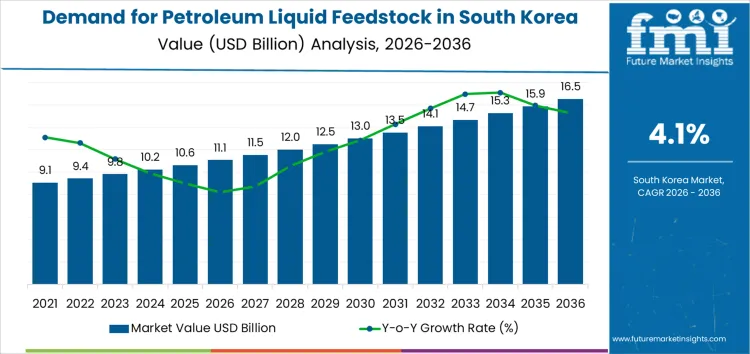
The demand for petroleum liquid feedstock in South Korea is likely to be USD 11.1 billion in 2026 and is projected to reach USD 16.5 billion by 2036, growing at a CAGR of 4.1%. Regional concentration will continue to influence how volumes move through the country’s refining and petrochemical network, as demand remains anchored in a few industrial hubs with established processing capacity. Uneven adoption patterns will persist because downstream industries operate with different feedstock efficiency levels, creating varied pull across locations. Geographic cost advantages will matter, with coastal clusters benefiting from lower import handling costs and shorter transport routes to major refining centers. Inland regions will face higher logistics exposure, shaping procurement decisions and influencing the pace at which new capacity is justified. These regional dynamics will determine which operators gain the most stable access to supply and which remain more vulnerable to shifts in global crude differentials and freight conditions.
Quick Stats for the Demand for Petroleum Liquid Feedstock in South Korea
- Petroleum Liquid Feedstock in South Korea Value (2026): USD 11.1 billion
- Petroleum Liquid Feedstock in South Korea Forecast Value (2036): USD 16.5 billion
- Petroleum Liquid Feedstock in South Korea Forecast CAGR (2026 to 2036): 4.1%
- Petroleum Liquid Feedstock in South Korea Leading Segment: Crude Oil-Derived Feedstock (66.5%)
- Key Growth Regions of Petroleum Liquid Feedstock in South Korea: Jeju (leading CAGR ~4.9%)
- Top Players of Petroleum Liquid Feedstock in South Korea: ExxonMobil Corporation, Saudi Aramco, Royal Dutch Shell plc, Total Energies SE, Reliance Industries Limited
What is the Growth Forecast for the Petroleum Liquid Feedstock Market through 2036?
The petroleum liquid feedstock market in South Korea shows a gradual gain pattern from 2026 through 2036, marked by steady increases in demand across the refining and petrochemical sectors. Early-period growth reflects stable refinery runs and consistent naphtha requirements for petrochemical operations. Gains between 2026 and 2030 remain moderate as producers balance cost pressures with feedstock optimization strategies. Market share shifts within the feedstock mix occur as refiners explore marginal efficiency improvements, yet the overall demand base holds its upward direction with limited volatility.
From 2031 onward, the curve maintains controlled momentum, reaching USD 16.5 billion by 2036. Share erosion within specific feedstock categories remains minimal because industrial buyers rarely deviate from proven procurement patterns. Incremental gains instead arise from expanded petrochemical capacities and periodic upgrades that support higher throughput. The overall trend reflects structural stability, where established buyers maintain long-term intake levels and additions to processing capacity generate measured growth across the period.
Key Takeaways for Demand for Petroleum Liquid Feedstock in South Korea
| Metric | Value |
|---|---|
| Industry Sales Value (2026) | USD 11.1 billion |
| Industry Forecast Value (2036) | USD 16.5 billion |
| Industry Forecast CAGR (2026 to 2036) | 4.1 % |
Why is the Demand for Petroleum Liquid Feedstock Growing in South Korea?
Demand for petroleum liquid feedstock in South Korea reflects the country’s extensive refining and petrochemical production capacity. South Korea hosts large integrated refining complexes that convert crude oil into a broad range of downstream products, and liquid feedstock forms a foundational input for these operations. Refiners use this feedstock to produce fuels, lubricants, and intermediary chemicals that supply domestic transport, industrial, and export markets. Petrochemical facilities depend on petroleum liquid feedstock to generate base chemicals such as olefins and aromatics, which in turn support plastics, synthetic fibers, and rubber manufacture. The structure of the domestic manufacturing sector, with strong shipbuilding, automotive, and consumer goods segments, sustains steady throughput requirements for refined intermediates. Procurement planners balance feedstock quality and yield patterns to align processing economics with end-use demand across industrial and commercial sectors.
Looking ahead, several factors are likely to shape continuing demand for petroleum liquid feedstock in South Korea. While energy transition efforts advance, liquid fuels and petrochemical intermediates remain central to current industrial frameworks, and refiners are optimizing operations to maintain competitiveness under shifting regulatory environments. The push for cleaner fuels and tighter emissions standards encourages refiners to adjust processing schemes, often increasing reliance on specific feedstock cuts that support low-sulfur fuel production. Expansion of petrochemical downstream capacity to serve domestic and export markets also influences feedstock procurement strategies, as producers seek reliable volumes that match evolving plant configurations. External factors, including global crude price dynamics and trade flows, affect the cost and availability of liquid feedstock, prompting adjustments in sourcing and inventory management. In addition, integration with renewable and alternative feedstock initiatives, though at an early stage, may complement traditional petroleum streams, yet current infrastructure and demand patterns sustain a key role for liquid feedstock in South Korea’s energy and chemical sectors.
What Shapes the Demand for Petroleum Liquid Feedstock in South Korea?
Demand for petroleum liquid feedstock in South Korea is guided by product type and source type, with heavy naphtha holding a 30% share and crude-oil-derived feedstock leading the source segment at 66.5%. These two categories influence refinery operations, petrochemical integration, and sourcing decisions across the country. Their dominance reflects processing compatibility, established supply chains, and the scale of downstream conversion units that rely on consistent liquid feed inputs.
Why Does Heavy Naphtha Lead Petroleum Liquid Feedstock Consumption in South Korea?
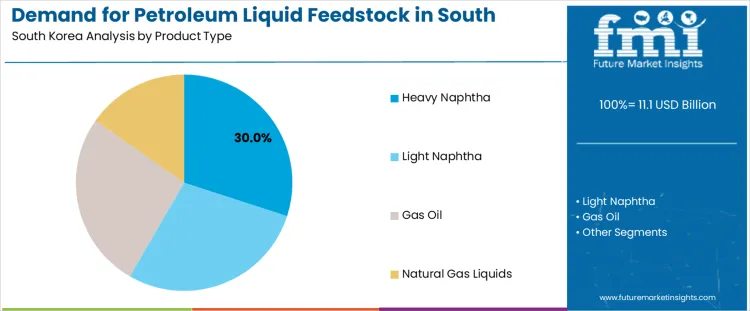
Heavy naphtha holds a 30% share in South Korea due to its preferred role in steam cracking, catalytic reforming, and aromatics production. Petrochemical complexes rely on heavy naphtha for ethylene, propylene, benzene, toluene, and xylene output, which in turn supports resin manufacturing, synthetic fibers, coatings, and packaging materials. The structure of South Korea’s refining sector favors streams that integrate smoothly into large-scale petrochemical operations. Heavy naphtha provides a stable boiling range that suits reformer units and cracker furnaces, supporting consistent yields across varied operating conditions. Industrial users value its flexibility across aromatics and olefins pathways, allowing refiners to adjust product slates according to downstream demand. Heavy naphtha also fits long-standing procurement patterns, with imports and domestic refinery production balancing seasonal and margin-driven variations. Its compatibility with desulfurization and hydrotreating infrastructure supports efficiency in pre-treatment steps required before chemical conversion. Petrochemical export activity, particularly in polyethylene, polypropylene, and paraxylene chains, reinforces reliance on heavy naphtha because feed consistency influences plant economics. As integrated refinery-chemical complexes continue operating at high utilization rates, heavy naphtha remains the preferred option for units designed around its specific yield profile and process stability within South Korea’s industrial fuel and chemical ecosystem.
Why Does Crude-Oil-Derived Feedstock Hold the Largest Share?
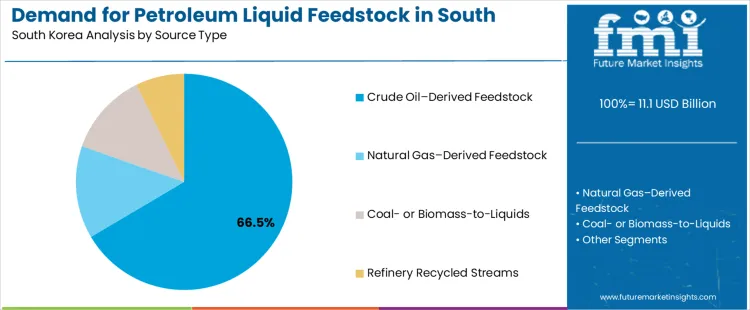
Crude-oil-derived feedstock accounts for 66.5% of South Korea’s petroleum liquid feedstock demand due to established refining systems designed around crude distillation, thermal cracking, reforming, and hydrotreating units. Refiners depend on crude-based streams to supply predictable volumes of naphtha, gas oil, and other intermediate liquids that flow directly into both fuel and petrochemical production lines. Crude-derived feedstock offers consistent quality, manageable impurity levels, and compatibility with catalyst systems used across major refining and chemical plants. South Korea’s import-dependent energy structure reinforces this share, as crude procurement contracts support stable refinery operations and reduce variability in feed composition. Integrated complexes require steady feed characteristics to maintain cracker yields, reformer efficiency, and hydrocracker performance. Crude-based streams also align with infrastructure investments in storage, transportation, and upgrading units that support large-volume processing. Natural gas and alternative liquid pathways offer niche supply sources, yet they do not match the scale or operational familiarity of crude-derived inputs. Policy planning, export-oriented petrochemical production, and refinery configuration all contribute to sustained reliance on crude-based feedstock. As refiners balance transportation fuel output with chemical feedstock production, crude-derived liquids remain central due to processing predictability, economic scale, and alignment with South Korea’s downstream industrial footprint.
What Is the Current Demand for Petroleum Liquid Feedstock in South Korea?
Demand for petroleum liquid feedstock in South Korea remains substantial, reflecting the country’s role as a major refining and petrochemical hub in East Asia. Refineries and integrated complexes require liquid feedstocks such as naphtha, straight-run gasoline, and light distillates to produce petrochemicals, polymers, and transportation fuels. Industrial activity in chemicals, plastics, and energy sectors underpins steady procurement of these input streams. Consumption patterns are linked to throughput levels at large facilities, with refinement adjusted based on global crude availability and regional demand for downstream products. The persistent need for reliable feedstock supplies shapes import strategies and storage planning.
What Factors Are Driving Demand for Petroleum Liquid Feedstock in South Korea?
Several structural factors drive the demand for petroleum liquid feedstock in South Korea. The country’s significant refining capacity and integrated petrochemical operations require continuous supplies of naphtha and other liquid fractions for cracking and conversion processes. Growth in the production of polyethylene, polypropylene, and synthetic rubber supports ongoing feedstock uptake. Demand for transportation fuels influences refinery operations, with lighter feedstocks processed to optimize fuel yields. South Korea’s export orientation in petrochemicals creates sustained pressure for feedstock inputs. Energy security policies and long-term supply agreements with crude exporters also shape the volume and types of liquid feedstocks imported and processed.
What Are the Constraints on Demand for Petroleum Liquid Feedstock in South Korea?
Constraints on demand for petroleum liquid feedstock in South Korea arise from structural and market forces. Competition from alternative feedstocks, including liquefied natural gas and shale derivatives sourced internationally, can shift procurement patterns for some chemical producers. Price volatility in crude and refined products affects refinery margins and may lead to adjustments in feedstock selection or throughput rates. Regulatory measures aimed at reducing carbon intensity and emissions influence refinery operations and may slow expansion of heavy feedstock processing. Logistical factors, such as storage capacity limits and port throughput, also impact how much liquid feedstock can be handled at any given time.
What Trends Are Emerging in South Korea’s Petroleum Liquid Feedstock Sector?
Emerging trends in South Korea’s petroleum liquid feedstock sector reflect shifts in energy transition strategies and global supply dynamics. Refiners are increasingly evaluating feedstock slates to balance production of traditional fuels with higher-value petrochemicals. There is attention on light, low-sulfur feedstocks that align with stricter fuel quality standards and environmental regulations. Integration of renewable feedstocks and bio-based liquids is advancing in select facilities to diversify input sources and reduce carbon intensity. Investments in processing technologies that improve yield efficiency and reduce energy use influence feedstock choice and utilization rates. Trade patterns are also adapting, with refiners adjusting import origins in response to global crude price movements and geopolitical developments.
What is the Regional Outlook for the Demand for Petroleum Liquid Feedstock in South Korea?
The demand for petroleum liquid feedstock across South Korea reflects the distribution of refining capacity, petrochemical activity, and industrial energy requirements. Provinces with established refinery clusters or strong links to petrochemicals are projected to see higher growth. Jeju records the fastest rise, shaped by increasing reliance on liquid fuels for transport and industrial activity. South Gyeongsang and South Jeolla also demonstrate solid growth, supported by their petrochemical, manufacturing, and logistics bases. North Jeolla shows moderate expansion, reflecting steady but less intensive industrial demand. As South Korea continues to integrate cleaner fuel standards, optimize petrochemical value chains, and upgrade refining assets, regional differences in feedstock demand are expected to sharpen.
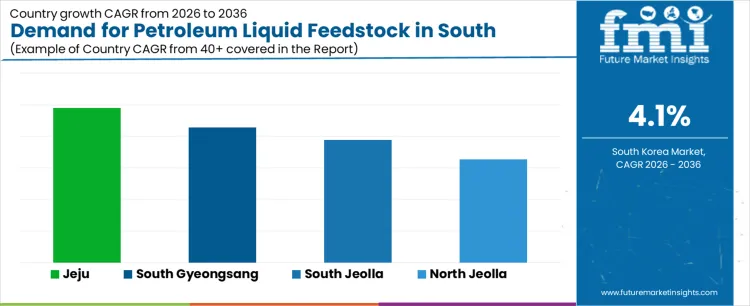
| Province | CAGR (2026-2036) |
|---|---|
| South Gyeongsang | 4.3% |
| North Jeolla | 3.3% |
| South Jeolla | 3.9% |
| Jeju | 4.9% |
What drives the demand for Petroleum Liquid Feedstock in South Gyeongsang?
South Gyeongsang is projected to record a CAGR of 4.3% in petroleum liquid feedstock demand from 2026 to 2036. The province has a diversified industrial base, with significant activity in petrochemicals, heavy manufacturing, and marine engineering. These sectors rely on liquid feedstock for refining processes, heating systems, and downstream chemical synthesis. As industrial facilities upgrade and expand operations, the need for consistent, high-quality feedstock increases. South Gyeongsang also benefits from proximity to major transport corridors and port infrastructure, which supports efficient movement of petroleum inputs. Ongoing investment in petrochemical complexes, along with the rising need for transport fuels and industrial energy, reinforces the province’s steady demand trajectory. The shift toward producing higher-value chemical intermediates further supports additional feedstock requirements across industrial clusters.
What influences the demand for Petroleum Liquid Feedstock in North Jeolla?
North Jeolla is expected to register a moderate CAGR of 3.3% between 2026 and 2036. The region’s industrial landscape is more fragmented, with smaller petrochemical, machinery, and materials-processing facilities that use petroleum feedstock in controlled volumes. Growth in the province is shaped by targeted industrial expansion, particularly in chemicals, fertilizers, and energy-intensive manufacturing. Environmental compliance measures are prompting facilities to optimize feedstock usage while maintaining production efficiency. Although North Jeolla does not have large refining hubs, its industrial zones still depend on liquid feedstock for thermal processes, feedstock blending, and auxiliary energy needs. As local manufacturing evolves toward higher-value goods and export-oriented production, steady demand for petroleum derivatives is expected, but growth remains more measured compared to coastal regions with large-scale petrochemical infrastructure.
What drives the demand for Petroleum Liquid Feedstock in South Jeolla?
South Jeolla is projected to grow at a CAGR of 3.9% in feedstock demand through 2036. The province hosts several chemical and processing industries that depend heavily on petroleum liquid feedstock for both primary operations and downstream conversion. Its industrial clusters continue to invest in product diversification, which raises the need for stable feedstock supply. South Jeolla’s strong agricultural exports also require processing and packaging infrastructure that consumes energy derived from petroleum-based inputs. As the province advances toward modernized industrial operations and adds refining-adjacent capacities, the requirement for liquid feedstock becomes more pronounced. Shipping and logistics activity along coastal zones add an additional layer of demand, supported by marine fuel requirements and industrial energy consumption. This combination sustains South Jeolla’s above-average growth profile.
Why is Jeju projected to have the highest growth in Petroleum Liquid Feedstock demand?
Jeju leads with a projected CAGR of 4.9% from 2026 to 2036. The island’s heavy dependence on imported energy, combined with strong tourism-driven transport demand, increases the need for petroleum liquid feedstock. Jeju’s road transport, aviation, and maritime sectors account for a significant share of its consumption. Industrial and commercial facilities also rely on liquid fuels due to limited availability of large-scale alternative energy infrastructure. As the region enhances its logistics, hospitality, and service sectors, feedstock demand rises in tandem. Jeju is also expanding its role as a testing ground for cleaner combustion technologies and hybrid energy systems, which still require baseline feedstock supply. The island’s geographic isolation makes petroleum liquid feedstock a stable and necessary source of energy, supporting its position as the fastest-growing province in South Korea for this segment.
How are Competitors Differentiating in the Petroleum Liquid Feedstock Market in South Korea?
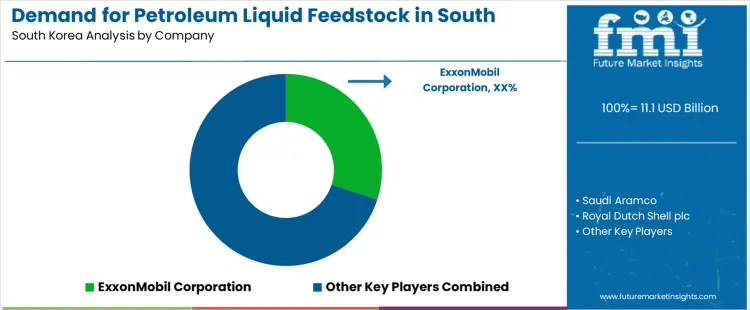
Competitive positioning in South Korea’s petroleum liquid feedstock market is shaped by supply reliability, refinery integration, and long-term contracting. ExxonMobil Corporation, the leading supplier, secures its position through steady crude and condensate flows, supported by upstream diversification and established relationships with South Korean refiners. Their strategy relies on consistent quality specifications, predictable delivery schedules, and strong integration with petrochemical feedstock systems. Saudi Aramco competes with a wide crude slate and a history of strategic partnerships with Korean refiners, offering grades aligned with catalytic cracking, hydrocracking, and aromatics production. Royal Dutch Shell plc positions itself through flexible trading operations that supply condensate, naphtha, and light distillates, enabling refiners to adjust to seasonal and demand-driven shifts in production.
Competition expands as TotalEnergies SE and Reliance Industries Limited target specialty requirements and niche demand pockets. TotalEnergies SE supports Korean refiners with balanced access to light and heavy feedstock streams backed by its integrated refining system, which helps maintain consistent sulfur profiles and distillation characteristics. Reliance Industries Limited provides large volumes of naphtha and related streams derived from its high-complexity refining assets, offering optionality for Korean petrochemical producers seeking stable yields in olefins and aromatics production. Across suppliers, product brochures remain central to communication, presenting crude and condensate specifications, assay data, distillation curves, sulfur profiles, and compatibility notes. These materials help refiners evaluate feedstock performance, ensure alignment with processing configurations, and manage procurement decisions within South Korea’s competitive supply landscape.
Key Players of the Demand for Petroleum Liquid Feedstock in South Korea
- ExxonMobil Corporation
- Saudi Aramco
- Royal Dutch Shell plc
- TotalEnergies SE
- Reliance Industries Limited
Scope of the Report
| Items | Values |
|---|---|
| Quantitative Units (2026) | USD Billion |
| Product Type | Heavy Naphtha, Light Naphtha, Gas Oil, Natural Gas Liquids |
| Source Type | Crude Oil-Derived Feedstock, Natural Gas-Derived Feedstock, Coal- or Biomass-to-Liquids, Refinery Recycled Streams |
| Application | Petroleum Refining, Fuel Blending, Hydrocracking, Aromatics Production, Lubricant Production, Others |
| Companies | ExxonMobil Corporation, Saudi Aramco, Royal Dutch Shell plc, TotalEnergies SE, Reliance Industries Limited |
| Region Covered | South Korea |
| Provinces Covered | South Gyeongsang, North Jeolla, South Jeolla, Jeju |
| Additional Attributes | Dollar sales by product type, source type, and application. Demand is shaped by refinery configuration, feedstock economics, and shifts toward cleaner fuels. Growth is supported by advanced cracking units, aromatics expansion, and flexibility in converting naphtha and gas oil into high-value downstream products. |
Demand for Petroleum Liquid Feedstock in South Korea
Product Type:
- Heavy Naphtha
- Light Naphtha
- Gas Oil
- Natural Gas Liquids
Source Type:
- Crude Oil-Derived Feedstock
- Natural Gas-Derived Feedstock
- Coal- or Biomass-to-Liquids
- Refinery Recycled Streams
Application:
- Petroleum Refining
- Fuel Blending
- Hydrocracking
- Aromatics Production
- Lubricant Production
- Others
Provinces:
- South Gyeongsang
- North Jeolla
- South Jeolla
- Jeju
Bibliography
- Korea Energy Economics Institute. (2024). Petroleum refining and feedstock supply trends in South Korea, 2024. Korea Energy Economics Institute.
- Ministry of Trade, Industry and Energy (Republic of Korea). (2024). Crude oil and petroleum liquid feedstock statistics report. Government of South Korea.
- International Energy Agency. (2024). Oil 2024: Analysis and forecast to 2030. International Energy Agency.
Frequently Asked Questions
How big is the demand for petroleum liquid feedstock in south korea in 2026?
The demand for petroleum liquid feedstock in south korea is estimated to be valued at USD 11.1 billion in 2026.
What will be the size of petroleum liquid feedstock in south korea in 2036?
The market size for the petroleum liquid feedstock in south korea is projected to reach USD 16.5 billion by 2036.
How much will be the demand for petroleum liquid feedstock in south korea growth between 2026 and 2036?
The demand for petroleum liquid feedstock in south korea is expected to grow at a 4.1% CAGR between 2026 and 2036.
What are the key product types in the petroleum liquid feedstock in south korea?
The key product types in petroleum liquid feedstock in south korea are heavy naphtha, light naphtha, gas oil and natural gas liquids.
Which source type segment is expected to contribute significant share in the petroleum liquid feedstock in south korea in 2026?
In terms of source type, crude oil-derived feedstock segment is expected to command 66.5% share in the petroleum liquid feedstock in south korea in 2026.
Preview the report firsthand - request a free sample
Get SampleGet the brochure for pricing and purchase details.
Get PDFTable of Content
- Executive Summary
- South Korea Market Outlook
- Demand-side Trends
- Supply-side Trends
- Technology Roadmap Analysis
- Analysis and Recommendations
- Market Overview
- Market Coverage / Taxonomy
- Market Definition / Scope / Limitations
- Market Background
- Market Dynamics
- Drivers
- Restraints
- Opportunity
- Trends
- Scenario Forecast
- Demand in Optimistic Scenario
- Demand in Likely Scenario
- Demand in Conservative Scenario
- Opportunity Map Analysis
- Product Life Cycle Analysis
- Supply Chain Analysis
- Investment Feasibility Matrix
- Value Chain Analysis
- PESTLE and Porter’s Analysis
- Regulatory Landscape
- Regional Parent Market Outlook
- Production and Consumption Statistics
- Import and Export Statistics
- Market Dynamics
- South Korea Market Analysis 2021 to 2025 and Forecast, 2026 to 2036
- Historical Market Size Value (USD Million) Analysis, 2021 to 2025
- Current and Future Market Size Value (USD Million) Projections, 2026 to 2036
- Y-o-Y Growth Trend Analysis
- Absolute $ Opportunity Analysis
- South Korea Market Pricing Analysis 2021 to 2025 and Forecast 2026 to 2036
- South Korea Market Analysis 2021 to 2025 and Forecast 2026 to 2036, By Product Type
- Introduction / Key Findings
- Historical Market Size Value (USD Million) Analysis By Product Type , 2021 to 2025
- Current and Future Market Size Value (USD Million) Analysis and Forecast By Product Type , 2026 to 2036
- Heavy Naphtha
- Light Naphtha
- Gas Oil
- Natural Gas Liquids
- Heavy Naphtha
- Y-o-Y Growth Trend Analysis By Product Type , 2021 to 2025
- Absolute $ Opportunity Analysis By Product Type , 2026 to 2036
- South Korea Market Analysis 2021 to 2025 and Forecast 2026 to 2036, By Source Type
- Introduction / Key Findings
- Historical Market Size Value (USD Million) Analysis By Source Type, 2021 to 2025
- Current and Future Market Size Value (USD Million) Analysis and Forecast By Source Type, 2026 to 2036
- Crude Oil-Derived Feedstock
- Natural Gas-Derived Feedstock
- Coal- or Biomass-to-Liquids
- Refinery Recycled Streams
- Crude Oil-Derived Feedstock
- Y-o-Y Growth Trend Analysis By Source Type, 2021 to 2025
- Absolute $ Opportunity Analysis By Source Type, 2026 to 2036
- South Korea Market Analysis 2021 to 2025 and Forecast 2026 to 2036, By Application
- Introduction / Key Findings
- Historical Market Size Value (USD Million) Analysis By Application, 2021 to 2025
- Current and Future Market Size Value (USD Million) Analysis and Forecast By Application, 2026 to 2036
- Petroleum Refining
- Fuel Blending
- Hydrocracking
- Aromatics Production
- Lubricant Production
- Others
- Petroleum Refining
- Y-o-Y Growth Trend Analysis By Application, 2021 to 2025
- Absolute $ Opportunity Analysis By Application, 2026 to 2036
- Market Structure Analysis
- Competition Dashboard
- Competition Benchmarking
- Market Share Analysis of Top Players
- By Regional
- By Product Type
- By Source Type
- By Application
- Competition Analysis
- Competition Deep Dive
- ExxonMobil Corporation
- Overview
- Product Portfolio
- Profitability by Market Segments (Product/Age /Sales Channel/Region)
- Sales Footprint
- Strategy Overview
- Marketing Strategy
- Product Strategy
- Channel Strategy
- Saudi Aramco
- Royal Dutch Shell plc
- TotalEnergies SE
- Reliance Industries Limited
- ExxonMobil Corporation
- Competition Deep Dive
- Assumptions & Acronyms Used
- Research Methodology


