

- Market Size (2026)
- USD 1.6 Bn
- Forecast (2036)
- USD 5.1 Bn
- CAGR (2026 to 2036)
- 12.4%
How big is Space Medicine Market in 2026?
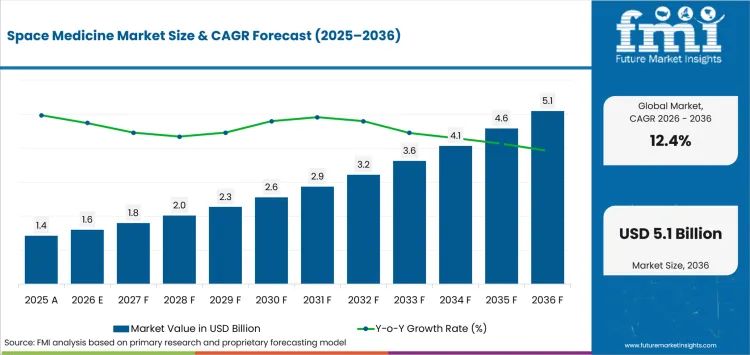
USD 1.6 billion in 2026 and USD 5.1 billion by 2036 at a 12.4% CAGR.
Demand for the space medicine market is projected to expand at 12.4% CAGR between 2026 and 2036, increasing valuation from USD 1.6 billion to USD 5.1 billion. Mission planners need compact medical devices that protect crew health without immediate hospital access or dependable emergency evacuation. NASA identified five human-spaceflight hazards in June 2026: radiation, isolation, distance from Earth, altered gravity and hostile closed environments. These conditions raise the value of autonomous monitoring and treatment that use limited power while preserving crew time.
Commercial routes differ across national programs because each agency combines research access with its own regulatory and qualification pathway. The UK Space Agency awarded three companies contracts in February 2026 to study medicines and advanced materials production in low Earth orbit. BioOrbit’s project combines microgravity drug manufacturing with regulatory planning for returned products. North American programs place greater emphasis on crew monitoring and independent medical decisions, so market entry requires different evidence for wearable medical devices and space-manufactured medicines.
Key Takeaways of Space Medicine Market
- Crewed missions expand demand for medical systems that preserve astronaut health without immediate access to hospitals or specialist teams.
- Medical devices are projected to account for 31.0% of product-type demand in 2026 as diagnostic and treatment functions must travel with each crew.
- Telemedicine solutions are estimated to capture 35.0% share in 2026 as remote consultation and continuous monitoring extend clinical support beyond spacecraft.
- Regenerative medicine is forecast to represent 29.0% share in 2026 owing to microgravity studies involving tissues and disease models.
- Flight qualification extends purchase timelines because hardware and software must tolerate launch loads plus radiation exposure and restricted maintenance access.
- Active companies include Lockheed Martin Corporation, Collins Aerospace, Redwire Corporation, Axiom Space Inc., SpacePharma SA, Varda Space Industries Inc., Boryung Corp. and KBR Inc.
Analyst Perspective
"Space medicine programs should be judged against the clinical event they must manage and the communication delay they must tolerate. Commercial value comes from proving that hardware, software and mission support operate as one care pathway within the intended radiation, power and crew-time limits."
- Anurag Sharma, Principal Consultant, Future Market Insights
How is the Space Medicine Market segmented?
The space medicine market is segmented by product type, technology, application, end user, spaceflight mission type and region.
Product type includes medical devices, health monitoring systems, pharmaceuticals and life-support systems. Technology covers telemedicine solutions, AI/ML, remote diagnostics and other mission-health systems. Applications include regenerative medicine, telemedicine and health monitoring, neurobiology and microbiology. End users comprise government agencies, commercial organizations, military programs and research institutions. Mission types cover orbital, suborbital and deep-space operations.
Why do medical devices lead demand within the product type category?
Medical devices carry diagnostic and treatment functions into spacecraft that cannot depend on rapid evacuation. Mission teams compare clinical coverage with equipment mass and power needs during point-of-care diagnostics selection. Devices also need controls that trained crew members can use during stressful or time-sensitive events.
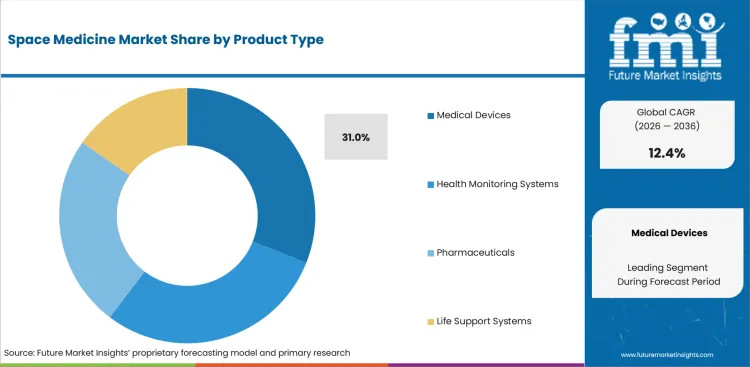
- Based on product type, medical devices are projected to account for 31.0% in 2026 due to onboard diagnostic and treatment requirements.
- NASA stated in August 2025 that exploration care may require real-time monitoring, medical imaging and in-flight analysis of blood plus urine and saliva. Products that combine several functions can reduce stored equipment, but each configuration must retain usable results under the intended mission conditions.
Why do telemedicine solutions lead demand within the technology category?
Telemedicine systems link crew observations with clinical expertise on Earth during missions with variable bandwidth and delayed messages. Platforms must preserve patient history and decision context as contact becomes less immediate. The operational advantage comes from maintaining clinical continuity during periods when live video and immediate specialist feedback are unavailable.
- By technology, telemedicine solutions are estimated to hold 35.0% in 2026 owing to remote consultation and continuous health monitoring.
- Canada moved three Connected Care Medical Module teams into prototyping after funding four next-generation designs during 2024. The program integrates software with diagnostic equipment, giving developers an operating route for remote patient monitoring and autonomous care under limited specialist access.
Why does regenerative medicine lead demand within the application category?
Regenerative medicine uses microgravity to examine tissue formation and disease processes that cannot be reproduced fully in terrestrial laboratories. Research sponsors compare experiment control with sample recovery and analytical quality during platform selection. Repeat orbital access matters because one flight rarely provides enough evidence for therapeutic development.
- The application category is forecast to be led by regenerative medicine at 29.0% share in 2026 due to controlled microgravity studies.
- Redwire received a five-year NASA biotechnology contract with a USD 25 million ceiling in August 2025. A first USD 2.5 million task order supported drug-development investigations using PIL-BOX, linking orbital facility operations with repeat pharmaceutical research.
Why do government space agencies lead demand within the end user category?
Government space agencies define medical risks and decide which evidence qualifies a system for crewed missions. Their programs connect health research with vehicle requirements and operational training. Private operators often apply the resulting standards as they assess similar hardware and clinical software for commercial missions.
- Government space agencies are set to lead the end user category with 39.0% share in 2026 due to funded crew-health programs.
- NASA described a clinical decision support concept in April 2024 that continuously gathers medical data and delivers real-time guidance. The model reduces crew workload during Earth-independent care, but commercial systems still need validated logic and mission-specific clinical governance.
Why do orbital missions lead demand within the spaceflight mission type category?
Orbital missions provide longer research windows and repeat access to laboratories with established integration procedures. Crewed platforms support live health studies that cannot be completed during short suborbital flights. Program value depends on dependable scheduling and clearly assigned responsibility for payload integration plus experiment operations.
- In 2026, orbital missions are expected to lead the spaceflight mission type category with 47.0% share because low Earth orbit offers established research and crew-support infrastructure.
- Axiom Space planned around 60 Ax-4 scientific studies and activities representing 31 countries in April 2025. The research volume makes integration capacity and flight scheduling central selection criteria for biomedical programs using orbital missions.
What are the drivers, restraints and opportunities in the Space Medicine Market?
Crewed exploration expands medical requirements while mission qualification and delayed communication restrict adoption. Repeat orbital access and recoverable research platforms provide revenue routes for monitoring, biomedical research and in-space pharmaceutical programs.
- Driver: Crewed lunar and orbital missions require continuous health monitoring plus greater medical autonomy during distance-related communication limits.
- Restraint: Flight qualification raises cost as devices must function under radiation and altered gravity with restricted power plus limited maintenance.
- Opportunity: Repeat orbital access and recoverable capsules support recurring biomedical experiments plus returned sample analysis for pharmaceutical programs.
Deep-Space Research Expands Continuous Care Requirements
Human health becomes an operating system as missions travel farther from immediate medical support. NASA outlined seven Artemis II research areas in September 2025, including sleep monitoring and immune biomarkers plus organ chips and radiation sensors. The program requires compact instruments and structured data handling, which increases demand for connected health monitoring that crews can use throughout the mission.
Flight Qualification Extends the Path to Mission Use
Terrestrial products cannot enter a crewed spacecraft based on routine clinical performance and safety evidence alone. NASA technical work published in July 2024 noted that commercial devices may need modification for long missions and the space environment. Developers must verify mass and power plus usability and data reliability, while AI healthcare tools need traceable decision logic before mission purchase.
Repeat Return Services Improve Research Economics
Commercial biomedical programs need more than a single experiment slot because formulation and tissue studies require comparable runs. Varda and Southern Launch agreed in September 2025 to support 20 Australian reentries through 2028. A defined return cadence gives pharmaceutical teams a clearer research route than conventional space tourism missions, provided launch access and regulatory approvals remain aligned.
Which country CAGRs are profiled in the Space Medicine Market?
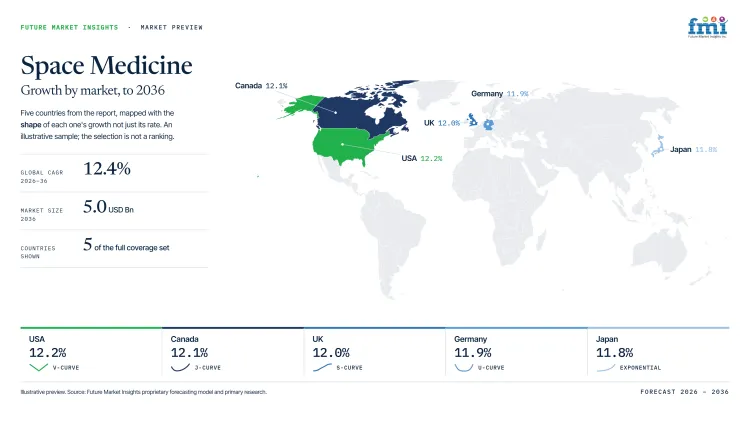
| Country | CAGR |
|---|---|
| South Korea | 13.2% |
| Australia | 12.4% |
| United States | 12.2% |
| Canada | 12.1% |
| United Kingdom | 12.0% |
| Germany | 11.9% |
| Japan | 11.8% |
How do country-level CAGRs compare in the Space Medicine Market?
The seven forecasts span 1.4 percentage points between South Korea and Japan in the country table. Similar growth rates conceal different entry routes involving agency research access and return infrastructure plus national qualification capacity.
- South Korea links domestic radiation measurement with international crewed exploration programs and partner qualification facilities.
- Australia provides authorized capsule returns that support recovered biomedical payloads and repeat in-orbit processing programs.
- The United States combines agency research demand with commercial human-spaceflight platforms and established mission-service providers.
- Canada develops autonomous medical tools for deep-space crews and remote communities with limited specialist access.
- The United Kingdom is defining regulated pathways for medicines manufactured under microgravity conditions and returned for terrestrial use.
- Germany uses ground analog laboratories and radiation research to test health countermeasures before flight integration.
- Japan connects Kibo laboratory access with astronaut medical operations and long-duration life-science research.
Comparable CAGRs reflect different commercial conditions because mission access and service infrastructure vary between national markets. The full report covers North America, Latin America, Western Europe, Eastern Europe, East Asia, South Asia and Pacific and the Middle East and Africa.
Country-wise Analysis
- Korea AeroSpace Administration connects domestic radiation research with NASA exploration missions that give Korean laboratories experience with crewed-flight integration. The South Korean space medicine market is projected to record 13.2% CAGR during the assessment period due to national programs linking domestic engineering teams with international human-spaceflight requirements. KASA reported in August 2025 that K-RadCube would become Korea’s first CubeSat launched with a crewed spacecraft, although repeat deployment depends on international schedules and partner qualification facilities.
- Australia has established an authorized commercial return route for capsules carrying microgravity payloads into South Australia. Adoption of space medicine services in Australia is estimated to expand at 12.4% CAGR through 2036 due to infrastructure that gives pharmaceutical researchers a defined route for recovering orbital experiments. The Australian Space Agency reported in February 2025 that Varda’s W-2 completed the first commercial return to a commercial spaceport, although repeated missions require overseas launch access and coordinated local reentry approvals.
- The United States combines NASA human-research programs with private orbital platforms and established spacecraft integrators across government and commercial missions. Space medicine demand in the United States is forecast to rise at 12.2% CAGR over the forecast period due to agency exploration programs and private low Earth orbit research capacity. NASA reported in September 2025 that four Artemis II astronauts would collect biological samples and use actigraphy plus radiation monitors, although flight qualification and limited payload capacity can extend purchasing decisions.
- Canada develops autonomous care technologies for deep-space missions and remote communities that face limited specialist access. Canada’s space medicine outlook is anticipated to advance at 12.1% CAGR over the assessment period due to connected-care modules and clinical decision support that increase medical autonomy. The Canadian Space Agency reported in June 2025 that ADAMS was deployed in Whapmagoostui for medical-emergency simulations, although agencies require reliable performance from terrestrial trials and completed flight qualification for crewed use.
- The United Kingdom is building a coordinated regulatory route for pharmaceuticals manufactured in orbit and supplied through licensed terrestrial channels. Space medicine sales in the United Kingdom are forecast to expand at 12.0% CAGR by 2036 due to clearer evidence standards and licensing pathways for in-orbit production. UK agencies announced in March 2026 that guidance would be paired with a reentry regulatory sandbox, although commercial distribution requires proof of product quality plus medicines regulation and spaceflight licensing.
- Germany combines DLR aerospace-medicine laboratories with controlled studies that test isolation and microgravity countermeasures for future crews. Germany is estimated to post 11.9% CAGR over the forecast period due to ground analog capacity and cooperation on exploration-related medical research. DLR began the 100-day SOLIS100 isolation study in April 2026 with six participants, but commercial technologies still require separate flight integration and qualification before mission purchase.
- Japan uses the Kibo module and dedicated astronaut medical operations to connect life-science research with long-duration crew support. By 2036, Japan is projected to grow at 11.8% CAGR due to established ISS access and national expertise in space medicine. JAXA astronaut Onishi began an ISS expedition in March 2025 with planned life-science work, although research providers remain constrained by shared Kibo schedules and mission-specific safety reviews.
Who are the notable companies in the Space Medicine Market?
Lockheed Martin Corporation, Collins Aerospace, Redwire Corporation, Axiom Space Inc., SpacePharma SA, Varda Space Industries Inc., Boryung Corp. and KBR Inc. are the notable companies serving this market.
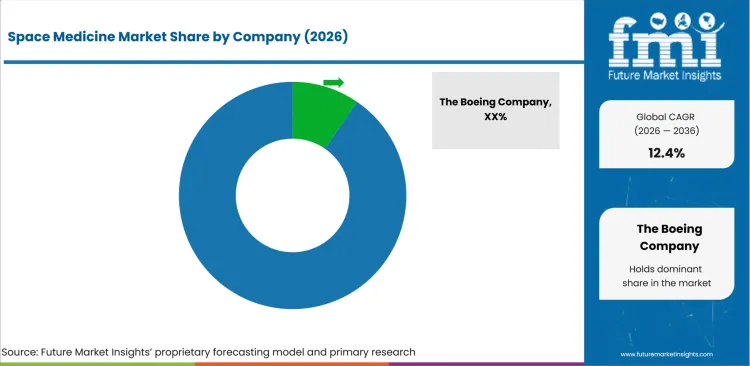
The competitive field remains specialized because no single supplier model covers crew care and biomedical research plus orbital return. Spacecraft companies compete on life-support integration, while research-platform operators compete on payload access and experiment control. Mission-health contractors compete on clinical operations and training, so entry depends on flight heritage plus documented integration across hardware and data. Automated space robotics can reduce crew handling during repeat experiments and improve the value of standardized payload interfaces.
- Lockheed Martin Corporation and Collins Aerospace concentrate on crewed spacecraft plus spacesuits and environmental-control functions that protect astronaut health.
- Redwire Corporation and Axiom Space Inc. combine orbital access with experiment integration while SpacePharma SA and Varda Space Industries Inc. specialize in automated biomedical payloads and return.
- Boryung Corp. develops space-health programs while KBR Inc. supports astronaut health research and specialized mission-medical operations.
Competitive Benchmarking: Space Medicine Market
| Company | Crew-Health Program Integration | Microgravity Biomedical Research | Mission Operations and Return | Geographic Reach |
|---|---|---|---|---|
| Lockheed Martin Corporation | High | Low | High | United States and partner missions |
| Collins Aerospace | High | Low | Medium | North America and international programs |
| Redwire Corporation | Medium | High | High | North America and Europe |
| Axiom Space Inc. | High | High | High | Global mission customers |
| SpacePharma SA | Low | High | Medium | Europe, Israel and United States |
| Varda Space Industries Inc. | Low | High | High | United States and Australia |
| Boryung Corp. | Medium | Medium | Low | South Korea and global partners |
| KBR Inc. | High | Medium | High | United States and international programs |
Key Developments in the Space Medicine Market
- In May 2026, SpacePharma launched the SPENCER mission with Roche Diagnostics and the European Space Agency. The miniaturized laboratory supported diagnostic development and three-dimensional tissue research during the company's fourteenth space mission, expanding its operating record for autonomous orbital experiments.
- In September 2025, Axiom Space and Burjeel Holdings released preliminary Suite Ride results from Axiom Mission 4. Continuous glucose monitors transmitted real-time readings from orbit while insulin pens were confirmed as the first flown to the space station, with both tools validated as functioning reliably in microgravity, providing an operating reference for chronic-care tools during human spaceflight.
- In August 2025, KBR received NASA’s Human Health and Performance Contract 2 for astronaut health and risk-mitigation research. The work covers the Human Research Program plus International Space Station and Artemis activities, extending KBR’s role across clinical support and research execution.
Key Players in the Space Medicine Market
Crew Systems and Life-Support Providers
- Lockheed Martin Corporation
- Collins Aerospace
Orbital Biomedical Research Platforms
- Redwire Corporation
- Axiom Space Inc.
- SpacePharma SA
- Varda Space Industries Inc.
Space-Health Programs and Medical Operations
- Boryung Corp.
- KBR Inc.
Space Medicine Market - Report Scope
| Coverage field | Report scope |
|---|---|
| Market breakdown | By product type, technology, application, end user, spaceflight mission type and region. |
| Quantitative Units | Revenue in USD billion and CAGR in %. |
| Market Definition | Medical devices, monitoring systems, pharmaceuticals, life-support systems, digital health technologies and biomedical research services used for human health during spaceflight or space-based research. |
| Regions Covered | North America, Latin America, Western Europe, Eastern Europe, East Asia, South Asia and Pacific and Middle East and Africa. |
| Countries Covered | South Korea, Australia, United States, Canada, United Kingdom, Germany, Japan, and 20+ countries included in the full report. |
| Key Companies Profiled | Lockheed Martin Corporation, Collins Aerospace, Redwire Corporation, Axiom Space Inc., SpacePharma SA, Varda Space Industries Inc., Boryung Corp. and KBR Inc. |
| Forecast Period | 2026 to 2036. |
| Approach | Primary and secondary research with market triangulation. |
Space Medicine Market - Research Methodology
| Method | Approach |
|---|---|
| Primary Research | FMI analysts gathered input from manufacturers, service providers, technology developers, distributors, end users, procurement teams, and subject-matter experts. Interviews examined purchasing decisions, product or service evaluation, adoption barriers, approval requirements, pricing considerations, and expectations for technical or commercial support. Respondents were also asked what evidence is required before a trial, pilot, or initial order develops into regular purchasing. |
| Desk Research | Desk research covered government statistics, regulatory publications, trade data, industry associations, technical literature, standards, company filings, product information, and official corporate announcements. Sources were reviewed for relevance, publication date, geographic coverage, and consistency with the defined market scope. Claims relating to performance, applications, approvals, capacity, investment, and commercial activity were retained only when supported by credible public evidence. |
| Market Sizing and Forecasting | The market model combined the baseline value with historical performance, segment structure, pricing and volume indicators, adoption levels, company participation, and country-level demand conditions. Forecast assumptions considered economic activity, investment trends, regulatory developments, technology adoption, purchasing cycles, supply availability, and barriers to wider market use. Segment and regional estimates were reconciled before the final market total was calculated. |
| Data Validation | Estimates were checked against multiple independent indicators, including public data, company activity, trade patterns, industry developments, and findings from primary interviews. Validation also tested whether products, services, applications, and company revenues fell within the defined market boundaries. Adjacent categories, unsupported claims, overlapping revenues, and activities without direct market relevance were excluded to reduce double counting and maintain consistency across segments and countries. |
Space Medicine Market by Segments
Space Medicine Market segmented by Product Type:
- Medical Devices
- Diagnostic Devices
- Therapeutic & Surgical Devices
- Health Monitoring Systems
- Wearable Health Monitors
- Biometric Monitoring Systems
- Pharmaceuticals
- Space-Adapted Pharmaceuticals
- Drug Delivery Systems
- Life Support Systems
- Environmental Control Systems
- Advanced Life Support Systems
Space Medicine Market segmented by Technology:
- Telemedicine Solutions
- Remote Medical Consultation
- Remote Patient Monitoring
- Artificial Intelligence & Machine Learning
- AI Health Monitoring
- Predictive Health Analytics
- Remote Diagnostics
- Portable Diagnostic Systems
- Remote Imaging & Testing
- Other Technologies
- Robotic Medical Systems
- Virtual Reality Health Systems
Space Medicine Market segmented by Application:
- Regenerative Medicine
- Tissue Regeneration
- Stem Cell Research
- Telemedicine & Health Monitoring
- In-Flight Medical Monitoring
- Remote Medical Care
- Neurobiology
- Neurophysiology Research
- Cognitive Health Monitoring
- Microbiology
- Microbial Research
- Infection Monitoring
Space Medicine Market segmented by End User:
- Government Space Agencies
- National Space Programs
- Government Research Missions
- Commercial Space Organizations
- Private Spaceflight Companies
- Space Tourism Operators
- Military Space Programs
- Military Space Operations
- Defense Space Research
- Research Institutions
- Universities
- Specialized Space Research Centers
Space Medicine Market segmented by Spaceflight Mission Type:
- Orbital Missions
- Low Earth Orbit Missions
- International Space Station Missions
- Suborbital Missions
- Commercial Suborbital Flights
- Focused Research Missions
- Deep Space Missions
- Lunar Missions
- Mars and Other Exploration Missions
Space Medicine Market by Region:
- North America
- United States
- Canada
- Latin America
- Mexico
- Brazil
- Chile
- Rest of Latin America
- Western Europe
- Germany
- United Kingdom
- Italy
- Spain
- France
- Nordics
- Benelux
- Rest of Western Europe
- Eastern Europe
- Russia
- Poland
- Hungary
- Balkan and Baltic States
- Rest of Eastern Europe
- East Asia
- China
- Japan
- South Korea
- South Asia and Pacific
- India
- ASEAN
- Australia and New Zealand
- Rest of South Asia and Pacific
- Middle East and Africa
- Kingdom of Saudi Arabia
- Other GCC Countries
- Türkiye
- South Africa
- Other African Union Countries
- Rest of Middle East and Africa
Research Sources and Bibliography
- National Aeronautics and Space Administration. (2026, June 12). 5 Hazards of Human Spaceflight.
- UK Space Agency. (2026, February 9). New studies for manufacturing advanced materials in orbit.
- National Aeronautics and Space Administration. (2025, August 6). Exploration Medical Technologies.
- Canadian Space Agency. (2025, July 17). Connected Care Medical Module (C2M2).
- Redwire Corporation. (2025, August 28). Redwire Awarded $25 Million Single Award IDIQ Contract by NASA To Provide Biotechnology and Support On-Orbit Operations Aboard the International Space Station.
- National Aeronautics and Space Administration. (2024, April 16). A Clinical Decision Support System for Earth-independent Medical Operations.
- Axiom Space. (2025, April 3). Ax-4 to Set Record for Most Research Activities Conducted During Axiom Space Mission.
- National Aeronautics and Space Administration. (2025, September 11). Artemis II Crew Both Subjects and Scientists in NASA Deep Space Research.
- National Aeronautics and Space Administration. (2024, July 29). ISS Technology Demonstrations for Future Spaceflight Medical Systems.
- Varda Space Industries Inc. (2025, September 30). Varda and Southern Launch Announce Agreement for 20 Reentries from Orbit Through 2028.
- Korea AeroSpace Administration. (2025, August 13). K-RadCube Transferred to NASA for Artemis II.
- Australian Space Agency. (2025, February 28). World-first historic space return lands in Australia.
- National Aeronautics and Space Administration. (2025, September 12). Artemis II Crew to Advance Human Spaceflight Research.
- Canadian Space Agency. (2025, June 30). Space medicine at the heart of a Cree territory.
- UK Space Agency. (2026, March 5). UK sets out world-leading pathway for space-manufactured drugs.
- German Aerospace Center. (2026, April 27). Isolation and bed rest studies begin - 100 days in isolation or 60 days in bed.
- Japan Aerospace Exploration Agency. (2025, March 16). JAXA Astronaut ONISHI Takuya Starts the International Space Station (ISS) Expedition Mission.
- Lockheed Martin Corporation. (2025, May 1). Lockheed Martin Completes Orion Development for Artemis II Mission to the Moon.
- RTX. (2024, January 31). RTX business Collins Aerospace announces developmental milestone of next-generation spacesuit.
- Axiom Space. (2025, September 26). Suite Ride Research Unlocks Potential for First Astronaut with Diabetes.
- SpacePharma SA. (2026, May 15). SPENCER Mission Marks a New Milestone in SpacePharma's Microgravity Research Platform.
- KBR Inc. (2025, August 13). KBR Awarded an Estimated USD 2.459 Billion Contract to Support Astronaut Health and Performance for Space Missions.
This bibliography is provided for reader reference and is not exhaustive. The full report contains the complete reference list and detailed citations.
This Report Answers
- How large is the space medicine market in 2026 and 2036?
- Which mission conditions increase demand for autonomous medical capability?
- Why do medical devices account for 31.0% of product-type demand in 2026?
- How do telemedicine solutions extend clinical support beyond spacecraft?
- Why does regenerative medicine capture 29.0% of application demand in 2026?
- How do orbital mission requirements differ from suborbital and deep-space care needs?
- How do national research routes translate into different commercial entry conditions?
- Which companies provide crew systems and orbital laboratories plus mission-medical services?
Frequently Asked Questions
How big is the Space Medicine Market in 2026?
The space medicine market is estimated at USD 1.6 billion in 2026 and is projected to reach USD 5.1 billion by 2036. Crewed missions require compact monitoring and treatment systems that remain usable despite radiation exposure and limited access to hospitals or specialist teams.
What is the CAGR of the Space Medicine Market from 2026 to 2036?
The space medicine market is forecast to expand at 12.4% CAGR between 2026 and 2036. Growth reflects crew-health research and commercial orbital platforms alongside greater medical autonomy for missions operating farther from immediate terrestrial support and emergency return options.
Which product type is projected to lead the Space Medicine Market?
Medical devices are projected to represent 31.0% of the space medicine market by product type in 2026. Their position reflects the need to carry diagnostic and therapeutic functions inside spacecraft without dependable emergency evacuation or immediate specialist intervention.
How much will the Space Medicine Market add between 2026 and 2036?
The space medicine market is projected to add USD 3.5 billion between 2026 and 2036. The incremental opportunity reflects wider crew-health requirements and repeat biomedical research access alongside qualification under restricted mass and power conditions for each intended mission environment.
Which companies are active in the Space Medicine Market?
Active companies in the space medicine market include Lockheed Martin Corporation, Collins Aerospace, Redwire Corporation, Axiom Space Inc., SpacePharma SA, Varda Space Industries Inc., Boryung Corp. and KBR Inc. Their roles cover crew systems and orbital laboratories plus return logistics and specialized mission-medical operations.
Preview the report firsthand - request a free sample
Get SampleGet the brochure for pricing and purchase details.
Get PDFTable of Content
- Key Takeaways
- Market Size and CAGR
- Top Growth Driver
- Fastest Growing Segment
- Leading Region
- Key Companies
- Emerging Opportunities
- Executive Summary
- Global Market Outlook
- Demand-side Trends
- Supply-side Trends
- Technology Roadmap Analysis
- Analysis and Recommendations
- Analyst Perspective (What is happening? Why now? What should investors know?)
- Key Questions Answered
- How large is the market?
- What is the CAGR?
- What are key trends?
- Which region dominates?
- Who are the leaders?
- Market Overview
- Market Coverage / Taxonomy
- Market Definition / Scope / Limitations
- Research Methodology
- Chapter Orientation
- Analytical Lens and Working Hypotheses
- Market Structure, Signals, and Trend Drivers
- Benchmarking and Cross-market Comparability
- Market Sizing, Forecasting, and Opportunity Mapping
- Research Design and Evidence Framework
- Desk Research Programme (Secondary Evidence)
- Expert Input and Fieldwork (Primary Evidence)
- Tooling, Models, and Reference Databases
- Data Engineering and Model Build
- Quality Assurance and Audit Trail
- Market Background
- Market Dynamics (Drivers, Restraints, Opportunity, Trends)
- Scenario Forecast (Optimistic, Likely, Conservative)
- Impact Analysis
- AI Impact
- Sustainability Impact
- Regulatory Impact
- Technology Impact
- Consumer / Buyer Analysis
- Purchase Drivers
- Adoption Barriers
- Buyer Journey
- Opportunity Map Analysis
- Product Life Cycle Analysis
- Supply Chain Analysis
- Investment Feasibility Matrix
- Value Chain Analysis
- PESTLE and Porter's Analysis
- Regulatory Landscape
- Regional Parent Market Outlook
- Production and Consumption Statistics
- Import and Export Statistics
- Global Market Analysis and Forecast, 2021 to 2036
- Historical Market Size Value (USD Billion) Analysis, 2021 to 2025
- Current and Future Market Size Value (USD Billion) Projections, 2026 to 2036
- Y-o-Y Growth Trend Analysis
- Absolute $ Opportunity Analysis
- Global Market Pricing Analysis, 2021 to 2036
- Global Market Analysis and Forecast, By Product Type, 2021 to 2036
- Introduction / Key Findings
- Historical Market Size Value (USD Billion) Analysis By Product Type, 2021 to 2025
- Current and Future Market Size Value (USD Billion) Analysis and Forecast By Product Type, 2026 to 2036
- Medical Devices
- Diagnostic Devices
- Therapeutic & Surgical Devices
- Health Monitoring Systems
- Wearable Health Monitors
- Biometric Monitoring Systems
- Pharmaceuticals
- Space-Adapted Pharmaceuticals
- Drug Delivery Systems
- Life Support Systems
- Environmental Control Systems
- Advanced Life Support Systems
- Medical Devices
- Y-o-Y Growth Trend Analysis By Product Type, 2021 to 2025
- Absolute $ Opportunity Analysis By Product Type, 2026 to 2036
- Global Market Analysis and Forecast, By Technology, 2021 to 2036
- Introduction / Key Findings
- Historical Market Size Value (USD Billion) Analysis By Technology, 2021 to 2025
- Current and Future Market Size Value (USD Billion) Analysis and Forecast By Technology, 2026 to 2036
- Telemedicine Solutions
- Remote Medical Consultation
- Remote Patient Monitoring
- Artificial Intelligence & Machine Learning
- AI Health Monitoring
- Predictive Health Analytics
- Remote Diagnostics
- Portable Diagnostic Systems
- Remote Imaging & Testing
- Others
- Robotic Medical Systems
- Virtual Reality Health Systems
- Telemedicine Solutions
- Y-o-Y Growth Trend Analysis By Technology, 2021 to 2025
- Absolute $ Opportunity Analysis By Technology, 2026 to 2036
- Global Market Analysis and Forecast, By Application, 2021 to 2036
- Introduction / Key Findings
- Historical Market Size Value (USD Billion) Analysis By Application, 2021 to 2025
- Current and Future Market Size Value (USD Billion) Analysis and Forecast By Application, 2026 to 2036
- Regenerative Medicine
- Tissue Regeneration
- Stem Cell Research
- Telemedicine & Health Monitoring
- In-Flight Medical Monitoring
- Remote Medical Care
- Neurobiology
- Neurophysiology Research
- Cognitive Health Monitoring
- Microbiology
- Microbial Research
- Infection Monitoring
- Regenerative Medicine
- Y-o-Y Growth Trend Analysis By Application, 2021 to 2025
- Absolute $ Opportunity Analysis By Application, 2026 to 2036
- Global Market Analysis and Forecast, By End User, 2021 to 2036
- Introduction / Key Findings
- Historical Market Size Value (USD Billion) Analysis By End User, 2021 to 2025
- Current and Future Market Size Value (USD Billion) Analysis and Forecast By End User, 2026 to 2036
- Government Space Agencies
- National Space Programs
- Government Research Missions
- Commercial Space Organizations
- Private Spaceflight Companies
- Space Tourism Operators
- Military Space Programs
- Military Space Operations
- Defense Space Research
- Research Institutions
- Universities
- Specialized Space Research Centers
- Government Space Agencies
- Y-o-Y Growth Trend Analysis By End User, 2021 to 2025
- Absolute $ Opportunity Analysis By End User, 2026 to 2036
- Global Market Analysis and Forecast, By Spaceflight Mission Type, 2021 to 2036
- Introduction / Key Findings
- Historical Market Size Value (USD Billion) Analysis By Spaceflight Mission Type, 2021 to 2025
- Current and Future Market Size Value (USD Billion) Analysis and Forecast By Spaceflight Mission Type, 2026 to 2036
- Orbital Missions
- Low Earth Orbit Missions
- International Space Station Missions
- Suborbital Missions
- Commercial Suborbital Flights
- Research Suborbital Missions
- Deep Space Missions
- Lunar Missions
- Mars & Deep Space Missions
- Orbital Missions
- Y-o-Y Growth Trend Analysis By Spaceflight Mission Type, 2021 to 2025
- Absolute $ Opportunity Analysis By Spaceflight Mission Type, 2026 to 2036
- Global Market Analysis and Forecast, By Region, 2021 to 2036
- Introduction
- Historical Market Size Value (USD Billion) Analysis By Region, 2021 to 2025
- Current Market Size Value (USD Billion) Analysis and Forecast By Region, 2026 to 2036
- North America
- Latin America
- Western Europe
- Eastern Europe
- East Asia
- South Asia and Pacific
- Middle East & Africa
- Market Attractiveness Analysis By Region
- North America Market Analysis and Forecast, By Country, 2021 to 2036
- Historical Market Size Value (USD Billion) Trend Analysis By Market Taxonomy, 2021 to 2025
- Market Size Value (USD Billion) Forecast By Market Taxonomy, 2026 to 2036
- By Country
- USA
- Canada
- By Product Type
- By Technology
- By Application
- By End User
- By Spaceflight Mission Type
- By Country
- Market Attractiveness Analysis
- By Country
- By Product Type
- By Technology
- By Application
- By End User
- By Spaceflight Mission Type
- Key Takeaways
- Latin America Market Analysis and Forecast, By Country
- Historical Market Size Value (USD Billion) Trend Analysis By Market Taxonomy, 2021 to 2025
- Market Size Value (USD Billion) Forecast By Market Taxonomy, 2026 to 2036
- By Country
- Brazil
- Mexico
- Chile
- Rest of Latin America
- By Product Type
- By Technology
- By Application
- By End User
- By Spaceflight Mission Type
- By Country
- Market Attractiveness Analysis
- By Country
- By Product Type
- By Technology
- By Application
- By End User
- By Spaceflight Mission Type
- Key Takeaways
- Western Europe Market Analysis and Forecast, By Country
- Historical Market Size Value (USD Billion) Trend Analysis By Market Taxonomy, 2021 to 2025
- Market Size Value (USD Billion) Forecast By Market Taxonomy, 2026 to 2036
- By Country
- Germany
- UK
- Italy
- Spain
- France
- Nordic
- BENELUX
- Rest of Western Europe
- By Product Type
- By Technology
- By Application
- By End User
- By Spaceflight Mission Type
- By Country
- Market Attractiveness Analysis
- By Country
- By Product Type
- By Technology
- By Application
- By End User
- By Spaceflight Mission Type
- Key Takeaways
- Eastern Europe Market Analysis and Forecast, By Country
- Historical Market Size Value (USD Billion) Trend Analysis By Market Taxonomy, 2021 to 2025
- Market Size Value (USD Billion) Forecast By Market Taxonomy, 2026 to 2036
- By Country
- Russia
- Poland
- Hungary
- Balkan & Baltic
- Rest of Eastern Europe
- By Product Type
- By Technology
- By Application
- By End User
- By Spaceflight Mission Type
- By Country
- Market Attractiveness Analysis
- By Country
- By Product Type
- By Technology
- By Application
- By End User
- By Spaceflight Mission Type
- Key Takeaways
- East Asia Market Analysis and Forecast, By Country
- Historical Market Size Value (USD Billion) Trend Analysis By Market Taxonomy, 2021 to 2025
- Market Size Value (USD Billion) Forecast By Market Taxonomy, 2026 to 2036
- By Country
- China
- Japan
- South Korea
- By Product Type
- By Technology
- By Application
- By End User
- By Spaceflight Mission Type
- By Country
- Market Attractiveness Analysis
- By Country
- By Product Type
- By Technology
- By Application
- By End User
- By Spaceflight Mission Type
- Key Takeaways
- South Asia and Pacific Market Analysis and Forecast, By Country
- Historical Market Size Value (USD Billion) Trend Analysis By Market Taxonomy, 2021 to 2025
- Market Size Value (USD Billion) Forecast By Market Taxonomy, 2026 to 2036
- By Country
- India
- ASEAN
- Australia & New Zealand
- Rest of South Asia and Pacific
- By Product Type
- By Technology
- By Application
- By End User
- By Spaceflight Mission Type
- By Country
- Market Attractiveness Analysis
- By Country
- By Product Type
- By Technology
- By Application
- By End User
- By Spaceflight Mission Type
- Key Takeaways
- Middle East & Africa Market Analysis and Forecast, By Country
- Historical Market Size Value (USD Billion) Trend Analysis By Market Taxonomy, 2021 to 2025
- Market Size Value (USD Billion) Forecast By Market Taxonomy, 2026 to 2036
- By Country
- Kingdom of Saudi Arabia
- Other GCC Countries
- Türkiye
- South Africa
- Other African Union
- Rest of Middle East & Africa
- By Product Type
- By Technology
- By Application
- By End User
- By Spaceflight Mission Type
- By Country
- Market Attractiveness Analysis
- By Country
- By Product Type
- By Technology
- By Application
- By End User
- By Spaceflight Mission Type
- Key Takeaways
- Key Countries Market Analysis
- USA
- Pricing Analysis
- Market Share Analysis, 2025
- By Product Type
- By Technology
- By Application
- By End User
- By Spaceflight Mission Type
- Canada
- Pricing Analysis
- Market Share Analysis, 2025
- By Product Type
- By Technology
- By Application
- By End User
- By Spaceflight Mission Type
- Mexico
- Pricing Analysis
- Market Share Analysis, 2025
- By Product Type
- By Technology
- By Application
- By End User
- By Spaceflight Mission Type
- Brazil
- Pricing Analysis
- Market Share Analysis, 2025
- By Product Type
- By Technology
- By Application
- By End User
- By Spaceflight Mission Type
- Chile
- Pricing Analysis
- Market Share Analysis, 2025
- By Product Type
- By Technology
- By Application
- By End User
- By Spaceflight Mission Type
- Germany
- Pricing Analysis
- Market Share Analysis, 2025
- By Product Type
- By Technology
- By Application
- By End User
- By Spaceflight Mission Type
- UK
- Pricing Analysis
- Market Share Analysis, 2025
- By Product Type
- By Technology
- By Application
- By End User
- By Spaceflight Mission Type
- Italy
- Pricing Analysis
- Market Share Analysis, 2025
- By Product Type
- By Technology
- By Application
- By End User
- By Spaceflight Mission Type
- Spain
- Pricing Analysis
- Market Share Analysis, 2025
- By Product Type
- By Technology
- By Application
- By End User
- By Spaceflight Mission Type
- France
- Pricing Analysis
- Market Share Analysis, 2025
- By Product Type
- By Technology
- By Application
- By End User
- By Spaceflight Mission Type
- India
- Pricing Analysis
- Market Share Analysis, 2025
- By Product Type
- By Technology
- By Application
- By End User
- By Spaceflight Mission Type
- ASEAN
- Pricing Analysis
- Market Share Analysis, 2025
- By Product Type
- By Technology
- By Application
- By End User
- By Spaceflight Mission Type
- Australia & New Zealand
- Pricing Analysis
- Market Share Analysis, 2025
- By Product Type
- By Technology
- By Application
- By End User
- By Spaceflight Mission Type
- China
- Pricing Analysis
- Market Share Analysis, 2025
- By Product Type
- By Technology
- By Application
- By End User
- By Spaceflight Mission Type
- Japan
- Pricing Analysis
- Market Share Analysis, 2025
- By Product Type
- By Technology
- By Application
- By End User
- By Spaceflight Mission Type
- South Korea
- Pricing Analysis
- Market Share Analysis, 2025
- By Product Type
- By Technology
- By Application
- By End User
- By Spaceflight Mission Type
- Russia
- Pricing Analysis
- Market Share Analysis, 2025
- By Product Type
- By Technology
- By Application
- By End User
- By Spaceflight Mission Type
- Poland
- Pricing Analysis
- Market Share Analysis, 2025
- By Product Type
- By Technology
- By Application
- By End User
- By Spaceflight Mission Type
- Hungary
- Pricing Analysis
- Market Share Analysis, 2025
- By Product Type
- By Technology
- By Application
- By End User
- By Spaceflight Mission Type
- Kingdom of Saudi Arabia
- Pricing Analysis
- Market Share Analysis, 2025
- By Product Type
- By Technology
- By Application
- By End User
- By Spaceflight Mission Type
- Türkiye
- Pricing Analysis
- Market Share Analysis, 2025
- By Product Type
- By Technology
- By Application
- By End User
- By Spaceflight Mission Type
- South Africa
- Pricing Analysis
- Market Share Analysis, 2025
- By Product Type
- By Technology
- By Application
- By End User
- By Spaceflight Mission Type
- USA
- Market Structure Analysis
- Competition Dashboard
- Competition Benchmarking
- Market Share Analysis of Top Players
- By Regional
- By Product Type
- By Technology
- By Application
- By End User
- By Spaceflight Mission Type
- Emerging Startups
- Innovation Benchmarking
- Competition Analysis
- Competition Deep Dive
- The Boeing Company
- Overview
- Product Portfolio
- Profitability by Market Segments
- Sales Footprint
- Strategy Overview
- Marketing Strategy
- Product Strategy
- Channel Strategy
- Lockheed Martin Corporation
- Collins Aerospace
- Redwire Corporation
- Sierra Space Corporation
- Axiom Space Inc.
- SpacePharma SA
- Varda Space Industries Inc.
- Boryung Corp.
- KBR Inc.
- Others
- The Boeing Company
- Case Studies
- Success Stories
- Recent Developments
- Competition Deep Dive
- Assumptions & Acronyms Used


