

- Market Size (2026)
- USD 620.4 Bn
- Forecast (2036)
- USD 1220.4 Bn
- CAGR (2026 to 2036)
- 7.0%
How big is the Space Technology Market in 2026?
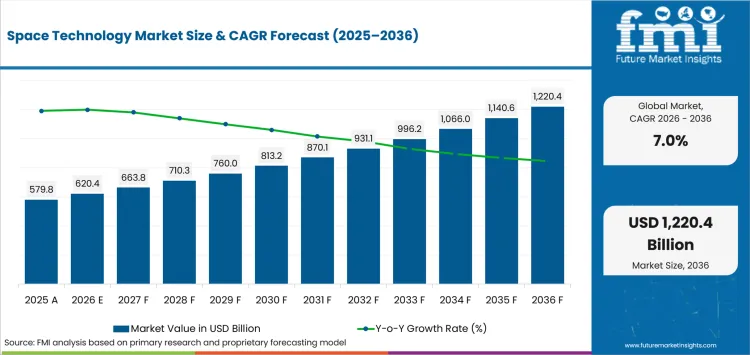
USD 620.4 billion in 2026 and USD 1,220.4 billion by 2036 at a 7.0% CAGR.
Space technology demand is projected to expand at 7.0% CAGR from USD 620.4 billion in 2026 to USD 1,220.4 billion by 2036. Continued investment in launch systems, satellites, communications infrastructure, and mission services is sustaining activity across the space sector. BEA reported in March 2025 that the USA space economy generated USD 240.9 billion in gross output during 2023. The scale of existing activity provides a substantial commercial base for spacecraft manufacturing and supporting technologies.
How government spending converts into market opportunities depends on national development models and qualification pathways. South Korea is using public investment to expand domestic capabilities across launch and satellite programs. KASA reported in December 2025 that its 2026 budget increased by 16.1% for transport and satellite initiatives. Additional funding can support test missions and supplier participation before larger procurement programs emerge. Germany follows a different route, relying more heavily on European programs and cross-border certification frameworks that influence the pace of project approvals and spacecraft orders.
Key Takeaways of Space Technology Market
- Constellation replenishment sustains recurring demand for spacecraft, launch integration and ground operations across active fleets.
- Hardware is projected at 54.0% in 2026 because every mission requires qualified flight or ground equipment.
- Satellite systems are estimated at 39.0% owing to complete platforms that combine buses, payloads and onboard controls.
- Satellite communications are forecast at 39.0% as protected networks require wide coverage plus dependable service gateways.
- Orbital congestion and spectrum coordination extend deployment schedules and raise tracking plus mission-assurance operating costs.
- SpaceX, Lockheed Martin Corporation, Northrop Grumman Corporation, Airbus SE, Boeing, Thales Group, RTX Corporation and Rocket Lab USA, Inc. span launch, spacecraft, payload and protected-mission roles.
Analyst Perspective
"Space technology contracts are won across complete mission chains that connect spacecraft with compatible launch and ground systems. Margin depends on standard platforms, reserved integration capacity and verified mission assurance."
- Sudip Saha, Principal Consultant, Future Market Insights
How is the Space Technology Market segmented?
The Space Technology Market is segmented by offering, technology, application, end user, orbit type and region.
Market taxonomy covers offering, technology, application, end user, orbit type and region. Offerings include hardware, software and services. Technologies cover satellite, launch, ground and in-space systems. Applications span communications, observation, navigation and defense. End users include commercial, civil and defense organizations. Orbit types cover low Earth, geostationary, medium Earth and beyond-GEO missions.
Why do satellite communications lead the application category?
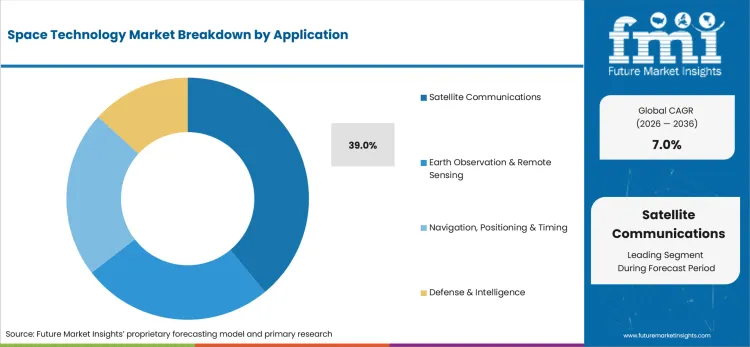
Satellite communications extend coverage beyond terrestrial networks and preserve links during disruption across contested areas. Service economics depend on payload capacity plus gateway access that supports regulated government and commercial traffic.
- In 2026, satellite communications are expected to lead application demand with 39.0% share because broadband and protected connectivity need wide-area coverage.
- The European Commission reported in November 2024 that IRIS² will combine over 290 satellites with an associated ground segment. Qualified satellite communication components must meet security controls, while satellite ground stations manage traffic handoffs across orbital layers without disrupting contracted service levels.
Why does hardware lead the offering category?
Hardware converts mission requirements into flight-ready spacecraft, launch equipment and ground assets for orbital missions. Engineers qualify thermal limits plus electrical interfaces before mission teams commit production funds or reserve launch capacity.
- Based on offering, hardware is projected to account for 54.0% in 2026 due to mandatory qualification across every mission chain.
- Mission teams assess satellite payloads against power budgets and communication interfaces, while launch providers qualify rocket propulsion systems against vehicle loads and scheduled test access. Completed checks determine whether a platform can enter repeat production without costly redesign or delayed integration.
Why do satellite systems lead the technology category?
Satellite systems combine buses, payloads and onboard controls into operating platforms for communications or observation missions. Their economics depend on production cadence as service continuity requires replacements before aging spacecraft leave the fleet.
- By technology, satellite systems are estimated to hold 39.0% in 2026 owing to communications and Earth observation missions requiring complete orbital platforms.
- Operators compare small satellite platforms by power margin and replenishment timing, while commercial Earth observation contracts require dependable integration support and stable data delivery. Reliable production schedules protect customer access to time-sensitive imagery across every contracted service period worldwide.
Why does low Earth orbit lead the orbit-type category?
Low Earth orbit supports shorter signal paths and frequent Earth revisit for broadband or imaging fleets. Dense orbital shells also require disciplined collision avoidance and disposal planning across every expansion campaign.
- The orbit-type category is forecast to be led by low Earth orbit at 52.0% share in 2026 due to constellation deployment patterns.
- Launch teams match satellite launch vehicles with integration windows and rideshare constraints across replenishment schedules. Operators assess debris-removal vehicles and disposal plans as orbital traffic controls shape insurance terms and mission approval for each commercial fleet expansion.
What are the drivers, restraints and opportunities in the Space Technology Market?
Connectivity and public missions sustain demand, while orbital congestion raises assurance costs and servicing extends revenue after deployment.
- Driver: Commercial programs require recurring spacecraft, launch integration and ground operations across replacement cycles and new missions.
- Restraint: Debris exposure and spectrum coordination add tracking, licensing and disposal work before operators can expand active fleets.
- Opportunity: Life-extension and in-space manufacturing support service revenue after initial spacecraft deployment and customer acceptance.
Recurring Programs Sustain Mission Demand
NASA's commercial space-station strategy separates technology development, certification, and operational services into distinct procurement stages. NASA stated in July 2026 that commercial station acquisition will involve individual purchasing decisions across these activities. This structure allows suppliers to participate throughout the station lifecycle rather than relying solely on initial hardware awards. Revenue opportunities can therefore extend into system integration and recurring mission services.
Orbital Congestion Raises Assurance Costs
Space operators face rising operational requirements as orbital activity continues to increase. ESA reported approximately 46,120 tracked objects in orbit during July 2026. Larger satellite populations increase the frequency of collision-risk assessments and traffic-management activities. Operators therefore devote greater resources to conjunction analysis and insurance coverage before expanding active constellations.
In-Orbit Servicing Extends Asset Economics
Satellite owners are increasingly evaluating servicing options as a way to maximize the value of existing orbital assets. ESA reported in September 2025 that the RISE program will demonstrate docking capabilities before commercial geostationary-orbit servicing begins. Successful rendezvous and docking operations could reduce the need for premature satellite replacement. Commercial adoption will depend on validated servicing systems and dependable mission-support capabilities across multiple servicing campaigns.
Which country CAGRs are profiled in the Space Technology Market?
| Country | CAGR |
|---|---|
| South Korea | 8.1% |
| Australia | 7.4% |
| United States | 7.2% |
| Japan | 6.8% |
| Germany | 6.5% |
How do country-level CAGRs compare in the Space Technology Market?
The forecasts span 1.6 points, with South Korea and Australia in the upper band. The spread describes forecast pace without establishing current revenue, installed capacity or market size today.
- South Korea reflects public launch funding that gives domestic teams repeated qualification opportunities across national satellite missions.
- Australia reflects launch infrastructure plus partnerships that compensate for a smaller integration base among emerging domestic firms.
- United States growth covers civil, commercial and protected missions supported by mature manufacturing and launch capacity.
- Japan combines public missions with quality reviews that lengthen qualification for unfamiliar designs across national programs.
- Germany relies on European program access despite cross-border qualification and limited domestic launch cadence today.
Comparable CAGRs can conceal different qualification, service and market-entry conditions across countries. The full report provides country-level CAGR analysis across North America, Latin America, Europe, East Asia, South Asia and Pacific, and the Middle East and Africa.
Country-wise Analysis
- South Korea uses national launch programs to move local spacecraft teams from component testing into flight qualification. In South Korea, space technology demand is predicted to advance at 8.1% CAGR through 2036 supported by public missions despite limited flight heritage among newer contractors. KASA reported in November 2025 that Nuri deployed thirteen payloads during its fourth successful launch, giving integrators mission evidence while repeat awards remain tied to reliability.
- Australia combines licensed launch ranges with commercial campaigns that give local teams practical flight experience. Australia's space technology outlook is anticipated to advance at 7.4% CAGR over the assessment period supported by regulatory reform despite limited repeat-launch evidence. The Australian Space Agency reported in December 2025 that an Australian-made orbital rocket attempted launch from national soil, while complex spacecraft programs continue to require cross-border integration partners.
- The United States combines civil missions, commercial constellations and protected programs with extensive manufacturing and launch capacity. The United States space technology sector is projected to record 7.2% CAGR during the assessment period driven by broad mission demand despite export controls. Boeing reported in July 2025 that two O3b mPOWER satellites launched for SES, providing platform evidence while assurance reviews continue to shape sales cycles.
- Japan uses launch, navigation and observation programs to qualify domestic manufacturers across several spacecraft classes. Adoption of space technology in Japan is estimated to expand at 6.8% CAGR through 2036 supported by active missions despite limited launch windows. JAXA reported in February 2025 that H3 Flight 5 placed QZS-6 into orbit, adding flight heritage while unfamiliar designs remain subject to extended quality reviews.
- Germany combines European launch access with propulsion testing and systems engineering at established facilities. Germany is estimated to post 6.5% CAGR over the forecast period shaped by European programs despite cross-border qualification and limited domestic launch cadence. DLR reported in April 2025 that about one hundred experts reviewed launch requirements at Lampoldshausen, where shared infrastructure lowers validation barriers but contracts remain tied to program schedules.
Who are the notable companies in the Space Technology Market?
Notable companies include SpaceX, Lockheed Martin Corporation, Northrop Grumman Corporation, Airbus SE, Boeing, Thales Group, RTX Corporation and Rocket Lab USA, Inc.
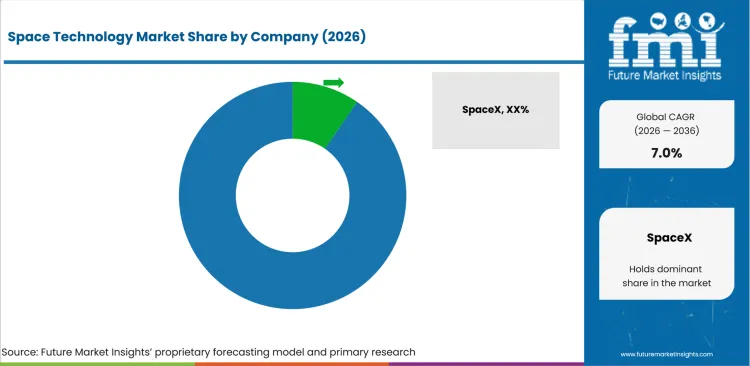
Integrated launch and spacecraft groups shape competition, while payload specialists compete in commercial satellite imaging through mission heritage and subsystem qualification against entry barriers involving production cadence and launch-interface access.
- SpaceX and Rocket Lab USA, Inc. combine launch access with spacecraft production and continuing mission operations.
- Lockheed Martin Corporation, Northrop Grumman Corporation and Airbus SE supply broad spacecraft platforms, while Boeing and Thales Group cover communications or observation missions and RTX Corporation supplies protected-space sensors.
Competitive Benchmarking: Space Technology Market
| Company | Platform Breadth | Infrastructure Depth | Flight Evidence | Geographic Reach |
|---|---|---|---|---|
| SpaceX | High | High | High | Global |
| Lockheed Martin Corporation | High | High | High | Global |
| Northrop Grumman Corporation | High | High | Medium | Global |
| Airbus SE | High | High | High | Global |
| Boeing | High | Medium | High | Global |
| Thales Group | Medium | Medium | High | Global |
| RTX Corporation | Low | Medium | High | Global |
| Rocket Lab USA, Inc. | Medium | High | Medium | North America, New Zealand and global customers |
Key Developments in the Space Technology Market
- In December 2025, Rocket Lab USA, Inc. was awarded an USD 816 million prime contract by the U.S. Space Development Agency to design and manufacture 18 satellites for the Tracking Layer Tranche 3 program.
- In August 2025, Rocket Lab USA, Inc. completed its USD 275 million acquisition of Geost, LLC, adding electro-optical and infrared payload capabilities for missile warning, tracking, and space domain awareness.
Key Players in the Space Technology Market
Integrated Space Platforms
- SpaceX
- Rocket Lab USA, Inc.
Space and Defense Primes
- Lockheed Martin Corporation
- Northrop Grumman Corporation
- Airbus SE
- Boeing
Payload Specialists
- Thales Group
- RTX Corporation
Space Technology Market - Report Scope
| Coverage field | Report scope |
|---|---|
| Market breakdown | Offering, technology, application, end user, orbit type and region. |
| Quantitative Units | Revenue in USD billion and CAGR in %. |
| Market Definition | Hardware, software and services for satellites, launch systems, ground systems and in-space infrastructure. |
| Regions Covered | North America, Latin America, Europe, East Asia, South Asia and Pacific, Middle East and Africa. |
| Countries Covered | South Korea, Australia, United States, Japan, Germany and 20+ countries included in the full report. |
| Key Companies Profiled | SpaceX, Lockheed Martin Corporation, Northrop Grumman Corporation, Airbus SE, Boeing, Thales Group, RTX Corporation and Rocket Lab USA, Inc. |
| Forecast Period | 2026 to 2036. |
| Approach | Primary and secondary research with market triangulation. |
Space Technology Market - Research Methodology
| Method | Approach |
|---|---|
| Primary Research | FMI analysts gathered input from manufacturers, service providers, technology developers, distributors, end users, procurement teams, and subject-matter experts. Interviews examined purchasing decisions, product or service evaluation, adoption barriers, approval requirements, pricing considerations, and expectations for technical or commercial support. Respondents were also asked what evidence is required before a trial, pilot, or initial order develops into regular purchasing. |
| Desk Research | Desk research covered government statistics, regulatory publications, trade data, industry associations, technical literature, standards, company filings, product information, and official corporate announcements. Sources were reviewed for relevance, publication date, geographic coverage, and consistency with the defined market scope. Claims relating to performance, applications, approvals, capacity, investment, and commercial activity were retained only when supported by credible public evidence. |
| Market Sizing and Forecasting | The market model combined the baseline value with historical performance, segment structure, pricing and volume indicators, adoption levels, company participation, and country-level demand conditions. Forecast assumptions considered economic activity, investment trends, regulatory developments, technology adoption, purchasing cycles, supply availability, and barriers to wider market use. Segment and regional estimates were reconciled before the final market total was calculated. |
| Data Validation | Estimates were checked against multiple independent indicators, including public data, company activity, trade patterns, industry developments, and findings from primary interviews. Validation also tested whether products, services, applications, and company revenues fell within the defined market boundaries. Adjacent categories, unsupported claims, overlapping revenues, and activities without direct market relevance were excluded to reduce double counting and maintain consistency across segments and countries. |
Space Technology Market by Segments
Space Technology Market segmented by Offering:
- Hardware
- Satellite Hardware
- Launch Vehicle Hardware
- Software
- Satellite Software
- Mission and Flight Software
- Services
- Satellite Services
- Ground and Data Services
Space Technology Market segmented by Technology:
- Satellite Systems
- Communication Satellites
- Earth Observation Satellites
- Launch Systems
- Launch Vehicles
- Launch Infrastructure
- Ground Systems
- Ground Stations
- Satellite Tracking Systems
- In-Space Infrastructure Systems
- In-Space Servicing
- Space Stations and Habitats
Space Technology Market segmented by Application:
- Satellite Communications
- Broadband Connectivity
- Satellite Broadcasting
- Earth Observation and Remote Sensing
- Remote Sensing
- Earth Imaging
- Navigation, Positioning and Timing
- GNSS Services
- Positioning Systems
- Defense and Intelligence
- Defense Satellites
- Intelligence and Surveillance
Space Technology Market segmented by End User:
- Commercial
- Satellite Operators
- Commercial Space Companies
- Government and Civil
- Space Agencies
- Civil Government Programs
- Defense and Intelligence
- Defense Agencies
- Military Space Programs
Space Technology Market segmented by Orbit Type:
- Low Earth Orbit
- LEO Communication Satellites
- LEO Earth Observation Satellites
- Geostationary Orbit
- GEO Communication Satellites
- GEO Weather Satellites
- Medium Earth Orbit
- Navigation Satellites
- Positioning Satellites
- Highly Elliptical and Beyond GEO
- Highly Elliptical Orbits
- Deep Space Missions
Space Technology Market by Region:
- North America
- United States
- Canada
- Mexico
- Latin America
- Brazil
- Chile
- Rest of Latin America
- Western Europe
- Germany
- United Kingdom
- Italy
- Spain
- France
- Nordics
- Benelux
- Rest of Western Europe
- Eastern Europe
- Russia
- Poland
- Hungary
- Balkan and Baltic States
- Rest of Eastern Europe
- East Asia
- China
- Japan
- South Korea
- South Asia and Pacific
- India
- ASEAN
- Australia and New Zealand
- Rest of South Asia and Pacific
- Middle East and Africa
- Kingdom of Saudi Arabia
- Other GCC Countries
- Türkiye
- South Africa
- Other African Union Countries
- Rest of Middle East and Africa
Research Sources and Bibliography
- USA Bureau of Economic Analysis. (2025, March 31). New and Revised Statistics for the USA Space Economy, 2012-2023.
- Korea AeroSpace Administration. (2025, December 3). KASA's 2026 Budget Set at 1.12 Trillion KRW.
- European Commission. (2024, November 7). IRIS2 - the European Commission awards the concession contract to SpaceRISE consortium.
- National Aeronautics and Space Administration. (2026, July 8). Commercial Space Stations in Low Earth Orbit.
- European Space Agency. (2026, July 31). Space Environment Statistics.
- European Space Agency. (2025, September 11). RISE: Extending missions in geostationary orbit.
- Korea AeroSpace Administration. (2025, November 27). Successful 4th Launch of Nuri Heralds the New Space Era.
- Australian Space Agency. (2025, December 19). 2025 Year in Review.
- Boeing. (2025, July 22). Two Boeing-Built O3b mPOWER Satellites Successfully Launch, Enhancing SES Constellation.
- Japan Aerospace Exploration Agency. (2025, February 2). Launch Result of MICHIBIKI No. 6, Quasi-Zenith Satellite System (QZS-6) aboard H3 Launch Vehicle flight No.5.
- German Aerospace Center. (2025, April 16). 12th DLR Industrial Days spark momentum for Europe's evolving space transport sector.
- Rocket Lab USA, Inc. (2026, May 21). Rocket Lab Awarded $90M Contract to Build GEO Satellites Hosting Space Domain Awareness Payload for USA Space Force.
- Space Systems Command. (2026, May 15). Space Force expands protected tactical satellite communications through new prototype contract.
- RTX Corporation. (2026, April 28). RTX's Raytheon delivers second missile-warning sensor to USA Space Force.
This bibliography is provided for reader reference and is not exhaustive. The full report contains the complete reference list and detailed citations.
This Report Answers
- How large is the global Space Technology market, and what is its growth outlook through 2036?
- Why does hardware hold a leading share of the Space Technology market?
- Why do satellite communications generate recurring demand within the Space Technology market?
- How does orbital congestion affect operating costs across the Space Technology market?
- Which companies lead spacecraft, launch, and payload segments of the Space Technology market?
- How do country-level regulations and launch access shape adoption across the Space Technology market?"
Frequently Asked Questions
How big is the space technology market in 2026?
The space technology market is valued at USD 620.4 billion in 2026 and is projected to reach USD 1,220.4 billion by 2036. Growth is supported by increasing satellite deployments, launch activities, and investments in space-based communication and observation services.
What is the CAGR of the space technology market from 2026 to 2036?
The space technology market is expected to grow at a CAGR of 7.0% between 2026 and 2036. Expansion is driven by advancements in spacecraft manufacturing, reliable launch capabilities, and long-term government and commercial space programs.
Which offering is projected to account for 54.0% of the space technology market?
Hardware is projected to account for 54.0% of the market in 2026. Its leading share reflects continued demand for spacecraft, launch systems, payloads, and ground infrastructure.
How much value is the space technology market forecast to add by 2036?
The space technology market is projected to add USD 590.2 billion in value between 2026 and 2036. This growth is fueled by constellation expansion, replacement missions, and ongoing investments in orbital and ground operations.
Which companies are active in the space technology market?
Key companies operating in the market include SpaceX, Lockheed Martin Corporation, Northrop Grumman Corporation, Airbus SE, Boeing, Thales Group, RTX Corporation, and Rocket Lab USA, Inc. These companies provide launch services, spacecraft platforms, payload technologies, and mission support infrastructure.
Preview the report firsthand - request a free sample
Get SampleGet the brochure for pricing and purchase details.
Get PDFTable of Content
- Key Takeaways
- Market Size and CAGR
- Top Growth Driver
- Fastest Growing Segment
- Leading Region
- Key Companies
- Emerging Opportunities
- Executive Summary
- Global Market Outlook
- Demand-side Trends
- Supply-side Trends
- Technology Roadmap Analysis
- Analysis and Recommendations
- Analyst Perspective (What is happening? Why now? What should investors know?)
- Key Questions Answered
- How large is the market?
- What is the CAGR?
- What are key trends?
- Which region dominates?
- Who are the leaders?
- Market Overview
- Market Coverage / Taxonomy
- Market Definition / Scope / Limitations
- Research Methodology
- Chapter Orientation
- Analytical Lens and Working Hypotheses
- Market Structure, Signals, and Trend Drivers
- Benchmarking and Cross-market Comparability
- Market Sizing, Forecasting, and Opportunity Mapping
- Research Design and Evidence Framework
- Desk Research Programme (Secondary Evidence)
- Expert Input and Fieldwork (Primary Evidence)
- Tooling, Models, and Reference Databases
- Data Engineering and Model Build
- Quality Assurance and Audit Trail
- Market Background
- Market Dynamics (Drivers, Restraints, Opportunity, Trends)
- Scenario Forecast (Optimistic, Likely, Conservative)
- Impact Analysis
- AI Impact
- Sustainability Impact
- Regulatory Impact
- Technology Impact
- Consumer / Buyer Analysis
- Purchase Drivers
- Adoption Barriers
- Buyer Journey
- Opportunity Map Analysis
- Product Life Cycle Analysis
- Supply Chain Analysis
- Investment Feasibility Matrix
- Value Chain Analysis
- PESTLE and Porter's Analysis
- Regulatory Landscape
- Regional Parent Market Outlook
- Production and Consumption Statistics
- Import and Export Statistics
- Global Market Analysis and Forecast, 2021 to 2036
- Historical Market Size Value (USD Billion) Analysis, 2021 to 2025
- Current and Future Market Size Value (USD Billion) Projections, 2026 to 2036
- Y-o-Y Growth Trend Analysis
- Absolute $ Opportunity Analysis
- Global Market Pricing Analysis, 2021 to 2036
- Global Market Analysis and Forecast, By Offering, 2021 to 2036
- Introduction / Key Findings
- Historical Market Size Value (USD Billion) Analysis By Offering, 2021 to 2025
- Current and Future Market Size Value (USD Billion) Analysis and Forecast By Offering, 2026 to 2036
- Hardware
- Satellite Hardware
- Launch Vehicle Hardware
- Software
- Satellite Software
- Mission & Flight Software
- Services
- Satellite Services
- Ground & Data Services
- Hardware
- Y-o-Y Growth Trend Analysis By Offering, 2021 to 2025
- Absolute $ Opportunity Analysis By Offering, 2026 to 2036
- Global Market Analysis and Forecast, By Technology, 2021 to 2036
- Introduction / Key Findings
- Historical Market Size Value (USD Billion) Analysis By Technology, 2021 to 2025
- Current and Future Market Size Value (USD Billion) Analysis and Forecast By Technology, 2026 to 2036
- Satellite Systems
- Communication Satellites
- Earth Observation Satellites
- Launch Systems
- Launch Vehicles
- Launch Infrastructure
- Ground Systems
- Ground Stations
- Satellite Tracking Systems
- In-Space Infrastructure Systems
- In-Space Servicing
- Space Stations & Habitats
- Satellite Systems
- Y-o-Y Growth Trend Analysis By Technology, 2021 to 2025
- Absolute $ Opportunity Analysis By Technology, 2026 to 2036
- Global Market Analysis and Forecast, By Application, 2021 to 2036
- Introduction / Key Findings
- Historical Market Size Value (USD Billion) Analysis By Application, 2021 to 2025
- Current and Future Market Size Value (USD Billion) Analysis and Forecast By Application, 2026 to 2036
- Satellite Communications
- Broadband Connectivity
- Satellite Broadcasting
- Earth Observation & Remote Sensing
- Remote Sensing
- Earth Imaging
- Navigation, Positioning & Timing
- GNSS Services
- Positioning Systems
- Defense & Intelligence
- Defense Satellites
- Intelligence & Surveillance
- Satellite Communications
- Y-o-Y Growth Trend Analysis By Application, 2021 to 2025
- Absolute $ Opportunity Analysis By Application, 2026 to 2036
- Global Market Analysis and Forecast, By End User, 2021 to 2036
- Introduction / Key Findings
- Historical Market Size Value (USD Billion) Analysis By End User, 2021 to 2025
- Current and Future Market Size Value (USD Billion) Analysis and Forecast By End User, 2026 to 2036
- Commercial
- Satellite Operators
- Commercial Space Companies
- Government & Civil
- Space Agencies
- Civil Government Programs
- Defense & Intelligence
- Defense Agencies
- Military Space Programs
- Commercial
- Y-o-Y Growth Trend Analysis By End User, 2021 to 2025
- Absolute $ Opportunity Analysis By End User, 2026 to 2036
- Global Market Analysis and Forecast, By Orbit Type, 2021 to 2036
- Introduction / Key Findings
- Historical Market Size Value (USD Billion) Analysis By Orbit Type, 2021 to 2025
- Current and Future Market Size Value (USD Billion) Analysis and Forecast By Orbit Type, 2026 to 2036
- Low Earth Orbit (LEO)
- LEO Communication Satellites
- LEO Earth Observation Satellites
- Geostationary Orbit (GEO)
- GEO Communication Satellites
- GEO Weather Satellites
- Medium Earth Orbit (MEO)
- Navigation Satellites
- Positioning Satellites
- Highly Elliptical & Beyond GEO
- Highly Elliptical Orbits
- Deep Space Missions
- Low Earth Orbit (LEO)
- Y-o-Y Growth Trend Analysis By Orbit Type, 2021 to 2025
- Absolute $ Opportunity Analysis By Orbit Type, 2026 to 2036
- Global Market Analysis and Forecast, By Region, 2021 to 2036
- Introduction
- Historical Market Size Value (USD Billion) Analysis By Region, 2021 to 2025
- Current Market Size Value (USD Billion) Analysis and Forecast By Region, 2026 to 2036
- North America
- Latin America
- Western Europe
- Eastern Europe
- East Asia
- South Asia and Pacific
- Middle East & Africa
- Market Attractiveness Analysis By Region
- North America Market Analysis and Forecast, By Country, 2021 to 2036
- Historical Market Size Value (USD Billion) Trend Analysis By Market Taxonomy, 2021 to 2025
- Market Size Value (USD Billion) Forecast By Market Taxonomy, 2026 to 2036
- By Country
- USA
- Canada
- By Offering
- By Technology
- By Application
- By End User
- By Orbit Type
- By Country
- Market Attractiveness Analysis
- By Country
- By Offering
- By Technology
- By Application
- By End User
- By Orbit Type
- Key Takeaways
- Latin America Market Analysis and Forecast, By Country
- Historical Market Size Value (USD Billion) Trend Analysis By Market Taxonomy, 2021 to 2025
- Market Size Value (USD Billion) Forecast By Market Taxonomy, 2026 to 2036
- By Country
- Brazil
- Mexico
- Chile
- Rest of Latin America
- By Offering
- By Technology
- By Application
- By End User
- By Orbit Type
- By Country
- Market Attractiveness Analysis
- By Country
- By Offering
- By Technology
- By Application
- By End User
- By Orbit Type
- Key Takeaways
- Western Europe Market Analysis and Forecast, By Country
- Historical Market Size Value (USD Billion) Trend Analysis By Market Taxonomy, 2021 to 2025
- Market Size Value (USD Billion) Forecast By Market Taxonomy, 2026 to 2036
- By Country
- Germany
- UK
- Italy
- Spain
- France
- Nordic
- BENELUX
- Rest of Western Europe
- By Offering
- By Technology
- By Application
- By End User
- By Orbit Type
- By Country
- Market Attractiveness Analysis
- By Country
- By Offering
- By Technology
- By Application
- By End User
- By Orbit Type
- Key Takeaways
- Eastern Europe Market Analysis and Forecast, By Country
- Historical Market Size Value (USD Billion) Trend Analysis By Market Taxonomy, 2021 to 2025
- Market Size Value (USD Billion) Forecast By Market Taxonomy, 2026 to 2036
- By Country
- Russia
- Poland
- Hungary
- Balkan & Baltic
- Rest of Eastern Europe
- By Offering
- By Technology
- By Application
- By End User
- By Orbit Type
- By Country
- Market Attractiveness Analysis
- By Country
- By Offering
- By Technology
- By Application
- By End User
- By Orbit Type
- Key Takeaways
- East Asia Market Analysis and Forecast, By Country
- Historical Market Size Value (USD Billion) Trend Analysis By Market Taxonomy, 2021 to 2025
- Market Size Value (USD Billion) Forecast By Market Taxonomy, 2026 to 2036
- By Country
- China
- Japan
- South Korea
- By Offering
- By Technology
- By Application
- By End User
- By Orbit Type
- By Country
- Market Attractiveness Analysis
- By Country
- By Offering
- By Technology
- By Application
- By End User
- By Orbit Type
- Key Takeaways
- South Asia and Pacific Market Analysis and Forecast, By Country
- Historical Market Size Value (USD Billion) Trend Analysis By Market Taxonomy, 2021 to 2025
- Market Size Value (USD Billion) Forecast By Market Taxonomy, 2026 to 2036
- By Country
- India
- ASEAN
- Australia & New Zealand
- Rest of South Asia and Pacific
- By Offering
- By Technology
- By Application
- By End User
- By Orbit Type
- By Country
- Market Attractiveness Analysis
- By Country
- By Offering
- By Technology
- By Application
- By End User
- By Orbit Type
- Key Takeaways
- Middle East & Africa Market Analysis and Forecast, By Country
- Historical Market Size Value (USD Billion) Trend Analysis By Market Taxonomy, 2021 to 2025
- Market Size Value (USD Billion) Forecast By Market Taxonomy, 2026 to 2036
- By Country
- Kingdom of Saudi Arabia
- Other GCC Countries
- Türkiye
- South Africa
- Other African Union
- Rest of Middle East & Africa
- By Offering
- By Technology
- By Application
- By End User
- By Orbit Type
- By Country
- Market Attractiveness Analysis
- By Country
- By Offering
- By Technology
- By Application
- By End User
- By Orbit Type
- Key Takeaways
- Key Countries Market Analysis
- USA
- Pricing Analysis
- Market Share Analysis, 2025
- By Offering
- By Technology
- By Application
- By End User
- By Orbit Type
- Canada
- Pricing Analysis
- Market Share Analysis, 2025
- By Offering
- By Technology
- By Application
- By End User
- By Orbit Type
- Mexico
- Pricing Analysis
- Market Share Analysis, 2025
- By Offering
- By Technology
- By Application
- By End User
- By Orbit Type
- Brazil
- Pricing Analysis
- Market Share Analysis, 2025
- By Offering
- By Technology
- By Application
- By End User
- By Orbit Type
- Chile
- Pricing Analysis
- Market Share Analysis, 2025
- By Offering
- By Technology
- By Application
- By End User
- By Orbit Type
- Germany
- Pricing Analysis
- Market Share Analysis, 2025
- By Offering
- By Technology
- By Application
- By End User
- By Orbit Type
- UK
- Pricing Analysis
- Market Share Analysis, 2025
- By Offering
- By Technology
- By Application
- By End User
- By Orbit Type
- Italy
- Pricing Analysis
- Market Share Analysis, 2025
- By Offering
- By Technology
- By Application
- By End User
- By Orbit Type
- Spain
- Pricing Analysis
- Market Share Analysis, 2025
- By Offering
- By Technology
- By Application
- By End User
- By Orbit Type
- France
- Pricing Analysis
- Market Share Analysis, 2025
- By Offering
- By Technology
- By Application
- By End User
- By Orbit Type
- India
- Pricing Analysis
- Market Share Analysis, 2025
- By Offering
- By Technology
- By Application
- By End User
- By Orbit Type
- ASEAN
- Pricing Analysis
- Market Share Analysis, 2025
- By Offering
- By Technology
- By Application
- By End User
- By Orbit Type
- Australia & New Zealand
- Pricing Analysis
- Market Share Analysis, 2025
- By Offering
- By Technology
- By Application
- By End User
- By Orbit Type
- China
- Pricing Analysis
- Market Share Analysis, 2025
- By Offering
- By Technology
- By Application
- By End User
- By Orbit Type
- Japan
- Pricing Analysis
- Market Share Analysis, 2025
- By Offering
- By Technology
- By Application
- By End User
- By Orbit Type
- South Korea
- Pricing Analysis
- Market Share Analysis, 2025
- By Offering
- By Technology
- By Application
- By End User
- By Orbit Type
- Russia
- Pricing Analysis
- Market Share Analysis, 2025
- By Offering
- By Technology
- By Application
- By End User
- By Orbit Type
- Poland
- Pricing Analysis
- Market Share Analysis, 2025
- By Offering
- By Technology
- By Application
- By End User
- By Orbit Type
- Hungary
- Pricing Analysis
- Market Share Analysis, 2025
- By Offering
- By Technology
- By Application
- By End User
- By Orbit Type
- Kingdom of Saudi Arabia
- Pricing Analysis
- Market Share Analysis, 2025
- By Offering
- By Technology
- By Application
- By End User
- By Orbit Type
- Türkiye
- Pricing Analysis
- Market Share Analysis, 2025
- By Offering
- By Technology
- By Application
- By End User
- By Orbit Type
- South Africa
- Pricing Analysis
- Market Share Analysis, 2025
- By Offering
- By Technology
- By Application
- By End User
- By Orbit Type
- USA
- Market Structure Analysis
- Competition Dashboard
- Competition Benchmarking
- Market Share Analysis of Top Players
- By Regional
- By Offering
- By Technology
- By Application
- By End User
- By Orbit Type
- Emerging Startups
- Innovation Benchmarking
- Competition Analysis
- Competition Deep Dive
- SpaceX
- Overview
- Product Portfolio
- Profitability by Market Segments
- Sales Footprint
- Strategy Overview
- Marketing Strategy
- Product Strategy
- Channel Strategy
- Lockheed Martin Corporation
- Northrop Grumman Corporation
- Airbus SE
- Boeing
- Thales Group
- RTX Corporation
- General Dynamics Corporation
- Rocket Lab USA, Inc.
- Safran S.A.
- Others
- SpaceX
- Case Studies
- Success Stories
- Recent Developments
- Competition Deep Dive
- Assumptions & Acronyms Used


