

- Market Size (2026)
- USD 0.4 Bn
- Forecast (2036)
- USD 1.1 Bn
- CAGR (2026 to 2036)
- 10.9%
How big is the Spinocerebellar Ataxias Market in 2026?
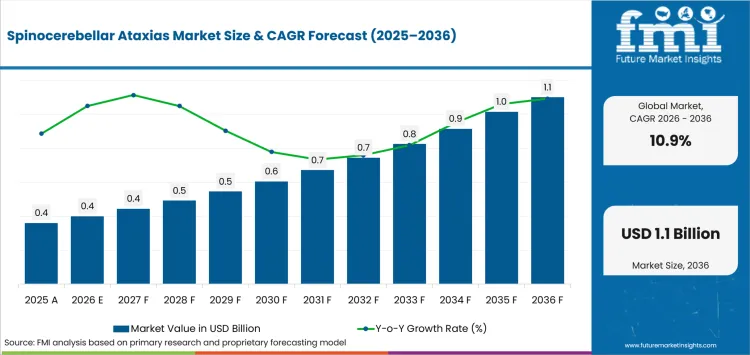
USD 0.4 billion in 2026 and USD 1.1 billion by 2036 at a 10.9% CAGR.
The spinocerebellar ataxias market is projected to rise from USD 0.4 billion in 2026 to USD 1.1 billion by 2036 at 10.9% CAGR. NINDS reports that diagnosis requires genetic testing and no cure is available, so demand combines rehabilitation and symptom medicines with subtype-targeted development.
Access depends on how quickly health systems identify hereditary cohorts and route them to specialist care. England completed more than 340,000 rare-disease genomic tests in 2025 including over 40,000 whole-genome equivalents. National review and coverage routes affect enrollment speed and regulated treatment access.
Key Takeaways of Spinocerebellar Ataxias Market
- Genetic diagnosis improves subtype confirmation for treatment selection and clinical-trial enrollment across specialist neurological pathways.
- Spinocerebellar Ataxia Type 3 is projected to lead the disease type category with 27.0% share during 2026 owing to stronger subtype recognition.
- Symptomatic treatment is expected to represent 46.0% during 2026, supported by continuing care requirements throughout progression.
- Oral administration is forecast to account for 58.0% during 2026 due to routine dispensing and lower procedural burden.
- Small genotype-specific cohorts and gradual progression increase recruitment costs while raising endpoint and regulatory evidence requirements.
- Biohaven Ltd., Vico Therapeutics B.V., Arrowhead Pharmaceuticals, Inc., Sarepta Therapeutics, Inc., REPROCELL Inc., Steminent Biotherapeutics Inc., Solaxa Inc. and IntraBio Inc. are som ek.
Analyst Perspective
"Analysts should compare programs by genotype fit and outcome measures that reliably detect gradual functional change. Commercial value depends on evidence quality, practical dosing and specialist delivery that remains workable beyond controlled trials."
- Anurag Sharma, Principal Consultant, Future Market Insights
How is the Spinocerebellar Ataxias Market segmented?
The Spinocerebellar Ataxias Market is segmented by disease type, treatment type, route of administration, end user, distribution channel and region.
Disease types include SCA3, SCA1, SCA6 and SCA2. Treatment covers symptomatic, disease-modifying, gene-targeted and cell-based approaches. Routes include oral, intrathecal, intravenous and investigational delivery. End users span clinical and research settings. Distribution includes hospital, specialty, retail and direct supply.
Why does Spinocerebellar Ataxia Type 3 lead the disease type category?
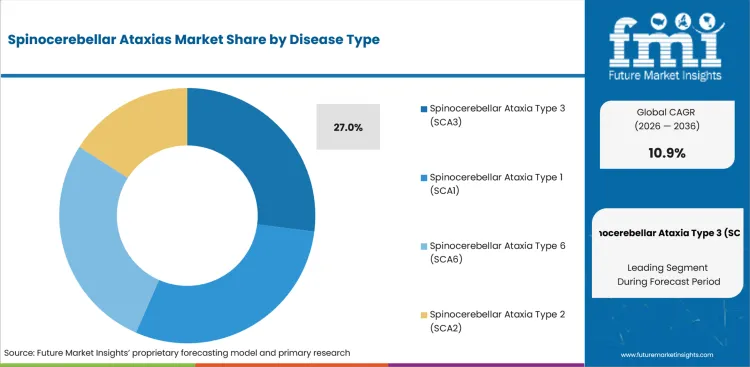
SCA3 has a defined ATXN3 target across antisense oligonucleotides and a visible base of genotype-focused clinical research.
- By disease type, SCA3 is estimated to hold 27.0% in 2026 owing to stronger subtype recognition and exact-target development.
- CIRM awarded USD 5.7 million in January 2025 for a preclinical SCA3 antisense program, which requires qualified oligonucleotide API supply and specialist intrathecal delivery for later trials.
Why does symptomatic treatment lead the treatment type category?
Symptomatic care remains necessary as gait impairment and speech difficulty continue without a cure, and rehabilitation within CNS treatment pathways changes with functional loss.
- In 2026, symptomatic treatment is expected to lead treatment type with 46.0% share, supported by continuing care needs across disease progression.
- Physical and occupational therapy preserve independence as speech services address communication and swallowing problems, and disease-targeted candidates do not replace continuing support during clinical development.
Why does oral administration lead the route of administration category?
Oral medicines fit routine neurology follow-up and reduce repeated procedures, extending rare neurological treatment beyond advanced therapy centers.
- Oral administration is projected to hold 58.0% share in 2026 owing to routine dispensing and lower administration complexity.
- Intrathecal candidates require lumbar procedures at specialist centers, and intravenous cell programs add controlled handling and release testing at qualified sites.
Why do hospitals and specialty clinics lead the end-user category?
Hospitals and specialty clinics combine neurological examination with genetic confirmation, and their molecular diagnostics capacity connects complex cases with counseling and multidisciplinary planning.
- The end-user category is forecast to be led by hospitals and specialty clinics at 42.0% share in 2026 due to concentrated diagnostic capacity.
- Specialist hospitals coordinate genotype confirmation with functional assessment and trial referral, and research institutes add natural-history data under national rules governing routine treatment access.
What are the drivers, restraints and opportunities in the Spinocerebellar Ataxias Market?
Genetic confirmation improves subtype matching. Small cohorts raise evidence burdens. Subtype-targeted programs require specialized delivery and manufacturing.
- Driver: Genetic confirmation reduces screen failures and assigns patients to the correct subtype for treatment selection or trial enrollment.
- Restraint: Gradual progression and limited genotype cohorts complicate endpoints while extending recruitment and follow-up requirements.
- Opportunity: Subtype-targeted programs need repeatable delivery and manufacturing routes for clinical use.
Genetic confirmation improves trial recruitment
Genetic confirmation assigns patients to the correct subtype for treatment, and broader genomic testing improves registries for specialist centers seeking trial-ready cohorts.
Slow progression raises the evidence burden
Gradual progression makes small effects difficult to separate from natural variation, so sponsors need sensitive endpoints and follow-up that captures meaningful change.
Subtype-targeted programs require delivery readiness
Subtype-targeted programs divide commercial routes by gene and administration method. Arrowhead and Sarepta's February 2025 collaboration covers SCA2, SCA1 and SCA3, while expansion requires rare disease gene therapy expertise and qualified cell and gene manufacturing capacity.
Which country CAGRs are profiled in the Spinocerebellar Ataxias Market?
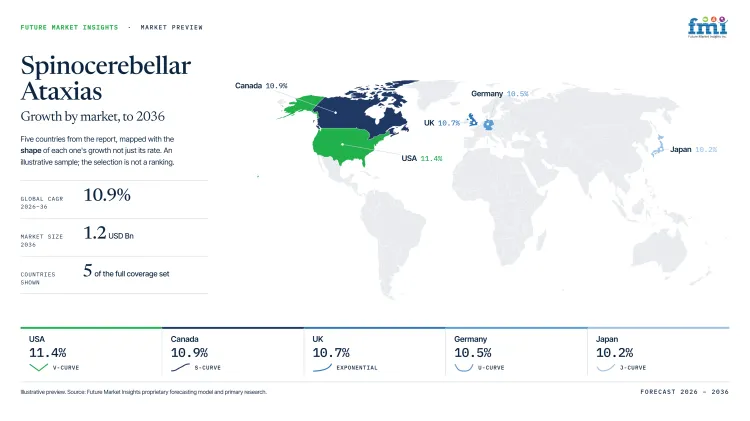
| Country | CAGR |
|---|---|
| South Korea | 11.8% |
| United States | 11.4% |
| United Kingdom | 10.7% |
| Germany | 10.5% |
| Japan | 10.2% |
How do country-level CAGRs compare in the Spinocerebellar Ataxias Market?
The forecasts span 1.6 percentage points between South Korea and Japan over the assessment period. These values measure projected pace rather than current revenue or diagnosed volume.
- South Korea points toward national diagnostic support and concentrated tertiary neurology centers for genetically defined cases.
- The United States forecast reflects active clinical development and an established rare-disease review route.
- The United Kingdom shows commissioned genomic panels and standardized hereditary ataxia referrals.
- Germany's adot reflects specialist centers and genomic care programs across university hospital networks.
- Japan's 10.2% forecast reflects designated-disease coverage and specialist evaluation across regulated clinical settings.
Country CAGRs reflect different routes from diagnosis to regulated treatment access. Full coverage spans North America, Latin America, Western Europe, Eastern Europe, East Asia, South Asia and Pacific, and Middle East and Africa.
Country-wise Analysis
- South Korea is projected to advance at an 11.8% CAGR through 2036. Growth stems from expanding patient identification and not treatment availability alone. Rare-disease cases are routed through 34 participating institutions for genetic evaluation and confirmation. KDCA expanded support coverage to 1,150 people in 2026. Unmet diagnostic demand remains substantial, with annual needs estimated at roughly 2,700 patients.
- The United States is expected to record an 11.4% CAGR over the assessment period, reflecting the strength of its orphan-drug development ecosystem. Specialist neurology centers continue to recruit genetically defined patient cohorts for multicenter studies. Biohaven completed an FDA review in November 2025. The agency's request for additional effectiveness evidence highlights the emphasis placed on clinical validation before commercialization.
- The United Kingdom is forecast to expand at a 10.7% CAGR as genomic testing becomes increasingly embedded within neurology services. NHS genomic pathways direct hereditary ataxia patients toward specialist assessment and molecular diagnosis. Testing panels updated in May 2026 include repeat-expansion analysis for SCA1, SCA2, SCA3, and SCA6. Broader diagnostic consistency may improve future treatment uptake once reimbursement pathways are established.
- Germany is likely to achieve a 10.5% CAGR through 2036, supported by growing integration of genomic medicine into rare-disease care. University hospitals combine sequencing capabilities with specialist referral networks for inherited neurological disorders. Approximately 5,000 patients had entered the genomic care model by the end of 2025. Expanding molecular diagnosis supports case identification, although recruitment remains dispersed across multiple low-prevalence subtypes.
- Japan's market is set to progress at a 10.2% CAGR through 2036, benefiting from an established framework for rare-disease management. Spinocerebellar degeneration remains covered under Japan's designated-disease system, which supports long-term monitoring and specialist care. The condition was included among 348 designated diseases in April 2026. Advanced therapies still face separate regulatory review and manufacturing requirements before widespread adoption can occur.
Who are the notable companies in the Spinocerebellar Ataxias Market?
Biohaven Ltd., Vico Therapeutics B.V., Arrowhead Pharmaceuticals, Inc., Sarepta Therapeutics, Inc., REPROCELL Inc., Steminent Biotherapeutics Inc., Solaxa Inc. and IntraBio Inc. are the notable companies covered in this market.
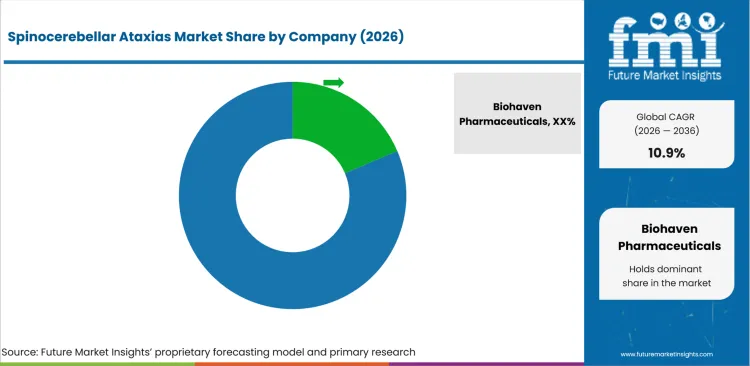
The field is concentrated among developers that control one modality or genotype rather than portfolios. Competition depends on recruitable cohorts and evidence that separates progression from background variation. Oral programs need scalable supply, while RNA and cell therapies require specialist administration or CNS gene therapy manufacturing.
- Biohaven, Solaxa and IntraBio compete with oral programs covering broad SCA populations or defined SCA27B and SCA6 cohorts, and their routes depend on trial evidence and prescribing access.
- Vico, Arrowhead and Sarepta concentrate on RNA programs with named genetic targets, while REPROCELL and Steminent combine cell-therapy manufacturing with Japanese commercialization rights.
Competitive Benchmarking: Spinocerebellar Ataxias Market
| Company | Program Stage | Subtype Specificity | Delivery Readiness | Geographic Reach |
|---|---|---|---|---|
| Biohaven Ltd. | High | Medium | Medium | United States and Europe |
| Vico Therapeutics B.V. | Medium | High | Medium | Europe and United States |
| Arrowhead Pharmaceuticals, Inc. | Medium | High | Medium | United States and New Zealand |
| Sarepta Therapeutics, Inc. | Medium | High | High | Worldwide development rights |
| REPROCELL Inc. | High | High | High | Japan and international partners |
| Steminent Biotherapeutics Inc. | High | High | High | Taiwan and Japan |
| Solaxa Inc. | Medium | High | High | United States and worldwide rights |
| IntraBio Inc. | High | Medium | Medium | United States and Europe |
Key Developments in the Spinocerebellar Ataxias Market
- In June 2026, REPROCELL Inc. submitted Japan's Stemchymal marketing application for SCA3 and SCA6 with Steminent Biotherapeutics Inc. as manufacturer.
- In February 2026, Vico Therapeutics B.V. began twice-annual dosing in an expanded Phase 1/2a VO659 cohort for SCA1 and SCA3.
- In February 2026, Solaxa Inc. signed a global SLX-100 license with Alvogen worth up to USD 95 million for SCA27B.
Key Players in the Spinocerebellar Ataxias Market
RNA-targeted programs
- Vico Therapeutics B.V.
- Arrowhead Pharmaceuticals, Inc.
- Sarepta Therapeutics, Inc.
Oral small-molecule programs
- Biohaven Ltd.
- Solaxa Inc.
- IntraBio Inc.
Regenerative medicine programs
- REPROCELL Inc.
- Steminent Biotherapeutics Inc.
Spinocerebellar Ataxias Market - Report Scope
| Coverage field | Report scope |
|---|---|
| Market breakdown | By disease type, treatment type, route of administration, end user, distribution channel and region. |
| Quantitative Units | Revenue in USD billion and CAGR in %. |
| Market Definition | Symptom-directed care and investigational therapies for hereditary spinocerebellar ataxias across defined subtypes, routes, care settings and distribution channels. |
| Regions Covered | North America, Latin America, Western Europe, Eastern Europe, East Asia, South Asia and Pacific, and Middle East and Africa. |
| Countries Covered | South Korea, United States, United Kingdom, Germany, Japan, and 20+ countries included in the full report. |
| Key Companies Profiled | Biohaven Ltd., Vico Therapeutics B.V., Arrowhead Pharmaceuticals, Inc., Sarepta Therapeutics, Inc., REPROCELL Inc., Steminent Biotherapeutics Inc., Solaxa Inc. and IntraBio Inc. |
| Forecast Period | 2026 to 2036. |
| Approach | Primary and secondary research with market triangulation. |
Spinocerebellar Ataxias Market - Research Methodology
| Method | Approach |
|---|---|
| Primary Research | FMI analysts gathered input from manufacturers, service providers, technology developers, distributors, end users, procurement teams, and subject-matter experts. Interviews examined purchasing decisions, product or service evaluation, adoption barriers, approval requirements, pricing considerations, and expectations for technical or commercial support. Respondents were also asked what evidence is required before a trial, pilot, or initial order develops into regular purchasing. |
| Desk Research | Desk research covered government statistics, regulatory publications, trade data, industry associations, technical literature, standards, company filings, product information, and official corporate announcements. Sources were reviewed for relevance, publication date, geographic coverage, and consistency with the defined market scope. Claims relating to performance, applications, approvals, capacity, investment, and commercial activity were retained only when supported by credible public evidence. |
| Market Sizing and Forecasting | The market model combined the baseline value with historical performance, segment structure, pricing and volume indicators, adoption levels, company participation, and country-level demand conditions. Forecast assumptions considered economic activity, investment trends, regulatory developments, technology adoption, purchasing cycles, supply availability, and barriers to wider market use. Segment and regional estimates were reconciled before the final market total was calculated. |
| Data Validation | Estimates were checked against multiple independent indicators, including public data, company activity, trade patterns, industry developments, and findings from primary interviews. Validation also tested whether products, services, applications, and company revenues fell within the defined market boundaries. Adjacent categories, unsupported claims, overlapping revenues, and activities without direct market relevance were excluded to reduce double counting and maintain consistency across segments and countries. |
Spinocerebellar Ataxias Market by Segments
Spinocerebellar Ataxias Market segmented by Disease Type:
- Spinocerebellar Ataxia Type 3 (SCA3)
- Genetic SCA3
- Adult-Onset SCA3
- Spinocerebellar Ataxia Type 1 (SCA1)
- Genetic SCA1
- Early-Onset SCA1
- Spinocerebellar Ataxia Type 6 (SCA6)
- Genetic SCA6
- Late-Onset SCA6
- Spinocerebellar Ataxia Type 2 (SCA2)
- Genetic SCA2
- Juvenile-Onset SCA2
Spinocerebellar Ataxias Market segmented by Treatment Type:
- Symptomatic Treatment
- Physical and Occupational Therapy
- Speech and Supportive Care
- Disease-Modifying Therapies
- Small-Molecule Therapies
- Neuroprotective Therapies
- Gene-Targeted Therapies
- Antisense Oligonucleotides
- RNA-Silencing Therapies
- Cell-Based Therapies
- Mesenchymal Stem Cells
- Other Regenerative Approaches
Spinocerebellar Ataxias Market segmented by Route of Administration:
- Oral Administration
- Oral Small Molecules
- Oral Neuroprotective Drugs
- Intrathecal Administration
- Antisense Oligonucleotides
- Other Central Nervous System Therapies
- Intravenous Administration
- Cell-Based Infusions
- Other Infusion Therapies
- Other Routes
- Subcutaneous Administration
- Investigational Delivery
Spinocerebellar Ataxias Market segmented by End User:
- Hospitals & Specialty Clinics
- Neurology Departments
- Movement Disorder Clinics
- Research Institutes
- Academic Research Centers
- Clinical Trial Sites
- Specialty Ataxia Centers
- Multidisciplinary Ataxia Clinics
- Genetic Counseling Centers
- Other End Users
- Rehabilitation Centers
- Long-Term Care Facilities
Spinocerebellar Ataxias Market segmented by Distribution Channel:
- Hospital Pharmacies
- Inpatient Pharmacies
- Specialty Hospital Pharmacies
- Specialty Pharmacies
- Rare-Disease Pharmacies
- Direct-to-Patient Services
- Retail Pharmacies
- Community Pharmacies
- Online Pharmacies
- Direct Distribution
- Clinical Trial Supply
- Manufacturer-Managed Programs
Spinocerebellar Ataxias Market by Region:
- North America
- United States
- Canada
- Latin America
- Mexico
- Brazil
- Chile
- Rest of Latin America
- Western Europe
- Germany
- United Kingdom
- Italy
- Spain
- France
- Nordics
- Benelux
- Rest of Western Europe
- Eastern Europe
- Russia
- Poland
- Hungary
- Balkan and Baltic States
- Rest of Eastern Europe
- East Asia
- China
- Japan
- South Korea
- South Asia and Pacific
- India
- ASEAN
- Australia and New Zealand
- Rest of South Asia and Pacific
- Middle East and Africa
- Kingdom of Saudi Arabia
- Other GCC Countries
- Türkiye
- South Africa
- Other African Union Countries
- Rest of Middle East and Africa
Research Sources and Bibliography
- National Institute of Neurological Disorders and Stroke. (2026, April 28). Spinocerebellar Ataxias.
- Department of Health and Social Care. (2026, April 14). England Rare Diseases Action Plan 2026: Main Report.
- California Institute for Regenerative Medicine. (2025, January 30). CIRM Awards Nearly $100 Million to Boost Discovery, Translational, and Clinical Disease Research.
- Arrowhead Pharmaceuticals, Inc. (2025, February 10). Arrowhead Pharmaceuticals Announces Closing of Global License and Collaboration Agreement with Sarepta Therapeutics.
- Korea Disease Control and Prevention Agency. (2026, March 31). 2026년 희귀질환 진단지원사업 본격 시행, 지원 규모 1,150명으로 확대.
- Biohaven Ltd. (2025, November 4). FDA Issues Complete Response Letter for Biohaven's VYGLXIA (troriluzole) New Drug Application for Spinocerebellar Ataxia.
- NHS England Genomics Education Programme. (2026, May 21). Adult-Onset Neurological Disorders Panel.
- Federal Ministry of Health. (2026, February 27). Vier Millionen Betroffene: Präzise Diagnostik schneller in die Versorgung bringen.
- Ministry of Health, Labour and Welfare. (2026, April). 令和8年4月時点の指定難病(告示番号1~348).
- ClinicalTrials.gov. (2025, October 27). Pivotal Study of N-acetyl-L-leucine for CACNA1A.
- REPROCELL Inc. (2026, June 24). REPROCELL Submits Application for Manufacturing and Marketing Approval in Japan for Stem Cell Therapy Stemchymal for Spinocerebellar Ataxia (SCA3 and SCA6).
- Vico Therapeutics B.V. (2026, February 24). Vico Therapeutics Announces Patient Dosing in Twice-Annual Regimen of VO659 in Phase 1/2 Trial in Huntington's Disease, Spinocerebellar Ataxia Type 3 and Type 1.
- Solaxa Inc. (2026, February 23). Solaxa and Alvogen enter into $95M license agreement for the development and commercialization of SLX-100.
This bibliography is provided for reader reference and is not exhaustive. The full report contains the complete reference list and detailed citations
This Report Answers
- How large is the Spinocerebellar Ataxias Market through 2036?
- How does genetic diagnosis convert into treatment or trial access?
- Which disease type holds the leading 2026 share?
- Why does symptomatic treatment retain the largest share?
- How do oral and invasive routes differ commercially?
- What evidence constraints slow genotype-specific development?
- How do national diagnosis and access pathways differ?
- How should companies compare stage, subtype specificity and delivery readiness?
Frequently Asked Questions
What is the size of the Spinocerebellar Ataxias Market in 2026?
The spinocerebellar ataxias market is estimated at USD 0.4 billion in 2026 and is projected to reach USD 1.1 billion by 2036. Growth is supported by expanding genetic diagnosis and continued demand for symptom management therapies.
What is the CAGR of the Spinocerebellar Ataxias Market from 2026 to 2036?
The spinocerebellar ataxias market is projected to grow at a CAGR of 10.9% between 2026 and 2036. Expansion is driven by broader genotype identification and ongoing development of targeted treatment approaches.
Which disease type leads the Spinocerebellar Ataxias Market?
SCA3 is projected to account for 27.0% of the market in 2026. Its leading position is supported by increasing genetic confirmation rates and the advancement of subtype-specific therapeutic programs.
How much will the Spinocerebellar Ataxias Market add between 2026 and 2036?
The spinocerebellar ataxias market is expected to add USD 0.76 billion in value between 2026 and 2036. Growth reflects continued investment in disease-specific therapies, rehabilitation services, and symptom-directed treatments.
Which companies are active in the Spinocerebellar Ataxias Market?
Key companies operating in the market include Biohaven, Vico, Arrowhead, Sarepta, REPROCELL, Steminent Biotherapeutics, Solaxa, and IntraBio. These companies are developing oral, RNA-based, and cell-based therapies for spinocerebellar ataxia treatment.
Preview the report firsthand - request a free sample
Get SampleGet the brochure for pricing and purchase details.
Get PDFTable of Content
- Key Takeaways
- Market Size and CAGR
- Top Growth Driver
- Fastest Growing Segment
- Leading Region
- Key Companies
- Emerging Opportunities
- Executive Summary
- Global Market Outlook
- Demand-side Trends
- Supply-side Trends
- Technology Roadmap Analysis
- Analysis and Recommendations
- Analyst Perspective (What is happening? Why now? What should investors know?)
- Key Questions Answered
- How large is the market?
- What is the CAGR?
- What are key trends?
- Which region dominates?
- Who are the leaders?
- Market Overview
- Market Coverage / Taxonomy
- Market Definition / Scope / Limitations
- Research Methodology
- Chapter Orientation
- Analytical Lens and Working Hypotheses
- Market Structure, Signals, and Trend Drivers
- Benchmarking and Cross-market Comparability
- Market Sizing, Forecasting, and Opportunity Mapping
- Research Design and Evidence Framework
- Desk Research Programme (Secondary Evidence)
- Expert Input and Fieldwork (Primary Evidence)
- Tooling, Models, and Reference Databases
- Data Engineering and Model Build
- Quality Assurance and Audit Trail
- Market Background
- Market Dynamics (Drivers, Restraints, Opportunity, Trends)
- Scenario Forecast (Optimistic, Likely, Conservative)
- Impact Analysis
- AI Impact
- Sustainability Impact
- Regulatory Impact
- Technology Impact
- Consumer / Buyer Analysis
- Purchase Drivers
- Adoption Barriers
- Buyer Journey
- Opportunity Map Analysis
- Product Life Cycle Analysis
- Supply Chain Analysis
- Investment Feasibility Matrix
- Value Chain Analysis
- PESTLE and Porter's Analysis
- Regulatory Landscape
- Regional Parent Market Outlook
- Production and Consumption Statistics
- Import and Export Statistics
- Global Market Analysis and Forecast, 2021 to 2036
- Historical Market Size Value (USD Billion) Analysis, 2021 to 2025
- Current and Future Market Size Value (USD Billion) Projections, 2026 to 2036
- Y-o-Y Growth Trend Analysis
- Absolute $ Opportunity Analysis
- Global Market Pricing Analysis, 2021 to 2036
- Global Market Analysis and Forecast, By Disease Type, 2021 to 2036
- Introduction / Key Findings
- Historical Market Size Value (USD Billion) Analysis By Disease Type, 2021 to 2025
- Current and Future Market Size Value (USD Billion) Analysis and Forecast By Disease Type, 2026 to 2036
- Spinocerebellar Ataxia Type 3 (SCA3)
- Genetic SCA3
- Adult-Onset SCA3
- Spinocerebellar Ataxia Type 1 (SCA1)
- Genetic SCA1
- Adult-Onset SCA1
- Spinocerebellar Ataxia Type 6 (SCA6)
- Genetic SCA6
- Late-Onset SCA6
- Spinocerebellar Ataxia Type 2 (SCA2)
- Genetic SCA2
- Adult-Onset SCA2
- Spinocerebellar Ataxia Type 3 (SCA3)
- Y-o-Y Growth Trend Analysis By Disease Type, 2021 to 2025
- Absolute $ Opportunity Analysis By Disease Type, 2026 to 2036
- Global Market Analysis and Forecast, By Treatment Type, 2021 to 2036
- Introduction / Key Findings
- Historical Market Size Value (USD Billion) Analysis By Treatment Type, 2021 to 2025
- Current and Future Market Size Value (USD Billion) Analysis and Forecast By Treatment Type, 2026 to 2036
- Symptomatic Treatment
- Physical & Occupational Therapy
- Speech & Supportive Care
- Disease-Modifying Therapies
- Neuroprotective Therapies
- Glutamate-Modulating Therapies
- Gene-Targeted Therapies
- Antisense Oligonucleotides
- Gene Silencing Therapies
- Cell-Based & Regenerative Therapies
- Mesenchymal Stem Cell Therapy
- Regenerative Medicine
- Symptomatic Treatment
- Y-o-Y Growth Trend Analysis By Treatment Type, 2021 to 2025
- Absolute $ Opportunity Analysis By Treatment Type, 2026 to 2036
- Global Market Analysis and Forecast, By Route of Administration, 2021 to 2036
- Introduction / Key Findings
- Historical Market Size Value (USD Billion) Analysis By Route of Administration, 2021 to 2025
- Current and Future Market Size Value (USD Billion) Analysis and Forecast By Route of Administration, 2026 to 2036
- Oral
- Oral Small Molecules
- Oral Neuroprotective Drugs
- Intrathecal
- Intrathecal Antisense Oligonucleotides
- Cerebrospinal Fluid Delivery
- Intravenous
- Infusion-Based Therapies
- Stem Cell Therapies
- Other Routes
- Subcutaneous Administration
- Other Investigational Routes
- Oral
- Y-o-Y Growth Trend Analysis By Route of Administration, 2021 to 2025
- Absolute $ Opportunity Analysis By Route of Administration, 2026 to 2036
- Global Market Analysis and Forecast, By End User, 2021 to 2036
- Introduction / Key Findings
- Historical Market Size Value (USD Billion) Analysis By End User, 2021 to 2025
- Current and Future Market Size Value (USD Billion) Analysis and Forecast By End User, 2026 to 2036
- Hospitals & Specialty Clinics
- Neurology Departments
- Movement Disorder Clinics
- Research & Academic Institutes
- University Research Centers
- Clinical Research Institutes
- Specialty Ataxia Centers
- Ataxia Treatment Centers
- Neurogenetic Clinics
- Others
- Rehabilitation Centers
- Long-Term Care Facilities
- Hospitals & Specialty Clinics
- Y-o-Y Growth Trend Analysis By End User, 2021 to 2025
- Absolute $ Opportunity Analysis By End User, 2026 to 2036
- Global Market Analysis and Forecast, By Distribution Channel, 2021 to 2036
- Introduction / Key Findings
- Historical Market Size Value (USD Billion) Analysis By Distribution Channel, 2021 to 2025
- Current and Future Market Size Value (USD Billion) Analysis and Forecast By Distribution Channel, 2026 to 2036
- Hospital Pharmacies
- Inpatient Pharmacies
- Specialty Hospital Pharmacies
- Specialty Pharmacies
- Rare Disease Pharmacies
- Specialty Drug Dispensers
- Retail Pharmacies
- Chain Pharmacies
- Independent Pharmacies
- Online & Direct Distribution
- Specialty Drug Delivery
- Direct-to-Patient Programs
- Hospital Pharmacies
- Y-o-Y Growth Trend Analysis By Distribution Channel, 2021 to 2025
- Absolute $ Opportunity Analysis By Distribution Channel, 2026 to 2036
- Global Market Analysis and Forecast, By Region, 2021 to 2036
- Introduction
- Historical Market Size Value (USD Billion) Analysis By Region, 2021 to 2025
- Current Market Size Value (USD Billion) Analysis and Forecast By Region, 2026 to 2036
- North America
- Latin America
- Western Europe
- Eastern Europe
- East Asia
- South Asia and Pacific
- Middle East & Africa
- Market Attractiveness Analysis By Region
- North America Market Analysis and Forecast, By Country, 2021 to 2036
- Historical Market Size Value (USD Billion) Trend Analysis By Market Taxonomy, 2021 to 2025
- Market Size Value (USD Billion) Forecast By Market Taxonomy, 2026 to 2036
- By Country
- USA
- Canada
- By Disease Type
- By Treatment Type
- By Route of Administration
- By End User
- By Distribution Channel
- By Country
- Market Attractiveness Analysis
- By Country
- By Disease Type
- By Treatment Type
- By Route of Administration
- By End User
- By Distribution Channel
- Key Takeaways
- Latin America Market Analysis and Forecast, By Country
- Historical Market Size Value (USD Billion) Trend Analysis By Market Taxonomy, 2021 to 2025
- Market Size Value (USD Billion) Forecast By Market Taxonomy, 2026 to 2036
- By Country
- Brazil
- Mexico
- Chile
- Rest of Latin America
- By Disease Type
- By Treatment Type
- By Route of Administration
- By End User
- By Distribution Channel
- By Country
- Market Attractiveness Analysis
- By Country
- By Disease Type
- By Treatment Type
- By Route of Administration
- By End User
- By Distribution Channel
- Key Takeaways
- Western Europe Market Analysis and Forecast, By Country
- Historical Market Size Value (USD Billion) Trend Analysis By Market Taxonomy, 2021 to 2025
- Market Size Value (USD Billion) Forecast By Market Taxonomy, 2026 to 2036
- By Country
- Germany
- UK
- Italy
- Spain
- France
- Nordic
- BENELUX
- Rest of Western Europe
- By Disease Type
- By Treatment Type
- By Route of Administration
- By End User
- By Distribution Channel
- By Country
- Market Attractiveness Analysis
- By Country
- By Disease Type
- By Treatment Type
- By Route of Administration
- By End User
- By Distribution Channel
- Key Takeaways
- Eastern Europe Market Analysis and Forecast, By Country
- Historical Market Size Value (USD Billion) Trend Analysis By Market Taxonomy, 2021 to 2025
- Market Size Value (USD Billion) Forecast By Market Taxonomy, 2026 to 2036
- By Country
- Russia
- Poland
- Hungary
- Balkan & Baltic
- Rest of Eastern Europe
- By Disease Type
- By Treatment Type
- By Route of Administration
- By End User
- By Distribution Channel
- By Country
- Market Attractiveness Analysis
- By Country
- By Disease Type
- By Treatment Type
- By Route of Administration
- By End User
- By Distribution Channel
- Key Takeaways
- East Asia Market Analysis and Forecast, By Country
- Historical Market Size Value (USD Billion) Trend Analysis By Market Taxonomy, 2021 to 2025
- Market Size Value (USD Billion) Forecast By Market Taxonomy, 2026 to 2036
- By Country
- China
- Japan
- South Korea
- By Disease Type
- By Treatment Type
- By Route of Administration
- By End User
- By Distribution Channel
- By Country
- Market Attractiveness Analysis
- By Country
- By Disease Type
- By Treatment Type
- By Route of Administration
- By End User
- By Distribution Channel
- Key Takeaways
- South Asia and Pacific Market Analysis and Forecast, By Country
- Historical Market Size Value (USD Billion) Trend Analysis By Market Taxonomy, 2021 to 2025
- Market Size Value (USD Billion) Forecast By Market Taxonomy, 2026 to 2036
- By Country
- India
- ASEAN
- Australia & New Zealand
- Rest of South Asia and Pacific
- By Disease Type
- By Treatment Type
- By Route of Administration
- By End User
- By Distribution Channel
- By Country
- Market Attractiveness Analysis
- By Country
- By Disease Type
- By Treatment Type
- By Route of Administration
- By End User
- By Distribution Channel
- Key Takeaways
- Middle East & Africa Market Analysis and Forecast, By Country
- Historical Market Size Value (USD Billion) Trend Analysis By Market Taxonomy, 2021 to 2025
- Market Size Value (USD Billion) Forecast By Market Taxonomy, 2026 to 2036
- By Country
- Kingdom of Saudi Arabia
- Other GCC Countries
- Türkiye
- South Africa
- Other African Union
- Rest of Middle East & Africa
- By Disease Type
- By Treatment Type
- By Route of Administration
- By End User
- By Distribution Channel
- By Country
- Market Attractiveness Analysis
- By Country
- By Disease Type
- By Treatment Type
- By Route of Administration
- By End User
- By Distribution Channel
- Key Takeaways
- Key Countries Market Analysis
- USA
- Pricing Analysis
- Market Share Analysis, 2025
- By Disease Type
- By Treatment Type
- By Route of Administration
- By End User
- By Distribution Channel
- Canada
- Pricing Analysis
- Market Share Analysis, 2025
- By Disease Type
- By Treatment Type
- By Route of Administration
- By End User
- By Distribution Channel
- Mexico
- Pricing Analysis
- Market Share Analysis, 2025
- By Disease Type
- By Treatment Type
- By Route of Administration
- By End User
- By Distribution Channel
- Brazil
- Pricing Analysis
- Market Share Analysis, 2025
- By Disease Type
- By Treatment Type
- By Route of Administration
- By End User
- By Distribution Channel
- Chile
- Pricing Analysis
- Market Share Analysis, 2025
- By Disease Type
- By Treatment Type
- By Route of Administration
- By End User
- By Distribution Channel
- Germany
- Pricing Analysis
- Market Share Analysis, 2025
- By Disease Type
- By Treatment Type
- By Route of Administration
- By End User
- By Distribution Channel
- UK
- Pricing Analysis
- Market Share Analysis, 2025
- By Disease Type
- By Treatment Type
- By Route of Administration
- By End User
- By Distribution Channel
- Italy
- Pricing Analysis
- Market Share Analysis, 2025
- By Disease Type
- By Treatment Type
- By Route of Administration
- By End User
- By Distribution Channel
- Spain
- Pricing Analysis
- Market Share Analysis, 2025
- By Disease Type
- By Treatment Type
- By Route of Administration
- By End User
- By Distribution Channel
- France
- Pricing Analysis
- Market Share Analysis, 2025
- By Disease Type
- By Treatment Type
- By Route of Administration
- By End User
- By Distribution Channel
- India
- Pricing Analysis
- Market Share Analysis, 2025
- By Disease Type
- By Treatment Type
- By Route of Administration
- By End User
- By Distribution Channel
- ASEAN
- Pricing Analysis
- Market Share Analysis, 2025
- By Disease Type
- By Treatment Type
- By Route of Administration
- By End User
- By Distribution Channel
- Australia & New Zealand
- Pricing Analysis
- Market Share Analysis, 2025
- By Disease Type
- By Treatment Type
- By Route of Administration
- By End User
- By Distribution Channel
- China
- Pricing Analysis
- Market Share Analysis, 2025
- By Disease Type
- By Treatment Type
- By Route of Administration
- By End User
- By Distribution Channel
- Japan
- Pricing Analysis
- Market Share Analysis, 2025
- By Disease Type
- By Treatment Type
- By Route of Administration
- By End User
- By Distribution Channel
- South Korea
- Pricing Analysis
- Market Share Analysis, 2025
- By Disease Type
- By Treatment Type
- By Route of Administration
- By End User
- By Distribution Channel
- Russia
- Pricing Analysis
- Market Share Analysis, 2025
- By Disease Type
- By Treatment Type
- By Route of Administration
- By End User
- By Distribution Channel
- Poland
- Pricing Analysis
- Market Share Analysis, 2025
- By Disease Type
- By Treatment Type
- By Route of Administration
- By End User
- By Distribution Channel
- Hungary
- Pricing Analysis
- Market Share Analysis, 2025
- By Disease Type
- By Treatment Type
- By Route of Administration
- By End User
- By Distribution Channel
- Kingdom of Saudi Arabia
- Pricing Analysis
- Market Share Analysis, 2025
- By Disease Type
- By Treatment Type
- By Route of Administration
- By End User
- By Distribution Channel
- Türkiye
- Pricing Analysis
- Market Share Analysis, 2025
- By Disease Type
- By Treatment Type
- By Route of Administration
- By End User
- By Distribution Channel
- South Africa
- Pricing Analysis
- Market Share Analysis, 2025
- By Disease Type
- By Treatment Type
- By Route of Administration
- By End User
- By Distribution Channel
- USA
- Market Structure Analysis
- Competition Dashboard
- Competition Benchmarking
- Market Share Analysis of Top Players
- By Regional
- By Disease Type
- By Treatment Type
- By Route of Administration
- By End User
- By Distribution Channel
- Emerging Startups
- Innovation Benchmarking
- Competition Analysis
- Competition Deep Dive
- Biohaven Pharmaceuticals
- Overview
- Product Portfolio
- Profitability by Market Segments
- Sales Footprint
- Strategy Overview
- Marketing Strategy
- Product Strategy
- Channel Strategy
- Vico Therapeutics
- Reata Pharmaceuticals
- Biogen Inc.
- Arrowhead Pharmaceuticals
- PTC Therapeutics
- Design Therapeutics
- Solid Biosciences
- Larimar Therapeutics
- REPROCELL Inc.
- Others
- Biohaven Pharmaceuticals
- Case Studies
- Success Stories
- Recent Developments
- Competition Deep Dive
- Assumptions & Acronyms Used


