

- Industry Size (2026)
- USD 447.0 Mn
- Forecast (2036)
- USD 757.7 Mn
- CAGR (2026 to 2036)
- 5.4%
Tannase Market Forecast and Outlook 2026 to 2036
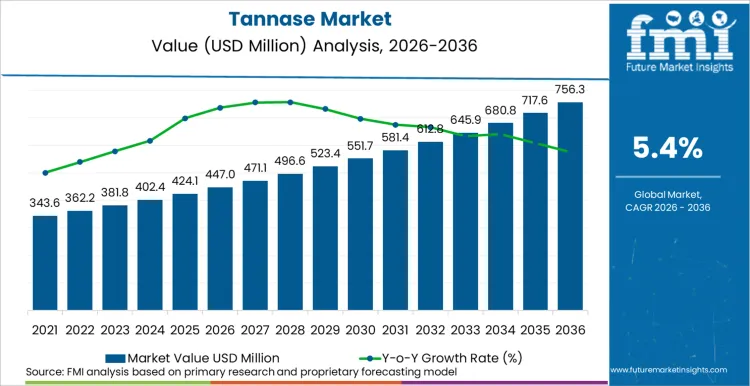
The global tannase sector is on track to achieve a valuation of USD 757.7 Million by 2036, progressing from USD 447.0 Million in 2026 at a CAGR of 5.4%. As per Future Market Insights, expansion is structurally underpinned by the accelerating adoption of enzymatic processing in the food and beverage industry, where tannase is used to hydrolyze tannins in tea, wine, and fruit juice production to improve clarity, taste, and shelf stability. The USA Food and Drug Administration (FDA) issued a GRAS No Questions letter (GRN 001192) in March 2025 for a tannase enzyme preparation produced by Aspergillus oryzae, submitted by Mitsubishi Chemical Corporation, which validates the regulatory pathway for expanded commercial use in food processing. This clearance compels enzyme suppliers to accelerate their product registration pipelines for new microbial-derived tannase formulations. Simultaneously, the regulatory landscape is shifting from fragmented national approvals to harmonized safety frameworks, which forces manufacturers to invest in multi-jurisdictional compliance.
Ester Baiget, CEO of Novonesis, stated: 'Novonesis reflects where we came from, what we can achieve, and what we will become together. We are dedicated to harness the transformative potential of biology.' This statement frames the strategic reality following the January 2024 completion of the Novozymes-Chr. Hansen merger, which created the world's largest industrial biosolutions company with direct implications for the tannase supply chain. FMI opines that this merger has restructured the competitive landscape by concentrating technical enzyme expertise and distribution networks under a single entity. The formation of Novonesis delivered 8% organic sales growth in the first nine months of 2025, confirming that the combined entity is capturing share in food enzyme applications including tannin hydrolysis.
As per FMI, the market is also being reshaped by strategic divestitures. In June 2025, dsm-firmenich completed the EUR 1.5 billion sale of its Feed Enzymes business to refocus on its Taste, Texture and Health division, redirecting R&D resources toward high-margin enzymes used in human nutrition, specifically for beverages and functional foods. Kerry Group released its 2025 strategic roadmap in November 2024, identifying the Processing Paradox as a key trend and signalling increased investment in enzymatic flavoring technologies that use tannase to reduce antinutrients while preserving health-beneficial polyphenols. Amano Enzyme USA expanded its Illinois manufacturing facility by nearly 30,000 square feet, with completion expected by April 2025, to increase production and technical service capacity for food enzymes across North, Central, and South America.
Key Takeaways
- Power dynamics in the tannase market are defined by the dominance of Novonesis following the Novozymes-Chr. Hansen merger, which consolidated the largest share of industrial enzyme R&D and distribution. Downstream beverage manufacturers face limited supplier choice for food-grade tannase, creating a market where pricing and supply terms are set by a small cluster of biosolutions firms including Novonesis, Amano Enzyme, and Kikkoman Biochemifa.
- Pricing asymmetry is evident between high-purity food-grade tannase, which commands premium pricing due to GRAS and Halal/Kosher certification requirements, and lower-grade industrial tannase used in leather processing or wastewater treatment. FMI analysts note that producers with certified product lines capture margins two to three times higher than commodity enzyme suppliers.
- Sourcing fragility is concentrated in microbial fermentation feedstocks and strain availability. The majority of commercial tannase is derived from Aspergillus niger or Aspergillus oryzae strains, and access to proprietary high-yield strains is controlled by a handful of Japanese and European enzyme houses, creating a bottleneck for new entrants.
- Brand and compliance risks are rising as food safety regulators tighten enzyme approval pathways. The FDA GRAS notification process, Halal and Kosher certification requirements, and EU novel food regulations create multi-layered compliance barriers that smaller producers struggle to navigate, increasing the risk of market exclusion.
- Geographic leverage is uneven: North America is a high-value market driven by clean-label beverage demand; Europe is shaped by strict EU enzyme approval regulations; East Asia, led by Japan, is the innovation hub for specialty tannase formulations; South Asia, particularly India, is a growing production base for tea-processing enzymes; Latin America contributes through wine and fruit juice applications; and the Middle East and Africa represent emerging demand linked to Halal-certified enzyme requirements.
- FMI analysts reframe the tannase market as an enzyme platform consolidation story. Executive strategy should focus on securing long-term supply agreements with the newly consolidated enzyme majors and investing in proprietary strain development to reduce dependence on external suppliers.
Summary of Tannase Market
What Is Growth Outlook for Tannase Market as per Future Market Insights Projection?
Future Market Insights projects the tannase market to expand at a CAGR of 5.4% from 2026 to 2036, increasing from USD 447.0 Million in 2026 to USD 757.7 Million by 2036.
FMI Research Approach: FMI proprietary forecasting model based on beverage production volume correlation and enzyme dosage rate analysis across tea, wine, and juice processing.
How Do FMI Analysts Perceive Tannase Market to Evolve?
FMI analysts perceive the market evolving toward supplier consolidation where a small number of biosolutions conglomerates will control both innovation pipelines and commercial pricing for food-grade tannase.
FMI Research Approach: Competitive landscape analysis following the Novozymes-Chr. Hansen merger and dsm-firmenich divestiture activity in 2024 to 2025.
Which Country Holds Largest Share in Global Tannase Market?
Japan holds a significant share of the global tannase market by value, supported by the presence of leading enzyme manufacturers including Kikkoman Biochemifa, Amano Enzyme, and Mitsubishi Chemical, which drive both domestic use and export supply.
FMI Research Approach: FMI country-level revenue modeling based on enzyme production output and FDA/EU regulatory filing activity.
How Large Will Tannase Market Be by 2036?
The global tannase market is projected to reach USD 757.7 Million by 2036.
FMI Research Approach: FMI long-term revenue forecast derived from processed beverage volume projections and enzyme adoption rate modeling.
What Is Definition of Tannase Market?
The tannase market includes revenue generated from the production and sale of tannin acyl hydrolase enzymes used in food and beverage processing, pharmaceutical gallic acid production, leather tanning, and wastewater treatment applications.
FMI Research Approach: FMI market taxonomy and inclusion-exclusion framework based on enzyme classification and end-use application mapping.
What Are Globally Unique Trends Shaping Tannase Market?
Globally unique trends include the consolidation of enzyme producers through mega-mergers, the expansion of FDA GRAS clearances for microbial tannase preparations, and the growing use of enzymatic de-tannification in plant-based beverage formulation.
FMI Research Approach: FDA GRAS notification tracking and biosolutions M&A activity monitoring.
Tannase Market Key Takeaways
| Metric | Details |
|---|---|
| Industry Size (2026) | USD 447.0 Million |
| Industry Value (2036) | USD 757.7 Million |
| CAGR (2026 to 2036) | 5.4% |
Source: Future Market Insights (FMI) analysis, based on proprietary forecasting model and primary research
Semi-Annual Demand Space Update
The below table presents a comparative assessment of the variation in CAGR over six months for the base year (2024) and current year (2025) for global tannase market. This analysis reveals crucial shifts in market performance and indicates revenue realization patterns, thus providing stakeholders with a better vision about the market growth trajectory over the year. The first half of the year, or H1, spans from January to June. The second half, H2, includes the months from July to December.
| Particular | Value CAGR |
|---|---|
| H1 | 4.8% (2025 to 2035) |
| H2 | 5.0% (2025 to 2035) |
| H1 | 5.3% (2026 to 2036) |
| H2 | 5.7% (2026 to 2036) |
The above table presents the expected CAGR for the global tannase demand space over semi-annual period spanning from 2026 to 2036. In the first half (H1) of the year 2024, the business is predicted to surge at a CAGR of 4.8%, followed by a slightly higher growth rate of 5.0% in the second half (H2) of the same year.
Moving into year 2025, the CAGR is projected to increase slightly to 5.3% in the first half and remain relatively moderate at 5.7% in the second half. In the first half (H1 2025) the market witnessed a decrease of 14 BPS while in the second half (H2 2025), the market witnessed an increase of 27 BPS.
Key Industry Highlights
Tannase in Action: Revolutionizing the Craft Beverage Experience
The popularity of craft beverages like specialty beers, artisanal wines and different teas, is motivating companies to try new ingredients and methods. It is being used to help create distinct flavor profiles by breaking down tannins, which can make drinks taste bitter.
By using tannase, companies are making their beverages smoother and more pleasant, further attracting more customers looking for something different. This innovation allows them to stand out in a crowded market as consumers are always on the watch for new and different drink options.
Dogfish Head Craft Brewery: Known for its experimental beers, Dogfish Head often uses unique ingredients and techniques to create distinctive flavors, which may include the use of enzymes like tannase.
Elevating Nutrition: The Benefits of Tannase in Functional Beverages
There is a growing interest in functional foods and beverages which provide health benefits beyond basic nutrition, which is driving the use of tannase. Tannins which is found in many plants can sometimes block the absorption of beneficial nutrients. By using tannase to break down these tannins companies can improve the bioavailability of important components, such as antioxidants and vitamins.
Which means that consumers can get more health benefits from the products they consume. As individuals are becoming more health-conscious and seeking out foods that support their well-being the demand for products improved with tannase is likely to increase, further making them more attractive to buyers.
Garden of Life and NOW Foods offers functional foods and supplements that uses tannase in formulations to improve nutrient absorption.
Tannase in Winemaking: Catering to the Premium Wine Consumer
Wine market is growing quickly worldwide, especially in regions like Asia-Pacific, where more individuals are finding out about wine and liking wine. As the demand is increasing winemakers are looking for ways to upgrade the quality and taste of their wines. By using tannase winemakers are making smoother and more tasty wines that appeal to consumers searching for premium experiences.
Château Lafite Rothschild is a prestigious French winery which is known for its premium wines and which explores various techniques, including the use of tannase, to improve wine quality.
2021 to 2025 Global Tannase Sales Analysis Compared to Demand Forecasts for 2026 to 2036
Global Tannase sales increased at a CAGR of 5.0% from 2021 to 2025. For the next ten years (2026 to 2036), projections are that expenditure on tannase will rise at 5.4% CAGR
Tannase is a versatile enzyme that is used in many different industries, not just in beverages. In the pharmaceutical industry, it can help improve the efficiency of certain medicines by breaking down tannins that may block nutrient absorption. In cosmetics, tannase is used to create products with better textures and skin benefits, as it can improve the properties of natural ingredients.
In agriculture, it helps in improving animal feed by making nutrients more available for digestion. This wide range of applications makes tannase imporatant to many industries, which is leading to increased demand as companies are looking for innovative ways to use it.
The rise of craft beverages has motivated companies to discover new ingredients and techniques, further making the industry more interesting. Tannase is one such ingredient that helps in making different flavor profiles by breaking down tannins, which can make drinks taste bitter.
This allows craft beverage brands to stand out in a crowded market, and attract consumers who are looking for something different and innovative. At the same time, the global wine market is expanding, especially in regions like Asia-Pacific, where more individuals are discovering and enjoying wine.
Dogfish Head Craft Brewery is famous for its experimental approach to brewing, using various ingredients and methods that may involve tannase to enhance flavor profiles.
Market Concentration
Tier 1 companies comprise industry leaders with market revenue of above USD 20 million sales domain share of 35% to 45% in the global sphere. These business leaders are characterized by high production capacity and a wide product portfolio.
These trade leaders are distinguished by their extensive expertise in manufacturing and reconditioning across multiple packaging formats and a broad geographical reach, underpinned by a robust consumer base. Prominent companies within tier 1 include DSM N.V, Novozymes, Creative Enzymes, GlpBio, and Merck KGaA.
Tier 2 companies include mid-size players with revenue of USD 5 to 20 million having presence in specific regions and highly influencing the local retail space. These are characterized by a strong presence overseas and strong consumer base knowledge.
These industry players have good technology and ensure regulatory compliance but may not have advanced technology and wide global reach. Prominent companies in tier 2 include MedChemExpress, Beijing Weinuo'en Bio-Technology, Nanning Doing-higher Bio-tech, Amano Enzyme, and Kikkoman Biochemifa.
Tier 3 includes the majority of small-scale companies operating at the local presence and serving niche demand space having revenue below USD 5 million. These companies are notably oriented towards fulfilling local marketplace demands and are consequently classified within the tier 3 share segment.
They are small-scale players and have limited geographical reach. Tier 3, within this context, is recognized as an unorganized field, denoting a sector characterized by a lack of extensive structure and formalization when compared to organized competitors.
Moreover, forming strategic partnerships with research institutions, universities, and other industry players will help in sharing knowledge and resources. This collaborative approach can lead to innovative solutions and a stronger market presence.
Country-wise Insights
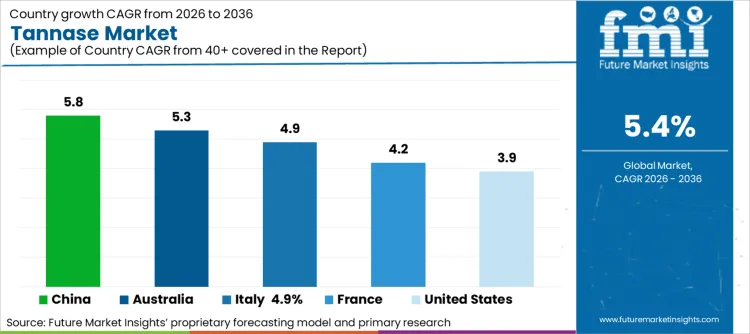
The table below highlights revenue from product sales in key countries. The United States and France are predicted to remain top consumers, with estimated trade valuations of USD 100.6 million and USD 71.9 million, respectively, by 2036.
| Countries | Market Value (2036) |
|---|---|
| United States | USD 100.6 million |
| France | USD 71.9 million |
| Italy | USD 57.5 million |
| Australia | USD 35.9 million |
| China | USD 21.6 million |
The following table shows the estimated growth rates of the top sales domains. Australia and China are set to exhibit high tannase consumption, recording CAGRs of 5.3% and 5.8%, respectively, through 2036.
| Countries | CAGR, 2026 to 2036 |
|---|---|
| United States | 3.9% |
| France | 4.2% |
| Italy | 4.9% |
| Australia | 5.3% |
| China | 5.8% |
United States to Retain Dominance in Tannase Usage
The ecosystem for Tannase in the United States is projected to exhibit a CAGR of 3.9% during the assessment period. By 2036, revenue from the sales of tannase in the country is expected to reach USD 100.6 million.
The USA beverage industry is famous for its creativity and willingness to try new things. Producers are constantly testing with different ingredients and techniques to make their drinks stand out in a crowded market. At the same time, consumers are becoming more picky about the quality of their drinks, especially when it comes to wine and beer.
Winemakers and brewers are using tannase to reduce astringency, which can make drinks taste bitter. By improving the overall flavor and quality of their products, they are attracting more customers who are looking for delightful and high-quality drinking experiences.
Demand Outlook for Tannase in France
Tannase demand in France is calculated to rise at a value CAGR of 4.2% during the forecast period (2026 to 2036). By 2036, France is expected to account for 14.3% of Tannase sales in Europe.
As France is famous for its high-quality wines and winemakers are always looking for ways to make their products better than before. Tannase is an essential ingredient in this process because it helps reduce the astringency. By using tannase, winemakers are making smoother, more delightful wines that appeal to consumers.
French consumers have very high hopes when it comes to wine quality. As they are becoming knowledgeable and getting insights, they are looking for wines that offer rich flavors and a pleasant drinking experience.
The Rise of Tannase: Meeting the Demands of China’s Expanding Wine Market
Tannase demand in China is calculated to rise at a value CAGR of 5.8% during the forecast period (2026 to 2036).
China's wine market is growing quickly, with more individuals are becoming interested in wine. As this market is expanding, winemakers are keen to improve the quality of their products to attract these new consumers. At the same time, the beverage industry in China is embracing innovation.
Producers are trying out with new ingredients and methods to stand out in a competitive market. Tannase is being explored as a way to create unique flavor profiles, further allowing brands to offer something different to consumers.
Category-Wise Insights
Eco-Friendly Enzymes: The Advantages of Plant-Sourced Tannase
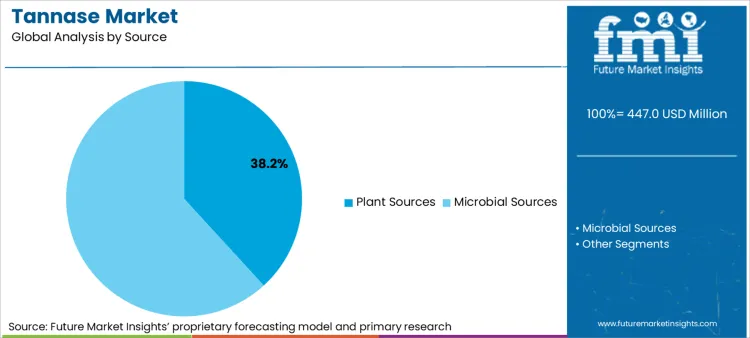
| Segment | Value Share (2026) |
|---|---|
| Plant Sources (Source) | 38.2% |
Plant-sourced tannase is considered a more sustainable choice than microbial sources as it comes from natural plants, which has a lower environmental impact. As companies are aiming to be more eco-friendly and using plant-based enzymes helps them meet sustainability goals.
The food industry is always changing, and plant-sourced tannase is being studied for its ability to enhance flavor, texture, and overall quality in products like wines, teas, and functional foods. This innovation allows companies to make better products while also attracting to consumers who prefer natural and sustainable ingredients.
Health-Ade Kombucha: This brand is known for its commitment to using natural ingredients in its kombucha, and it may explore plant-sourced tannase to enhance flavor and quality.
Innovation and Natural Choices: The Impact of Tannase in Food and Beverage
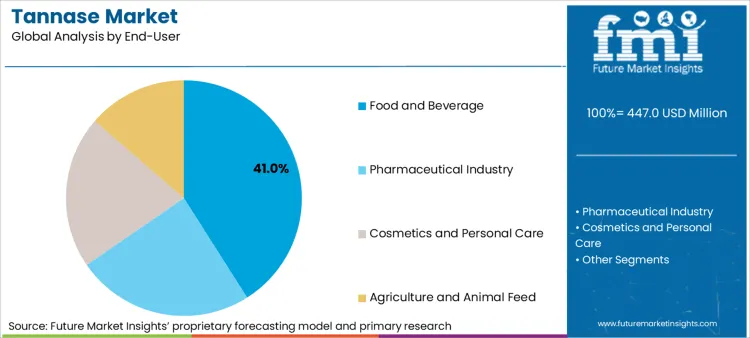
| Segment | Value Share (2026) |
|---|---|
| Food and Beverage Industry (End-User Industry) | 41.3% |
Consumer preferences are shifting towards natural and clean-label products, as more people want to know what is in their food and drinks. Tannase, especially when derived from plants, fits this trend perfectly, attracting consumers who value natural ingredients.
At the same time, the food and beverage industry is always changing, with producers eager to try new ingredients and techniques. Tannase is being studied for its ability to create unique flavors and enhance the quality of various products, helping brands stand out in a competitive market.
Competition Outlook
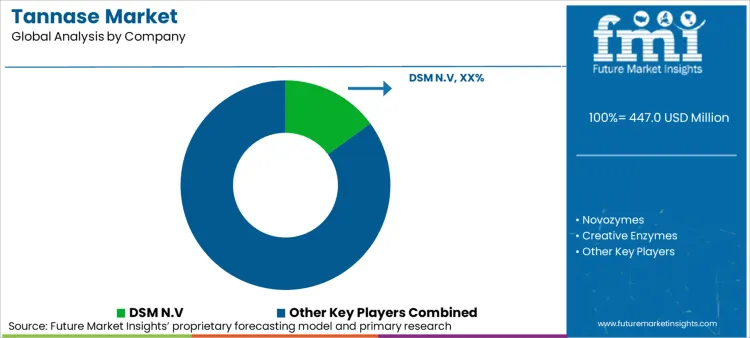
Companies are focusing on research and development to find new sources of tannase, especially plant-based options. This helps them create better and more effective products that meet changing consumer needs. Additionally, they are diversifying their product lines by offering different forms of tannase, like liquid and powdered versions, to serve various industries such as food, beverage, pharmaceuticals, and cosmetics.
Strategic partnerships with research institutions and universities also play a key role, as these collaborations can lead to new ideas and applications for tannase, keeping companies competitive in the market.
Recent Developments:
- In January 2024, the merger between Novozymes and Chr. Hansen was formally completed, creating Novonesis, the global leader in industrial biosolutions. This entity now commands the largest share of the technical enzyme market, including tannase applications for tea, wine, and juice clarification, integrating fermentation expertise with microbial culture capabilities.
- In June 2025, dsm-firmenich completed the EUR 1.5 billion sale of its Feed Enzymes business to redirect R&D investment toward its Taste, Texture and Health division, focusing on high-margin enzymes used in human nutrition, specifically enzymatic solutions that improve the sensory profile of plant-based and tea-derived products.
- In November 2024, Kerry Group released its 2025 strategic roadmap through its Health and Nutrition Institute (KHNI), identifying the Processing Paradox as a key trend and signalling increased investment in enzymatic hydrolysis technologies, including tannase, to reduce antinutrients while preserving beneficial polyphenols in functional beverages.
Leading Tannase Brands
- DSM N.V
- Novozymes
- Creative Enzymes
- GlpBio
- Merck KGaA
- MedChemExpress
- Beijing Weinuo'en Bio-Technology
- Nanning Doing-higher Bio-tech
- Amano Enzyme
- Kikkoman Biochemifa
- Others
Market Definition
The tannase market represents revenue generated from the production, sale, and application of tannin acyl hydrolase enzymes (EC 3.1.1.20) across food and beverage processing, pharmaceutical intermediate production, and industrial applications. The market measures the value of liquid and powder tannase formulations sold to beverage manufacturers, pharmaceutical firms, and industrial processors.
Inclusions cover microbial tannase derived from Aspergillus niger, Aspergillus oryzae, and other fungal/bacterial sources, food-grade GRAS-certified preparations, Halal and Kosher certified enzyme products, and tannase used in instant tea processing, wine clarification, juice de-bittering, and gallic acid production.
Exclusions include general-purpose proteases and lipases not classified as tannase, raw microbial cultures sold for research purposes prior to enzyme extraction, and plant-derived tannin compounds sold as chemical reagents rather than enzyme products.
Research Scope
| Items | Values |
|---|---|
| Quantitative Units (2026) | USD 447.0 Million |
| Product Type | Liquid Tannase, Powder Tannase, Immobilized Tannase |
| Application | Tea Processing, Wine Clarification, Juice De-bittering, Pharmaceutical, Leather, Wastewater |
| Regions Covered | North America, Europe, East Asia, South Asia, Latin America, Middle East & Africa |
| Key Companies Profiled | Novonesis, Amano Enzyme, Kikkoman Biochemifa, Mitsubishi Chemical, dsm-firmenich |
Key Segments of the Report
By Source:
This segment is further categorized into microbial sources (bacteria, fungi, yeast) and plant sources.
By End-User Industry:
This segment is further categorized into food and beverage industry, pharmaceutical industry, cosmetics and personal care, agriculture and animal feed, and biotechnology and research institutions.
By Formulation Type:
This segment is further categorized into Liquid Tannase and Powdered Tannase.
By Region:
Industry analysis has been carried out in key countries of North America, Latin America, Eastern Europe, Western Europe, East Asia, South Asia & Pacific, Central Asia, Balkan and Baltic Countries, Russia & Belarus and the Middle East & Africa.
Bibliography
- USA Food and Drug Administration. (2025, March). GRAS Notice No. GRN 001192: Tannase Enzyme Preparation. FDA.
- Novonesis. (2025, November). Nine-Month Results 2025: 8% Organic Sales Growth. Novonesis Investor Relations.
- Amano Enzyme USA. (2024). Groundbreaking for Facility Expansion in Illinois. Amano Enzyme Newsroom.
- Kerry Group. (2024, November). KHNI 2025 Strategic Roadmap: The Processing Paradox. Kerry Group.
- dsm-firmenich. (2025, June). Completion of Feed Enzymes Business Sale. dsm-firmenich Investor Relations.
Frequently Asked Questions
What is the current value of the Tannase Industry?
The global tannase industry is estimated at a value of USD 447.0 Million in 2026.
At what rate did the revenue stream for tannase grow between 2021 and 2025?
Sales of Tannase increased at 5.0% CAGR between 2021 and 2025.
Who are the leading manufacturers of Tannase?
DSM N.V, Novozymes, Creative Enzymes, GlpBio, and Merck KGaA are some of the leading players in this industry.
Which region will garner a significant value share by 2036?
The Europe domain is projected to hold a revenue share of 28.7% over the forecast period.
What share does North America account for in the global Tannase demand space in 2026?
North America holds 32.1% share of the global demand space for Tannase.
Preview the report firsthand - request a free sample
Get SampleGet the brochure for pricing and purchase details.
Get PDFTable of Content
- Executive Summary
- Global Market Outlook
- Demand-side Trends
- Supply-side Trends
- Technology Roadmap Analysis
- Analysis and Recommendations
- Market Overview
- Market Coverage / Taxonomy
- Market Definition / Scope / Limitations
- Research Methodology
- Chapter Orientation
- Analytical Lens and Working Hypotheses
- Market Structure, Signals, and Trend Drivers
- Benchmarking and Cross-market Comparability
- Market Sizing, Forecasting, and Opportunity Mapping
- Research Design and Evidence Framework
- Desk Research Programme (Secondary Evidence)
- Company Annual and Sustainability Reports
- Peer-reviewed Journals and Academic Literature
- Corporate Websites, Product Literature, and Technical Notes
- Earnings Decks and Investor Briefings
- Statutory Filings and Regulatory Disclosures
- Technical White Papers and Standards Notes
- Trade Journals, Industry Magazines, and Analyst Briefs
- Conference Proceedings, Webinars, and Seminar Materials
- Government Statistics Portals and Public Data Releases
- Press Releases and Reputable Media Coverage
- Specialist Newsletters and Curated Briefings
- Sector Databases and Reference Repositories
- FMI Internal Proprietary Databases and Historical Market Datasets
- Subscription Datasets and Paid Sources
- Social Channels, Communities, and Digital Listening Inputs
- Additional Desk Sources
- Expert Input and Fieldwork (Primary Evidence)
- Primary Modes
- Qualitative Interviews and Expert Elicitation
- Quantitative Surveys and Structured Data Capture
- Blended Approach
- Why Primary Evidence is Used
- Field Techniques
- Interviews
- Surveys
- Focus Groups
- Observational and In-context Research
- Social and Community Interactions
- Stakeholder Universe Engaged
- C-suite Leaders
- Board Members
- Presidents and Vice Presidents
- R&D and Innovation Heads
- Technical Specialists
- Domain Subject-matter Experts
- Scientists
- Physicians and Other Healthcare Professionals
- Governance, Ethics, and Data Stewardship
- Research Ethics
- Data Integrity and Handling
- Primary Modes
- Tooling, Models, and Reference Databases
- Desk Research Programme (Secondary Evidence)
- Data Engineering and Model Build
- Data Acquisition and Ingestion
- Cleaning, Normalisation, and Verification
- Synthesis, Triangulation, and Analysis
- Quality Assurance and Audit Trail
- Market Background
- Market Dynamics
- Drivers
- Restraints
- Opportunity
- Trends
- Scenario Forecast
- Demand in Optimistic Scenario
- Demand in Likely Scenario
- Demand in Conservative Scenario
- Opportunity Map Analysis
- Product Life Cycle Analysis
- Supply Chain Analysis
- Investment Feasibility Matrix
- Value Chain Analysis
- PESTLE and Porter’s Analysis
- Regulatory Landscape
- Regional Parent Market Outlook
- Production and Consumption Statistics
- Import and Export Statistics
- Market Dynamics
- Global Market Analysis 2021 to 2025 and Forecast, 2026 to 2036
- Historical Market Size Value (USD Million) Analysis, 2021 to 2025
- Current and Future Market Size Value (USD Million) Projections, 2026 to 2036
- Y-o-Y Growth Trend Analysis
- Absolute $ Opportunity Analysis
- Global Market Pricing Analysis 2021 to 2025 and Forecast 2026 to 2036
- Global Market Analysis 2021 to 2025 and Forecast 2026 to 2036, By Source
- Introduction / Key Findings
- Historical Market Size Value (USD Million) Analysis By Source , 2021 to 2025
- Current and Future Market Size Value (USD Million) Analysis and Forecast By Source , 2026 to 2036
- Plant Sources
- Microbial Sources
- Plant Sources
- Y-o-Y Growth Trend Analysis By Source , 2021 to 2025
- Absolute $ Opportunity Analysis By Source , 2026 to 2036
- Global Market Analysis 2021 to 2025 and Forecast 2026 to 2036, By End-User
- Introduction / Key Findings
- Historical Market Size Value (USD Million) Analysis By End-User, 2021 to 2025
- Current and Future Market Size Value (USD Million) Analysis and Forecast By End-User, 2026 to 2036
- Food and Beverage
- Pharmaceutical Industry
- Cosmetics and Personal Care
- Agriculture and Animal Feed
- Food and Beverage
- Y-o-Y Growth Trend Analysis By End-User, 2021 to 2025
- Absolute $ Opportunity Analysis By End-User, 2026 to 2036
- Global Market Analysis 2021 to 2025 and Forecast 2026 to 2036, By Region
- Introduction
- Historical Market Size Value (USD Million) Analysis By Region, 2021 to 2025
- Current Market Size Value (USD Million) Analysis and Forecast By Region, 2026 to 2036
- North America
- Latin America
- Western Europe
- Eastern Europe
- East Asia
- South Asia and Pacific
- Middle East & Africa
- Market Attractiveness Analysis By Region
- North America Market Analysis 2021 to 2025 and Forecast 2026 to 2036, By Country
- Historical Market Size Value (USD Million) Trend Analysis By Market Taxonomy, 2021 to 2025
- Market Size Value (USD Million) Forecast By Market Taxonomy, 2026 to 2036
- By Country
- USA
- Canada
- Mexico
- By Source
- By End-User
- By Country
- Market Attractiveness Analysis
- By Country
- By Source
- By End-User
- Key Takeaways
- Latin America Market Analysis 2021 to 2025 and Forecast 2026 to 2036, By Country
- Historical Market Size Value (USD Million) Trend Analysis By Market Taxonomy, 2021 to 2025
- Market Size Value (USD Million) Forecast By Market Taxonomy, 2026 to 2036
- By Country
- Brazil
- Chile
- Rest of Latin America
- By Source
- By End-User
- By Country
- Market Attractiveness Analysis
- By Country
- By Source
- By End-User
- Key Takeaways
- Western Europe Market Analysis 2021 to 2025 and Forecast 2026 to 2036, By Country
- Historical Market Size Value (USD Million) Trend Analysis By Market Taxonomy, 2021 to 2025
- Market Size Value (USD Million) Forecast By Market Taxonomy, 2026 to 2036
- By Country
- Germany
- UK
- Italy
- Spain
- France
- Nordic
- BENELUX
- Rest of Western Europe
- By Source
- By End-User
- By Country
- Market Attractiveness Analysis
- By Country
- By Source
- By End-User
- Key Takeaways
- Eastern Europe Market Analysis 2021 to 2025 and Forecast 2026 to 2036, By Country
- Historical Market Size Value (USD Million) Trend Analysis By Market Taxonomy, 2021 to 2025
- Market Size Value (USD Million) Forecast By Market Taxonomy, 2026 to 2036
- By Country
- Russia
- Poland
- Hungary
- Balkan & Baltic
- Rest of Eastern Europe
- By Source
- By End-User
- By Country
- Market Attractiveness Analysis
- By Country
- By Source
- By End-User
- Key Takeaways
- East Asia Market Analysis 2021 to 2025 and Forecast 2026 to 2036, By Country
- Historical Market Size Value (USD Million) Trend Analysis By Market Taxonomy, 2021 to 2025
- Market Size Value (USD Million) Forecast By Market Taxonomy, 2026 to 2036
- By Country
- China
- Japan
- South Korea
- By Source
- By End-User
- By Country
- Market Attractiveness Analysis
- By Country
- By Source
- By End-User
- Key Takeaways
- South Asia and Pacific Market Analysis 2021 to 2025 and Forecast 2026 to 2036, By Country
- Historical Market Size Value (USD Million) Trend Analysis By Market Taxonomy, 2021 to 2025
- Market Size Value (USD Million) Forecast By Market Taxonomy, 2026 to 2036
- By Country
- India
- ASEAN
- Australia & New Zealand
- Rest of South Asia and Pacific
- By Source
- By End-User
- By Country
- Market Attractiveness Analysis
- By Country
- By Source
- By End-User
- Key Takeaways
- Middle East & Africa Market Analysis 2021 to 2025 and Forecast 2026 to 2036, By Country
- Historical Market Size Value (USD Million) Trend Analysis By Market Taxonomy, 2021 to 2025
- Market Size Value (USD Million) Forecast By Market Taxonomy, 2026 to 2036
- By Country
- Kingdom of Saudi Arabia
- Other GCC Countries
- Turkiye
- South Africa
- Other African Union
- Rest of Middle East & Africa
- By Source
- By End-User
- By Country
- Market Attractiveness Analysis
- By Country
- By Source
- By End-User
- Key Takeaways
- Key Countries Market Analysis
- USA
- Pricing Analysis
- Market Share Analysis, 2025
- By Source
- By End-User
- Canada
- Pricing Analysis
- Market Share Analysis, 2025
- By Source
- By End-User
- Mexico
- Pricing Analysis
- Market Share Analysis, 2025
- By Source
- By End-User
- Brazil
- Pricing Analysis
- Market Share Analysis, 2025
- By Source
- By End-User
- Chile
- Pricing Analysis
- Market Share Analysis, 2025
- By Source
- By End-User
- Germany
- Pricing Analysis
- Market Share Analysis, 2025
- By Source
- By End-User
- UK
- Pricing Analysis
- Market Share Analysis, 2025
- By Source
- By End-User
- Italy
- Pricing Analysis
- Market Share Analysis, 2025
- By Source
- By End-User
- Spain
- Pricing Analysis
- Market Share Analysis, 2025
- By Source
- By End-User
- France
- Pricing Analysis
- Market Share Analysis, 2025
- By Source
- By End-User
- India
- Pricing Analysis
- Market Share Analysis, 2025
- By Source
- By End-User
- ASEAN
- Pricing Analysis
- Market Share Analysis, 2025
- By Source
- By End-User
- Australia & New Zealand
- Pricing Analysis
- Market Share Analysis, 2025
- By Source
- By End-User
- China
- Pricing Analysis
- Market Share Analysis, 2025
- By Source
- By End-User
- Japan
- Pricing Analysis
- Market Share Analysis, 2025
- By Source
- By End-User
- South Korea
- Pricing Analysis
- Market Share Analysis, 2025
- By Source
- By End-User
- Russia
- Pricing Analysis
- Market Share Analysis, 2025
- By Source
- By End-User
- Poland
- Pricing Analysis
- Market Share Analysis, 2025
- By Source
- By End-User
- Hungary
- Pricing Analysis
- Market Share Analysis, 2025
- By Source
- By End-User
- Kingdom of Saudi Arabia
- Pricing Analysis
- Market Share Analysis, 2025
- By Source
- By End-User
- Turkiye
- Pricing Analysis
- Market Share Analysis, 2025
- By Source
- By End-User
- South Africa
- Pricing Analysis
- Market Share Analysis, 2025
- By Source
- By End-User
- USA
- Market Structure Analysis
- Competition Dashboard
- Competition Benchmarking
- Market Share Analysis of Top Players
- By Regional
- By Source
- By End-User
- Competition Analysis
- Competition Deep Dive
- DSM N.V
- Overview
- Product Portfolio
- Profitability by Market Segments (Product/Age /Sales Channel/Region)
- Sales Footprint
- Strategy Overview
- Marketing Strategy
- Product Strategy
- Channel Strategy
- Novozymes
- Creative Enzymes
- GlpBio
- Merck KGaA
- MedChemExpress
- Beijing Weinuo'en Bio-Technology
- DSM N.V
- Competition Deep Dive
- Assumptions & Acronyms Used


