

- Industry Size (2025)
- USD 22.2 Mn
- Forecast (2035)
- USD 33.0 Mn
- CAGR (2025 to 2035)
- 4.1%
Demand for Tannase in Japan Forecast and Outlook 2025 to 2035
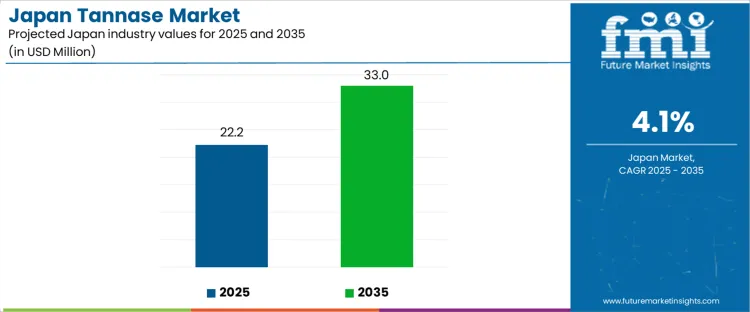
Demand for tannase in Japan is expected to grow from USD 22.2 million in 2025 to USD 33.0 million by 2035, reflecting a compound annual growth rate (CAGR) of 4.1%. Tannase, an enzyme used primarily in the food, beverage, and pharmaceutical industries, plays a key role in breaking down tannins in various products, improving taste, clarity, and stability. As demand for natural, enzyme-based solutions in food and beverage processing rises, so too does the need for tannase. It is widely used in the production of fruit juices, wine, and tea, where it helps reduce astringency and enhance flavor profiles.
Growth in Japan is further supported by the growing focus on clean-label products and the continued expansion of Japan’s food and beverage industry. Advancements in biotechnology and the increasing awareness of the benefits of enzyme applications in food processing will continue to drive demand for tannase over the next decade. As the demand for higher-quality and functional food products grows, tannase is expected to become an even more integral ingredient in food production processes.
Quick Stats of the Demand for Tannase in Japan
- Demand for Tannase in Japan Value (2025): USD 22.2 million
- Demand for Tannase in Japan Forecast Value (2035): USD 33.0 million
- Demand for Tannase in Japan Forecast CAGR (2025-2035): 4.1%
- Demand for Tannase in Japan Leading Source: Microbial Sources (Bacteria, Fungi, Yeast) (65%)
- Demand for Tannase in Japan Key Growth Regions: Kyushu & Okinawa, Kanto, Kansai, Chubu, Tohoku, Rest of Japan
- Demand for Tannase in Japan Key Players: DSM N.V., Novozymes, Creative Enzymes, GlpBio, Merck KGaA
What is the Growth Forecast for the Tannase Market through 2035?
Inflection point mapping for the tannase market in Japan shows steady and consistent growth with key points where the rate of expansion accelerates. Starting at USD 22.2 million in 2025, demand increases to USD 23.1 million in 2026 and USD 24.0 million in 2027, reflecting steady growth as tannase adoption continues to rise across the food, beverage, and pharmaceutical industries.
From 2027 to 2030, the market continues to grow gradually, reaching USD 25.0 million in 2028, USD 26.0 million in 2029, and USD 27.1 million in 2030. These years represent a period of continued steady growth as the application of tannase becomes more widespread in various sectors. Growth rate accelerates slightly by 2031, with the market reaching USD 28.2 million and continuing to grow at a faster pace.
By 2035, demand is expected to reach USD 33.0 million, with the inflection point mapping indicating that the pace of growth accelerates as tannase applications in food and beverage processing become more integrated and the demand for enzyme-based solutions increases.
Key Takeaways of Tannase Industry in Japan
| Metric | Value |
|---|---|
| Industry Sales Value (2025) | USD 22.2 million |
| Industry Forecast Value (2035) | USD 33 million |
| Industry Forecast CAGR (2025-2035) | 4.1% |
What Is Driving the Demand for Tannase in Japan?
Demand for tannase in Japan is driven by its role in enhancing beverage quality, particularly for beverages containing tannin-rich ingredients, such as tea, coffee, and fruit juices. Tannase helps break down tannins, which can contribute to bitterness, astringency, and turbidity in these products. By degrading tannins into simpler molecules, tannase improves the flavor, clarity, and overall quality of beverages, making it a valuable enzyme in the beverage production industry. Tannase is especially useful in the production of instant teas and water-soluble tea products, where its ability to reduce the harshness of tannins enhances solubility and makes the product more palatable. This makes tannase an essential ingredient for manufacturers aiming to improve the consumer experience in the beverage market.
Future demand for tannase in Japan is expected to rise as the consumption of tea, ready-to-drink beverages, and functional drinks continues to grow. With increased focus on improving taste, clarity, and digestibility in beverages, tannase will play a key role in producing more refined, consumer-friendly products. As functional beverages and nutraceutical drinks become more popular, manufacturers may use tannase to manage tannin levels and enhance the bioavailability of beneficial compounds. Demand for tannase will also depend on its ability to meet production needs, cost-effectiveness, and regulatory standards for enzyme-treated products.
What Are the Key Segments in Tannase Market in Japan?
The tannase market in Japan is segmented by source and end-user industry. Microbial sources (including bacteria, fungi, and yeast) lead the source segment, holding 65% of the market share. In terms of end-user industry, the food and beverage industry dominates, accounting for 39% of the market. The growing demand for tannase in various industrial applications, particularly in food processing and pharmaceutical products, is driving market growth in Japan.
Which Source Drives Tannase Demand in Japan?
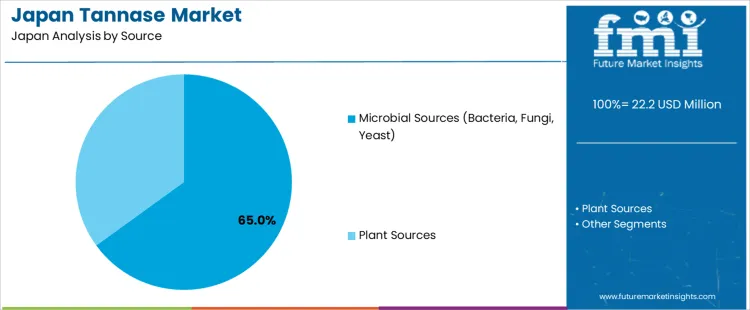
Microbial sources (bacteria, fungi, and yeast) are the primary source of tannase in Japan, representing 65% of the market share. Microbial-derived tannase is widely preferred due to its efficiency, cost-effectiveness, and ability to be produced in large quantities under controlled conditions. Microbial sources offer several advantages, including higher yields and the ability to tailor enzyme properties for specific applications, making them suitable for industries like food processing, pharmaceuticals, and research. While plant sources also contribute to the tannase market, microbial sources dominate due to their ability to meet the growing demand for industrial-scale enzyme production.
Which End-User Industry Drives Tannase Demand in Japan?
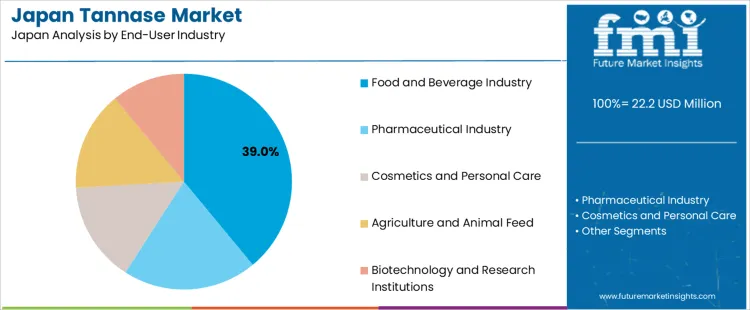
Food and beverage industry is the largest end-user industry for tannase in Japan, accounting for 39% of the market share. Tannase is widely used in the food and beverage industry for various purposes, including the clarification of beverages (such as wine, tea, and fruit juices), as well as for the removal of tannins in food products to improve flavor and texture. The demand for tannase in this sector is driven by the need to enhance product quality, improve processing efficiency, and meet consumer preferences for better-tasting, smoother beverages.
Other industries such as the pharmaceutical industry, cosmetics and personal care, agriculture and animal feed, and biotechnology and research institutions also use tannase, but the food and beverage industry remains the largest driver of demand due to the enzyme's key role in food and drink production processes.
What is the Key Dynamics for Tannase Demand in Japan?
Demand for tannase in Japan is being shaped by the growing use of enzymes in food and beverage processing, where tannase helps reduce bitterness and astringency in teas, juices, wines and other tannin-rich products. As the market for processed beverages, functional beverages and instant drinks expands, the need for quality improvement and flavor refinement supports uptake of tannase. Use of tannase in extraction of beneficial compounds from plant materials for food, nutraceutical and pharmaceutical purposes also reinforces demand. The trend toward cleaner label products and natural-ingredient processing adds to the importance of enzyme-based solutions such as tannase.
What are the Key Drivers for Tannase Demand in Japan?
One key driver is increasing consumption of tea, fruit juices, wines and other tannin-containing beverages in which tannase is used to improve clarity, reduce bitterness, and enhance flavor profile. Demand for instant tea, ready-to-drink beverages and functional drinks encourages use of tannase to ensure consistent taste and shelf stability. The growth of health-oriented foods and nutraceuticals creates demand for tannase to aid extraction or conversion of polyphenols and tannins into more bioavailable and beneficial compounds. Expansion of beverage manufacturing and food processing industries supports enzyme use as manufacturers seek efficient, scalable, and natural processing aids.
What are the Restraints for Tannase Demand in Japan?
One restraint is the cost and complexity associated with industrial-scale production, purification and stabilization of tannase, which may limit adoption among small and medium-scale manufacturers. Variability in tannase activity depending on source, substrate and processing conditions can affect reliability of outcomes and deter some users. Consumer sensitivity regarding enzyme use or additives may constrain demand in segments favoring minimal-processing or traditional methods. Also reliance on imported tannase or raw materials for enzyme production may expose supply chains to global volatility, affecting price competitiveness and availability.
What are the Key Trends in Tannase Demand in Japan?
There is growing interest in microbial-derived tannase produced via fermentation for its cost-effectiveness, consistency, and scalability. Use of tannase not only in traditional beverages but also in functional foods, nutraceuticals and plant-based product lines is rising as manufacturers seek to leverage its ability to improve taste and enhance bioactive compound yield. Enzymatic processing to reduce tannin content, improve digestibility, and refine flavor in teas, juices, wines and plant-based drinks is gaining traction. Demand for environmentally friendly, enzyme-based processing aids and cleaner label products supports further adoption of tannase in food, beverage and nutraceutical industries.
What is the Regional Demand Outlook for Tannase in Japan?
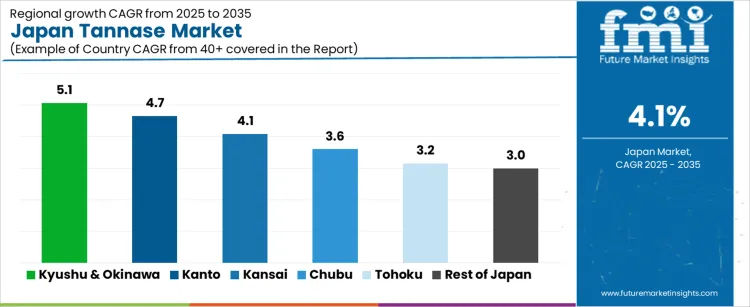
The demand for tannase in Japan is projected to grow steadily, with Kyushu & Okinawa leading the way at a projected CAGR of 5.1%. Kanto follows with a growth rate of 4.7%, while Kansai is expected to grow at 4.1%. Chubu is projected to grow at a rate of 3.6%, while Tohoku and Rest of Japan show more moderate growth, with CAGRs of 3.2% and 3.0%, respectively. The increasing use of tannase in food and beverage, pharmaceuticals, and cosmetics industries, along with the growing awareness of its health benefits, is driving the demand for tannase across Japan.
| Region | CAGR (2025-2035) |
|---|---|
| Kyushu & Okinawa | 5.1% |
| Kanto | 4.7% |
| Kansai | 4.1% |
| Chubu | 3.6% |
| Tohoku | 3.2% |
| Rest of Japan | 3.0% |
What is Driving the Growth of Tannase in Kyushu & Okinawa?
Kyushu & Okinawa is projected to experience the highest growth in the tannase market, with a projected CAGR of 5.1%. The region’s growing food and beverage industry, particularly in sectors like tea, wine, and fruit processing, is a key driver of this growth. Tannase, which is used to hydrolyze tannins in various foods and beverages, is becoming increasingly popular in Kyushu & Okinawa for improving flavor and reducing bitterness.
The region’s focus on traditional and artisanal food products, which often contain tannins, is contributing to the rising demand for tannase. Additionally, as consumer awareness of health benefits increases, the demand for tannase in functional foods and beverages is expected to rise. With the region’s strong focus on innovation in food processing and ingredient development, the market for tannase in Kyushu & Okinawa is expected to continue growing.
Why is the Tannase Market Expanding in Kanto?
In Kanto, the demand for tannase is projected to grow at a CAGR of 4.7%. Kanto, which includes Tokyo, is Japan’s most populous and technologically advanced region, making it a major market for food, beverage, and health-related products. The rising consumer interest in functional foods, beverages, and natural ingredients is driving the demand for tannase. Tannase is increasingly used in the production of tea, wine, fruit juices, and other beverages to reduce bitterness and enhance flavor, making it highly relevant in Kanto’s dynamic food and beverage industry.
Moreover, the region’s expanding pharmaceutical and cosmetic sectors are also contributing to the market growth as tannase is utilized in various health supplements and skincare formulations. The increasing focus on clean-label, natural products and the growing demand for health-enhancing ingredients in Kanto will support continued demand for tannase.
How is the Tannase Market Growing in Kansai?
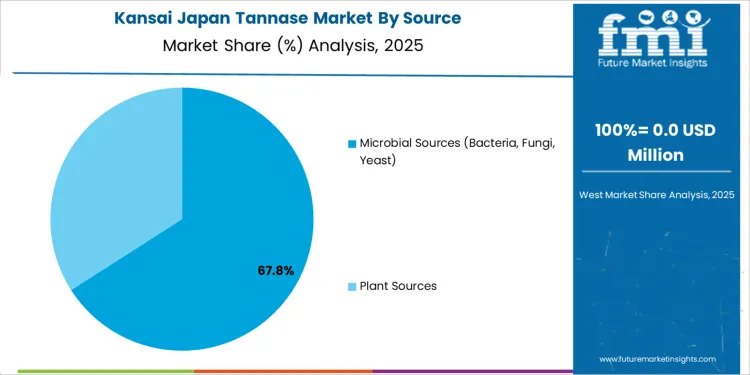
In Kansai, the tannase market is projected to grow at a CAGR of 4.1%. Kansai, which includes cities like Osaka and Kyoto, has a strong food culture and manufacturing base. The growing demand for functional food ingredients and healthier beverage options is driving the need for tannase in the region. Tannase is used in the production of beverages such as tea and wine, where it helps reduce bitterness and enhance flavor profiles. Kansai’s food and beverage industry is focusing on improving product quality and meeting consumer preferences for more natural and health-conscious offerings, which is supporting the adoption of tannase. Additionally, the region’s interest in traditional and artisanal food products, which often contain tannins, further drives the growth of the tannase market in Kansai.
What is Contributing to the Growth of Tannase in Chubu?
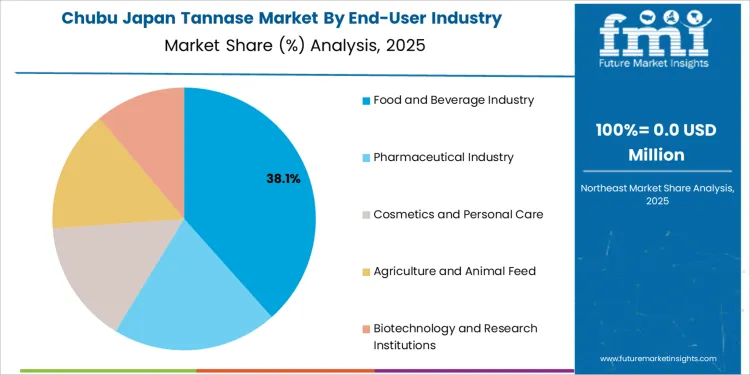
In Chubu, the tannase market is expected to grow at a CAGR of 3.6%. Chubu, home to Nagoya, has a diverse industrial base, with a growing focus on food and beverage innovation. The demand for tannase in Chubu is driven by its applications in tea, fruit processing, and wine production, where it is used to reduce tannin levels and improve product quality. The region’s food manufacturers are increasingly adopting tannase to meet consumer demands for smoother, less bitter beverages and foods. As Chubu continues to modernize its food processing techniques and improve the quality of its offerings, the adoption of tannase is expected to rise, contributing to the steady growth of the market.
What is Influencing the Growth of Tannase in Tohoku?
In Tohoku, the demand for tannase is projected to grow at a CAGR of 3.2%. While the growth rate is slower compared to other regions, the increasing adoption of tannase in food and beverage processing is contributing to steady market growth. Tannase’s ability to reduce bitterness and improve the flavor profile of products such as tea and fruit juices is making it more popular in Tohoku’s food industry. As consumer preferences for more natural and functional products increase, the demand for tannase is expected to rise gradually. The region’s focus on improving food quality and production efficiency will also support the growth of the tannase market in the coming years.
What is Contributing to the Growth of Tannase in Rest of Japan?
In Rest of Japan, the tannase market is expected to grow at a more moderate rate of 3.0%. While the demand is smaller compared to more urbanized regions, there is an increasing need for tannase in food production, particularly in rural areas where traditional food processing is prevalent. As businesses in Rest of Japan modernize their production techniques and adopt more efficient methods for product development, the use of tannase is expected to rise. The increasing availability of natural food ingredients and the growing trend of health-conscious eating are further supporting the adoption of tannase in the region. The continued development of food processing capabilities in Rest of Japan will contribute to the gradual expansion of the tannase market.
What is the Competitive Landscape for Demand for Tannase in Japan?
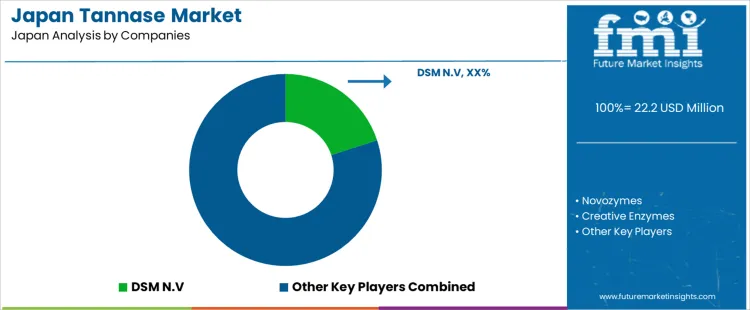
Demand for tannase in Japan is growing as the food and beverage, nutraceutical, and cosmetic industries seek natural, enzyme-based solutions to improve product quality and flavor profiles. Tannase, an enzyme that breaks down tannins into simpler compounds, is widely used in beverages like tea, coffee, fruit juices, and wine to reduce bitterness, astringency, and turbidity. As Japanese consumers increasingly demand milder-tasting beverages and functional drinks with health benefits, the demand for tannase continues to rise. Additionally, the trend toward clean-label, natural-ingredient products further boosts its use in the food, beverage, and wellness sectors.
On the supply side, several global enzyme and chemical-ingredient companies compete to meet this growing demand. DSM N.V. holds a leading share of around 20%, followed by Novozymes, Creative Enzymes, GlpBio, and Merck KGaA. These companies supply food-grade tannase, often produced via microbial fermentation for improved yield, consistency, and cost-efficiency. Competition among suppliers centers on enzyme purity, food-safety compliance, supply reliability, and flexibility in meeting local flavor preferences.
Key Players of the Tannase Industry in Japan
- DSM N.V
- Novozymes
- Creative Enzymes
- GlpBio
- Merck KGaA
Scope of the Report
| Items | Values |
|---|---|
| Quantitative Units (2025) | USD Million |
| Source | Microbial Sources (Bacteria, Fungi, Yeast), Plant Sources |
| End-User Industry | Food and Beverage Industry, Pharmaceutical Industry, Cosmetics and Personal Care, Agriculture and Animal Feed, Biotechnology and Research Institutions |
| Formulation Type | Liquid Tannase, Powdered Tannase |
| Companies | DSM N.V, Novozymes, Creative Enzymes, GlpBio, Merck KGaA |
| Regions Covered | Kyushu & Okinawa, Kanto, Kansai, Chubu, Tohoku, Rest of Japan |
| Additional Attributes | Dollar by sales by source, end-user industry, formulation type, and region. Includes tannase performance in various applications (e.g., tannin breakdown in food and beverage, pharmaceutical applications, etc.), cost-effectiveness in production, market trends towards plant-based and microbial sources, impact on product quality and shelf life, regulatory compliance, sustainability in production, market share and competitive positioning of key companies, and the role of tannase in improving product formulations across different industries. |
Key Segments in the Demand for Tannase in Japan
Source
- Microbial Sources (Bacteria, Fungi, Yeast)
- Plant Sources
End-User Industry
- Food and Beverage Industry
- Pharmaceutical Industry
- Cosmetics and Personal Care
- Agriculture and Animal Feed
- Biotechnology and Research Institutions
Formulation Type
- Liquid Tannase
- Powdered Tannase
Region
- Kyushu & Okinawa
- Kanto
- Kansai
- Chubu
- Tohoku
- Rest of Japan
Frequently Asked Questions
How big is the demand for tannase in Japan in 2025?
The demand for tannase in Japan is estimated to be valued at USD 22.2 million in 2025.
What will be the size of tannase in Japan in 2035?
The market size for the tannase in Japan is projected to reach USD 33.0 million by 2035.
How much will be the demand for tannase in Japan growth between 2025 and 2035?
The demand for tannase in Japan is expected to grow at a 4.1% CAGR between 2025 and 2035.
What are the key product types in the tannase in Japan?
The key product types in tannase in Japan are microbial sources (bacteria, fungi, yeast) and plant sources.
Which end-user industry segment is expected to contribute significant share in the tannase in Japan in 2025?
In terms of end-user industry, food and beverage industry segment is expected to command 39.0% share in the tannase in Japan in 2025.
Preview the report firsthand - request a free sample
Get SampleGet the brochure for pricing and purchase details.
Get PDFTable of Content
- Executive Summary
- Japan Market Outlook
- Demand-side Trends
- Supply-side Trends
- Technology Roadmap Analysis
- Analysis and Recommendations
- Market Overview
- Market Coverage / Taxonomy
- Market Definition / Scope / Limitations
- Market Background
- Market Dynamics
- Drivers
- Restraints
- Opportunity
- Trends
- Scenario Forecast
- Demand in Optimistic Scenario
- Demand in Likely Scenario
- Demand in Conservative Scenario
- Opportunity Map Analysis
- Product Life Cycle Analysis
- Supply Chain Analysis
- Investment Feasibility Matrix
- Value Chain Analysis
- PESTLE and Porter’s Analysis
- Regulatory Landscape
- Regional Parent Market Outlook
- Production and Consumption Statistics
- Import and Export Statistics
- Market Dynamics
- Japan Market Analysis 2020 to 2024 and Forecast, 2025 to 2035
- Historical Market Size Value (USD Million) Analysis, 2020 to 2024
- Current and Future Market Size Value (USD Million) Projections, 2025 to 2035
- Y-o-Y Growth Trend Analysis
- Absolute $ Opportunity Analysis
- Japan Market Pricing Analysis 2020 to 2024 and Forecast 2025 to 2035
- Japan Market Analysis 2020 to 2024 and Forecast 2025 to 2035, By Source
- Introduction / Key Findings
- Historical Market Size Value (USD Million) Analysis By Source , 2020 to 2024
- Current and Future Market Size Value (USD Million) Analysis and Forecast By Source , 2025 to 2035
- Microbial Sources (Bacteria, Fungi, Yeast)
- Plant Sources
- Y-o-Y Growth Trend Analysis By Source , 2020 to 2024
- Absolute $ Opportunity Analysis By Source , 2025 to 2035
- Japan Market Analysis 2020 to 2024 and Forecast 2025 to 2035, By End-User Industry
- Introduction / Key Findings
- Historical Market Size Value (USD Million) Analysis By End-User Industry, 2020 to 2024
- Current and Future Market Size Value (USD Million) Analysis and Forecast By End-User Industry, 2025 to 2035
- Food and Beverage Industry
- Pharmaceutical Industry
- Cosmetics and Personal Care
- Agriculture and Animal Feed
- Biotechnology and Research Institutions
- Y-o-Y Growth Trend Analysis By End-User Industry, 2020 to 2024
- Absolute $ Opportunity Analysis By End-User Industry, 2025 to 2035
- Japan Market Analysis 2020 to 2024 and Forecast 2025 to 2035, By Formulation Type
- Introduction / Key Findings
- Historical Market Size Value (USD Million) Analysis By Formulation Type, 2020 to 2024
- Current and Future Market Size Value (USD Million) Analysis and Forecast By Formulation Type, 2025 to 2035
- Liquid Tannase
- Powdered Tannase
- Y-o-Y Growth Trend Analysis By Formulation Type, 2020 to 2024
- Absolute $ Opportunity Analysis By Formulation Type, 2025 to 2035
- Market Structure Analysis
- Competition Dashboard
- Competition Benchmarking
- Market Share Analysis of Top Players
- By Regional
- By Source
- By End-User Industry
- By Formulation Type
- Competition Analysis
- Competition Deep Dive
- DSM N.V
- Overview
- Product Portfolio
- Profitability by Market Segments (Product/Age /Sales Channel/Region)
- Sales Footprint
- Strategy Overview
- Marketing Strategy
- Product Strategy
- Channel Strategy
- Novozymes
- Creative Enzymes
- GlpBio
- Merck KGaA
- DSM N.V
- Competition Deep Dive
- Assumptions & Acronyms Used
- Research Methodology


