

- Market Size (2026)
- USD 188.0 Mn
- Forecast (2036)
- USD 1751.0 Mn
- CAGR (2026 to 2036)
- 25.0%
How big is the Tele-Robotic Ultrasound & Remote Diagnostics Market in 2026?
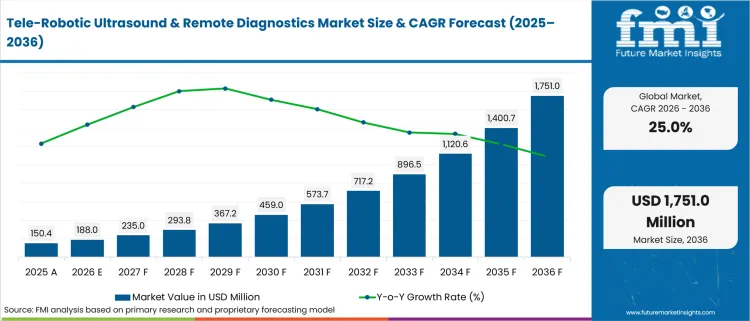
USD 188.0 million in 2026 and USD 1,751.0 million by 2036 at a 25.0% CAGR.
Demand for tele-robotic ultrasound and remote diagnostics is projected to expand at a 25.0% CAGR between 2026 and 2036, pushing value from USD 188.0 million in 2026 to USD 1,751.0 million by 2036. Expansion is expected to be supported by persistent staffing gaps in diagnostic imaging. The American Society of Radiologic Technologists reported in July 2025 that the USA sonography vacancy rate reached 12.4%, highlighting a constraint that can leave existing ultrasound systems underutilized when qualified operators are unavailable. Tele‑robotic platforms address this gap by enabling a remote specialist to control the scan while a trained clinician remains bedside, allowing hospitals to maintain diagnostic coverage without expanding on‑site specialist headcount.
Europe and Japan are likely to adopt remote ultrasound at different speeds due to different rules and hospital practices. The European Commission reported in March 2025 that the European Health Data Space Regulation entered into force on March 26, 2025. The regulation supports secure exchange of medical images and reports between hospitals and other health services. Each remote program must state who is responsible for the scan and how patient safety is managed. Japan has broad hospital capacity but remote practice remains guided by specialist rules and local service design. Japan's Ministry of Health, Labour and Welfare reported in March 2025 that doctor-to-doctor telemedicine remained an active policy area. Teleradiology services can add live scanning without placing a complete specialist team at every connected site.
Key Takeaways of Tele-Robotic Ultrasound & Remote Diagnostics Market
- Demand for tele-robotic ultrasound and remote diagnostics is driven by hospitals that own ultrasound equipment but lack qualified sonographers on-site, letting one specialist support planned examinations at several hospitals remotely.
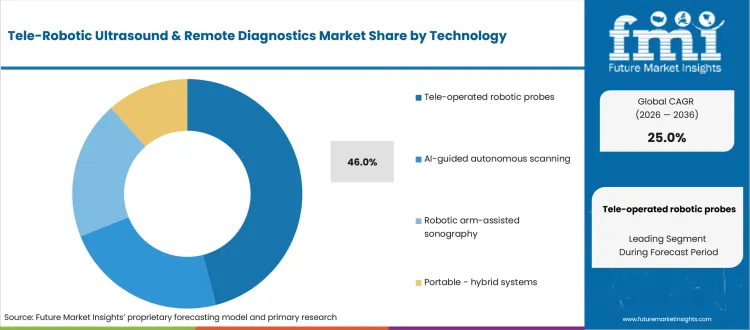
- By technology, tele-operated robotic probes are expected to lead with 46.0% share in 2026, offering the clearest route into routine diagnosis through direct specialist control from a remote console.
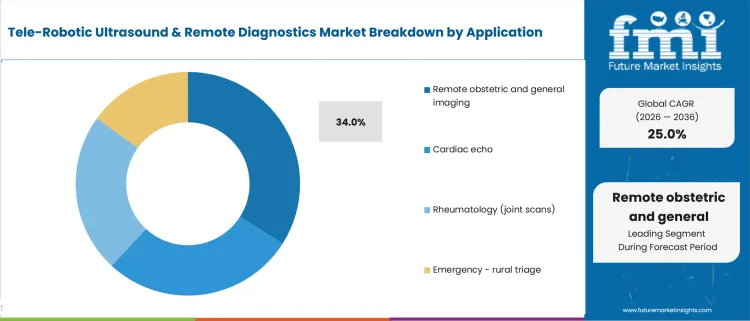
- Remote obstetric and general imaging are the dominant application segment, projected to hold 34.0% share in 2026, reflecting frequent planned examinations and clear access gaps.
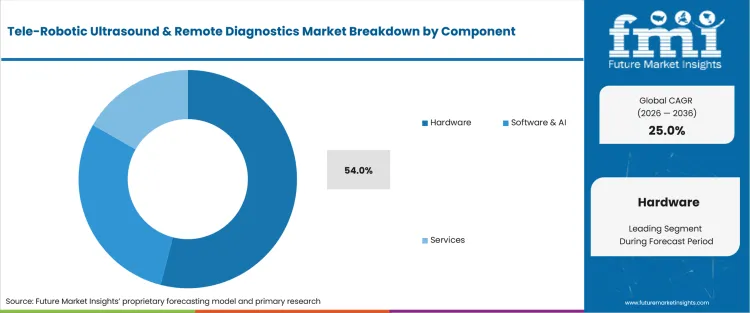
- Hardware is estimated to lead the component category with 54.0% share in 2026, as robotic arms and probe interfaces account for much of the initial purchase.
- Trained local staff and dependable connections remain critical to commercial value, as the case depends on completed examinations and travel avoided rather than the number of systems purchased.
- The European Union and Japan are expected to lead growth at 26.0% and 23.0% CAGR respectively through 2036, with workforce distribution and clinical responsibility shaping growth more than equipment availability alone.
- Competition centers on AdEchoTech, ROPCA, Life Science Robotics, Mendaera, Philips, and GE HealthCare, with vendors differentiating through tele-operated versus autonomous scanning approaches, obstetric focus, procedure-guidance robotics, and established service networks.
Analyst Perspective
"The telerobotic ultrasound systems market is advancing as healthcare providers expand diagnostic access without compromising clinical quality or patient safety. Successful deployments depend on seamless integration into established imaging workflows, clearly defined clinical responsibilities, and reliable performance across remote examinations. Healthcare organizations are placing greater value on platforms that support trained clinicians with dependable robotic control, consistent image acquisition, and robust technical support throughout routine clinical use."
- Anurag Sharma, Principal Consultant, Healthcare
Source: FMI's proprietary forecasting model and primary research
How is the Tele-Robotic Ultrasound & Remote Diagnostics Market segmented?
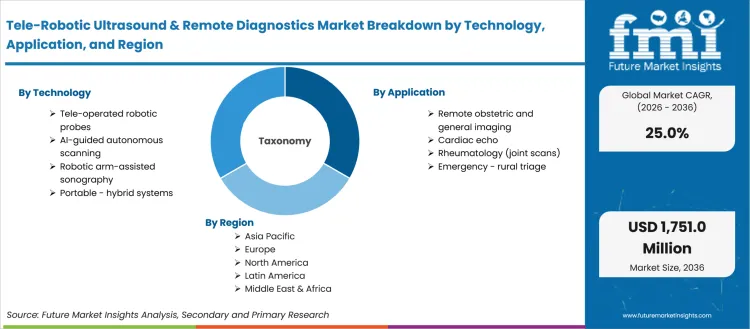
Technology, application, component, end user, business model, and region
The report segments the market by technology, application, component, end user, business model, and region. Technology compares tele-operated probes with autonomous scanning and robot-assisted systems used safely beside the patient. Applications cover obstetric imaging and cardiac echo together with joint scans and rural emergency triage services. Component analysis separates robotic hardware from software and clinical support services used across each system. End users include regional hospitals and university centers plus imaging networks and mobile-care programs in regional care. Business models compare direct purchase and leasing with subscriptions and pilot programs used during early adoption. Regional analysis considers staffing gaps and network quality across large health systems and care networks. The category overlaps with medical robots that control probe movement and telemedicine equipment that carries images plus control signals between sites.
How do tele-operated robotic probes shape the technology category?
Tele-operated systems leave image acquisition in the hands of a sonographer or radiologist working from a remote console. A clinician beside the patient prepares the room and maintains safe probe contact throughout the examination. GE HealthCare reported in December 2025 that it presented autonomous ultrasound concepts for clinical feedback. This contrast matters for hospitals that may adopt tele-operated platforms sooner through a familiar remote-specialist model. Autonomous ultrasound guidance and full-body AI ultrasound imaging follow a different clinical path that needs more validation.
- In 2026 tele-operated robotic probes are expected to lead the technology category with 46.0% share. AdEchoTech's MELODY uses this model through a trained clinician beside the patient and a remote expert who performs the scan. The arrangement suits hospitals that need specialist oversight without moving the patient to another center.
- Hospital programs are expected to favor tele-operated systems for planned abdominal and obstetric examinations that follow predictable preparation steps. Local staff prepare the patient and position the robot under direction from the remote specialist during each appointment. Each service needs a response plan for network loss or a sudden change in the patient's condition.
What supports remote obstetric and general imaging within the application category?
Routine obstetric and abdominal scans give remote ultrasound programs a practical entry point in regional hospitals with limited specialist coverage. These examinations need specialist judgment yet follow planned appointments and stable preparation steps at the patient location. The Society of Radiographers reported in March 2026 that the United Kingdom sonography vacancy rate reached 24.2%. Its survey highlighted obstetric and gynecology services as areas with acute staffing pressure across the country. Remote scanning can protect appointment capacity in these services if local staff receive clear training and clinical support.
- Remote obstetric and general imaging are forecast to represent 34.0% of application demand in 2026. NHS England reported in May 2025 that 603,200 patients were waiting for non-obstetric ultrasound at the end of March 2025. They represented 35.4% of the national diagnostic waiting list and created a large pool of planned examinations.
- Regional hospitals can use remote scanning to complete examinations that might otherwise require long patient travel. Obstetric and abdominal scans use repeatable preparation steps and allow live direction from the remote specialist. Emergency cases carry greater risk and need local clinicians who can respond immediately to changes in the patient's condition.
Why does hardware lead the component category?
Robotic arms and probe mounts account for most initial spending in tele-operated systems used for remote clinical work. The hardware must apply steady pressure and follow the remote clinician's hand movements without harming the patient. Communication software carries live images and control signals between the patient room and the remote specialist. The FDA cleared Mendaera's guidance system in July 2025 for robotic instrument placement with live ultrasound. The clearance did not cover remote diagnosis, yet it shows that regulators assess the robot and its software as one medical system.
- Hardware is projected to hold 54.0% of component spending in 2026 as motion control and probe integration account for much of the initial purchase. Imaging departments must review cleaning methods and pressure limits against the ultrasound systems already used in each hospital. Service plans need calibration and repair coverage so one failed robotic arm does not halt the entire program.
- Revenue from software and services is projected to rise as installed systems need secure updates and remote support. These services must protect image transfer and keep network delay low at every connected hospital site. A software fault can interrupt probe control and clinician communication during a live examination, so hospitals need strict access controls and rapid support.
What are the drivers, restraints, and opportunities in the Tele-Robotic Ultrasound & Remote Diagnostics Market?
Driver: persistent sonographer shortages are expected to increase hospital demand for remote robotic ultrasound services. Restraint: hospitals need clear proof of image quality and patient safety for every examination offered remotely. Opportunity: regional networks can bring scheduled ultrasound closer to rural patients and use scarce specialists across several sites.
- Driver: Health systems are expected to use remote robotic scanning to protect examination capacity in regions with persistent sonography vacancies.
- Restraint: Hospitals must document image quality and patient safety for every examination included in a remote robotic service.
- Opportunity: Regional imaging networks can reduce travel by bringing scheduled ultrasound services closer to patients outside major hospital centers.
Staff shortages create the clearest commercial case for tele-robotic ultrasound in regional care networks with limited specialist coverage. AdEchoTech reported in May 2026 that a Norwegian prenatal program could remove up to 140 kilometers of travel for one appointment. The study included 46 pregnant women and reported correlations as high as 0.993 against standard ultrasound. These results connect better access with measured image performance and let health systems judge the service by completed examinations and travel avoided rather than equipment ownership alone.
Launching a remote robotic service requires more planning than purchasing a standard ultrasound system for one hospital. The service combines probe movement and image capture inside one regulated medical system used across two sites. Medical Device Coordination Group guidance published in June 2025 states that software influencing medical hardware may qualify as an accessory. Each platform needs a clearly stated use supported by evidence for image quality and patient safety. Hospitals must define the examinations covered by the service and assign clinical responsibility at both sites.
Remote imaging networks can extend ultrasound services into places that lack a specialist on site. India's Ministry of Earth Sciences reported in February 2026 that a tele-robotic system linked AIIMS New Delhi with Maitri Station in Antarctica over 12,000 kilometers. The six-axis arm delivered diagnostically reliable images with less than one second of communication delay. This test shows that remote scanning can support urgent clinical decisions across isolated settings during emergencies. The commercial opening is significant for real-time e-healthcare systems that maintain image quality and clinician communication over long distances.
Which country CAGRs are profiled in the tele-robotic ultrasound & remote diagnostics market?
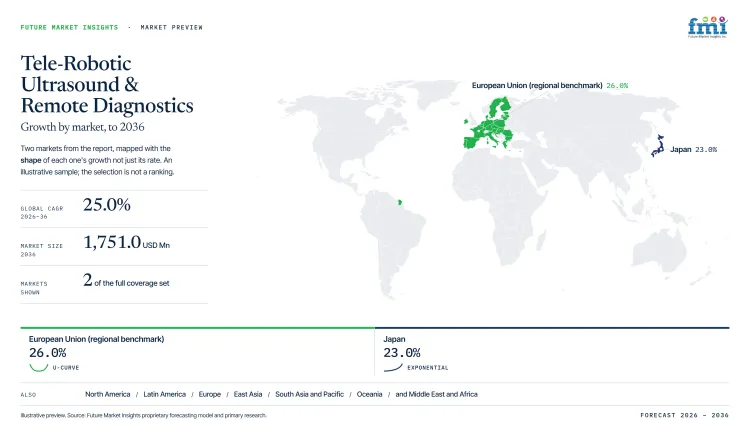
| Country | CAGR |
|---|---|
| European Union (regional benchmark) | 26.0% |
| Japan | 23.0% |
Source: FMI's proprietary forecasting model and primary research
How do country-level CAGRs compare in the tele-robotic ultrasound & remote diagnostics market?
The comparison spans 3.0 percentage points and points to a closely aligned growth outlook across the tele-robotic ultrasound & remote diagnostics market. The European Union regional benchmark leads with a CAGR of 26.0%, while Japan follows at 23.0%. Both markets are advancing through wider adoption of remote healthcare technologies, although deployment priorities reflect different healthcare delivery models and clinical integration strategies.
- The European Union regional benchmark records the higher CAGR at 26.0%. Healthcare providers are increasingly evaluating tele-robotic ultrasound systems that enable specialists to conduct diagnostic imaging from remote locations, improving access to expertise in underserved areas and supporting more connected healthcare services. Adoption varies across member states because digital health infrastructure and reimbursement frameworks differ throughout the region.
- Japan follows with a CAGR of 23.0%, remaining 3.0 percentage points below the European Union benchmark. Interest is centered on expanding access to diagnostic imaging in rural communities, strengthening telemedicine capabilities and improving specialist availability through remotely operated ultrasound platforms. An aging population and continued investment in healthcare technology further reinforce evaluation of remote diagnostic solutions.
Comparable CAGRs do not necessarily create identical commercial opportunities. Differences in healthcare infrastructure, telemedicine regulations, clinical workflows and reimbursement policies influence implementation timelines and long-term supplier positioning. The full report provides country-level CAGR analysis across North America, Latin America, Europe, East Asia, South Asia, Oceania and the Middle East and Africa.
Country-wise Analysis
Europe benefits from cross-border digital-health policy and a local base of established robotic ultrasound developers. Japan has broad hospital capacity but remote services remain guided by specialist practice and local rules. Both geographies need trained staff beside the patient and reliable links to the remote specialist.
-
European health systems face a workforce shortage that makes shared diagnostic capacity more valuable across regional care networks. The European Union is projected to grow at a 26.0% CAGR from 2026 to 2036. The European Commission reported in January 2025 that the region faced a combined shortage of 1.2 million doctors, nurses and midwives. Commercial use is expected to be more in networks that define one examination scope and share a trained specialist team across several sites.
- Japan combines high medical capacity with uneven specialist access beyond the country's largest cities and established university hospitals. Tele-robotic ultrasound demand in Japan is forecast to rise at a 23.0% CAGR from 2026 to 2036. Melody International reported via JICA in February 2026 that its iCTG remote fetal monitoring device had been deployed across 130 medical facilities in 39 of Japan's 47 prefectures by the end of 2025. The program uses remote fetal monitoring rather than robotic ultrasound; its scale shows that hospitals can organize remote maternal care across many locations. Tele-robotic providers must match that service reliability and give local clinicians a clear role in patient preparation and examination safety.
Who are the notable companies in the Tele-Robotic Ultrasound & Remote Diagnostics Market?
AdEchoTech and Life Science Robotics focus on remote or robot-assisted scanning across planned hospital examinations. ROPCA and Mendaera cover autonomous acquisition or procedure guidance; Philips and GE HealthCare add connected ultrasound support.
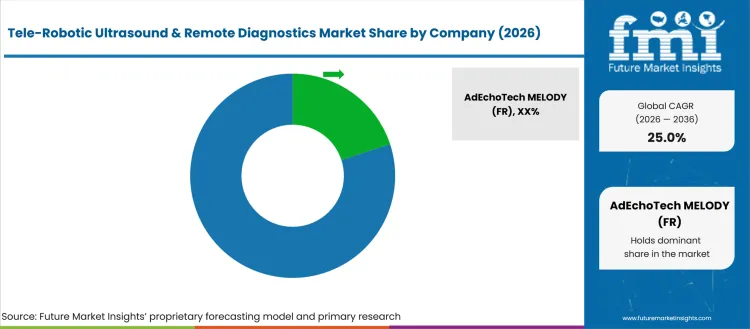
Competitive outlook contains focused robotics developers and larger imaging groups that add remote support to established ultrasound systems. AdEchoTech and Life Science Robotics provide remote or robot-assisted scanning for planned hospital examinations across hospital networks. ROPCA automates joint ultrasound for rheumatology and Mendaera guides needle-based procedures beside the patient during planned procedures. Philips and GE HealthCare add specialist support or automation through imaging systems used across several care settings. Hospitals using cardiovascular ultrasound can add remote expertise to complex cardiac studies across regional imaging networks. Portable cardiology ultrasound systems can extend that support into bedside care and smaller hospitals with limited specialist coverage. Selection depends on the clinical task and service model rather than a broad claim of remote ultrasound.
- Focused robotics companies focuses on control accuracy and a clinical purpose that hospitals can evaluate against one examination. AdEchoTech supports remote abdominal and obstetric scans from a specialist console across hospitals with expert shortages. ROPCA automates hand and wrist examinations for rheumatology clinics that need consistent images over time. Life Science Robotics supports obstetric scanning through robot-assisted probe handling that reduces physical strain during examinations.
- Large imaging companies add remote support to ultrasound platforms already used in routine hospital care across many regions. Philips offers live screen sharing and specialist guidance across selected systems used at the bedside. GE HealthCare contributes a broad service network and a large installed imaging base across global hospitals. Their advantage comes from existing equipment and training capacity rather than one dedicated robotic platform.
- Mendaera represents a separate branch of the category focused on ultrasound-guided procedures completed beside the patient. Its handheld robot supports precise instrument placement during minimally invasive treatment under live ultrasound guidance.
Competitive Benchmarking: Tele-Robotic Ultrasound & Remote Diagnostics Market
| Company | Remote Scanning Support | Autonomous Acquisition | Clinical Evidence | Service Reach |
|---|---|---|---|---|
| AdEchoTech | High | Low | High | Europe and selected international programs |
| Life Science Robotics | Medium | Low | Medium | Europe |
| ROPCA | Low | High | Medium | Europe |
| Mendaera | Low | Medium | High | United States |
| Philips | High | Medium | High | Global |
| GE HealthCare | Medium | Medium | Medium | Global |
Scoring basis: High indicates a direct capability supported by a documented product or clinical use. A Medium rating indicates relevant but partial coverage of the assessed capability within the current market. A Low rating indicates limited evidence for the assessed capability within the current market scope. Service reach reflects the geographic coverage documented in official company sources available by July 2026.
Source: Future Market Insights competitive analysis, 2026. Ratings reflect relative product relevance and documented clinical fit across the assessed market.
Key Developments in the Tele-Robotic Ultrasound & Remote Diagnostics Market
- In October 2025, Life Science Robotics placed its ARUS robot-assisted obstetric ultrasound system on GE HealthCare's Voluson Solution Store for women's health programs that use established Voluson platforms. ARUS combines joystick control and haptic feedback with adaptive pressure support, giving obstetric teams a defined route to add robot-assisted scanning and extending the smaller company's reach through GE HealthCare's network in obstetric care.
- In September 2025, Mendaera announced the first procedures completed with its Focalist handheld robotic system for patients receiving kidney stone treatment in the United States and began a limited commercial launch in urology.
- In June 2025, Philips launched the Flash 5100 point-of-care ultrasound system with built-in Collaboration Live support for immediate remote guidance during bedside examinations across emergency and ward settings.
- In March 2025, GE HealthCare expanded its work with NVIDIA on autonomous X-ray and ultrasound applications for guided image acquisition under a wider collaboration in clinical imaging. The program uses simulation and synthetic data ahead of physical testing and shows that imaging companies are preparing for automated acquisition even though broad clinical use still needs validation in real care settings across hospitals.
Key Players in the Tele-Robotic Ultrasound & Remote Diagnostics Market
Tele-operated and robot-assisted ultrasound specialists
- AdEchoTech
- Life Science Robotics
Autonomous and procedure-guidance robotics developers
- ROPCA
- Mendaera
Connected ultrasound and remote diagnostics providers
- Philips
- GE HealthCare
Tele-Robotic Ultrasound & Remote Diagnostics Market - Report Scope
| Report Attribute | Coverage |
|---|---|
| Market Breakdown | Technology, Application, Component, End User, Business Model, and Region |
| Market Definition | The market covers systems and services that let a specialist perform or guide ultrasound from another location. The scope includes tele-operated probes and robot-assisted scanning plus connected remote support for hospital networks. |
| Regions Covered | North America, Latin America, Europe, East Asia, South Asia and Pacific, Oceania, and Middle East and Africa |
| Countries Covered | United States, Canada, Germany, France, United Kingdom, Denmark, Japan, China, India, Australia and other countries within the regional model |
| Key Companies Profiled | AdEchoTech, Life Science Robotics, ROPCA, Mendaera, Philips and GE HealthCare |
| Approach | Hybrid research approach, combining bottom‑up assessment of scan demand, staffing gaps, and provider deployment capacity with top‑down reconciliation against regional healthcare spending, imaging volumes, and long‑term diagnostic service forecasts. |
Source: Future Market Insights - analysis driven by proprietary forecasting models and primary research
Tele-Robotic Ultrasound & Remote Diagnostics Market - Research Methodology
| Method | Application |
|---|---|
| Primary Research | FMI analysts gathered input from manufacturers, service providers, technology developers, distributors, end users, sourcing teams, and subject-matter experts. Interviews examined purchasing decisions, product or service evaluation, adoption barriers, approval requirements, pricing considerations, and expectations for technical or commercial support. Respondents were also asked what evidence is required before a trial, pilot, or initial order develops into regular purchasing. |
| Desk Research | Desk research covered government statistics, regulatory publications, trade data, industry associations, technical literature, standards, company filings, product information, and official corporate announcements. Sources were reviewed for relevance, publication date, geographic coverage, and consistency with the defined market scope. Claims relating to performance, applications, approvals, capacity, investment, and commercial activity were retained only when supported by credible public evidence. |
| Market Sizing and Forecasting | The market model combined the baseline value with historical performance, segment structure, pricing and volume indicators, adoption levels, company participation, and country-level demand conditions. Forecast assumptions considered economic activity, investment trends, regulatory developments, technology adoption, purchasing cycles, supply availability, and barriers to wider market use. Segment and regional estimates were reconciled before the final market total was calculated. |
| Data Validation | Estimates were checked against multiple independent indicators, including public data, company activity, trade patterns, industry developments, and findings from primary interviews. Validation also tested whether products, services, applications, and company revenues fell within the defined market boundaries. Adjacent categories, unsupported claims, overlapping revenues, and activities without direct market relevance were excluded to reduce double counting and maintain consistency across segments and countries. |
Source: Future Market Insights (FMI) analysis, based on proprietary forecasting model and primary research
Tele-Robotic Ultrasound & Remote Diagnostics Market by Segments
Tele-Robotic Ultrasound & Remote Diagnostics Market segmented by Technology:
- Tele-operated robotic probes
- AI-guided autonomous scanning
- Robotic arm-assisted sonography
- Portable hybrid systems
Tele-Robotic Ultrasound & Remote Diagnostics Market segmented by Application:
- Remote obstetric and general imaging
- Cardiac echo
- Rheumatology joint scans
- Emergency and rural triage
Tele-Robotic Ultrasound & Remote Diagnostics Market segmented by Component:
- Hardware
- Software and AI
- Services
Tele-Robotic Ultrasound & Remote Diagnostics Market segmented by End User:
- Rural hospitals and clinics
- University hospitals
- Imaging centers
- Home and mobile care
Tele-Robotic Ultrasound & Remote Diagnostics Market segmented by Business Model:
- Direct purchase
- Leasing
- Tele-service subscription
- Pilot programs
Tele-Robotic Ultrasound & Remote Diagnostics Market by Region:
- North America
- United States
- Canada
- Latin America
- Brazil
- Mexico
- Argentina
- Europe
- Germany
- United Kingdom
- France
- Italy
- Spain
- Other European Countries
- East Asia
- China
- Japan
- South Korea
- South Asia and Pacific
- India
- Thailand
- Indonesia
- Other South Asian and Pacific Countries
- Oceania
- Australia
- New Zealand
- Middle East and Africa
- Gulf Cooperation Council Countries
- South Africa
- Turkey
- Other Middle Eastern and African Countries
Research Sources and Bibliography
- AdEchoTech. (2026, May 18). Robotic tele-ultrasound: how Norway is bringing prenatal care closer to pregnant women.
- American Society of Radiologic Technologists. (2025, July 24). ASRT staffing and workplace survey shows vacancy rate increases near record highs.
- European Commission. (2025, January 17). Launch of the first EU action to address nurse shortages shows positive impact of the European Health Union.
- European Commission. (2025, March 5). European Health Data Space Regulation.
- GE HealthCare. (2025, March 18). GE HealthCare and NVIDIA reimagine diagnostic imaging with autonomous X-ray and ultrasound solutions.
- GE HealthCare. (2025, December 2). GE HealthCare introduces imaging solutions powered by its expanded collaboration with NVIDIA.
- Japan International Cooperation Agency. (2026, February 27). Telemedicine project optimized in Thailand saves mothers’ and babies’ lives.
- Japan Ministry of Health, Labour and Welfare. (2025, March 31). Survey and research report on doctor-to-doctor telemedicine.
- Life Science Robotics. (2025, October 31). LSR ARUS® now available on GE HealthCare’s Voluson Solution Store.
- Medical Device Coordination Group. (2025, June 17). MDCG 2019-11 rev. 1: Guidance on qualification and classification of software under Regulations (EU) 2017/745 and 2017/746.
- Mendaera. (2025, September 11). Mendaera announces world’s first procedures with Focalist handheld robotic system.
- NHS England. (2025, May 15). NHS diagnostic waiting times and activity data: March 2025 monthly report.
- Philips. (2025, June 17). Philips breaks new ground in point-of-care ultrasound with launch of Flash 5100 POC.
- Press Information Bureau, Government of India. (2026, February 16). Advancing healthcare frontiers: India demonstrates tele-robotic ultrasound connecting AIIMS New Delhi with Maitri Research Station in Antarctica.
- ROPCA. (n.d.). ARTHUR autonomous ultrasound robot.
- Society of Radiographers. (2026, March 30). Sonography vacancy rates have increased dramatically.
- USA Food and Drug Administration. (2025, July 2). 510(k) premarket notification K250524 for Mendaera Guidance System.
This bibliography is provided for reader reference and uses primary government, standards-body, official trade body, and company sources.
This Report Answers
- How large is the tele-robotic ultrasound and remote diagnostics market in 2026 and 2036?
- Which CAGR is projected for the market from 2026 to 2036?
- Why do sonography shortages create demand for remote robotic scanning?
- Which technology and application segments hold the notable shares?
- How do European Union and Japan growth rates compare with the global forecast?
- Which companies provide robotic scanning or remote ultrasound capabilities?
- How do medical device rules affect systems that control ultrasound hardware?
- What should hospitals review before introducing remote robotic ultrasound?
Frequently Asked Questions
What is driving growth in the Tele-Robotic Ultrasound & Remote Diagnostics Market?
Sonography shortages and long travel distances are increasing hospital interest in remote robotic scanning services. Trained local clinicians can help one specialist serve several hospitals without moving every patient to a distant center.
Who are the key players in the Tele-Robotic Ultrasound & Remote Diagnostics Market?
AdEchoTech and Life Science Robotics provide focused systems for remote or robot-assisted ultrasound examinations across hospital networks. ROPCA and Mendaera address autonomous joint scanning or ultrasound-guided procedures through specific clinical tasks beside the patient.
What is a notable restraint in the Tele-Robotic Ultrasound & Remote Diagnostics Market?
Hospitals must prove image quality and safe patient handling for every examination included in the service. Device approval and local clinical governance can extend the adoption timetable for new hospital programs.
Why should executives track the Tele-Robotic Ultrasound & Remote Diagnostics Market?
The category addresses a measured workforce gap and a geographic access problem in diagnostic imaging
What business problem does the Tele-Robotic Ultrasound & Remote Diagnostics Market address?
The market brings ultrasound expertise to patients who cannot reach a specialist easily in regional care. Remote control or guided automation lets hospitals use that expertise from another location during scheduled examinations.
What should procurement leaders evaluate before selecting suppliers?
Hospitals should compare clinical scope and network reliability with price and installation needs for each intended use. Evidence for patient safety and clear support responsibilities should carry equal weight in the final decision.
What limits return on investment for purchasers?
Returns weaken if a platform supports too few examinations or remains outside normal scheduling inside the hospital. Low staff confidence can leave expensive equipment underused even if the technology performs as intended.
How do suppliers build long-term account confidence?
Long-term trust comes from documented clinical performance and dependable service across the complete clinical program. Training helps local staff prepare each patient and manage the equipment safely beside them throughout the examination.
Preview the report firsthand - request a free sample
Get SampleGet the brochure for pricing and purchase details.
Get PDFTable of Content
- Key Takeaways
- Market Size and CAGR
- Top Growth Driver
- Fastest Growing Segment
- Leading Region
- Key Companies
- Emerging Opportunities
- Executive Summary
- Global Market Outlook
- Demand-side Trends
- Supply-side Trends
- Technology Roadmap Analysis
- Analysis and Recommendations
- Analyst Perspective (What is happening? Why now? What should investors know?)
- Key Questions Answered
- How large is the market?
- What is the CAGR?
- What are key trends?
- Which region dominates?
- Who are the leaders?
- Market Overview
- Market Coverage / Taxonomy
- Market Definition / Scope / Limitations
- Research Methodology
- Chapter Orientation
- Analytical Lens and Working Hypotheses
- Market Structure, Signals, and Trend Drivers
- Benchmarking and Cross-market Comparability
- Market Sizing, Forecasting, and Opportunity Mapping
- Research Design and Evidence Framework
- Desk Research Programme (Secondary Evidence)
- Expert Input and Fieldwork (Primary Evidence)
- Tooling, Models, and Reference Databases
- Data Engineering and Model Build
- Quality Assurance and Audit Trail
- Market Background
- Market Dynamics (Drivers, Restraints, Opportunity, Trends)
- Scenario Forecast (Optimistic, Likely, Conservative)
- Impact Analysis
- AI Impact
- Sustainability Impact
- Regulatory Impact
- Technology Impact
- Consumer / Buyer Analysis
- Purchase Drivers
- Adoption Barriers
- Buyer Journey
- Opportunity Map Analysis
- Product Life Cycle Analysis
- Supply Chain Analysis
- Investment Feasibility Matrix
- Value Chain Analysis
- PESTLE and Porter's Analysis
- Regulatory Landscape
- Regional Parent Market Outlook
- Production and Consumption Statistics
- Import and Export Statistics
- Global Market Analysis and Forecast, 2021 to 2036
- Historical Market Size Value (USD Million) Analysis, 2021 to 2025
- Current and Future Market Size Value (USD Million) Projections, 2026 to 2036
- Y-o-Y Growth Trend Analysis
- Absolute $ Opportunity Analysis
- Global Market Pricing Analysis, 2021 to 2036
- Global Market Analysis and Forecast, By Technology, 2021 to 2036
- Introduction / Key Findings
- Historical Market Size Value (USD Million) Analysis By Technology, 2021 to 2025
- Current and Future Market Size Value (USD Million) Analysis and Forecast By Technology, 2026 to 2036
- Tele-operated robotic probes
- AI-guided autonomous scanning
- Robotic arm-assisted sonography
- Portable - hybrid systems
- Tele-operated robotic probes
- Y-o-Y Growth Trend Analysis By Technology, 2021 to 2025
- Absolute $ Opportunity Analysis By Technology, 2026 to 2036
- Global Market Analysis and Forecast, By Application, 2021 to 2036
- Introduction / Key Findings
- Historical Market Size Value (USD Million) Analysis By Application, 2021 to 2025
- Current and Future Market Size Value (USD Million) Analysis and Forecast By Application, 2026 to 2036
- Remote obstetric and general imaging
- Cardiac echo
- Rheumatology (joint scans)
- Emergency - rural triage
- Remote obstetric and general imaging
- Y-o-Y Growth Trend Analysis By Application, 2021 to 2025
- Absolute $ Opportunity Analysis By Application, 2026 to 2036
- Global Market Analysis and Forecast, By Component, 2021 to 2036
- Introduction / Key Findings
- Historical Market Size Value (USD Million) Analysis By Component, 2021 to 2025
- Current and Future Market Size Value (USD Million) Analysis and Forecast By Component, 2026 to 2036
- Hardware
- Software & AI
- Services
- Hardware
- Y-o-Y Growth Trend Analysis By Component, 2021 to 2025
- Absolute $ Opportunity Analysis By Component, 2026 to 2036
- Global Market Analysis and Forecast, By End User, 2021 to 2036
- Introduction / Key Findings
- Historical Market Size Value (USD Million) Analysis By End User, 2021 to 2025
- Current and Future Market Size Value (USD Million) Analysis and Forecast By End User, 2026 to 2036
- Rural hospitals & clinics
- University hospitals
- Imaging centers
- Home - mobile care
- Rural hospitals & clinics
- Y-o-Y Growth Trend Analysis By End User, 2021 to 2025
- Absolute $ Opportunity Analysis By End User, 2026 to 2036
- Global Market Analysis and Forecast, By Business Model, 2021 to 2036
- Introduction / Key Findings
- Historical Market Size Value (USD Million) Analysis By Business Model, 2021 to 2025
- Current and Future Market Size Value (USD Million) Analysis and Forecast By Business Model, 2026 to 2036
- Direct
- Lease
- Tele-service subscription
- Pilot programs
- Direct
- Y-o-Y Growth Trend Analysis By Business Model, 2021 to 2025
- Absolute $ Opportunity Analysis By Business Model, 2026 to 2036
- Global Market Analysis and Forecast, By Region, 2021 to 2036
- Introduction
- Historical Market Size Value (USD Million) Analysis By Region, 2021 to 2025
- Current Market Size Value (USD Million) Analysis and Forecast By Region, 2026 to 2036
- North America
- Latin America
- Western Europe
- Eastern Europe
- East Asia
- South Asia and Pacific
- Middle East & Africa
- Market Attractiveness Analysis By Region
- North America Market Analysis and Forecast, By Country, 2021 to 2036
- Historical Market Size Value (USD Million) Trend Analysis By Market Taxonomy, 2021 to 2025
- Market Size Value (USD Million) Forecast By Market Taxonomy, 2026 to 2036
- By Country
- USA
- Canada
- By Technology
- By Application
- By Component
- By End User
- By Business Model
- By Country
- Market Attractiveness Analysis
- By Country
- By Technology
- By Application
- By Component
- By End User
- By Business Model
- Key Takeaways
- Latin America Market Analysis and Forecast, By Country
- Historical Market Size Value (USD Million) Trend Analysis By Market Taxonomy, 2021 to 2025
- Market Size Value (USD Million) Forecast By Market Taxonomy, 2026 to 2036
- By Country
- Brazil
- Mexico
- Chile
- Rest of Latin America
- By Technology
- By Application
- By Component
- By End User
- By Business Model
- By Country
- Market Attractiveness Analysis
- By Country
- By Technology
- By Application
- By Component
- By End User
- By Business Model
- Key Takeaways
- Western Europe Market Analysis and Forecast, By Country
- Historical Market Size Value (USD Million) Trend Analysis By Market Taxonomy, 2021 to 2025
- Market Size Value (USD Million) Forecast By Market Taxonomy, 2026 to 2036
- By Country
- Germany
- UK
- Italy
- Spain
- France
- Nordic
- BENELUX
- Rest of Western Europe
- By Technology
- By Application
- By Component
- By End User
- By Business Model
- By Country
- Market Attractiveness Analysis
- By Country
- By Technology
- By Application
- By Component
- By End User
- By Business Model
- Key Takeaways
- Eastern Europe Market Analysis and Forecast, By Country
- Historical Market Size Value (USD Million) Trend Analysis By Market Taxonomy, 2021 to 2025
- Market Size Value (USD Million) Forecast By Market Taxonomy, 2026 to 2036
- By Country
- Russia
- Poland
- Hungary
- Balkan & Baltic
- Rest of Eastern Europe
- By Technology
- By Application
- By Component
- By End User
- By Business Model
- By Country
- Market Attractiveness Analysis
- By Country
- By Technology
- By Application
- By Component
- By End User
- By Business Model
- Key Takeaways
- East Asia Market Analysis and Forecast, By Country
- Historical Market Size Value (USD Million) Trend Analysis By Market Taxonomy, 2021 to 2025
- Market Size Value (USD Million) Forecast By Market Taxonomy, 2026 to 2036
- By Country
- China
- Japan
- South Korea
- By Technology
- By Application
- By Component
- By End User
- By Business Model
- By Country
- Market Attractiveness Analysis
- By Country
- By Technology
- By Application
- By Component
- By End User
- By Business Model
- Key Takeaways
- South Asia and Pacific Market Analysis and Forecast, By Country
- Historical Market Size Value (USD Million) Trend Analysis By Market Taxonomy, 2021 to 2025
- Market Size Value (USD Million) Forecast By Market Taxonomy, 2026 to 2036
- By Country
- India
- ASEAN
- Australia & New Zealand
- Rest of South Asia and Pacific
- By Technology
- By Application
- By Component
- By End User
- By Business Model
- By Country
- Market Attractiveness Analysis
- By Country
- By Technology
- By Application
- By Component
- By End User
- By Business Model
- Key Takeaways
- Middle East & Africa Market Analysis and Forecast, By Country
- Historical Market Size Value (USD Million) Trend Analysis By Market Taxonomy, 2021 to 2025
- Market Size Value (USD Million) Forecast By Market Taxonomy, 2026 to 2036
- By Country
- Kingdom of Saudi Arabia
- Other GCC Countries
- Türkiye
- South Africa
- Other African Union
- Rest of Middle East & Africa
- By Technology
- By Application
- By Component
- By End User
- By Business Model
- By Country
- Market Attractiveness Analysis
- By Country
- By Technology
- By Application
- By Component
- By End User
- By Business Model
- Key Takeaways
- Key Countries Market Analysis
- USA
- Pricing Analysis
- Market Share Analysis, 2025
- By Technology
- By Application
- By Component
- By End User
- By Business Model
- Canada
- Pricing Analysis
- Market Share Analysis, 2025
- By Technology
- By Application
- By Component
- By End User
- By Business Model
- Mexico
- Pricing Analysis
- Market Share Analysis, 2025
- By Technology
- By Application
- By Component
- By End User
- By Business Model
- Brazil
- Pricing Analysis
- Market Share Analysis, 2025
- By Technology
- By Application
- By Component
- By End User
- By Business Model
- Chile
- Pricing Analysis
- Market Share Analysis, 2025
- By Technology
- By Application
- By Component
- By End User
- By Business Model
- Germany
- Pricing Analysis
- Market Share Analysis, 2025
- By Technology
- By Application
- By Component
- By End User
- By Business Model
- UK
- Pricing Analysis
- Market Share Analysis, 2025
- By Technology
- By Application
- By Component
- By End User
- By Business Model
- Italy
- Pricing Analysis
- Market Share Analysis, 2025
- By Technology
- By Application
- By Component
- By End User
- By Business Model
- Spain
- Pricing Analysis
- Market Share Analysis, 2025
- By Technology
- By Application
- By Component
- By End User
- By Business Model
- France
- Pricing Analysis
- Market Share Analysis, 2025
- By Technology
- By Application
- By Component
- By End User
- By Business Model
- India
- Pricing Analysis
- Market Share Analysis, 2025
- By Technology
- By Application
- By Component
- By End User
- By Business Model
- ASEAN
- Pricing Analysis
- Market Share Analysis, 2025
- By Technology
- By Application
- By Component
- By End User
- By Business Model
- Australia & New Zealand
- Pricing Analysis
- Market Share Analysis, 2025
- By Technology
- By Application
- By Component
- By End User
- By Business Model
- China
- Pricing Analysis
- Market Share Analysis, 2025
- By Technology
- By Application
- By Component
- By End User
- By Business Model
- Japan
- Pricing Analysis
- Market Share Analysis, 2025
- By Technology
- By Application
- By Component
- By End User
- By Business Model
- South Korea
- Pricing Analysis
- Market Share Analysis, 2025
- By Technology
- By Application
- By Component
- By End User
- By Business Model
- Russia
- Pricing Analysis
- Market Share Analysis, 2025
- By Technology
- By Application
- By Component
- By End User
- By Business Model
- Poland
- Pricing Analysis
- Market Share Analysis, 2025
- By Technology
- By Application
- By Component
- By End User
- By Business Model
- Hungary
- Pricing Analysis
- Market Share Analysis, 2025
- By Technology
- By Application
- By Component
- By End User
- By Business Model
- Kingdom of Saudi Arabia
- Pricing Analysis
- Market Share Analysis, 2025
- By Technology
- By Application
- By Component
- By End User
- By Business Model
- Türkiye
- Pricing Analysis
- Market Share Analysis, 2025
- By Technology
- By Application
- By Component
- By End User
- By Business Model
- South Africa
- Pricing Analysis
- Market Share Analysis, 2025
- By Technology
- By Application
- By Component
- By End User
- By Business Model
- USA
- Market Structure Analysis
- Competition Dashboard
- Competition Benchmarking
- Market Share Analysis of Top Players
- By Regional
- By Technology
- By Application
- By Component
- By End User
- By Business Model
- Emerging Startups
- Innovation Benchmarking
- Competition Analysis
- Competition Deep Dive
- AdEchoTech MELODY (FR)
- Overview
- Product Portfolio
- Profitability by Market Segments
- Sales Footprint
- Strategy Overview
- Marketing Strategy
- Product Strategy
- Channel Strategy
- ROPCA (DK)
- Sonoscanner (FR)
- AdEchoTech MELODY (FR)
- Case Studies
- Success Stories
- Recent Developments
- Competition Deep Dive
- Assumptions & Acronyms Used


