

- Market Size (2026)
- USD 1179.3 Mn
- Forecast (2036)
- USD 1875.5 Mn
- CAGR (2026 to 2036)
- 4.7%
How big is Teleprompter Systems Market in 2026?
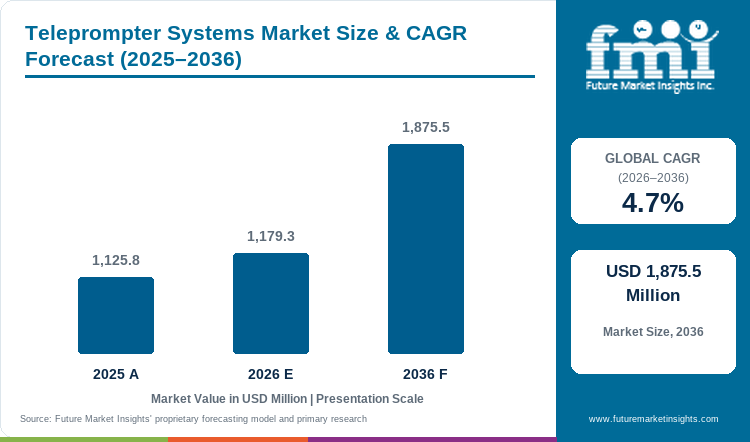
USD 1,179.3 million in 2026 and USD 1,875.5 million by 2036 at a 4.7% CAGR.
Sales of teleprompter systems are estimated to rise at 4.7% CAGR through 2036. Valuation rises from USD 1,125.8 million in 2025 to USD 1,179.3 million in 2026 and reaches USD 1,875.5 million by 2036. Broadcast engineering teams are replacing prompting hardware as PTZ cameras and IP production change camera layouts and control paths. In July 2025, the Federal Communications Commission reported 1,767 full-power television stations. The total included 33,532 licensed broadcast stations as of June 30. This large number of existing stations keeps replacement, integration and service important in broadcast equipment spending.
Spain is projected to grow at 5.8% CAGR through 2036, compared with 4.5% for the USA. In June 2026, CNMC reported 37.9 million paid audiovisual subscriptions in Spain during 2025. Production teams now create content for linear channels and video streaming at the same time. Studios therefore need prompting that can move between fixed cameras, PTZ rigs and remote production. The system must also keep presenter sightlines and basic control methods familiar.
Key Takeaways
- Studio upgrade programs are raising demand for teleprompters that work with PTZ cameras, IP production and newsroom control. On-air use must also stay reliable.
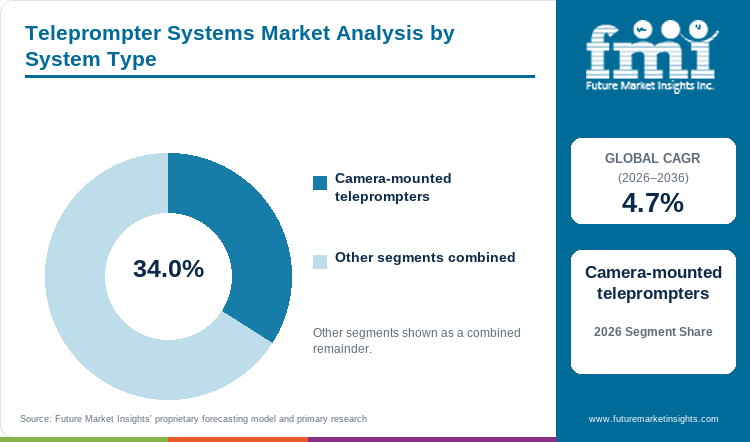
- By system type, camera-mounted teleprompters are projected to account for 34.0% in 2026, supported by direct presenter eye-line and use across many camera rigs.
- By display size, 12-17 inch systems are estimated to hold 36.0% in 2026, linked to useful reading distance and a manageable load on camera supports.
- By end use, broadcast studios are forecast to represent 33.0% in 2026, influenced by frequent use and the need for reliable live production.
- Camera clearance, software setup and backup control can slow approval. Prompting often becomes part of a camera chain used for live production.
- Some of the key players in this market include Autoscript, Autocue, CueScript, Prompter People, Datavideo, Ikan, Teleprompter Pro and Elgato.
Analyst Perspective
"Teleprompter purchases now depend on how well the system works with the camera and production network. Screen size alone is not enough. Suppliers can win repeat business by combining reliable prompting, simple control and local support."
- Sudip saha, Principal Consultant, Future Market Insights
How is the teleprompter systems market segmented?
Teleprompter Systems Market is segmented by System Type, Display Size, End Use, Control, Sales Channel and Region.
The teleprompter systems market is segmented by system type, display size, end use, control, sales channel and region. System type covers camera-mounted, presidential, studio, portable and IP/software systems. Display size spans below 12 inch, 12-17 inch, 17-24 inch and above 24 inch. End use covers broadcast studios, corporate video, education/online content, government/events and houses of worship. Control includes wired, wireless, foot pedal and software/cloud options. Sales channels include professional dealers, direct sales, rental houses and e-commerce/catalog routes.
How do camera-mounted teleprompters shape demand within the system type category?
Camera-mounted systems keep the script on the lens line, so presenters can read while keeping direct eye contact. Engineering teams check hood depth, camera clearance, payload and other camera accessories before they review software features. Ikan showed NDI-enabled teleprompter monitors at IBC 2025. The display included PTZ setups made for IP studio work.
- Based on system type, camera-mounted teleprompters are projected to account for 34.0% in 2026, supported by direct eye-line and use with many camera rigs.
- PTZ adoption increases the need for adjustable camera clearance. The prompter must allow lens movement without forcing teams to build a separate rig.
What supports 12-17 inch systems within the display size category?
The 12-17 inch range gives presenters useful reading distance without adding too much weight or mounting space. It works with many tripod, ENG and PTZ-adjacent setups. Larger stage prompts need more support. CueScript showed a 17-inch IP monitor at InfoComm in June 2025. The networked setup supported robotic, PTZ and traditional studios. This size also works well in professional content creation rooms. These rooms need readable text without a large camera setup.
- By display size, 12-17 inch systems are estimated to hold 36.0% in 2026, influenced by readable text and a manageable load on camera supports.
- Mid-size monitors help integration teams keep good camera movement and cue visibility. They also support a useful presenter distance in smaller studios.
How do broadcast studios influence selection within the end use category?
Broadcast studios run prompts under live timing, newsroom and camera-control rules. A failure can interrupt output, so engineering teams value tested connections and fast recovery. France Télévisions doubled filming capacity at its Vendargues production site in February 2026. The project shows continued spending on professional production systems. Similar enterprise video settings need prompting to work inside the production chain, not as a separate screen.
- In 2026, broadcast studios are expected to lead end use with 33.0% share, supported by frequent use and the need for reliable live production.
- Studio teams may approve higher-specification systems for live output. Newsroom, tally, timing and camera-control tools must all work together.
What supports wired controllers within the control category?
Wired control remains useful when operators want a direct response and a simple backup method. A physical controller does not depend on radio pairing or battery status during a live segment. Software options are also gaining new features. Elgato rebuilt its Prompter software in September 2026 with a new Voice Sync engine and operator view. The update shows how video streaming software can bring prompting closer to speech-led control.
- By control, wired controllers are forecast to represent 30.0% in 2026, reinforced by familiar use and a clear backup path in live production.
- Voice and software control can reduce manual input. Wired devices remain useful when studio teams want a separate physical control layer.
What drives professional dealers within the sales channel category?
Professional teleprompters often require the camera, glass, hood, payload, controller and network to work together. Dealers can solve these setup questions before installation and provide replacement parts later. CueScript used NAB New York in October 2025 to show systems from compact field kits to a 22-inch studio prompter. The same sales approach can help when pocket video cameras move into more structured creator and institutional setups.
- Professional dealers are projected to hold 34.0% of sales channel revenue in 2026, attributable to setup support and service after installation.
- Direct and e-commerce routes work well for standard packages. Complex camera chains still benefit from a channel that can check fit before delivery.
What are the drivers, restraints and opportunities in the Teleprompter Systems Market?
Studio modernization raises demand for integrated prompting, compatibility testing slows qualification and automated control gives suppliers new workflow value.
- Driver: PTZ, IP and remote-production upgrades can trigger teleprompter replacement. Older prompting may no longer work with the camera or newsroom setup.
- Restraint: Camera clearance, network setup and backup control can lengthen testing. A production team may need more time before approving a new prompting system.
- Opportunity: Voice-following and software control can reduce the need for a dedicated operator. This helps corporate, education, creator and distributed production teams.
Studio upgrades pull teleprompters into wider production refresh budgets
RTVE opened a buying process in May 2026 to update its B4 studio in Torrespaña. The plan covers SMPTE ST 2110 IP, UHD, HDR and cloud-capable remote production. The project changes the camera and control setup around the prompter. Prompting suppliers can join studio upgrade budgets when their systems support PTZ movement and IP routing. Their systems must also work with existing newsroom control. More live and on-demand output for streaming media services makes separate prompting workflows less practical for studio teams.
Integration risk can lengthen qualification inside live production
Ikan used IBC 2025 to show an NDI teleprompter monitor with video, power and tally over network connections. The design reduces cabling. An IP prompt must still work with the existing camera, control room and backup steps. Broadcast engineers often use video test equipment before they approve changes that affect live output. Rehearsal checks add another test step. Clear system-fit records can shorten this work without making claims about setups that have not been tested.
Software control widens prompting beyond the dedicated operator
Teleprompter Pro added Siri and Shortcuts support in July 2025. Users can create or open scripts through automation on Apple devices. Voice-led and app-led control can reduce manual steps for solo presenters and small studio teams. The same need appears in web conferencing rooms, training studios and internal video spaces. Many of these spaces do not use a dedicated prompt operator. Suppliers can earn software revenue when setup stays simple and a manual control option remains available.
Which country CAGRs are profiled in the Teleprompter Systems Market?
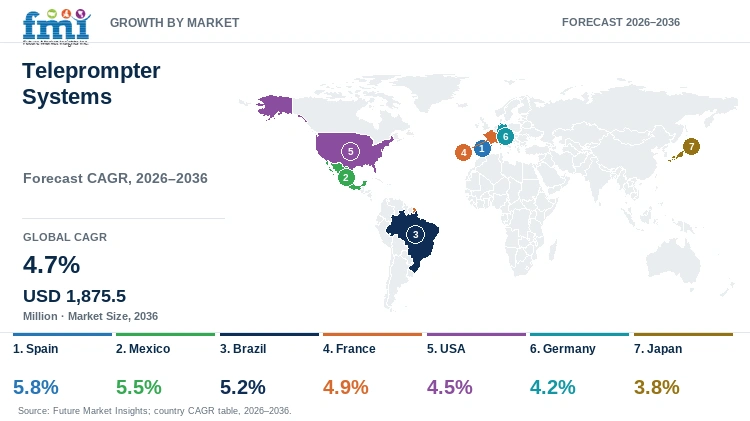
| Country | CAGR |
|---|---|
| Spain | 5.8% |
| Mexico | 5.5% |
| Brazil | 5.2% |
| France | 4.9% |
| USA | 4.5% |
| Germany | 4.2% |
| Japan | 3.8% |
How do country-level CAGRs compare in the Teleprompter Systems Market?
The CAGRs cover a 2.0 percentage-point range. Spain stands at 5.8%, while Japan stands at 3.8% through 2036. Spain, Mexico and Brazil form the higher group. The other countries show slower growth. These rates describe upgrade timing and existing production conditions. They do not describe current revenue size.
- Spain's public studio projects can place many orders into the same formal buying periods.
- Mexico's mixed budgets increase the need for local tech support during setup and service.
- Brazil's large service area can spread broadcaster replacement work across different schedules.
- France's multi-vendor projects increase the need for careful work between integration teams.
- The USA combines station replacement with demand from corporate and public video teams.
- Germany's detailed studio systems can require more testing before teams approve new equipment.
- Japan's long equipment life supports step-by-step upgrades and continued service support.
Similar CAGRs can still lead to different order timing because studio systems and service needs vary by country. The full report provides country-level CAGR analysis across North America, Latin America, Western Europe and Eastern Europe. It also covers East Asia, South Asia and Pacific and the Middle East and Africa.
Country-wise Analysis
- U.S. broadcasters operate many existing stations. Replacement and system fit therefore remain important in teleprompter buying. The USA is projected to grow at 4.5% CAGR through 2036, linked to regular upgrades in station, corporate and institutional studios. In July 2025, the FCC counted 1,767 full-power television stations within 33,532 licensed broadcast stations. Corporate studios also expand the buyer base beyond traditional television operators. New prompting must work with cameras and newsroom tools already in use. Suppliers with strong dealer coverage and fast tech help can reduce downtime during replacement projects.
- German video use includes live television and connected viewing. Broadcasters therefore manage several studio setups. Germany is estimated to post 4.2% CAGR over the forecast period, influenced by careful system changes and long equipment life. Video Trends 2025 reported 47.7 million regular Connected TV users in Germany in October 2025. Corporate and public studios also need support for both live and recorded work. Broadcast teams still need reliable live output as on-demand viewing grows. Vendors must support IP links without forcing a major change to familiar studio control.
- Japanese broadcasters are adding IP production while keeping strict rules for reliability and long-term support. Japan is forecast to grow at 3.8% CAGR through 2036, shaped by careful upgrades in mature studios. A May 2026 JETRO notice records a request from Japan Broadcasting Corporation. The request covers IP remote production network equipment for delivery by March 2027. Public and commercial producers also need local maintenance during step-by-step upgrades. Teleprompter changes therefore compete with other equipment needs. Suppliers need stable network support and local service that protects familiar work methods.
- Brazil is preparing a national move to the next generation of digital terrestrial television. Many stations still need to manage current production systems during that change. Brazil is projected to record 5.2% CAGR through 2036, reinforced by the TV 3.0 rollout plan. Decree No. 12,595 selected the TV 3.0 technology standard in August 2025 for national use. Local service capacity will affect how fast smaller stations finish each upgrade. Timing will differ by broadcaster and location. Teleprompter suppliers can support the change with modular systems that work with current interfaces and later network upgrades.
- French production buyers often use formal projects that combine studio hardware, system setup and service. France is anticipated to record 4.9% CAGR through 2036, influenced by continued changes in broadcast work. Arcom moved France to a new digital terrestrial television channel numbering plan in June 2025. Broadcasters and viewers had to adjust to the new national channel structure. Public and commercial studios also need service across equipment from several vendors. Prompting purchases remain tied to facility schedules, not the channel plan alone. Suppliers need strong setup support and clear system-fit records during studio upgrades.
- Mexican broadcasters and institutional studios work with very different budgets and support needs. Mexico is predicted to expand at 5.5% CAGR through 2036, tied to continued digital television oversight and uneven tech resources. IFT published terrestrial television quality measurements in its second-quarter 2025 activity report. The measurements covered Chiapas, Chihuahua and Guanajuato during May and June. Regional dealers can affect whether smaller sites adopt professional prompting. The quality checks show that service conditions are not the same everywhere. Vendors need channel partners that can handle setup, parts and software support outside major facilities.
- Spanish production teams are serving more online viewing while public broadcasters continue to update facilities. Spain is set to post 5.8% CAGR through 2036, supported by a wider mix of linear and connected video production. CNMC reported the national online viewing figure in May 2026. Paid online audiovisual platforms reached 65.7% of Spanish internet households in the fourth quarter of 2025. Integration teams that already support public broadcast projects can reduce setup risk during upgrades. More formats increase the need for flexible studio work. Public buying cycles and detailed tech rules still decide when prompting equipment becomes an order.
Who are the notable companies in the Teleprompter Systems Market?
Autoscript, Autocue, CueScript, Prompter People, Datavideo, Ikan, Teleprompter Pro, Elgato are active within the defined teleprompter systems boundary.
Competition includes three main supplier groups: professional broadcast prompting firms, studio hardware firms and software-led creator tools. Autoscript, Autocue and CueScript focus on newsroom, IP, or PTZ workflows. Prompter People, Datavideo and Ikan focus on studio hardware and camera fit. Teleprompter Pro and Elgato focus more on software-led and creator production. Entry is harder when one buyer needs camera fit, control integration and service from the same supplier relationship.
- Autoscript, Autocue and CueScript focus on professional broadcast prompting with network, newsroom, voice, or PTZ integration.
- Prompter People, Datavideo and Ikan focus on studio hardware, camera mounting, robotic workflows and complete production packages.
- Teleprompter Pro and Elgato serve software-led, creator, corporate and compact studio workflows that need simpler setup.
Competitive Benchmarking: Teleprompter Systems Market
| Company | Broadcast and Network Integration | PTZ and Robotic Fit | Control and Software Breadth | Geographic Reach |
|---|---|---|---|---|
| Autoscript | High | Medium | High | Global |
| Autocue | Medium | High | Medium | Global |
| CueScript | High | High | High | North America and Europe with international support |
| Prompter People | Medium | High | Medium | North America with international deployments |
| Datavideo | High | High | High | Global reseller network |
| Ikan | High | High | Medium | North America, Europe and international AV channels |
| Teleprompter Pro | Low | Low | High | Global software distribution |
| Elgato | Medium | Medium | High | Global creator and studio channels |
Scoring basis: High requires broad current evidence for the named criterion. Medium requires clear but narrower evidence. Low means that documented coverage is limited. Geographic reach describes the current sales or support area. It is not a score.
Key Developments in the Teleprompter Systems Market
- In February 2026, Autocue reported that its PTZ Camera Prompter won Best of Show at ISE Barcelona. The product was made for compact PTZ use inside the hood.
- In June 2025, Ikan announced three Best of Show awards at InfoComm. One award covered Studio Rover with an integrated 19-inch NDI teleprompter and PTZ camera.
- In April 2025, CueScript reported two NAB honors for its current prompting technology. They were Best of Show and Product of the Year recognition.
Key Players in the Teleprompter Systems Market
Broadcast prompting specialists
- Autoscript
- Autocue
- CueScript
Studio and production hardware suppliers
- Prompter People
- Datavideo
- Ikan
Software-led and creator-focused prompting
- Teleprompter Pro
- Elgato
Teleprompter Systems Market - Report Scope
| Coverage field | Report scope |
|---|---|
| Market breakdown | By system type, display size, end use, control, sales channel and region. |
| Quantitative Units | USD million. |
| Market Definition | Commercial hardware and software systems that place scripted text on or near a camera lens, stage sightline, or presentation position for live and recorded delivery are included. |
| Regions Covered | North America, Latin America, Western Europe, Eastern Europe, East Asia, South Asia and Pacific and Middle East and Africa. |
| Countries Covered | Spain, Mexico, Brazil, France, USA, Germany, Japan and 20+ countries included in the full report. |
| Key Companies Profiled | Autoscript, Autocue, CueScript, Prompter People, Datavideo, Ikan, Teleprompter Pro, Elgato. |
| Forecast Period | 2026 to 2036. |
| Approach | Primary and secondary research with market triangulation. |
Teleprompter Systems Market - Research Methodology
| Method | Approach |
|---|---|
| Primary Research | FMI analysts gathered input from manufacturers, service providers, technology developers, distributors, end users, procurement teams and subject-matter experts. Interviews examined purchasing decisions, product or service evaluation, adoption barriers, approval requirements, pricing considerations and expectations for technical or commercial support. Respondents were also asked what evidence is required before a trial, pilot, or initial order develops into regular purchasing. |
| Desk Research | Desk research covered government statistics, regulatory publications, trade data, industry associations, technical literature, standards, company filings, product information and official corporate announcements. Sources were reviewed for relevance, publication date, geographic coverage and consistency with the defined market scope. Claims relating to performance, applications, approvals, capacity, investment and commercial activity were retained only when supported by credible public evidence. |
| Market Sizing and Forecasting | The market model combined the baseline value with historical performance, segment structure, pricing and volume indicators, adoption levels, company participation and country-level demand conditions. Forecast assumptions considered economic activity, investment trends, regulatory developments, technology adoption, purchasing cycles, supply availability and barriers to wider market use. Segment and regional estimates were reconciled before the final market total was calculated. |
| Data Validation | Estimates were checked against multiple independent indicators, including public data, company activity, trade patterns, industry developments and findings from primary interviews. Validation also tested whether products, services, applications and company revenues fell within the defined market boundaries. Adjacent categories, unsupported claims, overlapping revenues and activities without direct market relevance were excluded to reduce double counting and maintain consistency across segments and countries. |
Teleprompter Systems Market by Segments
Teleprompter Systems Market segmented by System Type:
- Camera-mounted teleprompters
- Presidential teleprompters
- Studio teleprompter systems
- Portable teleprompters
- IP/software teleprompter systems
Teleprompter Systems Market segmented by Display Size:
- Below 12 inch
- 12-17 inch
- 17-24 inch
- Above 24 inch
Teleprompter Systems Market segmented by End Use:
- Broadcast studios
- Corporate video
- Education/online content
- Government/events
- Houses of worship
Teleprompter Systems Market segmented by Control:
- Wired controller
- Wireless controller
- Foot pedal
- Software/cloud control
Teleprompter Systems Market segmented by Sales Channel:
- Professional dealers
- Direct manufacturer sales
- Rental houses
- E-commerce/catalog
Teleprompter Systems Market by Region:
- North America
- United States
- Canada
- Latin America
- Brazil
- Mexico
- Chile
- Rest of Latin America
- Western Europe
- Germany
- United Kingdom
- Italy
- Spain
- France
- Nordics
- Benelux
- Rest of Western Europe
- Eastern Europe
- Russia
- Poland
- Hungary
- Balkan and Baltic States
- Rest of Eastern Europe
- East Asia
- China
- Japan
- South Korea
- South Asia and Pacific
- India
- ASEAN
- Australia and New Zealand
- Rest of South Asia and Pacific
- Middle East and Africa
- Kingdom of Saudi Arabia
- Other GCC Countries
- Türkiye
- South Africa
- Other African Union Countries
- Rest of Middle East and Africa
Research Sources and Bibliography
- Federal Communications Commission. (2025, July 8). Broadcast station totals as of June 30, 2025.
- National Commission of Markets and Competition (CNMC). (2026, June 22). Telecommunications and audiovisual sector grew 2.2% in 2025 and advanced in fiber and 5G deployment.
- Ikan International. (2025). Ikan at IBC 2025.
- CueScript. (2025, June 10). CueScript at InfoComm 2025: Elevating broadcast with innovation.
- France Télévisions. (2026, February 10). France Télévisions inaugurates its new production studios in Vendargues.
- Elgato. (2026, September 3). Elgato Studio 2.0: The Prompter experience, rebuilt.
- CueScript. (2025, October 1). Experience the tools broadcasters trust: Visit CueScript at NAB NY 2025.
- Corporación Radio y Televisión Española. (2026, May 22). Renovation of Studio B4 at Torrespaña to UHD IP technology and cloud production.
- Teleprompter Pro. (2025, July 31). Introducing Shortcuts and Siri support in Teleprompter Pro.
- The Media Authorities. (2025, October). Video Trends 2025.
- Japan External Trade Organization. (2026, May 20). Development of IP remote production network equipment, one set.
- Presidency of the Federative Republic of Brazil. (2025, August 27). Decree No. 12,595: Selection and national implementation of the TV 3.0 technological standard.
- Arcom. (2025, June 6). New digital terrestrial television channel numbering from June 6, 2025.
- Federal Telecommunications Institute. (2025). Second quarterly activity report 2025.
- National Commission of Markets and Competition (CNMC). (2026, May 29). Paid audiovisual content platforms reached two in three internet households in 2025.
- Autocue. (2026, February). Autocue PTZ Camera Prompter named Best of Show at ISE Barcelona.
- Ikan International. (2025, June 19). Ikan International wins three Best of Show awards at InfoComm 2025.
- CueScript. (2025, April 16). An award-winning NAB to remember.
- Autoscript. (2026, September 8). Autoscript launches new Voice Controller prompting solution to transform script control for presenters.
- Autocue. (2025, September). Autocue PTZ Prompter wins Best of Show at IBC 2025.
- CueScript. (2025, December 1). Knocking it out of the park!
- Prompter People. (2026, March 24). Proline Plus with stYpe virtual production.
- Datavideo. (2026, July 6). Datavideo launches advanced studio live production teleprompter TP-750 now available.
- Ikan International. (2026, September 14). The Westminster Schools: Building a student broadcast studio on network cable.
- Teleprompter Pro. (2025, September 9). Adopting Liquid Glass in Teleprompter Pro.
- Elgato. (2025, October 9). Elgato Camera Hub 2.2 release notes.
This bibliography is provided for reader reference and is not exhaustive. The full report contains the complete reference list and detailed citations.
This Report Answers
- How large is the teleprompter systems market in 2026 and what value is projected for 2036?
- Which studio changes are supporting teleprompter replacement and integration?
- Why do camera-mounted teleprompters hold the largest stated system type share in 2026?
- Why does the 12-17 inch range hold the largest stated display size share in 2026?
- Why do broadcast studios hold the largest stated end use share in 2026?
- How do the profiled country CAGRs differ through 2036?
- Which integration issues can slow teleprompter qualification in live production?
- Which control changes are widening use outside traditional broadcast studios?
- Which companies compete through broadcast integration, hardware-led systems, or software-led prompting?
- What should broadcast engineering and procurement teams evaluate before purchasing teleprompter systems?
Frequently Asked Questions
How big is the teleprompter systems market in 2026?
The teleprompter systems market is valued at USD 1,179.3 million in 2026. It is projected to reach USD 1,875.5 million by 2036. Studio upgrades support replacement when prompting must work with PTZ cameras, IP systems and newsroom workflows.
What is the CAGR of the teleprompter systems market from 2026 to 2036?
The teleprompter systems market is projected to grow at 4.7% CAGR between 2026 and 2036. Replacement cycles and system integration support the forecast as production teams update cameras, networks and control rooms.
Which system type leads the teleprompter systems market?
The camera-mounted teleprompter segment is expected to hold 34.0% of system type revenue in 2026. The format keeps script text on the lens line and works with many professional camera rigs.
Which display size leads the teleprompter systems market?
The 12-17 inch segment is estimated to hold 36.0% of display size revenue in 2026. The range gives presenters a useful reading distance. It also avoids much of the extra weight and mounting space needed by larger studio displays.
Which companies are active in the teleprompter systems market?
Key companies in the teleprompter systems market include Autoscript, Autocue, CueScript and Prompter People. The group also includes Datavideo, Ikan, Teleprompter Pro and Elgato. They differ in broadcast integration, PTZ hardware, software control and creator-focused production.
What is driving growth in the Teleprompter Systems Market?
Growth is supported by studio upgrades that add PTZ cameras, IP production and more automated control. Teleprompters gain budget priority when they keep presenter eye-line steady and work well with newsroom, camera and network systems.
What notable restraint affects the Teleprompter Systems Market?
The main restraint is approval risk around camera fit and rigging. The risk grows when software setup and on-air reliability also need testing. Buyers may delay purchase until the full camera chain and newsroom link have been checked. Controller use and backup steps must also work during live production.
Why should executives track the Teleprompter Systems Market?
Teleprompter choices now affect staffing, studio automation and the use of PTZ or remote-production designs. Executives should track the market because a low-cost display can still create higher operating costs when system fit or service support is weak.
What business problem does the Teleprompter Systems Market address?
Teleprompter systems let presenters read a script while keeping direct eye contact with a camera or audience. Professional systems reduce production friction by placing readable text near the lens and giving operators clear control. They can also help match timing with newsroom or network workflows.
What should broadcast engineering and procurement teams evaluate in the Teleprompter Systems Market?
Teams should check lens and camera fit, reading distance and payload. They should also test glass quality, controller backup, network links and software setup. Local service matters because installation and recovery need to be fast and reliable.
What limits return on investment in the Teleprompter Systems Market?
Return on investment falls when a system is hard to mount, rarely used, or needs repeated setup work after camera changes. Software fees and operator training can remove savings from a low purchase price. Slow service and poor system fit can add costs after installation.
What supports long-term commercial confidence in the Teleprompter Systems Market?
Demand is supported by regular video production and continued studio upgrades across broadcast, institutional, corporate and education users. Long-term confidence is strongest for suppliers that combine durable hardware, IP readiness, flexible control and dependable service across replacement cycles.
Preview the report firsthand - request a free sample
Get SampleGet the brochure for pricing and purchase details.
Get PDFTable of Content
- Key Takeaways
- Market Size and CAGR
- Top Growth Driver
- Fastest Growing Segment
- Leading Region
- Key Companies
- Emerging Opportunities
- Executive Summary
- Global Market Outlook
- Demand-side Trends
- Supply-side Trends
- Technology Roadmap Analysis
- Analysis and Recommendations
- Analyst Perspective (What is happening? Why now? What should investors know?)
- Key Questions Answered
- How large is the market?
- What is the CAGR?
- What are key trends?
- Which region dominates?
- Who are the leaders?
- Market Overview
- Market Coverage / Taxonomy
- Market Definition / Scope / Limitations
- Research Methodology
- Chapter Orientation
- Analytical Lens and Working Hypotheses
- Market Structure, Signals, and Trend Drivers
- Benchmarking and Cross-market Comparability
- Market Sizing, Forecasting, and Opportunity Mapping
- Research Design and Evidence Framework
- Desk Research Programme (Secondary Evidence)
- Expert Input and Fieldwork (Primary Evidence)
- Tooling, Models, and Reference Databases
- Data Engineering and Model Build
- Quality Assurance and Audit Trail
- Market Background
- Market Dynamics (Drivers, Restraints, Opportunity, Trends)
- Scenario Forecast (Optimistic, Likely, Conservative)
- Impact Analysis
- AI Impact
- Sustainability Impact
- Regulatory Impact
- Technology Impact
- Consumer / Buyer Analysis
- Purchase Drivers
- Adoption Barriers
- Buyer Journey
- Opportunity Map Analysis
- Product Life Cycle Analysis
- Supply Chain Analysis
- Investment Feasibility Matrix
- Value Chain Analysis
- PESTLE and Porter's Analysis
- Regulatory Landscape
- Regional Parent Market Outlook
- Production and Consumption Statistics
- Import and Export Statistics
- Global Market Analysis and Forecast, 2021 to 2036
- Historical Market Size Value (USD Million) Analysis, 2021 to 2025
- Current and Future Market Size Value (USD Million) Projections, 2026 to 2036
- Y-o-Y Growth Trend Analysis
- Absolute $ Opportunity Analysis
- Global Market Pricing Analysis, 2021 to 2036
- Global Market Analysis and Forecast, By System Type, 2021 to 2036
- Introduction / Key Findings
- Historical Market Size Value (USD Million) Analysis By System Type, 2021 to 2025
- Current and Future Market Size Value (USD Million) Analysis and Forecast By System Type, 2026 to 2036
- Camera-mounted teleprompters
- Presidential teleprompters
- Studio teleprompter systems
- Portable teleprompters
- IP/software teleprompter systems
- Y-o-Y Growth Trend Analysis By System Type, 2021 to 2025
- Absolute $ Opportunity Analysis By System Type, 2026 to 2036
- Global Market Analysis and Forecast, By Display Size, 2021 to 2036
- Introduction / Key Findings
- Historical Market Size Value (USD Million) Analysis By Display Size, 2021 to 2025
- Current and Future Market Size Value (USD Million) Analysis and Forecast By Display Size, 2026 to 2036
- Below 12 inch
- 12-17 inch
- 17-24 inch
- Above 24 inch
- Y-o-Y Growth Trend Analysis By Display Size, 2021 to 2025
- Absolute $ Opportunity Analysis By Display Size, 2026 to 2036
- Global Market Analysis and Forecast, By End Use, 2021 to 2036
- Introduction / Key Findings
- Historical Market Size Value (USD Million) Analysis By End Use, 2021 to 2025
- Current and Future Market Size Value (USD Million) Analysis and Forecast By End Use, 2026 to 2036
- Broadcast studios
- Corporate video
- Education/online content
- Government/events
- Houses of worship
- Y-o-Y Growth Trend Analysis By End Use, 2021 to 2025
- Absolute $ Opportunity Analysis By End Use, 2026 to 2036
- Global Market Analysis and Forecast, By Control, 2021 to 2036
- Introduction / Key Findings
- Historical Market Size Value (USD Million) Analysis By Control, 2021 to 2025
- Current and Future Market Size Value (USD Million) Analysis and Forecast By Control, 2026 to 2036
- Wired controller
- Wireless controller
- Foot pedal
- Software/cloud control
- Y-o-Y Growth Trend Analysis By Control, 2021 to 2025
- Absolute $ Opportunity Analysis By Control, 2026 to 2036
- Global Market Analysis and Forecast, By Sales Channel, 2021 to 2036
- Introduction / Key Findings
- Historical Market Size Value (USD Million) Analysis By Sales Channel, 2021 to 2025
- Current and Future Market Size Value (USD Million) Analysis and Forecast By Sales Channel, 2026 to 2036
- Professional dealers
- Direct manufacturer sales
- Rental houses
- E-commerce/catalog
- Y-o-Y Growth Trend Analysis By Sales Channel, 2021 to 2025
- Absolute $ Opportunity Analysis By Sales Channel, 2026 to 2036
- Global Market Analysis and Forecast, By Region, 2021 to 2036
- Introduction
- Historical Market Size Value (USD Million) Analysis By Region, 2021 to 2025
- Current Market Size Value (USD Million) Analysis and Forecast By Region, 2026 to 2036
- North America
- Latin America
- Western Europe
- Eastern Europe
- East Asia
- South Asia and Pacific
- Middle East and Africa
- Market Attractiveness Analysis By Region
- North America Market Analysis and Forecast, By Country, 2021 to 2036
- Historical Market Size Value (USD Million) Trend Analysis By Market Taxonomy, 2021 to 2025
- Market Size Value (USD Million) Forecast By Market Taxonomy, 2026 to 2036
- By Country
- United States
- Canada
- By System Type
- By Display Size
- By End Use
- By Control
- By Sales Channel
- By Country
- Market Attractiveness Analysis
- By Country
- By System Type
- By Display Size
- By End Use
- By Control
- By Sales Channel
- Key Takeaways
- Latin America Market Analysis and Forecast, By Country
- Historical Market Size Value (USD Million) Trend Analysis By Market Taxonomy, 2021 to 2025
- Market Size Value (USD Million) Forecast By Market Taxonomy, 2026 to 2036
- By Country
- Brazil
- Mexico
- Chile
- Rest of Latin America
- By System Type
- By Display Size
- By End Use
- By Control
- By Sales Channel
- By Country
- Market Attractiveness Analysis
- By Country
- By System Type
- By Display Size
- By End Use
- By Control
- By Sales Channel
- Key Takeaways
- Western Europe Market Analysis and Forecast, By Country
- Historical Market Size Value (USD Million) Trend Analysis By Market Taxonomy, 2021 to 2025
- Market Size Value (USD Million) Forecast By Market Taxonomy, 2026 to 2036
- By Country
- Germany
- United Kingdom
- Italy
- Spain
- France
- Nordics
- Benelux
- Rest of Western Europe
- By System Type
- By Display Size
- By End Use
- By Control
- By Sales Channel
- By Country
- Market Attractiveness Analysis
- By Country
- By System Type
- By Display Size
- By End Use
- By Control
- By Sales Channel
- Key Takeaways
- Eastern Europe Market Analysis and Forecast, By Country
- Historical Market Size Value (USD Million) Trend Analysis By Market Taxonomy, 2021 to 2025
- Market Size Value (USD Million) Forecast By Market Taxonomy, 2026 to 2036
- By Country
- Russia
- Poland
- Hungary
- Balkan and Baltic States
- Rest of Eastern Europe
- By System Type
- By Display Size
- By End Use
- By Control
- By Sales Channel
- By Country
- Market Attractiveness Analysis
- By Country
- By System Type
- By Display Size
- By End Use
- By Control
- By Sales Channel
- Key Takeaways
- East Asia Market Analysis and Forecast, By Country
- Historical Market Size Value (USD Million) Trend Analysis By Market Taxonomy, 2021 to 2025
- Market Size Value (USD Million) Forecast By Market Taxonomy, 2026 to 2036
- By Country
- China
- Japan
- South Korea
- By System Type
- By Display Size
- By End Use
- By Control
- By Sales Channel
- By Country
- Market Attractiveness Analysis
- By Country
- By System Type
- By Display Size
- By End Use
- By Control
- By Sales Channel
- Key Takeaways
- South Asia and Pacific Market Analysis and Forecast, By Country
- Historical Market Size Value (USD Million) Trend Analysis By Market Taxonomy, 2021 to 2025
- Market Size Value (USD Million) Forecast By Market Taxonomy, 2026 to 2036
- By Country
- India
- ASEAN
- Australia and New Zealand
- Rest of South Asia and Pacific
- By System Type
- By Display Size
- By End Use
- By Control
- By Sales Channel
- By Country
- Market Attractiveness Analysis
- By Country
- By System Type
- By Display Size
- By End Use
- By Control
- By Sales Channel
- Key Takeaways
- Middle East and Africa Market Analysis and Forecast, By Country
- Historical Market Size Value (USD Million) Trend Analysis By Market Taxonomy, 2021 to 2025
- Market Size Value (USD Million) Forecast By Market Taxonomy, 2026 to 2036
- By Country
- Kingdom of Saudi Arabia
- Other GCC Countries
- Türkiye
- South Africa
- Other African Union Countries
- Rest of Middle East and Africa
- By System Type
- By Display Size
- By End Use
- By Control
- By Sales Channel
- By Country
- Market Attractiveness Analysis
- By Country
- By System Type
- By Display Size
- By End Use
- By Control
- By Sales Channel
- Key Takeaways
- Key Countries Market Analysis
- United States
- Pricing Analysis
- Market Share Analysis, 2025
- By System Type
- By Display Size
- By End Use
- By Control
- By Sales Channel
- Canada
- Pricing Analysis
- Market Share Analysis, 2025
- By System Type
- By Display Size
- By End Use
- By Control
- By Sales Channel
- Mexico
- Pricing Analysis
- Market Share Analysis, 2025
- By System Type
- By Display Size
- By End Use
- By Control
- By Sales Channel
- Brazil
- Pricing Analysis
- Market Share Analysis, 2025
- By System Type
- By Display Size
- By End Use
- By Control
- By Sales Channel
- Chile
- Pricing Analysis
- Market Share Analysis, 2025
- By System Type
- By Display Size
- By End Use
- By Control
- By Sales Channel
- Germany
- Pricing Analysis
- Market Share Analysis, 2025
- By System Type
- By Display Size
- By End Use
- By Control
- By Sales Channel
- United Kingdom
- Pricing Analysis
- Market Share Analysis, 2025
- By System Type
- By Display Size
- By End Use
- By Control
- By Sales Channel
- Italy
- Pricing Analysis
- Market Share Analysis, 2025
- By System Type
- By Display Size
- By End Use
- By Control
- By Sales Channel
- Spain
- Pricing Analysis
- Market Share Analysis, 2025
- By System Type
- By Display Size
- By End Use
- By Control
- By Sales Channel
- France
- Pricing Analysis
- Market Share Analysis, 2025
- By System Type
- By Display Size
- By End Use
- By Control
- By Sales Channel
- India
- Pricing Analysis
- Market Share Analysis, 2025
- By System Type
- By Display Size
- By End Use
- By Control
- By Sales Channel
- ASEAN
- Pricing Analysis
- Market Share Analysis, 2025
- By System Type
- By Display Size
- By End Use
- By Control
- By Sales Channel
- Australia and New Zealand
- Pricing Analysis
- Market Share Analysis, 2025
- By System Type
- By Display Size
- By End Use
- By Control
- By Sales Channel
- China
- Pricing Analysis
- Market Share Analysis, 2025
- By System Type
- By Display Size
- By End Use
- By Control
- By Sales Channel
- Japan
- Pricing Analysis
- Market Share Analysis, 2025
- By System Type
- By Display Size
- By End Use
- By Control
- By Sales Channel
- South Korea
- Pricing Analysis
- Market Share Analysis, 2025
- By System Type
- By Display Size
- By End Use
- By Control
- By Sales Channel
- Russia
- Pricing Analysis
- Market Share Analysis, 2025
- By System Type
- By Display Size
- By End Use
- By Control
- By Sales Channel
- Poland
- Pricing Analysis
- Market Share Analysis, 2025
- By System Type
- By Display Size
- By End Use
- By Control
- By Sales Channel
- Hungary
- Pricing Analysis
- Market Share Analysis, 2025
- By System Type
- By Display Size
- By End Use
- By Control
- By Sales Channel
- Kingdom of Saudi Arabia
- Pricing Analysis
- Market Share Analysis, 2025
- By System Type
- By Display Size
- By End Use
- By Control
- By Sales Channel
- Türkiye
- Pricing Analysis
- Market Share Analysis, 2025
- By System Type
- By Display Size
- By End Use
- By Control
- By Sales Channel
- South Africa
- Pricing Analysis
- Market Share Analysis, 2025
- By System Type
- By Display Size
- By End Use
- By Control
- By Sales Channel
- United States
- Market Structure Analysis
- Competition Dashboard
- Competition Benchmarking
- Market Share Analysis of Top Players
- By Regional
- By System Type
- By Display Size
- By End Use
- By Control
- By Sales Channel
- Emerging Startups
- Innovation Benchmarking
- Competition Analysis
- Competition Deep Dive
- Autoscript
- Overview
- Product Portfolio
- Profitability by Market Segments
- Sales Footprint
- Strategy Overview
- Marketing Strategy
- Product Strategy
- Channel Strategy
- Autocue
- CueScript
- Prompter People
- Datavideo
- Ikan
- Teleprompter Pro
- Elgato
- Autoscript
- Case Studies
- Success Stories
- Recent Developments
- Competition Deep Dive
- Assumptions & Acronyms Used


