

- Market Size (2026)
- USD 5.17 Bn
- Forecast (2036)
- USD 10.08 Bn
- CAGR (2026 to 2036)
- 6.9%
Thromboprophylactic Drugs Market Outlook for 2026 to 2036
Summary of the Thromboprophylactic Drugs Market
- Demand and Growth Drivers
- Rising surgical procedure volumes and hospitalization rates are likely to sustain demand for thromboprophylactic drugs prescribed to prevent venous thromboembolism in at-risk patients.
- Growing adoption of direct oral anticoagulants over traditional heparin-based prophylaxis is expected to shift prescribing patterns toward convenient, fixed-dose oral options during the forecast period.
- Expansion of thromboprophylaxis guidelines to broader patient populations, including medical inpatients and post-discharge patients, is likely to increase treatment volumes through 2036.
- Product and Segment View
- Direct oral anticoagulants (DOACs) is likely to account for 39.1% of the drug class segment, reflecting sustained procurement across primary end-use categories.
- Venous thromboembolism (VTE) is likely to account for 28.6% of the application segment, reflecting sustained procurement across primary end-use categories.
- Hospitals is likely to account for 61.8% of the end user segment, reflecting sustained procurement across primary end-use categories.
- Geography and Competitive Outlook
- China is likely to remain a key market at 18.4%, supported by rapid hospital capacity expansion.
- India is likely to sustain growth at 17.0%, driven by expanding healthcare infrastructure.
- Companies that combine product breadth with customer access and distribution reach are likely to strengthen competitive positioning during the forecast period.
- Analyst Opinion
- Sabyasachi Ghosh, Principal Consultant at FMI says, 'The thromboprophylactic drugs market reflects expanding clinical guidelines and the shift toward oral anticoagulant prophylaxis. Companies with strong clinical evidence portfolios, broad indication coverage, and established hospital formulary positions are positioned to capture prescribing share during the forecast period.'
- The thromboprophylactic drugs market is evolving from injectable-dominated prophylaxis toward oral anticoagulant convenience.
- Adoption is increasing due to expanding clinical guidelines and growing recognition of VTE prevention importance.
- Demand is further supported by aging population demographics and increasing surgical procedure volumes.
- Companies with broad indication approval, clinical evidence, and hospital formulary access are likely to maintain prescribing share.
Key Takeaways
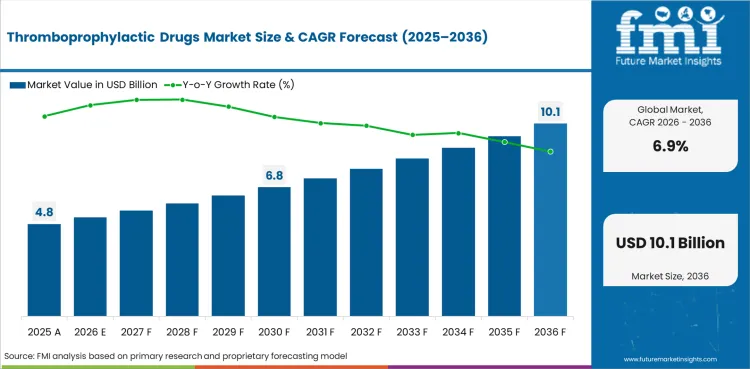
- The thromboprophylactic drugs market was valued at USD 4.84 billion in 2025.
- By 2036, the Thromboprophylactic Drugs Market is expected to be worth USD 10.08 billion.
- From 2026 to 2036, the market is projected to expand at a CAGR of 6.9%.
- The market is projected to create an incremental opportunity of USD 4.91 billion between 2026 and 2036.
- In 2026, hospitals are expected to account for 61.8% of the end-user segment, driven by expanding clinical utilization of direct oral anticoagulants for venous thromboembolism prevention in surgical, hospitalized, and at-risk patient populations.
- China (18.4%) and India (17.0%) are two of the fastest-growing markets in the world.
Thromboprophylactic Drugs Market Definition
The thromboprophylactic drugs market includes pharmaceutical anticoagulant products prescribed for prevention of venous thromboembolism in surgical patients, hospitalized medical patients, cancer patients, and other at-risk populations, covering direct oral anticoagulants, low-molecular-weight heparins, and unfractionated heparin formulations.
Thromboprophylactic Drugs Market Inclusions
Market scope encompasses all commercially traded thromboprophylactic drugs categorized by drug class (direct oral anticoagulants, low-molecular-weight heparins, unfractionated heparin, others), indication (venous thromboembolism prevention, post-surgical prophylaxis, medical inpatient prophylaxis, cancer-associated thrombosis), end user (hospitals, outpatient clinics, home care), and distribution channel (hospital pharmacy, retail pharmacy, specialty pharmacy). The range of revenue sizes is from 2026 to 2036.
Thromboprophylactic Drugs Market Exclusions
The scope does not include anticoagulant drugs prescribed exclusively for therapeutic treatment of established thrombosis, antiplatelet agents, or thrombolytic drugs used for acute clot dissolution.
Thromboprophylactic Drugs Market Research Methodology
- Primary Research: FMI analysts conducted interviews with manufacturers, end-use procurement teams, and distribution partners across key markets.
- Desk Research: Combined data from industry associations, regulatory filings, trade publications, and manufacturer disclosures.
- Market sizing and forecasting: Bottom-up aggregation across product types, end-use applications, and regional adoption curves, validated against industry benchmarks.
- Data validation: Cross-checked every quarter against production data, trade statistics, and manufacturer-reported figures.
Why is the Thromboprophylactic Drugs Market Growing?
- Surgical volume growth and expanding thromboprophylaxis guidelines are creating sustained demand for anticoagulant drugs prescribed for venous thromboembolism prevention.
- Direct oral anticoagulant adoption is shifting prescribing patterns from injectable heparin-based prophylaxis toward convenient fixed-dose oral formulations.
- China (18.4%) and India (17.0%) lead growth, reflecting expanding hospital capacity, increasing surgical volumes, and growing adoption of thromboprophylaxis protocols.
The thromboprophylactic drugs market is expanding at 6.9% CAGR, reflecting growing clinical recognition of venous thromboembolism risk and expanding prophylaxis guidelines. Direct oral anticoagulants account for 39.1% of the drug class segment, reflecting the ongoing shift from injectable anticoagulants toward oral formulations that offer dosing convenience and reduced monitoring requirements.
Venous thromboembolism prevention accounts for 28.6% of the indication segment, representing the core clinical application. Surgical patients, hospitalized medical patients, and cancer patients comprise the primary populations receiving thromboprophylaxis. Hospitals account for 61.8% of the end-user segment.
Guideline expansion is a structural growth driver. Clinical practice guidelines from cardiology, surgery, and oncology societies are extending thromboprophylaxis recommendations to broader patient populations, including medical inpatients, cancer patients receiving chemotherapy, and patients continuing prophylaxis post-discharge.
Market Segmentation Analysis
- Direct oral anticoagulants (DOACs) accounts for 39.1% of the drug class segment, reflecting consistent demand across primary applications.
- Venous thromboembolism (VTE) accounts for 28.6% of the application segment, reflecting consistent demand across primary applications.
- Hospitals accounts for 61.8% of the end user segment, reflecting consistent demand across primary applications.
The thromboprophylactic drugs market is segmented by drug class, application, end user, product.
Insights into the Direct oral anticoagulants (DOACs) Drug Class Segment
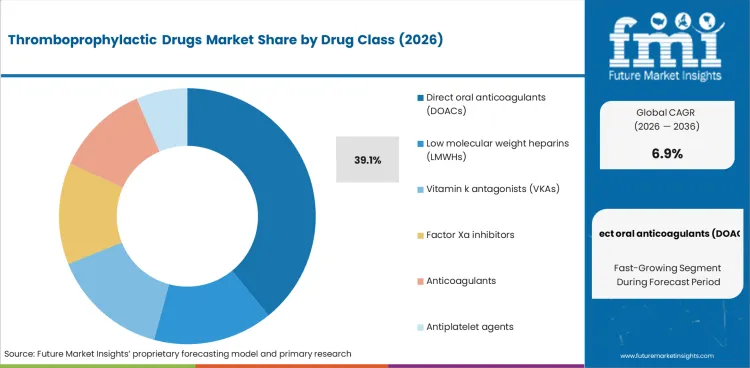
In 2026, direct oral anticoagulants (doacs) is expected to account for 39.1% of the drug class segment. Demand reflects procurement preferences where performance and specification compliance are critical.
Competitive positioning depends on production capability, quality certification, and the ability to meet evolving requirements. Suppliers with established relationships and proven performance are likely to maintain share.
Insights into the Venous thromboembolism (VTE) Application Segment
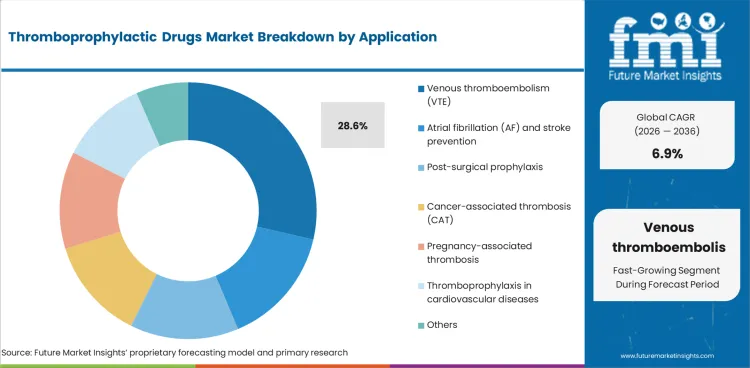
In 2026, venous thromboembolism (vte) is expected to account for 28.6% of the application segment. Demand reflects procurement preferences where performance and specification compliance are critical.
Competitive positioning depends on production capability, quality certification, and the ability to meet evolving requirements. Suppliers with established relationships and proven performance are likely to maintain share.
Thromboprophylactic Drugs Market Drivers, Restraints, and Opportunities
- Surgical volume growth and expanding thromboprophylaxis guidelines are creating sustained demand for anticoagulant drugs across hospital and outpatient settings.
- Bleeding risk concerns and the need for individualized dosing create clinical complexity that limits universal prophylaxis adoption in some patient populations.
- DOAC adoption is accelerating the shift from injectable to oral prophylaxis, creating convenience benefits that improve patient compliance and reduce administration costs.
The thromboprophylactic drugs market reflects surgical volume trends, clinical guideline evolution, and the competitive dynamics between injectable and oral anticoagulant formulations.
Surgical Volume and Hospitalization Growth
Increasing surgical procedure volumes and hospitalization rates expand the patient population eligible for thromboprophylaxis. Orthopedic surgery, abdominal surgery, and cancer surgery represent the highest-volume indication categories.
Bleeding Risk and Dosing Complexity
Anticoagulant-associated bleeding risk requires careful patient selection and dose adjustment. Clinical guidelines balance thrombosis prevention against hemorrhagic complications, creating nuanced prescribing decisions that influence drug choice and duration.
Direct Oral Anticoagulant Adoption Acceleration
DOACs offer fixed-dose oral administration without routine coagulation monitoring, creating convenience advantages over injectable low-molecular-weight heparins. This convenience drives prescribing shifts in both inpatient and extended post-discharge prophylaxis settings.
Analysis of Thromboprophylactic Drugs Market By Key Countries
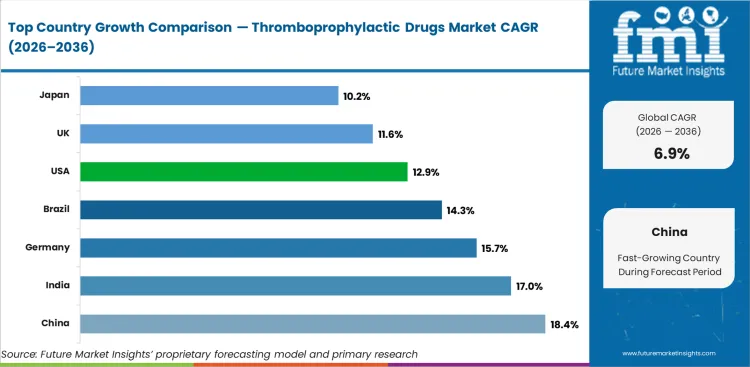
.webp "Top Country Growth Comparison Thromboprophylactic Drugs Market Cagr (2026 2036)")
| Country | CAGR |
|---|---|
| China | 18.4% |
| India | 17.0% |
| Germany | 15.7% |
| Brazil | 14.3% |
| USA | 12.9% |
| UK | 11.6% |
| Japan | 10.2% |
- China leads with 18.4%, supported by rapid hospital capacity expansion.
- India at 17.0%, reflecting expanding healthcare infrastructure.
- Germany at 15.7%, reflecting advanced clinical practice standards.
The global thromboprophylactic drugs market is expected to grow at a rate of 6.9% per year from 2026 to 2036. The study covers more than 30 countries, and the main markets are listed below.
Demand Outlook for Thromboprophylactic Drugs Market in China
China is expected to grow at 18.4% through 2036, reflecting rapid hospital capacity expansion, increasing surgical volumes, and growing adoption of thromboprophylaxis protocols in clinical practice.
- Hospital expansion drives prophylaxis drug demand.
- Surgical volume growth increases prescribing.
- Protocol adoption accelerates market penetration.
Future Outlook for Thromboprophylactic Drugs Market in India
India is expected to grow at 17.0% through 2036, reflecting expanding healthcare infrastructure, growing surgical procedure volumes, and increasing awareness of venous thromboembolism prevention.
- Healthcare growth creates prophylaxis demand.
- Surgical expansion increases treatment volumes.
- VTE awareness improves clinical adoption.
Opportunity Analysis of Thromboprophylactic Drugs Market in Germany
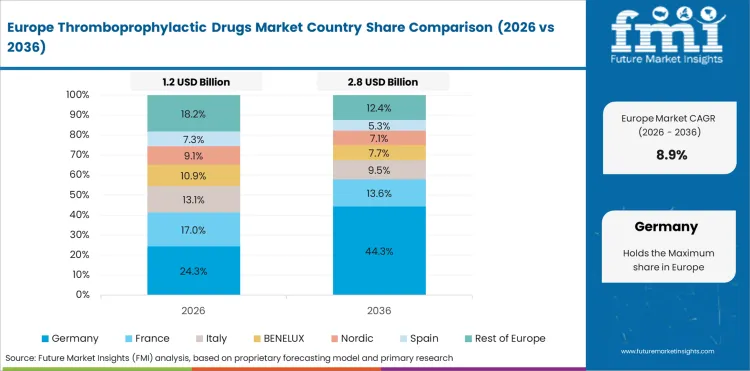
Germany is expected to grow at 15.7% through 2036, reflecting advanced clinical practice standards, comprehensive thromboprophylaxis guidelines, and established pharmaceutical procurement infrastructure.
- Clinical standards sustain comprehensive prophylaxis.
- Pharmaceutical infrastructure supports procurement.
- Guideline compliance drives prescribing volumes.
In-depth Analysis of Thromboprophylactic Drugs Market in Brazil
Brazil is expected to grow at 14.3% through 2036, reflecting healthcare system expansion, growing surgical capacity, and increasing adoption of evidence-based thromboprophylaxis protocols.
- Healthcare expansion creates treatment demand.
- Surgical growth drives prophylaxis prescribing.
- Protocol adoption increases market penetration.
Sales Analysis of Thromboprophylactic Drugs Market in USA
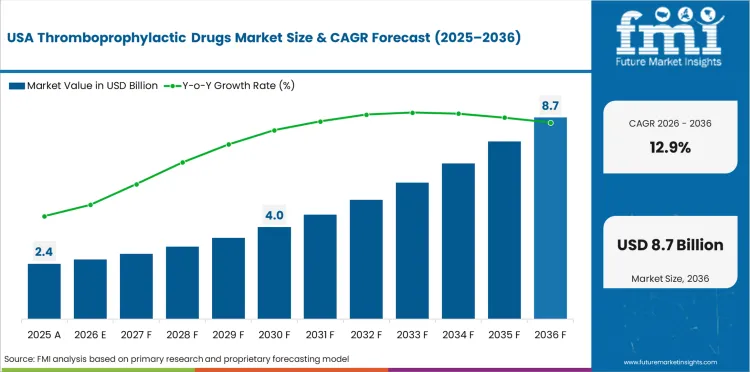
USA is expected to grow at 12.9% through 2036, reflecting large surgical volume, comprehensive thromboprophylaxis guidelines, and established DOAC prescribing patterns in hospital and post-discharge settings.
- Large surgical volume sustains drug demand.
- DOAC adoption drives prescribing transitions.
- Post-discharge prophylaxis expands treatment duration.
Growth Analysis of Thromboprophylactic Drugs Market in UK
UK is expected to grow at 11.6% through 2036, reflecting NHS thromboprophylaxis mandates, clinical guideline compliance, and DOAC adoption across hospital and community settings.
- NHS mandates sustain prophylaxis compliance.
- DOAC adoption shifts prescribing patterns.
- Clinical guidelines drive comprehensive treatment.
Market Outlook for Thromboprophylactic Drugs Market in Japan
Japan is expected to grow at 10.2% through 2036, reflecting aging population demographics, high surgical volumes, and clinical practice standards supporting comprehensive thromboprophylaxis.
- Aging population increases prophylaxis demand.
- High surgical volumes sustain prescribing.
- Clinical standards support comprehensive treatment.
Competitive Landscape and Strategic Positioning
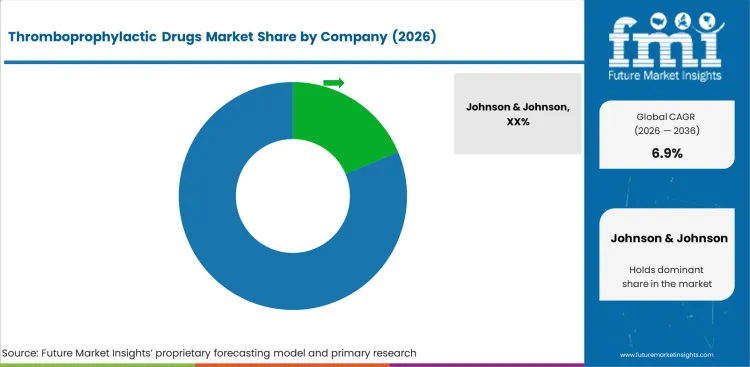
- Johnson & Johnson and Boehringer Ingelheim GmbH lead through broad portfolios and established customer relationships.
- Mid-tier participants compete through regional specialization and targeted product development.
- New entrants focus on technology-differentiated products and specialized applications.
Johnson & Johnson holds a strong position through technology leadership and established relationships. Boehringer Ingelheim GmbH competes through complementary capabilities.
Sanofi SA and Pfizer Inc. maintain positions through specialized offerings.
Barriers include established relationships, regulatory requirements, technology expertise, and manufacturing scale. Strategic priorities include technology advancement, compliance, and geographic expansion.
Key Companies in the Thromboprophylactic Drugs Market
Key global companies leading the thromboprophylactic drugs market include:
- Johnson & Johnson, Boehringer Ingelheim GmbH, Sanofi SA hold leading positions through technology leadership and established relationships.
- Pfizer Inc., Bayer AG have established positions through specialized offerings.
- Daiichi Sankyo Company, Portola Pharmaceuticals (Alexion), Aspen Pharmacare Holdings represent emerging participants with growth potential.
Competitive Benchmarking: Thromboprophylactic Drugs Market
| Company | Drug Portfolio | Clinical Evidence | Hospital Partnerships | Geographic Reach |
|---|---|---|---|---|
| Johnson & Johnson | High | High | High | Global |
| Boehringer Ingelheim GmbH | High | Medium | High | Global |
| Sanofi SA | Medium | Medium | Medium | Global |
| Pfizer Inc. | Medium | Moderate | Medium | Regional |
| Bayer AG | Moderate | Moderate | Moderate | Regional |
| Bristol-Myers Squibb | Moderate | Low | Moderate | Regional |
| Daiichi Sankyo Company | Low | Low | Low | Niche |
| Portola Pharmaceuticals (Alexion) | Low | Low | Low | Niche |
| Aspen Pharmacare Holdings | Low | Low | Low | Niche |
| Mylan N.V. (Viatris) | Low | Low | Low | Niche |
Source: Future Market Insights competitive analysis, 2026.
Key Developments in Thromboprophylactic Drugs Market
- In 2025, Boehringer Ingelheim GmbH received expanded label approval for extended thromboprophylaxis indication covering medical inpatients at elevated venous thromboembolism risk.
- In 2025, Bristol-Myers Squibb launched updated clinical practice guidance for its direct oral anticoagulant in post-surgical thromboprophylaxis across orthopedic and abdominal surgery settings.
Key Players in the Thromboprophylactic Drugs Market
Major Global Players
- Johnson & Johnson
- Boehringer Ingelheim GmbH
- Sanofi SA
- Pfizer Inc.
- Bayer AG
- Bristol-Myers Squibb
- AstraZeneca
Emerging Players/Startups
- Daiichi Sankyo Company
- Portola Pharmaceuticals (Alexion)
- Aspen Pharmacare Holdings
- Mylan N.V. (Viatris)
- Dr. Reddy's Laboratories
Report Scope and Coverage
| Metric | Value |
|---|---|
| Quantitative Units | USD 5.17 Billion to USD 10.08 Billion, at a CAGR of 6.9% |
| Market Definition | The thromboprophylactic drugs market encompasses anticoagulant pharmaceutical products including direct oral anticoagulants, low-molecular-weight heparins, and unfractionated heparin used for venous thromboembolism prevention in surgical, hospitalized, and at-risk patient populations. |
| Regions Covered | North America, Latin America, Europe, East Asia, South Asia and Pacific, Middle East and Africa |
| Countries Covered | China, India, Germany, Brazil, USA, UK, Japan, 30 plus countries |
| Key Companies Profiled | Johnson & Johnson, Boehringer Ingelheim GmbH, Sanofi SA, Pfizer Inc., Bayer AG, Bristol-Myers Squibb, AstraZeneca, Sun Pharmaceutical Industries, Daiichi Sankyo, Portola Pharmaceuticals, Laurus Labs |
| Forecast Period | 2026 to 2036 |
| Approach | Hybrid bottom-up and top-down methodology starting with verified transaction data, projecting adoption velocity across segments and regions. |
Segmentation
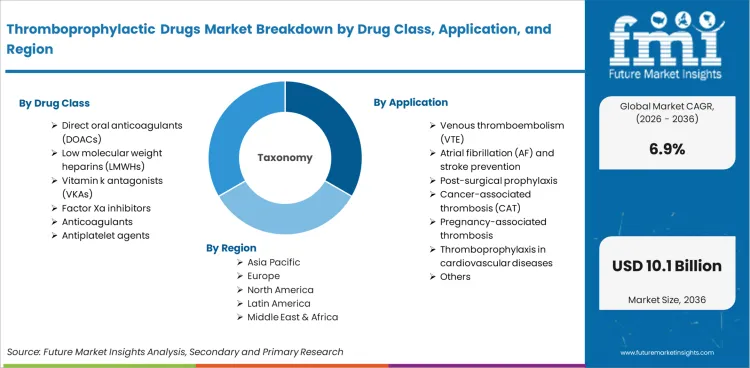
Thromboprophylactic Drugs Market Segmented by Drug Class:
- Direct oral anticoagulants (DOACs)
- Low molecular weight heparins (LMWHs)
- Vitamin k antagonists (VKAs)
- Factor Xa inhibitors
- Anticoagulants
- Antiplatelet agents
Thromboprophylactic Drugs Market Segmented by Application:
- Venous thromboembolism (VTE)
- Atrial fibrillation (AF) and stroke prevention
- Post-surgical prophylaxis
- Cancer-associated thrombosis (CAT)
- Pregnancy-associated thrombosis
- Thromboprophylaxis in cardiovascular diseases
- Others
Thromboprophylactic Drugs Market Segmented by End User:
- Hospitals
- Ambulatory surgical centers (ASCs)
- Clinics
- Home care settings
- Specialty pharmacies
Thromboprophylactic Drugs Market Segmented by Product:
- Anticoagulants
- Heparin Based Drugs
- Unfractionated Heparin
- Low Molecular Weight Heparin
- Direct Oral Anticoagulants
- Factor Xa Inhibitors
- Direct Thrombin Inhibitors
- Vitamin K Antagonists
- Warfarin Based Drugs
- Coumarin Derivatives
- Heparin Based Drugs
- Antiplatelet Drugs
- Aspirin Based Drugs
- Low Dose Aspirin
- Combination Aspirin Therapies
- P2Y12 Inhibitors
- Clopidogrel Based Drugs
- Ticagrelor Based Drugs
- Glycoprotein IIb IIIa Inhibitors
- Abciximab Based Drugs
- Eptifibatide Based Drugs
- Aspirin Based Drugs
Thromboprophylactic Drugs Market by Region:
- North America
- USA
- Canada
- Mexico
- Latin America
- Brazil
- Chile
- Rest of Latin America
- Western Europe
- Germany
- UK
- Italy
- Spain
- France
- Nordic
- BENELUX
- Rest of Western Europe
- Eastern Europe
- Russia
- Poland
- Hungary
- Balkan & Baltic
- Rest of Eastern Europe
- East Asia
- China
- Japan
- South Korea
- South Asia and Pacific
- India
- ASEAN
- Australia & New Zealand
- Rest of South Asia and Pacific
- Middle East & Africa
- Kingdom of Saudi Arabia
- Other GCC Countries
- Turkiye
- South Africa
- Other African Union
- Rest of Middle East & Africa
Research Sources and Bibliography
- USA Food and Drug Administration. (2024). FDA Guidance on Anticoagulant Drug Products: Clinical Evaluation for Thromboprophylaxis. FDA.
- European Medicines Agency. (2024). EMA Guidelines on Clinical Investigation of Antithrombotic Medicinal Products. EMA.
- World Health Organization. (2024). WHO Model List of Essential Medicines: Anticoagulant and Antithrombotic Agents. WHO.
- American College of Chest Physicians. (2025). ACCP Evidence-Based Clinical Practice Guidelines on Antithrombotic Therapy. ACCP.
- International Society on Thrombosis and Haemostasis. (2025). ISTH Guidelines on Venous Thromboembolism Prevention. ISTH.
This bibliography is provided for reader reference. The full Future Market Insights report contains the complete reference list with publication dates, URLs, and supporting data for all cited works.
This Report Answers
- Estimating the size of the market and revenue from 2026 to 2036.
- Segmentation analysis across all product, application, and end-use categories.
- Regional insights covering more than 30 markets worldwide.
- Technology and material analysis relevant to market applications.
- Competitive landscape assessment including company benchmarking.
- Identification of investment opportunities across high-growth segments and regions.
- Supply chain analysis and distribution channel assessment.
- Data delivery in PDF and Excel formats.
Frequently Asked Questions
What is the global market demand for Thromboprophylactic Drugs Market in 2026?
In 2026, the global thromboprophylactic drugs market is expected to be worth USD 5.17 billion.
How big will the Thromboprophylactic Drugs Market be in 2036?
By 2036, the thromboprophylactic drugs market is expected to be worth USD 10.08 billion.
How much is demand expected to grow between 2026 and 2036?
Between 2026 and 2036, demand is expected to grow at a CAGR of 6.9%.
Which End User segment is likely to lead globally in 2026?
Hospitals is expected to account for 61.8% of the end user segment in 2026, reflecting strong end-use demand.
What is causing demand to rise in China?
China is expected to grow at 18.4% through 2036, reflecting rapid hospital capacity expansion, increasing surgical volumes, and growing adoption of thromboprophylaxis protocols in clinical practice.
What is causing demand to rise in India?
India is expected to grow at 17.0% through 2036, reflecting expanding healthcare infrastructure, growing surgical procedure volumes, and increasing awareness of venous thromboembolism prevention.
What does this report mean by 'Thromboprophylactic Drugs Market definition'?
The thromboprophylactic drugs market encompasses anticoagulant pharmaceutical products including direct oral anticoagulants, low-molecular-weight heparins, and unfractionated heparin used for venous thromboembolism prevention in surgical, hospitalized, and at-risk patient populations.
How does FMI make the forecast and validate it?
Forecasting models use a hybrid bottom-up and top-down approach, starting with verified transaction data and validating against industry statistics and manufacturer disclosures.
Preview the report firsthand - request a free sample
Get SampleGet the brochure for pricing and purchase details.
Get PDFTable of Content
- Executive Summary
- Global Market Outlook
- Demand-side Trends
- Supply-side Trends
- Technology Roadmap Analysis
- Analysis and Recommendations
- Market Overview
- Market Coverage / Taxonomy
- Market Definition / Scope / Limitations
- Research Methodology
- Chapter Orientation
- Analytical Lens and Working Hypotheses
- Market Structure, Signals, and Trend Drivers
- Benchmarking and Cross-market Comparability
- Market Sizing, Forecasting, and Opportunity Mapping
- Research Design and Evidence Framework
- Desk Research Programme (Secondary Evidence)
- Company Annual and Sustainability Reports
- Peer-reviewed Journals and Academic Literature
- Corporate Websites, Product Literature, and Technical Notes
- Earnings Decks and Investor Briefings
- Statutory Filings and Regulatory Disclosures
- Technical White Papers and Standards Notes
- Trade Journals, Industry Magazines, and Analyst Briefs
- Conference Proceedings, Webinars, and Seminar Materials
- Government Statistics Portals and Public Data Releases
- Press Releases and Reputable Media Coverage
- Specialist Newsletters and Curated Briefings
- Sector Databases and Reference Repositories
- FMI Internal Proprietary Databases and Historical Market Datasets
- Subscription Datasets and Paid Sources
- Social Channels, Communities, and Digital Listening Inputs
- Additional Desk Sources
- Expert Input and Fieldwork (Primary Evidence)
- Primary Modes
- Qualitative Interviews and Expert Elicitation
- Quantitative Surveys and Structured Data Capture
- Blended Approach
- Why Primary Evidence is Used
- Field Techniques
- Interviews
- Surveys
- Focus Groups
- Observational and In-context Research
- Social and Community Interactions
- Stakeholder Universe Engaged
- C-suite Leaders
- Board Members
- Presidents and Vice Presidents
- R&D and Innovation Heads
- Technical Specialists
- Domain Subject-matter Experts
- Scientists
- Physicians and Other Healthcare Professionals
- Governance, Ethics, and Data Stewardship
- Research Ethics
- Data Integrity and Handling
- Primary Modes
- Tooling, Models, and Reference Databases
- Desk Research Programme (Secondary Evidence)
- Data Engineering and Model Build
- Data Acquisition and Ingestion
- Cleaning, Normalisation, and Verification
- Synthesis, Triangulation, and Analysis
- Quality Assurance and Audit Trail
- Market Background
- Market Dynamics
- Drivers
- Restraints
- Opportunity
- Trends
- Scenario Forecast
- Demand in Optimistic Scenario
- Demand in Likely Scenario
- Demand in Conservative Scenario
- Opportunity Map Analysis
- Product Life Cycle Analysis
- Supply Chain Analysis
- Investment Feasibility Matrix
- Value Chain Analysis
- PESTLE and Porter’s Analysis
- Regulatory Landscape
- Regional Parent Market Outlook
- Production and Consumption Statistics
- Import and Export Statistics
- Market Dynamics
- Global Market Analysis 2021 to 2025 and Forecast, 2026 to 2036
- Historical Market Size Value (USD Million) Analysis, 2021 to 2025
- Current and Future Market Size Value (USD Million) Projections, 2026 to 2036
- Y-o-Y Growth Trend Analysis
- Absolute $ Opportunity Analysis
- Global Market Pricing Analysis 2021 to 2025 and Forecast 2026 to 2036
- Global Market Analysis 2021 to 2025 and Forecast 2026 to 2036, By Drug Class
- Introduction / Key Findings
- Historical Market Size Value (USD Million) Analysis By Drug Class , 2021 to 2025
- Current and Future Market Size Value (USD Million) Analysis and Forecast By Drug Class , 2026 to 2036
- Direct oral anticoagulants (DOACs)
- Low molecular weight heparins (LMWHs)
- Vitamin k antagonists (VKAs)
- Factor Xa inhibitors
- Anticoagulants
- Antiplatelet agents
- Direct oral anticoagulants (DOACs)
- Y-o-Y Growth Trend Analysis By Drug Class , 2021 to 2025
- Absolute $ Opportunity Analysis By Drug Class , 2026 to 2036
- Global Market Analysis 2021 to 2025 and Forecast 2026 to 2036, By Application
- Introduction / Key Findings
- Historical Market Size Value (USD Million) Analysis By Application, 2021 to 2025
- Current and Future Market Size Value (USD Million) Analysis and Forecast By Application, 2026 to 2036
- Venous thromboembolism (VTE)
- Atrial fibrillation (AF) and stroke prevention
- Post-surgical prophylaxis
- Cancer-associated thrombosis (CAT)
- Pregnancy-associated thrombosis
- Thromboprophylaxis in cardiovascular diseases
- Others
- Venous thromboembolism (VTE)
- Y-o-Y Growth Trend Analysis By Application, 2021 to 2025
- Absolute $ Opportunity Analysis By Application, 2026 to 2036
- Global Market Analysis 2021 to 2025 and Forecast 2026 to 2036, By End User
- Introduction / Key Findings
- Historical Market Size Value (USD Million) Analysis By End User, 2021 to 2025
- Current and Future Market Size Value (USD Million) Analysis and Forecast By End User, 2026 to 2036
- Hospitals
- Ambulatory surgical centers (ASCs)
- Clinics
- Home care settings
- Specialty pharmacies
- Hospitals
- Y-o-Y Growth Trend Analysis By End User, 2021 to 2025
- Absolute $ Opportunity Analysis By End User, 2026 to 2036
- Global Market Analysis 2021 to 2025 and Forecast 2026 to 2036, By Product
- Introduction / Key Findings
- Historical Market Size Value (USD Million) Analysis By Product, 2021 to 2025
- Current and Future Market Size Value (USD Million) Analysis and Forecast By Product, 2026 to 2036
- Anticoagulants
- Heparin Based Drugs
- Unfractionated Heparin
- Low Molecular Weight Heparin
- Direct Oral Anticoagulants
- Factor Xa Inhibitors
- Direct Thrombin Inhibitors
- Vitamin K Antagonists
- Warfarin Based Drugs
- Coumarin Derivatives
- Antiplatelet Drugs
- Aspirin Based Drugs
- Low Dose Aspirin
- Combination Aspirin Therapies
- P2Y12 Inhibitors
- Clopidogrel Based Drugs
- Anticoagulants
- Y-o-Y Growth Trend Analysis By Product, 2021 to 2025
- Absolute $ Opportunity Analysis By Product, 2026 to 2036
- Global Market Analysis 2021 to 2025 and Forecast 2026 to 2036, By Region
- Introduction
- Historical Market Size Value (USD Million) Analysis By Region, 2021 to 2025
- Current Market Size Value (USD Million) Analysis and Forecast By Region, 2026 to 2036
- North America
- Latin America
- Western Europe
- Eastern Europe
- East Asia
- South Asia and Pacific
- Middle East & Africa
- Market Attractiveness Analysis By Region
- North America Market Analysis 2021 to 2025 and Forecast 2026 to 2036, By Country
- Historical Market Size Value (USD Million) Trend Analysis By Market Taxonomy, 2021 to 2025
- Market Size Value (USD Million) Forecast By Market Taxonomy, 2026 to 2036
- By Country
- USA
- Canada
- Mexico
- By Drug Class
- By Application
- By End User
- By Product
- By Country
- Market Attractiveness Analysis
- By Country
- By Drug Class
- By Application
- By End User
- By Product
- Key Takeaways
- Latin America Market Analysis 2021 to 2025 and Forecast 2026 to 2036, By Country
- Historical Market Size Value (USD Million) Trend Analysis By Market Taxonomy, 2021 to 2025
- Market Size Value (USD Million) Forecast By Market Taxonomy, 2026 to 2036
- By Country
- Brazil
- Chile
- Rest of Latin America
- By Drug Class
- By Application
- By End User
- By Product
- By Country
- Market Attractiveness Analysis
- By Country
- By Drug Class
- By Application
- By End User
- By Product
- Key Takeaways
- Western Europe Market Analysis 2021 to 2025 and Forecast 2026 to 2036, By Country
- Historical Market Size Value (USD Million) Trend Analysis By Market Taxonomy, 2021 to 2025
- Market Size Value (USD Million) Forecast By Market Taxonomy, 2026 to 2036
- By Country
- Germany
- UK
- Italy
- Spain
- France
- Nordic
- BENELUX
- Rest of Western Europe
- By Drug Class
- By Application
- By End User
- By Product
- By Country
- Market Attractiveness Analysis
- By Country
- By Drug Class
- By Application
- By End User
- By Product
- Key Takeaways
- Eastern Europe Market Analysis 2021 to 2025 and Forecast 2026 to 2036, By Country
- Historical Market Size Value (USD Million) Trend Analysis By Market Taxonomy, 2021 to 2025
- Market Size Value (USD Million) Forecast By Market Taxonomy, 2026 to 2036
- By Country
- Russia
- Poland
- Hungary
- Balkan & Baltic
- Rest of Eastern Europe
- By Drug Class
- By Application
- By End User
- By Product
- By Country
- Market Attractiveness Analysis
- By Country
- By Drug Class
- By Application
- By End User
- By Product
- Key Takeaways
- East Asia Market Analysis 2021 to 2025 and Forecast 2026 to 2036, By Country
- Historical Market Size Value (USD Million) Trend Analysis By Market Taxonomy, 2021 to 2025
- Market Size Value (USD Million) Forecast By Market Taxonomy, 2026 to 2036
- By Country
- China
- Japan
- South Korea
- By Drug Class
- By Application
- By End User
- By Product
- By Country
- Market Attractiveness Analysis
- By Country
- By Drug Class
- By Application
- By End User
- By Product
- Key Takeaways
- South Asia and Pacific Market Analysis 2021 to 2025 and Forecast 2026 to 2036, By Country
- Historical Market Size Value (USD Million) Trend Analysis By Market Taxonomy, 2021 to 2025
- Market Size Value (USD Million) Forecast By Market Taxonomy, 2026 to 2036
- By Country
- India
- ASEAN
- Australia & New Zealand
- Rest of South Asia and Pacific
- By Drug Class
- By Application
- By End User
- By Product
- By Country
- Market Attractiveness Analysis
- By Country
- By Drug Class
- By Application
- By End User
- By Product
- Key Takeaways
- Middle East & Africa Market Analysis 2021 to 2025 and Forecast 2026 to 2036, By Country
- Historical Market Size Value (USD Million) Trend Analysis By Market Taxonomy, 2021 to 2025
- Market Size Value (USD Million) Forecast By Market Taxonomy, 2026 to 2036
- By Country
- Kingdom of Saudi Arabia
- Other GCC Countries
- Turkiye
- South Africa
- Other African Union
- Rest of Middle East & Africa
- By Drug Class
- By Application
- By End User
- By Product
- By Country
- Market Attractiveness Analysis
- By Country
- By Drug Class
- By Application
- By End User
- By Product
- Key Takeaways
- Key Countries Market Analysis
- USA
- Pricing Analysis
- Market Share Analysis, 2025
- By Drug Class
- By Application
- By End User
- By Product
- Canada
- Pricing Analysis
- Market Share Analysis, 2025
- By Drug Class
- By Application
- By End User
- By Product
- Mexico
- Pricing Analysis
- Market Share Analysis, 2025
- By Drug Class
- By Application
- By End User
- By Product
- Brazil
- Pricing Analysis
- Market Share Analysis, 2025
- By Drug Class
- By Application
- By End User
- By Product
- Chile
- Pricing Analysis
- Market Share Analysis, 2025
- By Drug Class
- By Application
- By End User
- By Product
- Germany
- Pricing Analysis
- Market Share Analysis, 2025
- By Drug Class
- By Application
- By End User
- By Product
- UK
- Pricing Analysis
- Market Share Analysis, 2025
- By Drug Class
- By Application
- By End User
- By Product
- Italy
- Pricing Analysis
- Market Share Analysis, 2025
- By Drug Class
- By Application
- By End User
- By Product
- Spain
- Pricing Analysis
- Market Share Analysis, 2025
- By Drug Class
- By Application
- By End User
- By Product
- France
- Pricing Analysis
- Market Share Analysis, 2025
- By Drug Class
- By Application
- By End User
- By Product
- India
- Pricing Analysis
- Market Share Analysis, 2025
- By Drug Class
- By Application
- By End User
- By Product
- ASEAN
- Pricing Analysis
- Market Share Analysis, 2025
- By Drug Class
- By Application
- By End User
- By Product
- Australia & New Zealand
- Pricing Analysis
- Market Share Analysis, 2025
- By Drug Class
- By Application
- By End User
- By Product
- China
- Pricing Analysis
- Market Share Analysis, 2025
- By Drug Class
- By Application
- By End User
- By Product
- Japan
- Pricing Analysis
- Market Share Analysis, 2025
- By Drug Class
- By Application
- By End User
- By Product
- South Korea
- Pricing Analysis
- Market Share Analysis, 2025
- By Drug Class
- By Application
- By End User
- By Product
- Russia
- Pricing Analysis
- Market Share Analysis, 2025
- By Drug Class
- By Application
- By End User
- By Product
- Poland
- Pricing Analysis
- Market Share Analysis, 2025
- By Drug Class
- By Application
- By End User
- By Product
- Hungary
- Pricing Analysis
- Market Share Analysis, 2025
- By Drug Class
- By Application
- By End User
- By Product
- Kingdom of Saudi Arabia
- Pricing Analysis
- Market Share Analysis, 2025
- By Drug Class
- By Application
- By End User
- By Product
- Turkiye
- Pricing Analysis
- Market Share Analysis, 2025
- By Drug Class
- By Application
- By End User
- By Product
- South Africa
- Pricing Analysis
- Market Share Analysis, 2025
- By Drug Class
- By Application
- By End User
- By Product
- USA
- Market Structure Analysis
- Competition Dashboard
- Competition Benchmarking
- Market Share Analysis of Top Players
- By Regional
- By Drug Class
- By Application
- By End User
- By Product
- Competition Analysis
- Competition Deep Dive
- Johnson & Johnson
- Overview
- Product Portfolio
- Profitability by Market Segments (Product/Age /Sales Channel/Region)
- Sales Footprint
- Strategy Overview
- Marketing Strategy
- Product Strategy
- Channel Strategy
- Boehringer Ingelheim GmbH
- Sanofi SA
- Pfizer Inc.
- Bayer AG
- Bristol-Myers Squibb
- AstraZeneca
- Sun Pharmaceutical Industries
- Johnson & Johnson
- Competition Deep Dive
- Assumptions & Acronyms Used


