

- Market Size (2026)
- USD 339.4 Mn
- Forecast (2036)
- USD 1102.0 Mn
- CAGR (2026 to 2036)
- 12.5%
How big is Two-Phase Direct-to-Chip Commissioning Services Market in 2026?
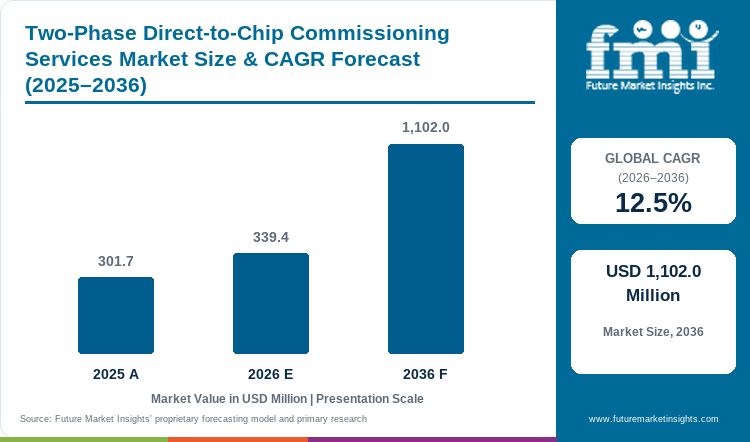
The market is projected to reach USD 339.4 Million in 2026 and USD 1,102.0 Million by 2036, growing at a 12.5% CAGR.
The market was valued at USD 301.7 Million in 2025. The industry's shift from component cooling to system-level thermal acceptance is actively changing where service spending occurs. Direct-to-chip loops now operate alongside high-value GPU clusters, meaning a single incorrect flow setting can render computing capacity unavailable. In December 2024, the USA Department of Energy reported that data centers consumed approximately 4.4% of USA electricity in 2023, projecting this share could rise to between 6.7% and 12.0% by 2028. As power demand surges, inefficient cooling becomes increasingly costly, making documented startup testing highly critical before production workloads go live.
Because of this, commissioning covers controls, alarm states, flow, and pressure. Teams also verify temperature response, redundancy, and full-load behavior prior to handover. For two-phase systems, these checks extend to vapor quality management and refrigerant-side operating conditions. Ultimately, buyers are paying for proof that the thermal chain functions exactly as designed, rather than just a basic equipment startup.
Demand drivers also vary significantly by country. South Korea relies on public policy to expand advanced GPU resources while navigating power and site constraints for AI data centers. Japan is bolstering domestic computational resources through its economic-security framework. Saudi Arabia and the UAE are expanding data-center capacity via large digital-infrastructure programs, and France is pairing AI investments with planned data-center capacity and a power grid primed for electrified growth. These varying conditions result in distinct service needs. New hyperscale campuses can utilize repeatable acceptance procedures across phased halls, whereas brownfield sites typically require more extensive design validation before refrigerant loops and heat rejection systems can be successfully integrated. Owners are most likely to purchase when commissioning evidence directly correlates to uptime, warranty acceptance, and a clearly defined operating envelope for their production clusters.
Key Takeaways
- The market is valued at USD 339.4 Million in 2026 and is forecast to reach USD 1,102.0 Million by 2036 at a 12.5% CAGR.
- Commissioning and balancing will account for 26.0% of Service Scope demand in 2026.
- Dry coolers will make up 29.0% of Heat Rejection / Secondary Loop demand in 2026.
- The 251-500 kW range accounts for 34.0% of Rack Density demand in 2026.
- Growth is most robust where new AI compute infrastructure is deployed alongside additional power and data-center capacity. Saudi Arabia has a forecasted CAGR of 14.1% from 2026 to 2036, followed closely by South Korea at 13.8%.
- Field-service access and thermal architecture control heavily shape the competitive landscape. Companies like Accelsius and ZutaCore position their two-phase direct-to-chip platforms alongside robust integration and deployment support.
Analyst Perspective
"System handoff readiness is the right test for direct-to-chip commissioning. Stable flow and temperature are essential, but controls, alarms and the secondary fluid network also have to behave correctly. The service proves its value when the same checks can be repeated across a large AI deployment."
- Sudip saha, Principal Analyst at Future Market Insights
How is the Two-Phase Direct-to-Chip Commissioning Services Market segmented?
The market is broken down by Service Scope, Heat Rejection / Secondary Loop, Rack Density, Data Center Type, Route to Market, and Region.
Each segmentation axis highlights a distinct part of the commissioning workload. For example, Service Scope separates initial project design from startup validation and failure analysis, while also distinguishing retrofit conversions from routine ongoing maintenance. Heat Rejection / Secondary Loop identifies exactly how rack-side thermal loads reach the facility's overall infrastructure. Rack Density indicates the specific testing burden created when significant heat is concentrated into smaller physical spaces. Data Center Type separates hyperscale AI environments from colocation, enterprise AI/HPC, and research/sovereign compute settings. Finally, Route to Market illustrates which entity owns the customer relationship and holds commissioning accountability. Collectively, these categories demonstrate that service demand relies on proving the entire connected thermal chain against site acceptance criteria, rather than just testing standalone cooling hardware.
Why does Commissioning / Balancing lead the Service Scope category?
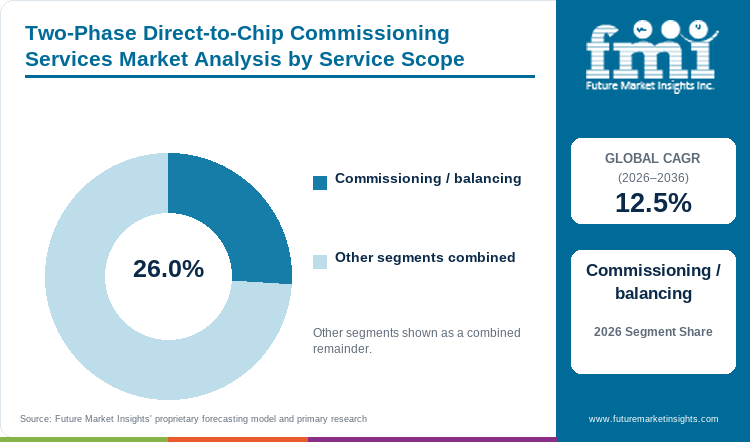
Before any IT load is accepted, commissioning and balancing test the cooling path as a unified, connected system. Teams measure flow distribution and temperature responses, then verify controls, alarms, and leak detection systems. This task is complex because the rack-side and facility-side networks must operate seamlessly together under intended conditions, going far beyond simply adding fluid.
- Commissioning and balancing holds a 26.0% market share in 2026 because comprehensive acceptance testing is mandatory across both new installations and retrofits before operational handover can occur.
- In February 2025, Vertiv launched its Liquid Cooling Services globally, featuring startup and commissioning work that strictly verifies connected equipment and the function of heat-rejection or cooling loops.
Why do Dry Coolers lead the Heat Rejection / Secondary Loop category?
Direct-to-chip architectures can function with warmer facility-water temperatures, making dry coolers a highly practical option for heat rejection. ASHRAE notes that 45°C inlet water enables dry-cooler heat rejection and reduces the need for mechanical refrigeration. Consequently, commissioning tasks shift toward fan staging, approach-temperature checks, and the validation of pump curves, control sequences, and ambient-temperature boundaries. Unlike chilled-water plants, a dry cooler's available cooling margin fluctuates with outdoor weather conditions. Two-phase systems can also reject heat into these warmer facility loops, making the facility interface a core part of the acceptance boundary. While chillers remain necessary in certain climates or for specific design temperatures-and cooling towers or hybrid setups serve other priorities-dry-cooler projects require repeatable service work focused on proving chiller-less operation across expected environmental conditions.
- Dry coolers hold a 29.0% share in 2026 because warm-water direct-to-chip (DTC) designs are increasing the adoption of closed-loop heat rejection, which requires careful validation of controls and seasonal performance.
- ASHRAE’s 2026 AI Data Center Energy Performance Framework highlights 45°C inlet water as a primary enabler of dry-cooler-based heat rejection, though it notes sensitivity to high ambient temperatures.
Why does 251-500 kW lead the Rack Density category?
At the 251-500 kW level, rack density is high enough that a single commissioning error can trigger a system-wide thermal crisis, yet this segment is much more common than the most extreme rack designs. A single mistake here can jeopardize multiple high-value accelerators through shared manifolds or Coolant Distribution Units (CDUs). Basic leak checks are not enough; teams must rigorously confirm flow balance and control responses, test fault states, and monitor facility-loop behavior under representative loads. Lower-density projects often retain more air-assisted cooling, while racks above 500 kW generally require highly specialized architectures and represent a narrower deployment class.
- The 251-500 kW category commands a 34.0% share in 2026 because it merges high commissioning complexity with a rack-and-row scale that is frequently repeated across large AI deployments.
- The February 2025 Open Compute Project two-phase technical paper highlighted an in-row refrigerant-to-liquid CDU design rated at 400 kW, featuring 45°C facility water and an in-situ secondary fluid network, placing it squarely in this segment.
Why does Hyperscale AI lead the Data Center Type category?
Hyperscale AI deployments condense massive amounts of computing value and thermal load into repeated cluster blocks. This repetition drastically increases the value of standardized acceptance procedures, allowing a single rack or row test pattern to be scaled across an entire data hall. These hyperscale sites integrate the liquid cooling loop with power controls, building management systems, and facility heat rejection, creating multiple interfaces where a configuration error could delay a compute rollout. Hyperscale AI effectively combines massive deployment scale with an uncompromising need for documented readiness before expensive accelerator capacity is handed over to operations.
- Hyperscale AI holds a 48.0% share in 2026 because highly concentrated GPU deployments necessitate repeatable commissioning packages that carry high stakes for uptime and scheduling.
- In March 2026, Accelsius introduced the NeuCool IR150, an integrated two-phase rack combining a CDU with 42U of IT space and built-in manifolds to support up to 150 kW of cooling capacity.
Why does Cooling OEM Direct lead the Route to Market category?
Cooling Original Equipment Manufacturers (OEMs) remain a dominant route to market because two-phase performance relies heavily on proprietary design choices across cold plates, refrigerant circuits, CDU controls, and service procedures. Keeping the OEM engaged during startup ensures settings stay within the intended operating envelope and reduces friction when commissioning records are tied to warranty or support agreements. Direct OEM engagement offers the most value when a customer desires a single technical owner fully accountable for system startup-a factor that carries extra weight during early adoption phases while field practices are still being standardized.
- Cooling OEM direct holds a 36.0% share in 2026 because proprietary thermal controls and unique service procedures keep the cooling-system supplier intimately involved in acceptance testing and handover.
- In March 2025, Accelsius launched NeuGuard, providing lifecycle support from planning through deployment, with commissioning and ongoing maintenance delivered via its authorized-service ecosystem.
What are the drivers, restraints and opportunities in the Two-Phase Direct-to-Chip Commissioning Services Market?
AI rack densification is accelerating the need for meticulously verified system startups. However, two-phase integration complexity can cause project delays, while warm-water and retrofit architectures are opening up new service opportunities.
- Driver: Before any compute capacity can be released, high-density AI clusters demand that direct-to-chip thermal systems are rigorously validated under realistic loads.
- Restraint: Refrigerant-side controls and interoperability issues can prolong qualification cycles, while a lack of technician capability and facility integration challenges can further delay acceptance.
- Opportunity: Warm-water heat rejection and brownfield conversions are expanding the need for design validation and balancing, and fault testing alongside lifecycle optimization creates ongoing follow-on work.
Thermal uncertainty is becoming costlier as AI compute density increases. ASHRAE points to direct-to-chip cooling as an emerging standard for HPC, specifically highlighting warm-water architectures for high-density setups. Concurrently, the USA Department of Energy expects data-center electricity demand to sharply rise through 2028. This combination means cooling efficiency and uptime are now weighted equally with power availability in capital investment decisions. Simply adopting liquid cooling does not trigger this spend; the catalyst is the need to release high-cost compute into production with a guaranteed thermal operating margin.
Integration and acceptance remain the primary constraints. Pumped two-phase systems rely on refrigerant phase changes and require sufficient mass flow to prevent cold-plate dry-out. The Open Compute Project (February 2025) also highlights pressure limits, material compatibility, service connections, and refrigerant handling as additional hurdles. Because responsibility spans server hardware, cooling equipment, facility water, and controls, even technically sound projects can face delays if ownership is vague or field capabilities are lacking.
Treating commissioning as an ongoing part of thermal architecture optimization-rather than a one-time checklist-represents a major service opportunity. Warm-water loops can efficiently support dry coolers and reduce reliance on chillers. Furthermore, retrofitting brownfield data centers introduces two-phase cooling via designs that reject heat to existing facility water or assisted-air systems. Thermal simulation, seasonal heat-rejection testing, controls tuning, and baseline maintenance all create robust avenues for sustained project revenue.
Which country CAGRs are profiled in the Two-Phase Direct-to-Chip Commissioning Services Market?
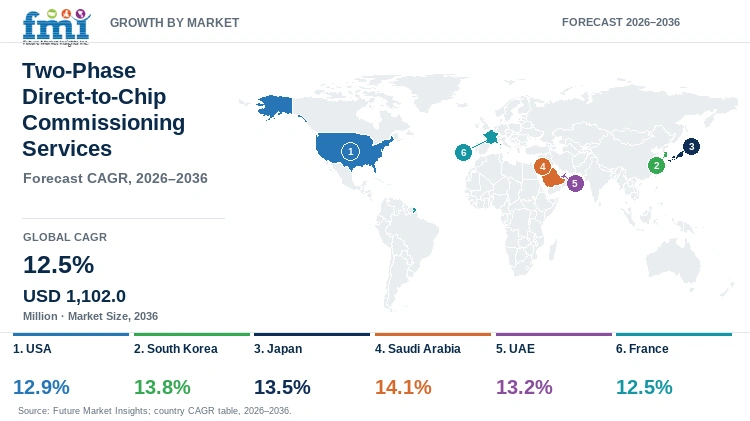
| Country | CAGR |
|---|---|
| USA | 12.9% |
| South Korea | 13.8% |
| Japan | 13.5% |
| Saudi Arabia | 14.1% |
| UAE | 13.2% |
| France | 12.5% |
How do country-level CAGRs compare in the Two-Phase Direct-to-Chip Commissioning Services Market?
Across the six profiled countries, the CAGR ranges by only 1.6 percentage points, stretching from 14.1% in Saudi Arabia down to 12.5% in France. Saudi Arabia and South Korea lead the pack, closely followed by Japan, while the UAE sits slightly above the USA and France. Because this spread is relatively narrow, on-the-ground implementation conditions are a more vital metric than a simple growth ranking.
- Saudi Arabia is 0.3 percentage points above South Korea; with such a slim gap, project priorities will rely heavily on local delivery capabilities and heat-rejection designs rather than headline growth figures.
- South Korea is 0.3 percentage points ahead of Japan. Korea's policy-driven GPU expansion prioritizes rapid infrastructure readiness, whereas Japan focuses on highly controlled qualification and stable supply for its funded compute projects.
- Japan is 0.3 percentage points above the UAE. Japan follows a deeply structured domestic-compute path, whereas the UAE’s phased hyperscale projects generate continuous, repeated commissioning packages as new capacity comes online.
- The UAE is 0.3 percentage points above the USA, which is in turn 0.4 points above France. Although these are lower-growth markets percentage-wise, they still support massive absolute service pools, as the CAGR does not reflect the vast size of their existing installed bases.
Country-wise Analysis
- USA: Hyperscale and colocation operators are increasingly treating cooling as a core component of the power-capacity challenge. With data centers projected by the DOE to consume up to 12.0% of USA electricity by 2028, power constraints drastically raise the cost of underperforming thermal infrastructure. Commissioning must connect full-load acceptance with energy performance and secondary-loop controls to ensure GPU capacity releases without excess non-IT load.
- South Korea: AI compute acquisition is rapidly accelerating through public policy aimed at mitigating power and site constraints. In February 2025, the Ministry of Science and ICT targeted 18,000 advanced GPUs by mid-2026, outlining support for power supply and citing Power System Impact Assessments for data centers outside Seoul. Local engineering resources and staged acceptance plans are essential to align cooling startups with facility approvals.
- Japan: Domestic computational resources are viewed as strategically imperative under Japan's policy frameworks. METI approved up to JPY 72.5 billion in April 2024 for projects aimed at improving AI computational resources. The local market constraint is controlled infrastructure qualification rather than a lack of demand, meaning service providers must supply meticulous design documentation and repeatable acceptance records.
- Saudi Arabia: Rapid data-center expansion demands thermal systems capable of reliable commissioning in high-ambient conditions. In April 2025, the Ministry of Communications and Information Technology reported a 42% capacity increase to 290.5 MW during 2023. Dry-cooler or hybrid commissioning expertise, seasonal performance testing, and localized service coverage are critical to support these phased additions.
- UAE: Hyperscale capacity in the UAE is being built in phases, allowing operators to standardize commissioning across successive data halls. In April 2025, an AED 2 billion hyperscale project was announced by the Dubai Media Office, developed by du with Microsoft as the primary tenant. The primary challenge here is maintaining consistent thermal acceptance as capacities and workloads scale up over time.
- France: France is developing massive data-center capacity in tandem with AI infrastructure investments. In June 2026, the Élysée reported a commitment from SoftBank to develop at least 3 GW (and up to 5 GW) of AI-dedicated capacity. Service suppliers must provide commissioning teams that can seamlessly scale across massive projects and effectively validate warm-water heat rejection at the system level.
Who are the notable companies in the Two-Phase Direct-to-Chip Commissioning Services Market?
Competition is largely divided by who owns the thermal architecture versus who can successfully support it in the field.
Competitive Benchmarking: Two-Phase Direct-to-Chip Commissioning Services Market
| Company | Two-Phase D2C Integration | Commissioning & Lifecycle Services | Fluid-Network & Secondary-Loop Support | Geographic Reach |
|---|---|---|---|---|
| Accelsius | High | High | Medium | North America and Europe with partner-led field support |
| Vertiv | Medium | High | High | More than 130 countries through a global service network |
| Parker Hannifin | Medium | Unscored | High | Global engineering and commercial network |
| ZutaCore | High | High | Medium | Americas, Europe, and Asia through direct and partner deployments |
(Scoring notes: "High" indicates broad documented capability against the criterion; "Medium" indicates credible but narrower capability; "Low" indicates a documented limitation; "Unscored" is used when public information is unavailable.)
Key Developments in the Two-Phase Direct-to-Chip Commissioning Services Market
- March 2026 (Accelsius): Introduced the NeuCool IR150 at NVIDIA GTC, an integrated rack combining a two-phase CDU with 42U of IT space and built-in liquid and vapor manifolds for up to 150 kW of cooling.
- May 2026 (Vertiv): Expanded its EMEA portfolio with the CoolChip CDU 2300 (2.3 MW liquid-to-liquid cooling) and Fluid Network Row Manifolds, paired with liquid-cooling services to widen their commissioning scope.
- July 2026 (Parker Hannifin): Launched the SCVOT2 Vortex Flow & Temperature Sensor designed for direct-to-chip and secondary-loop applications to support heat-removal validation under changing loads.
Key Players in the Two-Phase Direct-to-Chip Commissioning Services Market
- Integrated Two-Phase Platforms (Accelsius, ZutaCore): These companies pair proprietary two-phase direct-to-chip architectures with deployment, validation, and lifecycle support, meaning their commissioning closely tracks proprietary system behaviors.
- Lifecycle Infrastructure Services (Vertiv): Approaching from a broad critical-infrastructure base, Vertiv combines design support and installation with startup, commissioning, fluid management, and maintenance across secondary fluid networks and heat-rejection systems.
- Fluid-Network Instrumentation (Parker Hannifin): This firm supplies essential two-phase engineering knowledge and fluid-network technologies used for measurement and control, which are vital for commissioning teams relying on accurate sensing and compatible field components.
Two-Phase Direct-to-Chip Commissioning Services Market - Report Scope
| Coverage Field | Report Scope |
|---|---|
| Market breakdown | Service Scope; Heat Rejection / Secondary Loop; Rack Density; Data Center Type; Route to Market; Region |
| Quantitative Units | USD Million |
| Market Definition | Revenue from professional and lifecycle services directly tied to two-phase direct-to-chip cooling deployments. Includes design, simulation, commissioning, balancing, reliability analysis, retrofit, and managed maintenance. (Excludes hardware sales, unrelated EPC construction, single-phase, and immersion services). |
| Regions Covered | North America; Latin America; Western Europe; Eastern Europe; East Asia; South Asia and Pacific; Middle East and Africa |
| Countries Covered | USA, South Korea, Japan, Saudi Arabia, UAE, France, and more than twenty-five additional countries |
| Key Companies | Accelsius; Vertiv; Parker Hannifin; ZutaCore |
| Forecast Period | 2026 to 2036 |
| Approach | Hybrid bottom-up and top-down sizing reconciling service revenue by deployment scope, thermal architecture, buyer type, and country. |
Two-Phase Direct-to-Chip Commissioning Services Market - Research Methodology
| Method | Approach |
|---|---|
| Primary Research | Structured discussions with cooling OEMs, data-center operators, engineering firms, and decision-makers to test service scope, purchase triggers, workflows, and deployment frictions without relying on unsupported counts. |
| Desk Research | Review of government announcements, standards (ASHRAE, OCP), technical white papers, company filings, and dated project/service announcements explaining two-phase thermal architectures and build conditions. |
| Market Sizing | Hybrid sizing starting with addressable deployments and applying the service revenue boundary, reconciling against adoption timing, rack density, facility architecture, and service delivery routes for 2026-2036. |
| Data Validation | Cross-checking values across service scope, architecture, country conditions, and evidence while strictly excluding adjacent hardware or unverified claims. |
(Competitive positioning within the research is based on documented product capability, route-to-market strength, technical support, and recent market activity; it is a qualitative comparison, not a market-share ranking.)
Two-Phase Direct-to-Chip Commissioning Services Market by Segments
Two-Phase Direct-to-Chip Commissioning Services Market segmented by Service Scope:
- Commissioning / balancing
- Design & simulation
- Reliability & failure analysis
- Retrofit / conversion
- Managed maintenance
Two-Phase Direct-to-Chip Commissioning Services Market segmented by Heat Rejection / Secondary Loop:
- Dry coolers
- Chillers
- Cooling towers / evaporative
- Facility water loop / district interface
- Hybrid systems
Two-Phase Direct-to-Chip Commissioning Services Market segmented by Rack Density:
- 251-500 kW
- 100-250 kW
- Below 100 kW
- Above 500 kW
Two-Phase Direct-to-Chip Commissioning Services Market segmented by Data Center Type:
- Hyperscale AI
- Colocation AI
- Enterprise AI/HPC
- Research / sovereign compute
Two-Phase Direct-to-Chip Commissioning Services Market segmented by Route to Market:
- Cooling OEM direct
- MEP / EPC integrator
- Server / rack OEM bundle
- Service & retrofit channel
Two-Phase Direct-to-Chip Commissioning Services Market by Region
- North America
- United States
- Canada
- Latin America
- Brazil
- Mexico
- Argentina
- Chile
- Western Europe
- Germany
- France
- United Kingdom
- Italy
- Spain
- Benelux
- Nordics
- Eastern Europe
- Poland
- Czech Republic
- Romania
- Hungary
- East Asia
- China
- Japan
- South Korea
- South Asia and Pacific
- India
- ASEAN
- Australia and New Zealand
- Middle East and Africa
- GCC Countries
- South Africa
- Türkiye
- Israel
Research Sources and Bibliography
- USA Department of Energy (2024, December 20). DOE Releases New Report Evaluating Increase in Electricity Demand from Data Centers.
- ASHRAE (2026). Integrated Design Principles | AI Data Center Energy Performance Framework.
- Open Compute Project Foundation (2021, June 23). Open Compute Project Liquid Cooling Logistics and Integration White Paper, Revision 1.0.
- Open Compute Project Foundation (2025, February 14). Pumped 2P Refrigerant-Based Direct Liquid Cooling (DLC) White Paper.
- Vertiv (2025, February 11). Vertiv Announces Global Launch of Liquid Cooling Services Portfolio....
- Vertiv (2026, May 26). Vertiv Expands Liquid Cooling Portfolio in EMEA to Accelerate AI-Ready Data Centre Deployments.
- Accelsius (2025, March 12). Accelsius Introduces NeuGuard: An Enterprise-Grade Support Program....
- Accelsius (2026, March 16). Accelsius Makes NVIDIA GTC Debut with NeuCool IR150....
- Parker Hannifin (2026, July 23). Parker Launches the SCVOT2 Vortex Flow & Temperature Sensor....
- ZutaCore (2026, June 2). ZutaCore Announces $100M+ Series C Momentum....
- Ministry of Science and ICT, Republic of Korea (2025, February 20). Korea to Expand AI Computing Infrastructure....
- Ministry of Economy, Trade and Industry, Japan (2024, April 19). Approval of Plans for Ensuring a Stable Supply of Cloud Programs....
- Ministry of Communications and Information Technology, Saudi Arabia (2025, April 27). Saudi Arabia’s Digital Economy: A New Era....
- Government of Dubai Media Office (2025, April 22). Hamdan bin Mohammed Witnesses Announcement of AED2 Billion Hyperscale Data Centre.
The bibliography is included as a reader reference and is not exhaustive. The complete source list is contained in the full report.
This Report Answers
- What are the 2026 and 2036 values for the Two-Phase Direct-to-Chip Commissioning Services Market?
- Which AI infrastructure and thermal-management pressures support demand for commissioning and lifecycle services?
- Why does Commissioning / balancing hold the leading position within Service Scope?
- How does the leadership of Dry coolers shape secondary-loop commissioning demand?
- Why does the 251-500 kW class lead the Rack Density segmentation?
- How do growth rates differ across the USA, South Korea, Japan, Saudi Arabia, UAE, and France?
- How do Accelsius, Vertiv, Parker Hannifin, and ZutaCore participate across system integration and service roles?
- Which interoperability, validation, field-skill, and retrofit constraints can slow adoption?
Frequently Asked Questions
What is driving growth in the Two-Phase Direct-to-Chip Commissioning Services Market?
High-density AI deployments are pulling direct-to-chip cooling into the production-readiness process for expensive GPU capacity. Before racks move into operations, buyers increasingly require full-load testing and control verification, complete with documented balancing and handover evidence.
Who are the key players in the Two-Phase Direct-to-Chip Commissioning Services Market?
The companies profiled are Accelsius, Vertiv, Parker Hannifin, and ZutaCore. Accelsius and ZutaCore focus heavily on two-phase platforms; Vertiv contributes broad liquid-cooling lifecycle services; and Parker Hannifin provides essential fluid-network engineering and instrumentation.
What notable restraint affects the Two-Phase Direct-to-Chip Commissioning Services Market?
Integration across refrigerant circuits, CDUs, controls, and facility heat-rejection interfaces is the primary restraint. Acceptance is often delayed when responsibility is unclear or technicians lack standard procedures for validating flow, pressure, alarms, and dynamic-load behavior.
Why should executives track this market?
Commissioning dictates exactly how quickly installed AI compute becomes productive capacity. Poor thermal acceptance can delay revenue-generating workloads, raise operational risks, or spark disputes between cooling and facility suppliers.
What business problem does this market address?
It addresses the critical gap between raw installation and the proof of safe operation at intended IT loads. These services establish a verified baseline for controls and fluid behavior, recording heat-rejection performance before operations take over.
What should data-center decision-makers evaluate?
Decision-makers should compare two-phase domain knowledge against the depth of test coverage, facility-loop integration, and local field support. Crucially, acceptance ownership must be explicitly defined across the cooling OEM, MEP/EPC integrator, rack supplier, and operations team.
Preview the report firsthand - request a free sample
Get SampleGet the brochure for pricing and purchase details.
Get PDFTable of Content
- Key Takeaways
- Market Size and CAGR
- Top Growth Driver
- Fastest Growing Segment
- Leading Region
- Key Companies
- Emerging Opportunities
- Executive Summary
- Global Market Outlook
- Demand-side Trends
- Supply-side Trends
- Technology Roadmap Analysis
- Analysis and Recommendations
- Analyst Perspective (What is happening? Why now? What should investors know?)
- Key Questions Answered
- How large is the market?
- What is the CAGR?
- What are key trends?
- Which region dominates?
- Who are the leaders?
- Market Overview
- Market Coverage / Taxonomy
- Market Definition / Scope / Limitations
- Research Methodology
- Chapter Orientation
- Analytical Lens and Working Hypotheses
- Market Structure, Signals, and Trend Drivers
- Benchmarking and Cross-market Comparability
- Market Sizing, Forecasting, and Opportunity Mapping
- Research Design and Evidence Framework
- Desk Research Programme (Secondary Evidence)
- Expert Input and Fieldwork (Primary Evidence)
- Tooling, Models, and Reference Databases
- Data Engineering and Model Build
- Quality Assurance and Audit Trail
- Market Background
- Market Dynamics (Drivers, Restraints, Opportunity, Trends)
- Scenario Forecast (Optimistic, Likely, Conservative)
- Impact Analysis
- AI Impact
- Sustainability Impact
- Regulatory Impact
- Technology Impact
- Consumer / Buyer Analysis
- Purchase Drivers
- Adoption Barriers
- Buyer Journey
- Opportunity Map Analysis
- Product Life Cycle Analysis
- Supply Chain Analysis
- Investment Feasibility Matrix
- Value Chain Analysis
- PESTLE and Porter's Analysis
- Regulatory Landscape
- Regional Parent Market Outlook
- Production and Consumption Statistics
- Import and Export Statistics
- Global Market Analysis and Forecast, 2021 to 2036
- Historical Market Size Value (USD Million) Analysis, 2021 to 2025
- Current and Future Market Size Value (USD Million) Projections, 2026 to 2036
- Y-o-Y Growth Trend Analysis
- Absolute $ Opportunity Analysis
- Global Market Pricing Analysis, 2021 to 2036
- Global Market Analysis and Forecast, By Service Scope, 2021 to 2036
- Introduction / Key Findings
- Historical Market Size Value (USD Million) Analysis By Service Scope, 2021 to 2025
- Current and Future Market Size Value (USD Million) Analysis and Forecast By Service Scope, 2026 to 2036
- Commissioning / balancing
- Design & simulation
- Reliability & failure analysis
- Retrofit / conversion
- Managed maintenance
- Y-o-Y Growth Trend Analysis By Service Scope, 2021 to 2025
- Absolute $ Opportunity Analysis By Service Scope, 2026 to 2036
- Global Market Analysis and Forecast, By Heat Rejection / Secondary Loop, 2021 to 2036
- Introduction / Key Findings
- Historical Market Size Value (USD Million) Analysis By Heat Rejection / Secondary Loop, 2021 to 2025
- Current and Future Market Size Value (USD Million) Analysis and Forecast By Heat Rejection / Secondary Loop, 2026 to 2036
- Dry coolers
- Chillers
- Cooling towers / evaporative
- Facility water loop / district interface
- Hybrid systems
- Y-o-Y Growth Trend Analysis By Heat Rejection / Secondary Loop, 2021 to 2025
- Absolute $ Opportunity Analysis By Heat Rejection / Secondary Loop, 2026 to 2036
- Global Market Analysis and Forecast, By Rack Density, 2021 to 2036
- Introduction / Key Findings
- Historical Market Size Value (USD Million) Analysis By Rack Density, 2021 to 2025
- Current and Future Market Size Value (USD Million) Analysis and Forecast By Rack Density, 2026 to 2036
- 251-500 kW
- 100-250 kW
- Below 100 kW
- Above 500 kW
- Y-o-Y Growth Trend Analysis By Rack Density, 2021 to 2025
- Absolute $ Opportunity Analysis By Rack Density, 2026 to 2036
- Global Market Analysis and Forecast, By Data Center Type, 2021 to 2036
- Introduction / Key Findings
- Historical Market Size Value (USD Million) Analysis By Data Center Type, 2021 to 2025
- Current and Future Market Size Value (USD Million) Analysis and Forecast By Data Center Type, 2026 to 2036
- Hyperscale AI
- Colocation AI
- Enterprise AI/HPC
- Research / sovereign compute
- Y-o-Y Growth Trend Analysis By Data Center Type, 2021 to 2025
- Absolute $ Opportunity Analysis By Data Center Type, 2026 to 2036
- Global Market Analysis and Forecast, By Route to Market, 2021 to 2036
- Introduction / Key Findings
- Historical Market Size Value (USD Million) Analysis By Route to Market, 2021 to 2025
- Current and Future Market Size Value (USD Million) Analysis and Forecast By Route to Market, 2026 to 2036
- Cooling OEM direct
- MEP / EPC integrator
- Server / rack OEM bundle
- Service & retrofit channel
- Y-o-Y Growth Trend Analysis By Route to Market, 2021 to 2025
- Absolute $ Opportunity Analysis By Route to Market, 2026 to 2036
- Global Market Analysis and Forecast, By Region, 2021 to 2036
- Introduction
- Historical Market Size Value (USD Million) Analysis By Region, 2021 to 2025
- Current Market Size Value (USD Million) Analysis and Forecast By Region, 2026 to 2036
- North America
- Latin America
- Western Europe
- Eastern Europe
- East Asia
- South Asia and Pacific
- Middle East and Africa
- Market Attractiveness Analysis By Region
- North America Market Analysis and Forecast, By Country, 2021 to 2036
- Historical Market Size Value (USD Million) Trend Analysis By Market Taxonomy, 2021 to 2025
- Market Size Value (USD Million) Forecast By Market Taxonomy, 2026 to 2036
- By Country
- United States
- Canada
- By Service Scope
- By Heat Rejection / Secondary Loop
- By Rack Density
- By Data Center Type
- By Route to Market
- By Country
- Market Attractiveness Analysis
- By Country
- By Service Scope
- By Heat Rejection / Secondary Loop
- By Rack Density
- By Data Center Type
- By Route to Market
- Key Takeaways
- Latin America Market Analysis and Forecast, By Country
- Historical Market Size Value (USD Million) Trend Analysis By Market Taxonomy, 2021 to 2025
- Market Size Value (USD Million) Forecast By Market Taxonomy, 2026 to 2036
- By Country
- Brazil
- Mexico
- Argentina
- Chile
- By Service Scope
- By Heat Rejection / Secondary Loop
- By Rack Density
- By Data Center Type
- By Route to Market
- By Country
- Market Attractiveness Analysis
- By Country
- By Service Scope
- By Heat Rejection / Secondary Loop
- By Rack Density
- By Data Center Type
- By Route to Market
- Key Takeaways
- Western Europe Market Analysis and Forecast, By Country
- Historical Market Size Value (USD Million) Trend Analysis By Market Taxonomy, 2021 to 2025
- Market Size Value (USD Million) Forecast By Market Taxonomy, 2026 to 2036
- By Country
- Germany
- France
- United Kingdom
- Italy
- Spain
- Benelux
- Nordics
- By Service Scope
- By Heat Rejection / Secondary Loop
- By Rack Density
- By Data Center Type
- By Route to Market
- By Country
- Market Attractiveness Analysis
- By Country
- By Service Scope
- By Heat Rejection / Secondary Loop
- By Rack Density
- By Data Center Type
- By Route to Market
- Key Takeaways
- Eastern Europe Market Analysis and Forecast, By Country
- Historical Market Size Value (USD Million) Trend Analysis By Market Taxonomy, 2021 to 2025
- Market Size Value (USD Million) Forecast By Market Taxonomy, 2026 to 2036
- By Country
- Poland
- Czech Republic
- Romania
- Hungary
- By Service Scope
- By Heat Rejection / Secondary Loop
- By Rack Density
- By Data Center Type
- By Route to Market
- By Country
- Market Attractiveness Analysis
- By Country
- By Service Scope
- By Heat Rejection / Secondary Loop
- By Rack Density
- By Data Center Type
- By Route to Market
- Key Takeaways
- East Asia Market Analysis and Forecast, By Country
- Historical Market Size Value (USD Million) Trend Analysis By Market Taxonomy, 2021 to 2025
- Market Size Value (USD Million) Forecast By Market Taxonomy, 2026 to 2036
- By Country
- China
- Japan
- South Korea
- By Service Scope
- By Heat Rejection / Secondary Loop
- By Rack Density
- By Data Center Type
- By Route to Market
- By Country
- Market Attractiveness Analysis
- By Country
- By Service Scope
- By Heat Rejection / Secondary Loop
- By Rack Density
- By Data Center Type
- By Route to Market
- Key Takeaways
- South Asia and Pacific Market Analysis and Forecast, By Country
- Historical Market Size Value (USD Million) Trend Analysis By Market Taxonomy, 2021 to 2025
- Market Size Value (USD Million) Forecast By Market Taxonomy, 2026 to 2036
- By Country
- India
- ASEAN
- Australia and New Zealand
- By Service Scope
- By Heat Rejection / Secondary Loop
- By Rack Density
- By Data Center Type
- By Route to Market
- By Country
- Market Attractiveness Analysis
- By Country
- By Service Scope
- By Heat Rejection / Secondary Loop
- By Rack Density
- By Data Center Type
- By Route to Market
- Key Takeaways
- Middle East and Africa Market Analysis and Forecast, By Country
- Historical Market Size Value (USD Million) Trend Analysis By Market Taxonomy, 2021 to 2025
- Market Size Value (USD Million) Forecast By Market Taxonomy, 2026 to 2036
- By Country
- GCC Countries
- South Africa
- Türkiye
- Israel
- By Service Scope
- By Heat Rejection / Secondary Loop
- By Rack Density
- By Data Center Type
- By Route to Market
- By Country
- Market Attractiveness Analysis
- By Country
- By Service Scope
- By Heat Rejection / Secondary Loop
- By Rack Density
- By Data Center Type
- By Route to Market
- Key Takeaways
- Key Countries Market Analysis
- United States
- Pricing Analysis
- Market Share Analysis, 2025
- By Service Scope
- By Heat Rejection / Secondary Loop
- By Rack Density
- By Data Center Type
- By Route to Market
- Canada
- Pricing Analysis
- Market Share Analysis, 2025
- By Service Scope
- By Heat Rejection / Secondary Loop
- By Rack Density
- By Data Center Type
- By Route to Market
- Mexico
- Pricing Analysis
- Market Share Analysis, 2025
- By Service Scope
- By Heat Rejection / Secondary Loop
- By Rack Density
- By Data Center Type
- By Route to Market
- Brazil
- Pricing Analysis
- Market Share Analysis, 2025
- By Service Scope
- By Heat Rejection / Secondary Loop
- By Rack Density
- By Data Center Type
- By Route to Market
- Chile
- Pricing Analysis
- Market Share Analysis, 2025
- By Service Scope
- By Heat Rejection / Secondary Loop
- By Rack Density
- By Data Center Type
- By Route to Market
- Germany
- Pricing Analysis
- Market Share Analysis, 2025
- By Service Scope
- By Heat Rejection / Secondary Loop
- By Rack Density
- By Data Center Type
- By Route to Market
- United Kingdom
- Pricing Analysis
- Market Share Analysis, 2025
- By Service Scope
- By Heat Rejection / Secondary Loop
- By Rack Density
- By Data Center Type
- By Route to Market
- Italy
- Pricing Analysis
- Market Share Analysis, 2025
- By Service Scope
- By Heat Rejection / Secondary Loop
- By Rack Density
- By Data Center Type
- By Route to Market
- Spain
- Pricing Analysis
- Market Share Analysis, 2025
- By Service Scope
- By Heat Rejection / Secondary Loop
- By Rack Density
- By Data Center Type
- By Route to Market
- France
- Pricing Analysis
- Market Share Analysis, 2025
- By Service Scope
- By Heat Rejection / Secondary Loop
- By Rack Density
- By Data Center Type
- By Route to Market
- India
- Pricing Analysis
- Market Share Analysis, 2025
- By Service Scope
- By Heat Rejection / Secondary Loop
- By Rack Density
- By Data Center Type
- By Route to Market
- ASEAN
- Pricing Analysis
- Market Share Analysis, 2025
- By Service Scope
- By Heat Rejection / Secondary Loop
- By Rack Density
- By Data Center Type
- By Route to Market
- Australia and New Zealand
- Pricing Analysis
- Market Share Analysis, 2025
- By Service Scope
- By Heat Rejection / Secondary Loop
- By Rack Density
- By Data Center Type
- By Route to Market
- China
- Pricing Analysis
- Market Share Analysis, 2025
- By Service Scope
- By Heat Rejection / Secondary Loop
- By Rack Density
- By Data Center Type
- By Route to Market
- Japan
- Pricing Analysis
- Market Share Analysis, 2025
- By Service Scope
- By Heat Rejection / Secondary Loop
- By Rack Density
- By Data Center Type
- By Route to Market
- South Korea
- Pricing Analysis
- Market Share Analysis, 2025
- By Service Scope
- By Heat Rejection / Secondary Loop
- By Rack Density
- By Data Center Type
- By Route to Market
- Poland
- Pricing Analysis
- Market Share Analysis, 2025
- By Service Scope
- By Heat Rejection / Secondary Loop
- By Rack Density
- By Data Center Type
- By Route to Market
- Hungary
- Pricing Analysis
- Market Share Analysis, 2025
- By Service Scope
- By Heat Rejection / Secondary Loop
- By Rack Density
- By Data Center Type
- By Route to Market
- Türkiye
- Pricing Analysis
- Market Share Analysis, 2025
- By Service Scope
- By Heat Rejection / Secondary Loop
- By Rack Density
- By Data Center Type
- By Route to Market
- South Africa
- Pricing Analysis
- Market Share Analysis, 2025
- By Service Scope
- By Heat Rejection / Secondary Loop
- By Rack Density
- By Data Center Type
- By Route to Market
- Saudi Arabia
- Pricing Analysis
- Market Share Analysis, 2025
- By Service Scope
- By Heat Rejection / Secondary Loop
- By Rack Density
- By Data Center Type
- By Route to Market
- UAE
- Pricing Analysis
- Market Share Analysis, 2025
- By Service Scope
- By Heat Rejection / Secondary Loop
- By Rack Density
- By Data Center Type
- By Route to Market
- United States
- Market Structure Analysis
- Competition Dashboard
- Competition Benchmarking
- Market Share Analysis of Top Players
- By Regional
- By Service Scope
- By Heat Rejection / Secondary Loop
- By Rack Density
- By Data Center Type
- By Route to Market
- Emerging Startups
- Innovation Benchmarking
- Competition Analysis
- Competition Deep Dive
- Accelsius
- Overview
- Product Portfolio
- Profitability by Market Segments
- Sales Footprint
- Strategy Overview
- Marketing Strategy
- Product Strategy
- Channel Strategy
- Vertiv
- Parker Hannifin
- ZutaCore
- Accelsius
- Case Studies
- Success Stories
- Recent Developments
- Competition Deep Dive
- Assumptions & Acronyms Used


