

- Market Size (2026)
- USD 621.2 Mn
- Forecast (2036)
- USD 2262.8 Mn
- CAGR (2026 to 2036)
- 13.8%
How big is Two-Phase Direct-to-Chip Non-Condensable Gas Removal Systems Market in 2026?
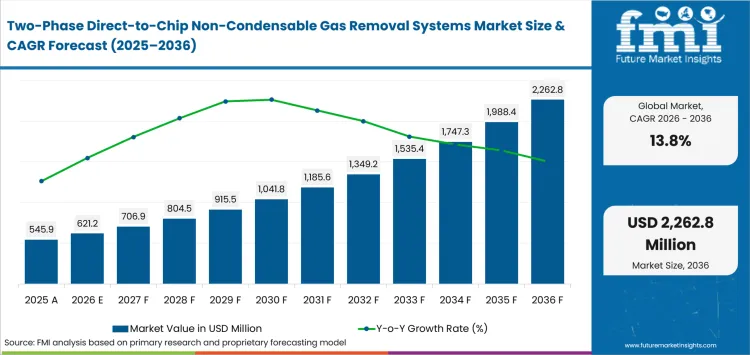
USD 621.2 million in 2026 and USD 2,262.8 million by 2036 at a 13.8% CAGR.
Demand is projected to rise from USD 621.2 million in 2026 to USD 2,262.8 million by 2036 at a 13.8% CAGR. AI infrastructure is raising the thermal load assigned to each rack and increasing interest in AI datacenter liquid cooling. The International Energy Agency reported in April 2026 that data-center electricity demand rose 17% during 2025 while AI-focused facilities grew faster. Higher rack loads expand the installed base requiring refrigerant evacuation and pressure control inside two-phase cooling loops.
Country conversion depends on how quickly power access and site approvals become energized compute capacity. France's Ministry of Economy identified 28 additional data-center sites in May 2025 following 35 announced in February. Saudi Arabia and UAE face hotter ambient conditions that favor low-water heat rejection at greenfield campuses. Cooling designs are assessed beside critical power and cooling systems so OEMs can approve refrigerant compatibility plus purge location and commissioning responsibility.
Key Takeaways
- AI rack density is shifting cooling expenditure toward two-phase direct-to-chip loops as trapped non-condensable gas raises condenser pressure and commissioning risk.
- By cooling architecture, direct-to-chip liquid cooling is estimated to hold 44.0% in 2026 owing to gas management inside the processor refrigerant circuit.
- In 2026, dry coolers are expected to lead heat Rejection - Secondary loop with 29.0% share because warm loops permit outdoor heat rejection without routine evaporative water use.
- The 251-500 kW rack-density band is likely to capture 34.0% share in 2026 attributable to thermal duty that warrants formal refrigerant controls and documented service procedures.
- Fluid qualification and warranty ownership lengthen some sales cycles once an independent purge device changes interfaces inside a validated refrigerant pressure envelope.
- Some of the key players in this market include Accelsius, ZutaCore, Parker Hannifin, Chemours, ASRock Rack, Foxconn, Compal Electronics, and Valeo.
Analyst Perspective
"A cooling OEM earns the NCG-control contract by proving stable condenser pressure during initial charging and every later circuit opening. Hyperscale operators should price service ownership alongside hardware cost since an inexpensive purge module can shift commissioning responsibility back onto the site team."
- Sudip saha, Principal Consultant, Future Market Insights
How is the Two-Phase Direct-to-Chip Non-Condensable Gas Removal Systems Market segmented?
The two-phase direct-to-chip non-condensable gas removal systems market is segmented by cooling architecture, heat Rejection - Secondary loop, rack density, data center type, route to market and region.
Cooling architecture covers direct-to-chip liquid cooling, rear-door heat exchangers, immersion cooling and hybrid air-liquid systems. Heat Rejection - Secondary loop includes dry coolers, chillers, cooling towers / evaporative, facility water loop / district interface and hybrid systems. Rack density covers four bands: 251-500 kW, 100-250 kW, below 100 kW and above 500 kW. Data center type includes four settings: hyperscale AI, colocation AI, enterprise AI/HPC and research / sovereign compute. Route to market includes cooling OEM direct, MEP / EPC integrator, server / rack OEM bundle and service & retrofit channel.
What supports Hyperscale AI leadership within the Data Center type category?
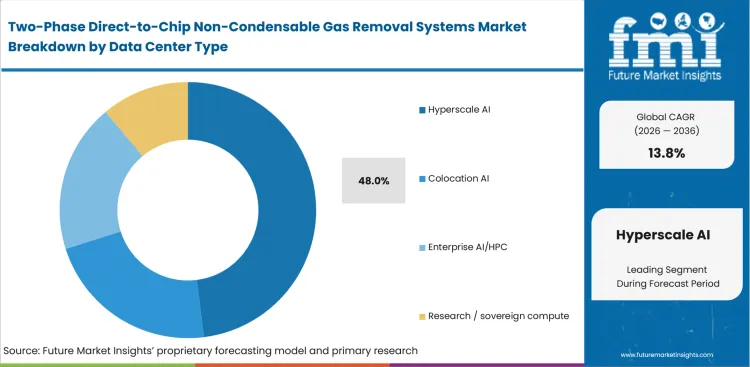
Hyperscale AI projects repeat one cooling design over large GPU fleets, which makes refrigerant charging discipline valuable at every rack. In November 2025 Accelsius announced a DarkNX agreement covering a 300 MW NeuCool-enabled AI campus in Ontario.
- Hyperscale AI is set to lead the data center type category with 48.0% share in 2026 due to standardized fleets that multiply the value of repeatable gas diagnostics.
- Operators favor factory-defined service procedures since thousands of similar refrigerant loops make site-specific troubleshooting expensive during fleet maintenance. The same discipline also supports liquid-cooled edge data centers that need repeatable field service without hyperscale staffing levels.
What makes Direct-to-Chip Liquid Cooling central to the Cooling Architecture category?
Processor cold plates place the refrigerant circuit beside the highest heat flux and make gas condition part of chip-level thermal performance. ASHRAE's June 2026 framework identifies direct-to-chip liquid cooling as the dominant high-density approach and treats cooling design as part of facility power planning.
- By cooling architecture, direct-to-chip liquid cooling is estimated to hold 44.0% in 2026 owing to gas removal occurring inside the same closed refrigerant path.
- Cooling OEMs specify evacuation points with pressure diagnostics near the cold plate so early gas removal prevents condenser pressure from reducing usable cooling duty during routine operation.
Why do Dry coolers lead the Heat Rejection - Secondary loop category?
Dry coolers suit warmer facility loops that reject heat outdoors without routine evaporative water consumption in regions where water availability constrains cooling design. ASHRAE's June 2026 thermal-efficiency guidance describes dry coolers as a primary heat-rejection option for warm-water AI facilities and explains why data center chillers can be avoided at higher loop temperatures.
- Dry coolers are projected to hold 29.0% share in 2026 owing to warmer loops that preserve useful temperature lift for outdoor heat rejection.
- NCG-control hardware protects condensing pressure during commissioning and later service events that expose the refrigerant circuit to ambient air.
How does 251-500 kW define the leading Rack-Density band?
The 251-500 kW band carries enough thermal duty to make refrigerant condition a rack-level operating risk without requiring a custom cooling plant for each rack. Accelsius reported in July 2025 that its test program cooled a complete 250 kW AI rack at up to 4,500 W per socket.
- By rack density, 251-500 kW is forecast to represent 34.0% in 2026 driven by repeatable rack modules that justify formal pressure control and service records.
- Rack designers compare NCG access with localized hotspot cooling so service technicians can read pressure histories and purge records without interrupting neighboring AI racks during fault diagnosis.
What are the drivers, restraints and opportunities in the Two-Phase Direct-to-Chip Non-Condensable Gas Removal Systems Market?
Higher AI heat density increases demand for disciplined two-phase refrigerant management while interface qualification slows standalone adoption and telemetry supports a repeatable control-service opportunity.
- Driver: Higher rack heat loads push more AI deployments into two-phase direct-to-chip loops where condenser pressure and refrigerant condition affect usable cooling capacity.
- Restraint: Gas-removal hardware changes the working-fluid circuit and therefore requires OEM acceptance for seal materials plus purge placement and warranty responsibility.
- Opportunity: Integrated pressure monitoring and purge-event records can convert gas management into an OEM control function with repeatable commissioning and retrofit service revenue.
AI Rack Loads Expand the Two-Phase Installed Base
High-density AI racks expand the number of refrigerant loops that need controlled evacuation before useful cooling capacity becomes available. ZutaCore launched a 240 kW two-phase sidecar in August 2025 for hyperscale sites that needed liquid cooling without replacing existing air-cooled racks. That deployment model broadens data center liquid cooling while giving NCG controls a repeatable position beside the refrigerant charge and condenser circuit.
Interface Qualification Slows Independent Add-On Modules
Standalone NCG hardware changes the same closed refrigerant path that carries pressure and heat between cold plates and condensers. The February 2025 Open Compute Project white paper places charge management and evacuation inside the commissioning sequence for pumped two-phase direct liquid cooling. Cooling OEMs therefore need to accept purge points plus seal materials for an independent module to enter the warranty boundary or routine service procedure.
Telemetry Supports Repeatable Gas-Control Service
Field technicians need pressure and temperature records that reveal gas-related drift prior to a cooling fault forcing another circuit opening. ZutaCore introduced near-real-time cooling telemetry with OmniTherm in March 2026 for servers using two-phase direct-to-chip cooling. Linking those records with purge events and direct-to-chip coolant fluids gives OEM service teams a documented basis for recommissioning work and recurring diagnostics during maintenance.
Which country CAGRs are profiled in the Two-Phase Direct-to-Chip Non-Condensable Gas Removal Systems Market?
| Country | CAGR |
|---|---|
| Saudi Arabia | 15.1% |
| UAE | 14.8% |
| South Korea | 14.4% |
| Japan | 14.1% |
| USA | 13.8% |
How do country-level CAGRs compare in the Two-Phase Direct-to-Chip Non-Condensable Gas Removal Systems Market?
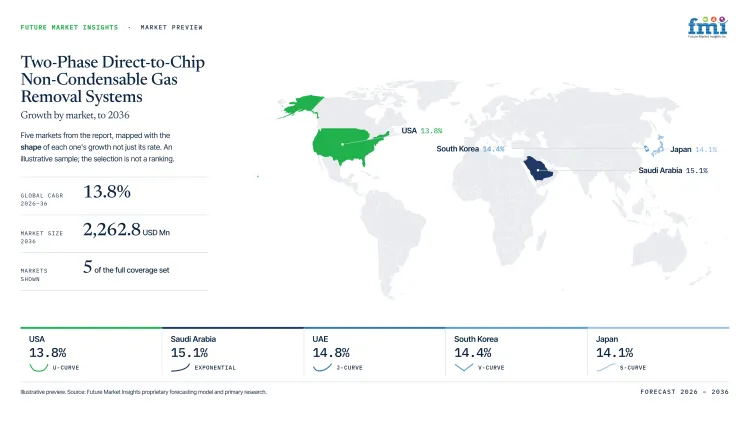
Country forecasts span 1.3 percentage points from Saudi Arabia at 15.1% to USA at 13.8%. Saudi Arabia and UAE form the faster Gulf group through greenfield campuses. South Korea and Japan occupy the middle band through data center infrastructure programs. USA follows with slower conversion as grid timing lengthens some new-build schedules.
- Saudi Arabia concentrates greenfield AI capacity in phased campuses designed for hot conditions.
- UAE developers repeat rack standards across very large Abu Dhabi AI campuses.
- South Korea links cooling acceptance to domestic server platforms and compute programs.
- Japan coordinates data-center siting with power and telecommunications infrastructure planning for AI campuses.
- USA pairs substantial retrofit demand with electrical interconnection delays for new halls.
Comparable CAGRs produce different sales cycles through service ownership and project mix.
The full report provides country-level CAGR analysis across North America, Latin America, Europe, East Asia, South Asia, Oceania and the Middle East and Africa.
Country-wise Analysis
- Hot ambient conditions in Riyadh narrow the operating margin available to outdoor heat rejection systems. This leads to AI campus teams specifying high-density cooling before later construction phases lock refrigerant interfaces. MCIT's April 2025 computing-infrastructure white paper documented about 148 MW of national data-center capacity as of March 2024 while the two-phase direct-to-chip non-condensable gas removal systems market is projected to record 15.1% CAGR through 2036 owing to concentrated greenfield capacity. The identifiable installed base gives cooling OEMs a practical service route, but entry still depends on documented charging and recommissioning that does not delay later rack blocks or shift warranty responsibility.
- Abu Dhabi's campus-scale AI projects require cooling interfaces that repeat over thousands of servers while keeping commissioning responsibility stable from one construction phase to the next through each expansion stage. In May 2025 Abu Dhabi Media Office announced a planned 5 GW UAE-US AI campus containing the 1 GW Stargate UAE cluster with its first 200 MW scheduled for 2026. Adoption of two-phase direct-to-chip non-condensable gas removal systems in UAE is forecast to expand at 14.8% CAGR through 2036 driven by standardized large campus builds, yet scale does not remove warranty ownership constraints once server and cooling designs are frozen.
- National compute programs in South Korea tie thermal hardware choices to domestic capacity expansion, so AI infrastructure projects increasingly evaluate cooling inside server-platform qualification with local integration partners. The two-phase direct-to-chip non-condensable gas removal systems market in South Korea is estimated to advance at 14.4% CAGR through 2036 reflecting platform-led purchasing while local integration partners directly shorten acceptance for rack-level gas control. MSIT announced in February 2025 that Korea planned 18,000 high-performance GPUs by mid-2026 with support for power and site requirements, but standalone NCG hardware faces longer acceptance unless the host OEM owns pressure interfaces and service responsibility.
- Dense AI sites in Japan cannot treat cooling as a late mechanical package once utility and equipment-room layouts are fixed, so developers coordinate electrical capacity with telecommunications routes earlier for new halls. METI and MIC published Watt-Bit Collaboration Report 1.0 in June 2025 after forming a public-private council to coordinate power and communications infrastructure for future data centers before capacity reservations are finalized. Demand for two-phase direct-to-chip non-condensable gas removal systems in Japan is forecast to rise at 14.1% CAGR through 2036 supported by coordinated siting, while compact equipment rooms make early refrigerant-compatibility records increasingly important as future cooling platforms are selected.
- Mechanical completion at US hyperscale and colocation sites can precede firm power availability, so operators pair liquid-cooling design with electrical interconnection planning and use the large installed base for retrofit service access during later commissioning. The USA Department of Energy warned in July 2025 that blackout risk could rise one hundredfold by 2030 under its studied retirement and load-growth scenario for future system adequacy. The two-phase direct-to-chip non-condensable gas removal systems market in USA is anticipated to expand at 13.8% CAGR through 2036 given new-build and retrofit demand, making operating-facility access comparatively important if grid timing defers new installations.
Who are the notable companies in the Two-Phase Direct-to-Chip Non-Condensable Gas Removal Systems Market?
Accelsius, ZutaCore, Parker Hannifin, Chemours, ASRock Rack, Foxconn, Compal Electronics, and Valeo are the notable companies serving this market.
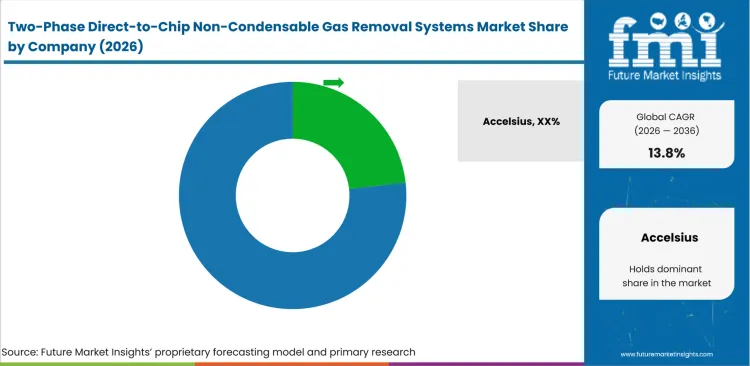
Two-phase platform ownership determines who can approve purge points and refrigerant controls inside the warranty boundary. Accelsius and ZutaCore own the host architectures while ASRock Rack, Foxconn and Compal Electronics integrate those systems into servers and racks. Parker Hannifin and Valeo supply loop hardware while Chemours qualifies dielectric fluids for two-phase use. NCG specialists therefore need platform approval plus evidence that their modules tolerate the high-purity thermal fluids specified for each circuit.
- Accelsius and ZutaCore own two-phase direct-to-chip platform designs, which gives each company direct control over purge locations and refrigerant monitoring interfaces.
- ASRock Rack plus Foxconn and Compal Electronics integrate two-phase cooling into server or rack designs that define thermal qualification and warranty ownership.
- Parker Hannifin plus Chemours and Valeo supply loop components or fluid and heat-reuse interfaces that influence system compatibility and service design.
Competitive Benchmarking: Two-Phase Direct-to-Chip Non-Condensable Gas Removal Systems Market
| Company | Two-Phase DTC Platform Ownership | Rack / Loop Integration Depth | Fluid and Interface Qualification | Geographic Reach |
|---|---|---|---|---|
| Accelsius | High | High | High | North America and Europe with partner-led international deployment |
| ZutaCore | High | High | High | Americas, Europe and Asia-Pacific |
| Parker Hannifin | Low | High | Medium | Global industrial and data-center sales footprint |
| Chemours | Low | Medium | High | Global chemistry and customer-support footprint |
| ASRock Rack | Medium | High | Medium | Global server sales with Asia and North America strength |
| Foxconn | Medium | High | High | Global AI-server manufacturing footprint |
| Compal Electronics | Medium | High | Medium | Asia, North America and international server programs |
| Valeo | Low | Medium | Medium | Europe, North America and international manufacturing footprint |
Scoring basis: High platform ownership requires a proprietary two-phase direct-to-chip architecture while Medium requires a factory-integrated partner system and Low identifies an enabling role without host-platform ownership. High integration requires several rack or loop interfaces while Medium requires one major integrated subsystem and Low covers one component layer. High qualification requires documented multi-interface or fluid validation while Medium requires one named qualification program and Low indicates a narrower documented role.
Key Developments in the Two-Phase Direct-to-Chip Non-Condensable Gas Removal Systems Market
- In April 2026, Accelsius announced general availability of NeuCool IR150 and launched HyperStart to help hyperscale operators validate two-phase direct-to-chip cooling for reference designs.
- In November 2025, ZutaCore launched 1.2 MW and 2 MW end-of-row coolant distribution units that centralize multiple racks while retaining rack-level monitoring and control.
- In May 2025, Chemours signed an agreement with DataVolt to develop advanced data-center liquid cooling including two-phase direct-to-chip and two-phase immersion configurations.
Key Players in the Two-Phase Direct-to-Chip Non-Condensable Gas Removal Systems Market
Two-Phase Direct-to-Chip Platform Developers
- Accelsius
- ZutaCore
Loop and Fluid Enablers
- Parker Hannifin
- Chemours
Server, Rack and Heat-Reuse Integrators
- ASRock Rack
- Foxconn
- Compal Electronics
- Valeo
Two-Phase Direct-to-Chip Non-Condensable Gas Removal Systems Market - Report Scope
| Coverage field | Report scope |
|---|---|
| Market breakdown | By cooling architecture, heat Rejection - Secondary loop, rack density, data center type, route to market and region. |
| Quantitative Units | USD million. |
| Market Definition | Revenue assigned to evacuation, gas-liquid separation, purge, sensing and control functions that remove or manage non-condensable gas inside two-phase direct-to-chip refrigerant loops. |
| Regions Covered | North America, Latin America, Europe, East Asia, South Asia and Pacific and Middle East and Africa. |
| Countries Covered | Saudi Arabia, UAE, South Korea, Japan, USA, and 20+ countries included in the full report. |
| Key Companies Profiled | Accelsius, ZutaCore, Parker Hannifin, Chemours, ASRock Rack, Foxconn, Compal Electronics, Valeo. |
| Forecast Period | 2026 to 2036. |
| Approach | Primary and secondary research with market triangulation. |
Two-Phase Direct-to-Chip Non-Condensable Gas Removal Systems Market - Research Methodology
| Method | Approach |
|---|---|
| Primary Research | FMI analysts gathered input from manufacturers, service providers, technology developers, distributors, end users, procurement teams, and subject-matter experts. Interviews examined purchasing decisions, product or service evaluation, adoption barriers, approval requirements, pricing considerations, and expectations for technical or commercial support. Respondents were also asked what evidence is required before a trial, pilot, or initial order develops into regular purchasing. |
| Desk Research | Desk research covered government statistics, regulatory publications, trade data, industry associations, technical literature, standards, company filings, product information, and official corporate announcements. Sources were reviewed for relevance, publication date, geographic coverage, and consistency with the defined market scope. Claims relating to performance, applications, approvals, capacity, investment, and commercial activity were retained only when supported by credible public evidence. |
| Market Sizing and Forecasting | The market model combined the baseline value with historical performance, segment structure, pricing and volume indicators, adoption levels, company participation, and country-level demand conditions. Forecast assumptions considered economic activity, investment trends, regulatory developments, technology adoption, purchasing cycles, supply availability, and barriers to wider market use. Segment and regional estimates were reconciled before the final market total was calculated. |
| Data Validation | Estimates were checked against multiple independent indicators, including public data, company activity, trade patterns, industry developments, and findings from primary interviews. Validation also tested whether products, services, applications, and company revenues fell within the defined market boundaries. Adjacent categories, unsupported claims, overlapping revenues, and activities without direct market relevance were excluded to reduce double counting and maintain consistency across segments and countries. |
Two-Phase Direct-to-Chip Non-Condensable Gas Removal Systems Market by Segments
Two-Phase Direct-to-Chip Non-Condensable Gas Removal Systems Market segmented by Cooling Architecture:
- Direct-to-chip liquid cooling
- Rear-door heat exchangers
- Immersion cooling
- Hybrid air-liquid systems
Two-Phase Direct-to-Chip Non-Condensable Gas Removal Systems Market segmented by Heat Rejection - Secondary Loop:
- Dry coolers
- Chillers
- Cooling towers / evaporative
- Facility water loop / district interface
- Hybrid systems
Two-Phase Direct-to-Chip Non-Condensable Gas Removal Systems Market segmented by Rack Density:
- 251-500 kW
- 100-250 kW
- Below 100 kW
- Above 500 kW
Two-Phase Direct-to-Chip Non-Condensable Gas Removal Systems Market segmented by Data Center Type:
- Hyperscale AI
- Colocation AI
- Enterprise AI/HPC
- Research / sovereign compute
Two-Phase Direct-to-Chip Non-Condensable Gas Removal Systems Market segmented by Route to Market:
- Cooling OEM direct
- MEP / EPC integrator
- Server / rack OEM bundle
- Service & retrofit channel
Two-Phase Direct-to-Chip Non-Condensable Gas Removal Systems Market by Region:
- North America
- United States
- Canada
- Latin America
- Brazil
- Mexico
- Argentina
- Chile
- Western Europe
- Germany
- France
- United Kingdom
- Italy
- Spain
- Benelux
- Nordics
- Eastern Europe
- Poland
- Czech Republic
- Romania
- Hungary
- East Asia
- China
- Japan
- South Korea
- South Asia and Pacific
- India
- ASEAN
- Australia and New Zealand
- Middle East and Africa
- GCC Countries
- South Africa
- Türkiye
- Israel
Research Sources and Bibliography
- International Energy Agency (2026, April 16). Data centre electricity use surged in 2025, even with tightening bottlenecks driving a scramble for solutions
- Ministère de l’Économie, des Finances et de la Souveraineté industrielle et énergétique (2025, May 21). IA : des investissements records annoncés lors du Sommet Choose France 2025
- ASHRAE (2026, June 10). AI Data Center Energy Performance Framework: Integrated Design Principles
- ASHRAE (2026, June 10). AI Data Center Energy Performance Framework: Energy and Thermal Efficiency
- Accelsius (2025, July 29). Accelsius Demonstrates Strong Momentum in First Half of 2025 with 5x Growth in Data Center Deployments
- Accelsius (2025, November 17). DarkNX Enters Agreement with Accelsius to Deploy 300MW NeuCool-Enabled AI Data Center Campus in Ontario
- ZutaCore (2025, August 5). 240kW Waterless AI Cooling Sidecar
- Open Compute Project, Intel, Vertiv, Parker Hannifin, & Accelsius (2025, February 14). White Paper: Pumped 2P Refrigerant-Based Direct Liquid Cooling (DLC) Technology for Next Generation AI Clusters with High TDP Accelerators
- ZutaCore (2026, March 16). ZutaCore Enables Waterless Two-Phase Cooling for NVIDIA RTX PRO 6000 PCIe GPUs
- Ministry of Communications and Information Technology, Saudi Arabia (2025, April). KSA Computing Infrastructure
- Abu Dhabi Media Office (2025, May 22). Global tech alliance launches 'Stargate UAE'
- Ministry of Science and ICT, Republic of Korea (2025, February 20). Korea to Expand AI Computing Infrastructure to Strengthen National AI Capabilities and Achieve Global Leadership
- Ministry of Economy, Trade and Industry, Japan (2025, June 12). Report 1.0 of the Public-Private Advisory Council on Watt-Bit Collaboration Published
- USA Department of Energy (2025, July 7). Department of Energy Releases Report on Evaluating USA Grid Reliability and Security
- Accelsius (2026, April 20). Accelsius Announces General Availability of NeuCool IR150 and Launches NeuCool HyperStart Program at Data Center World 2026
- ZutaCore (2025, November 12). ZutaCore Unveils Waterless End-of-Row CDU Family to Power the Next Generation of AI Data Centers
- The Chemours Company (2025, May 19). Chemours and DataVolt Announce Agreement to Accelerate Adoption of Liquid Cooling Solutions & Support Broader Innovation for Future-Ready AI Data Centers
- ASRock Rack (2025, May 20). ASRock Rack Unveils 6U8X-EGS2/ZC SYN H200 Server Platform in Collaboration with ZutaCore, Featuring Cutting-Edge Liquid Cooling Technology
- Compal Electronics (2025, September 9). ZutaCore and Compal Transform AI Data Center Cooling at Yotta 2025
- Accelsius (2026, July 21). Independent Benchmarks Show Accelsius Two-Phase Direct-to-Chip Cooling Delivers 9°C Lower NVIDIA B200 Junction Temperatures Than Single-Phase in Warm-Water Conditions
- ZutaCore (2026, June 2). ZutaCore Announces $100M+ Series C Momentum and Expands Leadership Team to Accelerate Global Growth
- The Chemours Company (2026, February 24). Following Successful Fluid Qualification Chemours & 2CRSi Join Forces to Accelerate Deployment of Two-Phase Liquid Cooling for High-Density Servers & IT Equipment
- SoftBank Corp., ZutaCore, & Hon Hai Technology Group (2025, February 28). SoftBank Corp., ZutaCore and Foxconn Collaborate on Design and Development of Rack-integrated Solution Optimized for ZutaCore's 2-phase DLC Technology Used in AI Servers that Utilize NVIDIA Accelerated Computing
- Parker Hannifin (2026, July 23). Parker Launches the SCVOT2 Vortex Flow & Temperature Sensor for Data Center Liquid Cooling
- Valeo (2025, January 7). Valeo enters commercial production with Heat Reuse Units (HRU) compatible with ZutaCore’s Two-Phase Direct-to-Chip Liquid Cooling
- ZutaCore (2025, November 10). ZutaCore and EGIL Wings Partner to Redefine AI Data Center Infrastructure with Sustainable, High-Performance Cooling and Energy Innovation
- Accelsius (2026, January 12). Accelsius Closes $65 million Series B Funding Led by Johnson Controls; Legrand Joining Round to Scale Liquid Cooling for Gigawatt-Class AI Factories
- Accelsius (2025, October 13). Accelsius Introduces NeuCool MR250, Unlocking At-Scale Two-Phase, Direct-to-Chip Cooling for AI and HPC
- ZutaCore (2025, October 13). ZutaCore and ASRock Rack Debut Unique NVIDIA HGX B300 Server with Fully Integrated Waterless Liquid Cooling
- The Chemours Company (2025, March 14). Chemours Joins Forces with NTT DATA and Hibiya Engineering, Ltd. For Full-Scale Opteon 2P50 Product Trial
This bibliography is provided for reader reference and is not exhaustive. The full report contains the complete reference list and detailed citations.
This Report Answers
- What are the 2026 and 2036 market values?
- Which AI rack changes increase NCG demand?
- Why does direct-to-chip cooling lead?
- Why do dry coolers lead?
- Why does the 251-500 kW band lead?
- How do the five country CAGRs compare?
- How do platform and interface companies compete?
- Which constraints limit standalone NCG-removal modules?
Frequently Asked Questions
How big is the two-phase direct-to-chip non-condensable gas removal systems market in 2026?
The two-phase direct-to-chip non-condensable gas removal systems market is valued at USD 621.2 million in 2026 and is projected to reach USD 2,262.8 million by 2036. AI rack heat density increases the number of refrigerant loops requiring controlled evacuation and gas separation during commissioning.
What is the CAGR of the two-phase direct-to-chip non-condensable gas removal systems market from 2026 to 2036?
The two-phase direct-to-chip non-condensable gas removal systems market is projected to grow at 13.8% CAGR between 2026 and 2036. Expansion follows higher rack thermal loads that increase two-phase cooling deployment and require formal refrigerant commissioning.
Which cooling architecture leads the two-phase direct-to-chip non-condensable gas removal systems market?
The direct-to-chip liquid cooling segment is expected to hold 44.0% of the two-phase direct-to-chip non-condensable gas removal systems market in 2026, driven by gas management inside its refrigerant path. Cooling OEMs retain direct control over evacuation and pressure diagnostics during commissioning at each individual rack.
Which countries are projected to record the highest growth in the two-phase direct-to-chip non-condensable gas removal systems market?
Saudi Arabia is projected to grow at 15.1% CAGR through 2036 while UAE reaches 14.8% and South Korea reaches 14.4%. Greenfield AI campuses and national compute programs increase demand for repeatable two-phase cooling qualification in these faster-growth markets.
Which companies are active in the two-phase direct-to-chip non-condensable gas removal systems market?
Key companies operating in the two-phase direct-to-chip non-condensable gas removal systems market include Accelsius, ZutaCore, Parker Hannifin, Chemours, ASRock Rack, Foxconn, Compal Electronics, and Valeo. Their roles cover host cooling platforms plus server integration and refrigerant-loop interfaces needed for NCG-control qualification.
Preview the report firsthand - request a free sample
Get SampleGet the brochure for pricing and purchase details.
Get PDFTable of Content
- Key Takeaways
- Market Size and CAGR
- Top Growth Driver
- Fastest Growing Segment
- Leading Region
- Key Companies
- Emerging Opportunities
- Executive Summary
- Global Market Outlook
- Demand-side Trends
- Supply-side Trends
- Technology Roadmap Analysis
- Analysis and Recommendations
- Analyst Perspective (What is happening? Why now? What should investors know?)
- Key Questions Answered
- How large is the market?
- What is the CAGR?
- What are key trends?
- Which region dominates?
- Who are the leaders?
- Market Overview
- Market Coverage / Taxonomy
- Market Definition / Scope / Limitations
- Research Methodology
- Chapter Orientation
- Analytical Lens and Working Hypotheses
- Market Structure, Signals, and Trend Drivers
- Benchmarking and Cross-market Comparability
- Market Sizing, Forecasting, and Opportunity Mapping
- Research Design and Evidence Framework
- Desk Research Programme (Secondary Evidence)
- Expert Input and Fieldwork (Primary Evidence)
- Tooling, Models, and Reference Databases
- Data Engineering and Model Build
- Quality Assurance and Audit Trail
- Market Background
- Market Dynamics (Drivers, Restraints, Opportunity, Trends)
- Scenario Forecast (Optimistic, Likely, Conservative)
- Impact Analysis
- AI Impact
- Sustainability Impact
- Regulatory Impact
- Technology Impact
- Consumer / Buyer Analysis
- Purchase Drivers
- Adoption Barriers
- Buyer Journey
- Opportunity Map Analysis
- Product Life Cycle Analysis
- Supply Chain Analysis
- Investment Feasibility Matrix
- Value Chain Analysis
- PESTLE and Porter's Analysis
- Regulatory Landscape
- Regional Parent Market Outlook
- Production and Consumption Statistics
- Import and Export Statistics
- Global Market Analysis and Forecast, 2021 to 2036
- Historical Market Size Value (USD Million) Analysis, 2021 to 2025
- Current and Future Market Size Value (USD Million) Projections, 2026 to 2036
- Y-o-Y Growth Trend Analysis
- Absolute $ Opportunity Analysis
- Global Market Pricing Analysis, 2021 to 2036
- Global Market Analysis and Forecast, By Cooling Architecture, 2021 to 2036
- Introduction / Key Findings
- Historical Market Size Value (USD Million) Analysis By Cooling Architecture, 2021 to 2025
- Current and Future Market Size Value (USD Million) Analysis and Forecast By Cooling Architecture, 2026 to 2036
- Direct-to-chip liquid cooling
- Rear-door heat exchangers
- Immersion cooling
- Hybrid air-liquid systems
- Direct-to-chip liquid cooling
- Y-o-Y Growth Trend Analysis By Cooling Architecture, 2021 to 2025
- Absolute $ Opportunity Analysis By Cooling Architecture, 2026 to 2036
- Global Market Analysis and Forecast, By Heat Rejection / Secondary Loop, 2021 to 2036
- Introduction / Key Findings
- Historical Market Size Value (USD Million) Analysis By Heat Rejection / Secondary Loop, 2021 to 2025
- Current and Future Market Size Value (USD Million) Analysis and Forecast By Heat Rejection / Secondary Loop, 2026 to 2036
- Dry coolers
- Chillers
- Cooling towers / evaporative
- Facility water loop / district interface
- Hybrid systems
- Dry coolers
- Y-o-Y Growth Trend Analysis By Heat Rejection / Secondary Loop, 2021 to 2025
- Absolute $ Opportunity Analysis By Heat Rejection / Secondary Loop, 2026 to 2036
- Global Market Analysis and Forecast, By Rack Density, 2021 to 2036
- Introduction / Key Findings
- Historical Market Size Value (USD Million) Analysis By Rack Density, 2021 to 2025
- Current and Future Market Size Value (USD Million) Analysis and Forecast By Rack Density, 2026 to 2036
- 251-500 kW
- 100-250 kW
- Below 100 kW
- Above 500 kW
- 251-500 kW
- Y-o-Y Growth Trend Analysis By Rack Density, 2021 to 2025
- Absolute $ Opportunity Analysis By Rack Density, 2026 to 2036
- Global Market Analysis and Forecast, By Data Center Type, 2021 to 2036
- Introduction / Key Findings
- Historical Market Size Value (USD Million) Analysis By Data Center Type, 2021 to 2025
- Current and Future Market Size Value (USD Million) Analysis and Forecast By Data Center Type, 2026 to 2036
- Hyperscale AI
- Colocation AI
- Enterprise AI/HPC
- Research / sovereign compute
- Hyperscale AI
- Y-o-Y Growth Trend Analysis By Data Center Type, 2021 to 2025
- Absolute $ Opportunity Analysis By Data Center Type, 2026 to 2036
- Global Market Analysis and Forecast, By Route to Market, 2021 to 2036
- Introduction / Key Findings
- Historical Market Size Value (USD Million) Analysis By Route to Market, 2021 to 2025
- Current and Future Market Size Value (USD Million) Analysis and Forecast By Route to Market, 2026 to 2036
- Cooling OEM direct
- MEP / EPC integrator
- Server / rack OEM bundle
- Service & retrofit channel
- Cooling OEM direct
- Y-o-Y Growth Trend Analysis By Route to Market, 2021 to 2025
- Absolute $ Opportunity Analysis By Route to Market, 2026 to 2036
- Global Market Analysis and Forecast, By Region, 2021 to 2036
- Introduction
- Historical Market Size Value (USD Million) Analysis By Region, 2021 to 2025
- Current Market Size Value (USD Million) Analysis and Forecast By Region, 2026 to 2036
- North America
- Latin America
- Western Europe
- Eastern Europe
- East Asia
- South Asia and Pacific
- Middle East & Africa
- Market Attractiveness Analysis By Region
- North America Market Analysis and Forecast, By Country, 2021 to 2036
- Historical Market Size Value (USD Million) Trend Analysis By Market Taxonomy, 2021 to 2025
- Market Size Value (USD Million) Forecast By Market Taxonomy, 2026 to 2036
- By Country
- USA
- Canada
- By Cooling Architecture
- By Heat Rejection / Secondary Loop
- By Rack Density
- By Data Center Type
- By Route to Market
- By Country
- Market Attractiveness Analysis
- By Country
- By Cooling Architecture
- By Heat Rejection / Secondary Loop
- By Rack Density
- By Data Center Type
- By Route to Market
- Key Takeaways
- Latin America Market Analysis and Forecast, By Country
- Historical Market Size Value (USD Million) Trend Analysis By Market Taxonomy, 2021 to 2025
- Market Size Value (USD Million) Forecast By Market Taxonomy, 2026 to 2036
- By Country
- Brazil
- Mexico
- Chile
- Rest of Latin America
- By Cooling Architecture
- By Heat Rejection / Secondary Loop
- By Rack Density
- By Data Center Type
- By Route to Market
- By Country
- Market Attractiveness Analysis
- By Country
- By Cooling Architecture
- By Heat Rejection / Secondary Loop
- By Rack Density
- By Data Center Type
- By Route to Market
- Key Takeaways
- Western Europe Market Analysis and Forecast, By Country
- Historical Market Size Value (USD Million) Trend Analysis By Market Taxonomy, 2021 to 2025
- Market Size Value (USD Million) Forecast By Market Taxonomy, 2026 to 2036
- By Country
- Germany
- UK
- Italy
- Spain
- France
- Nordic
- BENELUX
- Rest of Western Europe
- By Cooling Architecture
- By Heat Rejection / Secondary Loop
- By Rack Density
- By Data Center Type
- By Route to Market
- By Country
- Market Attractiveness Analysis
- By Country
- By Cooling Architecture
- By Heat Rejection / Secondary Loop
- By Rack Density
- By Data Center Type
- By Route to Market
- Key Takeaways
- Eastern Europe Market Analysis and Forecast, By Country
- Historical Market Size Value (USD Million) Trend Analysis By Market Taxonomy, 2021 to 2025
- Market Size Value (USD Million) Forecast By Market Taxonomy, 2026 to 2036
- By Country
- Russia
- Poland
- Hungary
- Balkan & Baltic
- Rest of Eastern Europe
- By Cooling Architecture
- By Heat Rejection / Secondary Loop
- By Rack Density
- By Data Center Type
- By Route to Market
- By Country
- Market Attractiveness Analysis
- By Country
- By Cooling Architecture
- By Heat Rejection / Secondary Loop
- By Rack Density
- By Data Center Type
- By Route to Market
- Key Takeaways
- East Asia Market Analysis and Forecast, By Country
- Historical Market Size Value (USD Million) Trend Analysis By Market Taxonomy, 2021 to 2025
- Market Size Value (USD Million) Forecast By Market Taxonomy, 2026 to 2036
- By Country
- China
- Japan
- South Korea
- By Cooling Architecture
- By Heat Rejection / Secondary Loop
- By Rack Density
- By Data Center Type
- By Route to Market
- By Country
- Market Attractiveness Analysis
- By Country
- By Cooling Architecture
- By Heat Rejection / Secondary Loop
- By Rack Density
- By Data Center Type
- By Route to Market
- Key Takeaways
- South Asia and Pacific Market Analysis and Forecast, By Country
- Historical Market Size Value (USD Million) Trend Analysis By Market Taxonomy, 2021 to 2025
- Market Size Value (USD Million) Forecast By Market Taxonomy, 2026 to 2036
- By Country
- India
- ASEAN
- Australia & New Zealand
- Rest of South Asia and Pacific
- By Cooling Architecture
- By Heat Rejection / Secondary Loop
- By Rack Density
- By Data Center Type
- By Route to Market
- By Country
- Market Attractiveness Analysis
- By Country
- By Cooling Architecture
- By Heat Rejection / Secondary Loop
- By Rack Density
- By Data Center Type
- By Route to Market
- Key Takeaways
- Middle East & Africa Market Analysis and Forecast, By Country
- Historical Market Size Value (USD Million) Trend Analysis By Market Taxonomy, 2021 to 2025
- Market Size Value (USD Million) Forecast By Market Taxonomy, 2026 to 2036
- By Country
- Kingdom of Saudi Arabia
- Other GCC Countries
- Türkiye
- South Africa
- Other African Union
- Rest of Middle East & Africa
- By Cooling Architecture
- By Heat Rejection / Secondary Loop
- By Rack Density
- By Data Center Type
- By Route to Market
- By Country
- Market Attractiveness Analysis
- By Country
- By Cooling Architecture
- By Heat Rejection / Secondary Loop
- By Rack Density
- By Data Center Type
- By Route to Market
- Key Takeaways
- Key Countries Market Analysis
- USA
- Pricing Analysis
- Market Share Analysis, 2025
- By Cooling Architecture
- By Heat Rejection / Secondary Loop
- By Rack Density
- By Data Center Type
- By Route to Market
- Canada
- Pricing Analysis
- Market Share Analysis, 2025
- By Cooling Architecture
- By Heat Rejection / Secondary Loop
- By Rack Density
- By Data Center Type
- By Route to Market
- Mexico
- Pricing Analysis
- Market Share Analysis, 2025
- By Cooling Architecture
- By Heat Rejection / Secondary Loop
- By Rack Density
- By Data Center Type
- By Route to Market
- Brazil
- Pricing Analysis
- Market Share Analysis, 2025
- By Cooling Architecture
- By Heat Rejection / Secondary Loop
- By Rack Density
- By Data Center Type
- By Route to Market
- Chile
- Pricing Analysis
- Market Share Analysis, 2025
- By Cooling Architecture
- By Heat Rejection / Secondary Loop
- By Rack Density
- By Data Center Type
- By Route to Market
- Germany
- Pricing Analysis
- Market Share Analysis, 2025
- By Cooling Architecture
- By Heat Rejection / Secondary Loop
- By Rack Density
- By Data Center Type
- By Route to Market
- UK
- Pricing Analysis
- Market Share Analysis, 2025
- By Cooling Architecture
- By Heat Rejection / Secondary Loop
- By Rack Density
- By Data Center Type
- By Route to Market
- Italy
- Pricing Analysis
- Market Share Analysis, 2025
- By Cooling Architecture
- By Heat Rejection / Secondary Loop
- By Rack Density
- By Data Center Type
- By Route to Market
- Spain
- Pricing Analysis
- Market Share Analysis, 2025
- By Cooling Architecture
- By Heat Rejection / Secondary Loop
- By Rack Density
- By Data Center Type
- By Route to Market
- France
- Pricing Analysis
- Market Share Analysis, 2025
- By Cooling Architecture
- By Heat Rejection / Secondary Loop
- By Rack Density
- By Data Center Type
- By Route to Market
- India
- Pricing Analysis
- Market Share Analysis, 2025
- By Cooling Architecture
- By Heat Rejection / Secondary Loop
- By Rack Density
- By Data Center Type
- By Route to Market
- ASEAN
- Pricing Analysis
- Market Share Analysis, 2025
- By Cooling Architecture
- By Heat Rejection / Secondary Loop
- By Rack Density
- By Data Center Type
- By Route to Market
- Australia & New Zealand
- Pricing Analysis
- Market Share Analysis, 2025
- By Cooling Architecture
- By Heat Rejection / Secondary Loop
- By Rack Density
- By Data Center Type
- By Route to Market
- China
- Pricing Analysis
- Market Share Analysis, 2025
- By Cooling Architecture
- By Heat Rejection / Secondary Loop
- By Rack Density
- By Data Center Type
- By Route to Market
- Japan
- Pricing Analysis
- Market Share Analysis, 2025
- By Cooling Architecture
- By Heat Rejection / Secondary Loop
- By Rack Density
- By Data Center Type
- By Route to Market
- South Korea
- Pricing Analysis
- Market Share Analysis, 2025
- By Cooling Architecture
- By Heat Rejection / Secondary Loop
- By Rack Density
- By Data Center Type
- By Route to Market
- Russia
- Pricing Analysis
- Market Share Analysis, 2025
- By Cooling Architecture
- By Heat Rejection / Secondary Loop
- By Rack Density
- By Data Center Type
- By Route to Market
- Poland
- Pricing Analysis
- Market Share Analysis, 2025
- By Cooling Architecture
- By Heat Rejection / Secondary Loop
- By Rack Density
- By Data Center Type
- By Route to Market
- Hungary
- Pricing Analysis
- Market Share Analysis, 2025
- By Cooling Architecture
- By Heat Rejection / Secondary Loop
- By Rack Density
- By Data Center Type
- By Route to Market
- Kingdom of Saudi Arabia
- Pricing Analysis
- Market Share Analysis, 2025
- By Cooling Architecture
- By Heat Rejection / Secondary Loop
- By Rack Density
- By Data Center Type
- By Route to Market
- Türkiye
- Pricing Analysis
- Market Share Analysis, 2025
- By Cooling Architecture
- By Heat Rejection / Secondary Loop
- By Rack Density
- By Data Center Type
- By Route to Market
- South Africa
- Pricing Analysis
- Market Share Analysis, 2025
- By Cooling Architecture
- By Heat Rejection / Secondary Loop
- By Rack Density
- By Data Center Type
- By Route to Market
- USA
- Market Structure Analysis
- Competition Dashboard
- Competition Benchmarking
- Market Share Analysis of Top Players
- By Regional
- By Cooling Architecture
- By Heat Rejection / Secondary Loop
- By Rack Density
- By Data Center Type
- By Route to Market
- Emerging Startups
- Innovation Benchmarking
- Competition Analysis
- Competition Deep Dive
- Accelsius
- Overview
- Product Portfolio
- Profitability by Market Segments
- Sales Footprint
- Strategy Overview
- Marketing Strategy
- Product Strategy
- Channel Strategy
- ZutaCore
- Parker Hannifin
- Chemours
- Accelsius
- Case Studies
- Success Stories
- Recent Developments
- Competition Deep Dive
- Assumptions & Acronyms Used


