

- Industry Size (2026)
- USD 0.8 Bn
- Forecast (2036)
- USD 1.7 Bn
- CAGR (2026 to 2036)
- 7.8%
Phase Change Microencapsulated Thermoregulating Fiber Market Forecast and Outlook 2026 to 2036
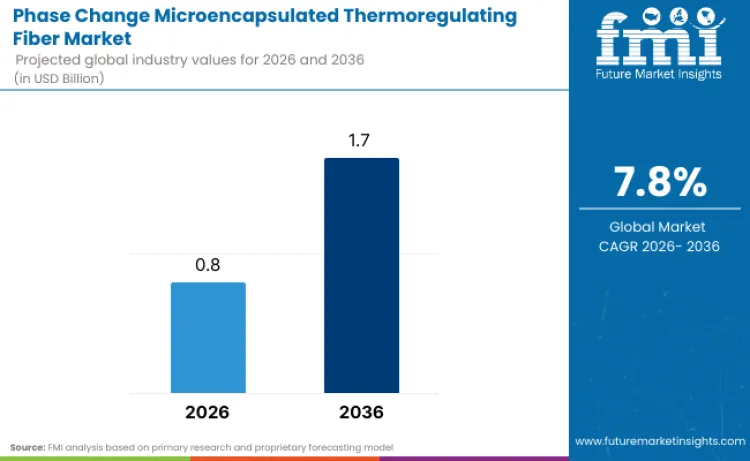
The global phase change microencapsulated thermoregulating fiber market is set to record a valuation of USD 0.8 billion in 2026, advancing toward USD 1.7 billion by 2036, representing a 7.8% CAGR. Growth is being shaped by a reset in buyer value definitions. Earlier adoption leaned on cool-touch demos and short-run apparel launches.
Current programs increasingly specify PCM as a passive system component where performance must persist after laundering, compression, and long service cycles. That is why the market is moving away from coating-heavy propositions toward melt-spinning integration, which protects fibre hand-feel, improves wash endurance, and reduces the variability buyers associate with post-process finishes.
Chemistry strategy is also broadening. Paraffin remains the scale anchor, yet expansion into workwear, PPE, and mobility interiors increases the penalty for leakage and flame-risk perception. This is accelerating development attention toward bio-based fatty acids and inorganic or silica shell systems that improve stability under stress and expand the addressable lane for regulated environments. Platform roadmaps increasingly bundle PCM with antimicrobial or moisture management functions, as brands attempt to justify premium pricing with multi-benefit textiles rather than single-claim thermoregulation.
This supply-and-qualification shift is visible in how executives frame corporate actions. An insight, which captures the increasing scope for PCM thermoregulating fiber, is the movement toward vertical control and domestic reliability. As Billy Blackburn (CEO, Alexium International) states,
“Bringing Microtek's microencapsulation and PCM technologies—and their manufacturing facilities—into the Alexium family... meaningfully strengthens our U.S. supply chain.” (Dec 2025)
Summary of the Phase Change Microencapsulated Thermoregulating Fiber Market
Where is the PCM Thermoregulating Fiber Category Heading over the 2026–2036 Window?
Future Market Insights expects the market to expand from USD 0.8 billion in 2026 to USD 1.7 billion by 2036, reflecting a 7.8% CAGR. The growth story is no longer led by cool-touch apparel launches. It is being written by passive thermal buffering needs in long-cycle bedding and infrastructure-adjacent use cases where endurance proof and supply assurance are now part of sourcing decisions.
FMI Research Approach: Forecasts are built using bottom-up revenue modelling, end-use conversion assumptions, and qualification filter tracking across bedding, workwear/PPE, and mobility interior programs.
What is the Most Important Shift in How Buyers Define “Value” in PCM Fibres?
Value is moving from does it feel cooler to does it keep working after real use. Procurement is tightening around thermoregulation that survives laundering, compression, and long service cycles. This is one reason the market is pivoting away from coating-heavy propositions toward fibre-integrated PCM formats that reduce wash-off risk and improve consistency across batches.
FMI Research Approach: FMI maps the shift through integration pathway analysis (finish-to-fibre migration), durability threshold benchmarking, and buyer interviews focused on complaint risk and performance drift under repeated use.
Which Country Currently Anchors Share Leadership, and Why Does It Hold That Position?
China holds the largest share by value, supported by scale-led bedding and home textile demand and concentrated domestic capability in microencapsulation and fibre integration. The decisive advantage is not only volume. It is the ability to supply high-throughput programs while meeting durability and wash-stability expectations that reduce complaint rates at scale.
FMI Research Approach: Country positioning is assessed through manufacturing cluster concentration, microencapsulation capacity mapping, and procurement preference signals tied to documented endurance under laundering and compression cycles.
What Does the 2036 Market Size Imply About Where Spending Concentrates?
Reaching USD 1.7 billion by 2036 implies that spending concentrates in applications where PCM operates as passive thermal infrastructure rather than a marketing add-on. Bedding remains the largest commercial anchor, while mobility interiors and battery-adjacent textile liners expand the addressable lane where energy efficiency and compliance economics matter.
FMI Research Approach: Market sizing integrates application mix logic, bedding penetration ramp assumptions, and mobility interior qualification cycles, cross-checked against platform migration signals.
What Exactly Sits Inside FMI’s Definition of the PCM Thermoregulating Fiber Market?
This market covers fibres, yarns, and textile structures that integrate microencapsulated phase change materials to absorb and release heat around defined transition temperatures, enabling passive thermoregulation across bedding, protective apparel, outdoor performance textiles, and interior textile systems.
FMI Research Approach: FMI applies a yarn-and-textile integration boundary that captures manufacturer-level textile revenues while excluding non-textile thermal storage formats and downstream retail margins.
What Global Signals ae Uniquely Shaping PCM Fibre Adoption Right Now?
Three signals stand out. First, vertical control of microencapsulation is becoming strategic, with defensive moves aimed at reducing third-party slurry fragility. Second, chemistry is broadening beyond paraffin as regulated environments raise the penalty for leakage perception and safety concerns. Third, PCM is being pulled into EV and energy-efficiency narratives where thermoregulation is treated as a system-level lever, not a comfort feature.
FMI Research Approach: Trend identification is grounded in M&A and capacity signals, chemistry migration tracking (bio-based and inorganic shell pathways), and mapping of infrastructure-led demand tied to compliance and energy efficiency requirements.
Why is this Demand Expanding even though PCM Has Existed for Years?
Demand for PCM Thermoregulating fibers is expanding because use cases have inverted. Outdoor apparel validated PCM, but the next growth layer is being pulled by energy and compliance economics where passive buffering reduces active load without adding power complexity.
FMI Research Approach: FMI evaluates growth drivers through use-case migration analysis, procurement discipline benchmarking, and qualification economics assessment across long-cycle products and regulated environments.
Phase Change Microencapsulated Thermoregulating Fiber Market Key Takeaways
| Metric | Details |
|---|---|
| Industry Size (2026) | USD 0.8 billion |
| Industry Value (2036) | USD 1.7 billion |
| CAGR (2026-2036) | 7.8% |
Source: Future Market Insights analysis, supported by a proprietary forecasting model and primary research
Why is the Phase Change Microencapsulated Thermoregulating Fiber Market Expanding?
Demand is being rewritten by a use-case inversion. Premium outdoor apparel helped validate PCM, but the next growth layer is being pulled by energy and compliance economics where passive thermal buffering reduces active load without adding power complexity. This is why PCM is specified in mobility interiors and battery-adjacent textile components, where thermal swings translate into HVAC draw and range penalties, and where materials are evaluated on endurance rather than novelty.
A second force is procurement tightening around qualification discipline. Buyers are filtering suppliers based on the ability to show stable thermoregulation after laundering, abrasion, and mechanical cycling. This mirrors broader reliability-first sourcing patterns visible across smart textile programs smart textile programs, where functional claims now need lifecycle proof before scaling.
A third force is chemistry and safety migration. Paraffin still anchors economics, yet as PCM enters workwear, PPE, and mobility interiors, leakage perception and flame behaviour become adoption friction points. That is accelerating interest in bio-based fatty acids and inorganic shells, similar to thermal management selection filters already visible in electronics-adjacent material programs where stability and leakage risk dominate qualification outcomes.
How is the Phase Change Microencapsulated Thermoregulating Fiber Market Segmented?
Type, fibre integration approach, end user, and application segment the phase change microencapsulated thermoregulating fiber industry. Each segment reflects a different procurement logic. Some buyers prioritise cost-to-enthalpy and scalable supply, while others prioritise wash endurance, leakage control, and documentation quality.
Why does Paraffin remain the Anchor Chemistry?
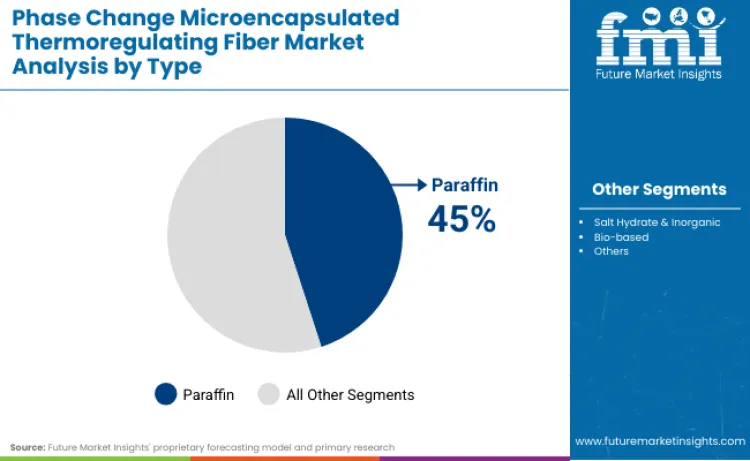
Paraffin holds a 45% share because it offers the most predictable cost-to-enthalpy performance at industrial scale, which matters in volume-heavy applications like bedding and large textile yardage programs. The commercial risk is not the wax itself. The risk is whether encapsulation quality prevents leakage, protects shell integrity under compression, and preserves enthalpy performance after repeated wash cycles.
That is why paraffin’s leadership persists even as premium lanes explore bio-based and inorganic shells. Buyers continue to specify paraffin when suppliers can prove stability and batch consistency, especially for long-cycle products where returns and complaints are expensive.
Why do Microencapsulated in Fibers account for a Dominant Share?
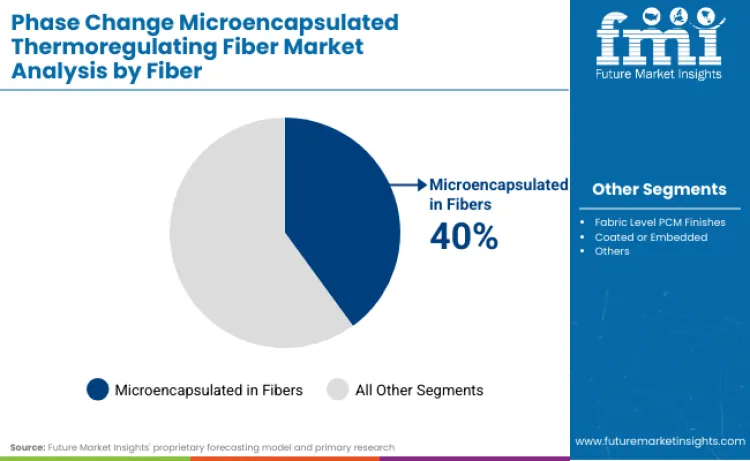
Microencapsulated-in-fibre systems hold 40% share because integration during fibre formation protects both durability and hand-feel while reducing wash-off risk that can limit fabric-level PCM finishes. This format also reduces operational variability for converters.
Brands and textile mills can specify thermoregulation as a controllable yarn input rather than relying on finishing steps that may vary by substrate, process window, and line conditions. As qualification cycles tighten, this integration advantage becomes a decisive procurement lever because it improves repeatability and reduces rejection risk in scaled production.
Why do Sleep & Bedding Brands lead End-user Adoption?
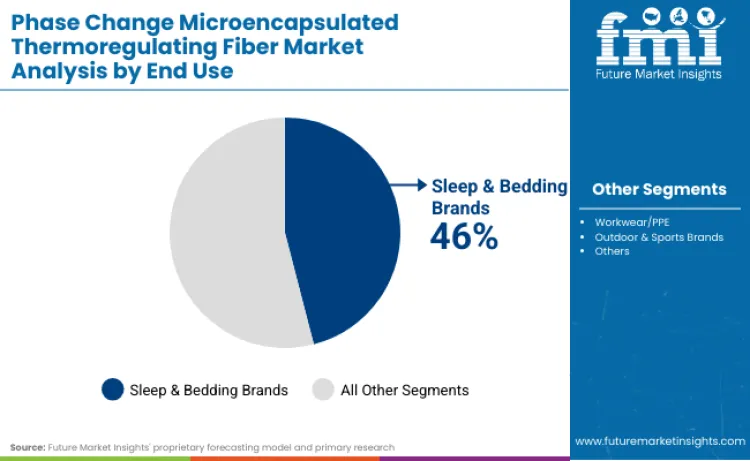
Sleep and bedding brands hold a 46% share because thermal stability is directly monetisable in long dwell-time products. PCM reduces hot sleep complaints without requiring powered devices, which lowers return risk and supports premium positioning.
Bedding programs also allow clearer benefit perception, since contact duration and nightly exposure make temperature buffering more noticeable than short-duration apparel use. This adoption logic aligns with comfort-led premiumisation patterns already shaping higher-value bedding categories, where buyers increasingly pay for measurable comfort performance rather than aesthetic upgrades alone.
Why does Bedding & Sleep Products command the Bulk of all Applications?
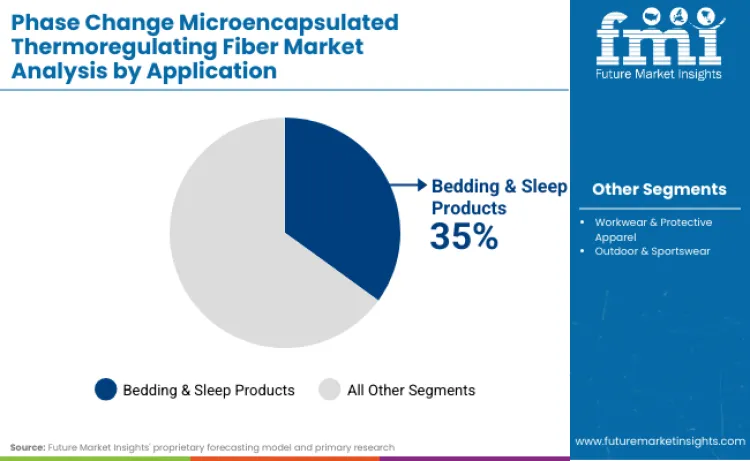
Bedding and sleep products hold a 35% share because they combine three adoption advantages: high consumer willingness to pay, long contact duration that makes PCM benefits tangible, and comparatively stable product constructions that support consistent performance.
Bedding also provides a natural entry lane for higher bio-based content narratives, which supports premiumisation for brands targeting sustainability-driven consumers. As bio-based PCM becomes more commercially available, bedding remains the most receptive segment because it can absorb incremental cost while linking thermoregulation to wellness positioning.
How is Decarbonisation Policy Converting PCM Fibers into Passive Energy Assets?
Decarbonisation policy changes the value equation for thermoregulation by turning comfort into an energy variable. In mobility and industrial contexts, the question is no longer whether a textile feels cooler. The question is whether passive buffering can reduce HVAC load, stabilise temperature swings, and support efficiency targets without adding electrical complexity. This logic is particularly relevant in EV interiors, where heating and cooling draw directly competes with range and where efficiency standards tighten the penalty for energy loss.
A second policy-linked dynamic is the shift toward verifiable ROI. High CapEx for retrofitting fibre or finishing lines can slow adoption in some segments, pushing PCM growth toward new-build programs where thermoregulation is designed into specifications early. Similar cost-versus-compliance dynamics are visible across protective textile purchasing, where proof of performance and qualification economics shape what scales.
How will Phase Change Microencapsulated Thermoregulating Fiber Expansion Unfold across Key Countries?
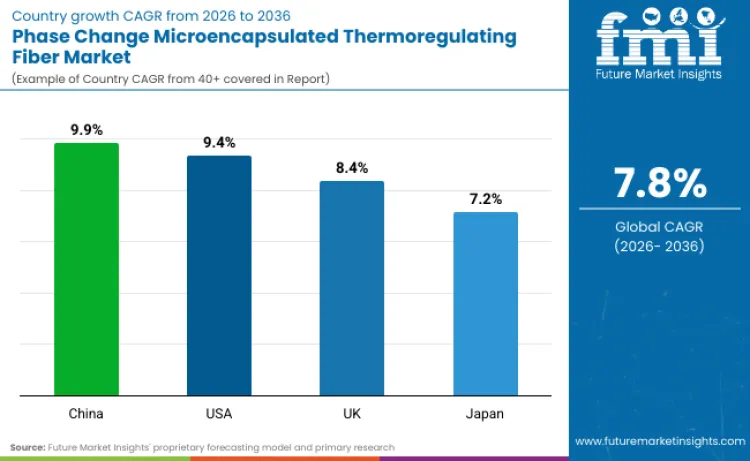
| Country | CAGR (2026 to 2036) |
|---|---|
| USA | 9.4% |
| China | 9.9% |
| Japan | 7.2% |
| UK | 8.4% |
Source: FMI analysis based on primary research and proprietary forecasting model
How is USA’s Growth tied to supply-chain control and bedding-led conversion?
Expected to advance at a 9.4% CAGR, USA is anchored in bedding conversion and a supply-chain localisation play that reduces batch variability risk. A concrete marker is the December 2025 acquisition of Microtek Laboratories by Alexium International for USD 2.17 million, explicitly aimed at vertically integrating US-based microencapsulation. The strategic implication is that microencapsulation capacity is becoming a procurement moat.
It improves lead-time reliability and reduces third-party slurry dependence, which matters in bedding programs where performance drift turns into returns, complaints, and warranty exposure. Bedding demand also supports value capture because thermal comfort is a premium purchase trigger, and replacement cycles reward suppliers that can document durability rather than deliver one-time performance demos. Related replacement-led bedding dynamics are visible in bed linen categories where premiumization continues to support functional upgrades.
How does EV Efficiency Compliance and Local Standards Pressure influence Demand in China?
China’s expansion is driven by by efficiency adoption inside NEV ecosystems, where passive thermal buffering supports range retention by reducing HVAC draw volatility. It is expected to advance at a 9.9% CAGR. A specific catalyst is the January 2026 MIIT-linked update stating a new EV energy standard of 15.1 kWh/100km, which increases the economic relevance of passive thermoregulation in interiors and adjacent textile liners.
This standardisation environment accelerates local qualification cycles and favours suppliers that can scale with consistent enthalpy performance and leakage control, since variability becomes a warranty and compliance risk rather than a marketing issue. China’s growth is less about consumer-facing comfort branding and more about supplier readiness to deliver stable, repeatable PCM performance at industrial volumes aligned with NEV requirements.
What anchors Japan’s Growth in OEM-grade scaling and recycled integration targets?
Japan’s 7.2% CAGR reflects an OEM-grade execution lane where materials are judged by manufacturability and measurable scale-up targets. A concrete proof point is the October 2025 launch of THERMOFRONT™ by Teijin Frontier, integrating PCM with 70% recycled fibre for EV cabin management.
The significance sits in how the launch ties thermoregulation to circularity expectations and provides explicit volume intent: Teijin Frontier stated an aim to sell 300,000 meters in fiscal 2025 and 1 million meters by fiscal 2028. This signals that Japan’s PCM textile growth is moving beyond pilot storytelling into programmatic volume ramps, where supply stability and integration discipline determine repeat orders.
Why is UK’s expansion linked to fiscal incentives and industrial energy economics in battery manufacturing?
Advancing at an 8.4% CAGR, UK’s expansion is supported by policy-aligned industrial economics that improve PCM’s payback case in thermal liner and battery manufacturing workflows. A specific marker is the October 2025 GOV.UK-linked expansion of the Climate Change Agreement (CCA) framework to provide tax reliefs for firms using PCM thermal liners in battery manufacturing.
This converts PCM liners from a discretionary add-on into a partially offset cost, which strengthens adoption in industrial and protective textile contexts where energy efficiency levers are sought without major equipment redesign. The UK’s growth therefore tracks a finance-and-compliance pathway, similar to how protective apparel product lines often scale when incentives and qualification requirements align.
How is the Competitive Landscape in the Phase Change Microencapsulated Thermoregulating Fiber Market?
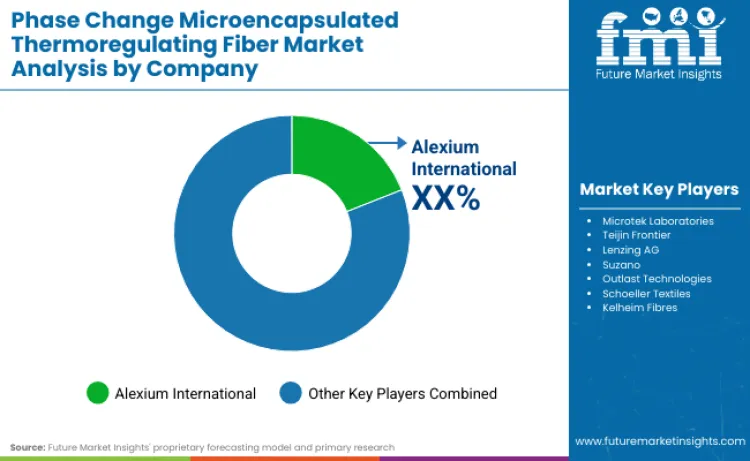
Competition is separating into three execution lanes defined by integration capability, supply assurance, and qualification credibility.
Verticalised PCM Platform Owners
This lane treats microencapsulation as a strategic asset rather than a purchased input. The Alexium–Microtek acquisition is the archetypal move because it reduces third-party slurry fragility and improves control over shell integrity and batch consistency.
These suppliers win by lowering buyer risk. They can offer tighter documentation, faster response to quality deviations, and more stable lead times, which matters in long-cycle bedding and mobility programs.
OEM-aligned integration innovators with sustainability credentials
This lane wins by linking fibre-level integration discipline with sustainability-aligned specifications. Teijin Frontier’s THERMOFRONT™ is a clear marker because it combines recycled content with PCM functionality while communicating measurable scale targets. This lane is best positioned for mobility interiors where qualification thresholds are high and suppliers must demonstrate repeatability under real use conditions.
Ingredient-branding incumbents facing a procurement reset
Legacy leaders built early dominance through brandable comfort narratives in premium outdoor apparel. That lane remains relevant where consumer-facing storytelling still drives willingness to pay. Yet the market’s centre of gravity is shifting toward infrastructure procurement, where buyers reward endurance proof and supply assurance more than brand visibility. Similar procurement tightening is visible across smart textile programs, where reliability and integration discipline increasingly determine supplier shortlists.
A structural stress point is emerging in Europe. High-cost producers face insolvency risk when volume commitments are weak and investors hesitate to fund capacity upgrades. A concrete marker is Kelheim Fibres announcing it will terminate operations by March 31, 2026, citing lack of volume commitments and failed investor deals. This reinforces the consolidation mandate and increases the probability that scale players and vertically integrated platforms capture share as qualification costs rise.
Key Players in Phase Change Microencapsulated Thermoregulating Fiber Market
- Alexium International
- Microtek Laboratories
- Teijin Frontier
- Lenzing AG
- Suzano
- Outlast Technologies
- Schoeller Textiles
- Kelheim Fibres
Market Definition
The phase change microencapsulated thermoregulating fiber market represents revenue generated from fibres, yarns, and textile structures that integrate microencapsulated PCM systems to absorb and release heat across defined transition bands. The scope includes PCM microencapsulated in fibre, fabric-level PCM finishes, and coated or embedded PCM architectures used across bedding, workwear and protective apparel, outdoor performance textiles, and interior textile systems.
The report includes PCM-integrated textile formats where thermoregulation is delivered through fibre-level or fabric-level integration, including melt-spun PCM fibres, finished textiles with microencapsulated PCM coatings, and embedded PCM structures engineered into yarns, nonwovens, or textile composites. Applications covered include bedding and sleep products, protective and industrial apparel, outdoor and sportswear, and infrastructure-led textile uses such as mobility interiors and battery-adjacent textile liners where passive thermal buffering supports energy efficiency, thermal stability, and system-level performance requirements.
The report excludes standalone PCM products that are not integrated into textile substrates, including bulk PCM blocks, macro-encapsulated PCM panels, and building-grade PCM boards or sheets used for wall, ceiling, or structural thermal storage. It also excludes non-textile thermal management systems such as HVAC PCM modules, electronic heat sinks, PCM-based cooling packs, and rigid insulation materials that do not involve fibre, yarn, or textile architectures. Additionally, the scope does not cover phase change materials used solely in construction materials, electronics enclosures, or mechanical thermal storage systems without a textile component.
Scope of Report
| Items | Values |
|---|---|
| Quantitative Units (2026) | USD 0.8 billion |
| Quantitative Units (2036) | USD 1.7 billion |
| CAGR (2026 to 2036) | 7.8% |
| Type | Paraffin (45%); Salt Hydrate & Inorganic; Bio-based; Others |
| Fiber | Microencapsulated in Fiber (40%); Fabric Level PCM Finishes; Coated or Embedded; Others |
| End User | Sleep & Bedding Brands (46%); Workwear/PPE; Outdoor & Sports Brands; Others |
| Application | Bedding & Sleep Products (35%); Workwear & Protective Apparel; Outdoor & Sportswear |
| Key Countries Covered | United States (9.4% CAGR); China (9.9% CAGR); Japan (7.2% CAGR); United Kingdom (8.4% CAGR) |
| Regions Covered | North America; Europe; East Asia |
| Competitive Focus | Vertical integration of microencapsulation; fibre-level integration platforms; qualification-grade endurance documentation; consolidation risk among high-cost producers |
| Additional Attributes | Segment share mapping, country CAGR mapping, procurement filters shaping qualification, integration economics across bedding and mobility interiors, chemistry migration beyond paraffin, supply-chain localisation signals |
Phase Change Microencapsulated Thermoregulating Fiber Market by Segments
By Type:
- Paraffin
- Salt Hydrate & Inorganic
- Bio-based
- Others
By Fiber:
- Microencapsulated in Fiber
- Fabric Level PCM Finishes
- Coated or Embedded
- Others
By End User:
- Sleep & Bedding Brands
- Workwear/PPE
- Outdoor & Sports Brands
- Others
By Application:
- Bedding & Sleep Products
- Workwear & Protective Apparel
- Outdoor & Sportswear
Bibliography
- Ministry of Industry and Information Technology (MIIT), China. (2026, January). EV energy standard update indicating 15.1 kWh/100km efficiency direction and compliance implications.
- GOV.UK. (2025, October). Climate Change Agreement framework expansion providing tax reliefs for firms using PCM thermal liners in battery manufacturing.
- Teijin Frontier. (2025, October). THERMOFRONT™ launch announcement, recycled content positioning, and stated volume targets for fiscal 2025–2028.
- Alexium International. (2025, December). Microtek Laboratories acquisition disclosure and executive commentary on domestic supply chain strengthening.
- Kelheim Fibres. (2026). Closure announcement citing lack of volume commitments and failed investor deals.
Frequently Asked Questions
What is the current global market size for phase change microencapsulated thermoregulating fibers?
The market is valued at USD 0.8 billion in 2026, supported by bedding conversion and infrastructure-led adoption in mobility and industrial textiles.
What is the projected CAGR for the phase change microencapsulated thermoregulating fiber market?
Demand for phase change microencapsulated thermoregulating fibers is projected to expand at a 7.8% CAGR from 2026 to 2036.
Which segment dominates by type?
Paraffin leads with 45% share, supported by scalable economics and stable cost-to-enthalpy performance.
Which fibre integration approach leads?
Microencapsulated in fiber leads with 40% share, as embedded integration improves wash endurance and reduces performance drift.
Which end user leads adoption today?
Sleep & bedding brands lead with 46% share, because thermal stability reduces complaint risk and supports premium positioning.
Preview the report firsthand - request a free sample
Get SampleGet the brochure for pricing and purchase details.
Get PDFTable of Content
- Executive Summary
- Market Outlook and Value Trajectory
- Use-case Inversion and Demand Reset
- Supply-side Integration and Qualification Shifts
- Chemistry Migration and Safety Perception Dynamics
- Strategic Recommendations
- Market Overview
- Market Definition
- Market Scope and Coverage
- Inclusions and Exclusions
- Market Size Snapshot (2026) and Forecast (2036)
- Key Drivers, Restraints, and Trends
- Market Analysis and Forecast 2021 to 2036
- Historical Market Size Value (USD Billion), 2021 to 2025
- Market Forecast Value (USD Billion), 2026 to 2036
- Y-o-Y Growth Trend Analysis, 2021 to 2036
- Absolute Dollar Opportunity Analysis, 2026 to 2036
- Market Background and System Context
- PCM Thermoregulating Fibres as Passive Thermal Infrastructure
- Integration Pathways (Fibre-integrated, Fabric-finished, Coated or Embedded)
- Performance Benchmarks (Laundering, Compression, Mechanical Cycling)
- Failure Modes (Leakage Risk, Shell Rupture, Enthalpy Drift)
- Multi-function Bundling (Antimicrobial, Moisture Management, Comfort Stacks)
- Why is the Phase Change Microencapsulated Thermoregulating Fiber Market Expanding?
- Mobility Interiors and Battery-adjacent Thermal Buffering Pull
- Procurement Tightening around Endurance Proof
- Finish-to-fibre Migration and Yield Stability Incentives
- Chemistry Broadening beyond Paraffin under Regulated-use Expectations
- Global Market Pricing Analysis 2021 to 2036
- Pricing Assumptions and Reference Structures
- Historical Pricing Trend Analysis
- Pricing Sensitivity and Forward Outlook
- Global Market Analysis 2021 to 2025 and Forecast 2026 to 2036, By Type
- Introduction and Key Findings
- Historical Market Size Value Analysis
- Market Forecast and Opportunity Analysis
- Paraffin
- Salt Hydrate and Inorganic
- Bio-based
- Others
- Y-o-Y Growth Trend Analysis
- Absolute Dollar Opportunity Analysis
- Global Market Analysis 2021 to 2025 and Forecast 2026 to 2036, By Fiber Integration Approach
- Introduction and Key Findings
- Historical Market Size Value Analysis
- Market Forecast and Opportunity Analysis
- Microencapsulated in Fiber
- Fabric Level PCM Finishes
- Coated or Embedded
- Others
- Y-o-Y Growth Trend Analysis
- Absolute Dollar Opportunity Analysis
- Global Market Analysis 2021 to 2025 and Forecast 2026 to 2036, By End User
- Introduction and Key Findings
- Historical Market Size Value Analysis
- Market Forecast and Opportunity Analysis
- Sleep and Bedding Brands
- Workwear and PPE
- Outdoor and Sports Brands
- Others
- Y-o-Y Growth Trend Analysis
- Absolute Dollar Opportunity Analysis
- Global Market Analysis 2021 to 2025 and Forecast 2026 to 2036, By Application
- Introduction and Key Findings
- Historical Market Size Value Analysis
- Market Forecast and Opportunity Analysis
- Bedding and Sleep Products
- Workwear and Protective Apparel
- Outdoor and Sportswear
- Y-o-Y Growth Trend Analysis
- Absolute Dollar Opportunity Analysis
- Global Market Analysis 2021 to 2025 and Forecast 2026 to 2036, By Region
- Introduction
- Historical Market Size Value Analysis
- Market Forecast by Region
- North America
- Europe
- East Asia
- Market Attractiveness Analysis
- North America Market Analysis 2021 to 2025 and Forecast 2026 to 2036
- Historical Trend Analysis
- Market Forecast
- Key Takeaways
- Europe Market Analysis 2021 to 2025 and Forecast 2026 to 2036
- Historical Trend Analysis
- Market Forecast
- Key Takeaways
- East Asia Market Analysis 2021 to 2025 and Forecast 2026 to 2036
- Historical Trend Analysis
- Market Forecast
- Key Takeaways
- Country-wise Analysis
- USA
- China
- Japan
- UK
- Competition Outlook
- Competitive Landscape and Positioning
- Vertical Integration of Microencapsulation
- Qualification Credibility and Endurance Documentation as Supplier Filters
- Recent Developments
- Company Profiles
- Alexium International
- Microtek Laboratories
- Teijin Frontier
- Lenzing AG
- Suzano
- Outlast Technologies
- Schoeller Textiles
- Kelheim Fibres
- Assumptions and Acronyms
- Assumptions
- Acronyms
- Research Methodology
- Chapter Orientation
- Analytical Framework
- Market Sizing and Forecasting Approach
- Validation and Data Sources
- Appendix
- Scope of Report
- Bibliography
- Frequently Asked Questions


