

- Market Size (2026)
- USD 503.5 Mn
- Forecast (2036)
- USD 1563.8 Mn
- CAGR (2026 to 2036)
- 12.0%
How big is Ultem Polyetherimide 3D Printing Resins Market in 2026?
USD 503.5 million in 2026 and USD 1563.8 million by 2036 at a 12.0% CAGR.
Sales of ultem polyetherimide 3D printing resins are estimated to rise at 12.0% CAGR through 2036, increasing valuation from USD 503.5 million in 2026 to USD 1563.8 million by 2036. Commercial growth depends on low-volume parts that need heat resistance and controlled flame behavior without expensive dedicated tooling. Defense vehicle programs illustrate that route through recurring ducting parts rather than isolated demonstration builds or one-time prototypes. In June 2026, miniFactory documented Rheinmetall UK's adoption of FFF with ULTEM 9085 for Challenger 3 ducting. The program selected in-house printing after comparing tooling cost and production control across several manufacturing options. The deployment links 3D printing materials revenue with recurring vehicle production and replacement workflows across a qualified part family.
Country demand varies with certification practice and access to heated-chamber systems supported by local application engineers. United States programs can draw on broad platform availability and polymer testing resources across aerospace research and commercial production. Japanese programs place greater weight on documented material data and structured process approval across new manufacturing routes. Both operating models require measurements that separate acceptable bulk resin properties from stable performance across the printed build direction. In May 2025, NIST described methods for measuring temperature and stress fields during polymer material extrusion. Temperature and stress data help engineering teams assess layer bonding and dimensional stability across commercial polyetherimide supply programs. Commercial conversion therefore depends on drying discipline and repeatable chamber conditions across qualification and recurring production.
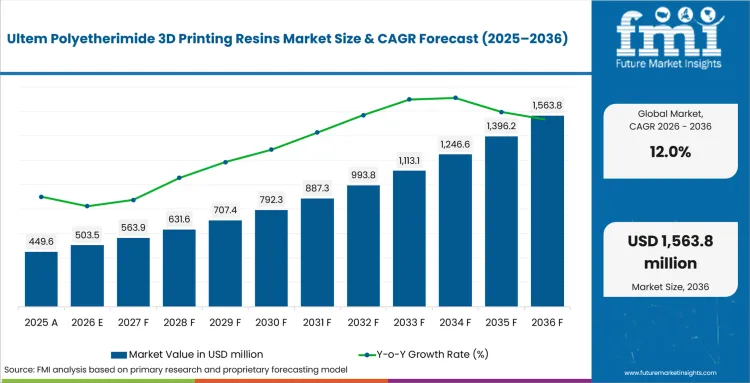
Key Takeaways of Ultem Polyetherimide 3D Printing Resins Market
- Demand is projected to expand as manufacturers replace costly tooling with qualified high-temperature polymer printing for recurring low-volume parts.
- Based on product type, filament is projected to account for 66.0% in 2026 due to traceable spool handling and established FDM qualification records.
- The application category is forecast to be led by aerospace and defense at 34.0% share in 2026 due to flame-performance and documentation requirements.
- Aerospace and defense manufacturers are likely to capture 34.0% share in 2026 attributable to direct control over airworthiness records and production acceptance.
- High material cost and narrow thermal windows restrain adoption as moisture or chamber variation can weaken interlayer performance across demanding builds.
- Through resin specifications and certified filament, SABIC and Stratasys anchor the specification-led tier; AON3D, Roboze, INTAMSYS, 3DGence, Apium, and miniFactory compete through platform capability or regional support.
Analyst Perspective
"Commercial value develops through a qualified Ultem process that supports several recurring parts with demanding heat and flame requirements. Resin datasheets cannot replace production evidence showing stable interlayer strength and dimensional control across repeated builds. Manufacturers that control feedstock traceability and drying alongside chamber temperature and local technical support are better positioned to convert aerospace qualification into repeat material orders."
- Nikhil Kaitwade, Principal Analyst, Future Market Insights
How is the Ultem Polyetherimide 3D Printing Resins Market segmented?
The Ultem Polyetherimide 3D Printing Resins market is segmented by Product Type, Application, End User, Distribution Channel, Technology, and Region.
The framework separates the purchased resin form, functional application, approving organization, sales route, printing process, and geographic market. Product type covers filament, pellets, powder, and specialized feedstocks with different storage and processing requirements. Application identifies the finished-part use, while end user names the organization responsible for qualification and repeat purchasing. Distribution channel distinguishes direct technical engagement, specialist distributors, printer-led ecosystems, and online purchasing routes across different support needs. Technology separates FDM and FFF from pellet extrusion, composite printing, and other high-temperature processes with different qualification demands. Regional analysis compares platform availability, service coverage, qualification practice, and production conditions across national markets. The separated dimensions prevent one aerospace order from being counted repeatedly across resin form, machine route, and approving organization within additive manufacturing materials.
Why does filament hold the largest position within the product type category?
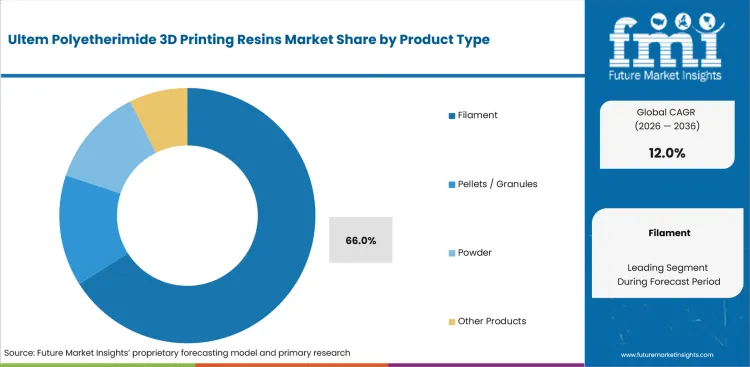
Qualified production programs prefer traceable spools that match validated machine settings and documented drying records across recurring builds. Continuous lot records reduce qualification variables and make failed builds easier to trace against drying or deposition settings. Stratasys introduced ULTEM 9085 Certified Grade for the F3300 in November 2025 with full traceability and tighter diameter tolerances. The material update connects 3D printing filament identification with consistent deposition records across regulated production runs.
- By product type, filament is estimated to hold 66.0% in 2026 owing to traceable spool handling across qualified FDM systems. Spool identity can remain linked with drying records and stable machine settings across recurring builds. Production teams can reuse those controls across related parts without rebuilding the complete material plan for each qualified geometry.
- Aerospace teams extend filament use through repeat programs that connect each material lot with printer settings and acceptance records. Moisture sensitivity remains a separate adoption barrier; incomplete conditioning can weaken layer bonding and increase rejected builds. Local application engineers reduce disruption by tracing conditioning failures ahead of several production runs entering the same process window.
What supports aerospace and defense within the application category?
Aircraft interior parts need heat resistance and controlled flame behavior across low-volume geometries that vary between programs. Qualification depends on the complete material-machine-process record rather than the resin grade listed on a datasheet. New geometries require defined process controls prior to reusing established evidence for recurring aircraft production. Cabin programs therefore favor material-machine combinations that retain orientation records and inspection criteria across related low-criticality parts within aerospace printing materials.
- Aerospace and defense is set to lead the application category with 34.0% share in 2026 due to demanding flame-performance and traceability requirements. Recurring cabin components and production tooling combine low-weight needs with documented material-process performance across repeat builds. Qualified combinations retain commercial value across related geometries that share comparable operating loads and inspection conditions.
- Aircraft manufacturers expand approved use through controlled part families that reuse validated orientations and acceptance tests across related geometries. EASA and FAA convened a joint additive manufacturing workshop in October 2025 on qualification of metallic and non-metallic aviation parts. The work supports clearer reuse of accepted evidence across low-criticality cabin components without treating each replacement geometry as a separate material program.
Why are aerospace and defense manufacturers central to the end user category?
Aerospace manufacturers control design approval and production records for printed components entering regulated aircraft programs. Approved organizations can reuse one controlled material route across several aircraft platforms, giving serial production greater commercial weight than prototype activity. Stratasys reported in December 2025 that Airbus produced more than 25,000 flight-ready parts annually with certified ULTEM 9085 filament. The program links aerospace lightweight materials with recurring cabin production and documented traceability across multiple aircraft models.
- Based on end user, aerospace and defense manufacturers are projected to account for 34.0% in 2026 due to direct control over airworthiness records and production acceptance. Internal qualification teams can extend a successful process record across related geometries while retaining responsibility for material and build conformity. Recurring cabin programs strengthen the segment through repeated use of approved feedstock and machine settings.
- Aerospace manufacturers broaden Ultem printing through qualified part families with stable demand and manageable inspection requirements. Smaller programs face higher validation costs if every new geometry requires separate engineering work and distant technical support. Dedicated internal specialists shorten reviews by coordinating material changes with inspection teams and retained production records across recurring aircraft programs.
How does direct Sales influence the distribution channel category?
Direct engagement gives resin and machine specialists access to operating data needed to diagnose complex PEI failures. Channel value rises as feedstock records and chamber performance must be reviewed together during qualification. Specialist distributors can manage routine engineering plastics supply, but moisture or chamber failures require escalation to the organizations controlling specifications. Contract value therefore depends on response time and clear technical ownership across qualification and recurring production.
- Direct sales is likely to capture 38.0% share in 2026 attributable to direct technical access during material-process troubleshooting and lot control. Engineering teams can resolve drying or chamber problems with the organizations controlling resin specifications and machine settings. Documented response commitments protect qualified programs from recurring interruptions and unexplained failures across production builds.
- Large manufacturers use direct contracts to secure lot continuity and defined technical response across qualified material-machine combinations. In July 2025, INTAMSYS stated that its global distribution and service network supported service centers processing PEI and other engineering materials. Regional partners improve installation coverage, while manufacturer escalation shortens root-cause analysis during complex high-temperature failures.
What keeps fused deposition modeling ahead within technology?
FDM provides an established machine base and material controls for high-temperature filament processing across industrial production programs. Thermal regulation determines whether deposited PEI layers retain enough heat for reliable bonding and dimensional control across each geometry. Industrial 3D printing platforms combine heated chambers with controlled cooling and repeatable spool conditioning across validated profiles. Pellet extrusion can support larger parts, but it requires separate development of bead geometry and interlayer consistency across long deposition paths.
- The technology category is forecast to be led by FDM at 52.0% share in 2026 due to established heated-chamber platforms and certified filament workflows. In June 2026, AON3D explained that ULTEM printing requires careful chamber management to reduce warping and weak layer adhesion. Existing qualification records support repeat production across related geometries with comparable orientation and thermal conditions.
- Manufacturers adopt FDM through familiar spool handling and software workflows that integrate with existing engineering records. Adoption slows if chamber capability or drying controls fail to reproduce the performance expected from the certified resin grade. Application engineers must verify orientation and bead placement prior to extending existing material evidence to a new geometry within production programs.
What are the drivers, restraints, and opportunities in the Ultem Polyetherimide 3D Printing Resins Market?
Qualified polymer printing reduces tooling for low-volume heat-resistant parts; narrow thermal and moisture windows restrict reliable production; simulation-led qualification can lower testing cost.
- Driver: Qualified high-temperature printing reduces tooling expense across recurring low-volume parts that require heat resistance and controlled flame behavior.
- Restraint: Chamber temperature and moisture variation can weaken interlayer strength despite acceptable bulk resin properties across demanding builds.
- Opportunity: Simulation and geometry-aware slicing can lower physical testing needs across expensive load-bearing ULTEM parts.
Recurring low-volume production supports resin demand by allowing aerospace and industrial manufacturers to avoid dedicated tooling for complex heat-resistant parts. Brackets and ducts often require design changes, weakening the economics of molds or machined tooling at limited volumes. In April 2025, AON3D documented metal-replacement applications using ULTEM 9085 and other industrial high-performance polymers. The applications demonstrate how one validated material-machine route can support related part families across specialty polymers production. Revenue grows through recurring orders that preserve thermal controls and acceptance tests across each production cycle.
Purchased resin properties do not guarantee equivalent strength across printed layers, making process sensitivity an adoption restraint. Chamber temperature governs polymer diffusion during deposition and directly affects strength across the build direction. AON3D reported in July 2026 that ULTEM 9085 specimens printed at 185°C achieved about 44% higher ZX tensile strength than specimens printed at 120°C. Production sites therefore need chamber capability and drying controls matched to the intended geometry and load case. Weak thermal management increases scrap and extends qualification through inconsistent acceptance results across repeated builds.
Simulation and geometry-aware slicing offer a practical route to higher machine utilization without relaxing thermal requirements. Faster deposition has commercial value if the revised toolpath preserves layer bonding across the complete part. AON3D reported in November 2025 that physics-based slicing reduced a test print time by as much as 54% without sacrificing stated part quality. Engineering teams can use the workflow to screen expensive ULTEM builds before committing resin and machine time. Commercial adoption depends on repeat acceptance data across representative geometries rather than one optimized demonstration.
Which country CAGRs are profiled in the Ultem Polyetherimide 3D Printing Resins Market?
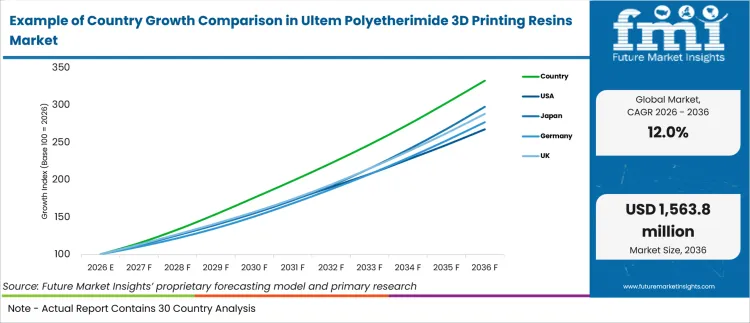
| Country | CAGR |
|---|---|
| Canada | 12.1% |
| Japan | 11.5% |
| UK | 11.2% |
| Germany | 10.7% |
| USA | 10.3% |
| Australia | 9.0% |
| South Korea | 8.6% |
How do country-level CAGRs compare in the Ultem Polyetherimide 3D Printing Resins Market?
The country forecasts span 3.5 percentage points and form three practical bands across the seven countries. Canada and Japan occupy the upper band, followed closely by the United Kingdom and Germany. The United States sits below that pair despite broader access to industrial platforms and aerospace testing resources. Australia and South Korea form the lower band with defense-led programs that remain sensitive to service distance and local qualification depth. The spacing reflects approved growth assumptions rather than absolute market size or guaranteed investment quality across each country. Country selection therefore requires separate review of recurring part demand and local technical support alongside qualification cost.
- Canada sits 0.6 percentage point above Japan, reflecting a slightly stronger forecast around aerospace production and concentrated qualification expertise.
- Japan remains 0.3 percentage point above the United Kingdom as rigorous documentation supports consistency but lengthens approval for new material-machine combinations.
- The United Kingdom sits 0.5 percentage point above Germany as defense adoption policy advances alongside demanding airworthiness and support obligations.
- Germany remains 0.4 percentage point above the United States through industrial engineering depth and large-format thermoplastic research across aerospace cabin applications.
- The United States follows Germany despite wider platform access as separate aerospace programs can repeat similar qualification work across production sites.
- Australia stands 0.4 percentage point above South Korea as deployable defense trials provide operating references despite long material and maintenance routes.
- South Korea closes the profiled range with coordinated defense localization but limited public evidence of serial PEI component approval.
Comparable growth rates can produce different entry conditions as qualification ownership and support distance vary across countries. Recurring part demand must offset validation cost and imported technical support before a national forecast becomes commercially attractive. The full report provides country-level CAGR analysis across North America, Latin America, Europe, East Asia, South Asia, Oceania and the Middle East and Africa.
Country-wise Analysis
- Canada's aerospace manufacturing base is concentrated in Quebec and Ontario, giving PEI printing programs access to established engineering and qualification talent. In Canada, Ultem Polyetherimide 3D Printing Resins demand is predicted to advance at 12.1% CAGR through 2036. Statistics Canada reported in February 2026 that Canada ranked among the five largest aerospace exporters during 2024. The ranking identifies a concentrated pool of aircraft manufacturers and technical partners able to evaluate high-temperature polymer parts. Specialized additive expertise within Canada's principal manufacturing clusters provides direct support for qualification and recurring production. Service access weakens outside the principal clusters and increases travel time for heated-chamber maintenance or material troubleshooting. Commercial entry should prioritize aerospace accounts that maintain internal qualification staff and documented production controls.
- Japanese aerospace programs use structured material approval and process documentation before introducing new production routes into established supply chains. Adoption of Ultem Polyetherimide 3D Printing Resins in Japan is estimated to expand at 11.5% CAGR through 2036, supported by rigorous quality systems and advanced manufacturing capability. Imported printer-material combinations require internal review, which gives shared process data direct value during qualification and system comparison. NEDO announced in June 2025 a program developing aerospace process-analysis tools and a shared material-certification data foundation. The data foundation reinforces Japan's preference for documented process evidence across new aerospace manufacturing routes. Long validation cycles remain a material friction for imported platforms lacking Japanese documentation and rapid local application support.
- United Kingdom defense programs are establishing formal additive manufacturing routes within distributed supply and equipment-support activities. Low-volume polymer parts fit these routes as design records and local production responsibilities remain controlled within approved programs. The Ministry of Defence published its Defence Advanced Manufacturing Strategy in March 2025 and identified additive manufacturing as the initial route toward wider advanced manufacturing use. Ultem Polyetherimide 3D Printing Resins sales in the United Kingdom are forecast to expand at 11.2% CAGR by 2036, shaped by defense adoption and aerospace engineering demand. The policy supports obsolete-part replacement and qualified low-volume production across controlled military maintenance and equipment-support programs. Airworthiness documentation and public purchasing requirements remain substantial frictions for new resin-printer combinations without local technical support.
- German aerospace research combines large-format printing with detailed material analysis for high-performance thermoplastic cabin components. Germany's Ultem Polyetherimide 3D Printing Resins market is estimated to post 10.7% CAGR over the forecast period, supported by engineering depth and industrial qualification requirements. Large cabin geometries require process control that preserves material properties across extended deposition paths and repeated processing cycles. DLR reported in August 2025 that its TIRIKA project was developing large-format printing and recycling routes for fiber-reinforced high-performance thermoplastics used in aircraft cabins. The program gives local engineers practical evidence on geometry scale and material behavior across several processing cycles. Serial approval remains difficult without stable property data for virgin and reprocessed feedstock plus responsive local engineering support.
- United States aerospace organizations have broad access to industrial FDM platforms and specialized polymer testing resources. NASA TechPort reported in January 2026 that interlayer adhesion remained the principal polymer limitation within its high-performance additive manufacturing project. The United States Ultem Polyetherimide 3D Printing Resins sector is projected to record 10.3% CAGR during the assessment period, supported by established additive infrastructure and qualification activity. Federal research and commercial platform availability enable detailed testing of build-direction strength across candidate parts. Separate aerospace programs can repeat similar qualification work across facilities and increase the cost of each approved geometry. Commercial programs should develop reusable material-process specifications that reduce duplicated testing across multiple production sites.
- Australian defense units are testing deployable polymer printing under field conditions that expose equipment reliability and support constraints. By 2036, Australia's Ultem Polyetherimide 3D Printing Resins market is projected to grow at 9.0% CAGR. Defense experimentation and local advanced manufacturing programs influence the forecast through new field evidence and operating experience. The Department of Defence reported in August 2025 that the Navy deployed its first containerized additive manufacturing demonstration with three polymer printers. Field trials give local teams operating evidence for spare-part workflows based on rapid production and digital design transfer. Long material routes and limited high-temperature service coverage remain significant frictions outside the principal Australian cities. Commercial entry requires a service plan that covers remote maintenance and moisture-sensitive material handling across deployed systems.
- South Korean defense manufacturing programs use coordinated government and military projects to identify parts and build additive process data. Shared process databases provide a local route for repeat testing and domestic technical learning across participating defense organizations. The Ministry of Trade, Industry and Energy reported in January 2025 that public bodies signed an agreement covering defense-part demonstrations and manufacturing process databases. South Korea's Ultem Polyetherimide 3D Printing Resins outlook is anticipated to advance at 8.6% CAGR over the assessment period, supported by defense localization and connected manufacturing networks. Coordinated programs support replacement-part development across selected maintenance and production workflows with domestic technical oversight. Limited public evidence for serial PEI component approval remains a material boundary outside controlled demonstration programs.
Who are the notable companies in the Ultem Polyetherimide 3D Printing Resins Market?
SABIC, Stratasys Ltd., AON3D, INTAMSYS Technology Co., Ltd., 3DGence Sp. z o.o., Roboze S.p.A., Apium 3D Technologies GmbH, and miniFactory Oy Ltd. are the notable companies reviewed in this market.
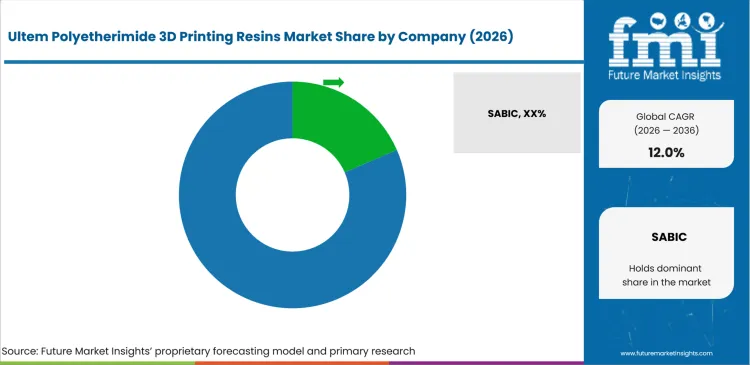
Competition is moderately concentrated around SABIC's PEI specifications and a limited group of industrial printers with verified ULTEM processing capability. Stratasys operates the clearest closed route through certified filament and controlled FDM profiles backed by recurring aerospace production records. AON3D and Roboze compete through open-material systems that emphasize measured chamber performance and specialized application engineering for PEI parts. INTAMSYS and 3DGence address manufacturers seeking alternative industrial platforms with validated PEI profiles and broader application support. Apium and miniFactory serve narrower industrial accounts through specialized material handling and regional technical support for installed systems. Entry remains possible for platforms that reduce qualification effort and shorten service response across installed systems. Competitive strength depends on repeatable interlayer performance and traceable feedstock control rather than nominal chamber temperature alone within industrial 3D printing platforms.
- SABIC and Stratasys form the specification-led tier through branded resin and certified filament used in regulated aerospace production. Their advantage rests on material traceability and accepted processing records that support recurring cabin components and maintenance parts. Closed qualification routes can shorten repeat approvals, but they limit material choice across independent high-temperature printer platforms.
- AON3D and Roboze challenge closed ecosystems through open-material hardware and process software supported by application engineering for difficult PEI geometries. Their position depends on measured chamber performance and consistent build results across repeated industrial parts. Open material access is most valuable for manufacturers that need broader feedstock choice without surrendering qualification control.
- INTAMSYS and 3DGence provide alternative industrial FDM platforms with verified high-temperature polymer profiles and application support. Apium and miniFactory address narrower industrial accounts through specialized material handling and regional service routes. Validated PEI profiles and timely technical response determine whether those platforms can retain production accounts following installation. Local engineering partners reduce downtime for manufacturers that cannot absorb repeated overseas service visits or lengthy troubleshooting cycles.
Competitive Benchmarking: Ultem Polyetherimide 3D Printing Resins Market
| Company | PEI Feedstock Control | High-Temperature Process Capability | Qualification and Application Support | Geographic Reach |
|---|---|---|---|---|
| SABIC | High | Low | High | Global |
| Stratasys Ltd. | High | High | High | Global |
| AON3D | Medium | High | High | North America and Europe |
| INTAMSYS Technology Co., Ltd. | Medium | High | Medium | Global |
| 3DGence Sp. z o.o. | Medium | High | Medium | Europe and North America |
| Roboze S.p.A. | Medium | High | High | Global |
| Apium 3D Technologies GmbH | Medium | Medium | Medium | Europe and distributors |
| miniFactory Oy Ltd. | Medium | High | Medium | Europe and partners |
Key Developments in the Ultem Polyetherimide 3D Printing Resins Market
- In November 2025, INTAMSYS launched the FUNMAT PRO 310 APOLLO for continuous production with high-performance polymers and traceable material handling. The platform combined active material drying with RFID identification and INTAMQuality workflow records across repeated industrial builds. INTAMSYS also reported faster printing and stronger Z-axis performance during the platform's Formnext introduction to industrial users. The launch broadens system choice for manufacturers that require controlled feedstock handling and repeatable production evidence across demanding polymer programs.
- In March 2026, Roboze launched ARGO 500 HYPERSPEED MISSION READY for aerospace and defense production using high-performance polymers. The platform supports ULTEM AM9085F and integrates material conditioning that protects moisture-sensitive feedstock during demanding builds. Logged conditioning and thermal control strengthen its fit for ducting and lightweight components that require repeatable production conditions. The release broadens platform choice for regulated programs that need documented material handling alongside high-temperature process control.
- In December 2025, Stratasys partnered with Novineer to integrate NoviPath FDM performance simulation into GrabCAD Print Pro for load-bearing parts. The workflow predicts component behavior and flags unsuitable geometries before engineering teams begin costly physical testing. Early access was scheduled for selected engineering teams during the second quarter of 2026 under the announced program. The integration supports simulation-led qualification that can reduce repeated trials across expensive high-temperature polymer builds and complex load paths.
- In April 2026, Stratasys expanded its FDM materials platform by adding ULTEM 1010 availability for the F3300 industrial printer. The material supports high-temperature aerospace parts and composite tooling that requires low thermal expansion across repeated builds. Stratasys also planned larger spool availability for the F900 and Fortus 450mc Gen III during summer 2026. The update broadens certified processing options for precision tooling and longer production runs with fewer material interruptions.
Ultem Polyetherimide 3D Printing Resins Market - Report Scope
| Coverage field | Report scope |
|---|---|
| Market breakdown | Product Type, Application, End User, Distribution Channel, Technology, and Region. |
| Market Definition | Polyetherimide filament, pellets, powders, and related feedstocks used in high-temperature material-extrusion additive manufacturing for functional parts and tooling. |
| Regions Covered | North America, Latin America, Western Europe, East Asia, South Asia and Pacific, and Middle East and Africa. |
| Countries Covered | Canada, Japan, UK, Germany, USA, Australia, and South Korea. |
| Key Companies Profiled | SABIC, Stratasys Ltd., AON3D, INTAMSYS Technology Co., Ltd., 3DGence Sp. z o.o., Roboze S.p.A., Apium 3D Technologies GmbH, and miniFactory Oy Ltd. |
| Forecast Period | 2026 to 2036. |
| Approach | Hybrid bottom-up and top-down market sizing supported by primary interviews and official desk research. |
Ultem Polyetherimide 3D Printing Resins Market - Research Methodology
| Method | Approach |
|---|---|
| Primary Research | FMI analysts gathered input from manufacturers, service providers, technology developers, distributors, end users, procurement teams, and subject-matter experts. Interviews examined purchasing decisions, product or service evaluation, adoption barriers, approval requirements, pricing considerations, and expectations for technical or commercial support. Respondents were also asked what evidence is required before a trial, pilot, or initial order develops into regular purchasing. |
| Desk Research | Desk research covered government statistics, regulatory publications, trade data, industry associations, technical literature, standards, company filings, product information, and official corporate announcements. Sources were reviewed for relevance, publication date, geographic coverage, and consistency with the defined market scope. Claims relating to performance, applications, approvals, capacity, investment, and commercial activity were retained only when supported by credible public evidence. |
| Market Sizing and Forecasting | The market model combined the baseline value with historical performance, segment structure, pricing and volume indicators, adoption levels, company participation, and country-level demand conditions. Forecast assumptions considered economic activity, investment trends, regulatory developments, technology adoption, purchasing cycles, supply availability, and barriers to wider market use. Segment and regional estimates were reconciled before the final market total was calculated. |
| Data Validation | Estimates were checked against multiple independent indicators, including public data, company activity, trade patterns, industry developments, and findings from primary interviews. Validation also tested whether products, services, applications, and company revenues fell within the defined market boundaries. Adjacent categories, unsupported claims, overlapping revenues, and activities without direct market relevance were excluded to reduce double counting and maintain consistency across segments and countries. |
Ultem Polyetherimide 3D Printing Resins Market by Segments
Ultem Polyetherimide (PEI) 3D Printing Resins Market, by Product Type
- Filament
- ULTEM 9085 Filament
- ULTEM 1010 Filament
- Pellets / Granules
- Standard PEI Pellets
- Industrial-Grade PEI Granules
- Powder
- PEI Polymer Powder
- Fine-Particle PEI Powder
- Other Products
- PEI Composite Feedstock
- Custom PEI Printing Materials
Ultem Polyetherimide (PEI) 3D Printing Resins Market, by Application
- Aerospace & Defense
- Aircraft Interior Components
- Aircraft Ducting and Brackets
- Industrial / Manufacturing
- Tooling and Fixtures
- Prototypes and Functional Components
- Automotive
- Under-the-Hood Components
- Lightweight Structural Components
- Electronics & Electrical
- Electrical Enclosures
- Connectors and Insulators
- Other Applications
- Medical Components
- Research and Specialized Applications
Ultem Polyetherimide (PEI) 3D Printing Resins Market, by End User
- Aerospace & Defense Manufacturers
- Aircraft OEMs
- Defense Equipment Manufacturers
- Industrial Manufacturers
- Industrial Equipment Producers
- Additive Manufacturing Service Providers
- Automotive Manufacturers
- Passenger Vehicle OEMs
- Commercial Vehicle OEMs
- Electronics & Electrical Manufacturers
- Electronics OEMs
- Electrical Equipment Manufacturers
- Other End Users
- Medical Device Manufacturers
- Research Institutions
Ultem Polyetherimide (PEI) 3D Printing Resins Market, by Distribution Channel
- Direct Sales
- Direct Material Manufacturer Sales
- Long-Term Industrial Supply Contracts
- Specialty Polymer Distributors
- Regional Polymer Distributors
- Engineering Plastic Distributors
- 3D Printing Material Suppliers
- Industrial 3D Printing Suppliers
- Additive Manufacturing Material Specialists
- OEM and Printer Manufacturer Channels
- Integrated Printer-Material Suppliers
- Certified Material Ecosystems
- Online and B2B Procurement Channels
- Industrial E-Commerce Platforms
- B2B Procurement Portals
Ultem Polyetherimide (PEI) 3D Printing Resins Market, by Technology
- Fused Deposition Modeling (FDM)
- Industrial FDM Printing
- Certified High-Temperature FDM Systems
- Fused Filament Fabrication (FFF)
- Professional FFF Printing
- Advanced High-Temperature FFF
- Pellet Extrusion / Large-Format Additive Manufacturing
- Direct Pellet Extrusion
- Large-Format PEI Printing
- Composite PEI 3D Printing
- Carbon-Fiber-Reinforced PEI
- Glass-Fiber-Reinforced PEI
- Other Advanced Printing Technologies
- Custom PEI Additive Manufacturing
- Emerging High-Temperature Printing Processes
Ultem Polyetherimide 3D Printing Resins Market by Region:
- North America
- United States
- Canada
- Europe
- Germany
- United Kingdom
- France
- Italy
- Spain
- Asia Pacific
- China
- Japan
- South Korea
- Taiwan
- Singapore
- Latin America
- Brazil
- Mexico
- Argentina
- Middle East & Africa
- GCC Countries
- South Africa
- Israel
Research Sources and Bibliography
- miniFactory Oy Ltd. (2026, June 15).
- National Institute of Standards and Technology. (2025, May 15).
- Stratasys Ltd. (2025, November 11).
- European Union Aviation Safety Agency. (2025, October 21).
- Stratasys Ltd. (2025, December 10)
- INTAMSYS Technology Co., Ltd. (2025, July 10).
- AON3D. (2026, June 29).
- AON3D. (2025, April 22).
- AON3D. (2026, July 9).
- AON3D. (2025, November 11).
- Statistics Canada. (2026, February 18).
- New Energy and Industrial Technology Development Organization. (2025, June 11).
- UK Ministry of Defence. (2025, March 28).
- Kühnast, F. (2025, August 15).
- National Aeronautics and Space Administration. (2026, January 22).
- Australian Department of Defence. (2025, August 8)
- Ministry of Trade, Industry and Energy. (2025, January 2).
- INTAMSYS Technology Co., Ltd. (2025, November 19).
- Roboze S.p.A. (2026, March 16)
- Stratasys Ltd. (2025, December 17).
- Stratasys Ltd. (2026, April 7).
- Stratasys Ltd. (n.d.).
- INTAMSYS Technology Co., Ltd. (n.d.).
This bibliography is provided for reader reference and is not exhaustive. The full report contains the complete reference list and detailed citations
This Report Answers
- How large is the Ultem Polyetherimide 3D Printing Resins market in 2026 and 2036?
- Which operating conditions convert high-temperature PEI printing from prototypes into repeat production?
- Why does Filament account for the largest Product Type share in 2026?
- How do aerospace qualification requirements influence Application and End User demand?
- Why does Direct Sales retain a substantial role in technical material and printer selection?
- How do the seven profiled country growth rates compare through 2036?
- Which companies control resin specifications or high-temperature printing platforms?
- What process failures can reduce interlayer strength and investment returns?
- How can simulation and documented material-process data improve commercial qualification?
Frequently Asked Questions
How big is the Ultem Polyetherimide 3D Printing Resins Market in 2026?
The ultem polyetherimide 3D printing resins market is valued at USD 503.5 million in 2026 and is forecast to reach USD 1563.8 million by 2036. Growth is driven by aerospace and defense manufacturers replacing costly tooling with qualified high-temperature polymer printing for recurring low-volume heat-resistant parts across regulated production programs.
What is the CAGR of the Ultem Polyetherimide 3D Printing Resins Market from 2026 to 2036?
The ultem polyetherimide 3D printing resins market grows at a CAGR of 12.0% between 2026 and 2036, supported by manufacturers qualifying high-temperature polymer printing for recurring low-volume parts that require heat resistance and controlled flame behavior without the cost of dedicated tooling across aerospace and industrial production programs.
Which product type leads the Ultem Polyetherimide 3D Printing Resins Market?
Filament accounts for 66.0% of the ultem polyetherimide 3D printing resins market by product type in 2026, driven by traceable spool handling and established FDM qualification records that let production teams link each material lot with drying records and machine settings across recurring regulated builds.
How much will the Ultem Polyetherimide 3D Printing Resins Market add between 2026 and 2036?
The ultem polyetherimide 3D printing resins market is set to add USD 1060.3 million between 2026 and 2036, growing from USD 503.5 million to USD 1563.8 million as qualified high-temperature polymer printing enters recurring aerospace, defense, and industrial production programs across a widening base of certified material-machine combinations.
Who are the leading companies in the Ultem Polyetherimide 3D Printing Resins Market?
Eight companies lead the ultem polyetherimide 3D printing resins market, including SABIC, Stratasys, AON3D, INTAMSYS, 3DGence, Roboze, Apium, and miniFactory, competing through resin specifications, certified filament, heated-chamber platforms, and regional application engineering across aerospace qualification workflows and industrial high-temperature production programs worldwide.
Preview the report firsthand - request a free sample
Get SampleGet the brochure for pricing and purchase details.
Get PDFTable of Content
- Key Takeaways
- Market Size and CAGR
- Top Growth Driver
- Fastest Growing Segment
- Leading Region
- Key Companies
- Emerging Opportunities
- Executive Summary
- Global Market Outlook
- Demand-side Trends
- Supply-side Trends
- Technology Roadmap Analysis
- Analysis and Recommendations
- Analyst Perspective (What is happening? Why now? What should investors know?)
- Key Questions Answered
- How large is the market?
- What is the CAGR?
- What are key trends?
- Which region dominates?
- Who are the leaders?
- Market Overview
- Market Coverage / Taxonomy
- Market Definition / Scope / Limitations
- Research Methodology
- Chapter Orientation
- Analytical Lens and Working Hypotheses
- Market Structure, Signals, and Trend Drivers
- Benchmarking and Cross-market Comparability
- Market Sizing, Forecasting, and Opportunity Mapping
- Research Design and Evidence Framework
- Desk Research Programme (Secondary Evidence)
- Expert Input and Fieldwork (Primary Evidence)
- Tooling, Models, and Reference Databases
- Data Engineering and Model Build
- Quality Assurance and Audit Trail
- Market Background
- Market Dynamics (Drivers, Restraints, Opportunity, Trends)
- Scenario Forecast (Optimistic, Likely, Conservative)
- Impact Analysis
- AI Impact
- Sustainability Impact
- Regulatory Impact
- Technology Impact
- Consumer / Buyer Analysis
- Purchase Drivers
- Adoption Barriers
- Buyer Journey
- Opportunity Map Analysis
- Product Life Cycle Analysis
- Supply Chain Analysis
- Investment Feasibility Matrix
- Value Chain Analysis
- PESTLE and Porter's Analysis
- Regulatory Landscape
- Regional Parent Market Outlook
- Production and Consumption Statistics
- Import and Export Statistics
- Global Market Analysis and Forecast, 2021 to 2036
- Historical Market Size Value (USD million) Analysis, 2021 to 2025
- Current and Future Market Size Value (USD million) Projections, 2026 to 2036
- Y-o-Y Growth Trend Analysis
- Absolute $ Opportunity Analysis
- Global Market Pricing Analysis, 2021 to 2036
- Global Market Analysis and Forecast, By Product Type, 2021 to 2036
- Introduction / Key Findings
- Historical Market Size Value (USD million) Analysis By Product Type, 2021 to 2025
- Current and Future Market Size Value (USD million) Analysis and Forecast By Product Type, 2026 to 2036
- Filament
- ULTEM 9085 Filament
- ULTEM 1010 Filament
- Pellets / Granules
- Standard PEI Pellets
- Industrial-Grade PEI Granules
- Powder
- PEI Polymer Powder
- Fine-Particle PEI Powder
- Other Products
- PEI Composite Feedstock
- Custom PEI Printing Materials
- Filament
- Y-o-Y Growth Trend Analysis By Product Type, 2021 to 2025
- Absolute $ Opportunity Analysis By Product Type, 2026 to 2036
- Global Market Analysis and Forecast, By Application, 2021 to 2036
- Introduction / Key Findings
- Historical Market Size Value (USD million) Analysis By Application, 2021 to 2025
- Current and Future Market Size Value (USD million) Analysis and Forecast By Application, 2026 to 2036
- Aerospace & Defense
- Aircraft Interior Components
- Aircraft Ducting and Brackets
- Industrial / Manufacturing
- Tooling and Fixtures
- Prototypes and Functional Components
- Automotive
- Under-the-Hood Components
- Lightweight Structural Components
- Electronics & Electrical
- Electrical Enclosures
- Connectors and Insulators
- Other Applications
- Medical Components
- Research and Specialized Applications
- Aerospace & Defense
- Y-o-Y Growth Trend Analysis By Application, 2021 to 2025
- Absolute $ Opportunity Analysis By Application, 2026 to 2036
- Global Market Analysis and Forecast, By End User, 2021 to 2036
- Introduction / Key Findings
- Historical Market Size Value (USD million) Analysis By End User, 2021 to 2025
- Current and Future Market Size Value (USD million) Analysis and Forecast By End User, 2026 to 2036
- Aerospace & Defense Manufacturers
- Aircraft OEMs
- Defense Equipment Manufacturers
- Industrial Manufacturers
- Industrial Equipment Producers
- Additive Manufacturing Service Providers
- Automotive Manufacturers
- Passenger Vehicle OEMs
- Commercial Vehicle OEMs
- Electronics & Electrical Manufacturers
- Electronics OEMs
- Electrical Equipment Manufacturers
- Other End Users
- Medical Device Manufacturers
- Research Institutions
- Aerospace & Defense Manufacturers
- Y-o-Y Growth Trend Analysis By End User, 2021 to 2025
- Absolute $ Opportunity Analysis By End User, 2026 to 2036
- Global Market Analysis and Forecast, By Distribution Channel, 2021 to 2036
- Introduction / Key Findings
- Historical Market Size Value (USD million) Analysis By Distribution Channel, 2021 to 2025
- Current and Future Market Size Value (USD million) Analysis and Forecast By Distribution Channel, 2026 to 2036
- Direct Sales
- Direct Material Manufacturer Sales
- Long-Term Industrial Supply Contracts
- Specialty Polymer Distributors
- Regional Polymer Distributors
- Engineering Plastic Distributors
- 3D Printing Material Suppliers
- Industrial 3D Printing Suppliers
- Additive Manufacturing Material Specialists
- OEM and Printer Manufacturer Channels
- Integrated Printer-Material Suppliers
- Certified Material Ecosystems
- Online and B2B Procurement Channels
- Industrial E-Commerce Platforms
- B2B Procurement Portals
- Direct Sales
- Y-o-Y Growth Trend Analysis By Distribution Channel, 2021 to 2025
- Absolute $ Opportunity Analysis By Distribution Channel, 2026 to 2036
- Global Market Analysis and Forecast, By Technology, 2021 to 2036
- Introduction / Key Findings
- Historical Market Size Value (USD million) Analysis By Technology, 2021 to 2025
- Current and Future Market Size Value (USD million) Analysis and Forecast By Technology, 2026 to 2036
- Fused Deposition Modeling (FDM)
- Industrial FDM Printing
- Certified High-Temperature FDM Systems
- Fused Filament Fabrication (FFF)
- Professional FFF Printing
- Advanced High-Temperature FFF
- Pellet Extrusion / Large-Format Additive Manufacturing
- Direct Pellet Extrusion
- Large-Format PEI Printing
- Composite PEI 3D Printing
- Carbon-Fiber-Reinforced PEI
- Glass-Fiber-Reinforced PEI
- Other Advanced Printing Technologies
- Custom PEI Additive Manufacturing
- Emerging High-Temperature Printing Processes
- Fused Deposition Modeling (FDM)
- Y-o-Y Growth Trend Analysis By Technology, 2021 to 2025
- Absolute $ Opportunity Analysis By Technology, 2026 to 2036
- Global Market Analysis and Forecast, By Region, 2021 to 2036
- Introduction
- Historical Market Size Value (USD million) Analysis By Region, 2021 to 2025
- Current Market Size Value (USD million) Analysis and Forecast By Region, 2026 to 2036
- North America
- Latin America
- Western Europe
- Eastern Europe
- East Asia
- South Asia and Pacific
- Middle East & Africa
- Market Attractiveness Analysis By Region
- North America Market Analysis and Forecast, By Country, 2021 to 2036
- Historical Market Size Value (USD million) Trend Analysis By Market Taxonomy, 2021 to 2025
- Market Size Value (USD million) Forecast By Market Taxonomy, 2026 to 2036
- By Country
- USA
- Canada
- By Product Type
- By Application
- By End User
- By Distribution Channel
- By Technology
- By Country
- Market Attractiveness Analysis
- By Country
- By Product Type
- By Application
- By End User
- By Distribution Channel
- By Technology
- Key Takeaways
- Latin America Market Analysis and Forecast, By Country
- Historical Market Size Value (USD million) Trend Analysis By Market Taxonomy, 2021 to 2025
- Market Size Value (USD million) Forecast By Market Taxonomy, 2026 to 2036
- By Country
- Brazil
- Mexico
- Chile
- Rest of Latin America
- By Product Type
- By Application
- By End User
- By Distribution Channel
- By Technology
- By Country
- Market Attractiveness Analysis
- By Country
- By Product Type
- By Application
- By End User
- By Distribution Channel
- By Technology
- Key Takeaways
- Western Europe Market Analysis and Forecast, By Country
- Historical Market Size Value (USD million) Trend Analysis By Market Taxonomy, 2021 to 2025
- Market Size Value (USD million) Forecast By Market Taxonomy, 2026 to 2036
- By Country
- Germany
- UK
- Italy
- Spain
- France
- Nordic
- BENELUX
- Rest of Western Europe
- By Product Type
- By Application
- By End User
- By Distribution Channel
- By Technology
- By Country
- Market Attractiveness Analysis
- By Country
- By Product Type
- By Application
- By End User
- By Distribution Channel
- By Technology
- Key Takeaways
- Eastern Europe Market Analysis and Forecast, By Country
- Historical Market Size Value (USD million) Trend Analysis By Market Taxonomy, 2021 to 2025
- Market Size Value (USD million) Forecast By Market Taxonomy, 2026 to 2036
- By Country
- Russia
- Poland
- Hungary
- Balkan & Baltic
- Rest of Eastern Europe
- By Product Type
- By Application
- By End User
- By Distribution Channel
- By Technology
- By Country
- Market Attractiveness Analysis
- By Country
- By Product Type
- By Application
- By End User
- By Distribution Channel
- By Technology
- Key Takeaways
- East Asia Market Analysis and Forecast, By Country
- Historical Market Size Value (USD million) Trend Analysis By Market Taxonomy, 2021 to 2025
- Market Size Value (USD million) Forecast By Market Taxonomy, 2026 to 2036
- By Country
- China
- Japan
- South Korea
- By Product Type
- By Application
- By End User
- By Distribution Channel
- By Technology
- By Country
- Market Attractiveness Analysis
- By Country
- By Product Type
- By Application
- By End User
- By Distribution Channel
- By Technology
- Key Takeaways
- South Asia and Pacific Market Analysis and Forecast, By Country
- Historical Market Size Value (USD million) Trend Analysis By Market Taxonomy, 2021 to 2025
- Market Size Value (USD million) Forecast By Market Taxonomy, 2026 to 2036
- By Country
- India
- ASEAN
- Australia & New Zealand
- Rest of South Asia and Pacific
- By Product Type
- By Application
- By End User
- By Distribution Channel
- By Technology
- By Country
- Market Attractiveness Analysis
- By Country
- By Product Type
- By Application
- By End User
- By Distribution Channel
- By Technology
- Key Takeaways
- Middle East & Africa Market Analysis and Forecast, By Country
- Historical Market Size Value (USD million) Trend Analysis By Market Taxonomy, 2021 to 2025
- Market Size Value (USD million) Forecast By Market Taxonomy, 2026 to 2036
- By Country
- Kingdom of Saudi Arabia
- Other GCC Countries
- Türkiye
- South Africa
- Other African Union
- Rest of Middle East & Africa
- By Product Type
- By Application
- By End User
- By Distribution Channel
- By Technology
- By Country
- Market Attractiveness Analysis
- By Country
- By Product Type
- By Application
- By End User
- By Distribution Channel
- By Technology
- Key Takeaways
- Key Countries Market Analysis
- USA
- Pricing Analysis
- Market Share Analysis, 2025
- By Product Type
- By Application
- By End User
- By Distribution Channel
- By Technology
- Canada
- Pricing Analysis
- Market Share Analysis, 2025
- By Product Type
- By Application
- By End User
- By Distribution Channel
- By Technology
- Mexico
- Pricing Analysis
- Market Share Analysis, 2025
- By Product Type
- By Application
- By End User
- By Distribution Channel
- By Technology
- Brazil
- Pricing Analysis
- Market Share Analysis, 2025
- By Product Type
- By Application
- By End User
- By Distribution Channel
- By Technology
- Chile
- Pricing Analysis
- Market Share Analysis, 2025
- By Product Type
- By Application
- By End User
- By Distribution Channel
- By Technology
- Germany
- Pricing Analysis
- Market Share Analysis, 2025
- By Product Type
- By Application
- By End User
- By Distribution Channel
- By Technology
- UK
- Pricing Analysis
- Market Share Analysis, 2025
- By Product Type
- By Application
- By End User
- By Distribution Channel
- By Technology
- Italy
- Pricing Analysis
- Market Share Analysis, 2025
- By Product Type
- By Application
- By End User
- By Distribution Channel
- By Technology
- Spain
- Pricing Analysis
- Market Share Analysis, 2025
- By Product Type
- By Application
- By End User
- By Distribution Channel
- By Technology
- France
- Pricing Analysis
- Market Share Analysis, 2025
- By Product Type
- By Application
- By End User
- By Distribution Channel
- By Technology
- India
- Pricing Analysis
- Market Share Analysis, 2025
- By Product Type
- By Application
- By End User
- By Distribution Channel
- By Technology
- ASEAN
- Pricing Analysis
- Market Share Analysis, 2025
- By Product Type
- By Application
- By End User
- By Distribution Channel
- By Technology
- Australia & New Zealand
- Pricing Analysis
- Market Share Analysis, 2025
- By Product Type
- By Application
- By End User
- By Distribution Channel
- By Technology
- China
- Pricing Analysis
- Market Share Analysis, 2025
- By Product Type
- By Application
- By End User
- By Distribution Channel
- By Technology
- Japan
- Pricing Analysis
- Market Share Analysis, 2025
- By Product Type
- By Application
- By End User
- By Distribution Channel
- By Technology
- South Korea
- Pricing Analysis
- Market Share Analysis, 2025
- By Product Type
- By Application
- By End User
- By Distribution Channel
- By Technology
- Russia
- Pricing Analysis
- Market Share Analysis, 2025
- By Product Type
- By Application
- By End User
- By Distribution Channel
- By Technology
- Poland
- Pricing Analysis
- Market Share Analysis, 2025
- By Product Type
- By Application
- By End User
- By Distribution Channel
- By Technology
- Hungary
- Pricing Analysis
- Market Share Analysis, 2025
- By Product Type
- By Application
- By End User
- By Distribution Channel
- By Technology
- Kingdom of Saudi Arabia
- Pricing Analysis
- Market Share Analysis, 2025
- By Product Type
- By Application
- By End User
- By Distribution Channel
- By Technology
- Türkiye
- Pricing Analysis
- Market Share Analysis, 2025
- By Product Type
- By Application
- By End User
- By Distribution Channel
- By Technology
- South Africa
- Pricing Analysis
- Market Share Analysis, 2025
- By Product Type
- By Application
- By End User
- By Distribution Channel
- By Technology
- USA
- Market Structure Analysis
- Competition Dashboard
- Competition Benchmarking
- Market Share Analysis of Top Players
- By Regional
- By Product Type
- By Application
- By End User
- By Distribution Channel
- By Technology
- Emerging Startups
- Innovation Benchmarking
- Competition Analysis
- Competition Deep Dive
- SABIC
- Overview
- Product Portfolio
- Profitability by Market Segments
- Sales Footprint
- Strategy Overview
- Marketing Strategy
- Product Strategy
- Channel Strategy
- Stratasys Ltd.
- Trident Plastics, Inc.
- Emco Industrial Plastics
- AON3D
- Ultrapolymers
- Polymer Resources
- Ensinger GmbH
- 3DGence
- INTAMSYS Technology Co., Ltd.
- SABIC
- Case Studies
- Success Stories
- Recent Developments
- Competition Deep Dive
- Assumptions & Acronyms Used


