

- Industry Size (2026)
- USD 4.8 Bn
- Forecast (2036)
- USD 6.9 Bn
- CAGR (2026 to 2036)
- 3.7%
UN-Certified PCR Plastic Chemical Drums Market Size, Market Forecast and Outlook By FMI
The UN‑certified PCR plastic chemical drums market was valued at USD 4.6 billion in 2025 and is projected to reach USD 4.8 billion in 2026, reflecting a CAGR of 3.7%. By 2036, the market is expected to grow to USD 6.9 billion, driven by advancements in polymer purification that are narrowing the performance gap between recycled and virgin plastics for hazardous material transport.
The integration of post-consumer recycled content into UN-rated containers forces resin suppliers and molding specialists to rethink structural integrity testing protocols entirely. Logistics directors transporting corrosive agents face intense pressure from downstream buyers to reduce scope 3 emissions without compromising hazardous materials compliance. Failing to secure certified sustainable packaging actively disqualifies bulk chemical suppliers from preferred vendor lists maintained by global pharmaceutical and agricultural conglomerates. This architectural pivot compels manufacturers to engineer multilayer plastic drums capable of passing severe drop and stack tests while incorporating high percentages of recovered material.
Summary of UN-Certified PCR Plastic Chemical Drums Market
- UN-Certified PCR Plastic Chemical Drums Market Definition:
- The market encompasses specialized rigid containers formed from post-consumer recycled polymers that carry formal United Nations authorization for transporting hazardous substances. This ecosystem relies on advanced material science to maintain strict physical safety tolerances while substituting virgin plastics with processed recovered resins.
- Demand Drivers in the Market:
- Escalating corporate sustainability goals force chemical manufacturers to specify packaging hardware capable of demonstrating verifiable reductions in supply chain carbon footprints.
- Implementation of extended producer responsibility taxes on virgin plastic packaging compels procurement teams to replace traditional containers with certified recycled alternatives.
- Advancements in polymer decontamination technology allow molders to utilize higher percentages of recovered plastic without compromising the drop impact resistance required for dangerous goods certification.
- Key Segments Analyzed in the FMI Report:
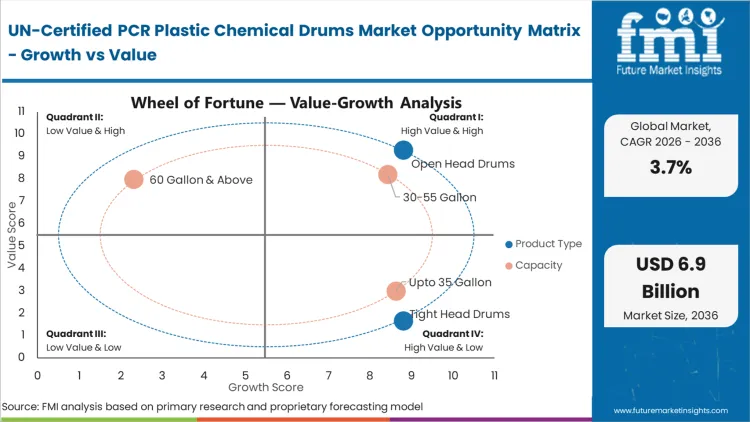
- Open Head Drums: 58.5% share in 2026, driven by high demand for easily accessible containers used in viscous chemical and solid powder transport operations.
- Polyethylene (PE): 48.5% share in 2026, reflecting the massive established recycling infrastructure that provides consistent feedstock for blow molding applications.
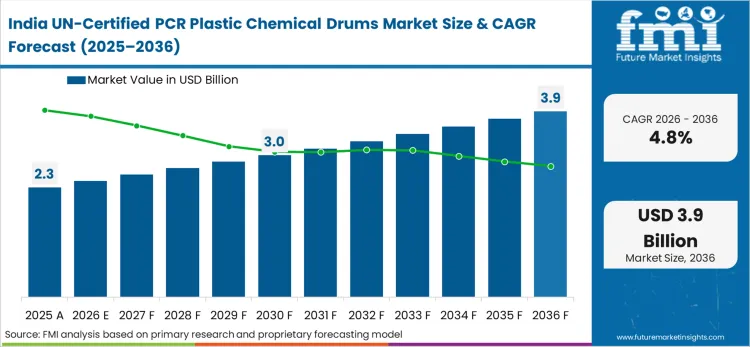
- India: 4.8% CAGR, anchored by rapid expansion in the domestic specialty chemicals sector and a strong push toward formalized industrial waste management.
- Analyst Opinion at FMI:
- Ismail Sutaria, Principal Consultant for Industrial Packaging, opines, "In my analysis, I have observed that the true bottleneck in sustainable packaging adoption is not polymer availability, but the extreme variability in structural performance introduced by inconsistent PCR feedstocks. Facilities attempting to pass severe UN drop tests using standard recycled resins face unavoidable container failures that trigger immediate compliance violations. Packaging engineers who continue relying on basic mechanical recycling methods will find themselves unable to meet the stringent dangerous goods safety margins required by global chemical transport authorities by 2028."
- Strategic Implications / Executive Takeaways:
- Rigid packaging manufacturers must secure consistent, high-purity post-consumer resin supply chains to qualify for impending sustainable vendor contracts from multinational chemical producers.
- Chemical plant logistics directors should phase out virgin plastic dependency and mandate specific recycled content minimums in all new bulk container procurement specifications.
- Polymer scientists must develop specialized additive formulations to restore impact strength and stress-crack resistance to degraded recycled plastics during the extrusion phase.
- Market Research Methodology:
- Primary Research: FMI conducted detailed technical interviews with principal packaging engineers, recycling facility operators, and hazardous goods logistics directors across 40 countries to validate material adoption timelines.
- Desk Research: Analysts aggregated public standards of documentation from UN transport regulatory bodies, corporate sustainability reports, and national plastic taxation frameworks.
- Market-Sizing and Forecasting: The model applies a bottom-up methodology starting with global installed base metrics for rigid industrial containers and projecting the conversion rate to recycled standards.
- Data Validation and Update Cycle: Segment forecasts undergo cross-validation against quarterly resin consumption volumes for sustainable industrial packaging markets.
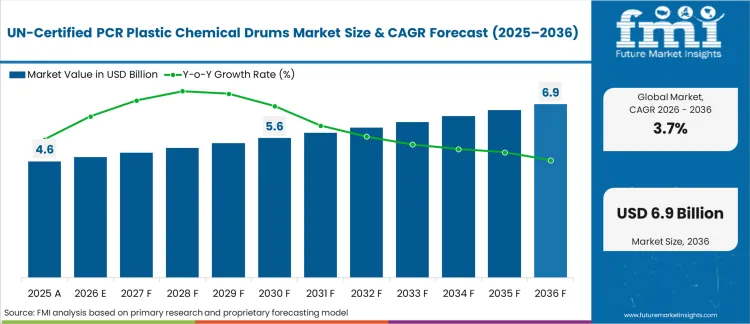
Sustaining growth occurs when regulatory bodies standardize testing criteria for heterogeneous recycled polymer blends. Quality assurance directors must validate structural consistency across varying batches of PCR resin before the 2028 packaging tax deadlines take effect in major industrial jurisdictions. Once closed-loop material recovery networks achieve sufficient scale, the cost penalty associated with certified recycled containers will disappear completely.
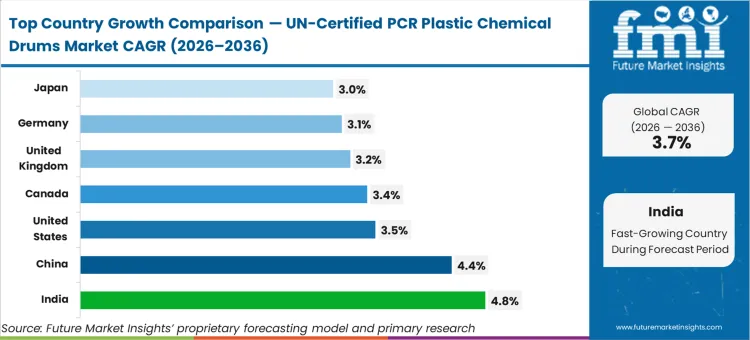
India advances at a 4.8% compound rate driven by aggressive industrial modernization and chemical export growth. China expands at a 4.4% trajectory as national environmental policies force domestic manufacturers to adopt circular economy principles. The United States tracks at 3.5% supported by infrastructure investments and stringent hazardous transport regulations. Canada records a 3.4% rate, followed closely by the United Kingdom at 3.2% and Germany at 3.1%, while Japan grows at a 3.0% pace anchored by precision manufacturing standards. This geographic distribution reflects varying national adoption velocities tied directly to localized extended producer responsibility mandates.
UN-Certified PCR Plastic Chemical Drums Market Definition
The UN-Certified PCR Plastic Chemical Drums market encompasses industrial bulk containers manufactured using post-consumer recycled plastics that meet strict United Nations standards for the safe transportation of hazardous materials. This sector provides rigid packaging solutions designed to withstand extreme physical stress, chemical degradation, and environmental exposure while actively reducing reliance on virgin petrochemical resins.
UN-Certified PCR Plastic Chemical Drums Market Inclusions
The market scope includes open head and tight head plastic drums engineered with specified percentages of recycled high-density polyethylene or polypropylene that hold valid UN marking codes for dangerous goods. Multi-layer rigid industrial packaging formats incorporating PCR core layers sandwiched between virgin contact layers fall within these boundaries. Associated closure mechanisms and specialized internal chemical resistance liners are fully incorporated.
UN-Certified PCR Plastic Chemical Drums Market Exclusions
Standard commercial containers lacking official UN certification for hazardous materials transport are excluded. Intermediate bulk containers, flexible packaging solutions, and traditional steel drums fall outside the defined parameters. Legacy industrial pails manufactured entirely from virgin resin or pre-consumer industrial scrap without verified post-consumer content are explicitly omitted from the valuation.
UN-Certified PCR Plastic Chemical Drums Market Research Methodology
- Primary Research: Analysts engaged with resin science directors, packaging procurement officers, and hazardous materials compliance managers to map the specific decision gates triggering sustainable container adoption.
- Desk Research: The data collection phase aggregated compliance roadmaps from international dangerous goods transport authorities, environmental tax legislative schedules, and major chemical OEM vendor guidelines.
- Market-Sizing and Forecasting: The baseline value derives from a bottom-up aggregation of certified recycled drum shipments, applying region-specific sustainability regulation curves to project future adoption velocity.
- Data Validation and Update Cycle: Projections are rigorously tested against publicly reported capital expenditure guidance from leading polymer molding and industrial packaging conglomerates.
Segmental Analysis
UN-Certified PCR Plastic Chemical Drums Market Analysis by Product Type
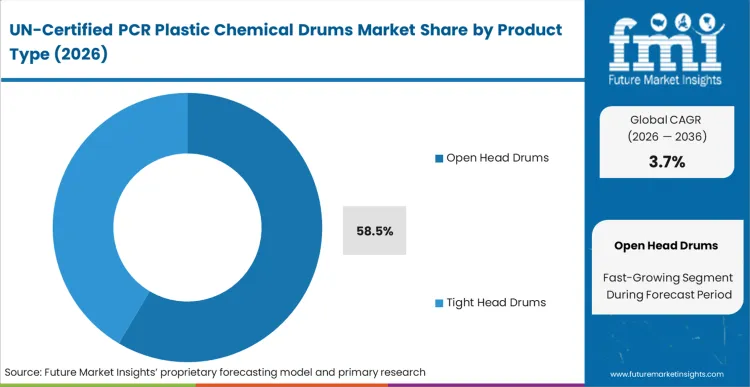
With legacy virgin containers facing escalating regulatory pressure, hazardous transport operators execute full-scale hardware replacement programs. Open Head Drums command a dominant 58.5% share in 2026, reflecting the absolute requirement for accessible rigid packaging in the handling of viscous liquids and industrial powders. Manufacturers deploying these wide-mouth containers establish the foundation for highly efficient filling and dispensing operations. This specific structural design eliminates the need for complex internal agitation equipment during the decanting process. Logistics planners specifying these units streamline their operational workflows and significantly reduce overall terminal processing times. FMI analysts opine that flattening the container geometry directly enables automated robotic filling applications on the factory floor. Packaging engineers unable to supply certified open-head variants risk immediate exclusion from the next wave of greenfield facility tenders. Procurement teams demanding these containers ensure rapid processing speeds for bulk solid chemicals.
- Viscous Handling: The wide aperture design natively handles thick industrial adhesives, shifting the extraction burden away from specialized pumping equipment.
- Automated Filling: Precise opening dimensions allow high-speed robotic dispensing nozzles to execute rapid material transfer sequences without physical interference.
- Sanitation Protocol: Complete interior visibility accelerates thorough cleaning cycles, permitting safe container reuse across multiple product campaigns.
UN-Certified PCR Plastic Chemical Drums Market Analysis by Capacity
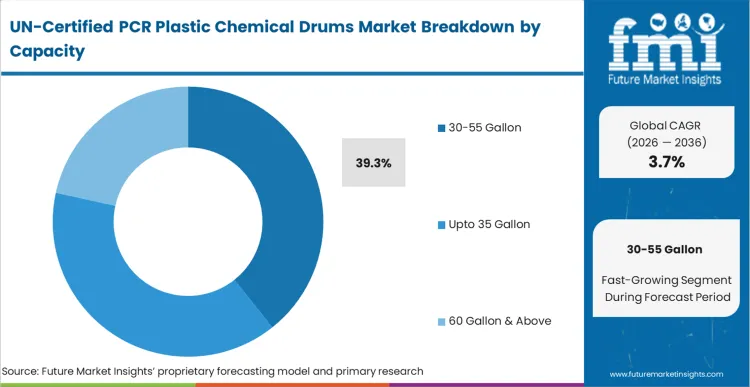
The integration of uniform container sizes across isolated warehouse cells forces facility managers to rethink traditional storage topologies. Incorporating these standardized hazardous chemicals packaging formats guarantees that high-speed automated storage and retrieval commands execute flawlessly. Chemical distributors failing to demonstrate seamless integration with established material handling infrastructure lose priority status in critical vendor upgrade cycles. The 30-55 Gallon segment emerges as the dominant capacity tier, expected to represent 39.3% of total market share in 2026. Modern industrial environments are increasingly built around standardized pallet dimensions, removing the delays and inefficiencies caused by irregular cargo geometries. As per FMI's projection, standardizing on this specific volume metric directly enables seamless intermodal transport across global shipping networks. Supply chain directors must validate exact volumetric efficiencies during route planning to authorize final logistics sign-off.
- Pallet Optimization: Exact dimensional scaling allows four units to fit perfectly on standard chemical pallets, maximizing shipping container volume utilization.
- Handling Standardization: Universal drum grabber attachments lift these specific weights reliably, minimizing the risk of hazardous material drops during forklift transit.
- Inventory Density: Uniform cylindrical profiles permit stable multi-tier stacking inside constrained distribution centers without requiring specialized racking systems.
UN-Certified PCR Plastic Chemical Drums Market Analysis by Material
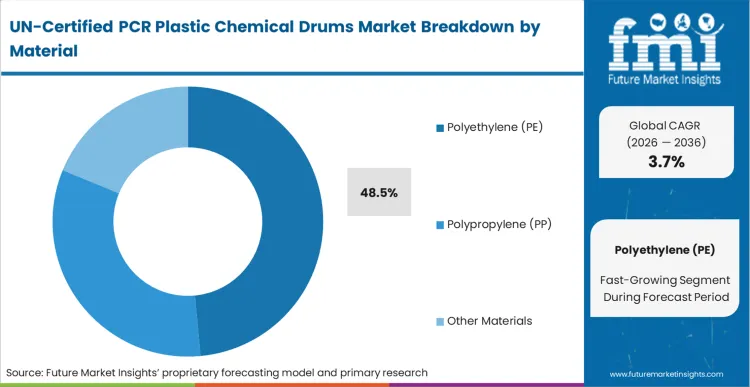
As per FMI's assessment, precise blending of post-consumer high-density polyethylene enables advanced stress-crack resistance when containers face extreme temperature fluctuations. Facilities operating without this foundational material architecture face systemic transport failures as weak polymer chains fracture under pressure. Resin suppliers failing to deliver consistent melt flow indexes in their recycled PE streams forfeit access to premium UN-certified manufacturing contracts. Quality assurance leads evaluating these compounds demand verified molecular weight distributions to guarantee long-term container integrity. High-density polymer networks provide the exact impact resistance necessary for dangerous goods certification. Polyethylene (PE) captures 48.5% of the market share in 2026 by establishing a highly resilient, chemically inert barrier for volatile substances. Material scientists utilizing this specific thermoplastic coordinate complex multilayer extrusion sequences with unprecedented reliability.
- Chemical Resistance: Non-polar molecular structures repel aggressive solvents naturally, protecting the surrounding environment from highly corrosive industrial acids.
- Impact Absorption: Flexible polymer chains distribute kinetic energy effectively during required certification drop tests, preventing catastrophic sidewall ruptures.
- Recycling Circularity: Established collection networks yield massive volumes of clean post-consumer milk jugs and industrial containers to feed new drum production.
UN-Certified PCR Plastic Chemical Drums Market Analysis by End-User
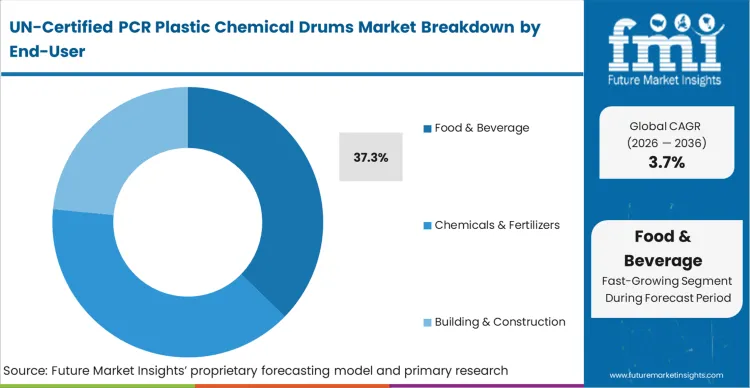
Stringent consumer safety regulations compel downstream buyers to monitor the exact material provenance of their supply chains. Food & Beverage accounts for a leading 37.3% segment share in 2026. Processing engineers operating continuous production facilities reject packaging designs introducing potential chemical migration into the food supply loop. FMI's analysis indicates that the convergence of strict FDA compliance with corporate sustainability targets amplifies the demand for multi-layer containers featuring virgin inner liners and PCR outer shells. Suppliers failing to demonstrate seamless compliance with established food contact material standards lose priority status in critical agricultural supply cycles. Utilizing these specialized PCR plastic packaging solutions protects sensitive flavor concentrates while satisfying aggressive retailer demands for reduced carbon footprints. Quality control directors authorizing these shipments prevent costly contamination events from halting global food distribution networks.
- Contamination Prevention: Co-extruded virgin inner layers block potential impurities found in recycled outer walls from leaching into sensitive consumable syrups.
- Traceability Mandates: Embedded tracking codes allow compliance officers to verify exact resin sourcing paths through complex international supply webs.
- Thermal Stability: Robust wall construction maintains structural integrity during high-temperature sterilization processes required for bulk agricultural concentrates.
UN-Certified PCR Plastic Chemical Drums Market Drivers, Restraints, and Opportunities
The convergence of corporate decarbonization goals and international plastic taxation frameworks forces packaging specification to extract virgin resins directly from the supply chain. This structural requirement renders traditional fossil-fuel-dependent container formats obsolete. Asset owners upgrading bulk logistics networks face a strict binary choice between absorbing heavy regulatory penalties or overhauling their base packaging infrastructure to incorporate sustainable materials. Transitioning to a certified recycled container fleet simplifies compliance reporting and enables direct qualification for green vendor initiatives. Facilities that fail to modernize their core transport layers risk immediate disqualification from multinational chemical supply contracts and reduced overall market access.
The intricate decontamination protocols required to optimize post-consumer resins create steep learning curves for traditional blow-molding engineers. Designing conflict-free material blends across varying scrap sources demands specialized polymer calculus expertise that most packaging facilities lack internally. To mitigate this skill gap, production directors increasingly rely on advanced additive packages that stabilize molecular weights and validate structural integrity before physical UN drop tests occur.
Opportunities in the UN-Certified PCR Plastic Chemical Drums Market
- Advanced Compatibilizer Integration: Specialized polymer additives enable material scientists to blend disparate plastic types smoothly during extrusion. This capability prevents microscopic stress fractures from progressing through the drum sidewall during transport.
- Closed-loop Asset Tracking: Upgraded digital watermarks permit logistics planners to monitor container lifecycles precisely without impacting critical material sorting machinery. This data extraction prevents valuable industrial drums from leaking into generic municipal waste streams.
- Marine-derived Resin Sourcing: Procurement officers integrating ocean-bound plastics require precise material traceability data. Deploying marine waste derived PCR plastics provides the verified sustainability metrics necessary to secure premium pricing contracts from eco-conscious consumer brands.
Regional Analysis
Based on the regional analysis, the UN-Certified PCR Plastic Chemical Drums market is segmented into North America, Latin America, Europe, East Asia, South Asia, Oceania, and Middle East & Africa across 40 plus countries.
.webp "Top Country Growth Comparison Un Certified Pcr Plastic Chemical Drums Market Cagr (2026 2036)")
| Country | CAGR (2026 to 2036) |
|---|---|
| India | 4.8% |
| China | 4.4% |
| United States | 3.5% |
| Canada | 3.4% |
| United Kingdom | 3.2% |
| Germany | 3.1% |
| Japan | 3.0% |
Source: Future Market Insights (FMI) analysis, based on proprietary forecasting model and primary research
Asia Pacific UN-Certified PCR Plastic Chemical Drums Market Analysis
Capital projects directors constructing new specialty chemical and agricultural processing facilities specify unified sustainable container standards in their initial site blueprints. This aggressive modernization strategy directly fuels the demand for high-performance impact modified PCR plastics. By building circular recovery networks directly into the foundation, regional asset owners establish highly flexible logistics environments capable of rapid compliance shifts. Greenfield industrial development across the Asia Pacific region accelerates the bypass of legacy packaging constraints. In FMI's view, this clean-slate approach eliminates the costly and time-consuming transition phase that plagues older manufacturing centers in the West.
- India: Anchoring India's 4.8% CAGR through to 2036 is the severe compliance pressure from a national push toward aggressive manufacturing self-sufficiency, triggering a wave of logistics upgrades that prioritize highly durable, sustainable packaging formats. Suppliers failing to provide certified drums with built-in UV resistance mechanisms face disqualification from major agricultural chemical tenders. India's specialty chemical export sector operates under stringent international shipping frameworks requiring verified structural integrity for all bulk liquid transport operations. Process engineers must deploy rigid containers capable of guaranteeing dangerous goods delivery to global ports without any catastrophic ruptures.
- China: The sheer volume of hazardous export material establishes a massive installed base of certified container infrastructure across the eastern industrial corridor. Procurement officers bypass virgin plastic supplies entirely, specifying native recycled content minimums for all new industrial packaging procurement contracts. As manufacturers unify their sustainable material strategies, China advances at a 4.4% CAGR. National environmental policies in China force domestic resin manufacturers to adopt circular economy principles across their entire production output. Molding facilities lacking documented compliance with rigorous dangerous goods testing standards forfeit access to lucrative state-backed chemical export projects.
- Japan: Every new packaging architecture must validate molecular recycling compatibility before receiving authorization for series production integration. The domestic packaging sector embeds precision sorting markers directly into polymer matrices to maintain global competitive advantage in high-purity recycling. Logistics coordinators relying on unverified scrap streams lose priority status in critical semiconductor chemical supply chains. Japan's highly organized industrial waste management sector enforces strict material recovery protocols through synchronized municipal sorting sequences. As this zero-waste standard becomes the universal baseline, Japan's UN-certified drum demand is rising at a CAGR of 3.0%.
FMI's report includes extensive coverage of the Asia Pacific rigid packaging landscape. It incorporates detailed analysis of Australia, South Korea, Indonesia, and the broader ASEAN region, tracking the localization of chemical production capabilities.
North America UN-Certified PCR Plastic Chemical Drums Market Analysis
Implementing a standardized, certified recycled packaging fleet enables facilities to deploy advanced circular tracking systems without compromising real-time transport safety. Packaging engineers leading critical logistics overhauls face strict directives to unify disparate container formats under a single sustainable architecture. Strict environmental, social, and governance mandates across North America target the systematic eradication of single-use virgin plastics in industrial settings. FMI's research confirms that the agricultural and pharmaceutical sectors actively drive this consolidation to secure their supply chains against mounting extended producer responsibility fees.
- United States: Federal infrastructure modernization initiatives actively penalize the deployment of vulnerable virgin containers in favor of standardized, resilient PCR formats. The United States tracks at a 3.5% annual expansion rate as discrete manufacturers unify their packaging strategies. Component suppliers lacking documented compliance with rigorous Department of Transportation standards face immediate exclusion from national supply contracts. The United States chemical manufacturing sector enforces strict dangerous goods transport regulations across its entire multi-tier distribution ecosystem. Supply chain directors replacing aging steel drums must deploy robust plastic architectures capable of supporting both real-time acid resistance and verified recycled content quotas.
- Canada: Canada records a 3.4% CAGR trajectory as this regulatory standard proliferates, driven by the national push to eliminate plastic waste that creates a recurring compliance cycle accelerating container hardware replacement. Engineering contractors targeting domestic fertilizer distribution networks must guarantee absolute structural determinism prior to the finalization of procurement budgets. Environmental ministries in Canada dictate stringent validation criteria for recycled content minimums across advanced industrial supply lines. Plant managers must demonstrate flawless execution of internal material recovery flows before receiving authorization to ship hazardous goods domestically.
FMI's report includes comprehensive evaluation of the North American sustainable packaging sector. The analysis encompasses Mexico's rapidly integrating cross-border chemical supply chains and the specific container testing parameters required to navigate varying international jurisdictions.
Europe UN-Certified PCR Plastic Chemical Drums Market Analysis
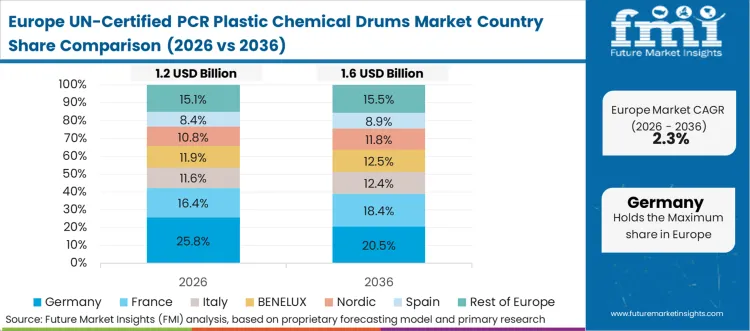
Upgrading the core packaging infrastructure provides the necessary physical resilience and environmental credentials to support advanced sustainable chemistry practices. Logistics architects redesigning legacy chemical supply lines must integrate continuous carbon monitoring data alongside critical hazardous material safety metrics. FMI's analysis indicates that this dual-purpose requirement forces the rapid adoption of high-performance PCR containers to guarantee transport stability while eliminating heavy plastic taxation liabilities. European industrial policy actively penalizes the continued operation of carbon-intensive and virgin-plastic-dependent manufacturing facilities.
- United Kingdom: The shift toward formalized extended producer responsibility forces chemical operators to abandon legacy virgin containers in favor of highly documented, sustainable alternatives. Fleet managers deploying advanced container tracking systems mandate material architectures capable of proving exactly 30% or higher PCR composition across distributed geographic assets. The United Kingdom's aggressive plastic packaging tax framework requires precise recycled content data to avoid significant financial penalties on industrial shipments. Quality assurance leads unable to demonstrate absolute material provenance under severe audit conditions forfeit qualification for national retail supply networks. This critical regulatory transition sustains the UK's 3.2% CAGR for certified drums through the forecast decade.
- Germany: Operations directors mandate zero-defect container architectures to ensure automated robotic transfer systems perform hazardous liquid decanting tasks flawlessly. Germany's advanced chemical engineering sector operates to high-stress handling tolerances that exceed standard industrial packaging specifications by orders of magnitude. Germany registers a 3.1% CAGR as centralized recycling mandates push circular economy integration. The concentration of advanced pharmaceutical and specialty polymer foundries necessitates continuous investment in ultra-durable, sustainable packaging backbones to maximize supply chain efficiency. Hardware suppliers targeting the next major infrastructure upgrade cycle must prove severe UN drop test compliance before entering the approved vendor list.
FMI's report includes thorough investigation of the European industrial packaging framework. A prevailing structural condition across these nations is the mandatory compliance with strict chemical safety directives, forcing asset owners to specify intelligent containers that can reliably transport aggressive solvents alongside standard operational data.
Competitive Aligners for Market Players
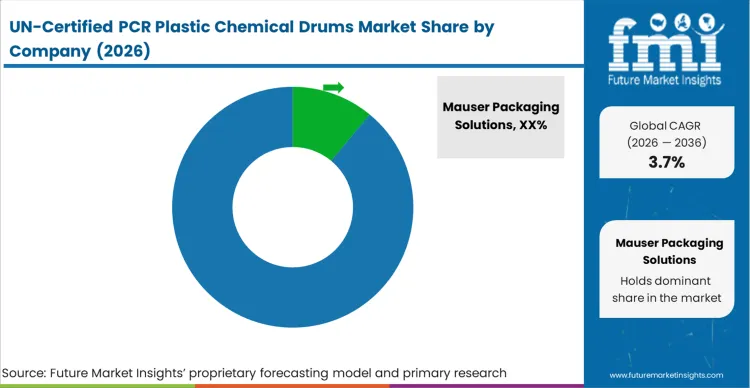
The introduction of standardized testing profiles for recycled resins under international dangerous goods protocols is reshaping how industrial buyers evaluate hazardous chemical packaging. Instead of accepting generic virgin containers, procurement teams now demand certified, highly documented PCR drums in all new tenders. This shift has raised the performance bar across the industry, meaning vendors that continue to rely on unregulated scrap streams risk being excluded from major modernization programs. Industry leaders have already begun adapting by establishing captive recycling facilities to secure consistent feedstock quality. As a result, packaging suppliers are now pushed to integrate sophisticated polymer purification systems directly into their manufacturing footprints instead of relying on external third-party scrap brokers.
Vendors embedding proprietary stress-crack resistant additives directly into their post-consumer resin blends gain a significant structural advantage. Companies like Mauser Packaging Solutions and Greif Inc, which increasingly utilize multi-layer co-extrusion technologies at the plant level, help reduce catastrophic failure rates during transport and shrink the overall carbon footprint of chemical logistics. This vertical integration approach accelerates the transition from linear to circular supply chains, allowing packaging architects and project leads to prioritize partners that avoid the structural variability associated with open-market recycled plastics. In contrast, container manufacturers slow to adopt advanced industrial bulk chemical packaging technologies risk losing position during early-stage vendor shortlisting.
Growth of closed-loop container recovery programs is disrupting long-established market strongholds. With more industrial packaging fleets becoming highly trackable and reusable, supply chain directors designing sustainable transport architectures can now secure consistent material returns, whether dealing with massive agricultural cooperatives or specialized pharmaceutical networks, without worrying about severe plastic taxation penalties. This expanded flexibility empowers facility owners to optimize logistics networks for carbon efficiency and physical reliability instead of being constrained by volatile virgin petrochemical pricing. The competitive structure over the forecast period will distinctly favor vertically integrated players capable of balancing strict UN safety tolerances with aggressive corporate decarbonization metrics.
Key Players in UN-Certified PCR Plastic Chemical Drums Market
- Mauser Packaging Solutions
- Greif Inc
- Schütz GmbH
- Time Technoplast
- Berry Global
- Snyder Industries
- Schutz Container Systems
Scope of the Report
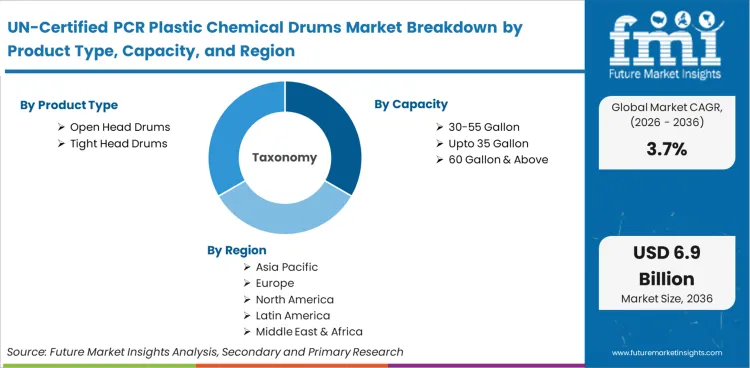
| Metric | Value |
|---|---|
| Quantitative Units | USD 4.8 billion to USD 6.9 billion, at a CAGR of 3.7% |
| Market Definition | The UN-Certified PCR Plastic Chemical Drums market encompasses industrial bulk containers manufactured using post-consumer recycled plastics that meet strict United Nations standards for the safe transportation of hazardous materials. |
| Product Type Segmentation | Open Head Drums, Tight Head Drums |
| Capacity Segmentation | 30-55 Gallon, Upto 35 Gallon, 60 Gallon & Above |
| Material Segmentation | Polyethylene (PE), Polypropylene (PP), Other Materials |
| End-User Segmentation | Food & Beverage, Chemicals & Fertilizers, Building & Construction, Pharmaceuticals |
| Regions Covered | North America, Latin America, Europe, East Asia, South Asia, Oceania, Middle East & Africa |
| Countries Covered | India, China, United States, Canada, United Kingdom, Germany, Japan, and 40 plus countries |
| Key Companies Profiled | Mauser Packaging Solutions, Greif Inc, Schütz GmbH, Time Technoplast, Berry Global, Snyder Industries, Schutz Container Systems |
| Forecast Period | 2026 to 2036 |
| Approach | The baseline value derives from a bottom-up aggregation of certified recycled drum shipments, applying region-specific sustainability regulation curves to project future adoption velocity. Forecasts undergo cross-validation against quarterly resin consumption volumes. |
Source: Future Market Insights (FMI) analysis, based on proprietary forecasting model and primary research
Segments
Product Type:
- Open Head Drums
- Tight Head Drums
Capacity:
- 30-55 Gallon
- Upto 35 Gallon
- 60 Gallon & Above
Material:
- Polyethylene (PE)
- Polypropylene (PP)
- Other Materials
End-User:
- Food & Beverage
- Chemicals & Fertilizers
- Building & Construction
- Pharmaceuticals
Regions:
- North America
- United States
- Canada
- Mexico
- Latin America
- Brazil
- Argentina
- Rest of Latin America
- Europe
- Germany
- United Kingdom
- France
- Italy
- Rest of Europe
- East Asia
- China
- Japan
- South Korea
- South Asia
- India
- Thailand
- Rest of South Asia
- Oceania
- Australia
- New Zealand
- Middle East & Africa
- South Africa
- Kingdom of Saudi Arabia
- Rest of Middle East & Africa
Bibliography
- USA Department of Transportation. (2025, January). Pipeline and Hazardous Materials Safety Administration guidelines for recycled packaging. PHMSA Directives.
- Association of Plastic Recyclers. (2024, August). Design guide for post-consumer resin integration in industrial applications. APR Standards.
- Reusable Industrial Packaging Association. (2025, February). Compliance manual for UN drop tests utilizing PCR plastics. RIPA Technical Publications.
- International Safe Transit Association. (2024, July). Testing protocols for recycled industrial bulk containers. ISTA Guidelines.
This bibliography is provided for reader reference. The full FMI report contains the complete reference list with primary research documentation.
This Report Addresses
- Market intelligence to support strategic planning across the organized UN‑certified PCR plastic chemical drums ecosystem, including recycled‑content compliance and hazardous goods transport requirements
- Market size estimation and 10‑year demand forecasts from 2026 to 2036, supported by validated supply chain analysis, certification audit reviews, and structured interviews with packaging and logistics stakeholders
- Growth opportunity mapping across product types, material classes, and end‑use industries with emphasis on UN‑rated structural performance, drop‑test compliance, and high‑purity PCR integration
- Segment and regional revenue forecasts covering Open Head and Tight Head Drums across major industrial clusters, shaped by evolving extended producer responsibility and plastic‑tax frameworks
- Competitive strategy assessment including multi‑layer extrusion capabilities, resin purification differentiation, structural‑performance engineering, and certification‑driven market positioning
- Product development tracking including advanced compatibilizers, high‑strength PCR blends, multilayer drum architectures, and additive systems engineered for stress‑crack resistance
- Market access analysis covering chemical and fertilizer distribution networks, food‑grade packaging ecosystems, construction supply routes, and cross‑industry procurement channels requiring UN‑certified PCR drums
- Market report delivery in PDF, Excel, PPT, and interactive dashboard formats for executive planning, procurement optimization, and operational benchmarking
Frequently Asked Questions
How large is the UN-Certified PCR Plastic Chemical Drums in 2026?
Demand for UN-Certified PCR Plastic Chemical Drums in the global market is estimated to be valued at USD 4.8 billion in 2026. Strict environmental mandates force packaging procurement officers to immediately replace virgin plastic containers.
What will the UN-Certified PCR Plastic Chemical Drums be valued at by 2036?
Market size for UN-Certified PCR Plastic Chemical Drums is projected to reach USD 6.9 billion by 2036. The standardization of testing criteria for heterogeneous recycled polymer blends creates a highly defensible growth trajectory.
What CAGR is projected for UN-Certified PCR Plastic Chemical Drums from 2026 to 2036?
Demand for UN-Certified PCR Plastic Chemical Drums is expected to grow at a CAGR of 3.7% between 2026 and 2036. This compound expansion relies entirely on a structural shift driven by severe plastic taxes in major industrial hubs.
Which Product Type is poised to lead global sales by 2026?
Open Head Drums accounts for 58.5% share in 2026 as hazardous transport operators execute full-scale hardware replacement programs to streamline filling operations. This specific structural design eliminates the need for complex internal agitation equipment.
Which Capacity tier dominates the market?
The 30-55 Gallon segment is poised to lead with 39.3% share in 2026. Standardizing on this specific volume metric directly enables seamless intermodal transport across global shipping networks.
What Material holds the largest market share?
Polyethylene (PE) captures 48.5% share in 2026 by establishing a highly resilient barrier for volatile substances. Precise blending of post-consumer high-density polyethylene enables advanced stress-crack resistance during transport.
How significant is the role of Food & Beverage in driving adoption in 2026?
Food & Beverage represents 37.3% of segment share as processing engineers reject packaging designs introducing potential chemical migration into the food supply loop. The convergence of strict FDA compliance with corporate sustainability targets amplifies demand for multi-layer containers.
Which End-User holds the second largest share?
Chemicals & Fertilizers represents the next major adoption sector. Logistics directors must deploy robust plastic architectures capable of supporting both real-time acid resistance and verified recycled content quotas.
What forces packaging specification leads to overhaul their infrastructure?
The convergence of corporate decarbonization goals and international plastic taxation frameworks demands action. This structural requirement renders traditional fossil-fuel-dependent container formats obsolete.
What creates steep learning curves for traditional blow-molding engineers?
The intricate decontamination protocols required to optimize post-consumer resins cause significant friction. Designing conflict-free material blends demands specialized polymer calculus expertise that most packaging facilities lack.
How do specialized polymer additives create market opportunities?
Advanced compatibilizer integration enables material scientists to blend disparate plastic types smoothly during extrusion. This capability prevents microscopic stress fractures from progressing through the drum sidewall.
What drives demand in China?
National environmental policies force domestic resin manufacturers to adopt circular economy principles across their entire production output. Procurement officers bypass virgin plastic supplies entirely, specifying native recycled content minimums.
What policy framework accelerates India's packaging network buildout?
India's specialty chemical export sector operates under stringent international shipping frameworks requiring verified structural integrity. This compliance pressure forces the deployment of highly durable, sustainable packaging formats.
What distinguishes Japan's growth from other Asian markets?
Japan's highly organized industrial waste management sector enforces strict material recovery protocols through synchronized municipal sorting sequences. Every new packaging architecture must validate molecular recycling compatibility before integration.
Why is North America a crucial region for sustainable chemical packaging?
Strict environmental, social, and governance mandates target the systematic eradication of single-use virgin plastics in industrial settings. Supply chain directors actively drive this consolidation to secure networks against mounting extended producer responsibility fees.
What compliance standards are referenced for Germany?
Operations directors mandate zero-defect container architectures to ensure automated robotic transfer systems perform hazardous liquid decanting tasks flawlessly. The concentration of advanced pharmaceutical foundries necessitates continuous investment in ultra-durable packaging.
How does the United Kingdom enforce its material requirements?
The aggressive plastic packaging tax framework requires precise recycled content data to avoid significant financial penalties. Fleet managers must deploy architectures capable of proving exactly 30% or higher PCR composition.
What is the India growth outlook in this report?
India is projected to expand at a CAGR of 4.8% during 2026 to 2036.
What is the China growth outlook in this report?
China is projected to grow at a CAGR of 4.4% during 2026 to 2036.
What is the United States growth outlook in this report?
The United States advances at a 3.5% compound rate over the forecast decade.
What is UN-Certified PCR Plastic Chemical Drums and what is it mainly used for?
It encompasses rigid packaging solutions designed to withstand extreme physical stress while actively reducing reliance on virgin petrochemical resins. It is primarily used to transport hazardous liquids and powders safely.
What does UN-Certified PCR Plastic Chemical Drums mean in this report?
The scope includes open head and tight head plastic drums engineered with specified percentages of recycled polymers that hold valid UN marking codes for dangerous goods.
What is excluded from the scope of this report?
Standard commercial containers lacking official UN certification for hazardous materials transport are explicitly excluded.
What does market forecast mean on this page?
The market forecast represents a model-based projection built on defined sustainability regulation curves and adoption assumptions for strategic planning purposes.
Preview the report firsthand - request a free sample
Get SampleGet the brochure for pricing and purchase details.
Get PDFTable of Content
- Key Takeaways
- Market Size and CAGR
- Top Growth Driver
- Fastest Growing Segment
- Leading Region
- Key Companies
- Emerging Opportunities
- Executive Summary
- Global Market Outlook
- Demand-side Trends
- Supply-side Trends
- Technology Roadmap Analysis
- Analysis and Recommendations
- Analyst Perspective (What is happening? Why now? What should investors know?)
- Key Questions Answered
- How large is the market?
- What is the CAGR?
- What are key trends?
- Which region dominates?
- Who are the leaders?
- Market Overview
- Market Coverage / Taxonomy
- Market Definition / Scope / Limitations
- Research Methodology
- Chapter Orientation
- Analytical Lens and Working Hypotheses
- Market Structure, Signals, and Trend Drivers
- Benchmarking and Cross-market Comparability
- Market Sizing, Forecasting, and Opportunity Mapping
- Research Design and Evidence Framework
- Desk Research Programme (Secondary Evidence)
- Expert Input and Fieldwork (Primary Evidence)
- Tooling, Models, and Reference Databases
- Data Engineering and Model Build
- Quality Assurance and Audit Trail
- Market Background
- Market Dynamics (Drivers, Restraints, Opportunity, Trends)
- Scenario Forecast (Optimistic, Likely, Conservative)
- Impact Analysis
- AI Impact
- Sustainability Impact
- Regulatory Impact
- Technology Impact
- Consumer / Buyer Analysis
- Purchase Drivers
- Adoption Barriers
- Buyer Journey
- Opportunity Map Analysis
- Product Life Cycle Analysis
- Supply Chain Analysis
- Investment Feasibility Matrix
- Value Chain Analysis
- PESTLE and Porter's Analysis
- Regulatory Landscape
- Regional Parent Market Outlook
- Production and Consumption Statistics
- Import and Export Statistics
- Global Market Analysis and Forecast, 2021 to 2036
- Historical Market Size Value (USD Billion) & Volume (Unit) Analysis, 2021 to 2025
- Current and Future Market Size Value (USD Billion) & Volume (Unit) Projections, 2026 to 2036
- Y-o-Y Growth Trend Analysis
- Absolute $ Opportunity Analysis
- Global Market Pricing Analysis, 2021 to 2036
- Global Market Analysis and Forecast, By Product Type, 2021 to 2036
- Introduction / Key Findings
- Historical Market Size Value (USD Billion) & Volume (Unit) Analysis By Product Type, 2021 to 2025
- Current and Future Market Size Value (USD Billion) & Volume (Unit) Analysis and Forecast By Product Type, 2026 to 2036
- Open Head Drums
- Tight Head Drums
- Open Head Drums
- Y-o-Y Growth Trend Analysis By Product Type, 2021 to 2025
- Absolute $ Opportunity Analysis By Product Type, 2026 to 2036
- Global Market Analysis and Forecast, By Capacity, 2021 to 2036
- Introduction / Key Findings
- Historical Market Size Value (USD Billion) & Volume (Unit) Analysis By Capacity, 2021 to 2025
- Current and Future Market Size Value (USD Billion) & Volume (Unit) Analysis and Forecast By Capacity, 2026 to 2036
- 30-55 Gallon
- Upto 35 Gallon
- 60 Gallon & Above
- 30-55 Gallon
- Y-o-Y Growth Trend Analysis By Capacity, 2021 to 2025
- Absolute $ Opportunity Analysis By Capacity, 2026 to 2036
- Global Market Analysis and Forecast, By Material, 2021 to 2036
- Introduction / Key Findings
- Historical Market Size Value (USD Billion) & Volume (Unit) Analysis By Material, 2021 to 2025
- Current and Future Market Size Value (USD Billion) & Volume (Unit) Analysis and Forecast By Material, 2026 to 2036
- Polyethylene (PE)
- Polypropylene (PP)
- Other Materials
- Polyethylene (PE)
- Y-o-Y Growth Trend Analysis By Material, 2021 to 2025
- Absolute $ Opportunity Analysis By Material, 2026 to 2036
- Global Market Analysis and Forecast, By End-User, 2021 to 2036
- Introduction / Key Findings
- Historical Market Size Value (USD Billion) & Volume (Unit) Analysis By End-User, 2021 to 2025
- Current and Future Market Size Value (USD Billion) & Volume (Unit) Analysis and Forecast By End-User, 2026 to 2036
- Food & Beverage
- Chemicals & Fertilizers
- Building & Construction
- Pharmaceuticals
- Food & Beverage
- Y-o-Y Growth Trend Analysis By End-User, 2021 to 2025
- Absolute $ Opportunity Analysis By End-User, 2026 to 2036
- Global Market Analysis and Forecast, By Region, 2021 to 2036
- Introduction
- Historical Market Size Value (USD Billion) & Volume (Unit) Analysis By Region, 2021 to 2025
- Current Market Size Value (USD Billion) & Volume (Unit) Analysis and Forecast By Region, 2026 to 2036
- North America
- Latin America
- Western Europe
- Eastern Europe
- East Asia
- South Asia and Pacific
- Middle East & Africa
- Market Attractiveness Analysis By Region
- North America Market Analysis and Forecast, By Country, 2021 to 2036
- Historical Market Size Value (USD Billion) & Volume (Unit) Trend Analysis By Market Taxonomy, 2021 to 2025
- Market Size Value (USD Billion) & Volume (Unit) Forecast By Market Taxonomy, 2026 to 2036
- By Country
- USA
- Canada
- Mexico
- By Product Type
- By Capacity
- By Material
- By End-User
- By Country
- Market Attractiveness Analysis
- By Country
- By Product Type
- By Capacity
- By Material
- By End-User
- Key Takeaways
- Latin America Market Analysis and Forecast, By Country
- Historical Market Size Value (USD Billion) & Volume (Unit) Trend Analysis By Market Taxonomy, 2021 to 2025
- Market Size Value (USD Billion) & Volume (Unit) Forecast By Market Taxonomy, 2026 to 2036
- By Country
- Brazil
- Chile
- Rest of Latin America
- By Product Type
- By Capacity
- By Material
- By End-User
- By Country
- Market Attractiveness Analysis
- By Country
- By Product Type
- By Capacity
- By Material
- By End-User
- Key Takeaways
- Western Europe Market Analysis and Forecast, By Country
- Historical Market Size Value (USD Billion) & Volume (Unit) Trend Analysis By Market Taxonomy, 2021 to 2025
- Market Size Value (USD Billion) & Volume (Unit) Forecast By Market Taxonomy, 2026 to 2036
- By Country
- Germany
- UK
- Italy
- Spain
- France
- Nordic
- BENELUX
- Rest of Western Europe
- By Product Type
- By Capacity
- By Material
- By End-User
- By Country
- Market Attractiveness Analysis
- By Country
- By Product Type
- By Capacity
- By Material
- By End-User
- Key Takeaways
- Eastern Europe Market Analysis and Forecast, By Country
- Historical Market Size Value (USD Billion) & Volume (Unit) Trend Analysis By Market Taxonomy, 2021 to 2025
- Market Size Value (USD Billion) & Volume (Unit) Forecast By Market Taxonomy, 2026 to 2036
- By Country
- Russia
- Poland
- Hungary
- Balkan & Baltic
- Rest of Eastern Europe
- By Product Type
- By Capacity
- By Material
- By End-User
- By Country
- Market Attractiveness Analysis
- By Country
- By Product Type
- By Capacity
- By Material
- By End-User
- Key Takeaways
- East Asia Market Analysis and Forecast, By Country
- Historical Market Size Value (USD Billion) & Volume (Unit) Trend Analysis By Market Taxonomy, 2021 to 2025
- Market Size Value (USD Billion) & Volume (Unit) Forecast By Market Taxonomy, 2026 to 2036
- By Country
- China
- Japan
- South Korea
- By Product Type
- By Capacity
- By Material
- By End-User
- By Country
- Market Attractiveness Analysis
- By Country
- By Product Type
- By Capacity
- By Material
- By End-User
- Key Takeaways
- South Asia and Pacific Market Analysis and Forecast, By Country
- Historical Market Size Value (USD Billion) & Volume (Unit) Trend Analysis By Market Taxonomy, 2021 to 2025
- Market Size Value (USD Billion) & Volume (Unit) Forecast By Market Taxonomy, 2026 to 2036
- By Country
- India
- ASEAN
- Australia & New Zealand
- Rest of South Asia and Pacific
- By Product Type
- By Capacity
- By Material
- By End-User
- By Country
- Market Attractiveness Analysis
- By Country
- By Product Type
- By Capacity
- By Material
- By End-User
- Key Takeaways
- Middle East & Africa Market Analysis and Forecast, By Country
- Historical Market Size Value (USD Billion) & Volume (Unit) Trend Analysis By Market Taxonomy, 2021 to 2025
- Market Size Value (USD Billion) & Volume (Unit) Forecast By Market Taxonomy, 2026 to 2036
- By Country
- Kingdom of Saudi Arabia
- Other GCC Countries
- Türkiye
- South Africa
- Other African Union
- Rest of Middle East & Africa
- By Product Type
- By Capacity
- By Material
- By End-User
- By Country
- Market Attractiveness Analysis
- By Country
- By Product Type
- By Capacity
- By Material
- By End-User
- Key Takeaways
- Key Countries Market Analysis
- USA
- Pricing Analysis
- Market Share Analysis, 2025
- By Product Type
- By Capacity
- By Material
- By End-User
- Canada
- Pricing Analysis
- Market Share Analysis, 2025
- By Product Type
- By Capacity
- By Material
- By End-User
- Mexico
- Pricing Analysis
- Market Share Analysis, 2025
- By Product Type
- By Capacity
- By Material
- By End-User
- Brazil
- Pricing Analysis
- Market Share Analysis, 2025
- By Product Type
- By Capacity
- By Material
- By End-User
- Chile
- Pricing Analysis
- Market Share Analysis, 2025
- By Product Type
- By Capacity
- By Material
- By End-User
- Germany
- Pricing Analysis
- Market Share Analysis, 2025
- By Product Type
- By Capacity
- By Material
- By End-User
- UK
- Pricing Analysis
- Market Share Analysis, 2025
- By Product Type
- By Capacity
- By Material
- By End-User
- Italy
- Pricing Analysis
- Market Share Analysis, 2025
- By Product Type
- By Capacity
- By Material
- By End-User
- Spain
- Pricing Analysis
- Market Share Analysis, 2025
- By Product Type
- By Capacity
- By Material
- By End-User
- France
- Pricing Analysis
- Market Share Analysis, 2025
- By Product Type
- By Capacity
- By Material
- By End-User
- India
- Pricing Analysis
- Market Share Analysis, 2025
- By Product Type
- By Capacity
- By Material
- By End-User
- ASEAN
- Pricing Analysis
- Market Share Analysis, 2025
- By Product Type
- By Capacity
- By Material
- By End-User
- Australia & New Zealand
- Pricing Analysis
- Market Share Analysis, 2025
- By Product Type
- By Capacity
- By Material
- By End-User
- China
- Pricing Analysis
- Market Share Analysis, 2025
- By Product Type
- By Capacity
- By Material
- By End-User
- Japan
- Pricing Analysis
- Market Share Analysis, 2025
- By Product Type
- By Capacity
- By Material
- By End-User
- South Korea
- Pricing Analysis
- Market Share Analysis, 2025
- By Product Type
- By Capacity
- By Material
- By End-User
- Russia
- Pricing Analysis
- Market Share Analysis, 2025
- By Product Type
- By Capacity
- By Material
- By End-User
- Poland
- Pricing Analysis
- Market Share Analysis, 2025
- By Product Type
- By Capacity
- By Material
- By End-User
- Hungary
- Pricing Analysis
- Market Share Analysis, 2025
- By Product Type
- By Capacity
- By Material
- By End-User
- Kingdom of Saudi Arabia
- Pricing Analysis
- Market Share Analysis, 2025
- By Product Type
- By Capacity
- By Material
- By End-User
- Türkiye
- Pricing Analysis
- Market Share Analysis, 2025
- By Product Type
- By Capacity
- By Material
- By End-User
- South Africa
- Pricing Analysis
- Market Share Analysis, 2025
- By Product Type
- By Capacity
- By Material
- By End-User
- USA
- Market Structure Analysis
- Competition Dashboard
- Competition Benchmarking
- Market Share Analysis of Top Players
- By Regional
- By Product Type
- By Capacity
- By Material
- By End-User
- Emerging Startups
- Innovation Benchmarking
- Competition Analysis
- Competition Deep Dive
- Mauser Packaging Solutions
- Overview
- Product Portfolio
- Profitability by Market Segments (Product/Region/Sales Channel)
- Sales Footprint
- Strategy Overview
- Marketing Strategy
- Product Strategy
- Channel Strategy
- Greif Inc
- Schütz GmbH
- Time Technoplast
- Berry Global
- Snyder Industries
- Schutz Container Systems
- Mauser Packaging Solutions
- Case Studies
- Success Stories
- Recent Developments
- Competition Deep Dive
- Assumptions & Acronyms Used


