

- Industry Size (2026)
- USD 58.7 Mn
- Forecast (2036)
- USD 83.4 Mn
- CAGR (2026 to 2036)
- 3.6%
Cottonseed Hulls Outlook in the UK 2026 to 2036
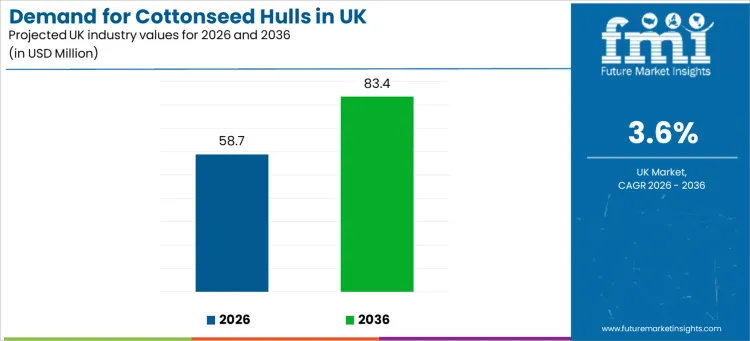
Demand for cottonseed hulls in the UK is projected at USD 58.7 million in 2026 and is expected to reach USD 83.4 million by 2036, expanding at a 3.6% CAGR. Buyers who treat cottonseed hulls as a practical, functional input rather than a commodity filler define demand. They evaluate it through consistent fibre contribution, predictable handling, storage efficiency, and repeatable performance in specialised end uses such as fungal cultivation, animal nutrition, wastewater treatment, and furfural production.
Cottonseed hulls are positioned as a fibrous by-product of cottonseed processing and are commonly used as a feed input for ruminants, sold in bulk or pellet formats. (feedipedia.org) UK demand is shaped by how reliably suppliers can deliver consistent particle structure, low contamination risk, and stable moisture control. Operations teams also look closely at logistics cost because hulls are low-density and transport sensitivity impacts delivered price.
Across high-throughput end users, adoption tends to hold when the material improves practical outcomes such as aeration, moisture retention, structural bulk, and substrate stability. This matters in fungal cultivation where substrate structure influences yield reliability, and in feed channels where physical form affects feeding consistency and mix uniformity.
Quick Stats for Cottonseed Hulls Demand in the UK
- Cottonseed Hulls Valuation in the UK (2026): USD 58.7 million
- Cottonseed Hulls Forecast Valuation in the UK (2036): USD 83.4 million
- Cottonseed Hulls Forecast CAGR 2026 to 2036: 3.6%
- Leading Regional Growth: England (3.9%)
- Leading Form: Bulk (65.4% share)
- Leading End Use: Fungal Cultivation (38.0% share)
- Key Companies Profiled: Mamta Cotton Industries; Pramoda Exim Corporation; Prem International; Shree Ram Proteins Ltd.; SMM TRADERS
Cottonseed Hulls Industry in the UK Key Takeaways
| Metric | Value |
|---|---|
| Industry Value (2026) | USD 58.7 million |
| Industry Forecast Value (2036) | USD 83.4 million |
| Forecast CAGR (2026 to 2036) | 3.6% |
Why is the UK Building Steady Demand for Cottonseed Hulls?
UK demand is supported by two clear purchasing logics. The first is performance-led use in specialist production where physical structure matters. The second is value-led inclusion where fibre and bulk properties are required at a controlled cost.
In animal nutrition, cottonseed hulls are recognised for their fibre contribution, especially for ruminant feeding systems where bulk and roughage support feeding structure. Feed buyers also operate inside defined labelling and marketing rules for feed materials and compound feed. The UK’s Animal Feed (Composition, Marketing and Use) regulations provide the compliance framework used across these decisions.
In fungal cultivation, the use case is built around the substrate’s ability to hold structure and support growth conditions. Research evaluating cottonseed hulls as part of oyster mushroom substrate mixes highlights measurable effects on growth and yield outcomes. This creates consistent demand from operators who prioritise stable substrate behaviour rather than experimenting with frequent material changes.
Some UK procurement teams align sourcing discipline with cottonseed hulls, then coordinate feed-side optimisation programs through animal feed protein ingredients when balancing fibre sources with broader formulation inputs.
How is Cottonseed Hulls Demand Segmented by Form and End Use?
Segmentation in the cottonseed hulls landscape in the UK is shaped by how buyers manage handling efficiency and the performance requirement tied to each use case.
Why does bulk form remain the preferred choice for cost control and handling speed?
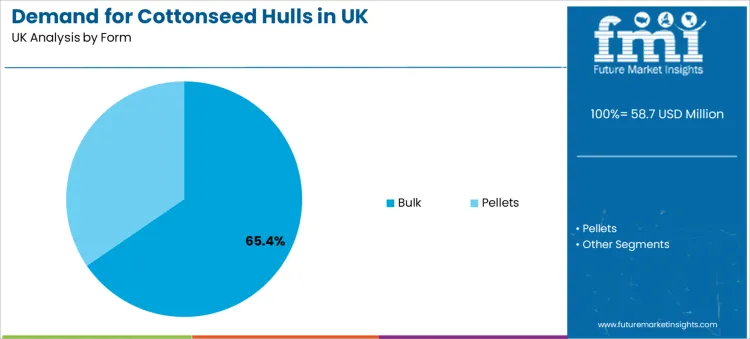
Bulk holds a 65.4% share, making it the dominant form. This reflects purchasing behaviours where operators want straightforward loading, storage, and dosing at scale. Bulk handling also aligns with high-volume operations that can absorb large deliveries and manage stock rotation without frequent packaging waste.
Bulk form is particularly favoured when hulls are used as a structural input rather than a precisely dosed additive. It suits feed channels that prioritise roughage contribution, and it fits substrate blending routines in fungal cultivation where volume throughput matters as much as composition.
Some sourcing teams benchmark bulk-form procurement against fibre-rich by-product planning connected to cottonseed meal, especially when they want a coordinated approach to cotton-derived inputs across multiple buyer groups.
What keeps fungal cultivation as the leading end-use segment in the UK?
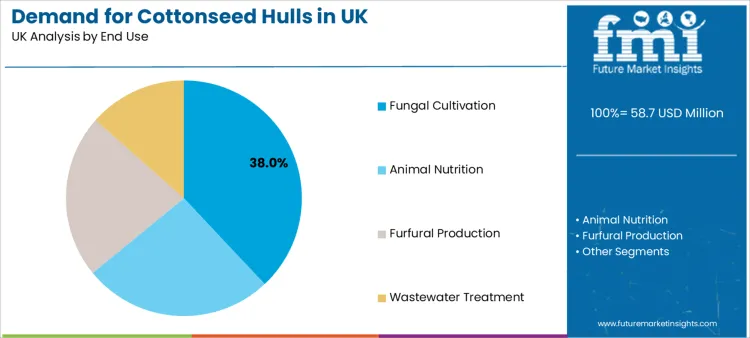
Fungal cultivation accounts for a 38.0% share, making it the largest end-use category. This reflects the role of cottonseed hulls as a substrate component where structure, aeration, and moisture behaviour influence production consistency. Operators prefer inputs that behave predictably across batches, reduce compaction risk, and support stable growth conditions.
Evidence from cultivation studies indicates that cottonseed hulls used as a substrate component can influence yield and nutritional composition outcomes in oyster mushroom production systems. For commercial operators, these performance outcomes translate into a clear procurement rule: substrate inputs must be stable, scalable, and consistent across cycles.
Planning decisions around substrate choices often sit alongside adjacent capability needs tied to controlled-environment outputs for mushroom-based animal feed when cultivation systems extend into downstream valorisation pathways.
How do the remaining end-use segments sustain stable pull-through demand?
- Animal nutrition: Buyers select hulls to improve fibre structure and maintain predictable feeding behaviour, especially for ruminant feeding systems.
- Furfural production: Hulls can be considered as a lignocellulosic feedstock route for bio-based chemical production, aligning with value creation frameworks seen in the furfural outlook.
- Wastewater treatment: Interest here is tied to the material’s adsorption potential and secondary use of spent substrates. Studies highlight dye adsorption performance using spent cottonseed hull substrate after cultivation.
What are the Dynamics, Restraints, Opportunities, and Threats Shaping this Space?
What dynamics are supporting demand stability across the UK?
Demand is supported by cost-sensitive operational needs and repeatable performance in specific end uses. Feed and cultivation buyers tend to maintain steady purchasing once a reliable specification is qualified. Compliance frameworks for feed materials strengthen structured procurement behaviour, particularly where buyers require documentation discipline.
What restraints can slow growth or shift purchasing patterns?
Quality variability is a major restraint. Changes in moisture, particle size distribution, and contamination risk can reduce suitability for fungal substrate mixes or disrupt feed blending consistency. Logistics cost is another restraint because the product’s bulk density affects transport economics.
Where do the most practical opportunities sit for suppliers and processors?
- Specification-controlled bulk supply: Buyers reward suppliers who can hold consistent moisture and particle characteristics at scale.
- Value-add processing: Pelleting and screened grades can support customers who need easier dosing and reduced dust.
- Secondary use optimisation: Spent substrate reuse pathways create additional value opportunities linked to adsorption performance demonstrated in wastewater contexts.
These pathways also align with broader chemical and environmental inputs considered in the water and wastewater treatment chemicals outlook where treatment economics and performance discipline shape adoption.
What threats can disrupt demand expectations?
Substitution risk remains a threat when alternative fibre sources or substrate materials offer lower delivered cost or more stable supply. Regulatory expectations around feed documentation and buyer audit readiness can also shift vendor selection when traceability requirements tighten. Supply chain disruption in cottonseed processing can impact availability and lead buyers to diversify inputs.
How is Cottonseed Hulls Demand Evolving across Key Regions in the UK?
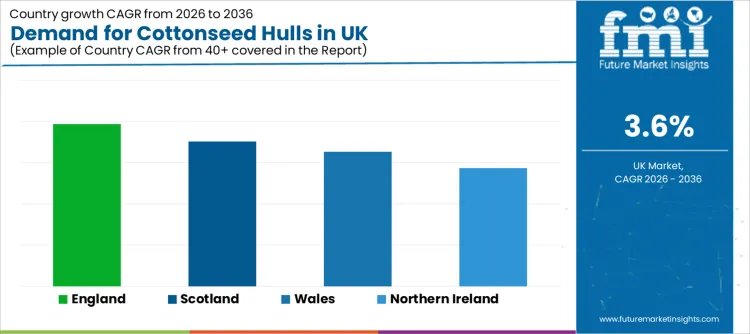
| Region | CAGR 2026 to 2036 |
|---|---|
| England | 3.9% |
| Scotland | 3.5% |
| Wales | 3.3% |
| Northern Ireland | 2.9% |
Why is England leading growth through larger-volume demand clusters and stronger procurement scale?
England grows at 3.9%, supported by the largest concentration of high-volume buyers across feed, processing, and specialised cultivation activity. Demand strengthens where operators prioritise consistent bulk supply and structured vendor management.
How is Scotland sustaining steady uptake through stable specialist demand pockets?
Scotland expands at 3.5%, driven by steady procurement across buyers that value reliability and manageable logistics. Demand holds where suppliers can deliver stable specifications that protect operational outcomes.
What is shaping Wales as buyers prioritise value discipline and practical performance fit?
Wales grows at 3.3%, shaped by purchasing decisions that emphasise cost control, predictable handling, and performance in targeted end uses. Adoption stays stable when the material improves output consistency without requiring process changes.
Why is Northern Ireland progressing through smaller-scale demand and selective supplier qualification?
Northern Ireland rises at 2.9%, reflecting more measured procurement and selective qualification cycles. Buyers expand purchases once supply stability and material consistency are proven.
What Defines the Competitive Landscape for Cottonseed Hulls in the UK?
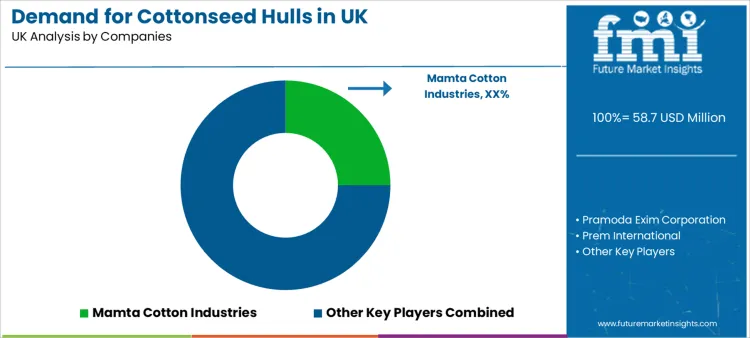
Competition is shaped by supply continuity, physical specification control, and the ability to support end-use requirements with reliable documentation. Buyers assess vendors on consistency of bulk deliveries, dust management, moisture stability, and contamination control. For fungal cultivation operators, substrate stability becomes the core decision factor. For feed buyers, predictable fibre contribution and reliable blending behaviour remain central.
Mamta Cotton Industries, Pramoda Exim Corporation, Prem International, Shree Ram Proteins Ltd., and SMM TRADERS compete through supply availability and the ability to serve buyer needs across varying volumes. Supplier differentiation improves when vendors support packaging options, deliver consistent product specs, and reduce downtime risk linked to material variability.
Key Industry Participants
- Mamta Cotton Industries
- Pramoda Exim Corporation
- Prem International
- Shree Ram Proteins Ltd.
- SMM TRADERS
Scope of Report
| Items | Values |
|---|---|
| Quantitative Units | USD Million |
| Form | Bulk; Pellets |
| End Use | Fungal Cultivation; Animal Nutrition; Furfural Production; Wastewater Treatment |
| Regions Covered | England; Scotland; Wales; Northern Ireland |
| Key Companies Profiled | Mamta Cotton Industries; Pramoda Exim Corporation; Prem International; Shree Ram Proteins Ltd.; SMM TRADERS |
Cottonseed Hulls Demand in the UK by Segment
By Form
- Bulk
- Pellets
By End Use
- Fungal Cultivation
- Animal Nutrition
- Furfural Production
- Wastewater Treatment
By Region
- England
- Scotland
- Wales
- Northern Ireland
Bibliography
- European Commission. (2017). Commission Regulation (EU) 2017/1017 amending Regulation (EU) No 68/2013 on the Catalogue of feed materials
- Food and Agriculture Organization of the United Nations. (2013). Cottonseed hulls. Feedipedia.
- Sardar, A., Ali, M. A., & Ahmad, I. (2020). Effect of substrates (cotton stalks and cotton seed hulls) on growth, yield and nutritional composition of oyster mushrooms (Pleurotus ostreatus and Pleurotus florida).
- The Animal Feed (Composition, Marketing and Use) (England) Regulations 2015. (2015). UK Statutory Instruments 2015 No. 255.
- Zou, W., Han, R., Chen, Z., Shi, J., & Hong, M. (2011). Removal of Neutral Red from aqueous solution by adsorption on spent cottonseed hull substrate. Journal of Hazardous Materials.
Frequently Asked Questions
How big is the demand for cottonseed hulls in uk in 2026?
The demand for cottonseed hulls in uk is estimated to be valued at USD 58.7 million in 2026.
What will be the size of cottonseed hulls in uk in 2036?
The market size for the cottonseed hulls in uk is projected to reach USD 83.4 million by 2036.
How much will be the demand for cottonseed hulls in uk growth between 2026 and 2036?
The demand for cottonseed hulls in uk is expected to grow at a 3.6% CAGR between 2026 and 2036.
What are the key product types in the cottonseed hulls in uk?
The key product types in cottonseed hulls in uk are bulk and pellets.
Which end use segment is expected to contribute significant share in the cottonseed hulls in uk in 2026?
In terms of end use, fungal cultivation segment is expected to command 38.0% share in the cottonseed hulls in uk in 2026.
Preview the report firsthand - request a free sample
Get SampleGet the brochure for pricing and purchase details.
Get PDFTable of Content
- Executive Summary
- UK Market Outlook
- Demand-side Trends
- Supply-side Trends
- Technology Roadmap Analysis
- Analysis and Recommendations
- Market Overview
- Market Coverage / Taxonomy
- Market Definition / Scope / Limitations
- Market Background
- Market Dynamics
- Drivers
- Restraints
- Opportunity
- Trends
- Scenario Forecast
- Demand in Optimistic Scenario
- Demand in Likely Scenario
- Demand in Conservative Scenario
- Opportunity Map Analysis
- Product Life Cycle Analysis
- Supply Chain Analysis
- Investment Feasibility Matrix
- Value Chain Analysis
- PESTLE and Porter’s Analysis
- Regulatory Landscape
- Regional Parent Market Outlook
- Production and Consumption Statistics
- Import and Export Statistics
- Market Dynamics
- UK Market Analysis 2021 to 2025 and Forecast, 2026 to 2036
- Historical Market Size Value (USD Million) Analysis, 2021 to 2025
- Current and Future Market Size Value (USD Million) Projections, 2026 to 2036
- Y-o-Y Growth Trend Analysis
- Absolute $ Opportunity Analysis
- UK Market Pricing Analysis 2021 to 2025 and Forecast 2026 to 2036
- UK Market Analysis 2021 to 2025 and Forecast 2026 to 2036, By Form
- Introduction / Key Findings
- Historical Market Size Value (USD Million) Analysis By Form , 2021 to 2025
- Current and Future Market Size Value (USD Million) Analysis and Forecast By Form , 2026 to 2036
- Bulk
- Pellets
- Bulk
- Y-o-Y Growth Trend Analysis By Form , 2021 to 2025
- Absolute $ Opportunity Analysis By Form , 2026 to 2036
- UK Market Analysis 2021 to 2025 and Forecast 2026 to 2036, By End Use
- Introduction / Key Findings
- Historical Market Size Value (USD Million) Analysis By End Use, 2021 to 2025
- Current and Future Market Size Value (USD Million) Analysis and Forecast By End Use, 2026 to 2036
- Fungal Cultivation
- Animal Nutrition
- Furfural Production
- Wastewater Treatment
- Fungal Cultivation
- Y-o-Y Growth Trend Analysis By End Use, 2021 to 2025
- Absolute $ Opportunity Analysis By End Use, 2026 to 2036
- Market Structure Analysis
- Competition Dashboard
- Competition Benchmarking
- Market Share Analysis of Top Players
- By Regional
- By Form
- By End Use
- Competition Analysis
- Competition Deep Dive
- Mamta Cotton Industries
- Overview
- Product Portfolio
- Profitability by Market Segments (Product/Age /Sales Channel/Region)
- Sales Footprint
- Strategy Overview
- Marketing Strategy
- Product Strategy
- Channel Strategy
- Pramoda Exim Corporation
- Prem International
- Shree Ram Proteins Ltd.
- SMM TRADERS
- Mamta Cotton Industries
- Competition Deep Dive
- Assumptions & Acronyms Used
- Research Methodology


