

- Industry Size (2026)
- USD 51.86 Mn
- Forecast (2036)
- USD 70.37 Mn
- CAGR (2026 to 2036)
- 3.10%
Demand for Filter Paper in USA Size, Market Forecast and Outlook By FMI
The demand for filter paper in USA was valued at USD 50.30 million in 2025, projected to reach USD 51.86 million in 2026, and is forecast to expand to USD 70.37 million by 2036 at a 3.10% CAGR. Sustained specialty coffee consumption and the growing popularity of pour-over brewing methods among American consumers are maintaining demand for cone and basket filter paper products. Third-wave coffee culture promoting manual brewing techniques and single-origin bean preparation has elevated filter paper from a commodity kitchen consumable to a brewing variable that specialty coffee consumers actively select based on filtration characteristics and flavour impact.
The absolute dollar opportunity of approximately USD 18.51 million over the forecast period reflects measured consumption growth driven by specialty coffee segment expansion and the entry of unbleached and oxygen-bleached filter paper variants that command per-unit pricing premiums over standard chlorine-bleached products. Single-serve drip bag coffee filter adoption for workplace and travel brewing is creating an incremental consumption channel that generates filter paper demand outside traditional home brewing applications. Laboratory and industrial filtration applications provide a stable secondary demand base that is insensitive to consumer beverage trend fluctuations.
The West region sets the pace at a 3.6% CAGR, driven by the highest specialty coffee shop density and the strongest pour-over brewing culture among U.S. census regions. The South follows at 3.2% as growing specialty coffee consumption and expanding coffee chain presence generate filter paper procurement. The Northeast maintains 2.9% growth supported by established specialty coffee culture and high per-capita coffee consumption. The Midwest registers 2.5% driven by steady drip coffee consumption patterns and growing specialty coffee awareness.
Summary of Demand for Filter Paper in USA
- Demand for Filter Paper in USA Definition
- Filter paper for USA beverage applications encompasses food-grade cone, basket, V-cone, and drip bag filters in bleached and unbleached cellulose for residential, commercial, and single-serve coffee and beverage preparation.
- Demand Drivers in the Market
- Third-wave coffee culture promoting pour-over manual brewing has elevated filter paper selection from commodity procurement to a brewing variable that specialty consumers choose based on filtration characteristics and flavour impact.
- Unbleached and oxygen-bleached filter paper variants command per-unit premiums over chlorine-bleached products as health-conscious and environmentally aware consumers drive material preference shifts.
- Single-serve drip bag coffee filter adoption for workplace and travel brewing creates an incremental consumption channel generating filter paper demand outside traditional home brewing.
- Key Segments Analyzed in the FMI Report
- Cone by Shape: 52.2% share in 2026, reflecting the pour-over brewing method dominance in specialty coffee consumption where cone-shaped filters deliver the controlled flow rate and extraction profile that manual brewing enthusiasts specify.
- Below 30 GSM by Thickness: 44.0% share in 2026, as lighter-weight filter papers deliver faster flow rates preferred for single-cup pour-over brewing that constitutes the highest-growth preparation method.
- West region: 3.6% compound growth driven by the highest specialty coffee shop density and the strongest pour-over brewing culture among U.S. census regions.
- Analyst Opinion at FMI
- Ismail Sutaria, Principal Analyst, Packaging, at FMI benefits from the premiumization trend in coffee consumption where manual brewing method adoption converts consumers from auto-drip machines using commodity basket filters to pour-over setups requiring specialty cone filters at higher per-unit pricing. Manufacturers who develop filter papers with documented brewing characteristic data, including flow rate, particle retention, and taste neutrality testing, capture the informed specialty consumer segment. The critical competitive risk centers on reusable metal filter adoption, as environmentally motivated consumers switching to permanent filters reduce disposable paper consumption per brewing household.
- Strategic Implications / Executive Takeaways
- Filter paper manufacturers must develop brewing characteristic documentation including flow rate, retention, and taste neutrality data to capture the informed specialty coffee consumer segment that actively selects filters based on performance.
- Grocery retailers must expand specialty filter paper shelf space to accommodate cone, V-cone, and unbleached variants alongside traditional basket filters to serve the premiumizing home coffee preparation market.
- Single-serve drip bag filter manufacturers must develop compostable packaging and filter constructions to address environmental concerns that drive reusable filter substitution among eco-conscious consumers.
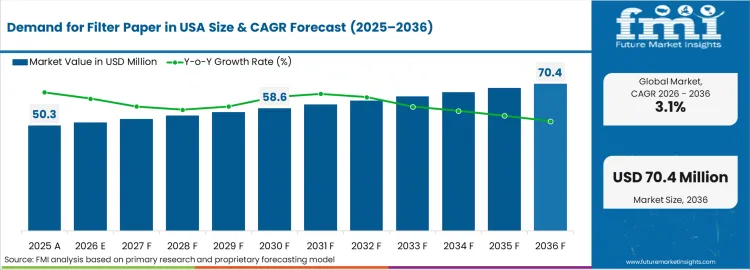
Demand for Filter Paper in USA Key Takeaways
| Metric | Details |
|---|---|
| Industry Size (2026) | USD 51.86 Million |
| Industry Value (2036) | USD 70.37 Million |
| CAGR (2026-2036) | 3.10% |
Source: Future Market Insights, 2026
Demand for Filter Paper in USA Definition
Filter paper for beverage applications encompasses food-grade paper products designed to separate brewed liquid from ground coffee, tea, or other botanical particulates during the brewing process. These products include cone-shaped pour-over filters, flat-bottom basket filters, V-cone drip filters, and single-serve drip bag coffee filters manufactured from bleached or unbleached cellulose fibres at varying thickness grades for residential, commercial, and single-serve beverage preparation applications.
Demand for Filter Paper in USA Inclusions
Market scope includes cone pour-over filter papers, basket-style drip filters, V-cone filters, single-serve drip bag filters, and specialty brewing filter papers. Coverage spans residential home brewing, commercial coffee shop use, workplace single-serve applications, and laboratory filtration across bleached and unbleached paper types.
Demand for Filter Paper in USA Exclusions
Metal mesh reusable coffee filters, cloth brewing filters, espresso machine portafilter accessories, and industrial process filtration papers without food-grade certification are excluded. Coffee brewing equipment and pods/capsules fall outside analytical parameters.
Demand for Filter Paper in USA Research Methodology
- Primary Research: Analysts engaged with specialty coffee roaster equipment procurement managers, grocery retail coffee accessory category buyers, and filter paper manufacturer sales directors to map the consumption triggers for filter paper shape and type selection.
- Desk Research: Data collection phases aggregated specialty coffee consumption statistics, pour-over brewer ownership data, and grocery retail filter paper category sales from major U.S. retail chains.
- Market-Sizing and Forecasting: Baseline values derive from a bottom-up aggregation of filter paper unit consumption multiplied by average per-pack retail prices across shape and paper type categories, applying regional specialty coffee penetration growth curves.
- Data Validation and Update Cycle: Projections are tested against publicly reported food-grade paper product revenues from leading filter paper manufacturers and specialty coffee accessory distributors.
Why is the Demand for Filter Paper in USA Growing?
The demand for filter paper in the USA is rising as laboratories, industrial processing plants, and environmental testing facilities increasingly require high‑quality filtration media. Filter paper is essential for applications such as chemical analysis, air and liquid filtration, quality control in food and beverage production, and environmental monitoring. As regulatory and operational standards tighten, the need for reliable filter paper products continues to expand.
In the industrial sector, manufacturing processes in pharmaceuticals, biotechnology, and electronics depend on filter paper to ensure purity and product integrity. These industries require consistent, high‑performance materials capable of handling complex filtration tasks. As production volumes increase and processes become more sophisticated, demand grows for specialized filter paper grades that meet technical specifications and testing requirements.
Environmental and regulatory drivers also play a significant role. With an increasing number of air‑ and water‑quality monitoring programs, laboratories and agencies rely on filter paper for sampling, diagnostics, and data collection. As awareness of environmental issues grows and enforcement of monitoring intensifies, filters are needed in greater quantities to support ongoing testing efforts.
Advancements in material science and filter‑paper manufacturing are contributing to uptake. Improved pore‑size consistency, greater strength, better chemical resistance and compatibility with automated systems make newer filter papers more effective and versatile. As user’s upgrade equipment and processes, the need for modern filtration media continues to rise, supporting steady growth through 2035.
What is the Segment-Wise Analysis of Demand for Filter Paper in the USA?
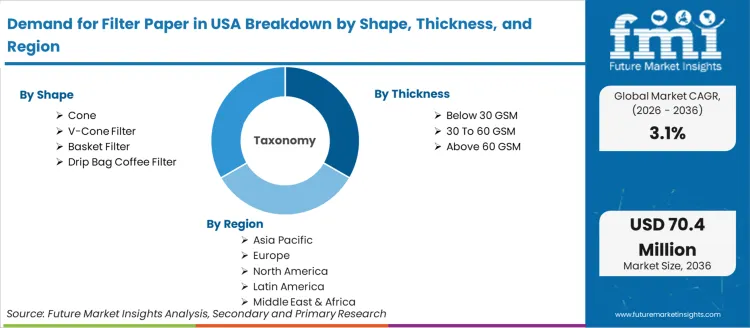
Demand for filter paper in the USA is segmented by paper type, application, shape, and thickness. By paper type, demand is divided into bleached and unbleached, with bleached holding the largest share at 63.6%. The demand is also segmented by application, including alcoholic and non-alcoholic, with alcoholic beverages leading the demand at 56%. In terms of shape, demand is divided into cone, V-cone filter, basket filter, and drip bag coffee filter. Regarding thickness, demand is divided into below 30 GSM, 30 to 60 GSM, and above 60 GSM. Regionally, demand is divided into West USA, South USA, Northeast USA, and Midwest USA.
What Makes Bleached Filter Paper the Leading Choice for Paper Type Demand?
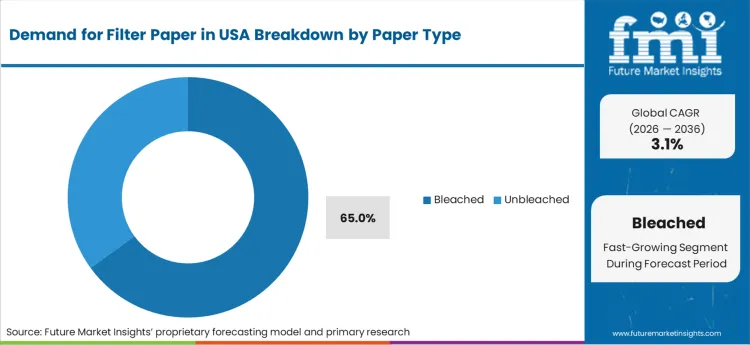
Bleached filter paper accounts for 63.6% of the demand for filter paper in the USA. The bleaching process provides filter paper with superior purity and clarity, which is particularly important in applications where the quality of the final product is highly sensitive, such as in the production of alcoholic beverages and coffee. Bleached paper offers a clean, white appearance, which makes it ideal for use in filtering liquids, as it minimizes any potential contamination or discoloration of the product.
Bleached filter paper is more porous, allowing for better filtration efficiency, which enhances the overall quality of the filtration process. With industries such as food and beverage, pharmaceuticals, and laboratories demanding high-quality filtration solutions, bleached filter paper continues to dominate the industry due to its high performance, consistency, and ability to meet stringent industry standards.
Why Do Alcoholic Beverages Dominate the Application Demand for Filter Paper?
Alcoholic beverages account for 56% of the demand for filter paper in the USA. The filtration process is essential in the production of alcoholic beverages like wine, beer, and spirits, where filter paper is used to remove impurities, clarify liquids, and enhance the final product’s taste and quality. In alcoholic beverage production, filter paper is used to separate solids such as yeast, grains, or fruit pulp, ensuring that the beverage remains clear and free of unwanted particles.
The growing popularity of craft beverages and the need for higher-quality filtration in the alcohol industry have driven the demand for filter paper in this sector. As consumer preferences continue to shift toward premium and artisanal alcoholic drinks, the demand for high-quality filtration solutions, including filter paper, will continue to grow, securing its leading position in the industry.
What are the Key Trends Drivers and Restraints in the Demand for Filter Paper in USA?
Key drivers include increasing use of filter paper in food & beverage (coffee, tea, juice) and laboratory/diagnostic applications, rising demand for high‑purity filtration in pharmaceuticals, growing resource efficiency focus prompting development of recyclable and biodegradable filter papers. Restraints include competition from alternative filtration technologies (membranes, synthetic filters), pressure on raw‑material costs (wood pulp, specialized fibres), and regulatory / certification hurdles for food‑contact or clinical‑grade filter papers.
Why is Demand for Filter Paper Growing in USA?
In USA, demand for filter paper is growing as industries such as beverage manufacturing, particularly coffee and specialty drinks, and laboratories require high-quality filtration papers to ensure clarity, taste, and analytical reliability. The expansion of the lab and pharmaceutical sectors is also boosting the demand for precision filter papers.
The trend toward resource efficiency is encouraging consumers and businesses to seek greener filter-paper options. As end-users become more focused on product purity, reliability, and eco-friendly materials, filter paper usage is increasing across both industrial and consumer-facing applications. This growing emphasis on environmental impact and quality control is further fueling the demand for advanced filter paper solutions.
How are Technological Innovations Driving Growth of Filter Paper in USA?
Technological innovations are advancing the demand for filter paper in USA by enhancing material performance and expanding its applications. Developments include more precise pore structures that improve filtration efficiency, as well as the introduction of biodegradable or plant-based fibers for eco-friendly alternatives. Coatings and treatments that enhance the durability and purity of filter papers are gaining traction, as are custom shapes and formats designed for specialized uses in beverages and laboratories.
These advancements make filter papers more effective, versatile, and aligned with resource efficiency goals, thus encouraging adoption across various industries. As the need for high-performance and eco-conscious products grows, the filter paper industry continues to evolve.
What are the Key Challenges Limiting Adoption of Filter Paper in USA?
Despite strong demand, several challenges limit the adoption of filter paper in USA. One primary issue is cost: premium or eco-friendly filter papers often come with higher prices than basic alternatives, which may deter cost-sensitive consumers. Another challenge is the competition from alternative filtration technologies, such as synthetic membranes, which can outperform traditional filter paper in certain applications.
Supply-chain constraints, including fluctuating costs and availability of raw materials like high-quality fibers, can also impact production. For applications in food and beverage industries, regulatory and food-safety certifications are required, which can slow the process of adoption due to time and cost factors.
What is the Regional Demand Outlook for Filter Paper in USA?
.webp "Top Country Growth Comparison Demand For Filter Paper In Usa Cagr (2026 2036)")
| Region | CAGR (%) |
|---|---|
| West | 3.6 |
| South | 3.2 |
| Northeast | 2.9 |
| Midwest | 2.5 |
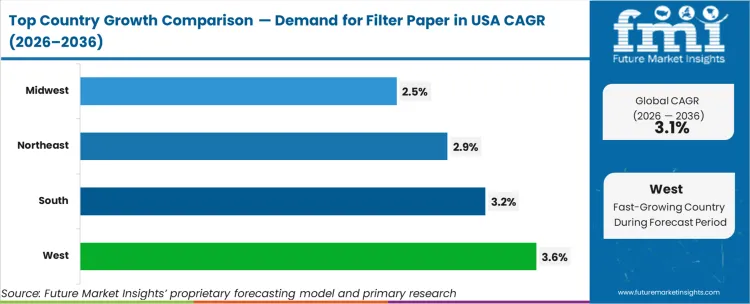
Demand for filter paper in USA is growing across all regions, with the West leading at a 3.6% CAGR. This growth is driven by the region’s expanding industrial sectors and increasing use of filter paper in various applications such as laboratory testing, food processing, and pharmaceuticals. The South follows with a 3.2% CAGR, supported by the region’s robust manufacturing industry and growing need for filtration solutions in diverse sectors. The Northeast shows a 2.9% CAGR, with demand driven by its high concentration of research institutions and laboratories. The Midwest experiences moderate growth at 2.5%, with steady demand from industrial applications, including water treatment and manufacturing processes.
What is Driving Demand for Filter Paper in the West of USA?
The West is experiencing the highest demand for filter paper in USA, with a 3.6% CAGR. This growth is primarily driven by the region’s expanding industrial sectors, particularly in areas like biotechnology, pharmaceuticals, and environmental testing. Cities like Los Angeles, San Francisco, and Seattle are hubs for these industries, where filter paper is increasingly used for a range of applications, from laboratory analysis to water filtration systems. As industrial processes grow more complex, the demand for high-quality, precise filtration solutions has risen.
The West's focus on research and development in environmental and scientific sectors contributes to the demand for filter paper. For example, water treatment facilities, pharmaceutical manufacturers, and food processing companies are increasingly adopting filter paper to meet quality and safety standards. With a strong emphasis on resource efficiency, the West is also driving the demand for eco-friendly filter papers, which align with broader trends toward environmentally conscious industrial practices. As the region continues to innovate in science, healthcare, and manufacturing, the need for filtration solutions like filter paper will remain strong.
How is Demand for Filter Paper Growing in the South of USA?
The South is seeing strong demand for filter paper in USA, with a 3.2% CAGR. This growth is largely driven by the region’s diverse industrial landscape, which includes manufacturing, food processing, and agriculture. As industries in the South continue to grow and modernize, the need for filtration solutions has increased. Filter paper is widely used in these sectors for tasks such as product testing, quality control, and environmental monitoring. States like Texas, Georgia, and Florida are seeing increased investments in manufacturing and chemical processing, which in turn fuels the demand for filtration products.
The growing awareness of environmental concerns has led many businesses in the South to invest in cleaner, more efficient filtration systems, driving up demand for high-quality filter paper. The agricultural industry, a key driver in the South, also utilizes filter paper for various purposes, such as soil and water testing. As the South continues to expand its industrial base, the demand for filter paper is expected to remain robust, particularly in sectors that require rigorous quality control and compliance with environmental standards.
What is Driving Demand for Filter Paper in the Northeast of USA?
The Northeast is experiencing steady demand for filter paper in USA, with a 2.9% CAGR. This growth is driven by the region’s concentration of research institutions, universities, and healthcare facilities, which rely heavily on filter paper for laboratory work and various industrial applications. Cities like New York, Boston, and Philadelphia are centers for academic research, pharmaceuticals, and biotechnology, where filter paper plays an essential role in scientific testing, environmental analysis, and product development.
The Northeast’s well-established pharmaceutical and healthcare sectors further drive the demand for high-quality filter paper, particularly for clinical and laboratory use. The region’s focus on resource efficiency and environmental protection has increased the demand for eco-friendly and efficient filtration solutions. The rise in consumer and industrial awareness of environmental issues has led to greater adoption of filtration technologies that utilize biodegradable or recyclable filter paper. As these sectors continue to innovate and evolve, the demand for filter paper in the Northeast will remain strong, supported by ongoing advancements in research and development and environmental awareness.
How is Demand for Filter Paper Growing in the Midwest of USA?
The Midwest is experiencing moderate demand for filter paper in USA, with a 2.5% CAGR. The growth in this region is largely driven by its strong industrial base, particularly in sectors such as manufacturing, agriculture, and water treatment. The Midwest’s heavy reliance on industrial processes and agricultural operations has contributed to steady demand for filter paper for a variety of applications, including product filtration, water testing, and environmental monitoring. States like Illinois, Michigan, and Ohio are central to manufacturing industries where filter paper is essential for ensuring product purity and quality.
The demand for filter paper in the Midwest is also supported by the region’s expanding focus on environmental resource efficiency, with businesses increasingly looking for solutions that reduce waste and improve efficiency. The region’s commitment to improving water quality and addressing environmental concerns has led to greater use of filter paper in water treatment and filtration systems. As industries continue to grow and modernize, the demand for high-performance filter paper in the Midwest is expected to rise, though at a more moderate pace compared to other regions.
What is the Competitive Landscape of USA Demand for Filter Paper?
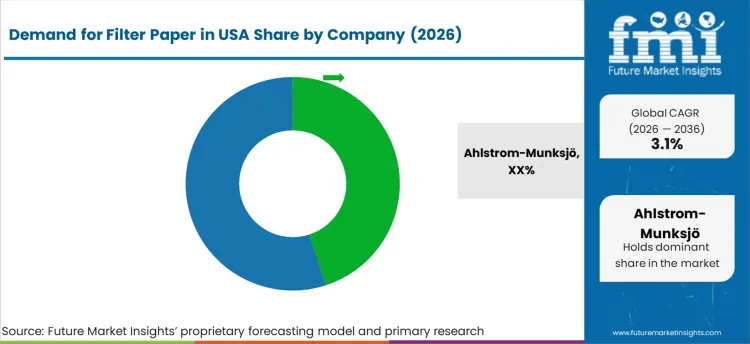
In the USA, demand for filter paper is driven by strong requirements in industries such as food & beverage, pharmaceuticals, chemical processing, and laboratory analytics. These filter papers are used for tasks like clarifying liquids, removing fine particulates, preparing samples, and supporting compliance with stringent quality standards. As advanced manufacturing, research activity, and regulatory demands grow, the role of high‑performance filter paper becomes increasingly important.
Key suppliers in this landscape include Ahlstrom‑Munksjö with a 45.5% share, Azumi Co Ltd, Hollingsworth & Vose, Thermo Fisher Scientific Inc., and Merck KGaA. These companies differentiate through their material science capabilities, multiple grades of pore size and filtration performance, global distribution networks and service to end‑users requiring validated processes. The dominance of Ahlstrom‑Munksjö reflects its scale and established infrastructure in the USA industry.
The competitive dynamics are influenced by several factors. First, innovation in performance such as higher retention, lower extractables, faster flow and chemical compatibility serves as a key differentiator. Second, regulatory obligations in sectors like pharma and food drive demand for certified papers, instrument compatibility and vendor reliability. Third, cost pressures and competition from alternative filtration technologies (e.g., membrane filters) represent ongoing challenges. Suppliers that combine technical excellence, supply‑chain responsiveness and cost‑effectiveness are best positioned to capture the growing demand for filter paper in the USA.
Key Players in USA Filter Paper Demand
- Ahlstrom-Munksjö
- Azumi Co Ltd
- Hollingsworth & Vose
- Thermo Fisher Scientific Inc.
- Merck KGaA
Scope of the Report
| Metric | Value |
|---|---|
| Quantitative Units | USD 51.86 Million to USD 70.37 Million, at a CAGR of 3.10% |
| Market Definition | Filter paper for USA beverage applications encompasses food-grade cone, basket, V-cone, and drip bag filters in bleached and unbleached cellulose for residential, commercial, and single-serve coffee and beverage preparation. |
| Segmentation | Shape: Cone, V-Cone Filter, Basket Filter, and Drip Bag Coffee Filter; Thickness: Below 30 GSM, 30 To 60 GSM, and Above 60 GSM; Paper Type: Bleached and Unbleached; Application: Non-alcoholic and Alcoholic |
| Regions Covered | West, South, Northeast, Midwest |
| Countries/Regions Covered | West, South, Northeast, Midwest |
| Key Companies Profiled | Ahlstrom-Munksjo, Azumi Co Ltd, Hollingsworth & Vose, Thermo Fisher Scientific Inc. |
| Forecast Period | 2026 to 2036 |
| Approach | Forecasting models apply a bottom-up methodology starting with installed base metrics and projecting conversion rates to technology adoption. |
USA Filter Paper Demand by Key Segments
Shape:
- Cone
- V-Cone Filter
- Basket Filter
- Drip Bag Coffee Filter
Thickness:
- Below 30 GSM
- 30 To 60 GSM
- Above 60 GSM
Paper Type:
- Bleached
- Unbleached
Application:
- Alcoholic
- Non-alcoholic
Region:
- West USA
- South USA
- Northeast USA
- Midwest USA
Bibliography
- National Coffee Association USA. (2024). National Coffee Data Trends: Annual Consumption and Brewing Method Survey. NCA.
- Specialty Coffee Association. (2024). U.S. Specialty Coffee Consumption Trends: Annual Market Report. SCA.
- USA Food and Drug Administration. (2024). Food Contact Notification: Filter Paper Material Safety Requirements. FDA.
- USA Census Bureau. (2024). Annual Retail Trade Survey: Coffee and Tea Accessories Category Revenue. Census Bureau.
- Forest Stewardship Council. (2024). FSC Certified Paper Products: U.S. Market Volume and Growth Report. FSC.
- American Forest & Paper Association. (2024). Specialty Paper Production Statistics: Food-Grade Filter Paper Category. AF&PA.
This bibliography is provided for reader reference. The full FMI report contains the complete reference list with primary research documentation.
This Report Addresses
- Market sizing and quantitative forecast metrics detailing filter paper unit consumption and revenues across shape, thickness, paper type, and application categories through 2036.
- Segmentation analysis mapping the premiumization from commodity basket filters to specialty cone and V-cone formats driven by pour-over brewing adoption.
- Regional deployment intelligence comparing specialty coffee-driven demand in the West against traditional drip brewing consumption patterns in the Midwest and South.
- Regulatory compliance assessment analyzing FDA food contact material standards and FSC certification requirements affecting filter paper specification.
- Competitive posture evaluation tracking branded specialty filter paper manufacturers against private-label grocery retail competitors.
- Capital project strategic guidance defining the brewing characteristic testing and certification requirements for filter paper manufacturers targeting specialty coffee channels.
- Supply chain vulnerability analysis identifying cellulose pulp availability constraints and reusable filter substitution risks.
- Custom data delivery formats encompassing interactive dashboards, raw Excel datasets, and comprehensive PDF narrative reports.
Frequently Asked Questions
How large is the demand for Filter Paper in USA in 2026?
Demand is estimated to be valued at USD 51.86 million in 2026.
What will be the market size by 2036?
Market size is projected to reach USD 70.37 million by 2036.
What is the expected CAGR between 2026 and 2036?
Demand is expected to grow at a CAGR of 3.10% between 2026 and 2036.
Which Shape is poised to lead sales by 2026?
Cone accounts for 52.2% share driven by pour-over brewing dominance in specialty coffee consumption.
How is Bleached paper positioned in 2026?
Bleached represents 65.0% share as the established standard for consumer coffee filter paper across retail channels.
What is driving demand in the West region?
Highest specialty coffee shop density and strongest pour-over culture fuel the fastest growth at 3.6% CAGR through 2036.
What is included in the scope of this report?
The market covers cone, basket, V-cone, and drip bag filters in bleached and unbleached grades for residential, commercial, and single-serve applications.
What is excluded from the scope of this report?
Metal mesh filters, cloth filters, espresso accessories, industrial filtration papers, coffee equipment, and pods/capsules are excluded.
Preview the report firsthand - request a free sample
Get SampleGet the brochure for pricing and purchase details.
Get PDFTable of Content
- Executive Summary
- Global Market Outlook
- Demand-side Trends
- Supply-side Trends
- Technology Roadmap Analysis
- Analysis and Recommendations
- Market Overview
- Market Coverage / Taxonomy
- Market Definition / Scope / Limitations
- Research Methodology
- Chapter Orientation
- Analytical Lens and Working Hypotheses
- Market Structure, Signals, and Trend Drivers
- Benchmarking and Cross-market Comparability
- Market Sizing, Forecasting, and Opportunity Mapping
- Research Design and Evidence Framework
- Desk Research Programme (Secondary Evidence)
- Company Annual and Sustainability Reports
- Peer-reviewed Journals and Academic Literature
- Corporate Websites, Product Literature, and Technical Notes
- Earnings Decks and Investor Briefings
- Statutory Filings and Regulatory Disclosures
- Technical White Papers and Standards Notes
- Trade Journals, Industry Magazines, and Analyst Briefs
- Conference Proceedings, Webinars, and Seminar Materials
- Government Statistics Portals and Public Data Releases
- Press Releases and Reputable Media Coverage
- Specialist Newsletters and Curated Briefings
- Sector Databases and Reference Repositories
- FMI Internal Proprietary Databases and Historical Market Datasets
- Subscription Datasets and Paid Sources
- Social Channels, Communities, and Digital Listening Inputs
- Additional Desk Sources
- Expert Input and Fieldwork (Primary Evidence)
- Primary Modes
- Qualitative Interviews and Expert Elicitation
- Quantitative Surveys and Structured Data Capture
- Blended Approach
- Why Primary Evidence is Used
- Field Techniques
- Interviews
- Surveys
- Focus Groups
- Observational and In-context Research
- Social and Community Interactions
- Stakeholder Universe Engaged
- C-suite Leaders
- Board Members
- Presidents and Vice Presidents
- R&D and Innovation Heads
- Technical Specialists
- Domain Subject-matter Experts
- Scientists
- Physicians and Other Healthcare Professionals
- Governance, Ethics, and Data Stewardship
- Research Ethics
- Data Integrity and Handling
- Primary Modes
- Tooling, Models, and Reference Databases
- Desk Research Programme (Secondary Evidence)
- Data Engineering and Model Build
- Data Acquisition and Ingestion
- Cleaning, Normalisation, and Verification
- Synthesis, Triangulation, and Analysis
- Quality Assurance and Audit Trail
- Market Background
- Market Dynamics
- Drivers
- Restraints
- Opportunity
- Trends
- Scenario Forecast
- Demand in Optimistic Scenario
- Demand in Likely Scenario
- Demand in Conservative Scenario
- Opportunity Map Analysis
- Product Life Cycle Analysis
- Supply Chain Analysis
- Investment Feasibility Matrix
- Value Chain Analysis
- PESTLE and Porter’s Analysis
- Regulatory Landscape
- Regional Parent Market Outlook
- Production and Consumption Statistics
- Import and Export Statistics
- Market Dynamics
- Global Market Analysis 2021 to 2025 and Forecast, 2026 to 2036
- Historical Market Size Value (USD Million) Analysis, 2021 to 2025
- Current and Future Market Size Value (USD Million) Projections, 2026 to 2036
- Y-o-Y Growth Trend Analysis
- Absolute $ Opportunity Analysis
- Global Market Pricing Analysis 2021 to 2025 and Forecast 2026 to 2036
- Global Market Analysis 2021 to 2025 and Forecast 2026 to 2036, By Shape
- Introduction / Key Findings
- Historical Market Size Value (USD Million) Analysis By Shape , 2021 to 2025
- Current and Future Market Size Value (USD Million) Analysis and Forecast By Shape , 2026 to 2036
- Cone
- V-Cone Filter
- Basket Filter
- Drip Bag Coffee Filter
- Cone
- Y-o-Y Growth Trend Analysis By Shape , 2021 to 2025
- Absolute $ Opportunity Analysis By Shape , 2026 to 2036
- Global Market Analysis 2021 to 2025 and Forecast 2026 to 2036, By Thickness
- Introduction / Key Findings
- Historical Market Size Value (USD Million) Analysis By Thickness, 2021 to 2025
- Current and Future Market Size Value (USD Million) Analysis and Forecast By Thickness, 2026 to 2036
- Below 30 GSM
- 30 To 60 GSM
- Above 60 GSM
- Below 30 GSM
- Y-o-Y Growth Trend Analysis By Thickness, 2021 to 2025
- Absolute $ Opportunity Analysis By Thickness, 2026 to 2036
- Global Market Analysis 2021 to 2025 and Forecast 2026 to 2036, By Paper Type
- Introduction / Key Findings
- Historical Market Size Value (USD Million) Analysis By Paper Type, 2021 to 2025
- Current and Future Market Size Value (USD Million) Analysis and Forecast By Paper Type, 2026 to 2036
- Bleached
- Unbleached
- Bleached
- Y-o-Y Growth Trend Analysis By Paper Type, 2021 to 2025
- Absolute $ Opportunity Analysis By Paper Type, 2026 to 2036
- Global Market Analysis 2021 to 2025 and Forecast 2026 to 2036, By Application
- Introduction / Key Findings
- Historical Market Size Value (USD Million) Analysis By Application, 2021 to 2025
- Current and Future Market Size Value (USD Million) Analysis and Forecast By Application, 2026 to 2036
- Non-alcoholic
- Alcoholic
- Non-alcoholic
- Y-o-Y Growth Trend Analysis By Application, 2021 to 2025
- Absolute $ Opportunity Analysis By Application, 2026 to 2036
- Global Market Analysis 2021 to 2025 and Forecast 2026 to 2036, By Region
- Introduction
- Historical Market Size Value (USD Million) Analysis By Region, 2021 to 2025
- Current Market Size Value (USD Million) Analysis and Forecast By Region, 2026 to 2036
- North America
- Latin America
- Western Europe
- Eastern Europe
- East Asia
- South Asia and Pacific
- Middle East & Africa
- Market Attractiveness Analysis By Region
- North America Market Analysis 2021 to 2025 and Forecast 2026 to 2036, By Country
- Historical Market Size Value (USD Million) Trend Analysis By Market Taxonomy, 2021 to 2025
- Market Size Value (USD Million) Forecast By Market Taxonomy, 2026 to 2036
- By Country
- USA
- Canada
- Mexico
- By Shape
- By Thickness
- By Paper Type
- By Application
- By Country
- Market Attractiveness Analysis
- By Country
- By Shape
- By Thickness
- By Paper Type
- By Application
- Key Takeaways
- Latin America Market Analysis 2021 to 2025 and Forecast 2026 to 2036, By Country
- Historical Market Size Value (USD Million) Trend Analysis By Market Taxonomy, 2021 to 2025
- Market Size Value (USD Million) Forecast By Market Taxonomy, 2026 to 2036
- By Country
- Brazil
- Chile
- Rest of Latin America
- By Shape
- By Thickness
- By Paper Type
- By Application
- By Country
- Market Attractiveness Analysis
- By Country
- By Shape
- By Thickness
- By Paper Type
- By Application
- Key Takeaways
- Western Europe Market Analysis 2021 to 2025 and Forecast 2026 to 2036, By Country
- Historical Market Size Value (USD Million) Trend Analysis By Market Taxonomy, 2021 to 2025
- Market Size Value (USD Million) Forecast By Market Taxonomy, 2026 to 2036
- By Country
- Germany
- UK
- Italy
- Spain
- France
- Nordic
- BENELUX
- Rest of Western Europe
- By Shape
- By Thickness
- By Paper Type
- By Application
- By Country
- Market Attractiveness Analysis
- By Country
- By Shape
- By Thickness
- By Paper Type
- By Application
- Key Takeaways
- Eastern Europe Market Analysis 2021 to 2025 and Forecast 2026 to 2036, By Country
- Historical Market Size Value (USD Million) Trend Analysis By Market Taxonomy, 2021 to 2025
- Market Size Value (USD Million) Forecast By Market Taxonomy, 2026 to 2036
- By Country
- Russia
- Poland
- Hungary
- Balkan & Baltic
- Rest of Eastern Europe
- By Shape
- By Thickness
- By Paper Type
- By Application
- By Country
- Market Attractiveness Analysis
- By Country
- By Shape
- By Thickness
- By Paper Type
- By Application
- Key Takeaways
- East Asia Market Analysis 2021 to 2025 and Forecast 2026 to 2036, By Country
- Historical Market Size Value (USD Million) Trend Analysis By Market Taxonomy, 2021 to 2025
- Market Size Value (USD Million) Forecast By Market Taxonomy, 2026 to 2036
- By Country
- China
- Japan
- South Korea
- By Shape
- By Thickness
- By Paper Type
- By Application
- By Country
- Market Attractiveness Analysis
- By Country
- By Shape
- By Thickness
- By Paper Type
- By Application
- Key Takeaways
- South Asia and Pacific Market Analysis 2021 to 2025 and Forecast 2026 to 2036, By Country
- Historical Market Size Value (USD Million) Trend Analysis By Market Taxonomy, 2021 to 2025
- Market Size Value (USD Million) Forecast By Market Taxonomy, 2026 to 2036
- By Country
- India
- ASEAN
- Australia & New Zealand
- Rest of South Asia and Pacific
- By Shape
- By Thickness
- By Paper Type
- By Application
- By Country
- Market Attractiveness Analysis
- By Country
- By Shape
- By Thickness
- By Paper Type
- By Application
- Key Takeaways
- Middle East & Africa Market Analysis 2021 to 2025 and Forecast 2026 to 2036, By Country
- Historical Market Size Value (USD Million) Trend Analysis By Market Taxonomy, 2021 to 2025
- Market Size Value (USD Million) Forecast By Market Taxonomy, 2026 to 2036
- By Country
- Kingdom of Saudi Arabia
- Other GCC Countries
- Turkiye
- South Africa
- Other African Union
- Rest of Middle East & Africa
- By Shape
- By Thickness
- By Paper Type
- By Application
- By Country
- Market Attractiveness Analysis
- By Country
- By Shape
- By Thickness
- By Paper Type
- By Application
- Key Takeaways
- Key Countries Market Analysis
- USA
- Pricing Analysis
- Market Share Analysis, 2025
- By Shape
- By Thickness
- By Paper Type
- By Application
- Canada
- Pricing Analysis
- Market Share Analysis, 2025
- By Shape
- By Thickness
- By Paper Type
- By Application
- Mexico
- Pricing Analysis
- Market Share Analysis, 2025
- By Shape
- By Thickness
- By Paper Type
- By Application
- Brazil
- Pricing Analysis
- Market Share Analysis, 2025
- By Shape
- By Thickness
- By Paper Type
- By Application
- Chile
- Pricing Analysis
- Market Share Analysis, 2025
- By Shape
- By Thickness
- By Paper Type
- By Application
- Germany
- Pricing Analysis
- Market Share Analysis, 2025
- By Shape
- By Thickness
- By Paper Type
- By Application
- UK
- Pricing Analysis
- Market Share Analysis, 2025
- By Shape
- By Thickness
- By Paper Type
- By Application
- Italy
- Pricing Analysis
- Market Share Analysis, 2025
- By Shape
- By Thickness
- By Paper Type
- By Application
- Spain
- Pricing Analysis
- Market Share Analysis, 2025
- By Shape
- By Thickness
- By Paper Type
- By Application
- France
- Pricing Analysis
- Market Share Analysis, 2025
- By Shape
- By Thickness
- By Paper Type
- By Application
- India
- Pricing Analysis
- Market Share Analysis, 2025
- By Shape
- By Thickness
- By Paper Type
- By Application
- ASEAN
- Pricing Analysis
- Market Share Analysis, 2025
- By Shape
- By Thickness
- By Paper Type
- By Application
- Australia & New Zealand
- Pricing Analysis
- Market Share Analysis, 2025
- By Shape
- By Thickness
- By Paper Type
- By Application
- China
- Pricing Analysis
- Market Share Analysis, 2025
- By Shape
- By Thickness
- By Paper Type
- By Application
- Japan
- Pricing Analysis
- Market Share Analysis, 2025
- By Shape
- By Thickness
- By Paper Type
- By Application
- South Korea
- Pricing Analysis
- Market Share Analysis, 2025
- By Shape
- By Thickness
- By Paper Type
- By Application
- Russia
- Pricing Analysis
- Market Share Analysis, 2025
- By Shape
- By Thickness
- By Paper Type
- By Application
- Poland
- Pricing Analysis
- Market Share Analysis, 2025
- By Shape
- By Thickness
- By Paper Type
- By Application
- Hungary
- Pricing Analysis
- Market Share Analysis, 2025
- By Shape
- By Thickness
- By Paper Type
- By Application
- Kingdom of Saudi Arabia
- Pricing Analysis
- Market Share Analysis, 2025
- By Shape
- By Thickness
- By Paper Type
- By Application
- Turkiye
- Pricing Analysis
- Market Share Analysis, 2025
- By Shape
- By Thickness
- By Paper Type
- By Application
- South Africa
- Pricing Analysis
- Market Share Analysis, 2025
- By Shape
- By Thickness
- By Paper Type
- By Application
- USA
- Market Structure Analysis
- Competition Dashboard
- Competition Benchmarking
- Market Share Analysis of Top Players
- By Regional
- By Shape
- By Thickness
- By Paper Type
- By Application
- Competition Analysis
- Competition Deep Dive
- Ahlstrom-Munksjö
- Overview
- Product Portfolio
- Profitability by Market Segments (Product/Age /Sales Channel/Region)
- Sales Footprint
- Strategy Overview
- Marketing Strategy
- Product Strategy
- Channel Strategy
- Azumi Co Ltd
- Hollingsworth & Vose
- Thermo Fisher Scientific Inc.
- Ahlstrom-Munksjö
- Competition Deep Dive
- Assumptions & Acronyms Used


