

- Industry Size (2025)
- USD 13645.6 Mn
- Forecast (2035)
- USD 20900.9 Mn
- CAGR (2025 to 2035)
- 4.4%
USA Fish Meal Market Outlook from 2025 to 2035
The USA Fish Meal Market is projected to reach USD 13,645.6 million in 2025, growing at a CAGR of 4.4% over the next decade to an estimated value of USD 20,900.9 million by 2035.
| Attributes | Values |
|---|---|
| Estimated USA Industry Size in 2025 | USD 13,645.6 million |
| Projected USA Industry Value in 2035 | USD 20,900.9 million |
| Value-based CAGR from 2025 to 2035 | 4.4% |
The driving force for the growth of the market is the rising consumption of high-protein feed in aquaculture, livestock farming, and pet food production.
Fish meal is a central protein supply in aquaculture and animal feed and is a source of essential amino acids, omega-3 fatty acids (EPA and DHA), and very high digestibility. Spurred by advancements in sustainable fisheries and the byproduct utilization of the fish processing plants, the manufacturers are turning to eco-friendly practices of production to follow the guidelines of consumers and regulations.
There is a continuous rise in aquaculture projects in the USA, which invariably leads to an increase in the demand for fish meal-based feed solutions. Moreover, it has become essential for the fish meal to be produced sustainably and traceably because the fishing quotas and environmental laws that are being enforced by the regulatory bodies are becoming more prevalent.
Along with it, the potential of utilizing alternative protein sources and fish processing waste recycling is being realized which is the reason for reduced environmental impact as well as better economic results.
Increased demand for high-protein poultry and livestock feed is cited as a reason for growing fish meal production. The availability of fish meal for application in organic fertilizers and nutraceuticals also favours the expansion of market applications.
On the one hand, however, industrial players still have some pressing issues: volatility in pricing, disruption in the supply chains with all its variants, sustainability, etc.
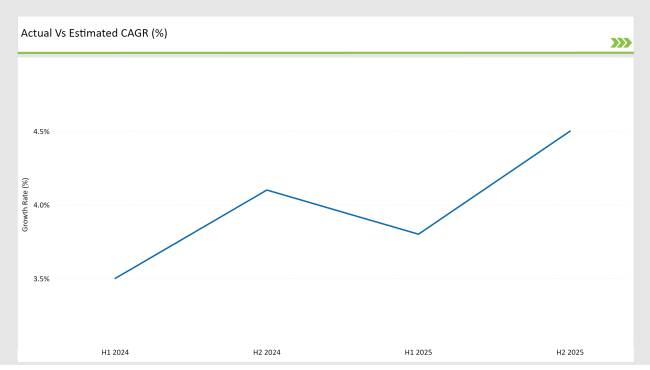
Semi-Annual Market Update for the USA Fish Meal Market
The USA Fish Meal Market is observed to grow steadily attributed to increasing investments in aquaculture feed development and sustainability-based production. Firms are focusing on waste limits, increasing processing efficiency, and creating sources of alternative proteins.
The government backing for sustainable fishing and the protection of ocean species could not only lead to production methods but also drive market stability, which we will see in the industry.
H1 signifies period from January to June, H2 Signifies period from July to December
Recent Developments
| Date | Development/M&A Activity & Details |
|---|---|
| January 24 | Omega Protein Corporation: Launched a new high-protein fish meal blend designed for sustainable aquaculture feed formulations. |
| March 24 | Cargill, Inc.: Expanded its fish meal production capacity in the USA, incorporating advanced fish oil extraction technologies. |
| May 24 | Daybrook Fisheries, Inc.: Partnered with a leading aquaculture company to enhance traceability and sustainability in fish meal sourcing. |
| July 24 | Pacific Seafood Group: Introduced a new fish meal pellet formulation, focusing on improved nutrient absorption in livestock feed. |
| September 24 | Trident Seafoods Corporation: Gained regulatory approval for an innovative fish meal protein hydrolysate, expanding its pet food applications. |
Key Industry Highlights of United States Fish Meal Industry
Sustainable Sourcing and Byproduct Utilization
The fish meal manufacturing industry is predominantly becoming increasingly inclined towards sustainability, thus necessitating the adoption of the byproduct route and green extraction methods. It has become a matter of fact that companies rely more on fish processing waste and bycatch as a source to address the pressure of overfishing and at the same time ensure resource efficiency.
The market participants point to the fact that they are primarily focusing on the production of farmed fish meal and cutting-edge processing methods as a response to the increased fishing quotas and sustainability regulations. The circular economy principle is being acknowledged more and more, which provides companies with the possibility to realize excellent fish waste recycling and reduction of raw material costs while also putting a brake on environmental deterioration.
Technological Developments in Fish Meal Processing
Enterprises are being equipped with high-temperature, low-microbe drying, grinding, and oil extraction machining which are used to boost fish meal quality and nutrient preservation. New techniques such as enzymatic hydrolysis and advanced microfiltration are making protein hydrolysates better for premium aqua feed and pet food formulations.
The trend of shifting to automated processing systems is also a driver of efficient production, waste minimization, and consistent quality in production batches. Moreover, errant use of machinery powered with artificial intelligence that governs quality control systems has gone far beyond the ordinary, for example, aiding companies with complying regulations on proper food safety and aquaculture nutrition.
An analysis of USA Fish Meal Categories by Product Types and Application
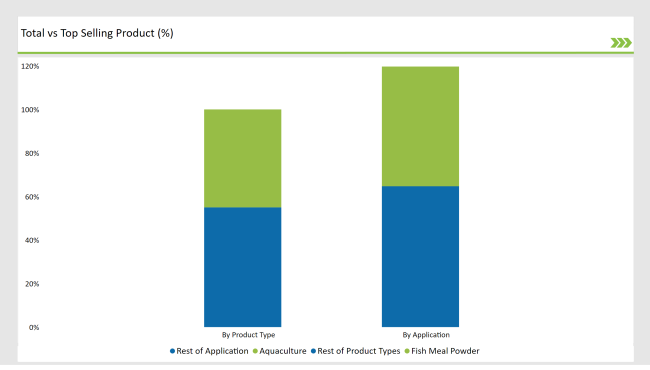
% share of Individual categories by Product Types and Application in 2025
Fruit Berries to the United States for the Fish Meal Market
Fish meal powder is the topmost product type in the United States fish meal market, possessing a 45% market share as a result of the rapid digestibility and concentrated protein. It is extensively inserted in the aquaculture and livestock sector as a feed granting an efficient nutrient absorption and important metabolism amino acids for the optimum growth of animals.
The increasing demand for ecological fish meal is adapted and so the sew-dry plants of the manufacturers are other steps that have to be done. It is also the way to increase the effectiveness of the production and at the same time cut down on the environmental load.
The trend of rich people turning into more sustainable and healthier lives will change the demand for the premium grade of fish meal powder. With this, it can be the starting point for product inventions and for the development of new techniques for automating and streamlining production processes, which will keep fish meal being an essential nutrient in animal nutrition.
Dominant Application in the USA Fish Meal Market
The largest segment of fish meal is still aquaculture, obtaining 55% of the market share. There is an increase in dependence on fish farms across the globe, therefore, fish meal is part of the salmon and shrimp diets which are the main components in this category with a 70% of the share.
Sustainability continues to be the major issue in the merchandising world, so alternative sources of proteins, which are not fish-based, are being researched more and more.
This is a conclusion of the plan as the industry is interested in finding the best method of achieving nutrition targets without fish meal. The adaptability of the farming sector will push the demand for fish meal even further, which will guarantee that they remain a part of the core process in the realization of sustainable seafood.
2025 Market share of USA Fish Meal Market suppliers
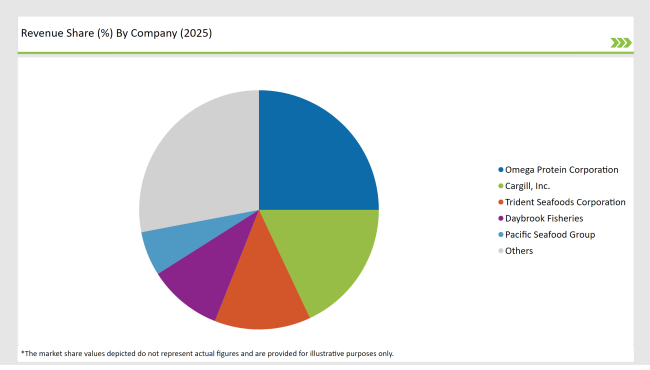
Note: above chart is indicative in nature
Market Concentration and Competitive Landscape
The USA fish oil market is a la layered competition where local, regional, and national fish oil manufacturers form a crucial part of driving the industry growth.
Tier 1 Companies are the market's leading companies with prominent players, including Omega Protein Corporation, Cargill, Inc., and Trident Seafoods Corporation. They have large-scale production facilities, and wide supply chain networks besides huge budgets in research and development which are the advantages these companies get from this.
Thus, they accomplish their goal of staying one step ahead of the competition and satisfying the growing demand for fish oil products that are in use in different applications.
Tier 2 Companies prescribe to the philosophy of creating value with local companies through such partnerships as Daybrook Fisheries, Pacific Seafood Group, and Cooke Aquaculture USA, which formulate the fish oil market with their regional aquatic partnerships while emphasizing unique fish oil industry applications. Their moves enable them to address particular market demands and thereby improve their distribution channels.
Tier 3 Companies focus on niche markets through initiatives relating to the manufacture of special formulations, and quality fish oil production from sustainable sources.
The companies are capable of servicing specialty feed with the attributes that consumers value such as environmental health and choice of product in the feed they buy. The diversity inherent in the structure of the market is what fosters creativity and makes the players in the market more attractive to consumer needs.
Key Segments of the Fish Meal Market Report
By Product types:
The USA Fish Meal Market is segmented by product type into fish meal powder, fish meal pellets, fish oil, and fish protein hydrolysate.
By Application:
By application, the market is categorized into aquaculture, animal feed, pet food, fertilizers, and nutraceuticals
By Source:
The segmentation by source includes wild-caught fish, farmed fish, bycatch, and processing byproducts.
Frequently Asked Questions
What is the expected market size of the USA Fish Meal Market by 2035?
The market is projected to reach USD 20,900.9 million.
What is the expected CAGR for 2025 to 2035?
The market is expected to grow at 4.4% CAGR.
Which segment holds the largest market share?
Aquaculture dominates with a 55% market share.
What are the key growth drivers?
Sustainable sourcing, increased aquaculture demand, and innovations in fish meal processing.
Who are the leading manufacturers in the USA Fish Meal Market?
Omega Protein Corporation, Cargill, Daybrook Fisheries, Pacific Seafood Group, Trident Seafoods Corporation.
Preview the report firsthand - request a free sample
Get SampleGet the brochure for pricing and purchase details.
Get PDFTable of Content
- Executive Summary
- Industry Introduction, Including Taxonomy and Market Definition
- Market Trends and Success Factors, Including Macro-economic Factors, Market Dynamics, and Recent Industry Developments
- Market Demand Analysis 2020 to 2024 and Forecast 2025 to 2035, including Historical Analysis and Future Projections
- Pricing Analysis
- Market Analysis 2020 to 2024 and Forecast 2025 to 2035, by Key Segments
- Competition Outlook, including Market Structure Analysis, Company Share Analysis by Key Players, and Competition Dashboard
- Company Profile
- Research Methodology
- Assumptions & Acronyms


