

- Industry Size (2026)
- USD 1.04 Bn
- Forecast (2036)
- USD 1.48 Bn
- CAGR (2026 to 2036)
- 3.60%
Demand for Foldable Plastic Pallet Boxes in USA Size, Market Forecast and Outlook By FMI
The demand for foldable plastic pallet boxes in USA was valued at USD 1.00 billion in 2025, projected to reach USD 1.04 billion in 2026, and is forecast to expand to USD 1.48 billion by 2036 at a 3.60% CAGR. Automotive OEM returnable packaging mandates, growing e-commerce fulfillment centre returnable container adoption, and corporate sustainability pledges targeting single-use packaging reduction are driving procurement of foldable plastic pallet boxes across U.S. supply chains. Distribution centre operators are converting from single-use corrugated gaylord boxes to reusable foldable pallet containers that deliver five to seven year service life and 60% to 75% empty volume reduction for return freight optimization.
The absolute dollar opportunity of approximately USD 440 million over the forecast period reflects steady conversion growth from disposable to returnable packaging systems across multiple supply chain segments. PP foldable pallet boxes optimized for automotive parts handling generate the highest per-unit values due to precision fit requirements and anti-static specifications for electronic component transport. Cold chain foldable pallet boxes with insulation panel integration are creating a premium product tier for pharmaceutical and fresh food distribution applications.
The West region sets the pace at a 4.1% CAGR, driven by technology sector returnable packaging adoption and the highest e-commerce fulfillment centre density. The South follows at 3.7% supported by automotive manufacturing supply chain returnable packaging standardization. The Northeast maintains 3.3% driven by pharmaceutical distribution and food service returnable container adoption. The Midwest registers 2.9% supported by automotive OEM returnable packaging mandates.
Summary of Demand for Foldable Plastic Pallet Boxes in USA
- Demand for Foldable Plastic Pallet Boxes in USA Definition
- Foldable plastic pallet boxes in USA are collapsible reusable containers in PP, PE, and HDPE integrating pallet bases with foldable sidewalls for return logistics optimization across automotive, food, pharma, and e-commerce supply chains.
- Demand Drivers in the Market
- Automotive OEM returnable packaging mandates requiring suppliers to ship parts in standardized foldable containers generate recurring procurement volumes tied to vehicle production schedules across major assembly plant networks.
- E-commerce fulfillment centre operators converting from single-use corrugated gaylords to reusable foldable containers capture five to seven year service life economics and 60% to 75% return freight volume reduction.
- Corporate sustainability pledges targeting single-use packaging reduction create institutional procurement mandates for returnable foldable container systems across consumer goods and food distribution networks.
- Key Segments Analyzed in the FMI Report
- PP by Material Type: 36.9% share in 2026, as polypropylene delivers the chemical resistance, hinge durability, and precision moulding capability required for automotive parts handling and anti-static electronic component transport specifications.
- Automotive Industry by End-Use Type: 23.7% share in 2026, reflecting the concentrated returnable packaging procurement from automotive OEM supply chains that mandate standardized foldable container specifications across tier-1 and tier-2 suppliers.
- West region: 4.1% compound growth driven by technology sector returnable packaging and e-commerce fulfillment centre density generating foldable container procurement volumes.
- Analyst Opinion at FMI
- Ismail Sutaria, Principal Analyst, Packaging, at FMI benefits USA foldable pallet box market is transitioning from automotive-dominated returnable packaging into broader adoption across e-commerce, pharmaceutical, and food distribution channels as sustainability mandates and return freight cost optimization create compelling conversion economics beyond traditional closed-loop automotive supply chains. Manufacturers who develop cold chain insulated and anti-static specialty configurations capture premium pricing tiers above commodity foldable containers. The critical adoption barrier centers on initial fleet investment cost, as foldable pallet boxes require three to five times higher upfront procurement than disposable alternatives, necessitating total cost of ownership analysis that demonstrates multi-year return.
- Strategic Implications / Executive Takeaways
- Foldable container manufacturers must develop total cost of ownership calculators demonstrating multi-year return versus disposable alternatives to overcome the initial investment barrier for first-time adopting supply chains.
- E-commerce fulfillment operators must pilot foldable container programmes in high-frequency return routes to validate empty volume reduction economics before scaling to full network deployment.
- Automotive OEM packaging teams must update returnable container specifications to include next-generation fold mechanism designs that improve stack stability and reduce damage rates during automated handling.
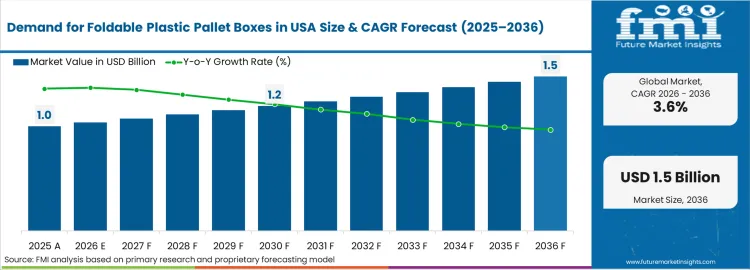
Demand for Foldable Plastic Pallet Boxes in USA Key Takeaways
| Metric | Details |
|---|---|
| Industry Size (2026) | USD 1.04 Billion |
| Industry Value (2036) | USD 1.48 Billion |
| CAGR (2026-2036) | 3.60% |
Source: Future Market Insights, 2026
Demand for Foldable Plastic Pallet Boxes in USA Definition
Foldable plastic pallet boxes for the U.S. market are collapsible large-format reusable containers manufactured from PP, PE, and HDPE that integrate pallet bases with hinged or removable sidewalls for volume-reduced return logistics in closed-loop supply chains. These containers serve automotive parts handling, food distribution, pharmaceutical storage, e-commerce fulfillment, and general logistics applications as returnable packaging alternatives to single-use corrugated gaylord boxes.
Demand for Foldable Plastic Pallet Boxes in USA Inclusions
Market scope includes foldable PP pallet boxes, collapsible PE bulk containers, foldable HDPE pallet containers, anti-static foldable containers for electronics, and insulated foldable containers for cold chain applications. Coverage spans automotive, food and beverage, logistics, pharmaceutical, and consumer goods end uses.
Demand for Foldable Plastic Pallet Boxes in USA Exclusions
Non-foldable rigid plastic containers, corrugated gaylord boxes, wooden crate systems, and standard flat plastic pallets without integrated box enclosure are excluded.
Demand for Foldable Plastic Pallet Boxes in USA Research Methodology
- Primary Research: Analysts engaged with automotive OEM packaging engineers, e-commerce fulfillment centre operations managers, and returnable packaging programme coordinators to map the procurement triggers for foldable pallet box adoption in U.S. supply chains.
- Desk Research: Data collection phases aggregated automotive returnable packaging mandate compliance data, e-commerce fulfillment centre construction statistics, and corporate sustainability packaging reduction pledge timelines.
- Market-Sizing and Forecasting: Baseline values derive from a bottom-up aggregation of foldable pallet box unit procurement multiplied by average per-unit prices across material and end-use categories, applying U.S.-specific returnable packaging conversion curves.
- Data Validation and Update Cycle: Projections are tested against publicly reported returnable packaging revenues from leading foldable container manufacturers and industrial packaging distributors.
Why is the Demand for Foldable Plastic Pallet Boxes in USA Growing?
The demand for foldable plastic pallet boxes in the USA is rising as industrial, retail and logistics sectors seek more efficient, lightweight and reusable packaging and storage solutions. These collapsible units provide major advantages over traditional wooden crates and rigid bins by saving floor and transport space when empty and enabling easier return logistics. As warehousing and supply‑chain costs climb amid e‑commerce expansion and cross‑border trade, these spaceâ€saving solutions are gaining traction.
Key demand drivers include the rise in e‑commerce fulfillment, frequent product turnover and increasing automation in distribution centres. Retailers and logistics operators need durable containers that integrate well with automated systems, reduce manual handling and optimise warehouse density. Foldable plastic pallet boxes, often made from HDPE or other engineered plastics, meet these needs by offering stackability, durability and versatility. Their usability across industries such as food & beverage, automotive parts, pharmaceuticals and consumer goods broadens adoption.
Total cost of ownership considerations is fueling growth in the USA. Companies are shifting from disposable packaging toward reusable containers to reduce waste, lower long‑haul return transportation costs and align with corporate environmental targets. The enhanced durability, washability and repeated‑use cycle of foldable plastic pallet boxes make them a preferred option in modern supply chains. Given these operational, space‑efficiency and sustainability benefits, the demand in the USA is anticipated to grow steadily through 2035.
What is the Segment-Wise Analysis of Demand for Foldable Plastic Pallet Boxes in USA?
Demand for foldable plastic pallet boxes in the USA is segmented by material type and end-use type. By material type, demand is divided into PP (Polypropylene), PE (Polyethylene), and HDPE (High-Density Polyethylene), with PP holding the largest share. In terms of end-use type, the industry is categorized into automotive industry, food and beverage industry, logistics and shipping, pharmaceutical, consumer goods, and others, with the automotive industry leading the demand. Regionally, demand is divided into West, South, Northeast, and Midwest.
Why Does PP (Polypropylene) Lead the Demand for Foldable Plastic Pallet Boxes?
PP (Polypropylene) accounts for 38% of the demand for foldable plastic pallet boxes in the USA. Polypropylene is favored for its unique combination of lightweight, durability, and versatility, making it an ideal material for storage and transport packaging solutions. It offers excellent resistance to chemicals, moisture, and wear, making it especially suitable for industries where pallet boxes are exposed to various environmental conditions and need to endure repeated use.
In industries like automotive, logistics, and food and beverage, PP provides a cost-effective and long-lasting solution, helping to reduce packaging waste and the overall costs associated with shipping. The lightweight nature of PP also contributes to cost savings in transportation, as it reduces shipping weight. PP is highly resistant to impact, which is essential for ensuring the protection of goods during transit and storage. As sustainability concerns increase, PP is also a preferred option because it is recyclable, contributing to a greener supply chain.
Why Does the Automotive Industry Dominate the End-Use Demand?
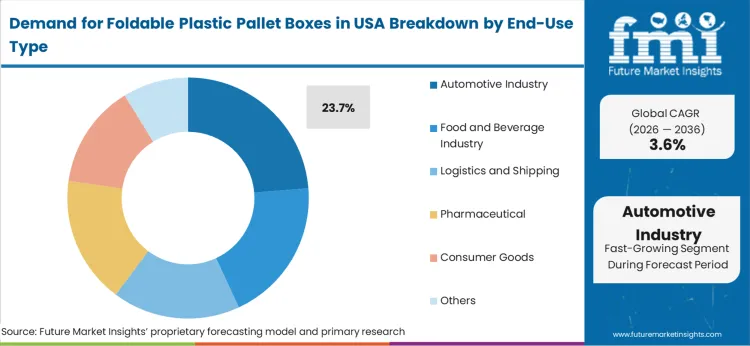
The automotive industry accounts for 23% of the demand for foldable plastic pallet boxes in the USA. In this sector, these pallet boxes are used extensively for transporting and storing automotive parts, components, and assemblies. The automotive industry demands packaging solutions that are not only durable and able to withstand heavy loads but also flexible enough to optimize storage space. Foldable plastic pallet boxes meet all these needs, offering reusable, sturdy, and stackable storage options that help improve the efficiency of supply chain operations.
The automotive industry’s adoption of foldable plastic pallet boxes is driven by the need for cost-effective, space-saving packaging solutions that also enhance logistics processes. As the industry focuses on streamlining its production and transportation methods, the demand for packaging that reduces waste and transportation costs grows. As companies seek more sustainable practices, foldable plastic pallet boxes, which can be reused and recycled, are becoming a preferred choice. Given the growing complexity and scale of automotive production and the need for efficient logistics, the demand for foldable plastic pallet boxes in the automotive industry will continue to expand, reinforcing its dominant position in the industry.
What Drives the Demand in the Food and Beverage Industry?
The food and beverage industry represents a key demand segment for foldable plastic pallet boxes in the USA. The industry requires packaging solutions that are not only durable but also compliant with stringent hygiene and safety standards. Foldable plastic pallet boxes are ideal for this purpose, providing a hygienic and secure way to store, transport, and display products. These boxes are used extensively for bulk food items, beverages, and packaged products, ensuring that goods are safely stored and transported without contamination.
The demand for foldable plastic pallet boxes in the food and beverage industry is driven by the sector’s focus on efficiency, cost-effectiveness, and sustainability. These boxes can be easily folded and stacked when not in use, saving valuable space in warehouses and transportation. As the food and beverage industry grows increasingly concerned with reducing waste, foldable plastic pallet boxes offer a reusable and recyclable solution, making them an environmentally friendly choice. The ongoing trend toward sustainable packaging and the need to meet stringent health and safety regulations ensure that foldable plastic pallet boxes will continue to see rising demand in the food and beverage sector, playing a crucial role in modernizing logistics and improving operational efficiency.
What Are the Key Trends, Drivers & Restraints in Demand for Foldable Plastic Pallet Boxes in USA?
Key drivers include: growing e‑commerce and omni‑channel fulfilment requiring flexible storage/transport solutions; rising emphasis on reusable packaging and reducing empty return‑leg costs; wood and steel alternatives facing sustainability and regulation pressure; and automation/warehouse redesign where stackable, standardized foldable plastics are preferred. Restraints include higher upfront cost compared to basic rigid containers or wooden crates, raw‑material price volatility (plastics, resin) which affects unit cost, load‑capacity limitations (some foldable cannot handle as heavy loads as rigid heavy‑duty steel crates), and inertia in replacing long‑standing rack systems or standard container types.
Why is Demand for Foldable Plastic Pallet Boxes Growing in USA?
In the USA, growth is driven by organizations seeking to reduce storage and transport inefficiencies and by the shift to reusable/returnable container systems. Many fulfilment‑centres and distribution hubs face high real‑estate costs and value any space‑saving measure foldable plastic pallet boxes allow empty containers to collapse, reducing the footprint of storage when not in use. The surge in e‑commerce shipping and returns also means more empty containers travelling back in supply‑chains. Foldable reduce empty‑leg cost and volume. Environmental factors matter too: companies are replacing single‑use or poorly recycled wooden crates with plastic that can be reused many times. Some sectors like automotive manufacturing, cold‑chain, and food & beverage demand hygienic, easy‑to-clean containers foldable plastic pallet boxes support those requirements while offering the collapse/stack benefit.
How are Technological & Product Innovations Driving Growth of Foldable Plastic Pallet Boxes in USA?
Innovation is helping accelerate uptake of foldable plastic pallet boxes in the USA by improving materials, design, and integration. For example: manufacturers are using high‑density polyethylene (HDPE) or polypropylene (PP) and composite materials for improved durability and load‑capacity; designs now enable dramatic volume reduction when collapsed (e.g., 1:2 or 1:3 fold ratios) making them highly space‑efficient. Some models integrate features like drop‑gates, hinged walls, ventilation for food/fresh produce, compatibility with automated storage/retrieval systems (ASRS) and racking systems. Customizations (size, lid/vented options, RFID tracking) adds value for logistic operators. These improvements reduce total cost of ownership (TCO), facilitate integration into modern logistics systems, and make the investment case stronger for USA operations.
What are the Key Challenges Limiting Adoption of Foldable Plastic Pallet Boxes in USA?
A major challenge is cost, foldable plastic pallet boxes often cost more upfront than standard one‑piece plastic or wooden crates, meaning smaller operators may delay upgrading. Load and durability limitations can be a barrier for heavy‑duty or industrial uses where extreme loads or rough handling occur some foldable models may not match the capacity of rigid steel/wood boxes. Raw‑material and resin price volatility (e.g., HDPE, PP) can affect pricing and ROI calculations. Also, in large enterprises the shift to reusable systems requires changes in logistics, tracking and reverse‑flow operations (collecting the collapsed units, managing returns) these operational changes slow adoption. Finally, some supply‑chains are still reliant on legacy container types and may resist switching until full cost/benefit is proven.
What is the Regional Demand Outlook for Foldable Plastic Pallet Boxes in USA?
.webp "Top Country Growth Comparison Demand For Foldable Plastic Pallet Boxes In Usa Cagr (2026 2036)")
| Region | CAGR (%) |
|---|---|
| West | 4.1% |
| South | 3.7% |
| Northeast | 3.3% |
| Midwest | 2.9% |
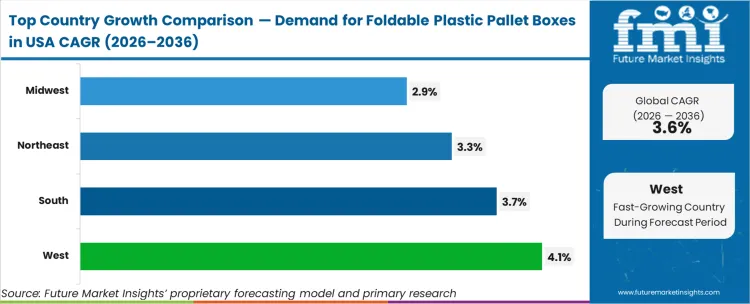
The demand for foldable plastic pallet boxes in the USA is growing across all regions, with the West leading at a 4.1% CAGR. This growth is driven by the increasing need for efficient, durable, and reusable packaging solutions in industries like retail, logistics, and manufacturing. The South follows with a 3.7% CAGR, fueled by its expanding logistics and distribution networks. The Northeast shows a 3.3% CAGR, supported by high consumer demand and strong industrial sectors. The Midwest experiences moderate growth at 2.9%, driven by a rising focus on cost-effective and space-efficient packaging in industries.
Why is Growth Strongest in the West for Foldable Plastic Pallet Boxes?
The West is experiencing the highest demand for foldable plastic pallet boxes in the USA, with a 4.1% CAGR. This growth is primarily attributed to the region’s large logistics and manufacturing industries, particularly in cities like Los Angeles and San Francisco, where distribution networks are extensive. The West has a significant focus on sustainability and space efficiency, making foldable plastic pallet boxes an attractive solution for businesses seeking to reduce waste, optimize storage, and improve overall supply chain efficiency.
Thee growing emphasis on reducing packaging waste and adopting reusable, long-lasting solutions is contributing to the demand for foldable plastic pallet boxes in the region. As industries such as retail and e-commerce continue to expand in the West, the need for durable, easy-to-store, and cost-effective packaging solutions like foldable plastic pallet boxes is expected to rise. With a strong logistical infrastructure and increasing environmental awareness, the West is set to maintain its leadership in the demand for these products.
How is Growth in the South Influenced for Foldable Plastic Pallet Boxes?
The South is experiencing steady demand for foldable plastic pallet boxes, with a 3.7% CAGR. This growth is largely driven by the region's expanding manufacturing, retail, and logistics sectors, particularly in states like Texas, Georgia, and Florida. The rise of large distribution centers, warehouses, and e-commerce fulfillment hubs is contributing to the increasing adoption of foldable plastic pallet boxes, as businesses look for ways to optimize their storage and supply chain operations.
As industries in the South focus on reducing packaging costs, improving efficiency, and minimizing environmental impact, foldable plastic pallet boxes are becoming an attractive solution due to their durability, reusability, and space-saving features. The growing demand for sustainable and cost-effective packaging options in the South is supporting the growth of this product. With continued industrial expansion and a focus on better supply chain management, the South is expected to see continued growth in the use of foldable plastic pallet boxes.
What is Driving Growth in the Northeast for Foldable Plastic Pallet Boxes?
The Northeast is seeing steady demand for foldable plastic pallet boxes, with a 3.3% CAGR. The region’s strong industrial base, particularly in retail, manufacturing, and food production, is contributing to this demand. Major cities like New York, Boston, and Philadelphia are home to large-scale warehouses and distribution centers, which rely on efficient packaging solutions for transporting goods. Foldable plastic pallet boxes, known for their ability to be reused and stored compactly, are becoming an increasingly popular choice in these sectors.
As businesses in the Northeast focus on optimizing supply chain efficiency and reducing packaging costs, the demand for foldable plastic pallet boxes is growing. There is an increasing focus on environmental sustainability, driving industries to move away from disposable packaging and adopt more durable and reusable options. With a combination of strong manufacturing and retail sectors, as well as rising environmental concerns, the Northeast is well-positioned for continued growth in the adoption of foldable plastic pallet boxes.
How is Growth in the Midwest Being Supported for Foldable Plastic Pallet Boxes?
The Midwest is experiencing moderate growth in demand for foldable plastic pallet boxes, with a 2.9% CAGR. The region’s manufacturing and industrial sectors, particularly in cities like Chicago and Detroit, are driving this growth. As industries in the Midwest continue to focus on improving logistics, reducing operational costs, and enhancing supply chain efficiency, foldable plastic pallet boxes are becoming increasingly popular due to their space-saving and reusable design.
While growth in the Midwest is slower compared to other regions, the increasing awareness of the benefits of foldable plastic pallet boxes, such as their durability and environmental impact, is contributing to their adoption. The region’s strong manufacturing base, combined with a rising focus on sustainability and cost-effective solutions, supports the continued demand for these products. As more companies in the Midwest seek to improve packaging efficiency and reduce waste, the demand for foldable plastic pallet boxes is expected to grow at a moderate pace.
What is the Competitive Landscape of USA Nutritive Sweeteners Demand?
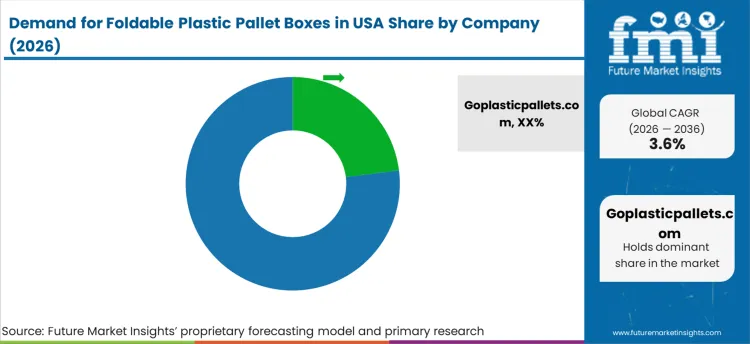
The demand for foldable plastic pallet boxes in the USA is on the rise, driven by logistics optimization, e‑commerce growth, and sustainability initiatives. These containers offer significant benefits in reducing return‑trip volume, saving warehouse space when collapsed, and improving the handling of bulk materials across industries, from automotive to food & beverage. The broader foldable and collapsible container industry is projected to grow steadily, reflecting the need for efficient storage and transport solutions.
In the USA demand landscape, Goplasticpallets.com holds an estimated 23.2% share, underscoring its strong role in providing foldable plastic pallet box solutions tailored to American logistics and material‑handling needs. Other key suppliers include Enlightening Pallet Industry Co, Royal Packs Industries, Exporta, Transoplast, and CABKA Group, all of which contribute to the USA demand by offering container solutions suited for return logistics, storage efficiency, and space‑conscious operations.
Key drivers of demand include the surge in omnichannel retail and e‑commerce, which places a premium on collapsible and reusable bulk containers, growing awareness of circular‑economy practices, and increasing industrial focus on reducing container footprint and maximizing transport efficiency. While challenges such as higher upfront costs compared to traditional wooden crates and the need for standardization and durability in reuse loops may moderate uptake, the overall outlook for foldable plastic pallet boxes in the USA remains positive, driven by sustainable logistics and supply‑chain efficiency trends.
Key Players in USA Nutritive Sweeteners Demand
- Goplasticpallets.com
- Enlightening Pallet Industry Co
- Royal Packs Industries
- Exporta
- Transoplast
- CABKA Group
Scope of the Report
| Metric | Value |
|---|---|
| Quantitative Units | USD 1.04 Billion to USD 1.48 Billion, at a CAGR of 3.60% |
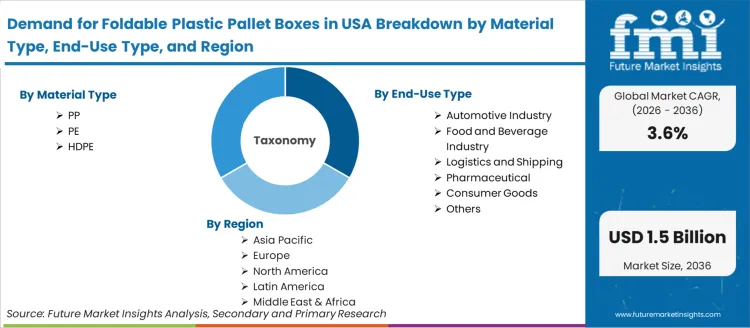
| Market Definition | Foldable plastic pallet boxes in USA are collapsible reusable containers in PP, PE, and HDPE integrating pallet bases with foldable sidewalls for return logistics optimization across automotive, food, pharma, and e-commerce supply chains. |
| Segmentation | Material Type: PP, PE, and HDPE; End-Use Type: Automotive Industry, Food and Beverage Industry, Logistics and Shipping, Pharmaceutical, Consumer Goods, and Others |
| Regions Covered | West, South, Northeast, Midwest |
| Key Companies Profiled | Goplasticpallets.com, Enlightening Pallet Industry Co, Royal Packs Industries, Exporta, Transoplast, CABKA Group |
| Forecast Period | 2026 to 2036 |
| Approach | Forecasting models apply a bottom-up methodology starting with installed base metrics and projecting conversion rates to technology adoption. |
USA Nutritive Sweeteners Demand by Key Segments
Material Type
- PP
- PE
- HDPE
End-Use Type
- Automotive Industry
- Food and Beverage Industry
- Logistics and Shipping
- Pharmaceutical
- Consumer Goods
- Others
Region
- West
- South
- Northeast
- Midwest
Bibliography
- Reusable Packaging Association. (2024). U.S. Returnable Packaging Market: Industry Survey and Adoption Statistics. RPA.
- Automotive Industry Action Group. (2024). Returnable Container Standards: AIAG Packaging Specification Guidelines. AIAG.
- U.S. Environmental Protection Agency. (2024). Sustainable Materials Management: Returnable Packaging Waste Reduction Assessment. EPA.
- Council of Supply Chain Management Professionals. (2024). Annual State of Logistics Report: Packaging Cost and Sustainability Metrics. CSCMP.
- American Chemistry Council. (2024). Plastics Industry Producers Statistics: Industrial Container Resin Consumption. ACC.
- Material Handling Industry. (2024). Returnable Container Systems: Technology and Market Adoption Report. MHI.
This bibliography is provided for reader reference. The full FMI report contains the complete reference list with primary research documentation.
This Report Addresses
- Market sizing and quantitative forecast metrics detailing foldable pallet box unit procurement and revenues across material and end-use categories through 2036.
- Segmentation analysis mapping the conversion velocity from disposable corrugated to returnable foldable containers across automotive, e-commerce, and food distribution channels.
- Regional deployment intelligence comparing automotive supply chain demand in the South and Midwest against e-commerce fulfillment-driven adoption in the West.
- Regulatory compliance assessment analyzing FDA food contact and sustainability packaging reduction mandates affecting foldable container material and procurement specifications.
- Competitive posture evaluation tracking domestic U.S. foldable container manufacturers against European returnable packaging specialists entering the U.S. market.
- Capital project strategic guidance defining the fleet investment analysis and total cost of ownership requirements for foldable container programme deployment.
- Supply chain vulnerability analysis identifying polymer resin price volatility and fold mechanism durability factors affecting fleet replacement economics.
- Custom data delivery formats encompassing interactive dashboards, raw Excel datasets, and comprehensive PDF narrative reports.
Frequently Asked Questions
How large is the demand for Foldable Plastic Pallet Boxes in USA in 2026?
Demand is estimated to be valued at USD 1.04 billion in 2026.
What will be the market size by 2036?
Market size is projected to reach USD 1.48 billion by 2036.
What is the expected CAGR between 2026 and 2036?
Demand is expected to grow at a CAGR of 3.60% between 2026 and 2036.
Which Material Type is poised to lead by 2026?
PP accounts for 36.9% share delivering chemical resistance and hinge durability for automotive and electronics applications.
How is Automotive Industry positioned by End-Use in 2026?
Automotive Industry represents 23.7% share through OEM returnable packaging mandates across supplier networks.
What is driving demand in the West region?
Technology sector returnable packaging and e-commerce fulfillment density fuel the fastest growth at 4.1% CAGR through 2036.
What is included in the scope of this report?
The market covers foldable PP, PE, HDPE containers including anti-static and insulated variants for automotive, food, pharma, and e-commerce.
What is excluded from the scope of this report?
Non-foldable rigid containers, corrugated gaylords, wooden crates, and flat pallets without box enclosure are excluded.
Preview the report firsthand - request a free sample
Get SampleGet the brochure for pricing and purchase details.
Get PDFTable of Content
- Executive Summary
- Global Market Outlook
- Demand-side Trends
- Supply-side Trends
- Technology Roadmap Analysis
- Analysis and Recommendations
- Market Overview
- Market Coverage / Taxonomy
- Market Definition / Scope / Limitations
- Research Methodology
- Chapter Orientation
- Analytical Lens and Working Hypotheses
- Market Structure, Signals, and Trend Drivers
- Benchmarking and Cross-market Comparability
- Market Sizing, Forecasting, and Opportunity Mapping
- Research Design and Evidence Framework
- Desk Research Programme (Secondary Evidence)
- Company Annual and Sustainability Reports
- Peer-reviewed Journals and Academic Literature
- Corporate Websites, Product Literature, and Technical Notes
- Earnings Decks and Investor Briefings
- Statutory Filings and Regulatory Disclosures
- Technical White Papers and Standards Notes
- Trade Journals, Industry Magazines, and Analyst Briefs
- Conference Proceedings, Webinars, and Seminar Materials
- Government Statistics Portals and Public Data Releases
- Press Releases and Reputable Media Coverage
- Specialist Newsletters and Curated Briefings
- Sector Databases and Reference Repositories
- FMI Internal Proprietary Databases and Historical Market Datasets
- Subscription Datasets and Paid Sources
- Social Channels, Communities, and Digital Listening Inputs
- Additional Desk Sources
- Expert Input and Fieldwork (Primary Evidence)
- Primary Modes
- Qualitative Interviews and Expert Elicitation
- Quantitative Surveys and Structured Data Capture
- Blended Approach
- Why Primary Evidence is Used
- Field Techniques
- Interviews
- Surveys
- Focus Groups
- Observational and In-context Research
- Social and Community Interactions
- Stakeholder Universe Engaged
- C-suite Leaders
- Board Members
- Presidents and Vice Presidents
- R&D and Innovation Heads
- Technical Specialists
- Domain Subject-matter Experts
- Scientists
- Physicians and Other Healthcare Professionals
- Governance, Ethics, and Data Stewardship
- Research Ethics
- Data Integrity and Handling
- Primary Modes
- Tooling, Models, and Reference Databases
- Desk Research Programme (Secondary Evidence)
- Data Engineering and Model Build
- Data Acquisition and Ingestion
- Cleaning, Normalisation, and Verification
- Synthesis, Triangulation, and Analysis
- Quality Assurance and Audit Trail
- Market Background
- Market Dynamics
- Drivers
- Restraints
- Opportunity
- Trends
- Scenario Forecast
- Demand in Optimistic Scenario
- Demand in Likely Scenario
- Demand in Conservative Scenario
- Opportunity Map Analysis
- Product Life Cycle Analysis
- Supply Chain Analysis
- Investment Feasibility Matrix
- Value Chain Analysis
- PESTLE and Porter’s Analysis
- Regulatory Landscape
- Regional Parent Market Outlook
- Production and Consumption Statistics
- Import and Export Statistics
- Market Dynamics
- Global Market Analysis 2021 to 2025 and Forecast, 2026 to 2036
- Historical Market Size Value (USD Million) Analysis, 2021 to 2025
- Current and Future Market Size Value (USD Million) Projections, 2026 to 2036
- Y-o-Y Growth Trend Analysis
- Absolute $ Opportunity Analysis
- Global Market Pricing Analysis 2021 to 2025 and Forecast 2026 to 2036
- Global Market Analysis 2021 to 2025 and Forecast 2026 to 2036, By Material Type
- Introduction / Key Findings
- Historical Market Size Value (USD Million) Analysis By Material Type , 2021 to 2025
- Current and Future Market Size Value (USD Million) Analysis and Forecast By Material Type , 2026 to 2036
- PP
- PE
- HDPE
- PP
- Y-o-Y Growth Trend Analysis By Material Type , 2021 to 2025
- Absolute $ Opportunity Analysis By Material Type , 2026 to 2036
- Global Market Analysis 2021 to 2025 and Forecast 2026 to 2036, By End-Use Type
- Introduction / Key Findings
- Historical Market Size Value (USD Million) Analysis By End-Use Type, 2021 to 2025
- Current and Future Market Size Value (USD Million) Analysis and Forecast By End-Use Type, 2026 to 2036
- Automotive Industry
- Food and Beverage Industry
- Logistics and Shipping
- Pharmaceutical
- Consumer Goods
- Others
- Automotive Industry
- Y-o-Y Growth Trend Analysis By End-Use Type, 2021 to 2025
- Absolute $ Opportunity Analysis By End-Use Type, 2026 to 2036
- Global Market Analysis 2021 to 2025 and Forecast 2026 to 2036, By Region
- Introduction
- Historical Market Size Value (USD Million) Analysis By Region, 2021 to 2025
- Current Market Size Value (USD Million) Analysis and Forecast By Region, 2026 to 2036
- North America
- Latin America
- Western Europe
- Eastern Europe
- East Asia
- South Asia and Pacific
- Middle East & Africa
- Market Attractiveness Analysis By Region
- North America Market Analysis 2021 to 2025 and Forecast 2026 to 2036, By Country
- Historical Market Size Value (USD Million) Trend Analysis By Market Taxonomy, 2021 to 2025
- Market Size Value (USD Million) Forecast By Market Taxonomy, 2026 to 2036
- By Country
- USA
- Canada
- Mexico
- By Material Type
- By End-Use Type
- By Country
- Market Attractiveness Analysis
- By Country
- By Material Type
- By End-Use Type
- Key Takeaways
- Latin America Market Analysis 2021 to 2025 and Forecast 2026 to 2036, By Country
- Historical Market Size Value (USD Million) Trend Analysis By Market Taxonomy, 2021 to 2025
- Market Size Value (USD Million) Forecast By Market Taxonomy, 2026 to 2036
- By Country
- Brazil
- Chile
- Rest of Latin America
- By Material Type
- By End-Use Type
- By Country
- Market Attractiveness Analysis
- By Country
- By Material Type
- By End-Use Type
- Key Takeaways
- Western Europe Market Analysis 2021 to 2025 and Forecast 2026 to 2036, By Country
- Historical Market Size Value (USD Million) Trend Analysis By Market Taxonomy, 2021 to 2025
- Market Size Value (USD Million) Forecast By Market Taxonomy, 2026 to 2036
- By Country
- Germany
- UK
- Italy
- Spain
- France
- Nordic
- BENELUX
- Rest of Western Europe
- By Material Type
- By End-Use Type
- By Country
- Market Attractiveness Analysis
- By Country
- By Material Type
- By End-Use Type
- Key Takeaways
- Eastern Europe Market Analysis 2021 to 2025 and Forecast 2026 to 2036, By Country
- Historical Market Size Value (USD Million) Trend Analysis By Market Taxonomy, 2021 to 2025
- Market Size Value (USD Million) Forecast By Market Taxonomy, 2026 to 2036
- By Country
- Russia
- Poland
- Hungary
- Balkan & Baltic
- Rest of Eastern Europe
- By Material Type
- By End-Use Type
- By Country
- Market Attractiveness Analysis
- By Country
- By Material Type
- By End-Use Type
- Key Takeaways
- East Asia Market Analysis 2021 to 2025 and Forecast 2026 to 2036, By Country
- Historical Market Size Value (USD Million) Trend Analysis By Market Taxonomy, 2021 to 2025
- Market Size Value (USD Million) Forecast By Market Taxonomy, 2026 to 2036
- By Country
- China
- Japan
- South Korea
- By Material Type
- By End-Use Type
- By Country
- Market Attractiveness Analysis
- By Country
- By Material Type
- By End-Use Type
- Key Takeaways
- South Asia and Pacific Market Analysis 2021 to 2025 and Forecast 2026 to 2036, By Country
- Historical Market Size Value (USD Million) Trend Analysis By Market Taxonomy, 2021 to 2025
- Market Size Value (USD Million) Forecast By Market Taxonomy, 2026 to 2036
- By Country
- India
- ASEAN
- Australia & New Zealand
- Rest of South Asia and Pacific
- By Material Type
- By End-Use Type
- By Country
- Market Attractiveness Analysis
- By Country
- By Material Type
- By End-Use Type
- Key Takeaways
- Middle East & Africa Market Analysis 2021 to 2025 and Forecast 2026 to 2036, By Country
- Historical Market Size Value (USD Million) Trend Analysis By Market Taxonomy, 2021 to 2025
- Market Size Value (USD Million) Forecast By Market Taxonomy, 2026 to 2036
- By Country
- Kingdom of Saudi Arabia
- Other GCC Countries
- Turkiye
- South Africa
- Other African Union
- Rest of Middle East & Africa
- By Material Type
- By End-Use Type
- By Country
- Market Attractiveness Analysis
- By Country
- By Material Type
- By End-Use Type
- Key Takeaways
- Key Countries Market Analysis
- USA
- Pricing Analysis
- Market Share Analysis, 2025
- By Material Type
- By End-Use Type
- Canada
- Pricing Analysis
- Market Share Analysis, 2025
- By Material Type
- By End-Use Type
- Mexico
- Pricing Analysis
- Market Share Analysis, 2025
- By Material Type
- By End-Use Type
- Brazil
- Pricing Analysis
- Market Share Analysis, 2025
- By Material Type
- By End-Use Type
- Chile
- Pricing Analysis
- Market Share Analysis, 2025
- By Material Type
- By End-Use Type
- Germany
- Pricing Analysis
- Market Share Analysis, 2025
- By Material Type
- By End-Use Type
- UK
- Pricing Analysis
- Market Share Analysis, 2025
- By Material Type
- By End-Use Type
- Italy
- Pricing Analysis
- Market Share Analysis, 2025
- By Material Type
- By End-Use Type
- Spain
- Pricing Analysis
- Market Share Analysis, 2025
- By Material Type
- By End-Use Type
- France
- Pricing Analysis
- Market Share Analysis, 2025
- By Material Type
- By End-Use Type
- India
- Pricing Analysis
- Market Share Analysis, 2025
- By Material Type
- By End-Use Type
- ASEAN
- Pricing Analysis
- Market Share Analysis, 2025
- By Material Type
- By End-Use Type
- Australia & New Zealand
- Pricing Analysis
- Market Share Analysis, 2025
- By Material Type
- By End-Use Type
- China
- Pricing Analysis
- Market Share Analysis, 2025
- By Material Type
- By End-Use Type
- Japan
- Pricing Analysis
- Market Share Analysis, 2025
- By Material Type
- By End-Use Type
- South Korea
- Pricing Analysis
- Market Share Analysis, 2025
- By Material Type
- By End-Use Type
- Russia
- Pricing Analysis
- Market Share Analysis, 2025
- By Material Type
- By End-Use Type
- Poland
- Pricing Analysis
- Market Share Analysis, 2025
- By Material Type
- By End-Use Type
- Hungary
- Pricing Analysis
- Market Share Analysis, 2025
- By Material Type
- By End-Use Type
- Kingdom of Saudi Arabia
- Pricing Analysis
- Market Share Analysis, 2025
- By Material Type
- By End-Use Type
- Turkiye
- Pricing Analysis
- Market Share Analysis, 2025
- By Material Type
- By End-Use Type
- South Africa
- Pricing Analysis
- Market Share Analysis, 2025
- By Material Type
- By End-Use Type
- USA
- Market Structure Analysis
- Competition Dashboard
- Competition Benchmarking
- Market Share Analysis of Top Players
- By Regional
- By Material Type
- By End-Use Type
- Competition Analysis
- Competition Deep Dive
- Goplasticpallets.com
- Overview
- Product Portfolio
- Profitability by Market Segments (Product/Age /Sales Channel/Region)
- Sales Footprint
- Strategy Overview
- Marketing Strategy
- Product Strategy
- Channel Strategy
- Enlightening Pallet Industry Co
- Royal Packs Industries
- Exporta
- Transoplast
- CABKA Group
- Goplasticpallets.com
- Competition Deep Dive
- Assumptions & Acronyms Used


