

- Industry Size (2026)
- USD 397.19 Mn
- Forecast (2036)
- USD 724.84 Mn
- CAGR (2026 to 2036)
- 6.2%
Demand for Hepatitis B Diagnostic Tests in USA Size, Market Forecast and Outlook By FMI
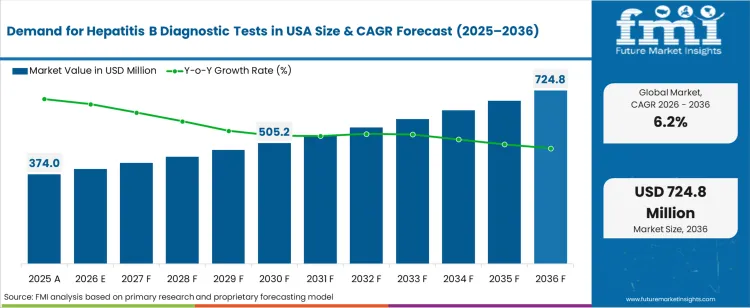
The demand for hepatitis b diagnostic tests in usa was valued at USD 374.00 million in 2025, projected to reach USD 397.19 million in 2026, and is forecast to expand to USD 724.84 million by 2036 at a 6.2% CAGR. CDC-recommended universal hepatitis B screening guidelines for all adults aged 18 and older, implemented since March 2023, are expanding the addressable testing population and driving sustained volume growth across hospital laboratories, community health centres, and commercial reference laboratories. The addition of triple-panel hepatitis B testing (HBsAg, anti-HBs, anti-HBc) to routine adult screening protocols is increasing the number of assays performed per patient encounter compared to prior single-marker screening approaches.
Summary of Demand for Hepatitis B Diagnostic Tests in USA
- Market Snapshot
- The demand for hepatitis b diagnostic tests in usa is valued at USD 374.00 million in 2025 and is projected to reach USD 724.84 million by 2036.
- The industry is expected to grow at a 6.2% CAGR from 2026 to 2036, creating an incremental opportunity of USD 327.65 million.
- The market is shaped by the CDC's universal adult hepatitis B screening recommendation, which has expanded the addressable testing population by an estimated 67 million previously unscreened adults.
- Demand and Growth Drivers
- CDC universal adult hepatitis B screening recommendations implemented since March 2023 are the primary volume catalyst, expanding routine testing to an estimated 67 million previously unscreened adults.
- Triple-panel screening protocols (HBsAg, anti-HBs, anti-HBc) are increasing the number of assays performed per patient encounter compared to prior single-marker approaches.
- Quantitative HBV DNA viral load monitoring for chronic hepatitis B treatment adds higher-value molecular assay consumption on top of serology screening volumes.
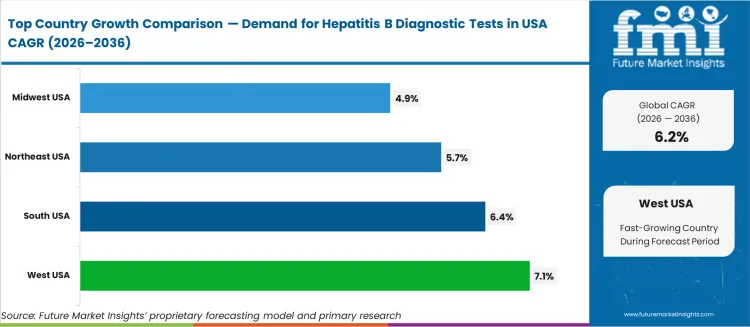
- Among tracked regions, the West leads at 7.1% CAGR, followed by the South at 6.4%, the Northeast at 5.7%, and the Midwest at 4.9%.
- Product and Segment View
- The market covers enzyme immunoassay kits and point-of-care testing kits used for HBsAg screening, anti-HBs immunity assessment, and HBV DNA viral load quantification.
- End users include hospitals, clinics, diagnostic centres, community health facilities, and home care settings.
- Enzyme Immunoassay Kits lead by product type with 65.0% share in 2026.
- Hospitals lead by end user with 40.0% share in 2026.
- The scope includes HBV-specific diagnostic reagents and excludes general immunoassay analysers, hepatitis C and HIV test kits, and liver biopsy equipment.
- Geography and Competitive Outlook
- The West and South are the fastest-growing regions, driven by high HBV prevalence among immigrant populations and expanding community health centre screening capacity.
- The Northeast and Midwest reflect steady growth from integrated health system screening protocol adoption and laboratory network expansion.
- Competition is concentrated among established IVD manufacturers with FDA-cleared hepatitis B assay platforms, including Roche Diagnostics, Abbott Laboratories, Siemens Healthineers, Bio-Rad Laboratories, Danaher Corporation (Beckman Coulter).
Demand for Hepatitis B Diagnostic Tests in USA Key Takeaways
| Metric | Details |
|---|---|
| Industry Size (2026) | USD 397.19 million |
| Industry Value (2036) | USD 724.84 million |
| CAGR (2026 to 2036) | 6.2% |
Source: Future Market Insights, 2026
The incremental opportunity between 2026 and 2036 amounts to USD 327.65 million. FMI is of the opinion that the universal screening mandate is the primary volume catalyst, with an estimated 67 million previously unscreened adults now eligible for routine testing through primary care encounters. The shift from risk-based to universal screening has increased test ordering rates at federally qualified health centres and integrated delivery networks. Quantitative HBV DNA viral load testing for treatment monitoring adds higher-value molecular assay consumption on top of the serology screening base.
Sub-national growth trajectories reflect screening programme adoption rates and immigrant population density. West at 7.1%, South at 6.4%, Northeast at 5.7%, Midwest at 4.9%. The West leads, driven by California's high hepatitis B prevalence among Asian American and Pacific Islander populations and state-funded screening programme infrastructure. The South follows, where expanding Medicaid coverage and community health centre capacity are broadening access to routine screening. The Northeast benefits from dense laboratory networks serving urban immigrant communities with elevated HBV prevalence, while the Midwest reflects steady growth from integrated health system screening protocol adoption.
Demand for Hepatitis B Diagnostic Tests in USA Definition
Hepatitis B diagnostic tests are in vitro diagnostic products used to detect hepatitis B virus infection markers, immune status, and viral load in blood specimens. The USA market covers enzyme immunoassay kits and point-of-care testing kits used for HBsAg screening, anti-HBs immunity assessment, anti-HBc exposure detection, and HBV DNA viral load quantification. These tests are deployed across hospital laboratories, clinics, diagnostic centres, community health facilities, and home care settings.
Demand for Hepatitis B Diagnostic Tests in USA Inclusions
Market scope includes enzyme immunoassay kits (ELISA, CLIA, ECLIA), rapid point-of-care testing kits, and molecular diagnostic reagents for HBV detection and viral load monitoring. Triple-panel screening kits, confirmatory assays, and associated calibrators and quality controls are included.
Demand for Hepatitis B Diagnostic Tests in USA Exclusions
General immunoassay analyser hardware, hepatitis C and HIV diagnostic test kits, liver function biochemistry panels, and FibroScan elastography devices are excluded. Hepatitis B vaccines, antiviral therapeutics, and treatment management services are outside the analytical scope.
Demand for Hepatitis B Diagnostic Tests in USA Research Methodology
- Primary Research: Analysts engaged with procurement managers, laboratory directors, and facility operators to map decision triggers, specification requirements, and adoption timelines across institutional and commercial channels.
- Desk Research: Data collection aggregated regulatory filings, public procurement records, industry association publications, and manufacturer financial disclosures to establish baseline market parameters.
- Market-Sizing and Forecasting: Baseline values derive from a bottom-up aggregation of unit shipment data and average selling prices, applying region-specific adoption curves to project forward demand trajectories.
- Data Validation and Update Cycle: Projections are cross-validated against publicly reported financial disclosures from leading manufacturers and verified against institutional procurement records.
Why is the Demand for Hepatitis B Diagnostic Tests in the USA Growing?
Demand for hepatitis B diagnostic tests in the USA is increasing because healthcare systems prioritize early identification and long term monitoring of chronic viral infections. Routine screening expands in primary care, prenatal visits and community health programs to prevent mother to child transmission and detect infection before liver complications develop. Large groups of individuals with risk factors such as shared needle exposure, close household contact with infected persons and older adults require ongoing surveillance and confirmatory testing.
Specialty clinics and hospitals rely on viral load assays and serology panels to guide treatment decisions and monitor response to antiviral therapy. Blood banks and organ donation programs maintain strict screening protocols to protect transfusion and transplant safety. Public health initiatives encourage testing among populations with low awareness of infection status, including foreign born residents from regions where hepatitis B prevalence is higher. Constraints include inconsistent follow up after initial testing and insurance variability for certain diagnostic panels. Some individuals avoid screening due to limited access to primary care or concern about stigma. Laboratory capacity planning may fluctuate with changes in vaccination coverage and public funding priorities.
Which Product Types and End Users Lead Demand for Hepatitis B Diagnostic Tests in the USA?
Demand for hepatitis B diagnostic tests in the United States is supported by nationwide screening programs, increased focus on early detection, and continued incidence among high-risk groups such as individuals with chronic liver disease and immunocompromised patients. Hospitals and clinical laboratories rely on advanced immunoassays for accurate viral antigen and antibody assessment. Growth is reinforced by USA public health strategies emphasizing vaccination monitoring, donor screening, and improved access to diagnostic solutions through diverse care settings.
By Product Type, Enzyme Immunoassay Kits Hold the Largest Share
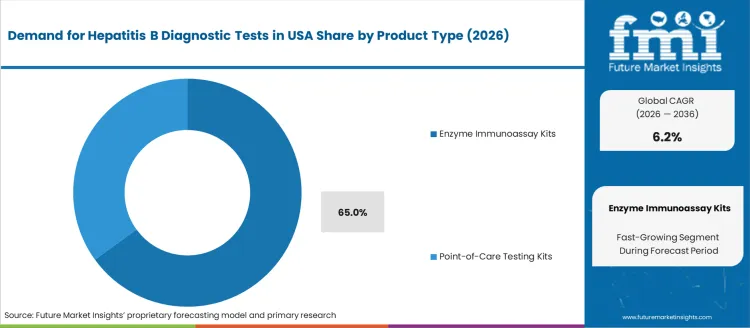
Enzyme Immunoassay (EIA) kits represent 65.0%, positioning them as the leading diagnostic modality due to high sensitivity levels required for hepatitis B surface antigen (HBsAg) and antibody detection. These kits remain essential for screening asymptomatic individuals and confirming viral activity during disease management. Their dominance reflects strong adoption among hospitals and accredited laboratories where automated platforms enable consistent processing of high sample volumes. Point-of-care kits explain the remaining demand share, supporting urgent screening in decentralized settings including emergency departments and outreach programs. These portable formats serve populations that benefit from rapid results despite smaller throughput capabilities. Product demand across the USA aligns with stringent testing standards, reimbursement support, and clinical preference for validated assay performance.
Key Points:
- EIA kits dominate due to accuracy and laboratory automation
- Point-of-care supports rapid screening in decentralized settings
- Screening demand linked to national liver disease prevention goals
By End User, Hospitals Account for the Largest Share
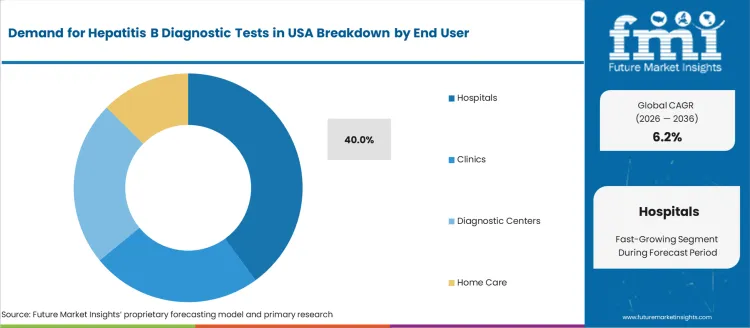
Hospitals hold 40.0%, driven by their central role in acute care, pre-operative screening, emergency diagnostics, and infectious disease management. Clinics and diagnostic centers share the remaining segment, serving routine patient testing and community-based screening programs. Home care represents a smaller presence due to limited use of self-administered tests in hepatitis B detection. End-user demand in the USA reflects clinical complexity, patient flow, and reimbursement coverage, with hospital laboratories continuing to perform confirmatory and highly sensitive viral load assessment.
Key Points:
- Hospitals lead due to comprehensive screening capabilities
- Clinics and diagnostic centers expand reach for early detection
- Home testing remains limited for hepatitis B monitoring
What are the Drivers, Restraints, and Key Trends of the Demand for Hepatitis B Diagnostic Tests in the USA?
Growth of immigration screening from endemic regions, increased monitoring in high risk populations and expanding prenatal testing programs are driving demand.
In the United States, hepatitis B diagnostic testing gains adoption as public health agencies conduct routine screening among individuals born in regions with higher infection prevalence, including parts of Asia and Africa. Primary care and infectious disease clinics monitor patients with chronic liver disease and those receiving immunosuppressive therapies to detect viral reactivation early. Prenatal care guidelines recommend hepatitis B screening for all pregnant women to prevent maternal to infant transmission, creating stable test volume within obstetric networks. Substance use treatment facilities and community health centers expand testing to identify undiagnosed infections among at risk adults. These coordinated health efforts support continuous procurement of serology and molecular tests.
Underdiagnosis in uninsured populations, testing hesitancy due to stigma and reimbursement variation for screening restrain demand.
Patients without consistent medical coverage may postpone routine checkups and miss screening opportunities. Stigma related to infection risk factors can discourage individuals from requesting tests or discussing concerns with clinicians. Reimbursement for screening outside guideline directed risk groups may be limited, leading some providers to order tests selectively. Lack of follow through after initial screening can reduce repeat molecular monitoring for chronic cases if patients disconnect from continued care. These gaps slow broader uptake of diagnostic pathways.
Shift toward point of care rapid tests, increased linkage to digital record systems and rising co testing with hepatitis C and HIV define key trends.
Community clinics and emergency departments adopt rapid assays that allow immediate counseling and referral for vaccination or treatment. Integration with electronic medical records streamlines reporting and improves follow up scheduling for chronic disease management. Screening programs increasingly combine hepatitis B tests with hepatitis C and HIV panels to improve detection efficiency among shared risk groups. Pharmaceutical and public health initiatives emphasize early diagnosis to support antiviral therapy access and reduce long term liver complications. These developments indicate sustained, prevention driven demand for hepatitis B diagnostic testing across the United States healthcare system.
Analysis of the Demand for Hepatitis B Diagnostic Tests in the USA by Region
Demand for hepatitis B diagnostic tests in the United States is driven by chronic-liver-disease surveillance, immigration-screening protocols, blood-safety requirements, and prenatal testing programs. Laboratories and hospitals use serological panels and molecular assays to identify active infection, prior exposure, and immunity status. Public health initiatives encourage screening in higher-risk populations, including individuals with comorbid infections or family history. Centralized reference labs and hospital networks evaluate analyzers based on throughput, automation compatibility, and linkage to electronic health records. West USA leads at 7.1% CAGR, South USA follows with 6.4%, Northeast USA grows at 5.7%, and Midwest USA records 4.9%, reflecting variations in demographics and healthcare-access infrastructure.
.webp "Top Country Growth Comparison Demand For Hepatitis B Diagnostic Tests In Usa Cagr (2026 2036)")
| Region | CAGR (2026-2036) |
|---|---|
| West USA | 7.1% |
| South USA | 6.4% |
| Northeast USA | 5.7% |
| Midwest USA | 4.9% |
How is West USA driving demand for hepatitis B diagnostic tests?
West USA shows the highest regional momentum, growing at 7.1% CAGR, supported by large coastal metropolitan centers in California and Washington. Screenings are integrated into primary-care workflows, community clinics, and hospital admission panels for at-risk patient groups. Immigration-support services encourage serology testing as part of comprehensive infectious-disease evaluation for new arrivals. Blood banks rely on high-sensitivity assays to secure transfusion safety across densely populated catchment areas. Diagnostic laboratories invest in automated platforms that consolidate hepatitis B, hepatitis C, and HIV testing to manage high daily specimen volumes. Public health departments promote testing during outreach events in urban neighborhoods, increasing specimen submissions through community clinics. Procurement teams review analyzer performance data, reagent shelf-life, and interface compatibility with laboratory information systems.
- High-density urban populations sustaining routine screening volumes
- Immigration-related evaluations including hepatitis B serology panels
- Blood-safety standards requiring sensitive, automated testing platforms
- Outreach programs forwarding specimens through community-clinic networks
How is South USA shaping demand for hepatitis B diagnostic tests?
South USA advances at approximately 6.4% CAGR, influenced by demographic structure, regional liver-disease incidence, and strong hospital networks in Texas, Florida, and Georgia. Screening is incorporated into emergency-department panels where patients present with non-specific liver-function abnormalities. Obstetrics practices conduct routine tests in prenatal care, checking infection risk and vaccination history. Community-health centers serving uninsured and underinsured populations rely on compact analyzers or send-out services to reference laboratories. Public-health programs coordinate testing drives that target higher-risk groups, guiding individuals toward follow-up consultation. Procurement emphasizes reagent pricing stability, instrument uptime, and scalable capacity to handle episodic surges during outreach campaigns. Rural facilities favor platforms with straightforward operation and remote-service support.
- Prenatal-care protocols underpinning consistent test utilization
- Community-health centers channeling specimens to reference labs
- Public-health campaigns triggering episodic test-volume peaks
- Simpler systems valued in rural diagnostic settings
How is Northeast USA contributing to hepatitis B test utilization?
Northeast USA posts about 5.7% CAGR, reflecting strong adoption within academic medical centers and integrated health systems in New York, New Jersey, and Massachusetts. Hospitals standardize hepatitis B panels within pre-surgical and chronic-liver-disease workups. Infectious-disease clinics manage follow-up testing to monitor treatment decisions and immunity status, especially in patients with additional viral infections. Reference laboratories use high-throughput analyzers connected to regional courier networks to serve community practices. University-affiliated institutions participate in surveillance studies that rely on consistent assay performance across multiple sites. Purchasers examine test-metric precision, lot-to-lot consistency, and data-integration capabilities that support regional health-reporting systems.
- Academic medical centers embedding standardized test panels
- Infectious-disease clinics coordinating repeat assessments
- High-throughput reference labs serving wide physician networks
- Data-integration needs influencing platform choice
How is Midwest USA influencing national demand for hepatitis B diagnostic tests?
Midwest USA grows at around 4.9% CAGR, representing steady adoption across hospital systems and independent laboratories in Illinois, Ohio, Michigan, and neighboring states. Testing demand is tied to routine pre-employment and occupational-health screenings in healthcare workers and other at-risk professions. Primary-care physicians order hepatitis B panels for patients with elevated liver enzymes or risk factors documented during visits. Community hospitals deploy mid-range analyzers that balance cost with reliability, avoiding excessive overcapacity. Rural laboratories often rely on regional reference centers for confirmatory or molecular assays, maintaining essential serology capacity in-house. Procurement strategies prioritize robust technical support and reagent logistics suited to winter-weather disruptions.
- Occupational-health protocols sustaining regular screening activity
- Primary care driving baseline serology ordering
- Mid-range analyzers supporting community-hospital needs
- Logistics resilience important in winter-affected regions
What does the competitive landscape for hepatitis B diagnostic test demand in the United States look like?
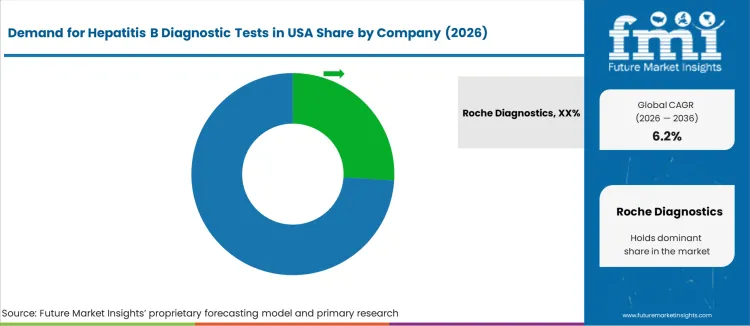
Hepatitis B diagnostic testing in the United States supports screening in hospitals, clinical laboratories, community health programs, and blood-safety networks. Demand is sustained by CDC-recommended screening protocols for high-risk groups, prenatal testing requirements, and monitoring of chronic infection. Laboratories prioritize high-sensitivity assays, automation compatibility, and consistent reagent supply. Interoperability with digital reporting systems strengthens adoption in centralized testing environments that handle high daily sample volumes. Roche Diagnostics holds an estimated 26.2% share. Its immunoassay and molecular testing platforms are broadly installed in national reference laboratories and large hospital systems.
Wide test menu availability increases operational consistency across viral hepatitis workflows. Abbott Laboratories participates with automated assay systems used in routine screening and confirmatory viral marker detection for both acute and chronic cases. Siemens Healthineers supports diagnostic networks with high-throughput immunoassay instruments aligned to diverse laboratory sizes. Bio-Rad Laboratories contributes through specialized hepatitis B test kits used in public-health settings and follow-up research applications. Danaher Corporation (Beckman Coulter) focuses on integrated chemistry and immunoassay analyzers within community hospital networks where dependable uptime and guided workflows are valued. Competitive positioning is influenced by assay accuracy, regulatory compliance, ease of workflow standardization, and the ability to scale from targeted screening programs to continuous monitoring in chronic-care populations across the United States.
Key Players in USA Hepatitis B Diagnostic Tests Demand
- Roche Diagnostics
- Abbott Laboratories
- Siemens Healthineers
- Bio-Rad Laboratories
- Danaher Corporation (Beckman Coulter)
Scope of the Report
| Metric | Value |
|---|---|
| Quantitative Units | USD 397.19 to USD 724.84 million, at a CAGR of 6.2% |
| Market Definition | Hepatitis B diagnostic tests are in vitro diagnostic products used to detect hepatitis B virus infection markers, immune status, and viral load in blood specimens. The USA market covers enzyme immunoassay kits and point-of-care testing kits used for HBsAg screening, anti-HBs immunity assessment, anti-HBc exposure detection, and HBV DNA viral load quantification. |
| Segmentation | Product Type (Enzyme Immunoassay Kits, Point-of-Care Testing Kits), End User (Hospitals, Clinics, Diagnostic Centers, Home Care) |
| Regions Covered | West, South, Northeast, Midwest |
| Key Companies Profiled | Roche Diagnostics, Abbott Laboratories, Siemens Healthineers, Bio-Rad Laboratories, Danaher Corporation (Beckman Coulter) |
| Forecast Period | 2026 to 2036 |
| Approach | Forecasting models apply a bottom-up methodology starting with unit shipment and average selling price data, cross-validated against manufacturer financial disclosures and institutional procurement records. |
USA Hepatitis B Diagnostic Tests Demand by Segments
Product Type:
- Enzyme Immunoassay Kits (EIA)
- Point-of-Care Testing Kits
End User:
- Hospitals
- Clinics
- Diagnostic Centers
- Home Care
Region:
- West USA
- South USA
- Northeast USA
- Midwest USA
Bibliography
- 1. Centers for Disease Control and Prevention. (2024). Recommendations for Hepatitis B Screening and Testing. CDC.
- 2. USA Food and Drug Administration. (2024). In Vitro Diagnostic Device Premarket Review Database. FDA.
- 3. USA Preventive Services Task Force. (2024). Hepatitis B Virus Infection: Screening Recommendation Statement. USPSTF.
- 4. World Health Organization. (2024). Global Hepatitis Report: Monitoring and Evaluation Framework. WHO.
- 5. Abbott Laboratories. (2024). Annual Report 2024: Diagnostics Division. Abbott.
- 6. American Association for the Study of Liver Diseases. (2024). AASLD Practice Guidance on Hepatitis B. AASLD.
This bibliography is provided for reader reference. The full Future Market Insights report contains the complete reference list with primary research documentation.
This Report Addresses
- Market sizing and quantitative forecast metrics detailing expenditure on hepatitis b diagnostic tests in usa across the forecast period through 2036.
- Segmentation analysis mapping adoption velocity across product type and end user categories and evaluating structural factors driving segment concentration.
- Regional deployment intelligence comparing growth trajectories across tracked geographies and identifying institutional and regulatory factors differentiating adoption rates.
- Regulatory compliance assessment analysing how applicable standards, safety mandates, and procurement specifications influence competitive positioning.
- Competitive posture evaluation tracking manufacturer market share concentration, distribution strategies, and product portfolio differentiation.
- Capital allocation guidance defining procurement specifications and technical parameters required for institutional and commercial purchasing decisions.
- Supply chain analysis identifying sourcing constraints, distribution channel structures, and inventory management factors affecting market access.
- Custom data delivery formats encompassing interactive dashboards, raw Excel datasets, and comprehensive PDF narrative reports.
Frequently Asked Questions
How large is the demand for hepatitis b diagnostic tests in usa in 2026?
The demand for hepatitis b diagnostic tests in usa is estimated to be valued at USD 397.19 million in 2026.
What will be the market size of demand for hepatitis b diagnostic tests in usa by 2036?
Market size for demand for hepatitis b diagnostic tests in usa is projected to reach USD 724.84 million by 2036.
What is the expected growth rate for demand for hepatitis b diagnostic tests in usa between 2026 and 2036?
The demand for hepatitis b diagnostic tests in usa is expected to grow at a CAGR of 6.2% between 2026 and 2036.
Which product type is poised to lead by 2026?
Enzyme Immunoassay Kits accounts for 65.0% share in 2026, driven by established procurement patterns and institutional adoption.
How is hospitals positioned in driving adoption in 2026?
Hospitals holds 40.0% share of the end user segment in 2026, reflecting concentrated institutional demand.
What is the growth outlook for West?
West is projected to grow at a CAGR of 7.1% during 2026 to 2036.
What is included in the scope of this report?
Market scope includes enzyme immunoassay kits (ELISA, CLIA, ECLIA), rapid point-of-care testing kits, and molecular diagnostic reagents for HBV detection and viral load monitoring. Triple-panel screening kits, confirmatory assays, and associated calibrators and quality controls are included.
How does FMI build and validate the demand for hepatitis b diagnostic tests in usa forecast?
Forecasting models apply a bottom-up methodology starting with unit shipment and average selling price data, cross-validated against manufacturer financial disclosures and institutional procurement records.
Preview the report firsthand - request a free sample
Get SampleGet the brochure for pricing and purchase details.
Get PDFTable of Content
- Executive Summary
- Global Market Outlook
- Demand-side Trends
- Supply-side Trends
- Technology Roadmap Analysis
- Analysis and Recommendations
- Market Overview
- Market Coverage / Taxonomy
- Market Definition / Scope / Limitations
- Research Methodology
- Chapter Orientation
- Analytical Lens and Working Hypotheses
- Market Structure, Signals, and Trend Drivers
- Benchmarking and Cross-market Comparability
- Market Sizing, Forecasting, and Opportunity Mapping
- Research Design and Evidence Framework
- Desk Research Programme (Secondary Evidence)
- Company Annual and Sustainability Reports
- Peer-reviewed Journals and Academic Literature
- Corporate Websites, Product Literature, and Technical Notes
- Earnings Decks and Investor Briefings
- Statutory Filings and Regulatory Disclosures
- Technical White Papers and Standards Notes
- Trade Journals, Industry Magazines, and Analyst Briefs
- Conference Proceedings, Webinars, and Seminar Materials
- Government Statistics Portals and Public Data Releases
- Press Releases and Reputable Media Coverage
- Specialist Newsletters and Curated Briefings
- Sector Databases and Reference Repositories
- FMI Internal Proprietary Databases and Historical Market Datasets
- Subscription Datasets and Paid Sources
- Social Channels, Communities, and Digital Listening Inputs
- Additional Desk Sources
- Expert Input and Fieldwork (Primary Evidence)
- Primary Modes
- Qualitative Interviews and Expert Elicitation
- Quantitative Surveys and Structured Data Capture
- Blended Approach
- Why Primary Evidence is Used
- Field Techniques
- Interviews
- Surveys
- Focus Groups
- Observational and In-context Research
- Social and Community Interactions
- Stakeholder Universe Engaged
- C-suite Leaders
- Board Members
- Presidents and Vice Presidents
- R&D and Innovation Heads
- Technical Specialists
- Domain Subject-matter Experts
- Scientists
- Physicians and Other Healthcare Professionals
- Governance, Ethics, and Data Stewardship
- Research Ethics
- Data Integrity and Handling
- Primary Modes
- Tooling, Models, and Reference Databases
- Desk Research Programme (Secondary Evidence)
- Data Engineering and Model Build
- Data Acquisition and Ingestion
- Cleaning, Normalisation, and Verification
- Synthesis, Triangulation, and Analysis
- Quality Assurance and Audit Trail
- Market Background
- Market Dynamics
- Drivers
- Restraints
- Opportunity
- Trends
- Scenario Forecast
- Demand in Optimistic Scenario
- Demand in Likely Scenario
- Demand in Conservative Scenario
- Opportunity Map Analysis
- Product Life Cycle Analysis
- Supply Chain Analysis
- Investment Feasibility Matrix
- Value Chain Analysis
- PESTLE and Porter’s Analysis
- Regulatory Landscape
- Regional Parent Market Outlook
- Production and Consumption Statistics
- Import and Export Statistics
- Market Dynamics
- Global Market Analysis 2021 to 2025 and Forecast, 2026 to 2036
- Historical Market Size Value (USD Million) Analysis, 2021 to 2025
- Current and Future Market Size Value (USD Million) Projections, 2026 to 2036
- Y-o-Y Growth Trend Analysis
- Absolute $ Opportunity Analysis
- Global Market Pricing Analysis 2021 to 2025 and Forecast 2026 to 2036
- Global Market Analysis 2021 to 2025 and Forecast 2026 to 2036, By Product Type
- Introduction / Key Findings
- Historical Market Size Value (USD Million) Analysis By Product Type , 2021 to 2025
- Current and Future Market Size Value (USD Million) Analysis and Forecast By Product Type , 2026 to 2036
- Enzyme Immunoassay Kits
- Point-of-Care Testing Kits
- Enzyme Immunoassay Kits
- Y-o-Y Growth Trend Analysis By Product Type , 2021 to 2025
- Absolute $ Opportunity Analysis By Product Type , 2026 to 2036
- Global Market Analysis 2021 to 2025 and Forecast 2026 to 2036, By End User
- Introduction / Key Findings
- Historical Market Size Value (USD Million) Analysis By End User, 2021 to 2025
- Current and Future Market Size Value (USD Million) Analysis and Forecast By End User, 2026 to 2036
- Hospitals
- Clinics
- Diagnostic Centers
- Home Care
- Hospitals
- Y-o-Y Growth Trend Analysis By End User, 2021 to 2025
- Absolute $ Opportunity Analysis By End User, 2026 to 2036
- Global Market Analysis 2021 to 2025 and Forecast 2026 to 2036, By Region
- Introduction
- Historical Market Size Value (USD Million) Analysis By Region, 2021 to 2025
- Current Market Size Value (USD Million) Analysis and Forecast By Region, 2026 to 2036
- North America
- Latin America
- Western Europe
- Eastern Europe
- East Asia
- South Asia and Pacific
- Middle East & Africa
- Market Attractiveness Analysis By Region
- North America Market Analysis 2021 to 2025 and Forecast 2026 to 2036, By Country
- Historical Market Size Value (USD Million) Trend Analysis By Market Taxonomy, 2021 to 2025
- Market Size Value (USD Million) Forecast By Market Taxonomy, 2026 to 2036
- By Country
- USA
- Canada
- Mexico
- By Product Type
- By End User
- By Country
- Market Attractiveness Analysis
- By Country
- By Product Type
- By End User
- Key Takeaways
- Latin America Market Analysis 2021 to 2025 and Forecast 2026 to 2036, By Country
- Historical Market Size Value (USD Million) Trend Analysis By Market Taxonomy, 2021 to 2025
- Market Size Value (USD Million) Forecast By Market Taxonomy, 2026 to 2036
- By Country
- Brazil
- Chile
- Rest of Latin America
- By Product Type
- By End User
- By Country
- Market Attractiveness Analysis
- By Country
- By Product Type
- By End User
- Key Takeaways
- Western Europe Market Analysis 2021 to 2025 and Forecast 2026 to 2036, By Country
- Historical Market Size Value (USD Million) Trend Analysis By Market Taxonomy, 2021 to 2025
- Market Size Value (USD Million) Forecast By Market Taxonomy, 2026 to 2036
- By Country
- Germany
- UK
- Italy
- Spain
- France
- Nordic
- BENELUX
- Rest of Western Europe
- By Product Type
- By End User
- By Country
- Market Attractiveness Analysis
- By Country
- By Product Type
- By End User
- Key Takeaways
- Eastern Europe Market Analysis 2021 to 2025 and Forecast 2026 to 2036, By Country
- Historical Market Size Value (USD Million) Trend Analysis By Market Taxonomy, 2021 to 2025
- Market Size Value (USD Million) Forecast By Market Taxonomy, 2026 to 2036
- By Country
- Russia
- Poland
- Hungary
- Balkan & Baltic
- Rest of Eastern Europe
- By Product Type
- By End User
- By Country
- Market Attractiveness Analysis
- By Country
- By Product Type
- By End User
- Key Takeaways
- East Asia Market Analysis 2021 to 2025 and Forecast 2026 to 2036, By Country
- Historical Market Size Value (USD Million) Trend Analysis By Market Taxonomy, 2021 to 2025
- Market Size Value (USD Million) Forecast By Market Taxonomy, 2026 to 2036
- By Country
- China
- Japan
- South Korea
- By Product Type
- By End User
- By Country
- Market Attractiveness Analysis
- By Country
- By Product Type
- By End User
- Key Takeaways
- South Asia and Pacific Market Analysis 2021 to 2025 and Forecast 2026 to 2036, By Country
- Historical Market Size Value (USD Million) Trend Analysis By Market Taxonomy, 2021 to 2025
- Market Size Value (USD Million) Forecast By Market Taxonomy, 2026 to 2036
- By Country
- India
- ASEAN
- Australia & New Zealand
- Rest of South Asia and Pacific
- By Product Type
- By End User
- By Country
- Market Attractiveness Analysis
- By Country
- By Product Type
- By End User
- Key Takeaways
- Middle East & Africa Market Analysis 2021 to 2025 and Forecast 2026 to 2036, By Country
- Historical Market Size Value (USD Million) Trend Analysis By Market Taxonomy, 2021 to 2025
- Market Size Value (USD Million) Forecast By Market Taxonomy, 2026 to 2036
- By Country
- Kingdom of Saudi Arabia
- Other GCC Countries
- Turkiye
- South Africa
- Other African Union
- Rest of Middle East & Africa
- By Product Type
- By End User
- By Country
- Market Attractiveness Analysis
- By Country
- By Product Type
- By End User
- Key Takeaways
- Key Countries Market Analysis
- USA
- Pricing Analysis
- Market Share Analysis, 2025
- By Product Type
- By End User
- Canada
- Pricing Analysis
- Market Share Analysis, 2025
- By Product Type
- By End User
- Mexico
- Pricing Analysis
- Market Share Analysis, 2025
- By Product Type
- By End User
- Brazil
- Pricing Analysis
- Market Share Analysis, 2025
- By Product Type
- By End User
- Chile
- Pricing Analysis
- Market Share Analysis, 2025
- By Product Type
- By End User
- Germany
- Pricing Analysis
- Market Share Analysis, 2025
- By Product Type
- By End User
- UK
- Pricing Analysis
- Market Share Analysis, 2025
- By Product Type
- By End User
- Italy
- Pricing Analysis
- Market Share Analysis, 2025
- By Product Type
- By End User
- Spain
- Pricing Analysis
- Market Share Analysis, 2025
- By Product Type
- By End User
- France
- Pricing Analysis
- Market Share Analysis, 2025
- By Product Type
- By End User
- India
- Pricing Analysis
- Market Share Analysis, 2025
- By Product Type
- By End User
- ASEAN
- Pricing Analysis
- Market Share Analysis, 2025
- By Product Type
- By End User
- Australia & New Zealand
- Pricing Analysis
- Market Share Analysis, 2025
- By Product Type
- By End User
- China
- Pricing Analysis
- Market Share Analysis, 2025
- By Product Type
- By End User
- Japan
- Pricing Analysis
- Market Share Analysis, 2025
- By Product Type
- By End User
- South Korea
- Pricing Analysis
- Market Share Analysis, 2025
- By Product Type
- By End User
- Russia
- Pricing Analysis
- Market Share Analysis, 2025
- By Product Type
- By End User
- Poland
- Pricing Analysis
- Market Share Analysis, 2025
- By Product Type
- By End User
- Hungary
- Pricing Analysis
- Market Share Analysis, 2025
- By Product Type
- By End User
- Kingdom of Saudi Arabia
- Pricing Analysis
- Market Share Analysis, 2025
- By Product Type
- By End User
- Turkiye
- Pricing Analysis
- Market Share Analysis, 2025
- By Product Type
- By End User
- South Africa
- Pricing Analysis
- Market Share Analysis, 2025
- By Product Type
- By End User
- USA
- Market Structure Analysis
- Competition Dashboard
- Competition Benchmarking
- Market Share Analysis of Top Players
- By Regional
- By Product Type
- By End User
- Competition Analysis
- Competition Deep Dive
- Roche Diagnostics
- Overview
- Product Portfolio
- Profitability by Market Segments (Product/Age /Sales Channel/Region)
- Sales Footprint
- Strategy Overview
- Marketing Strategy
- Product Strategy
- Channel Strategy
- Abbott Laboratories
- Siemens Healthineers
- Bio-Rad Laboratories
- Danaher Corporation (Beckman Coulter)
- Roche Diagnostics
- Competition Deep Dive
- Assumptions & Acronyms Used


