

- Market Size (2026)
- USD 3.9 Bn
- Forecast (2036)
- USD 7.6 Bn
- CAGR (2026 to 2036)
- 6.9%
How big is the Varicose Ulcer Market in 2026?
USD 3.9 billion in 2026 and USD 7.6 billion by 2036 at a 6.9% CAGR.
Sales in the varicose ulcer market are projected to grow at 6.9% CAGR through 2036, driving valuation to USD 7.6 billion by 2036 from USD 3.9 billion in 2026. Clinicians select pressure levels and wound products according to arterial suitability and treatment stage during follow-up.
Long treatment episodes require repeated pressure control and wound-bed management across hospital and community settings. MedTech Europe reported in March 2026 that chronic wounds affect 7.4 million to 14.9 million Europeans. The documented burden sustains recurring compression therapy throughout active treatment and structured recurrence prevention programs. advanced wound care products become relevant as exudate control or specialist escalation changes treatment plans.
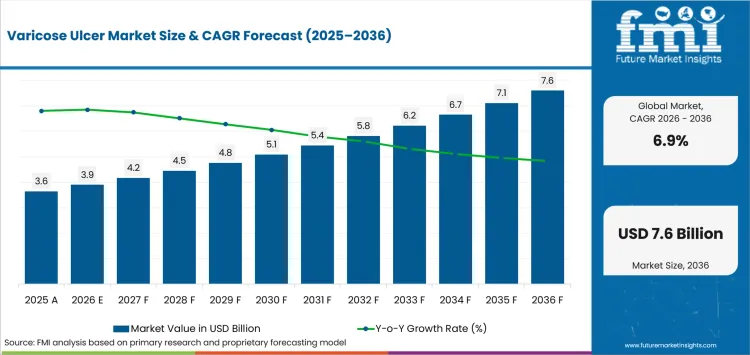
Key Takeaways of Varicose Ulcer Market
- Repeated compression fitting and dressing replacement sustain recurring product use throughout healing and recurrence prevention.
- Compression therapy is projected to hold 38.5% in 2026 driven by direct control of venous hypertension.
- Uncomplicated varicose ulcers are forecast at 48.0% share in 2026 owing to structured repeatable care pathways.
- Hospitals are estimated at 46.0% share in 2026 attributable to vascular assessment and specialist wound-care procedures.
- Arterial assessment errors or poor adherence can delay healing and increase variation across clinical visits.
- Essity Health & Medical, Solventum Corporation, Smith+Nephew, Mölnlycke Health Care, Convatec Group PLC, Coloplast A/S, Organogenesis Holdings Inc. and Integra LifeSciences Holdings Corporation serve the market through compression, advanced dressings and regenerative wound products.
Analyst Perspective
“Varicose ulcer care earns value through stable compression pressure as dressing needs change with exudate and wound depth. Companies that connect fitting support with escalation criteria reduce treatment variation across hospital discharge and community follow-up.”
- Anurag Sharma, Principal Consultant, Future Market Insights
How is the Varicose Ulcer Market segmented?
The Varicose Ulcer Market is segmented by therapy type, ulcer severity, end user, treatment setting, distribution channel and region.
The varicose ulcer market is segmented by therapy type, ulcer severity, end user, treatment setting, distribution channel and region. Therapy type covers compression, dressings, biologics and adjuncts, while ulcer severity distinguishes uncomplicated, complicated and refractory ulcers. End users include hospitals, clinics, home healthcare and ambulatory centers, while treatment settings cover hospital, specialty, home-based and ambulatory care. Distribution channels include institutional sales, medical distributors, pharmacies and online platforms serving recurring wound-care needs.
Why does compression therapy lead demand within the therapy type category?
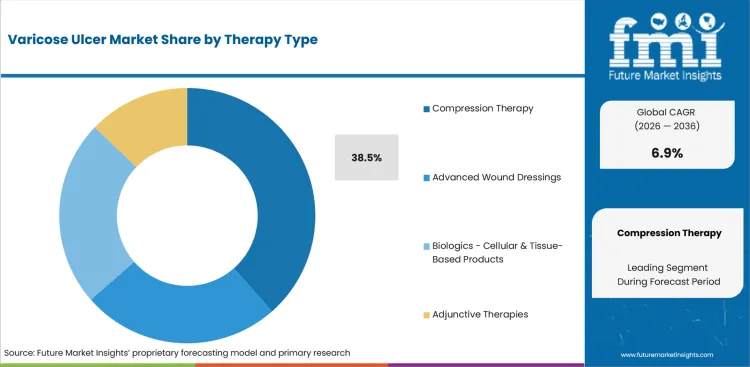
Compression therapy lowers venous pressure once arterial screening confirms firm pressure is safe for the patient. SCAI placed compression and wound care within its June 2025 chronic venous disease guidance, reinforcing pressure control throughout active treatment.
- By therapy type, compression therapy is estimated to hold 38.5% in 2026 owing to its direct role in controlling venous hypertension during routine treatment.
- Wound teams add advanced wound dressings beneath compression to manage exudate without replacing pressure control. Clinicians adjust dressing frequency and pressure strength as wound depth, drainage and tolerance change across repeated clinic or home visits.
Why do uncomplicated varicose ulcers lead demand within the ulcer severity category?
Uncomplicated varicose ulcers remain suitable for planned compression and moisture management until infection or deeper tissue loss changes the clinical pathway. Scheduled review allows dressing frequency to change without immediate use of cellular products or intensive procedures.
- Based on ulcer severity, uncomplicated varicose ulcers are projected to account for 48.0% in 2026 due to repeatable management of superficial wounds.
- Product choice depends on pressure tolerance and daily self-care throughout extended community treatment and follow-up programs. NICE defined four strong-compression formats in August 2025 and set at least 40 mmHg at the ankle as the treatment benchmark.
Why do hospitals lead demand within the end user category?
Hospitals combine vascular assessment with wound expertise and procedural access for ulcers that do not improve through routine management. Central teams coordinate infection review and reimbursement documentation before arranging continued care beyond discharge and community follow-up.
- In 2026, hospitals are expected to lead the end user category with 46.0% share because they combine diagnostics with complex escalation decisions. Organogenesis reported in February 2026 that hospitals and wound centers remain core customers for advanced wound products and clinical support.
- Specialist teams introduce negative pressure wound therapy or tissue-engineered skin substitutes once standard care has been assessed.
Why does hospital-based care lead demand within the treatment setting category?
Hospital-based care integrates arterial screening and infection review within one pathway for ulcers with varied complexity. Coloplast received a Vizient contract for Biatain Silicone Fit in May 2026 following review by hospital experts.
- The treatment setting category is forecast to be led by hospital-based care at 45.0% share in 2026 due to access to diagnostics and multidisciplinary review.
- Clinical teams use wound debridement devices and advanced dressings to prepare difficult wound beds for continued treatment. Discharge planning then guides product selection across specialist review and community nursing during prolonged treatment episodes and follow-up across hospital-to-home transitions.
What are the drivers, restraints and opportunities in the Varicose Ulcer Market?
Driver: repeated treatment sustains recurring use. Restraint: arterial suitability limits standardized compression. Opportunity: coordinated pathways improve care transitions.
- Driver: Repeated compression fitting and dressing replacement sustain recurring product use throughout active healing and recurrence prevention.
- Restraint: Arterial status and patient tolerance materially restrict standardized compression across varied ulcer presentations and treatment settings.
- Opportunity: Coordinated product families reduce switching during hospital discharge and community management of complex chronic wounds.
Compression fitting and dressing replacement recur throughout active healing and recurrence prevention across prolonged treatment episodes. Health systems therefore favor chronic wound care product families with training that limits pressure variation across repeated visits.
Arterial suitability and patient tolerance determine whether firm compression remains safe during each clinical assessment. CMS stated in April 2025 that skin-substitute coverage requires high-quality effectiveness evidence, which can delay escalation beyond antimicrobial wound dressings and standard care.
Public coverage programs can make coordinated product supply practical for clearly defined patient groups during recurring care. The Australian Government launched the Chronic Wound Consumables Scheme in June 2025 for eligible bandages, dressings and adhesives delivered through trained health professionals.
Which country CAGRs are profiled in the Varicose Ulcer Market?
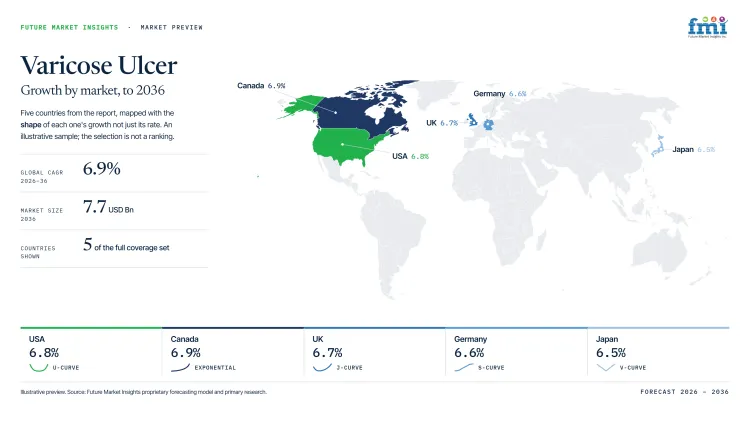
| Country | CAGR |
|---|---|
| South Korea | 8.2% |
| Japan | 6.5% |
| Germany | 6.6% |
| Australia | 7.1% |
| Canada | 6.9% |
| United States | 6.8% |
| United Kingdom | 6.7% |
How do country-level CAGRs compare in the Varicose Ulcer Market?
The displayed CAGRs span 1.5 percentage points across five healthcare systems and describe forecast pace without measuring current revenue or installed product use.
- South Korea presents device-registration requirements that influence launch preparation for imported compression systems and wound products.
- Australia reflects structured public referral criteria that require complete wound records and vascular imaging for specialist review.
- Canada reflects program-specific benefit schedules that govern recurring access to compression bandages and advanced dressings.
- The United States shows specialist treatment capacity tempered by regional coverage and coding requirements for advanced therapies.
- The United Kingdom points toward national community-service standards constrained by local staffing and referral capacity across regions.
Comparable CAGRs can produce different market entry conditions. The full report provides country-level CAGR analysis across North America, Latin America, Europe, East Asia, South Asia and Pacific, and the Middle East and Africa.
Country-wise Analysis
- Imported wound-care devices enter South Korea through registration and GMP documentation that manufacturers align with national quality requirements before hospitals establish stable purchasing routes for compression systems and advanced dressings across purchasing channels. Adoption of wound-care products in South Korea is estimated to expand at 8.2% CAGR through 2036, supported by a defined approval route and clearer documentation for regulated devices across national hospital supply routes. The Ministry of Food and Drug Safety published English GMP regulations in February 2026 to assist manufacturers and importers, although complete quality records can lengthen registration and delay hospital onboarding for new wound-care products.
- Public vascular clinics in Victoria require recent imaging and detailed wound records before accepting referrals for non-healing lower-leg ulcers through the public hospital system after prolonged routine management fails to reduce wound size adequately. Victoria updated its statewide referral criteria in October 2025, giving community clinicians a defined information route while incomplete records can postpone compression reassessment and specialist acceptance during formal referral preparation in practice. Australia is estimated to post 7.1% CAGR over the forecast period, supported by structured referrals that connect community treatment with hospital review for ulcers that fail routine management across prolonged community care episodes.
- Public assistance programs in Canada determine which recurring wound products eligible residents receive through approved medical-supply routes, shaping formulary access for compression bandages and advanced dressings across provincial care systems and home-care networks. Varicose ulcer product demand in Canada is forecast to rise at 6.9% CAGR over the forecast period, driven by recurring home-care requirements and documented benefit schedules for wound consumables across provincial purchasing routes. Ontario published its medical and surgical benefit schedule in September 2025 with venous-ulcer bands and compression formats, although eligibility rules and approved listings remain specific to each public program and eligible patient category nationally.
- Advanced wound treatment in the United States depends on payer documentation that supports escalation beyond compression and standard dressings across Medicare contractors, private insurers and specialist wound-center purchasing pathways for complex outpatient cases. CMS withdrew planned venous-leg-ulcer skin-substitute determinations in December 2025 and returned decisions to Medicare Administrative Contractors, leaving manufacturers with regional evidence and coding requirements across local coverage jurisdictions nationwide for advanced wound products. Venous ulcer treatment product sales in the United States are forecast to expand at 6.8% CAGR by 2036, supported by specialist treatment capacity despite uneven reimbursement rules across regional jurisdictions and care settings nationwide.
- Community wound services in the United Kingdom connect hospital discharge with specialist tissue-viability assessment and continued treatment in homes or clinics through locally commissioned referral and nursing pathways across extended local healing episodes. The United Kingdom varicose ulcer market is projected to record 6.7% CAGR during the assessment period, supported by defined community pathways that sustain compression and dressing use across extended episodes and recurrence prevention. NHS England set a 24-hour response for urgent wound assessment and five to seven working days for routine referrals in March 2026, although local staffing can delay reassessment and specialist escalation across community services.
Who are the notable companies in the Varicose Ulcer Market?
Essity Health & Medical, Solventum Corporation, Smith+Nephew, Mölnlycke Health Care, Convatec Group PLC, Coloplast A/S, Organogenesis Holdings Inc. and Integra LifeSciences Holdings Corporation are the notable companies serving this market.
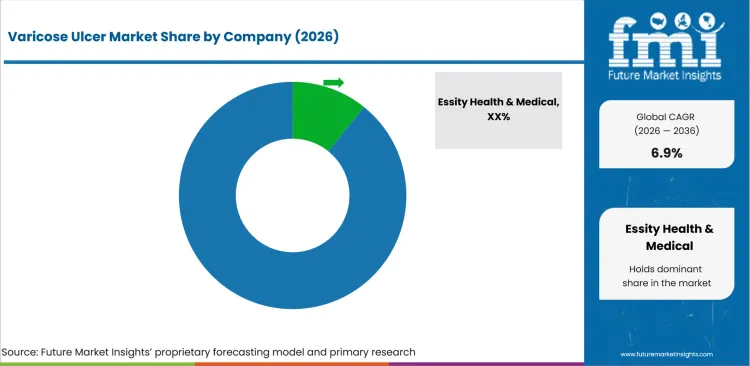
The market remains fragmented across compression, dressings and regenerative products that address different treatment stages. Entry barriers include clinical evidence, reimbursement support and service capability for digital wound measurement across repeated visits.
- Essity Health & Medical, Solventum Corporation and Smith+Nephew combine compression with broader wound-management portfolios and clinician education across hospital and community settings.
- Mölnlycke Health Care, Convatec Group PLC and Coloplast A/S compete through exudate control, wound cleansing and advanced dressing breadth across recurring care pathways.
- Organogenesis Holdings Inc. and Integra LifeSciences Holdings Corporation focus on cellular or dermal matrix products used during specialist escalation for difficult chronic ulcers.
Competitive Benchmarking: Varicose Ulcer Market
| Company | Therapy Pathway Breadth | Advanced Wound Depth | Clinical Support | Geographic Reach |
|---|---|---|---|---|
| Essity Health & Medical | Medium | Medium | Medium | Global |
| Solventum Corporation | High | High | High | Global |
| Smith+Nephew | High | High | High | Global |
| Mölnlycke Health Care | High | High | High | Global |
| Convatec Group PLC | Medium | High | High | Global |
| Coloplast A/S | Medium | High | Medium | Global |
| Organogenesis Holdings Inc. | Low | High | High | United States |
| Integra LifeSciences Holdings Corporation | Low | Medium | Medium | Global |
Key Developments in the Varicose Ulcer Market
- In May 2026, Smith+Nephew launched ALLEVYN Complete Care and RENASYS EDGE for chronic wound management across dressing and portable negative pressure pathways.
- In December 2025, Solventum Corporation completed the Acera Surgical acquisition and added synthetic tissue matrices to its United States acute-care wound portfolio.
- In July 2025, Convatec Group PLC secured clearance in the United States and Europe for Aquacel ConvaFiber. The gelling-fiber dressing is indicated for venous leg ulcers across acute and community clinical settings.
Key Players in the Varicose Ulcer Market
Integrated Wound Care Platforms
- Essity Health & Medical
- Solventum Corporation
- Smith+Nephew
Advanced Dressing and Wound Management Specialists
- Mölnlycke Health Care
- Convatec Group PLC
- Coloplast A/S
Cellular and Tissue-Based Product Providers
- Organogenesis Holdings Inc.
- Integra LifeSciences Holdings Corporation
Varicose Ulcer Market - Report Scope
| Coverage field | Report scope |
|---|---|
| Market breakdown | By therapy type, ulcer severity, end user, treatment setting, distribution channel and region. |
| Quantitative Units | Revenue USD billion and CAGR in % |
| Market Definition | Products used to control venous pressure, manage wound beds and support healing throughout varicose ulcer treatment. |
| Regions Covered | North America, Latin America, Europe, East Asia, South Asia and Pacific, and Middle East and Africa. |
| Countries Covered | South Korea, Australia, Canada, United States, United Kingdom, and 20+ countries included in the full report. |
| Key Companies Profiled | Essity Health & Medical, Solventum Corporation, Smith+Nephew, Mölnlycke Health Care, Convatec Group PLC, Coloplast A/S, Organogenesis Holdings Inc. and Integra LifeSciences Holdings Corporation. |
| Forecast Period | 2026 to 2036. |
| Approach | Primary and secondary research with market triangulation. |
Varicose Ulcer Market - Research Methodology
| Method | Approach |
|---|---|
| Primary Research | FMI analysts gathered input from manufacturers, service providers, technology developers, distributors, end users, procurement teams, and subject-matter experts. Interviews examined purchasing decisions, product or service evaluation, adoption barriers, approval requirements, pricing considerations, and expectations for technical or commercial support. Respondents were also asked what evidence is required before a trial, pilot, or initial order develops into regular purchasing. |
| Desk Research | Desk research covered government statistics, regulatory publications, trade data, industry associations, technical literature, standards, company filings, product information, and official corporate announcements. Sources were reviewed for relevance, publication date, geographic coverage, and consistency with the defined market scope. Claims relating to performance, applications, approvals, capacity, investment, and commercial activity were retained only when supported by credible public evidence. |
| Market Sizing and Forecasting | The market model combined the baseline value with historical performance, segment structure, pricing and volume indicators, adoption levels, company participation, and country-level demand conditions. Forecast assumptions considered economic activity, investment trends, regulatory developments, technology adoption, purchasing cycles, supply availability, and barriers to wider market use. Segment and regional estimates were reconciled before the final market total was calculated. |
| Data Validation | Estimates were checked against multiple independent indicators, including public data, company activity, trade patterns, industry developments, and findings from primary interviews. Validation also tested whether products, services, applications, and company revenues fell within the defined market boundaries. Adjacent categories, unsupported claims, overlapping revenues, and activities without direct market relevance were excluded to reduce double counting and maintain consistency across segments and countries. |
Varicose Ulcer Market by Segments
Varicose Ulcer Market segmented by Therapy Type:
- Compression Therapy
- Multilayer Compression Systems
- Dual-Layer Ulcer Stocking Kits
- Advanced Wound Dressings
- Foam Dressings
- Hydrofiber-CMC Dressings
- Biologics - Cellular & Tissue-Based Products
- Living Cell Constructs
- Amniotic-Chorionic Membranes
- Adjunctive Therapies
- Negative Pressure Wound Therapy
- Enzymatic Debridement Agents
Varicose Ulcer Market segmented by Ulcer Severity:
- Uncomplicated Varicose Ulcers
- Early-Stage Venous Leg Ulcers
- Superficial Venous Ulcers
- Complicated Varicose Ulcers
- Infected Venous Ulcers
- Deep or Exudative Ulcers
- Refractory - High-Risk Varicose Ulcers
- Non-Healing Ulcers
- Recurrent Venous Ulcers
Varicose Ulcer Market segmented by End User:
- Hospitals
- Inpatient Wound Care Departments
- Hospital-Based Vascular Clinics
- Wound Care Centers & Specialty Clinics
- Specialized Wound Care Centers
- Vascular & Dermatology Clinics
- Home Healthcare & Community Nursing
- Home Nursing Services
- Community Wound Care
- Ambulatory Surgical Centers & Office-Based Labs
- Ambulatory Surgical Centers
- Office-Based Vascular Labs
Varicose Ulcer Market segmented by Treatment Setting:
- Hospital-Based Care
- Inpatient Treatment
- Outpatient Hospital Clinics
- Specialty Wound Care
- Wound Care Centers
- Vascular Specialty Clinics
- Home-Based Care
- Home Healthcare
- Community Nursing
- Ambulatory Care
- Ambulatory Surgical Centers
- Office-Based Laboratories
Varicose Ulcer Market segmented by Distribution Channel:
- Direct Institutional Sales
- Hospital Procurement
- Healthcare System Contracts
- Medical & Specialty Distributors
- Medical Device Distributors
- Wound Care Product Distributors
- Retail & Community Pharmacies
- Chain Pharmacies
- Independent Pharmacies
- Online & E-Commerce
- Online Medical Supply Platforms
- Direct-to-Consumer Websites
Varicose Ulcer Market by Region:
- North America
- United States
- Canada
- Latin America
- Brazil
- Chile
- Mexico
- Rest of Latin America
- Western Europe
- Germany
- United Kingdom
- Italy
- Spain
- France
- Nordics
- Benelux
- Rest of Western Europe
- Eastern Europe
- Russia
- Poland
- Hungary
- Balkan and Baltic States
- Rest of Eastern Europe
- East Asia
- China
- Japan
- South Korea
- South Asia and Pacific
- India
- ASEAN
- Australia and New Zealand
- Rest of South Asia and Pacific
- Middle East and Africa
- Kingdom of Saudi Arabia
- Other GCC Countries
- Türkiye
- South Africa
- Other African Union Countries
- Rest of Middle East and Africa
Research Sources and Bibliography
- MedTech Europe. (2026, March 31). White paper: Shaping the future of wound care in Europe.
- Society for Cardiovascular Angiography & Interventions. (2025, June 30). SCAI Clinical Document Provides Clinical Practice Guidelines for the Management of Chronic Venous Disease.
- National Institute for Health and Care Excellence. (2025, August 27). Compression products for treating venous leg ulcers: late-stage assessment.
- Organogenesis Holdings Inc. (2026, February 26). Form 10-K.
- Coloplast A/S. (2026, May 1). Coloplast receives Innovative Technology contract from Vizient for Biatain Silicone Fit.
- Centers for Medicare & Medicaid Services. (2025, April 11). CMS Statement on Local Coverage Determination for Certain Skin Substitute Grafts.
- Australian Government Department of Health, Disability and Ageing. (2025, June 18). Free Medicare chronic wound care scheme starts.
- Ministry of Food and Drug Safety. (2026, February 11). Medical Device Good Manufacturing Practice (GMP) Regulations.
- Victoria Department of Health. (2025, October 29). Non-healing or chronic lower leg ulcers.
- Government of Ontario. (2025, September 9). Medical surgical | Ontario Disability Support Program (ODSP) schedule of benefits for mandatory special necessities.
- Centers for Medicare & Medicaid Services. (2025, December 24). Final Local Coverage Determinations (LCDs) for Certain Skin Substitutes Withdrawn.
- NHS England. (2026, March 3). Standardising community health services - core component descriptions.
- Essity. (2025, December 2). Proforma reporting of Essity’s new business areas.
- Smith+Nephew. (2026, May 5). Smith+Nephew drives progress in chronic wound care with ALLEVYN COMPLETE CARE Dressing and RENASYS EDGE tNPWT set to launch at EWMA 2026.
- Solventum Corporation. (2025, December 23). Solventum Completes Acquisition of Acera Surgical.
- Convatec Group PLC. (2025, July 24). Convatec secures US and European regulatory clearance for Aquacel ConvaFiber wound care innovation.
- Mölnlycke Health Care. (2025, May 28). Mölnlycke Health Care acquires P.G.F. Industry Solutions GmbH, the manufacturer of Granudacyn, a range of solutions for wound cleansing and moisturising.
- Integra LifeSciences Holdings Corporation. (2026, April 7). Integra LifeSciences Unveils New Real-World Evidence Highlighting PriMatrix Utilization.
- Solventum Corporation. (2026, February 27). Annual report on Form 10-K for the year ended December 31, 2025.
- Convatec Group PLC. (2026, February 24). Annual results for the year ended 31 December 2025.
This bibliography is provided for reader reference and is not exhaustive. The full report contains the complete reference list and detailed citations
This Report Answers
- How large is the Varicose Ulcer Market in 2026 and 2036?
- Which therapy type accounts for the largest approved 2026 share?
- How does ulcer severity change product selection and escalation routes?
- Which end user and treatment setting shape institutional product demand?
- How do country growth rates differ across the forecast period?
- Which companies provide compression, dressings and regenerative wound products?
- What clinical factors limit safe compression and advanced therapy adoption?
- How should decision-makers compare treatment continuity across different care settings?
Frequently Asked Questions
How big is the Varicose Ulcer Market in 2026?
USD 3.9 billion is the 2026 value of the Varicose Ulcer Market across compression systems and recurring clinical wound products. Vascular assessment and dressing changes support repeat purchases as the Varicose Ulcer Market approaches USD 7.6 billion by 2036 globally.
What is the CAGR of the Varicose Ulcer Market from 2026 to 2036?
6.9% is the projected ten-year CAGR of the Varicose Ulcer Market from 2026 to 2036. Expansion reflects repeated compression fitting and wound-product replacement across hospital and community pathways that require ongoing clinical review throughout active healing and recurrence prevention programs.
Which therapy type leads the Varicose Ulcer Market?
38.5% is the projected 2026 therapy-type share for compression therapy within the Varicose Ulcer Market. Direct venous-pressure control supports its position, while arterial screening and patient tolerance determine safe pressure during each treatment episode and subsequent scheduled clinical review appointments.
How much will the Varicose Ulcer Market add between 2026 and 2036?
USD 3.7 billion is expected to be added to the Varicose Ulcer Market between 2026 and 2036. Incremental value comes from recurring compression, advanced dressings and specialist escalation products used across extended treatment episodes instead of isolated product purchases and procedures.
Which companies are active in the Varicose Ulcer Market?
Key companies in varicose ulcer market include Essity Health & Medical, Solventum Corporation, Smith+Nephew, Mölnlycke Health Care, Convatec Group PLC, Coloplast A/S, Organogenesis Holdings Inc. and Integra LifeSciences Holdings Corporation. The group covers compression, advanced dressings, wound cleansing, negative pressure therapy and regenerative wound matrices.
Preview the report firsthand - request a free sample
Get SampleGet the brochure for pricing and purchase details.
Get PDFTable of Content
- Key Takeaways
- Market Size and CAGR
- Top Growth Driver
- Fastest Growing Segment
- Leading Region
- Key Companies
- Emerging Opportunities
- Executive Summary
- Global Market Outlook
- Demand-side Trends
- Supply-side Trends
- Technology Roadmap Analysis
- Analysis and Recommendations
- Analyst Perspective (What is happening? Why now? What should investors know?)
- Key Questions Answered
- How large is the market?
- What is the CAGR?
- What are key trends?
- Which region dominates?
- Who are the leaders?
- Market Overview
- Market Coverage / Taxonomy
- Market Definition / Scope / Limitations
- Research Methodology
- Chapter Orientation
- Analytical Lens and Working Hypotheses
- Market Structure, Signals, and Trend Drivers
- Benchmarking and Cross-market Comparability
- Market Sizing, Forecasting, and Opportunity Mapping
- Research Design and Evidence Framework
- Desk Research Programme (Secondary Evidence)
- Expert Input and Fieldwork (Primary Evidence)
- Tooling, Models, and Reference Databases
- Data Engineering and Model Build
- Quality Assurance and Audit Trail
- Market Background
- Market Dynamics (Drivers, Restraints, Opportunity, Trends)
- Scenario Forecast (Optimistic, Likely, Conservative)
- Impact Analysis
- AI Impact
- Sustainability Impact
- Regulatory Impact
- Technology Impact
- Consumer / Buyer Analysis
- Purchase Drivers
- Adoption Barriers
- Buyer Journey
- Opportunity Map Analysis
- Product Life Cycle Analysis
- Supply Chain Analysis
- Investment Feasibility Matrix
- Value Chain Analysis
- PESTLE and Porter's Analysis
- Regulatory Landscape
- Regional Parent Market Outlook
- Production and Consumption Statistics
- Import and Export Statistics
- Global Market Analysis and Forecast, 2021 to 2036
- Historical Market Size Value (USD Billion) Analysis, 2021 to 2025
- Current and Future Market Size Value (USD Billion) Projections, 2026 to 2036
- Y-o-Y Growth Trend Analysis
- Absolute $ Opportunity Analysis
- Global Market Pricing Analysis, 2021 to 2036
- Global Market Analysis and Forecast, By Therapy Type, 2021 to 2036
- Introduction / Key Findings
- Historical Market Size Value (USD Billion) Analysis By Therapy Type, 2021 to 2025
- Current and Future Market Size Value (USD Billion) Analysis and Forecast By Therapy Type, 2026 to 2036
- Compression Therapy
- Multilayer Compression Systems
- Dual-Layer Ulcer Stocking Kits
- Advanced Wound Dressings
- Foam Dressings
- Hydrofiber-CMC Dressings
- Biologics - Cellular & Tissue-Based Products
- Living Cell Constructs
- Amniotic-Chorionic Membranes
- Adjunctive Therapies
- Negative Pressure Wound Therapy
- Enzymatic Debridement Agents
- Compression Therapy
- Y-o-Y Growth Trend Analysis By Therapy Type, 2021 to 2025
- Absolute $ Opportunity Analysis By Therapy Type, 2026 to 2036
- Global Market Analysis and Forecast, By Ulcer Severity, 2021 to 2036
- Introduction / Key Findings
- Historical Market Size Value (USD Billion) Analysis By Ulcer Severity, 2021 to 2025
- Current and Future Market Size Value (USD Billion) Analysis and Forecast By Ulcer Severity, 2026 to 2036
- Uncomplicated Varicose Ulcers
- Early-Stage Venous Leg Ulcers
- Superficial Venous Ulcers
- Complicated Varicose Ulcers
- Infected Venous Ulcers
- Deep or Exudative Ulcers
- Refractory - High-Risk Varicose Ulcers
- Non-Healing Ulcers
- Recurrent Venous Ulcers
- Uncomplicated Varicose Ulcers
- Y-o-Y Growth Trend Analysis By Ulcer Severity, 2021 to 2025
- Absolute $ Opportunity Analysis By Ulcer Severity, 2026 to 2036
- Global Market Analysis and Forecast, By End User, 2021 to 2036
- Introduction / Key Findings
- Historical Market Size Value (USD Billion) Analysis By End User, 2021 to 2025
- Current and Future Market Size Value (USD Billion) Analysis and Forecast By End User, 2026 to 2036
- Hospitals
- Inpatient Wound Care Departments
- Hospital-Based Vascular Clinics
- Wound Care Centers & Specialty Clinics
- Specialized Wound Care Centers
- Vascular & Dermatology Clinics
- Home Healthcare & Community Nursing
- Home Nursing Services
- Community Wound Care
- Ambulatory Surgical Centers & Office-Based Labs
- Ambulatory Surgical Centers
- Office-Based Vascular Labs
- Hospitals
- Y-o-Y Growth Trend Analysis By End User, 2021 to 2025
- Absolute $ Opportunity Analysis By End User, 2026 to 2036
- Global Market Analysis and Forecast, By Treatment Setting, 2021 to 2036
- Introduction / Key Findings
- Historical Market Size Value (USD Billion) Analysis By Treatment Setting, 2021 to 2025
- Current and Future Market Size Value (USD Billion) Analysis and Forecast By Treatment Setting, 2026 to 2036
- Hospital-Based Care
- Inpatient Treatment
- Outpatient Hospital Clinics
- Specialty Wound Care
- Wound Care Centers
- Vascular Specialty Clinics
- Home-Based Care
- Home Healthcare
- Community Nursing
- Ambulatory Care
- Ambulatory Surgical Centers
- Office-Based Laboratories
- Hospital-Based Care
- Y-o-Y Growth Trend Analysis By Treatment Setting, 2021 to 2025
- Absolute $ Opportunity Analysis By Treatment Setting, 2026 to 2036
- Global Market Analysis and Forecast, By Distribution Channel, 2021 to 2036
- Introduction / Key Findings
- Historical Market Size Value (USD Billion) Analysis By Distribution Channel, 2021 to 2025
- Current and Future Market Size Value (USD Billion) Analysis and Forecast By Distribution Channel, 2026 to 2036
- Direct Institutional Sales
- Hospital Procurement
- Healthcare System Contracts
- Medical & Specialty Distributors
- Medical Device Distributors
- Wound Care Product Distributors
- Retail & Community Pharmacies
- Chain Pharmacies
- Independent Pharmacies
- Online & E-Commerce
- Online Medical Supply Platforms
- Direct-to-Consumer Websites
- Direct Institutional Sales
- Y-o-Y Growth Trend Analysis By Distribution Channel, 2021 to 2025
- Absolute $ Opportunity Analysis By Distribution Channel, 2026 to 2036
- Global Market Analysis and Forecast, By Region, 2021 to 2036
- Introduction
- Historical Market Size Value (USD Billion) Analysis By Region, 2021 to 2025
- Current Market Size Value (USD Billion) Analysis and Forecast By Region, 2026 to 2036
- North America
- Latin America
- Western Europe
- Eastern Europe
- East Asia
- South Asia and Pacific
- Middle East & Africa
- Market Attractiveness Analysis By Region
- North America Market Analysis and Forecast, By Country, 2021 to 2036
- Historical Market Size Value (USD Billion) Trend Analysis By Market Taxonomy, 2021 to 2025
- Market Size Value (USD Billion) Forecast By Market Taxonomy, 2026 to 2036
- By Country
- USA
- Canada
- By Therapy Type
- By Ulcer Severity
- By End User
- By Treatment Setting
- By Distribution Channel
- By Country
- Market Attractiveness Analysis
- By Country
- By Therapy Type
- By Ulcer Severity
- By End User
- By Treatment Setting
- By Distribution Channel
- Key Takeaways
- Latin America Market Analysis and Forecast, By Country
- Historical Market Size Value (USD Billion) Trend Analysis By Market Taxonomy, 2021 to 2025
- Market Size Value (USD Billion) Forecast By Market Taxonomy, 2026 to 2036
- By Country
- Brazil
- Mexico
- Chile
- Rest of Latin America
- By Therapy Type
- By Ulcer Severity
- By End User
- By Treatment Setting
- By Distribution Channel
- By Country
- Market Attractiveness Analysis
- By Country
- By Therapy Type
- By Ulcer Severity
- By End User
- By Treatment Setting
- By Distribution Channel
- Key Takeaways
- Western Europe Market Analysis and Forecast, By Country
- Historical Market Size Value (USD Billion) Trend Analysis By Market Taxonomy, 2021 to 2025
- Market Size Value (USD Billion) Forecast By Market Taxonomy, 2026 to 2036
- By Country
- Germany
- UK
- Italy
- Spain
- France
- Nordic
- BENELUX
- Rest of Western Europe
- By Therapy Type
- By Ulcer Severity
- By End User
- By Treatment Setting
- By Distribution Channel
- By Country
- Market Attractiveness Analysis
- By Country
- By Therapy Type
- By Ulcer Severity
- By End User
- By Treatment Setting
- By Distribution Channel
- Key Takeaways
- Eastern Europe Market Analysis and Forecast, By Country
- Historical Market Size Value (USD Billion) Trend Analysis By Market Taxonomy, 2021 to 2025
- Market Size Value (USD Billion) Forecast By Market Taxonomy, 2026 to 2036
- By Country
- Russia
- Poland
- Hungary
- Balkan & Baltic
- Rest of Eastern Europe
- By Therapy Type
- By Ulcer Severity
- By End User
- By Treatment Setting
- By Distribution Channel
- By Country
- Market Attractiveness Analysis
- By Country
- By Therapy Type
- By Ulcer Severity
- By End User
- By Treatment Setting
- By Distribution Channel
- Key Takeaways
- East Asia Market Analysis and Forecast, By Country
- Historical Market Size Value (USD Billion) Trend Analysis By Market Taxonomy, 2021 to 2025
- Market Size Value (USD Billion) Forecast By Market Taxonomy, 2026 to 2036
- By Country
- China
- Japan
- South Korea
- By Therapy Type
- By Ulcer Severity
- By End User
- By Treatment Setting
- By Distribution Channel
- By Country
- Market Attractiveness Analysis
- By Country
- By Therapy Type
- By Ulcer Severity
- By End User
- By Treatment Setting
- By Distribution Channel
- Key Takeaways
- South Asia and Pacific Market Analysis and Forecast, By Country
- Historical Market Size Value (USD Billion) Trend Analysis By Market Taxonomy, 2021 to 2025
- Market Size Value (USD Billion) Forecast By Market Taxonomy, 2026 to 2036
- By Country
- India
- ASEAN
- Australia & New Zealand
- Rest of South Asia and Pacific
- By Therapy Type
- By Ulcer Severity
- By End User
- By Treatment Setting
- By Distribution Channel
- By Country
- Market Attractiveness Analysis
- By Country
- By Therapy Type
- By Ulcer Severity
- By End User
- By Treatment Setting
- By Distribution Channel
- Key Takeaways
- Middle East & Africa Market Analysis and Forecast, By Country
- Historical Market Size Value (USD Billion) Trend Analysis By Market Taxonomy, 2021 to 2025
- Market Size Value (USD Billion) Forecast By Market Taxonomy, 2026 to 2036
- By Country
- Kingdom of Saudi Arabia
- Other GCC Countries
- Türkiye
- South Africa
- Other African Union
- Rest of Middle East & Africa
- By Therapy Type
- By Ulcer Severity
- By End User
- By Treatment Setting
- By Distribution Channel
- By Country
- Market Attractiveness Analysis
- By Country
- By Therapy Type
- By Ulcer Severity
- By End User
- By Treatment Setting
- By Distribution Channel
- Key Takeaways
- Key Countries Market Analysis
- USA
- Pricing Analysis
- Market Share Analysis, 2025
- By Therapy Type
- By Ulcer Severity
- By End User
- By Treatment Setting
- By Distribution Channel
- Canada
- Pricing Analysis
- Market Share Analysis, 2025
- By Therapy Type
- By Ulcer Severity
- By End User
- By Treatment Setting
- By Distribution Channel
- Mexico
- Pricing Analysis
- Market Share Analysis, 2025
- By Therapy Type
- By Ulcer Severity
- By End User
- By Treatment Setting
- By Distribution Channel
- Brazil
- Pricing Analysis
- Market Share Analysis, 2025
- By Therapy Type
- By Ulcer Severity
- By End User
- By Treatment Setting
- By Distribution Channel
- Chile
- Pricing Analysis
- Market Share Analysis, 2025
- By Therapy Type
- By Ulcer Severity
- By End User
- By Treatment Setting
- By Distribution Channel
- Germany
- Pricing Analysis
- Market Share Analysis, 2025
- By Therapy Type
- By Ulcer Severity
- By End User
- By Treatment Setting
- By Distribution Channel
- UK
- Pricing Analysis
- Market Share Analysis, 2025
- By Therapy Type
- By Ulcer Severity
- By End User
- By Treatment Setting
- By Distribution Channel
- Italy
- Pricing Analysis
- Market Share Analysis, 2025
- By Therapy Type
- By Ulcer Severity
- By End User
- By Treatment Setting
- By Distribution Channel
- Spain
- Pricing Analysis
- Market Share Analysis, 2025
- By Therapy Type
- By Ulcer Severity
- By End User
- By Treatment Setting
- By Distribution Channel
- France
- Pricing Analysis
- Market Share Analysis, 2025
- By Therapy Type
- By Ulcer Severity
- By End User
- By Treatment Setting
- By Distribution Channel
- India
- Pricing Analysis
- Market Share Analysis, 2025
- By Therapy Type
- By Ulcer Severity
- By End User
- By Treatment Setting
- By Distribution Channel
- ASEAN
- Pricing Analysis
- Market Share Analysis, 2025
- By Therapy Type
- By Ulcer Severity
- By End User
- By Treatment Setting
- By Distribution Channel
- Australia & New Zealand
- Pricing Analysis
- Market Share Analysis, 2025
- By Therapy Type
- By Ulcer Severity
- By End User
- By Treatment Setting
- By Distribution Channel
- China
- Pricing Analysis
- Market Share Analysis, 2025
- By Therapy Type
- By Ulcer Severity
- By End User
- By Treatment Setting
- By Distribution Channel
- Japan
- Pricing Analysis
- Market Share Analysis, 2025
- By Therapy Type
- By Ulcer Severity
- By End User
- By Treatment Setting
- By Distribution Channel
- South Korea
- Pricing Analysis
- Market Share Analysis, 2025
- By Therapy Type
- By Ulcer Severity
- By End User
- By Treatment Setting
- By Distribution Channel
- Russia
- Pricing Analysis
- Market Share Analysis, 2025
- By Therapy Type
- By Ulcer Severity
- By End User
- By Treatment Setting
- By Distribution Channel
- Poland
- Pricing Analysis
- Market Share Analysis, 2025
- By Therapy Type
- By Ulcer Severity
- By End User
- By Treatment Setting
- By Distribution Channel
- Hungary
- Pricing Analysis
- Market Share Analysis, 2025
- By Therapy Type
- By Ulcer Severity
- By End User
- By Treatment Setting
- By Distribution Channel
- Kingdom of Saudi Arabia
- Pricing Analysis
- Market Share Analysis, 2025
- By Therapy Type
- By Ulcer Severity
- By End User
- By Treatment Setting
- By Distribution Channel
- Türkiye
- Pricing Analysis
- Market Share Analysis, 2025
- By Therapy Type
- By Ulcer Severity
- By End User
- By Treatment Setting
- By Distribution Channel
- South Africa
- Pricing Analysis
- Market Share Analysis, 2025
- By Therapy Type
- By Ulcer Severity
- By End User
- By Treatment Setting
- By Distribution Channel
- USA
- Market Structure Analysis
- Competition Dashboard
- Competition Benchmarking
- Market Share Analysis of Top Players
- By Regional
- By Therapy Type
- By Ulcer Severity
- By End User
- By Treatment Setting
- By Distribution Channel
- Emerging Startups
- Innovation Benchmarking
- Competition Analysis
- Competition Deep Dive
- Essity Health & Medical
- Overview
- Product Portfolio
- Profitability by Market Segments
- Sales Footprint
- Strategy Overview
- Marketing Strategy
- Product Strategy
- Channel Strategy
- Solventum
- Smith+Nephew
- Mölnlycke Health Care
- Convatec Group PLC
- Coloplast A/S
- Organogenesis Holdings Inc.
- Integra LifeSciences Holdings Corporation
- B. Braun Melsungen AG
- Cardinal Health
- Others
- Essity Health & Medical
- Case Studies
- Success Stories
- Recent Developments
- Competition Deep Dive
- Assumptions & Acronyms Used


