

- Industry Size (2026)
- USD 22.7 Bn
- Forecast (2036)
- USD 33.5 Bn
- CAGR (2026 to 2036)
- 4.0%
Vascular Endothelial Growth Factor Inhibitor Market Size, Market Forecast and Outlook By FMI
The vascular endothelial growth factor inhibitor market is likely to grow from USD 22.7 billion in 2026 to USD 33.5 billion by 2036. The industry is anticipated to register 4.0% CAGR during the forecast period. Biologics are projected to lead with 72.1% share in 2026. Oncology is likely to account for 75.5% of disease indication demand in 2026.
Summary of the Vascular Endothelial Growth Factor Inhibitor Market
- Demand and Growth Drivers
- Solid tumor treatment needs may keep VEGF inhibitor use steady in oncology care.
- Biosimilar launches are likely to improve patient access across cost-sensitive healthcare systems.
- Retinal disease treatment is forecast to support demand for long-acting anti-VEGF therapies.
- Product and Segment View
- Biologics are likely to lead drug demand due to their targeted action against VEGF pathways.
- VEGF A inhibitors are projected to retain preference as they address major angiogenesis mechanisms.
- Oncology may remain the main indication as cancer therapies use higher systemic doses.
- Geography and Competitive Outlook
- North America is likely to maintain strong demand through biologic adoption and specialty care access.
- Asia is forecast to expand as biosimilars and oncology treatment coverage improve.
- Leading companies are anticipated to focus on lifecycle management and subcutaneous formulations.
- Analyst Opinion
- Sabyasachi Ghosh, Principal Consultant for Healthcare at FMI, suggests, “The vascular endothelial growth factor inhibitor market is moving toward broader access and improved delivery formats. Companies with strong biologic portfolios and reliable biosimilar strategies are likely to gain advantage as oncology and retinal care demand stable treatment options.”
- Vascular Endothelial Growth Factor Inhibitor Market Value Analysis
- The vascular endothelial growth factor inhibitor market is shifting from single blockbuster reliance toward biosimilar-supported treatment access.
- Oncology centers are projected to prefer therapies with proven survival benefit and manageable safety profiles.
- VEGF A inhibitors are likely to keep commercial strength because they address core angiogenesis pathways.
- Investment across North America and Asia is forecast to focus on biosimilars and longer-acting delivery systems.
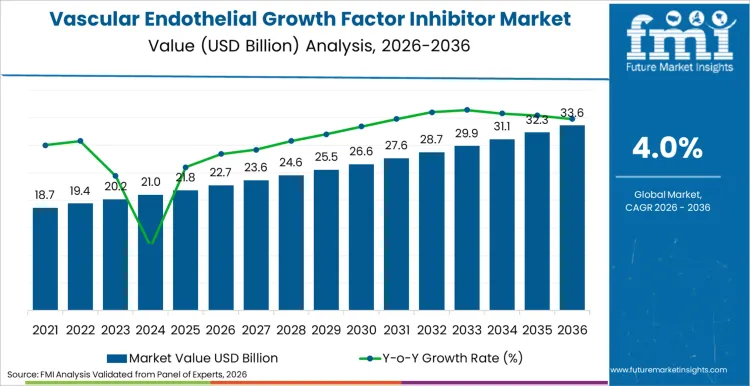
Key Takeaways, Market Size, and Forecast
| Metric | Value |
|---|---|
| Market Size (2026) | USD 22.7 Billion |
| Market Size (2036) | USD 33.5 Billion |
| CAGR (2026–2036) | 4.0% |
| Leading Drug (2026) | Biologics |
| Biologics Share (2026) | 72.1% |
| Leading Disease Indication (2026) | Oncology |
| Oncology Share (2026) | 75.5% |
| Fastest-Growing Country | Australia |
| Australia CAGR | 4.0% |
Vascular Endothelial Growth Factor Inhibitor Market Key Takeaways
| Metric | Value |
|---|---|
| Industry Size (2026) | USD 22.7 Billion |
| Industry Value (2036) | USD 33.5 Billion |
| CAGR (2026 to 2036) | 4.0% |
Source: Future Market Insights (FMI) analysis, based on proprietary forecasting model and primary research
What Drivers Are Accelerating Market Expansion?
Catalysts for market expansion include the rising incidence of metastatic cancers and age-related eye conditions. Despite the high cost of therapy, clinical outcomes justify spending on retinal biologics that preserve vision and extend survival. FMI analysts opine that the widespread adoption of angiogenesis assays in drug discovery is accelerating the identification of potent new molecules. Manufacturers are responding by launching biosimilars that offer equivalent efficacy at a lower price point, expanding the addressable patient population. The integration of biomarkers to predict patient response is also refining treatment protocols, reducing wastage and improving the value proposition of these expensive therapies for payers.
Companies are acquiring biotech firms specializing in uveal melanoma treatment to expand their niche oncology portfolios. Large conglomerates are also diversifying into ocular drug delivery system technologies to extend the lifecycle of their molecules into ophthalmology. Investment in ophthalmic biologics manufacturing capacity allows brands to ensure stable supply chains for both cancer and retinal indications. Such strategic moves ensure resilience against patent cliffs while meeting evolving clinical demands for multi-indication blockbusters.
How Is the Vascular Endothelial Growth Factor Inhibitor Market Segmented?
Global landscapes are intricately divided across drug class, type, and indication, allowing stakeholders to identify specific value pools like solid tumors or retinal diseases. Segmentation strategies enable manufacturers to tailor production capabilities, dedicating sterile fill-finish lines for ophthalmic injectable products while optimizing bulk fermentation for oncology biologics. Understanding distinctions between chronic maintenance therapy in cancer and acute intervention in eye disease is critical for commercial strategy. Dominant segments dictate procurement of key raw materials, with biologics requiring complex supply chains for living cell lines. Such granular analysis helps companies allocate R&D budgets effectively towards high-growth categories.
Why Do Biologics Maintain Dominance?
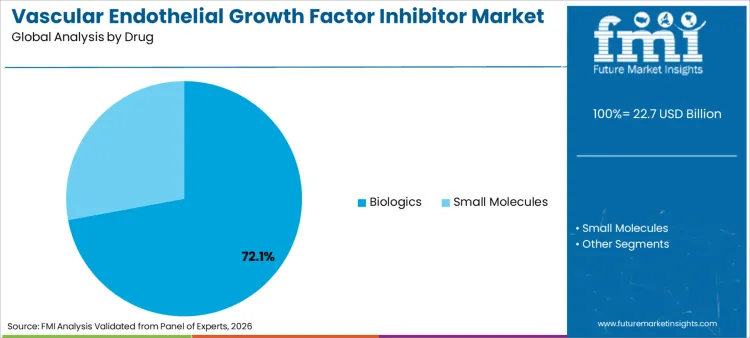
Biologics account for 72.1% of share in 2026, driven by their high specificity and potency in neutralizing VEGF proteins. Monoclonal antibodies have become the cornerstone of anti-angiogenic therapy, offering targeted action that small molecules often struggle to match. Dominance is reinforced by the success of ophthalmic prefilled injectables which improve dosing accuracy and safety. As per FMI's projection, the complex manufacturing process of biologics creates a high barrier to entry, protecting market share for established players. The clinical success of these large molecules in treating varied conditions from colon cancer to wet AMD ensures steady demand across multiple medical specialties.
Why Do VEGF A Inhibitors Lead the Type Category?
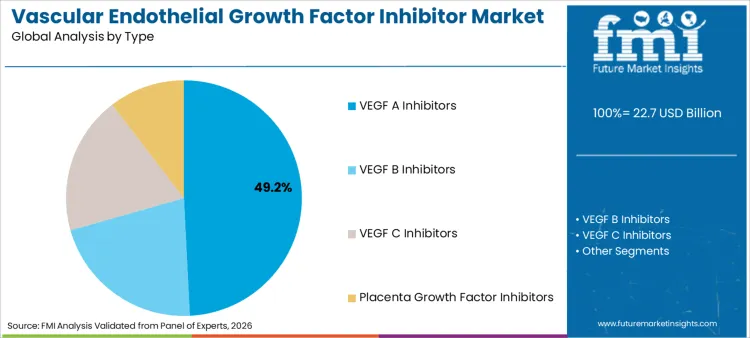
VEGF A inhibitors account for 49.2% of share in 2026, driven by the protein's central role in pathological angiogenesis. Blocking this specific pathway has proven most effective in starving tumors of blood supply and reducing vascular leakage in the eye. FMI is of the opinion that the widespread approval of drugs targeting VEGF-A for diabetic retinopathy solidifies this segment's leadership. Continuous research into optimizing the binding affinity of these inhibitors is extending dosing intervals, a key factor in patient adherence. The versatility of VEGF-A inhibition across different tissue types makes it the primary target for drug developers aiming for blockbuster status.
Why Does Oncology Lead Disease Indications?
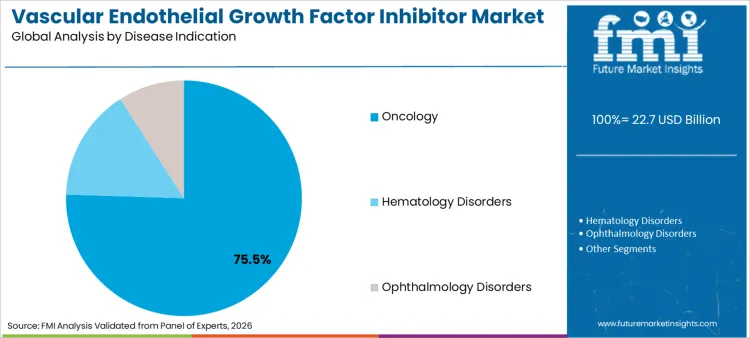
Oncology accounts for 75.5% of share in 2026, driven by the systemic nature of cancer treatment which requires higher dosages compared to localized ophthalmic applications. The integration of anti-VEGF agents into standard-of-care regimens for prevalent cancers like lung, kidney, and colorectal ensures massive volume consumption. According to FMI's estimates, the emergence of combination therapies with fibroblast growth factor receptor inhibitor drugs is further expanding the oncology segment. While ophthalmology is high-value, the sheer scale of the global cancer burden and the duration of maintenance therapies keeps oncology as the overwhelming revenue generator.
What Drivers Are Fueling Ophthalmic Applications?
A primary driver is the aging global population susceptible to vision-threatening conditions. Patients seek treatments that can halt progression, driving demand for diabetic retinopathy treatment options. The availability of wide field imaging systems aids in early detection, expanding the pool of eligible patients. FMI analysts opine that the shift from retinal laser photocoagulation to pharmacotherapy has revolutionized care standards. Brands marketing long-acting injectables are capturing market share by reducing the treatment burden. This focus on preserving quality of life through vision retention supports premium pricing strategies in the ophthalmology segment.
What Restraints Are Hampering Market Expansion?
High costs associated with biologic therapies act as a significant restraint, limiting access in developing regions. Budget constraints in public healthcare systems often lead to strict criteria for reimbursement, delaying treatment initiation. FMI is of the opinion that the risk of systemic side effects, such as hypertension and thrombosis, limits the use of these inhibitors in certain patient populations. The threat of counterfeit drugs necessitates investment in authentication and brand protection solutions, adding to operational costs. Manufacturers struggle to balance broad accessibility with the need to recoup extensive R&D investments.
Which Trends Are Reshaping Retinal Therapy?
The trend towards extended-release delivery systems is reshaping retinal disease management. Research into retinal vein occlusion treatment is focusing on implants that elute drugs over months rather than requiring monthly injections. This aligns with the push to reduce the burden on caregivers and healthcare facilities. Integration with neovascular age related macular degeneration treatment protocols is creating a demand for dual-action molecules that target multiple pathways simultaneously. Such innovations cater to the need for more durable treatment responses in chronic eye conditions.
How Will the Vascular Endothelial Growth Factor Inhibitor Industry Evolve in Major Nations?
Global landscapes are characterized by high biologic adoption in Western nations, while Asian economies drive volume through biosimilar uptake and healthcare expansion. Each region presents unique regulatory drivers, from FDA fast-track designations in the USA to NMPA approvals in China. Successful global players must operate decentralized commercial strategies, tailoring pricing models to local reimbursement capabilities while leveraging global clinical data.
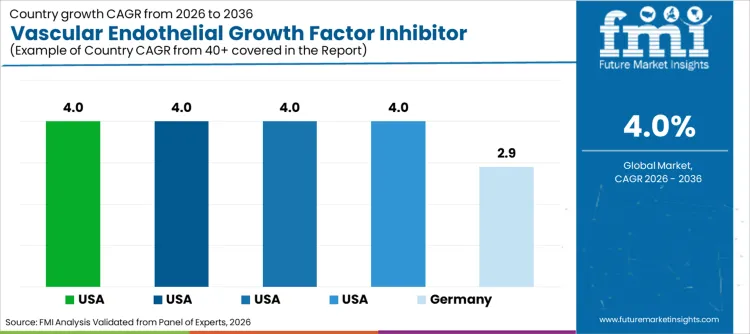
| Country | CAGR (2026 to 2036) |
|---|---|
| USA | 4.0% |
| China | 4.0% |
| Japan | 4.0% |
| Australia | 4.0% |
| Germany | 2.9% |
Source: Future Market Insights (FMI) analysis, based on proprietary forecasting model and primary research
Why Is the Market in the USA Driving Biologic Innovation?
Demand for VEGF inhibitors in the USA is set to grow at 4.0% CAGR. Growth is fueled by the rapid adoption of novel biologics and a robust insurance landscape that supports high-cost therapies. U.S. oncologists are early adopters of combination regimens, driving volume growth. FMI analysts opine that the presence of major pharmaceutical HQs fosters a competitive environment for clinical trials. The market for age related macular degeneration treatments is particularly strong due to high disease awareness and screening rates among the elderly population.
How Is the Landscape in China Leveraging Biosimilars?
VEGF inhibitor sales in China are projected to rise at 4.0% CAGR. Growth is underpinned by government efforts to expand the national reimbursement drug list (NRDL) to include advanced cancer therapies. Domestic manufacturers are aggressively launching biosimilars, making treatments more affordable. As per FMI's analysis, the rising burden of age related vision dysfunction is driving demand in the ophthalmology sector. The sheer size of the patient population allows for volume-based procurement strategies that sustain market growth despite price cuts.
Why Is the Domain in Germany Focusing on Cost-Effectiveness?
The VEGF inhibitor sector in Germany is poised to expand at 2.9% CAGR. Expansion is driven by a healthcare system that emphasizes evidence-based medicine and cost-benefit analysis. German providers prioritize therapies with proven survival benefits, influencing prescribing patterns. FMI is of the opinion that the market is seeing a shift towards outpatient cancer care, supporting the use of subcutaneous formulations. The integration of eye infections treatment protocols ensures comprehensive care, although strict pricing controls limit the explosive growth seen in other regions.
How Is the Industry in Japan Targeting Aging Demographics?
Japan's VEGF inhibitor industry is projected to grow at 4.0% CAGR. Characterized by a super-aged society, products often tie to the management of chronic age-related conditions like wet AMD. Manufacturers excel in providing patient-centric packaging and support services. "Preventative care" culture ensures early diagnosis and treatment initiation. Research institutes are focusing on ocular immunosuppresents to be used in conjunction with anti-VEGF therapies. The robust public insurance system supports widespread access to expensive biologics, maintaining steady market value.
Why Is the Sector in Australia Advancing Clinical Research?
VEGF inhibitor demand in Australia is set to grow at 4.0% CAGR. Growth concentrates around a strong clinical trial ecosystem and government subsidies for essential medicines. Australian researchers are pivotal in global studies for new indications. Innovation in localized delivery is supported by a well-integrated specialist network. The market benefits from high rates of skin cancer and related conditions, driving specific oncology demand. Efficient regulatory pathways allow for the timely introduction of new therapeutic options to the public.
How Is the Competitive Landscape in Vascular Endothelial Growth Factor Inhibitor Market Evolving?
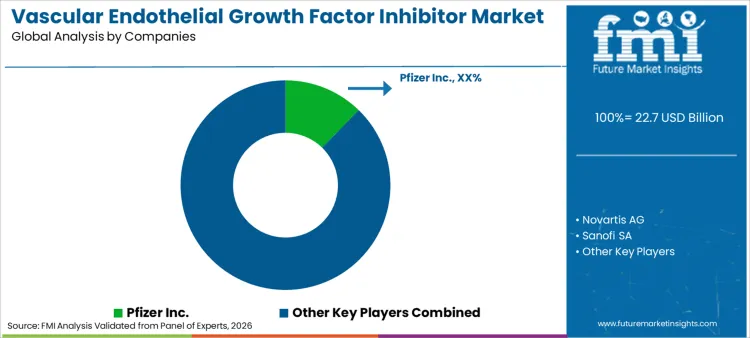
Market participants are increasingly focusing on lifecycle management to defend market share against biosimilars. Pfizer Inc. leads the market with a dominant 12.3% share, leveraging its diversified oncology portfolio and global commercial infrastructure. FMI is of the opinion that Pfizer's scale advantage allows it to negotiate favorable tender agreements and invest in extensive real-world evidence generation. Leading players are also engaging in M&A activities to acquire novel antibody platforms, integrating bispecifics that offer superior efficacy over first-generation inhibitors.
Competition is further intensified by the entry of biosimilar manufacturers offering high-quality alternatives at reduced prices. This trend forces incumbents to differentiate through improved delivery devices and patient support programs. Strategic partnerships with academic institutions drive the exploration of new biomarkers for patient selection. Service reliability and supply chain security are becoming key battlegrounds, with companies vying to become the preferred partner for hospital formularies by guaranteeing uninterrupted access to critical life-saving medications.
Key Players in Vascular Endothelial Growth Factor Inhibitor Market
- Pfizer Inc.
- Novartis AG
- Sanofi SA
- Bayer Healthcare LLC
- F. Hoffmann-La Roche Ltd
- Amgen Inc.
- Eli Lilly and Company
Scope of Report
| Items | Values |
|---|---|
| Quantitative Units | USD Billion |
| Drug | Biologics, Small Molecules |
| Type | VEGF A Inhibitors, VEGF B Inhibitors, VEGF C Inhibitors, Placenta Growth Factor Inhibitors |
| Disease Indication | Oncology, Hematology Disorders, Ophthalmology Disorders |
| Distribution Channel | Hospitals, Specialty Clinics, Mail Order Pharmacies |
| Regions | North America, Europe, East Asia, South Asia, Latin America, MEA |
Source: Future Market Insights (FMI) analysis, based on proprietary forecasting model and primary research
Vascular Endothelial Growth Factor Inhibitor Market by Segments
Drug:
- Biologics
- Small Molecules
Type:
- VEGF A Inhibitors
- VEGF B Inhibitors
- VEGF C Inhibitors
- Placenta Growth Factor Inhibitors
Disease Indication:
- Oncology
- Hematology Disorders
- Ophthalmology Disorders
Distribution Channel:
- Hospitals
- Specialty Clinics
- Mail Order Pharmacies
Bibliography
- USA Food and Drug Administration. (2025). Approved Drug Products with Therapeutic Equivalence Evaluations (Orange Book). USA Department of Health & Human Services, Washington, DC, United States.
- European Medicines Agency. (2024). European public assessment reports (EPARs) for vascular endothelial growth factor (VEGF) inhibitors. EMA, Amsterdam, Netherlands.
- American Society of Clinical Oncology. (2025). ASCO Clinical Practice Guidelines: Systemic Therapy for Early Stage Breast Cancer. ASCO, Alexandria, VA, United States.
- National Comprehensive Cancer Network. (2024). NCCN Clinical Practice Guidelines in Oncology (NCCN Guidelines). NCCN, Plymouth Meeting, PA, United States.
Frequently Asked Questions
How big is the global Vascular Endothelial Growth Factor Inhibitor market?
The global Vascular Endothelial Growth Factor Inhibitor market is estimated to be valued at USD 22.7 billion in 2026.
What is the growth outlook for the Vascular Endothelial Growth Factor Inhibitor market over the next 10 years?
The Vascular Endothelial Growth Factor Inhibitor market is expected to grow at a CAGR of 4.0% from 2026 to 2036, reaching a valuation of USD 33.5 billion.
Which Disease Indication drives demand for Vascular Endothelial Growth Factor Inhibitor?
Oncology is the primary driver of demand, poised to capture approximately 75.5% of the global market share in 2026.
Who are the leading players in the Vascular Endothelial Growth Factor Inhibitor market?
Leading players in the market include Pfizer Inc., Novartis AG, Sanofi SA, and Bayer Healthcare LLC, among others.
What are the key regional differences in the Vascular Endothelial Growth Factor Inhibitor market?
Regional differences include high biologic adoption in the USA, biosimilar growth in China, and a focus on cost-effectiveness and safety in Germany and Japan.
Preview the report firsthand - request a free sample
Get SampleGet the brochure for pricing and purchase details.
Get PDFTable of Content
- Executive Summary
- Global Market Outlook
- Demand-side Trends
- Supply-side Trends
- Technology Roadmap Analysis
- Analysis and Recommendations
- Market Overview
- Market Coverage / Taxonomy
- Market Definition / Scope / Limitations
- Market Background
- Market Dynamics
- Drivers
- Restraints
- Opportunity
- Trends
- Scenario Forecast
- Demand in Optimistic Scenario
- Demand in Likely Scenario
- Demand in Conservative Scenario
- Opportunity Map Analysis
- Product Life Cycle Analysis
- Supply Chain Analysis
- Investment Feasibility Matrix
- Value Chain Analysis
- PESTLE and Porter’s Analysis
- Regulatory Landscape
- Regional Parent Market Outlook
- Production and Consumption Statistics
- Import and Export Statistics
- Market Dynamics
- Global Market Analysis 2021 to 2025 and Forecast, 2026 to 2036
- Historical Market Size Value (USD Million) Analysis, 2021 to 2025
- Current and Future Market Size Value (USD Million) Projections, 2026 to 2036
- Y-o-Y Growth Trend Analysis
- Absolute $ Opportunity Analysis
- Global Market Pricing Analysis 2021 to 2025 and Forecast 2026 to 2036
- Global Market Analysis 2021 to 2025 and Forecast 2026 to 2036, By Drug
- Introduction / Key Findings
- Historical Market Size Value (USD Million) Analysis By Drug , 2021 to 2025
- Current and Future Market Size Value (USD Million) Analysis and Forecast By Drug , 2026 to 2036
- Biologics
- Small Molecules
- Biologics
- Y-o-Y Growth Trend Analysis By Drug , 2021 to 2025
- Absolute $ Opportunity Analysis By Drug , 2026 to 2036
- Global Market Analysis 2021 to 2025 and Forecast 2026 to 2036, By Type
- Introduction / Key Findings
- Historical Market Size Value (USD Million) Analysis By Type, 2021 to 2025
- Current and Future Market Size Value (USD Million) Analysis and Forecast By Type, 2026 to 2036
- VEGF A Inhibitors
- VEGF B Inhibitors
- VEGF C Inhibitors
- Placenta Growth Factor Inhibitors
- VEGF A Inhibitors
- Y-o-Y Growth Trend Analysis By Type, 2021 to 2025
- Absolute $ Opportunity Analysis By Type, 2026 to 2036
- Global Market Analysis 2021 to 2025 and Forecast 2026 to 2036, By Disease Indication
- Introduction / Key Findings
- Historical Market Size Value (USD Million) Analysis By Disease Indication, 2021 to 2025
- Current and Future Market Size Value (USD Million) Analysis and Forecast By Disease Indication, 2026 to 2036
- Oncology
- Hematology Disorders
- Ophthalmology Disorders
- Oncology
- Y-o-Y Growth Trend Analysis By Disease Indication, 2021 to 2025
- Absolute $ Opportunity Analysis By Disease Indication, 2026 to 2036
- Global Market Analysis 2021 to 2025 and Forecast 2026 to 2036, By Distribution Channel
- Introduction / Key Findings
- Historical Market Size Value (USD Million) Analysis By Distribution Channel, 2021 to 2025
- Current and Future Market Size Value (USD Million) Analysis and Forecast By Distribution Channel, 2026 to 2036
- Hospitals
- Specialty Clinics
- Mail Order Pharmacies
- Hospitals
- Y-o-Y Growth Trend Analysis By Distribution Channel, 2021 to 2025
- Absolute $ Opportunity Analysis By Distribution Channel, 2026 to 2036
- Global Market Analysis 2021 to 2025 and Forecast 2026 to 2036, By Region
- Introduction
- Historical Market Size Value (USD Million) Analysis By Region, 2021 to 2025
- Current Market Size Value (USD Million) Analysis and Forecast By Region, 2026 to 2036
- North America
- Latin America
- Western Europe
- Eastern Europe
- East Asia
- South Asia and Pacific
- Middle East & Africa
- Market Attractiveness Analysis By Region
- North America Market Analysis 2021 to 2025 and Forecast 2026 to 2036, By Country
- Historical Market Size Value (USD Million) Trend Analysis By Market Taxonomy, 2021 to 2025
- Market Size Value (USD Million) Forecast By Market Taxonomy, 2026 to 2036
- By Country
- USA
- Canada
- Mexico
- By Drug
- By Type
- By Disease Indication
- By Distribution Channel
- By Country
- Market Attractiveness Analysis
- By Country
- By Drug
- By Type
- By Disease Indication
- By Distribution Channel
- Key Takeaways
- Latin America Market Analysis 2021 to 2025 and Forecast 2026 to 2036, By Country
- Historical Market Size Value (USD Million) Trend Analysis By Market Taxonomy, 2021 to 2025
- Market Size Value (USD Million) Forecast By Market Taxonomy, 2026 to 2036
- By Country
- Brazil
- Chile
- Rest of Latin America
- By Drug
- By Type
- By Disease Indication
- By Distribution Channel
- By Country
- Market Attractiveness Analysis
- By Country
- By Drug
- By Type
- By Disease Indication
- By Distribution Channel
- Key Takeaways
- Western Europe Market Analysis 2021 to 2025 and Forecast 2026 to 2036, By Country
- Historical Market Size Value (USD Million) Trend Analysis By Market Taxonomy, 2021 to 2025
- Market Size Value (USD Million) Forecast By Market Taxonomy, 2026 to 2036
- By Country
- Germany
- UK
- Italy
- Spain
- France
- Nordic
- BENELUX
- Rest of Western Europe
- By Drug
- By Type
- By Disease Indication
- By Distribution Channel
- By Country
- Market Attractiveness Analysis
- By Country
- By Drug
- By Type
- By Disease Indication
- By Distribution Channel
- Key Takeaways
- Eastern Europe Market Analysis 2021 to 2025 and Forecast 2026 to 2036, By Country
- Historical Market Size Value (USD Million) Trend Analysis By Market Taxonomy, 2021 to 2025
- Market Size Value (USD Million) Forecast By Market Taxonomy, 2026 to 2036
- By Country
- Russia
- Poland
- Hungary
- Balkan & Baltic
- Rest of Eastern Europe
- By Drug
- By Type
- By Disease Indication
- By Distribution Channel
- By Country
- Market Attractiveness Analysis
- By Country
- By Drug
- By Type
- By Disease Indication
- By Distribution Channel
- Key Takeaways
- East Asia Market Analysis 2021 to 2025 and Forecast 2026 to 2036, By Country
- Historical Market Size Value (USD Million) Trend Analysis By Market Taxonomy, 2021 to 2025
- Market Size Value (USD Million) Forecast By Market Taxonomy, 2026 to 2036
- By Country
- China
- Japan
- South Korea
- By Drug
- By Type
- By Disease Indication
- By Distribution Channel
- By Country
- Market Attractiveness Analysis
- By Country
- By Drug
- By Type
- By Disease Indication
- By Distribution Channel
- Key Takeaways
- South Asia and Pacific Market Analysis 2021 to 2025 and Forecast 2026 to 2036, By Country
- Historical Market Size Value (USD Million) Trend Analysis By Market Taxonomy, 2021 to 2025
- Market Size Value (USD Million) Forecast By Market Taxonomy, 2026 to 2036
- By Country
- India
- ASEAN
- Australia & New Zealand
- Rest of South Asia and Pacific
- By Drug
- By Type
- By Disease Indication
- By Distribution Channel
- By Country
- Market Attractiveness Analysis
- By Country
- By Drug
- By Type
- By Disease Indication
- By Distribution Channel
- Key Takeaways
- Middle East & Africa Market Analysis 2021 to 2025 and Forecast 2026 to 2036, By Country
- Historical Market Size Value (USD Million) Trend Analysis By Market Taxonomy, 2021 to 2025
- Market Size Value (USD Million) Forecast By Market Taxonomy, 2026 to 2036
- By Country
- Kingdom of Saudi Arabia
- Other GCC Countries
- Turkiye
- South Africa
- Other African Union
- Rest of Middle East & Africa
- By Drug
- By Type
- By Disease Indication
- By Distribution Channel
- By Country
- Market Attractiveness Analysis
- By Country
- By Drug
- By Type
- By Disease Indication
- By Distribution Channel
- Key Takeaways
- Key Countries Market Analysis
- USA
- Pricing Analysis
- Market Share Analysis, 2025
- By Drug
- By Type
- By Disease Indication
- By Distribution Channel
- Canada
- Pricing Analysis
- Market Share Analysis, 2025
- By Drug
- By Type
- By Disease Indication
- By Distribution Channel
- Mexico
- Pricing Analysis
- Market Share Analysis, 2025
- By Drug
- By Type
- By Disease Indication
- By Distribution Channel
- Brazil
- Pricing Analysis
- Market Share Analysis, 2025
- By Drug
- By Type
- By Disease Indication
- By Distribution Channel
- Chile
- Pricing Analysis
- Market Share Analysis, 2025
- By Drug
- By Type
- By Disease Indication
- By Distribution Channel
- Germany
- Pricing Analysis
- Market Share Analysis, 2025
- By Drug
- By Type
- By Disease Indication
- By Distribution Channel
- UK
- Pricing Analysis
- Market Share Analysis, 2025
- By Drug
- By Type
- By Disease Indication
- By Distribution Channel
- Italy
- Pricing Analysis
- Market Share Analysis, 2025
- By Drug
- By Type
- By Disease Indication
- By Distribution Channel
- Spain
- Pricing Analysis
- Market Share Analysis, 2025
- By Drug
- By Type
- By Disease Indication
- By Distribution Channel
- France
- Pricing Analysis
- Market Share Analysis, 2025
- By Drug
- By Type
- By Disease Indication
- By Distribution Channel
- India
- Pricing Analysis
- Market Share Analysis, 2025
- By Drug
- By Type
- By Disease Indication
- By Distribution Channel
- ASEAN
- Pricing Analysis
- Market Share Analysis, 2025
- By Drug
- By Type
- By Disease Indication
- By Distribution Channel
- Australia & New Zealand
- Pricing Analysis
- Market Share Analysis, 2025
- By Drug
- By Type
- By Disease Indication
- By Distribution Channel
- China
- Pricing Analysis
- Market Share Analysis, 2025
- By Drug
- By Type
- By Disease Indication
- By Distribution Channel
- Japan
- Pricing Analysis
- Market Share Analysis, 2025
- By Drug
- By Type
- By Disease Indication
- By Distribution Channel
- South Korea
- Pricing Analysis
- Market Share Analysis, 2025
- By Drug
- By Type
- By Disease Indication
- By Distribution Channel
- Russia
- Pricing Analysis
- Market Share Analysis, 2025
- By Drug
- By Type
- By Disease Indication
- By Distribution Channel
- Poland
- Pricing Analysis
- Market Share Analysis, 2025
- By Drug
- By Type
- By Disease Indication
- By Distribution Channel
- Hungary
- Pricing Analysis
- Market Share Analysis, 2025
- By Drug
- By Type
- By Disease Indication
- By Distribution Channel
- Kingdom of Saudi Arabia
- Pricing Analysis
- Market Share Analysis, 2025
- By Drug
- By Type
- By Disease Indication
- By Distribution Channel
- Turkiye
- Pricing Analysis
- Market Share Analysis, 2025
- By Drug
- By Type
- By Disease Indication
- By Distribution Channel
- South Africa
- Pricing Analysis
- Market Share Analysis, 2025
- By Drug
- By Type
- By Disease Indication
- By Distribution Channel
- USA
- Market Structure Analysis
- Competition Dashboard
- Competition Benchmarking
- Market Share Analysis of Top Players
- By Regional
- By Drug
- By Type
- By Disease Indication
- By Distribution Channel
- Competition Analysis
- Competition Deep Dive
- Competition Deep Dive
- Assumptions & Acronyms Used
- Research Methodology


