

- Market Size (2026)
- USD 0.5 Bn
- Forecast (2036)
- USD 3.4 Bn
- CAGR (2026 to 2036)
- 21.5%
How big is the Vector Purification Market in 2026?
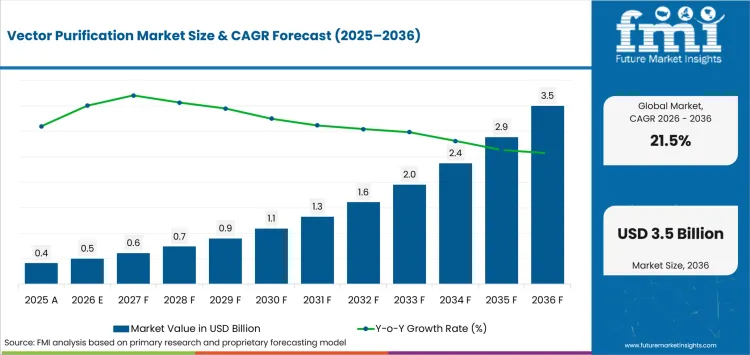
USD 0.5 billion in 2026 and USD 3.5 billion by 2036 at a 21.5% CAGR.
Demand for vector purification is projected to expand at 21.5% CAGR between 2026 and 2036, increasing valuation from USD 0.5 billion in 2026 to USD 3.4 billion by 2036. Commercial growth reflects the recurring need to recover functional particles and remove host-cell or product-related impurities across every manufactured batch.
Regulatory approvals convert development pipelines into recurring downstream manufacturing work across qualified manufacturing sites and documented production campaigns. In January 2025, FDA reported ten rare-disease cell and gene therapy approvals at roughly twice the previous annual pace following its August 2023 reorganization. Each approved process requires repeatable vector recovery and impurity control across every licensed commercial manufacturing batch.
Key Takeaways
- Therapy approvals increase demand for purification workflows that preserve functional vectors and remove process-related or product-related impurities across regulated batches.
- AAV vectors are estimated to account for 46.0% of vector-type demand in 2026 due to broad in vivo use across tissue-specific programs.
- Chromatography is projected to hold 42.0% of purification-technique demand in 2026 owing to selective capture and orthogonal polishing.
- Gene therapy is forecast to represent 57.0% of therapy demand in 2026 as vector quality directly affects dose delivery and release.
- Recovery losses and vector heterogeneity restrain adoption because added polishing can reduce final particle yield during commercial process transfer.
- Danaher Corporation, Merck KGaA, Thermo Fisher Scientific Inc. and Sartorius AG provide broad bioprocess technologies while Lonza Group AG, FUJIFILM Biotechnologies, Rose BioSolutions and Repligen Corporation add regulated vector manufacturing or specialized purification capabilities.
Analyst Perspective
“Manufacturing teams should compare purification proposals against the impurity profile and recovery target for each vector rather than equipment price alone. The stronger process preserves full capsids and clears residual DNA or host proteins across serotypes, scales and qualified sites.”
- Anurag Sharma, Principal Consultant, Future Market Insights
How is the Vector Purification Market segmented?
The vector purification industry is segmented by vector type, purification technique, type of therapy, therapeutic area, scale of operation and region.
The vector purification market is segmented by vector type, purification technique, type of therapy, therapeutic area, scale of operation and region. Vector type covers AAV, lentiviral, adenoviral and retroviral vectors, while purification techniques include chromatography, filtration, centrifugation and precipitation. Therapy categories cover gene therapy, cell therapy, vaccinology and other therapies, while therapeutic areas include oncology, genetic disorders, neurological disorders and ophthalmology. Scale of operation separates commercial, clinical and preclinical production according to batch maturity and regulatory use.
Why do AAV vectors hold the largest share within the vector type category?
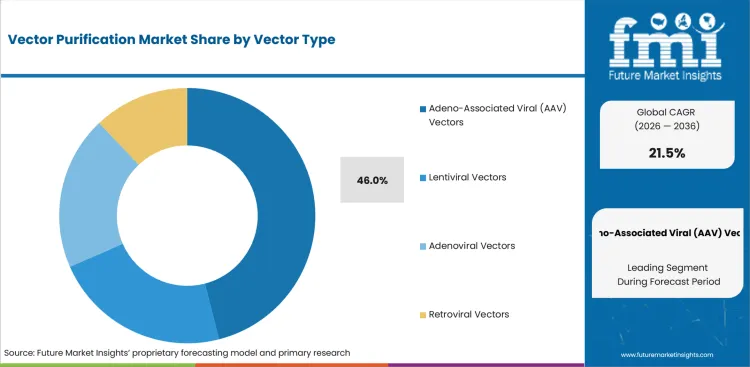
AAV purification must recover functional capsids amid empty particles and host-cell material that can compromise potency or safety across tissue-specific programs. Comparable measurement methods guide resin selection during viral vector development, and NIST reported substantial interlaboratory variation in full-and-empty capsid results in December 2024.
- AAV vectors are set to lead the vector type category with 46.0% share in 2026 due to broad in vivo use across gene therapy programs.
- Developers need aligned assays across serotypes so chromatography resins and polishing steps transfer without changing reported full-capsid quality or causing inconsistent release decisions across qualified manufacturing sites.
Why does chromatography retain the largest share within the purification technique category?
Chromatography combines selective capture with orthogonal polishing across regulated unit operations that must tolerate variable feeds and changing column loads. Preparative chromatography and ion-exchange steps separate target vectors from charged impurities during downstream processing development.
- By purification technique, chromatography is estimated to hold 42.0% in 2026 owing to selective recovery and repeatable impurity clearance across regulated workflows.
- Process teams need evidence to set column geometry and loading limits reliably during commercial scale-up. In January 2025, a National Library of Medicine study reported about 70% AAV8 recovery after monolith capture with extensive protein and DNA removal.
How does gene therapy support demand within the type of therapy category?
Gene therapy places the vector at the center of dose delivery and final product quality across regulated clinical programs. In vivo and ex vivo workflows need evidence linking vector recovery with formulation, and PMDA published regenerative-product approval guidance in March 2025.
- Gene therapy is projected to hold 57.0% share in 2026 owing to vector quality requirements that directly affect dose delivery and release.
- Manufacturing files must connect vector controls to the final therapy through documented bioprocessing systems and release criteria. Consistent formulation supports modified-cell workflows and direct in vivo dosing across gene therapy manufacturing sites.
What supports commercial scale within the scale of operation category?
Commercial production requires repeatable recovery across larger batches and qualified sites, with transfer studies defining acceptable ranges for equipment changes and hold times. Closed-system bioprocessing limits contamination risk across campaigns and shared manufacturing suites during regulated production.
- The scale of operation category is forecast to be led by commercial scale at 42.0% share in 2026 due to larger-batch production requirements.
- Scale-up teams need proof that polishing remains effective across batch volumes and changing column loads. In June 2025, a National Library of Medicine study demonstrated two-pass anion-exchange enrichment across four AAV serotypes at production scale.
What are the drivers, restraints and opportunities in the Vector Purification Market?
Clinical progression raises demand for scalable purification, complex capsid mixtures reduce recovery, and connected platforms can shorten transfer work.
- Driver: Programs entering larger batches require purification workflows that transfer without losing vector recovery or impurity control.
- Restraint: Empty capsids and persistent host material require extra polishing that can reduce final particle yield.
- Opportunity: Standardized chromatography and membrane assemblies can shorten qualification across production scales and manufacturing sites.
Programs entering larger batches need vector-specific capture and pharmaceutical filtration within one documented transfer package. Manufacturing teams must preserve recovery and impurity clearance as column capacity and membrane area increase across regulated sites.
Empty and partial capsids require added polishing that improves purity but reduces recoverable vector yield. Early mass-balance studies define acceptable losses and limit costly comparability work during commercial transfer programs.
Manufacturers that pair single-use bioreactors with standardized downstream assemblies can reduce repeated integration work across manufacturing scales and sites. In May 2026, NIIMBL selected a continuous and automated AAV purification project involving Danaher’s Cytiva and Merck KGaA’s EMD Millipore business. The project gives technology providers a defined route to validate process control and analytical integration together.
Which country CAGRs are profiled in the Vector Purification Market?
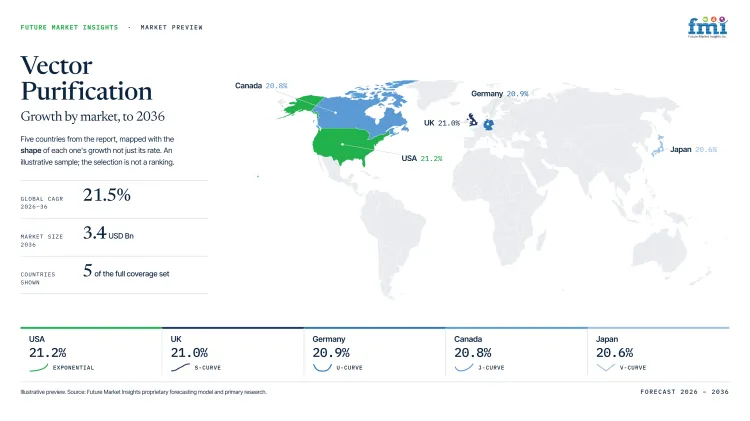
| Country | CAGR |
|---|---|
| Japan | 20.6% |
| South Korea | 22.7% |
| Canada | 20.8% |
| Australia | 21.3% |
| United States | 21.2% |
| United Kingdom | 21.0% |
| Germany | 20.9% |
How do country-level CAGRs compare in the Vector Purification Market?
The country comparison spans 2.1 percentage points and reveals three distinct growth groups across the Vector Purification Market. South Korea leads as the fastest-growing market at 22.7%, while Australia, the United States, the United Kingdom and Germany form a closely aligned middle group spanning only 0.4 percentage points. Japan and Canada remain at the lower end with a 0.2-point difference.
- South Korea leads the comparison at a 22.7% CAGR through 2036, supported by national biotechnology investment that is strengthening domestic manufacturing infrastructure and specialized process-transfer capabilities.
- Australia records a 21.3% CAGR, remaining 1.4 percentage points below South Korea. Its defined advanced-therapy pathway supports local interpretation of international manufacturing guidance and continued development of vector purification capabilities.
- The United States grows at a 21.2% CAGR, only 0.1 percentage point below Australia. Broad clinical and commercial capacity supports demand, while comparability requirements across different equipment trains shape process development.
- The United Kingdom records a 21.0% CAGR, remaining 0.2 percentage points below the United States. Licensed manufacturing capacity supports the market, although specialized skills and cautious investment decisions can influence expansion.
- Germany records a 20.9% CAGR, only 0.1 percentage point below the United Kingdom. Established research and hospital networks support vector purification activity, while site transfers require detailed records and experienced process teams.
- Canada records a 20.8% CAGR, remaining 0.1 percentage point below Germany. Its position reflects continued development of advanced bioprocessing capabilities and manufacturing infrastructure supporting vector-based applications.
- Japan records a 20.6% CAGR, creating a 0.2-percentage-point gap from Canada. Established research capabilities and growing advanced-therapy activity support demand for vector purification processes.
Comparable CAGRs can still produce different market conditions. Differences in biotechnology investment, manufacturing capacity, process-transfer requirements, specialized skills, regulatory pathways and advanced-therapy infrastructure influence market development across countries. The full report provides country-level CAGR analysis across North America, Latin America, Europe, East Asia, South Asia and Pacific, and the Middle East and Africa.
Country-wise Analysis
- South Korean vector programs depend on domestic process teams that transfer purification steps from research laboratories into regulated clinical production across regional biotechnology clusters and shared manufacturing facilities serving local clinical and commercial programs. In January 2025, the Ministry of Science and ICT placed a public biofoundry and biomanufacturing innovation within its advanced-biotechnology work plan to strengthen shared commercialization infrastructure for domestic developers and manufacturing partners nationwide. South Korea is estimated to post 22.7% CAGR over the forecast period, supported by national investment although smaller programs face limited access to specialists who qualify media and document comparable recovery during scale-up.
- Australian sponsors must interpret international advanced-therapy guidance through domestic law as genetically modified cell products enter regulated development across dispersed specialist facilities using different quality systems and equipment configurations across regional manufacturing networks. Adoption of vector purification in Australia is estimated to expand at 21.3% CAGR through 2036, aided by regulatory clarity although sponsors need local interpretation during transfers between research and commercial facilities at commercial scale. Domestic documentation gained a clearer national basis in May 2026, when the Therapeutic Goods Administration adopted relevant guidance for quality and clinical evidence covering products entering domestic clinical evaluation and regulated manufacturing submissions.
- United States developers transfer purification processes across commercial networks with different equipment trains and process histories that complicate consistent recovery and impurity control across qualified manufacturing sites during clinical progression and each commercial launch. FDA issued final CMC flexibility guidance in May 2026 under 21 CFR Part 601, retaining product-specific licensure evidence for manufacturing changes and comparability decisions across licensed facilities and revised downstream processing operations nationwide. The United States vector purification outlook is anticipated to advance at 21.2% CAGR over the assessment period, reinforced by broad capacity although column or membrane changes require comparability packages during regulated technology transfer.
- Licensed manufacturing capacity is distributed across United Kingdom clusters that connect process-transfer support with technical training and regulated production services for clinical and commercial vector programs across several life-science regions through specialist networks. Vector purification sales in the United Kingdom are forecast to expand at 21.0% CAGR by 2036, influenced by local expertise although skills gaps and cautious investment can delay downstream upgrades for smaller developers. National capacity remains substantial because the Cell and Gene Therapy Catapult counted 36 licensed manufacturers with 56,419 square meters of GMP space in November 2025 across Britain’s regulated manufacturing network for advanced therapies.
- German vector programs use research hospitals and biopharmaceutical engineering networks that connect clinical studies with process development across regional biotechnology centers and specialized manufacturing sites serving advanced-therapy developers throughout regulated domestic clinical development. The Paul-Ehrlich-Institut updated its advice framework in July 2025 and offers pre-advice plus scientific advice on manufacturing quality, viral safety and clinical-trial planning for advanced therapies during early development and major manufacturing changes. The German vector purification sector is projected to record 20.9% CAGR during the assessment period, supported by experienced teams despite detailed comparability records and qualified local specialists required for manufacturing authorizations and site transfers.
Who are the notable companies in the Vector Purification Market?
Danaher Corporation, Merck KGaA, Thermo Fisher Scientific Inc., Sartorius AG, Lonza Group AG, FUJIFILM Biotechnologies, Rose BioSolutions and Repligen Corporation are notable companies serving this market.
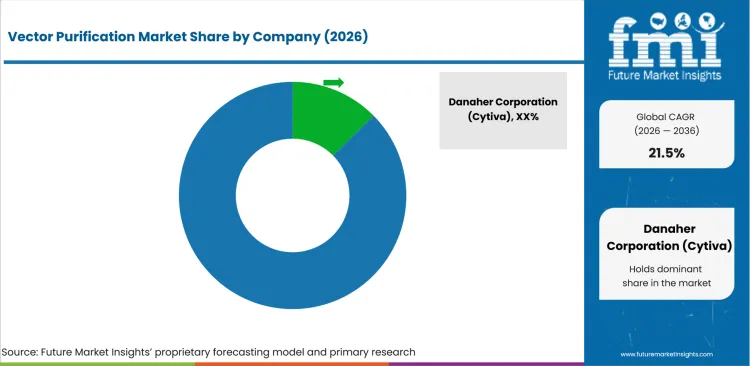
The market is moderately concentrated around integrated bioprocess groups and viral-vector CDMOs with established quality systems. Entry barriers remain high because chromatography media, filtration assemblies and bioprocessing analytics must perform across vector classes without changing recovery or impurity clearance at regulated scale.
- Danaher Corporation, Merck KGaA, Thermo Fisher Scientific Inc. and Sartorius AG combine broad bioprocess portfolios with chromatography or filtration depth.
- Lonza Group AG, FUJIFILM Biotechnologies and Rose BioSolutions connect process development with regulated viral-vector manufacturing and transfer support.
- Repligen Corporation concentrates on AAV-specific affinity and anion-exchange media alongside filtration and chromatography systems for downstream development.
Competitive Benchmarking: Vector Purification Market
| Company | Vector-specific purification depth | Chromatography and filtration breadth | Process development or GMP support | Geographic Reach |
|---|---|---|---|---|
| Danaher Corporation | High | High | Medium | Global |
| Merck KGaA | High | High | High | Global |
| Thermo Fisher Scientific Inc. | High | High | High | Global |
| Sartorius AG | High | High | Medium | Global |
| Lonza Group AG | Medium | Medium | High | North America, Europe and Asia |
| FUJIFILM Biotechnologies | Medium | Medium | High | North America and Europe |
| Rose BioSolutions | High | High | High | North America and Europe |
| Repligen Corporation | High | High | Medium | Global |
Key Developments in the Vector Purification Market
- In May 2026, Rose BioSolutions began operating independently through GI Partners’ completed acquisition of Charles River Laboratories’ CDMO and Cell Solutions businesses.
- In December 2025, Repligen Corporation launched AVIPure HiPer AAV8 and AAV9 affinity resins alongside HiPer QA anion-exchange resin for viral-vector workflows.
- In September 2025, Thermo Fisher Scientific Inc. completed its approximately USD 4.0 billion acquisition of Solventum’s purification and filtration business.
Key Players in the Vector Purification Market
Integrated Bioprocess Technology Platforms
- Danaher Corporation
- Merck KGaA
- Thermo Fisher Scientific Inc.
- Sartorius AG
Viral Vector Development and Manufacturing Platforms
- Lonza Group AG
- FUJIFILM Biotechnologies
- Rose BioSolutions
Purification Technology Specialists
- Repligen Corporation
Vector Purification Market - Report Scope
| Coverage field | Report scope |
|---|---|
| Market breakdown | By vector type, purification technique, type of therapy, therapeutic area, scale of operation and region. |
| Quantitative Units | Revenue USD billion and CAGR in %. |
| Market Definition | Technologies, consumables and services used to clarify, concentrate, capture, polish and exchange buffers for viral vectors. |
| Regions Covered | North America, Latin America, Europe, East Asia, South Asia and Pacific, and Middle East and Africa. |
| Countries Covered | South Korea, Australia, United States, United Kingdom, Germany and 20+ countries included in the full report. |
| Key Companies Profiled | Danaher Corporation, Merck KGaA, Thermo Fisher Scientific Inc., Sartorius AG, Lonza Group AG, FUJIFILM Biotechnologies, Rose BioSolutions and Repligen Corporation. |
| Forecast Period | 2026 to 2036. |
| Approach | Primary and secondary research with market triangulation. |
Vector Purification Market - Research Methodology
| Method | Approach |
|---|---|
| Primary Research | FMI analysts gathered input from manufacturers, service providers, technology developers, distributors, end users, procurement teams, and subject-matter experts. Interviews examined purchasing decisions, product or service evaluation, adoption barriers, approval requirements, pricing considerations, and expectations for technical or commercial support. Respondents were also asked what evidence is required before a trial, pilot, or initial order develops into regular purchasing. |
| Desk Research | Desk research covered government statistics, regulatory publications, trade data, industry associations, technical literature, standards, company filings, product information, and official corporate announcements. Sources were reviewed for relevance, publication date, geographic coverage, and consistency with the defined market scope. Claims relating to performance, applications, approvals, capacity, investment, and commercial activity were retained only when supported by credible public evidence. |
| Market Sizing and Forecasting | The market model combined the baseline value with historical performance, segment structure, pricing and volume indicators, adoption levels, company participation, and country-level demand conditions. Forecast assumptions considered economic activity, investment trends, regulatory developments, technology adoption, purchasing cycles, supply availability, and barriers to wider market use. Segment and regional estimates were reconciled before the final market total was calculated. |
| Data Validation | Estimates were checked against multiple independent indicators, including public data, company activity, trade patterns, industry developments, and findings from primary interviews. Validation also tested whether products, services, applications, and company revenues fell within the defined market boundaries. Adjacent categories, unsupported claims, overlapping revenues, and activities without direct market relevance were excluded to reduce double counting and maintain consistency across segments and countries. |
Vector Purification Market by Segments
Vector Purification Market segmented by Vector Type:
- Adeno-Associated Viral (AAV) Vectors
- Recombinant AAV Vectors
- Self-Complementary AAV Vectors
- Lentiviral Vectors
- Integrating Lentiviral Vectors
- Non-Integrating Lentiviral Vectors
- Adenoviral Vectors
- First-Generation Adenoviral Vectors
- Third-Generation Adenoviral Vectors
- Retroviral Vectors
- Gamma-Retroviral Vectors
- Other Retroviral Vectors
Vector Purification Market segmented by Purification Technique:
- Chromatography
- Affinity Chromatography
- Ion-Exchange Chromatography
- Filtration
- Ultrafiltration
- Diafiltration
- Centrifugation
- Density Gradient Centrifugation
- Continuous Centrifugation
- Precipitation
- Polyethylene Glycol Precipitation
- Salt Precipitation
Vector Purification Market segmented by Type of Therapy:
- Gene Therapy
- In Vivo Gene Therapy
- Ex Vivo Gene Therapy
- Cell Therapy
- CAR-T Cell Therapy
- Stem Cell Therapy
- Vaccinology
- Viral Vector-Based Vaccines
- Therapeutic Vaccines
- Other Therapies
- Oncolytic Virus Therapy
- Gene Editing Applications
Vector Purification Market segmented by Therapeutic Area:
- Oncology
- Cancer Gene Therapy
- Cancer Cell Therapy
- Genetic Disorders
- Inherited Metabolic Disorders
- Rare Genetic Diseases
- Neurological Disorders
- Neurodegenerative Diseases
- Neuromuscular Disorders
- Ophthalmology
- Inherited Retinal Diseases
- Ocular Gene Therapy
Vector Purification Market segmented by Scale of Operation:
- Commercial Scale
- Large-Scale Manufacturing
- Commercial Drug Production
- Clinical Scale
- Phase I-II Manufacturing
- Phase III Manufacturing
- Preclinical Scale
- Early Process Development
- Preclinical Research
Vector Purification Market by Region:
- North America
- United States
- Canada
- Latin America
- Brazil
- Chile
- Mexico
- Rest of Latin America
- Western Europe
- Germany
- United Kingdom
- Italy
- Spain
- France
- Nordics
- Benelux
- Rest of Western Europe
- Eastern Europe
- Russia
- Poland
- Hungary
- Balkan and Baltic States
- Rest of Eastern Europe
- East Asia
- China
- Japan
- South Korea
- South Asia and Pacific
- India
- ASEAN
- Australia and New Zealand
- Rest of South Asia and Pacific
- Middle East and Africa
- Kingdom of Saudi Arabia
- Other GCC Countries
- Türkiye
- South Africa
- Other African Union Countries
- Rest of Middle East and Africa
Research Sources and Bibliography
- USA Food and Drug Administration. (2025, January 17). CY 2024 Report from the Director.
- Lehman, S., Vreeland, W., Jacques, J., et al. (2024, December 26). Interlaboratory Measurement of Adeno-Associated Virus: Comparative Quantification of Full and Empty Capsids.
- Nascimento, A., Faria, T. Q., Bollmann, F., et al. (2025, January 11). Purification of AAV8 through a scalable two-step monolithic chromatography approach.
- Pharmaceuticals and Medical Devices Agency. (2025, March 26). Guideline for Preparation of Attached Data and Overviews for Applications for Approval of Regenerative Medical Products.
- Thakur, G., Mink, S., Garcia, A. J., Bak, H., & Tustian, A. D. (2025, June 12). A two-pass anion-exchange chromatography strategy for enrichment of full capsids in manufacturing of adeno-associated viral vectors.
- National Institute for Innovation in Manufacturing Biopharmaceuticals. (2026, May 19). NIIMBL Announces 8 New Technology and Workforce Projects.
- Ministry of Science and ICT, Republic of Korea. (2025, January 13). MSIT’s Work Plan for 2025.
- Therapeutic Goods Administration. (2026, July 16). Guideline on quality, non-clinical and clinical aspects of medicinal products containing genetically modified cells.
- USA Food and Drug Administration. (2026, May). Chemistry, Manufacturing, and Controls Flexibilities for Developing Human Cellular and Gene Therapy Products for a Biologics License Application.
- Cell and Gene Therapy Catapult. (2025, November 4). Annual Review 2025.
- Paul-Ehrlich-Institut. (2025, July 16). Innovation Office at the Paul-Ehrlich-Institut - Informal Advice for the development of ATMP, Advice Concept.
- Danaher Corporation. (2026, March 25). 2025 Annual Report.
- Merck KGaA. (2026). Viral Vector Downstream Processing. Retrieved August 4, 2026.
- Thermo Fisher Scientific Inc. (2026, February 26). Annual Report on Form 10-K for the fiscal year ended December 31, 2025.
- Sartorius AG. (2024, December 9). Part of the Solution: How Purification Experts Make Novel Drugs Safe for Use.
- Lonza Group AG. (2026). Viral Vectors Manufacturing Services (CDMO). Retrieved August 4, 2026.
- Rose BioSolutions. (2026). Viral Vector Manufacturing Services. Retrieved August 4, 2026.
- FUJIFILM Biotechnologies. (2026). Viral Gene Therapy Platform. Retrieved August 4, 2026.
- Repligen Corporation. (2026, February 26). Annual Report on Form 10-K for the fiscal year ended December 31, 2025.
- Repligen Corporation. (2025, December 16). Repligen Introduces Next-Generation Chromatography Resins to Advance New Modality Workflows.
- Thermo Fisher Scientific Inc. (2025, September 2). Thermo Fisher Scientific Completes Acquisition of Solventum’s Purification and Filtration Business.
- GI Partners. (2026, May 7). GI Partners Completes Acquisition of the CDMO and Cell Solutions Businesses from Charles River Laboratories and forms Rose BioSolutions.
This bibliography is provided for reader reference and is not exhaustive. The full report contains the complete reference list and detailed citations
This Report Answers
- How large is the vector purification market in 2026 and 2036?
- Which vector type accounts for the largest approved 2026 share?
- Why does chromatography retain the largest purification-technique share?
- How does gene therapy shape recurring vector purification demand?
- Which operating conditions reduce vector recovery during polishing?
- How do country growth rates differ across the five profiled markets?
- Which companies provide purification technology or regulated manufacturing support?
- How should manufacturers compare vector purification options during process transfer?
- Where can connected downstream platforms reduce qualification work?
Frequently Asked Questions
How big is the Vector Purification Market in 2026?
USD 0.5 billion represents the vector purification market in 2026 across technologies and services supporting viral-vector downstream processing. Purification teams must preserve functional particles and remove process impurities during regulated commercial manufacturing as valuation advances toward USD 3.4 billion by 2036.
What is the CAGR of the Vector Purification Market from 2026 to 2036?
The vector purification market is projected to expand at 21.5% CAGR between 2026 and 2036 across regulated regional manufacturing networks. Commercial programs require connected workflows that transfer into larger production without weakening vector recovery or impurity control during validated scale-up.
Which vector type is projected to account for 46.0% of the Vector Purification Market?
AAV vectors are projected to account for 46.0% of vector-type demand within the vector purification market in 2026. Broad in vivo use supports their position although serotype differences require dedicated affinity capture and polishing development for consistent regulated commercial production.
How much will the Vector Purification Market add between 2026 and 2036?
USD 2.9 billion is expected to be added to the vector purification market between 2026 and 2036. Commercial programs need scalable capture and polishing operations that preserve comparable quality across larger batches and qualified manufacturing sites during regulated technology transfer.
Which companies are active in the Vector Purification Market?
Eight active companies in the vector purification market globally include Danaher Corporation, Merck KGaA, Thermo Fisher Scientific Inc. and Sartorius AG. Lonza Group AG, FUJIFILM Biotechnologies, Rose BioSolutions and Repligen Corporation add regulated manufacturing or specialized downstream purification capabilities.
Preview the report firsthand - request a free sample
Get SampleGet the brochure for pricing and purchase details.
Get PDFTable of Content
- Key Takeaways
- Market Size and CAGR
- Top Growth Driver
- Fastest Growing Segment
- Leading Region
- Key Companies
- Emerging Opportunities
- Executive Summary
- Global Market Outlook
- Demand-side Trends
- Supply-side Trends
- Technology Roadmap Analysis
- Analysis and Recommendations
- Analyst Perspective (What is happening? Why now? What should investors know?)
- Key Questions Answered
- How large is the market?
- What is the CAGR?
- What are key trends?
- Which region dominates?
- Who are the leaders?
- Market Overview
- Market Coverage / Taxonomy
- Market Definition / Scope / Limitations
- Research Methodology
- Chapter Orientation
- Analytical Lens and Working Hypotheses
- Market Structure, Signals, and Trend Drivers
- Benchmarking and Cross-market Comparability
- Market Sizing, Forecasting, and Opportunity Mapping
- Research Design and Evidence Framework
- Desk Research Programme (Secondary Evidence)
- Expert Input and Fieldwork (Primary Evidence)
- Tooling, Models, and Reference Databases
- Data Engineering and Model Build
- Quality Assurance and Audit Trail
- Market Background
- Market Dynamics (Drivers, Restraints, Opportunity, Trends)
- Scenario Forecast (Optimistic, Likely, Conservative)
- Impact Analysis
- AI Impact
- Sustainability Impact
- Regulatory Impact
- Technology Impact
- Consumer / Buyer Analysis
- Purchase Drivers
- Adoption Barriers
- Buyer Journey
- Opportunity Map Analysis
- Product Life Cycle Analysis
- Supply Chain Analysis
- Investment Feasibility Matrix
- Value Chain Analysis
- PESTLE and Porter's Analysis
- Regulatory Landscape
- Regional Parent Market Outlook
- Production and Consumption Statistics
- Import and Export Statistics
- Global Market Analysis and Forecast, 2021 to 2036
- Historical Market Size Value (USD Billion) Analysis, 2021 to 2025
- Current and Future Market Size Value (USD Billion) Projections, 2026 to 2036
- Y-o-Y Growth Trend Analysis
- Absolute $ Opportunity Analysis
- Global Market Pricing Analysis, 2021 to 2036
- Global Market Analysis and Forecast, By Vector Type, 2021 to 2036
- Introduction / Key Findings
- Historical Market Size Value (USD Billion) Analysis By Vector Type, 2021 to 2025
- Current and Future Market Size Value (USD Billion) Analysis and Forecast By Vector Type, 2026 to 2036
- Adeno-Associated Viral (AAV) Vectors
- Recombinant AAV Vectors
- Self-Complementary AAV Vectors
- Lentiviral Vectors
- Integrating Lentiviral Vectors
- Non-Integrating Lentiviral Vectors
- Adenoviral Vectors
- First-Generation Adenoviral Vectors
- Third-Generation Adenoviral Vectors
- Retroviral Vectors
- Gamma-Retroviral Vectors
- Other Retroviral Vectors
- Adeno-Associated Viral (AAV) Vectors
- Y-o-Y Growth Trend Analysis By Vector Type, 2021 to 2025
- Absolute $ Opportunity Analysis By Vector Type, 2026 to 2036
- Global Market Analysis and Forecast, By Purification Technique, 2021 to 2036
- Introduction / Key Findings
- Historical Market Size Value (USD Billion) Analysis By Purification Technique, 2021 to 2025
- Current and Future Market Size Value (USD Billion) Analysis and Forecast By Purification Technique, 2026 to 2036
- Chromatography
- Affinity Chromatography
- Ion-Exchange Chromatography
- Filtration
- Ultrafiltration
- Diafiltration
- Centrifugation
- Density Gradient Centrifugation
- Continuous Centrifugation
- Precipitation
- Polyethylene Glycol Precipitation
- Salt Precipitation
- Chromatography
- Y-o-Y Growth Trend Analysis By Purification Technique, 2021 to 2025
- Absolute $ Opportunity Analysis By Purification Technique, 2026 to 2036
- Global Market Analysis and Forecast, By Type of Therapy, 2021 to 2036
- Introduction / Key Findings
- Historical Market Size Value (USD Billion) Analysis By Type of Therapy, 2021 to 2025
- Current and Future Market Size Value (USD Billion) Analysis and Forecast By Type of Therapy, 2026 to 2036
- Gene Therapy
- In Vivo Gene Therapy
- Ex Vivo Gene Therapy
- Cell Therapy
- CAR-T Cell Therapy
- Stem Cell Therapy
- Vaccinology
- Viral Vector-Based Vaccines
- Therapeutic Vaccines
- Other Therapies
- Oncolytic Virus Therapy
- Gene Editing Applications
- Gene Therapy
- Y-o-Y Growth Trend Analysis By Type of Therapy, 2021 to 2025
- Absolute $ Opportunity Analysis By Type of Therapy, 2026 to 2036
- Global Market Analysis and Forecast, By Therapeutic Area, 2021 to 2036
- Introduction / Key Findings
- Historical Market Size Value (USD Billion) Analysis By Therapeutic Area, 2021 to 2025
- Current and Future Market Size Value (USD Billion) Analysis and Forecast By Therapeutic Area, 2026 to 2036
- Oncology
- Cancer Gene Therapy
- Cancer Cell Therapy
- Genetic Disorders
- Inherited Metabolic Disorders
- Rare Genetic Diseases
- Neurological Disorders
- Neurodegenerative Diseases
- Neuromuscular Disorders
- Ophthalmology
- Inherited Retinal Diseases
- Ocular Gene Therapy
- Oncology
- Y-o-Y Growth Trend Analysis By Therapeutic Area, 2021 to 2025
- Absolute $ Opportunity Analysis By Therapeutic Area, 2026 to 2036
- Global Market Analysis and Forecast, By Scale of Operation, 2021 to 2036
- Introduction / Key Findings
- Historical Market Size Value (USD Billion) Analysis By Scale of Operation, 2021 to 2025
- Current and Future Market Size Value (USD Billion) Analysis and Forecast By Scale of Operation, 2026 to 2036
- Commercial Scale
- Large-Scale Manufacturing
- Commercial Drug Production
- Clinical Scale
- Phase I-II Manufacturing
- Phase III Manufacturing
- Preclinical Scale
- Early Process Development
- Preclinical Research
- Commercial Scale
- Y-o-Y Growth Trend Analysis By Scale of Operation, 2021 to 2025
- Absolute $ Opportunity Analysis By Scale of Operation, 2026 to 2036
- Global Market Analysis and Forecast, By Region, 2021 to 2036
- Introduction
- Historical Market Size Value (USD Billion) Analysis By Region, 2021 to 2025
- Current Market Size Value (USD Billion) Analysis and Forecast By Region, 2026 to 2036
- North America
- Latin America
- Western Europe
- Eastern Europe
- East Asia
- South Asia and Pacific
- Middle East & Africa
- Market Attractiveness Analysis By Region
- North America Market Analysis and Forecast, By Country, 2021 to 2036
- Historical Market Size Value (USD Billion) Trend Analysis By Market Taxonomy, 2021 to 2025
- Market Size Value (USD Billion) Forecast By Market Taxonomy, 2026 to 2036
- By Country
- USA
- Canada
- By Vector Type
- By Purification Technique
- By Type of Therapy
- By Therapeutic Area
- By Scale of Operation
- By Country
- Market Attractiveness Analysis
- By Country
- By Vector Type
- By Purification Technique
- By Type of Therapy
- By Therapeutic Area
- By Scale of Operation
- Key Takeaways
- Latin America Market Analysis and Forecast, By Country
- Historical Market Size Value (USD Billion) Trend Analysis By Market Taxonomy, 2021 to 2025
- Market Size Value (USD Billion) Forecast By Market Taxonomy, 2026 to 2036
- By Country
- Brazil
- Mexico
- Chile
- Rest of Latin America
- By Vector Type
- By Purification Technique
- By Type of Therapy
- By Therapeutic Area
- By Scale of Operation
- By Country
- Market Attractiveness Analysis
- By Country
- By Vector Type
- By Purification Technique
- By Type of Therapy
- By Therapeutic Area
- By Scale of Operation
- Key Takeaways
- Western Europe Market Analysis and Forecast, By Country
- Historical Market Size Value (USD Billion) Trend Analysis By Market Taxonomy, 2021 to 2025
- Market Size Value (USD Billion) Forecast By Market Taxonomy, 2026 to 2036
- By Country
- Germany
- UK
- Italy
- Spain
- France
- Nordic
- BENELUX
- Rest of Western Europe
- By Vector Type
- By Purification Technique
- By Type of Therapy
- By Therapeutic Area
- By Scale of Operation
- By Country
- Market Attractiveness Analysis
- By Country
- By Vector Type
- By Purification Technique
- By Type of Therapy
- By Therapeutic Area
- By Scale of Operation
- Key Takeaways
- Eastern Europe Market Analysis and Forecast, By Country
- Historical Market Size Value (USD Billion) Trend Analysis By Market Taxonomy, 2021 to 2025
- Market Size Value (USD Billion) Forecast By Market Taxonomy, 2026 to 2036
- By Country
- Russia
- Poland
- Hungary
- Balkan & Baltic
- Rest of Eastern Europe
- By Vector Type
- By Purification Technique
- By Type of Therapy
- By Therapeutic Area
- By Scale of Operation
- By Country
- Market Attractiveness Analysis
- By Country
- By Vector Type
- By Purification Technique
- By Type of Therapy
- By Therapeutic Area
- By Scale of Operation
- Key Takeaways
- East Asia Market Analysis and Forecast, By Country
- Historical Market Size Value (USD Billion) Trend Analysis By Market Taxonomy, 2021 to 2025
- Market Size Value (USD Billion) Forecast By Market Taxonomy, 2026 to 2036
- By Country
- China
- Japan
- South Korea
- By Vector Type
- By Purification Technique
- By Type of Therapy
- By Therapeutic Area
- By Scale of Operation
- By Country
- Market Attractiveness Analysis
- By Country
- By Vector Type
- By Purification Technique
- By Type of Therapy
- By Therapeutic Area
- By Scale of Operation
- Key Takeaways
- South Asia and Pacific Market Analysis and Forecast, By Country
- Historical Market Size Value (USD Billion) Trend Analysis By Market Taxonomy, 2021 to 2025
- Market Size Value (USD Billion) Forecast By Market Taxonomy, 2026 to 2036
- By Country
- India
- ASEAN
- Australia & New Zealand
- Rest of South Asia and Pacific
- By Vector Type
- By Purification Technique
- By Type of Therapy
- By Therapeutic Area
- By Scale of Operation
- By Country
- Market Attractiveness Analysis
- By Country
- By Vector Type
- By Purification Technique
- By Type of Therapy
- By Therapeutic Area
- By Scale of Operation
- Key Takeaways
- Middle East & Africa Market Analysis and Forecast, By Country
- Historical Market Size Value (USD Billion) Trend Analysis By Market Taxonomy, 2021 to 2025
- Market Size Value (USD Billion) Forecast By Market Taxonomy, 2026 to 2036
- By Country
- Kingdom of Saudi Arabia
- Other GCC Countries
- Türkiye
- South Africa
- Other African Union
- Rest of Middle East & Africa
- By Vector Type
- By Purification Technique
- By Type of Therapy
- By Therapeutic Area
- By Scale of Operation
- By Country
- Market Attractiveness Analysis
- By Country
- By Vector Type
- By Purification Technique
- By Type of Therapy
- By Therapeutic Area
- By Scale of Operation
- Key Takeaways
- Key Countries Market Analysis
- USA
- Pricing Analysis
- Market Share Analysis, 2025
- By Vector Type
- By Purification Technique
- By Type of Therapy
- By Therapeutic Area
- By Scale of Operation
- Canada
- Pricing Analysis
- Market Share Analysis, 2025
- By Vector Type
- By Purification Technique
- By Type of Therapy
- By Therapeutic Area
- By Scale of Operation
- Mexico
- Pricing Analysis
- Market Share Analysis, 2025
- By Vector Type
- By Purification Technique
- By Type of Therapy
- By Therapeutic Area
- By Scale of Operation
- Brazil
- Pricing Analysis
- Market Share Analysis, 2025
- By Vector Type
- By Purification Technique
- By Type of Therapy
- By Therapeutic Area
- By Scale of Operation
- Chile
- Pricing Analysis
- Market Share Analysis, 2025
- By Vector Type
- By Purification Technique
- By Type of Therapy
- By Therapeutic Area
- By Scale of Operation
- Germany
- Pricing Analysis
- Market Share Analysis, 2025
- By Vector Type
- By Purification Technique
- By Type of Therapy
- By Therapeutic Area
- By Scale of Operation
- UK
- Pricing Analysis
- Market Share Analysis, 2025
- By Vector Type
- By Purification Technique
- By Type of Therapy
- By Therapeutic Area
- By Scale of Operation
- Italy
- Pricing Analysis
- Market Share Analysis, 2025
- By Vector Type
- By Purification Technique
- By Type of Therapy
- By Therapeutic Area
- By Scale of Operation
- Spain
- Pricing Analysis
- Market Share Analysis, 2025
- By Vector Type
- By Purification Technique
- By Type of Therapy
- By Therapeutic Area
- By Scale of Operation
- France
- Pricing Analysis
- Market Share Analysis, 2025
- By Vector Type
- By Purification Technique
- By Type of Therapy
- By Therapeutic Area
- By Scale of Operation
- India
- Pricing Analysis
- Market Share Analysis, 2025
- By Vector Type
- By Purification Technique
- By Type of Therapy
- By Therapeutic Area
- By Scale of Operation
- ASEAN
- Pricing Analysis
- Market Share Analysis, 2025
- By Vector Type
- By Purification Technique
- By Type of Therapy
- By Therapeutic Area
- By Scale of Operation
- Australia & New Zealand
- Pricing Analysis
- Market Share Analysis, 2025
- By Vector Type
- By Purification Technique
- By Type of Therapy
- By Therapeutic Area
- By Scale of Operation
- China
- Pricing Analysis
- Market Share Analysis, 2025
- By Vector Type
- By Purification Technique
- By Type of Therapy
- By Therapeutic Area
- By Scale of Operation
- Japan
- Pricing Analysis
- Market Share Analysis, 2025
- By Vector Type
- By Purification Technique
- By Type of Therapy
- By Therapeutic Area
- By Scale of Operation
- South Korea
- Pricing Analysis
- Market Share Analysis, 2025
- By Vector Type
- By Purification Technique
- By Type of Therapy
- By Therapeutic Area
- By Scale of Operation
- Russia
- Pricing Analysis
- Market Share Analysis, 2025
- By Vector Type
- By Purification Technique
- By Type of Therapy
- By Therapeutic Area
- By Scale of Operation
- Poland
- Pricing Analysis
- Market Share Analysis, 2025
- By Vector Type
- By Purification Technique
- By Type of Therapy
- By Therapeutic Area
- By Scale of Operation
- Hungary
- Pricing Analysis
- Market Share Analysis, 2025
- By Vector Type
- By Purification Technique
- By Type of Therapy
- By Therapeutic Area
- By Scale of Operation
- Kingdom of Saudi Arabia
- Pricing Analysis
- Market Share Analysis, 2025
- By Vector Type
- By Purification Technique
- By Type of Therapy
- By Therapeutic Area
- By Scale of Operation
- Türkiye
- Pricing Analysis
- Market Share Analysis, 2025
- By Vector Type
- By Purification Technique
- By Type of Therapy
- By Therapeutic Area
- By Scale of Operation
- South Africa
- Pricing Analysis
- Market Share Analysis, 2025
- By Vector Type
- By Purification Technique
- By Type of Therapy
- By Therapeutic Area
- By Scale of Operation
- USA
- Market Structure Analysis
- Competition Dashboard
- Competition Benchmarking
- Market Share Analysis of Top Players
- By Regional
- By Vector Type
- By Purification Technique
- By Type of Therapy
- By Therapeutic Area
- By Scale of Operation
- Emerging Startups
- Innovation Benchmarking
- Competition Analysis
- Competition Deep Dive
- Danaher Corporation (Cytiva)
- Overview
- Product Portfolio
- Profitability by Market Segments
- Sales Footprint
- Strategy Overview
- Marketing Strategy
- Product Strategy
- Channel Strategy
- Merck KGaA
- Thermo Fisher Scientific Inc.
- Sartorius AG
- Bio-Rad Laboratories, Inc.
- Agilent Technologies, Inc.
- Lonza Group AG
- Takara Bio Inc.
- Repligen Corporation
- FUJIFILM Diosynth Biotechnologies
- Others
- Danaher Corporation (Cytiva)
- Case Studies
- Success Stories
- Recent Developments
- Competition Deep Dive
- Assumptions & Acronyms Used


