

- Market Size (2026)
- USD 6.1 Bn
- Forecast (2036)
- USD 51.6 Bn
- CAGR (2026 to 2036)
- 23.8%
How big is Voice Search Market in 2026?
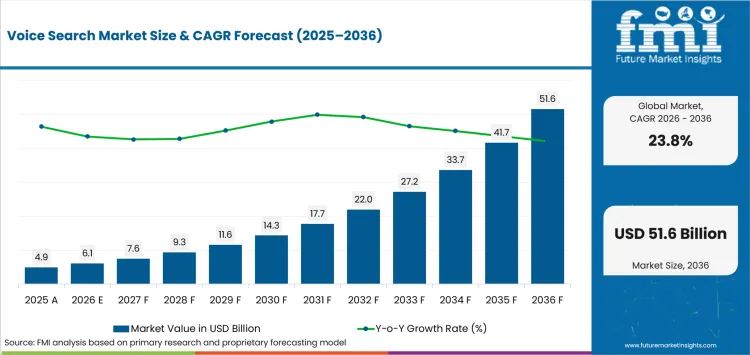
USD 6.1 billion in 2026 and USD 51.6 billion by 2036 at a 23.8% CAGR.
Demand for voice search is projected to expand at 23.8% CAGR between 2026 and 2036, increasing valuation from USD 6.1 billion in 2026 to USD 51.6 billion by 2036. Commercial adoption depends on recognition accuracy and context retention that preserve the intended query across connected interfaces.
Household devices provide a recurring access route for voice search beyond mobile screens through smart speakers and connected audio interfaces. Ofcom reported in July 2025 that 40% of UK households owned a smart speaker and 43% of owners searched for information online. Established household use makes recognition quality and visible source links commercial requirements for recurring spoken requests through voice assistants.
Key Takeaways of Voice Search Market
- Context-preserving spoken search expands as accurate recognition connects recurring device use with verifiable web retrieval across platforms.
- Generic search is projected at 48.0% share in 2026 due to frequent information and navigation requests.
- Smartphones and mobile devices are estimated at 38.0% of application demand in 2026 owing to integrated microphones and personal accounts.
- Consumer electronics is forecast at 34.0% by end-use in 2026 supported by recurring access through phones and smart speakers.
- Accent variation and privacy obligations limit adoption if recognition quality or consent controls fail during routine spoken interactions.
- Google LLC, Amazon.com, Inc., Apple Inc., Baidu, Inc., Samsung Electronics Co., Ltd., Microsoft Corporation, International Business Machines Corporation and NVIDIA Corporation serve consumer or enterprise voice-search routes.
Analyst Perspective
"A reliable voice-search system must preserve names and follow-up context throughout retrieval and any automated result. Platform teams should compare source visibility and permission handling across noisy devices so users can inspect or correct fluent answers during commercial use."
- Sudip saha, Principal Consultant, Future Market Insights
How is the Voice Search Market segmented?
The voice search market is segmented by type, application, end use, technology and region.
Voice search is segmented by type, application, end use, technology and region across commercial interfaces. Type covers generic search, context-aware search and proactive search across direct, personalized and predictive requests. Application includes smartphones and mobile devices, smart speakers, automotive and consumer electronics for recurring spoken access. End use covers consumer electronics, automotive, retail and e-commerce, and healthcare workflows with distinct operating requirements. Technology includes speech recognition and automatic speech recognition, natural language processing, AI/ML, voice biometrics and cloud-based voice processing.
Why does generic search lead the type category?
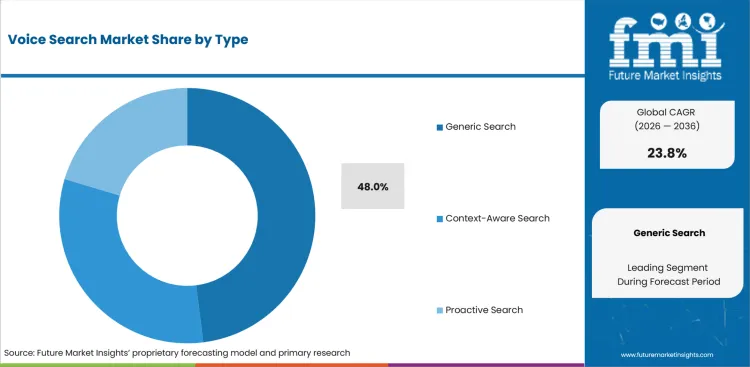
Generic search handles routine fact and destination requests without requiring stored preferences or predictive permissions. Its commercial value comes from resolving direct information needs through familiar web indexes while preserving source links for inspection through conversational AI.
- Based on type, generic search is projected to account for 48.0% in 2026 due to frequent fact and navigation requests across everyday sessions.
- Routine information requests from mobile and household users already fit established web indexes without requiring predictive account context. Google introduced Search Live in June 2025 with spoken follow-up questions and visible web links, connecting direct audio requests with inspectable results.
Why do smartphones and mobile devices lead the application category?
Smartphones combine microphones with search applications and location context inside the device used for most personal computing. Google began rolling AI Mode across India in July 2025 with voice and image input inside the Google app.
- In 2026, smartphones and mobile devices are expected to lead the application category with 38.0% share because microphones and personal accounts already sit inside the main search device.
- The same account can carry voice, text and camera input without requiring a separate assistant device or setup process. Mobile speech recognition therefore gives application developers a direct route to recurring spoken search sessions through established handset distribution.
Why does consumer electronics lead the end-use category?
Consumer electronics provide recurring voice-search access through microphones embedded in smartphones and smart speakers used throughout the day across personal and shared settings. Far-field recognition must separate the speaker from music and changing room noise across household use.
- The consumer electronics segment is likely to capture 34.0% share in 2026 attributable to repeated access through phones and smart speakers.
- Installed screens and speakers let device manufacturers extend voice search through software without replacing household hardware. Baidu's March 2026 Form 20-F identifies DuerOS and Xiaodu as the company's smart-living operations, with Xiaodu devices providing the consumer hardware route.
Why does speech recognition and automatic speech recognition lead the technology category?
Speech recognition forms the entry layer for every spoken query and converts audio at retrieval. IBM and Deepgram announced in February 2026 that recognition and synthesis would enter watsonx Orchestrate, linking speech infrastructure with governed enterprise workflows.
- The technology category is forecast to be led by speech recognition and automatic speech recognition at 36.0% share in 2026 due to real-time transcription at query entry.
- Production teams need streaming transcription that handles accents and background noise inside governed applications daily. Deployable recognition earns commercial value through low latency plus tuning controls and reliable handoff to natural language processing across customer service and healthcare workflows.
What are the drivers, restraints and opportunities in the Voice Search Market?
Context-preserving interfaces expand spoken discovery while recognition variability and privacy obligations weaken trust as governed applications connect voice queries with defined commercial actions.
- Driver: Follow-up questions preserve context across voice and visual inputs during longer information journeys on connected devices.
- Restraint: Accent coverage and data handling determine whether users trust spoken responses enough to act on retrieved information.
- Opportunity: Healthcare and automotive workflows combine recognition with domain data and governed action paths for defined commercial uses.
Longer voice-search sessions become useful as an interface retains earlier questions and accepts camera input without restarting the request. In-vehicle generative AI extends that continuity to navigation, although road noise and driver attention require stable recognition plus concise responses during travel.
Shared smart home devices process adult and child requests through one household account, so consent and retention controls must serve several regular users. G7 privacy authorities identified virtual voice assistants among connected-home devices that process personal information in June 2026. Clear recording notices and account-level deletion controls determine whether families continue using spoken search during routine household use.
Healthcare natural language processing provides a defined expansion route by joining speech capture with governed retrieval inside clinical documentation. Microsoft introduced Dragon Copilot in March 2025 through dictation, ambient listening and healthcare safeguards within one clinical assistant. Hospitals can shorten note preparation through this route, although deployment depends on local workflow approval and reliable access to supporting patient information.
Which country CAGRs are profiled in the Voice Search Market?
| Country | CAGR |
|---|---|
| South Korea | 25.1% |
| Canada | 22.6% |
| Japan | 23.1% |
| USA | 22.9% |
| UK | 22.7% |
| Germany | 22.4% |
How do country-level CAGRs compare in the Voice Search Market?
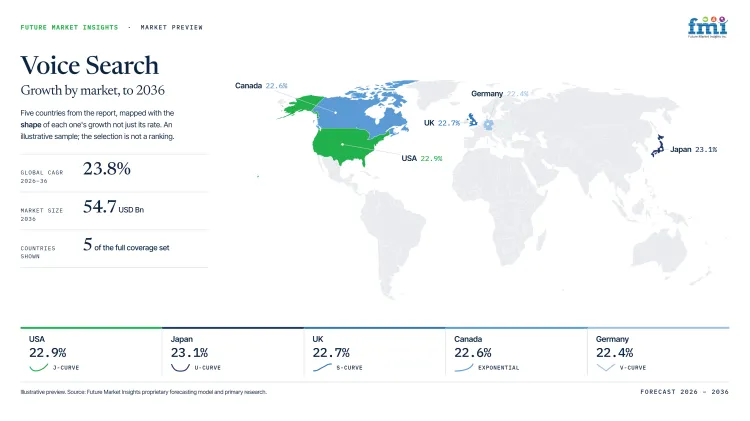
The country comparison spans 2.7 percentage points and reveals three distinct growth groups across the Voice Search Market. South Korea leads the comparison at 25.1%, while Japan, the USA, the UK and Germany form a closely aligned middle group spanning only 0.7 percentage points. Canada remains at the lower end with a 0.5-point gap from Germany.
- South Korea leads the comparison at a 25.1% CAGR through 2036, supported by strong digital adoption, widespread smart-device usage and continued integration of voice interfaces across consumer and connected-device applications.
- Japan records a 23.1% CAGR, remaining 2.0 percentage points below South Korea. High smartphone penetration, established voice-assistant usage and continued development of Japanese-language voice recognition support market expansion.
- The USA grows at a 22.9% CAGR, only 0.2 percentage points below Japan. Broad smart-speaker adoption, mature digital ecosystems and integration of voice search across online services support continued growth.
- The UK records a 22.7% CAGR, remaining 0.2 percentage points below the USA. Strong smartphone adoption, established voice-assistant usage and integration across digital services support voice-search activity.
- Germany records a 22.4% CAGR, 0.3 percentage points below the UK. Growing use of voice-enabled devices and improvements in German-language recognition support adoption across digital applications.
- Canada records a 22.6% CAGR, remaining 0.2 percentage points below the USA and 0.2 percentage points above Germany. High smartphone penetration and established digital-service usage support continued adoption of voice-enabled search.
Comparable CAGRs can still produce different market conditions. Differences in digital adoption, smartphone penetration, language-recognition capabilities, smart-device usage and integration across online services influence voice-search adoption across countries. The full report provides country-level CAGR analysis across North America, Latin America, Europe, East Asia, South Asia and Pacific, and the Middle East and Africa.
Country-wise Analysis
- South Korean voice-search services benefit from domestic handset production and carrier distribution that place Korean-language functions inside supported Galaxy devices with familiar account recovery, retail availability and national repair routes for recurring commercial use. Samsung introduced conversational Bixby in February 2026 with natural-language device control and current web results across selected Galaxy markets including Korea through one assistant interface without separate browser redirects during routine use. The South Korean voice search sector is projected to record 25.1% CAGR during the assessment period, driven by local device integration although language coverage and pronunciation variance require field testing for broad commercial deployment.
- Japanese voice-search services require dependable recognition for local names and natural speech across devices supported by domestic carriers plus regional retail and repair channels with familiar account recovery for recurring household and workplace requests. In Japan, voice search demand is predicted to advance at 23.1% CAGR through 2036 owing to local-language software expertise although regional pronunciation and shared-device privacy require tailored testing across household and commercial settings. Apple made natural Siri requests and contextual conversation support available in Japanese during March 2025 across eligible Apple devices, giving users spoken and typed requests without changing the active device account or application.
- Mobile voice search in the USA operates through large first-party platforms that distribute spoken features across established accounts, widely used applications and national device-support channels serving household and commercial users across regions. Google added video input to Search Live in July 2025 so users could combine spoken questions with visual context and web links for repair and shopping plus education and local discovery through mobile applications. USA is estimated to post 22.9% CAGR over the forecast period, supported by broad application access although public noise and uneven source disclosure require field testing as organizations standardize one customer interface for users.
- United Kingdom voice-search services operate through smart speakers and connected devices sold through national electronics channels with familiar setup, warranty and household support routes for recurring information requests across shared homes and workplaces. The UK's voice search outlook is anticipated to advance at 22.7% CAGR over the assessment period, shaped by established speaker use although fragmented assistant platforms require cross-device discoverability testing as publishers commit commercial content. The ICO issued final smart-device guidance in June 2026 requiring specific consent, clear privacy information and controls that remain available throughout product use across household members and linked applications during daily voice interactions.
- Germany provides a visible automotive route for voice search through premium vehicle interfaces supported by dealership service, engineering networks and map-data partnerships across factory-installed infotainment systems used for daily travel across major vehicle programs. Mercedes-Benz and Google Cloud announced conversational search for the new CLA in January 2025 with current map data and multi-turn point-of-interest questions inside the vehicle assistant during travel and local discovery requests. Adoption of voice search in Germany is estimated to expand at 22.4% CAGR through 2036, reinforced by automotive integration although GDPR consent requirements and variable road noise require validation across routes and driver profiles.
Who are the notable companies in the Voice Search Market?
Google LLC, Amazon.com, Inc., Apple Inc., Baidu, Inc., Samsung Electronics Co., Ltd., Microsoft Corporation, International Business Machines Corporation and NVIDIA Corporation are the notable companies serving the voice search market.
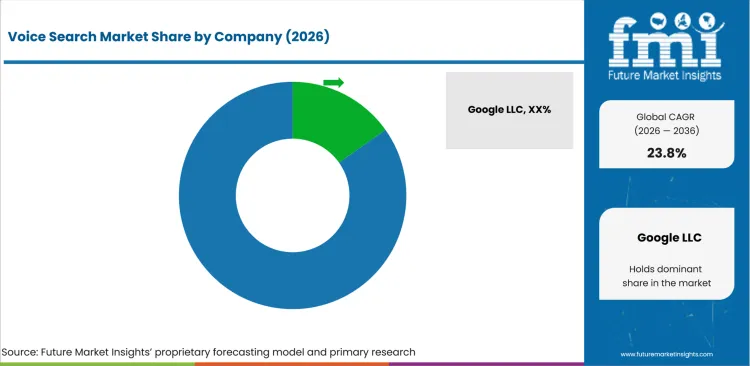
Consumer voice search remains concentrated among companies that control search indexes and assistant accounts across widely distributed operating systems and devices. Enterprise competition is more fragmented through separately purchased recognition models and workflow integration for defined applications. New entrants need local-language performance plus low latency and governance evidence for one supported deployment in speech and voice analytics applications.
- Google LLC, Amazon.com, Inc. and Apple Inc. combine web retrieval, assistant accounts and consumer-device distribution across recurring search sessions.
- Baidu, Inc. and Samsung Electronics Co., Ltd. connect spoken search with Chinese-language services or Galaxy device control.
- Microsoft Corporation joins International Business Machines Corporation and NVIDIA Corporation in serving clinical workflows plus enterprise orchestration and deployable speech infrastructure.
Competitive Benchmarking: Voice Search Market
| Company | Consumer voice-search reach | Speech and language platform | Device or vertical integration | Geographic Reach |
|---|---|---|---|---|
| Google LLC | High | High | High | More than 200 countries and territories |
| Amazon.com, Inc. | High | High | High | USA, Canada, Mexico, UK, Brazil and selected European markets |
| Apple Inc. | High | Medium | High | Supported Apple device markets; Siri AI rollout varies |
| Baidu, Inc. | High | High | High | China |
| Samsung Electronics Co., Ltd. | Medium | Medium | High | Germany, India, Korea, Poland, UK and USA |
| Microsoft Corporation | High | High | High | Nearly every Copilot app market; more than 40 languages |
| International Business Machines Corporation | Low | High | Medium | Global enterprise markets |
| NVIDIA Corporation | Low | High | Medium | Global cloud, on-premises and edge deployments |
Key Developments in the Voice Search Market
- In July 2026, Amazon expanded Alexa+ access through Alexa.com and the Alexa mobile app across supported markets.
- In June 2026, Apple introduced Siri AI for developer testing with web knowledge plus personal context and conversation history across supported Apple devices.
- In March 2026, Google expanded Search Live across more than 200 countries and territories offering AI Mode.
Key Players in the Voice Search Market
Consumer Search and Assistant Platforms
- Google LLC
- Amazon.com, Inc.
- Apple Inc.
Regional Device and Search Platforms
- Baidu, Inc.
- Samsung Electronics Co., Ltd.
Enterprise Speech and AI Infrastructure
- Microsoft Corporation
- International Business Machines Corporation
- NVIDIA Corporation
Voice Search Market - Report Scope
| Coverage field | Report scope |
|---|---|
| Market breakdown | By type, application, end use, technology and region. |
| Quantitative Units | Revenue in USD billion and CAGR in %. |
| Market Definition | Software, platforms, embedded capabilities and related services that accept spoken queries and return information or actions. |
| Regions Covered | North America, Latin America, Europe, East Asia, South Asia and Pacific, and Middle East and Africa. |
| Countries Covered | South Korea, Japan, USA, UK, Germany, and 20+ countries included in the full report. |
| Key Companies Profiled | Google LLC, Amazon.com, Inc., Apple Inc., Baidu, Inc., Samsung Electronics Co., Ltd., Microsoft Corporation, International Business Machines Corporation, NVIDIA Corporation. |
| Forecast Period | 2026 to 2036. |
| Approach | Primary and secondary research with market triangulation. |
Voice Search Market - Research Methodology
| Method | Approach |
|---|---|
| Primary Research | FMI analysts gathered input from manufacturers, service providers, technology developers, distributors, end users, procurement teams, and subject-matter experts. Interviews examined purchasing decisions, product or service evaluation, adoption barriers, approval requirements, pricing considerations, and expectations for technical or commercial support. Respondents were also asked what evidence is required before a trial, pilot, or initial order develops into regular purchasing. |
| Desk Research | Desk research covered government statistics, regulatory publications, trade data, industry associations, technical literature, standards, company filings, product information, and official corporate announcements. Sources were reviewed for relevance, publication date, geographic coverage, and consistency with the defined market scope. Claims relating to performance, applications, approvals, capacity, investment, and commercial activity were retained only when supported by credible public evidence. |
| Market Sizing and Forecasting | The market model combined the baseline value with historical performance, segment structure, pricing and volume indicators, adoption levels, company participation, and country-level demand conditions. Forecast assumptions considered economic activity, investment trends, regulatory developments, technology adoption, purchasing cycles, supply availability, and barriers to wider market use. Segment and regional estimates were reconciled before the final market total was calculated. |
| Data Validation | Estimates were checked against multiple independent indicators, including public data, company activity, trade patterns, industry developments, and findings from primary interviews. Validation also tested whether products, services, applications, and company revenues fell within the defined market boundaries. Adjacent categories, unsupported claims, overlapping revenues, and activities without direct market relevance were excluded to reduce double counting and maintain consistency across segments and countries. |
Voice Search Market by Segments
Voice Search Market segmented by Type:
- Generic Search
- Information Search
- Navigational Search
- Context-Aware Search
- Personalized Search
- Conversational Search
- Proactive Search
- Predictive Search
- Recommendation-Based Search
Voice Search Market segmented by Application:
- Smartphones & Mobile Devices
- Voice Assistants
- Mobile Search
- Smart Speakers
- Home Voice Assistants
- Smart Home Control
- Automotive
- In-Vehicle Voice Search
- Voice-Enabled Infotainment
- Consumer Electronics
- Smart TVs
- Wearable Devices
Voice Search Market segmented by End Use:
- Consumer Electronics
- Smartphones
- Smart Speakers
- Automotive
- Connected Vehicles
- In-Car Infotainment
- Retail & E-commerce
- Voice Shopping
- Product Search
- Healthcare
- Voice-Based Healthcare Search
- Clinical Information Access
Voice Search Market segmented by Technology:
- Speech Recognition & Automatic Speech Recognition
- Speech-to-Text
- Real-Time Voice Recognition
- Natural Language Processing
- Natural Language Understanding
- Conversational AI
- Artificial Intelligence & Machine Learning
- Deep Learning
- Generative AI
- Others
- Voice Biometrics
- Cloud-Based Voice Processing
Voice Search Market by Region:
- North America
- United States
- Canada
- Latin America
- Brazil
- Chile
- Mexico
- Rest of Latin America
- Western Europe
- Germany
- United Kingdom
- Italy
- Spain
- France
- Nordics
- Benelux
- Rest of Western Europe
- Eastern Europe
- Russia
- Poland
- Hungary
- Balkan and Baltic States
- Rest of Eastern Europe
- East Asia
- China
- Japan
- South Korea
- South Asia and Pacific
- India
- ASEAN
- Australia and New Zealand
- Rest of South Asia and Pacific
- Middle East and Africa
- Kingdom of Saudi Arabia
- Other GCC Countries
- Türkiye
- South Africa
- Other African Union Countries
- Rest of Middle East and Africa
Research Sources and Bibliography
- Ofcom. (2025, July 30). Media Nations 2025 - UK Report.
- Google. (2025, June 18). Search Live: Talk, listen and explore in real time with AI Mode.
- Budaraju, H. (2025, July 8). AI Mode in Google Search Rolling Out in India.
- Baidu, Inc. (2026, March 17). Form 20-F.
- IBM. (2026, February 24). Deepgram and IBM Introduce Advanced Voice Capabilities for Enterprise AI.
- Office of the Privacy Commissioner of Canada. (2026, June 25-26). G7 Data Protection and Privacy Authorities joint paper on connected home devices and children’s privacy.
- Microsoft. (2025, March 3). Microsoft Dragon Copilot provides the healthcare industry's first unified voice AI assistant that enables clinicians to streamline clinical documentation, surface information and automate tasks.
- Samsung Electronics. (2026, February 20). Samsung Introduces the New Bixby in One UI 8.5.
- Apple. (2025, March 31). Apple Intelligence
- Google. (2025, July 29). New ways to learn and explore with AI Mode in Search.
- Information Commissioner's Office. (2026, June 11). Setting out our expectations for the smart device industry.
- Mercedes-Benz Group. (2025, January 13). Cooperation with AI-powered conversational search.
- The Copilot Team. (2025, February 25). Announcing Free, Unlimited Access to Think Deeper and Voice.
- Amazon. (2025, February 26; updated 2026, July 21). Introducing Alexa+, the next generation of Alexa.
- Apple. (2026, June 8). Apple introduces Siri AI, a profoundly more capable and personal assistant.
- Google. (2026, March 26). Search Live is expanding globally.
- NVIDIA Corporation. (2026). Riva.
This bibliography is provided for reader reference and is not exhaustive. The full report contains the complete reference list and detailed citations
This Report Answers
- How large is the Voice Search Market in 2026 and 2036?
- Which operating conditions support recurring voice-search demand across connected interfaces?
- Which type segment accounts for the largest approved 2026 share?
- How does application access shape commercial voice-search demand across devices?
- Which end-use setting supports recurring spoken information requests?
- Which technology layer governs reliable entry for every spoken query?
- How do profiled country growth rates affect commercial entry conditions?
- Which companies serve consumer and enterprise voice-search applications?
Frequently Asked Questions
How big is the voice search market in 2026?
USD 6.1 billion represents the voice search market value in 2026 across consumer and enterprise interfaces used commercially. Reliable recognition and visible source links support repeated use as the category advances toward USD 51.6 billion by 2036 across connected devices.
What is the CAGR of the voice search market from 2026 to 2036?
A 23.8% CAGR is projected for the voice search market between 2026 and 2036 across assessed commercial applications worldwide. Context-preserving assistants broaden spoken discovery while privacy controls and language-specific testing determine reliable performance across mobile and household systems plus automotive and enterprise environments.
Which type segment is projected to account for 48.0% of the voice search market?
Generic search is projected to account for 48.0% of type demand within the voice search market in 2026. Frequent fact and navigation questions support broad relevance without requiring retained preferences or predictive permissions across common daily spoken search journeys worldwide.
How much will the voice search market add between 2026 and 2036?
USD 48.76 billion is expected to be added to the voice search market between 2026 and 2036. The increase depends on broader device access and accurate spoken retrieval across mobile and household systems plus automotive and enterprise environments with stable permissions.
Which companies are active in the voice search market?
Eight companies active in the voice search market include Google LLC, Amazon.com, Inc., Apple Inc., Baidu, Inc., Samsung Electronics Co., Ltd., Microsoft Corporation, International Business Machines Corporation and NVIDIA Corporation. The group covers consumer search, device distribution, clinical workflows, enterprise orchestration and deployable speech infrastructure.
Preview the report firsthand - request a free sample
Get SampleGet the brochure for pricing and purchase details.
Get PDFTable of Content
- Key Takeaways
- Market Size and CAGR
- Top Growth Driver
- Fastest Growing Segment
- Leading Region
- Key Companies
- Emerging Opportunities
- Executive Summary
- Global Market Outlook
- Demand-side Trends
- Supply-side Trends
- Technology Roadmap Analysis
- Analysis and Recommendations
- Analyst Perspective (What is happening? Why now? What should investors know?)
- Key Questions Answered
- How large is the market?
- What is the CAGR?
- What are key trends?
- Which region dominates?
- Who are the leaders?
- Market Overview
- Market Coverage / Taxonomy
- Market Definition / Scope / Limitations
- Research Methodology
- Chapter Orientation
- Analytical Lens and Working Hypotheses
- Market Structure, Signals, and Trend Drivers
- Benchmarking and Cross-market Comparability
- Market Sizing, Forecasting, and Opportunity Mapping
- Research Design and Evidence Framework
- Desk Research Programme (Secondary Evidence)
- Expert Input and Fieldwork (Primary Evidence)
- Tooling, Models, and Reference Databases
- Data Engineering and Model Build
- Quality Assurance and Audit Trail
- Market Background
- Market Dynamics (Drivers, Restraints, Opportunity, Trends)
- Scenario Forecast (Optimistic, Likely, Conservative)
- Impact Analysis
- AI Impact
- Sustainability Impact
- Regulatory Impact
- Technology Impact
- Consumer / Buyer Analysis
- Purchase Drivers
- Adoption Barriers
- Buyer Journey
- Opportunity Map Analysis
- Product Life Cycle Analysis
- Supply Chain Analysis
- Investment Feasibility Matrix
- Value Chain Analysis
- PESTLE and Porter's Analysis
- Regulatory Landscape
- Regional Parent Market Outlook
- Production and Consumption Statistics
- Import and Export Statistics
- Global Market Analysis and Forecast, 2021 to 2036
- Historical Market Size Value (USD Billion) Analysis, 2021 to 2025
- Current and Future Market Size Value (USD Billion) Projections, 2026 to 2036
- Y-o-Y Growth Trend Analysis
- Absolute $ Opportunity Analysis
- Global Market Pricing Analysis, 2021 to 2036
- Global Market Analysis and Forecast, By Type, 2021 to 2036
- Introduction / Key Findings
- Historical Market Size Value (USD Billion) Analysis By Type, 2021 to 2025
- Current and Future Market Size Value (USD Billion) Analysis and Forecast By Type, 2026 to 2036
- Generic Search
- Information Search
- Navigational Search
- Context-Aware Search
- Personalized Search
- Conversational Search
- Proactive Search
- Predictive Search
- Recommendation-Based Search
- Generic Search
- Y-o-Y Growth Trend Analysis By Type, 2021 to 2025
- Absolute $ Opportunity Analysis By Type, 2026 to 2036
- Global Market Analysis and Forecast, By Application, 2021 to 2036
- Introduction / Key Findings
- Historical Market Size Value (USD Billion) Analysis By Application, 2021 to 2025
- Current and Future Market Size Value (USD Billion) Analysis and Forecast By Application, 2026 to 2036
- Smartphones & Mobile Devices
- Voice Assistants
- Mobile Search
- Smart Speakers
- Home Voice Assistants
- Smart Home Control
- Automotive
- In-Vehicle Voice Search
- Voice-Enabled Infotainment
- Consumer Electronics
- Smart TVs
- Wearable Devices
- Smartphones & Mobile Devices
- Y-o-Y Growth Trend Analysis By Application, 2021 to 2025
- Absolute $ Opportunity Analysis By Application, 2026 to 2036
- Global Market Analysis and Forecast, By End Use, 2021 to 2036
- Introduction / Key Findings
- Historical Market Size Value (USD Billion) Analysis By End Use, 2021 to 2025
- Current and Future Market Size Value (USD Billion) Analysis and Forecast By End Use, 2026 to 2036
- Consumer Electronics
- Smartphones
- Smart Speakers
- Automotive
- Connected Vehicles
- In-Car Infotainment
- Retail & E-commerce
- Voice Shopping
- Product Search
- Healthcare
- Voice-Based Healthcare Search
- Clinical Information Access
- Consumer Electronics
- Y-o-Y Growth Trend Analysis By End Use, 2021 to 2025
- Absolute $ Opportunity Analysis By End Use, 2026 to 2036
- Global Market Analysis and Forecast, By Technology, 2021 to 2036
- Introduction / Key Findings
- Historical Market Size Value (USD Billion) Analysis By Technology, 2021 to 2025
- Current and Future Market Size Value (USD Billion) Analysis and Forecast By Technology, 2026 to 2036
- Speech Recognition & Automatic Speech Recognition
- Speech-to-Text
- Real-Time Voice Recognition
- Natural Language Processing
- Natural Language Understanding
- Conversational AI
- Artificial Intelligence & Machine Learning
- Deep Learning
- Generative AI
- Others
- Voice Biometrics
- Cloud-Based Voice Processing
- Speech Recognition & Automatic Speech Recognition
- Y-o-Y Growth Trend Analysis By Technology, 2021 to 2025
- Absolute $ Opportunity Analysis By Technology, 2026 to 2036
- Global Market Analysis and Forecast, By Region, 2021 to 2036
- Introduction
- Historical Market Size Value (USD Billion) Analysis By Region, 2021 to 2025
- Current Market Size Value (USD Billion) Analysis and Forecast By Region, 2026 to 2036
- North America
- Latin America
- Western Europe
- Eastern Europe
- East Asia
- South Asia and Pacific
- Middle East & Africa
- Market Attractiveness Analysis By Region
- North America Market Analysis and Forecast, By Country, 2021 to 2036
- Historical Market Size Value (USD Billion) Trend Analysis By Market Taxonomy, 2021 to 2025
- Market Size Value (USD Billion) Forecast By Market Taxonomy, 2026 to 2036
- By Country
- USA
- Canada
- By Type
- By Application
- By End Use
- By Technology
- By Country
- Market Attractiveness Analysis
- By Country
- By Type
- By Application
- By End Use
- By Technology
- Key Takeaways
- Latin America Market Analysis and Forecast, By Country
- Historical Market Size Value (USD Billion) Trend Analysis By Market Taxonomy, 2021 to 2025
- Market Size Value (USD Billion) Forecast By Market Taxonomy, 2026 to 2036
- By Country
- Brazil
- Mexico
- Chile
- Rest of Latin America
- By Type
- By Application
- By End Use
- By Technology
- By Country
- Market Attractiveness Analysis
- By Country
- By Type
- By Application
- By End Use
- By Technology
- Key Takeaways
- Western Europe Market Analysis and Forecast, By Country
- Historical Market Size Value (USD Billion) Trend Analysis By Market Taxonomy, 2021 to 2025
- Market Size Value (USD Billion) Forecast By Market Taxonomy, 2026 to 2036
- By Country
- Germany
- UK
- Italy
- Spain
- France
- Nordic
- BENELUX
- Rest of Western Europe
- By Type
- By Application
- By End Use
- By Technology
- By Country
- Market Attractiveness Analysis
- By Country
- By Type
- By Application
- By End Use
- By Technology
- Key Takeaways
- Eastern Europe Market Analysis and Forecast, By Country
- Historical Market Size Value (USD Billion) Trend Analysis By Market Taxonomy, 2021 to 2025
- Market Size Value (USD Billion) Forecast By Market Taxonomy, 2026 to 2036
- By Country
- Russia
- Poland
- Hungary
- Balkan & Baltic
- Rest of Eastern Europe
- By Type
- By Application
- By End Use
- By Technology
- By Country
- Market Attractiveness Analysis
- By Country
- By Type
- By Application
- By End Use
- By Technology
- Key Takeaways
- East Asia Market Analysis and Forecast, By Country
- Historical Market Size Value (USD Billion) Trend Analysis By Market Taxonomy, 2021 to 2025
- Market Size Value (USD Billion) Forecast By Market Taxonomy, 2026 to 2036
- By Country
- China
- Japan
- South Korea
- By Type
- By Application
- By End Use
- By Technology
- By Country
- Market Attractiveness Analysis
- By Country
- By Type
- By Application
- By End Use
- By Technology
- Key Takeaways
- South Asia and Pacific Market Analysis and Forecast, By Country
- Historical Market Size Value (USD Billion) Trend Analysis By Market Taxonomy, 2021 to 2025
- Market Size Value (USD Billion) Forecast By Market Taxonomy, 2026 to 2036
- By Country
- India
- ASEAN
- Australia & New Zealand
- Rest of South Asia and Pacific
- By Type
- By Application
- By End Use
- By Technology
- By Country
- Market Attractiveness Analysis
- By Country
- By Type
- By Application
- By End Use
- By Technology
- Key Takeaways
- Middle East & Africa Market Analysis and Forecast, By Country
- Historical Market Size Value (USD Billion) Trend Analysis By Market Taxonomy, 2021 to 2025
- Market Size Value (USD Billion) Forecast By Market Taxonomy, 2026 to 2036
- By Country
- Kingdom of Saudi Arabia
- Other GCC Countries
- Türkiye
- South Africa
- Other African Union
- Rest of Middle East & Africa
- By Type
- By Application
- By End Use
- By Technology
- By Country
- Market Attractiveness Analysis
- By Country
- By Type
- By Application
- By End Use
- By Technology
- Key Takeaways
- Key Countries Market Analysis
- USA
- Pricing Analysis
- Market Share Analysis, 2025
- By Type
- By Application
- By End Use
- By Technology
- Canada
- Pricing Analysis
- Market Share Analysis, 2025
- By Type
- By Application
- By End Use
- By Technology
- Mexico
- Pricing Analysis
- Market Share Analysis, 2025
- By Type
- By Application
- By End Use
- By Technology
- Brazil
- Pricing Analysis
- Market Share Analysis, 2025
- By Type
- By Application
- By End Use
- By Technology
- Chile
- Pricing Analysis
- Market Share Analysis, 2025
- By Type
- By Application
- By End Use
- By Technology
- Germany
- Pricing Analysis
- Market Share Analysis, 2025
- By Type
- By Application
- By End Use
- By Technology
- UK
- Pricing Analysis
- Market Share Analysis, 2025
- By Type
- By Application
- By End Use
- By Technology
- Italy
- Pricing Analysis
- Market Share Analysis, 2025
- By Type
- By Application
- By End Use
- By Technology
- Spain
- Pricing Analysis
- Market Share Analysis, 2025
- By Type
- By Application
- By End Use
- By Technology
- France
- Pricing Analysis
- Market Share Analysis, 2025
- By Type
- By Application
- By End Use
- By Technology
- India
- Pricing Analysis
- Market Share Analysis, 2025
- By Type
- By Application
- By End Use
- By Technology
- ASEAN
- Pricing Analysis
- Market Share Analysis, 2025
- By Type
- By Application
- By End Use
- By Technology
- Australia & New Zealand
- Pricing Analysis
- Market Share Analysis, 2025
- By Type
- By Application
- By End Use
- By Technology
- China
- Pricing Analysis
- Market Share Analysis, 2025
- By Type
- By Application
- By End Use
- By Technology
- Japan
- Pricing Analysis
- Market Share Analysis, 2025
- By Type
- By Application
- By End Use
- By Technology
- South Korea
- Pricing Analysis
- Market Share Analysis, 2025
- By Type
- By Application
- By End Use
- By Technology
- Russia
- Pricing Analysis
- Market Share Analysis, 2025
- By Type
- By Application
- By End Use
- By Technology
- Poland
- Pricing Analysis
- Market Share Analysis, 2025
- By Type
- By Application
- By End Use
- By Technology
- Hungary
- Pricing Analysis
- Market Share Analysis, 2025
- By Type
- By Application
- By End Use
- By Technology
- Kingdom of Saudi Arabia
- Pricing Analysis
- Market Share Analysis, 2025
- By Type
- By Application
- By End Use
- By Technology
- Türkiye
- Pricing Analysis
- Market Share Analysis, 2025
- By Type
- By Application
- By End Use
- By Technology
- South Africa
- Pricing Analysis
- Market Share Analysis, 2025
- By Type
- By Application
- By End Use
- By Technology
- USA
- Market Structure Analysis
- Competition Dashboard
- Competition Benchmarking
- Market Share Analysis of Top Players
- By Regional
- By Type
- By Application
- By End Use
- By Technology
- Emerging Startups
- Innovation Benchmarking
- Competition Analysis
- Competition Deep Dive
- Google LLC
- Overview
- Product Portfolio
- Profitability by Market Segments
- Sales Footprint
- Strategy Overview
- Marketing Strategy
- Product Strategy
- Channel Strategy
- Amazon.com, Inc.
- Apple Inc.
- Microsoft Corporation
- Baidu, Inc.
- Samsung Electronics Co., Ltd.
- IBM Corporation
- Alibaba Group Holding Limited
- NVIDIA Corporation
- Nuance Communications, Inc.
- Others
- Google LLC
- Case Studies
- Success Stories
- Recent Developments
- Competition Deep Dive
- Assumptions & Acronyms Used


