

- Market Size (2026)
- USD 353.8 Mn
- Forecast (2036)
- USD 853.1 Mn
- CAGR (2026 to 2036)
- 9.2%
How big is the Water-Based Barrier Coatings for Food Packaging Market in 2026?
USD 353.8 million in 2026 and USD 853.1 million by 2036 at a 9.2% CAGR.
Demand for water-based barrier coatings for food packaging is projected to rise at a 9.2% CAGR by 2036, driving industry valuation from USD 353.8 million in 2026 to USD 853.1 million through 2036. European packaging rules are shifting qualification toward fiber structures that protect food through grease and moisture barriers without difficult laminate separation. In February 2025, the European Commission confirmed that the Packaging and Packaging Waste Regulation entered force on February 11. The regulation gives converters a defined period to align coating chemistry with recyclability testing and production-line performance. Related packaging coatings show how waterborne layers can protect paper surfaces during filling and storage. Investment in recyclable packaging depends on full-package trials that reproduce coat weight and sealing performance on existing equipment.
United States converters face a direct reformulation route for grease-resistant paper, while European programs place more weight on finished-package recyclability.On January 3, 2025, the FDA confirmed that 35 PFAS-related food-contact notifications were no longer effective as of January 6, 2025. The action increased demand for validated fluorine-free coatings across paper and paperboard food-contact programs in the United States. European programs require separate evidence for fiber recovery and fee classification across distinct national recycling systems. Development teams in food packaging therefore need migration data together with barrier results and recycling evidence for each destination. Commercial adoption strengthens as coating weight and heat-seal behavior remain stable on existing lines during repeated production.
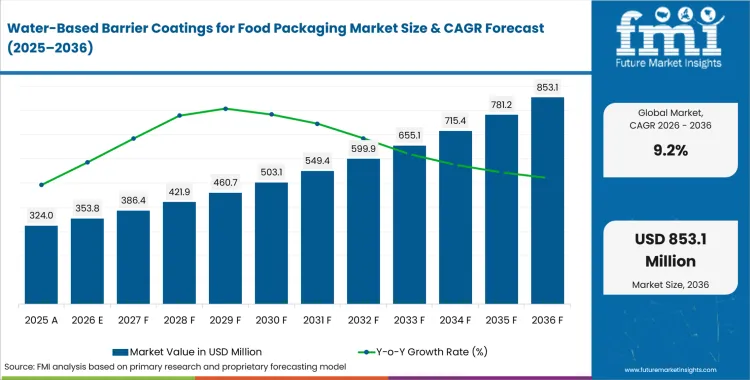
Key Takeaways of Water-Based Barrier Coatings for Food Packaging Market
- Food brands are expanding fiber-based packaging programs that require grease and moisture protection without difficult plastic laminate separation.
- Paper is projected to hold 41.8% share by material in 2026, supported by established coating equipment and familiar paper-recycling routes.
- Pouches are estimated to represent 23.0% of format demand in 2026, reinforced by lightweight structures serving snacks and shelf-stable foods.
- Food is expected to capture 57.6% share in 2026, shaped by recurring barrier requirements across several package formats.
- Recyclability assessment and production-line consistency remain material constraints as coatings must preserve protection across conversion and local recovery systems.
- Competition includes Michelman, Solenis, BASF, ACTEGA, Dow, Henkel, Siegwerk and Kuraray across integrated chemistry and specialist barrier models.
Analyst Perspective
"Successful water-based coating programs treat barrier performance and fiber recovery as one package qualification task. Food-contact approval cannot compensate for unstable coat weight or sealing behavior during repeated commercial production runs. Companies that combine formulation support with converter trials can shorten reformulation cycles and build repeat business across paper pouches, trays and regional foodservice packaging."
- Nandini Roy Choudhury, Principal Analyst, Future Market Insights
How is the Water-Based Barrier Coatings for Food Packaging Market segmented?
The water-based barrier coatings for food packaging industry is segmented by material, format, barrier or feature, end use, and region.
Material identifies the coated substrate, while format identifies the package structure receiving the functional layer. Barrier or feature separates grease protection, moisture control, traceability and freshness functions across the finished package. End use identifies the product category that sets migration, shelf-life and handling requirements for each commercial specification. Regional analysis captures differences in food-contact approval, recycling systems and technical support that influence adoption timing. The paper packaging market provides a useful comparison for fiber economics without replacing this title's coating-specific boundary. Related barrier technologies clarify functional differences across grease, water-vapor and oxygen protection in coated structures. Together, these dimensions connect formulation selection with package design, converter trials and repeat purchasing across commercial programs.
Why does paper shape material demand in the water-based barrier coatings for food packaging market?
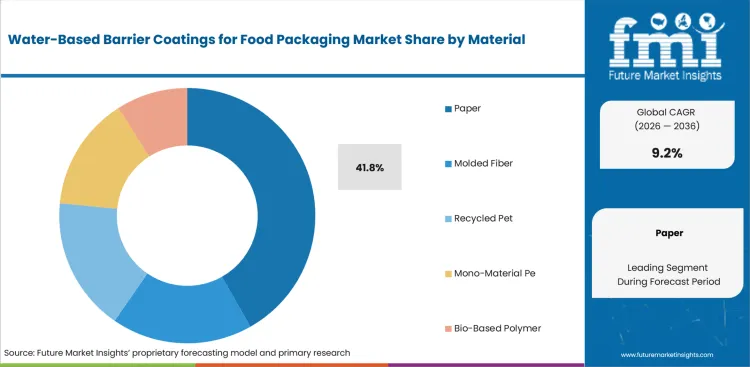
Paper gives converters a familiar surface for adding grease and moisture protection without changing the base forming process. In April 2026, BASF presented water-based Joncryl resins for repulpable barrier coatings that remain compatible with paper recycling. The development links coating performance with fiber recovery inside the same finished paper packaging structure. Qualification therefore centers on coat weight, drying behavior and finished-package recovery across existing converting equipment.
- In 2026, paper is expected to lead the material category with 41.8% share because established coating lines already process paper webs at commercial speed. Paper supports established printing and cutting routes used across high-volume food-packaging plants and contract converting sites. Its position depends on proven fiber recovery from the coated structure rather than familiarity with the uncoated substrate.
- Converters favor paper for programs requiring print quality and controlled coating weight across large production runs. The molded fiber market creates adjacent demand for barrier layers on trays and foodservice shapes. Adoption expands through trials that preserve seal performance and fiber recovery across the complete package under intended storage conditions.
What supports pouches within the format category?
Pouches place the coating within a flexible structure that must seal reliably around snacks and powders. Viscous foods add leakage risk across folds and sealed edges throughout storage and regional distribution. In April 2026, Michelman introduced Nuvita Life 4002 and 4605 as bio-based water-based coatings for paper pouches and sachets. The coatings combine grease and moisture protection with heat sealing on vertical form-fill-seal equipment used for commercial production. The launch gives converters a direct qualification route at production speed across flexible webs and intended product conditions.
- Pouches are projected to hold 23.0% share in 2026 owing to their low package weight across shelf-stable food programs. Coated paper pouches combine barrier and heat-seal functions within one lightweight structure used across filling lines. Their position depends on reliable seals across flexible webs exposed to folding and repeated handling.
- Food manufacturers expand pouch use for products requiring moisture or grease protection with less packaging material. Commercial success depends on uniform coating across flexible packaging webs and dependable sealing at production speed. Converter trials should measure leakage and fold resistance separately from basic laboratory barrier values under intended filling conditions.
Why does the grease resistant segment shape barrier or feature demand?
Grease resistance creates a visible performance result for bakery products and takeaway foods across high-volume packaging formats. In August 2025, Solenis reported that TopScreen coatings protected paper against oil and grease without polyethylene films or intentionally added PFAS. The range runs on standard coating and cup-forming equipment across established commercial food-packaging production lines. The development connects functional additives with practical fiber substitution across food-contact packaging and established converting processes.
- The grease resistant segment is likely to capture 14.0% share in 2026 attributable to direct use across oily foods and foodservice packaging. Converters can verify performance through stain resistance and package integrity during normal food-holding and storage periods. The measurable result gives grease protection a clearer qualification route than features requiring digital infrastructure across participating sites.
- Quick-service chains and packaged-food brands expand purchases for formats exposed to oil during storage or consumption. Adoption depends on grease protection that preserves print quality and fiber recovery across each finished package. Coating developers earn repeat programs by reproducing protection without slowing drying or creating deposits on production equipment during long runs.
What makes food central to the end use category?
Food packaging exposes coated substrates to migration review and storage conditions that differ by product composition. In May 2026, UPM and BASF announced recyclable paper packaging concepts using waterborne Joncryl barrier coatings. The structures provide moisture and grease protection across food applications and support compatibility with established paper-recycling protocols. The collaboration links food-contact requirements with material recovery across finished structures used in commercial food packaging. Commercial qualification therefore needs migration evidence and production-line trials for every intended package geometry and food application.
- Food is set to lead the end-use category with 57.6% share in 2026 due to recurring grease and moisture protection requirements. Bakery packs and frozen-food formats create repeated coating demand across several package structures and commercial filling conditions. The segment's position reflects application frequency rather than dependence on one barrier function or package type.
- Food converters broaden water-based coating use across bakery and takeaway packaging with different holding conditions. Each program requires migration documents and shelf-life tests for the intended temperature and product composition. Adoption expands through stable coating weight across repeated production runs and several package geometries without major equipment changes across regional plants.
What are the drivers, restraints, and opportunities in the Water-Based Barrier Coatings for Food Packaging Market?
Regulatory deadlines and fiber-conversion programs support demand, but recyclability scoring and line-performance trade-offs limit broader implementation.
- Driver: Food brands are redesigning fiber packages that require water-based grease and moisture protection on existing converting lines.
- Restraint: Recyclability classifications differ by package structure and can penalize coated formats without proven sorting or fiber-recovery performance.
- Opportunity: Coating developers can secure repeat programs through food-contact compliance and stable production results across several package formats.
Food brands need functional barriers that support fiber conversion without weakening package integrity during filling and storage. In April 2026, ACTEGA presented ACTGreen water-based coatings that protect against water and fats while supporting fiber recovery. The company identified baking trays and fast-food packaging as commercial applications for the ACTGreen coating range. The development gives converters a direct route for comparing barrier results with repulping performance across finished structures. Programs advance through trials that confirm both outcomes on existing paper and board converting lines at production speed.
Recyclability scoring restrains adoption because a functional coating changes how the complete package enters collection and reprocessing systems. UK regulators updated the recyclability assessment methodology for packaging components and material classifications in September 2025. The method assigns red, amber or green ratings that affect producer fees at package-component level. Strong grease protection cannot secure commercial approval if the finished structure receives an unfavorable classification. Converter qualification therefore requires barrier testing and recovery evidence from the same finished package construction during commercial review.
Application-specific formulation creates an opportunity for developers that combine aqueous processing with several barrier functions. In June 2025, Kuraray Europe introduced repulpable EXCEVAL polymers for coatings used on paper-based food packaging. The water-soluble resins provide gas and grease barriers across recyclable coating concepts for food applications. The route lets converters reduce plastic content without treating barrier performance and fiber recovery as separate projects. Commercial value depends on matching each resin system with the intended food and converting conditions.
Which country CAGRs are profiled in the Water-Based Barrier Coatings for Food Packaging Market?
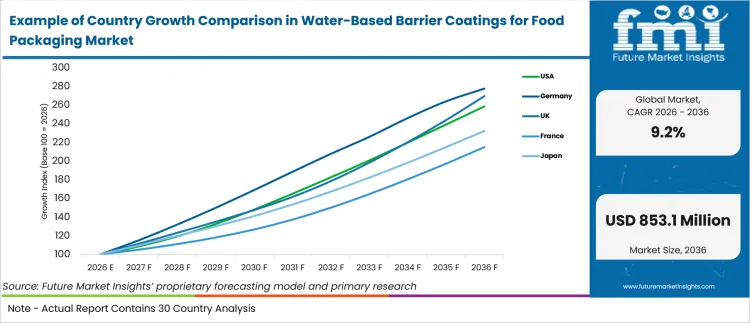
| Country | CAGR |
|---|---|
| India | 12.4% |
| United States | 11.5% |
| United Kingdom | 10.6% |
| Germany | 8.7% |
| Japan | 9.7% |
| France | 7.8% |
How do country-level CAGRs compare in the Water-Based Barrier Coatings for Food Packaging Market?
The country forecasts show a differentiated growth pattern across the water-based barrier coatings for food packaging market, with a noticeable transition from high-growth adoption markets to more established packaging economies. India, the United States and the United Kingdom form an upper group where demand is supported by ongoing replacement of conventional barrier materials and increasing focus on recyclable packaging formats. Japan creates a bridge between this group and the lower-growth European markets, reflecting steady movement toward fiber-based packaging solutions. Germany and France follow at a more measured pace, although the gaps between adjacent countries remain moderate rather than abrupt.
- India benefits from rapid growth in packaged food consumption and increasing investment in sustainable packaging materials that can meet both performance and environmental requirements.
- The United States reflects strong demand for recyclable food packaging solutions as brand owners and packaging converters expand the use of fiber-based formats with advanced barrier properties.
- The United Kingdom continues to support market development through packaging sustainability initiatives and growing adoption of coating technologies that reduce reliance on plastic-based barrier layers.
- Japan's outlook is influenced by continued innovation in high-performance packaging materials and efforts to balance product protection with circular economy objectives.
- Germany maintains steady momentum as packaging manufacturers evaluate water-based barrier systems that align with evolving recycling requirements and material efficiency goals.
- France supports market expansion through increasing demand for environmentally responsible food packaging and greater emphasis on reducing the environmental impact of packaging materials.
Similar CAGRs do not necessarily create identical commercial opportunities. Differences in food packaging regulations, recycling infrastructure, coating performance requirements and converter adoption strategies can significantly influence market penetration. As a result, suppliers may encounter distinct qualification, testing and commercialization pathways even where forecast growth rates appear relatively comparable. The full report provides country-level CAGR analysis across North America, Latin America, Europe, East Asia, South Asia, Oceania and the Middle East and Africa.
Country-wise Analysis
- India's coating opportunity begins with plastic-waste obligations that make packaging composition and EPR reporting visible across national retail programs. Large food converters compare coated paper with plastic-reduction targets across high-volume product lines and contract packing sites. The Indian water-based barrier coatings sector is projected to record 12.4% CAGR during the assessment period, supported by packaged-food scale and wider fiber conversion. The Press Information Bureau reported the status of plastic EPR implementation across India in March 2026. The agency listed 2,986 registered recyclers and 196.97 lakh metric tonnes processed under EPR by March 5. Paper recovery follows separate routes, so converters must validate local collection and pulping performance for coated structures. Uneven testing capacity outside major industrial centers remains a friction across regional production and packaging networks. Coating producers need local trials that prove barrier performance and realistic recovery routes across intended sales areas.
- United States adoption begins with FDA food-contact authorization and large paper-converting networks serving national food brands. Water-based barrier coating sales in the United States are forecast to expand at 11.5% CAGR by 2036, reinforced by replacement of fluorinated grease barriers. The FDA updated its food-contact substance inventory with current notification information for paper coatings in June 2026. FCN No. 2412 took effect on February 12, 2025 for microfibrillated cellulose in food-contact paper coatings. The authorization provides a defined evaluation route for selected fiber-based formulations across established regulatory channels. Regional coating and cup-forming clusters provide an enabler for production trials across several major converting states. State packaging rules and customer protocols create additional documentation burdens beyond federal clearance for national brand programs. National rollouts require separate proof for migration safety and recycling compatibility across the finished package.
- United Kingdom packaging economics now reflect producer-responsibility fees that differ by material classification and alter the cost of coated structures. Adoption of water-based barrier coatings in the United Kingdom is estimated to expand at 10.6% CAGR through 2036, underpinned by paper-format redesign and fee exposure. PackUK updated final base-fee categories in June 2025 and separated paper from fiber-based composite packaging. The category split gives coating developers a commercial reason to preserve paper classification through formal recyclability assessment. Centralized retailer specifications provide an enabler through repeat volumes across several food formats and national store networks. Documentation needed for modulated fees remains a friction across major packaging programs and material redesign decisions. Coating developers need test data that links barrier performance with the final package classification rather than the coating layer.
- Germany combines a mature dual-system recycling network with detailed technical expectations for coated paper and board. Converters test fiber recovery and sorting behavior together with grease or moisture protection during commercial qualification. Water-based barrier coating demand in Germany is forecast to rise at 8.7% CAGR over the forecast period, underpinned by established paper use and strict recovery controls. In January 2026, the German Environment Agency (UBA) and the Central Agency Packaging Register (ZSVR) jointly reported that approximately 5.5 million tonnes of packaging waste collected by dual systems were recycled during 2024. The agency confirmed that paper and cardboard met statutory recycling targets across the national dual-system network. The infrastructure supports commercial scale but raises the proof standard for coating compatibility across finished package structures. Developers must reconcile barrier strength with fiber recovery across several national collection and reprocessing routes. Local technical support improves adoption through faster coating and drying adjustments during production-scale converter trials.
- Japan's packaging route depends on municipal collection plans that differ across paper categories and local sorting practices. In Japan, water-based barrier coating demand is predicted to advance at 9.7% CAGR through 2036. Careful material qualification and compact food formats support the national outlook across specialized converting programs. The Ministry of the Environment published fiscal 2026 collection plans for paper packaging and other materials in March 2026. Paper packaging collection was planned by 904 municipalities with an estimated volume of 97 thousand tonnes. Municipal planning provides an enabler for packages that retain a clear paper recovery route across local systems. Uneven collection coverage remains a friction across local authorities and contracted waste-service areas throughout Japan. Coating producers need precise Japanese documentation and technical support that protects sealing performance within limited production footprints. Programs advance as package design matches the collection route serving the intended customer region and package category.
- France combines mature household collection with producer-responsibility obligations for professional packaging across national commercial channels. By 2036, the French water-based barrier coatings market is projected to grow at 7.8% CAGR. Fiber-recycling expectations and foodservice conversion shape adoption across retail networks and commercial foodservice packaging programs. ADEME published data covering household packaging and graphic papers placed on the market during 2024 in April 2026.The agency recorded 6.35 million tonnes of household packaging and graphic papers placed on the market, with a 69.6% recycling rate for household packaging and 66.9% for graphic papers. The established system gives food brands a familiar recovery framework for evaluating coated paper structures and formats. Composite structures face additional evidence requirements if coatings alter sorting or pulping behavior across existing recovery systems. French converters therefore need local trials that document grease protection and fiber recovery across the final package. Programs advance most effectively through national recyclability testing and food-contact review for each finished package structure.
Who are the notable companies in the Water-Based Barrier Coatings for Food Packaging Market?
Michelman, Solenis, BASF, ACTEGA, Dow, Henkel, Siegwerk and Kuraray are notable companies shaping this market.
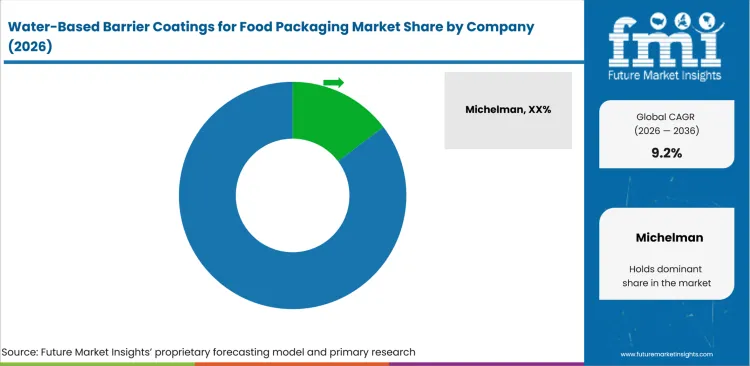
Competition centers on companies that combine water-based coating chemistry with converter-scale validation across paper and board. In May 2026, Michelman announced two validated paper-packaging concepts developed with UPM Specialty Materials and BOBST. The collaboration joined substrate design with bio-based coatings and production-line expertise across two commercial package concepts. Validation methods used across paper cups now extend toward broader fiber structures and flexible food-packaging formats. Solenis and ACTEGA compete through barrier portfolios supported by extensive paper and board application testing. BASF and Henkel integrate coatings with wider polymer or adhesive platforms across regional packaging programs. Dow adds scalable aqueous dispersion capacity, while Siegwerk and Kuraray focus on natural-polymer or repulpable barrier routes.
- Michelman and Solenis compete with ACTEGA through dedicated water-based barrier portfolios serving paper and board food packaging. Their commercial case depends on grease or moisture coverage and technical testing that establishes coat weight and recovery performance across varied finished package structures.
- BASF and Henkel combine barrier chemistry with wider polymer or adhesive platforms across regional packaging programs. Dow adds scalable aqueous dispersion capacity for paper applications across foodservice and flexible packaging formats. Their advantage rests on coordinated sealing and recycling evidence across several converter locations and national packaging programs.
- Siegwerk and Kuraray address focused chemistry routes through natural-polymer coatings or repulpable aqueous resins for paper applications. Their options suit converters prioritizing grease resistance and fiber recovery within clearly defined food-packaging structures. Their narrower platforms support targeted qualification for specific foods and documented recovery conditions across selected package formats.
Competitive Benchmarking: Water-Based Barrier Coatings for Food Packaging Market
| Company | Barrier Portfolio Breadth | Food-Contact and Grease Protection | Recyclability and Line Support | Geographic Reach |
|---|---|---|---|---|
| Michelman | High | High | High | Global |
| Solenis | High | High | Medium | Global |
| BASF | High | High | High | Global |
| ACTEGA | High | High | Medium | Global |
| Dow | High | High | High | Global |
| Henkel | High | High | High | Global |
| Siegwerk | Medium | High | Medium | Global |
| Kuraray | Medium | High | Medium | Global |
Key Developments in the Water-Based Barrier Coatings for Food Packaging Market
- In November 2025, Michelman introduced Michem Coat 9250 as a water-based coating for recyclable hot-beverage paper cups. The company reported higher solids and stronger resistance to coffee and creamers across several cup-forming systems. Typical coated structures passed recyclability evaluations in the European Union and China as well as the United States. The launch broadens options for high-speed cup programs requiring heat sealing and dependable fiber recovery.
- In May 2025, Dow inaugurated an advanced BLUEWAVE technology facility at its Lauterbourg site in France. The production line creates aqueous polymer dispersions for barrier coatings used in recyclable paper packaging. Dow identified RHOBARR 320 as an aqueous dispersion manufactured at the facility for recyclable paper applications. RHOBARR 320 provides grease and liquid resistance together with heat sealing across paper packaging applications. The investment expands European production capacity for converters evaluating fiber-based food structures across commercial packaging programs.
- In March 2025, Siegwerk announced TÜV Austria home-compostability certification for two CIRKIT NATUBAR water-based coatings. The formulations use natural polymers to improve water and grease resistance across paper packaging and foodservice applications. Siegwerk reported a 100% CEPI scorecard result and full repulpability for the coated paper structures under testing. The certification gives foodservice converters a documented end-of-life route alongside barrier performance for selected disposable fiber formats.
- In April 2026, Henkel expanded its water-based barrier and heat-seal coating portfolio for paper applications. The company stated that the coatings support food-contact packaging on standard coating processes and retain repulpable performance. The range covers grease and moisture protection alongside sealing at low temperatures or high line speeds. The expansion gives converters a broader route for replacing plastic layers without rebuilding existing coating operations.
Key Players in the Water-Based Barrier Coatings for Food Packaging Market
Barrier Coating Specialists
- Michelman
- Solenis
- ACTEGA
- Siegwerk
Integrated Material and Adhesive Providers
- BASF
- Dow
- Henkel
Specialty Barrier Polymer Provider
- Kuraray
Water-Based Barrier Coatings for Food Packaging Market - Report Scope
| Coverage field | Report scope |
|---|---|
| Market breakdown | Material, format, barrier or feature, end use, and region. |
| Quantitative Units | Revenue in USD Million, CAGR in %. |
| Market Definition | Commercially tracked demand for water-based barrier coatings used on food packaging across the defined material, format, feature, and end-use categories. |
| Regions Covered | North America, Latin America, Europe, East Asia, South Asia, Oceania, and Middle East and Africa. |
| Countries Covered | United States, Germany, United Kingdom, France, Japan, India, and 30+ countries. |
| Key Companies Profiled | Michelman, Solenis, BASF, ACTEGA, Dow, Henkel, Siegwerk, Kuraray. |
| Forecast Period | 2026 to 2036. |
| Approach | Hybrid bottom-up and top-down market sizing supported by primary interviews and official desk research. |
Water-Based Barrier Coatings for Food Packaging Market - Research Methodology
| Method | Approach |
|---|---|
| Primary Research | FMI analysts gathered input from manufacturers, service providers, technology developers, distributors, end users, procurement teams, and subject-matter experts. Interviews examined purchasing decisions, product or service evaluation, adoption barriers, approval requirements, pricing considerations, and expectations for technical or commercial support. Respondents were also asked what evidence is required before a trial, pilot, or initial order develops into regular purchasing. |
| Desk Research | Desk research covered government statistics, regulatory publications, trade data, industry associations, technical literature, standards, company filings, product information, and official corporate announcements. Sources were reviewed for relevance, publication date, geographic coverage, and consistency with the defined market scope. Claims relating to performance, applications, approvals, capacity, investment, and commercial activity were retained only when supported by credible public evidence. |
| Market Sizing and Forecasting | The market model combined the baseline value with historical performance, segment structure, pricing and volume indicators, adoption levels, company participation, and country-level demand conditions. Forecast assumptions considered economic activity, investment trends, regulatory developments, technology adoption, purchasing cycles, supply availability, and barriers to wider market use. Segment and regional estimates were reconciled before the final market total was calculated. |
| Data Validation | Estimates were checked against multiple independent indicators, including public data, company activity, trade patterns, industry developments, and findings from primary interviews. Validation also tested whether products, services, applications, and company revenues fell within the defined market boundaries. Adjacent categories, unsupported claims, overlapping revenues, and activities without direct market relevance were excluded to reduce double counting and maintain consistency across segments and countries. |
Water-Based Barrier Coatings for Food Packaging Market by Segments
Water-Based Barrier Coatings for Food Packaging Market Segmented by Material:
- Paper
- Molded Fiber
- Recycled PET
- Mono-material PE
- Bio-based Polymer
Water-Based Barrier Coatings for Food Packaging Market Segmented by Format:
- Pouches
- Trays
- Labels
- Mailers
- Inserts
Water-Based Barrier Coatings for Food Packaging Market Segmented by Barrier or Feature:
- Grease Resistant
- High Barrier
- Tamper Evident
- Traceable
- Freshness Indicating
Water-Based Barrier Coatings for Food Packaging Market Segmented by End Use:
- Food
- Pharmaceutical
- E-commerce
- Personal Care
- Cold Chain
Water-Based Barrier Coatings for Food Packaging Market by Region:
- North America
- United States
- Canada
- Latin America
- Mexico
- Brazil
- Chile
- Rest of Latin America
- Western Europe
- Germany
- United Kingdom
- Italy
- Spain
- France
- Nordics
- Benelux
- Rest of Western Europe
- Eastern Europe
- Russia
- Poland
- Hungary
- Balkans and Baltics
- Rest of Eastern Europe
- East Asia
- China
- Japan
- South Korea
- South Asia and Pacific
- India
- ASEAN
- Australia and New Zealand
- Rest of South Asia and Pacific
- Middle East and Africa
- Kingdom of Saudi Arabia
- Other GCC Countries
- Türkiye
- South Africa
- Rest of Africa
- Rest of Middle East and Africa
Research Sources and Bibliography
- Directorate-General for Environment. (2025, February 11). New rules enter into force for a more sustainable and competitive packaging economy.
- USA Food and Drug Administration. (2025, January 3). FDA Determines Authorization for 35 Food Contact Notifications Related to PFAS Are No Longer Effective.
- BASF. (2026, April 16). BASF at interpack 2026: Solutions for modern packaging concepts.
- Michelman. (2026, April 30). Michelman Introduces Nuvita® Life 4002 & Nuvita® Life 4605: Bio-Based Barrier Coatings for Paper Packaging Applications.
- Solenis. (2025, August 13). Solenis to Showcase Sustainable Paper and Packaging Solutions at FACHPACK 2025 and PACK EXPO Las Vegas 2025.
- BASF. (2026, May 4). UPM and BASF accelerate the transition to recyclable, fiber-based packaging.
- ACTEGA. (2026, April 8). ACTEGA at INTERPACK 2026.
- Department for Environment, Food & Rural Affairs, Environment Agency, & Natural Resources Wales. (2025, September 4). Recyclability assessment methodology: how to assess your packaging waste.
- Kuraray Europe GmbH. (2025, June 18). Kuraray pioneers sustainable packaging with innovative barrier materials.
- Press Information Bureau, Government of India. (2026, March 23). PARLIAMENT QUESTION: Circular Economy Framework and Extended Producer Responsibility.
- USA Food and Drug Administration. (2026, June 30). Inventory of Effective Food Contact Substance Notifications: FCN No. 2412.
- Department for Environment, Food & Rural Affairs. (2025, June 30). Extended Producer Responsibility for Packaging: 2025 base fees.
- German Environment Agency & Central Agency Packaging Register. (2026, January 27). Facts against myths: Packaging waste recycling in Germany is working.
- Ministry of the Environment, Government of Japan. (2026, March 31). [Compilation results of projected separate collection volumes from fiscal 2026 onward under the Containers and Packaging Recycling Law].
- ADEME. (2026, April 7). Emballages ménagers et papiers graphiques : données 2024.
- Michelman. (2026, May 7). UPM, Michelman, and BOBST Introduce Bio-Based Paper Packaging Concepts Aligned With EU Packaging Rules.
- Michelman. (2025, November 6). Michelman Introduces Michem® Coat 9250: Next-Generation Recyclable Cup Coating for Hot Beverages.
- Dow. (2025, May 28). How innovative Dow BLUEWAVE™ technology supports sustainable business growth.
- Siegwerk. (2025, March 5). Siegwerk Achieves Home Compostability Certification for CIRKIT NATUBAR PR4798 and CIRKIT NATUBAR CT4326 Water-Based Coatings.
- Henkel. (2026, April 8). Henkel expands its barrier and heat seal coatings portfolio for paper applications.
This bibliography is provided for reader reference and is not exhaustive. The full report contains the complete reference list and detailed citations
This Report Answers
- How large is the water-based barrier coatings for food packaging market in 2026 and 2036?
- Which operating pressures support conversion from plastic laminates toward coated fiber packaging?
- Why does paper account for the largest material share in 2026?
- How do pouches change sealing and barrier requirements across flexible food formats?
- Why does grease resistance create a distinct commercial qualification route?
- How do country growth rates differ across India, the United States, Europe and Japan?
- Which companies provide dedicated coatings or integrated material platforms for food packaging?
- What limits recyclability claims across coated paper and fiber-based composite structures?
- How should converters compare barrier performance with line compatibility and recovery evidence?
Frequently Asked Questions
How big is the Water-Based Barrier Coatings for Food Packaging Market in 2026?
The water-based barrier coatings for food packaging market is valued at USD 353.8 million in 2026 and is forecast to reach USD 853.1 million by 2036, supported by food brands expanding fiber-based packaging programs that require grease and moisture protection without difficult plastic laminate separation across commercial converting lines.
What is the CAGR of the Water-Based Barrier Coatings for Food Packaging Market from 2026 to 2036?
The water-based barrier coatings for food packaging market is projected to grow at a CAGR of 9.2% between 2026 and 2036, supported by regulatory deadlines eliminating fluorinated grease barriers, expanding European recyclability requirements, and growing food brand investment in fiber-based packaging formats with validated waterborne barrier performance.
Which material leads the Water-Based Barrier Coatings for Food Packaging Market?
Paper accounts for 41.8% of the water-based barrier coatings for food packaging market by material in 2026, driven by established coating equipment compatibility and familiar paper-recycling routes that allow converters to add grease and moisture protection without changing base forming processes across high-volume food-packaging plants.
How much will the Water-Based Barrier Coatings for Food Packaging Market add between 2026 and 2036?
The water-based barrier coatings for food packaging market is set to add USD 499.3 million between 2026 and 2036, growing from USD 353.8 million to USD 853.1 million as PFAS phase-outs, European packaging recyclability rules, and fiber-conversion programs across food brands accelerate adoption of waterborne barrier systems globally.
Who are the leading companies in the Water-Based Barrier Coatings for Food Packaging Market?
Leading companies in the water-based barrier coatings for food packaging market include Michelman, Solenis, BASF, ACTEGA, Dow, Henkel, Siegwerk, and Kuraray, competing across dedicated barrier coating portfolios, integrated material and adhesive platforms, and specialty barrier polymer systems with global converter reach.
Preview the report firsthand - request a free sample
Get SampleGet the brochure for pricing and purchase details.
Get PDFTable of Content
- Key Takeaways
- Market Size and CAGR
- Top Growth Driver
- Fastest Growing Segment
- Leading Region
- Key Companies
- Emerging Opportunities
- Executive Summary
- Global Market Outlook
- Demand-side Trends
- Supply-side Trends
- Technology Roadmap Analysis
- Analysis and Recommendations
- Analyst Perspective (What is happening? Why now? What should investors know?)
- Key Questions Answered
- How large is the market?
- What is the CAGR?
- What are key trends?
- Which region dominates?
- Who are the leaders?
- Market Overview
- Market Coverage / Taxonomy
- Market Definition / Scope / Limitations
- Research Methodology
- Chapter Orientation
- Analytical Lens and Working Hypotheses
- Market Structure, Signals, and Trend Drivers
- Benchmarking and Cross-market Comparability
- Market Sizing, Forecasting, and Opportunity Mapping
- Research Design and Evidence Framework
- Desk Research Programme (Secondary Evidence)
- Expert Input and Fieldwork (Primary Evidence)
- Tooling, Models, and Reference Databases
- Data Engineering and Model Build
- Quality Assurance and Audit Trail
- Market Background
- Market Dynamics (Drivers, Restraints, Opportunity, Trends)
- Scenario Forecast (Optimistic, Likely, Conservative)
- Impact Analysis
- AI Impact
- Sustainability Impact
- Regulatory Impact
- Technology Impact
- Consumer / Buyer Analysis
- Purchase Drivers
- Adoption Barriers
- Buyer Journey
- Opportunity Map Analysis
- Product Life Cycle Analysis
- Supply Chain Analysis
- Investment Feasibility Matrix
- Value Chain Analysis
- PESTLE and Porter's Analysis
- Regulatory Landscape
- Regional Parent Market Outlook
- Production and Consumption Statistics
- Import and Export Statistics
- Global Market Analysis and Forecast, 2021 to 2036
- Historical Market Size Value (USD Million) Analysis, 2021 to 2025
- Current and Future Market Size Value (USD Million) Projections, 2026 to 2036
- Y-o-Y Growth Trend Analysis
- Absolute $ Opportunity Analysis
- Global Market Pricing Analysis, 2021 to 2036
- Global Market Analysis and Forecast, By Material, 2021 to 2036
- Introduction / Key Findings
- Historical Market Size Value (USD Million) Analysis By Material, 2021 to 2025
- Current and Future Market Size Value (USD Million) Analysis and Forecast By Material, 2026 to 2036
- Paper
- Molded Fiber
- Recycled Pet
- Mono-Material Pe
- Bio-Based Polymer
- Paper
- Y-o-Y Growth Trend Analysis By Material, 2021 to 2025
- Absolute $ Opportunity Analysis By Material, 2026 to 2036
- Global Market Analysis and Forecast, By Format, 2021 to 2036
- Introduction / Key Findings
- Historical Market Size Value (USD Million) Analysis By Format, 2021 to 2025
- Current and Future Market Size Value (USD Million) Analysis and Forecast By Format, 2026 to 2036
- Pouches
- Trays
- Labels
- Mailers
- Inserts
- Pouches
- Y-o-Y Growth Trend Analysis By Format, 2021 to 2025
- Absolute $ Opportunity Analysis By Format, 2026 to 2036
- Global Market Analysis and Forecast, By Barrier or Feature, 2021 to 2036
- Introduction / Key Findings
- Historical Market Size Value (USD Million) Analysis By Barrier or Feature, 2021 to 2025
- Current and Future Market Size Value (USD Million) Analysis and Forecast By Barrier or Feature, 2026 to 2036
- Grease Resistant
- High Barrier
- Tamper Evident
- Traceable
- Freshness Indicating
- Grease Resistant
- Y-o-Y Growth Trend Analysis By Barrier or Feature, 2021 to 2025
- Absolute $ Opportunity Analysis By Barrier or Feature, 2026 to 2036
- Global Market Analysis and Forecast, By End Use, 2021 to 2036
- Introduction / Key Findings
- Historical Market Size Value (USD Million) Analysis By End Use, 2021 to 2025
- Current and Future Market Size Value (USD Million) Analysis and Forecast By End Use, 2026 to 2036
- Food
- Pharmaceutical
- E-Commerce
- Personal Care
- Cold Chain
- Food
- Y-o-Y Growth Trend Analysis By End Use, 2021 to 2025
- Absolute $ Opportunity Analysis By End Use, 2026 to 2036
- Global Market Analysis and Forecast, By Region, 2021 to 2036
- Introduction
- Historical Market Size Value (USD Million) Analysis By Region, 2021 to 2025
- Current Market Size Value (USD Million) Analysis and Forecast By Region, 2026 to 2036
- North America
- Latin America
- Western Europe
- Eastern Europe
- East Asia
- South Asia and Pacific
- Middle East & Africa
- Market Attractiveness Analysis By Region
- North America Market Analysis and Forecast, By Country, 2021 to 2036
- Historical Market Size Value (USD Million) Trend Analysis By Market Taxonomy, 2021 to 2025
- Market Size Value (USD Million) Forecast By Market Taxonomy, 2026 to 2036
- By Country
- USA
- Canada
- By Material
- By Format
- By Barrier or Feature
- By End Use
- By Country
- Market Attractiveness Analysis
- By Country
- By Material
- By Format
- By Barrier or Feature
- By End Use
- Key Takeaways
- Latin America Market Analysis and Forecast, By Country
- Historical Market Size Value (USD Million) Trend Analysis By Market Taxonomy, 2021 to 2025
- Market Size Value (USD Million) Forecast By Market Taxonomy, 2026 to 2036
- By Country
- Brazil
- Mexico
- Chile
- Rest of Latin America
- By Material
- By Format
- By Barrier or Feature
- By End Use
- By Country
- Market Attractiveness Analysis
- By Country
- By Material
- By Format
- By Barrier or Feature
- By End Use
- Key Takeaways
- Western Europe Market Analysis and Forecast, By Country
- Historical Market Size Value (USD Million) Trend Analysis By Market Taxonomy, 2021 to 2025
- Market Size Value (USD Million) Forecast By Market Taxonomy, 2026 to 2036
- By Country
- Germany
- UK
- Italy
- Spain
- France
- Nordic
- BENELUX
- Rest of Western Europe
- By Material
- By Format
- By Barrier or Feature
- By End Use
- By Country
- Market Attractiveness Analysis
- By Country
- By Material
- By Format
- By Barrier or Feature
- By End Use
- Key Takeaways
- Eastern Europe Market Analysis and Forecast, By Country
- Historical Market Size Value (USD Million) Trend Analysis By Market Taxonomy, 2021 to 2025
- Market Size Value (USD Million) Forecast By Market Taxonomy, 2026 to 2036
- By Country
- Russia
- Poland
- Hungary
- Balkan & Baltic
- Rest of Eastern Europe
- By Material
- By Format
- By Barrier or Feature
- By End Use
- By Country
- Market Attractiveness Analysis
- By Country
- By Material
- By Format
- By Barrier or Feature
- By End Use
- Key Takeaways
- East Asia Market Analysis and Forecast, By Country
- Historical Market Size Value (USD Million) Trend Analysis By Market Taxonomy, 2021 to 2025
- Market Size Value (USD Million) Forecast By Market Taxonomy, 2026 to 2036
- By Country
- China
- Japan
- South Korea
- By Material
- By Format
- By Barrier or Feature
- By End Use
- By Country
- Market Attractiveness Analysis
- By Country
- By Material
- By Format
- By Barrier or Feature
- By End Use
- Key Takeaways
- South Asia and Pacific Market Analysis and Forecast, By Country
- Historical Market Size Value (USD Million) Trend Analysis By Market Taxonomy, 2021 to 2025
- Market Size Value (USD Million) Forecast By Market Taxonomy, 2026 to 2036
- By Country
- India
- ASEAN
- Australia & New Zealand
- Rest of South Asia and Pacific
- By Material
- By Format
- By Barrier or Feature
- By End Use
- By Country
- Market Attractiveness Analysis
- By Country
- By Material
- By Format
- By Barrier or Feature
- By End Use
- Key Takeaways
- Middle East & Africa Market Analysis and Forecast, By Country
- Historical Market Size Value (USD Million) Trend Analysis By Market Taxonomy, 2021 to 2025
- Market Size Value (USD Million) Forecast By Market Taxonomy, 2026 to 2036
- By Country
- Kingdom of Saudi Arabia
- Other GCC Countries
- Türkiye
- South Africa
- Other African Union
- Rest of Middle East & Africa
- By Material
- By Format
- By Barrier or Feature
- By End Use
- By Country
- Market Attractiveness Analysis
- By Country
- By Material
- By Format
- By Barrier or Feature
- By End Use
- Key Takeaways
- Key Countries Market Analysis
- USA
- Pricing Analysis
- Market Share Analysis, 2025
- By Material
- By Format
- By Barrier or Feature
- By End Use
- Canada
- Pricing Analysis
- Market Share Analysis, 2025
- By Material
- By Format
- By Barrier or Feature
- By End Use
- Mexico
- Pricing Analysis
- Market Share Analysis, 2025
- By Material
- By Format
- By Barrier or Feature
- By End Use
- Brazil
- Pricing Analysis
- Market Share Analysis, 2025
- By Material
- By Format
- By Barrier or Feature
- By End Use
- Chile
- Pricing Analysis
- Market Share Analysis, 2025
- By Material
- By Format
- By Barrier or Feature
- By End Use
- Germany
- Pricing Analysis
- Market Share Analysis, 2025
- By Material
- By Format
- By Barrier or Feature
- By End Use
- UK
- Pricing Analysis
- Market Share Analysis, 2025
- By Material
- By Format
- By Barrier or Feature
- By End Use
- Italy
- Pricing Analysis
- Market Share Analysis, 2025
- By Material
- By Format
- By Barrier or Feature
- By End Use
- Spain
- Pricing Analysis
- Market Share Analysis, 2025
- By Material
- By Format
- By Barrier or Feature
- By End Use
- France
- Pricing Analysis
- Market Share Analysis, 2025
- By Material
- By Format
- By Barrier or Feature
- By End Use
- India
- Pricing Analysis
- Market Share Analysis, 2025
- By Material
- By Format
- By Barrier or Feature
- By End Use
- ASEAN
- Pricing Analysis
- Market Share Analysis, 2025
- By Material
- By Format
- By Barrier or Feature
- By End Use
- Australia & New Zealand
- Pricing Analysis
- Market Share Analysis, 2025
- By Material
- By Format
- By Barrier or Feature
- By End Use
- China
- Pricing Analysis
- Market Share Analysis, 2025
- By Material
- By Format
- By Barrier or Feature
- By End Use
- Japan
- Pricing Analysis
- Market Share Analysis, 2025
- By Material
- By Format
- By Barrier or Feature
- By End Use
- South Korea
- Pricing Analysis
- Market Share Analysis, 2025
- By Material
- By Format
- By Barrier or Feature
- By End Use
- Russia
- Pricing Analysis
- Market Share Analysis, 2025
- By Material
- By Format
- By Barrier or Feature
- By End Use
- Poland
- Pricing Analysis
- Market Share Analysis, 2025
- By Material
- By Format
- By Barrier or Feature
- By End Use
- Hungary
- Pricing Analysis
- Market Share Analysis, 2025
- By Material
- By Format
- By Barrier or Feature
- By End Use
- Kingdom of Saudi Arabia
- Pricing Analysis
- Market Share Analysis, 2025
- By Material
- By Format
- By Barrier or Feature
- By End Use
- Türkiye
- Pricing Analysis
- Market Share Analysis, 2025
- By Material
- By Format
- By Barrier or Feature
- By End Use
- South Africa
- Pricing Analysis
- Market Share Analysis, 2025
- By Material
- By Format
- By Barrier or Feature
- By End Use
- USA
- Market Structure Analysis
- Competition Dashboard
- Competition Benchmarking
- Market Share Analysis of Top Players
- By Regional
- By Material
- By Format
- By Barrier or Feature
- By End Use
- Emerging Startups
- Innovation Benchmarking
- Competition Analysis
- Competition Deep Dive
- Michelman
- Overview
- Product Portfolio
- Profitability by Market Segments
- Sales Footprint
- Strategy Overview
- Marketing Strategy
- Product Strategy
- Channel Strategy
- Solenis
- BASF
- ACTEGA
- Dow
- Henkel
- Siegwerk
- Kuraray
- Michelman
- Case Studies
- Success Stories
- Recent Developments
- Competition Deep Dive
- Assumptions & Acronyms Used


