

- Market Size (2026)
- USD 863.4 Mn
- Forecast (2036)
- USD 1575.6 Mn
- CAGR (2026 to 2036)
- 6.2%
Water Treatment Antiscalant Biopolymers Market Size, Market Forecast and Outlook By FMI
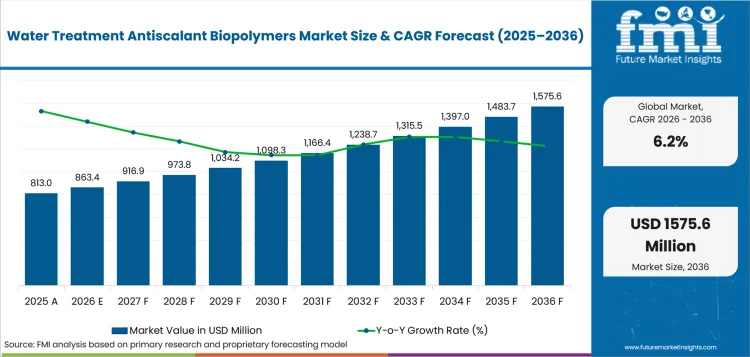
USD 863.4 million in 2026 and USD 1,575.6 million by 2036 at a 6.2% CAGR.
The water treatment antiscalant biopolymers industry value is forecast to grow from USD 813.0 million in 2025 to USD 1,575.6 million by 2036 at 6.2% CAGR as industrial users shift toward lower-impact scale control for membrane reuse, cooling water, boiler feed, desalination, and process-water loops. Water treatment is forecast to represent 54.0% share in 2026 because reverse osmosis systems and cooling circuits need reliable scale inhibition. Additives are expected to secure 48.0% share in 2026, led by direct feedwater dosing and service-supported chemical programs.
| Metric | Value |
|---|---|
| 2026 Market Size | USD 863.4 million |
| 2036 Market Size | USD 1,575.6 million |
| Forecast CAGR | 6.2% from 2026 to 2036 |
| Leading Application | Water Treatment |
| Water Treatment Share in 2026 | 54.0% |
| Leading Function | Additive |
| Additive Share in 2026 | 48.0% |
| Fastest-growing Country | China |
| China CAGR | 7.0% by 2036 |
Summary of the Water Treatment Antiscalant Biopolymers Market
| Market Signal | Commercial Impact |
|---|---|
| Demand and Growth Drivers | Industrial reuse projects are increasing demand for antiscalant biopolymers.
|
| Product and Segment View | Water treatment, additives, and reverse osmosis lead their respective segment axes.
|
| Geography and Growth Outlook | China and India are expected to remain the key growth markets.
|
| Competitive Landscape | Competition is moving toward lower-impact chemistry and service-led programs.
|
| Analyst Perspective | Antiscalant biopolymers are becoming performance-led rather than commodity drum chemicals.
- Nikhil Kaitwade, Senior Chemicals Analyst at FMI |
Quality control and water reuse planning are creating a stronger outlook for antiscalant biopolymers. EPA's 2025 industrial water reuse resources include a risk-based framework for microbial treatment targets used in safe potable and non-potable reuse planning. The World Bank stated in November 2025 that global freshwater reserves are declining by 324 billion cubic meters per year, enough to meet annual needs for 280 million people. Gradiant's April 2024 CURE Chemicals launch added more than 300 proprietary formulations across antiscalants, cleaners, process chemicals, biocides, and related treatment chemistries, showing how suppliers are moving toward site-specific water treatment packages.
Which factors support expansion in the water treatment antiscalant biopolymers market?
Finished antiscalant biopolymer revenue and service-supported dosing programs support market value across regulated water treatment channels.
- Market value is supported by finished scale-control chemical revenue before equipment-linked services add incremental sales.
- Supplier pricing reflects polymer performance, local water testing, and dosing support before commodity substitution affects margins.
- Revenue improves as industrial plants use higher-recovery systems that make mineral scale and membrane fouling more expensive.
- Buyer trust rises when suppliers document calcium carbonate, calcium sulfate, barium sulfate, and silica inhibition across local feedwater conditions.
Why is the water treatment antiscalant biopolymers market growing?
Membrane operators need lower scaling risk at higher recovery rates, which raises demand for polymer inhibitors with dosing support.
Water reuse is creating a stronger performance test for antiscalant biopolymers as operators push membrane systems through more variable feedwater conditions. EPA stated in November 2025 that USA wastewater treatment facilities process approximately 34 billion gallons of wastewater every day, while nitrogen and phosphorus removal varies by treatment method and equipment. This supports demand for antiscalants that stabilize high-recovery treatment while lowering cleaning pressure and chemical load. Suppliers benefit when buyers view scale inhibition, feedwater testing, and discharge profile as linked operating requirements.
How is the water treatment antiscalant biopolymers market segmented?
The water treatment antiscalant biopolymers industry is segmented by chemistry type, function, application, water system type, and end-use industry.
- Bio-based chemistry is projected to secure 42.0% share in 2026, led by buyers screening for biodegradability, lower phosphorus load, and reduced aquatic persistence.
- Additives are anticipated to hold 48.0% share in 2026 since antiscalants are normally dosed directly into feedwater before membrane, cooling, or boiler contact.
- Water treatment is expected to capture 54.0% share in 2026 due to reverse osmosis, cooling-water, and reuse systems requiring continuous scale control.
- Reverse osmosis systems are forecast to represent 46.5% share in 2026, guided by reuse plants and desalination systems that require membrane protection.
- Industrial manufacturing is projected to account for 38.0% share in 2026, reflected by process-water loops, cooling towers, and reuse lines across production plants.
Why does bio-based chemistry dominate the chemistry type segment?
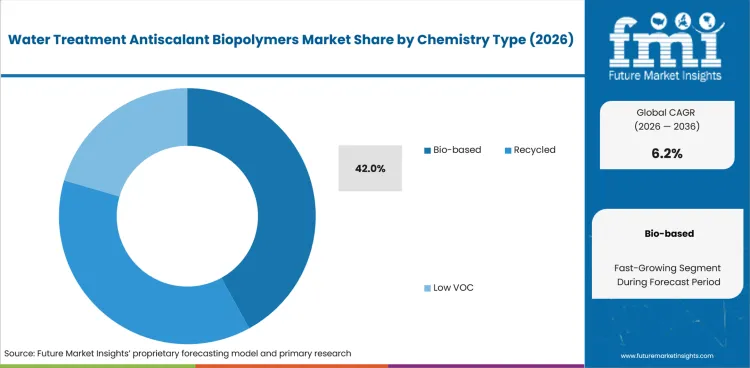
- Bio-based chemistry is projected to account for 42.0% share in 2026, influenced by buyer interest in lower phosphorus contribution and better environmental documentation.
- Low VOC and halogen-free grades gain use where chemical stewardship rules shape supplier approval, especially in food, beverage, electronics, and regulated manufacturing accounts.
Which function leads the water treatment antiscalant biopolymers market?
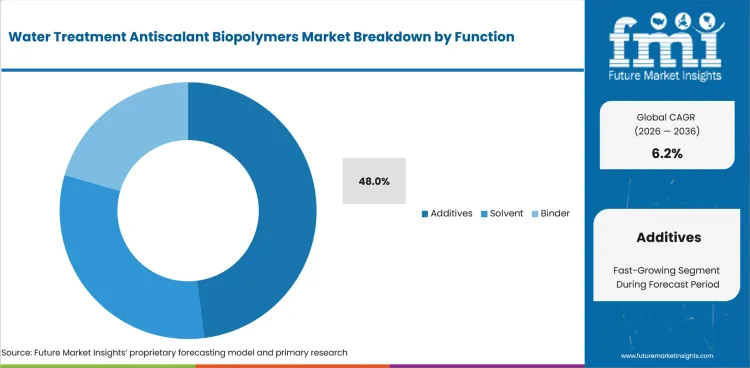
- Additives are anticipated to hold 48.0% share in 2026 through direct dosing into feedwater and cooling loops where antiscalant performance is measured through operating stability.
- Process aid demand gains value when suppliers bundle chemistry with diagnostics, especially for industrial users operating membrane separation technology in reuse lines.
Which application leads the water treatment antiscalant biopolymers market?
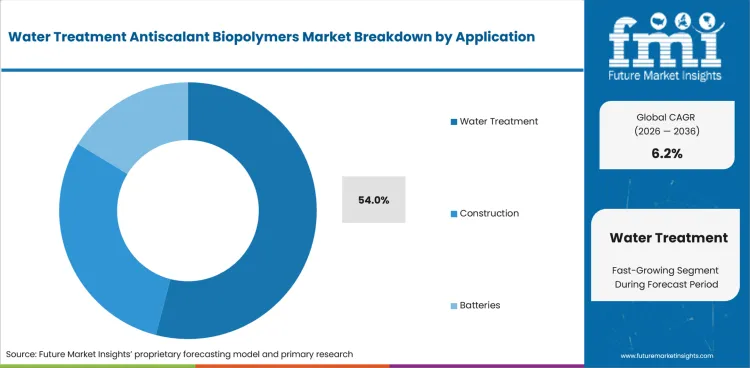
- Water treatment is forecast to secure 54.0% share in 2026, reflected by reverse osmosis and cooling-water systems that make scale control central to equipment reliability.
- Textiles, batteries, construction, and personal care use related polymer chemistry, but water treatment buyers apply stricter checks on pH range, membrane compatibility, and discharge profile.
Which water system type leads the water treatment antiscalant biopolymers market?
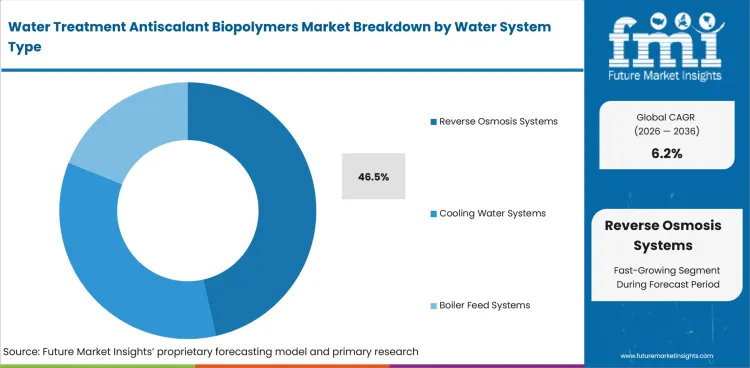
- Reverse osmosis systems are expected to account for 46.5% share in 2026, led by membrane reuse, high-recovery operation, and desalination systems where scaling directly affects uptime.
- Cooling water systems create steady demand because heat-transfer surfaces require polymeric dispersants when plants raise concentration cycles to conserve water.
Which end-use industry leads the water treatment antiscalant biopolymers market?
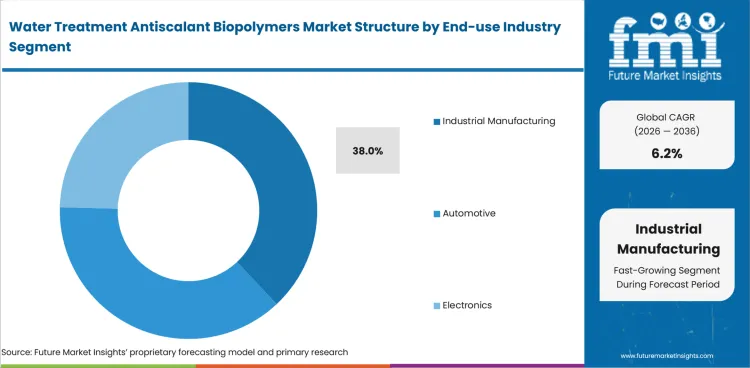
- Industrial manufacturing is projected to hold 38.0% share in 2026, shaped by process-water loops, cooling towers, and water reuse systems across chemicals, energy, textiles, and food processing.
- Electronics demand is smaller by volume, but ultrapure water requirements raise the value of qualified antiscalant programs and technical support.
What are the driver, restraints, and opportunities in the water treatment antiscalant biopolymers market?
Reuse demand and membrane protection support expansion while qualification cycles and cost proof limit faster substitution.
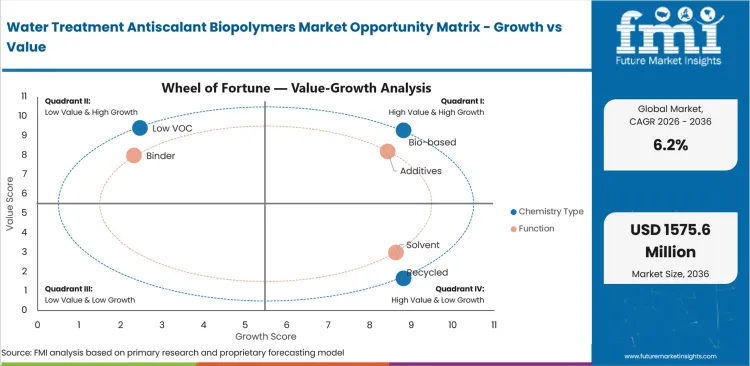
- Driver: High-recovery reverse osmosis raises the need for antiscalants that control carbonate and silica scale.
- Restraint: Greener chemistry faces qualification delays when buyers need proof across local feedwater conditions.
- Opportunity: Suppliers can pair polymers with diagnostics for users buying reverse osmosis pumps and membrane skids.
Membrane Recovery Chemistry
Reverse osmosis plants use antiscalants to protect membranes while pushing more water through each train. The commercial gain is strongest when the product reduces cleaning, supports stable recovery, and protects membrane life. EPA stated that USD 6.2 billion in fiscal year 2025 water infrastructure investments would help communities upgrade systems that manage wastewater, protect freshwater resources, and deliver safe drinking water. This strengthens the treatment project base where polymer scale inhibitors become part of operating reliability.
Qualification and Cost Pressure
Biopolymer antiscalants face a restraint when plants need side-by-side trials before replacing familiar phosphonate-heavy formulations. Cost proof matters because operators will not accept a greener label if silica, carbonate, or sulfate scaling increases downtime. OECD cited global water infrastructure needs ranging from USD 6.7 trillion by 2030 to USD 22.6 trillion by 2050, showing why utilities and industrial users remain careful about treatment costs and procurement timing. Suppliers therefore need pilot data, local water testing, and dose-response curves before wider conversion.
Diagnostics-led Water Reuse Opportunity
Suppliers can improve adoption by pairing bio-based polymers with feedwater testing, dosing software, and membrane diagnostics. EPA's Clean Water State Revolving Fund infographic states that the program provided USD 194 billion in funding and 53,000 loan agreements for water-quality infrastructure projects from 1987 through FY 2025. This creates a larger opportunity for suppliers that connect antiscalant chemistry with documented treatment outcomes rather than selling only standalone additives.
Which countries are growing fastest in the water treatment antiscalant biopolymers market?
China 7.0% CAGR, India 6.8% CAGR, South Korea 6.4% CAGR, United States 6.1% CAGR, Germany 5.8% CAGR, France 5.7% CAGR, United Kingdom 5.6% CAGR, and Japan 5.4% CAGR through 2036.
.webp "Top Country Growth Comparison Water Treatment Antiscalant Biopolymers Market Cagr (2026 2036)")
| Country | CAGR |
|---|---|
| China | 7.0% |
| India | 6.8% |
| South Korea | 6.4% |
| United States | 6.1% |
| Germany | 5.8% |
| France | 5.7% |
| United Kingdom | 5.6% |
| Japan | 5.4% |
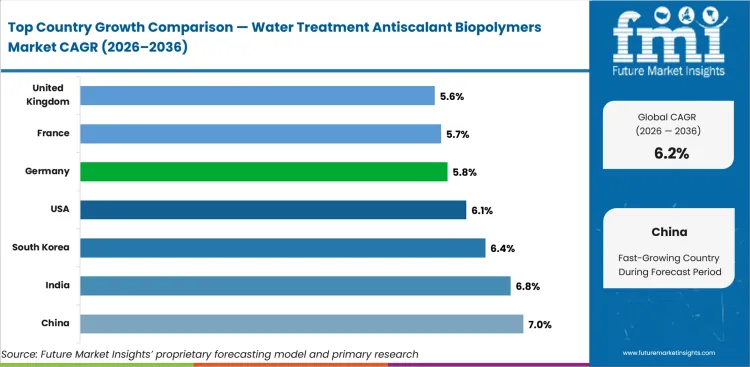
Source: Future Market Insights, 2026.
How do country-level CAGRs compare in the water treatment antiscalant biopolymers market?
China leads country growth while Japan records the most cautious expansion outlook among profiled markets.
- China is forecast to record 7.0% CAGR by 2036 as recycled water use and industrial reuse support faster chemical adoption.
- India is expected to expand at 6.8% CAGR from 2026 to 2036 due to sewage treatment capacity and reuse project development.
- South Korea is projected to grow at 6.4% CAGR through 2036 as smart water systems and high-spec industrial water needs support qualified chemistries.
- The United States is estimated to rise at 6.1% CAGR by 2036 with water reuse guidance and service-led industrial treatment channels.
- Germany is expected to advance at 5.8% CAGR over the forecast period as mature treatment systems move toward lower-impact formulations.
- France is forecast to grow at 5.7% CAGR through 2036 as wastewater compliance and water-saving policy influence treatment programs.
- The United Kingdom is projected to post 5.6% CAGR by 2036 as regulated utility investment supports water quality upgrades.
- Japan is projected to post 5.4% CAGR by 2036 as high-spec water users apply conservative qualification cycles.
How fast is the water treatment antiscalant biopolymers market growing in China?
A 7.0% CAGR through 2036 reflects recycled-water adoption, industrial reuse, and treatment upgrade activity.
Country Market Snapshot Table
| Parameter | Value |
|---|---|
| Market Size in 2025 (Value) | USD 201.9 million |
| Market Size in 2026 (Value) | USD 216.0 million |
| Market Forecast in 2036 (Value) | USD 424.9 million |
| CAGR (2026 to 2036) | 7.0% |
| Years Considered | 2021 to 2036 |
| Base Year | 2025 |
| Forecast Period | 2026 to 2036 |
| Units Considered | Value (USD million) |
| Leading Sub-Region | Yangtze River Delta and coastal industrial corridors |
China Water Treatment Antiscalant Biopolymers Market Outlook
China demand is influenced by industrial reuse, municipal treatment upgrades, and strong manufacturing water needs. Plants need antiscalant programs that work across changing feedwater chemistry and high recovery targets.
Local cost pressure remains high, but recycled-water adoption gives qualified biopolymer suppliers a larger application base. Suppliers that can prove membrane protection and lower discharge load should gain stronger access in coastal manufacturing clusters.
Key Growth Drivers
- City-level recycled water adoption supports antiscalant demand in reuse systems. Chinese cities used more than 22 billion cubic meters of recycled water in 2025.
- Water quality improvement supports broader treatment spending. China reported surface-water bodies classified as good quality at 91.4% in 2025.
- Electronics and chemical clusters need stable process water, so membrane protection remains a practical purchase reason for qualified antiscalant biopolymers.
- Local distributors help suppliers reach county-level treatment projects where large system integrators need site-level dosing support.
Key Restraints
- Water-efficiency gains can make new chemical switching more selective. China's 2024 annual climate report stated that water consumption per capita decreased by 3.72% compared with 2020.
- Better baseline surface-water quality can shift some municipal buying from emergency treatment toward selective optimization.
- Industrial discharge variation can slow conversion because biopolymer products need proof across multiple feedwater profiles.
What makes China unique
China is unique due to large recycled-water use, industrial reuse intensity, and fast-moving municipal treatment upgrades.
Key Companies
- Italmatch Chemicals
- BASF SE
- Veolia Water Technologies
- Solenis
- Nouryon
- Kurita Water Industries
- Gradiant
Sales & Marketing Channels
- Direct industrial accounts
- Membrane system integrators
- Local chemical distributors
- EPC water project tenders
- Municipal treatment contractors
- Industrial park service providers
Country Segment Breakdown Table
| Segment | Sub-Segments |
|---|---|
| By Chemistry Type | Bio-based · Recycled · Low VOC · Halogen Free · Waterborne |
| By Function | Solvent · Additive · Binder · Coating · Process Aid |
| By Application | Textiles · Batteries · Construction · Personal Care · Water Treatment |
| By Water System Type | Reverse Osmosis Systems · Cooling Water Systems · Boiler Feed Systems · Desalination Systems · Industrial Reuse Systems |
| By End-use Industry | Automotive · Electronics · Packaging · Agriculture · Industrial Manufacturing |
| Key Sub-Regions Covered, Industrial Water Corridors | Yangtze River Delta · Pearl River Delta · Bohai Rim · Sichuan-Chongqing · Central China · Fujian Coast |
Frequently Asked Questions
How fast is China water treatment antiscalant biopolymers market growing?
Sales in China are ready to scale at 7.0% CAGR from 2026 to 2036, guided by reuse and industrial water treatment.
Who leads China water treatment antiscalant biopolymers market?
Italmatch, BASF, Veolia, Solenis, Nouryon, Kurita, and Gradiant compete through specialty chemistry and industrial service programs.
What is driving adoption in China water treatment antiscalant biopolymers market?
Recycled water use, industrial reuse, and membrane protection needs are moving buyers toward qualified polymer antiscalants.
What is driving water treatment antiscalant biopolymers growth in India?
A 6.8% CAGR through 2036 is supported by sewage treatment capacity, reuse projects, and municipal infrastructure investment.
Country Market Snapshot Table
| Parameter | Value |
|---|---|
| Market Size in 2025 (Value) | USD 73.0 million |
| Market Size in 2026 (Value) | USD 78.0 million |
| Market Forecast in 2036 (Value) | USD 150.6 million |
| CAGR (2026 to 2036) | 6.8% |
| Years Considered | 2021 to 2036 |
| Base Year | 2025 |
| Forecast Period | 2026 to 2036 |
| Units Considered | Value (USD million) |
| Leading Sub-Region | Western and southern industrial corridors |
India Water Treatment Antiscalant Biopolymers Market Outlook
India demand is shaped by municipal treatment expansion, reuse planning, and industrial water-stress management. Antiscalant biopolymers gain relevance when reverse osmosis, sewage recycling, and process-water loops need lower scaling risk.
Industrial buyers are price-sensitive, but infrastructure programs create room for specialty chemistry when performance is linked to membrane uptime. Suppliers that support trials and local dosing guidance should gain stronger acceptance.
Key Growth Drivers
- Municipal water access expansion widens the addressable treatment base. Jal Jeevan Mission reported more than 15.44 crore rural households with tap water connections as of February 2025.
- Sewage reuse projects increase membrane chemical relevance. AMRUT 2.0 approved 6,739 MLD sewage treatment capacity, including 2,093 MLD for recycle and reuse.
- Industrial corridors in Gujarat, Maharashtra, Tamil Nadu, Karnataka, and Telangana require stable process water for chemicals, pharmaceuticals, textiles, and electronics.
- Local service partners help international suppliers adapt formulations to high hardness, salinity, and variable feedwater quality across Indian treatment sites.
Key Restraints
- Price-sensitive municipal procurement can slow adoption when biopolymer products carry premiums over conventional antiscalants.
- Project execution gaps remain a restraint. Namami Gange reported 212 sewerage infrastructure projects with 6,540 MLD treatment capacity, while 136 projects had been completed and operational.
- Plant operators often require extended trials because scale-control performance varies across seasonal feedwater and industrial discharge conditions.
What makes India unique
India is unique due to large municipal treatment expansion, high industrial water stress, and growing reuse capacity.
Key Companies
- Thermax Limited
- Ion Exchange India Limited
- Gradiant
- Veolia Water Technologies
- Solenis
- BASF India
- Italmatch Chemicals
Sales & Marketing Channels
- EPC project tenders
- Industrial water service contracts
- Chemical distributor networks
- Membrane OEM referrals
- Municipal treatment procurement
- Plant-level pilot trials
Country Segment Breakdown Table
| Segment | Sub-Segments |
|---|---|
| By Chemistry Type | Bio-based · Recycled · Low VOC · Halogen Free · Waterborne |
| By Function | Solvent · Additive · Binder · Coating · Process Aid |
| By Application | Textiles · Batteries · Construction · Personal Care · Water Treatment |
| By Water System Type | Reverse Osmosis Systems · Cooling Water Systems · Boiler Feed Systems · Desalination Systems · Industrial Reuse Systems |
| By End-use Industry | Automotive · Electronics · Packaging · Agriculture · Industrial Manufacturing |
| Key Sub-Regions Covered, Industrial Water Corridors | Gujarat · Maharashtra · Tamil Nadu · Karnataka · Telangana · Delhi NCR |
Frequently Asked Questions
How fast is India water treatment antiscalant biopolymers market growing?
Demand in India is ready to rise at 6.8% CAGR from 2026 to 2036 with reuse and treatment capacity additions.
Who leads India water treatment antiscalant biopolymers market?
Thermax, Ion Exchange India, Veolia, Solenis, BASF India, Italmatch, and Gradiant compete through equipment, chemistry, and service channels.
What is driving adoption in India water treatment antiscalant biopolymers market?
Municipal treatment programs and industrial water stress are moving buyers toward higher-performing antiscalant systems.
How is the water treatment antiscalant biopolymers market performing in South Korea?
A 6.4% CAGR through 2036 reflects smart water systems, industrial water quality needs, and domestic technology support.
Country Market Snapshot Table
| Parameter | Value |
|---|---|
| Market Size in 2025 (Value) | USD 58.3 million |
| Market Size in 2026 (Value) | USD 62.0 million |
| Market Forecast in 2036 (Value) | USD 115.3 million |
| CAGR (2026 to 2036) | 6.4% |
| Years Considered | 2021 to 2036 |
| Base Year | 2025 |
| Forecast Period | 2026 to 2036 |
| Units Considered | Value (USD million) |
| Leading Sub-Region | Gyeonggi and semiconductor-water corridors |
South Korea Water Treatment Antiscalant Biopolymers Market Outlook
South Korea demand is supported by high-spec industrial water systems and smart water management programs. Semiconductor, electronics, battery, and chemicals plants require stable treatment chemistry that avoids contamination risk.
Suppliers must demonstrate reliable performance before replacing proven chemistries. Domestic water companies and public institutions are improving technology support, which can help qualified antiscalant biopolymers gain visibility.
Key Growth Drivers
- Smart plant programs support advanced treatment chemistry. Korea planned AI and big data-based smart water purification plants across 43 metropolitan treatment facilities.
- National water industry policy supports technology development. Korea targeted a water industry market worth KRW 60 trillion by 2028 with about KRW 410 billion for core technology R&D.
- Semiconductor and battery clusters need reliable process water, making membrane protection and scale-control documentation important for chemical qualification.
- Public water technology events and testing channels increase supplier visibility when products show measurable operating benefits.
Key Restraints
- Domestic supplier focus can slow diversification. Korea's environment ministry stated that 97% of domestic water companies focus on the domestic market, which limits overseas scale effects.
- High-spec industrial buyers often prefer incumbent suppliers because water quality deviation can disrupt electronics and battery production.
- Service-led qualification can take longer when new biopolymer products need compatibility checks with membranes, dosing equipment, and downstream polishing steps.
What makes South Korea unique
South Korea is unique due to smart water infrastructure, high-spec electronics demand, and government support for water technology.
Key Companies
- Kurita Korea
- Samsung Engineering
- Doosan Enerbility
- Veolia Water Technologies Korea
- Solenis Korea
- K-water-linked suppliers
Sales & Marketing Channels
- Direct industrial accounts
- Water technology pilots
- EPC engineering channels
- Semiconductor plant qualification
- Chemical distributors
- Public water innovation platforms
Country Segment Breakdown Table
| Segment | Sub-Segments |
|---|---|
| By Chemistry Type | Bio-based · Recycled · Low VOC · Halogen Free · Waterborne |
| By Function | Solvent · Additive · Binder · Coating · Process Aid |
| By Application | Textiles · Batteries · Construction · Personal Care · Water Treatment |
| By Water System Type | Reverse Osmosis Systems · Cooling Water Systems · Boiler Feed Systems · Desalination Systems · Industrial Reuse Systems |
| By End-use Industry | Automotive · Electronics · Packaging · Agriculture · Industrial Manufacturing |
| Key Sub-Regions Covered, High-spec Water Clusters | Gyeonggi · Seoul · Incheon · Ulsan · Busan · Chungcheong |
Frequently Asked Questions
How fast is South Korea water treatment antiscalant biopolymers market growing?
Industry in South Korea is projected to increase at 6.4% CAGR from 2026 to 2036 through smart water and high-purity water needs.
Who leads South Korea water treatment antiscalant biopolymers market?
Kurita Korea, Veolia Water Technologies Korea, Solenis Korea, , and engineering-led suppliers compete through industrial water programs.
What is driving adoption in South Korea water treatment antiscalant biopolymers market?
Smart water purification and semiconductor process-water reliability are supporting qualified antiscalant programs.
What is the water treatment antiscalant biopolymers market outlook in the United States?
A 6.1% CAGR through 2036 is supported by water reuse guidance and national industrial treatment channels.
Country Market Snapshot Table
| Parameter | Value |
|---|---|
| Market Size in 2025 (Value) | USD 169.7 million |
| Market Size in 2026 (Value) | USD 180.0 million |
| Market Forecast in 2036 (Value) | USD 325.4 million |
| CAGR (2026 to 2036) | 6.1% |
| Years Considered | 2021 to 2036 |
| Base Year | 2025 |
| Forecast Period | 2026 to 2036 |
| Units Considered | Value (USD million) |
| Leading Sub-Region | California, Texas, Arizona, and industrial reuse corridors |
United States Water Treatment Antiscalant Biopolymers Market Outlook
United States demand is shaped by water reuse, drought-exposed industrial clusters, and service-heavy water treatment channels. Buyers often evaluate antiscalants as part of broader membrane care and plant reliability programs.
Refineries, semiconductor plants, food processors, and power users value local technical support when switching chemistry. Suppliers with field teams, dosing tools, and testing capacity can defend higher-value biopolymer products.
Key Growth Drivers
- Federal water investment supports treatment upgrades. EPA stated USD 6.2 billion in fiscal year 2025 water infrastructure investments would help communities upgrade wastewater and drinking-water systems.
- Wastewater treatment scale creates recurring treatment demand. EPA stated that USA wastewater facilities process approximately 34 billion gallons of wastewater every day.
- Industrial reuse in California, Texas, and Arizona raises demand for reverse osmosis antiscalants that can handle variable source water.
- Service-led procurement favors suppliers with local testing, troubleshooting, and dosing software rather than commodity drum supply alone.
Key Restraints
- Small-system capacity can limit adoption of specialty chemistry. EPA stated in 2026 that over 90% of USA drinking water systems serve fewer than 10,000 people.
- Product approval can be slow when plants require membrane trials before replacing familiar formulations.
- Low-cost phosphonate options remain common where discharge permits and sustainability targets are less strict.
What makes the United States unique
United States is unique due to water-stress demand and a large service-company channel that can scale new formulations quickly.
Key Companies
- Gradiant
- Solenis
- Veolia Water Technologies
- BASF Corporation
- Italmatch Chemicals
- Nouryon
- ChemTreat
Sales & Marketing Channels
- Direct industrial service contracts
- Membrane OEM referrals
- Distributor stocking programs
- EPC water project tenders
- Corporate sustainability sourcing
- Pilot testing at plant sites
Country Segment Breakdown Table
| Segment | Sub-Segments |
|---|---|
| By Chemistry Type | Bio-based · Recycled · Low VOC · Halogen Free · Waterborne |
| By Function | Solvent · Additive · Binder · Coating · Process Aid |
| By Application | Textiles · Batteries · Construction · Personal Care · Water Treatment |
| By Water System Type | Reverse Osmosis Systems · Cooling Water Systems · Boiler Feed Systems · Desalination Systems · Industrial Reuse Systems |
| By End-use Industry | Automotive · Electronics · Packaging · Agriculture · Industrial Manufacturing |
| Key Sub-Regions Covered, Reuse and Industrial Water Clusters | California · Texas · Arizona · Midwest · Southeast · Northeast |
Frequently Asked Questions
How fast is United States water treatment antiscalant biopolymers market growing?
Sector in the United States is anticipated to grow at 6.1% CAGR from 2026 to 2036 reflecting reuse and industrial water reliability.
Who leads United States water treatment antiscalant biopolymers market?
Gradiant, Solenis, Veolia Water Technologies, BASF, Italmatch, Nouryon, and ChemTreat compete through service and chemistry programs.
What is driving adoption in United States water treatment antiscalant biopolymers market?
Water reuse projects and service-led industrial treatment contracts are moving buyers toward qualified antiscalant biopolymers.
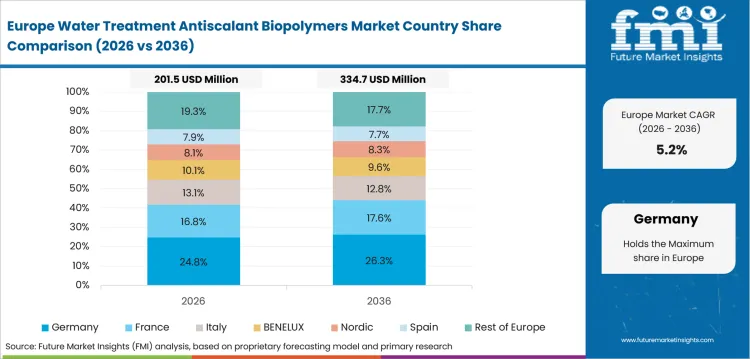
What is the water treatment antiscalant biopolymers market forecast for Germany?
A 5.8% CAGR through 2036 reflects mature wastewater systems and lower-impact formulation demand.
Country Market Snapshot Table
| Parameter | Value |
|---|---|
| Market Size in 2025 (Value) | USD 62.4 million |
| Market Size in 2026 (Value) | USD 66.0 million |
| Market Forecast in 2036 (Value) | USD 116.0 million |
| CAGR (2026 to 2036) | 5.8% |
| Years Considered | 2021 to 2036 |
| Base Year | 2025 |
| Forecast Period | 2026 to 2036 |
| Units Considered | Value (USD million) |
| Leading Sub-Region | North Rhine-Westphalia and southern industrial clusters |
Germany Water Treatment Antiscalant Biopolymers Market Outlook
Germany demand is tied to industrial process reliability and strict chemical documentation. Buyers check safety data, performance proof, and environmental profile before replacing existing formulations.
The market is mature, so new demand comes more from replacement and optimization than first-time installation. Biopolymer suppliers can gain share when they show lower-impact chemistry without increasing scaling risk.
Key Growth Drivers
- Large treatment infrastructure supports recurring water chemical demand. Germany generates more than 5 billion cubic meters of wastewater each year, plus around 3 billion cubic meters of rainwater runoff into treatment plants.
- Sustainable formulation work supports buyer interest in lower-impact polymers. BASF launched Sokalan CP 301 in April 2025 as a readily biodegradable dispersant.
- Chemical, automotive, and electronics plants need predictable cooling-water and process-water treatment, making documentation-led adoption important.
- EU wastewater expectations increase scrutiny of nutrient load, micropollutants, and chemical stewardship across large treatment systems.
Key Restraints
- Mature public sewage coverage reduces the pace of new installation-led chemical demand. Germany has about 97% public sewage connection, which makes replacement demand more important than first-time adoption.
- Buyers often require long qualification files before replacing proven water treatment formulations.
- Premium biopolymer products must demonstrate savings through lower cleaning, less blowdown, or longer membrane life.
What makes Germany unique
Germany is unique due to high documentation standards, making technical proof a stronger sales lever than broad sustainability claims.
Key Companies
- BASF SE
- Kurita Europe
- Veolia Water Technologies
- Solenis
- Italmatch Chemicals
- Nouryon
- Lanxess-linked distributors
Sales & Marketing Channels
- Direct industrial account management
- Chemical distributor supply
- Cooling-water service contracts
- Membrane system integrator referrals
- Plant maintenance procurement
- EU compliance-driven tender routes
Country Segment Breakdown Table
| Segment | Sub-Segments |
|---|---|
| By Chemistry Type | Bio-based · Recycled · Low VOC · Halogen Free · Waterborne |
| By Function | Solvent · Additive · Binder · Coating · Process Aid |
| By Application | Textiles · Batteries · Construction · Personal Care · Water Treatment |
| By Water System Type | Reverse Osmosis Systems · Cooling Water Systems · Boiler Feed Systems · Desalination Systems · Industrial Reuse Systems |
| By End-use Industry | Automotive · Electronics · Packaging · Agriculture · Industrial Manufacturing |
| Key Sub-Regions Covered, Industrial Water Clusters | North Rhine-Westphalia · Bavaria · Baden-Württemberg · Hesse · Lower Saxony · Saxony |
Frequently Asked Questions
How fast is Germany water treatment antiscalant biopolymers market growing?
Demand in Germany is ready to rise at 5.8% CAGR from 2026 to 2036 with replacement and optimization demand.
Who leads Germany water treatment antiscalant biopolymers market?
BASF, Kurita Europe, Veolia Water Technologies, Solenis, Italmatch, and Nouryon compete through industrial water channels.
What is driving adoption in Germany water treatment antiscalant biopolymers market?
Strict documentation standards and lower-impact formulation goals are supporting qualified biopolymer antiscalant adoption.
What is the water treatment antiscalant biopolymers market outlook in France?
A 5.7% CAGR through 2036 reflects wastewater compliance, water-saving policy, and integrated service channels.
Country Market Snapshot Table
| Parameter | Value |
|---|---|
| Market Size in 2025 (Value) | USD 50.6 million |
| Market Size in 2026 (Value) | USD 53.5 million |
| Market Forecast in 2036 (Value) | USD 93.1 million |
| CAGR (2026 to 2036) | 5.7% |
| Years Considered | 2021 to 2036 |
| Base Year | 2025 |
| Forecast Period | 2026 to 2036 |
| Units Considered | Value (USD million) |
| Leading Sub-Region | Paris Basin and industrial water-service corridors |
France Water Treatment Antiscalant Biopolymers Market Outlook
France demand is shaped by wastewater compliance, industrial reuse, and integrated water-service models. Buyers often evaluate chemicals as part of broader treatment performance and system reliability.
Service-led channels help suppliers bundle dosing, monitoring, and chemistry. Biopolymer antiscalants gain attention when they reduce cleaning pressure while supporting lower-impact procurement.
Key Growth Drivers
- Wastewater treatment depth creates a broad service base. France had 22,704 wastewater treatment plants in 2022, representing 79 million population equivalent units and 105.8 million population equivalent treatment capacity.
- Water-saving policy supports reuse and efficiency demand. France's water strategy targets a 10% reduction in water abstraction by 2030.
- Integrated water-service groups give suppliers a route to sell antiscalants with equipment monitoring and maintenance support.
- Industrial users in chemicals, food production, and energy need reliable cooling-water and process-water treatment.
Key Restraints
- Compliance costs can slow substitution when buyers are already managing large environmental service expenses. EEA's 2025 France country profile states that expenditure on environmental protection services represents 2.0% of France's GDP.
- Public-sector procurement can stretch supplier approval timelines when treatment operators prefer proven chemical programs.
- Buyers may resist premiums unless suppliers document lower cleaning frequency, reduced discharge load, or water savings.
What makes France unique
France is unique due to strong integrated water-service channels that make system-level selling more common than standalone chemical selling.
Key Companies
- Veolia Water Technologies
- Solenis
- BASF France
- Italmatch Chemicals
- Nouryon
- SUEZ-linked service channels
- Kurita Europe
Sales & Marketing Channels
- Integrated water-service contracts
- Municipal procurement tenders
- Industrial distributor accounts
- EPC project specifications
- Plant-level trials
- Sustainability-linked supplier reviews
Country Segment Breakdown Table
| Segment | Sub-Segments |
|---|---|
| By Chemistry Type | Bio-based · Recycled · Low VOC · Halogen Free · Waterborne |
| By Function | Solvent · Additive · Binder · Coating · Process Aid |
| By Application | Textiles · Batteries · Construction · Personal Care · Water Treatment |
| By Water System Type | Reverse Osmosis Systems · Cooling Water Systems · Boiler Feed Systems · Desalination Systems · Industrial Reuse Systems |
| By End-use Industry | Automotive · Electronics · Packaging · Agriculture · Industrial Manufacturing |
| Key Sub-Regions Covered, Water-service Corridors | Île-de-France · Auvergne-Rhône-Alpes · Hauts-de-France · Grand Est · Nouvelle-Aquitaine · Provence-Alpes-Côte d’Azur |
Frequently Asked Questions
How fast is France water treatment antiscalant biopolymers market growing?
France is expected to expand at 5.7% CAGR from 2026 to 2036, reflected by wastewater compliance and water-saving goals.
Who leads France water treatment antiscalant biopolymers market?
Veolia Water Technologies, Solenis, BASF France, Italmatch, Nouryon, and Kurita Europe compete through service and specialty chemistry channels.
What is driving adoption in France water treatment antiscalant biopolymers market?
Wastewater treatment depth and integrated service channels are moving buyers toward documented antiscalant programs.
How is the water treatment antiscalant biopolymers market performing in the United Kingdom?
A 5.6% CAGR through 2036 reflects utility investment, storm-overflow improvement plans, and regulated procurement.
Country Market Snapshot Table
| Parameter | Value |
|---|---|
| Market Size in 2025 (Value) | USD 46.4 million |
| Market Size in 2026 (Value) | USD 49.0 million |
| Market Forecast in 2036 (Value) | USD 84.5 million |
| CAGR (2026 to 2036) | 5.6% |
| Years Considered | 2021 to 2036 |
| Base Year | 2025 |
| Forecast Period | 2026 to 2036 |
| Units Considered | Value (USD million) |
| Leading Sub-Region | England and Wales utility frameworks |
United Kingdom Water Treatment Antiscalant Biopolymers Market Outlook
United Kingdom demand is supported by regulated utility spending and wastewater treatment performance expectations. Antiscalant biopolymers gain attention when buyers need chemistry that supports membrane assets and treatment reliability.
Framework procurement makes supplier approval important. Companies with safety files, local technical support, and performance documentation are better positioned than suppliers relying on low-price substitution.
Key Growth Drivers
- Utility investment creates a stronger treatment upgrade context. Ofwat's PR24 final determinations support GBP 104 billion of spending over the next 5 years.
- Storm-overflow improvement plans raise attention on wastewater infrastructure. The UK government stated that GBP 11 billion would be invested between 2025 and 2030 in storm overflow improvements.
- Food, beverage, pharmaceutical, and industrial estates need scale control for process-water and cooling-water reliability.
- Utility framework agreements reward suppliers that can document compliance, service history, and treatment performance.
Key Restraints
- Performance scrutiny remains high because storm overflows spilled for 3.61 million hours in 2024 across England's rivers, lakes, and seas.
- Utility tender cycles limit fast switching even when greener chemistry is available.
- Public bill pressure can slow premium chemical adoption unless suppliers show clear operating savings.
What makes the United Kingdom unique
United Kingdom is unique due to tender-driven procurement, where framework access shapes sales more than spot demand.
Key Companies
- Solenis UK
- Veolia Water Technologies UK
- BASF UK
- Nouryon
- Italmatch Chemicals
- Kurita UK
- Industrial water service distributors
Sales & Marketing Channels
- Utility framework agreements
- Industrial distributor networks
- EPC contractor specifications
- Water company pilot trials
- Facility-management channels
- Compliance documentation reviews
Country Segment Breakdown Table
| Segment | Sub-Segments |
|---|---|
| By Chemistry Type | Bio-based · Recycled · Low VOC · Halogen Free · Waterborne |
| By Function | Solvent · Additive · Binder · Coating · Process Aid |
| By Application | Textiles · Batteries · Construction · Personal Care · Water Treatment |
| By Water System Type | Reverse Osmosis Systems · Cooling Water Systems · Boiler Feed Systems · Desalination Systems · Industrial Reuse Systems |
| By End-use Industry | Automotive · Electronics · Packaging · Agriculture · Industrial Manufacturing |
| Key Sub-Regions Covered, Utility and Industrial Corridors | London · Midlands · North West England · Yorkshire · Scotland · Wales |
Frequently Asked Questions
How fast is United Kingdom water treatment antiscalant biopolymers market growing?
Industry in the United Kingdom is projected to increase at 5.6% CAGR from 2026 to 2036 through utility upgrades.
Who leads United Kingdom water treatment antiscalant biopolymers market?
Solenis UK, Veolia Water Technologies UK, BASF UK, Nouryon, Italmatch, and Kurita UK compete through water-service and industrial channels.
What is driving adoption in United Kingdom water treatment antiscalant biopolymers market?
Regulated water spending and wastewater performance scrutiny are moving buyers toward documented scale-control chemistry.
What is the water treatment antiscalant biopolymers market forecast for Japan?
A 5.4% CAGR through 2036 reflects high-spec industrial water needs and conservative qualification practices.
Country Market Snapshot Table
| Parameter | Value |
|---|---|
| Market Size in 2025 (Value) | USD 55.0 million |
| Market Size in 2026 (Value) | USD 58.0 million |
| Market Forecast in 2036 (Value) | USD 98.1 million |
| CAGR (2026 to 2036) | 5.4% |
| Years Considered | 2021 to 2036 |
| Base Year | 2025 |
| Forecast Period | 2026 to 2036 |
| Units Considered | Value (USD million) |
| Leading Sub-Region | Kanto, Kansai, and high-purity industrial corridors |
Japan Water Treatment Antiscalant Biopolymers Market Outlook
Japan demand is shaped by high-quality industrial water systems and long supplier relationships. Electronics, pharmaceuticals, and advanced manufacturing users focus on reliability before adopting new water treatment chemistry.
Biopolymer antiscalants gain access when suppliers prove membrane compatibility and avoid downstream contamination risk. The market is smaller by volume but demanding in qualification quality.
Key Growth Drivers
- Japan's water infrastructure expertise supports supplier credibility. JICA's 2025 India water and sanitation project summary reported water treatment plants with 1,545 MLD capacity and sewage treatment plants with 770 MLD capacity under assisted projects.
- International water project experience supports Japanese technology channels. JICA stated that Japan's water and sanitation support in India mainly consisted of ODA loans of more than 806 billion Japanese yen.
- Domestic electronics and pharmaceutical plants need stable process water, making qualified antiscalant chemistry valuable despite cautious adoption.
- Kurita and other Japanese water treatment specialists provide strong technical service channels for formulation testing.
Key Restraints
- Population decline can make water service procurement conservative. MLIT's 2025 white paper summary projects Japan's total population at 112.84 million in 2040 and 87.00 million in 2070.
- Buyers often prefer proven incumbents when water purity and production continuity are sensitive.
- Lower-volume demand limits fast scale-up compared with China, India, and the United States.
What makes Japan unique
Japan is unique because smaller-volume demand is matched with demanding qualification, making technical credibility the core entry test.
Key Companies
- Kurita Water Industries
- Organo Corporation
- Veolia Water Technologies Japan
- BASF Japan
- Solenis Japan
- Italmatch Chemicals
- Mitsubishi Chemical-linked channels
Sales & Marketing Channels
- Direct technical account sales
- Long-term service contracts
- Membrane OEM referrals
- Electronics plant qualification trials
- Trading-company distribution
- Maintenance contractor routes
Country Segment Breakdown Table
| Segment | Sub-Segments |
|---|---|
| By Chemistry Type | Bio-based · Recycled · Low VOC · Halogen Free · Waterborne |
| By Function | Solvent · Additive · Binder · Coating · Process Aid |
| By Application | Textiles · Batteries · Construction · Personal Care · Water Treatment |
| By Water System Type | Reverse Osmosis Systems · Cooling Water Systems · Boiler Feed Systems · Desalination Systems · Industrial Reuse Systems |
| By End-use Industry | Automotive · Electronics · Packaging · Agriculture · Industrial Manufacturing |
| Key Sub-Regions Covered, High-purity Water Clusters | Tokyo · Kanagawa · Osaka · Kyoto · Aichi · Fukuoka |
Frequently Asked Questions
How fast is Japan water treatment antiscalant biopolymers market growing?
Sector in Japan is projected at 5.4% CAGR from 2026 to 2036 as high-spec industrial water users qualify lower-impact chemistry.
Who leads Japan water treatment antiscalant biopolymers market?
Kurita Water Industries, Organo, Veolia Water Technologies Japan, BASF Japan, Solenis Japan, and Italmatch compete through technical water channels.
What is driving adoption in Japan water treatment antiscalant biopolymers market?
High-purity water needs and trusted service relationships are supporting lower-impact antiscalant programs.
Who are the leading companies in the water treatment antiscalant biopolymers market?
Italmatch Chemicals, BASF, Nouryon, Veolia Water Technologies, Solenis, Kurita Water Industries, and Gradiant.
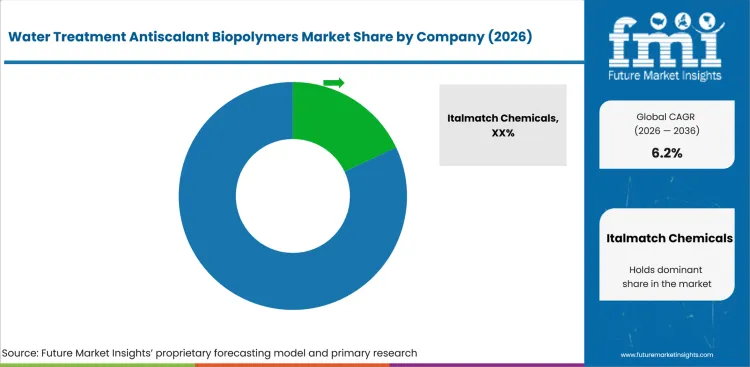
- Established specialty chemical companies hold an advantage through scale-control chemistry depth and application testing.
- Water service companies gain buyer trust by combining antiscalants with dosing, monitoring, and plant support.
- Bio-based and biodegradable polymer suppliers gain acceptance when documentation supports lower-impact treatment programs.
- Regional water treatment specialists gain share where local feedwater knowledge and trial support are critical.
Specialty chemical companies compete by proving scale inhibition across calcium carbonate, calcium sulfate, barium sulfate, and silica. Italmatch Chemicals supports industrial water and process treatment through scale-control agents, dispersants, corrosion inhibitors, and biocides selected by system condition and water quality. Veolia Water Technologies competes through Hydrex, which includes more than 3,000 formulations designed to protect systems against scale deposition, corrosion, fouling, and biological issues.
Service strength has become a competitive separator because many plants buy antiscalants as part of a broader membrane care or cooling-water program. Solenis offers scale inhibitors and antiscalants addressing calcium, barium, magnesium, manganese, silicate, and sulfate scales, while Nouryon positions biodegradable chelating agents as phosphate alternatives. Suppliers that can combine chemistry with diagnostics and plant-level support should gain stronger account access.
Smaller and regional suppliers can win where buyers need local dosing support and quick troubleshooting. India, China, and South Korea create openings for service partners with local testing capacity. Germany, France, the United Kingdom, and Japan create harder qualification conditions because buyers require stronger documentation, compatibility checks, and proof of operating savings before switching.
How do top water treatment antiscalant biopolymers companies compare?
Italmatch and BASF score strongest on chemistry depth while Veolia, Solenis, Kurita, and Gradiant score strongest on service-led water treatment execution.
| Company | Relevance to Market Title | Scale-control Chemistry Depth | Bio-based or Lower-impact Portfolio | Service and Diagnostics Strength | Channel Reach | Geographic Footprint |
|---|---|---|---|---|---|---|
| Italmatch Chemicals | Very High | Very Strong | Strong | Strong | Strong | Global |
| BASF SE | Very High | Strong | Very Strong | Moderate | Very Strong | Global |
| Nouryon | High | Strong | Strong | Moderate | Strong | Global |
| Veolia Water Technologies | Very High | Strong | Moderate | Very Strong | Very Strong | Global |
| Solenis | Very High | Very Strong | Moderate | Very Strong | Very Strong | Global |
| Kurita Water Industries | High | Strong | Moderate | Very Strong | Strong | Japan and Asia |
| Gradiant | High | Strong | Strong | Very Strong | Strong | Global |
| Thermax Limited | Moderate to High | Moderate | Moderate | Strong | Strong | India |
| Ion Exchange India Limited | Moderate to High | Moderate | Moderate | Strong | Strong | India |
Source: Future Market Insights competitive analysis, 2026.
Who are the key players in the water treatment antiscalant biopolymers market?
Italmatch Chemicals, BASF, Nouryon, Veolia Water Technologies, Solenis, Kurita Water Industries, and Gradiant are listed with regional suppliers and service firms.
Key global companies leading the water treatment antiscalant biopolymers market include:
- Italmatch Chemicals
- BASF SE
- Nouryon
- Veolia Water Technologies
- Solenis
- Kurita Water Industries
- Gradiant
- Kemira
- Dow
- SNF Group
Key Developments in Water Treatment Antiscalant Biopolymers Market
- In April 2024, Gradiant launched CURE Chemicals with more than 300 proprietary formulations covering antiscalants, cleaners, process chemicals, biocides, and related treatment chemistries.
- In April 2025, BASF launched Sokalan CP 301, a readily biodegradable dispersant positioned for stable formulations and lower-impact chemical programs.
- In 2025, Veolia Water Technologies continued positioning Hydrex as a broad water treatment chemical range with more than 3,000 formulations for protection against scale, corrosion, fouling, and biological problems.
Key Players in the Water Treatment Antiscalant Biopolymers Market
Global Specialty Chemical Companies
- Italmatch Chemicals
- BASF SE
- Nouryon
- Kemira
- Dow
- SNF Group
Water Treatment Service Providers
- Veolia Water Technologies
- Solenis
- Kurita Water Industries
- Gradiant
Regional Industrial Water Companies
- Thermax Limited
- Ion Exchange India Limited
- ChemTreat
- Organo Corporation
- Kurita Korea
Water Treatment Antiscalant Biopolymers Market - Report Scope
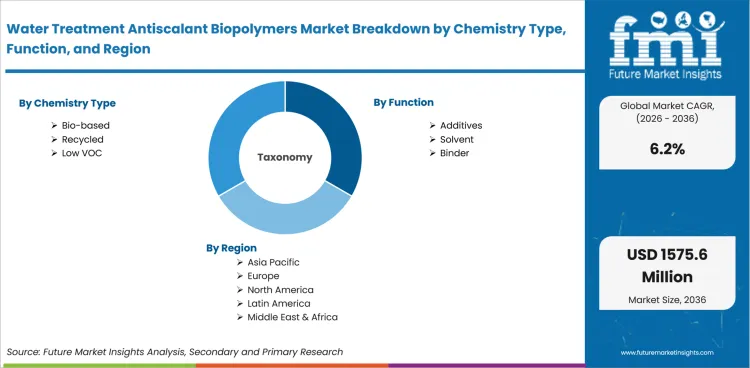
| Parameter | Details |
|---|---|
| Forecast period | 2026 to 2036 |
| Historical period | 2021 to 2025 |
| Quantitative unit | Revenue in USD million |
| By chemistry type | Bio-based, recycled, low VOC, halogen free, waterborne |
| By function | Solvent, additive, binder, coating, process aid |
| By application | Textiles, batteries, construction, personal care, water treatment |
| By water system type | Reverse osmosis systems, cooling water systems, boiler feed systems, desalination systems, industrial reuse systems |
| By end-use industry | Automotive, electronics, packaging, agriculture, industrial manufacturing |
| Regions covered | North America, Europe, East Asia, South Asia, Latin America |
| Countries covered | China, India, South Korea, United States, Germany, France, United Kingdom, Japan |
| Key companies profiled | Italmatch Chemicals, BASF, Nouryon, Veolia Water Technologies, Solenis, Kurita, Gradiant |
| Approach | Bottom-up product-boundary approach using eligible chemical revenue, dosing intensity, treatment system penetration, country-level reuse demand, and supplier service coverage |
Source: Future Market Insights competitive analysis, 2026.
Water Treatment Antiscalant Biopolymers Market - Scope & Definition
| Attribute | Detail |
|---|---|
| Market Definition | Polymeric or bio-derived additives used to inhibit mineral scale in water treatment systems, including membrane, cooling water, boiler feed, desalination, and reuse applications |
| Functions Covered | Scale inhibition, dispersancy, feedwater conditioning, membrane protection, cooling-water treatment, and process-water reliability support |
| Applications Covered | Textiles, batteries, construction, personal care, and water treatment applications using lower-impact polymer chemistry |
| End-Use Industries | Automotive, electronics, packaging, agriculture, and industrial manufacturing |
| Grades Covered | Bio-based, recycled, low VOC, halogen-free, and waterborne chemistries |
| Inclusions | Commercial antiscalant biopolymers, biodegradable dispersants, bio-derived chelates, membrane scale inhibitors, and lower-impact polymer additives used in treatment programs |
| Exclusions | Commodity acids, conventional phosphonate-only scale inhibitors without bio-based positioning, household descaling liquids, pool chemicals, boiler corrosion inhibitors sold without scale-control function, and water treatment equipment revenue |
Water Treatment Antiscalant Biopolymers Market - Research Methodology
| Method | Description |
|---|---|
| Primary Research | FMI analyst interviews with industrial water treatment buyers, membrane system integrators, chemical distributors, water service providers, and plant operators across key markets |
| Desk Research | Review of regulatory water-quality sources, official water infrastructure data, company product portfolios, technical documents, and industrial treatment chemistry references |
| Market Sizing & Forecasting | Bottom-up product-boundary approach using eligible chemical revenue, antiscalant use rates, membrane intensity, water reuse adoption, and country-level industrial treatment demand |
| Data Validation | Cross-verification using water infrastructure investment, wastewater treatment activity, supplier portfolios, dosing applications, and country-specific reuse and industrial water signals |
Water Treatment Antiscalant Biopolymers Market Breakdown by Chemistry Type, Function, Application, Water System Type, End-use Industry, and Region
Water Treatment Antiscalant Biopolymers Market Segmented by Chemistry Type
- Bio-based
- Recycled
- Low VOC
- Halogen Free
- Waterborne
Water Treatment Antiscalant Biopolymers Market Segmented by Function
- Solvent
- Additive
- Binder
- Coating
- Process Aid
Water Treatment Antiscalant Biopolymers Market Segmented by Application
- Textiles
- Batteries
- Construction
- Personal Care
- Water Treatment
Water Treatment Antiscalant Biopolymers Market Segmented by Water System Type
- Reverse Osmosis Systems
- Cooling Water Systems
- Boiler Feed Systems
- Desalination Systems
- Industrial Reuse Systems
Water Treatment Antiscalant Biopolymers Market Segmented by End-use Industry
- Automotive
- Electronics
- Packaging
- Agriculture
- Industrial Manufacturing
Water Treatment Antiscalant Biopolymers Market by Region
- North America
- Europe
- East Asia
- South Asia
- Latin America
Research Sources and Bibliography
- BASF SE. (2025, April 7). BASF launches Sokalan CP 301: A readily biodegradable dispersant with optimal performance for stable agricultural formulations.
- Federal Ministry for the Environment, Nature Conservation, Nuclear Safety and Consumer Protection. (2026, February 11). General information on waste water treatment plants.
- Federal Ministry for the Environment, Nature Conservation, Nuclear Safety and Consumer Protection. (2026, February 11). Waste water.
- Gradiant. (2024, April 16). Gradiant launches CURE Chemicals for the world's essential industries.
- Japan International Cooperation Agency. (2025, January 23). JICA assisted water supply and sanitation projects.
- Ministry of Climate, Energy and Environment, Republic of Korea. (2024, March 20). Reference materials for the Vice Minister of Environment's attendance at the opening ceremony of the 2024 International Water Industry Exhibition.
- Ministry of Ecology and Environment of the People's Republic of China. (2025, January 21). China's policies and actions for addressing climate change: 2024 annual report.
- Ministry of Housing and Urban Affairs, Government of India. (2025, March 27). Upgradation of STPs.
- Ministry of Jal Shakti, Government of India. (2025, February 1). Jal Jeevan Mission: Ensuring tap water for rural families.
- Ministry of Jal Shakti, Government of India. (2025, July 31). Targets achieved under Namami Gange Mission.
- Ministry of Land, Infrastructure, Transport and Tourism, Government of Japan. (2025). Summary of the White Paper on Land, Infrastructure, Transport and Tourism in Japan, 2025.
- OECD. (2025). Financing water: Investing in sustainable growth.
- OECD. (2025, June 30). Environment at a Glance: France.
- Ofwat. (2024, December). Our final determinations for the 2024 price review.
- State Council of the People's Republic of China. (2026, January 16). China reports improved ecological environment in 2025.
- State Council of the People's Republic of China. (2026, May 14). China's 2025 urban recycled water utilization exceeds 22 billion cubic meters.
- UK Department for Environment, Food & Rural Affairs. (2026, February 19). A new vision for water.
- USA Environmental Protection Agency. (2024, October 23). Biden-Harris Administration announces USD 3.6 billion for water infrastructure through the Bipartisan Infrastructure Law.
- USA Environmental Protection Agency. (2025, July 8). Water reuse for industrial applications resources.
- USA Environmental Protection Agency. (2025, November 12). Sources and solutions: Wastewater.
- USA Environmental Protection Agency. (2026). Clean Water State Revolving Fund infographic.
- USA Environmental Protection Agency. (2026, April 13). EPA announces USD 30 million to help small and rural communities protect their water.
- Veolia Water Technologies. (2025). Hydrex water treatment chemical range of products.
- World Bank. (2025, November 4). World annual fresh water losses could supply 280 million people.
This bibliography is provided for reader reference and is not exhaustive. The full report contains the complete reference list and detailed citations.
This Report Answers
- Market size estimates for 2026 and forecasts through 2036 for the water treatment antiscalant biopolymers market.
- Insights across regional and country-level markets.
- Analysis of demand drivers, water reuse activity, membrane protection needs, and purchasing behavior.
- Evaluation of leading chemistry types, functions, applications, system types, and end-use industries.
- Assessment of wastewater regulations, reuse guidance, industrial water stress, and procurement impacts on market development.
- Identification of opportunities across bio-based chemistry, reverse osmosis systems, cooling water, and industrial reuse applications.
- Evaluation of supply chain dynamics, product innovation trends, and service-led distribution structures.
- Country-level growth analysis covering China, India, South Korea, the United States, Germany, France, the United Kingdom, and Japan.
- Assessment of the competitive landscape, including specialty chemical suppliers and water treatment service providers.
- Analysis of plant qualification cycles, buyer preferences, and emerging growth opportunities.
- Regional outlooks across North America, Europe, East Asia, South Asia, and Latin America.
- Delivery of market data, forecasts, and supporting analysis in PDF and Excel formats.
Frequently Asked Questions
What is the growth prospect for water treatment antiscalant biopolymers?
Demand for water treatment antiscalant biopolymers is expected to rise at a considerable pace as industrial users shift toward lower-impact scale-control chemistry.
Which companies are expected to shape the water treatment antiscalant biopolymers market?
Italmatch Chemicals, BASF, Nouryon, Veolia Water Technologies, Solenis, Kurita Water Industries, and Gradiant are expected to shape competition through chemistry, service, and diagnostics.
Why are suppliers investing in water treatment antiscalant biopolymers?
Suppliers are investing in water treatment antiscalant biopolymers to serve reuse systems, high-recovery membrane plants, and buyers seeking lower-impact chemical programs.
Why are service-led channels important in the water treatment antiscalant biopolymers market?
Service-led channels support dosing, testing, troubleshooting, and operating proof across industrial water treatment accounts.
Which product formats are gaining attention in water treatment antiscalant biopolymers?
Bio-based additives and biodegradable dispersants are gaining attention as buyers compare performance with lower phosphorus contribution.
How do regulations influence water treatment antiscalant biopolymer adoption?
Regulations influence adoption by increasing scrutiny of wastewater discharge, nutrient control, chemical load, and treatment documentation.
Why is membrane compatibility important for water treatment antiscalant biopolymers?
Membrane compatibility is important because antiscalants must prevent scale without damaging reverse osmosis performance or downstream treatment reliability.
What role does industrial reuse play in market adoption?
Industrial reuse supports adoption by increasing dissolved solids variability and raising the value of feedwater testing and scale-control programs.
How do cooling-water systems support water treatment antiscalant biopolymers?
Cooling-water systems support demand because higher cycles of concentration increase scaling risk on heat-transfer surfaces.
Preview the report firsthand - request a free sample
Get SampleGet the brochure for pricing and purchase details.
Get PDFTable of Content
- Key Takeaways
- Market Size and CAGR
- Top Growth Driver
- Fastest Growing Segment
- Leading Region
- Key Companies
- Emerging Opportunities
- Executive Summary
- Global Market Outlook
- Demand-side Trends
- Supply-side Trends
- Technology Roadmap Analysis
- Analysis and Recommendations
- Analyst Perspective (What is happening? Why now? What should investors know?)
- Key Questions Answered
- How large is the market?
- What is the CAGR?
- What are key trends?
- Which region dominates?
- Who are the leaders?
- Market Overview
- Market Coverage / Taxonomy
- Market Definition / Scope / Limitations
- Research Methodology
- Chapter Orientation
- Analytical Lens and Working Hypotheses
- Market Structure, Signals, and Trend Drivers
- Benchmarking and Cross-market Comparability
- Market Sizing, Forecasting, and Opportunity Mapping
- Research Design and Evidence Framework
- Desk Research Programme (Secondary Evidence)
- Expert Input and Fieldwork (Primary Evidence)
- Tooling, Models, and Reference Databases
- Data Engineering and Model Build
- Quality Assurance and Audit Trail
- Market Background
- Market Dynamics (Drivers, Restraints, Opportunity, Trends)
- Scenario Forecast (Optimistic, Likely, Conservative)
- Impact Analysis
- AI Impact
- Sustainability Impact
- Regulatory Impact
- Technology Impact
- Consumer / Buyer Analysis
- Purchase Drivers
- Adoption Barriers
- Buyer Journey
- Opportunity Map Analysis
- Product Life Cycle Analysis
- Supply Chain Analysis
- Investment Feasibility Matrix
- Value Chain Analysis
- PESTLE and Porter's Analysis
- Regulatory Landscape
- Regional Parent Market Outlook
- Production and Consumption Statistics
- Import and Export Statistics
- Global Market Analysis and Forecast, 2021 to 2036
- Historical Market Size Value (USD Million) Analysis, 2021 to 2025
- Current and Future Market Size Value (USD Million) Projections, 2026 to 2036
- Y-o-Y Growth Trend Analysis
- Absolute $ Opportunity Analysis
- Global Market Pricing Analysis, 2021 to 2036
- Global Market Analysis and Forecast, By Chemistry Type, 2021 to 2036
- Introduction / Key Findings
- Historical Market Size Value (USD Million) Analysis By Chemistry Type, 2021 to 2025
- Current and Future Market Size Value (USD Million) Analysis and Forecast By Chemistry Type, 2026 to 2036
- Bio-based
- Recycled
- Low VOC
- Bio-based
- Y-o-Y Growth Trend Analysis By Chemistry Type, 2021 to 2025
- Absolute $ Opportunity Analysis By Chemistry Type, 2026 to 2036
- Global Market Analysis and Forecast, By Function, 2021 to 2036
- Introduction / Key Findings
- Historical Market Size Value (USD Million) Analysis By Function, 2021 to 2025
- Current and Future Market Size Value (USD Million) Analysis and Forecast By Function, 2026 to 2036
- Additives
- Solvent
- Binder
- Additives
- Y-o-Y Growth Trend Analysis By Function, 2021 to 2025
- Absolute $ Opportunity Analysis By Function, 2026 to 2036
- Global Market Analysis and Forecast, By Application, 2021 to 2036
- Introduction / Key Findings
- Historical Market Size Value (USD Million) Analysis By Application, 2021 to 2025
- Current and Future Market Size Value (USD Million) Analysis and Forecast By Application, 2026 to 2036
- Water Treatment
- Construction
- Batteries
- Water Treatment
- Y-o-Y Growth Trend Analysis By Application, 2021 to 2025
- Absolute $ Opportunity Analysis By Application, 2026 to 2036
- Global Market Analysis and Forecast, By Water System Type, 2021 to 2036
- Introduction / Key Findings
- Historical Market Size Value (USD Million) Analysis By Water System Type, 2021 to 2025
- Current and Future Market Size Value (USD Million) Analysis and Forecast By Water System Type, 2026 to 2036
- Reverse Osmosis Systems
- Cooling Water Systems
- Boiler Feed Systems
- Reverse Osmosis Systems
- Y-o-Y Growth Trend Analysis By Water System Type, 2021 to 2025
- Absolute $ Opportunity Analysis By Water System Type, 2026 to 2036
- Global Market Analysis and Forecast, By End-use Industry, 2021 to 2036
- Introduction / Key Findings
- Historical Market Size Value (USD Million) Analysis By End-use Industry, 2021 to 2025
- Current and Future Market Size Value (USD Million) Analysis and Forecast By End-use Industry, 2026 to 2036
- Industrial Manufacturing
- Automotive
- Electronics
- Industrial Manufacturing
- Y-o-Y Growth Trend Analysis By End-use Industry, 2021 to 2025
- Absolute $ Opportunity Analysis By End-use Industry, 2026 to 2036
- Global Market Analysis and Forecast, By Region, 2021 to 2036
- Introduction
- Historical Market Size Value (USD Million) Analysis By Region, 2021 to 2025
- Current Market Size Value (USD Million) Analysis and Forecast By Region, 2026 to 2036
- North America
- Latin America
- Western Europe
- Eastern Europe
- East Asia
- South Asia and Pacific
- Middle East & Africa
- Market Attractiveness Analysis By Region
- North America Market Analysis and Forecast, By Country, 2021 to 2036
- Historical Market Size Value (USD Million) Trend Analysis By Market Taxonomy, 2021 to 2025
- Market Size Value (USD Million) Forecast By Market Taxonomy, 2026 to 2036
- By Country
- USA
- Canada
- Mexico
- By Chemistry Type
- By Function
- By Application
- By Water System Type
- By End-use Industry
- By Country
- Market Attractiveness Analysis
- By Country
- By Chemistry Type
- By Function
- By Application
- By Water System Type
- By End-use Industry
- Key Takeaways
- Latin America Market Analysis and Forecast, By Country
- Historical Market Size Value (USD Million) Trend Analysis By Market Taxonomy, 2021 to 2025
- Market Size Value (USD Million) Forecast By Market Taxonomy, 2026 to 2036
- By Country
- Brazil
- Chile
- Rest of Latin America
- By Chemistry Type
- By Function
- By Application
- By Water System Type
- By End-use Industry
- By Country
- Market Attractiveness Analysis
- By Country
- By Chemistry Type
- By Function
- By Application
- By Water System Type
- By End-use Industry
- Key Takeaways
- Western Europe Market Analysis and Forecast, By Country
- Historical Market Size Value (USD Million) Trend Analysis By Market Taxonomy, 2021 to 2025
- Market Size Value (USD Million) Forecast By Market Taxonomy, 2026 to 2036
- By Country
- Germany
- UK
- Italy
- Spain
- France
- Nordic
- BENELUX
- Rest of Western Europe
- By Chemistry Type
- By Function
- By Application
- By Water System Type
- By End-use Industry
- By Country
- Market Attractiveness Analysis
- By Country
- By Chemistry Type
- By Function
- By Application
- By Water System Type
- By End-use Industry
- Key Takeaways
- Eastern Europe Market Analysis and Forecast, By Country
- Historical Market Size Value (USD Million) Trend Analysis By Market Taxonomy, 2021 to 2025
- Market Size Value (USD Million) Forecast By Market Taxonomy, 2026 to 2036
- By Country
- Russia
- Poland
- Hungary
- Balkan & Baltic
- Rest of Eastern Europe
- By Chemistry Type
- By Function
- By Application
- By Water System Type
- By End-use Industry
- By Country
- Market Attractiveness Analysis
- By Country
- By Chemistry Type
- By Function
- By Application
- By Water System Type
- By End-use Industry
- Key Takeaways
- East Asia Market Analysis and Forecast, By Country
- Historical Market Size Value (USD Million) Trend Analysis By Market Taxonomy, 2021 to 2025
- Market Size Value (USD Million) Forecast By Market Taxonomy, 2026 to 2036
- By Country
- China
- Japan
- South Korea
- By Chemistry Type
- By Function
- By Application
- By Water System Type
- By End-use Industry
- By Country
- Market Attractiveness Analysis
- By Country
- By Chemistry Type
- By Function
- By Application
- By Water System Type
- By End-use Industry
- Key Takeaways
- South Asia and Pacific Market Analysis and Forecast, By Country
- Historical Market Size Value (USD Million) Trend Analysis By Market Taxonomy, 2021 to 2025
- Market Size Value (USD Million) Forecast By Market Taxonomy, 2026 to 2036
- By Country
- India
- ASEAN
- Australia & New Zealand
- Rest of South Asia and Pacific
- By Chemistry Type
- By Function
- By Application
- By Water System Type
- By End-use Industry
- By Country
- Market Attractiveness Analysis
- By Country
- By Chemistry Type
- By Function
- By Application
- By Water System Type
- By End-use Industry
- Key Takeaways
- Middle East & Africa Market Analysis and Forecast, By Country
- Historical Market Size Value (USD Million) Trend Analysis By Market Taxonomy, 2021 to 2025
- Market Size Value (USD Million) Forecast By Market Taxonomy, 2026 to 2036
- By Country
- Kingdom of Saudi Arabia
- Other GCC Countries
- Türkiye
- South Africa
- Other African Union
- Rest of Middle East & Africa
- By Chemistry Type
- By Function
- By Application
- By Water System Type
- By End-use Industry
- By Country
- Market Attractiveness Analysis
- By Country
- By Chemistry Type
- By Function
- By Application
- By Water System Type
- By End-use Industry
- Key Takeaways
- Key Countries Market Analysis
- USA
- Pricing Analysis
- Market Share Analysis, 2025
- By Chemistry Type
- By Function
- By Application
- By Water System Type
- By End-use Industry
- Canada
- Pricing Analysis
- Market Share Analysis, 2025
- By Chemistry Type
- By Function
- By Application
- By Water System Type
- By End-use Industry
- Mexico
- Pricing Analysis
- Market Share Analysis, 2025
- By Chemistry Type
- By Function
- By Application
- By Water System Type
- By End-use Industry
- Brazil
- Pricing Analysis
- Market Share Analysis, 2025
- By Chemistry Type
- By Function
- By Application
- By Water System Type
- By End-use Industry
- Chile
- Pricing Analysis
- Market Share Analysis, 2025
- By Chemistry Type
- By Function
- By Application
- By Water System Type
- By End-use Industry
- Germany
- Pricing Analysis
- Market Share Analysis, 2025
- By Chemistry Type
- By Function
- By Application
- By Water System Type
- By End-use Industry
- UK
- Pricing Analysis
- Market Share Analysis, 2025
- By Chemistry Type
- By Function
- By Application
- By Water System Type
- By End-use Industry
- Italy
- Pricing Analysis
- Market Share Analysis, 2025
- By Chemistry Type
- By Function
- By Application
- By Water System Type
- By End-use Industry
- Spain
- Pricing Analysis
- Market Share Analysis, 2025
- By Chemistry Type
- By Function
- By Application
- By Water System Type
- By End-use Industry
- France
- Pricing Analysis
- Market Share Analysis, 2025
- By Chemistry Type
- By Function
- By Application
- By Water System Type
- By End-use Industry
- India
- Pricing Analysis
- Market Share Analysis, 2025
- By Chemistry Type
- By Function
- By Application
- By Water System Type
- By End-use Industry
- ASEAN
- Pricing Analysis
- Market Share Analysis, 2025
- By Chemistry Type
- By Function
- By Application
- By Water System Type
- By End-use Industry
- Australia & New Zealand
- Pricing Analysis
- Market Share Analysis, 2025
- By Chemistry Type
- By Function
- By Application
- By Water System Type
- By End-use Industry
- China
- Pricing Analysis
- Market Share Analysis, 2025
- By Chemistry Type
- By Function
- By Application
- By Water System Type
- By End-use Industry
- Japan
- Pricing Analysis
- Market Share Analysis, 2025
- By Chemistry Type
- By Function
- By Application
- By Water System Type
- By End-use Industry
- South Korea
- Pricing Analysis
- Market Share Analysis, 2025
- By Chemistry Type
- By Function
- By Application
- By Water System Type
- By End-use Industry
- Russia
- Pricing Analysis
- Market Share Analysis, 2025
- By Chemistry Type
- By Function
- By Application
- By Water System Type
- By End-use Industry
- Poland
- Pricing Analysis
- Market Share Analysis, 2025
- By Chemistry Type
- By Function
- By Application
- By Water System Type
- By End-use Industry
- Hungary
- Pricing Analysis
- Market Share Analysis, 2025
- By Chemistry Type
- By Function
- By Application
- By Water System Type
- By End-use Industry
- Kingdom of Saudi Arabia
- Pricing Analysis
- Market Share Analysis, 2025
- By Chemistry Type
- By Function
- By Application
- By Water System Type
- By End-use Industry
- Türkiye
- Pricing Analysis
- Market Share Analysis, 2025
- By Chemistry Type
- By Function
- By Application
- By Water System Type
- By End-use Industry
- South Africa
- Pricing Analysis
- Market Share Analysis, 2025
- By Chemistry Type
- By Function
- By Application
- By Water System Type
- By End-use Industry
- USA
- Market Structure Analysis
- Competition Dashboard
- Competition Benchmarking
- Market Share Analysis of Top Players
- By Regional
- By Chemistry Type
- By Function
- By Application
- By Water System Type
- By End-use Industry
- Emerging Startups
- Innovation Benchmarking
- Competition Analysis
- Competition Deep Dive
- Italmatch Chemicals
- Overview
- Product Portfolio
- Profitability by Market Segments (Product/Region/Sales Channel)
- Sales Footprint
- Strategy Overview
- Marketing Strategy
- Product Strategy
- Channel Strategy
- BASF SE
- Nouryon
- Veolia Water Technologies
- Solenis
- Kurita Water Industries
- Gradiant
- Italmatch Chemicals
- Case Studies
- Success Stories
- Recent Developments
- Competition Deep Dive
- Assumptions & Acronyms Used


