

- Market Size (2026)
- USD 720.7 Mn
- Forecast (2036)
- USD 1219.4 Mn
- CAGR (2026 to 2036)
- 5.4%
How big is Weigh Feeder Belts Market in 2026?
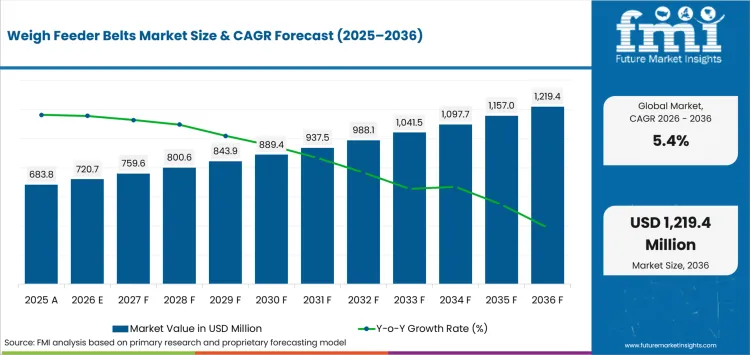
USD 720.7 million in 2026 and USD 1,219.4 million by 2036 at a 5.4% CAGR.
Weigh feeder belts demand is projected to increase valuation from USD 720.7 million in 2026 to USD 1219.4 million by 2036 at 5.4% CAGR. Metered process lines place each belt inside a bulk material handling system that can transfer tracking errors into measured feed. The USA Geological Survey estimated 2025 portland and blended cement output at 82 million tons in February 2026. That operating scale sustains conveyor belt specifications focused on stable tracking and dependable splice behavior across planned maintenance cycles.
Country routes differ because mature plants emphasize replacement service while newer industrial programs place more weight on process documentation and local availability. China added cement to its national carbon market in March 2025 and expected about 1,500 enterprises across three added sectors to enter. The policy does not regulate feeder belts directly but raises the commercial value of repeatable input control at covered cement plants. New belt feeder installations give engineers a cleaner specification point because belt construction and weighing hardware can be qualified together.
Key Takeaways of Weigh Feeder Belts Market
- Metered bulk-material processes sustain recurring belt demand as belt wear or mistracking can disturb feeder calibration during continuous production.
- Based on belt type, flat weigh feeder belts are projected to account for 33.0% in 2026 due to a uniform carrying profile supporting repeatable weighbridge contact.
- By cover material, rubber is estimated to hold 34.0% in 2026 owing to compound options that address abrasion and heat plus flame exposure.
- In 2026, raw material feeders are expected to lead application demand with 29.0% share because primary inputs require controlled dosing before downstream processing.
- Supplier switching remains constrained by feeder geometry and tracking behavior because splice construction must also fit the plant shutdown window.
- Continental, Habasit, Forbo Siegling, Ammeraal Beltech, Fenner Dunlop, Yokohama Rubber, Bando Chemical, and Nitta serve bulk-duty and precision belt roles across the market.
Analyst Perspective
"Weigh feeder belt evaluation should start with stable loading and splice behavior at the installed feeder instead of catalog breadth alone. Commercial value rises when a supplier combines repeatable fabrication with service that fits the plant maintenance window."
- Nikhil Kaitwade, Principal Consultant, Future Market Insights
How is the Weigh Feeder Belts Market segmented?
The weigh feeder belts market is segmented by belt type, cover material, application, width, demand type and region.
Belt types include flat weigh feeder belts, cleated belts, sidewall belts, endless belts, and skirted feeder belts. Cover materials include rubber, PVC, PU, heat-resistant rubber, and abrasion-resistant rubber. Applications include raw material feeders, coal feeders, clinker feeders, additive feeders, and cement blending. Widths include <500 mm, 500-1,000 mm, and >1,000 mm. Demand type separates new feeder fitment from replacement or spares.
What makes flat weigh feeder belts central to the belt type category?
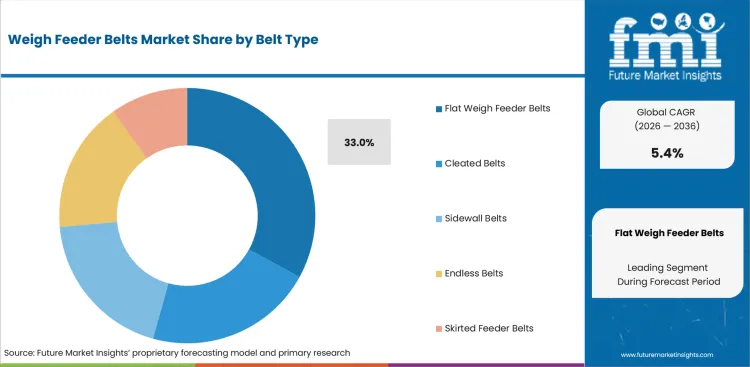
Flat belts present a continuous carrying surface across the weighing zone that limits profile changes affecting conveyor system geometry during measurement. Continental launched VersaFlex in May 2026 with a high-strength vulcanised splice achieved through an optimised finger splice design, plus mechanical-fastener capability for demanding above-ground material handling.
- Flat weigh feeder belts are set to lead the belt type category with 33.0% share in 2026 due to a level profile that stabilizes weighbridge contact during continuous plant service.
- Plant engineers protect metering stability by checking carcass consistency and joint construction during approval instead of accepting dimensional fit alone under loaded conditions used during feeder calibration checks.
Why does rubber lead the cover material category?
Rubber gives plant engineers compound routes for abrasion and heat while retaining options for flame exposure in bulk-solid service. The same selection logic appears across industrial rubber compounds that operate beside severe material streams. Yokohama Rubber launched FLAME GUARD ECO in April 2025 with a new compound that lowered running resistance while retaining flame-retardant performance.
- The cover material category is forecast to be led by rubber at 34.0% share in 2026 due to compound flexibility across abrasive and high-temperature bulk-solid service.
- Plant engineers use cover chemistry to match abrasion and heat exposure before approving a belt for continuous bulk-material service.
How do raw material feeders anchor the application category?
Raw material feeders establish mass flow before grinding or blending can magnify dosing errors so belt tracking becomes a process-control requirement. Large surface mining equipment also feeds ore into continuous transfer routes before later downstream processing. Fenner Conveyors renewed a five-year Rio Tinto contract in April 2025 for conveyor belts and splice kits across Australian iron ore operations.
- By application, raw material feeders are forecast to represent 29.0% in 2026 driven by the need to meter primary solids before grinding or blending.
- Mine and cement operators qualify raw-feed belts against continuous loading conditions because a tracking fault before processing can disrupt several downstream units.
Why do replacement and spares lead the demand type category?
Replacement work starts with installed pulley geometry and weighing hardware already fixed which raises the value of dimensional records and repeatable fabrication. Forbo announced in May 2026 that Movement Systems would place production, fabrication, and on-site services under one Global Operations structure. Regional conveying equipment service matters when a worn belt must be fitted inside an existing shutdown plan.
- Replacement and spares are projected to hold 74.0% share in 2026 owing to recurring cover and splice wear across installed weigh feeder fleets.
- Maintenance teams favor documented dimensions and repeatable splicing because an emergency belt must fit existing equipment without extending a planned outage.
What are the drivers, restraints and opportunities in the Weigh Feeder Belts Market?
High-throughput bulk handling supports recurring demand while feeder-specific qualification slows switching and regional fabrication can shorten replacement lead times.
- Driver: Continuous cement and mineral handling creates recurring feeder duty because stable mass flow depends on belt condition throughout production.
- Restraint: Alternative belts must match installed geometry and demonstrate stable tracking before plant engineers accept splice or cover changes.
- Opportunity: Regional fabrication and field support can convert urgent wear events into qualified replacement orders inside scheduled maintenance windows.
Continuous Bulk Handling Sustains Replacement Demand
High-volume coal and mineral streams keep conveyor drive loads active across plants that depend on uninterrupted feed into processing equipment. The USA Energy Information Administration reported in July 2026 that electricity generation and useful thermal output consumed 425.3 million short tons of coal during 2025. That throughput sustains recurring feeder duty as operators connect belt condition with controlled fuel dosing and planned maintenance.
Qualification Risk Slows Supplier Switching
Replacement decisions remain sensitive to carcass behavior because a new belt must track correctly across an existing weighbridge and pulley set. AMMEGA launched its Belting Technology Connect program in July 2025 with customer-specific sessions covering belt selection and material handling. The program illustrates why technical selection support remains commercially relevant before a plant changes an established feeder specification during maintenance.
Local Fabrication Can Shorten Critical Lead Times
Plants gain a practical supply option as fabrication and emergency support sit closer to installed feeders. AMMEGA opened a Quebec City belting unit in July 2025 with local technicians providing custom fabrication plus installation and emergency maintenance. Regional capability can shorten the period between wear detection and qualified replacement delivery without removing dimensional checks needed before a critical feeder returns to service.
Which country CAGRs are profiled in the Weigh Feeder Belts Market?
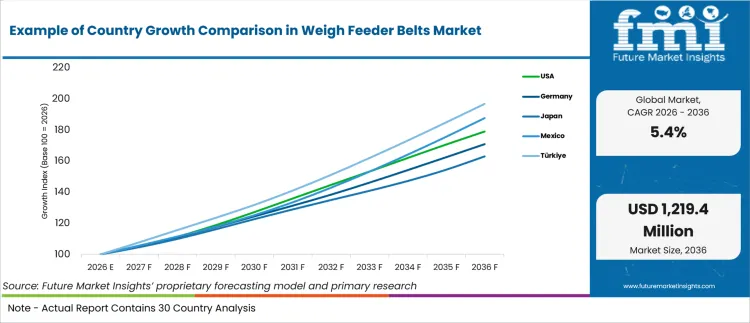
| Country | CAGR |
|---|---|
| Türkiye | 5.1% |
| Mexico | 5.0% |
| USA | 4.5% |
| Germany | 4.1% |
| Japan | 3.8% |
How do country-level CAGRs compare in the Weigh Feeder Belts Market?
The profiled forecasts span 1.3 percentage points from Türkiye to Japan within a narrow growth band. Türkiye and Mexico form the upper pair while the USA separates them from Germany and Japan. The spacing reflects replacement cycles and local activity rather than differences in market size or installed feeder volume.
- Türkiye combines civil-engineering gains with weaker building output across aggregate handling demand.
- Mexico pairs construction recovery with distributor response across mineral corridors and cement plants.
- The USA converts demand mainly through planned outages and established MRO replacement channels.
- Germany combines renewed construction orders with mature feeders and strict post-maintenance reliability requirements.
- Japan favors measured replacement as stable material demand increases emphasis on maintenance predictability.
The narrow spread reflects different order-conversion routes rather than shared installed-base conditions. The full report provides country-level CAGR analysis across North America, Latin America, Europe, East Asia, South Asia, Oceania and the Middle East and Africa.
Country-wise Analysis
- Türkiye: Turkish construction activity showed a split operating picture in May 2026 as civil engineering expanded while building work declined and kept weigh feeder belt orders tied to project type and regional cement flows. Weigh feeder belt demand in Türkiye is forecast to rise at 5.1% CAGR over the assessment period as infrastructure work sustains material movement despite softer building activity and uneven new-equipment commissioning across industrial sites. TurkStat reported in July 2026 that civil-engineering production rose 6.2% year over year while total construction output fell 3.0%, so local stock and field support protect shutdown schedules when imported specifications extend lead times.
- Mexico: Mexican cement and mineral processors operate beside a construction market that accelerated in May 2026 which supports feeder utilization across concrete and raw-material lines while increasing the value of reliable regional replacement stock. The Mexico weigh feeder belts market is projected to record 5.0% CAGR during the assessment period as plant maintenance combines with selective capacity additions and stronger construction-company output across active industrial corridors. INEGI reported in July 2026 that construction-company production value rose 2.7% month over month and 7.5% year over year, yet dimensional matching and uneven service coverage remain material frictions for plants with outage schedules.
- USA: American cement and mineral plants buy feeder belts through established OEM and MRO channels with planned outages determining when maintenance teams inspect tracking behavior and replace worn covers or splices across regional sites. Adoption of weigh feeder belts in the USA is estimated to expand at 4.5% CAGR through 2036 as recurring maintenance offsets a mature equipment base and supports predictable aftermarket ordering across dispersed industrial regions. The USA Census Bureau reported in July 2026 that May construction spending ran at a USD 2.21 trillion annualized rate, while legacy dimensions and splice practices increase qualification work for replacement suppliers.
- Germany: German cement and mineral operators combine mature feeder fleets with renewed construction activity which makes documented reliability especially important during planned belt replacements across established process lines and long operating cycles nationwide. Germany is estimated to post 4.1% CAGR over the forecast period as recurring maintenance continues across cement and mineral sites with strict approval routines for critical weighing equipment across long production cycles each year. Destatis reported in February 2026 that real main-construction orders rose 6.8% during 2025, yet exact geometry and outage discipline favor suppliers supporting blended cement production with traceable compound data and repeatable splice dimensions.
- Japan: Japanese industrial users prioritize predictable maintenance and energy performance across mature material-handling systems because belt-induced drift after service work can disrupt feeder calibration and raise the proof burden for specification changes nationally. By 2036 Japan is projected to grow at 3.8% CAGR as replacement demand follows measured cement and industrial-material use instead of rapid greenfield feeder expansion across established domestic plants and mature service networks. Japan’s infrastructure ministry projected 33 million tonnes of cement demand for fiscal 2025 in October 2025, while stable material use and strict qualification routines favor suppliers with documented tracking behavior and dependable service procedures.
Who are the notable companies in the Weigh Feeder Belts Market?
Continental, Habasit, Forbo Siegling, Ammeraal Beltech, Fenner Dunlop, Yokohama Rubber, Bando Chemical and Nitta are the notable companies serving this market.
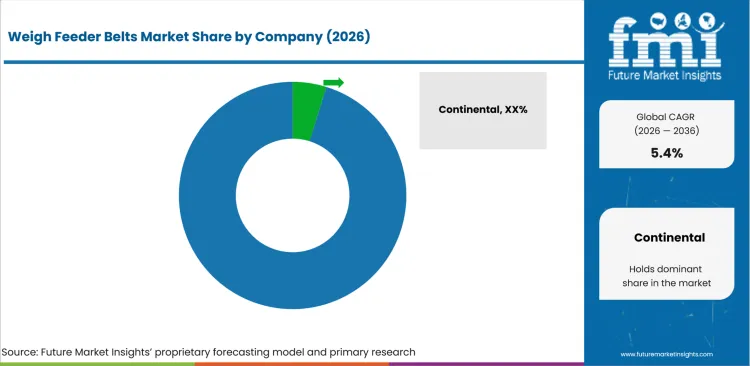
Competition splits between heavy-duty rubber conveyor belts and precision process-belt specialists as regional fabrication and field service determine how quickly a qualified replacement reaches the feeder. Entry barriers come from application proof because belt mass and tracking behavior must remain consistent across the weighing zone.
- Continental and Fenner Dunlop join Yokohama Rubber in severe-duty belting for mining and cement plus coal and aggregate handling.
- Habasit and Forbo Siegling join Ammeraal Beltech in process-belt control plus fabrication and service for equipment requiring precise tracking.
- Bando Chemical and Nitta combine diversified industrial belting with Asian production or processing networks that support regional supply and replacement activity.
Competitive Benchmarking: Weigh Feeder Belts Market
| Company | Metering-Specific Belt Control | Bulk-Duty Cover Engineering | Fabrication and Field Service | Geographic Reach |
|---|---|---|---|---|
| Continental | Medium | High | High | Global |
| Habasit | High | Medium | High | Global |
| Forbo Siegling | Medium | Medium | High | Global |
| Ammeraal Beltech | Medium | Medium | High | Global |
| Fenner Dunlop | Medium | High | High | Australia and international mining markets |
| Yokohama Rubber | Medium | High | Medium | Japan and international industrial markets |
| Bando Chemical | Medium | Medium | Medium | Asia, North America and international sales |
| Nitta | Medium | Medium | High | Japan, India, South Asia and Middle East |
Key Developments in the Weigh Feeder Belts Market
- In March 2026, Fenner Conveyors launched the INFINITY SERIES belt range with 10% locally recycled material in its inaugural product for heavy industrial service.
- In February 2026, Nitta completed a Pune-area factory with about three times the former floor area and expanded transmission and conveyor-belt processing for regional markets.
- In December 2025, Ammeraal Conveyor Belting, an established Australian manufacturer of synthetic conveyor belts with over 40 years of experience, officially joined the AMMEGA Group, extending AMMEGA's fabrication and service coverage across Australia and New Zealand.
Key Players in the Weigh Feeder Belts Market
Heavy-Duty Bulk-Material Belt Suppliers
- Continental
- Fenner Dunlop
- Yokohama Rubber
Precision Process-Belt and Fabrication Specialists
- Habasit
- Forbo Siegling
- Ammeraal Beltech
Diversified Asian Industrial-Belt Suppliers
- Bando Chemical
- Nitta
Weigh Feeder Belts Market - Report Scope
| Coverage field | Report scope |
|---|---|
| Market breakdown | By belt type, cover material, application, width, demand type and region. |
| Quantitative Units | Revenue in USD million and CAGR in %. |
| Market Definition | Commercial belts installed on gravimetric or weigh-feeder systems that meter bulk solids across continuous industrial process lines. |
| Regions Covered | North America, Latin America, Europe, East Asia, South Asia and Pacific, and Middle East and Africa. |
| Countries Covered | Türkiye, Mexico, USA, Germany, Japan, and 20+ countries included in the full report. |
| Key Companies Profiled | Continental, Habasit, Forbo Siegling, Ammeraal Beltech, Fenner Dunlop, Yokohama Rubber, Bando Chemical, Nitta. |
| Forecast Period | 2026 to 2036. |
| Approach | Primary and secondary research with market triangulation. |
Weigh Feeder Belts Market - Research Methodology
| Method | Approach |
|---|---|
| Primary Research | FMI analysts gathered input from manufacturers, service providers, technology developers, distributors, end users, procurement teams, and subject-matter experts. Interviews examined purchasing decisions, product or service evaluation, adoption barriers, approval requirements, pricing considerations, and expectations for technical or commercial support. Respondents were also asked what evidence is required before a trial, pilot, or initial order develops into regular purchasing. |
| Desk Research | Desk research covered government statistics, regulatory publications, trade data, industry associations, technical literature, standards, company filings, product information, and official corporate announcements. Sources were reviewed for relevance, publication date, geographic coverage, and consistency with the defined market scope. Claims relating to performance, applications, approvals, capacity, investment, and commercial activity were retained only when supported by credible public evidence. |
| Market Sizing and Forecasting | The market model combined the baseline value with historical performance, segment structure, pricing and volume indicators, adoption levels, company participation, and country-level demand conditions. Forecast assumptions considered economic activity, investment trends, regulatory developments, technology adoption, purchasing cycles, supply availability, and barriers to wider market use. Segment and regional estimates were reconciled before the final market total was calculated. |
| Data Validation | Estimates were checked against multiple independent indicators, including public data, company activity, trade patterns, industry developments, and findings from primary interviews. Validation also tested whether products, services, applications, and company revenues fell within the defined market boundaries. Adjacent categories, unsupported claims, overlapping revenues, and activities without direct market relevance were excluded to reduce double counting and maintain consistency across segments and countries. |
Weigh Feeder Belts Market by Segments
Weigh Feeder Belts Market segmented by Belt Type:
- Flat Weigh Feeder Belts
- Cleated Belts
- Sidewall Belts
- Endless Belts
- Skirted Feeder Belts
Weigh Feeder Belts Market segmented by Cover Material:
- Rubber
- PVC
- PU
- Heat-resistant Rubber
- Abrasion-resistant Rubber
Weigh Feeder Belts Market segmented by Application:
- Raw Material Feeders
- Coal Feeders
- Clinker Feeders
- Additive Feeders
- Cement Blending
Weigh Feeder Belts Market segmented by Width:
- <500 mm
- 500-1,000 mm
- >1,000 mm
Weigh Feeder Belts Market segmented by Demand Type:
- New Feeder Fitment
- Replacement / Spares
Weigh Feeder Belts Market by Region:
- North America
- United States
- Canada
- Latin America
- Brazil
- Mexico
- Chile
- Rest of Latin America
- Western Europe
- Germany
- United Kingdom
- Italy
- Spain
- France
- Nordics
- Benelux
- Rest of Western Europe
- Eastern Europe
- Russia
- Poland
- Hungary
- Balkan and Baltic States
- Rest of Eastern Europe
- East Asia
- China
- Japan
- South Korea
- South Asia and Pacific
- India
- ASEAN
- Australia and New Zealand
- Rest of South Asia and Pacific
- Middle East and Africa
- Kingdom of Saudi Arabia
- Other GCC Countries
- Türkiye
- South Africa
- Other African Union Countries
- Rest of Middle East and Africa
Research Sources and Bibliography
- USA Geological Survey. (2026, February 6). Mineral commodity summaries 2026.
- State Council of the People’s Republic of China. (2025, March 27). China expands carbon trading market to steel, cement, aluminum smelting sectors.
- Continental. (2026, May 4). Continental Launches VersaFlex Single-Ply Conveyor Belt, Delivering Strength, Flexibility and Uptime for Above-Ground Mining.
- Yokohama Rubber Co., Ltd. (2025, April 30). Yokohama Rubber launches FLAME GUARD ECO, an energy-efficient and flame-retardant conveyor belt.
- Fenner Conveyors. (2025, April 7). Fenner Conveyors and Rio Tinto renew partnership.
- Forbo Holding Ltd. (2026, May 11). Media release: Forbo accelerates Movement Systems transformation: new operating model and direct CEO leadership.
- USA Energy Information Administration. (2026, July 23). Electric Power Monthly: Coal consumption for electricity generation and useful thermal output, by sector.
- AMMEGA. (2025, July 16). AMMEGA Group Launches Belting Technology Connect.
- AMMEGA. (2025, July 24). AMMEGA Canada Expands Operations with New Quebec City Belting Unit.
- Turkish Statistical Institute. (2026, July 16). Construction Production Index - May 2026.
- Instituto Nacional de Estadística y Geografía. (2026, July 24). National Survey of Construction Companies (ENEC) 2018. May, 2026.
- USA Census Bureau. (2026, July 1). Monthly Construction Spending, May 2026.
- Statistisches Bundesamt. (2026, February 25). KORREKTUR: Auftragseingang im Bauhauptgewerbe 2025 um 6,8 % höher als im Vorjahr.
- Ministry of Land, Infrastructure, Transport and Tourism. (2025, October 31).
- Fenner Conveyors. (2026, March 20). Unveiling INFINITY SERIES: The Ultimate Evolution in Sustainable Belting.
- Nitta Corporation. (2026, February 26).
- AMMEGA. (2025, December 1). Welcoming Ammeraal Conveyor Belting to the AMMEGA Group.
- Continental. (2025, October 20). ContiTech plans to expand Manufacturing Operations in Mount Pleasant, Iowa Facility.
- Yokohama Rubber Co., Ltd. (2025, July 25). Yokohama Rubber turns consolidated conveyor belt production and sales subsidiary in China into a wholly owned subsidiary.
- Fenner Conveyors. (2025, June 23). Another Major Turnkey Conveyor Project Secured by Fenner Conveyors.
- Fenner Conveyors. (n.d.). Quality. Retrieved August 13, 2026.
- Forbo Movement Systems. (n.d.). Certifications. Retrieved August 13, 2026.
- Habasit. (2025). Can a TPU belt outperform a silicone belt?
- Forbo Holding Ltd. (n.d.). Forbo Movement Systems - Synthetic Belting for Food, Fitness & More. Retrieved August 13, 2026.
- Bando Chemical Industries, Ltd. (n.d.). Belt Processing Service / Sales Agent (Overseas). Retrieved August 13, 2026.
- Bando Chemical Industries, Ltd. (n.d.). Top page|Sunline Belt Selection Site. Retrieved August 13, 2026.
- Nitta Corporation. (n.d.). Power Transmission and Conveyor Belts/Conveyor Units. Retrieved August 13, 2026.
This bibliography is provided for reader reference and is not exhaustive. The full report contains the complete reference list and detailed citations
This Report Answers
- How large is the weigh feeder belts market in 2026 and 2036?
- Which operating conditions make belt stability critical to gravimetric feeding?
- Why do flat weigh feeder belts account for 33.0% of belt type demand in 2026?
- Why does rubber represent 34.0% of cover material demand in 2026?
- What supports raw material feeder demand across cement and mineral processing?
- Why do replacement and spares account for 74.0% of demand type in 2026?
- How do the five profiled country growth rates differ?
- Which qualification and service factors slow supplier switching?
- Which companies compete across bulk-duty belts, process belts, and regional fabrication?
Frequently Asked Questions
How big is the Weigh Feeder Belts Market in 2026?
The weigh feeder belts market is expected to be valued at USD 720.7 million in 2026 and reach USD 1219.4 million by 2036. Recurring replacement orders follow feeder wear as plants protect stable mass flow during scheduled maintenance.
What is the CAGR of the Weigh Feeder Belts Market from 2026 to 2036?
The weigh feeder belts market is projected to grow at a CAGR of 5.4% between 2026 and 2036. Expansion follows continuous cement and mineral handling as belt condition affects measured feed stability and equipment uptime.
Which belt type leads the Weigh Feeder Belts Market?
Flat weigh feeder belts are projected to account for 33.0% of the weigh feeder belts market by belt type in 2026. Their continuous carrying surface supports stable weighbridge contact and simplifies tracking checks during routine maintenance.
How much value will the Weigh Feeder Belts Market add between 2026 and 2036?
The weigh feeder belts market is expected to add USD 498.7 million in value between 2026 and 2036. The increase reflects recurring replacement plus new fitment as plants maintain stable metering across cement and mineral process lines.
Which companies are active in the Weigh Feeder Belts Market?
Companies active in the weigh feeder belts market include Continental, Habasit, Forbo Siegling, Ammeraal Beltech, Fenner Dunlop, Yokohama Rubber, Bando Chemical, and Nitta. Their competition centers on belt stability, cover engineering, fabrication quality, and field service for installed feeders.
Preview the report firsthand - request a free sample
Get SampleGet the brochure for pricing and purchase details.
Get PDFTable of Content
- Key Takeaways
- Market Size and CAGR
- Top Growth Driver
- Fastest Growing Segment
- Leading Region
- Key Companies
- Emerging Opportunities
- Executive Summary
- Global Market Outlook
- Demand-side Trends
- Supply-side Trends
- Technology Roadmap Analysis
- Analysis and Recommendations
- Analyst Perspective (What is happening? Why now? What should investors know?)
- Key Questions Answered
- How large is the market?
- What is the CAGR?
- What are key trends?
- Which region dominates?
- Who are the leaders?
- Market Overview
- Market Coverage / Taxonomy
- Market Definition / Scope / Limitations
- Research Methodology
- Chapter Orientation
- Analytical Lens and Working Hypotheses
- Market Structure, Signals, and Trend Drivers
- Benchmarking and Cross-market Comparability
- Market Sizing, Forecasting, and Opportunity Mapping
- Research Design and Evidence Framework
- Desk Research Programme (Secondary Evidence)
- Expert Input and Fieldwork (Primary Evidence)
- Tooling, Models, and Reference Databases
- Data Engineering and Model Build
- Quality Assurance and Audit Trail
- Market Background
- Market Dynamics (Drivers, Restraints, Opportunity, Trends)
- Scenario Forecast (Optimistic, Likely, Conservative)
- Impact Analysis
- AI Impact
- Sustainability Impact
- Regulatory Impact
- Technology Impact
- Consumer / Buyer Analysis
- Purchase Drivers
- Adoption Barriers
- Buyer Journey
- Opportunity Map Analysis
- Product Life Cycle Analysis
- Supply Chain Analysis
- Investment Feasibility Matrix
- Value Chain Analysis
- PESTLE and Porter's Analysis
- Regulatory Landscape
- Regional Parent Market Outlook
- Production and Consumption Statistics
- Import and Export Statistics
- Global Market Analysis and Forecast, 2021 to 2036
- Historical Market Size Value (USD Million) Analysis, 2021 to 2025
- Current and Future Market Size Value (USD Million) Projections, 2026 to 2036
- Y-o-Y Growth Trend Analysis
- Absolute $ Opportunity Analysis
- Global Market Pricing Analysis, 2021 to 2036
- Global Market Analysis and Forecast, By Belt Type, 2021 to 2036
- Introduction / Key Findings
- Historical Market Size Value (USD Million) Analysis By Belt Type, 2021 to 2025
- Current and Future Market Size Value (USD Million) Analysis and Forecast By Belt Type, 2026 to 2036
- Flat Weigh Feeder Belts
- Cleated Belts
- Sidewall Belts
- Endless Belts
- Skirted Feeder Belts
- Flat Weigh Feeder Belts
- Y-o-Y Growth Trend Analysis By Belt Type, 2021 to 2025
- Absolute $ Opportunity Analysis By Belt Type, 2026 to 2036
- Global Market Analysis and Forecast, By Cover Material, 2021 to 2036
- Introduction / Key Findings
- Historical Market Size Value (USD Million) Analysis By Cover Material, 2021 to 2025
- Current and Future Market Size Value (USD Million) Analysis and Forecast By Cover Material, 2026 to 2036
- Rubber
- PVC
- PU
- Heat-resistant Rubber
- Abrasion-resistant Rubber
- Rubber
- Y-o-Y Growth Trend Analysis By Cover Material, 2021 to 2025
- Absolute $ Opportunity Analysis By Cover Material, 2026 to 2036
- Global Market Analysis and Forecast, By Application, 2021 to 2036
- Introduction / Key Findings
- Historical Market Size Value (USD Million) Analysis By Application, 2021 to 2025
- Current and Future Market Size Value (USD Million) Analysis and Forecast By Application, 2026 to 2036
- Raw Material Feeders
- Coal Feeders
- Clinker Feeders
- Additive Feeders
- Cement Blending
- Raw Material Feeders
- Y-o-Y Growth Trend Analysis By Application, 2021 to 2025
- Absolute $ Opportunity Analysis By Application, 2026 to 2036
- Global Market Analysis and Forecast, By Width, 2021 to 2036
- Introduction / Key Findings
- Historical Market Size Value (USD Million) Analysis By Width, 2021 to 2025
- Current and Future Market Size Value (USD Million) Analysis and Forecast By Width, 2026 to 2036
- 500-1,000 mm
- <500 mm
- >1,000 mm
- 500-1,000 mm
- Y-o-Y Growth Trend Analysis By Width, 2021 to 2025
- Absolute $ Opportunity Analysis By Width, 2026 to 2036
- Global Market Analysis and Forecast, By Demand Type, 2021 to 2036
- Introduction / Key Findings
- Historical Market Size Value (USD Million) Analysis By Demand Type, 2021 to 2025
- Current and Future Market Size Value (USD Million) Analysis and Forecast By Demand Type, 2026 to 2036
- Replacement / Spares
- New Feeder Fitment
- Replacement / Spares
- Y-o-Y Growth Trend Analysis By Demand Type, 2021 to 2025
- Absolute $ Opportunity Analysis By Demand Type, 2026 to 2036
- Global Market Analysis and Forecast, By Region, 2021 to 2036
- Introduction
- Historical Market Size Value (USD Million) Analysis By Region, 2021 to 2025
- Current Market Size Value (USD Million) Analysis and Forecast By Region, 2026 to 2036
- North America
- Latin America
- Western Europe
- Eastern Europe
- East Asia
- South Asia and Pacific
- Middle East & Africa
- Market Attractiveness Analysis By Region
- North America Market Analysis and Forecast, By Country, 2021 to 2036
- Historical Market Size Value (USD Million) Trend Analysis By Market Taxonomy, 2021 to 2025
- Market Size Value (USD Million) Forecast By Market Taxonomy, 2026 to 2036
- By Country
- USA
- Canada
- By Belt Type
- By Cover Material
- By Application
- By Width
- By Demand Type
- By Country
- Market Attractiveness Analysis
- By Country
- By Belt Type
- By Cover Material
- By Application
- By Width
- By Demand Type
- Key Takeaways
- Latin America Market Analysis and Forecast, By Country
- Historical Market Size Value (USD Million) Trend Analysis By Market Taxonomy, 2021 to 2025
- Market Size Value (USD Million) Forecast By Market Taxonomy, 2026 to 2036
- By Country
- Brazil
- Mexico
- Chile
- Rest of Latin America
- By Belt Type
- By Cover Material
- By Application
- By Width
- By Demand Type
- By Country
- Market Attractiveness Analysis
- By Country
- By Belt Type
- By Cover Material
- By Application
- By Width
- By Demand Type
- Key Takeaways
- Western Europe Market Analysis and Forecast, By Country
- Historical Market Size Value (USD Million) Trend Analysis By Market Taxonomy, 2021 to 2025
- Market Size Value (USD Million) Forecast By Market Taxonomy, 2026 to 2036
- By Country
- Germany
- UK
- Italy
- Spain
- France
- Nordic
- BENELUX
- Rest of Western Europe
- By Belt Type
- By Cover Material
- By Application
- By Width
- By Demand Type
- By Country
- Market Attractiveness Analysis
- By Country
- By Belt Type
- By Cover Material
- By Application
- By Width
- By Demand Type
- Key Takeaways
- Eastern Europe Market Analysis and Forecast, By Country
- Historical Market Size Value (USD Million) Trend Analysis By Market Taxonomy, 2021 to 2025
- Market Size Value (USD Million) Forecast By Market Taxonomy, 2026 to 2036
- By Country
- Russia
- Poland
- Hungary
- Balkan & Baltic
- Rest of Eastern Europe
- By Belt Type
- By Cover Material
- By Application
- By Width
- By Demand Type
- By Country
- Market Attractiveness Analysis
- By Country
- By Belt Type
- By Cover Material
- By Application
- By Width
- By Demand Type
- Key Takeaways
- East Asia Market Analysis and Forecast, By Country
- Historical Market Size Value (USD Million) Trend Analysis By Market Taxonomy, 2021 to 2025
- Market Size Value (USD Million) Forecast By Market Taxonomy, 2026 to 2036
- By Country
- China
- Japan
- South Korea
- By Belt Type
- By Cover Material
- By Application
- By Width
- By Demand Type
- By Country
- Market Attractiveness Analysis
- By Country
- By Belt Type
- By Cover Material
- By Application
- By Width
- By Demand Type
- Key Takeaways
- South Asia and Pacific Market Analysis and Forecast, By Country
- Historical Market Size Value (USD Million) Trend Analysis By Market Taxonomy, 2021 to 2025
- Market Size Value (USD Million) Forecast By Market Taxonomy, 2026 to 2036
- By Country
- India
- ASEAN
- Australia & New Zealand
- Rest of South Asia and Pacific
- By Belt Type
- By Cover Material
- By Application
- By Width
- By Demand Type
- By Country
- Market Attractiveness Analysis
- By Country
- By Belt Type
- By Cover Material
- By Application
- By Width
- By Demand Type
- Key Takeaways
- Middle East & Africa Market Analysis and Forecast, By Country
- Historical Market Size Value (USD Million) Trend Analysis By Market Taxonomy, 2021 to 2025
- Market Size Value (USD Million) Forecast By Market Taxonomy, 2026 to 2036
- By Country
- Kingdom of Saudi Arabia
- Other GCC Countries
- Türkiye
- South Africa
- Other African Union
- Rest of Middle East & Africa
- By Belt Type
- By Cover Material
- By Application
- By Width
- By Demand Type
- By Country
- Market Attractiveness Analysis
- By Country
- By Belt Type
- By Cover Material
- By Application
- By Width
- By Demand Type
- Key Takeaways
- Key Countries Market Analysis
- USA
- Pricing Analysis
- Market Share Analysis, 2025
- By Belt Type
- By Cover Material
- By Application
- By Width
- By Demand Type
- Canada
- Pricing Analysis
- Market Share Analysis, 2025
- By Belt Type
- By Cover Material
- By Application
- By Width
- By Demand Type
- Mexico
- Pricing Analysis
- Market Share Analysis, 2025
- By Belt Type
- By Cover Material
- By Application
- By Width
- By Demand Type
- Brazil
- Pricing Analysis
- Market Share Analysis, 2025
- By Belt Type
- By Cover Material
- By Application
- By Width
- By Demand Type
- Chile
- Pricing Analysis
- Market Share Analysis, 2025
- By Belt Type
- By Cover Material
- By Application
- By Width
- By Demand Type
- Germany
- Pricing Analysis
- Market Share Analysis, 2025
- By Belt Type
- By Cover Material
- By Application
- By Width
- By Demand Type
- UK
- Pricing Analysis
- Market Share Analysis, 2025
- By Belt Type
- By Cover Material
- By Application
- By Width
- By Demand Type
- Italy
- Pricing Analysis
- Market Share Analysis, 2025
- By Belt Type
- By Cover Material
- By Application
- By Width
- By Demand Type
- Spain
- Pricing Analysis
- Market Share Analysis, 2025
- By Belt Type
- By Cover Material
- By Application
- By Width
- By Demand Type
- France
- Pricing Analysis
- Market Share Analysis, 2025
- By Belt Type
- By Cover Material
- By Application
- By Width
- By Demand Type
- India
- Pricing Analysis
- Market Share Analysis, 2025
- By Belt Type
- By Cover Material
- By Application
- By Width
- By Demand Type
- ASEAN
- Pricing Analysis
- Market Share Analysis, 2025
- By Belt Type
- By Cover Material
- By Application
- By Width
- By Demand Type
- Australia & New Zealand
- Pricing Analysis
- Market Share Analysis, 2025
- By Belt Type
- By Cover Material
- By Application
- By Width
- By Demand Type
- China
- Pricing Analysis
- Market Share Analysis, 2025
- By Belt Type
- By Cover Material
- By Application
- By Width
- By Demand Type
- Japan
- Pricing Analysis
- Market Share Analysis, 2025
- By Belt Type
- By Cover Material
- By Application
- By Width
- By Demand Type
- South Korea
- Pricing Analysis
- Market Share Analysis, 2025
- By Belt Type
- By Cover Material
- By Application
- By Width
- By Demand Type
- Russia
- Pricing Analysis
- Market Share Analysis, 2025
- By Belt Type
- By Cover Material
- By Application
- By Width
- By Demand Type
- Poland
- Pricing Analysis
- Market Share Analysis, 2025
- By Belt Type
- By Cover Material
- By Application
- By Width
- By Demand Type
- Hungary
- Pricing Analysis
- Market Share Analysis, 2025
- By Belt Type
- By Cover Material
- By Application
- By Width
- By Demand Type
- Kingdom of Saudi Arabia
- Pricing Analysis
- Market Share Analysis, 2025
- By Belt Type
- By Cover Material
- By Application
- By Width
- By Demand Type
- Türkiye
- Pricing Analysis
- Market Share Analysis, 2025
- By Belt Type
- By Cover Material
- By Application
- By Width
- By Demand Type
- South Africa
- Pricing Analysis
- Market Share Analysis, 2025
- By Belt Type
- By Cover Material
- By Application
- By Width
- By Demand Type
- USA
- Market Structure Analysis
- Competition Dashboard
- Competition Benchmarking
- Market Share Analysis of Top Players
- By Regional
- By Belt Type
- By Cover Material
- By Application
- By Width
- By Demand Type
- Emerging Startups
- Innovation Benchmarking
- Competition Analysis
- Competition Deep Dive
- Continental
- Overview
- Product Portfolio
- Profitability by Market Segments
- Sales Footprint
- Strategy Overview
- Marketing Strategy
- Product Strategy
- Channel Strategy
- Habasit
- Forbo Siegling
- Ammeraal Beltech
- Fenner Dunlop
- Mitsuboshi Belting
- Yokohama Rubber
- Bando Chemical
- Sparks Belting
- Nitta
- Continental
- Case Studies
- Success Stories
- Recent Developments
- Competition Deep Dive
- Assumptions & Acronyms Used


