

- Market Size (2026)
- USD 772.3 Mn
- Forecast (2036)
- USD 1211.8 Mn
- CAGR (2026 to 2036)
- 4.6%
How big is Weld Through Primers Market in 2026?
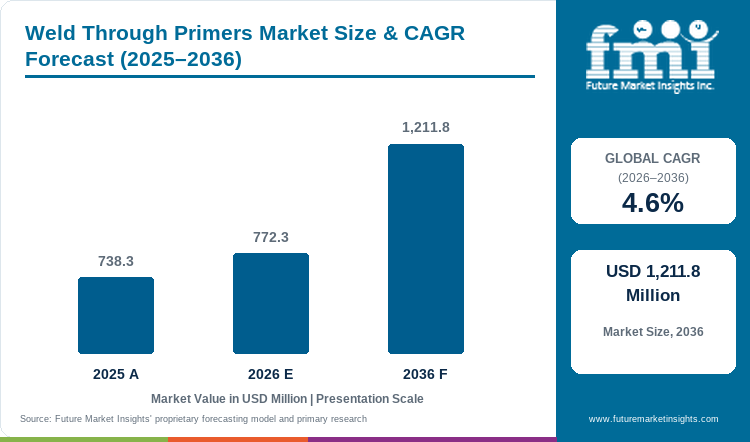
USD 772.3 million in 2026 and USD 1,211.8 million by 2036, expanding at 4.6% CAGR.
Sales of weld through primers are estimated to rise at 4.6% CAGR through 2036. Valuation rises from USD 738.3 million in 2025 to USD 772.3 million in 2026 and reaches USD 1,211.8 million by 2036. Body shops use primer during automotive repair services when they replace welded panels. New panels leave hidden flanges open before welding. I-CAR reported in May 2025 that General Motors requires approved weld-through coating on certain joining surfaces. The primer is part of the written panel-replacement steps.
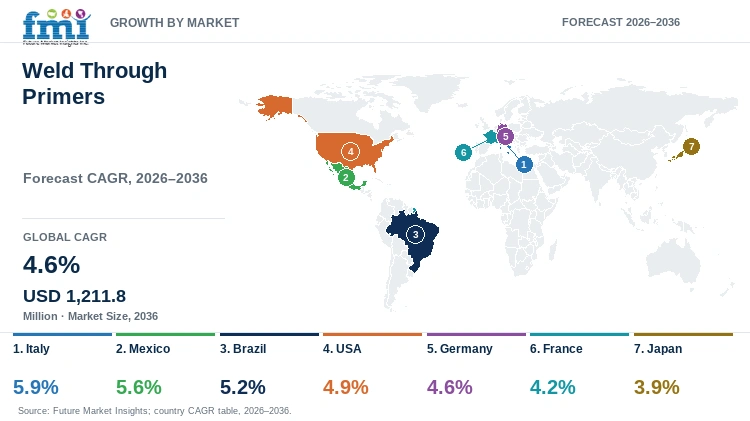
Italy is projected to grow at 5.9% CAGR through 2036, compared with 4.9% for the USA. Used-car sales keep repair work active in Italy. The US already has a large body-shop base. Automobile Club d’Italia reported in January 2026 that about 3.2 million used-car ownership transfers occurred in 2025. Shops working on older cars check whether primer works with automotive paints and coatings. Faster growth does not mean Italy has more current revenue.
Key Takeaways
- Car makers' repair rules tie primer demand to panel replacement and flange preparation.
- By primer type, zinc-rich primers are estimated to hold 38.0% in 2026, supported by zinc protection on steel joints.
- In 2026, automotive repair is expected to lead the application category with 31.0% share, driven by repeat panel work and flange preparation.
- By substrate, steel is forecast to represent 43.0% in 2026, linked to its wide use in replacement panels.
- Too much primer in the weld zone can raise resistance. It can also create small pores and cause rework.
- Some of the key players in this market include 3M, PPG, Axalta, Henkel, SEM Products, U-POL, Sherwin-Williams, Würth, Rust-Oleum, and Pro Form Products.
Analyst Perspective
“Primer choice starts with the repair steps, not the coating alone. Clear guidance can protect hidden flanges without causing weld faults or extra work. That helps suppliers win repeat orders.”
- Nikhil Kaitwade, Principal Consultant, Future Market Insights
How is the weld through primers market segmented?
The weld through primers market is segmented by Primer Type, Application, Substrate, End Use, Sales Channel, and Region.
The market has six main segments. They are primer type, application, substrate, end use, sales channel, and region. Primer type includes zinc-rich and copper-rich primers. It also includes epoxy weld, aerosol, and water-based products. Application includes automotive repair and body-in-white assembly. It also includes metal fabrication, marine repair, and industrial maintenance. The taxonomy below lists all groups and subsegments.
What supports zinc-rich primers within the primer type category?
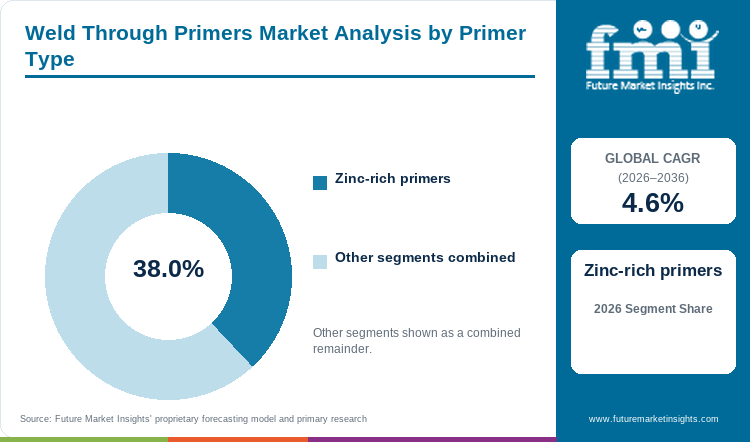
Zinc-rich primers use zinc to protect exposed steel inside hidden flanges. The coating must stay thin so the weld stays stable. Steel also uses corrosion protection coatings after metal work is complete. Weld-through primers work before the metal parts are joined. I-CAR said in May 2025 that GM-approved repairs use zinc-based weld-through coating on certain mating surfaces.
- By primer type, zinc-rich primers are estimated to hold 38.0% in 2026, supported by zinc protection on steel joints.
- Repairers check zinc content against weld behavior. Too much coating can raise resistance at the joint.
Why does automotive repair account for a large application share?
Body shops replace damaged welded panels, so they use primer again on each job. Technicians coat hidden flanges before they join the panel. They use automotive refinish coatings after the structural work. In August 2026, the U.S. Bureau of Labor Statistics counted 163,200 automotive body and related repair jobs in 2025. That workforce creates many local points for small-pack restocking. It also creates steady need for product help during repairs.
- By application, automotive repair is forecast to represent 31.0% in 2026, driven by repeat panel replacement and coating work.
- Body-in-white plants use central material rules. Repair shops buy smaller amounts for each job.
How does steel shape selection within the substrate category?
Steel leads substrate demand because welded seams are hard to reach once panels are joined. Galvanized steel has an extra zinc layer. Aluminum needs different protection and joining steps. In May 2026, Henkel introduced the Teroson EP 52 series for weld-bonded body structures. Those structures need guidance for each metal. They also use other anti-corrosion coatings as part of the wider protection process.
- In 2026, steel is expected to lead the substrate category with 43.0% share, linked to common steel panel repair.
- Mixed-metal repairs need clear guidance for each metal. One coating process does not work for every joint.
What supports automotive aftermarket demand within the end use category?
Aftermarket demand comes from single repair jobs, not large factory contracts. Shops restock aerosols and brushable packs with sealers and paint products. Axalta reported in November 2025 that its fast-cure repair system was made for faster work and lower energy use. Marine yards use separate marine coatings and rust-control systems. Weld-primer buying therefore follows a more specific repair job.
- By end use, automotive aftermarket is estimated to hold 34.0% in 2026, tied to repeat panel work and small-pack restocking.
- OEM body shops follow tighter material lists. Independent shops care more about ready stock and clear instructions.
Why do automotive paint distributors hold an important sales channel position?
Local paint distributors keep stock nearby and give repair advice. Body shops can buy primer with seam sealer, abrasives, and welding equipment and consumables. In May 2026, PPG said SEM products would reach Mexican body shops through authorized distributors and selected Comex stores. Local stock helps shops replace small repair items fast. Local advice also helps them use each product correctly.
- Automotive paint distributors are set to lead the sales channel category with 36.0% share in 2026, enabled by local stock and repair help.
- Direct suppliers suit large accounts, so catalog channels reach more shops but may offer less repair help.
What are the drivers, restraints and opportunities in the Weld Through Primers Market?
Vehicle-specific corrosion repair sustains primer demand, weld-zone control limits careless use, and better application systems can reduce waste and rework.
- Driver: OEM repair rules make rust protection part of approved welded-panel replacement.
- Restraint: Too much coating or poor weld-zone prep can raise porosity risk and slow repair work.
- Opportunity: Easy spray, brushable, and lower-emission formats can cut waste while still meeting repair rules.
OEM repair procedures make corrosion treatment part of welded-panel replacement
I-CAR reported in January 2025 that Subaru repair rules require a conductive rust coating on certain spot-welded surfaces. The rule makes rust protection part of the joining process. It is not just appearance work. Repair shops need products that match the metal and weld method in the vehicle guide. Suppliers of surface treatment chemicals and repair coatings can compete better when their data clearly matches those steps. Clear instructions can also cut rework from thick or misplaced coating. Each approved panel replacement creates repeat demand. Hidden flanges are hard to coat once the joint is closed, so shops must protect them before welding.
Weld quality limits primer film inside the direct weld zone
I-CAR reported in January 2025 that FCA/Stellantis requires zinc weld-through primer to be removed from the direct GMA weld zone. The step lowers porosity risk during welding. Primer still protects nearby mating surfaces. Technicians must therefore control where they apply it. Shops also manage ventilation, cleaning, and personal protection during related 2K coating work. These tasks add labor and training needs. Too much coating can slow welding or cause rework. Poor prep can also break the repair flow. Suppliers can reduce this barrier with clear thin-film guidance. Exact instructions also help shops keep primer out of the direct arc path during welding.
Application control gives suppliers a practical product-development route
PPG and SEM Products announced a texture-repair coating system in January 2026. The system is for collision centers and repair programs. It uses clear application steps to cut variation without changing the repair process. Weld-primer formulators can use the same idea for spray pattern, film thickness, and surface prep. Metal shops also use high-performance epoxy coatings after welding. That makes coating fit part of the job. Aerosol and brushable formats can cut overspray and waste. Each format still needs tests for the metal and weld process. A body shop should add the format to normal repair work only after those checks are complete.
Which country CAGRs are profiled in the Weld Through Primers Market?
| Country | CAGR |
|---|---|
| Italy | 5.9% |
| Mexico | 5.6% |
| Brazil | 5.2% |
| USA | 4.9% |
| Germany | 4.6% |
| France | 4.2% |
| Japan | 3.9% |
How do country-level CAGRs compare in the Weld Through Primers Market?
Country CAGRs range from 3.9% to 5.9%. Italy, Mexico, and Brazil are in the higher-growth group. The USA and Germany stay close to the global rate. France and Japan grow more slowly. Local repair work, supply routes, and approval rules create these differences. Current revenue size does not explain them by itself.
- Italy combines an older car base with active used-car sales.
- Mexico combines export car production with strong paint and repair supply.
- Brazil adds car-output growth but still faces supply gaps.
- US demand rests on a large body-repair workforce.
- Germany ties product choice closely to written repair rules.
- France's older car fleet keeps repair work active.
- Japan puts strong weight on steady results during product approval.
The same CAGR can still lead to a different sales pattern. Each country has its own repair system. The full report covers North America and Latin America. It also covers Western Europe and Eastern Europe. East Asia, South Asia and Pacific, and the Middle East and Africa are included as well.
Country-wise Analysis
- US body shops form a large repair network. They handle many replacement-panel jobs. The USA is estimated to post 4.9% CAGR over the forecast period, supported by steady body repair. In August 2026, the U.S. Bureau of Labor Statistics published its 2025 job count. It recorded 163,200 automotive body and related repair jobs. Those workers create many places to restock primer. Training quality can still vary by shop. Suppliers need clear weld-zone guides and reliable local stock. Good guidance helps shops follow approved rust-protection steps. It can also cut rework during busy periods. Local support helps turn one-time orders into repeat sales.
- German body shops and plants rely on clear repair rules and stable supply. Weld through primer demand in Germany is forecast to rise at 4.6% CAGR over the forecast period, linked to its large vehicle-production base. VDA reported in September 2025 that Germany made almost 2.8 million passenger cars in the first eight months of 2025. Large output does not remove repair issues. Mixed metals and OEM rules can slow product changes. Suppliers need clear product sheets for dealer-linked and independent shops. Repair methods can also differ by car model. Regional paint sellers need steady access to approved products. They also need simple instructions for each repair route.
- Japan's body shops want steady results before they switch repair materials. By 2036, Japan is projected to grow at 3.9% CAGR, shaped by long vehicle ownership and careful product approval. In April 2026, JAMA published a national survey on passenger cars. The survey work took place in September 2025. It found that 71.9% of households owned a passenger car. Among car-owning households, 30.5% owned more than one. Long ownership keeps repair work steady. Strict approval rules can slow product changes. Vendors need Japanese instructions and steady product quality. Local sellers must fill small repeat orders without making shops start the approval process again.
- Brazilian body shops must balance rust protection, pack price, and steady supply. In Brazil, weld through primer demand is predicted to advance at 5.2% CAGR through 2036, influenced by growing domestic vehicle activity. In January 2026, ANFAVEA said Brazil made 2.644 million vehicles in 2025. Output was 3.5% higher than in 2024. Car production supports repair and metal work. Long delivery routes can still delay small packs. Suppliers need stock in more regions and simple use guides. Local stock helps shops take urgent repair jobs outside large industrial centers. It also cuts lost time. Distributors need pack sizes that work for small repair orders.
- French body shops serve a large, older car fleet. Repair costs shape product choice. France's weld through primers outlook is anticipated to advance at 4.2% CAGR over the assessment period, tied to vehicle age and replacement work. In September 2025, the national transport statistics service counted 39.7 million cars in use on January 1, 2025. The average car was 11.5 years old. Older cars keep repair work active. Insurer time limits can reduce extra prep time. Suppliers need fast-drying products and clear French instructions. The guide should show the primer area and the weld zone that stays clear. Small packs also help shops cut unused material.
- Italian body shops work in a market with many used-car sales. The country also has many independent repair outlets. Italy is estimated to post 5.9% CAGR over the forecast period, supported by repeat repair work and distributor reach. In February 2026, Automobile Club d’Italia reported 258,878 used-car transfers in January. That equals 203 used cars for every 100 new cars. High turnover creates repair work. It does not guarantee premium-product sales. Suppliers need broad local coverage, small packs, and short use instructions. These features make flange prep easier to repeat. Shops also need quick restocking so planned body work does not stop.
- Mexico combines export car output with a large body-repair trade. Weld through primer sales in Mexico are forecast to expand at 5.6% CAGR by 2036, reinforced by high light-vehicle output and repair distribution. INEGI published June 2025 vehicle data in July 2025. Mexico made 361,047 light vehicles that month. It exported 331,517 units. The country's size can make small-pack supply uneven outside major assembly areas. Suppliers need local stock and bilingual repair guides. Strong dealer coverage helps shops replace low-volume items during active jobs. It also helps independent repair routes away from large plants. Faster restocking matters, but repair guidance must stay strong.
Who are the notable companies in the Weld Through Primers Market?
3M, PPG, Axalta, Henkel, SEM Products, U-POL, Sherwin-Williams, Würth, Rust-Oleum, Pro Form Products are active within the defined weld through primers and collision-repair supply boundary.
The field includes large coating groups, specialist autobody brands, and trade suppliers. 3M and Henkel sell joint-protection products with automotive adhesives and sealants used in body repair. PPG owns SEM Products. Axalta owns U-POL and Pro Form Products. Sherwin-Williams, Würth, and Rust-Oleum add trade or retail access. A supplier still needs proof that its product works with the metal and weld process. It also needs clear guidance and local stock.
- 3M, PPG, Axalta, Henkel, and Sherwin-Williams sell wider repair systems. They also support customers across several regions.
- SEM Products, U-POL, and Pro Form Products focus more on autobody goods used during repair work.
- Würth and Rust-Oleum use broad trade or retail channels. These routes make primer restocking easier.
Competitive Benchmarking: Weld Through Primers Market
| Company | Weld-Primer / Repair Breadth | Procedure Support | Channel Integration | Geographic Reach |
|---|---|---|---|---|
| 3M | Medium | High | High | Global |
| PPG | Medium | High | High | Global |
| Axalta | Medium | High | High | Global |
| Henkel | Medium | High | High | Global |
| SEM Products | High | High | High | North America and Mexico |
| U-POL | High | High | High | Global |
| Sherwin-Williams | Medium | Medium | High | Global |
| Würth | Medium | Medium | High | Europe and North America |
| Rust-Oleum | Medium | Medium | High | North America and selected export markets |
| Pro Form Products | High | Medium | Medium | North America |
Scoring basis: High means direct proof for the stated area. Medium means the proof is narrower. Low applies below that level. Geographic Reach lists the regions in which the company is active. It is not scored.
Key Developments in the Weld Through Primers Market
- In October 2025, Rust-Oleum announced new Auto Primers with Custom Spray 5-in-1 technology. It planned sales to start in spring 2026.
- In September 2025, PPG announced a body-shop paint partnership with Toyota Motor Europe. The work supports better body-shop repairs.
- In January 2025, Axalta said BMW Group chose it to supply refinish paint. The carmaker also named Axalta as a supplier it recommends. The deal covers more than 50 countries and includes a private-label program.
Key Players in the Weld Through Primers Market
Integrated collision-repair and coating systems
- 3M
- PPG
- Axalta
- Henkel
- Sherwin-Williams
Specialist autobody consumable brands
- SEM Products
- U-POL
- Pro Form Products
Trade and retail repair routes
- Würth
- Rust-Oleum
Weld Through Primers Market - Report Scope
| Coverage field | Report scope |
|---|---|
| Market breakdown | By primer type, application, substrate, end use, sales channel, and region. |
| Quantitative Units | USD million. |
| Market Definition | Commercial weld-through primers applied to mating metal surfaces before specified welding operations are included. Ordinary topcoat primers and unrelated corrosion coatings are excluded. |
| Regions Covered | North America, Latin America, Western Europe, Eastern Europe, East Asia, South Asia and Pacific, and Middle East and Africa. |
| Countries Covered | Italy, Mexico, Brazil, USA, Germany, France, Japan, and 20+ countries included in the full report. |
| Key Companies Profiled | 3M, PPG, Axalta, Henkel, SEM Products, U-POL, Sherwin-Williams, Würth, Rust-Oleum, Pro Form Products. |
| Forecast Period | 2026 to 2036. |
| Approach | Primary and secondary research with market triangulation. |
Weld Through Primers Market - Research Methodology
| Method | Approach |
|---|---|
| Primary Research | FMI analysts gathered input from manufacturers, service providers, technology developers, distributors, end users, procurement teams, and subject-matter experts. Interviews examined purchasing decisions, product or service evaluation, adoption barriers, approval requirements, pricing considerations, and expectations for technical or commercial support. Respondents were also asked what evidence is required before a trial, pilot, or initial order develops into regular purchasing. |
| Desk Research | Desk research covered government statistics, regulatory publications, trade data, industry associations, technical literature, standards, company filings, product information, and official corporate announcements. Sources were reviewed for relevance, publication date, geographic coverage, and consistency with the defined market scope. Claims relating to performance, applications, approvals, capacity, investment, and commercial activity were retained only when supported by credible public evidence. |
| Market Sizing and Forecasting | The market model combined the baseline value with historical performance, segment structure, pricing and volume indicators, adoption levels, company participation, and country-level demand conditions. Forecast assumptions considered economic activity, investment trends, regulatory developments, technology adoption, purchasing cycles, supply availability, and barriers to wider market use. Segment and regional estimates were reconciled before the final market total was calculated. |
| Data Validation | Estimates were checked against multiple independent indicators, including public data, company activity, trade patterns, industry developments, and findings from primary interviews. Validation also tested whether products, services, applications, and company revenues fell within the defined market boundaries. Adjacent categories, unsupported claims, overlapping revenues, and activities without direct market relevance were excluded to reduce double counting and maintain consistency across segments and countries. |
Weld Through Primers Market by Segments
Weld Through Primers Market segmented by Primer Type:
- Zinc-rich primers
- Copper-rich primers
- Epoxy weld primers
- Aerosol primers
- Water-based primers
Weld Through Primers Market segmented by Application:
- Automotive repair
- Body-in-white assembly
- Metal fabrication
- Marine repair
- Industrial maintenance
Weld Through Primers Market segmented by Substrate:
- Steel
- Galvanized steel
- Aluminum
- Stainless steel
- Mixed metals
Weld Through Primers Market segmented by End Use:
- Automotive aftermarket
- OEM body shops
- Fabrication shops
- Marine yards
- MRO workshops
Weld Through Primers Market segmented by Sales Channel:
- Automotive paint distributors
- Industrial distributors
- E-commerce - catalog
- Direct coating suppliers
Weld Through Primers Market by Region:
- North America
- United States
- Canada
- Latin America
- Brazil
- Mexico
- Chile
- Rest of Latin America
- Western Europe
- Germany
- United Kingdom
- Italy
- Spain
- France
- Nordics
- Benelux
- Rest of Western Europe
- Eastern Europe
- Russia
- Poland
- Hungary
- Balkan and Baltic States
- Rest of Eastern Europe
- East Asia
- China
- Japan
- South Korea
- South Asia and Pacific
- India
- ASEAN
- Australia and New Zealand
- Rest of South Asia and Pacific
- Middle East and Africa
- Kingdom of Saudi Arabia
- Other GCC Countries
- Türkiye
- South Africa
- Other African Union Countries
- Rest of Middle East and Africa
Research Sources and Bibliography
- I-CAR. (2025, May 2). Weld-through primer guidelines: General Motors - update.
- I-CAR. (2025, January 22). Weld-through primer guidelines: FCA/Stellantis - update.
- I-CAR. (2025, January 29). Weld-through primer guidelines: Subaru - update.
- U.S. Bureau of Labor Statistics. (2026, August 27). Automotive body and glass repairers.
- Henkel. (2026, May 12). New Henkel automotive adhesive: One product, twice the power.
- Axalta Coating Systems. (2025, November 24). Axalta wins 2025 R&D 100 Award for fast-cure, low-energy collision repair paint system.
- PPG. (2026, May 12). PPG introduces SEM products for body shops in Mexico.
- PPG. (2026, January 19). PPG’s SEM Products and 4Plastic introduce texture refinishing system.
- Automobile Club d’Italia. (2026, January 16). Used cars: The 10 favorites of Italians in 2025.
- Automobile Club d’Italia. (2026, February 10). Used-car market: The 10 favorites of Italians in January.
- German Association of the Automotive Industry. (2025, September 2). Car production declined in August.
- Japan Automobile Manufacturers Association. (2026, April 14). 2025 passenger car market trends survey.
- ANFAVEA. (2026, January 15). Vehicle production and sales grew in 2025 and ANFAVEA projects another increase in 2026.
- French Ministry for Ecological Transition, SDES. (2025, September 19). 39.7 million cars in circulation in France on January 1, 2025.
- INEGI. (2025, July 7). Monthly report: Administrative Registry of the Light Vehicle Automotive Industry, June 2025.
- Rust-Oleum. (2025, October 29). Rust-Oleum powers up auto appearance solutions at SEMA 2025.
- PPG. (2025, September 2). PPG and Toyota Motor Europe expand body-shop coating collaboration.
- Axalta Coating Systems. (2025, January 6). Axalta selected as recommended BMW Group refinish supplier.
- 3M. (2025, May 17). 3M is innovating to deliver end-to-end automotive solutions.
- PPG. (2026, January 26). PPG named sole supplier of coatings for Quality Collision Group body shops.
- Axalta Coating Systems. (2026, July 28). Axalta releases second quarter 2026 results.
- SEM Products. (2026, March 3). New Purple AVS Group: Advanced vented system technology for modern body shops.
- Sherwin-Williams Automotive Finishes. (2025, June). Sherwin-Williams returns as an ARC360 corporate partner.
- Würth USA. (n.d.). 2025 year in review. Retrieved September 21, 2026.
- U-POL. (2025, September 30). AutoZone 2025.
- Pro Form Products. (n.d.). Pro Form USA. Retrieved September 21, 2026.
- 3M. (2026, May 19). 3M and SkillsUSA competition helps prepare the next generation of skilled autobody repair technicians.
- PPG. (2026, August 3). PPG introduces PPG QUICKLINE waterborne refinish system for body shops in U.S. and Canada.
- PPG. (2026, March 9). PPG introduces fast-drying clearcoat to PPG DELTRON automotive refinish line.
- SEM Products. (2026, March 6). Color Coat 3: One Solution. Endless Possibilities.
- Axalta Coating Systems. (2025, April 22). Axalta takes its market-leading Fast Cure Low Energy technology to the next level.
- Axalta Coating Systems. (2025, February 13). Annual report for the year ended December 31, 2024.
This bibliography is provided for reader reference and is not exhaustive. The full report includes the complete source list and detailed citations.
This Report Answers
- How large is the weld through primers market in 2026 and 2036?
- Which repair procedures create repeat weld-through primer demand?
- Why do zinc-rich primers account for 38.0% of primer type revenue in 2026?
- Why does automotive repair represent 31.0% of application demand in 2026?
- Why does steel account for 43.0% of substrate revenue in 2026?
- How do film build and weld-zone preparation affect product selection?
- How do country CAGRs differ among the seven profiled countries?
- Which companies compete through collision-repair systems, specialist products, and trade distribution?
- What should repair shops and fabricators check before buying weld-through primers?
Frequently Asked Questions
How big is the weld through primers market in 2026?
The weld through primers market is valued at USD 772.3 million in 2026. It is projected to reach USD 1,211.8 million by 2036. Panel replacement creates repeat primer use because hidden metal surfaces need protection before welding.
What is the CAGR of the weld through primers market from 2026 to 2036?
The market is projected to grow at 4.6% CAGR from 2026 to 2036. Body repair and written rust-protection steps support the forecast. Each approved panel replacement can require fresh primer.
Which primer type leads the weld through primers market?
Zinc-rich primers are projected to account for 38.0% of primer type revenue in 2026. Zinc helps protect exposed steel at hidden joints. Repair rules often call for this primer before the metal parts are joined.
Which substrate leads the weld through primers market in 2026?
Steel is expected to account for 43.0% of substrate revenue in 2026. Many replacement panels use steel. Hidden steel joints need rust protection before welding closes the seam.
Which countries have the higher projected CAGRs in the weld through primers market?
Italy is projected to grow at 5.9% CAGR through 2036. Mexico is projected at 5.6%, and Brazil at 5.2%. Their repair work, car output, supply routes, and approval rules differ.
Which companies are active in the weld through primers market?
Key companies include 3M, PPG, Axalta, Henkel, SEM Products, U-POL, Sherwin-Williams, Würth, Rust-Oleum, and Pro Form Products. They compete through repair support, product range, specialist goods, and different sales channels.
Preview the report firsthand - request a free sample
Get SampleGet the brochure for pricing and purchase details.
Get PDFTable of Content
- Key Takeaways
- Market Size and CAGR
- Top Growth Driver
- Fastest Growing Segment
- Leading Region
- Key Companies
- Emerging Opportunities
- Executive Summary
- Global Market Outlook
- Demand-side Trends
- Supply-side Trends
- Technology Roadmap Analysis
- Analysis and Recommendations
- Analyst Perspective (What is happening? Why now? What should investors know?)
- Key Questions Answered
- How large is the market?
- What is the CAGR?
- What are key trends?
- Which region dominates?
- Who are the leaders?
- Market Overview
- Market Coverage / Taxonomy
- Market Definition / Scope / Limitations
- Research Methodology
- Chapter Orientation
- Analytical Lens and Working Hypotheses
- Market Structure, Signals, and Trend Drivers
- Benchmarking and Cross-market Comparability
- Market Sizing, Forecasting, and Opportunity Mapping
- Research Design and Evidence Framework
- Desk Research Programme (Secondary Evidence)
- Expert Input and Fieldwork (Primary Evidence)
- Tooling, Models, and Reference Databases
- Data Engineering and Model Build
- Quality Assurance and Audit Trail
- Market Background
- Market Dynamics (Drivers, Restraints, Opportunity, Trends)
- Scenario Forecast (Optimistic, Likely, Conservative)
- Impact Analysis
- AI Impact
- Sustainability Impact
- Regulatory Impact
- Technology Impact
- Consumer / Buyer Analysis
- Purchase Drivers
- Adoption Barriers
- Buyer Journey
- Opportunity Map Analysis
- Product Life Cycle Analysis
- Supply Chain Analysis
- Investment Feasibility Matrix
- Value Chain Analysis
- PESTLE and Porter's Analysis
- Regulatory Landscape
- Regional Parent Market Outlook
- Production and Consumption Statistics
- Import and Export Statistics
- Global Market Analysis and Forecast, 2021 to 2036
- Historical Market Size Value (USD Million) Analysis, 2021 to 2025
- Current and Future Market Size Value (USD Million) Projections, 2026 to 2036
- Y-o-Y Growth Trend Analysis
- Absolute $ Opportunity Analysis
- Global Market Pricing Analysis, 2021 to 2036
- Global Market Analysis and Forecast, By Primer Type, 2021 to 2036
- Introduction / Key Findings
- Historical Market Size Value (USD Million) Analysis By Primer Type, 2021 to 2025
- Current and Future Market Size Value (USD Million) Analysis and Forecast By Primer Type, 2026 to 2036
- Zinc-rich primers
- Copper-rich primers
- Epoxy weld primers
- Aerosol primers
- Water-based primers
- Y-o-Y Growth Trend Analysis By Primer Type, 2021 to 2025
- Absolute $ Opportunity Analysis By Primer Type, 2026 to 2036
- Global Market Analysis and Forecast, By Application, 2021 to 2036
- Introduction / Key Findings
- Historical Market Size Value (USD Million) Analysis By Application, 2021 to 2025
- Current and Future Market Size Value (USD Million) Analysis and Forecast By Application, 2026 to 2036
- Automotive repair
- Body-in-white assembly
- Metal fabrication
- Marine repair
- Industrial maintenance
- Y-o-Y Growth Trend Analysis By Application, 2021 to 2025
- Absolute $ Opportunity Analysis By Application, 2026 to 2036
- Global Market Analysis and Forecast, By Substrate, 2021 to 2036
- Introduction / Key Findings
- Historical Market Size Value (USD Million) Analysis By Substrate, 2021 to 2025
- Current and Future Market Size Value (USD Million) Analysis and Forecast By Substrate, 2026 to 2036
- Steel
- Galvanized steel
- Aluminum
- Stainless steel
- Mixed metals
- Y-o-Y Growth Trend Analysis By Substrate, 2021 to 2025
- Absolute $ Opportunity Analysis By Substrate, 2026 to 2036
- Global Market Analysis and Forecast, By End Use, 2021 to 2036
- Introduction / Key Findings
- Historical Market Size Value (USD Million) Analysis By End Use, 2021 to 2025
- Current and Future Market Size Value (USD Million) Analysis and Forecast By End Use, 2026 to 2036
- Automotive aftermarket
- OEM body shops
- Fabrication shops
- Marine yards
- MRO workshops
- Y-o-Y Growth Trend Analysis By End Use, 2021 to 2025
- Absolute $ Opportunity Analysis By End Use, 2026 to 2036
- Global Market Analysis and Forecast, By Sales Channel, 2021 to 2036
- Introduction / Key Findings
- Historical Market Size Value (USD Million) Analysis By Sales Channel, 2021 to 2025
- Current and Future Market Size Value (USD Million) Analysis and Forecast By Sales Channel, 2026 to 2036
- Automotive paint distributors
- Industrial distributors
- E-commerce - catalog
- Direct coating suppliers
- Y-o-Y Growth Trend Analysis By Sales Channel, 2021 to 2025
- Absolute $ Opportunity Analysis By Sales Channel, 2026 to 2036
- Global Market Analysis and Forecast, By Region, 2021 to 2036
- Introduction
- Historical Market Size Value (USD Million) Analysis By Region, 2021 to 2025
- Current Market Size Value (USD Million) Analysis and Forecast By Region, 2026 to 2036
- North America
- Latin America
- Western Europe
- Eastern Europe
- East Asia
- South Asia and Pacific
- Middle East and Africa
- Market Attractiveness Analysis By Region
- North America Market Analysis and Forecast, By Country, 2021 to 2036
- Historical Market Size Value (USD Million) Trend Analysis By Market Taxonomy, 2021 to 2025
- Market Size Value (USD Million) Forecast By Market Taxonomy, 2026 to 2036
- By Country
- United States
- Canada
- By Primer Type
- By Application
- By Substrate
- By End Use
- By Sales Channel
- By Country
- Market Attractiveness Analysis
- By Country
- By Primer Type
- By Application
- By Substrate
- By End Use
- By Sales Channel
- Key Takeaways
- Latin America Market Analysis and Forecast, By Country
- Historical Market Size Value (USD Million) Trend Analysis By Market Taxonomy, 2021 to 2025
- Market Size Value (USD Million) Forecast By Market Taxonomy, 2026 to 2036
- By Country
- Brazil
- Mexico
- Chile
- Rest of Latin America
- By Primer Type
- By Application
- By Substrate
- By End Use
- By Sales Channel
- By Country
- Market Attractiveness Analysis
- By Country
- By Primer Type
- By Application
- By Substrate
- By End Use
- By Sales Channel
- Key Takeaways
- Western Europe Market Analysis and Forecast, By Country
- Historical Market Size Value (USD Million) Trend Analysis By Market Taxonomy, 2021 to 2025
- Market Size Value (USD Million) Forecast By Market Taxonomy, 2026 to 2036
- By Country
- Germany
- United Kingdom
- Italy
- Spain
- France
- Nordics
- Benelux
- Rest of Western Europe
- By Primer Type
- By Application
- By Substrate
- By End Use
- By Sales Channel
- By Country
- Market Attractiveness Analysis
- By Country
- By Primer Type
- By Application
- By Substrate
- By End Use
- By Sales Channel
- Key Takeaways
- Eastern Europe Market Analysis and Forecast, By Country
- Historical Market Size Value (USD Million) Trend Analysis By Market Taxonomy, 2021 to 2025
- Market Size Value (USD Million) Forecast By Market Taxonomy, 2026 to 2036
- By Country
- Russia
- Poland
- Hungary
- Balkan and Baltic States
- Rest of Eastern Europe
- By Primer Type
- By Application
- By Substrate
- By End Use
- By Sales Channel
- By Country
- Market Attractiveness Analysis
- By Country
- By Primer Type
- By Application
- By Substrate
- By End Use
- By Sales Channel
- Key Takeaways
- East Asia Market Analysis and Forecast, By Country
- Historical Market Size Value (USD Million) Trend Analysis By Market Taxonomy, 2021 to 2025
- Market Size Value (USD Million) Forecast By Market Taxonomy, 2026 to 2036
- By Country
- China
- Japan
- South Korea
- By Primer Type
- By Application
- By Substrate
- By End Use
- By Sales Channel
- By Country
- Market Attractiveness Analysis
- By Country
- By Primer Type
- By Application
- By Substrate
- By End Use
- By Sales Channel
- Key Takeaways
- South Asia and Pacific Market Analysis and Forecast, By Country
- Historical Market Size Value (USD Million) Trend Analysis By Market Taxonomy, 2021 to 2025
- Market Size Value (USD Million) Forecast By Market Taxonomy, 2026 to 2036
- By Country
- India
- ASEAN
- Australia and New Zealand
- Rest of South Asia and Pacific
- By Primer Type
- By Application
- By Substrate
- By End Use
- By Sales Channel
- By Country
- Market Attractiveness Analysis
- By Country
- By Primer Type
- By Application
- By Substrate
- By End Use
- By Sales Channel
- Key Takeaways
- Middle East and Africa Market Analysis and Forecast, By Country
- Historical Market Size Value (USD Million) Trend Analysis By Market Taxonomy, 2021 to 2025
- Market Size Value (USD Million) Forecast By Market Taxonomy, 2026 to 2036
- By Country
- Kingdom of Saudi Arabia
- Other GCC Countries
- Türkiye
- South Africa
- Other African Union Countries
- Rest of Middle East and Africa
- By Primer Type
- By Application
- By Substrate
- By End Use
- By Sales Channel
- By Country
- Market Attractiveness Analysis
- By Country
- By Primer Type
- By Application
- By Substrate
- By End Use
- By Sales Channel
- Key Takeaways
- Key Countries Market Analysis
- United States
- Pricing Analysis
- Market Share Analysis, 2025
- By Primer Type
- By Application
- By Substrate
- By End Use
- By Sales Channel
- Canada
- Pricing Analysis
- Market Share Analysis, 2025
- By Primer Type
- By Application
- By Substrate
- By End Use
- By Sales Channel
- Mexico
- Pricing Analysis
- Market Share Analysis, 2025
- By Primer Type
- By Application
- By Substrate
- By End Use
- By Sales Channel
- Brazil
- Pricing Analysis
- Market Share Analysis, 2025
- By Primer Type
- By Application
- By Substrate
- By End Use
- By Sales Channel
- Chile
- Pricing Analysis
- Market Share Analysis, 2025
- By Primer Type
- By Application
- By Substrate
- By End Use
- By Sales Channel
- Germany
- Pricing Analysis
- Market Share Analysis, 2025
- By Primer Type
- By Application
- By Substrate
- By End Use
- By Sales Channel
- United Kingdom
- Pricing Analysis
- Market Share Analysis, 2025
- By Primer Type
- By Application
- By Substrate
- By End Use
- By Sales Channel
- Italy
- Pricing Analysis
- Market Share Analysis, 2025
- By Primer Type
- By Application
- By Substrate
- By End Use
- By Sales Channel
- Spain
- Pricing Analysis
- Market Share Analysis, 2025
- By Primer Type
- By Application
- By Substrate
- By End Use
- By Sales Channel
- France
- Pricing Analysis
- Market Share Analysis, 2025
- By Primer Type
- By Application
- By Substrate
- By End Use
- By Sales Channel
- India
- Pricing Analysis
- Market Share Analysis, 2025
- By Primer Type
- By Application
- By Substrate
- By End Use
- By Sales Channel
- ASEAN
- Pricing Analysis
- Market Share Analysis, 2025
- By Primer Type
- By Application
- By Substrate
- By End Use
- By Sales Channel
- Australia and New Zealand
- Pricing Analysis
- Market Share Analysis, 2025
- By Primer Type
- By Application
- By Substrate
- By End Use
- By Sales Channel
- China
- Pricing Analysis
- Market Share Analysis, 2025
- By Primer Type
- By Application
- By Substrate
- By End Use
- By Sales Channel
- Japan
- Pricing Analysis
- Market Share Analysis, 2025
- By Primer Type
- By Application
- By Substrate
- By End Use
- By Sales Channel
- South Korea
- Pricing Analysis
- Market Share Analysis, 2025
- By Primer Type
- By Application
- By Substrate
- By End Use
- By Sales Channel
- Russia
- Pricing Analysis
- Market Share Analysis, 2025
- By Primer Type
- By Application
- By Substrate
- By End Use
- By Sales Channel
- Poland
- Pricing Analysis
- Market Share Analysis, 2025
- By Primer Type
- By Application
- By Substrate
- By End Use
- By Sales Channel
- Hungary
- Pricing Analysis
- Market Share Analysis, 2025
- By Primer Type
- By Application
- By Substrate
- By End Use
- By Sales Channel
- Kingdom of Saudi Arabia
- Pricing Analysis
- Market Share Analysis, 2025
- By Primer Type
- By Application
- By Substrate
- By End Use
- By Sales Channel
- Türkiye
- Pricing Analysis
- Market Share Analysis, 2025
- By Primer Type
- By Application
- By Substrate
- By End Use
- By Sales Channel
- South Africa
- Pricing Analysis
- Market Share Analysis, 2025
- By Primer Type
- By Application
- By Substrate
- By End Use
- By Sales Channel
- United States
- Market Structure Analysis
- Competition Dashboard
- Competition Benchmarking
- Market Share Analysis of Top Players
- By Regional
- By Primer Type
- By Application
- By Substrate
- By End Use
- By Sales Channel
- Emerging Startups
- Innovation Benchmarking
- Competition Analysis
- Competition Deep Dive
- 3M
- Overview
- Product Portfolio
- Profitability by Market Segments
- Sales Footprint
- Strategy Overview
- Marketing Strategy
- Product Strategy
- Channel Strategy
- PPG
- Axalta
- Henkel
- SEM Products
- U-POL
- Sherwin-Williams
- Würth
- Rust-Oleum
- Pro Form Products
- 3M
- Case Studies
- Success Stories
- Recent Developments
- Competition Deep Dive
- Assumptions & Acronyms Used


